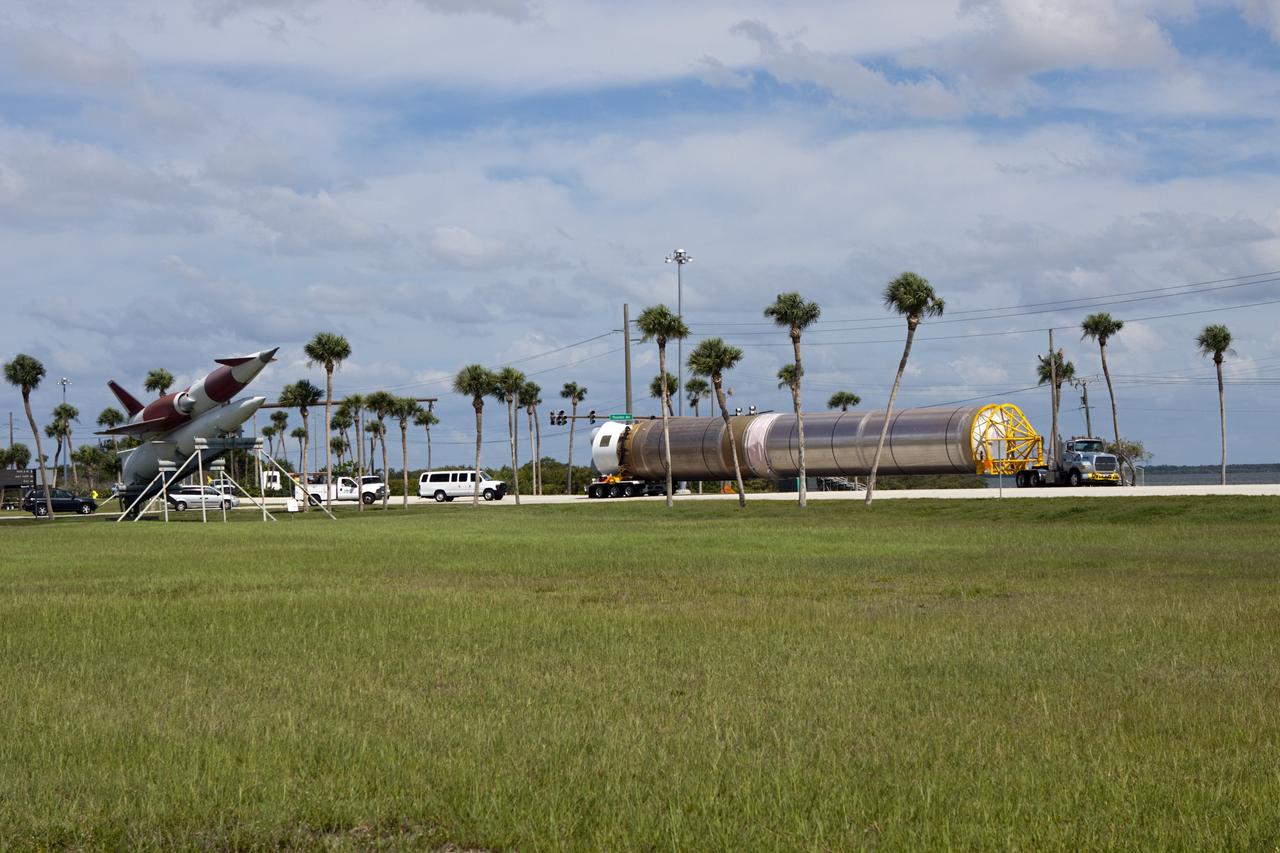
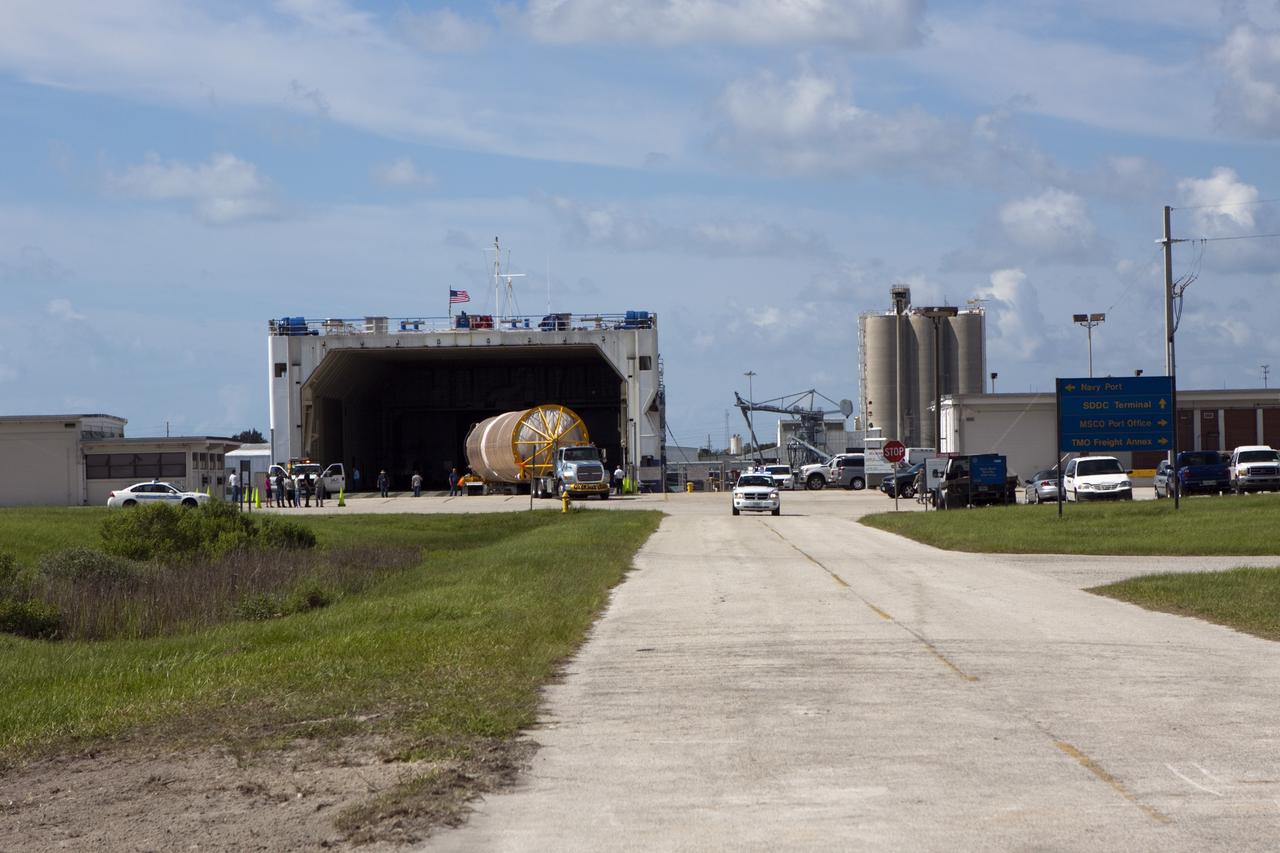
CAPE CANAVERAL, Fla. – The Atlas V first stage booster for NASA's Radiation Belt Storm Probes mission approaches Cape Canaveral Air Force Station in Florida. The booster was delivered by barge to nearby Port Canaveral. The Radiation Belt Storm Probes, or RBSP, mission will help us understand the sun’s influence on Earth and near-Earth space by studying the Earth’s radiation belts on various scales of space and time. For more information, visit http://www.nasa.gov/rbsp. Photo credit: NASA/Jim Grossmann
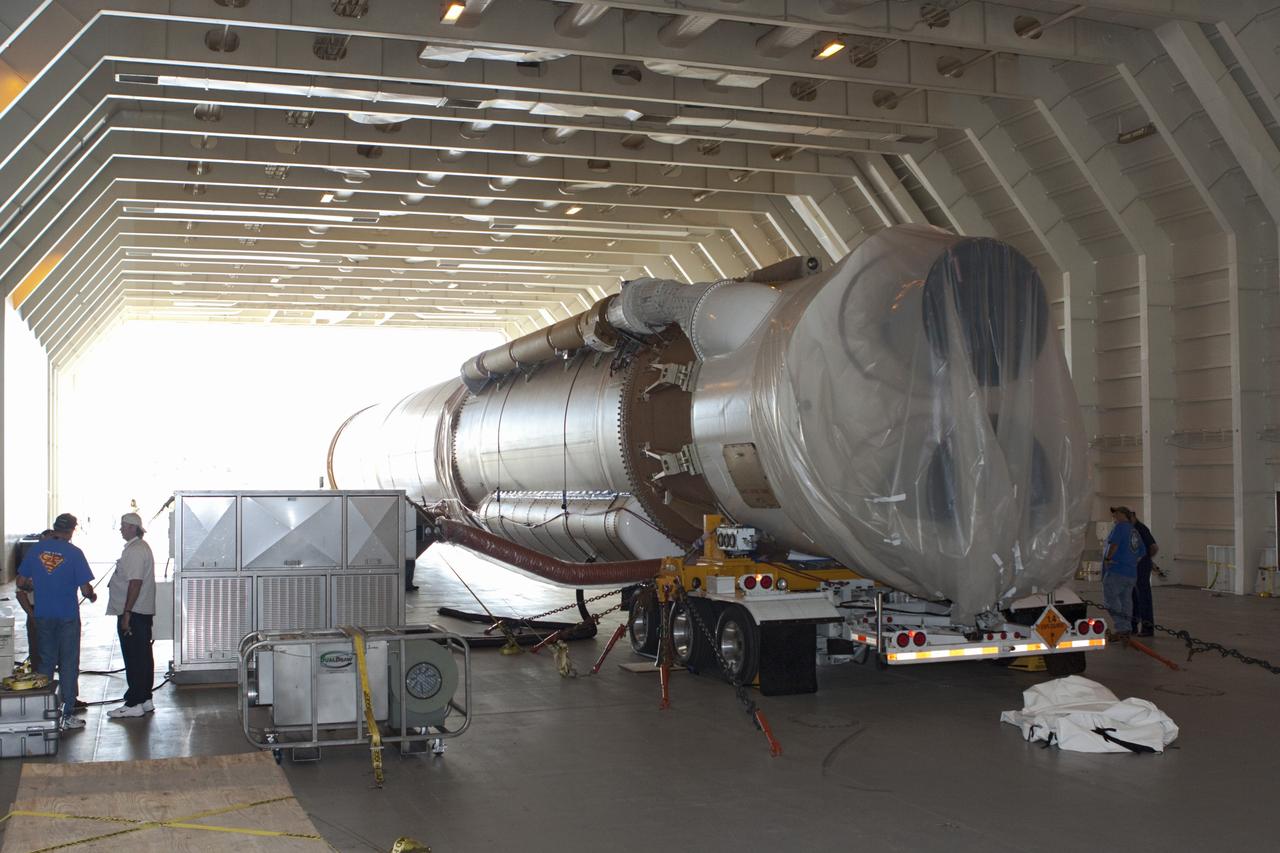
CAPE CANAVERAL, Fla. – At Port Canaveral in Florida, the Atlas V first stage booster for NASA's Radiation Belt Storm Probes mission waits to be offloaded from United Launch Alliance's Delta Mariner barge. The Radiation Belt Storm Probes, or RBSP, mission will help us understand the sun’s influence on Earth and near-Earth space by studying the Earth’s radiation belts on various scales of space and time. For more information, visit http://www.nasa.gov/rbsp. Photo credit: NASA/Jim Grossmann
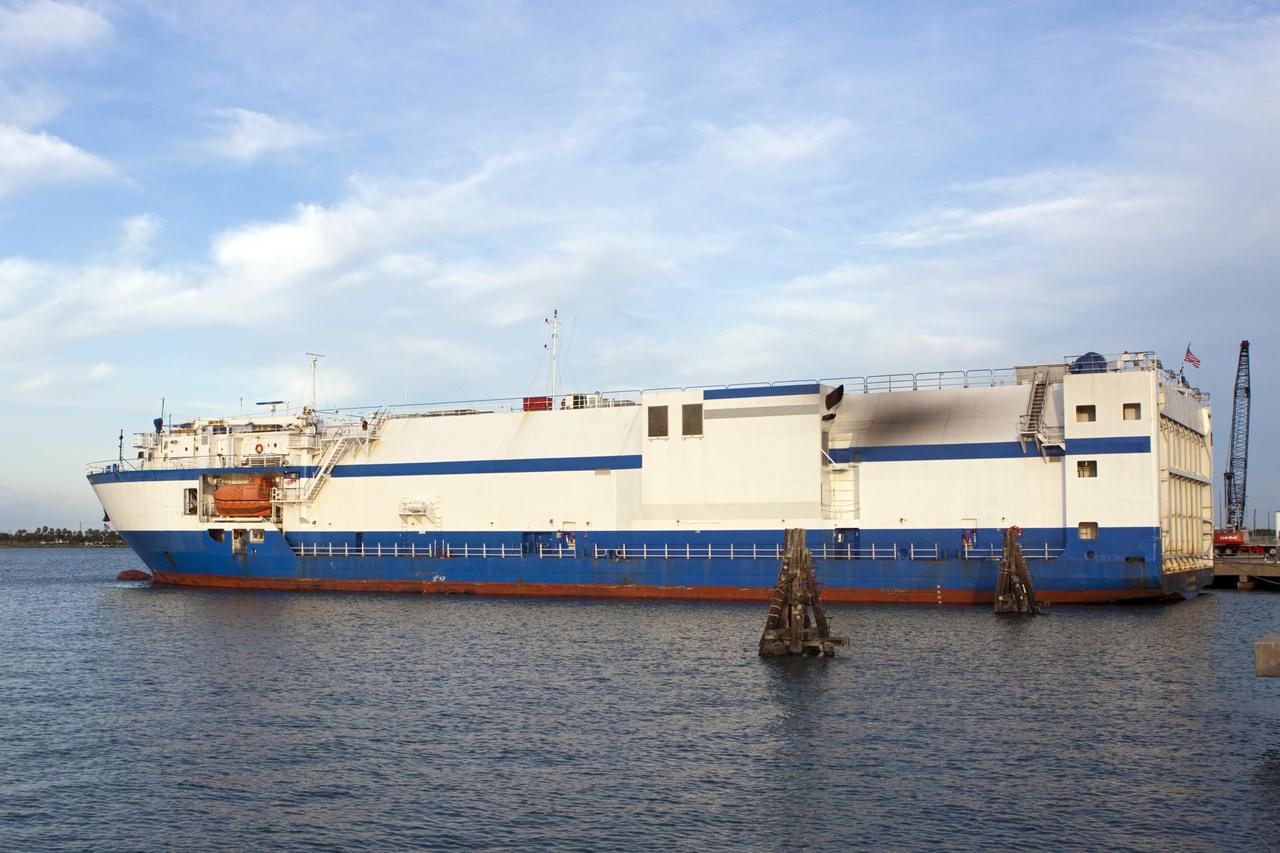
CAPE CANAVERAL, Fla. – United Launch Alliance's Delta Mariner barge arrives at Port Canaveral in Florida carrying the Atlas V first stage booster for NASA's Radiation Belt Storm Probes mission. The Radiation Belt Storm Probes, or RBSP, mission will help us understand the sun’s influence on Earth and near-Earth space by studying the Earth’s radiation belts on various scales of space and time. For more information, visit http://www.nasa.gov/rbsp. Photo credit: NASA/Jim Grossmann
CAPE CANAVERAL, Fla. – The Atlas V first stage booster for NASA's Radiation Belt Storm Probes mission is towed away from the dock at Port Canaveral. The booster arrived on United Launch Alliance's barge, the Delta Mariner. The Radiation Belt Storm Probes, or RBSP, mission will help us understand the sun’s influence on Earth and near-Earth space by studying the Earth’s radiation belts on various scales of space and time. For more information, visit http://www.nasa.gov/rbsp. Photo credit: NASA/Jim Grossmann
CAPE CANAVERAL, Fla. – The Atlas V first stage booster for NASA's Radiation Belt Storm Probes mission is offloaded from United Launch Alliance's Delta Mariner barge at Port Canaveral in Florida. The Radiation Belt Storm Probes, or RBSP, mission will help us understand the sun’s influence on Earth and near-Earth space by studying the Earth’s radiation belts on various scales of space and time. For more information, visit http://www.nasa.gov/rbsp. Photo credit: NASA/Jim Grossmann
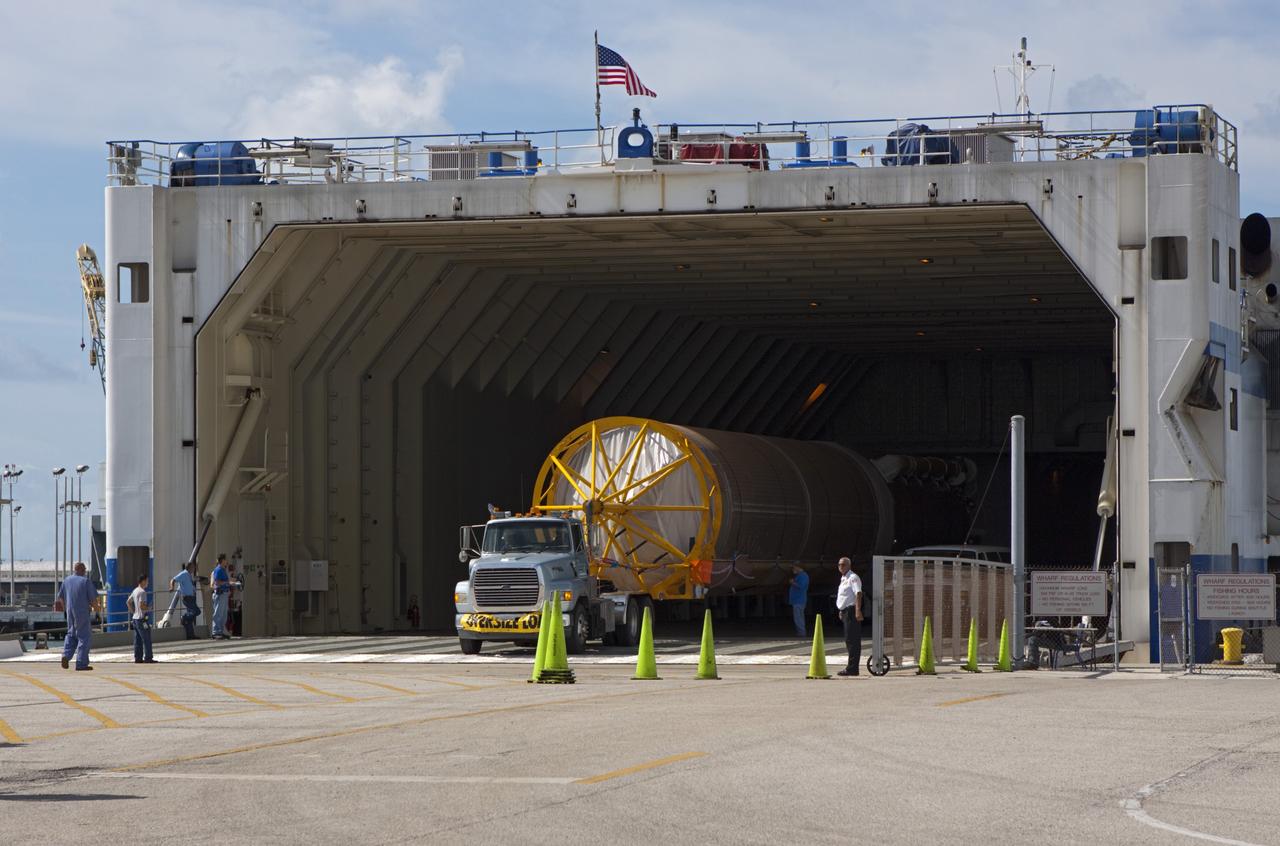
CAPE CANAVERAL, Fla. – The Atlas V first stage booster for NASA's Radiation Belt Storm Probes mission emerges from United Launch Alliance's Delta Mariner barge at Port Canaveral in Florida. The Radiation Belt Storm Probes, or RBSP, mission will help us understand the sun’s influence on Earth and near-Earth space by studying the Earth’s radiation belts on various scales of space and time. For more information, visit http://www.nasa.gov/rbsp. Photo credit: NASA/Jim Grossmann
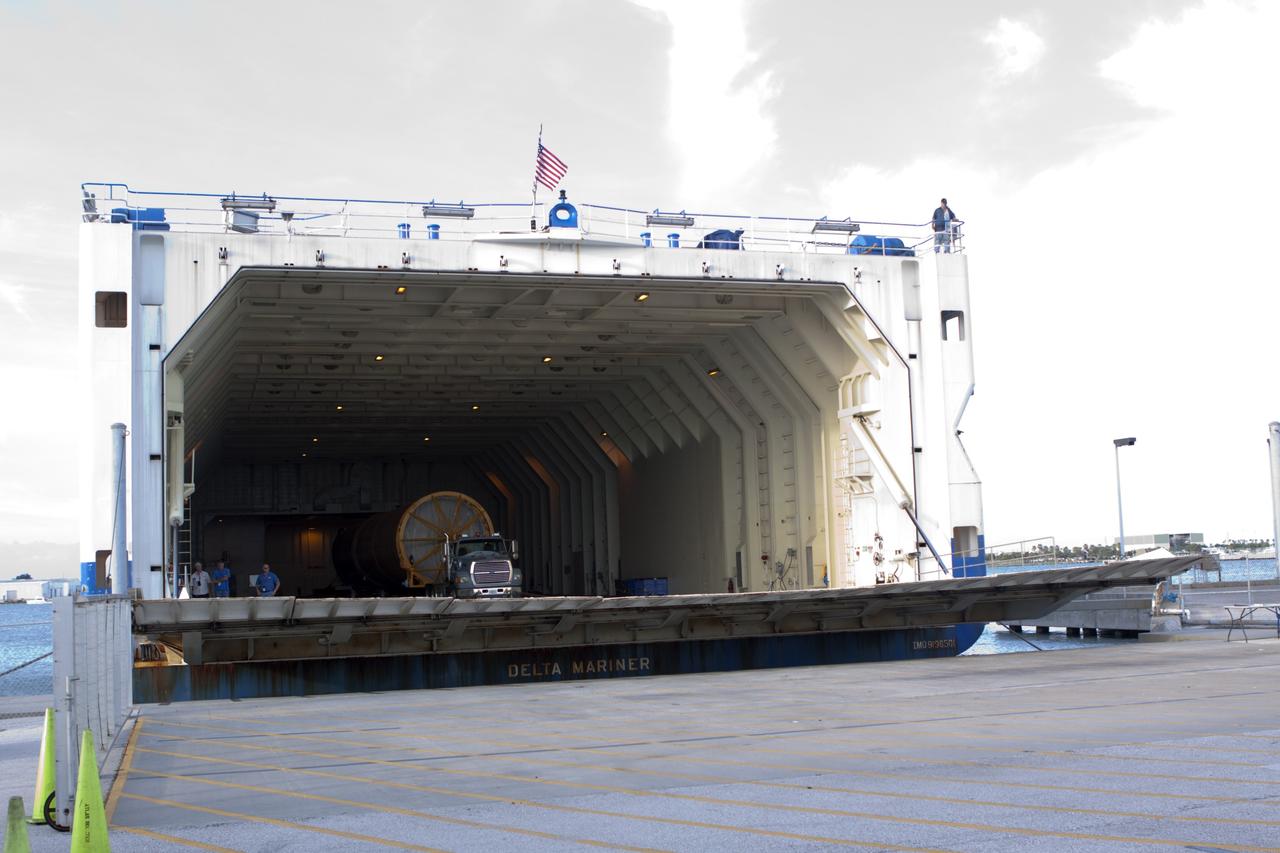
CAPE CANAVERAL, Fla. – The Atlas V first stage booster for NASA's Radiation Belt Storm Probes mission arrives at Port Canaveral in Florida aboard United Launch Alliance's Delta Mariner barge. The Radiation Belt Storm Probes, or RBSP, mission will help us understand the sun’s influence on Earth and near-Earth space by studying the Earth’s radiation belts on various scales of space and time. For more information, visit http://www.nasa.gov/rbsp. Photo credit: NASA/Jim Grossmann
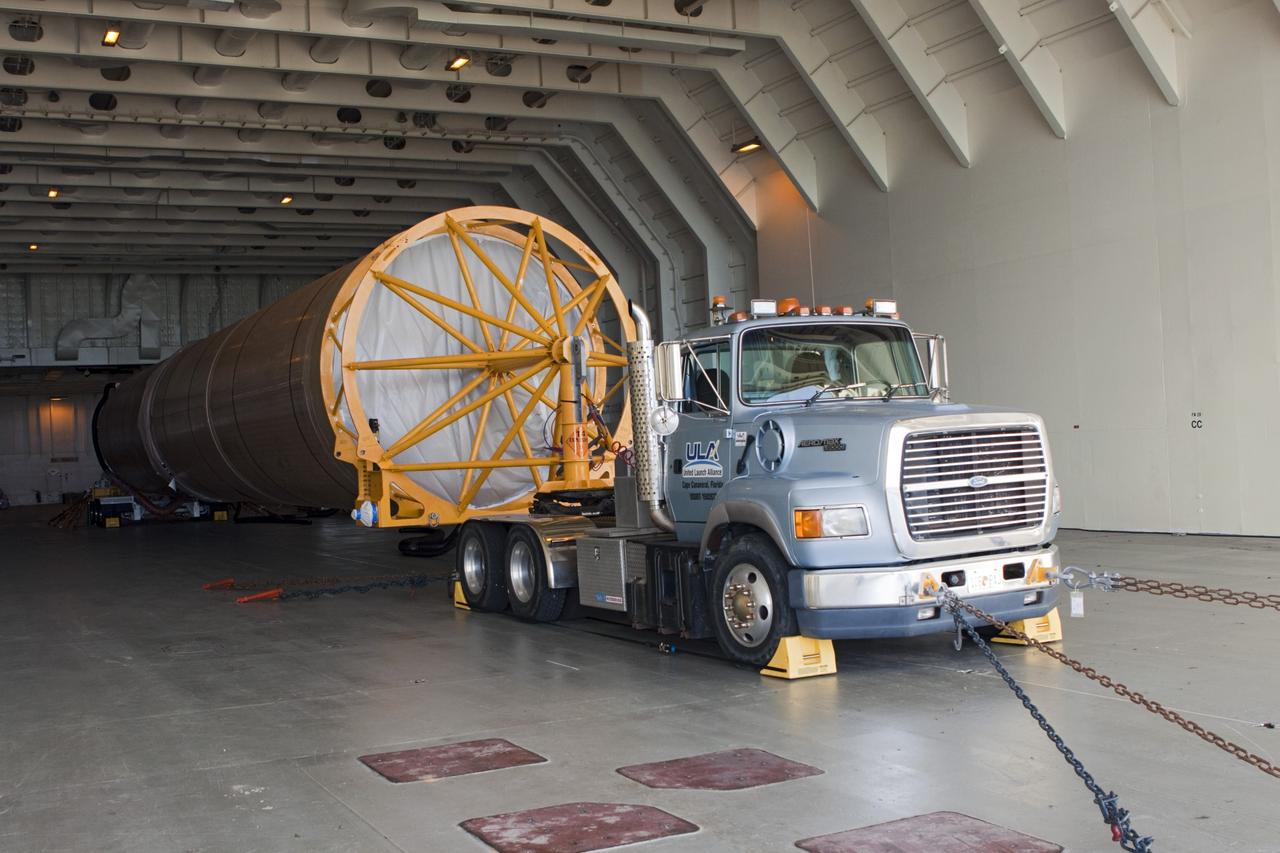
CAPE CANAVERAL, Fla. – At Port Canaveral in Florida, the Atlas V first stage booster for NASA's Radiation Belt Storm Probes mission is attached to a truck for offloading from United Launch Alliance's Delta Mariner barge. The Radiation Belt Storm Probes, or RBSP, mission will help us understand the sun’s influence on Earth and near-Earth space by studying the Earth’s radiation belts on various scales of space and time. For more information, visit http://www.nasa.gov/rbsp. Photo credit: NASA/Jim Grossmann
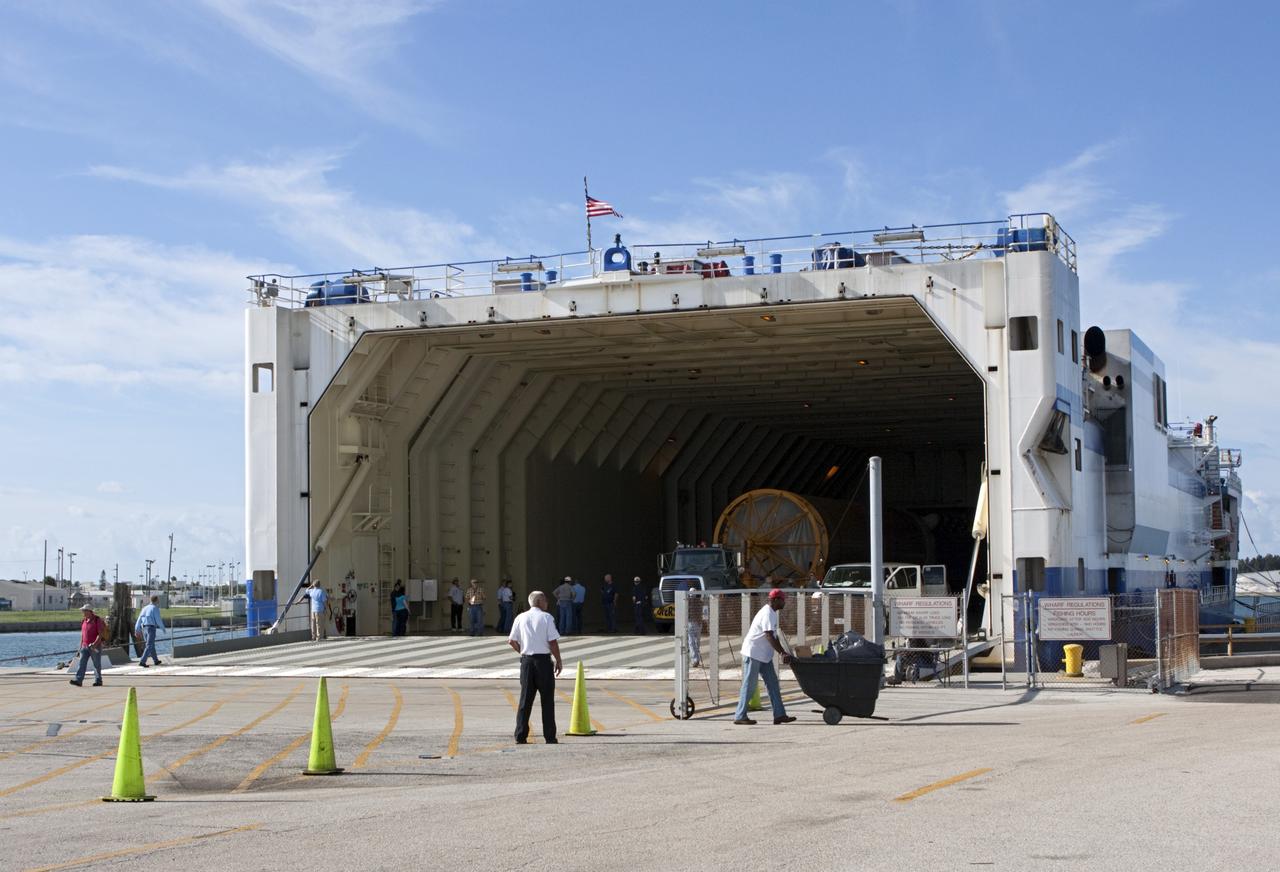
CAPE CANAVERAL, Fla. – The Atlas V first stage booster for NASA's Radiation Belt Storm Probes mission is ready to be offloaded at Port Canaveral in Florida. The booster arrived on United Launch Alliance's barge, the Delta Mariner. The Radiation Belt Storm Probes, or RBSP, mission will help us understand the sun’s influence on Earth and near-Earth space by studying the Earth’s radiation belts on various scales of space and time. For more information, visit http://www.nasa.gov/rbsp. Photo credit: NASA/Jim Grossmann
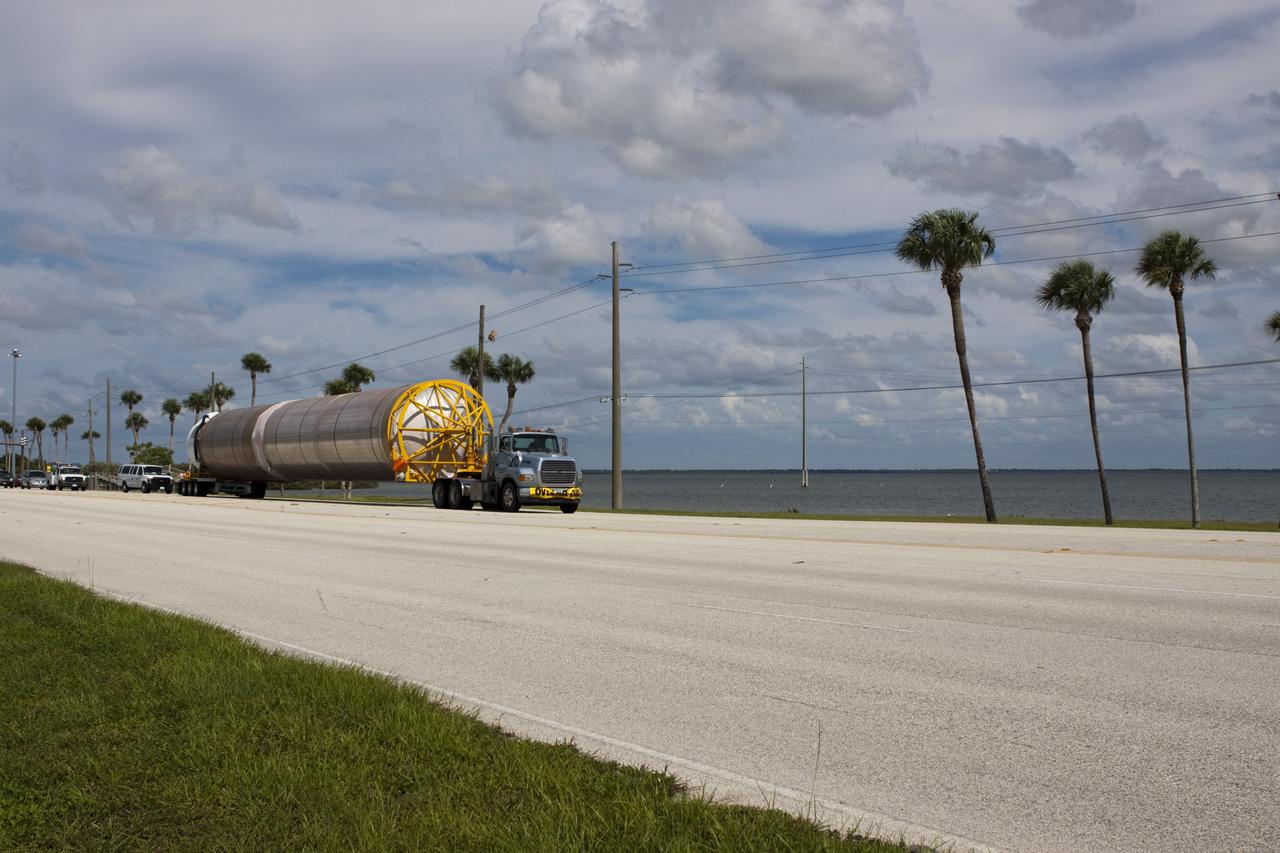
CAPE CANAVERAL, Fla. – Framed by palm trees and backdropped by the Banana River, the United Launch Alliance Atlas V first stage booster for NASA's Radiation Belt Storm Probes mission arrives at Cape Canaveral Air Force Station in Florida. The booster was delivered by barge to nearby Port Canaveral. The Radiation Belt Storm Probes, or RBSP, mission will help us understand the sun’s influence on Earth and near-Earth space by studying the Earth’s radiation belts on various scales of space and time. For more information, visit http://www.nasa.gov/rbsp. Photo credit: NASA/Jim Grossmann

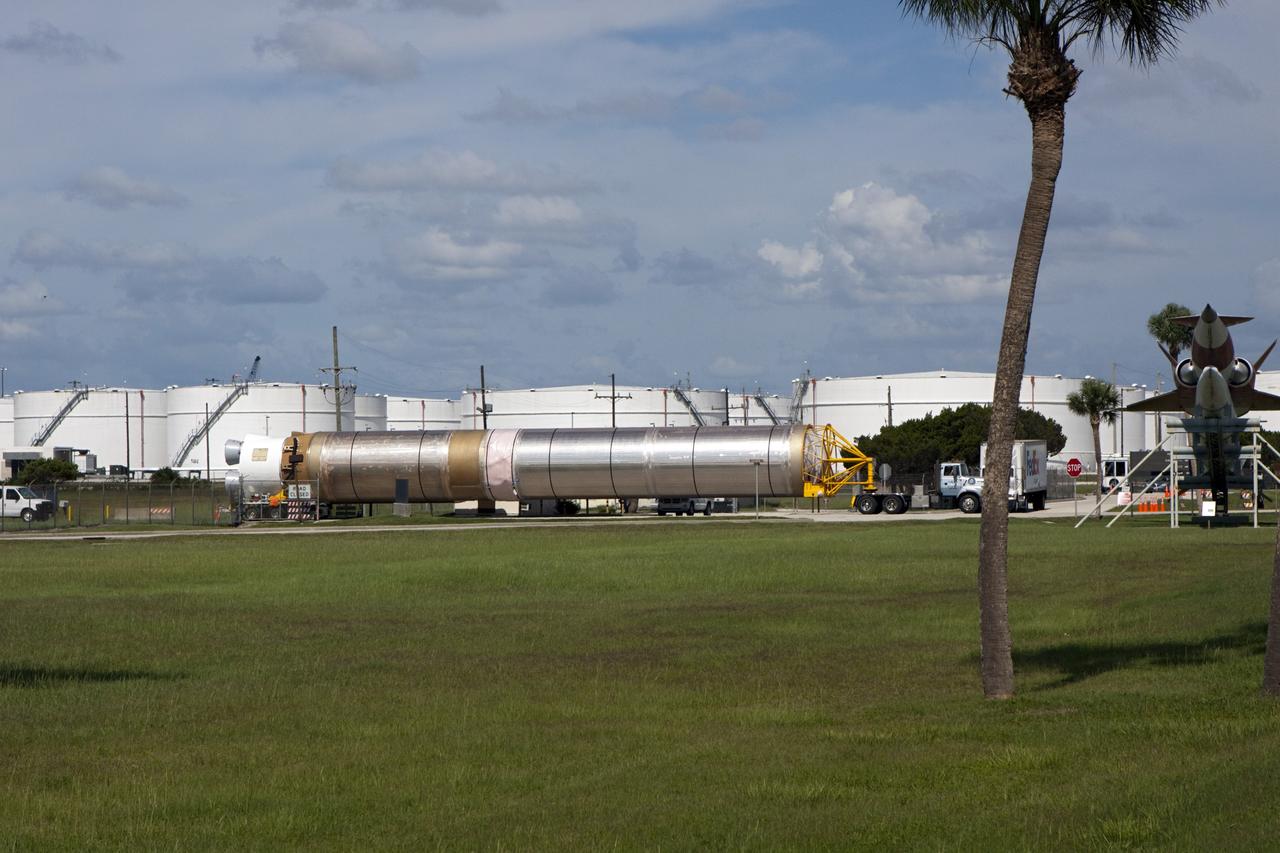
CAPE CANAVERAL, Fla. – A truck tows the United Launch Alliance Atlas V first stage booster through Cape Canaveral Air Force Station in Florida en route to the Atlas Spaceflight Operations Center, or ASOC. The booster, which was delivered by barge to nearby Port Canaveral, will be used to launch NASA's Radiation Belt Storm Probes mission. The Radiation Belt Storm Probes, or RBSP, mission will help us understand the sun’s influence on Earth and near-Earth space by studying the Earth’s radiation belts on various scales of space and time. For more information, visit http://www.nasa.gov/rbsp. Photo credit: NASA/Jim Grossmann
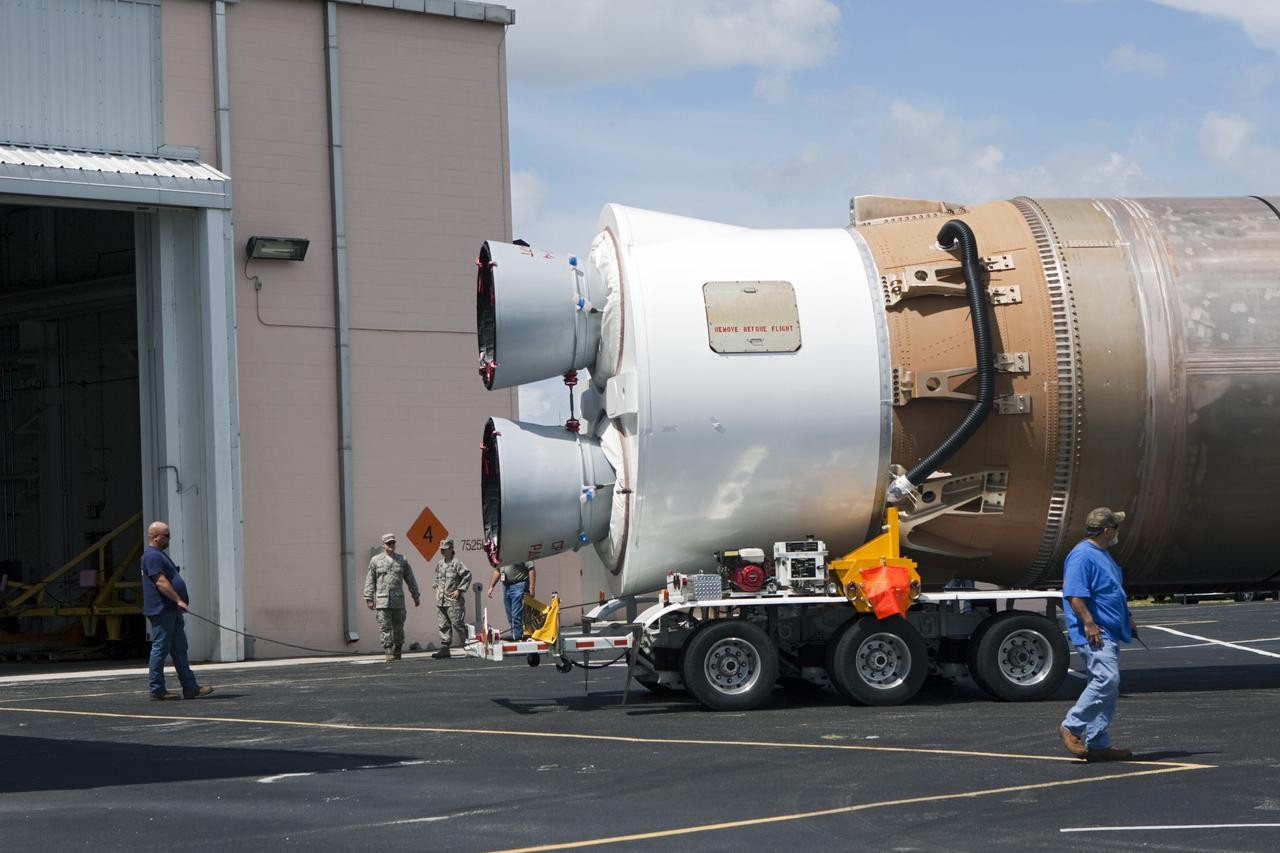
CAPE CANAVERAL, Fla. – At Cape Canaveral Air Force Station in Florida, employees prepare to move the United Launch Alliance Atlas V first stage booster into the Atlas Spaceflight Operations Center, or ASOC. The booster, which was delivered by barge to nearby Port Canaveral, will be used to launch NASA's Radiation Belt Storm Probes mission. The Radiation Belt Storm Probes, or RBSP, mission will help us understand the sun’s influence on Earth and near-Earth space by studying the Earth’s radiation belts on various scales of space and time. For more information, visit http://www.nasa.gov/rbsp. Photo credit: NASA/Jim Grossmann
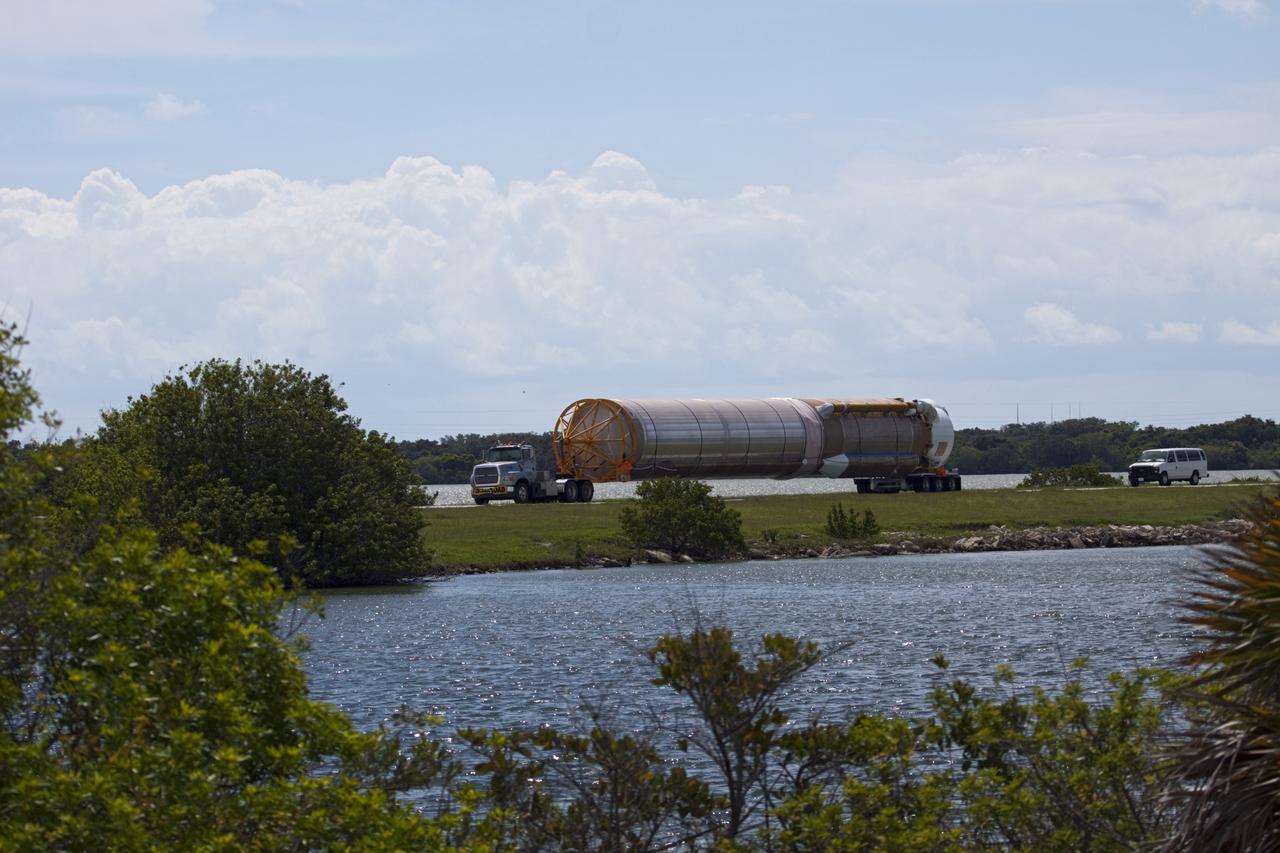
CAPE CANAVERAL, Fla. – A truck tows the United Launch Alliance Atlas V first stage booster through Cape Canaveral Air Force Station in Florida en route to the Atlas Spaceflight Operations Center, or ASOC. The booster, which was delivered by barge to nearby Port Canaveral, will be used to launch NASA's Radiation Belt Storm Probes mission. The Radiation Belt Storm Probes, or RBSP, mission will help us understand the sun’s influence on Earth and near-Earth space by studying the Earth’s radiation belts on various scales of space and time. For more information, visit http://www.nasa.gov/rbsp. Photo credit: NASA/Jim Grossmann
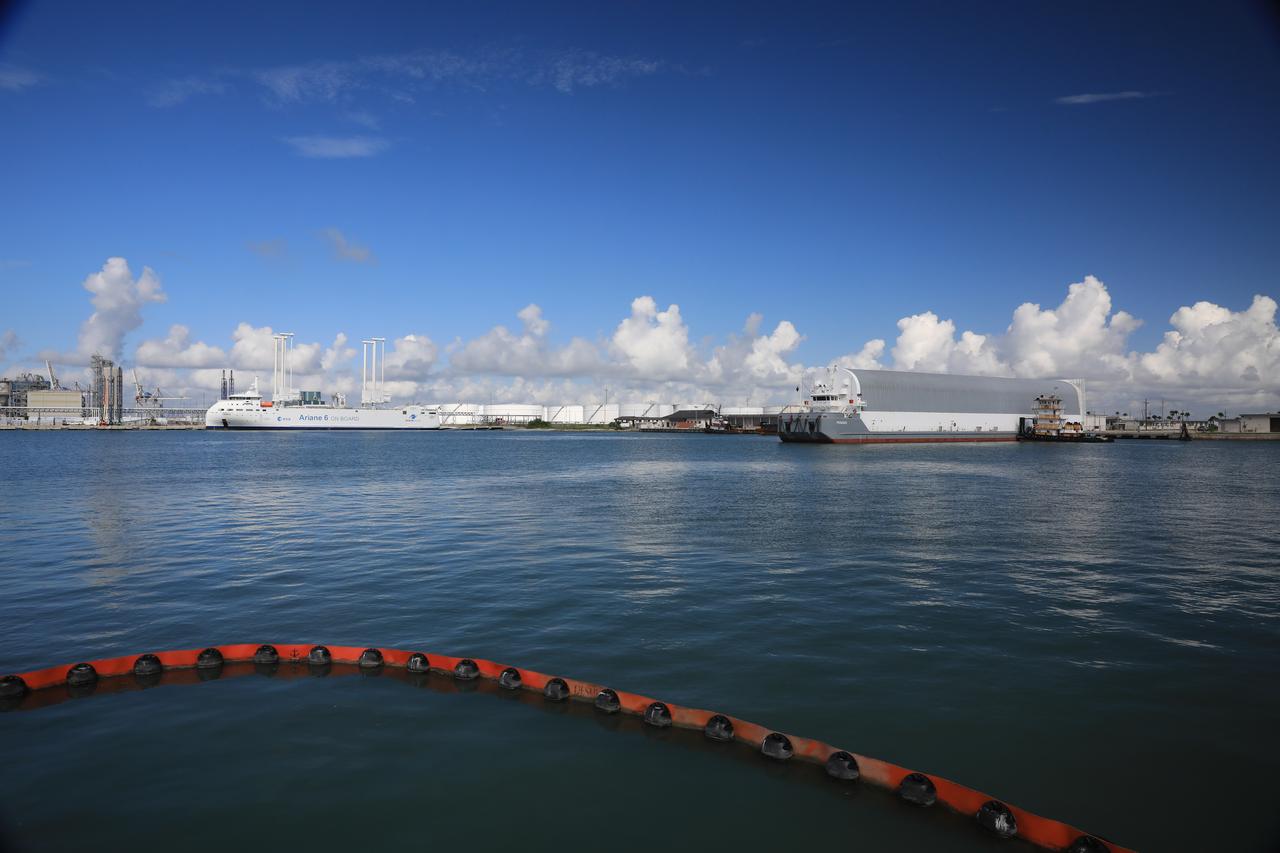
NASA’s Pegasus barge, carrying several pieces of the Artemis campaign hardware, along with the ESA (European Space Agency) ship carrying European Service Module 3 for NASA’s Artemis III mission arrives at Port Canaveral on Tuesday, Sept. 3, 2024, awaiting transportation to NASA’s Kennedy Space Center in Florida. Through the Artemis campaign, we are exploring the Moon for scientific discovery, technology advancement, and to learn how to live and work on another world.
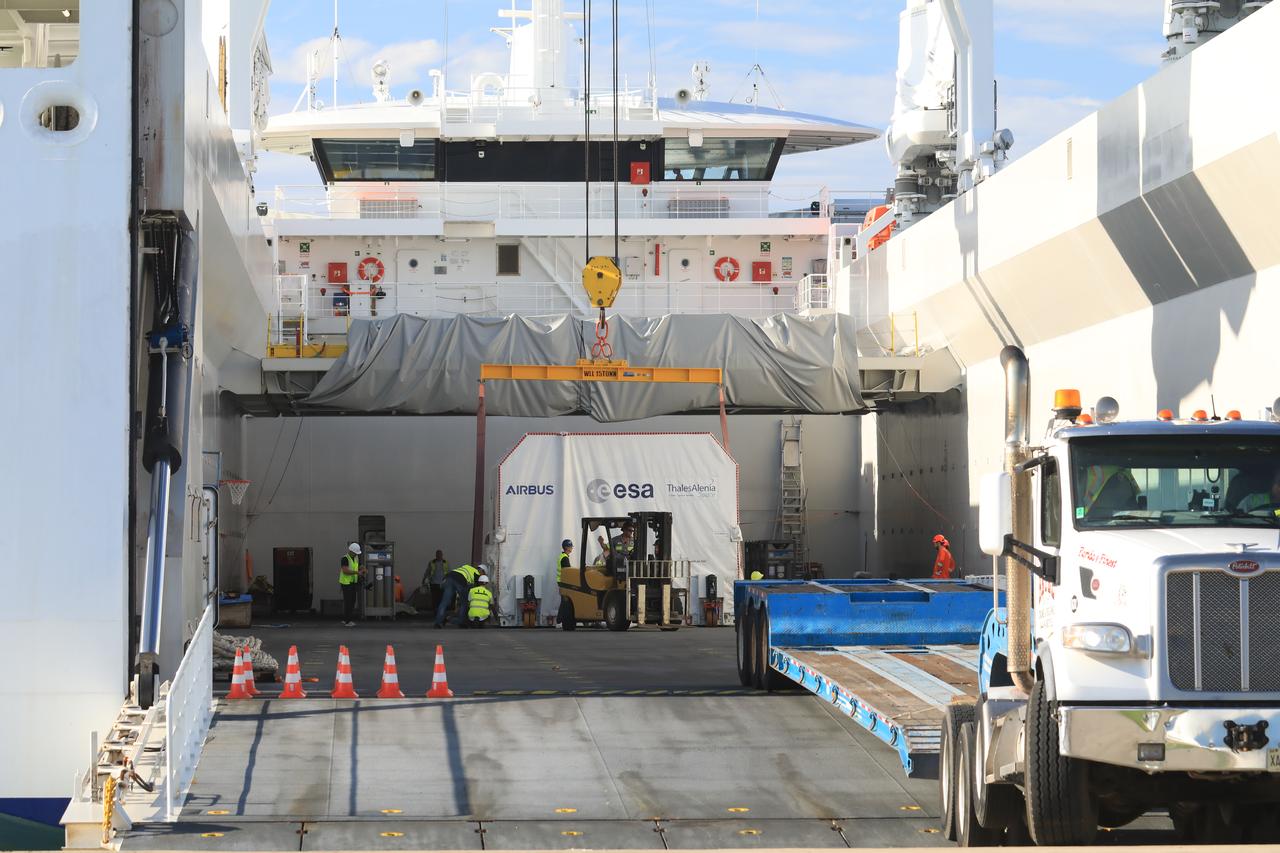
The transport carrier containing the European Service Module 3 for NASA’s Artemis III mission arrives at Port Canaveral on Tuesday, Sept. 3, 2024, awaiting transportation to NASA’s Kennedy Space Center in Florida. The European Service Module 3, which is assembled by Airbus in Bremen, Germany, traveled 10 days across the Atlantic Ocean via the Canopee ship. The European Service Module 3 provides the spacecraft’s propulsion, thermal control, electrical power, and life support systems. Artemis III will send four astronauts to the lunar orbit where two crew members will spend a week near the South Pole of the Moon conducting new science.
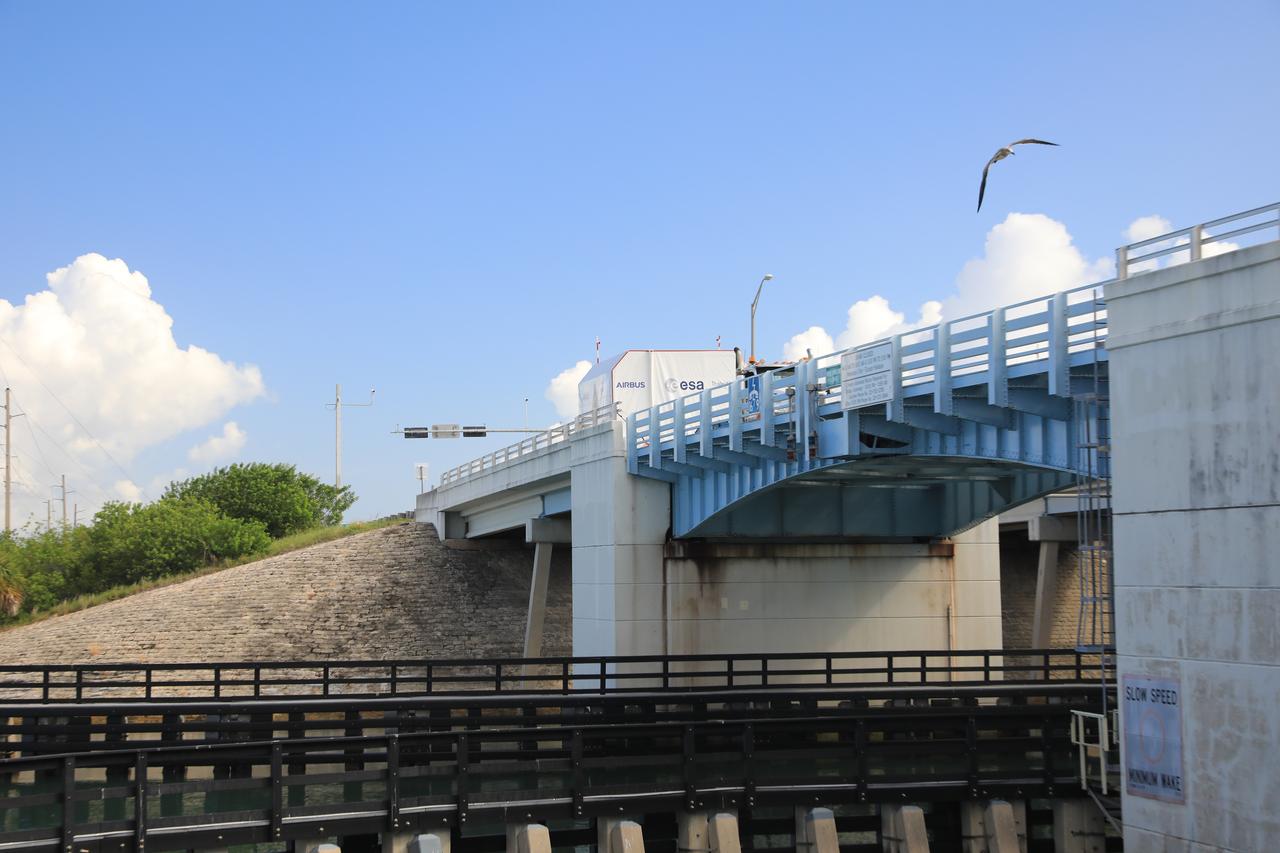
The transport carrier containing the European Service Module 3 for NASA’s Artemis III mission arrives at Port Canaveral on Tuesday, Sept. 3, 2024, awaiting transportation to NASA’s Kennedy Space Center in Florida. The European Service Module 3, which is assembled by Airbus in Bremen, Germany, traveled 10 days across the Atlantic Ocean via the Canopee ship. The European Service Module 3 provides the spacecraft’s propulsion, thermal control, electrical power, and life support systems. Artemis III will send four astronauts to the lunar orbit where two crew members will spend a week near the South Pole of the Moon conducting new science.
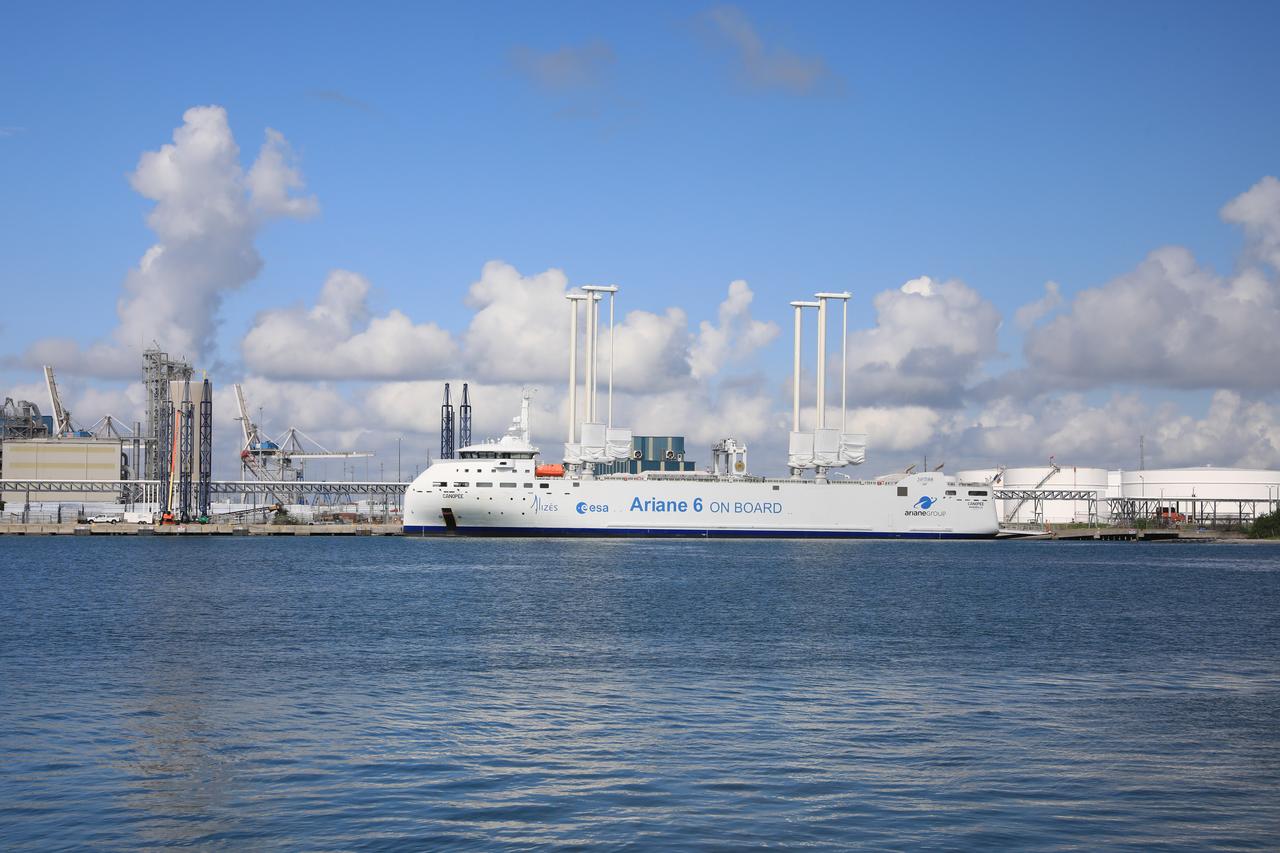
The European Service Module 3 for NASA’s Artemis III mission arrives at Port Canaveral on Tuesday, Sept. 3, 2024, awaiting transportation to NASA’s Kennedy Space Center in Florida. The European Service Module 3, which is assembled by Airbus in Bremen, Germany, traveled across the Atlantic Ocean by the ESA (European Space Agency) aboard the Canopee ship. The European Service Module 3 provides the spacecraft’s propulsion, thermal control, electrical power, and life support systems. Artemis III will send four astronauts to the lunar orbit where two crew members will spend a week near the South Pole of the Moon conducting new science.
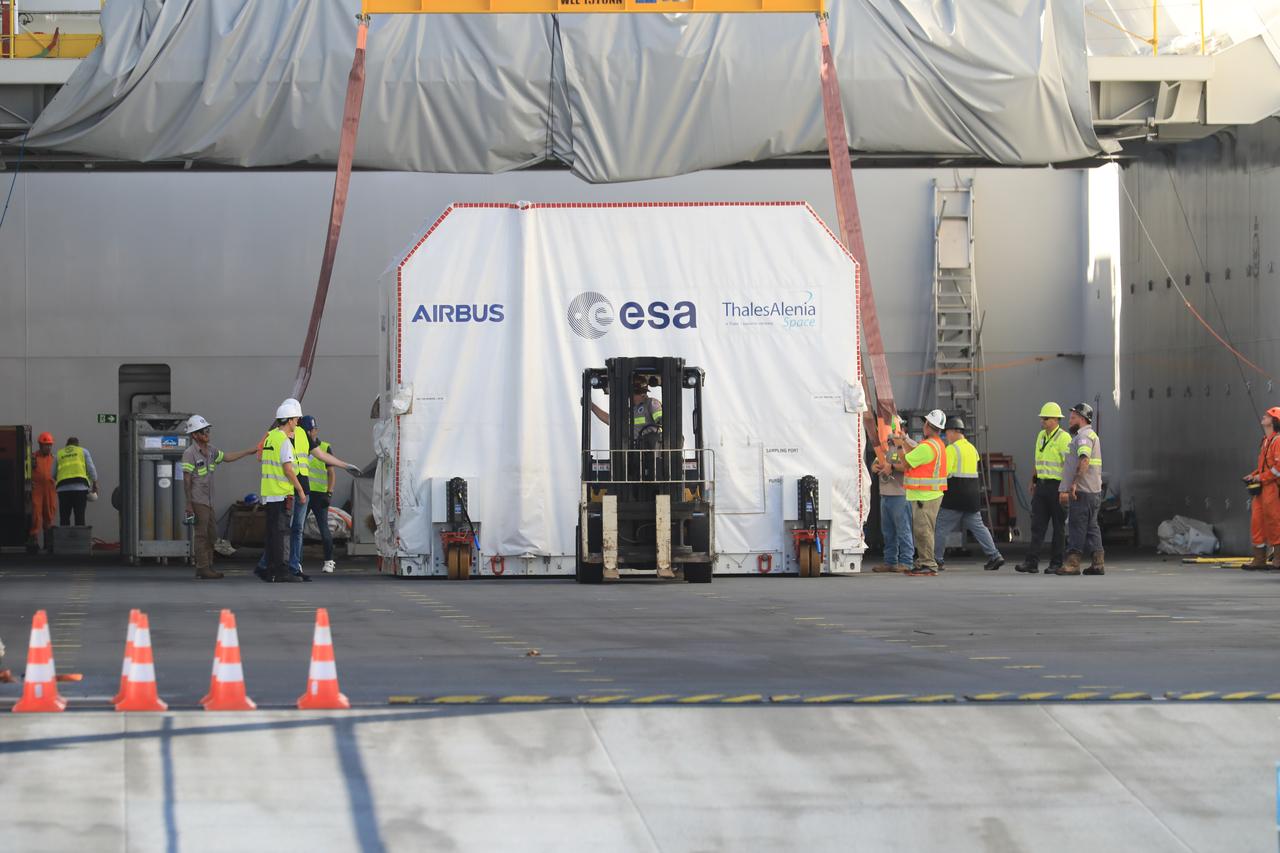
The transport carrier containing the European Service Module 3 for NASA’s Artemis III mission arrives at Port Canaveral on Tuesday, Sept. 3, 2024, awaiting transportation to NASA’s Kennedy Space Center in Florida. The European Service Module 3, which is assembled by Airbus in Bremen, Germany, traveled 10 days across the Atlantic Ocean via the Canopee ship. The European Service Module 3 provides the spacecraft’s propulsion, thermal control, electrical power, and life support systems. Artemis III will send four astronauts to the lunar orbit where two crew members will spend a week near the South Pole of the Moon conducting new science.
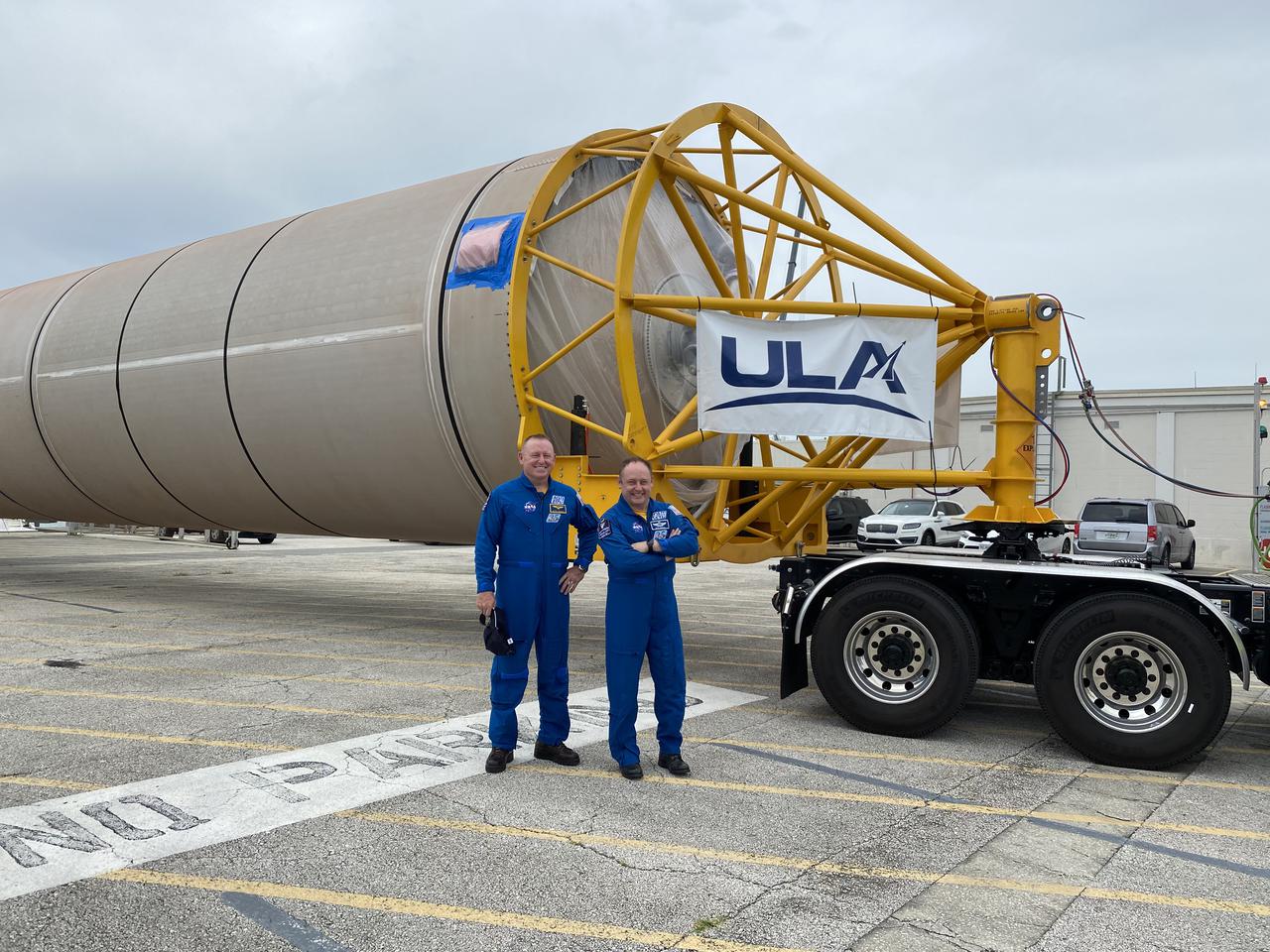
NASA astronauts Barry “Butch” Wilmore, left, Mike Fincke, right, welcome the United Launch Alliance (ULA) Atlas V rocket that will transport them and NASA astronaut Nicole Mann to the International Space Station on Boeing’s CST-100 Starliner spacecraft for the company’s Crew Flight Test (CFT). The Atlas V rocket arrived at Cape Canaveral Space Force Station (CCSFS), Florida on June 21, 2021, after its journey on a rocket-delivery ship from ULA’s manufacturing factory in Decatur, Alabama. Starliner’s first flight with astronauts aboard, CFT will launch from Space Launch Complex-41 at CCSFS. The flight test will demonstrate the ability of the Atlas V and Starliner to safely carry astronauts to and from the space station for the agency’s Commercial Crew Program.

SpaceX’s Crew Dragon spacecraft arrives in Port Canaveral, Florida, aboard the company’s recovery ship, Go Searcher, on Saturday, March 9, 2019. Crew Dragon splashed down in the Atlantic Ocean, about 200 miles off Florida’s east coast, at 8:45 a.m. EST on March 8, after undocking from the International Space Station at 2:32 a.m. As part of the Demo-1 mission, the uncrewed spacecraft docked to the orbiting laboratory on March 3, following a 2:49 a.m. EST liftoff aboard a SpaceX Falcon 9 rocket from Launch Complex 39A at NASA’s Kennedy Space Center in Florida on March 2. SpaceX’s inaugural flight with NASA’s Commercial Crew Program is the first flight test of a space system designed for humans built and operated by a commercial company through a public-private partnership. NASA and SpaceX will use data from Demo-1 to further prepare for Demo-2, the crewed flight test that will carry NASA astronauts Bob Behnken and Doug Hurley to the International Space Station later this year.
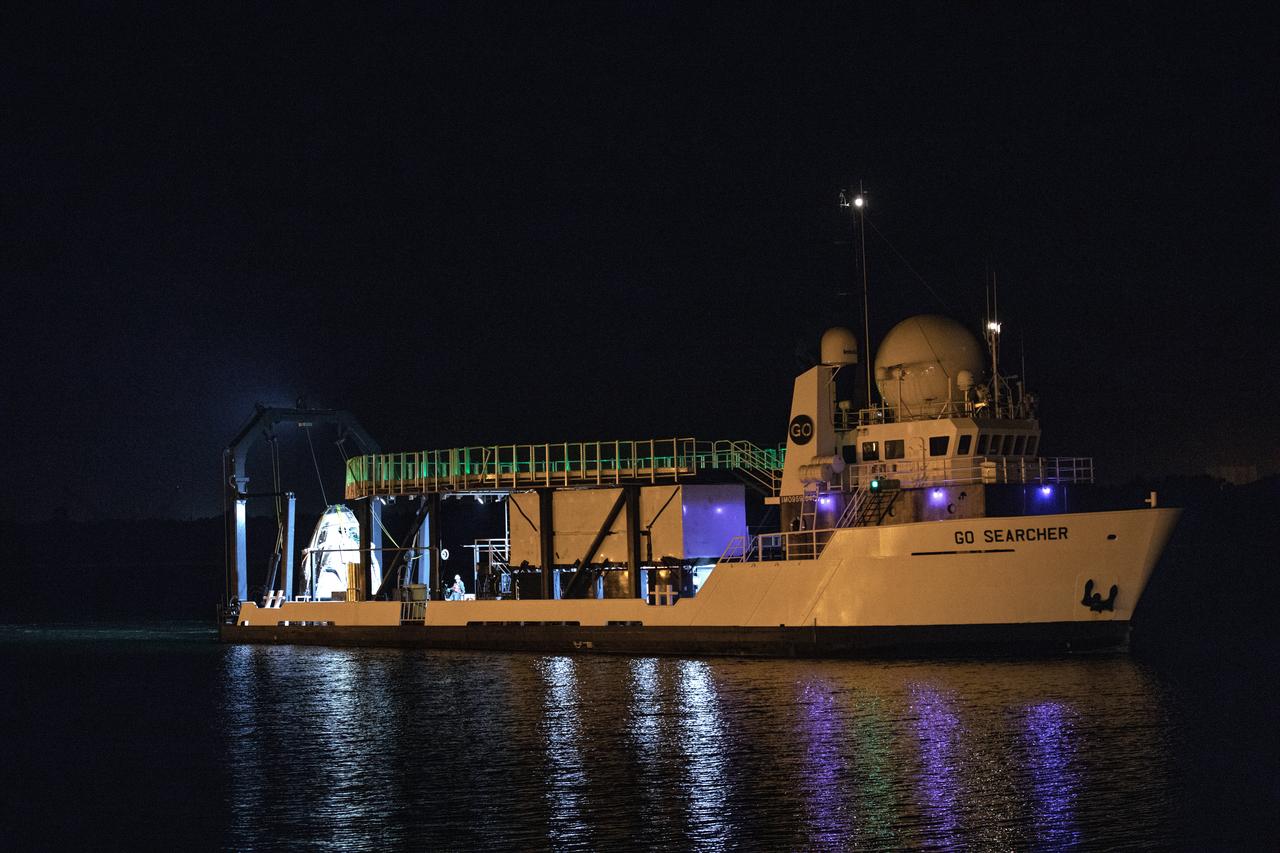
SpaceX’s recovery ship, Go Searcher, enters Port Canaveral in Florida on Saturday, March 9, 2019, with the company’s Crew Dragon spacecraft on its main deck. Crew Dragon splashed down in the Atlantic Ocean, about 200 miles off Florida’s east coast, at 8:45 a.m. EST on March 8, after undocking from the International Space Station at 2:32 a.m. As part of the Demo-1 mission, the uncrewed spacecraft docked to the orbiting laboratory on March 3, following a 2:49 a.m. EST liftoff aboard a SpaceX Falcon 9 rocket from Launch Complex 39A at NASA’s Kennedy Space Center in Florida on March 2. SpaceX’s inaugural flight with NASA’s Commercial Crew Program is the first flight test of a space system designed for humans built and operated by a commercial company through a public-private partnership. NASA and SpaceX will use data from Demo-1 to further prepare for Demo-2, the crewed flight test that will carry NASA astronauts Bob Behnken and Doug Hurley to the International Space Station later this year.
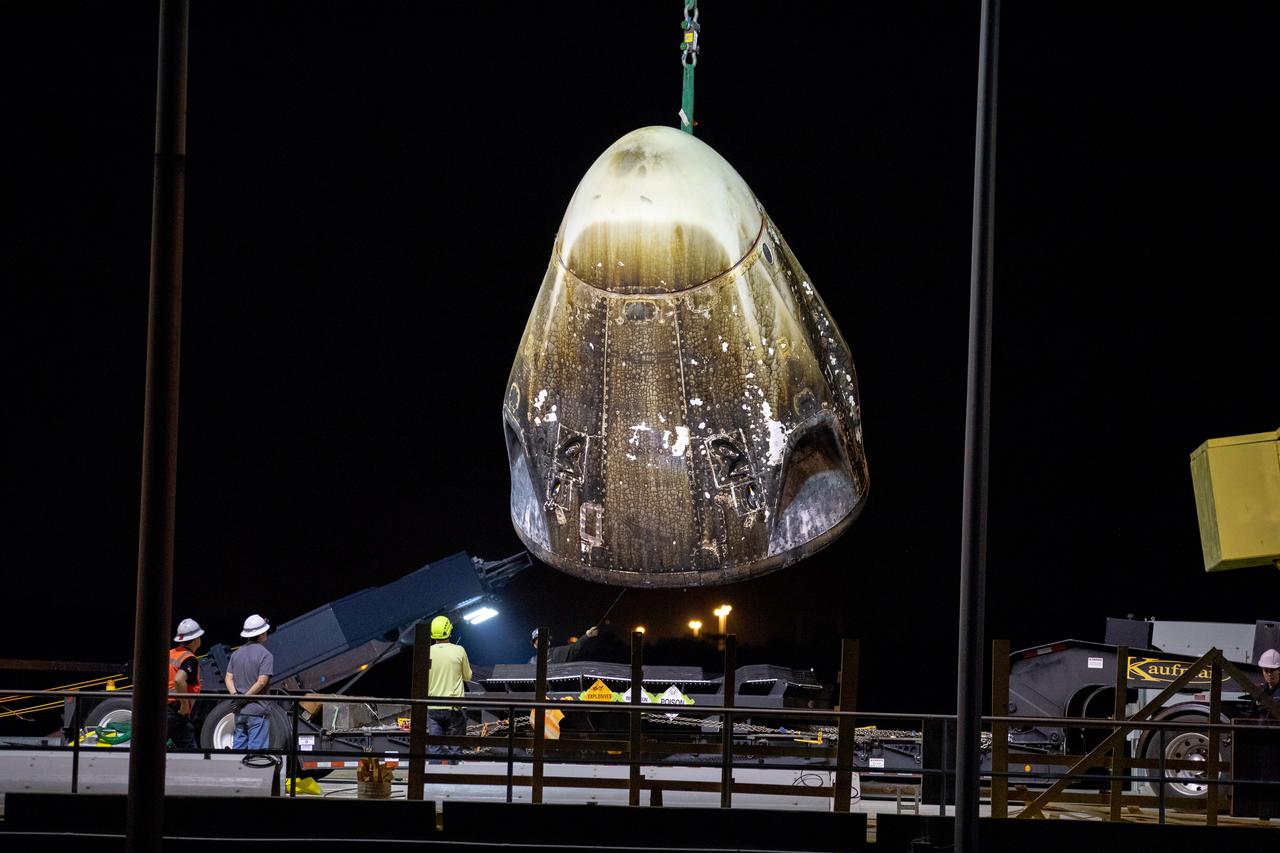
The SpaceX Crew Dragon spacecraft is offloaded from the company’s recovery ship, Go Searcher, in Florida’s Port Canaveral on Saturday, March 9, 2019. Crew Dragon splashed down in the Atlantic Ocean, about 200 miles off Florida’s east coast, at 8:45 a.m. EST on March 8, after undocking from the International Space Station at 2:32 a.m. As part of the Demo-1 mission, the uncrewed spacecraft docked to the orbiting laboratory on March 3, following a 2:49 a.m. EST liftoff aboard a SpaceX Falcon 9 rocket from Launch Complex 39A at NASA’s Kennedy Space Center in Florida on March 2. SpaceX’s inaugural flight with NASA’s Commercial Crew Program is the first flight test of a space system designed for humans built and operated by a commercial company through a public-private partnership. NASA and SpaceX will use data from Demo-1 to further prepare for Demo-2, the crewed flight test that will carry NASA astronauts Bob Behnken and Doug Hurley to the International Space Station later this year.
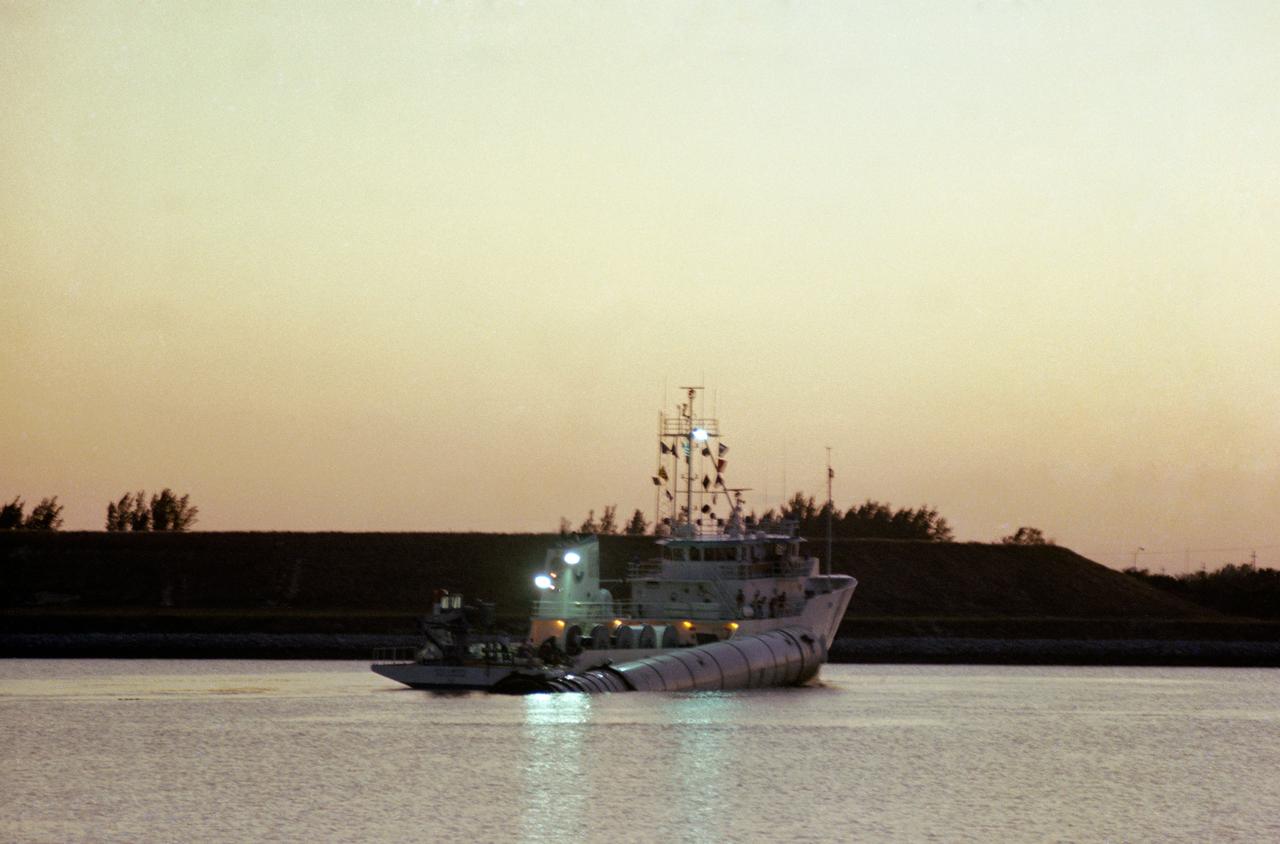
S81-31308 (13 April 1981) --- The solid rocket booster recovery ship UTC Liberty heads for Cape Canaveral Air Force Station after retrieving one of the two booster casings from the launch of Columbia, America?s first space shuttle in orbit. The vessel had been tied up overnight at the Trident Submarine Basin at Port Canaveral, from which point this photograph was made. The boosters and the parachutes that bring them to safe landings in the Atlantic east of NASA's Kennedy Space Center are recovered at sea, dewatered and towed to processing facilities at Cape Canaveral Air Force Station. Photo credit: NASA
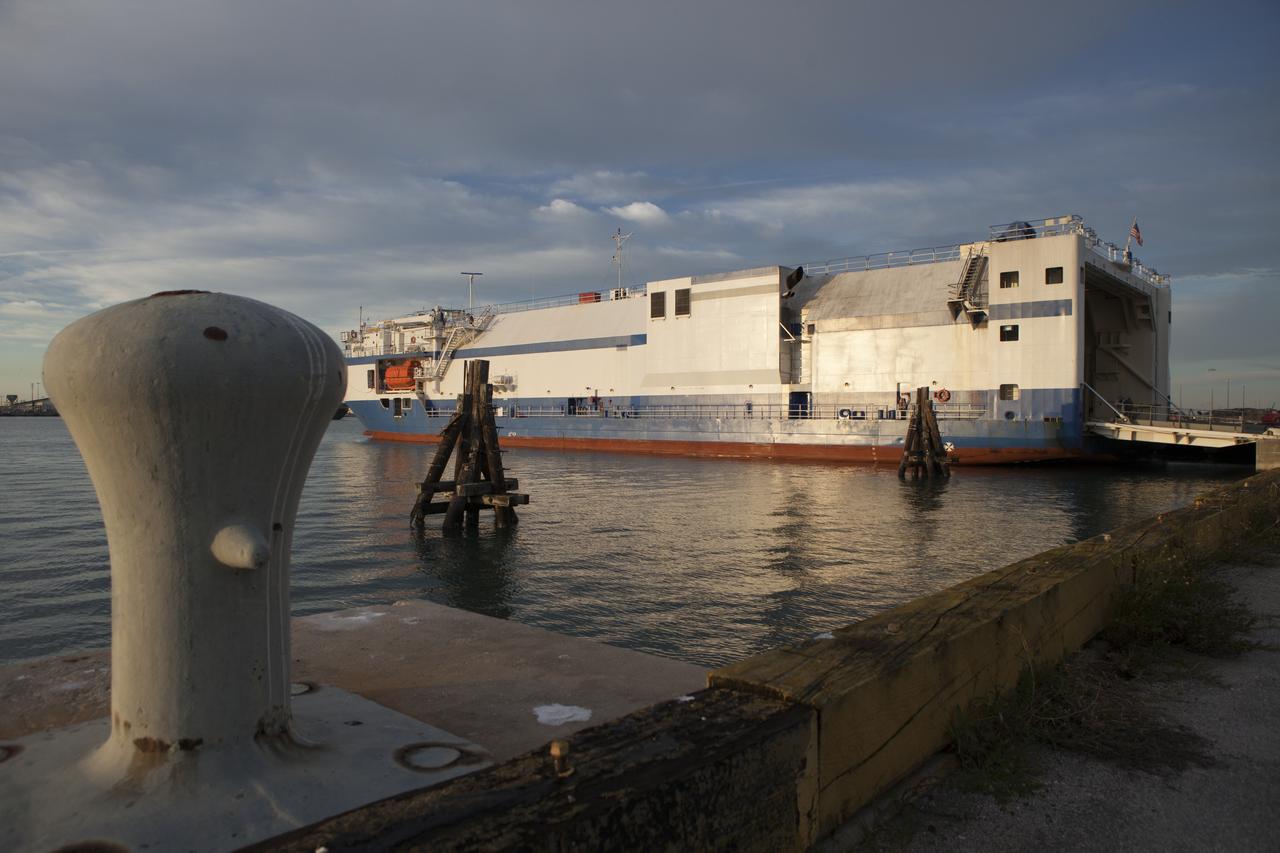
The United Launch Alliance Delta Mariner arrives at Port Canaveral to deliver the Atlas V rocket that will be used to launch NASA's Magnetospheric Multiscale mission.
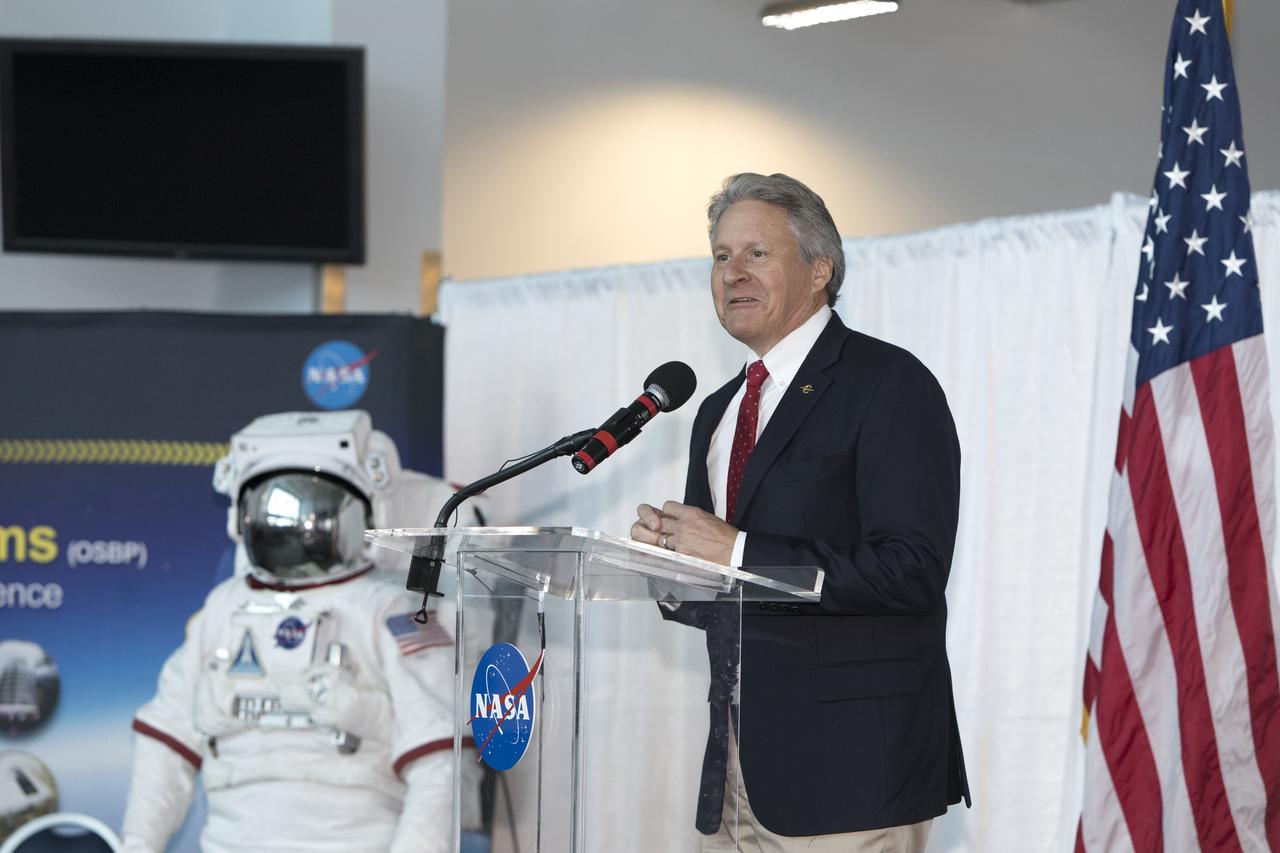
John Murray, chief executive officer with the Canaveral Port Authority, welcomes attendees and vendors to the NASA Business Opportunities Expo 2018, on Oct. 23, inside Cruise Terminal 6 at Port Canaveral in Florida. The 28th Business Opportunities Expo featured more than 200 businesses, large and small, and government exhibitors from throughout the Space Coast and the nation. The Business Opportunities Expo is facilitated by Kennedy's Small Business Programs Office and Prime Contractor Board, along with the U.S. Air Force 45th Space Wing and Canaveral Port Authority. Vendors from a variety of product and service areas, such as computer technology, engineering services, communication equipment and services, and construction and safety products, to name a few, were at the expo. Representatives from the 45th Space Wing, Kennedy prime contractors, NASA and many more agencies and organizations were on hand to provide information and answer questions.
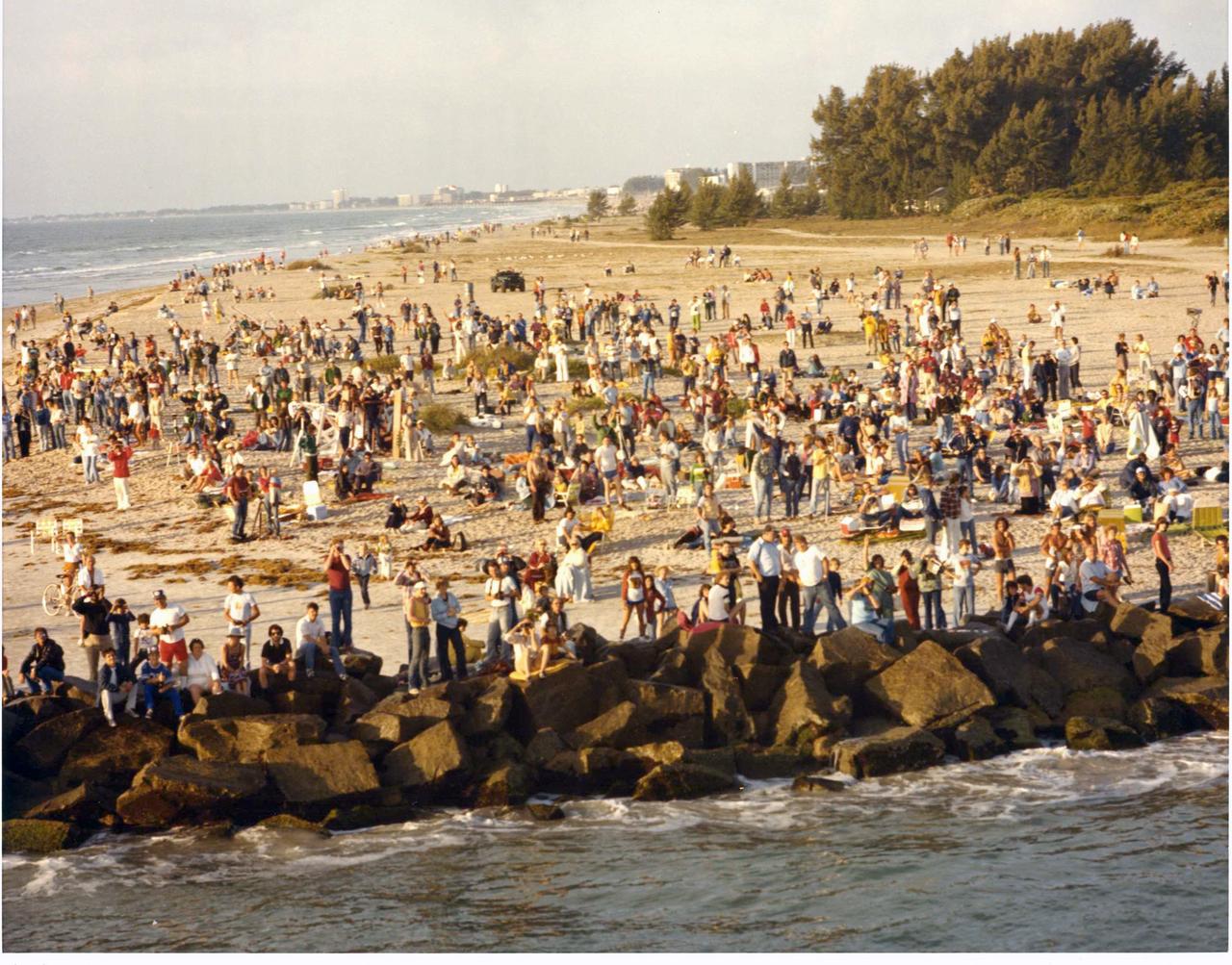
At Jetty Park in Port Canaveral, a crowd of approximately 6,000 gathered to view the 7 a.m. space shuttle launch. Many people spent the night at the Brevard County park, equipped with cameras, lawn chairs, and coolers. Jetty Park, south of the space center, was one of the best viewing sites in the county.
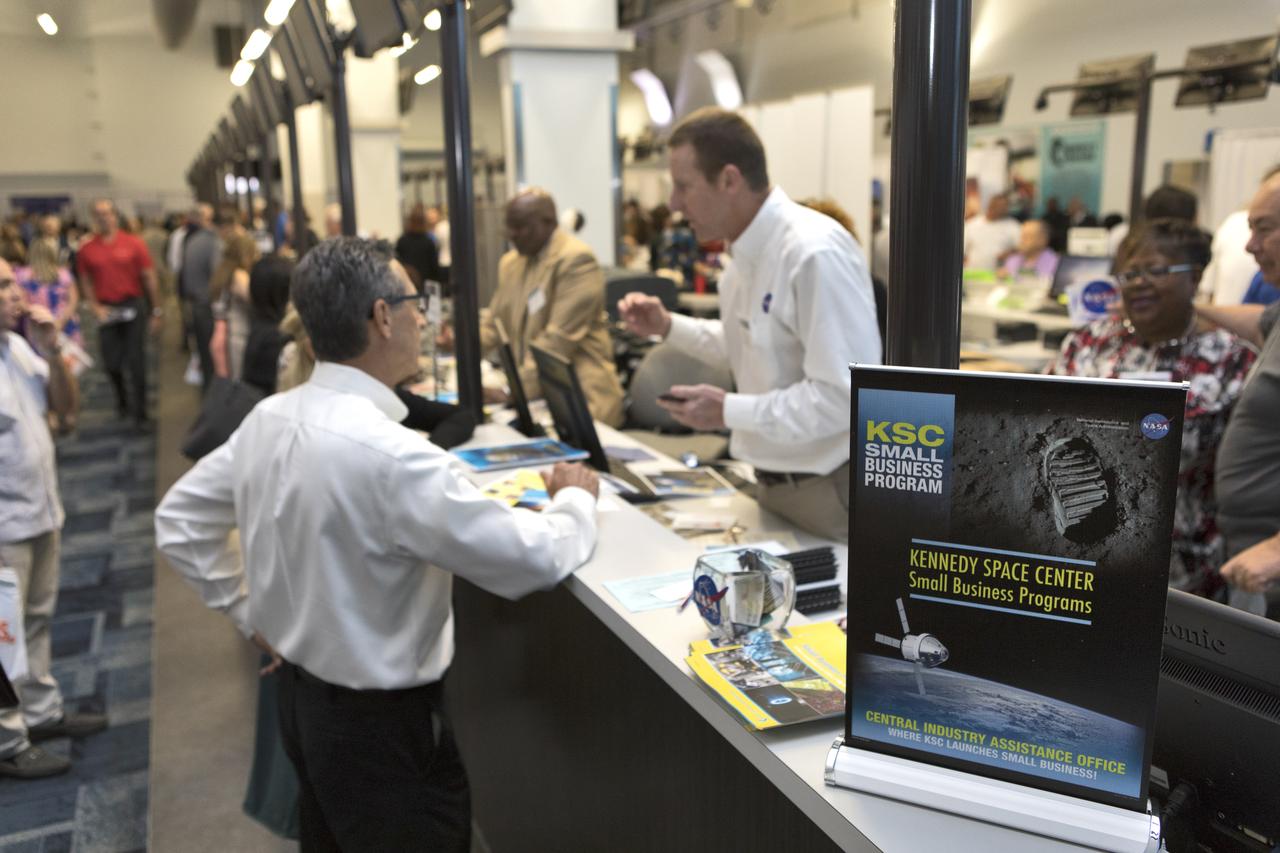
Attendees talk to representatives from Kennedy Space Center's Central Industry Assistance Office, during the agency's Business Opportunities Expo 2018, on Oct. 23, inside Cruise Terminal 6 at Port Canaveral in Florida. The 28th Business Opportunities Expo featured more than 200 businesses, large and small, and government exhibitors from throughout the Space Coast and the nation. The Business Opportunities Expo is facilitated by Kennedy's Small Business Programs Office and Prime Contractor Board, along with the U.S. Air Force 45th Space Wing and Canaveral Port Authority. Vendors from a variety of product and service areas, such as computer technology, engineering services, communication equipment and services, and construction and safety products, to name a few, were at the expo. Representatives from the 45th Space Wing, Kennedy prime contractors, NASA and many more agencies and organizations were on hand to provide information and answer questions.
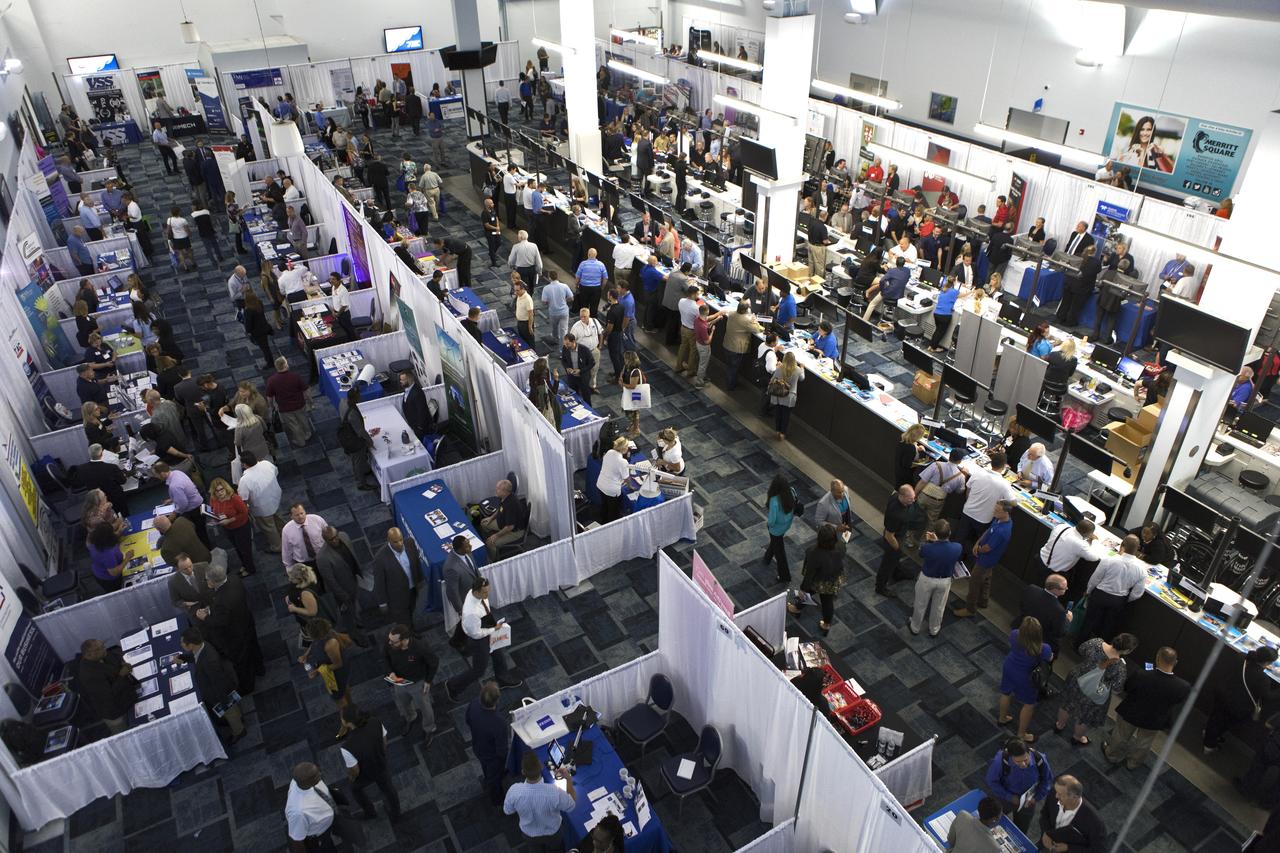
Attendees talk with representatives from a variety of business and government agencies during NASA's Business Opportunities Expo 2018, on Oct. 23, inside Cruise Terminal 6 at Port Canaveral in Florida. The 28th Business Opportunities Expo featured more than 200 businesses, large and small, and government exhibitors from throughout the Space Coast and the nation. The Business Opportunities Expo is facilitated by Kennedy's Small Business Programs Office and Prime Contractor Board, along with the U.S. Air Force 45th Space Wing and Canaveral Port Authority. Vendors from a variety of product and service areas, such as computer technology, engineering services, communication equipment and services, and construction and safety products, to name a few, were at the expo. Representatives from the 45th Space Wing, Kennedy prime contractors, NASA and many more agencies and organizations were on hand to provide information and answer questions.
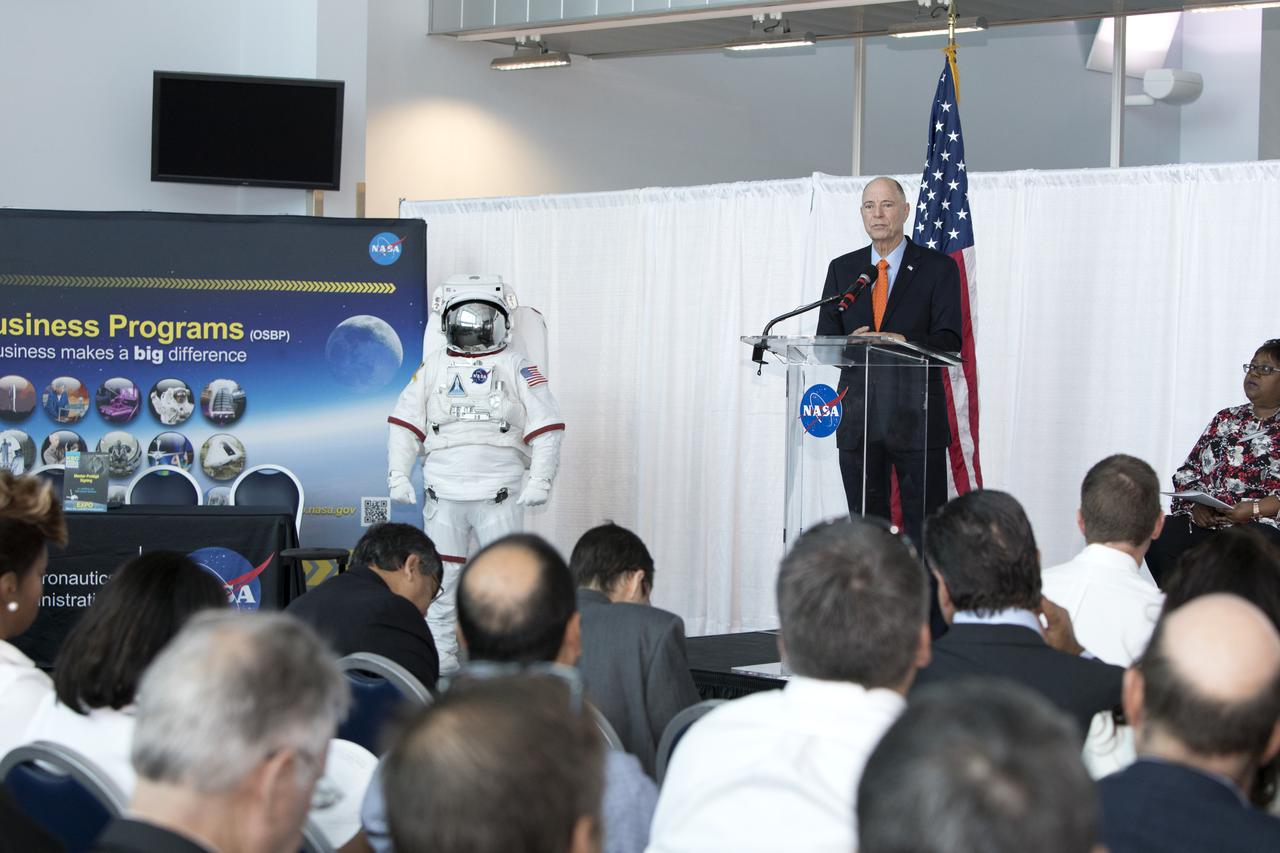
U.S. Rep. Bill Posey speaks to attendees during the NASA Business Opportunities Expo 2018, on Oct. 23, inside Cruise Terminal 6 at Port Canaveral in Florida. The 28th Business Opportunities Expo featured more than 200 businesses, large and small, and government exhibitors from throughout the Space Coast and the nation. The Business Opportunities Expo is facilitated by Kennedy's Small Business Programs Office and Prime Contractor Board, along with the U.S. Air Force 45th Space Wing and Canaveral Port Authority. Vendors from a variety of product and service areas, such as computer technology, engineering services, communication equipment and services, and construction and safety products, to name a few, were at the expo. Representatives from the 45th Space Wing, Kennedy prime contractors, NASA and many more agencies and organizations were on hand to provide information and answer questions.
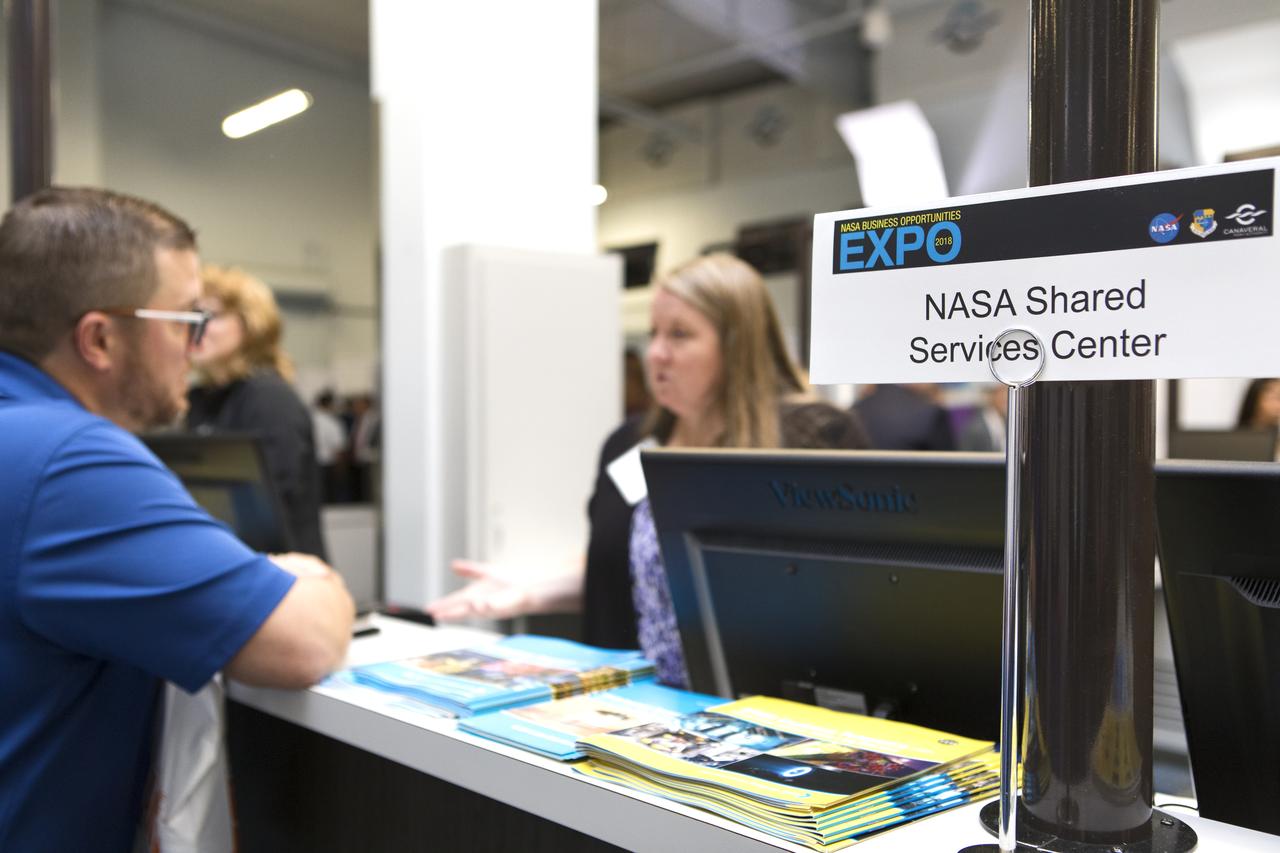
Attendees talk to vendors, such as the NASA Shared Services Center, during the agency's Business Opportunities Expo 2018, on Oct. 23, inside Cruise Terminal 6 at Port Canaveral in Florida. The 28th Business Opportunities Expo featured more than 200 businesses, large and small, and government exhibitors from throughout the Space Coast and the nation. The Business Opportunities Expo is facilitated by Kennedy's Small Business Programs Office and Prime Contractor Board, along with the U.S. Air Force 45th Space Wing and Canaveral Port Authority. Vendors from a variety of product and service areas, such as computer technology, engineering services, communication equipment and services, and construction and safety products, to name a few, were at the expo. Representatives from the 45th Space Wing, Kennedy prime contractors, NASA and many more agencies and organizations were on hand to provide information and answer questions.
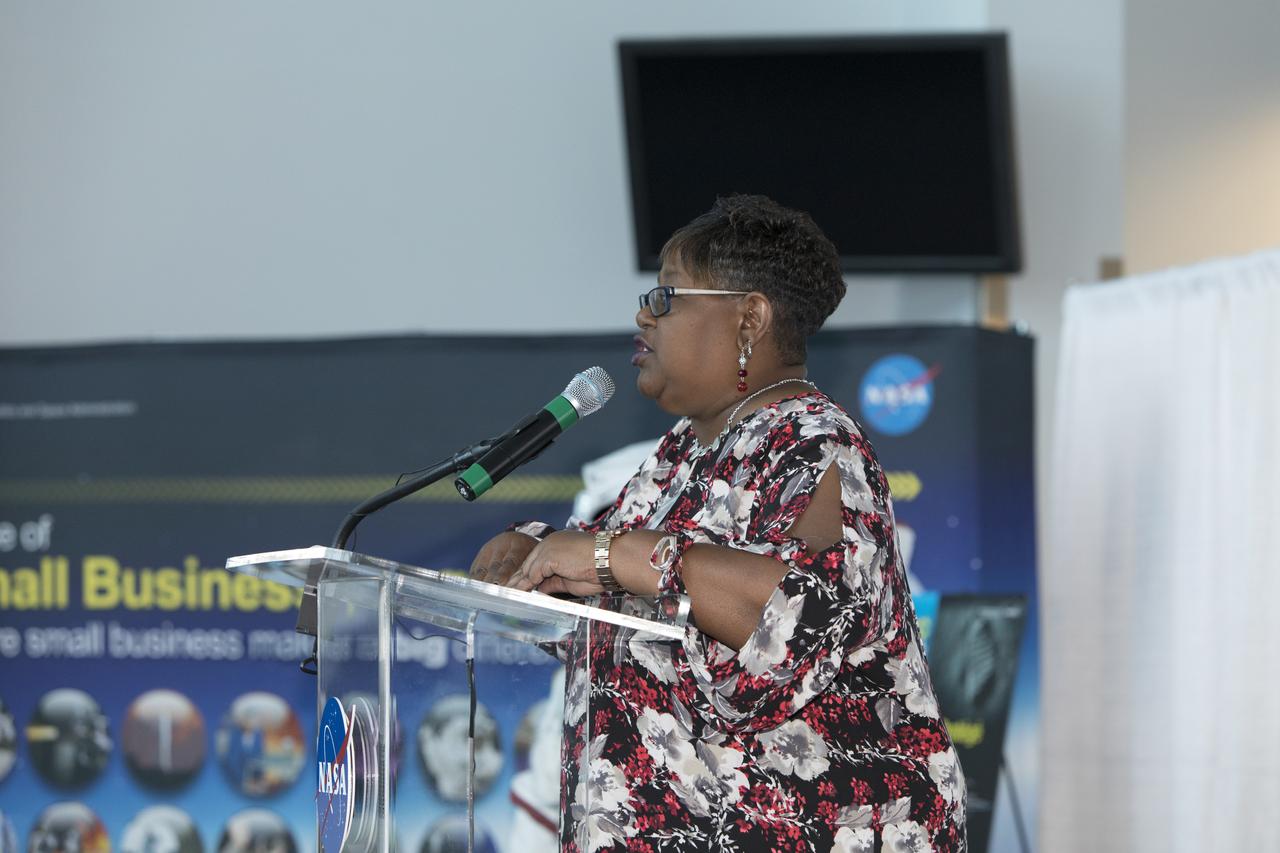
Joyce McDowell, small business specialist at Kennedy Space Center, welcomes attendees and vendors to NASA's Business Opportunities Expo 2018, on Oct. 23, inside Cruise Terminal 6 at Port Canaveral in Florida. The 28th Business Opportunities Expo featured more than 200 businesses, large and small, and government exhibitors from throughout the Space Coast and the nation. The Business Opportunities Expo is facilitated by Kennedy's Small Business Programs Office and Prime Contractor Board, along with the U.S. Air Force 45th Space Wing and Canaveral Port Authority. Vendors from a variety of product and service areas, such as computer technology, engineering services, communication equipment and services, and construction and safety products, to name a few, were at the expo. Representatives from the 45th Space Wing, Kennedy prime contractors, NASA and many more agencies and organizations were on hand to provide information and answer questions.
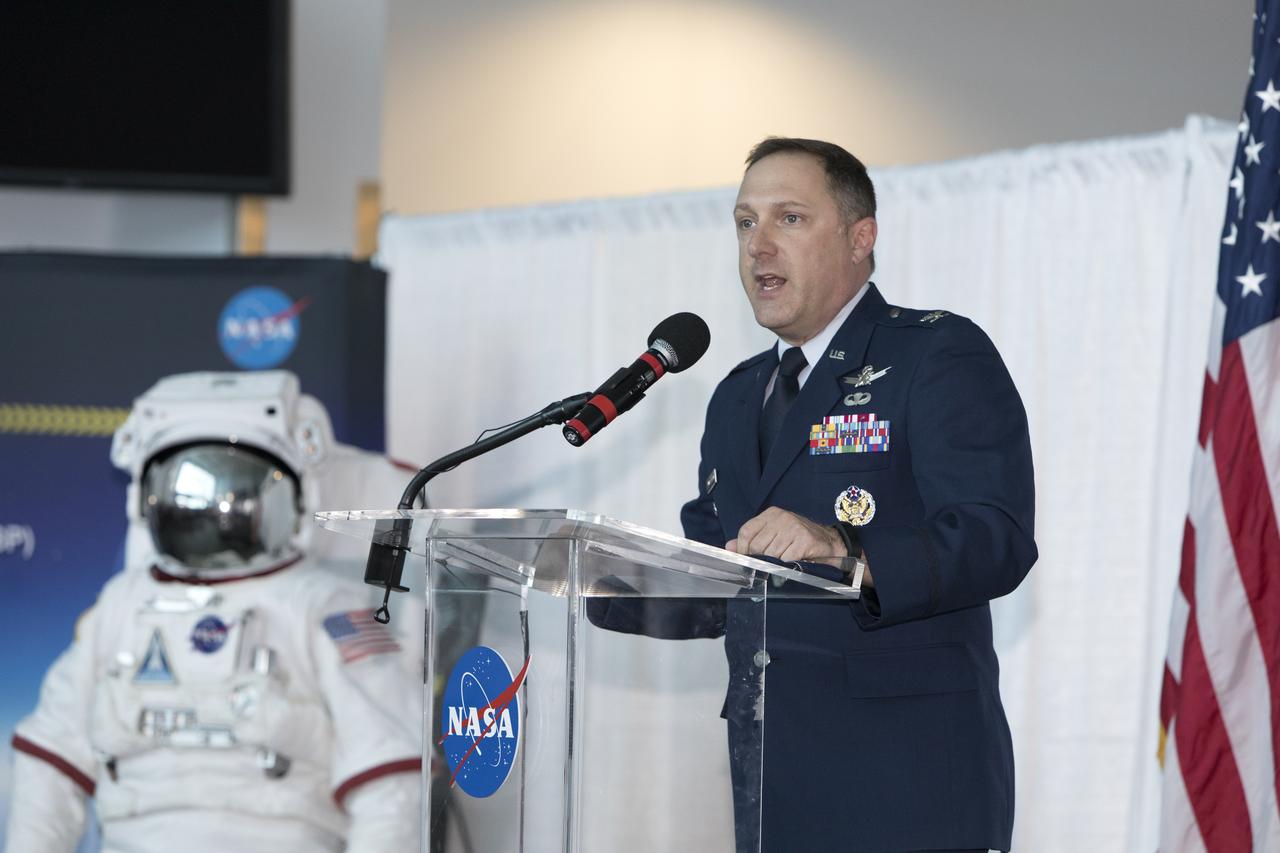
Colonel Thomas Ste. Marie, vice commander, 45th Space Wing, welcomes attendees and vendors to the NASA Business Opportunities Expo 2018, on Oct. 23, inside Cruise Terminal 6 at Port Canaveral in Florida. The 28th Business Opportunities Expo featured more than 200 businesses, large and small, and government exhibitors from throughout the Space Coast and the nation. The Business Opportunities Expo is facilitated by Kennedy's Small Business Programs Office and Prime Contractor Board, along with the U.S. Air Force 45th Space Wing and Canaveral Port Authority. Vendors from a variety of product and service areas, such as computer technology, engineering services, communication equipment and services, and construction and safety products, to name a few, were at the expo. Representatives from the 45th Space Wing, Kennedy prime contractors, NASA and many more agencies and organizations were on hand to provide information and answer questions.
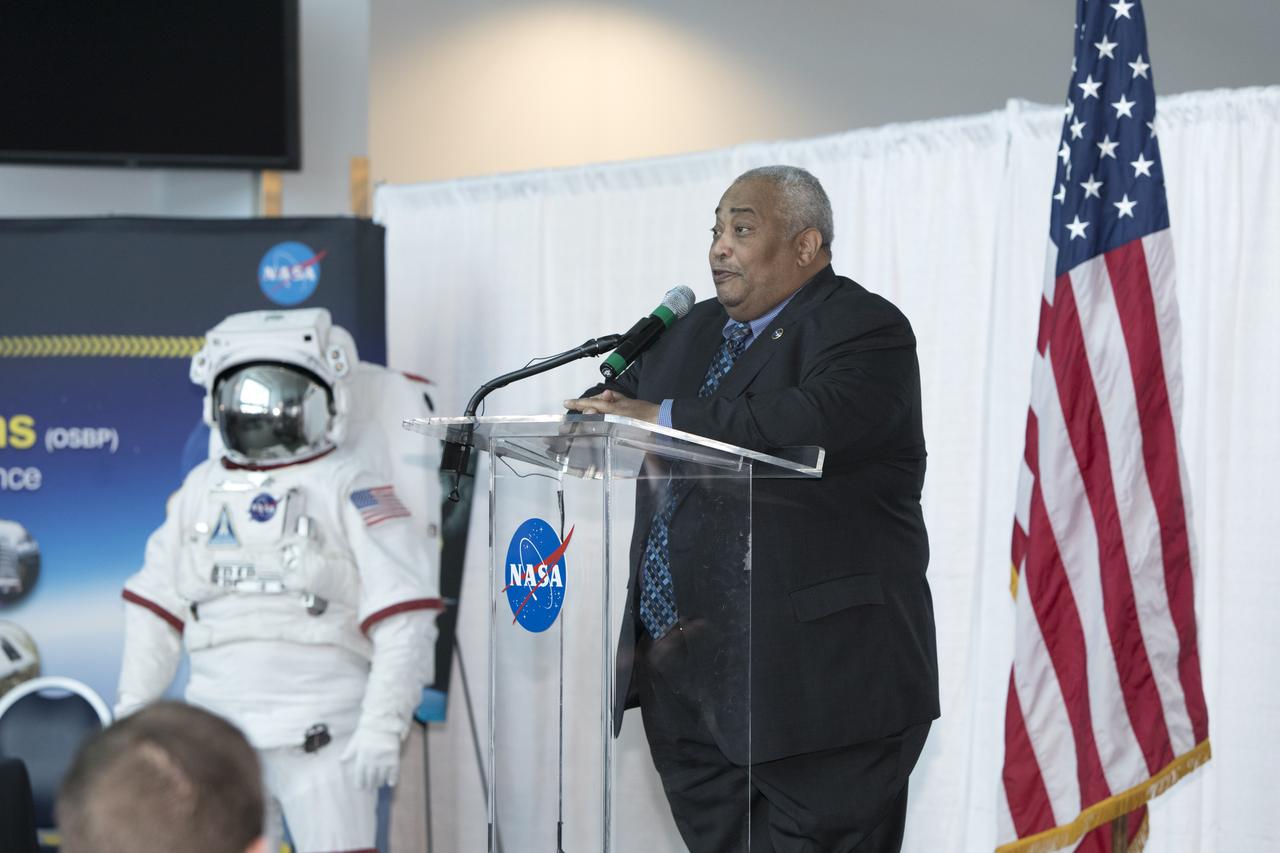
Glenn Delgado, associate administrator, NASA Office of Small Business Programs, speaks to attendees during the NASA Business Opportunities Expo 2018, on Oct. 23, inside Cruise Terminal 6 at Port Canaveral in Florida. The 28th Business Opportunities Expo featured more than 200 businesses, large and small, and government exhibitors from throughout the Space Coast and the nation. The Business Opportunities Expo is facilitated by Kennedy's Small Business Programs Office and Prime Contractor Board, along with the U.S. Air Force 45th Space Wing and Canaveral Port Authority. Vendors from a variety of product and service areas, such as computer technology, engineering services, communication equipment and services, and construction and safety products, to name a few, were at the expo. Representatives from the 45th Space Wing, Kennedy prime contractors, NASA and many more agencies and organizations were on hand to provide information and answer questions.
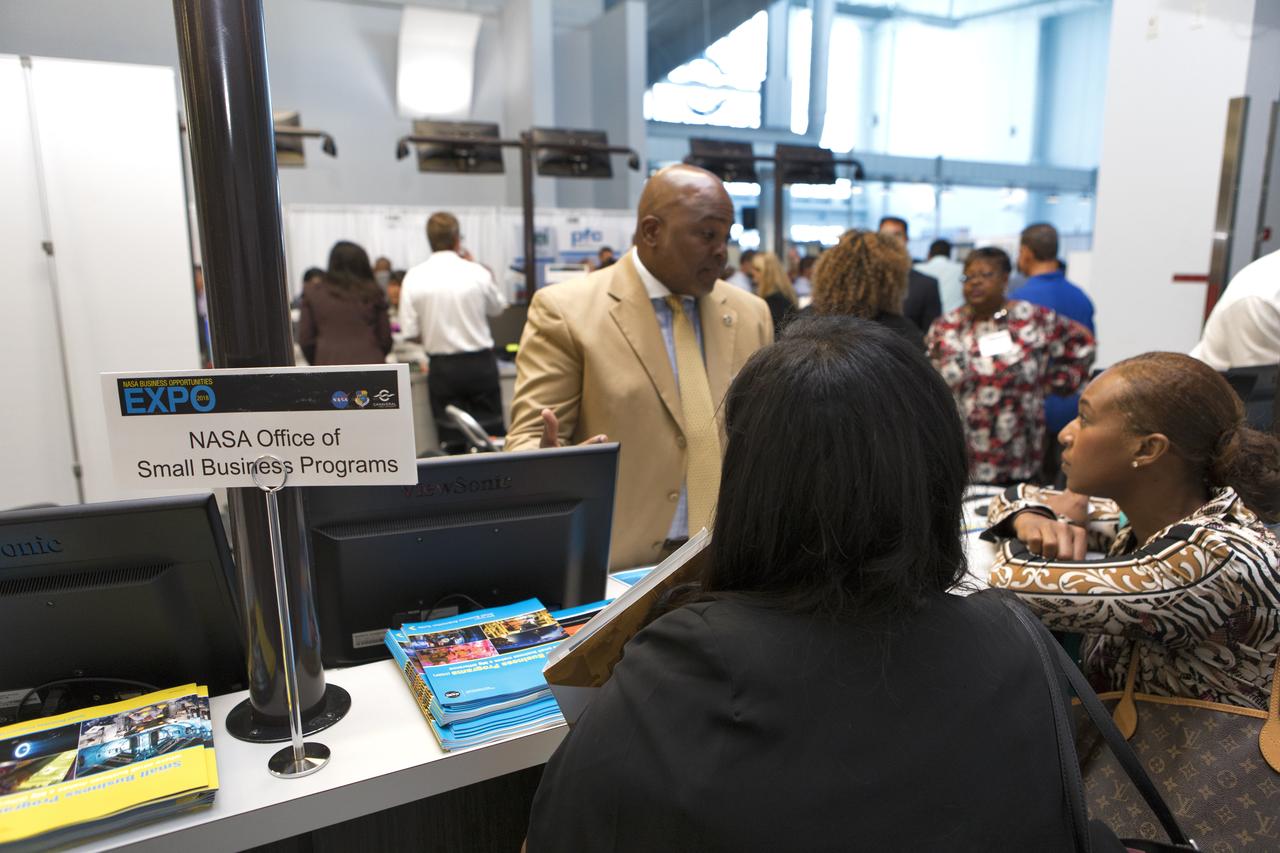
An attendee talks to representatives from the NASA Office of Small Business Programs, during the agency's Business Opportunities Expo 2018, on Oct. 23, inside Cruise Terminal 6 at Port Canaveral in Florida. The 28th Business Opportunities Expo featured more than 200 businesses, large and small, and government exhibitors from throughout the Space Coast and the nation. The Business Opportunities Expo is facilitated by Kennedy's Small Business Programs Office and Prime Contractor Board, along with the U.S. Air Force 45th Space Wing and Canaveral Port Authority. Vendors from a variety of product and service areas, such as computer technology, engineering services, communication equipment and services, and construction and safety products, to name a few, were at the expo. Representatives from the 45th Space Wing, Kennedy prime contractors, NASA and many more agencies and organizations were on hand to provide information and answer questions.

Amber Allen, a program analyst in the Launch Services Program, speaks to attendees at NASA's Business Opportunities Expo 2018, on Oct. 23, inside Cruise Terminal 6 at Port Canaveral in Florida. The 28th Business Opportunities Expo featured more than 200 businesses, large and small, and government exhibitors from throughout the Space Coast and the nation. The Business Opportunities Expo is facilitated by Kennedy's Small Business Programs Office and Prime Contractor Board, along with the U.S. Air Force 45th Space Wing and Canaveral Port Authority. Vendors from a variety of product and service areas, such as computer technology, engineering services, communication equipment and services, and construction and safety products, to name a few, were at the expo. Representatives from the 45th Space Wing, Kennedy prime contractors, NASA and many more agencies and organizations were on hand to provide information and answer questions.
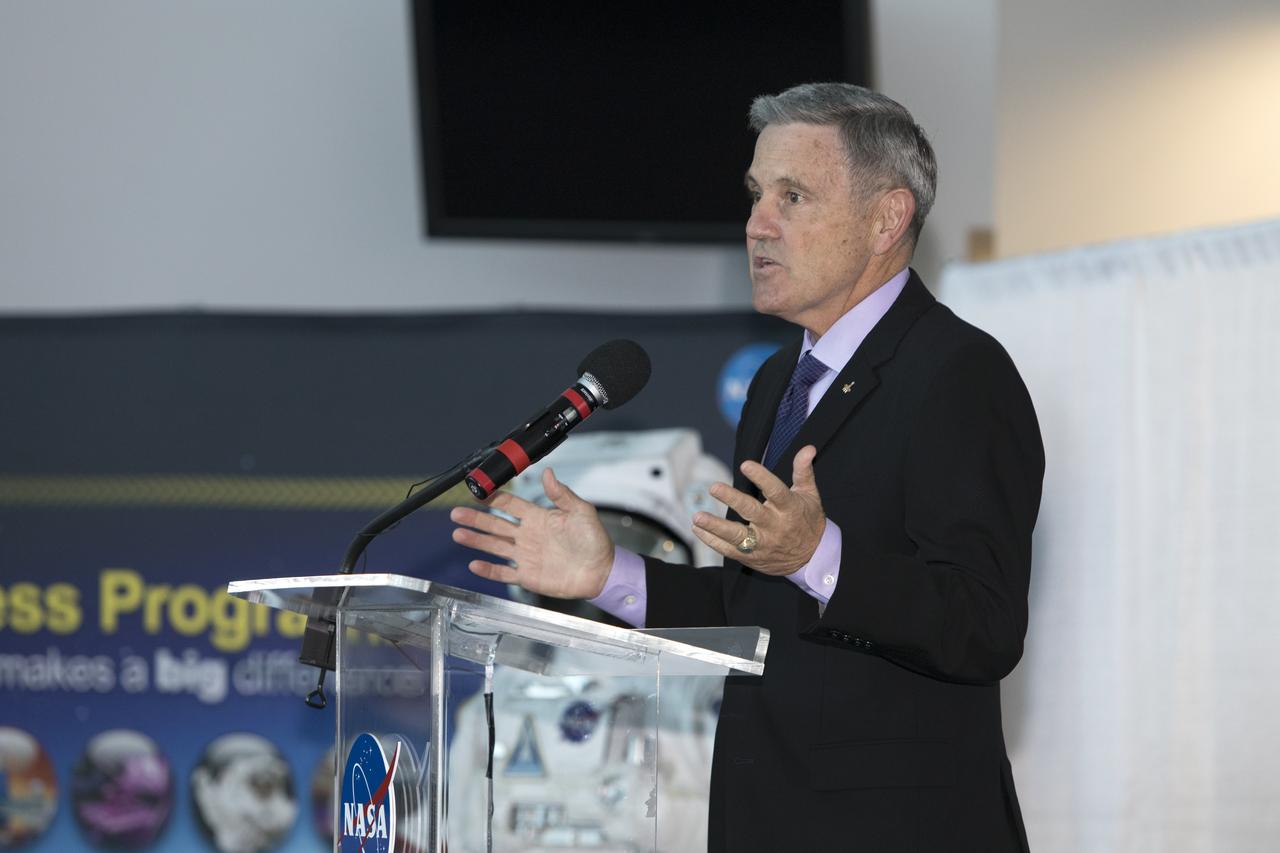
Kennedy Space Center Director Bob Cabana welcomes attendees and vendors to the NASA Business Opportunities Expo 2018, on Oct. 23, inside Cruise Terminal 6 at Port Canaveral in Florida. The 28th Business Opportunities Expo featured more than 200 businesses, large and small, and government exhibitors from throughout the Space Coast and the nation. The Business Opportunities Expo is facilitated by Kennedy's Small Business Programs Office and Prime Contractor Board, along with the U.S. Air Force 45th Space Wing and Canaveral Port Authority. Vendors from a variety of product and service areas, such as computer technology, engineering services, communication equipment and services, and construction and safety products, to name a few, were at the expo. Representatives from the 45th Space Wing, Kennedy prime contractors, NASA and many more agencies and organizations were on hand to provide information and answer questions.
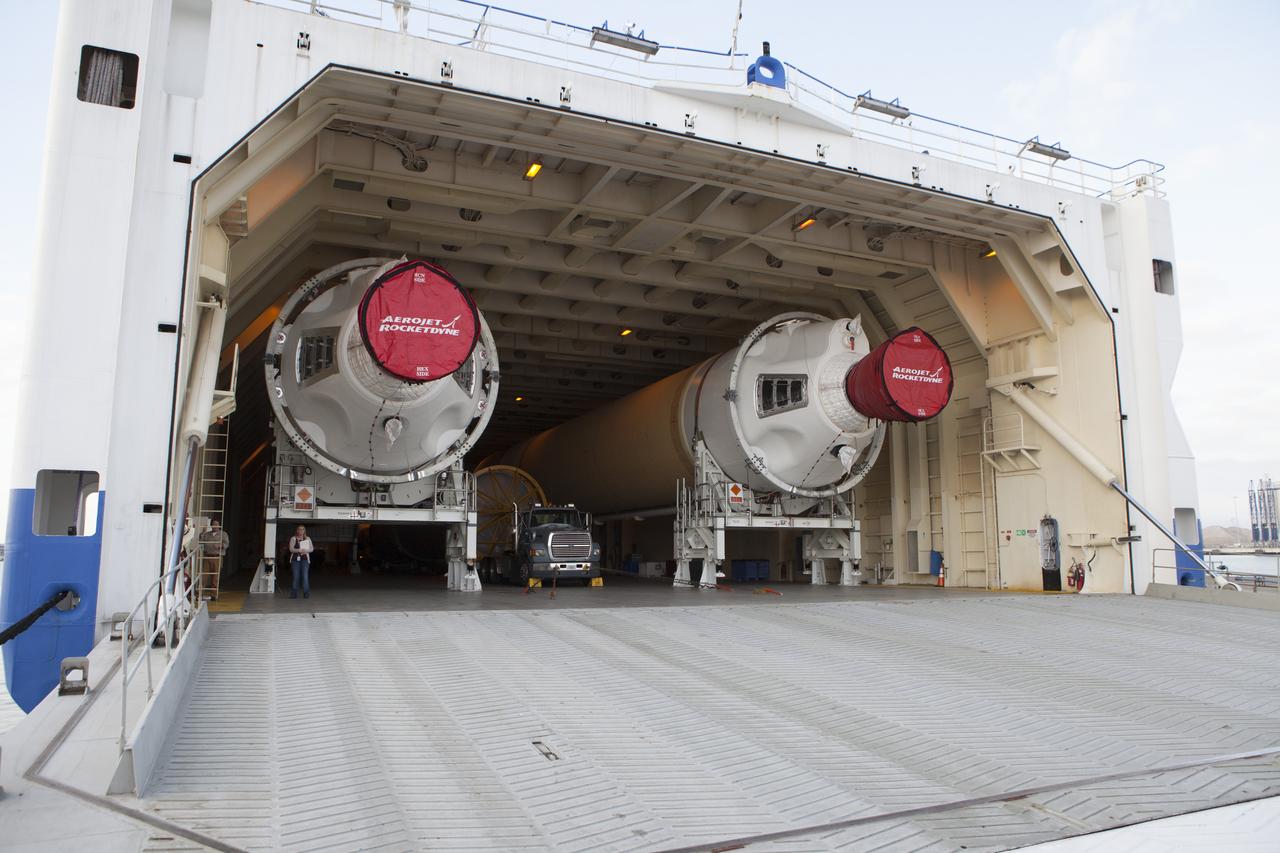
CAPE CANAVERAL, Fla. – A barge arrives at the U.S. Army Outpost wharf at Port Canaveral in Florida, carrying two of the three United Launch Alliance Delta IV heavy boosters for NASA’s upcoming Exploration Flight Test-1, or EFT-1, mission with the Orion spacecraft. The core booster and starboard booster will be offloaded and then transported to the Horizontal Integration Facility, or HIF, at Space Launch Complex 37 on Cape Canaveral Air Force Station. The port booster and the upper stage are planned to be shipped to Cape Canaveral in April. At the HIF, all three boosters will be processed and checked out before being moved to the nearby launch pad and hoisted into position. During the EFT-1 mission, Orion will travel farther into space than any human spacecraft has gone in more than 40 years. The data gathered during the flight will influence design decisions, validate existing computer models and innovative new approaches to space systems development, as well as reduce overall mission risks and costs for later Orion flights. Liftoff of Orion on EFT-1 is planned for fall 2014. Photo credit: NASA/Kim Shiflett
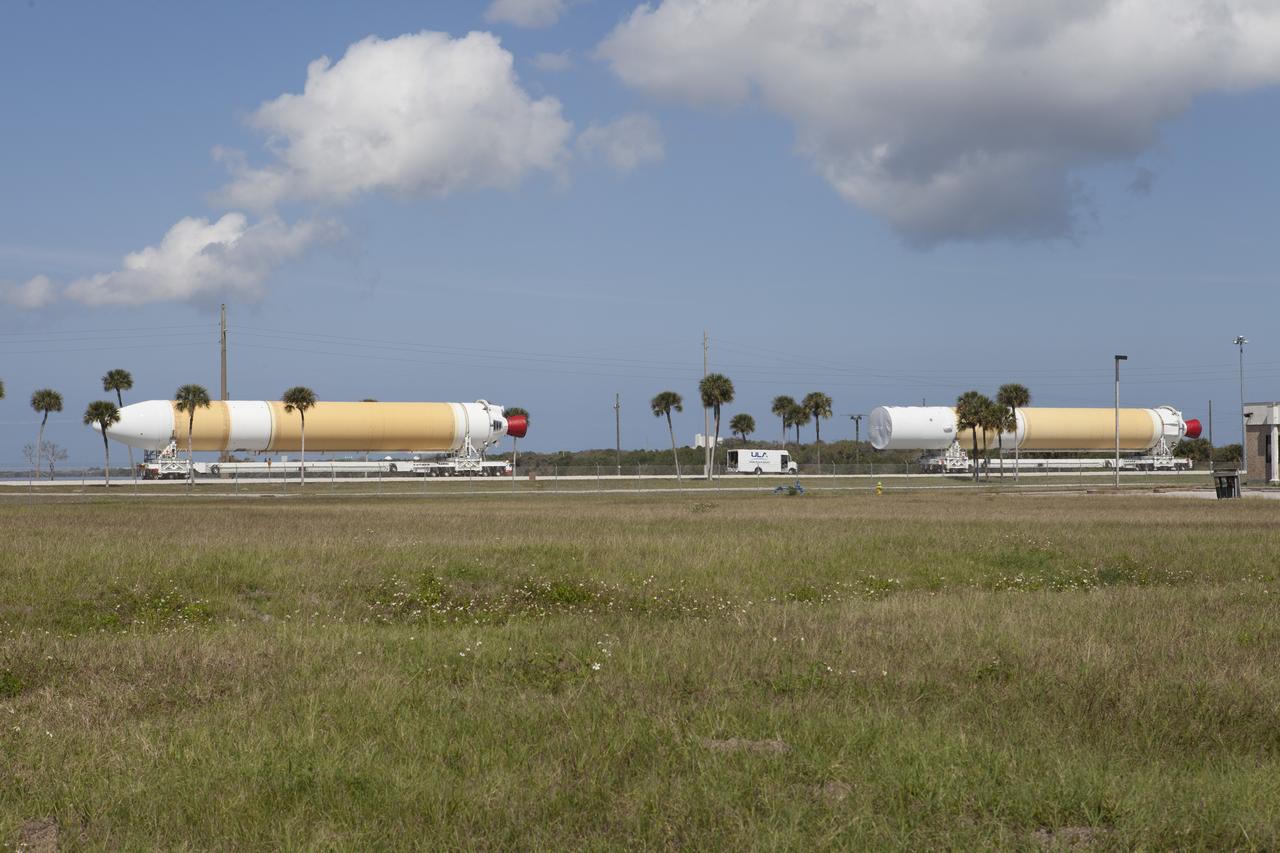
CAPE CANAVERAL, Fla. – Two of the three United Launch Alliance Delta IV heavy boosters for NASA’s upcoming Exploration Flight Test-1, or EFT-1, mission with the Orion spacecraft, arrived by barge at the U.S. Army Outpost wharf at Port Canaveral in Florida. The core booster and starboard booster were offloaded and are being transported to the Horizontal Integration Facility, or HIF, at Space Launch Complex 37 on Cape Canaveral Air Force Station. The port booster and the upper stage are planned to be shipped to Cape Canaveral in April. At the HIF, all three boosters will be processed and checked out before being moved to the nearby launch pad and hoisted into position. During the EFT-1 mission, Orion will travel farther into space than any human spacecraft has gone in more than 40 years. The data gathered during the flight will influence design decisions, validate existing computer models and innovative new approaches to space systems development, as well as reduce overall mission risks and costs for later Orion flights. Liftoff of Orion on EFT-1 is planned for fall 2014. Photo credit: NASA/Kim Shiflett

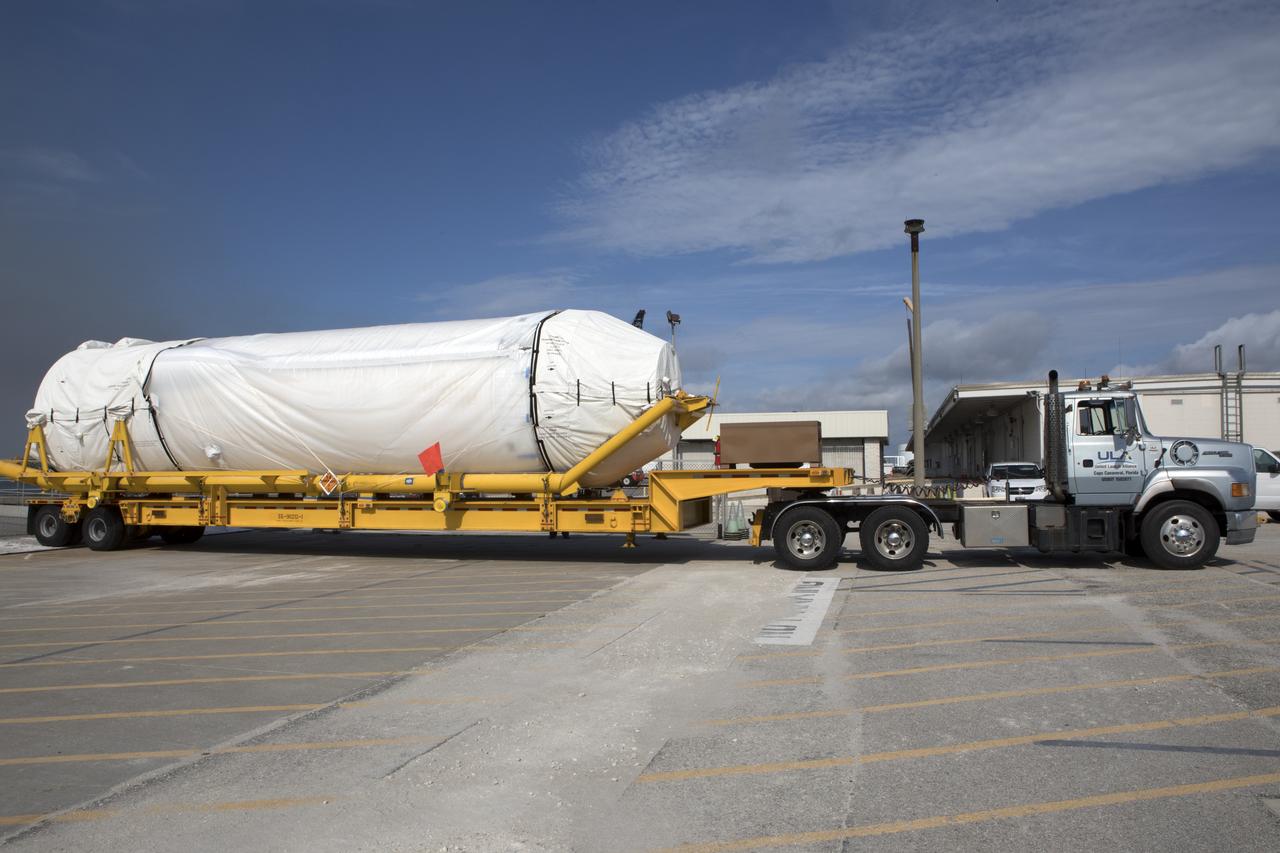
At Port Canaveral in Florida, a United Launch Alliance Atlas V rocket booster is transported from the company's Mariner ship to the Atlas Spaceflight Operations Center at Cape Canaveral Air Force Station. The rocket is scheduled to launch the Tracking and Data Relay Satellite, TDRS-M. It will be the latest spacecraft destined for the agency's constellation of communications satellites that allows nearly continuous contact with orbiting spacecraft ranging from the International Space Station and Hubble Space Telescope to the array of scientific observatories. Liftoff atop the ULA Atlas V rocket is scheduled to take place from Cape Canaveral's Space Launch Complex 41 on Aug. 3, 2017 at 9:02 a.m. EDT.
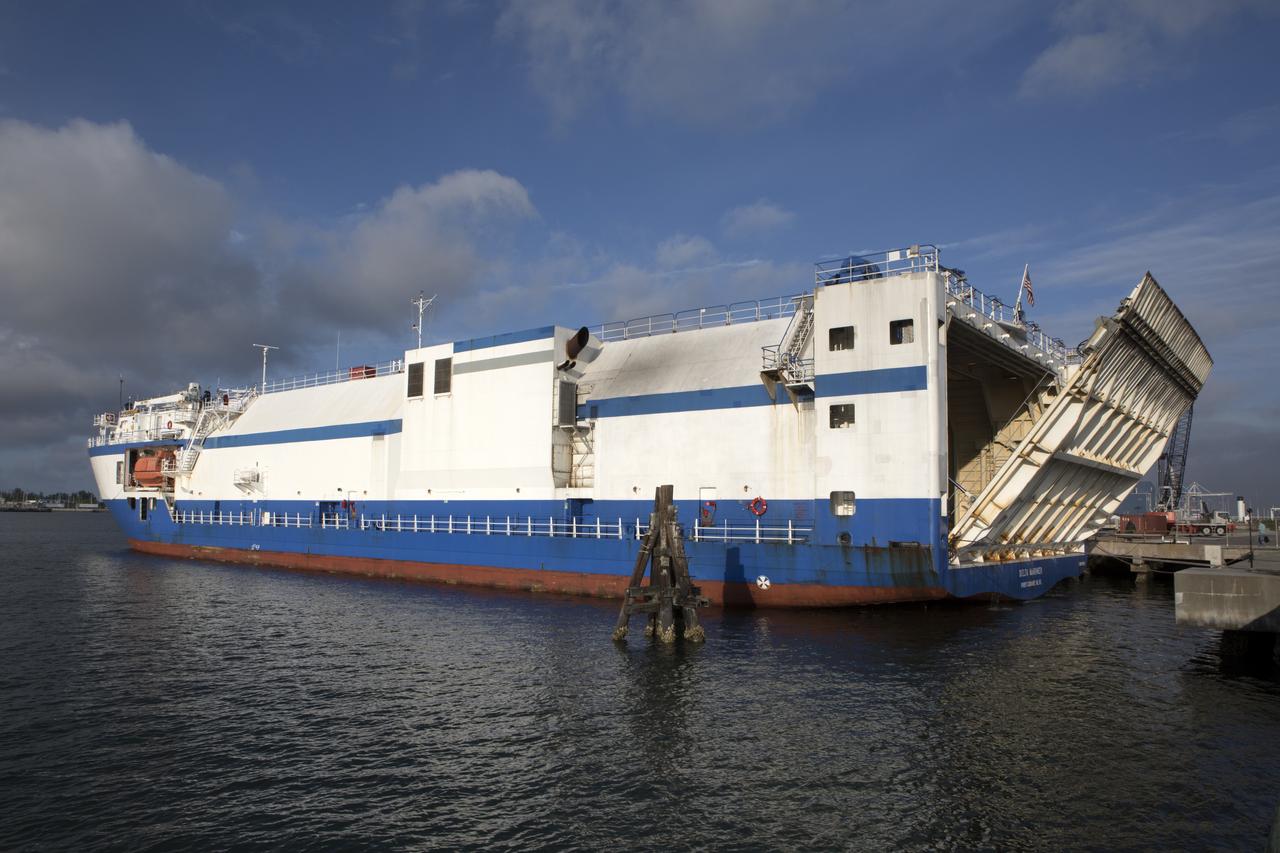
The United Launch Alliance (ULA) Mariner arrives at Port Canaveral in Florida carrying an Atlas V rocket booster bound for nearby Cape Canaveral Air Force Station. The rocket is scheduled to launch the Tracking and Data Relay Satellite, TDRS-M. It will be the latest spacecraft destined for the agency's constellation of communications satellites that allows nearly continuous contact with orbiting spacecraft ranging from the International Space Station and Hubble Space Telescope to the array of scientific observatories. Liftoff atop the ULA Atlas V rocket is scheduled to take place from Cape Canaveral's Space Launch Complex 41 on Aug. 3, 2017 at 9:02 a.m. EDT.
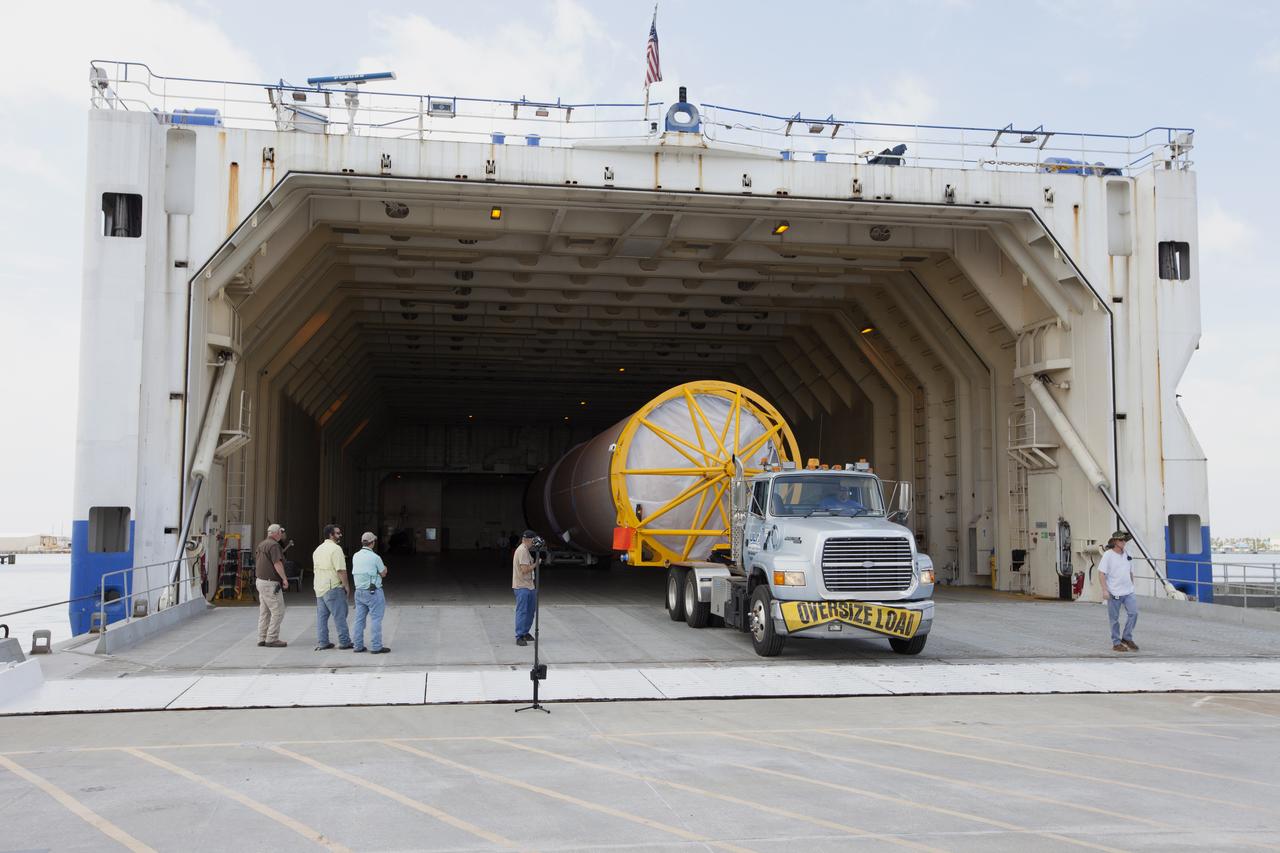
At Port Canaveral in Florida, a United Launch Alliance Centaur uppoer stage is transported from the company's Mariner ship to the Atlas Spaceflight Operations Center at Cape Canaveral Air Force Station. The rocket is scheduled to launch the Tracking and Data Relay Satellite, TDRS-M. It will be the latest spacecraft destined for the agency's constellation of communications satellites that allows nearly continuous contact with orbiting spacecraft ranging from the International Space Station and Hubble Space Telescope to the array of scientific observatories. Liftoff atop the ULA Atlas V rocket is scheduled to take place from Cape Canaveral's Space Launch Complex 41 on Aug. 3, 2017 at 9:02 a.m. EDT.
At Port Canaveral in Florida, a United Launch Alliance Atlas V rocket booster is transported from the company's Mariner ship to the Atlas Spaceflight Operations Center at Cape Canaveral Air Force Station. The rocket is scheduled to launch the Tracking and Data Relay Satellite, TDRS-M. It will be the latest spacecraft destined for the agency's constellation of communications satellites that allows nearly continuous contact with orbiting spacecraft ranging from the International Space Station and Hubble Space Telescope to the array of scientific observatories. Liftoff atop the ULA Atlas V rocket is scheduled to take place from Cape Canaveral's Space Launch Complex 41 on Aug. 3, 2017 at 9:02 a.m. EDT.
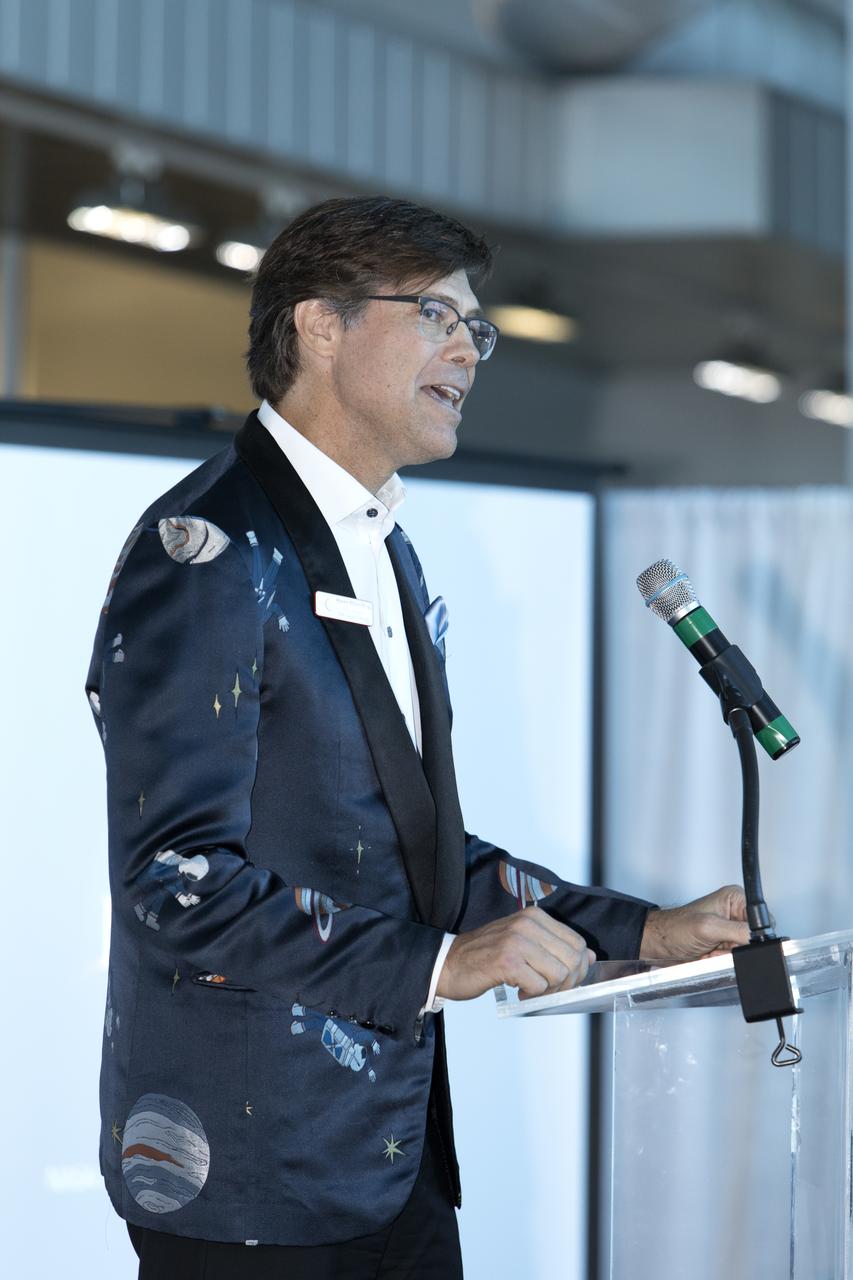
Barry Hamilton, CEO and founder of Red Canyon Software Inc., speaks to attendees at NASA's Business Opportunities Expo 2018, on Oct. 23, inside Cruise Terminal 6 at Port Canaveral in Florida. Red Canyon Software signed a Mentor-Protégé Agreement with a.i. solutions during the expo. Red Canyon Software will be mentored by a.i. solutions. The 28th Business Opportunities Expo featured more than 200 businesses, large and small, and government exhibitors from throughout the Space Coast and the nation. The Business Opportunities Expo is facilitated by Kennedy's Small Business Programs Office and Prime Contractor Board, along with the U.S. Air Force 45th Space Wing and Canaveral Port Authority. Vendors from a variety of product and service areas, such as computer technology, engineering services, communication equipment and services, and construction and safety products, to name a few, were at the expo. Representatives from the 45th Space Wing, Kennedy prime contractors, NASA and many more agencies and organizations were on hand to provide information and answer questions.
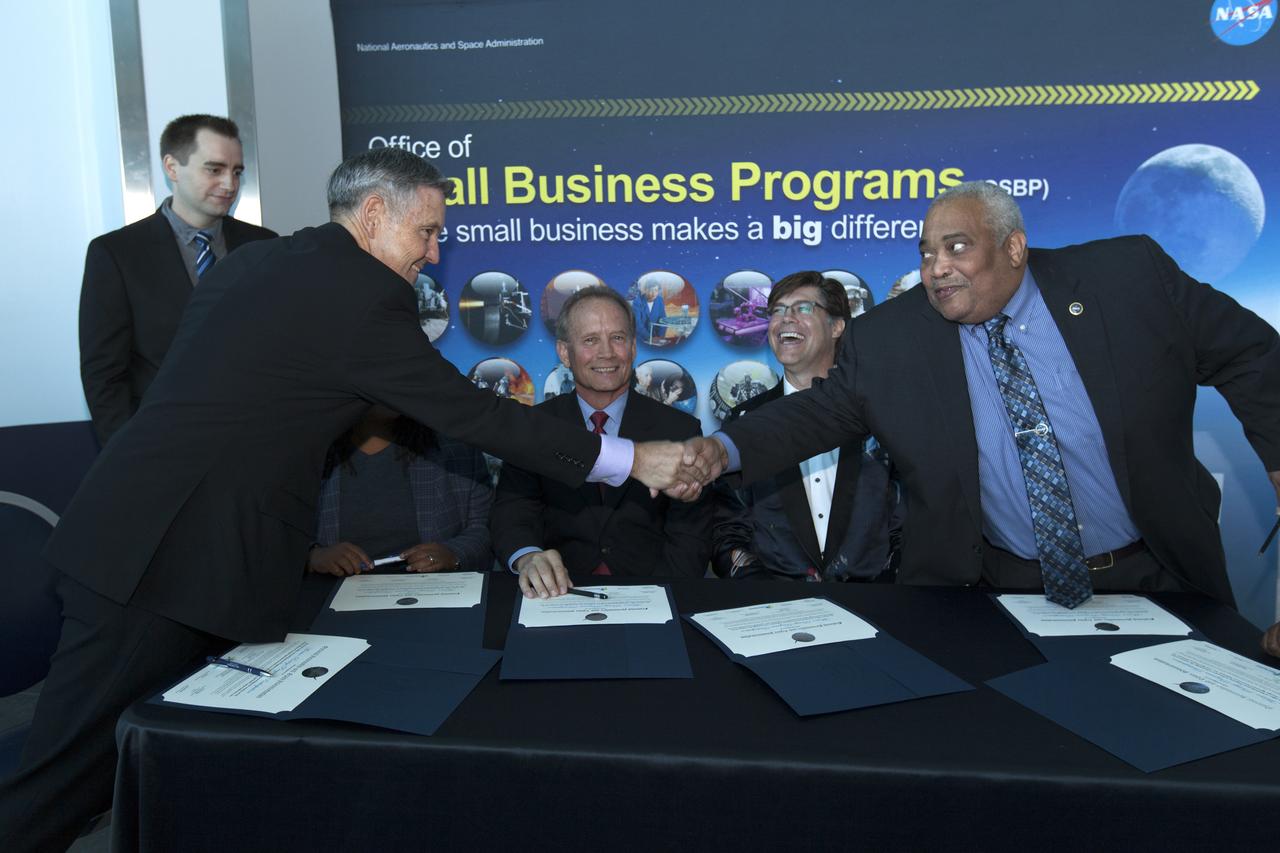
NASA Kennedy Space Center Director Bob Cabana, standing, shakes hands with Glenn Delgado, associate administrator, NASA Office of Small Business Programs, during the signing of a Mentor-Protégé Agreement on Oct. 23, 2018, at the NASA Business Opportunities Expo 2018 inside Cruise Terminal 6 at Port Canaveral in Florida. Seated, in view from left, are Steve Owens, deputy program manager with a.i. solutions Inc., a contractor at Kennedy; and Barry Hamilton, CEO and Founder of Red Canyon Software Inc. A.I. Solutions will serve as the mentor to protégé Red Canyon Software. The 28th Business Opportunities Expo featured more than 200 businesses, large and small, and government exhibitors from throughout the Space Coast and the nation. The Business Opportunities Expo is facilitated by Kennedy's Small Business Programs Office and Prime Contractor Board, along with the U.S. Air Force 45th Space Wing and Canaveral Port Authority. Vendors from a variety of product and service areas, such as computer technology, engineering services, communication equipment and services, and construction and safety products, to name a few, were at the expo. Representatives from the 45th Space Wing, Kennedy prime contractors, NASA and many more agencies and organizations were on hand to provide information and answer questions.
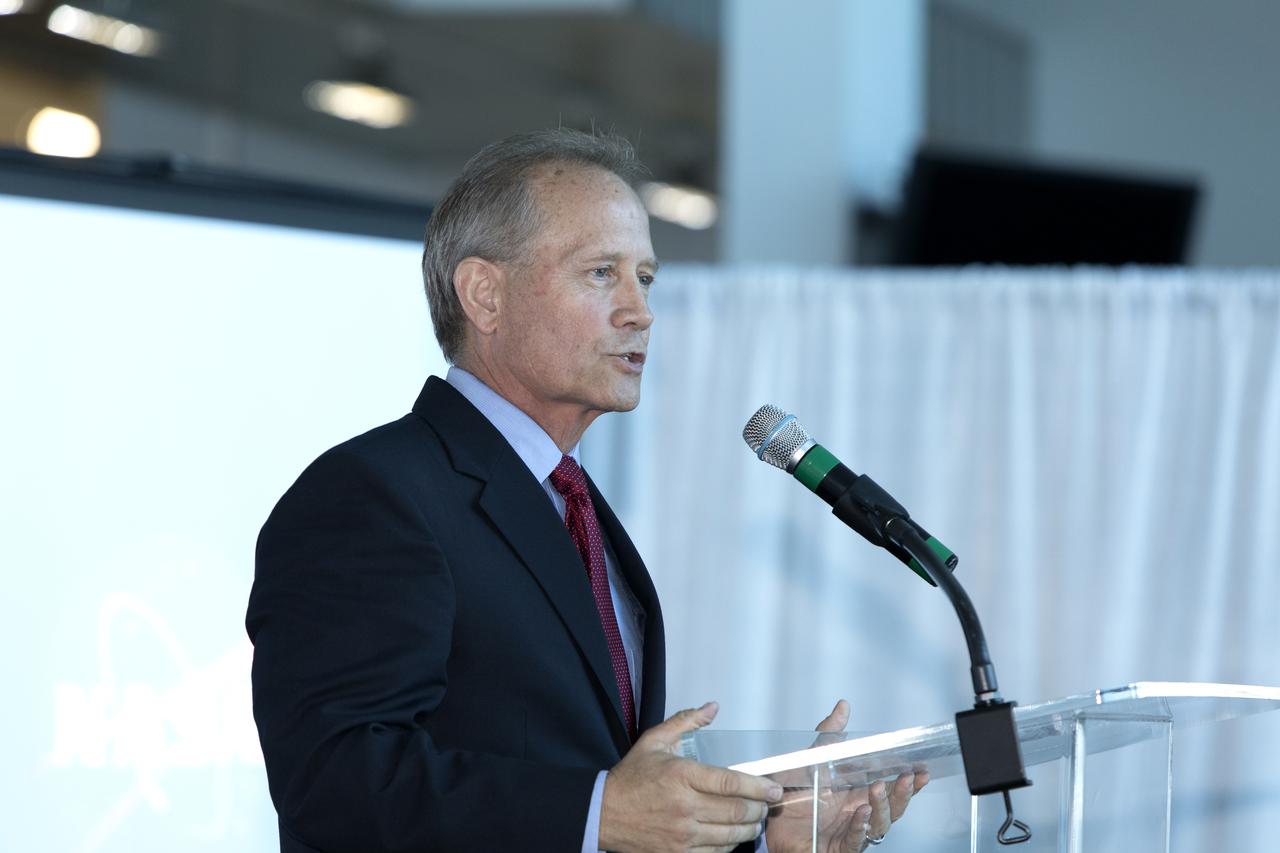
Steve Owens, deputy program manager with a.i. solutions Inc., a contractor at Kennedy Space Center, speaks to attendees at NASA's Business Opportunities Expo 2018, on Oct. 23, inside Cruise Terminal 6 at Port Canaveral in Florida. a.i. solutions signed a Mentor-Protégé Agreement with Red Canyon Software Inc. during the expo. a.i. solutions will be mentor to Red Canyon Software. The 28th Business Opportunities Expo featured more than 200 businesses, large and small, and government exhibitors from throughout the Space Coast and the nation. The Business Opportunities Expo is facilitated by Kennedy's Small Business Programs Office and Prime Contractor Board, along with the U.S. Air Force 45th Space Wing and Canaveral Port Authority. Vendors from a variety of product and service areas, such as computer technology, engineering services, communication equipment and services, and construction and safety products, to name a few, were at the expo. Representatives from the 45th Space Wing, Kennedy prime contractors, NASA and many more agencies and organizations were on hand to provide information and answer questions.
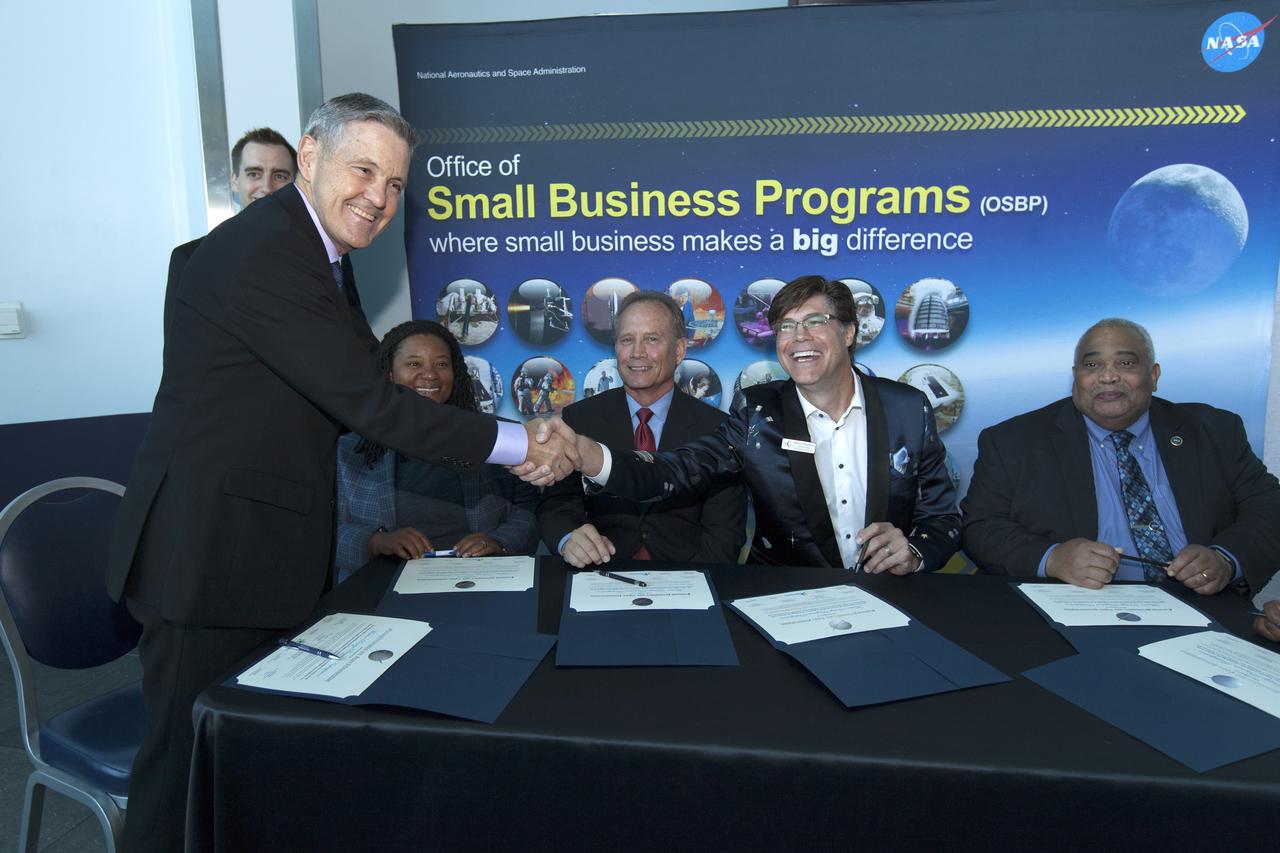
NASA Kennedy Space Center Director Bob Cabana, standing, shakes hands with Barry Hamilton, CEO and Founder of Red Canyon Software Inc., during the signing of a Mentor-Protégé Agreement on Oct. 23, 2018, at the NASA Business Opportunities Expo 2018 inside Cruise Terminal 6 at Port Canaveral in Florida. Seated, from left are Amber Allen, program analyst in the Launch Services Program; Steve Owens, deputy program manager with a.i. solutions Inc., a contractor at Kennedy; and Glenn Delgado, associate administrator, NASA Office of Small Business Programs. a.i. solutions will serve as the mentor to protégé Red Canyon Software. The 28th Business Opportunities Expo featured more than 200 businesses, large and small, and government exhibitors from throughout the Space Coast and the nation. The Business Opportunities Expo is facilitated by Kennedy's Small Business Programs Office and Prime Contractor Board, along with the U.S. Air Force 45th Space Wing and Canaveral Port Authority. Vendors from a variety of product and service areas, such as computer technology, engineering services, communication equipment and services, and construction and safety products, to name a few, were at the expo. Representatives from the 45th Space Wing, Kennedy prime contractors, NASA and many more agencies and organizations were on hand to provide information and answer questions.
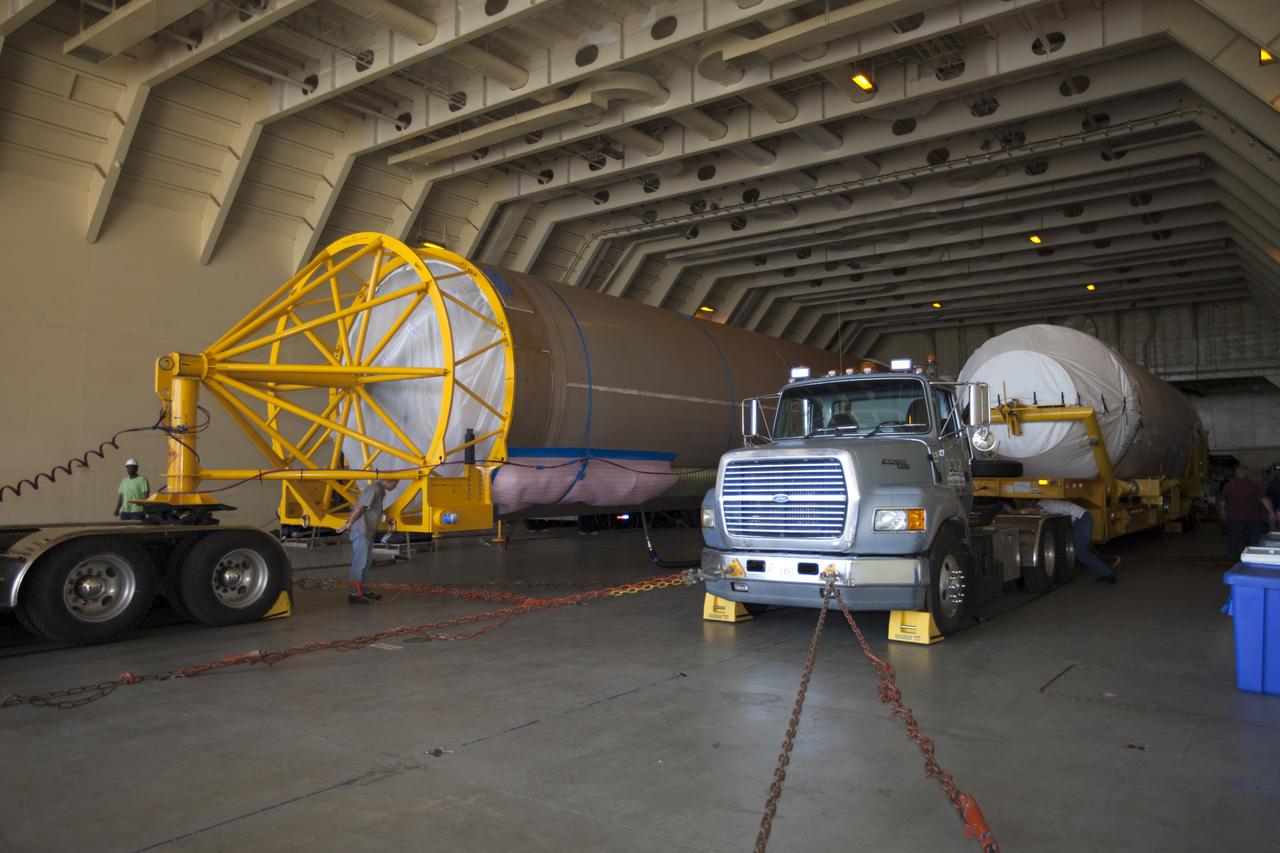
At Port Canaveral in Florida, a United Launch Alliance Atlas V rocket booster and Centaur upper stage are about to be transported from the company's Mariner ship to the Atlas Spaceflight Operations Center at Cape Canaveral Air Force Station. The rocket is scheduled to launch the Tracking and Data Relay Satellite, TDRS-M. It will be the latest spacecraft destined for the agency's constellation of communications satellites that allows nearly continuous contact with orbiting spacecraft ranging from the International Space Station and Hubble Space Telescope to the array of scientific observatories. Liftoff atop the ULA Atlas V rocket is scheduled to take place from Cape Canaveral's Space Launch Complex 41 on Aug. 3, 2017 at 9:02 a.m. EDT.

CAPE CANAVERAL, Fla. – The United Launch Alliance Atlas V first stage booster for NASA's Radiation Belt Storm Probes mission approaches the Atlas Spaceflight Operations Center, or ASOC, at Cape Canaveral Air Force Station in Florida. The Radiation Belt Storm Probes, or RBSP, mission will help us understand the sun’s influence on Earth and near-Earth space by studying the Earth’s radiation belts on various scales of space and time. For more information, visit http://www.nasa.gov/rbsp. Photo credit: NASA/Jim Grossmann
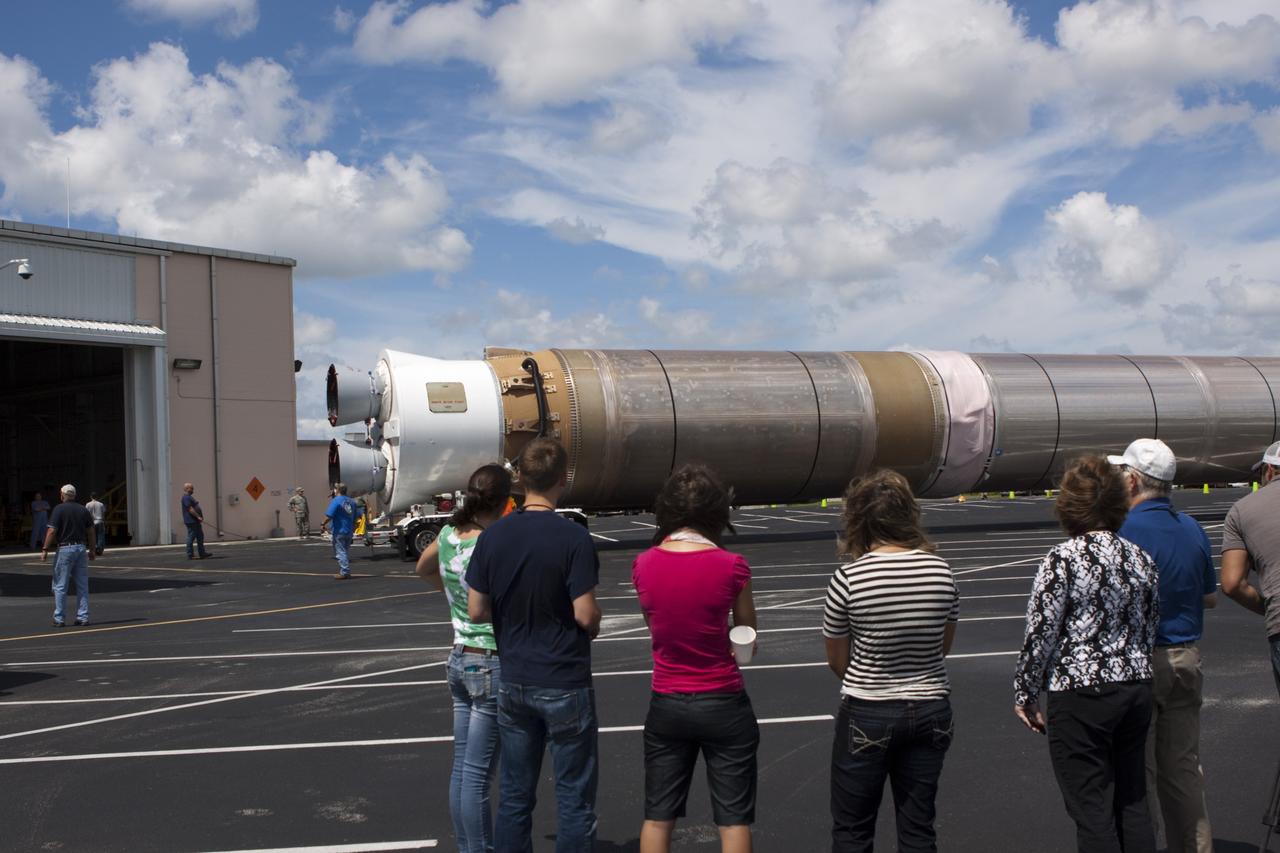
CAPE CANAVERAL, Fla. – Employees watch as the United Launch Alliance Atlas V first stage booster for NASA's Radiation Belt Storm Probes mission arrives at the Atlas Spaceflight Operations Center, or ASOC, at Cape Canaveral Air Force Station in Florida. The Radiation Belt Storm Probes, or RBSP, mission will help us understand the sun’s influence on Earth and near-Earth space by studying the Earth’s radiation belts on various scales of space and time. For more information, visit http://www.nasa.gov/rbsp. Photo credit: NASA/Jim Grossmann
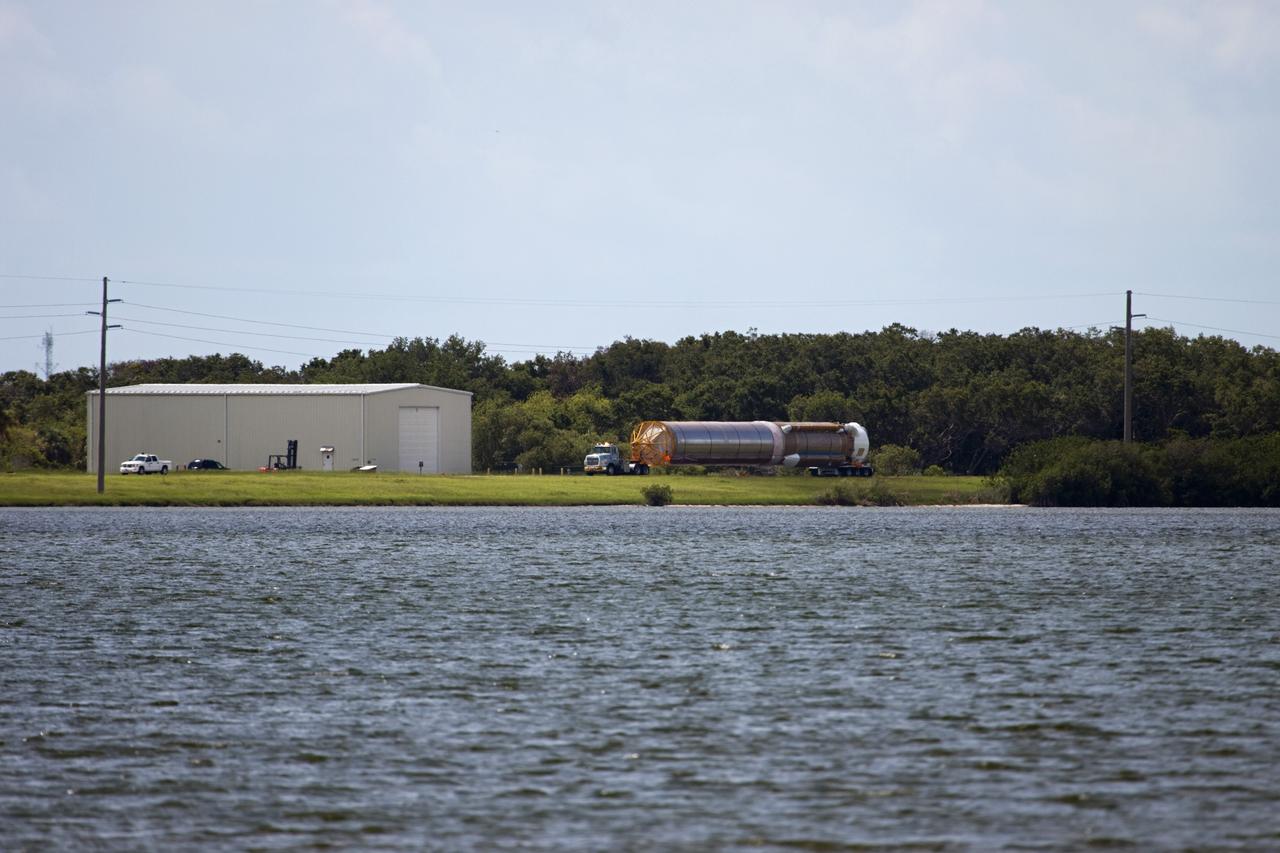
CAPE CANAVERAL, Fla. – The United Launch Alliance Atlas V first stage booster for NASA's Radiation Belt Storm Probes mission travels through Cape Canaveral Air Force Station in Florida en route to the Atlas Spaceflight Operations Center, or ASOC. The Radiation Belt Storm Probes, or RBSP, mission will help us understand the sun’s influence on Earth and near-Earth space by studying the Earth’s radiation belts on various scales of space and time. For more information, visit http://www.nasa.gov/rbsp. Photo credit: NASA/Jim Grossmann
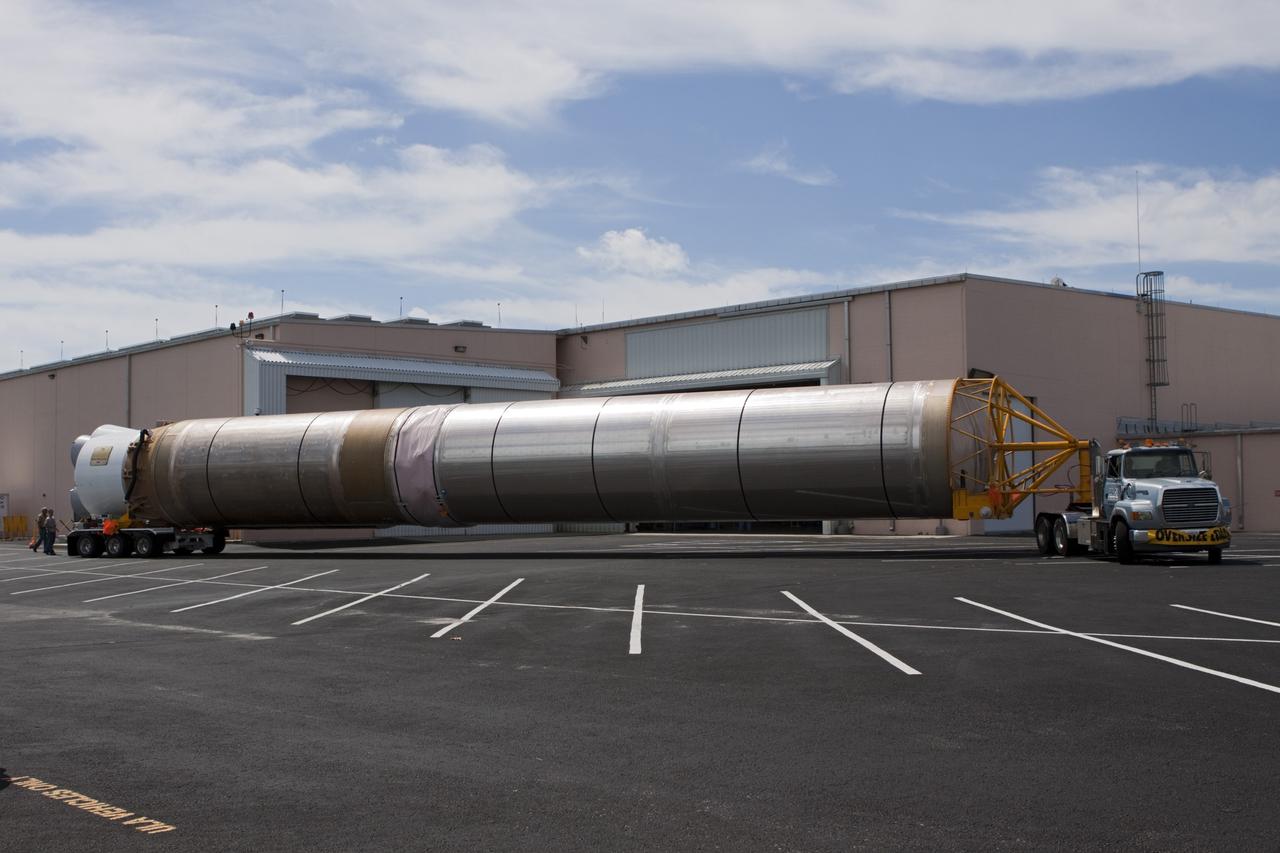
CAPE CANAVERAL, Fla. – The United Launch Alliance Atlas V first stage booster for NASA's Radiation Belt Storm Probes mission arrives at the Atlas Spaceflight Operations Center, or ASOC, at Cape Canaveral Air Force Station in Florida. The Radiation Belt Storm Probes, or RBSP, mission will help us understand the sun’s influence on Earth and near-Earth space by studying the Earth’s radiation belts on various scales of space and time. For more information, visit http://www.nasa.gov/rbsp. Photo credit: NASA/Jim Grossmann
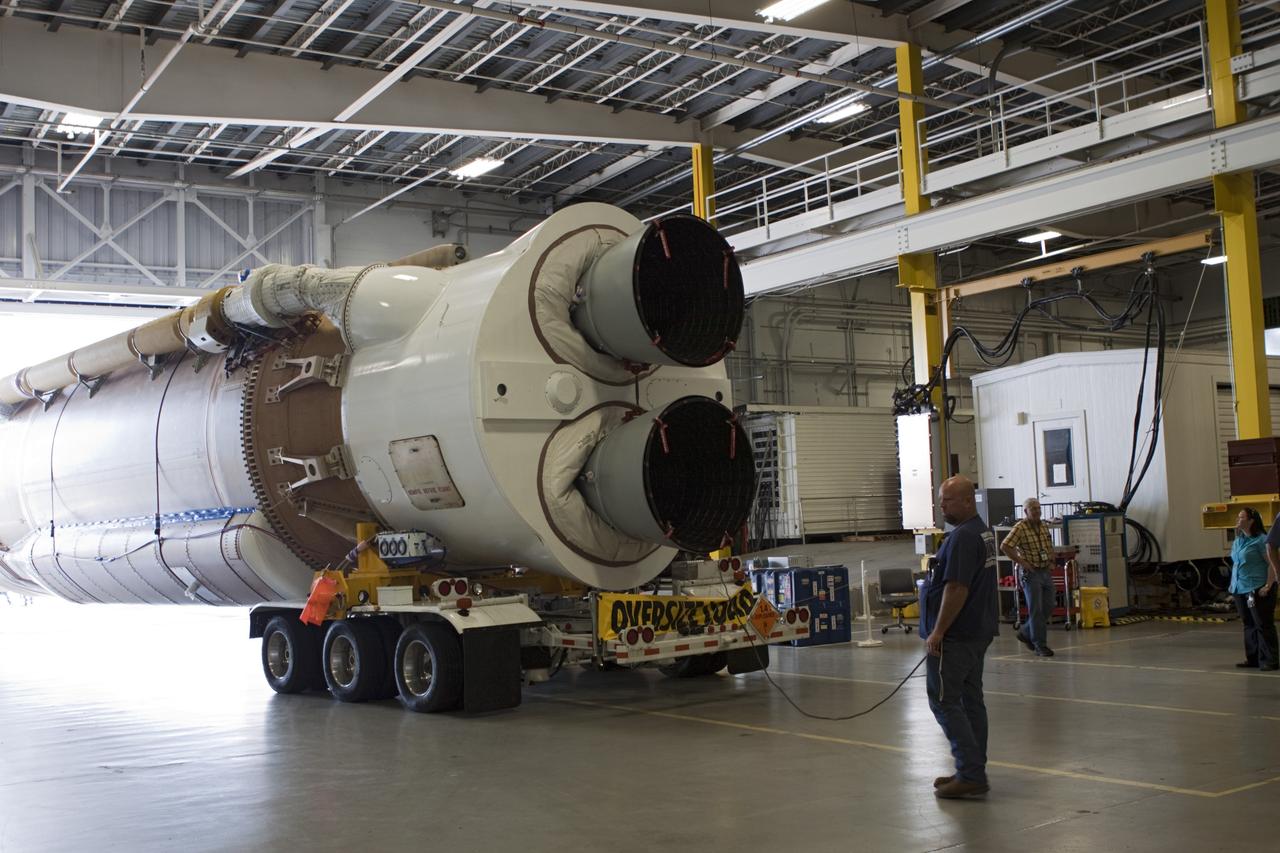
CAPE CANAVERAL, Fla. – The United Launch Alliance Atlas V first stage booster for NASA's Radiation Belt Storm Probes mission backs into the Atlas Spaceflight Operations Center, or ASOC, at Cape Canaveral Air Force Station in Florida. The Radiation Belt Storm Probes, or RBSP, mission will help us understand the sun’s influence on Earth and near-Earth space by studying the Earth’s radiation belts on various scales of space and time. For more information, visit http://www.nasa.gov/rbsp. Photo credit: NASA/Jim Grossmann
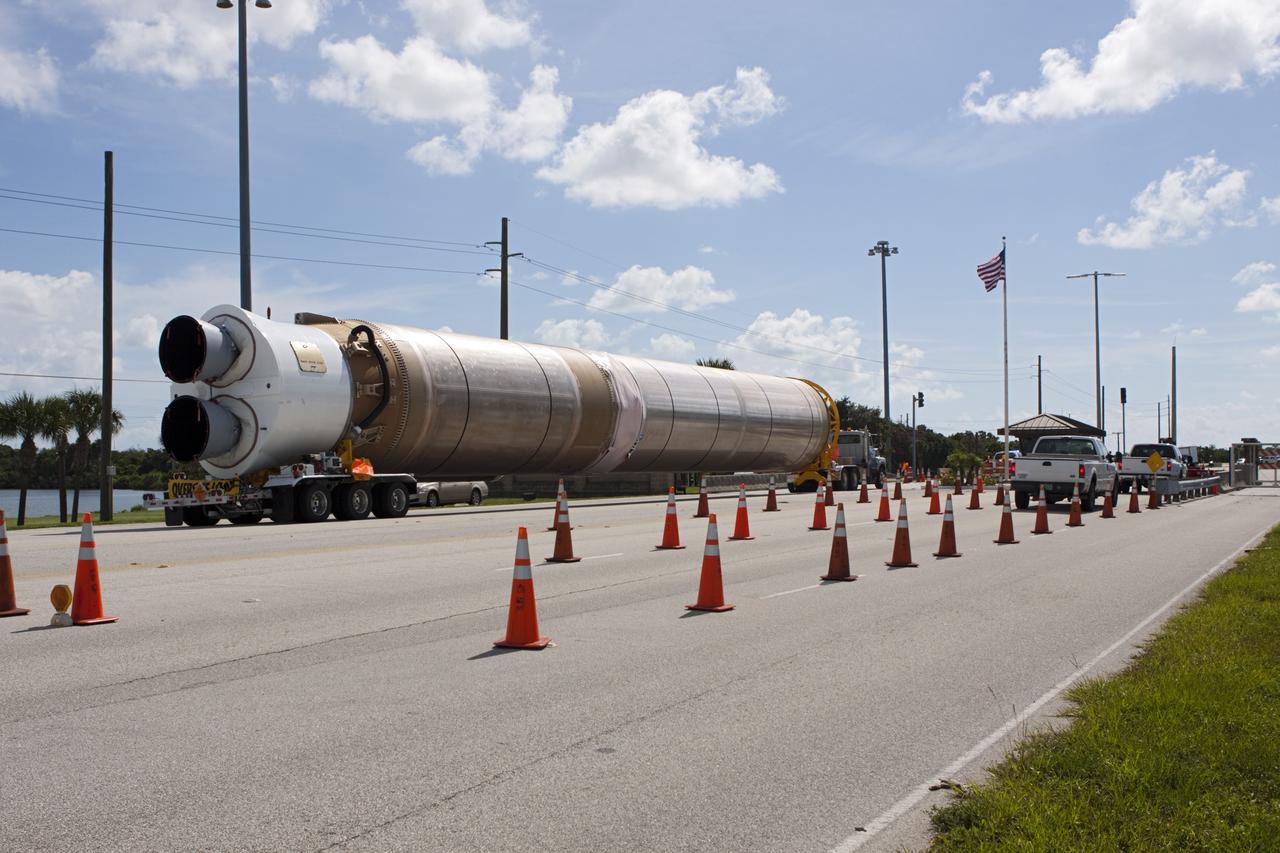
CAPE CANAVERAL, Fla. – The United Launch Alliance Atlas V first stage booster for NASA's Radiation Belt Storm Probes mission passes the secure gate at Cape Canaveral Air Force Station in Florida en route to the Atlas Spaceflight Operations Center, or ASOC. The Radiation Belt Storm Probes, or RBSP, mission will help us understand the sun’s influence on Earth and near-Earth space by studying the Earth’s radiation belts on various scales of space and time. For more information, visit http://www.nasa.gov/rbsp. Photo credit: NASA/Jim Grossmann
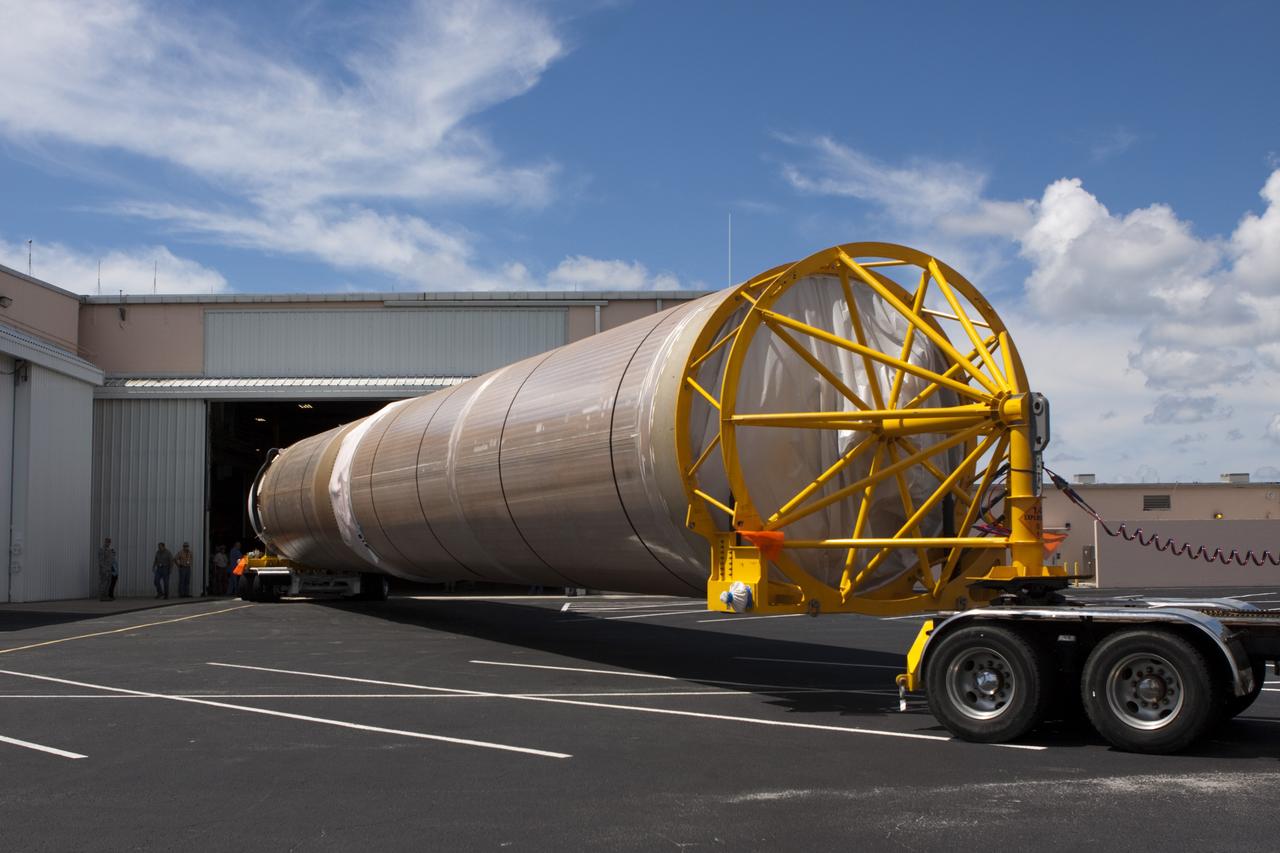
CAPE CANAVERAL, Fla. – The United Launch Alliance Atlas V first stage booster for NASA's Radiation Belt Storm Probes mission begins moving into the Atlas Spaceflight Operations Center, or ASOC, at Cape Canaveral Air Force Station in Florida. The Radiation Belt Storm Probes, or RBSP, mission will help us understand the sun’s influence on Earth and near-Earth space by studying the Earth’s radiation belts on various scales of space and time. For more information, visit http://www.nasa.gov/rbsp. Photo credit: NASA/Jim Grossmann
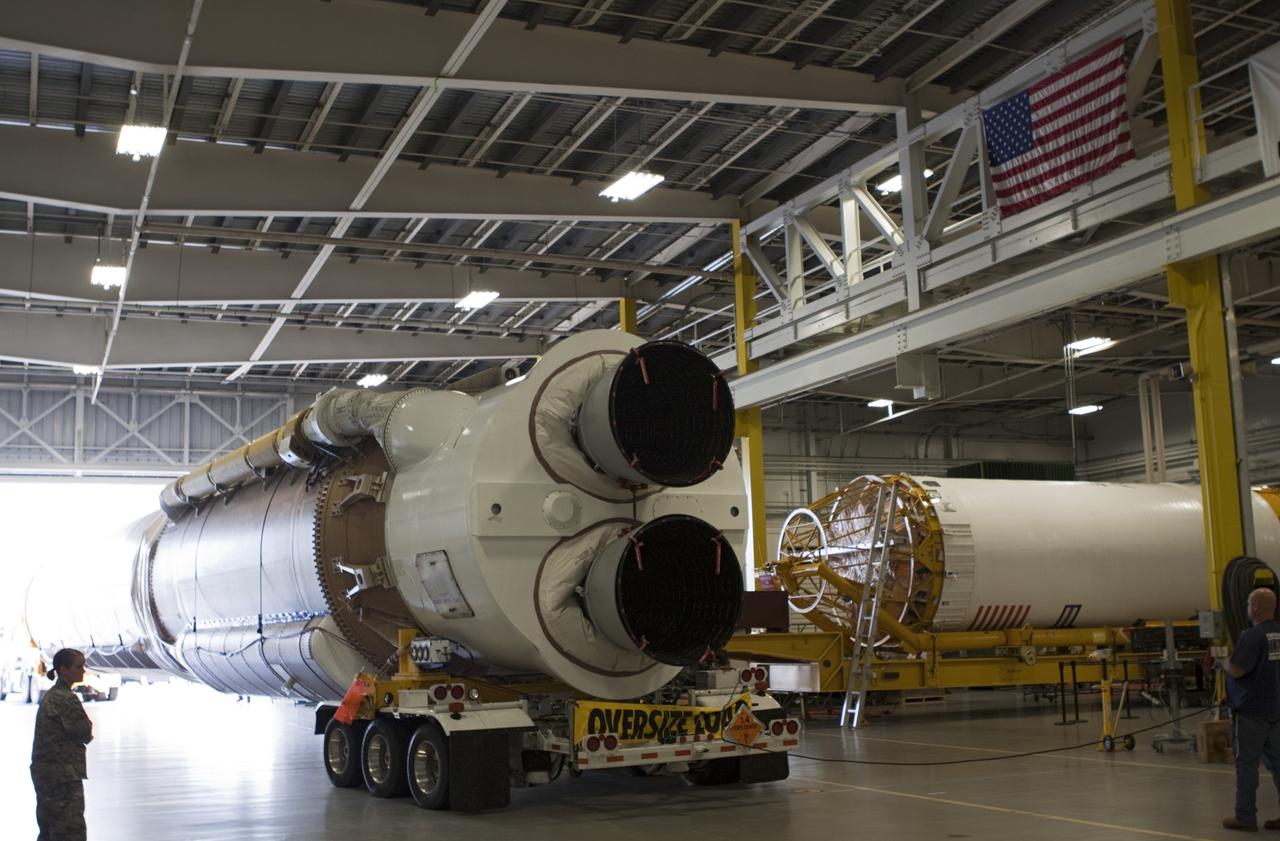
CAPE CANAVERAL, Fla. – The United Launch Alliance Atlas V first stage booster for NASA's Radiation Belt Storm Probes enters the Atlas Spaceflight Operations Center, or ASOC, at Cape Canaveral Air Force Station in Florida. At right is the rocket's Centaur upper stage. The Radiation Belt Storm Probes, or RBSP, mission will help us understand the sun’s influence on Earth and near-Earth space by studying the Earth’s radiation belts on various scales of space and time. For more information, visit http://www.nasa.gov/rbsp. Photo credit: NASA/Jim Grossmann
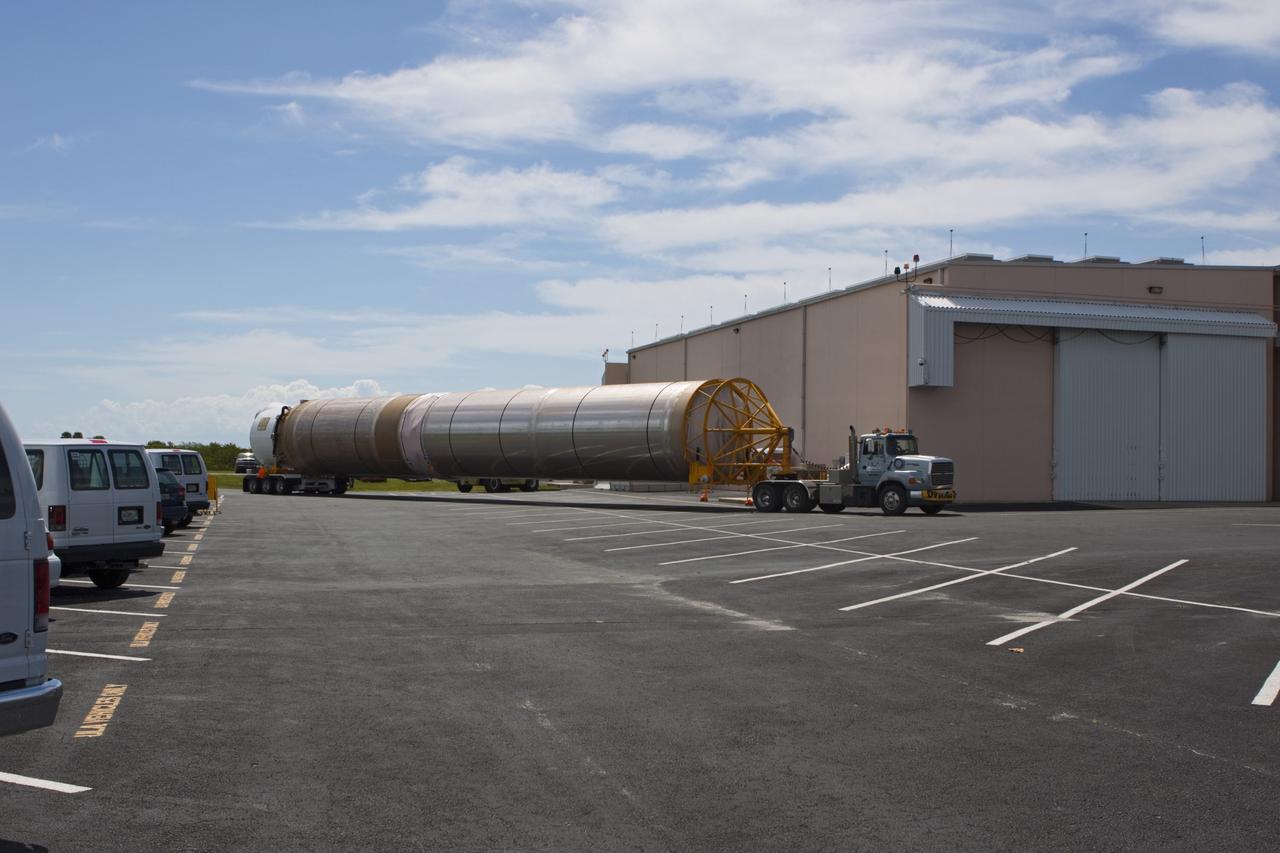
CAPE CANAVERAL, Fla. – The United Launch Alliance Atlas V first stage booster for NASA's Radiation Belt Storm Probes mission arrives at the Atlas Spaceflight Operations Center, or ASOC, at Cape Canaveral Air Force Station in Florida. The Radiation Belt Storm Probes, or RBSP, mission will help us understand the sun’s influence on Earth and near-Earth space by studying the Earth’s radiation belts on various scales of space and time. For more information, visit http://www.nasa.gov/rbsp. Photo credit: NASA/Jim Grossmann
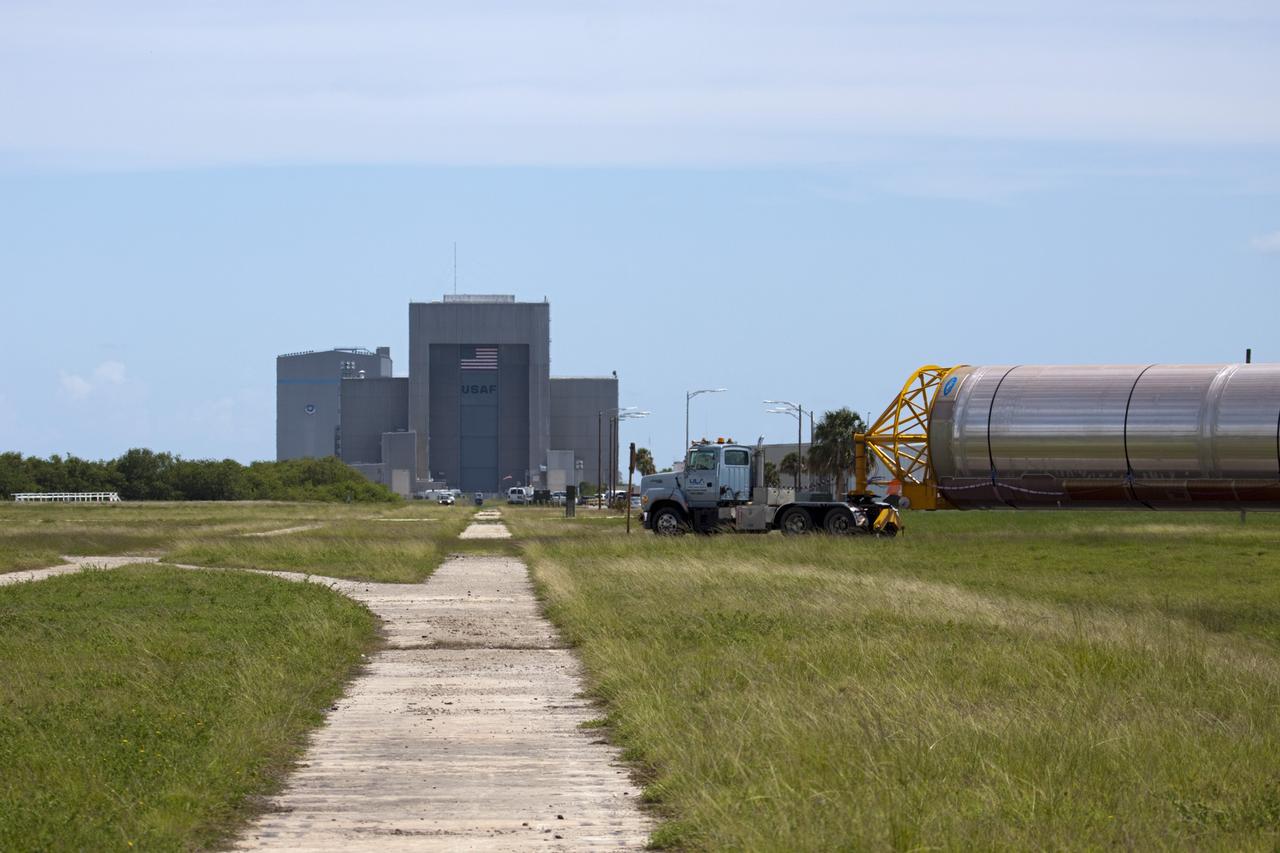
CAPE CANAVERAL, Fla. – The United Launch Alliance Atlas V first stage booster for NASA's Radiation Belt Storm Probes mission approaches the Atlas Spaceflight Operations Center, or ASOC, at Cape Canaveral Air Force Station in Florida. The Radiation Belt Storm Probes, or RBSP, mission will help us understand the sun’s influence on Earth and near-Earth space by studying the Earth’s radiation belts on various scales of space and time. For more information, visit http://www.nasa.gov/rbsp. Photo credit: NASA/Jim Grossmann
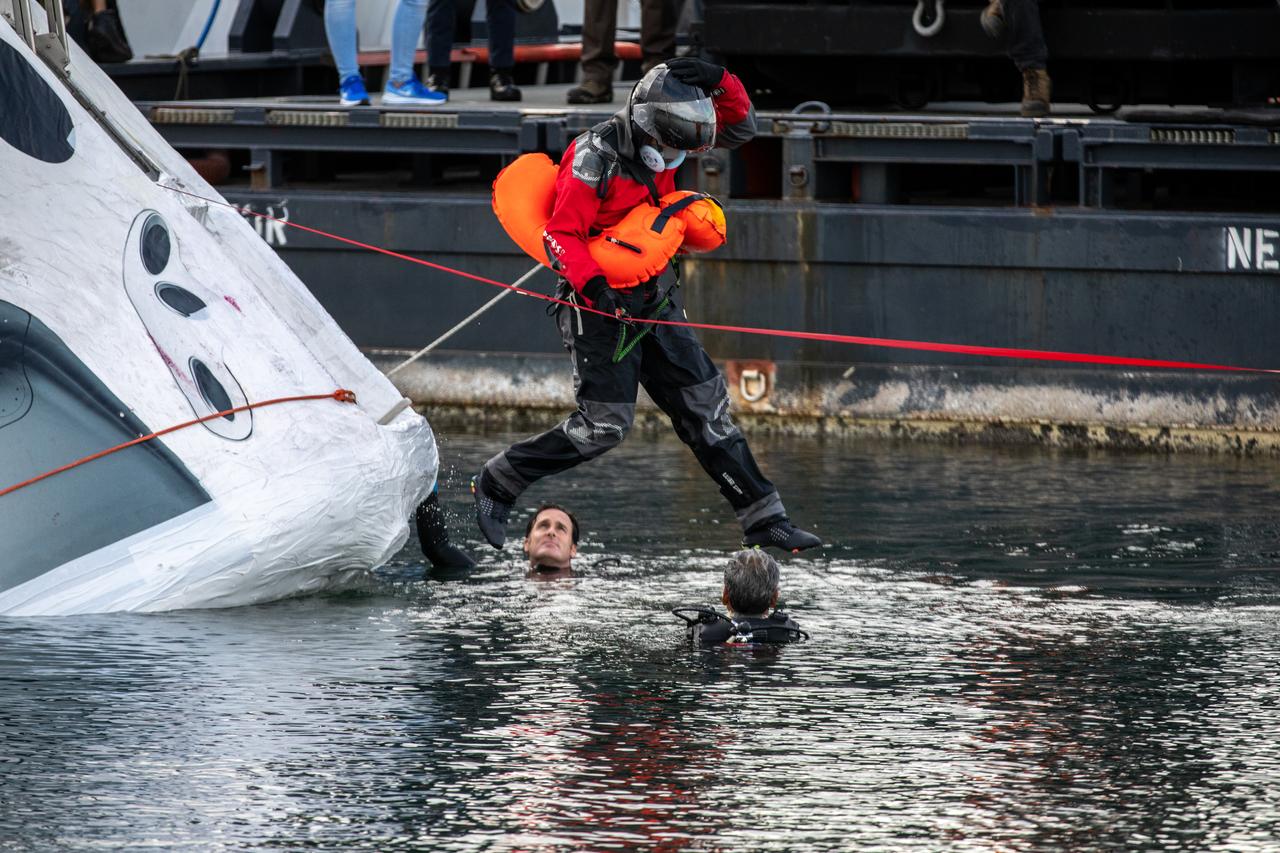
NASA astronauts Shane Kimbrough and Megan McArthur, Japan Aerospace Exploration Agency astronaut Akihiko Hoshide, and European Space Agency astronaut Thomas Pesquet participate in an egress training exercise in Port Canaveral, Florida, on Oct. 1, 2020, in preparation for NASA’s SpaceX Crew-2 mission as part of the agency’s Commercial Crew Program. The exercise involved simulating an emergency situation after splashdown of the Crew Dragon spacecraft. Using a mock-up of the Crew Dragon, the crew practiced exiting the capsule and jumping into the water. Crew-2 is targeted to launch from Kennedy Space Center’s Launch Complex 39A in spring 2021.
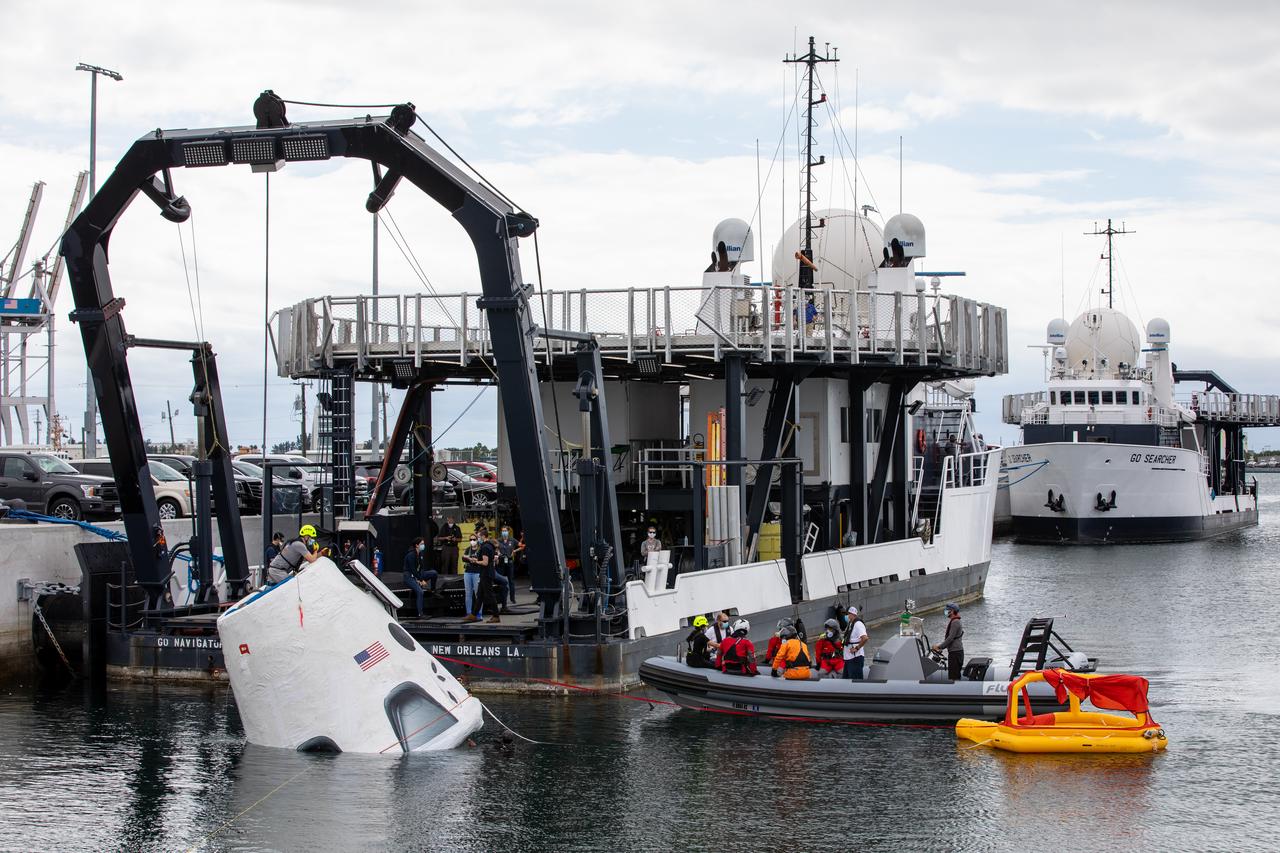
NASA astronauts Shane Kimbrough and Megan McArthur, Japan Aerospace Exploration Agency astronaut Akihiko Hoshide, and European Space Agency astronaut Thomas Pesquet participate in an egress training exercise in Port Canaveral, Florida, on Oct. 1, 2020, in preparation for NASA’s SpaceX Crew-2 mission as part of the agency’s Commercial Crew Program. The exercise involved simulating an emergency situation after splashdown of the Crew Dragon spacecraft. Using a mock-up of the Crew Dragon, the crew practiced exiting the capsule and jumping into the water. Crew-2 is targeted to launch from Kennedy Space Center’s Launch Complex 39A in spring 2021.
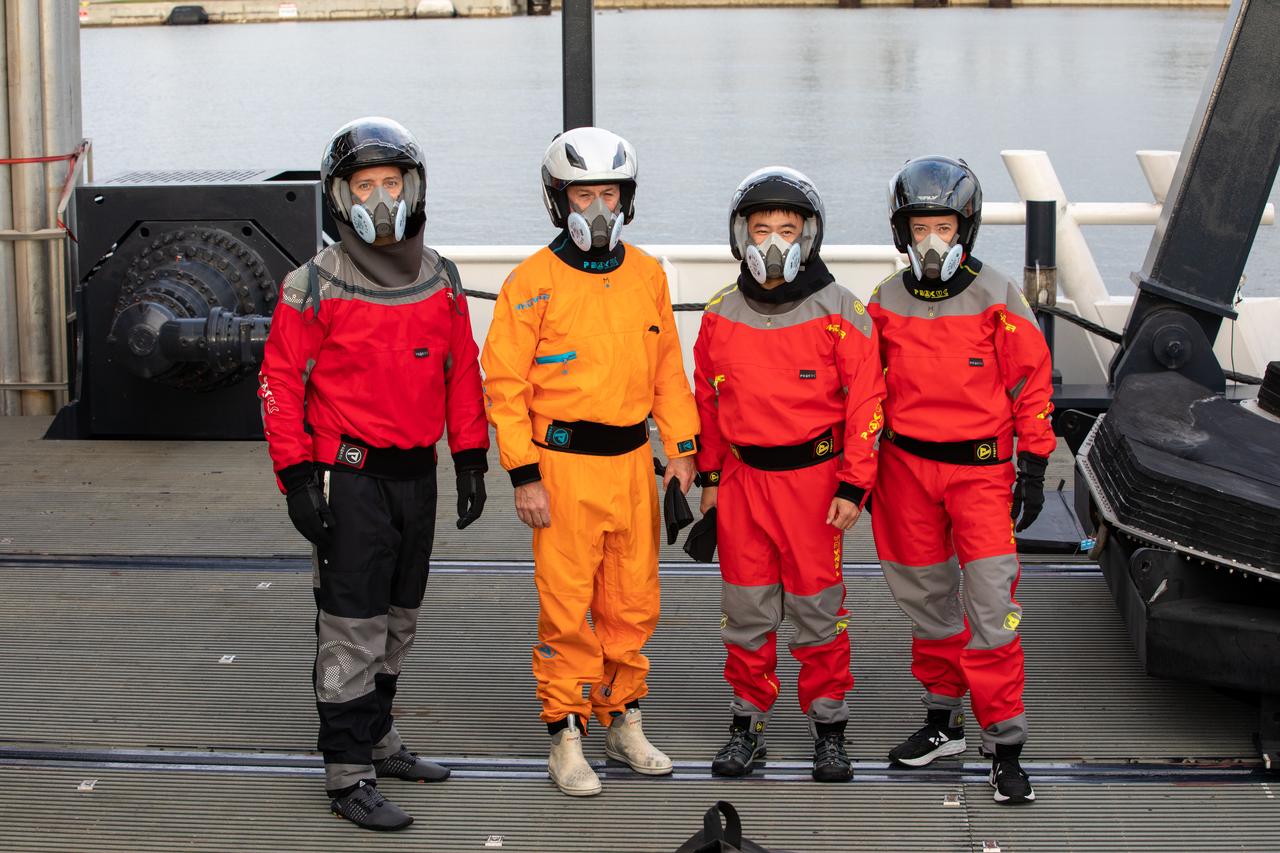
NASA astronauts Shane Kimbrough and Megan McArthur, Japan Aerospace Exploration Agency astronaut Akihiko Hoshide, and European Space Agency astronaut Thomas Pesquet participate in an egress training exercise in Port Canaveral, Florida, on Oct. 1, 2020, in preparation for NASA’s SpaceX Crew-2 mission as part of the agency’s Commercial Crew Program. The exercise involved simulating an emergency situation after splashdown of the Crew Dragon spacecraft. Using a mock-up of the Crew Dragon, the crew practiced exiting the capsule and jumping into the water. Crew-2 is targeted to launch from Kennedy Space Center’s Launch Complex 39A in spring 2021.
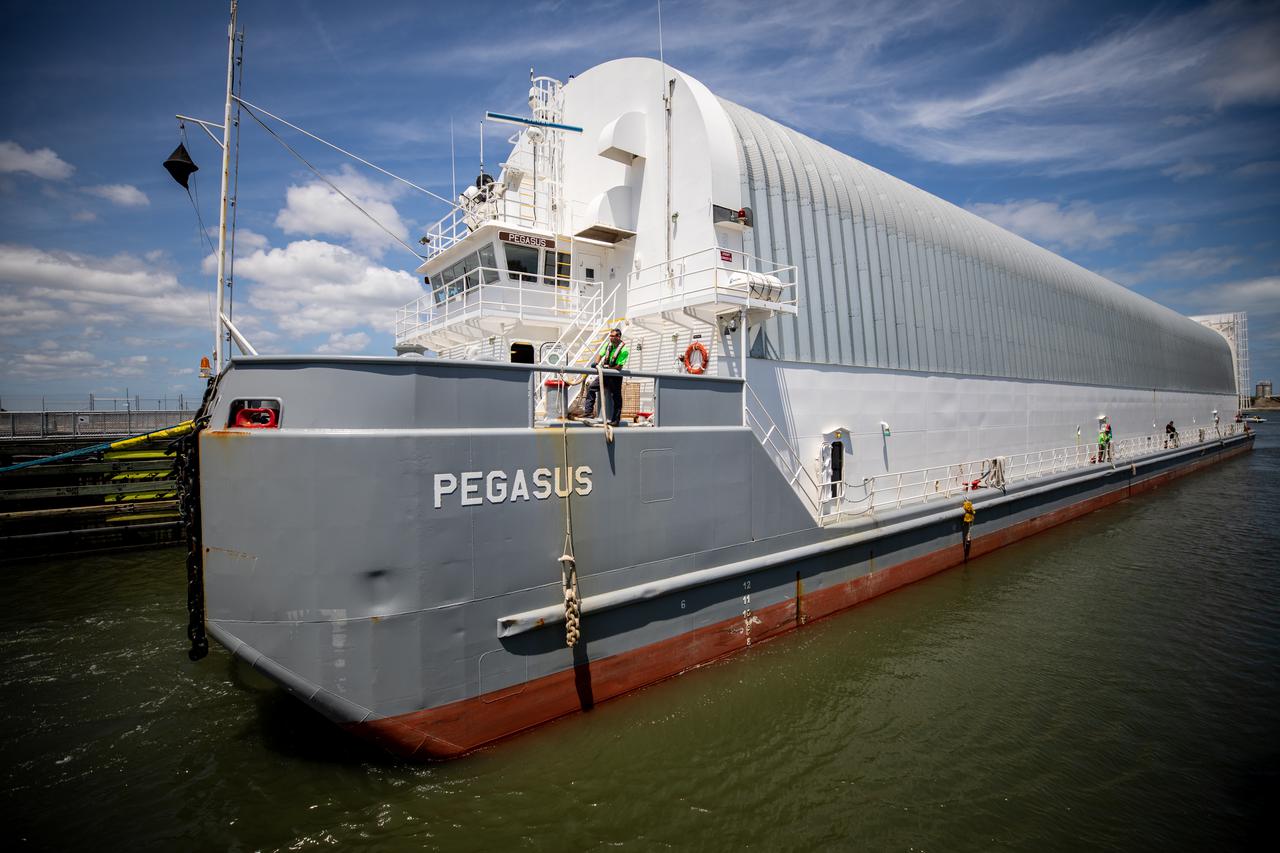
The Pegasus barge, carrying the mighty Space Launch System (SLS) core stage, passes through Port Canaveral on its way to NASA’s Kennedy Space Center in Florida on April 27, 2021, after journeying from the agency’s Stennis Space Center in Mississippi. The core stage is the final piece of Artemis hardware to arrive at the spaceport and will be offloaded and moved to Kennedy’s Vehicle Assembly Building, where it will be prepared for integration atop the mobile launcher with the completed stack of solid rocket boosters ahead of the Artemis I launch. The first in a series of increasingly complex missions, Artemis I will test SLS and Orion as an integrated system prior to crewed flights to the Moon.
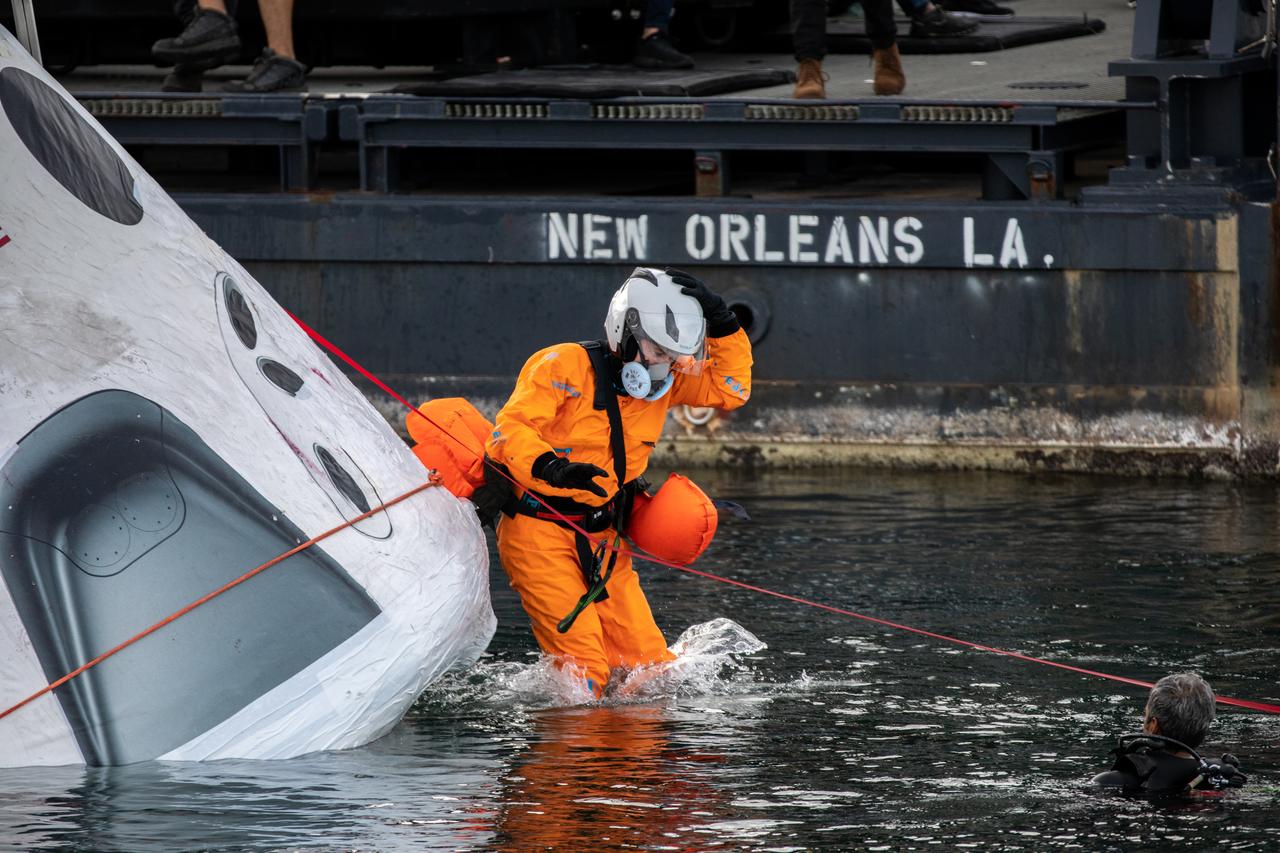
NASA astronauts Shane Kimbrough and Megan McArthur, Japan Aerospace Exploration Agency astronaut Akihiko Hoshide, and European Space Agency astronaut Thomas Pesquet participate in an egress training exercise in Port Canaveral, Florida, on Oct. 1, 2020, in preparation for NASA’s SpaceX Crew-2 mission as part of the agency’s Commercial Crew Program. The exercise involved simulating an emergency situation after splashdown of the Crew Dragon spacecraft. Using a mock-up of the Crew Dragon, the crew practiced exiting the capsule and jumping into the water. Crew-2 is targeted to launch from Kennedy Space Center’s Launch Complex 39A in spring 2021.
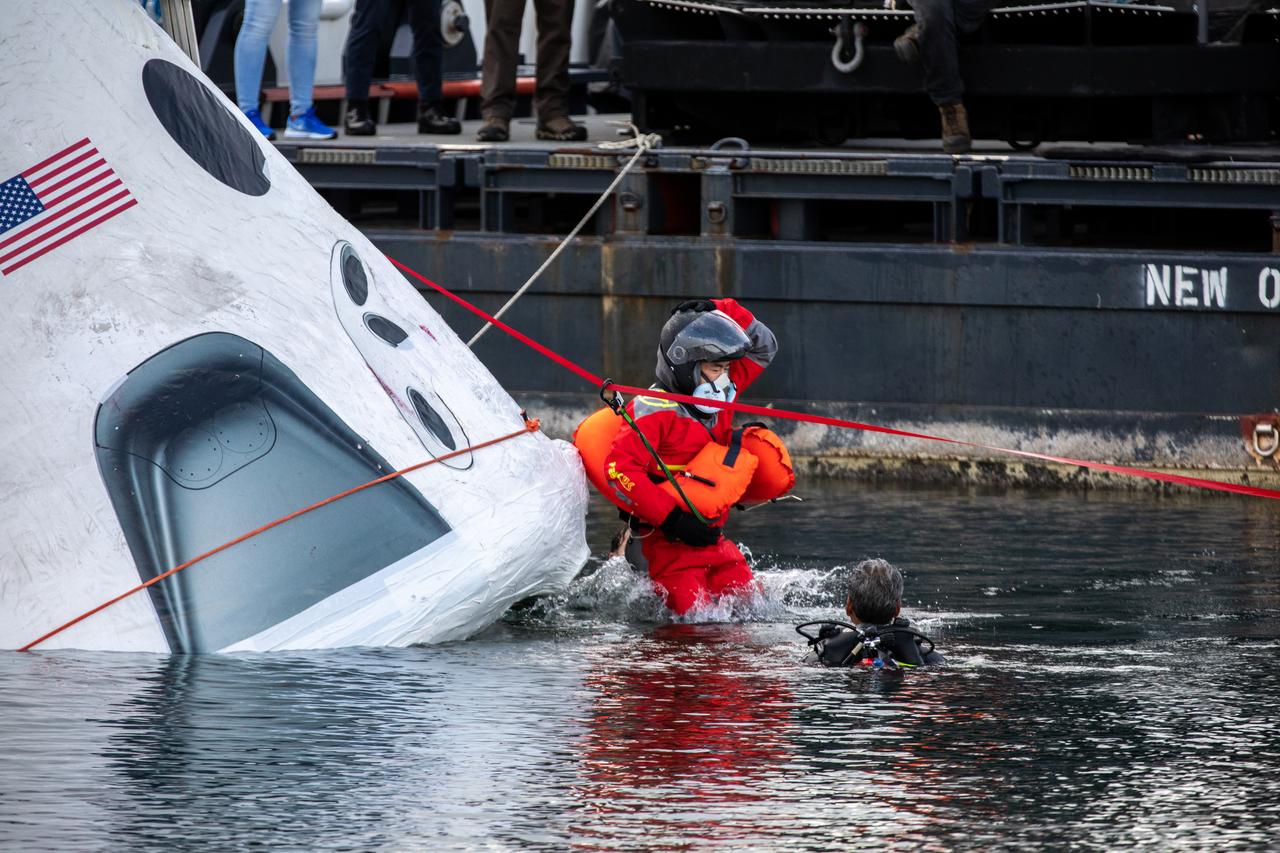
NASA astronauts Shane Kimbrough and Megan McArthur, Japan Aerospace Exploration Agency astronaut Akihiko Hoshide, and European Space Agency astronaut Thomas Pesquet participate in an egress training exercise in Port Canaveral, Florida, on Oct. 1, 2020, in preparation for NASA’s SpaceX Crew-2 mission as part of the agency’s Commercial Crew Program. The exercise involved simulating an emergency situation after splashdown of the Crew Dragon spacecraft. Using a mock-up of the Crew Dragon, the crew practiced exiting the capsule and jumping into the water. Crew-2 is targeted to launch from Kennedy Space Center’s Launch Complex 39A in spring 2021.
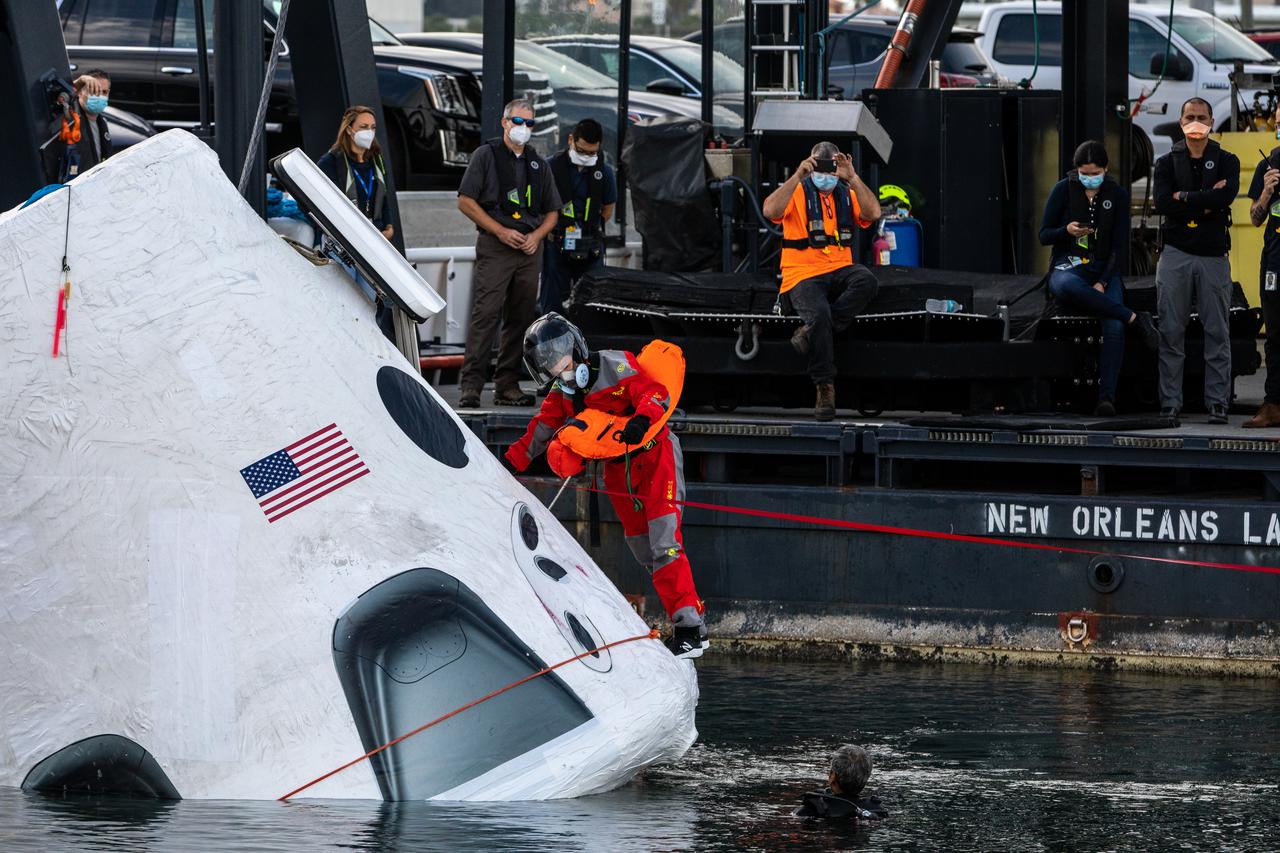
NASA astronauts Shane Kimbrough and Megan McArthur, Japan Aerospace Exploration Agency astronaut Akihiko Hoshide, and European Space Agency astronaut Thomas Pesquet participate in an egress training exercise in Port Canaveral, Florida, on Oct. 1, 2020, in preparation for NASA’s SpaceX Crew-2 mission as part of the agency’s Commercial Crew Program. The exercise involved simulating an emergency situation after splashdown of the Crew Dragon spacecraft. Using a mock-up of the Crew Dragon, the crew practiced exiting the capsule and jumping into the water. Crew-2 is targeted to launch from Kennedy Space Center’s Launch Complex 39A in spring 2021.
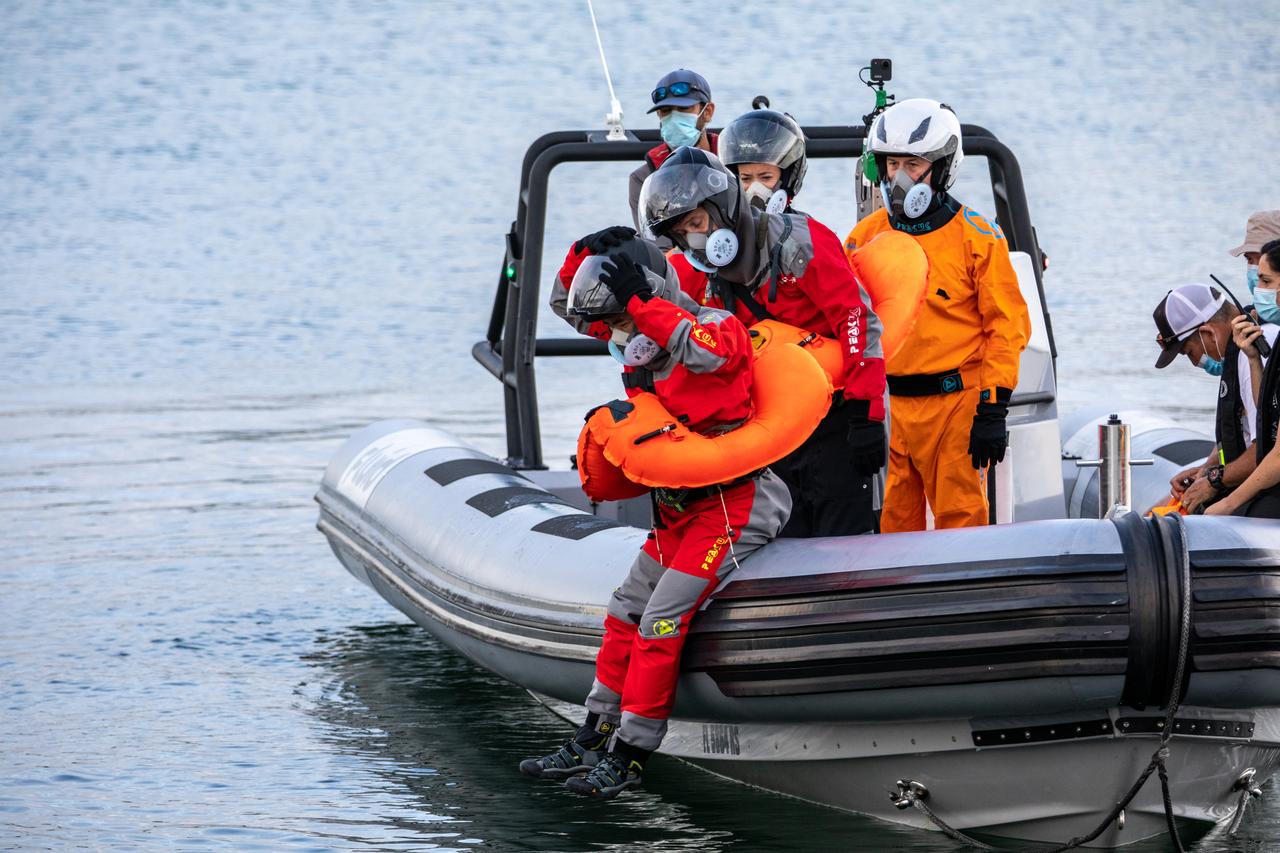
NASA astronauts Shane Kimbrough and Megan McArthur, Japan Aerospace Exploration Agency astronaut Akihiko Hoshide, and European Space Agency astronaut Thomas Pesquet participate in an egress training exercise in Port Canaveral, Florida, on Oct. 1, 2020, in preparation for NASA’s SpaceX Crew-2 mission as part of the agency’s Commercial Crew Program. The exercise involved simulating an emergency situation after splashdown of the Crew Dragon spacecraft. Using a mock-up of the Crew Dragon, the crew practiced exiting the capsule and jumping into the water. Crew-2 is targeted to launch from Kennedy Space Center’s Launch Complex 39A in spring 2021.
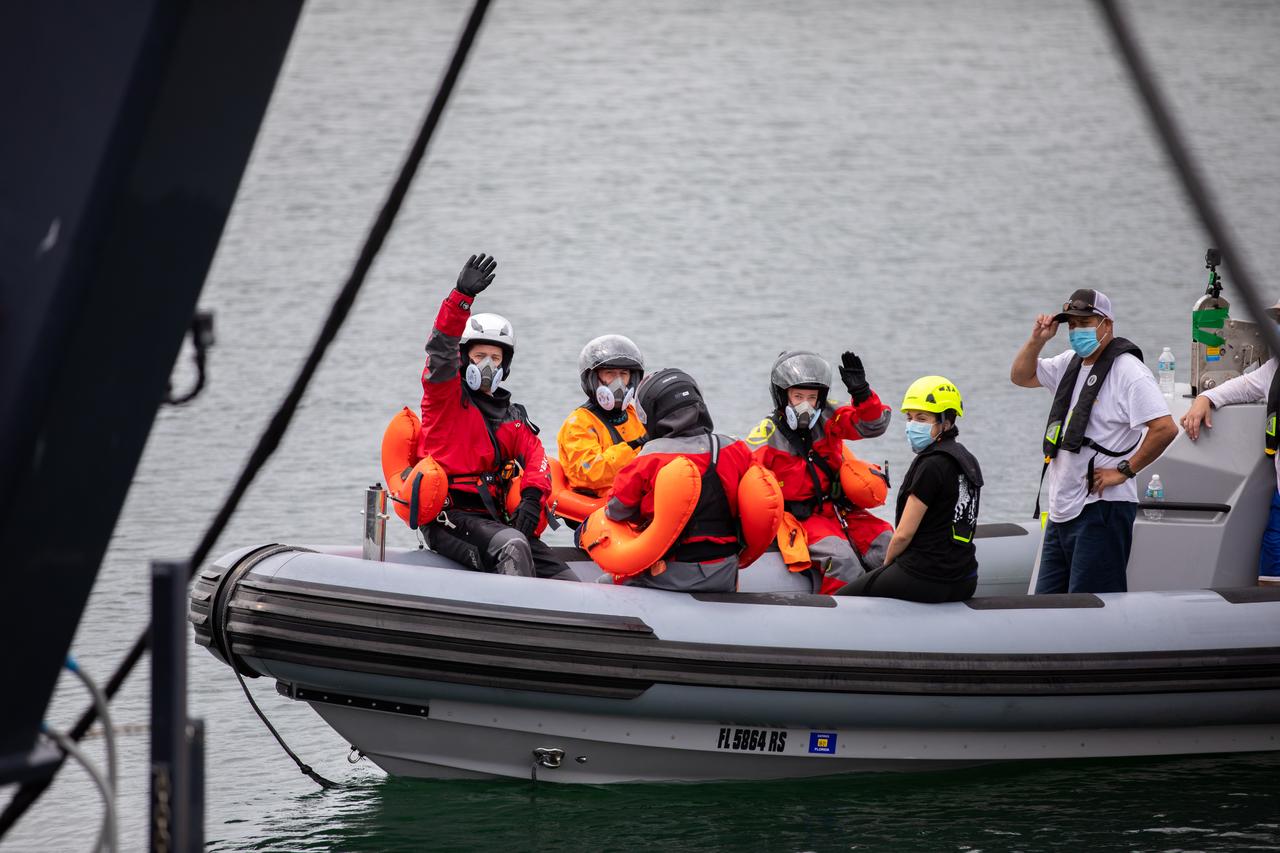
NASA astronauts Shane Kimbrough and Megan McArthur, Japan Aerospace Exploration Agency astronaut Akihiko Hoshide, and European Space Agency astronaut Thomas Pesquet participate in an egress training exercise in Port Canaveral, Florida, on Oct. 1, 2020, in preparation for NASA’s SpaceX Crew-2 mission as part of the agency’s Commercial Crew Program. The exercise involved simulating an emergency situation after splashdown of the Crew Dragon spacecraft. Using a mock-up of the Crew Dragon, the crew practiced exiting the capsule and jumping into the water. Crew-2 is targeted to launch from Kennedy Space Center’s Launch Complex 39A in spring 2021.
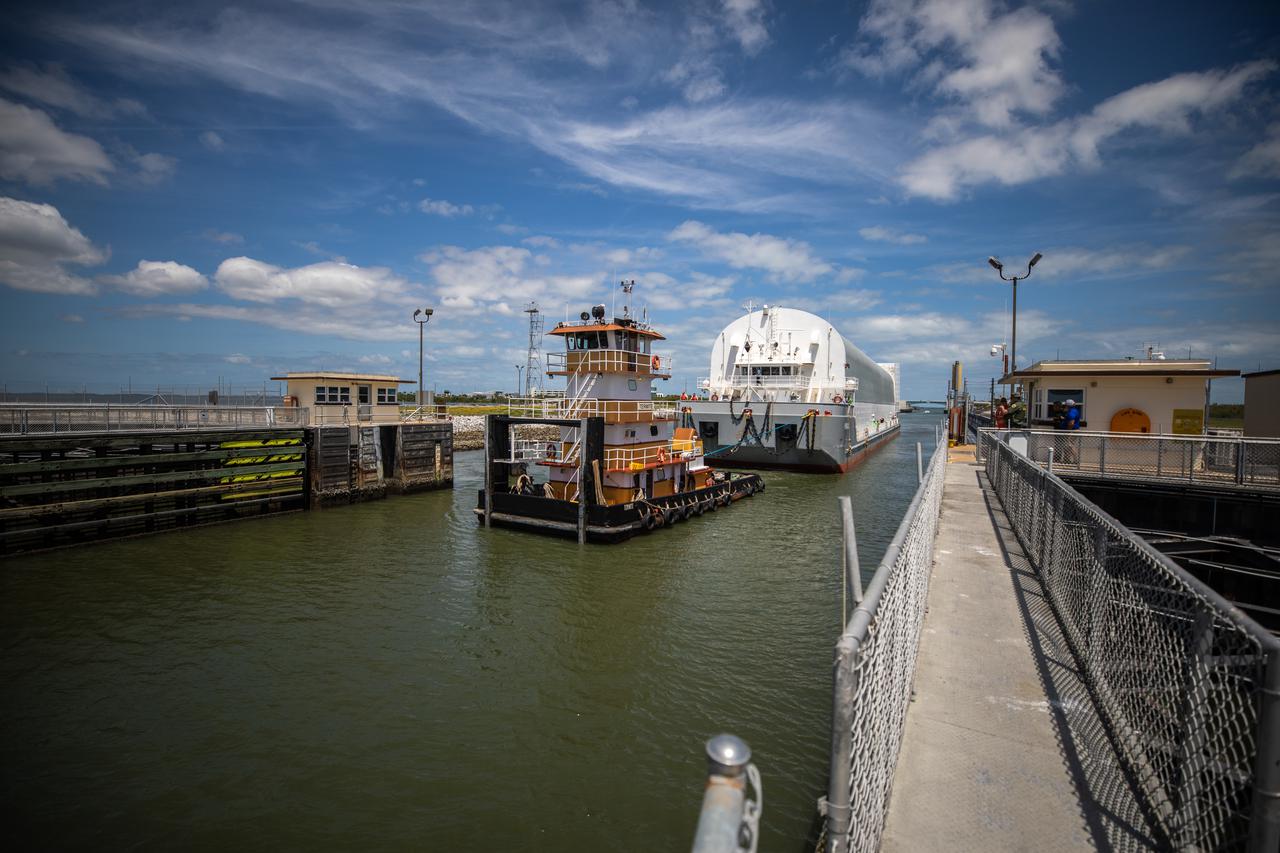
After its journey from NASA’s Stennis Space Center in Mississippi aboard the Pegasus barge, the mighty Space Launch System (SLS) core stage passes through Port Canaveral on its way to the agency’s Kennedy Space Center in Florida on April 27, 2021. The core stage is the final piece of Artemis hardware to arrive at the spaceport and will be offloaded and moved to Kennedy’s Vehicle Assembly Building, where it will be prepared for integration atop the mobile launcher with the completed stack of solid rocket boosters ahead of the Artemis I launch. The first in a series of increasingly complex missions, Artemis I will test SLS and Orion as an integrated system prior to crewed flights to the Moon.
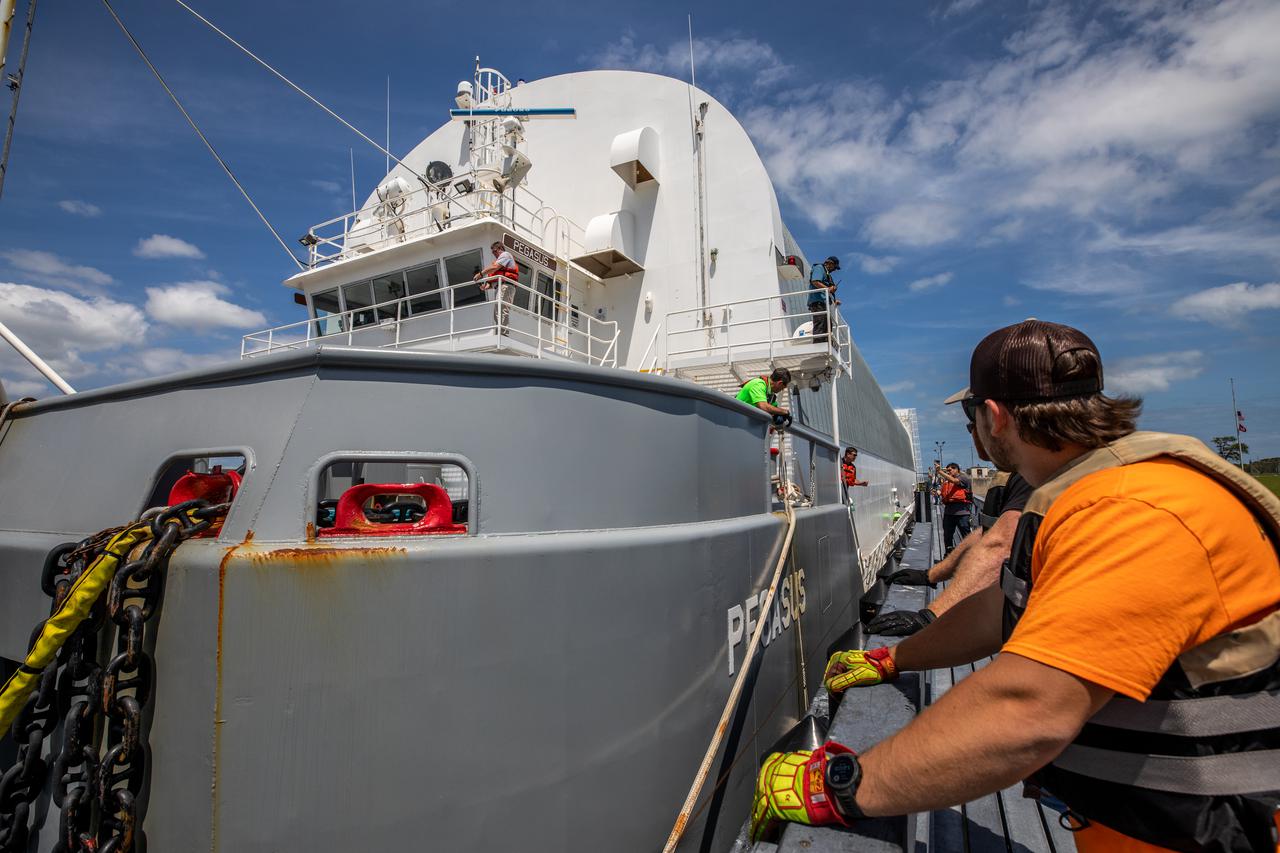
After its journey from NASA’s Stennis Space Center in Mississippi aboard the Pegasus barge, the mighty Space Launch System (SLS) core stage passes through Port Canaveral on its way to the agency’s Kennedy Space Center in Florida on April 27, 2021. The core stage is the final piece of Artemis hardware to arrive at the spaceport and will be offloaded and moved to Kennedy’s Vehicle Assembly Building, where it will be prepared for integration atop the mobile launcher with the completed stack of solid rocket boosters ahead of the Artemis I launch. The first in a series of increasingly complex missions, Artemis I will test SLS and Orion as an integrated system prior to crewed flights to the Moon.
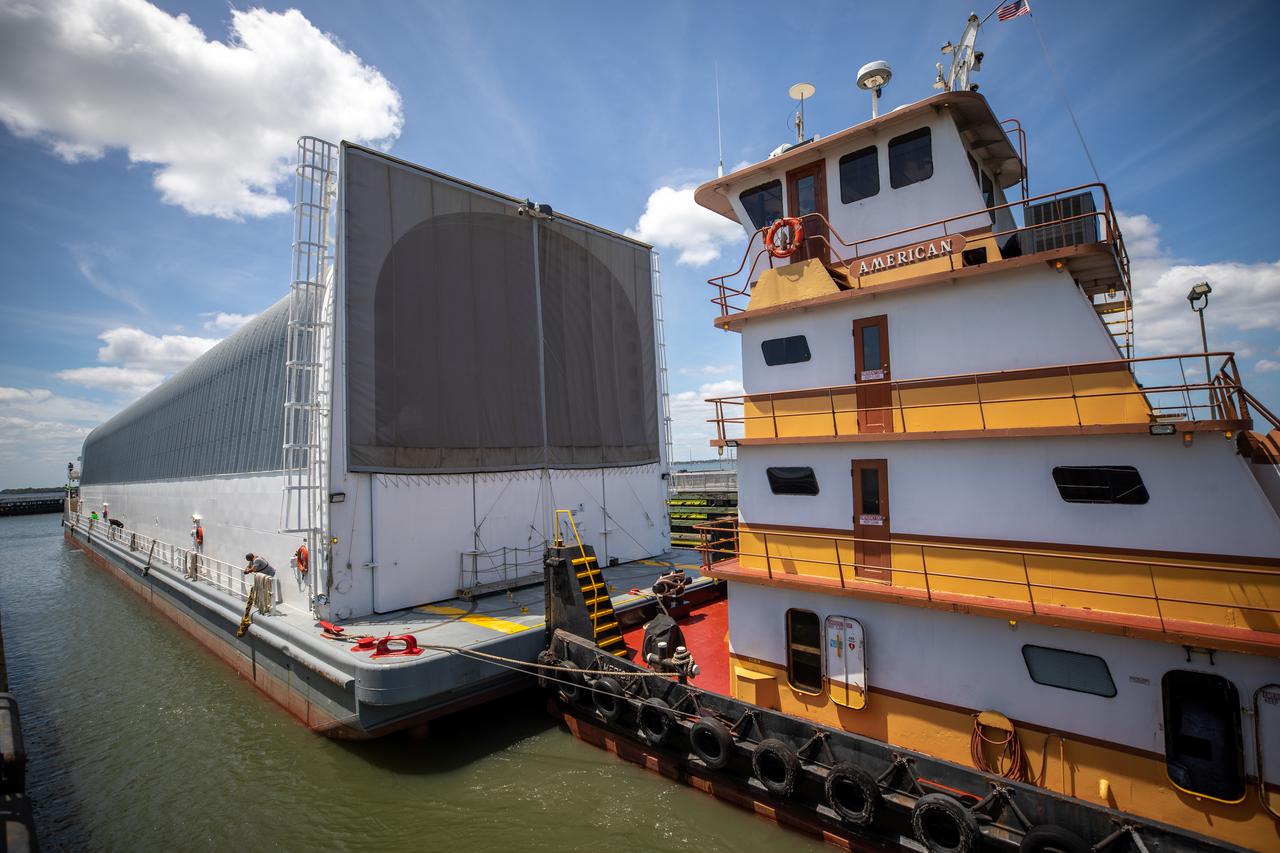
The Pegasus barge, carrying the mighty Space Launch System (SLS) core stage, passes through Port Canaveral on its way to NASA’s Kennedy Space Center in Florida on April 27, 2021, after journeying from the agency’s Stennis Space Center in Mississippi. The core stage is the final piece of Artemis hardware to arrive at the spaceport and will be offloaded and moved to Kennedy’s Vehicle Assembly Building, where it will be prepared for integration atop the mobile launcher with the completed stack of solid rocket boosters ahead of the Artemis I launch. The first in a series of increasingly complex missions, Artemis I will test SLS and Orion as an integrated system prior to crewed flights to the Moon.
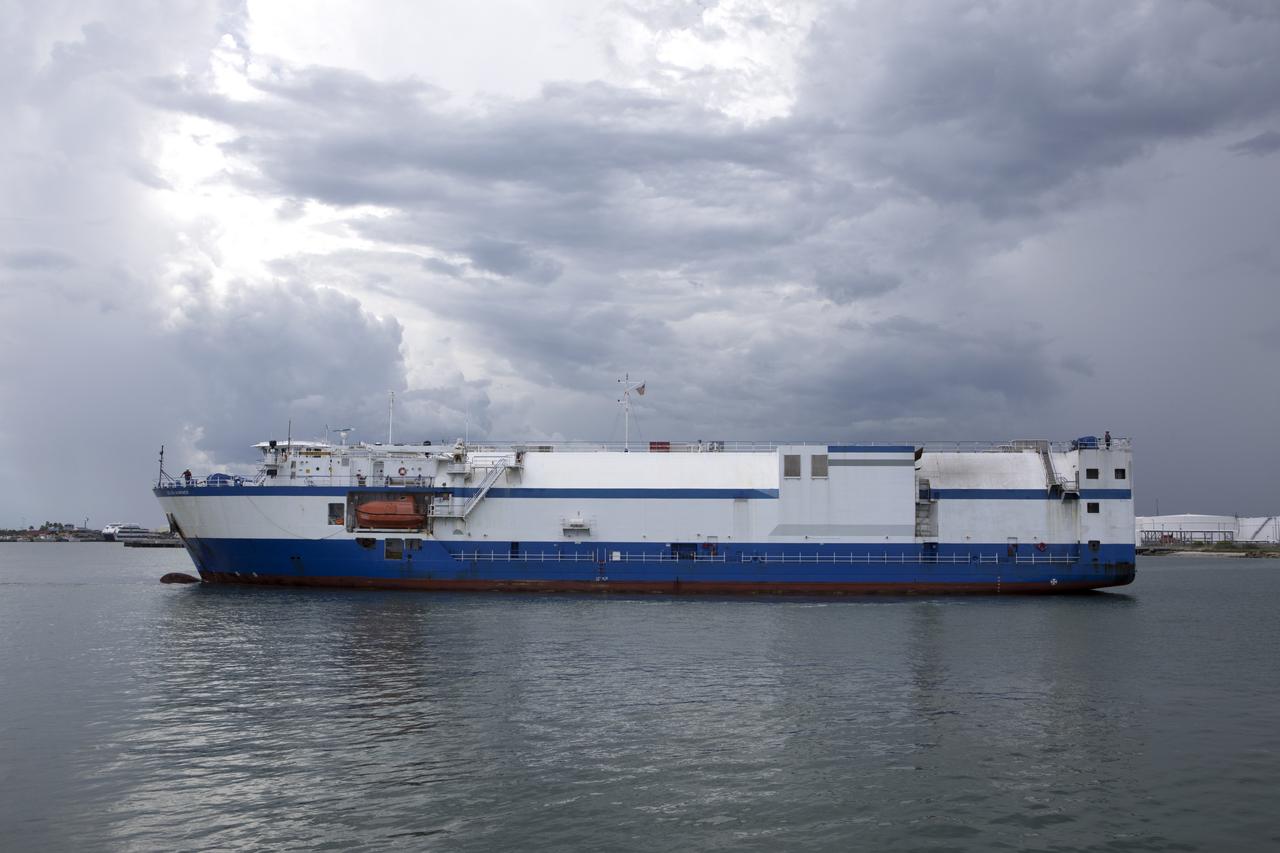
The United Launch Alliance (ULA) Mariner arrives at Port Canaveral in Florida carrying an Atlas V rocket booster bound for nearby Cape Canaveral Air Force Station. The rocket is scheduled to launch the Tracking and Data Relay Satellite, TDRS-M. It will be the latest spacecraft destined for the agency's constellation of communications satellites that allows nearly continuous contact with orbiting spacecraft ranging from the International Space Station and Hubble Space Telescope to the array of scientific observatories. Liftoff atop the ULA Atlas V rocket is scheduled to take place from Cape Canaveral's Space Launch Complex 41 on Aug. 3, 2017 at 9:02 a.m. EDT.
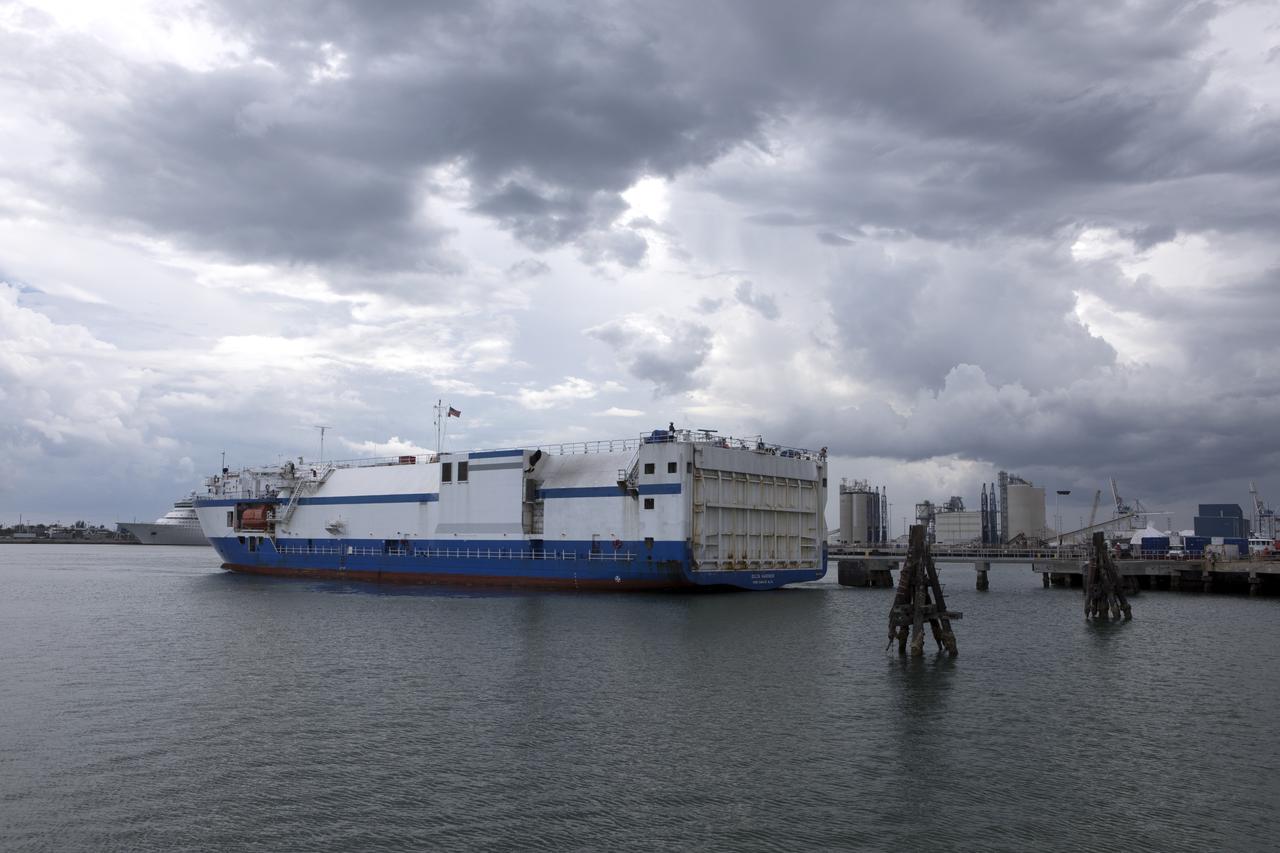
The United Launch Alliance (ULA) Mariner arrives at Port Canaveral in Florida carrying an Atlas V rocket booster bound for nearby Cape Canaveral Air Force Station. The rocket is scheduled to launch the Tracking and Data Relay Satellite, TDRS-M. It will be the latest spacecraft destined for the agency's constellation of communications satellites that allows nearly continuous contact with orbiting spacecraft ranging from the International Space Station and Hubble Space Telescope to the array of scientific observatories. Liftoff atop the ULA Atlas V rocket is scheduled to take place from Cape Canaveral's Space Launch Complex 41 on Aug. 3, 2017 at 9:02 a.m. EDT.
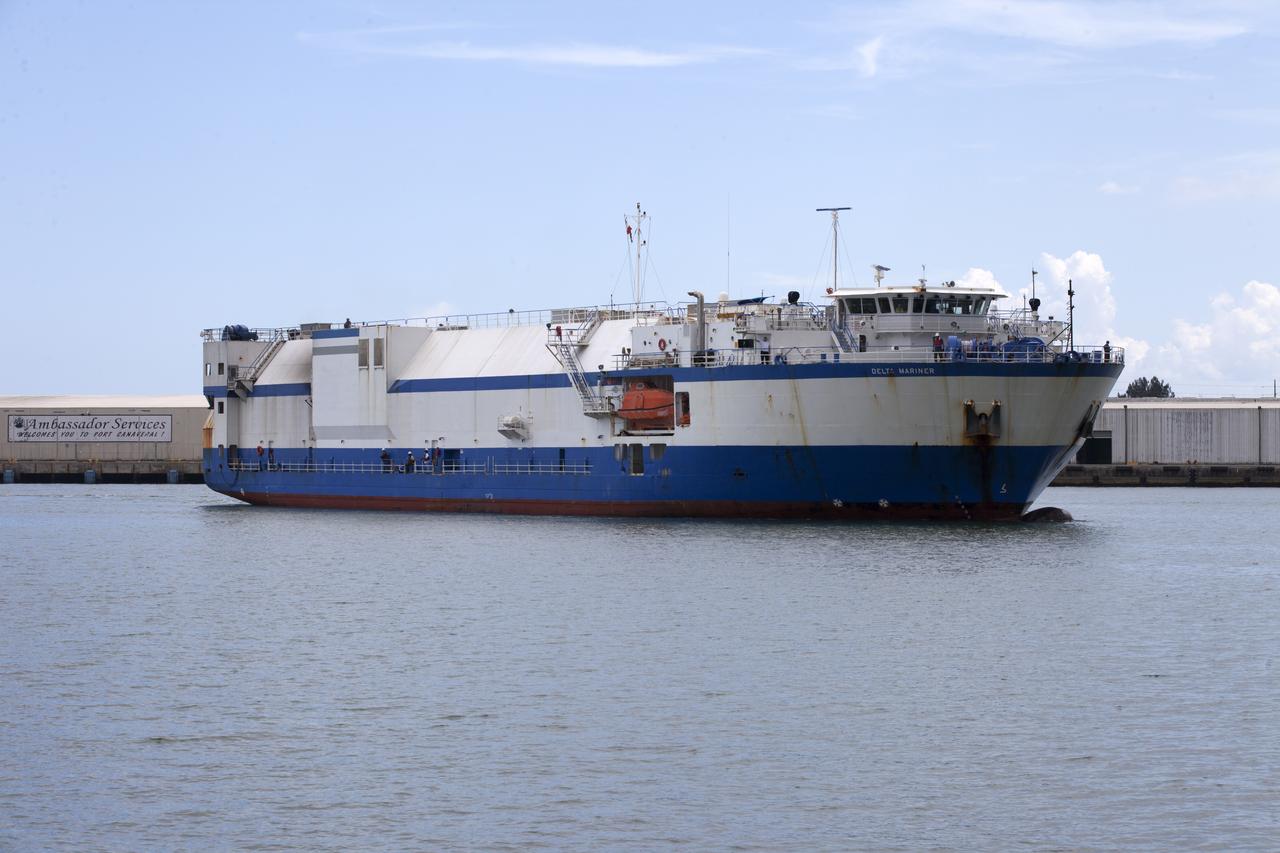
The United Launch Alliance (ULA) Mariner arrives at Port Canaveral in Florida carrying an Atlas V rocket booster bound for nearby Cape Canaveral Air Force Station. The rocket is scheduled to launch the Tracking and Data Relay Satellite, TDRS-M. It will be the latest spacecraft destined for the agency's constellation of communications satellites that allows nearly continuous contact with orbiting spacecraft ranging from the International Space Station and Hubble Space Telescope to the array of scientific observatories. Liftoff atop the ULA Atlas V rocket is scheduled to take place from Cape Canaveral's Space Launch Complex 41 on Aug. 3, 2017 at 9:02 a.m. EDT.
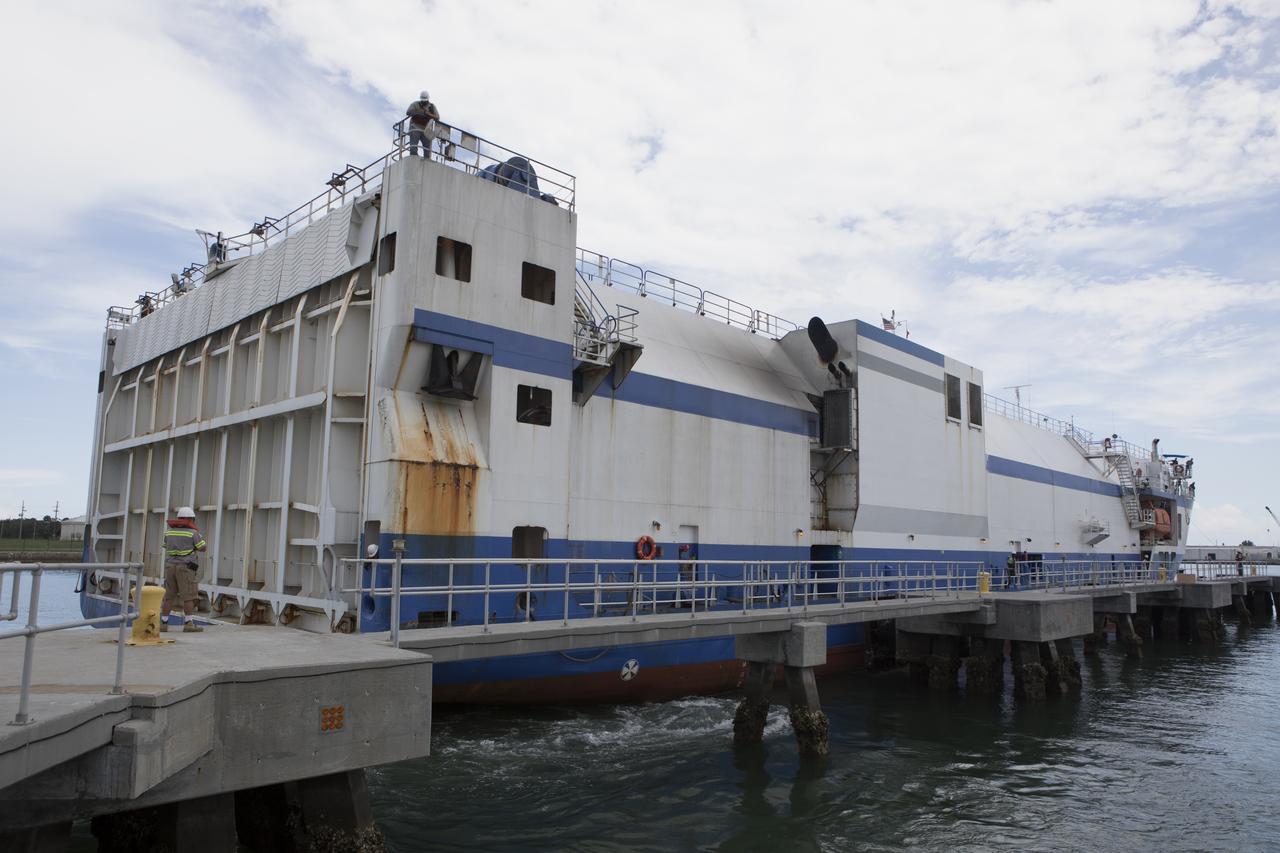
The United Launch Alliance (ULA) Mariner arrives at Port Canaveral in Florida carrying an Atlas V rocket booster bound for nearby Cape Canaveral Air Force Station. The rocket is scheduled to launch the Tracking and Data Relay Satellite, TDRS-M. It will be the latest spacecraft destined for the agency's constellation of communications satellites that allows nearly continuous contact with orbiting spacecraft ranging from the International Space Station and Hubble Space Telescope to the array of scientific observatories. Liftoff atop the ULA Atlas V rocket is scheduled to take place from Cape Canaveral's Space Launch Complex 41 on Aug. 3, 2017 at 9:02 a.m. EDT.
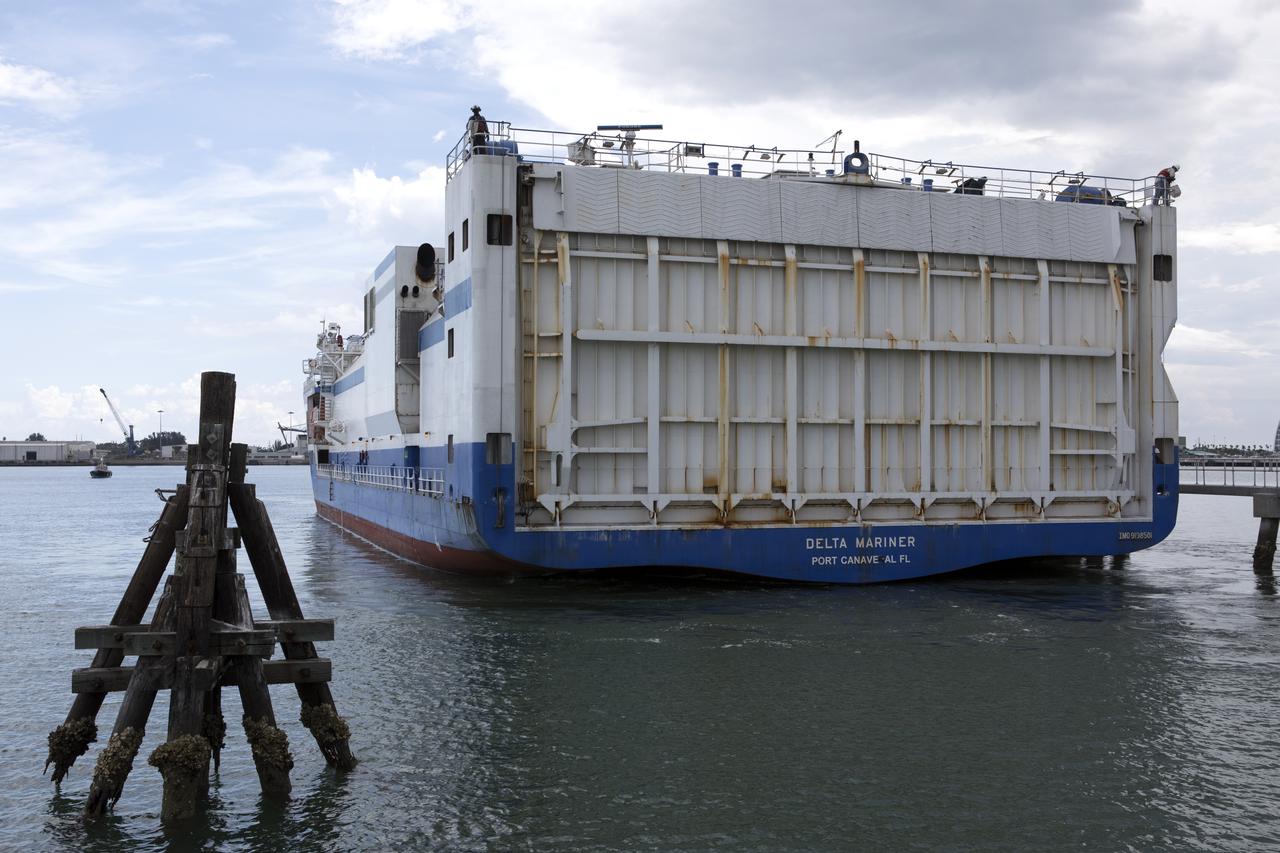
The United Launch Alliance (ULA) Mariner arrives at Port Canaveral in Florida carrying an Atlas V rocket booster bound for nearby Cape Canaveral Air Force Station. The rocket is scheduled to launch the Tracking and Data Relay Satellite, TDRS-M. It will be the latest spacecraft destined for the agency's constellation of communications satellites that allows nearly continuous contact with orbiting spacecraft ranging from the International Space Station and Hubble Space Telescope to the array of scientific observatories. Liftoff atop the ULA Atlas V rocket is scheduled to take place from Cape Canaveral's Space Launch Complex 41 on Aug. 3, 2017 at 9:02 a.m. EDT.

PORT CANAVERAL, Fla. – Bruce Deardoff, Canaveral Port Authority Commission chairman, spoke during opening ceremonies at the Historically Underutilized Business Zone, or HUBZone, Industry Day and Expo 2012. The event was hosted for business leaders who are interested in learning about government contracting opportunities and what local and national vendors have to offer. The expo was held in Cruise Terminal 4 at Port Canaveral, Fla. The annual trade show is sponsored by Kennedy's Prime Contractor Board, the U.S. Air Force 45th Space Wing and the Canaveral Port Authority. It featured about 175 large and small businesses and government exhibitors from Brevard County and across the nation. Photo credit: NASA/ Kim Shiflett
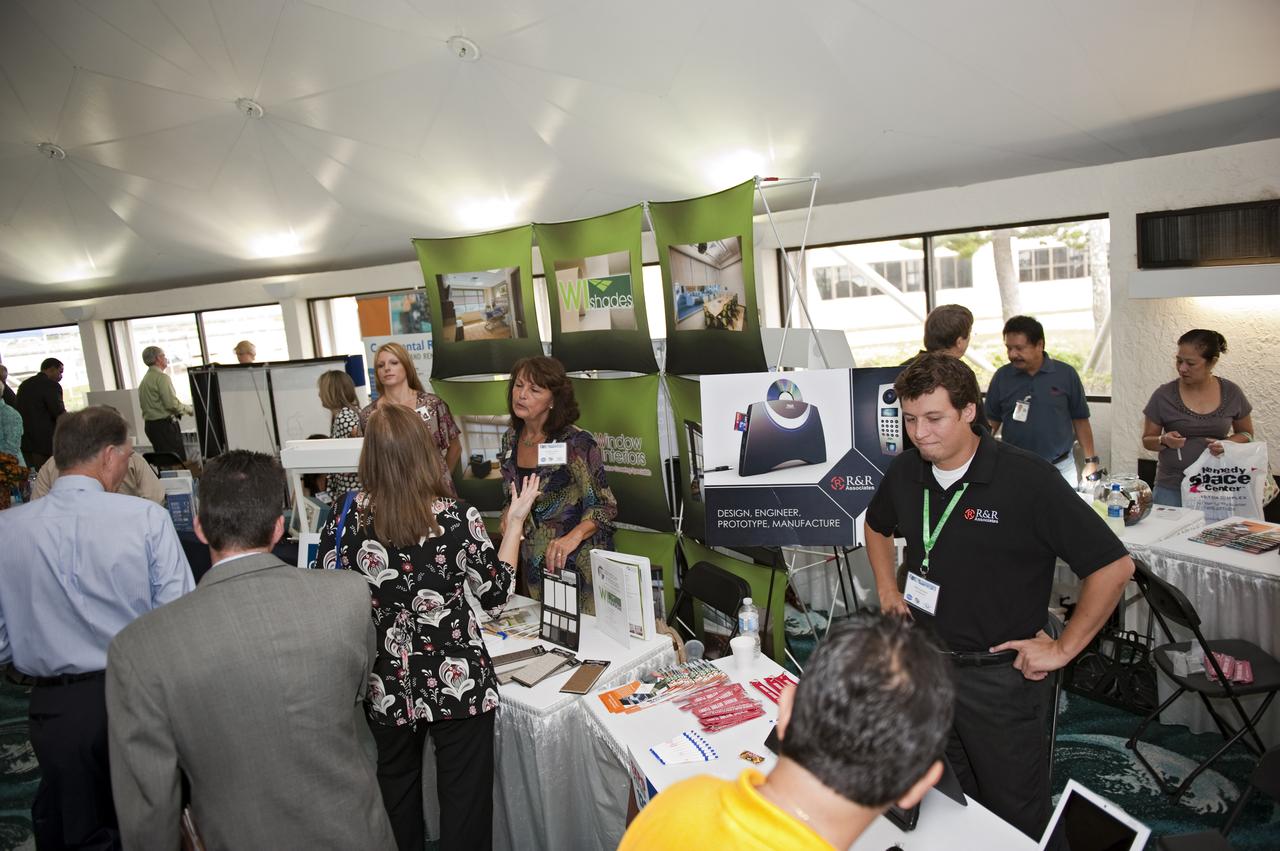
NASA SPONSORED BUSINESS EXPO AT PORT CANAVERAL
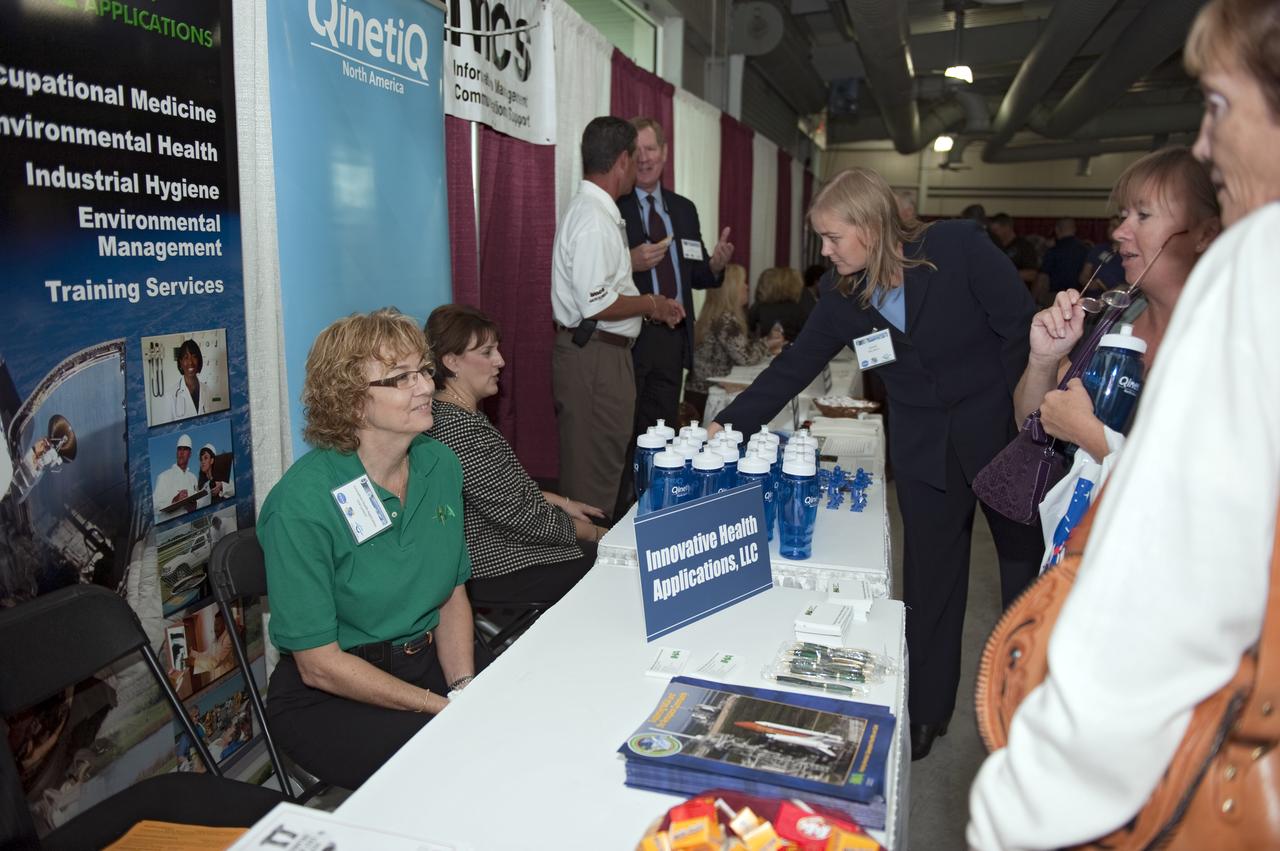
NASA SPONSORED BUSINESS EXPO AT PORT CANAVERAL
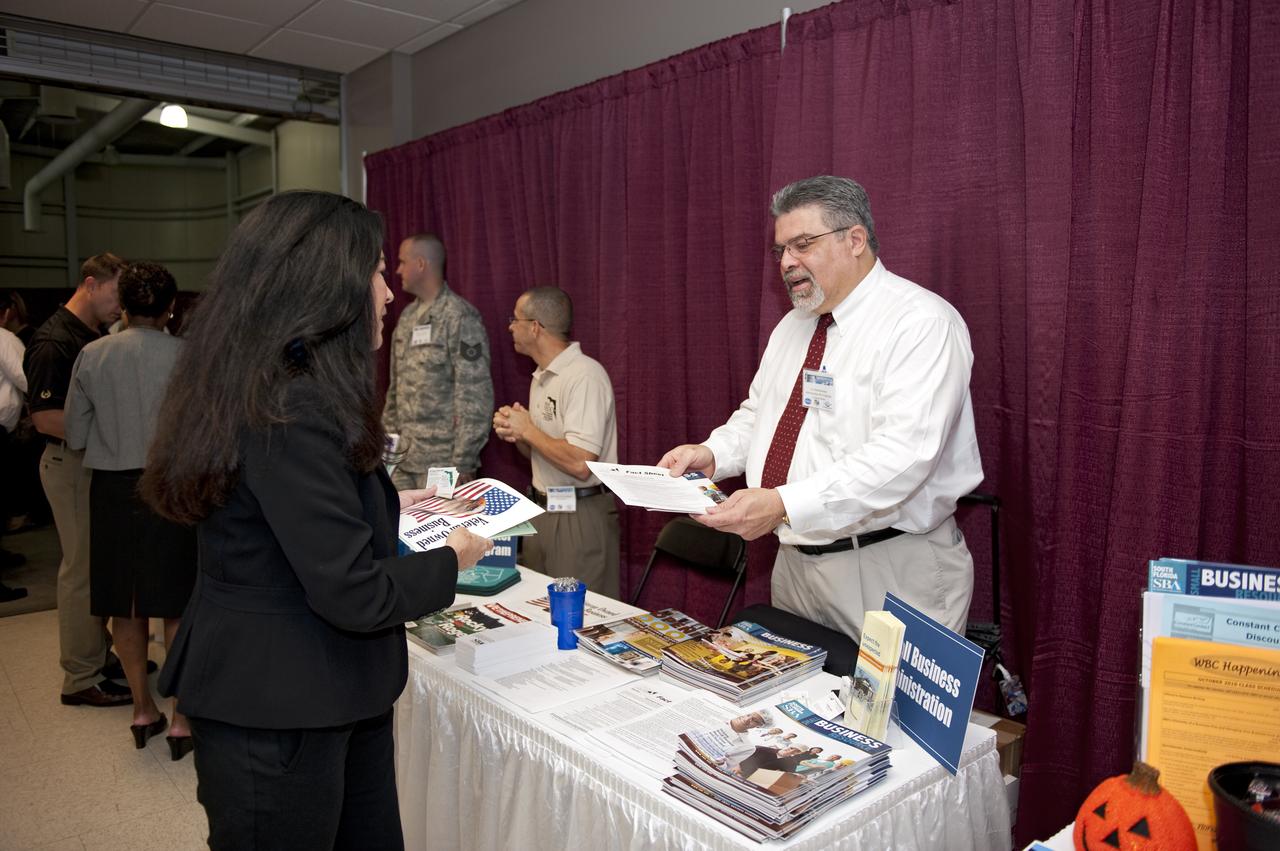
NASA SPONSORED BUSINESS EXPO AT PORT CANAVERAL
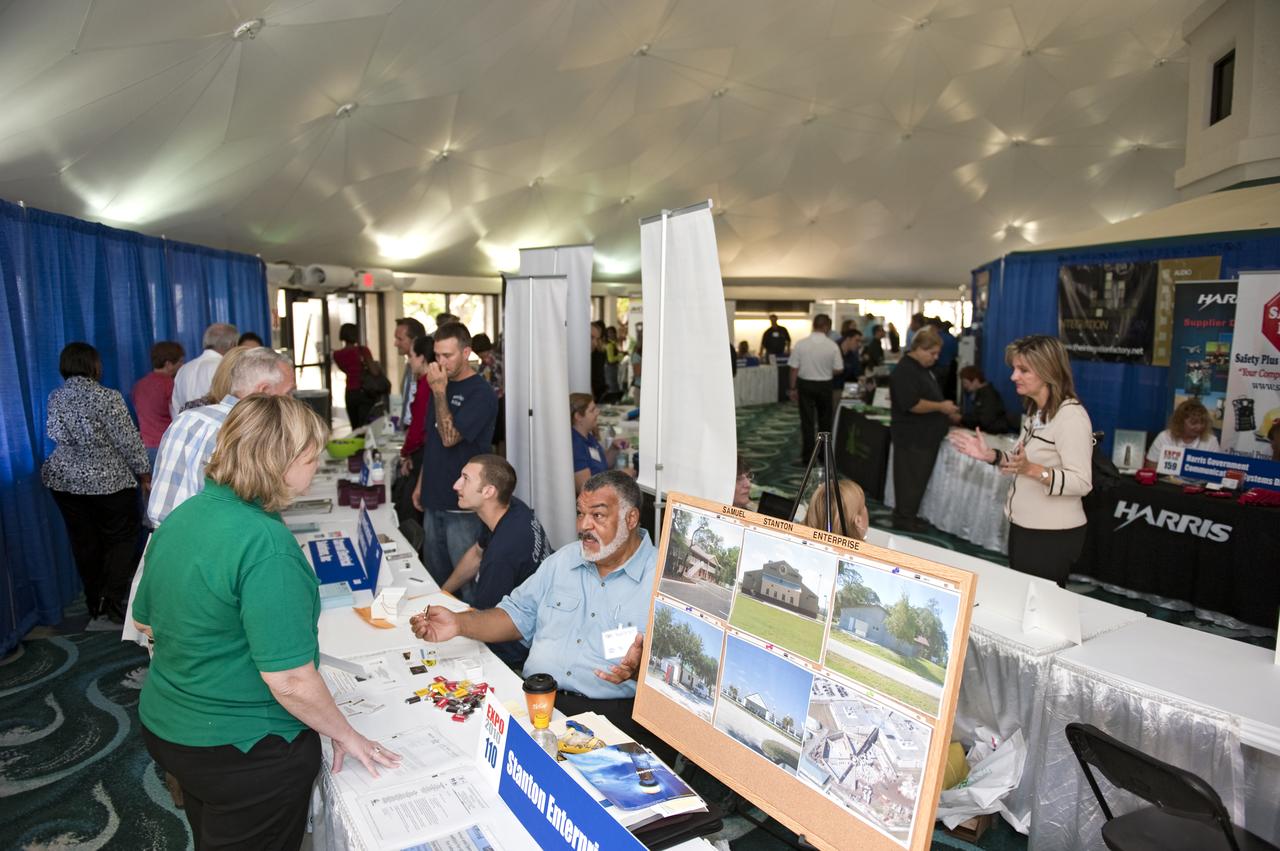
NASA SPONSORED BUSINESS EXPO AT PORT CANAVERAL
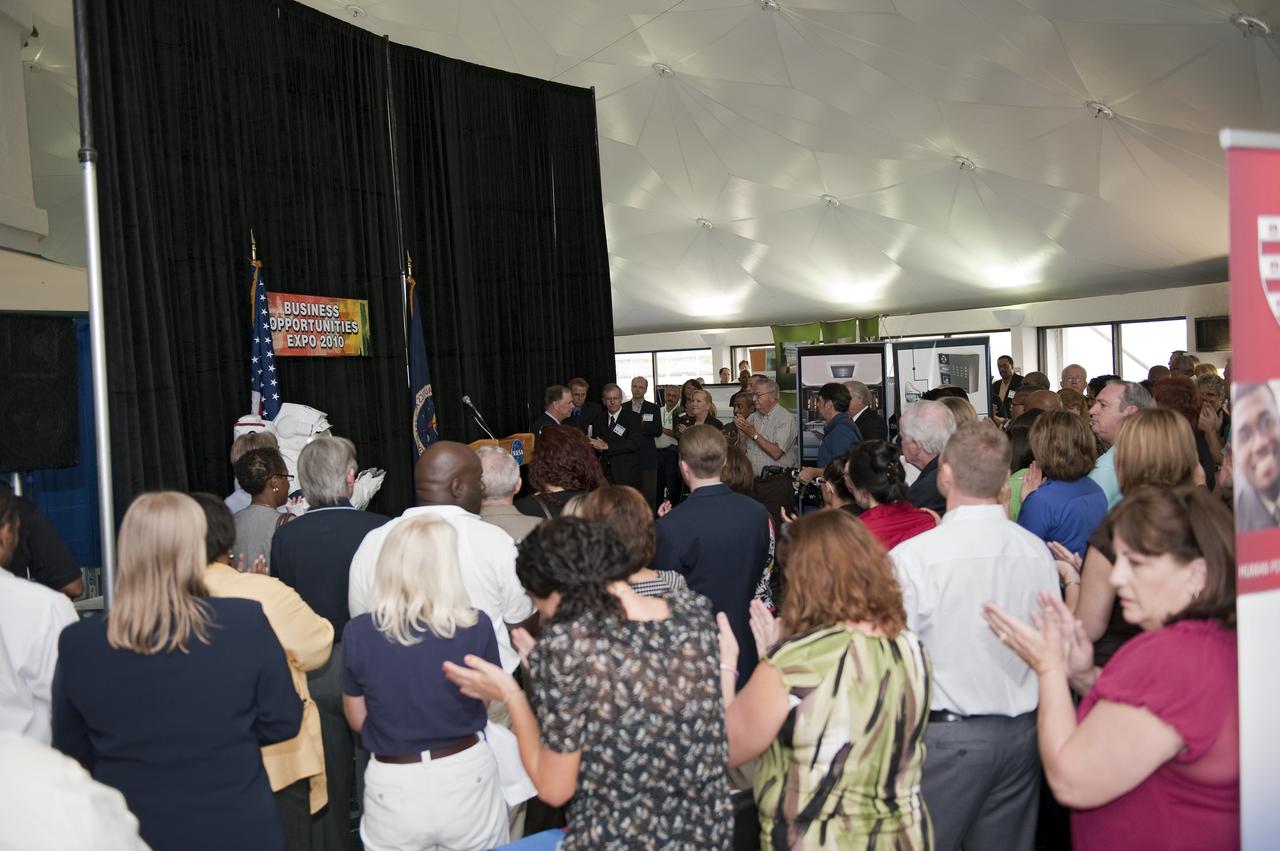
NASA SPONSORED BUSINESS EXPO AT PORT CANAVERAL

STS-335 LON - ET-122 ARRIVAL THRU PORT CANAVERAL BERM
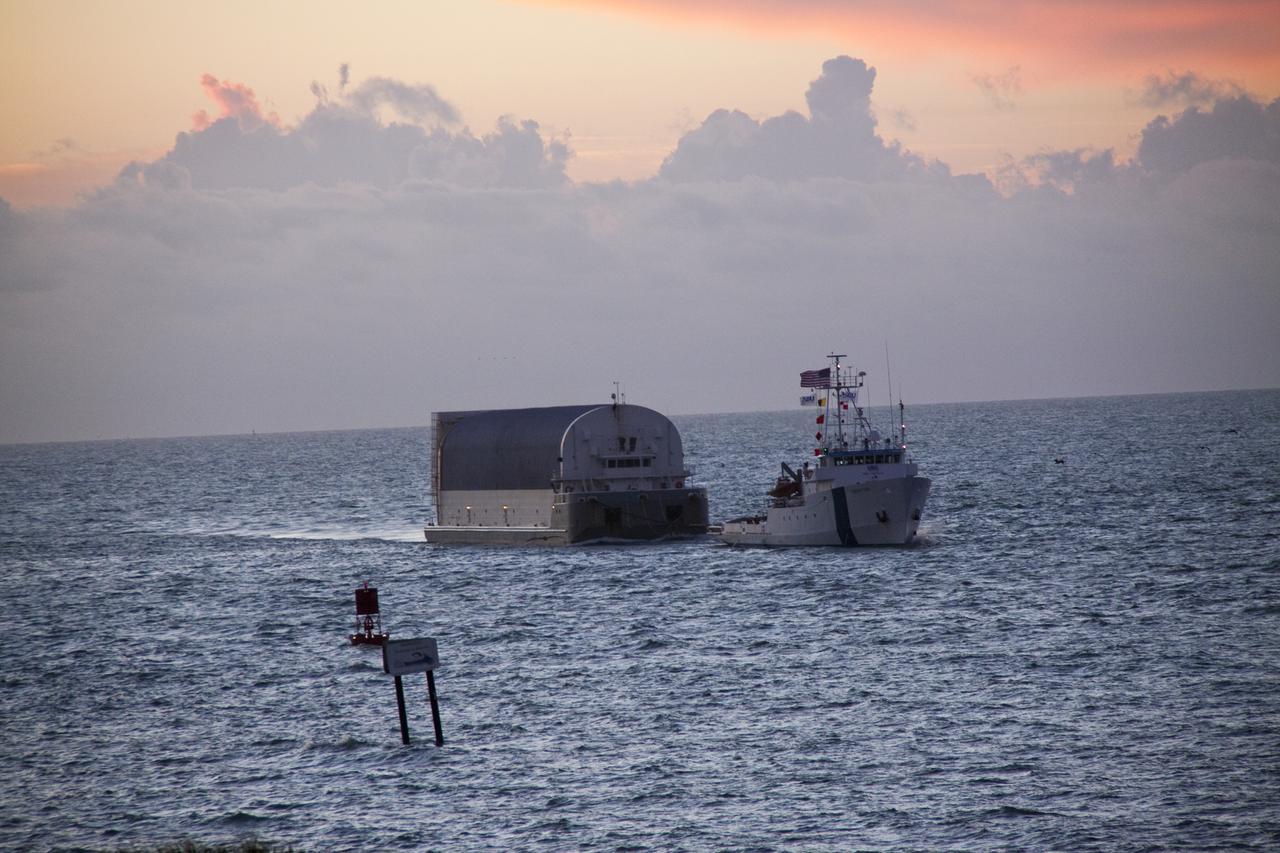
STS-335 LON - ET-122 ARRIVAL THRU PORT CANAVERAL BERM
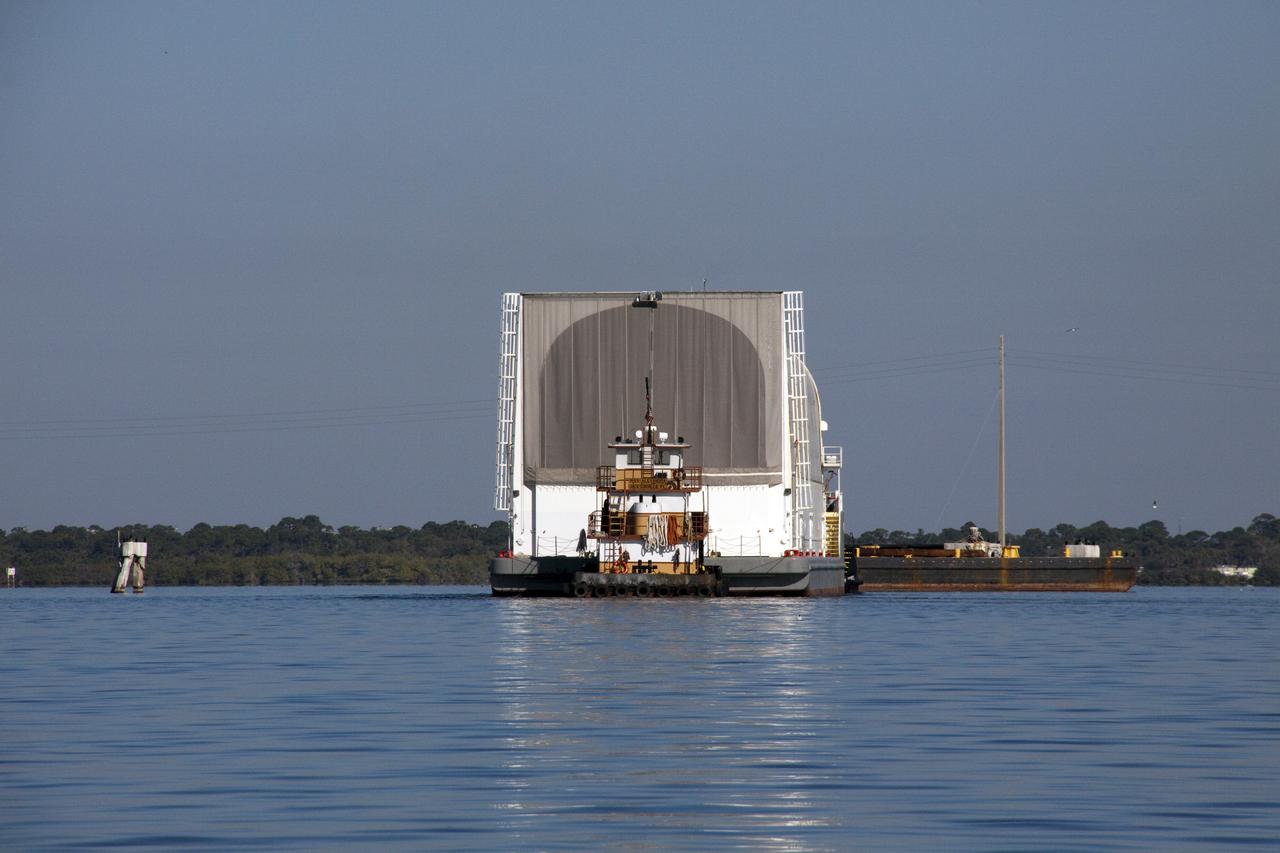
STS-132 ET-136 ARRIVAL THRU PORT CANAVERAL
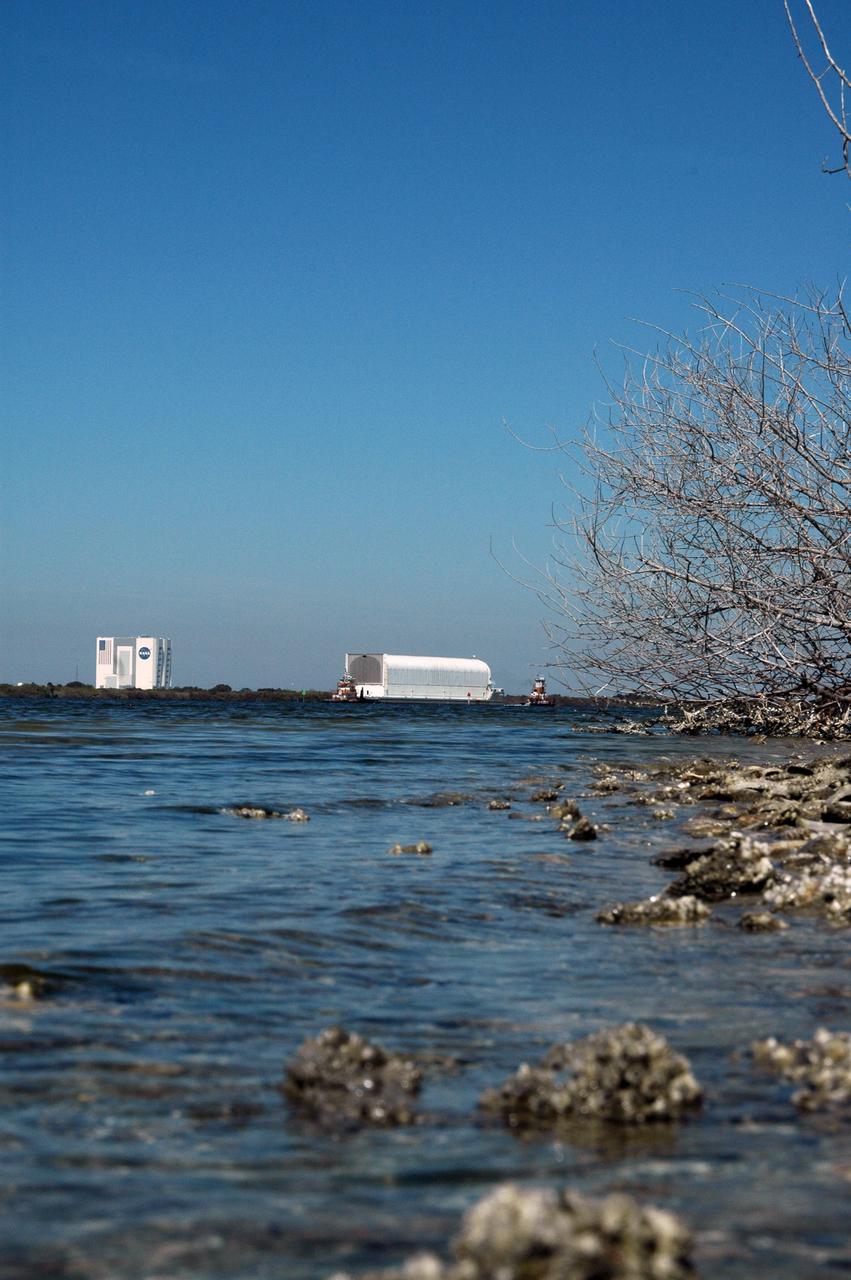
STS-132 ET-136 ARRIVAL THRU PORT CANAVERAL
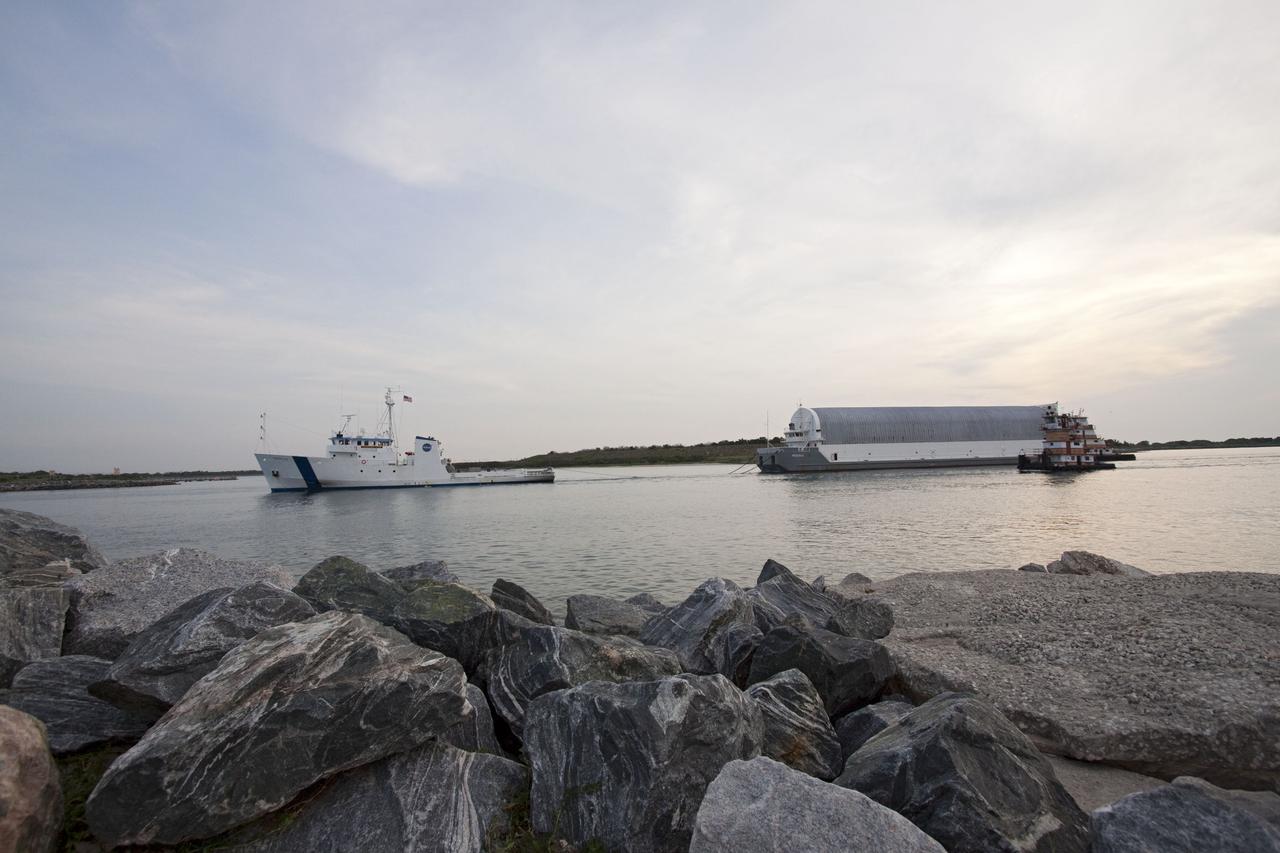
STS-134 ET-138 ARRIVAL THRU PORT CANAVERAL

STS-335 LON - ET-122 ARRIVAL THRU PORT CANAVERAL BERM
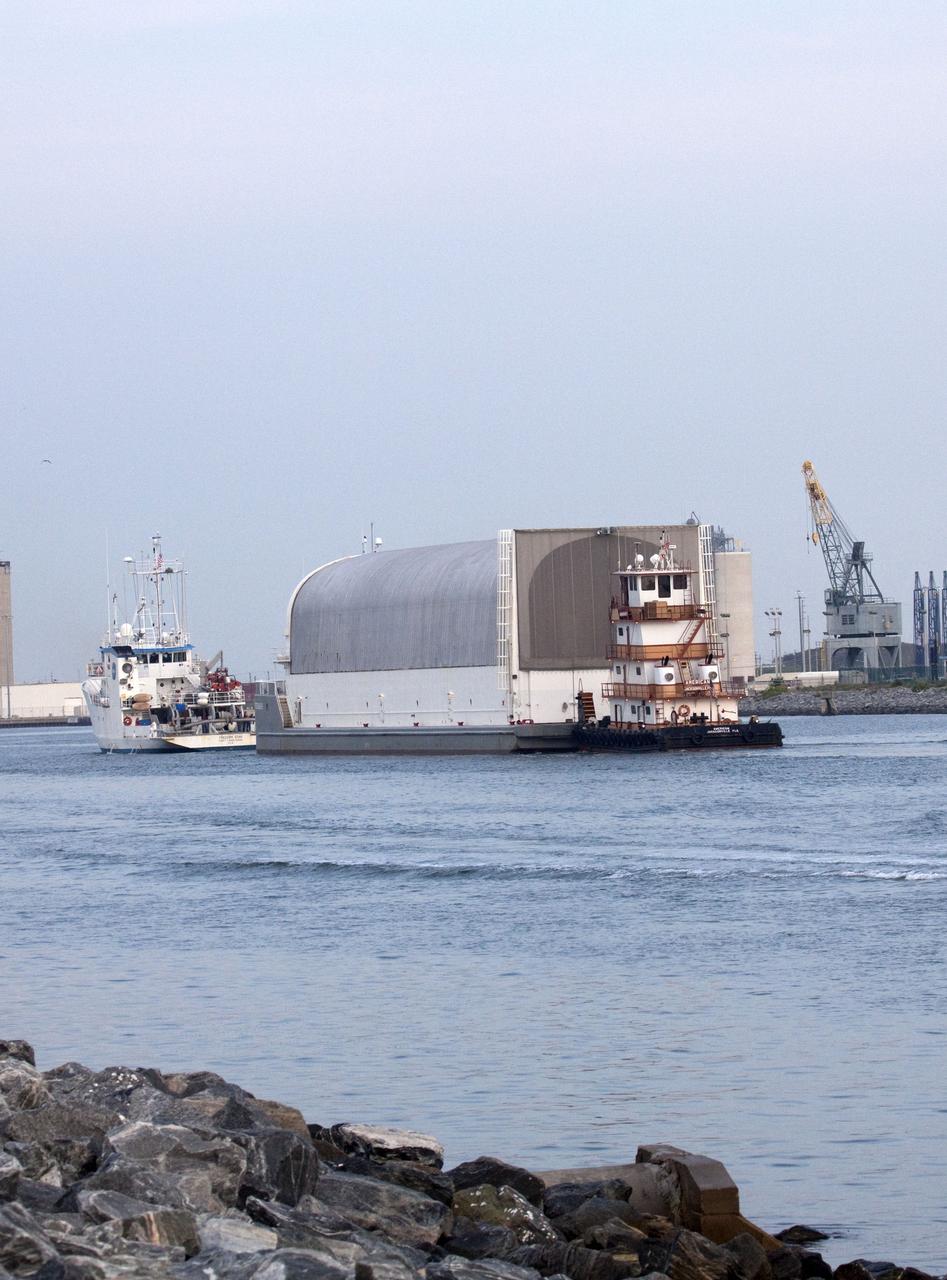
STS-134 ET-138 ARRIVAL THRU PORT CANAVERAL
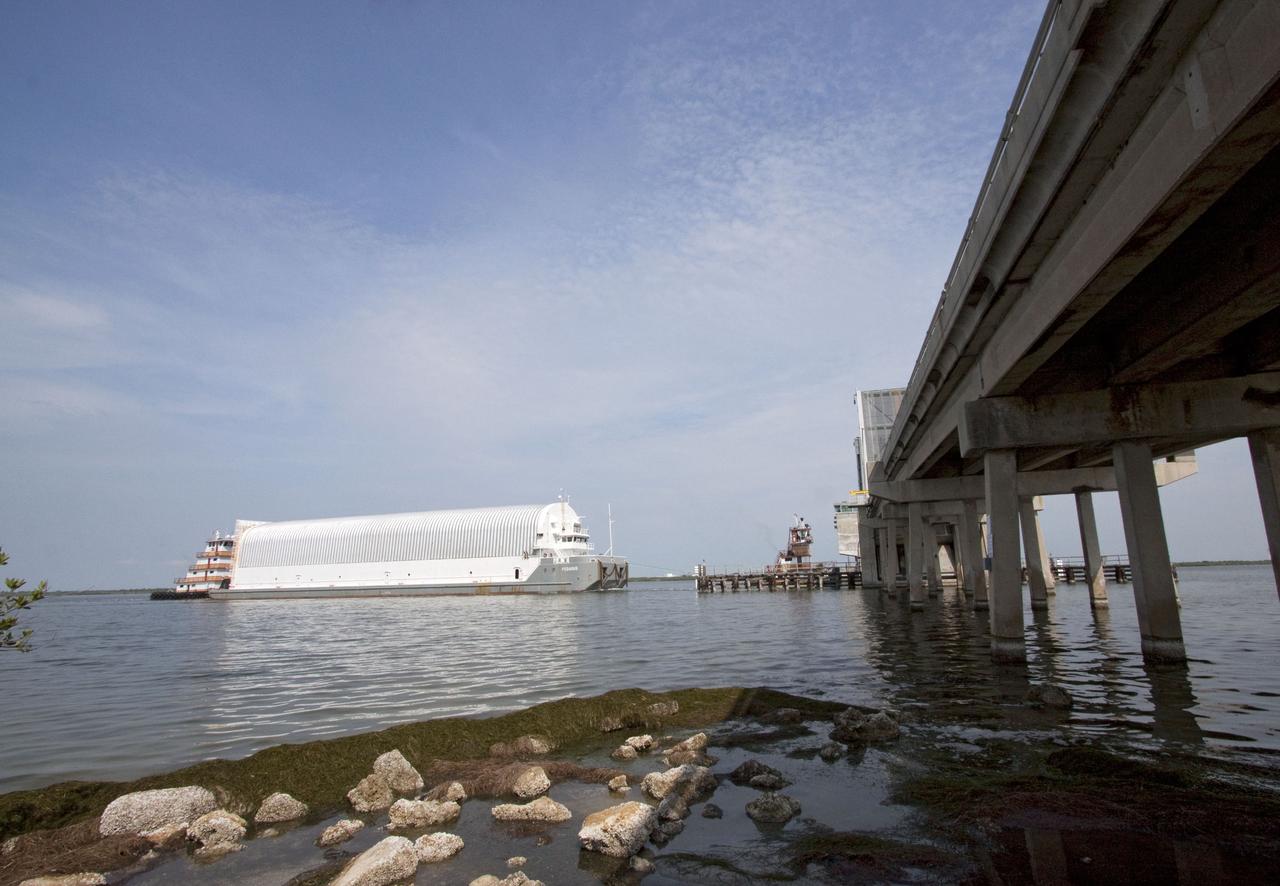
STS-134 ET-138 ARRIVAL THRU PORT CANAVERAL
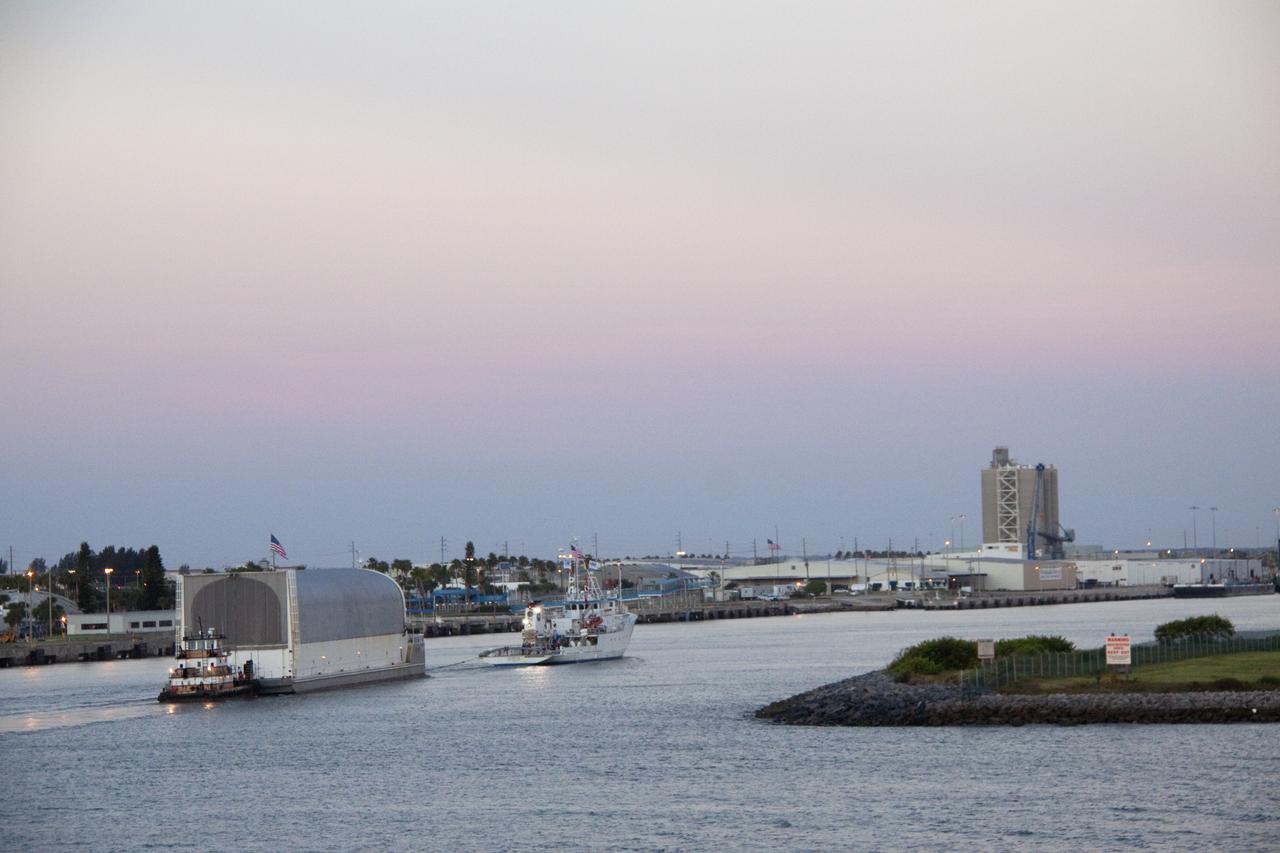
STS-335 LON - ET-122 ARRIVAL THRU PORT CANAVERAL BERM
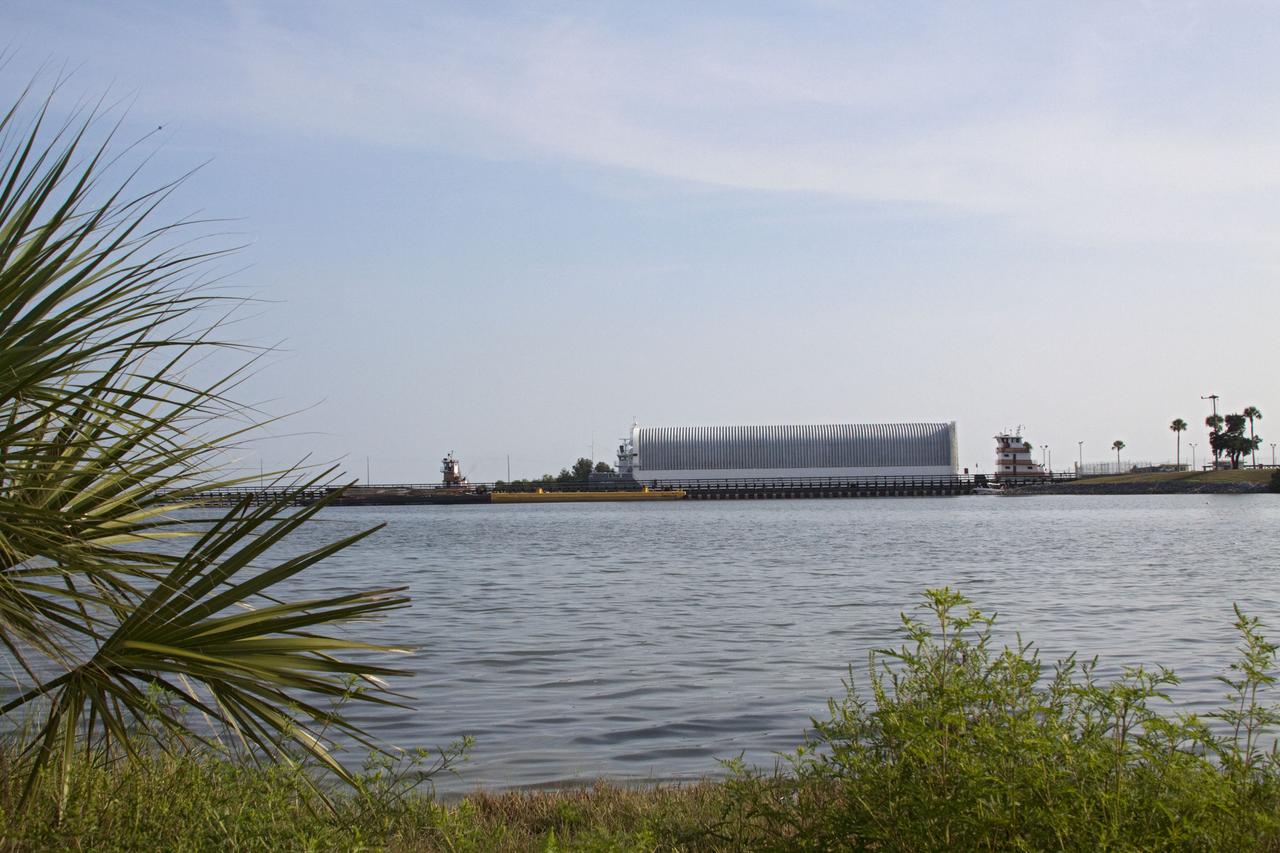
STS-134 ET-138 ARRIVAL THRU PORT CANAVERAL
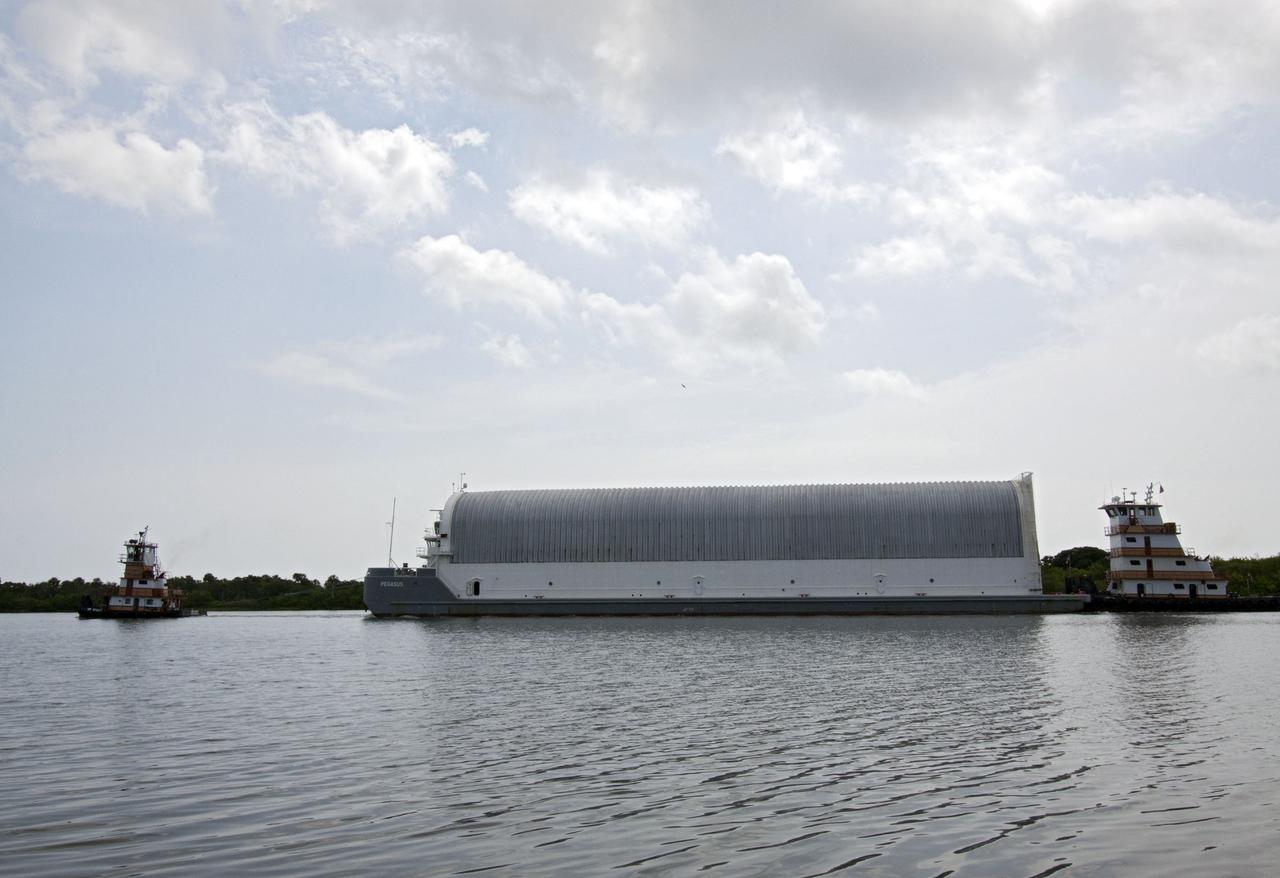
STS-134 ET-138 ARRIVAL THRU PORT CANAVERAL
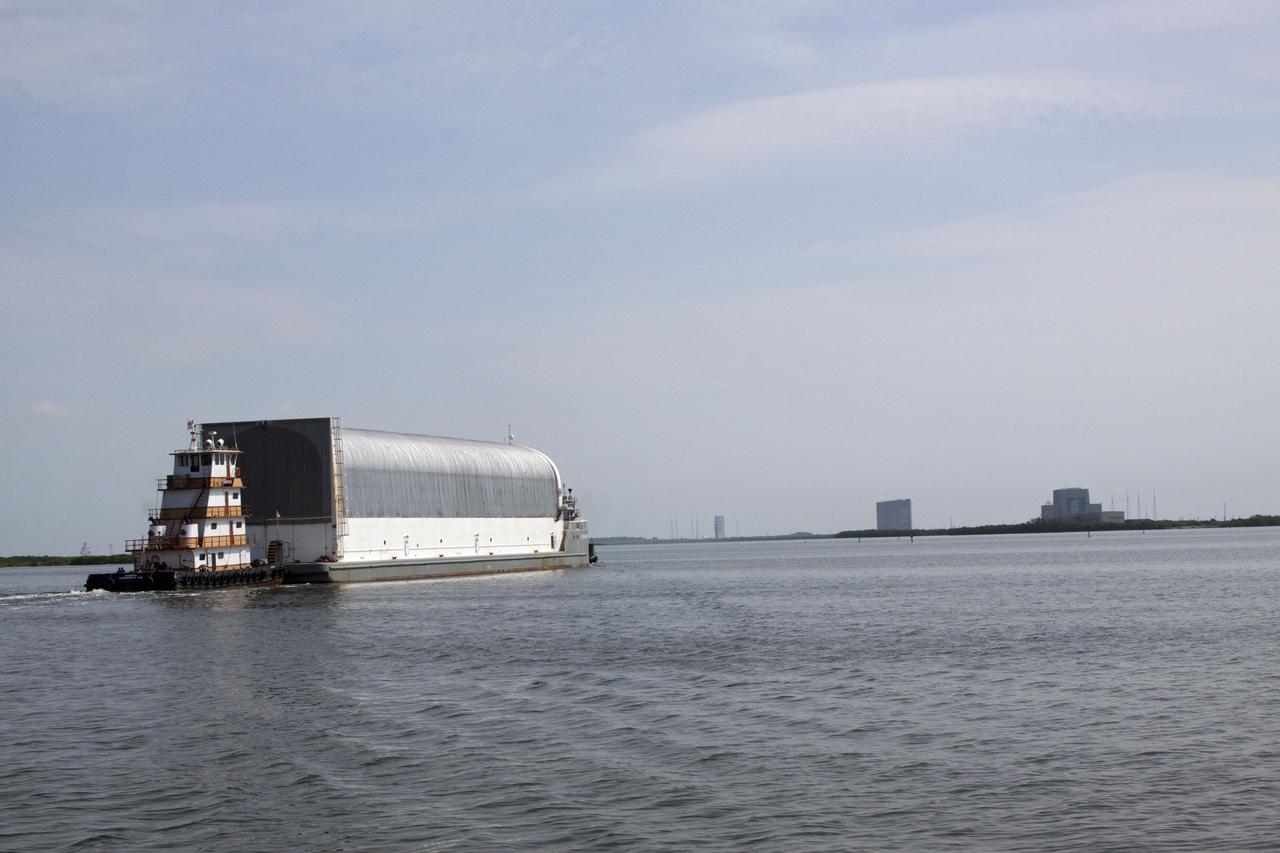
STS-134 ET-138 ARRIVAL THRU PORT CANAVERAL
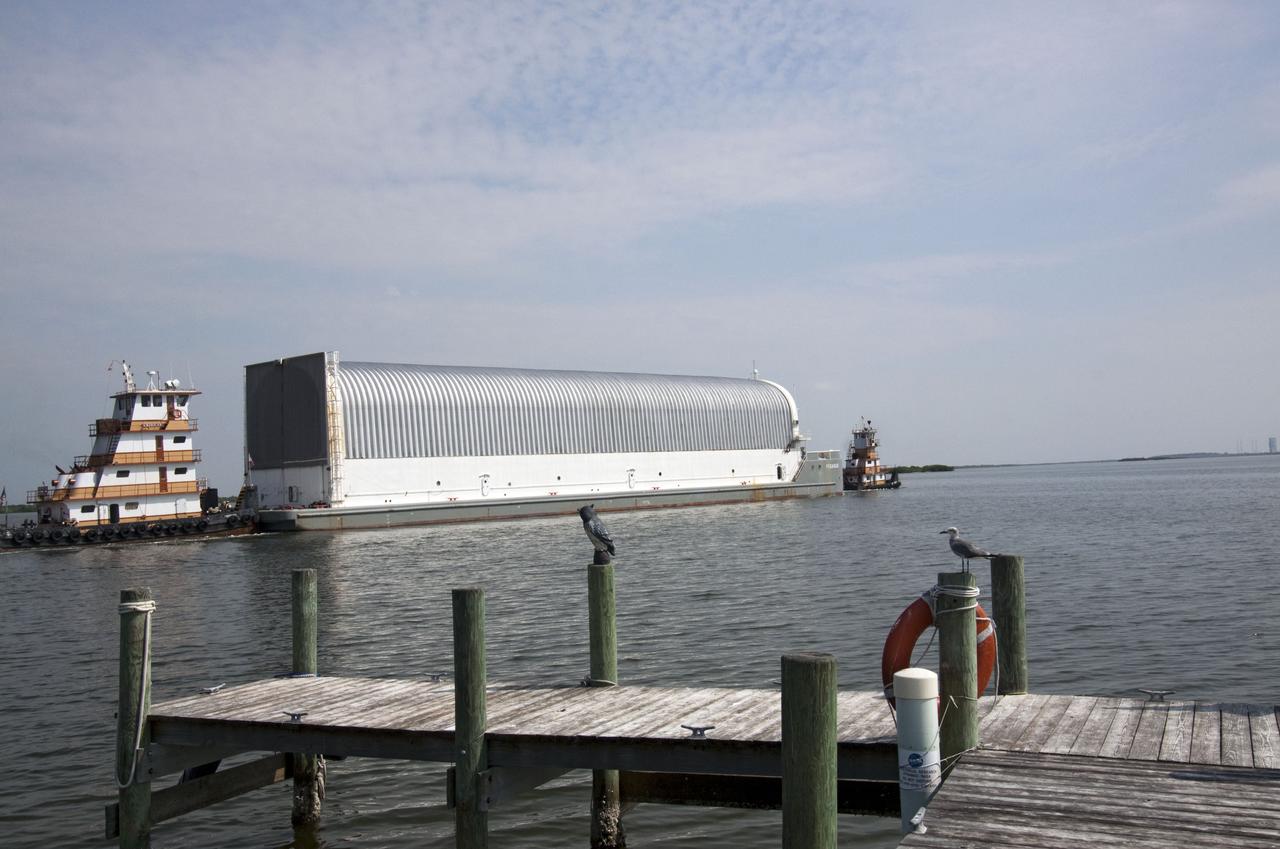
STS-134 ET-138 ARRIVAL THRU PORT CANAVERAL
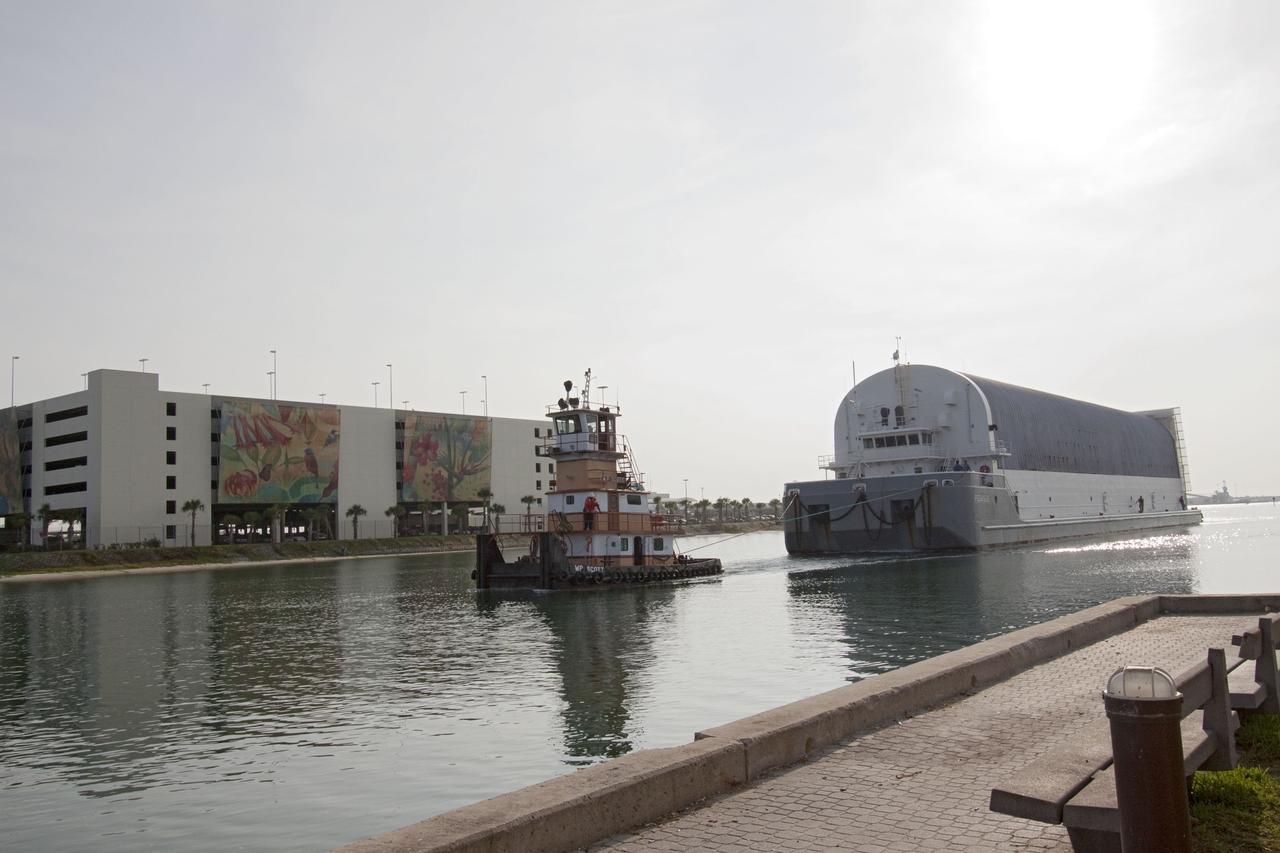
STS-134 ET-138 ARRIVAL THRU PORT CANAVERAL
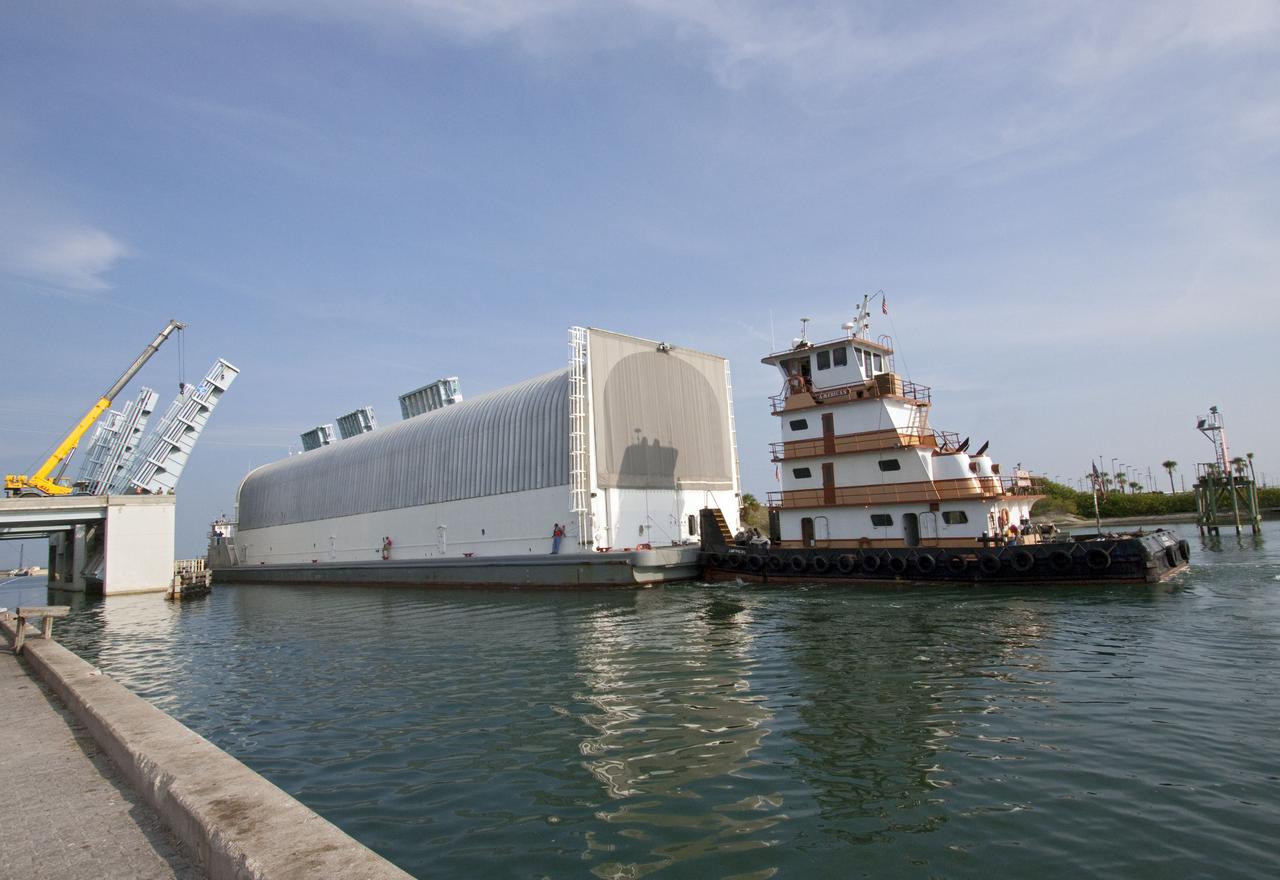
STS-134 ET-138 ARRIVAL THRU PORT CANAVERAL
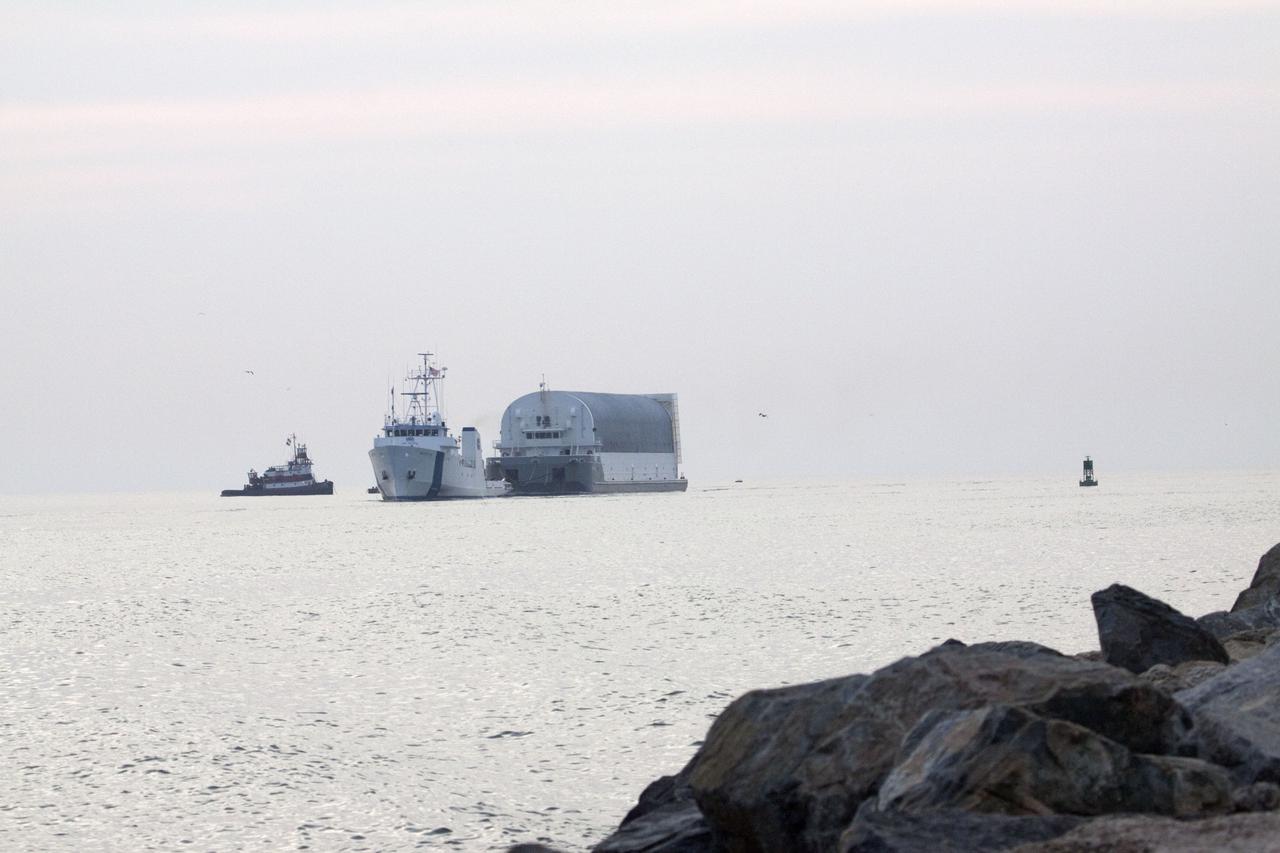
STS-134 ET-138 ARRIVAL THRU PORT CANAVERAL
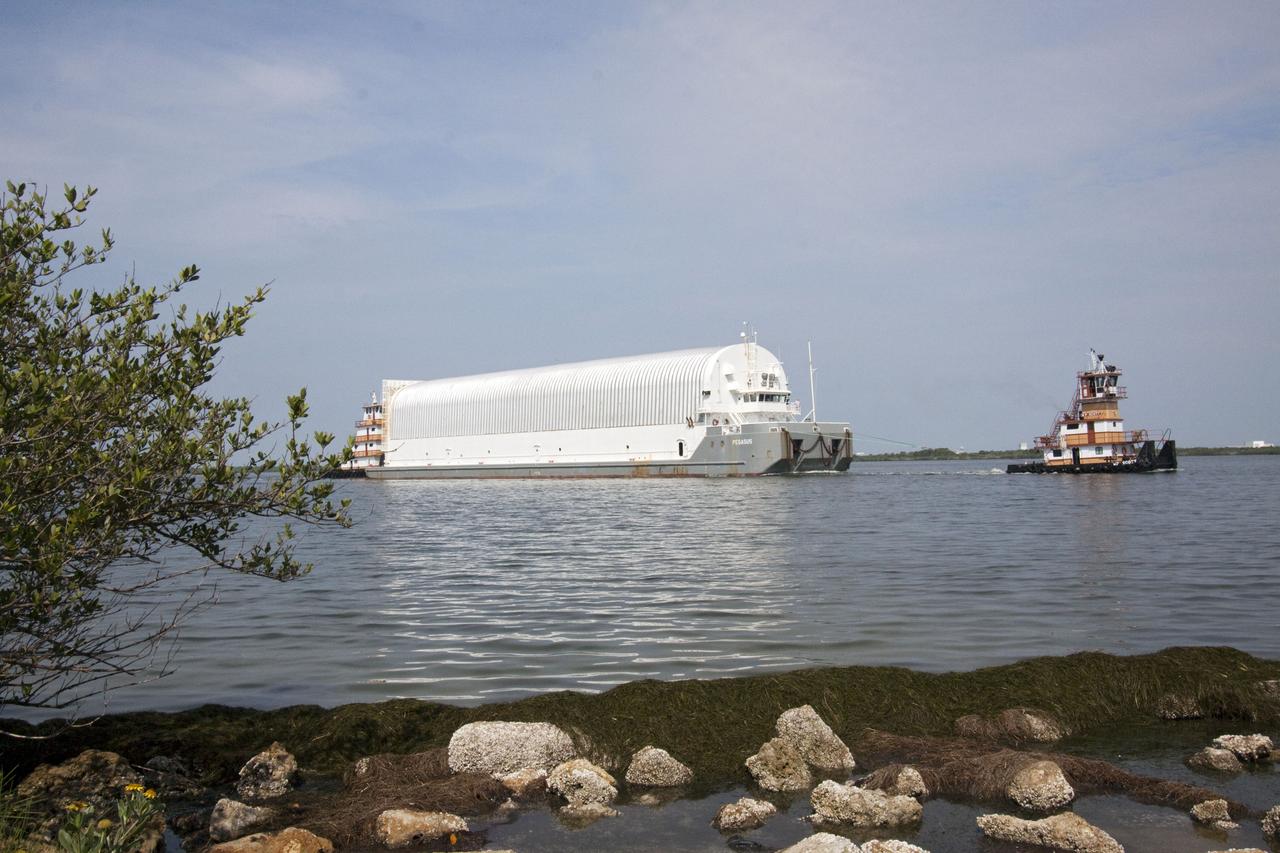
STS-134 ET-138 ARRIVAL THRU PORT CANAVERAL
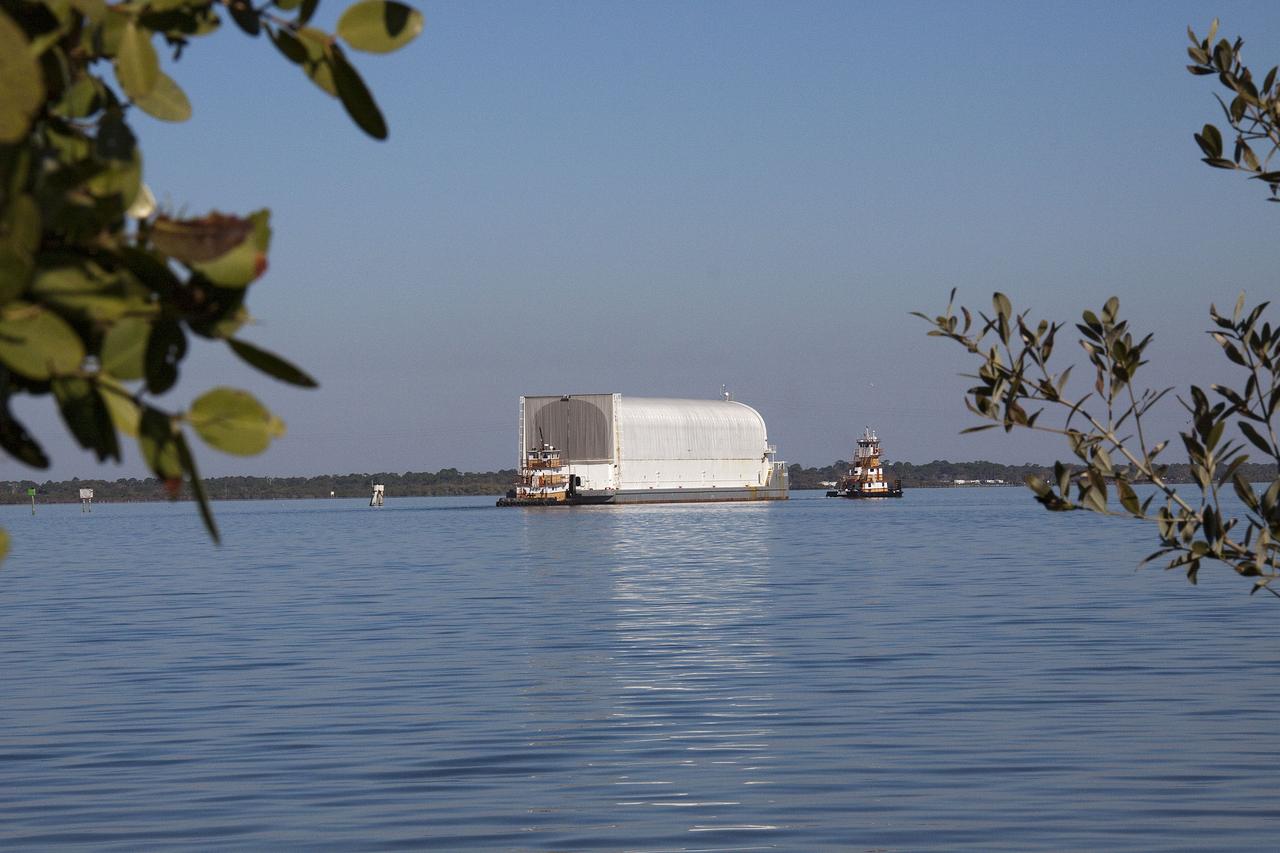
STS-132 ET-136 ARRIVAL THRU PORT CANAVERAL
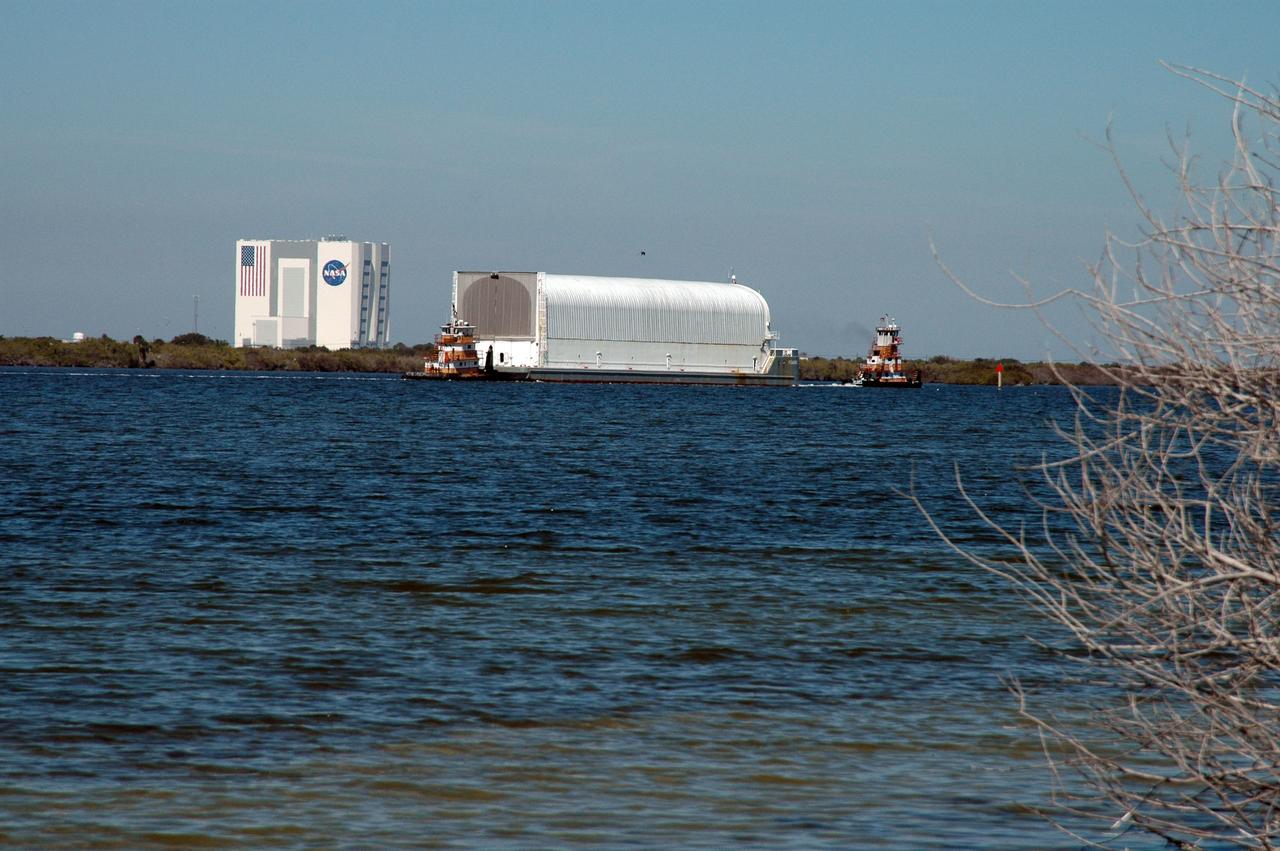
STS-132 ET-136 ARRIVAL THRU PORT CANAVERAL
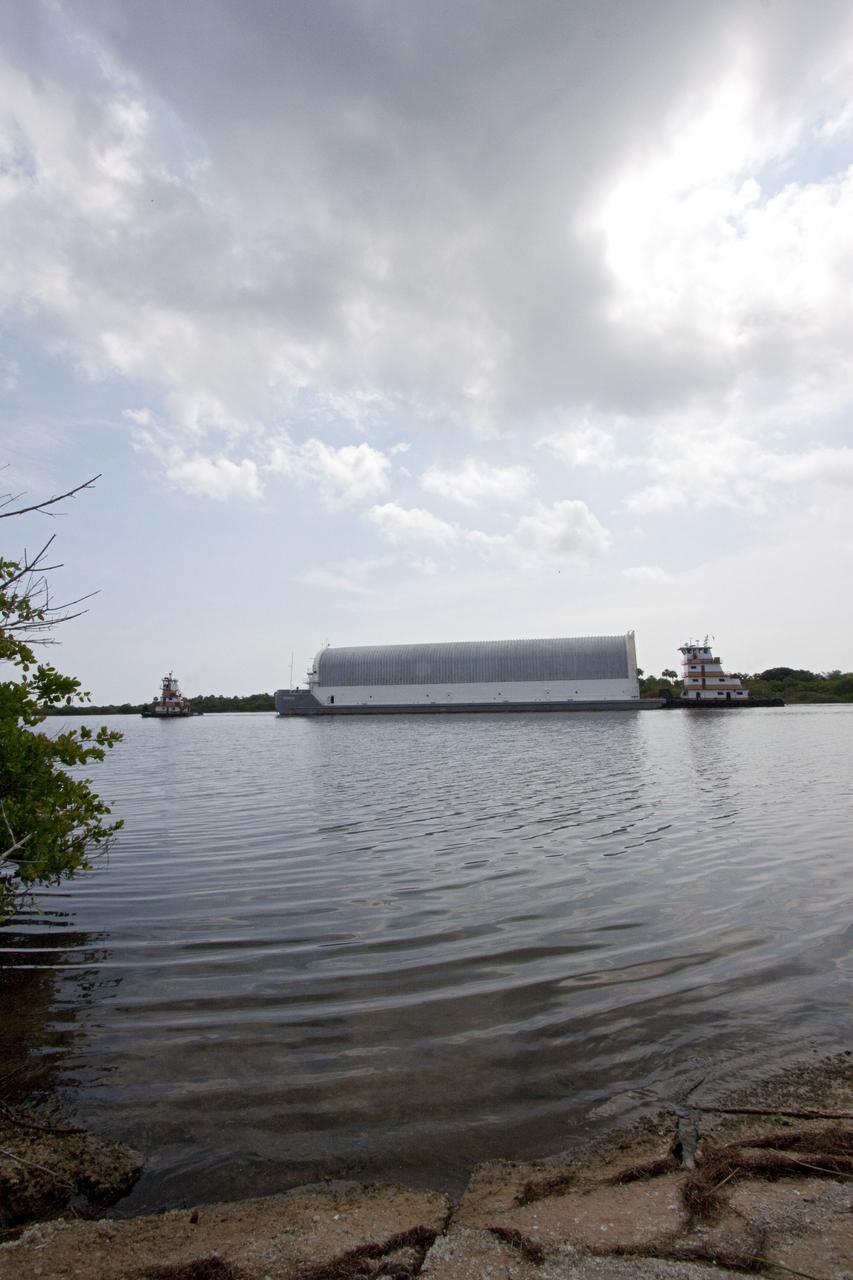
STS-134 ET-138 ARRIVAL THRU PORT CANAVERAL