
In archived NASA data, researchers have discovered "super spiral" galaxies that dwarf our own spiral galaxy, the Milky Way, and compete in size and brightness with the largest galaxies in the universe. The unprecedented galaxies have long hidden in plain sight by mimicking the appearance of typical spirals. Three examples of super spirals are presented here in images taken by the Sloan Digital Sky Survey. The super spiral on the left (Figure 1), catalogued as 2MASX J08542169+0449308, contains two galactic nuclei, instead of just the usual one, and thus looks like two eggs frying in a pan. The central image (Figure 2) shows a super spiral designated 2MASX J16014061+2718161, and it also contains the double nuclei. On the right (Figure 3), a huge galaxy with the moniker SDSS J094700.08+254045.7 stands as one of the biggest and brightest super spirals. The mega-galaxy's starry disk and spiral arms stretch about 320,000 light-years across, or more than three times the breadth of the Milky Way. These double nuclei, which are known to result from the recent merger of two galaxies, could offer a vital hint about the potential origin of super spirals. Researchers speculate that a special merger involving two, gas-rich spiral galaxies could see their pooled gases settle down into a new, larger stellar disk -- presto, a super spiral. The super spirals were discovered using the NASA/IPAC Extragalactic Database, or NED, an online repository containing information on over 100 million galaxies. NED brings together a wealth of data from many different projects, including ultraviolet light observations from the Galaxy Evolution Explorer, visible light from Sloan Digital Sky Survey, infrared light from the 2-Micron All-Sky Survey, and links to data from other missions such as NASA's Spitzer Space Telescope and Wide-Field Infrared Survey Explorer, or WISE. http://photojournal.jpl.nasa.gov/catalog/PIA20064

JANUARY 9, 2014: The vibrant magentas and blues in this Hubble image of the barred spiral galaxy M83 reveal that the galaxy is ablaze with star formation. The galactic panorama unveils a tapestry of the drama of stellar birth and death. The galaxy, also known as the Southern Pinwheel, lies 15 million light-years away in the constellation Hydra. Credit: NASA, ESA, and the Hubble Heritage Team (STScI/AURA) Acknowledgement: W. Blair (STScI/Johns Hopkins University) and R. O'Connell (University of Virginia) <b><a href="http://www.nasa.gov/audience/formedia/features/MP_Photo_Guidelines.html" rel="nofollow">NASA image use policy.</a></b> <b><a href="http://www.nasa.gov/centers/goddard/home/index.html" rel="nofollow">NASA Goddard Space Flight Center</a></b> enables NASA’s mission through four scientific endeavors: Earth Science, Heliophysics, Solar System Exploration, and Astrophysics. Goddard plays a leading role in NASA’s accomplishments by contributing compelling scientific knowledge to advance the Agency’s mission. <b>Follow us on <a href="http://twitter.com/NASA_GoddardPix" rel="nofollow">Twitter</a></b> <b>Like us on <a href="http://www.facebook.com/pages/Greenbelt-MD/NASA-Goddard/395013845897?ref=tsd" rel="nofollow">Facebook</a></b> <b>Find us on <a href="http://instagram.com/nasagoddard?vm=grid" rel="nofollow">Instagram</a></b>
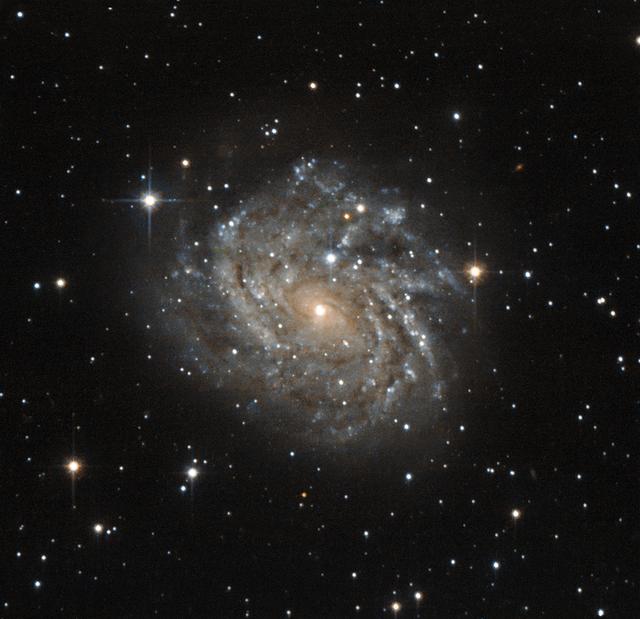
This little-known galaxy, officially named J04542829-6625280, but most often referred to as LEDA 89996, is a classic example of a spiral galaxy. The galaxy is much like our own galaxy, the Milky Way. The disk-shaped galaxy is seen face on, revealing the winding structure of the spiral arms. Dark patches in these spiral arms are in fact dust and gas — the raw materials for new stars. The many young stars that form in these regions make the spiral arms appear bright and bluish. The galaxy sits in a vibrant area of the night sky within the constellation of Dorado (The Swordfish), and appears very close to the Large Magellanic Cloud — one of the satellite galaxies of the Milky Way. The observations were carried out with the high resolution channel of Hubble’s Advanced Camera for Surveys. Image credit: ESA/Hubble & NASA, Acknowledgement: Flickr user C. Claude <b><a href="http://go.nasa.gov/1Tqugil" rel="nofollow">NASA image use policy.</a></b> <b><a href="http://go.nasa.gov/1Tqugin" rel="nofollow">NASA Goddard Space Flight Center</a></b> enables NASA’s mission through four scientific endeavors: Earth Science, Heliophysics, Solar System Exploration, and Astrophysics. Goddard plays a leading role in NASA’s accomplishments by contributing compelling scientific knowledge to advance the Agency’s mission. <b>Follow us on <a href="http://go.nasa.gov/1Tqugir" rel="nofollow">Twitter</a></b> <b>Like us on <a href="http://go.nasa.gov/1TqujdP" rel="nofollow">Facebook</a></b> <b>Find us on <a href="http://go.nasa.gov/1TqujdT" rel="nofollow">Instagram</a></b>

Spiral galaxy NGC 3274 is a relatively faint galaxy located over 20 million light-years away in the constellation of Leo (The Lion). This NASA/ESA Hubble Space Telescope image comes courtesy of Hubble's Wide Field Camera 3 (WFC3), whose multi-color vision allows astronomers to study a wide range of targets, from nearby star formation to galaxies in the most remote regions of the cosmos. This image combines observations gathered in five different filters, bringing together ultraviolet, visible and infrared light to show off NGC 3274 in all its glory. NGC 3274 was discovered by Wilhelm Herschel in 1783. The galaxy PGC 213714 is also visible on the upper right of the frame, located much farther away from Earth. Image Credit: ESA/Hubble & NASA, D. Calzetti <b><a href="http://www.nasa.gov/audience/formedia/features/MP_Photo_Guidelines.html" rel="nofollow">NASA image use policy.</a></b> <b><a href="http://www.nasa.gov/centers/goddard/home/index.html" rel="nofollow">NASA Goddard Space Flight Center</a></b> enables NASA’s mission through four scientific endeavors: Earth Science, Heliophysics, Solar System Exploration, and Astrophysics. Goddard plays a leading role in NASA’s accomplishments by contributing compelling scientific knowledge to advance the Agency’s mission. <b>Follow us on <a href="http://twitter.com/NASAGoddardPix" rel="nofollow">Twitter</a></b> <b>Like us on <a href="http://www.facebook.com/pages/Greenbelt-MD/NASA-Goddard/395013845897?ref=tsd" rel="nofollow">Facebook</a></b> <b>Find us on <a href="http://instagrid.me/nasagoddard/?vm=grid" rel="nofollow">Instagram</a></b>
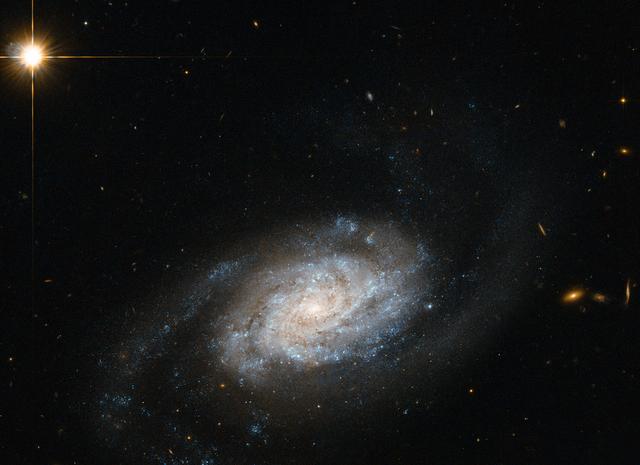
Shown here is a spiral galaxy known as NGC 3455, which lies some 65 million light-years away from us in the constellation of Leo (the Lion). Galaxies are classified into different types according to their structure and appearance. This classification system is known as the Hubble Sequence, named after its creator Edwin Hubble. In this image released 14, April, 2014, NGC 3455 is known as a type SB galaxy — a barred spiral. Barred spiral galaxies account for approximately two thirds of all spirals. Galaxies of this type appear to have a bar of stars slicing through the bulge of stars at their center. The SB classification is further sub-divided by the appearance of a galaxy's pinwheeling spiral arms; SBa types have more tightly wound arms, whereas SBc types have looser ones. SBb types, such as NGC 3455, lie in between. NGC 3455 is part of a pair of galaxies — its partner, NGC 3454, lies out of frame. This cosmic duo belong to a group known as the NGC 3370 group, which is in turn one of the Leo II groups, a large collection of galaxies scattered some 30 million light-years to the right of the Virgo cluster. This image is from Hubble's Advanced Camera for Surveys. Credit: ESA/Hubble & NASA, Acknowledgement: Nick Rose <b><a href="http://www.nasa.gov/audience/formedia/features/MP_Photo_Guidelines.html" rel="nofollow">NASA image use policy.</a></b> <b><a href="http://www.nasa.gov/centers/goddard/home/index.html" rel="nofollow">NASA Goddard Space Flight Center</a></b> enables NASA’s mission through four scientific endeavors: Earth Science, Heliophysics, Solar System Exploration, and Astrophysics. Goddard plays a leading role in NASA’s accomplishments by contributing compelling scientific knowledge to advance the Agency’s mission. <b>Follow us on <a href="http://twitter.com/NASAGoddardPix" rel="nofollow">Twitter</a></b> <b>Like us on <a href="http://www.facebook.com/pages/Greenbelt-MD/NASA-Goddard/395013845897?ref=tsd" rel="nofollow">Facebook</a></b> <b>Find us on <a href="http://instagram.com/nasagoddard?vm=grid" rel="nofollow">Instagram</a></b>

Barred Spiral Galaxy NGC 1300 Credit: NASA, ESA, and The Hubble Heritage Team (STScI/AURA) Acknowledgment: P. Knezek (WIYN) The Hubble Space Telescope is a project of international cooperation between NASA and the European Space Agency. NASA's Goddard Space Flight Center manages the telescope. The Space Telescope Science Institute conducts Hubble science operations. Goddard is responsible for HST project management, including mission and science operations, servicing missions, and all associated development activities. To learn more about the Hubble Space Telescope go here: <a href="http://www.nasa.gov/mission_pages/hubble/main/index.html" rel="nofollow">www.nasa.gov/mission_pages/hubble/main/index.html</a>

This new Hubble image is centered on NGC 5793, a spiral galaxy over 150 million light-years away in the constellation of Libra. This galaxy has two particularly striking features: a beautiful dust lane and an intensely bright center — much brighter than that of our own galaxy, or indeed those of most spiral galaxies we observe. NGC 5793 is a Seyfert galaxy. These galaxies have incredibly luminous centers that are thought to be caused by hungry supermassive black holes — black holes that can be billions of times the size of the sun — that pull in and devour gas and dust from their surroundings. This galaxy is of great interest to astronomers for many reasons. For one, it appears to house objects known as masers. Whereas lasers emit visible light, masers emit microwave radiation. The term "masers" comes from the acronym Microwave Amplification by Stimulated Emission of Radiation. Maser emission is caused by particles that absorb energy from their surroundings and then re-emit this in the microwave part of the spectrum. Naturally occurring masers, like those observed in NGC 5793, can tell us a lot about their environment; we see these kinds of masers in areas where stars are forming. In NGC 5793 there are also intense mega-masers, which are thousands of times more luminous than the sun. Credit: NASA, ESA, and E. Perlman (Florida Institute of Technology) <b><a href="http://www.nasa.gov/audience/formedia/features/MP_Photo_Guidelines.html" rel="nofollow">NASA image use policy.</a></b> <b><a href="http://www.nasa.gov/centers/goddard/home/index.html" rel="nofollow">NASA Goddard Space Flight Center</a></b> enables NASA’s mission through four scientific endeavors: Earth Science, Heliophysics, Solar System Exploration, and Astrophysics. Goddard plays a leading role in NASA’s accomplishments by contributing compelling scientific knowledge to advance the Agency’s mission. <b>Follow us on <a href="http://twitter.com/NASAGoddardPix" rel="nofollow">Twitter</a></b> <b>Like us on <a href="http://www.facebook.com/pages/Greenbelt-MD/NASA-Goddard/395013845897?ref=tsd" rel="nofollow">Facebook</a></b> <b>Find us on <a href="http://instagram.com/nasagoddard?vm=grid" rel="nofollow">Instagram</a></b>
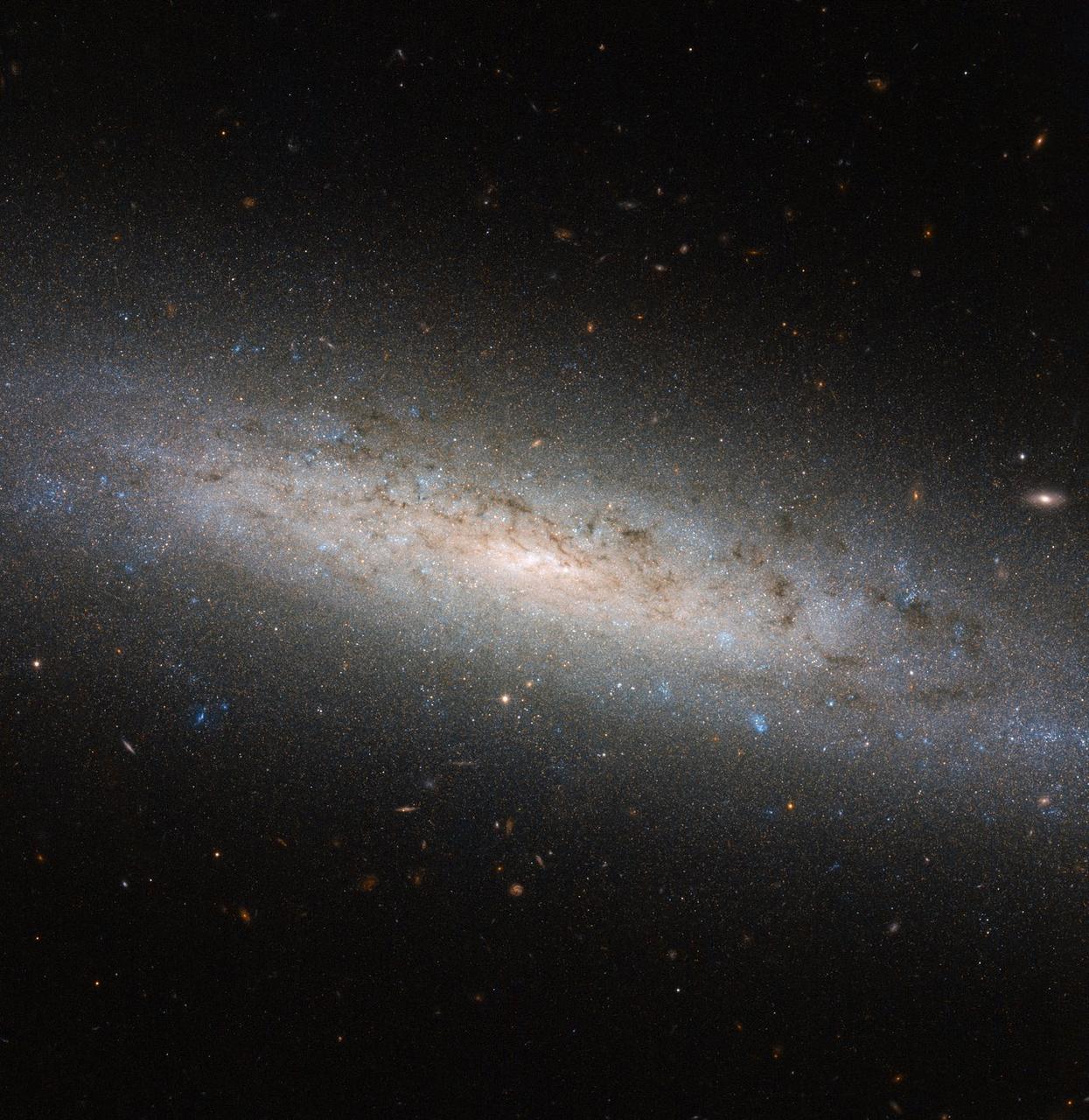
This shining disk of a spiral galaxy sits approximately 25 million light-years away from Earth in the constellation of Sculptor. Named NGC 24, the galaxy was discovered by British astronomer William Herschel in 1785, and measures some 40,000 light-years across. This picture was taken using the NASA/ESA Hubble Space Telescope’s Advanced Camera for Surveys, known as ACS for short. It shows NGC 24 in detail, highlighting the blue bursts (young stars), dark lanes (cosmic dust), and red bubbles (hydrogen gas) of material peppered throughout the galaxy’s spiral arms. Numerous distant galaxies can also been seen hovering around NGC 24’s perimeter. However, there may be more to this picture than first meets the eye. Astronomers suspect that spiral galaxies like NGC 24 and the Milky Way are surrounded by, and contained within, extended haloes of dark matter. Dark matter is a mysterious substance that cannot be seen; instead, it reveals itself via its gravitational interactions with surrounding material. Its existence was originally proposed to explain why the outer parts of galaxies, including our own, rotate unexpectedly fast, but it is thought to also play an essential role in a galaxy’s formation and evolution. Most of NGC 24’s mass — a whopping 80 percent — is thought to be held within such a dark halo. Image Credit: NASA/ESA <b><a href="http://www.nasa.gov/audience/formedia/features/MP_Photo_Guidelines.html" rel="nofollow">NASA image use policy.</a></b> <b><a href="http://www.nasa.gov/centers/goddard/home/index.html" rel="nofollow">NASA Goddard Space Flight Center</a></b> enables NASA’s mission through four scientific endeavors: Earth Science, Heliophysics, Solar System Exploration, and Astrophysics. Goddard plays a leading role in NASA’s accomplishments by contributing compelling scientific knowledge to advance the Agency’s mission. <b>Follow us on <a href="http://twitter.com/NASAGoddardPix" rel="nofollow">Twitter</a></b> <b>Like us on <a href="http://www.facebook.com/pages/Greenbelt-MD/NASA-Goddard/395013845897?ref=tsd" rel="nofollow">Facebook</a></b> <b>Find us on <a href="http://instagrid.me/nasagoddard/?vm=grid" rel="nofollow">Instagram</a></b>
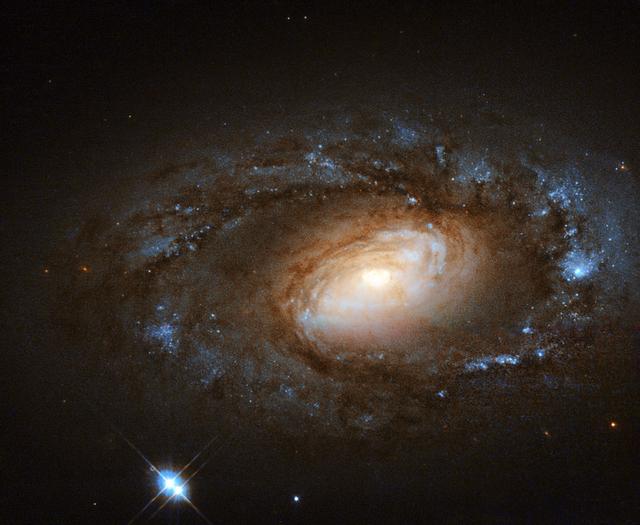
The NASA/ESA Hubble Space Telescope observes some of the most beautiful galaxies in our skies — spirals sparkling with bright stellar nurseries, violent duos ripping gas and stars away from one another as they tangle together, and ethereal irregular galaxies that hang like flocks of birds suspended in the blackness of space. However, galaxies, like humans, are not all supermodels. This little spiral, known as NGC 4102, has a different kind of appeal, with its tightly-wound spiral arms and understated, but charming, appearance. NGC 4102 lies in the northern constellation of Ursa Major (The Great Bear). It contains what is known as a LINER, or low-ionization nuclear emission-line region, meaning that its nucleus emits particular types of radiation — specifically, emission from weakly-ionized or neutral atoms of certain elements. Even in this sense, NGC 4102 is not special; around one third of all nearby galaxies are thought to be LINER galaxies. Many LINER galaxies also contain intense regions of star formation. This is thought to be intrinsically linked to their centers but just why, is still a mystery for astronomers — either the starbursts pour fuel inwards to fuel the LINERs, or this active central region triggers the starbursts. NGC 4102 does indeed contain a starburst region towards its center, where stars are being created at a rate much more furious than in a normal galaxy. This star formation is taking place within a small rotating disk, around 1000 light-years in diameter and with a mass some three billion times the mass of the sun. This image uses infrared and visible observations taken using Hubble’s Wide Field Planetary Camera 2. Credit: ESA/Hubble, NASA and S. Smartt (Queen's University Belfast) Acknowledgement: Renaud Houdinet <b><a href="http://www.nasa.gov/audience/formedia/features/MP_Photo_Guidelines.html" rel="nofollow">NASA image use policy.</a></b> <b><a href="http://www.nasa.gov/centers/goddard/home/index.html" rel="nofollow">NASA Goddard Space Flight Center</a></b> enables NASA’s mission through four scientific endeavors: Earth Science, Heliophysics, Solar System Exploration, and Astrophysics. Goddard plays a leading role in NASA’s accomplishments by contributing compelling scientific knowledge to advance the Agency’s mission. <b>Follow us on <a href="http://twitter.com/NASAGoddardPix" rel="nofollow">Twitter</a></b> <b>Like us on <a href="http://www.facebook.com/pages/Greenbelt-MD/NASA-Goddard/395013845897?ref=tsd" rel="nofollow">Facebook</a></b> <b>Find us on <a href="http://instagram.com/nasagoddard?vm=grid" rel="nofollow">Instagram</a></b>
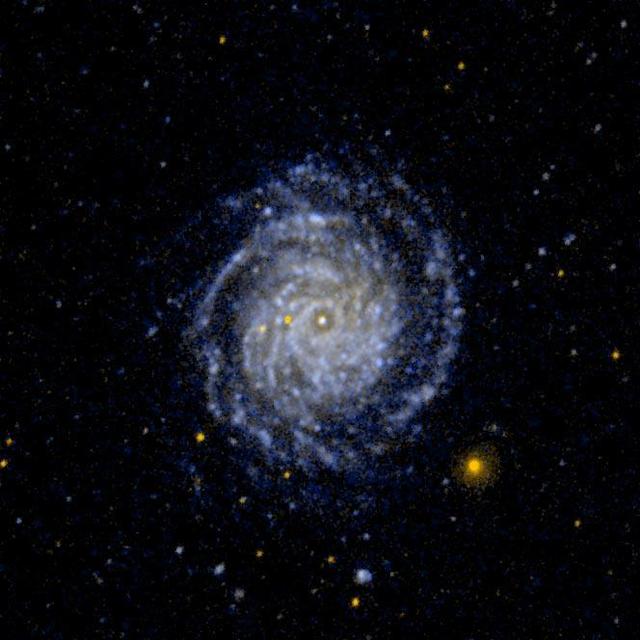
This ultraviolet image from NASA Galaxy Evolution Explorer is of the large face on spiral galaxy NGC 3344. The inner spiral arms are wrapped so tightly that they are difficult to distinguish. http://photojournal.jpl.nasa.gov/catalog/PIA07904

Astronomers using NASA Hubble Space Telescope have found a spiral galaxy that may rotate in the opposite direction from what was expected.
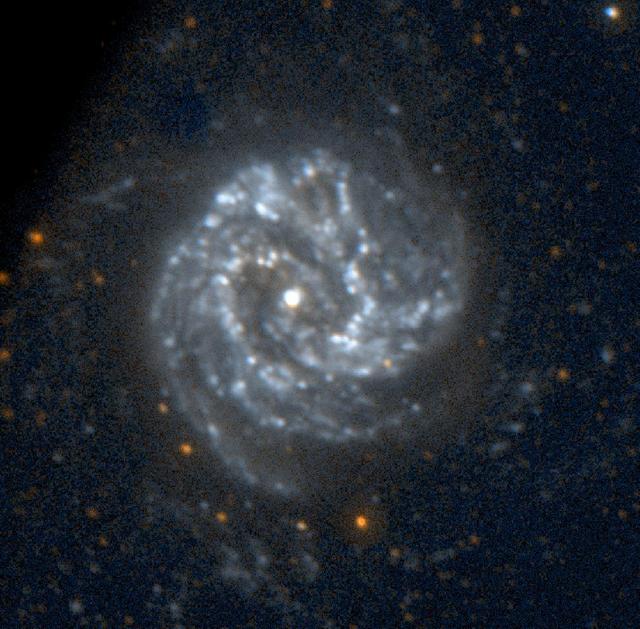
This image of the spiral galaxy Messier 83 was taken by NASA's Galaxy Evolution Explorer on June 7, 2003. Located 15 million light years from Earth and known as the Southern Pinwheel Galaxy, Messier 83 displays significant amounts of ultraviolet emissions far from the optically bright portion of the galaxy. It is also known to have an extended hydrogen disc that appears to radiate a faint ultraviolet emission. The red stars in the foreground of the image are Milky Way stars. http://photojournal.jpl.nasa.gov/catalog/PIA04629

In celebration of the 27th anniversary of the launch of NASA's Hubble Space Telescope on April 24, 1990, astronomers used the legendary telescope to take a portrait of a stunning pair of spiral galaxies. This starry pair offers a glimpse of what our Milky Way galaxy would look like to an outside observer. The edge-on galaxy is called NGC 4302, and the tilted galaxy is NGC 4298. These galaxies look quite different because we see them angled at different positions on the sky. They are actually very similar in terms of their structure and contents. From our view on Earth, researchers report an inclination of 90 degrees for NGC 4302, which is exactly edge on. NGC 4298 is tilted 70 degrees. In NGC 4298, the telltale, pinwheel-like structure is visible, but it's not as prominent as in some other spiral galaxies. In the edge-on NGC 4302, dust in the disk is silhouetted against rich lanes of stars. Absorption by dust makes the galaxy appear darker and redder than its companion. A large blue patch appears to be a giant region of recent star formation. Read more: <a href="https://go.nasa.gov/2pGyA4o" rel="nofollow">go.nasa.gov/2pGyA4o</a> <b><a href="http://www.nasa.gov/audience/formedia/features/MP_Photo_Guidelines.html" rel="nofollow">NASA image use policy.</a></b> <b><a href="http://www.nasa.gov/centers/goddard/home/index.html" rel="nofollow">NASA Goddard Space Flight Center</a></b> enables NASA’s mission through four scientific endeavors: Earth Science, Heliophysics, Solar System Exploration, and Astrophysics. Goddard plays a leading role in NASA’s accomplishments by contributing compelling scientific knowledge to advance the Agency’s mission. <b>Follow us on <a href="http://twitter.com/NASAGoddardPix" rel="nofollow">Twitter</a></b> <b>Like us on <a href="http://www.facebook.com/pages/Greenbelt-MD/NASA-Goddard/395013845897?ref=tsd" rel="nofollow">Facebook</a></b> <b>Find us on <a href="http://instagrid.me/nasagoddard/?vm=grid" rel="nofollow">Instagram</a></b>
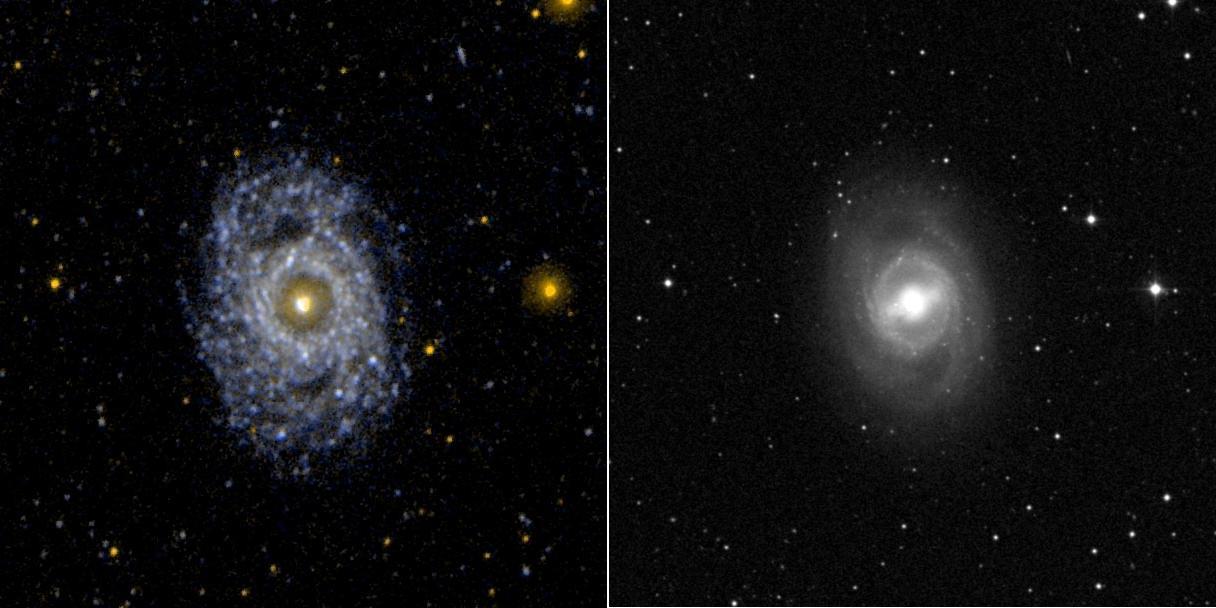
This ultraviolet image from NASA Galaxy Evolution Explorer left and visual image right of the face on barred and ringed spiral galaxy NGC 3351 M95.

NGC 6090 is a beautiful pair of spiral galaxies with an overlapping central region and two long tidal tails formed from material ripped out of the galaxies by gravitational interaction. This image is from NASA Hubble Space Telescope.
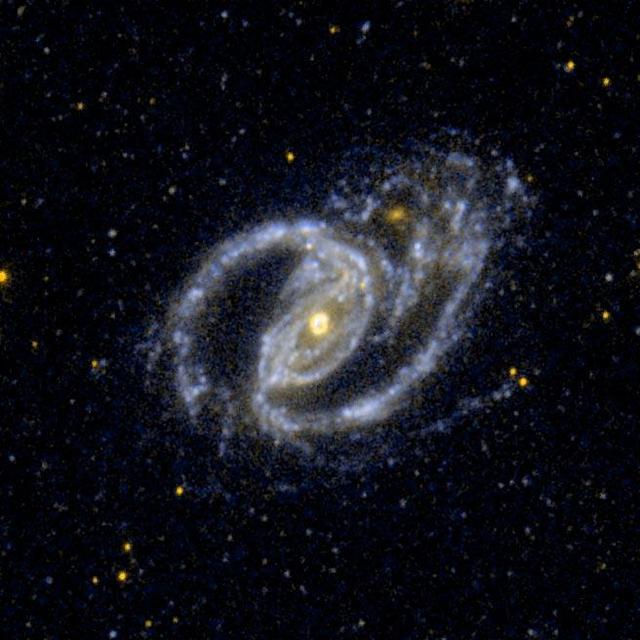
This ultraviolet image from NASA Galaxy Evolution Explorer shows the interacting pair NGC 1097, a barred spiral galaxy, and the small elliptical companion galaxy NGC 1097A.

This Chandra X-ray observatory image of M83 shows numerous point-like neutron stars and black hole x-ray sources scattered throughout the disk of this spiral galaxy. The bright nuclear region of the galaxy glows prominently due to a burst of star formation that is estimated to have begun about 20 million years ago in the galaxy's time frame. The nuclear region, enveloped by a 7 million degree Celsius gas cloud of carbon, neon, magnesium, silicon, and sulfur atoms, contains a much higher concentration of neutron stars and black holes than the rest of the galaxy. Hot gas with a slightly lower temperature of 4 million degrees observed along the spiral arms of the galaxy suggests that star formation in this region may be occurring at a more sedate rate.
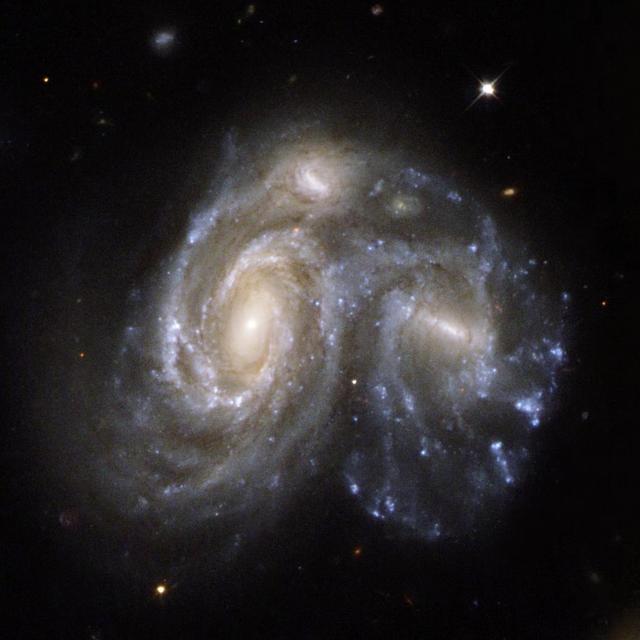
NGC 6050/IC 1179 Arp 272 is a remarkable collision between two spiral galaxies, NGC 6050 and IC 1179, and is part of the Hercules Galaxy Cluster, located in the constellation of Hercules. This image is from NASA Hubble Space Telescope.
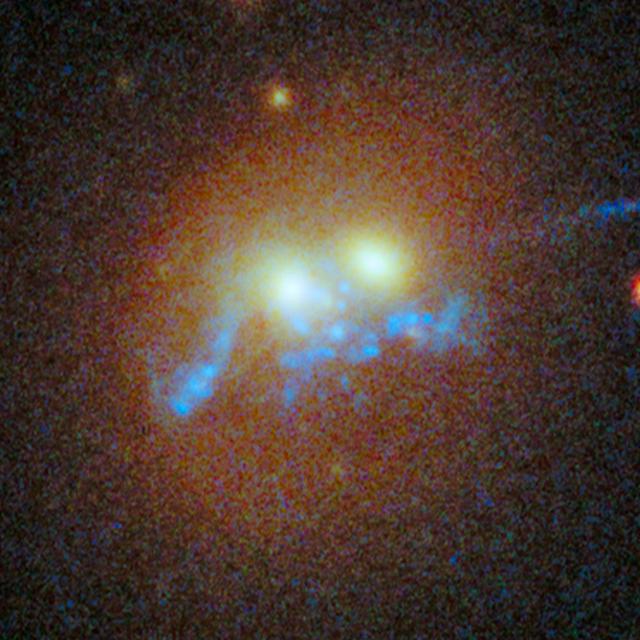
NASA's Hubble Space Telescope has photographed the dense galaxy cluster SDSS J1531+3414 in the northern constellation Corona Borealis. Made up primarily of giant elliptical galaxies with a few spirals and irregular galaxies thrown in for good measure, the cluster's powerful gravity warps the image of background galaxies into blue streaks and arcs. At the center of the bull's-eye of blue, gravitationally lensed filaments lies a pair of elliptical galaxies that are also exhibiting some interesting features. A 100,000-light-year-long structure that looks like a string of pearls twisted into a corkscrew shape winds around the cores of the two massive galaxies. The "pearls" are superclusters of blazing, blue-white, newly born stars. These super star clusters are evenly spaced along the chain at separations of 3,000 light-years from one another. Read more: <a href="http://1.usa.gov/1ztQvL9" rel="nofollow">1.usa.gov/1ztQvL9</a> Credit: NASA/ESA <b><a href="http://www.nasa.gov/audience/formedia/features/MP_Photo_Guidelines.html" rel="nofollow">NASA image use policy.</a></b> <b><a href="http://www.nasa.gov/centers/goddard/home/index.html" rel="nofollow">NASA Goddard Space Flight Center</a></b> enables NASA’s mission through four scientific endeavors: Earth Science, Heliophysics, Solar System Exploration, and Astrophysics. Goddard plays a leading role in NASA’s accomplishments by contributing compelling scientific knowledge to advance the Agency’s mission. <b>Follow us on <a href="http://twitter.com/NASAGoddardPix" rel="nofollow">Twitter</a></b> <b>Like us on <a href="http://www.facebook.com/pages/Greenbelt-MD/NASA-Goddard/395013845897?ref=tsd" rel="nofollow">Facebook</a></b> <b>Find us on <a href="http://instagram.com/nasagoddard?vm=grid" rel="nofollow">Instagram</a></b>

NASA's Hubble Space Telescope has photographed the dense galaxy cluster SDSS J1531+3414 in the northern constellation Corona Borealis. Made up primarily of giant elliptical galaxies with a few spirals and irregular galaxies thrown in for good measure, the cluster's powerful gravity warps the image of background galaxies into blue streaks and arcs. At the center of the bull's-eye of blue, gravitationally lensed filaments lies a pair of elliptical galaxies that are also exhibiting some interesting features. A 100,000-light-year-long structure that looks like a string of pearls twisted into a corkscrew shape winds around the cores of the two massive galaxies. The "pearls" are superclusters of blazing, blue-white, newly born stars. These super star clusters are evenly spaced along the chain at separations of 3,000 light-years from one another. Read more: <a href="http://1.usa.gov/1ztQvL9" rel="nofollow">1.usa.gov/1ztQvL9</a> Credit: NASA/ESA <b><a href="http://www.nasa.gov/audience/formedia/features/MP_Photo_Guidelines.html" rel="nofollow">NASA image use policy.</a></b> <b><a href="http://www.nasa.gov/centers/goddard/home/index.html" rel="nofollow">NASA Goddard Space Flight Center</a></b> enables NASA’s mission through four scientific endeavors: Earth Science, Heliophysics, Solar System Exploration, and Astrophysics. Goddard plays a leading role in NASA’s accomplishments by contributing compelling scientific knowledge to advance the Agency’s mission. <b>Follow us on <a href="http://twitter.com/NASAGoddardPix" rel="nofollow">Twitter</a></b> <b>Like us on <a href="http://www.facebook.com/pages/Greenbelt-MD/NASA-Goddard/395013845897?ref=tsd" rel="nofollow">Facebook</a></b> <b>Find us on <a href="http://instagram.com/nasagoddard?vm=grid" rel="nofollow">Instagram</a></b>
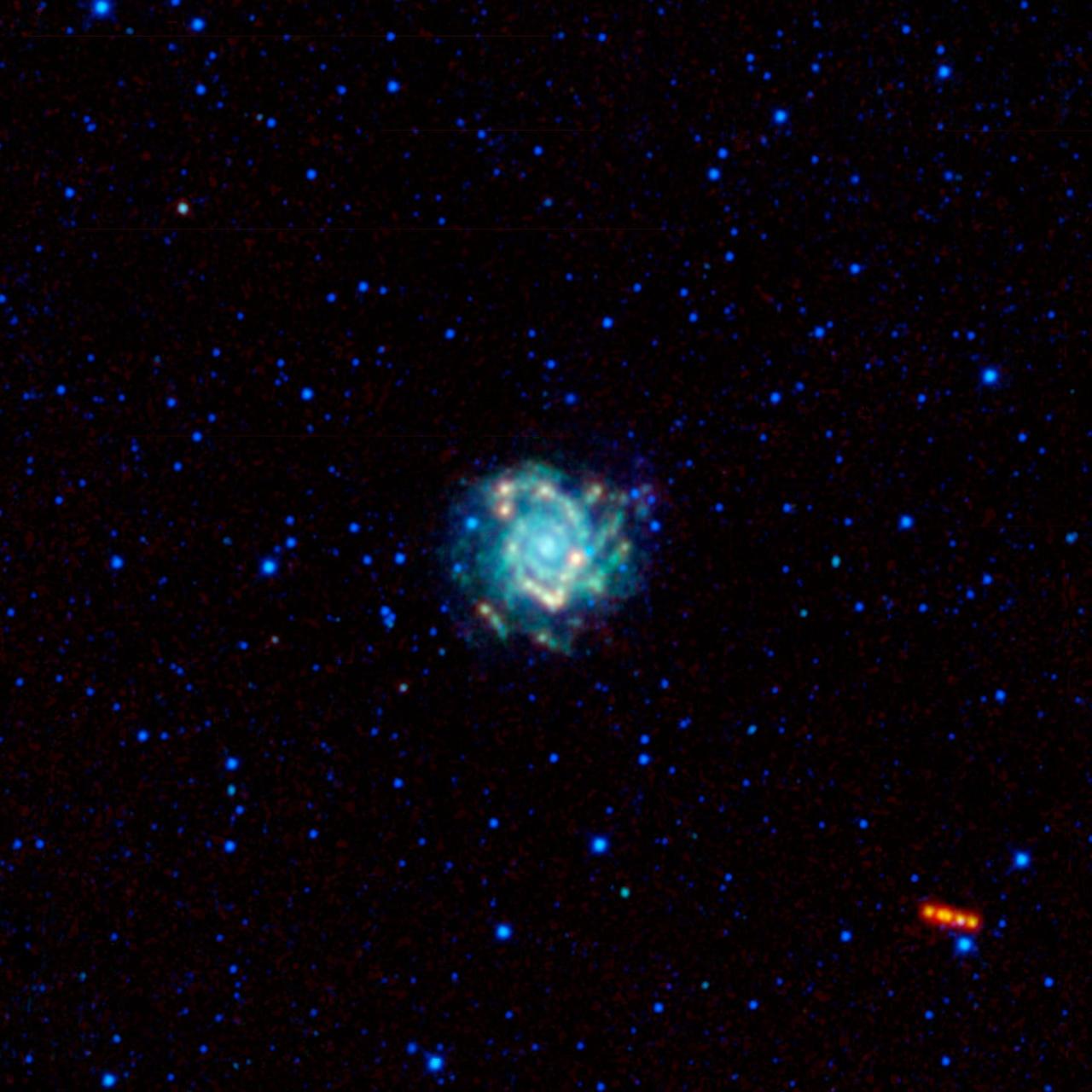
Galaxy Messier 74, with its spiral arms seen face-on, is in the center of this image captured by NASA Wide-field Infrared Survey Explorer, or WISE, while an asteroid tracks its way across the sky.
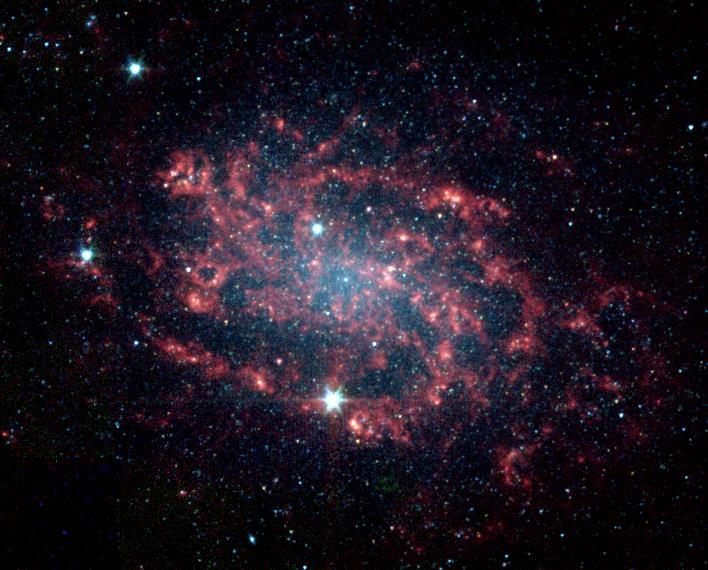
Sometimes, the best way to understand how something works is to take it apart. The same is true for galaxies like NGC 300, which NASA's Spitzer Space Telescope has divided into its various parts. NGC 300 is a face-on spiral galaxy located 7.5 million light-years away in the southern constellation Sculptor. This false-color image taken by the infrared array camera on Spitzer readily distinguishes the main star component of the galaxy (blue) from its dusty spiral arms (red). The star distribution peaks strongly in the central bulge where older stars congregate, and tapers off along the arms where younger stars reside. Thanks to Spitzer's unique ability to sense the heat or infrared emission from dust, astronomers can now clearly trace the embedded dust structures within NGC 300's arms. When viewed at visible wavelengths, the galaxy's dust appears as dark lanes, largely overwhelmed by bright starlight. With Spitzer, the dust - in particular organic compounds called polycyclic aromatic hydrocarbons - can be seen in vivid detail (red). These organic molecules are produced, along with heavy elements, by the stellar nurseries that pepper the arms. The findings provide a better understanding of spiral galaxy mechanics and, in the future, will help decipher more distant galaxies, whose individual components cannot be resolved. This image was taken on Nov. 21, 2003 and is composed of photographs obtained at four wavelengths: 3.6 microns (blue), 4.5 microns (green), 5.8 microns (orange) and 8 microns (red). http://photojournal.jpl.nasa.gov/catalog/PIA05879
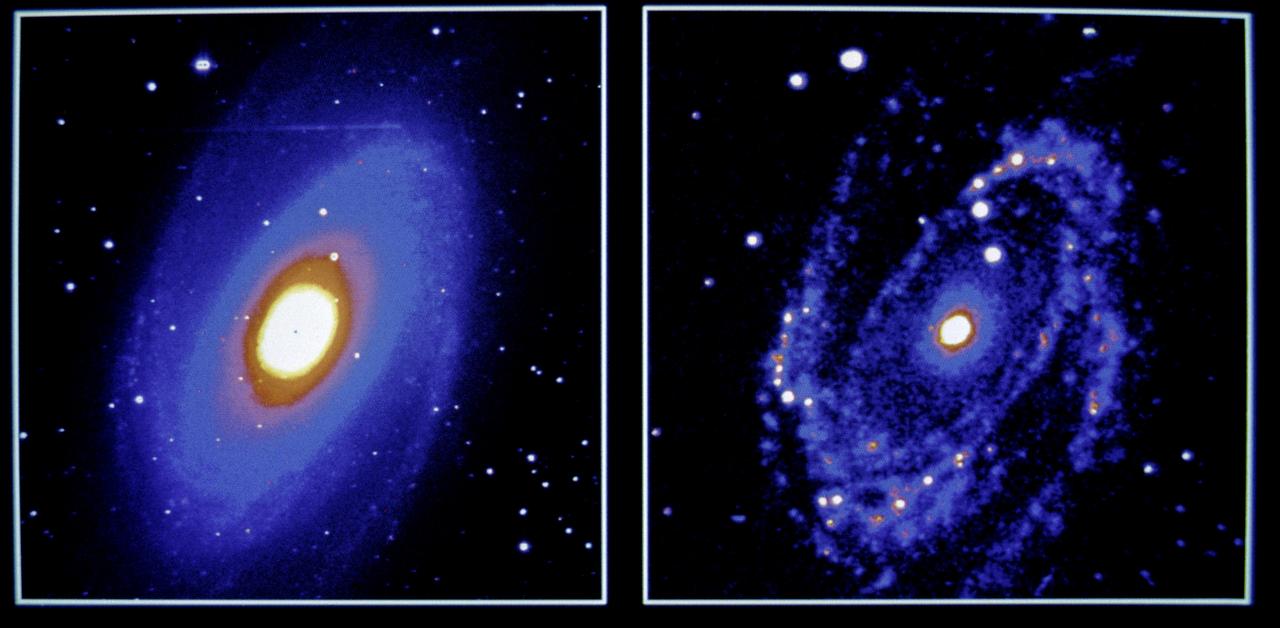
This is a presentation of two comparison images of the Spiral Galaxy M81 in the constellation URA Major. The galaxy is about 12-million light years from Earth. The left image is the Spiral Galaxy M81 as photographed by the Ultraviolet Imaging Telescope (UIT) during the Astro-1 Mission (STS-35) on December 9, 1990. This UIT photograph, made with ultraviolet light, reveals regions where new stars are forming at a rapid rate. The right image is a photograph of the same galaxy in red light made with a 36-inch (0.9-meter) telescope at the Kitt Peak National Observatory near Tucson, Arizona. The Astro Observatory was designed to explore the universe by observing and measuring ultraviolet radiation from celestial objects. Three instruments made up the Astro Observatory: The Hopkins Ultraviolet Telescope (HUT), the Ultraviolet Imaging Telescope (UIT), and the Wisconsin Ultraviolet Photo-Polarimetry Experiment (WUPPE). The Marshall Space Flight Center had management responsibilities for the Astro-1 mission. The Astro-1 Observatory was launched aboard the Space Shuttle Orbiter Columbia (STS-35) on December 2, 1990.

Lying more than 110 million light-years away from Earth in the constellation of Antlia (The Air Pump) is the spiral galaxy IC 2560, shown here in an image from NASA/ESA Hubble Space Telescope. At this distance it is a relatively nearby spiral galaxy, and is part of the Antlia cluster — a group of over 200 galaxies held together by gravity. This cluster is unusual; unlike most other galaxy clusters, it appears to have no dominant galaxy within it. In this image, it is easy to spot IC 2560's spiral arms and barred structure. This spiral is what astronomers call a Seyfert-2 galaxy, a kind of spiral galaxy characterized by an extremely bright nucleus and very strong emission lines from certain elements — hydrogen, helium, nitrogen, and oxygen. The bright center of the galaxy is thought to be caused by the ejection of huge amounts of super-hot gas from the region around a central black hole. There is a story behind the naming of this quirky constellation — Antlia was originally named antlia pneumatica by French astronomer Abbé Nicolas Louis de Lacaille, in honor of the invention of the air pump in the 17th century. Credit: Hubble/European Space Agency and NASA <b><a href="http://www.nasa.gov/audience/formedia/features/MP_Photo_Guidelines.html" rel="nofollow">NASA image use policy.</a></b> <b><a href="http://www.nasa.gov/centers/goddard/home/index.html" rel="nofollow">NASA Goddard Space Flight Center</a></b> enables NASA’s mission through four scientific endeavors: Earth Science, Heliophysics, Solar System Exploration, and Astrophysics. Goddard plays a leading role in NASA’s accomplishments by contributing compelling scientific knowledge to advance the Agency’s mission. <b>Follow us on <a href="http://twitter.com/NASA_GoddardPix" rel="nofollow">Twitter</a></b> <b>Like us on <a href="http://www.facebook.com/pages/Greenbelt-MD/NASA-Goddard/395013845897?ref=tsd" rel="nofollow">Facebook</a></b> <b>Find us on <a href="http://instagram.com/nasagoddard?vm=grid" rel="nofollow">Instagram</a></b>
![Despite its unassuming appearance, the edge-on spiral galaxy captured in the left half of this NASA/ESA Hubble Space Telescope image is actually quite remarkable. Located about one billion light-years away in the constellation of Eridanus, this striking galaxy — known as LO95 0313-192 — has a spiral shape similar to that of the Milky Way. It has a large central bulge, and arms speckled with brightly glowing gas mottled by thick lanes of dark dust. Its companion, sitting in the right of the frame, is known rather unpoetically as [LOY2001] J031549.8-190623. Jets, outbursts of superheated gas moving at close to the speed of light, have long been associated with the cores of giant elliptical galaxies, and galaxies in the process of merging. However, in an unexpected discovery, astronomers found LO95 0313-192, even though it is a spiral galaxy, to have intense radio jets spewing out from its center. The galaxy appears to have two more regions that are also strongly emitting in the radio part of the spectrum, making it even rarer still. The discovery of these giant jets in 2003 — not visible in this image, but indicated in this earlier Hubble composite — has been followed by the unearthing of a further three spiral galaxies containing radio-emitting jets in recent years. This growing class of unusual spirals continues to raise significant questions about how jets are produced within galaxies, and how they are thrown out into the cosmos. Image credit: ESA/Hubble & NASA; acknowledgement, Judy Schmidt <b><a href="http://www.nasa.gov/audience/formedia/features/MP_Photo_Guidelines.html" rel="nofollow">NASA image use policy.</a></b> <b><a href="http://www.nasa.gov/centers/goddard/home/index.html" rel="nofollow">NASA Goddard Space Flight Center</a></b> enables NASA’s mission through four scientific endeavors: Earth Science, Heliophysics, Solar System Exploration, and Astrophysics. Goddard plays a leading role in NASA’s accomplishments by contributing compelling scientific knowledge to advance the Agency’s mission. <b>Follow us on <a href="http://twitter.com/NASAGoddardPix" rel="nofollow">Twitter</a></b> <b>Like us on <a href="http://www.facebook.com/pages/Greenbelt-MD/NASA-Goddard/395013845897?ref=tsd" rel="nofollow">Facebook</a></b> <b>Find us on <a href="http://instagrid.me/nasagoddard/?vm=grid" rel="nofollow">Instagram</a></b>](https://images-assets.nasa.gov/image/GSFC_20171208_Archive_e000423/GSFC_20171208_Archive_e000423~medium.jpg)
Despite its unassuming appearance, the edge-on spiral galaxy captured in the left half of this NASA/ESA Hubble Space Telescope image is actually quite remarkable. Located about one billion light-years away in the constellation of Eridanus, this striking galaxy — known as LO95 0313-192 — has a spiral shape similar to that of the Milky Way. It has a large central bulge, and arms speckled with brightly glowing gas mottled by thick lanes of dark dust. Its companion, sitting in the right of the frame, is known rather unpoetically as [LOY2001] J031549.8-190623. Jets, outbursts of superheated gas moving at close to the speed of light, have long been associated with the cores of giant elliptical galaxies, and galaxies in the process of merging. However, in an unexpected discovery, astronomers found LO95 0313-192, even though it is a spiral galaxy, to have intense radio jets spewing out from its center. The galaxy appears to have two more regions that are also strongly emitting in the radio part of the spectrum, making it even rarer still. The discovery of these giant jets in 2003 — not visible in this image, but indicated in this earlier Hubble composite — has been followed by the unearthing of a further three spiral galaxies containing radio-emitting jets in recent years. This growing class of unusual spirals continues to raise significant questions about how jets are produced within galaxies, and how they are thrown out into the cosmos. Image credit: ESA/Hubble & NASA; acknowledgement, Judy Schmidt <b><a href="http://www.nasa.gov/audience/formedia/features/MP_Photo_Guidelines.html" rel="nofollow">NASA image use policy.</a></b> <b><a href="http://www.nasa.gov/centers/goddard/home/index.html" rel="nofollow">NASA Goddard Space Flight Center</a></b> enables NASA’s mission through four scientific endeavors: Earth Science, Heliophysics, Solar System Exploration, and Astrophysics. Goddard plays a leading role in NASA’s accomplishments by contributing compelling scientific knowledge to advance the Agency’s mission. <b>Follow us on <a href="http://twitter.com/NASAGoddardPix" rel="nofollow">Twitter</a></b> <b>Like us on <a href="http://www.facebook.com/pages/Greenbelt-MD/NASA-Goddard/395013845897?ref=tsd" rel="nofollow">Facebook</a></b> <b>Find us on <a href="http://instagrid.me/nasagoddard/?vm=grid" rel="nofollow">Instagram</a></b>

A colorful collection of galaxy specimens from NASA Wide-field Infrared Survey Explorer mission showcases galaxies of several types, from elegant grand design spirals to more patchy flocculent spirals.
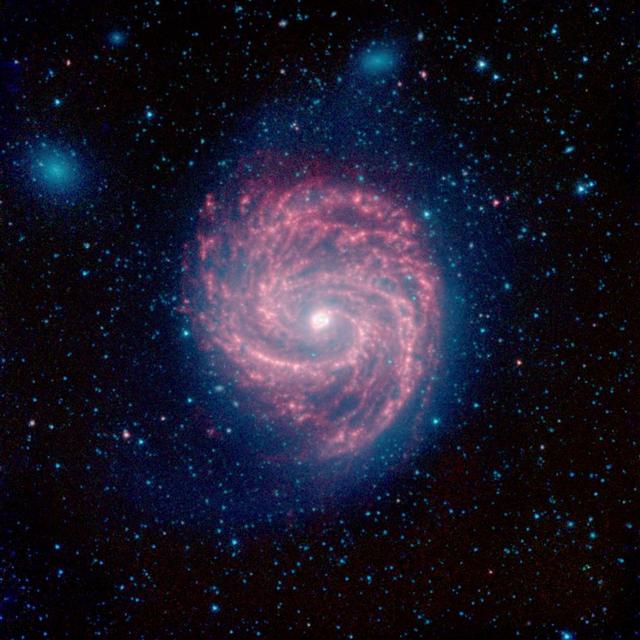
This infrared image, from NASA Spitzer Space Telescope, of M100 is a classic example of a grand design spiral galaxy, with prominent and well-defined spiral arms winding from the hot center, out to the cooler edges of the galaxy.
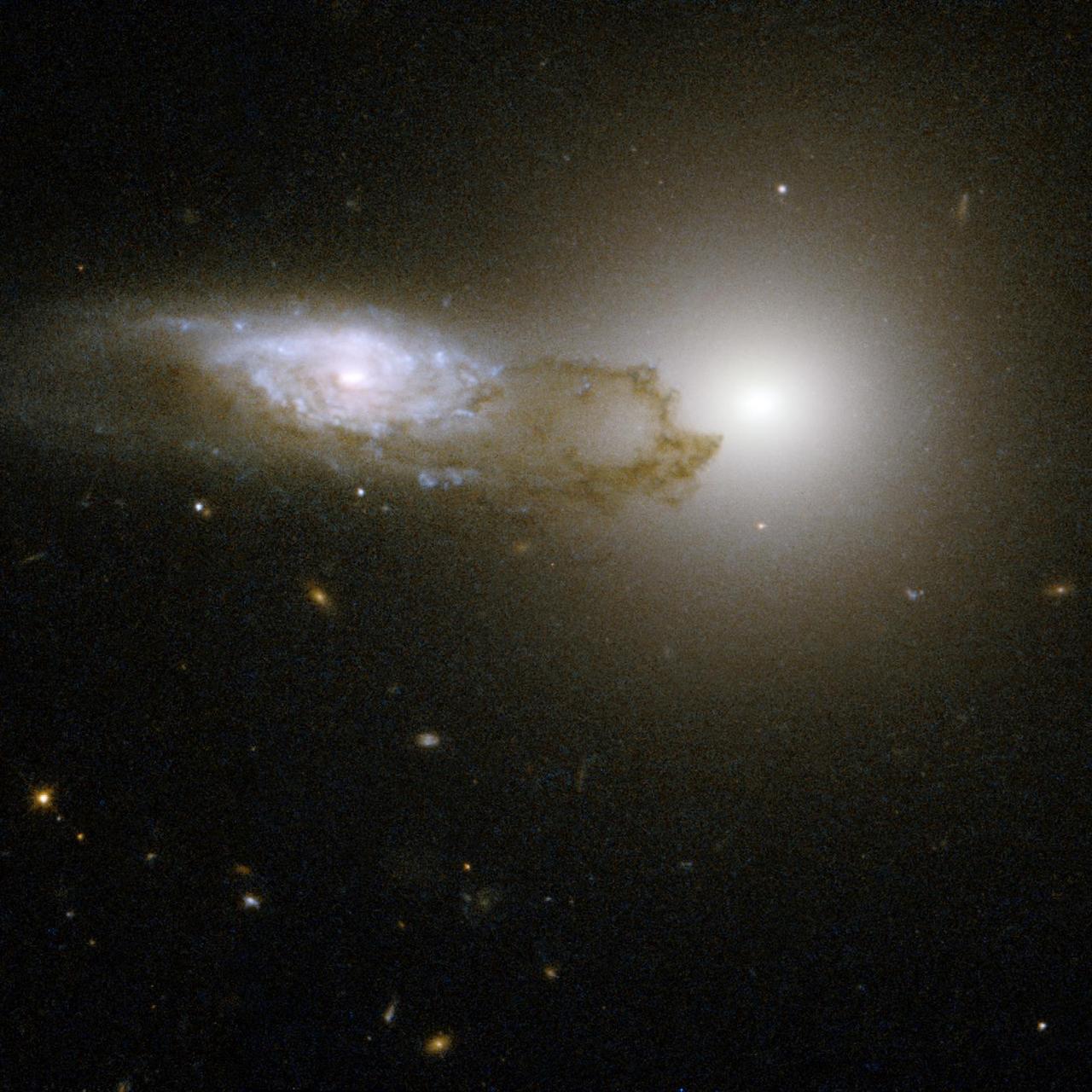
AM 1316-241 is made up of two interacting galaxies—a spiral galaxy on the left of the frame in front of an elliptical galaxy on the right of the frame. This image is part of a large collection of images of merging galaxies taken by NASA Hubble.
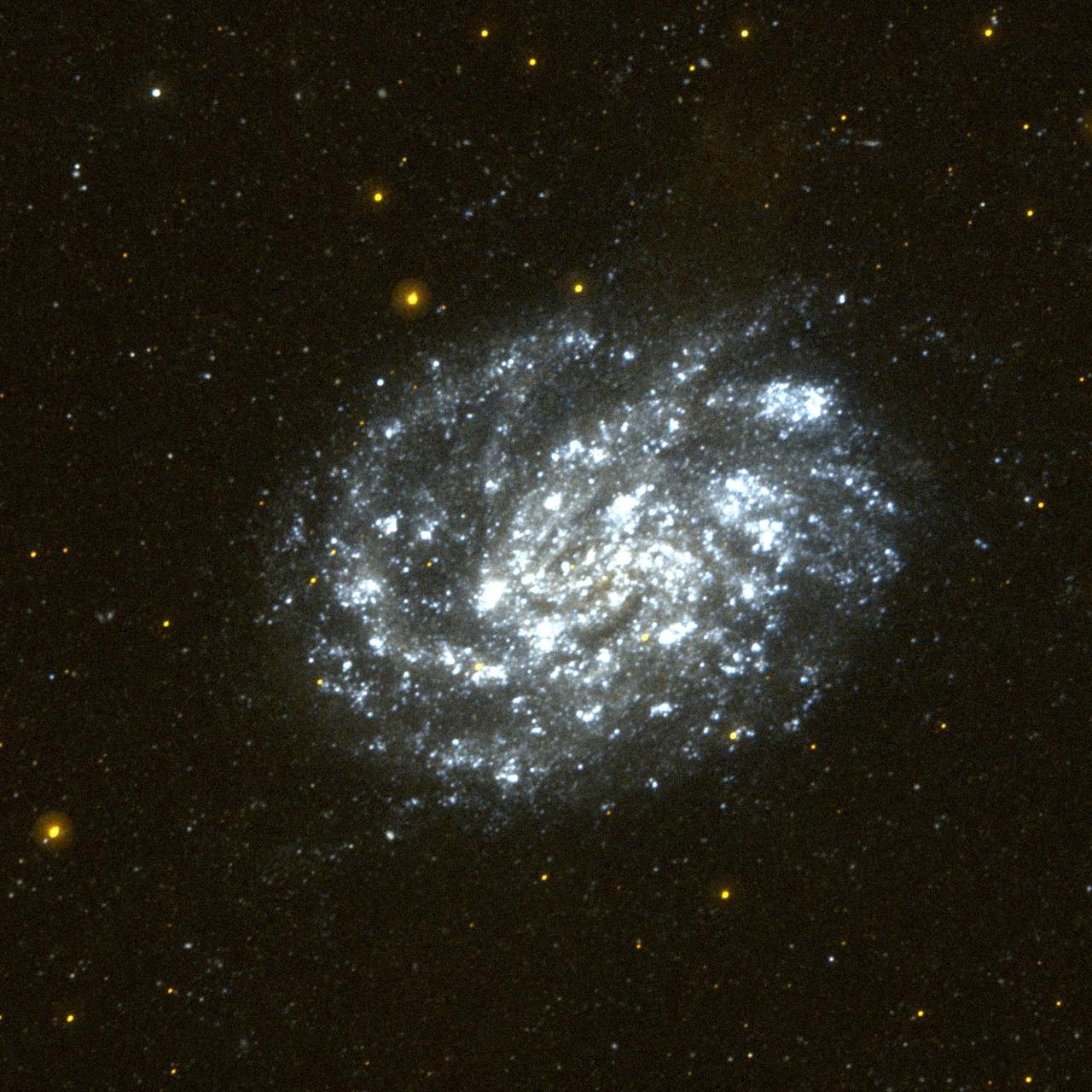
This image of the nearby spiral galaxy NGC 300 was taken by Galaxy Evolution Explorer in a single orbit exposure of 27 minutes on October 10, 2003. NGC 300 lies 7 million light years from our Milky Way galaxy and is one of a group of galaxies in the constellation Sculptor. NGC 300 is often used as a prototype of a spiral galaxy because in optical images it displays flowing spiral arms and a bright central region of older (and thus redder) stars. The Galaxy Evolution Explorer image taken in ultraviolet light shows us that NGC 300 is an efficient star-forming galaxy. The bright blue regions in the Galaxy Evolution Explorer image reveal new stars forming all the way into the nucleus of NGC 300. http://photojournal.jpl.nasa.gov/catalog/PIA04924
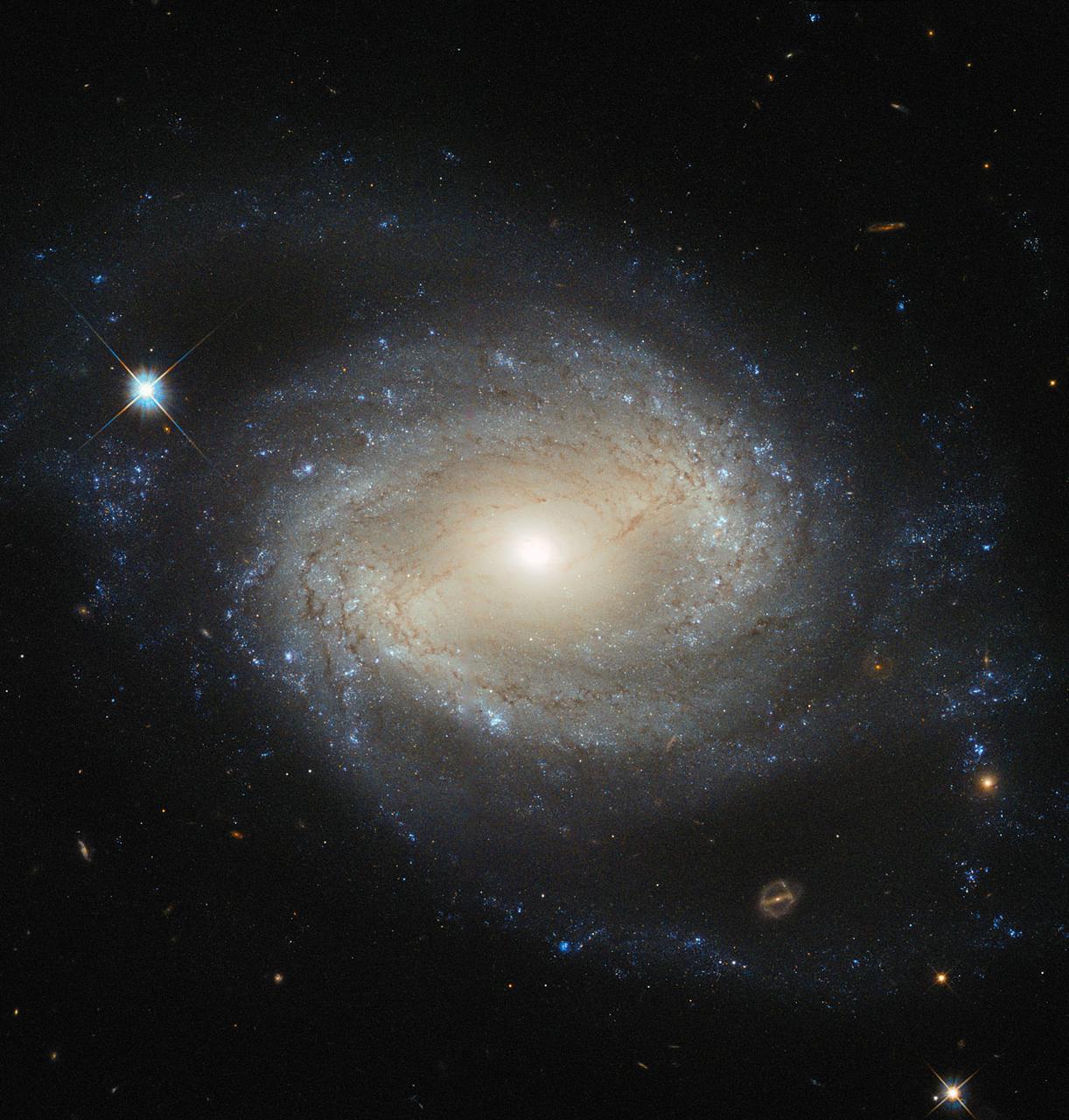
NGC 4639 is a beautiful example of a type of galaxy known as a barred spiral. It lies over 70 million light-years away in the constellation of Virgo and is one of about 1,500 galaxies that make up the Virgo Cluster. In this image, taken by the NASA/ESA Hubble Space Telescope, one can clearly see the bar running through the bright, round core of the galaxy. Bars are found in around two-thirds of spiral galaxies, and are thought to be a natural phase in their evolution. The galaxy’s spiral arms are sprinkled with bright regions of active star formation. Each of these tiny jewels is actually several hundred light-years across and contains hundreds or thousands of newly formed stars. But NGC 4639 also conceals a dark secret in its core — a massive black hole that is consuming the surrounding gas. This is known as an active galactic nucleus (AGN), and is revealed by characteristic features in the spectrum of light from the galaxy and by X-rays produced close to the black hole as the hot gas plunges towards it. Most galaxies are thought to contain a black hole at the center. NGC 4639 is in fact a very weak example of an AGN, demonstrating that AGNs exist over a large range of activity, from galaxies like NGC 4639 to distant quasars, where the parent galaxy is almost completely dominated by the emissions from the AGN. Image credit: ESA/Hubble & NASA <b><a href="http://www.nasa.gov/audience/formedia/features/MP_Photo_Guidelines.html" rel="nofollow">NASA image use policy.</a></b> <b><a href="http://www.nasa.gov/centers/goddard/home/index.html" rel="nofollow">NASA Goddard Space Flight Center</a></b> enables NASA’s mission through four scientific endeavors: Earth Science, Heliophysics, Solar System Exploration, and Astrophysics. Goddard plays a leading role in NASA’s accomplishments by contributing compelling scientific knowledge to advance the Agency’s mission. <b>Follow us on <a href="http://twitter.com/NASAGoddardPix" rel="nofollow">Twitter</a></b> <b>Like us on <a href="http://www.facebook.com/pages/Greenbelt-MD/NASA-Goddard/395013845897?ref=tsd" rel="nofollow">Facebook</a></b> <b>Find us on <a href="http://instagrid.me/nasagoddard/?vm=grid" rel="nofollow">Instagram</a></b>
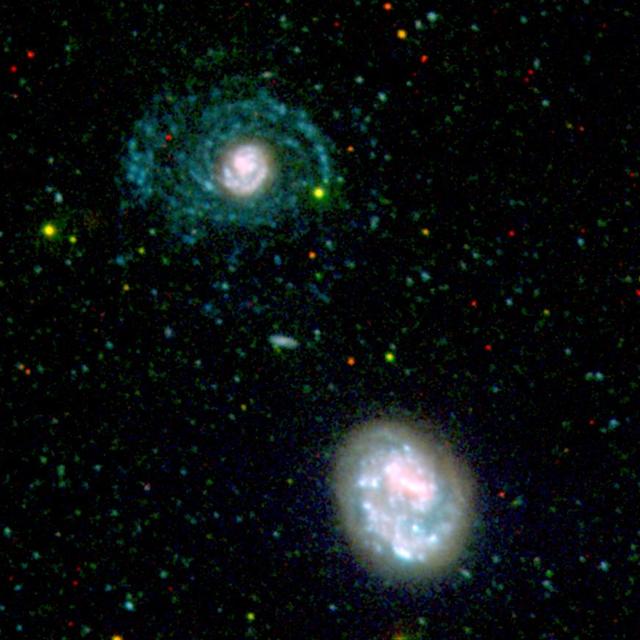
This image highlights the hidden spiral arms blue that were discovered around the nearby galaxy NGC 4625 by the ultraviolet eyes of NASA Galaxy Evolution Explorer.
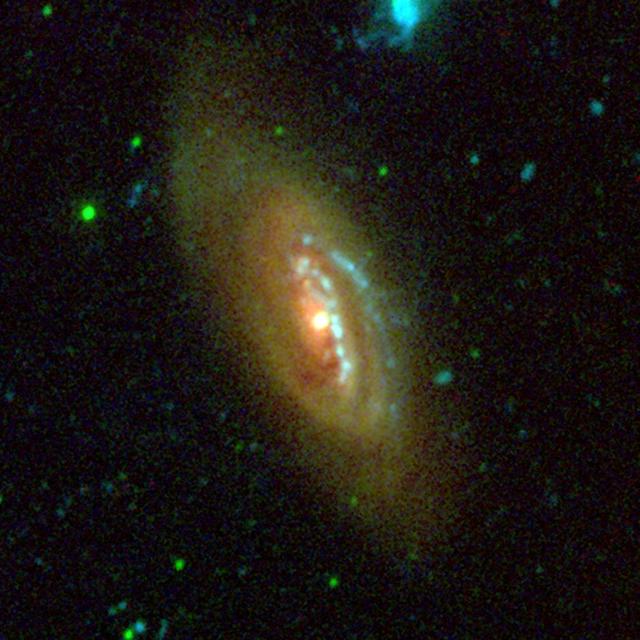
This image from NASA Galaxy Evolution Explorer shows the galaxy NGC 4569 in the constellation Virgo. It is one of the largest and brightest spiral galaxies found in the Virgo cluster of galaxies, the nearest major galaxy cluster to our Milky Way galaxy.
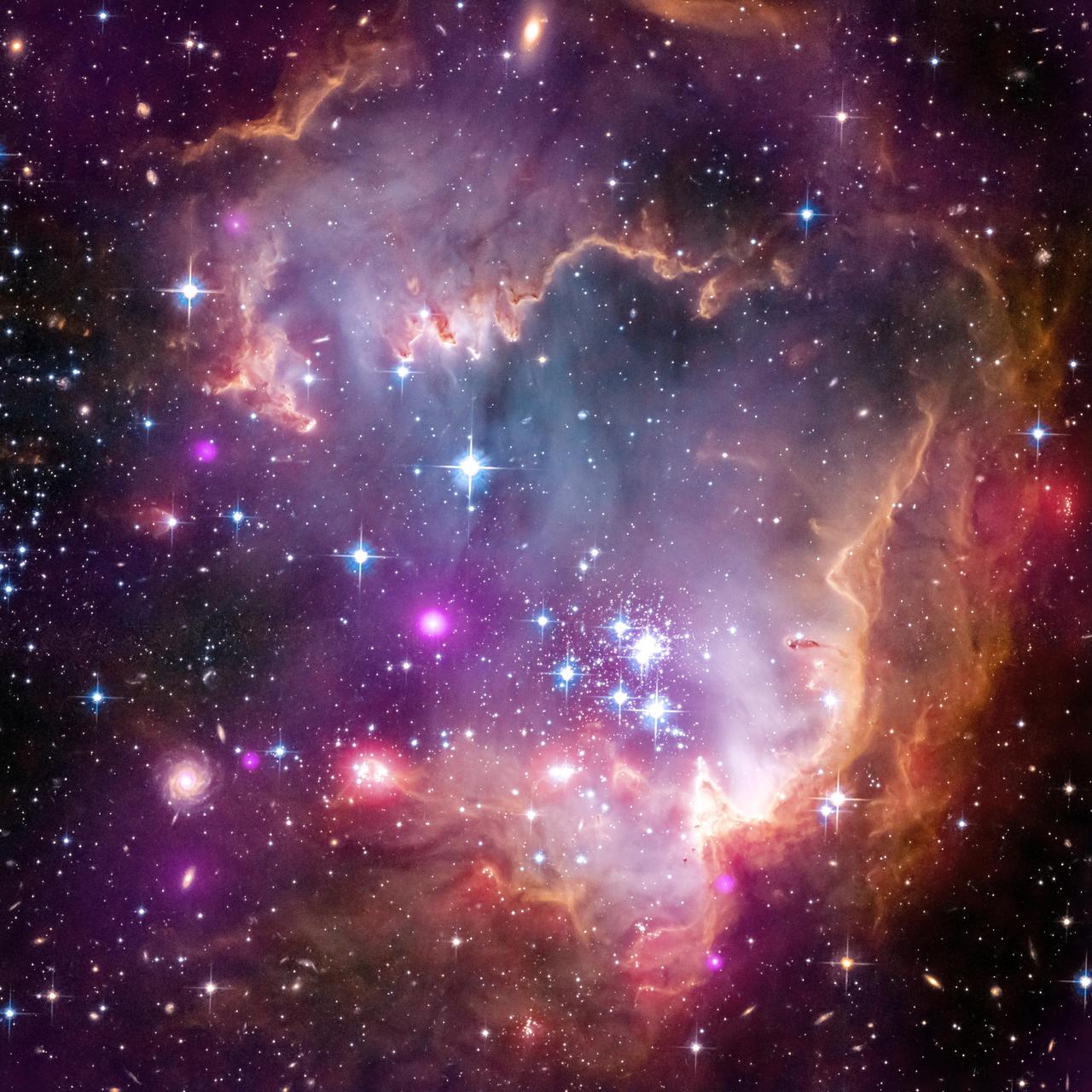
The tip of the wing of the Small Magellanic Cloud galaxy is dazzling in this new view from NASA Great Observatories. The SMC, is a small galaxy about 200,000 light-years way that orbits our own Milky Way spiral galaxy.
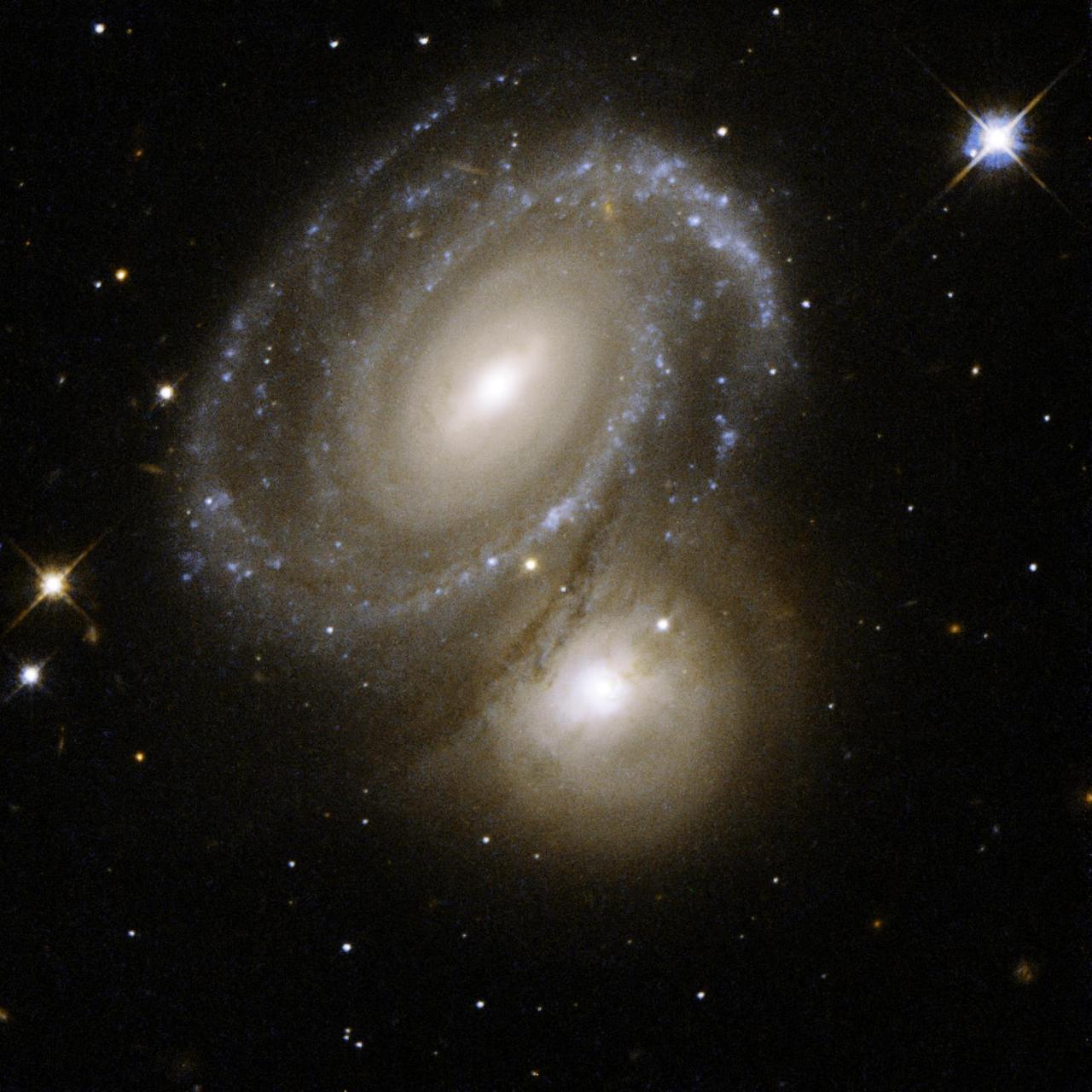
AM 0500-620 consists of a highly symmetric spiral galaxy seen nearly face-on and partially backlit by a background galaxy. This image is part of a large collection of images of merging galaxies taken by NASA Hubble Space Telescope.
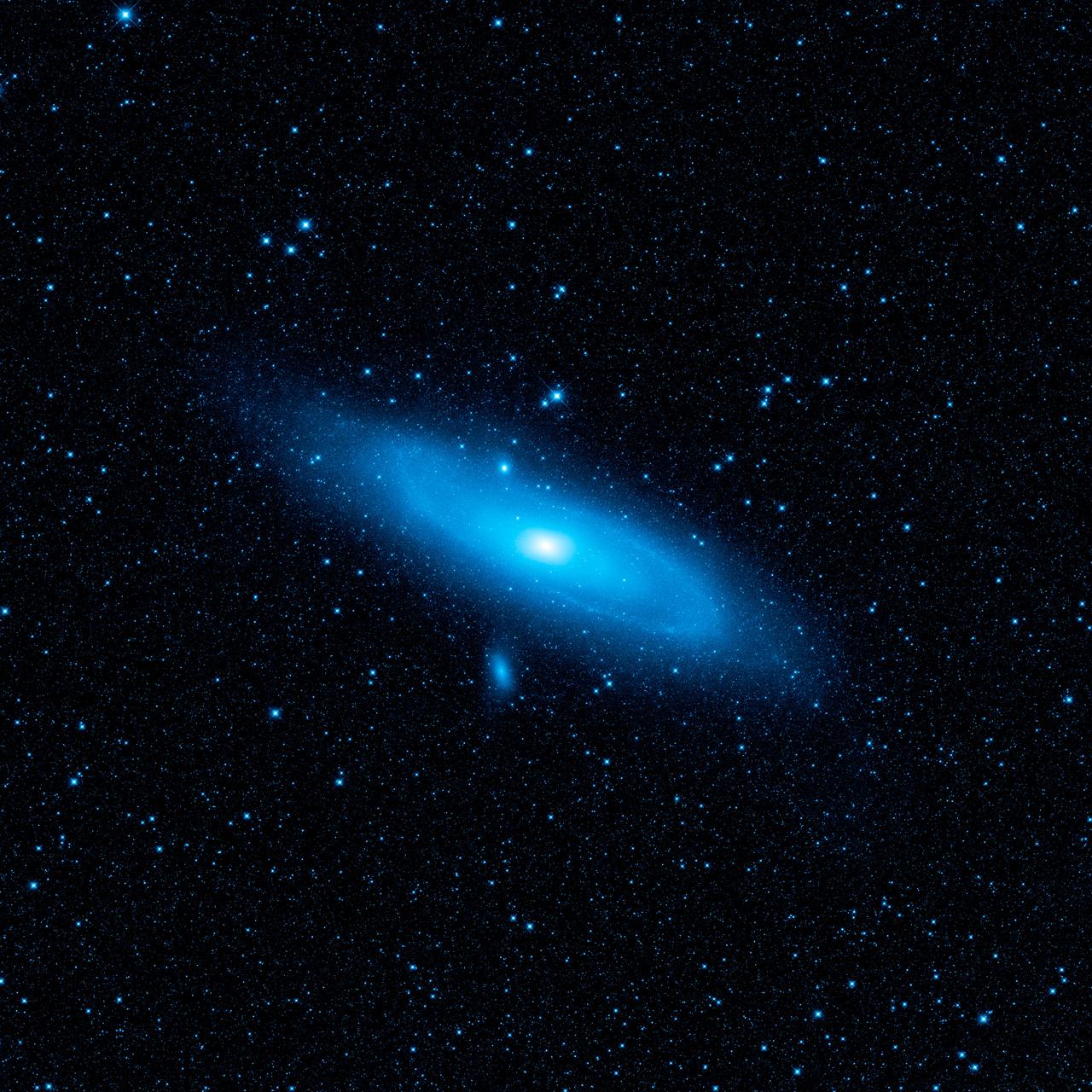
This image from NASA Wide-field Infrared Survey Explorer highlights the Andromeda galaxy older stellar population in blue. A pronounced warp in the disk of the galaxy, the aftermath of a collision with another galaxy, can be seen in the spiral arm.
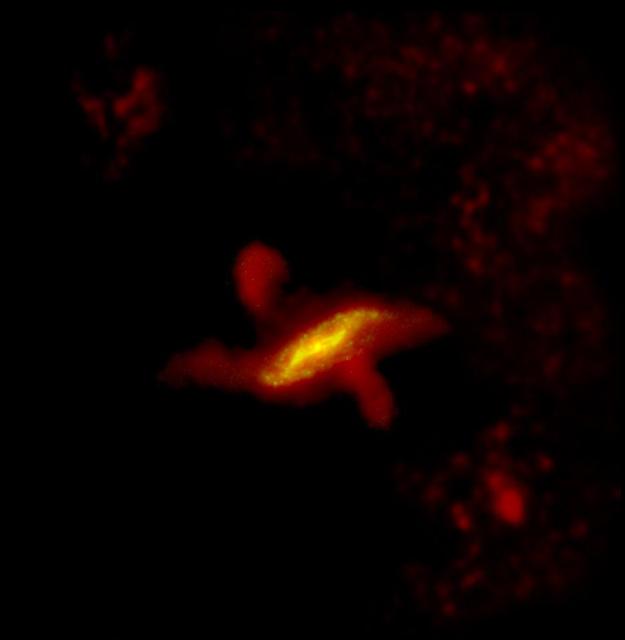
This parallelogram shaped region of dust observed by ESA Herschel Space telescope can be best described using galaxy formation models where a flat spiral galaxy collides with an elliptical galaxy becoming warped in the process.
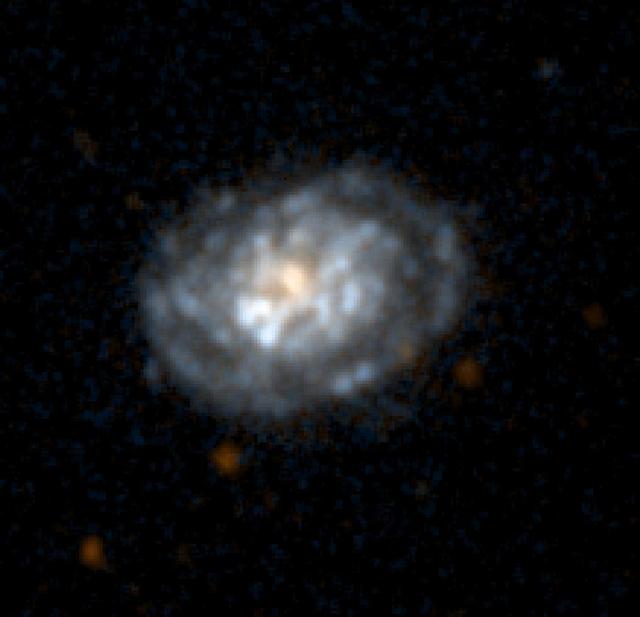
NASA Galaxy Evolution Explorer took this ultraviolet color image of the galaxy NGC5962 on June 7, 2003. This spiral galaxy is located 90 million light-years from Earth. http://photojournal.jpl.nasa.gov/catalog/PIA04635
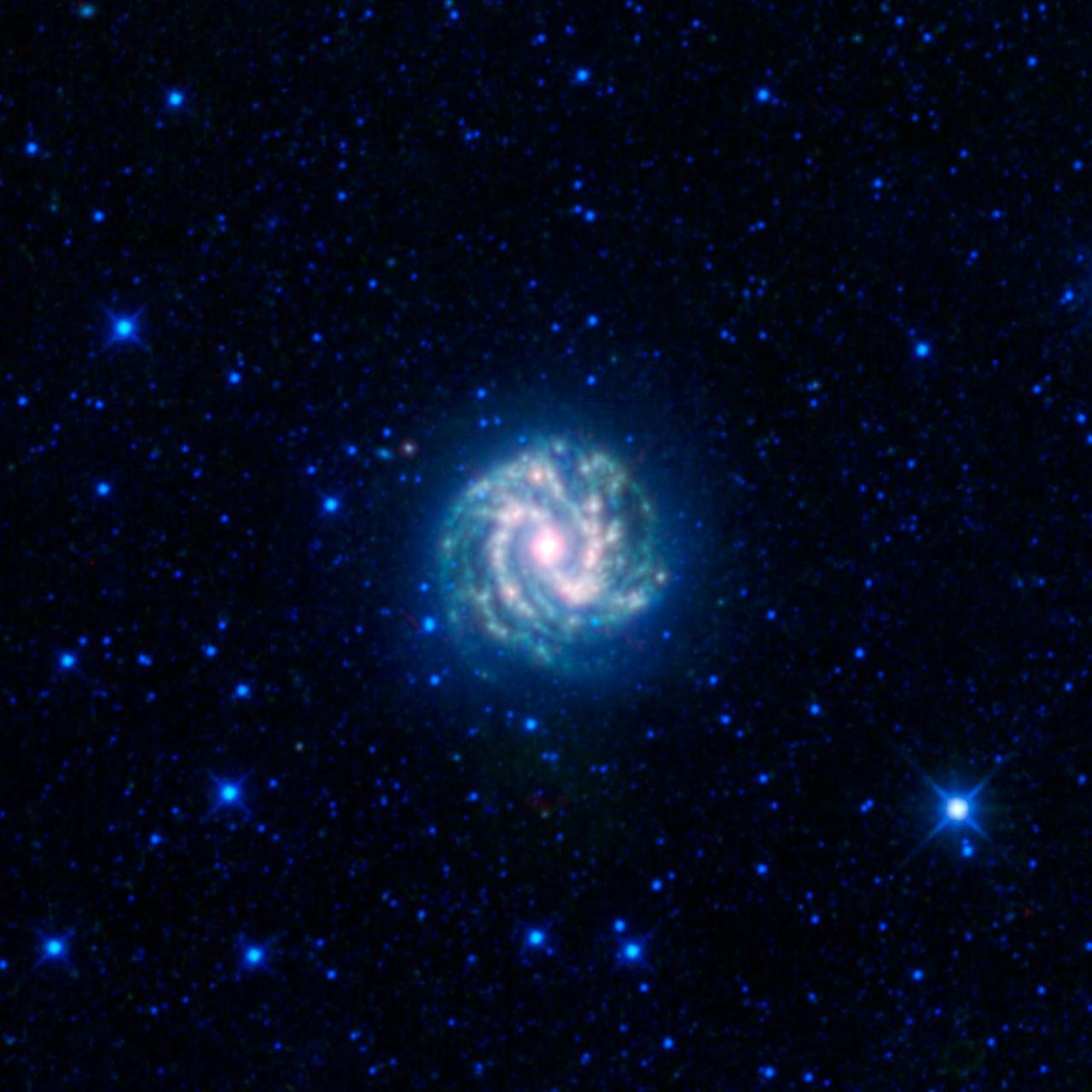
This image from NASA Wide-field Infrared Survey Explorer shows the nearby galaxy M83. This is a spiral galaxy approximately 15 million light-years away in the constellation Hydra, sometimes referred to as the southern Pinwheel galaxy.
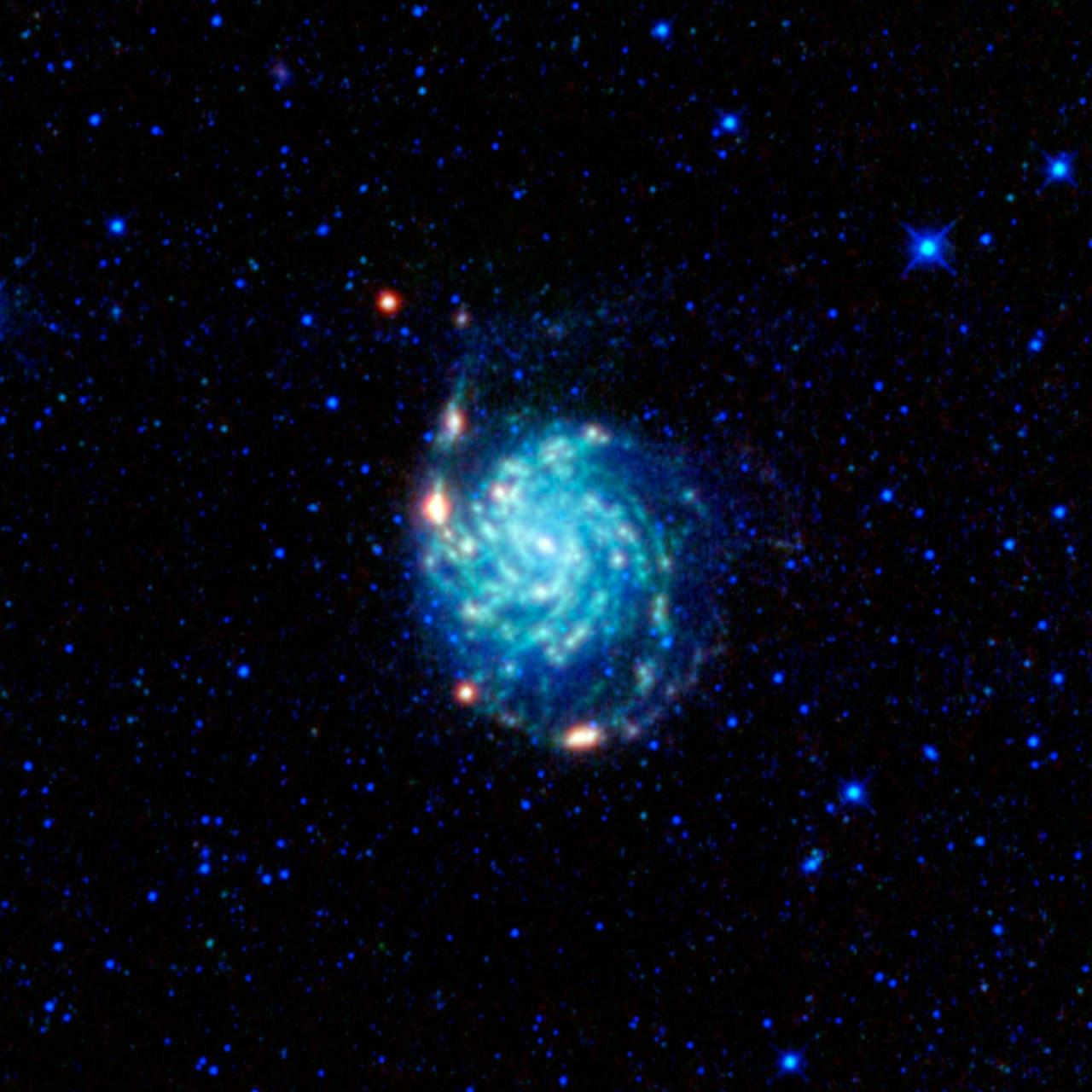
A large spiral galaxy dominates this view from NASA Wide-field Infrared Survey Explorer. The galaxy, often called the Pinwheel galaxy, was designated object 101 in astronomer Charles Messier catalog of fuzzy things in the sky that are not comets.
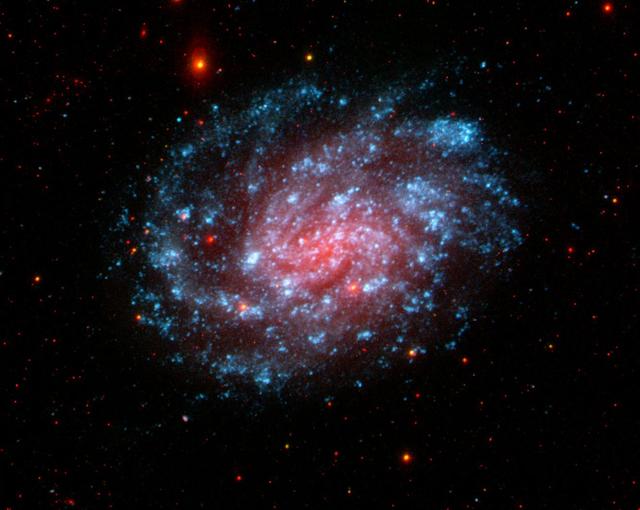
This image from NASA Galaxy Evolution Explorer shows the galaxy NGC 300, located about seven million light-years away in the constellation Sculptor. It is a classic spiral galaxy with open arms and vigorous star formation throughout.
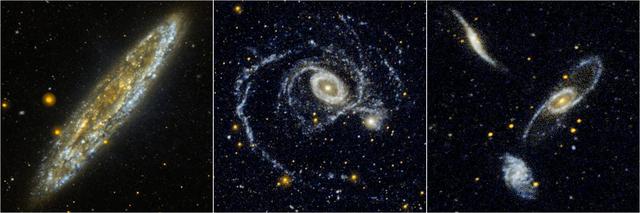
Located 10 million light-years away in the southern constellation Sculptor, the Silver Dollar galaxy, or NGC 253, is one of the brightest spiral galaxies in the night sky as seen in this edge-on view from NASA Galaxy Evolution Explorer.

This ultraviolet image from NASA Galaxy Evolution Explorer is of a diverse group of galaxy types. NGC 3190 is a dusty edge on spiral galaxy. NGC 3187 is highly distorted.

Evidence from NASA Galaxy Evolution Explorer supports the long-held notion that many galaxies begin life as smaller spirals before transforming into larger, elliptical-shaped galaxies.
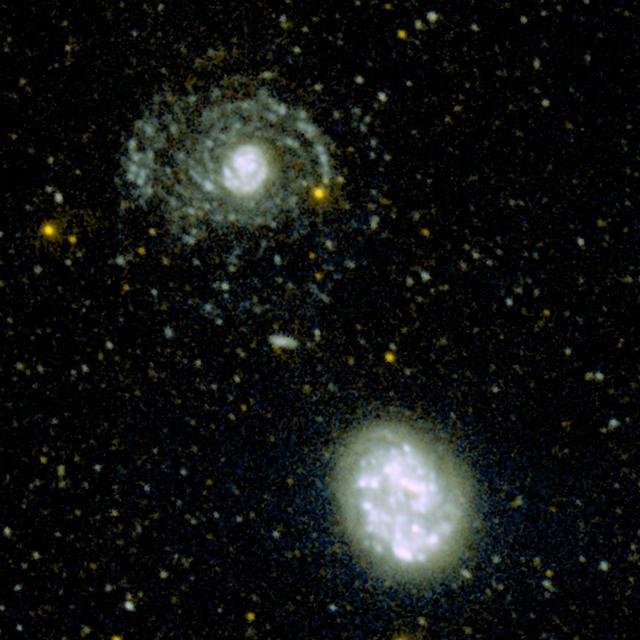
This image shows the hidden spiral arms that were discovered around the galaxy called NGC 4625 top by the ultraviolet eyes of NASA Galaxy Evolution Explorer. An armless companion galaxy called NGC 4618 is pictured below.
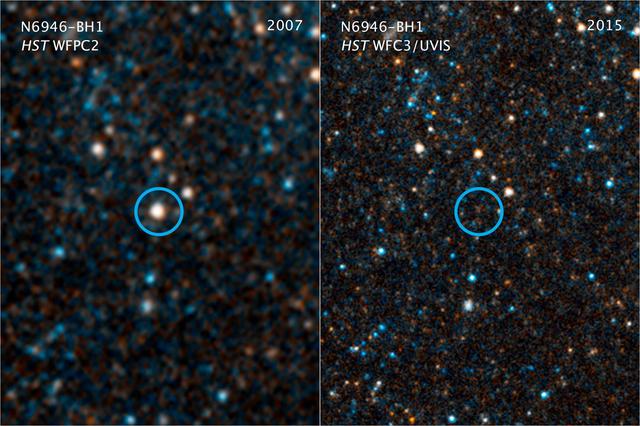
This pair of visible-light and near-infrared photos from NASA's Hubble Space Telescope shows the giant star N6946-BH1 before and after it vanished out of sight by imploding to form a black hole. The left image shows the star, which is 25 times the mass of our sun, as it looked in 2007. In 2009, the star shot up in brightness to become over 1 million times more luminous than our sun for several months. But then it seemed to vanish, as seen in the right panel image from 2015. A small amount of infrared light has been detected from where the star used to be. This radiation probably comes from debris falling onto a black hole. The black hole is located 22 million light-years away in the spiral galaxy NGC 6946. https://photojournal.jpl.nasa.gov/catalog/PIA21467
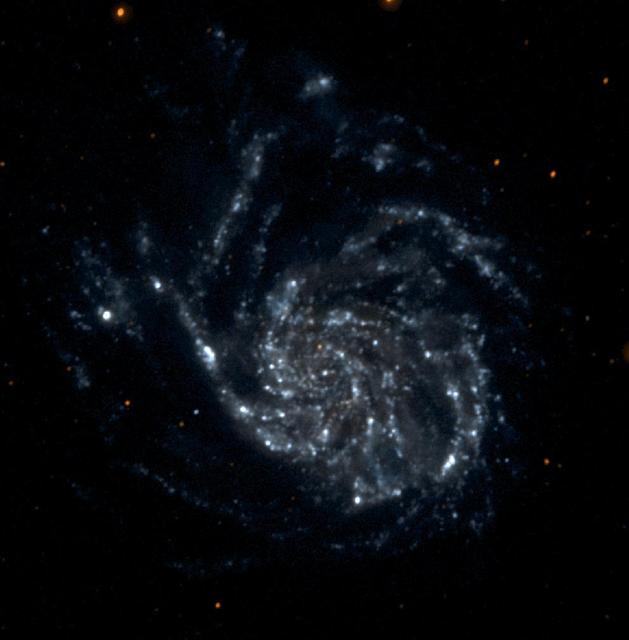
This single orbit exposure, ultraviolet color image of Messier 101 was taken by NASA's Galaxy Evolution Explorer on June 20, 2003. Messier 101 is a large spiral galaxy located 20 million light-years from Earth. This image is a short and medium "exposure" picture of the evolution of star formation in a spiral galaxy. The far ultraviolet emission detects the younger stars as concentrated in tight spiral arms, while the near ultraviolet emission, which traces stars living for more than 100 million years, displays the movement of the spiral pattern over a 100 million year period. The red stars in the foreground of the image are Milky Way stars. http://photojournal.jpl.nasa.gov/catalog/PIA04632
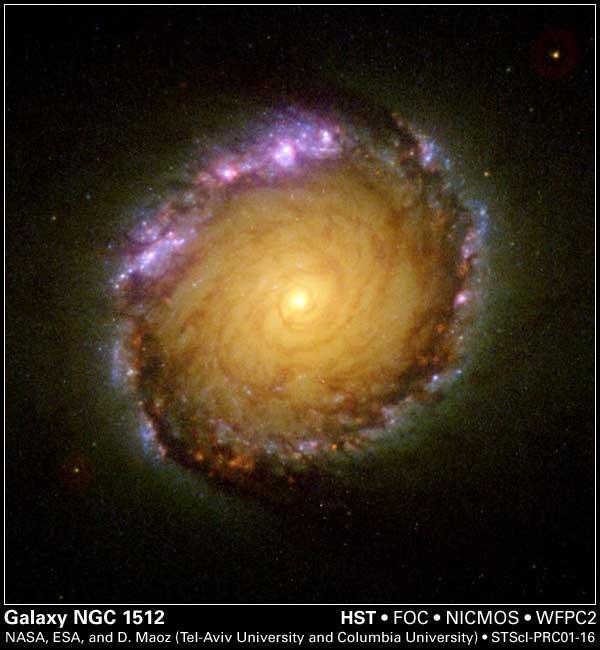
A rainbow of colors is captured in the center of a magnificent barred spiral galaxy, as witnessed by the three cameras of NASA Hubble Space Telescope.
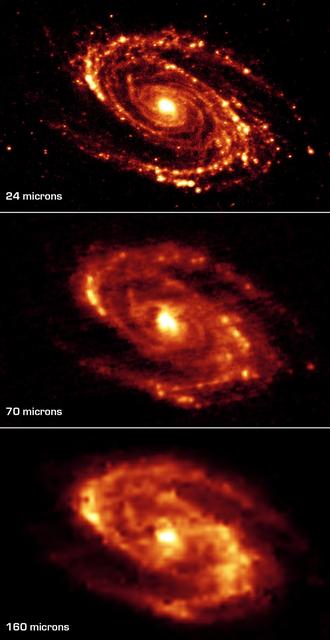
The magnificent and dusty spiral arms of the nearby galaxy Messier 81 are highlighted in these NASA Spitzer Space Telescope images.
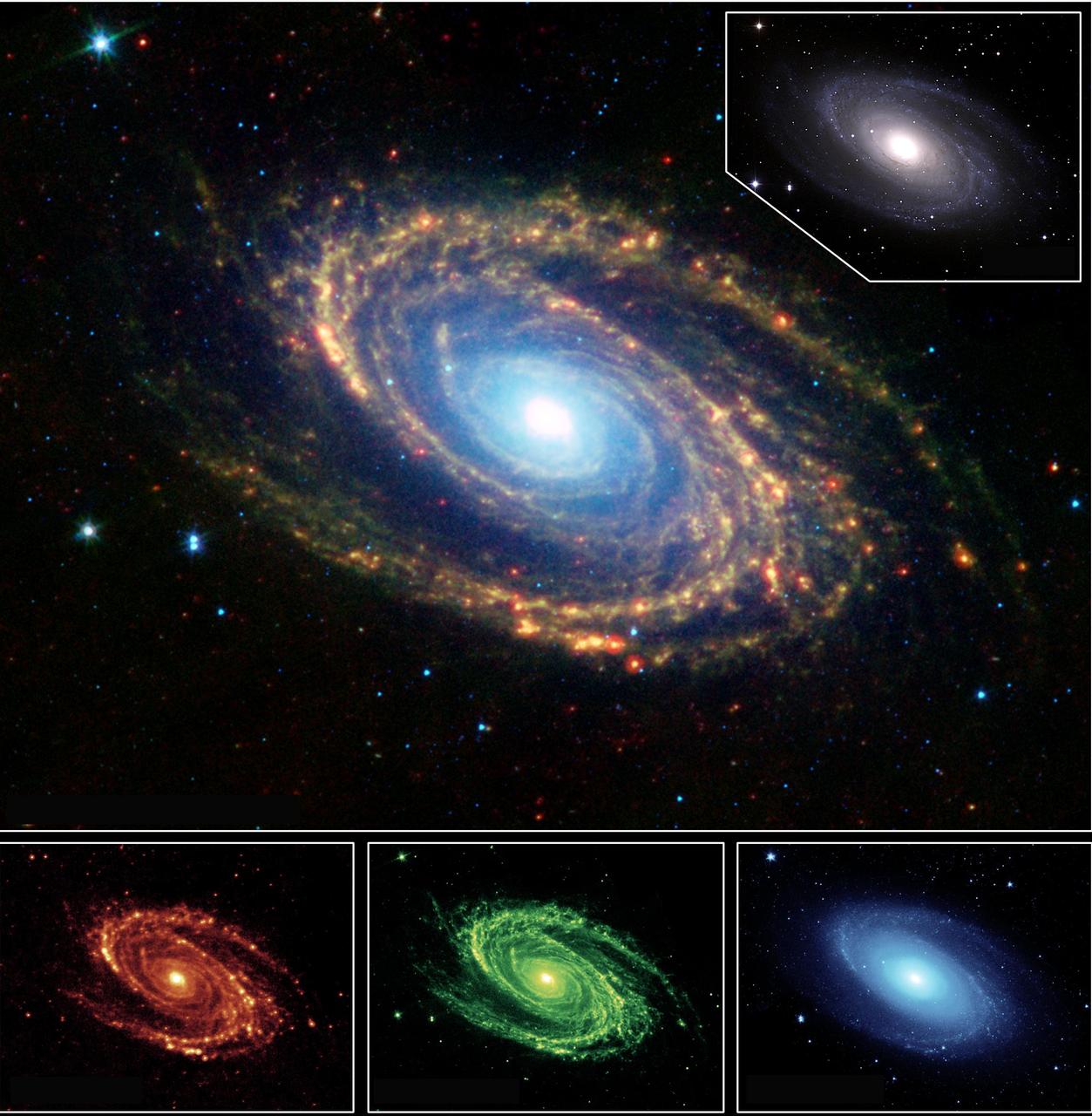
The magnificent spiral arms of the nearby galaxy Messier 81 are highlighted in this image from NASA Spitzer Space Telescope.
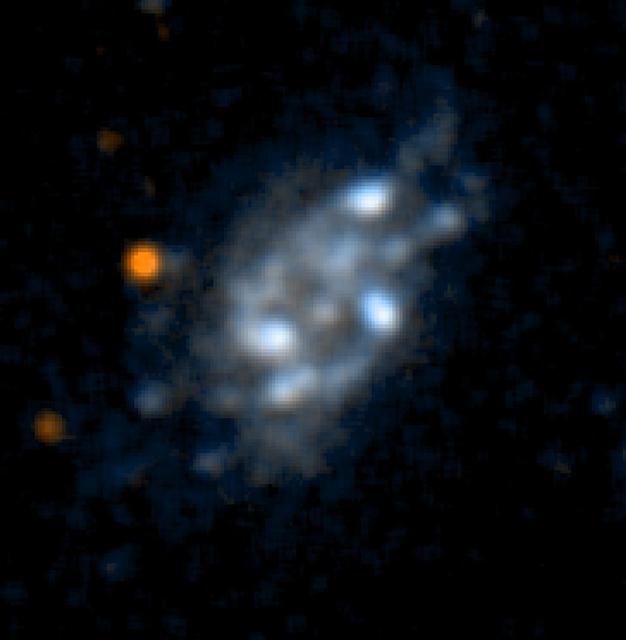
This ultraviolet color image of the galaxy UGC10445 was taken by NASA Galaxy Evolution Explorer on June 7 and June 14, 2003. UGC10445 is a spiral galaxy located 40 million light-years from Earth. http://photojournal.jpl.nasa.gov/catalog/PIA04623

This is an ultraviolet color image of the galaxy NGC5398 taken by NASA Galaxy Evolution Explorer on June 7, 2003. NGC5398 is a barred spiral galaxy located 60 million light-years from Earth. The star formation is concentrated in the two bright regions of the image. http://photojournal.jpl.nasa.gov/catalog/PIA04633
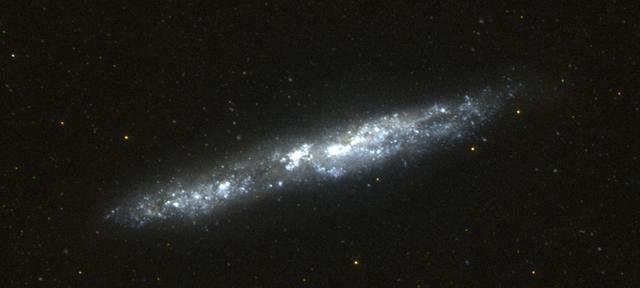
This image of the nearby edge-on spiral galaxy NGC 55 was taken by Galaxy Evolution Explorer on September 14, 2003, during 2 orbits. This galaxy lies 5.4 million light years from our Milky Way galaxy and is a member of the "local group" of galaxies that also includes the Andromeda galaxy (M31), the Magellanic clouds, and 40 other galaxies. The spiral disk of NGC 55 is inclined to our line of sight by approximately 80 degrees and so this galaxy looks cigar-shaped. This picture is a combination of Galaxy Evolution Explorer images taken with the far ultraviolet (colored blue) and near ultraviolet detectors, (colored red). The bright blue regions in this image are areas of active star formation detected in the ultraviolet by Galaxy Evolution Explorer. The red stars in this image are foreground stars in our own Milky Way galaxy. http://photojournal.jpl.nasa.gov/catalog/PIA04923
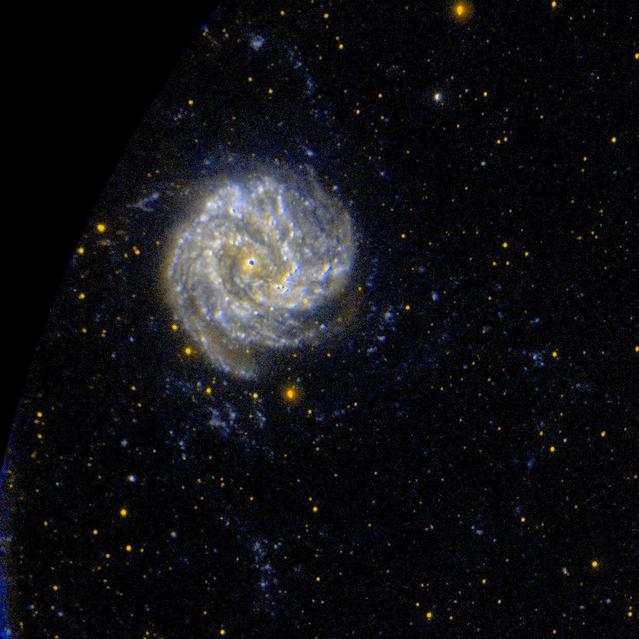
Ultraviolet images such as this one from NASA's Galaxy Evolution Explorer suggest the M83 has unusual pockets of star formation separated by large distances from the spiral arms in the main disk of the galaxy. http://photojournal.jpl.nasa.gov/catalog/PIA07903
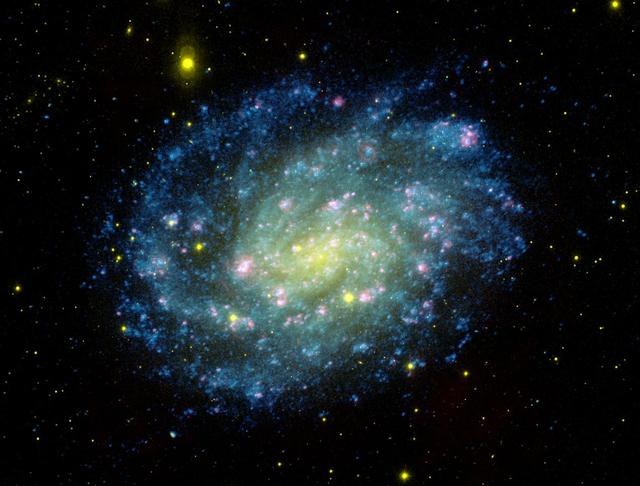
Young hot blue stars dominate the outer spiral arms of nearby galaxy NGC 300, while the older stars congregate in the nuclear regions which appear yellow-green in this image from NASA Galaxy Evolution Explorer.

NASA Galaxy Evolution Explorer is celebrates its fourth year in space with some of M81 hottest stars. In this ultraviolet image, the magnificent M81 spiral galaxy is shown at the center.
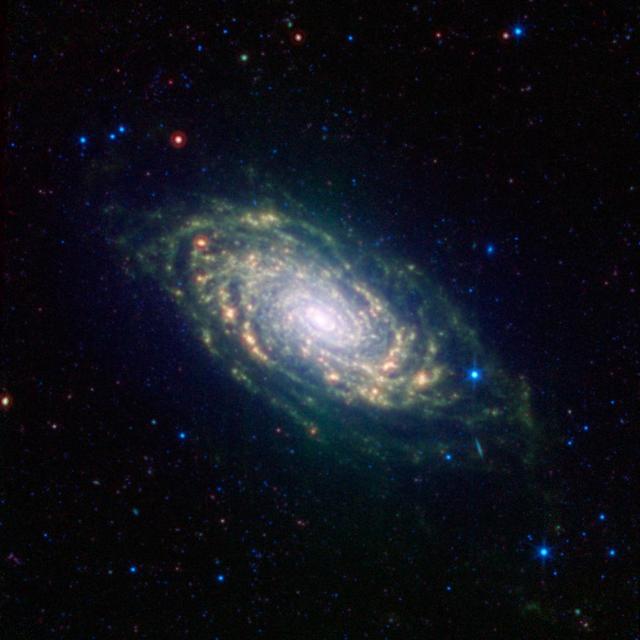
This image from NASA Spitzer Space Telescope shows infrared light from the Sunflower galaxy, otherwise known as Messier 63. Spitzer view highlights the galaxy dusty spiral arms.
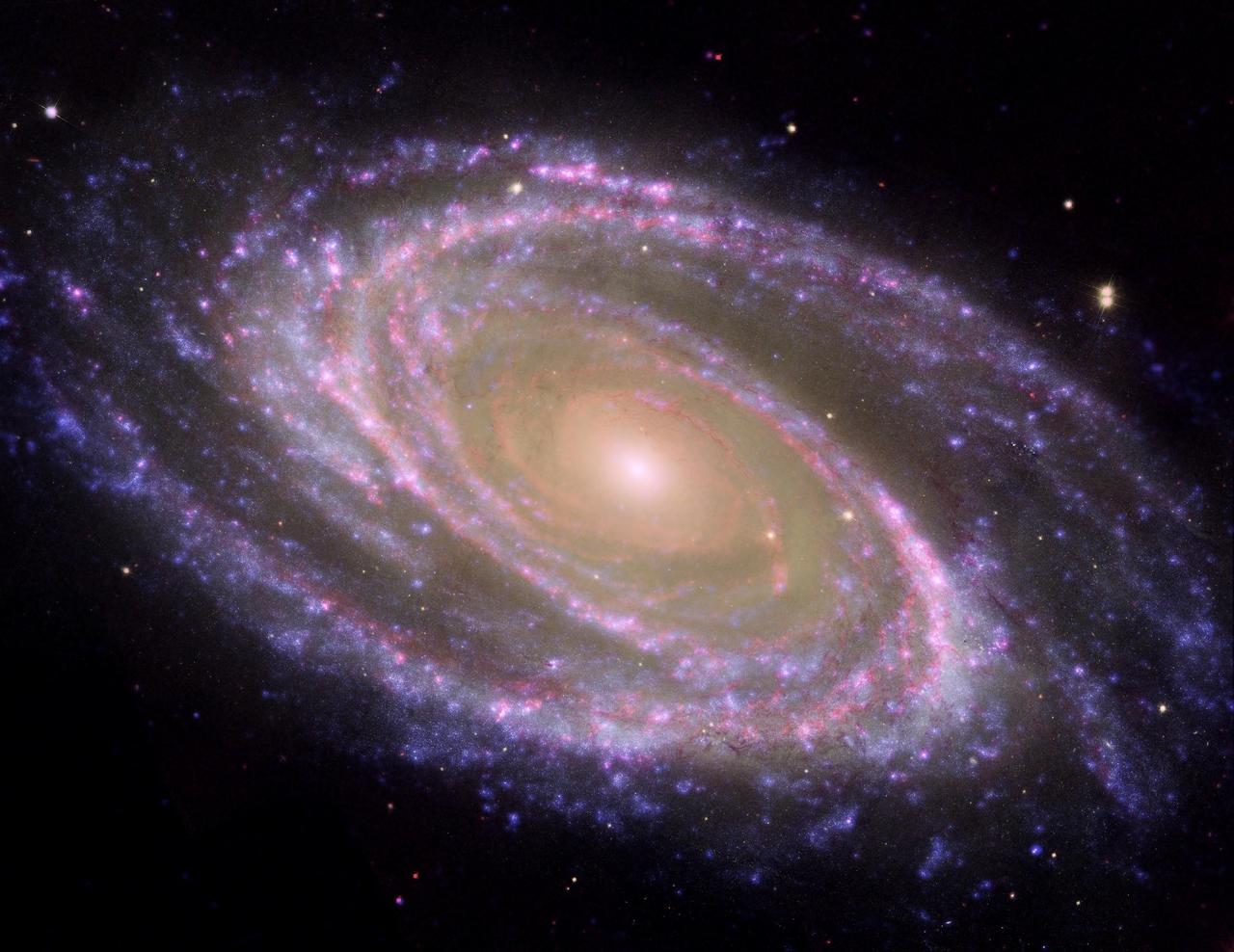
The perfectly picturesque spiral galaxy known as Messier 81, or M81, looks sharp in this new composite from NASA Spitzer and Hubble space telescopes and NASA Galaxy Evolution Explorer.

The magenta spots in this image from NASA NuSTAR show two black holes in the spiral galaxy called NGC 1313, or the Topsy Turvy galaxy, located about 13 million light-years away in the Reticulum constellation.
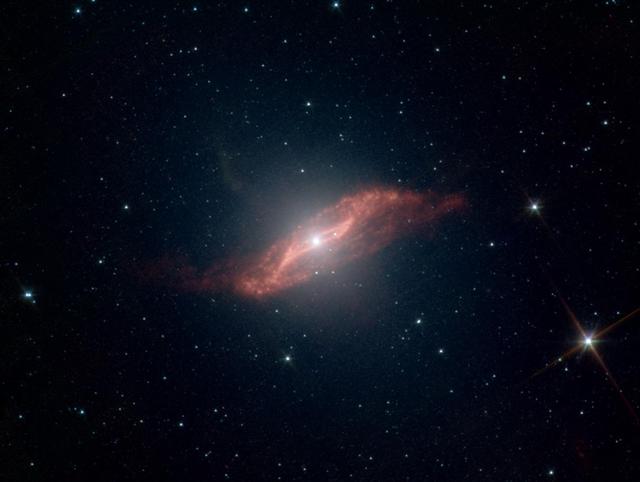
This image taken by NASA Spitzer Space Telescope shows in unprecedented detail the galaxy Centaurus A last big meal: a spiral galaxy seemingly twisted into a parallelogram-shaped structure of dust.
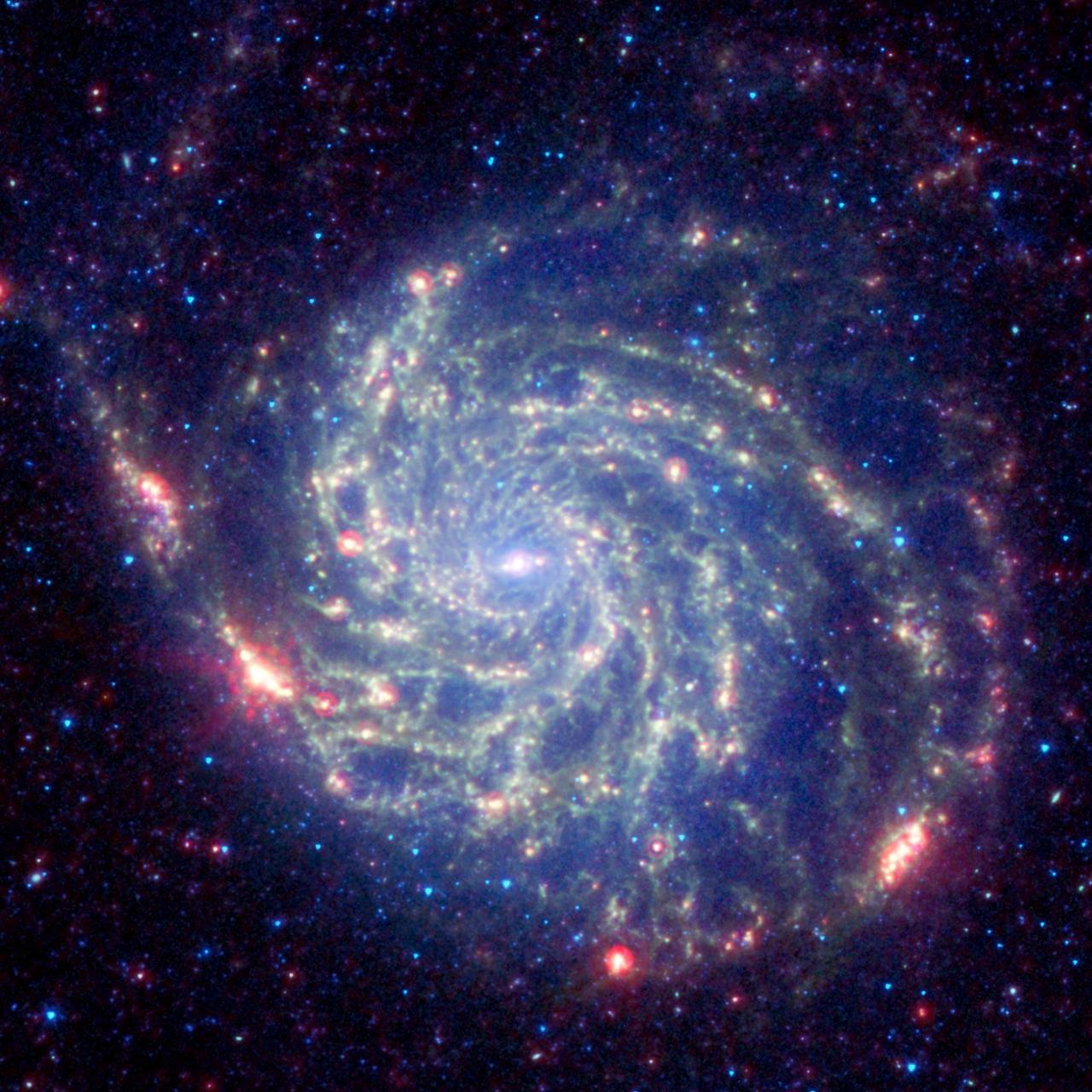
The galaxy Messier 101 is a swirling spiral of stars, gas, and dust. Messier 101 is nearly twice as wide as our Milky Way galaxy in this image as seen by NASA Spitzer Space Telescope.
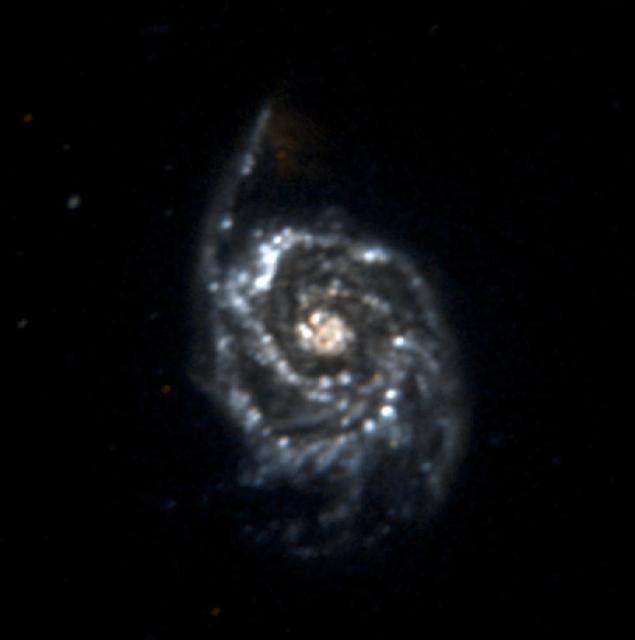
NASA's Galaxy Evolution Explorer took this image of the spiral galaxy Messier 51 on June 19 and 20, 2003. Messier 51 is located 27 million light-years from Earth. Due to a lack of star formation, the companion galaxy in the top of the picture is barely visible as a near ultraviolet object. http://photojournal.jpl.nasa.gov/catalog/PIA04628

This image taken by the ultraviolet-light monitoring camera on the European Space Agency ESA XMM-Newton telescope shows the beautiful spiral arms of the galaxy NGC1365.

This dazzling infrared image from NASA Spitzer Space Telescope shows hundreds of thousands of stars crowded into the swirling core of our spiral Milky Way galaxy.

This composite of the giant barred spiral galaxy NGC 6872 is 522,000 light-years across, making it about five times the size of the Milky Way.
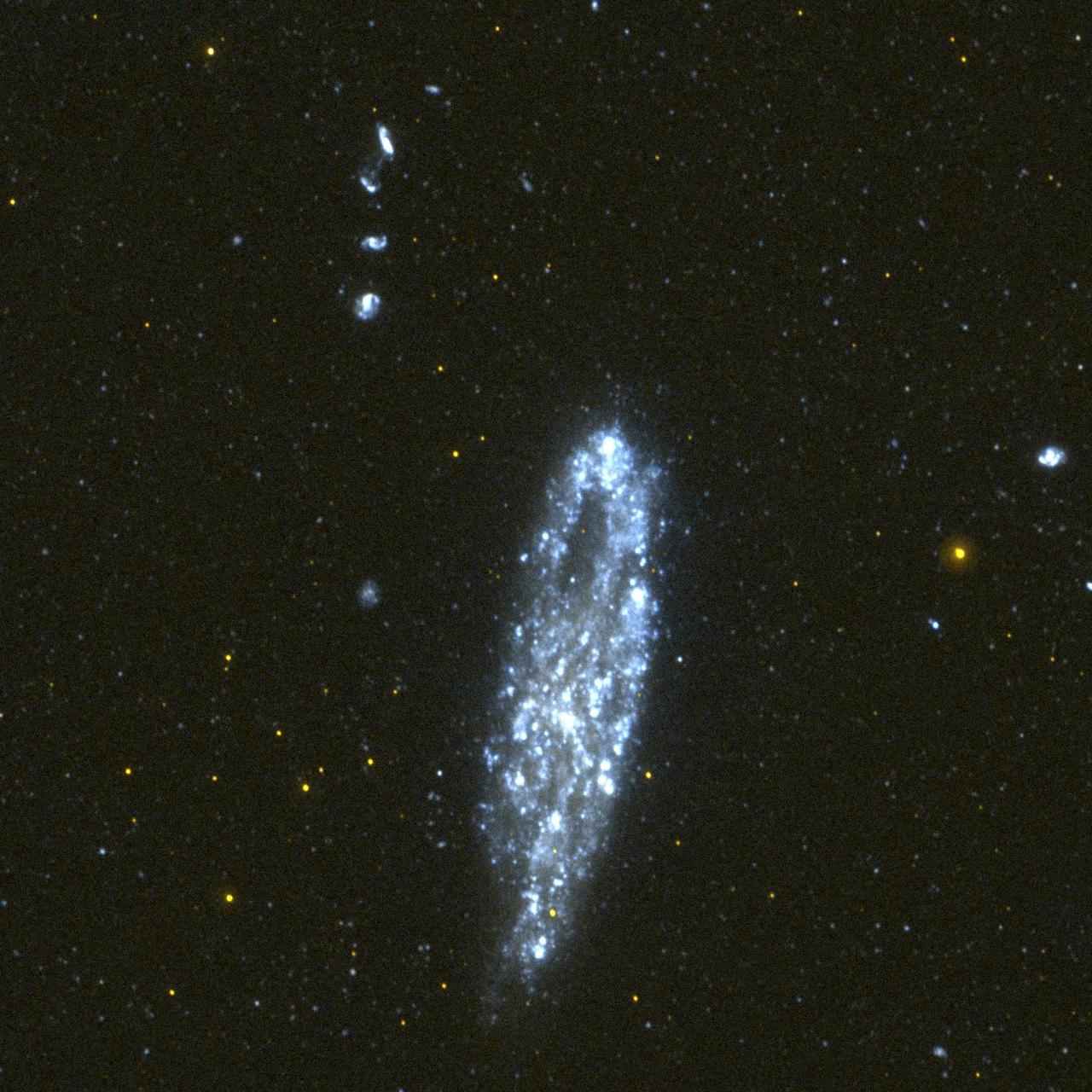
This image of the dwarf spiral galaxy NGC 247 was taken by Galaxy Evolution Explorer on October 13, 2003, in a single orbit exposure of 1600 seconds. The region that looks like a "hole" in the upper part of the galaxy is a location with a deficit of gas and therefore a lower star formation rate and ultraviolet brightness. Optical images of this galaxy show a bright star on the southern edge. This star is faint and red in the Galaxy Evolution Explorer ultraviolet image, revealing that it is a foreground star in our Milky Way galaxy. The string of background galaxies to the North-East (upper left) of NGC 247 is 355 million light years from our Milky Way galaxy whereas NGC 247 is a mere 9 million light years away. The faint blue light that can be seen in the Galaxy Evolution Explorer image of the upper two of these background galaxies may indicate that they are in the process of merging together. http://photojournal.jpl.nasa.gov/catalog/PIA04922
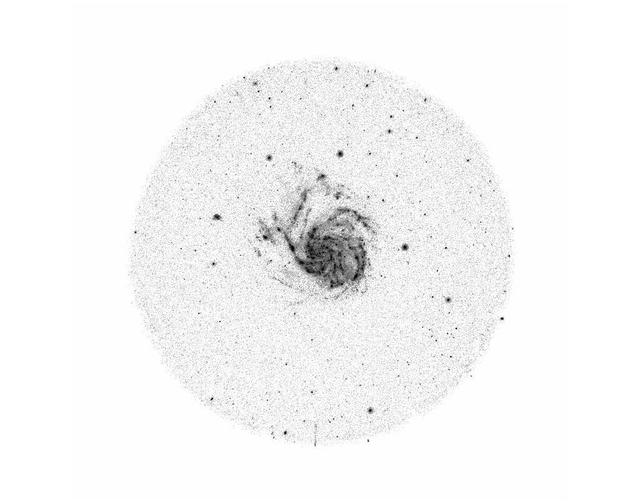
NASA Galaxy Evolution Explorer took this near ultraviolet image of Messier 101 on June 20, 2003. Messier 101 is a large spiral galaxy located 20 million light-years from Earth. http://photojournal.jpl.nasa.gov/catalog/PIA04631
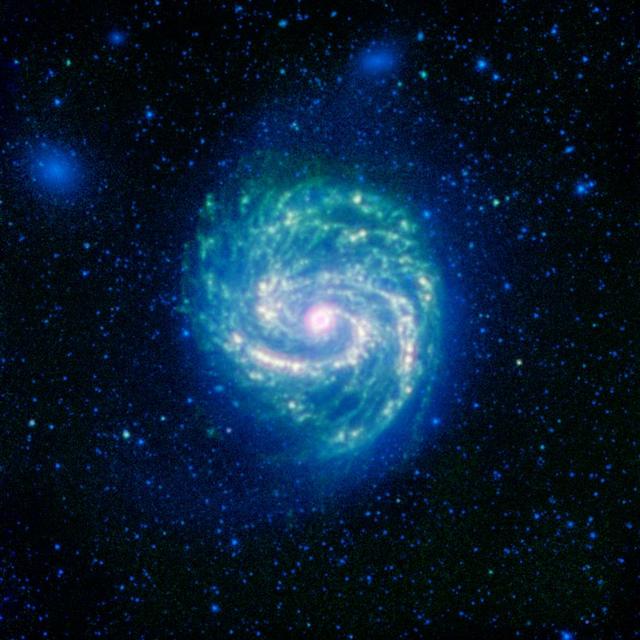
The galaxy Messier 100, or M100, shows its swirling spiral in this infrared image from NASA Spitzer Space Telescope. The arcing spiral arms of dust and gas that harbor star forming regions glow vividly when seen in the infrared.

The image from NASA Hubble Telescope shows spiral arms and dust clouds in the nearby Whirlpool galaxy. Visible starlight and light from the emission of glowing hydrogen is seen, which is associated with the most luminous young stars in the spiral arms.
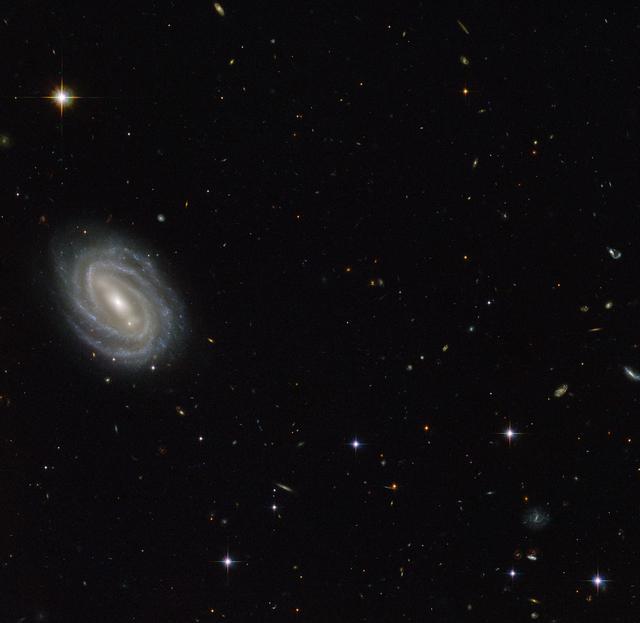
This new NASA/ESA Hubble Space Telescope image shows a beautiful spiral galaxy known as PGC 54493, located in the constellation of Serpens (The Serpent). This galaxy is part of a galaxy cluster that has been studied by astronomers exploring an intriguing phenomenon known as weak gravitational lensing. This effect, caused by the uneven distribution of matter (including dark matter) throughout the Universe, has been explored via surveys such as the Hubble Medium Deep Survey. Dark matter is one of the great mysteries in cosmology. It behaves very differently from ordinary matter as it does not emit or absorb light or other forms of electromagnetic energy — hence the term "dark." Even though we cannot observe dark matter directly, we know it exists. One prominent piece of evidence for the existence of this mysterious matter is known as the "galaxy rotation problem." Galaxies rotate at such speeds and in such a way that ordinary matter alone — the stuff we see — would not be able to hold them together. The amount of mass that is "missing" visibly is dark matter, which is thought to make up some 27 percent of the total contents of the Universe, with dark energy and normal matter making up the rest. PGC 55493 has been studied in connection with an effect known as cosmic shearing. This is a weak gravitational lensing effect that creates tiny distortions in images of distant galaxies. European Space Agency ESA/Hubble & NASA, Acknowledgement: Judy Schmidt <b><a href="http://www.nasa.gov/audience/formedia/features/MP_Photo_Guidelines.html" rel="nofollow">NASA image use policy.</a></b> <b><a href="http://www.nasa.gov/centers/goddard/home/index.html" rel="nofollow">NASA Goddard Space Flight Center</a></b> enables NASA’s mission through four scientific endeavors: Earth Science, Heliophysics, Solar System Exploration, and Astrophysics. Goddard plays a leading role in NASA’s accomplishments by contributing compelling scientific knowledge to advance the Agency’s mission. <b>Follow us on <a href="http://twitter.com/NASAGoddardPix" rel="nofollow">Twitter</a></b> <b>Like us on <a href="http://www.facebook.com/pages/Greenbelt-MD/NASA-Goddard/395013845897?ref=tsd" rel="nofollow">Facebook</a></b> <b>Find us on <a href="http://instagrid.me/nasagoddard/?vm=grid" rel="nofollow">Instagram</a></b>
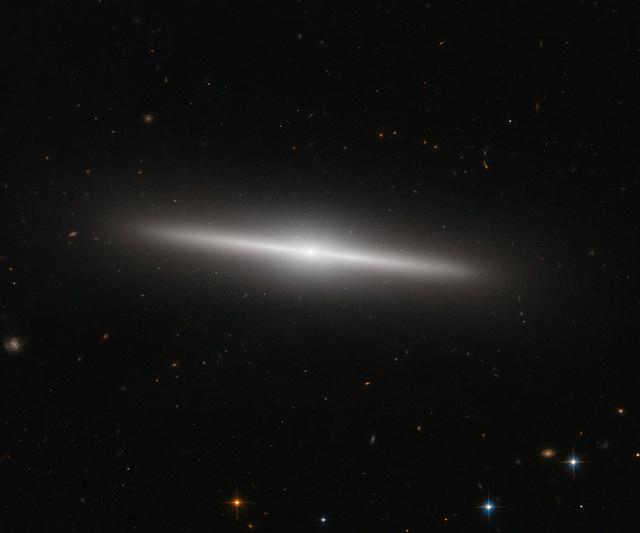
Hubble sees a galaxy 60 million light-years away This new NASA/ESA Hubble Space Telescope image shows the galaxy IC 335 in front of a backdrop of distant galaxies. IC 335 is part of a galaxy group containing three other galaxies, and located in the Fornax Galaxy Cluster 60 million light-years away. As seen in this image, the disk of IC 335 appears edge-on from the vantage point of Earth. This makes it harder for astronomers to classify it, as most of the characteristics of a galaxy’s morphology — the arms of a spiral or the bar across the center — are only visible on its face. Still, the 45 000 light-year-long galaxy could be classified as an S0 type. These lenticular galaxies are an intermediate state in galaxy morphological classification schemes between true spiral and elliptical galaxies. They have a thin stellar disk and a bulge, like spiral galaxies, but in contrast to typical spiral galaxies they have used up most of the interstellar medium. Only a few new stars can be created out of the material that is left and the star formation rate is very low. Hence, the population of stars in S0 galaxies consists mainly of aging stars, very similar to the star population in elliptical galaxies. As S0 galaxies have only ill-defined spiral arms they are easily mistaken for elliptical galaxies if they are seen inclined face-on or edge-on as IC 335 here. And indeed, despite the morphological differences between S0 and elliptical class galaxies, they share some common characteristics, like typical sizes and spectral features. Both classes are also deemed "early-type" galaxies, because they are evolving passively. However, while elliptical galaxies may be passively evolving when we observe them, they have usually had violent interactions with other galaxies in their past. In contrast, S0 galaxies are either aging and fading spiral galaxies, which never had any interactions with other galaxies, or they are the aging result of a single merger between two spiral galaxies in the past. The exact nature of these galaxies is still a matter of debate. Credit: ESA/Hubble and NASA
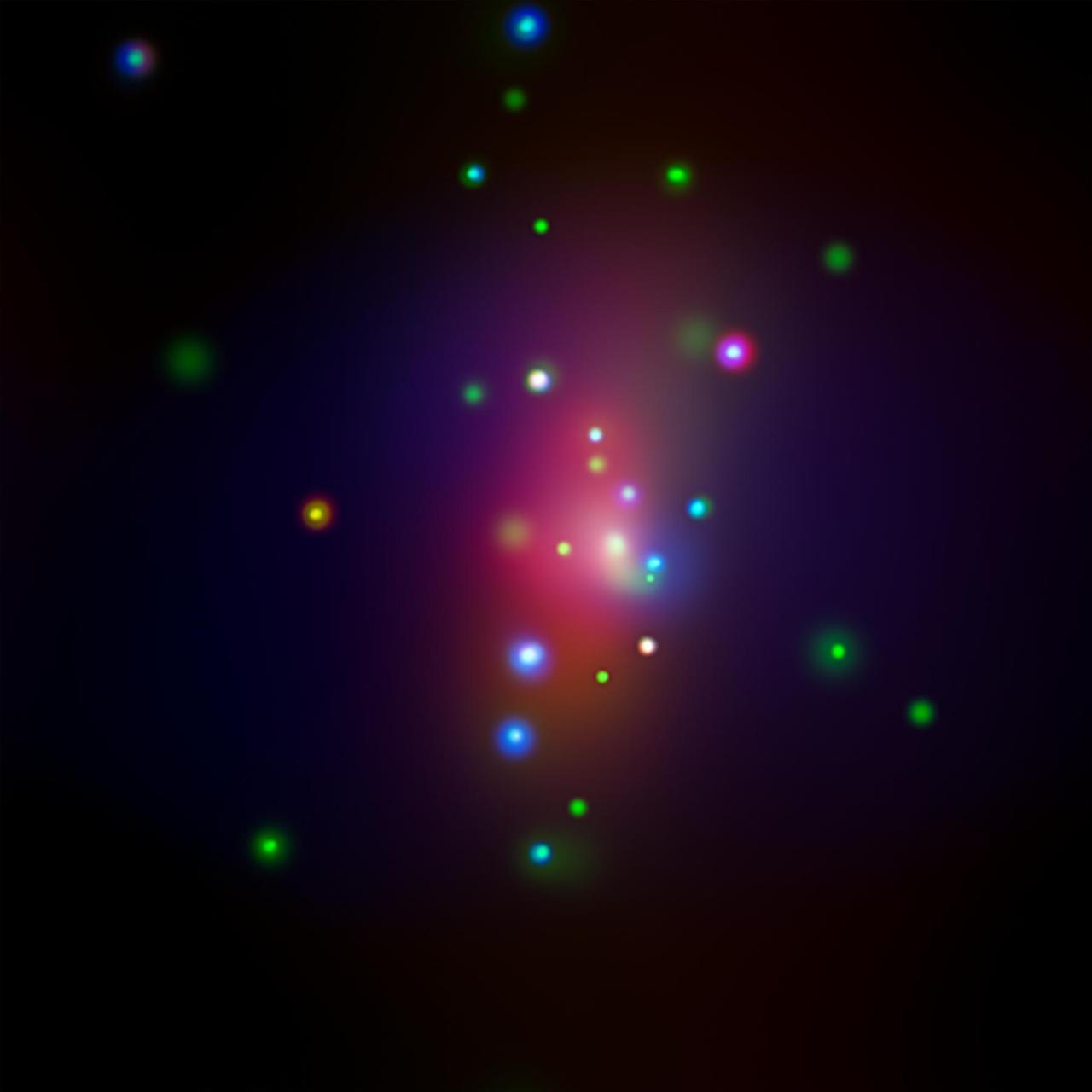
This image from NASA's Chandra X-ray Observatory shows spiral galaxy NGC 7331, center, in a three-color X-ray image. Red, green and blue colors are used for low, medium and high-energy X-rays, respectively. An unusual supernova called SN 2014C has been spotted in this galaxy. http://photojournal.jpl.nasa.gov/catalog/PIA21089
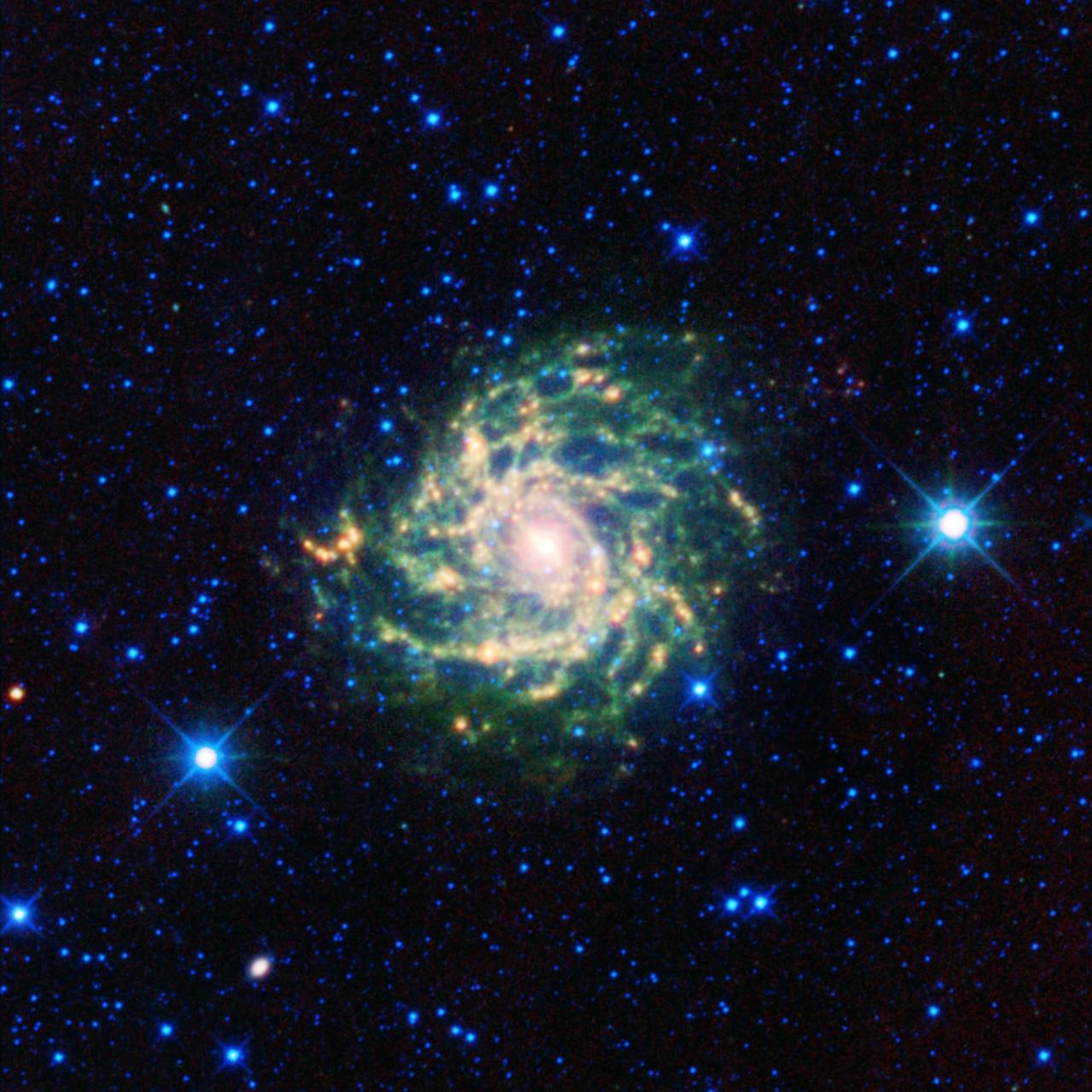
A leggy cosmic creature comes out of hiding in this new infrared view from NASA Wide-field Infrared Survey Explorer. The spiral beauty, called IC 342 and sometimes the hidden galaxy, is shrouded behind our own galaxy, the Milky Way.
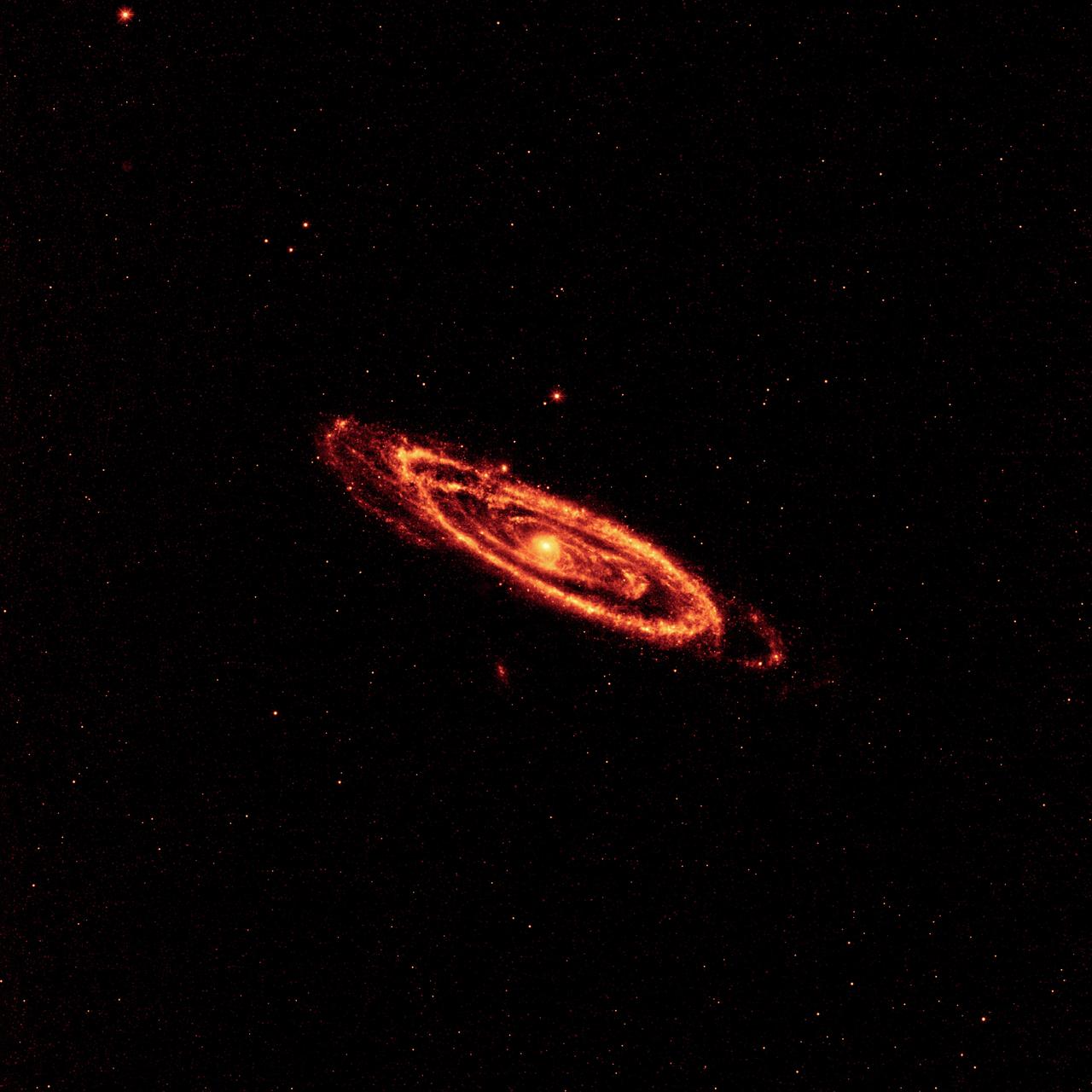
This image from NASA Wide-field Infrared Survey Explorer highlights the dust that speckles the Andromeda galaxy spiral arms. The hot dust, which is being heated by newborn stars, traces the spidery arms all the way to the center of the galaxy.
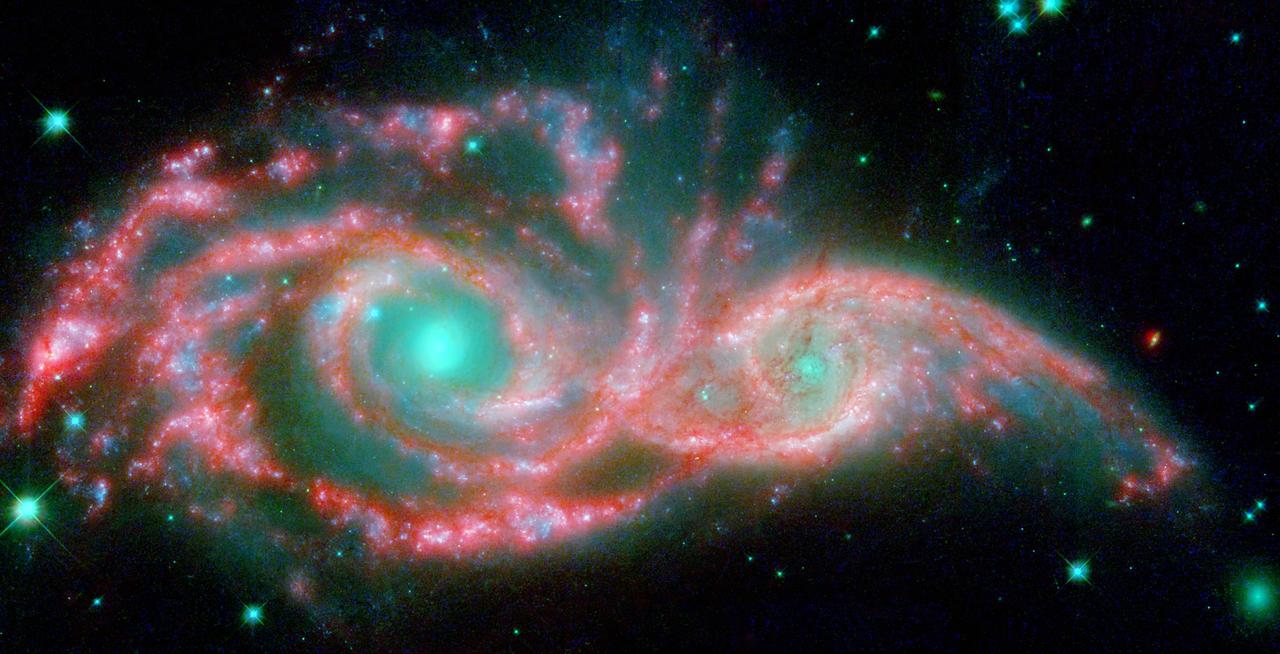
NASA Hubble and Spitzer telescopes combined to make these shape-shifting galaxies taking on the form of a giant mask. The icy blue eyes are actually the cores of two merging galaxies, called NGC 2207 and IC 2163, and the mask is their spiral arms.
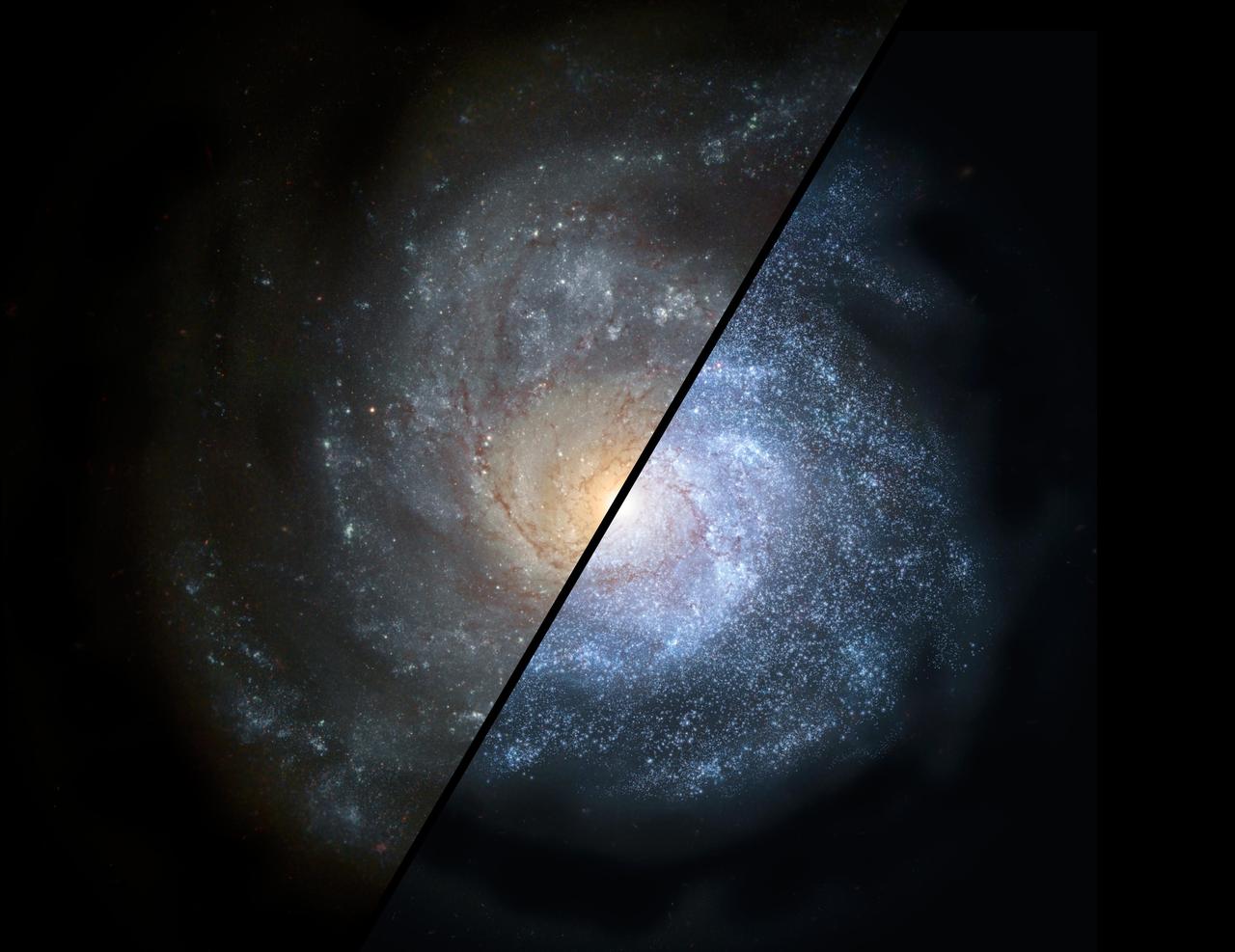
This artist concept shows how a normal spiral galaxy around our local universe left might have looked back in the distant universe, when astronomers think galaxies would have been filled with larger populations of hot, bright stars right.
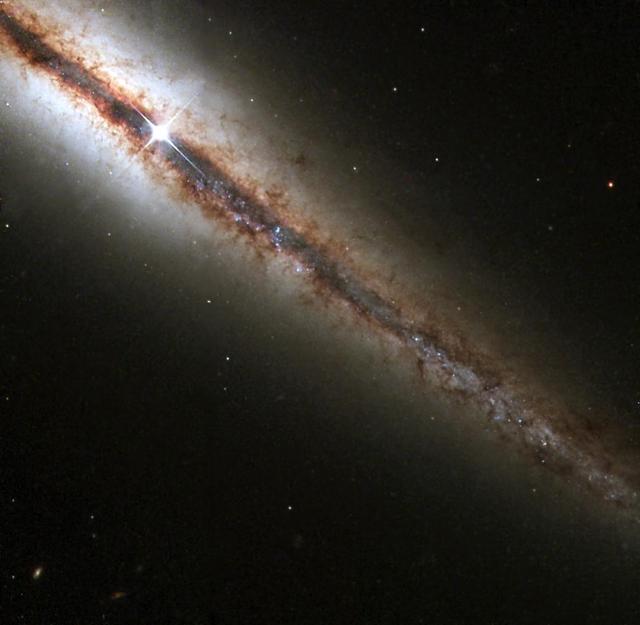
An amazing edge-on view of a spiral galaxy 55 million light years from Earth has been captured by the Hubble Space Telescope. The image reveals in great detail huge clouds of dust and gas extending along and above the galaxy main disk.

The smudge of stars at the center of this NASA/ESA Hubble Space Telescope image is a galaxy known as UGC 5797. UGC 5797 is an emission line galaxy, meaning that it is currently undergoing active star formation. The result is a stellar population that is constantly being refurbished as massive bright blue stars form. Galaxies with prolific star formation are not only veiled in a blue tint, but are key to the continuation of a stellar cycle. In this image UGC 5797 appears in front of a background of spiral galaxies. Spiral galaxies have copious amounts of dust and gas — the main ingredient for stars — and therefore often also belong to the class of emission line galaxies. Spiral galaxies have disk-like shapes that drastically vary in appearance depending on the angle at which they are observed. The collection of spiral galaxies in this frame exhibits this attribute acutely: Some are viewed face-on, revealing the structure of the spiral arms, while the two in the bottom left are seen edge-on, appearing as plain streaks in the sky. There are many spiral galaxies, with varying colors and at different angles, sprinkled across this image — just take a look. Credit: ESA/Hubble & NASA, Acknowledgement: Luca Limatola
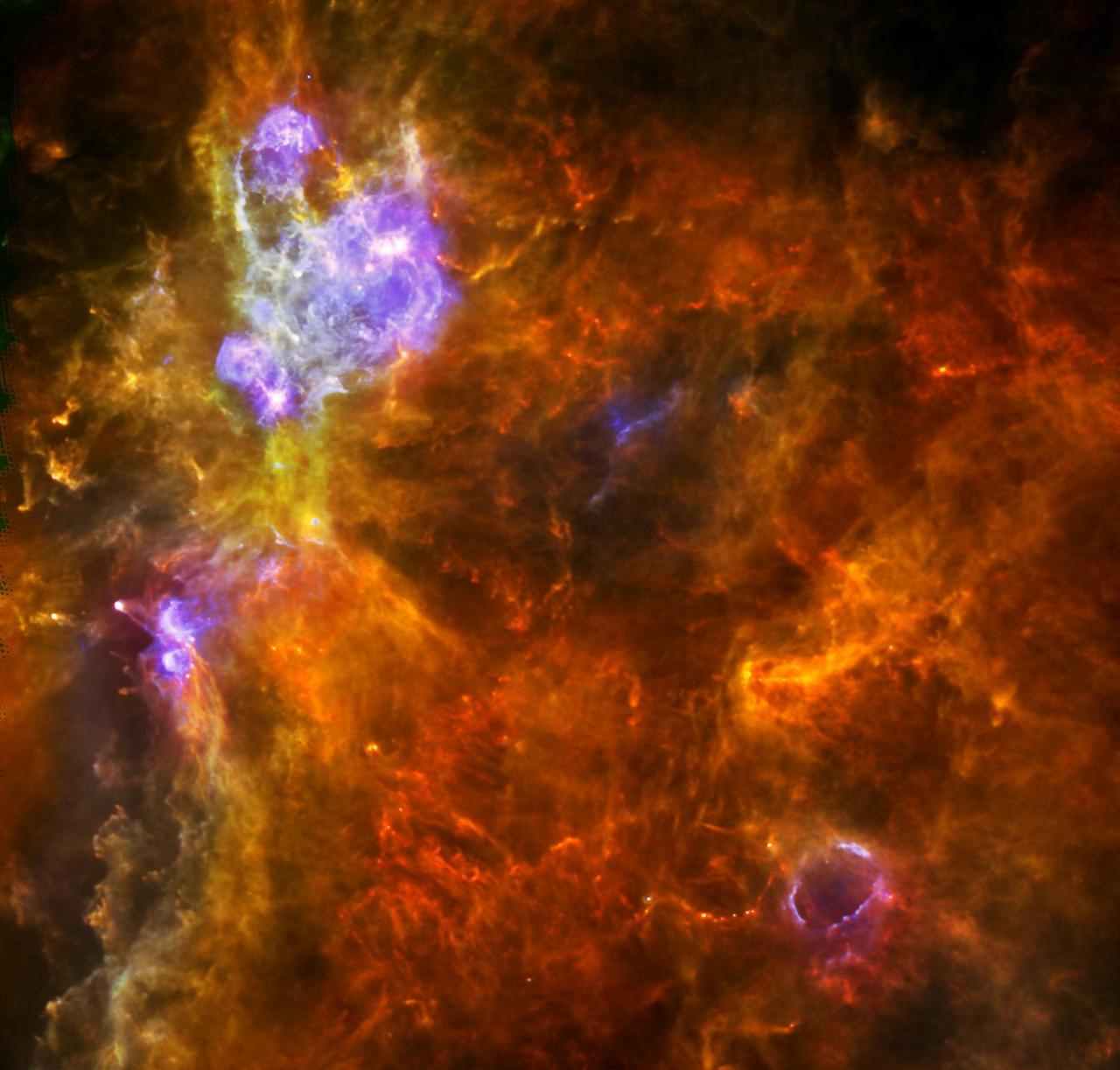
W3 is an enormous stellar nursery about 6,200 light-years away in the Perseus Arm, one of the Milky Way galaxy main spiral arms as seen by ESA Herschel space observatory.
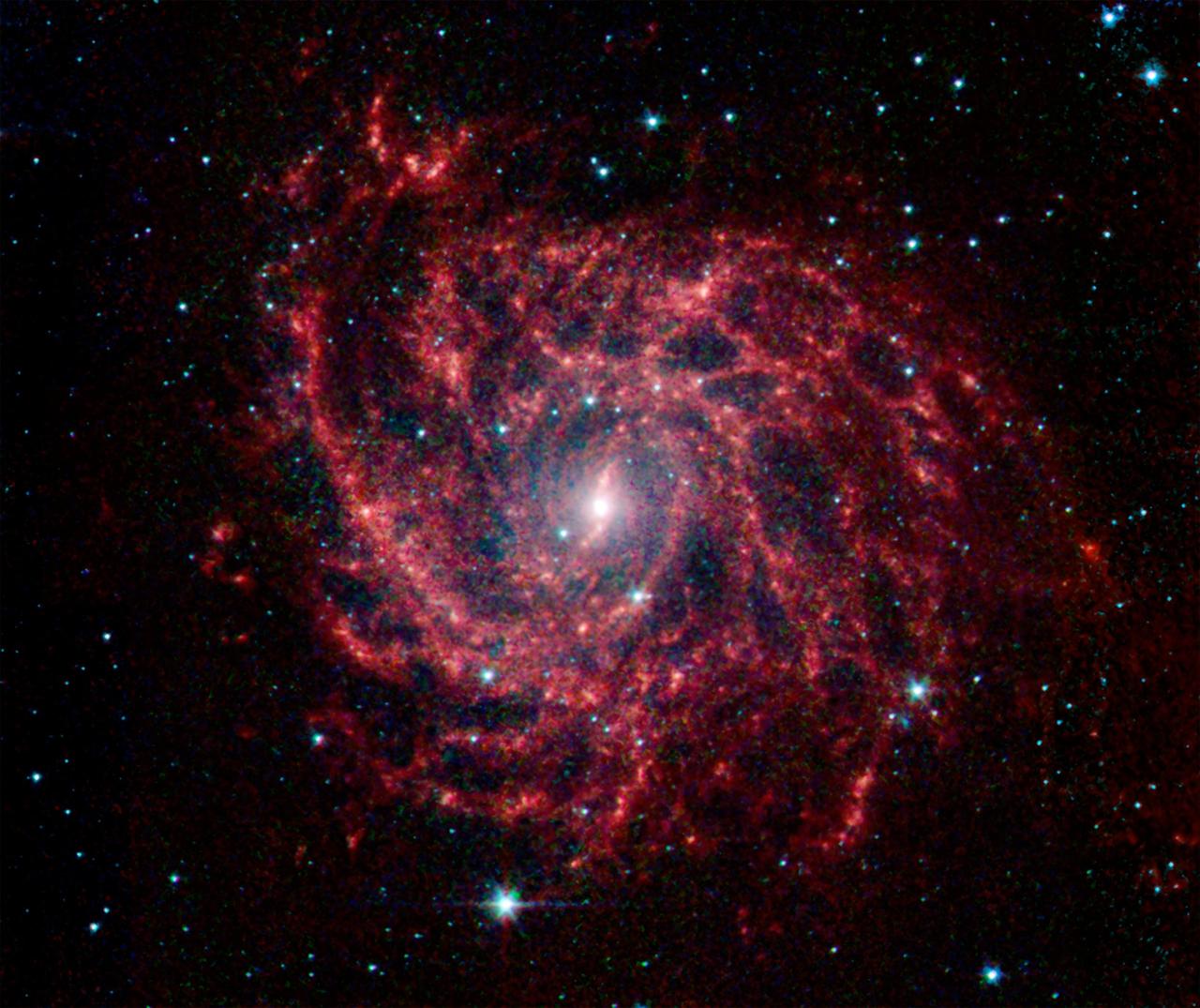
Looking like a spider web swirled into a spiral, galaxy IC 342 presents its delicate pattern of dust in this infrared light image from NASA Spitzer Space Telescope.

Looking like a spider web swirled into a spiral, galaxy IC 342 presents its delicate pattern of dust in this infrared light image from NASA Spitzer Space Telescope. The very center glows especially brightly in the infrared.
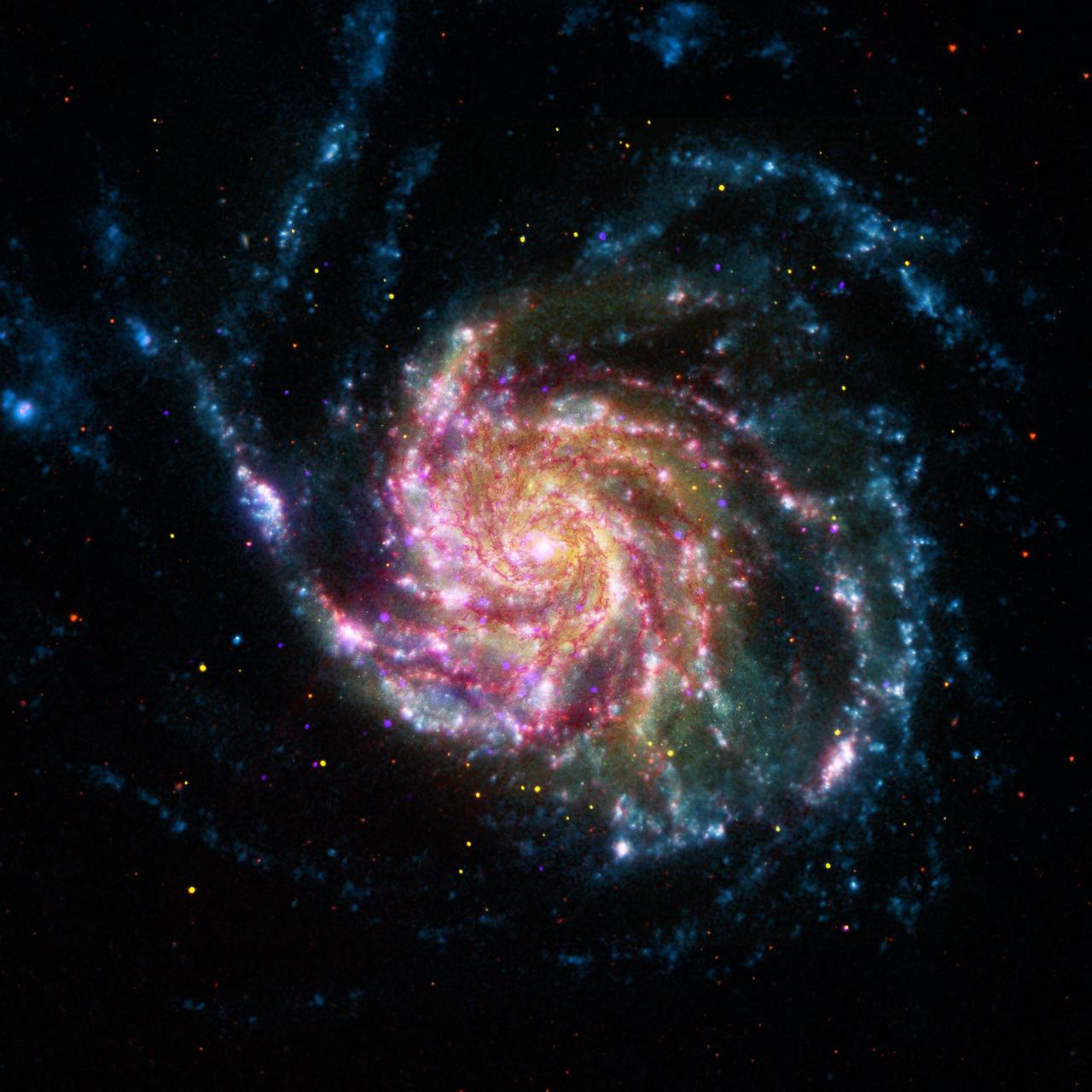
This image of the Pinwheel Galaxy, or M101, in the constellation of Ursa Major, combines data from four of NASA space telescopes. The view shows that both young and old stars are evenly distributed along M101 tightly wound spiral arms.
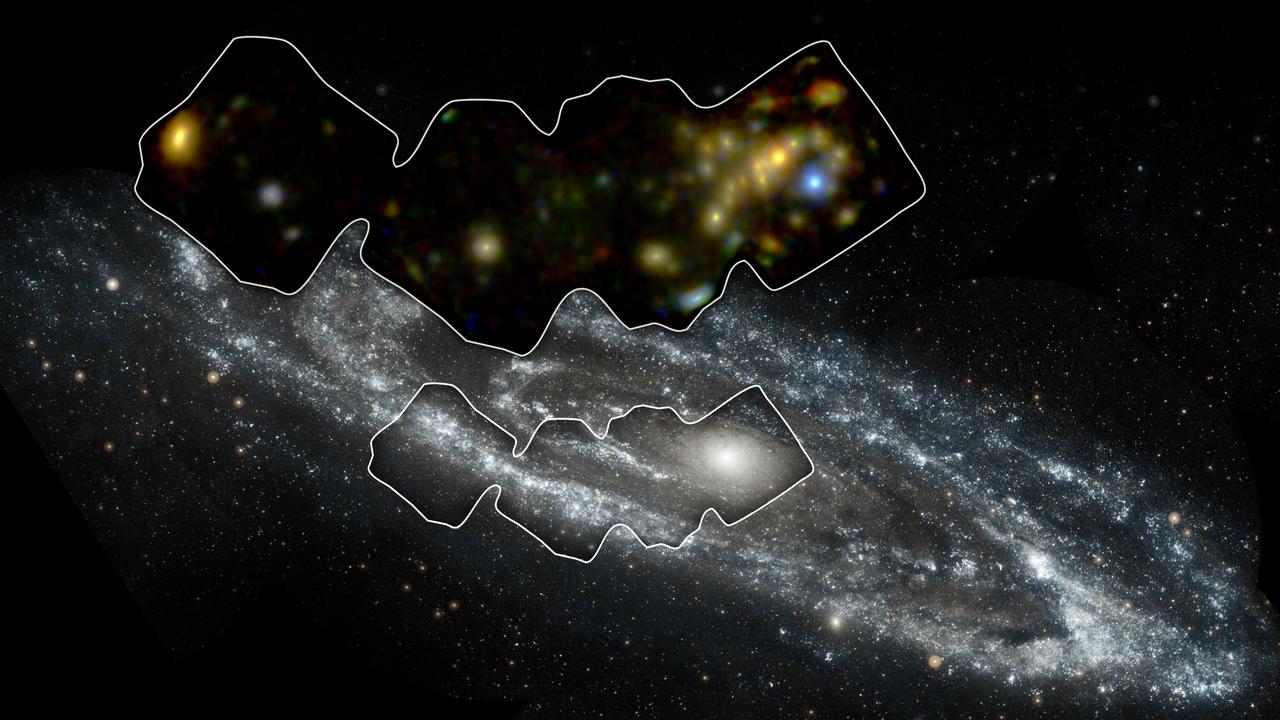
These images from NASA GALEX and NuSTAR is of Andromeda, a spiral galaxy like our Milky Way but larger in size. It lies 2.5 million light-years away in the Andromeda constellation.
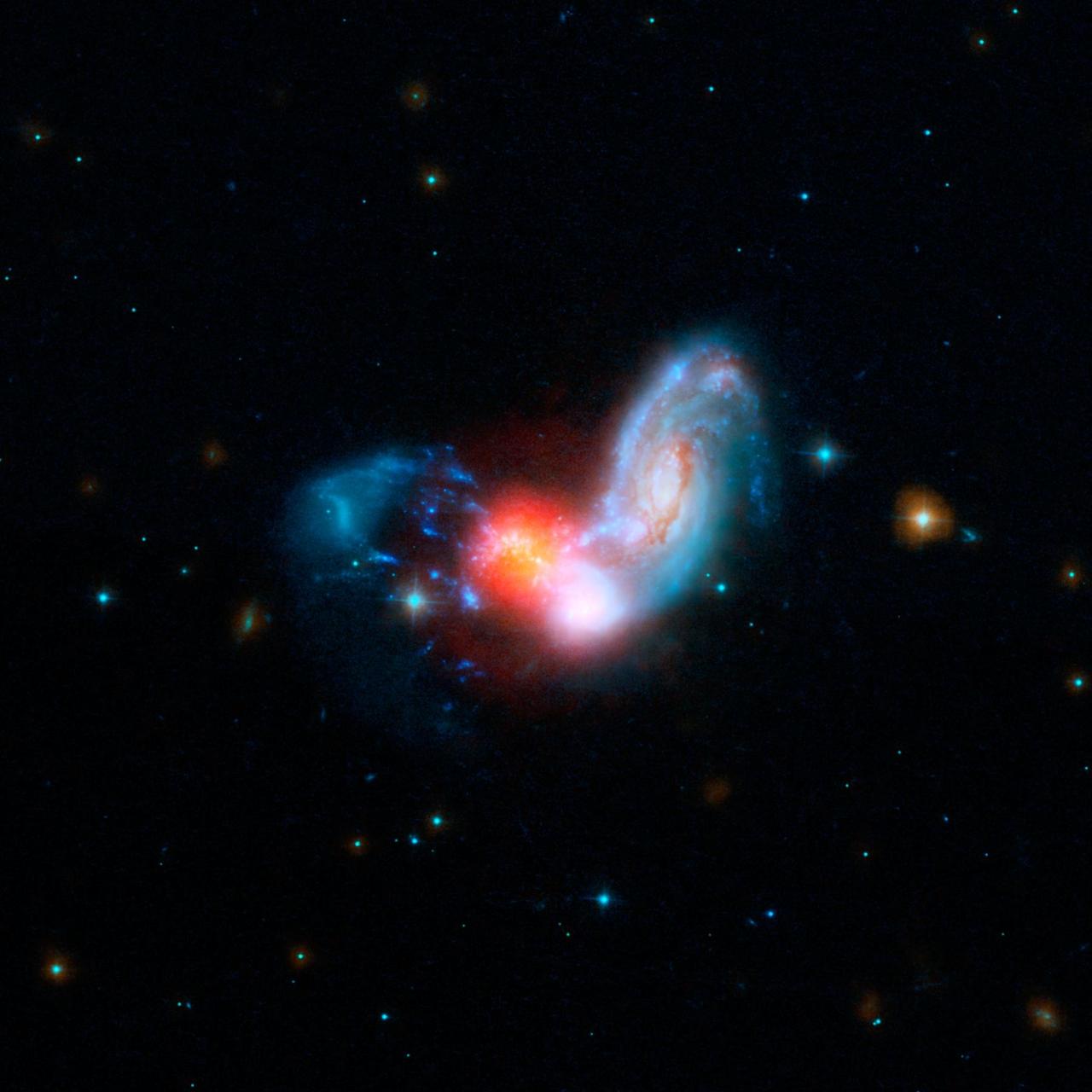
A brilliant burst of star formation is revealed in this image combining observations from NASA Spitzer and Hubble Space Telescopes. The collision of two spiral galaxies has triggered this luminous starburst.
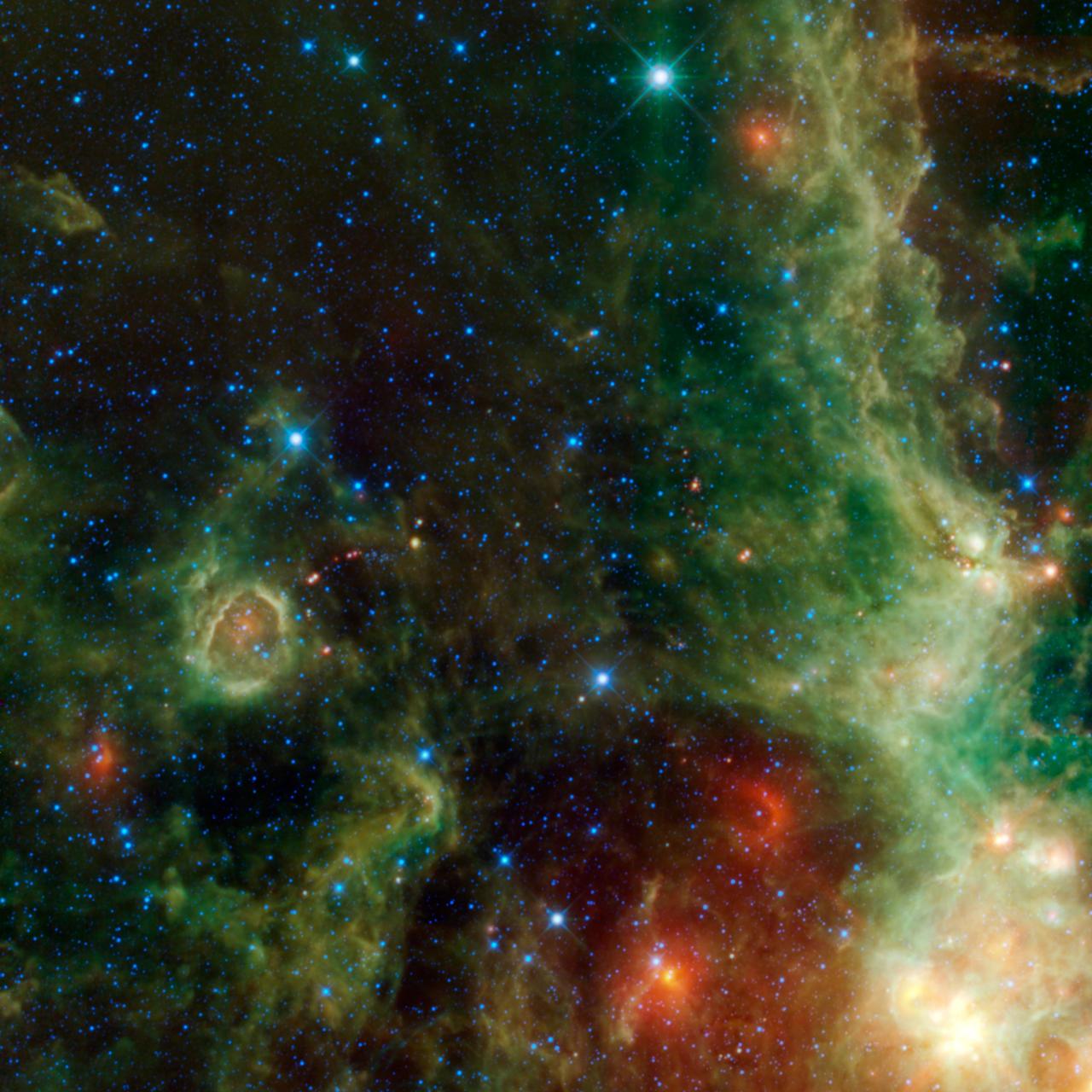
This image from NASA Wide-field Infrared Survey Explorer, or WISE, is a view within the constellation Cassiopeia of another portion of the vast star forming complex that makes up part of the Perseus spiral arm of the Milky Way Galaxy.
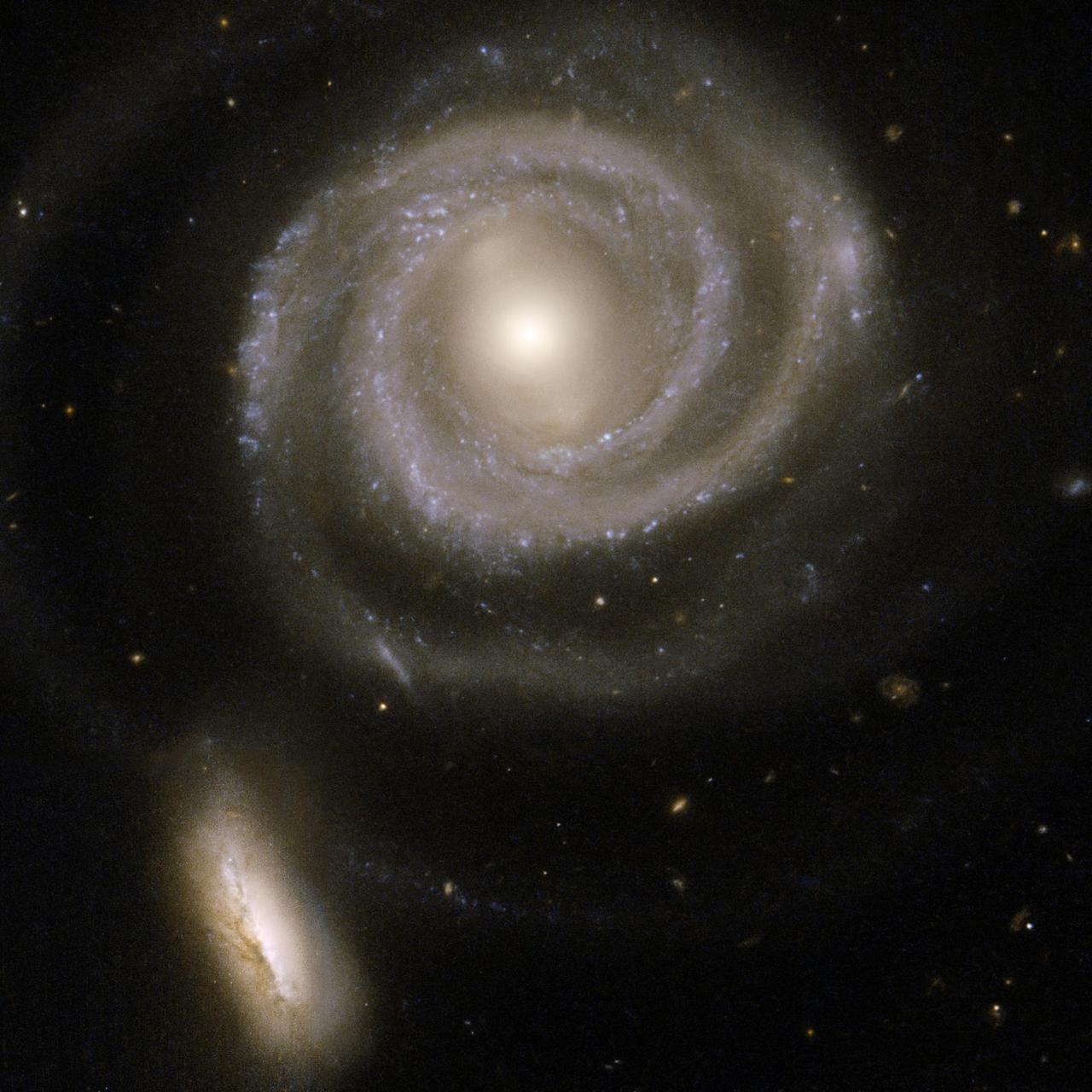
This beautiful pair of interacting galaxies consists of NGC 5754, the large spiral on the right, and NGC 5752, the smaller companion in the bottom left corner of the image. This image is from NASA Hubble Space Telescope.

This plot of data from NASA Spitzer Space Telescope indicates that a flat, spiral galaxy called NGC 3621 has a feeding, supermassive black hole lurking within it.
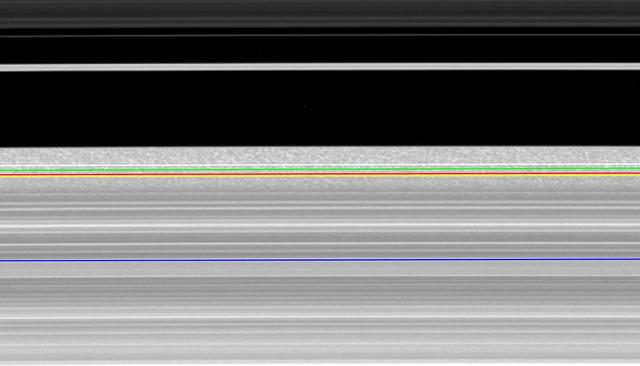
Keeping a close watch on the outer portion of Saturn B ring, NASA Cassini spacecraft records the complex inward and outward movement of the edge of the ring. This ring movement resembles the suspected behavior of spiral disk galaxies.
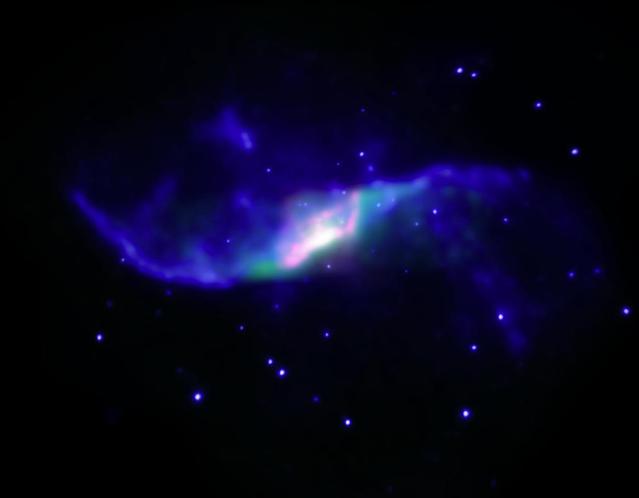
A composite image of the spiral galaxy NGC 4258 showing X-ray emission observed with NASA Chandra X-ray Observatory blue and infrared emission observed with NASA Spitzer Space Telescope red and green.
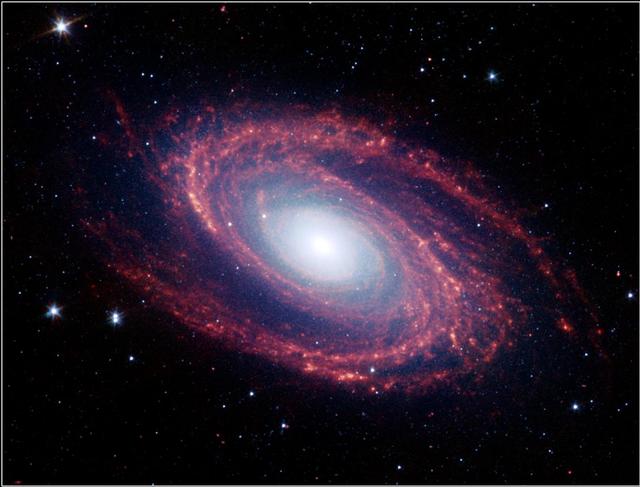
The magnificent spiral arms of the nearby galaxy Messier 81 are highlighted in this NASA Spitzer Space Telescope image. Located in the northern constellation of Ursa Major which also includes the Big Dipper.
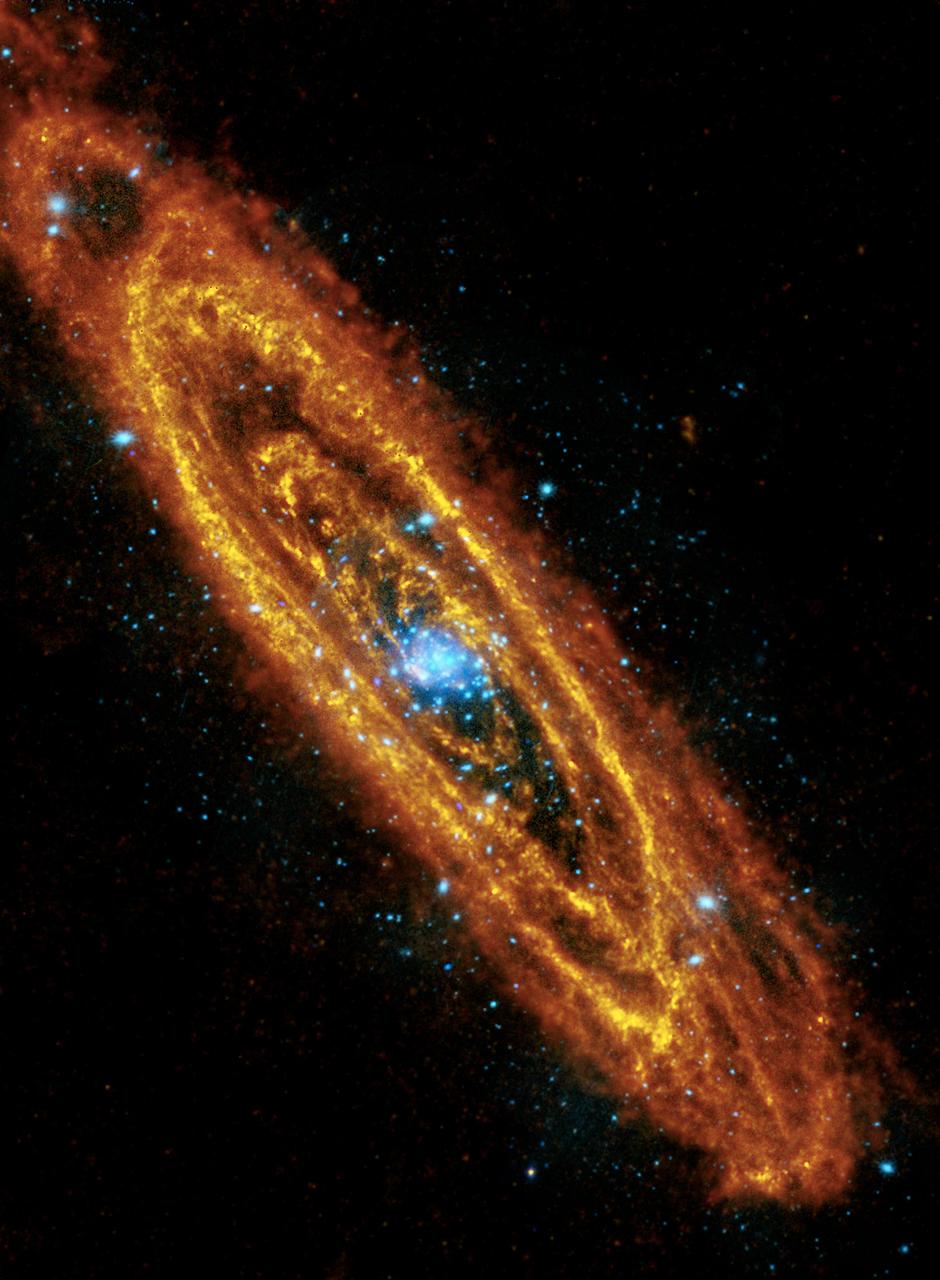
This mosaic of the Andromeda spiral galaxy highlights explosive stars in its interior, and cooler, dusty stars forming in its many rings. This is a combination of observations from the Herschel Space Observatory and the XMM-Newton telescope.
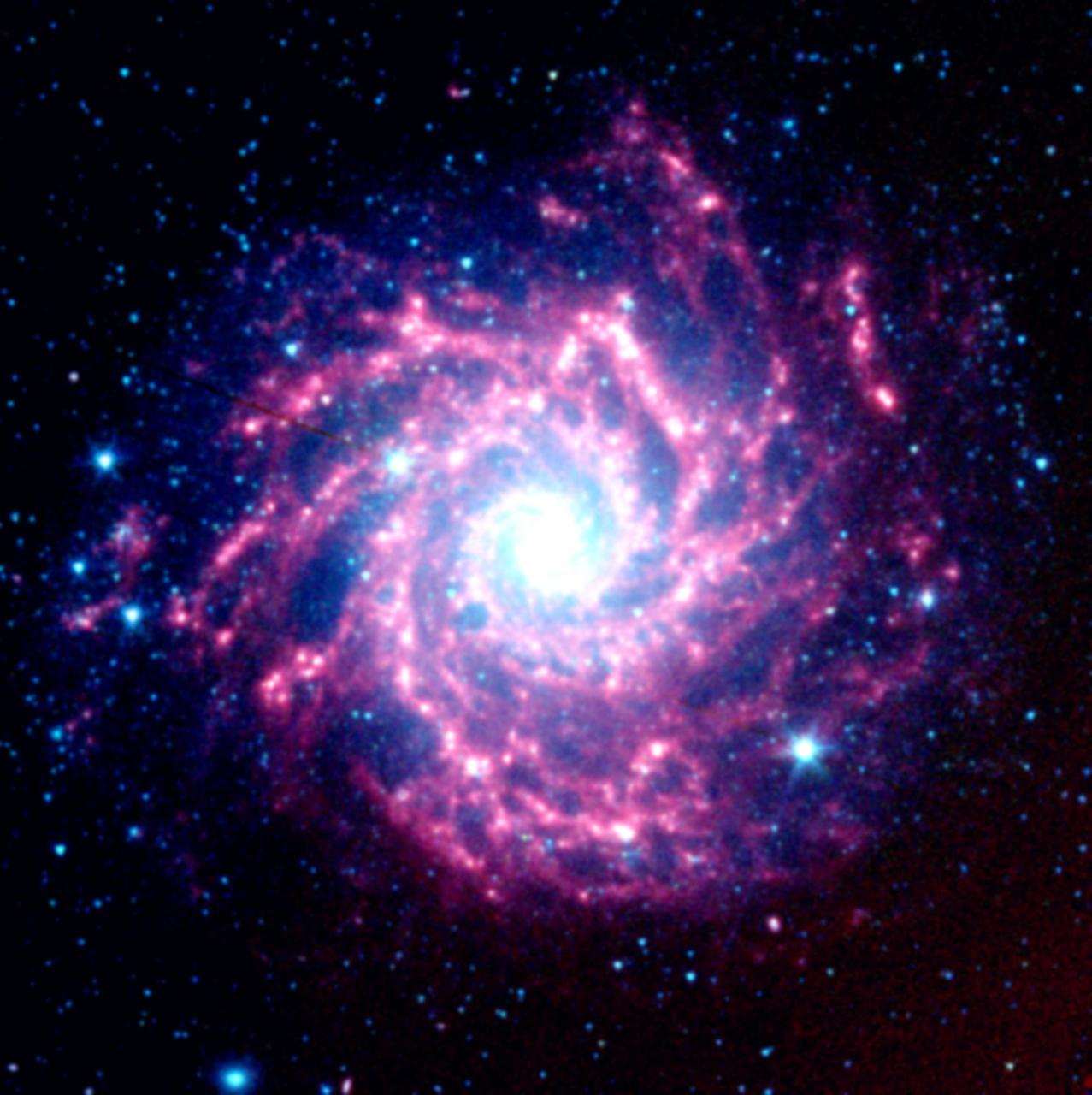
Astronomers using NASA Spitzer Space Telescope have spotted a dust factory 30 million light-years away in the spiral galaxy M74. The factory is located at the scene of a massive star explosive death, or supernova.

Astronomers using data from NASA's Wide-field Infrared Survey Explorer, or WISE, are helping to trace the shape of our Milky Way galaxy's spiral arms. This illustration shows where WISE data revealed clusters of young stars shrouded in dust, called embedded clusters, which are known to reside in spiral arms. The bars represent uncertainties in the data. The nearly 100 clusters shown here were found in the arms called Perseus, Sagittarius-Carina, and Outer -- three of the galaxy's four proposed primary arms. Our sun resides in a spur to an arm, or a minor arm, called Orion Cygnus. http://photojournal.jpl.nasa.gov/catalog/PIA19341
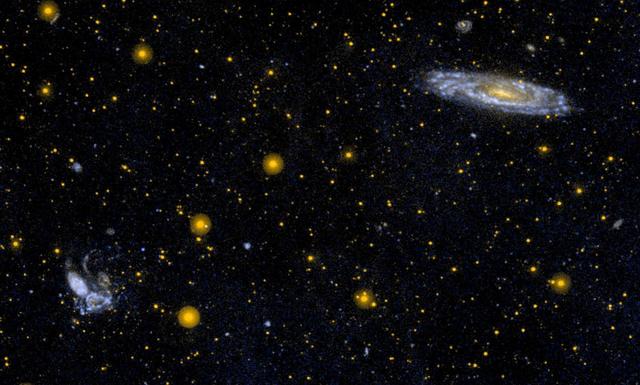
This ultraviolet image from NASA Galaxy Evolution Explorer is of the interacting group of galaxies known as Stephan Quintet NGC 7317, NGC 7318A, NGC 7318B, NGC 7319, NGC 7320, lower left. Of the five galaxies in this tightly packed group, NGC 7320 (the large spiral in the group) is probably a foreground galaxy and not associated with the other four. The spiral galaxy in the upper right is NGC 7331. http://photojournal.jpl.nasa.gov/catalog/PIA07905
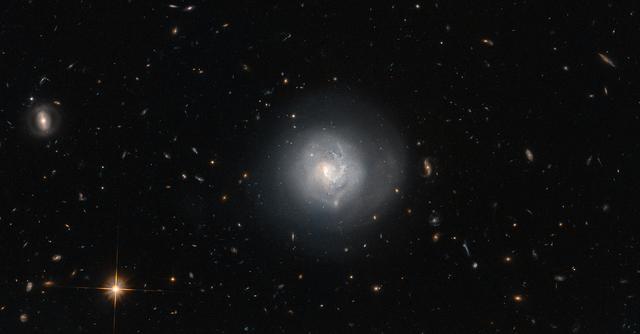
This galaxy is known as Mrk 820 and is classified as a lenticular galaxy — type S0 on the Hubble Tuning Fork. The Hubble Tuning Fork is used to classify galaxies according to their morphology. Elliptical galaxies look like smooth blobs in the sky and lie on the handle of the fork. They are arranged along the handle based on how elliptical they are, with the more spherical galaxies furthest from the tines of the fork, and the more egg-shaped ones closest to the end of the handle where it divides. The two prongs of the tuning fork represent types of unbarred and barred spiral galaxies. Lenticular galaxies like Mrk 820 are in the transition zone between ellipticals and spirals and lie right where the fork divides. A closer look at the appearance of Mrk 820 reveals hints of a spiral structure embedded in a circular halo of stars. Surrounding Mrk 820 in this image is good sampling of other galaxy types, covering almost every type found on the Hubble Tuning Fork, both elliptical and spiral. Most of the smears and specks are distant galaxies, but the prominent bright object at the bottom is a foreground star called TYC 4386-787-1. A version of this image was entered into the Hubble's Hidden Treasures image processing competition by contestant Judy Schmidt.

A contingent of young stars and star-forming gas clouds is sticking out of one of the Milky Way's spiral arms like a splinter protruding from a plank of wood. Stretching some 3,000 light-years, this is the first major structure identified with such a dramatically different orientation relative to the arm. The background image shows the location of the splinter in the Milky Way. The yellow region in the center of the image is the galaxy's bright and crowded center. The galaxy's arms spiral around the center, and are full of stars and star-forming clouds of gas and dust. A key property of spiral arms is how tightly they wind around a galaxy. This characteristic is measured by the arm's pitch angle. A circle has a pitch angle of 0 degrees; as the spiral becomes more open, the pitch angle increases. Most models of the Milky Way suggest that the Sagittarius Arm forms a spiral that has a pitch angle of about 12 degrees, but the protruding structure has a pitch angle of nearly 60 degrees. Similar structures – sometimes called spurs or feathers – are commonly found jutting out of the arms of other spiral galaxies. For decades scientists have wondered whether our Milky Way's spiral arms are also dotted with these structures or if they are relatively smooth. https://photojournal.jpl.nasa.gov/catalog/PIA24576
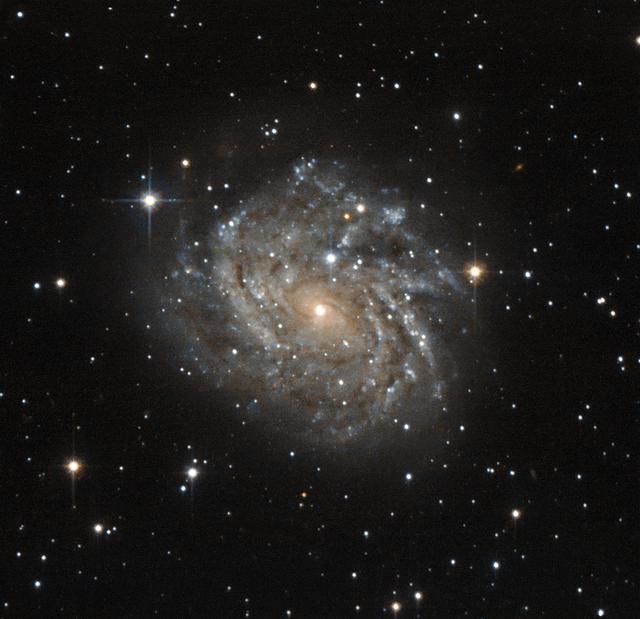
This little-known galaxy, officially named J04542829-6625280, but most often referred to as LEDA 89996, is a classic example of a spiral galaxy. The galaxy is much like our own galaxy, the Milky Way. The disc-shaped galaxy is seen face on, revealing the winding structure of the spiral arms. Dark patches in these spiral arms are in fact dust and gas — the raw materials for new stars. The many young stars that form in these regions make the spiral arms appear bright and bluish. The galaxy sits in a vibrant area of the night sky within the constellation of Dorado (The Swordfish), and appears very close to the Large Magellanic Cloud — one of the satellite galaxies of the Milky Way. The observations were carried out with the high resolution channel of Hubble’s Advanced Camera for Surveys. This instrument has delivered some of the sharpest views of the Universe so far achieved by mankind. This image covers only a tiny patch of sky — about the size of a one cent euro coin held 100 metres away! A version of this image was entered into the Hubble’s Hidden Treasures image processing competition by flickr user c.claude.
![Despite its unassuming appearance, the edge-on spiral galaxy captured in the left half of this NASA/ESA Hubble Space Telescope image is actually quite remarkable. Located about one billion light-years away in the constellation of Eridanus, this striking galaxy — known as LO95 0313-192 — has a spiral shape similar to that of the Milky Way. It has a large central bulge, and arms speckled with brightly glowing gas mottled by thick lanes of dark dust. Its companion, sitting pretty in the right of the frame, is known rather unpoetically as [LOY2001] J031549.8-190623. Jets, outbursts of superheated gas moving at close to the speed of light, have long been associated with the cores of giant elliptical galaxies, and galaxies in the process of merging. However, in an unexpected discovery, astronomers found LO95 0313-192 to have intense radio jets spewing out from its centre! The galaxy appears to have two more regions that are also strongly emitting in the radio part of the spectrum, making it even rarer still. The discovery of these giant jets in 2003 — not visible in this image, but indicated in this earlier Hubble composite — has been followed by the unearthing of a further three spiral galaxies containing radio-emitting jets in recent years. This growing class of unusual spirals continues to raise significant questions about how jets are produced within galaxies, and how they are thrown out into the cosmos.](https://images-assets.nasa.gov/image/hubble-finds-misbehaving-spiral_24662986146_o/hubble-finds-misbehaving-spiral_24662986146_o~medium.jpg)
Despite its unassuming appearance, the edge-on spiral galaxy captured in the left half of this NASA/ESA Hubble Space Telescope image is actually quite remarkable. Located about one billion light-years away in the constellation of Eridanus, this striking galaxy — known as LO95 0313-192 — has a spiral shape similar to that of the Milky Way. It has a large central bulge, and arms speckled with brightly glowing gas mottled by thick lanes of dark dust. Its companion, sitting pretty in the right of the frame, is known rather unpoetically as [LOY2001] J031549.8-190623. Jets, outbursts of superheated gas moving at close to the speed of light, have long been associated with the cores of giant elliptical galaxies, and galaxies in the process of merging. However, in an unexpected discovery, astronomers found LO95 0313-192 to have intense radio jets spewing out from its centre! The galaxy appears to have two more regions that are also strongly emitting in the radio part of the spectrum, making it even rarer still. The discovery of these giant jets in 2003 — not visible in this image, but indicated in this earlier Hubble composite — has been followed by the unearthing of a further three spiral galaxies containing radio-emitting jets in recent years. This growing class of unusual spirals continues to raise significant questions about how jets are produced within galaxies, and how they are thrown out into the cosmos.
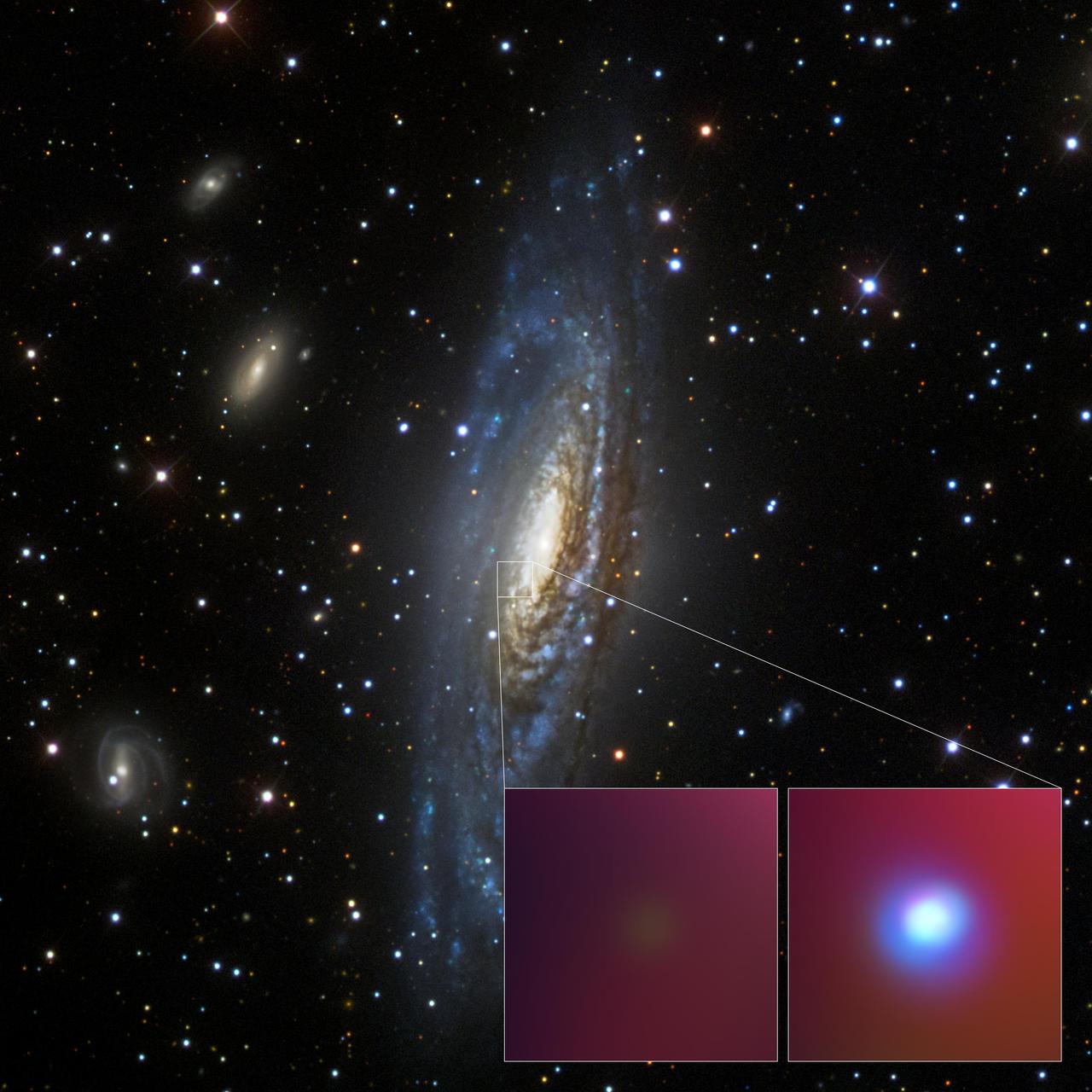
This visible-light image from the Sloan Digital Sky Survey shows spiral galaxy NGC 7331, center, where astronomers observed the unusual supernova SN 2014C . The inset images are from NASA's Chandra X-ray Observatory, showing a small region of the galaxy before the supernova explosion (left) and after it (right). Red, green and blue colors are used for low, medium and high-energy X-rays, respectively. http://photojournal.jpl.nasa.gov/catalog/PIA21088

Art by Gebing Conception shows a quasar as a tremendous outburst in the core of a far-distant spiral galaxy
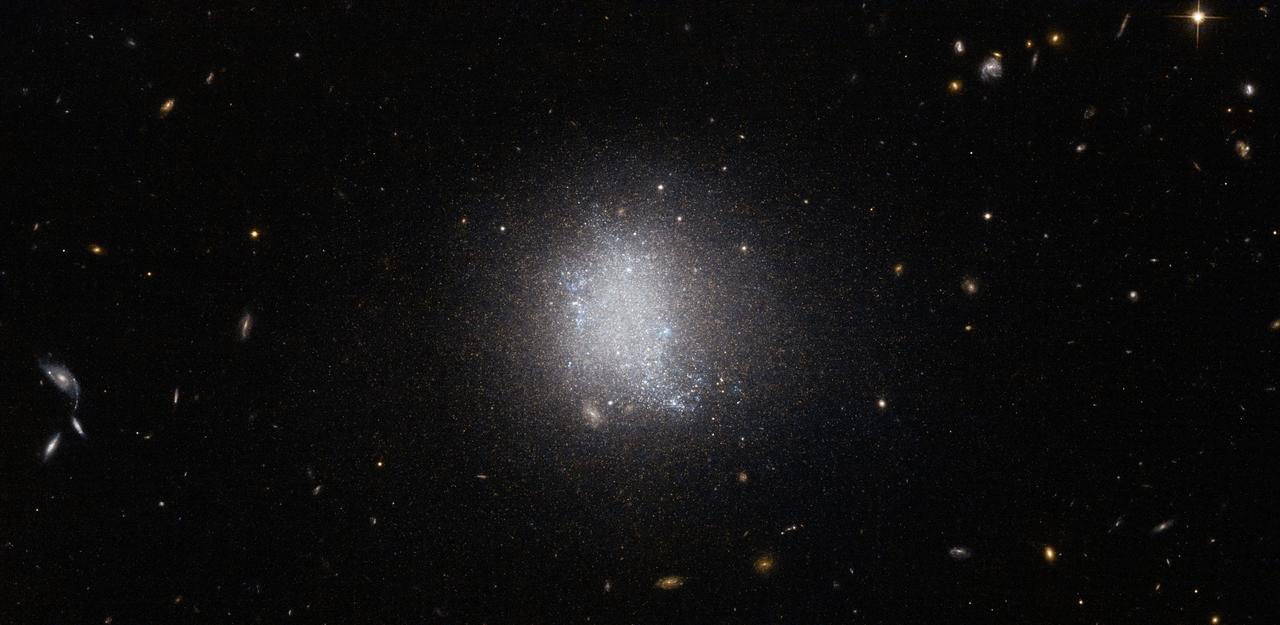
The smudge of stars at the center of this NASA/ESA Hubble Space Telescope image is a galaxy known as UGC 5797. UGC 5797 is an emission line galaxy, meaning that it is currently undergoing active star formation. The result is a stellar population that is constantly being refurbished as massive bright blue stars form. Galaxies with prolific star formation are not only veiled in a blue tint, but are key to the continuation of a stellar cycle. In this image UGC 5797 appears in front of a background of spiral galaxies. Spiral galaxies have copious amounts of dust and gas — the main ingredient for stars — and therefore often also belong to the class of emission line galaxies. Spiral galaxies have disk-like shapes that drastically vary in appearance depending on the angle at which they are observed. The collection of spiral galaxies in this frame exhibits this attribute acutely: Some are viewed face-on, revealing the structure of the spiral arms, while the two in the bottom left are seen edge-on, appearing as plain streaks in the sky. There are many spiral galaxies, with varying colors and at different angles, sprinkled across this image — just take a look. Credit: ESA/Hubble & NASA, Acknowledgement: Luca Limatola <b><a href="http://www.nasa.gov/audience/formedia/features/MP_Photo_Guidelines.html" rel="nofollow">NASA image use policy.</a></b> <b><a href="http://www.nasa.gov/centers/goddard/home/index.html" rel="nofollow">NASA Goddard Space Flight Center</a></b> enables NASA’s mission through four scientific endeavors: Earth Science, Heliophysics, Solar System Exploration, and Astrophysics. Goddard plays a leading role in NASA’s accomplishments by contributing compelling scientific knowledge to advance the Agency’s mission. <b>Follow us on <a href="http://twitter.com/NASAGoddardPix" rel="nofollow">Twitter</a></b> <b>Like us on <a href="http://www.facebook.com/pages/Greenbelt-MD/NASA-Goddard/395013845897?ref=tsd" rel="nofollow">Facebook</a></b> <b>Find us on <a href="http://instagrid.me/nasagoddard/?vm=grid" rel="nofollow">Instagram</a></b>