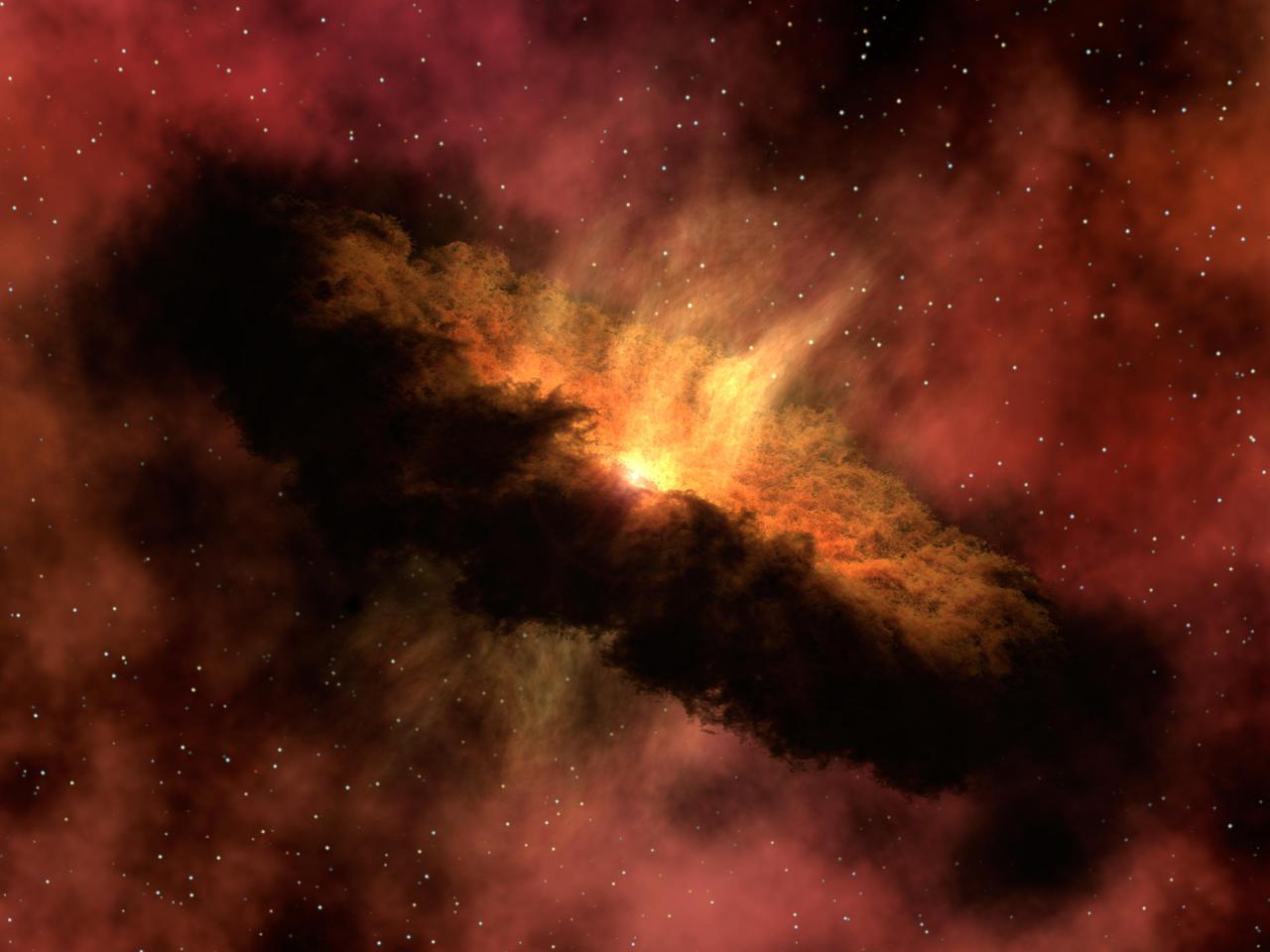
NASA Spitzer Space Telescope observed a fledgling solar system like the one depicted in this artist concept, and discovered deep within it enough water vapor to fill the oceans on Earth five times.
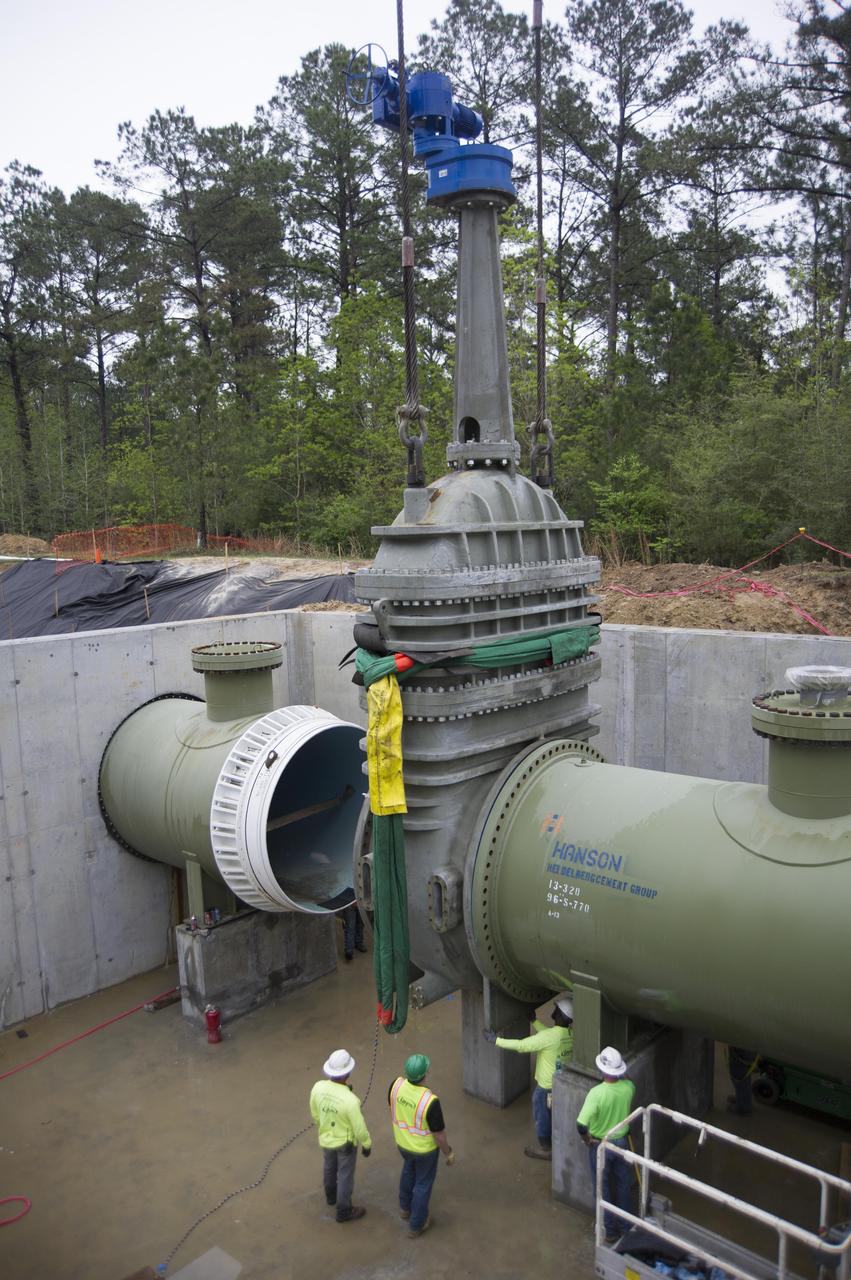
Stennis Space Center employees install a 96-inch valve during a recent upgrade of the high-pressure industrial water system that serves the site’s large rocket engine test stands. The upgraded system has a capacity to flow 335,000 gallons of water a minute, which is a critical element for testing. At Stennis, engines are anchored in place on large test stands and fired just as they are during an actual space flight. The fire and exhaust from the test is redirected out of the stand by a large flame trench. A water deluge system directs thousands of gallons of water needed to cool the exhaust. Water also must be available for fire suppression in the event of a mishap. The new system supports RS-25 engine testing on the A-1 Test Stand, as well as testing of the core stage of NASA’s new Space Launch System on the B-2 Test Stand at Stennis.
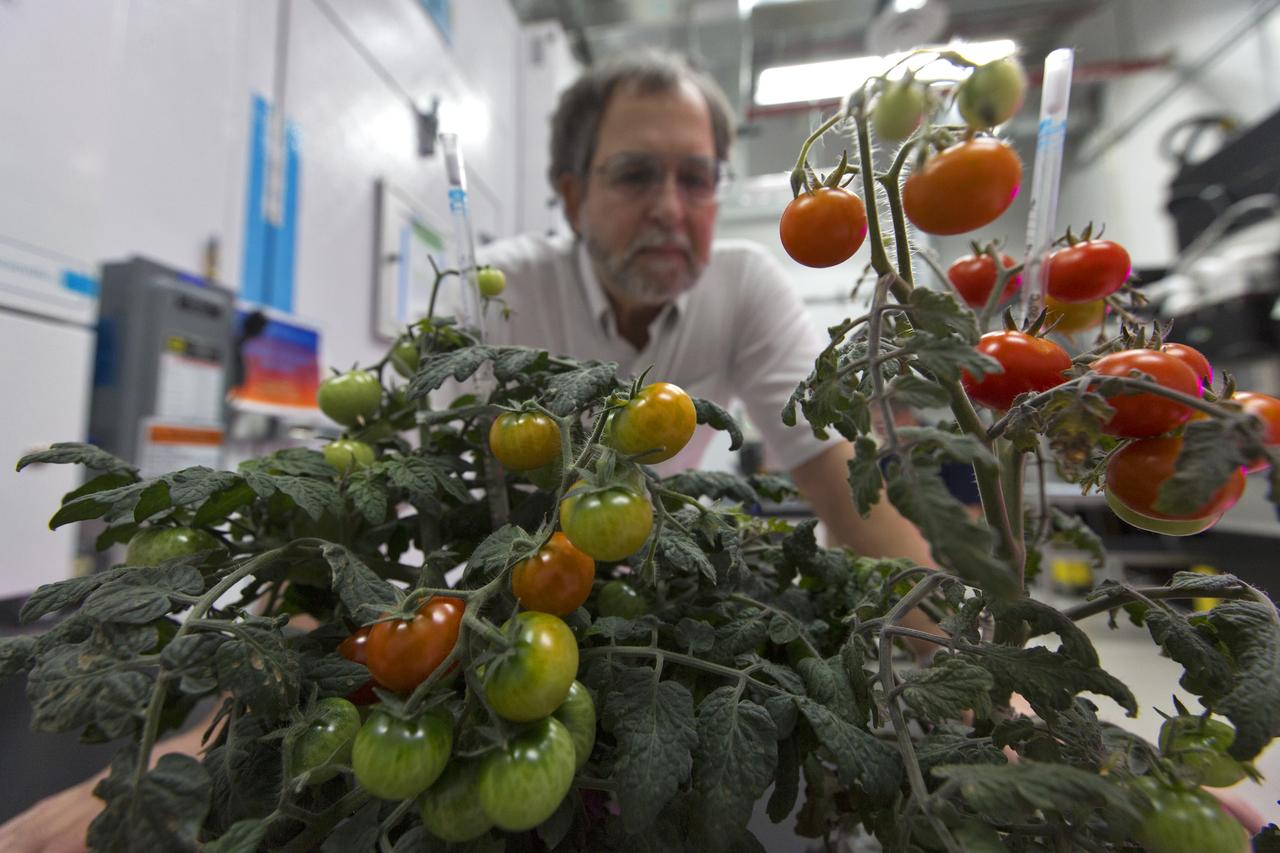
Howard Levine, Ph.D., a research scientist at NASA's Kennedy Space Center in Florida, reviews the growth of several tomato plants in a laboratory in the Space Station Processing Facility. The tomato plants are growing in the Veggie Passive Orbital Nutrient Delivery System (PONDS). Veggie PONDS is a direct follow-on to the Veg-01 and Veg-03 hardware and plant growth validation tests. The primary goal of this newly developed plant growing system, Veggie PONDS, is to demonstrate uniform plant growth. PONDS units have features that are designed to mitigate microgravity effects on water distribution, increase oxygen exchange and provide sufficient room for root zone growth. PONDS is planned for use during Veg-04 and Veg-05 on the International Space Station after the Veggie PONDS Validation flights on SpaceX-14 and OA-9.
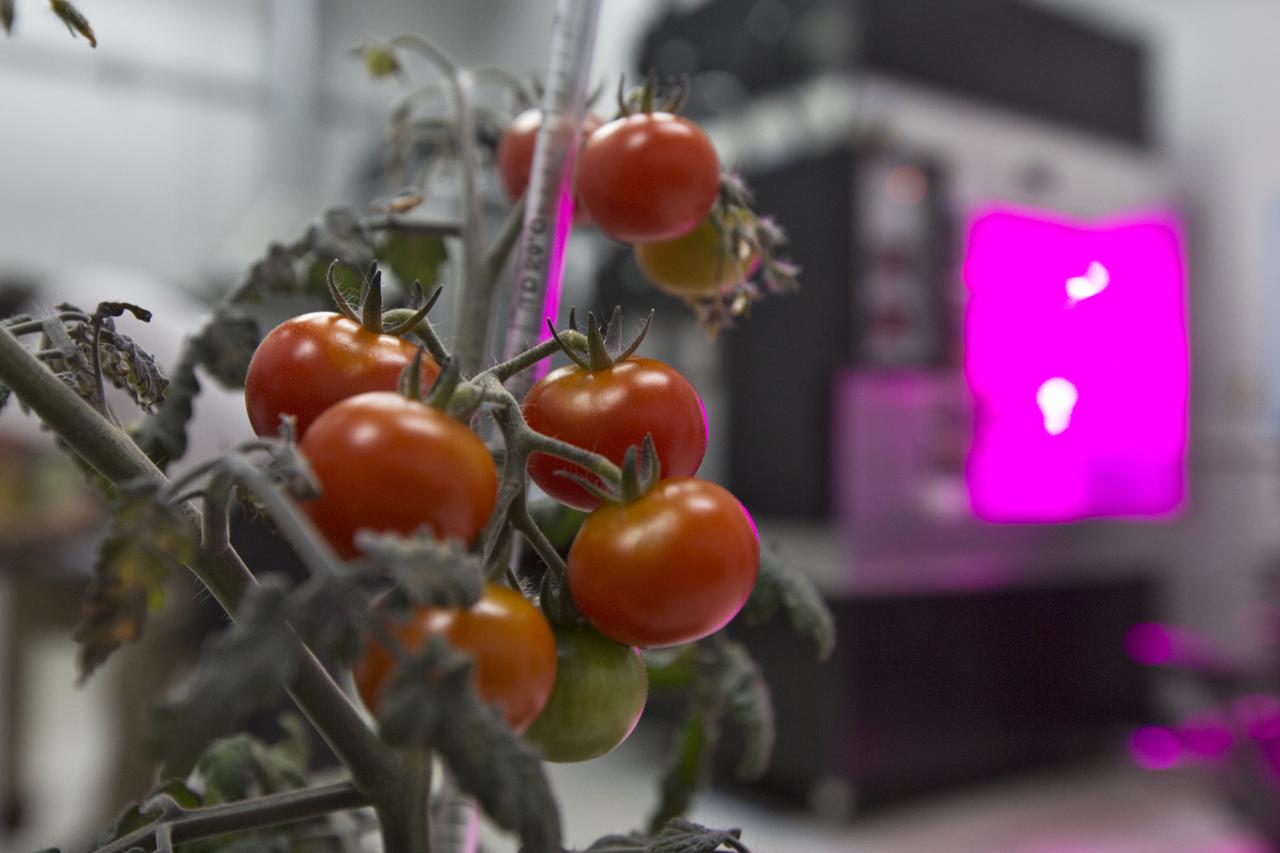
Tomato plants are growing inside a laboratory at the Space Station Processing Facility at NASA’s Kennedy Space Center in Florida. The plant growth is being tested in the Veggie Passive Orbital Nutrient Delivery System (PONDS). Veggie PONDS is a direct follow-on to the Veg-01 and Veg-03 hardware and plant growth validation tests. The primary goal of this newly developed plant growing system, Veggie PONDS, is to demonstrate uniform plant growth. PONDS units have features that are designed to mitigate microgravity effects on water distribution, increase oxygen exchange and provide sufficient room for root zone growth. PONDS is planned for use during Veg-04 and Veg-05 on the International Space Station after the Veggie PONDS Validation flights on SpaceX-14 and OA-9.
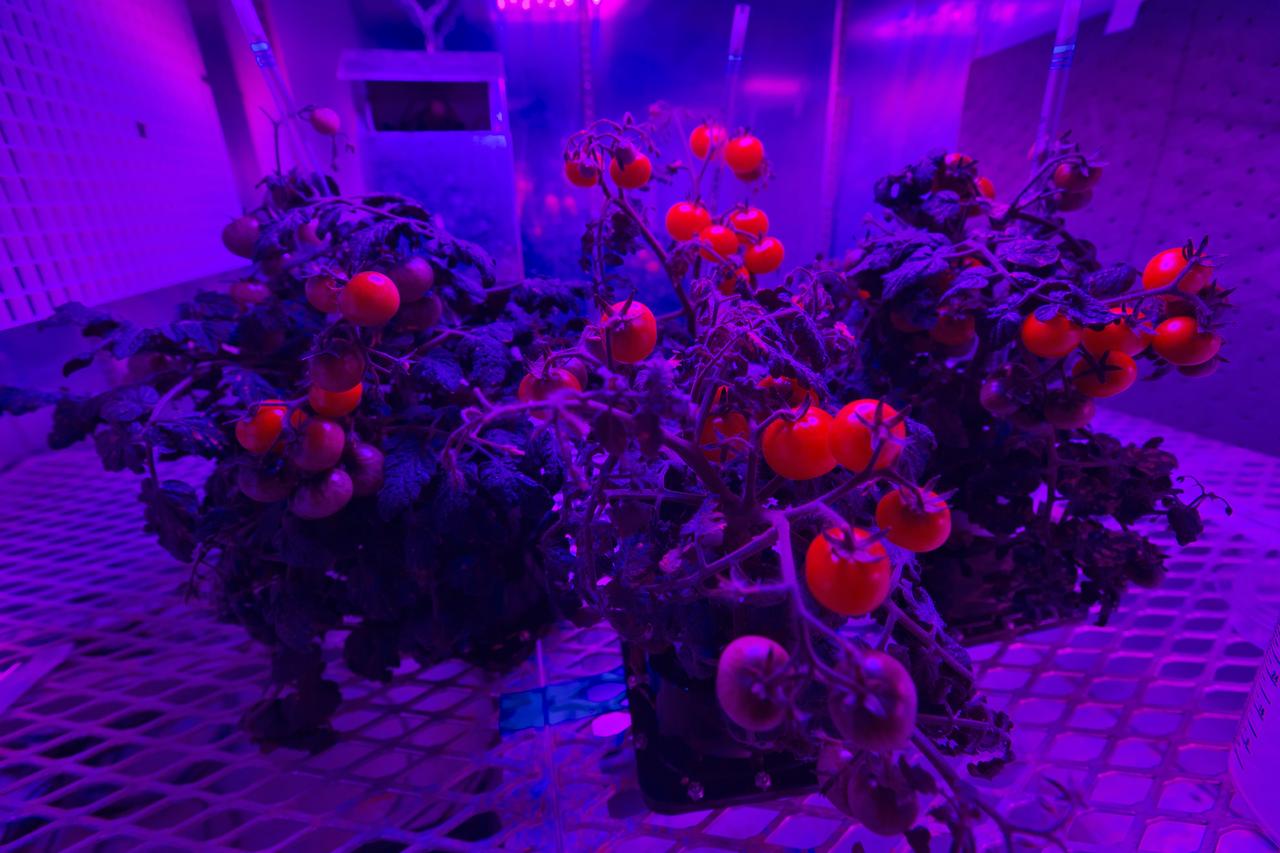
Tomato plants are growing under red and blue LED lights in a growth chamber inside a laboratory at the Space Station Processing Facility at NASA’s Kennedy Space Center in Florida. The plant growth is being tested in the Veggie Passive Orbital Nutrient Delivery System (PONDS). Veggie PONDS is a direct follow-on to the Veg-01 and Veg-03 hardware and plant growth validation tests. The primary goal of this newly developed plant growing system, Veggie PONDS, is to demonstrate uniform plant growth. PONDS units have features that are designed to mitigate microgravity effects on water distribution, increase oxygen exchange and provide sufficient room for root zone growth. PONDS is planned for use during Veg-04 and Veg-05 on the International Space Station after the Veggie PONDS Validation flights on SpaceX-14 and OA-9.
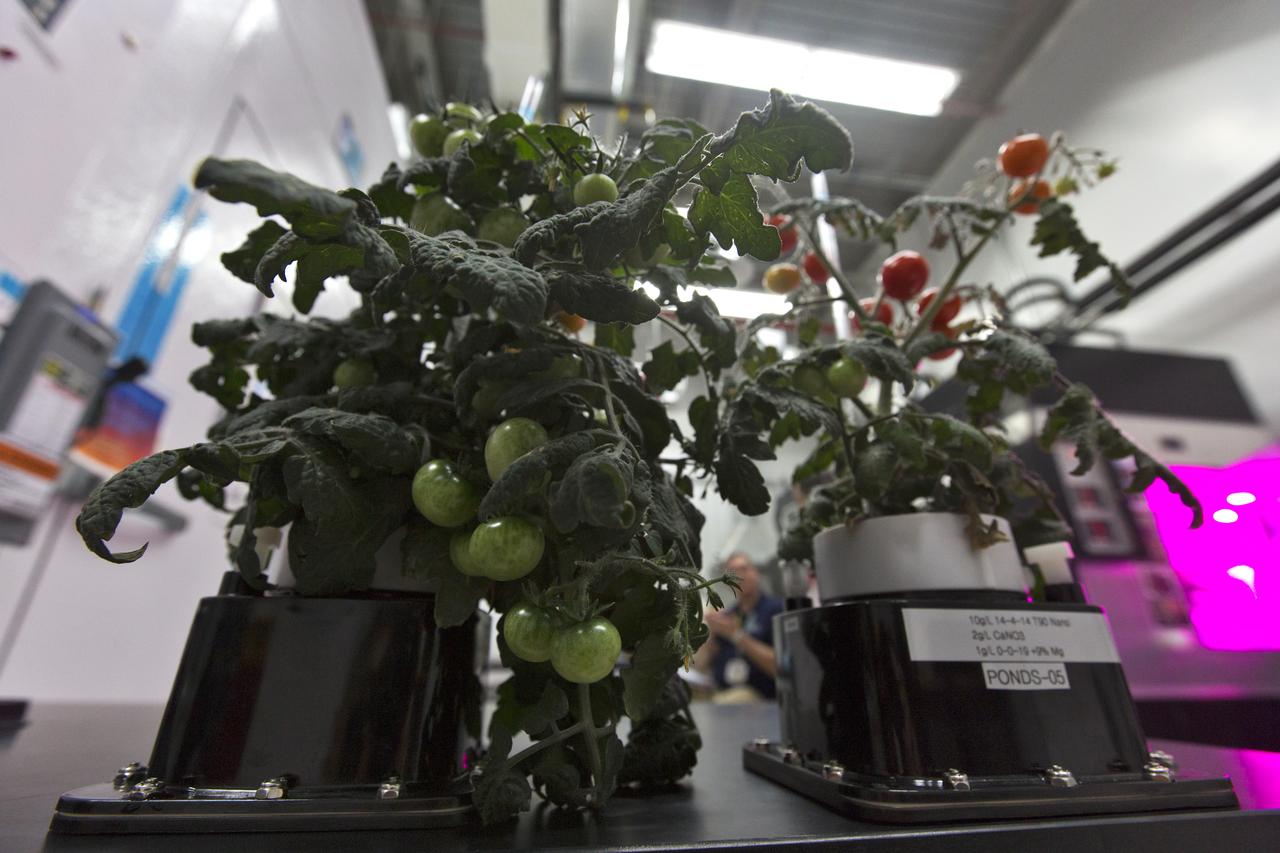
Tomato plants are growing inside a laboratory at the Space Station Processing Facility at NASA’s Kennedy Space Center in Florida. The plant growth is being tested in the Veggie Passive Orbital Nutrient Delivery System (PONDS). Veggie PONDS is a direct follow-on to the Veg-01 and Veg-03 hardware and plant growth validation tests. The primary goal of this newly developed plant growing system, Veggie PONDS, is to demonstrate uniform plant growth. PONDS units have features that are designed to mitigate microgravity effects on water distribution, increase oxygen exchange and provide sufficient room for root zone growth. PONDS is planned for use during Veg-04 and Veg-05 on the International Space Station after the Veggie PONDS Validation flights on SpaceX-14 and OA-9.
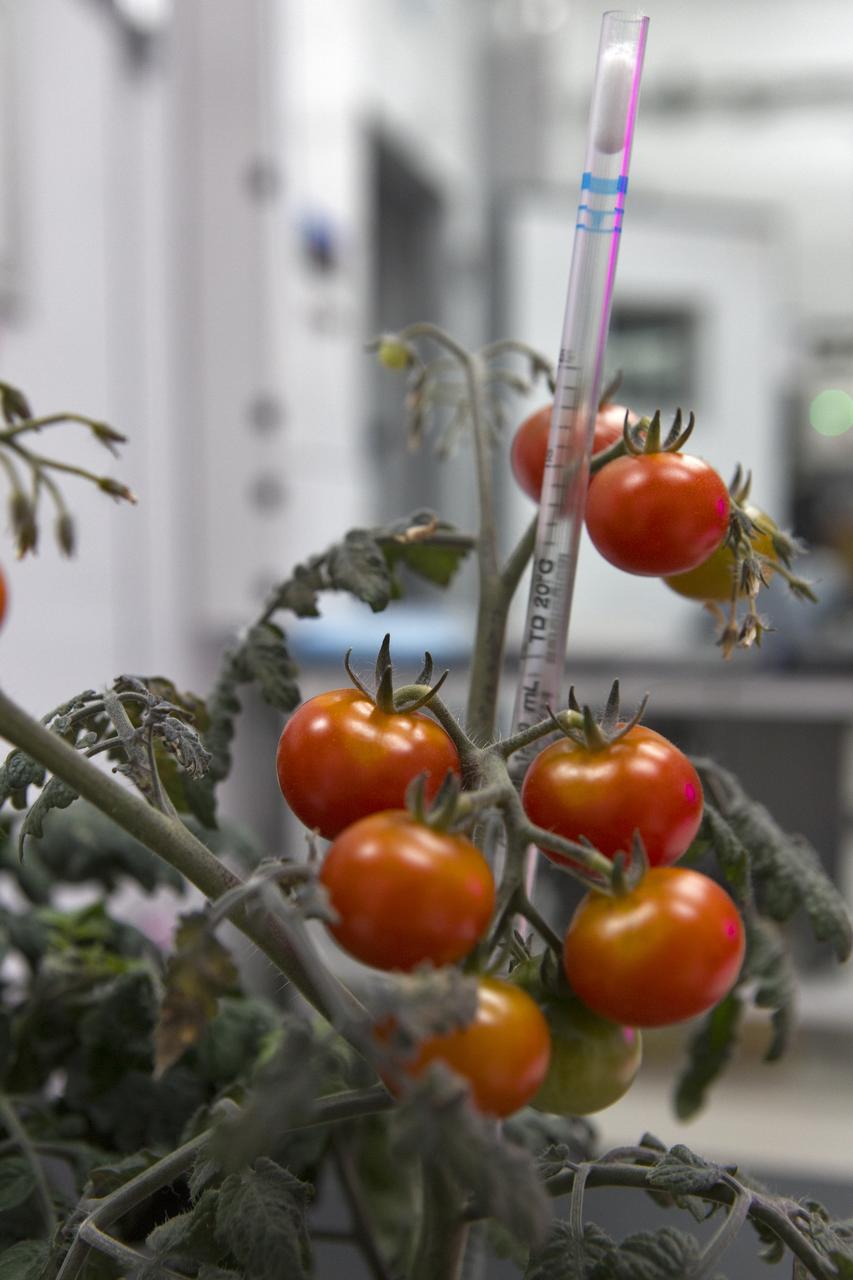
Tomato plants are growing inside a laboratory at the Space Station Processing Facility at NASA’s Kennedy Space Center in Florida. The plant growth is being tested in the Veggie Passive Orbital Nutrient Delivery System (PONDS). Veggie PONDS is a direct follow-on to the Veg-01 and Veg-03 hardware and plant growth validation tests. The primary goal of this newly developed plant growing system, Veggie PONDS, is to demonstrate uniform plant growth. PONDS units have features that are designed to mitigate microgravity effects on water distribution, increase oxygen exchange and provide sufficient room for root zone growth. PONDS is planned for use during Veg-04 and Veg-05 on the International Space Station after the Veggie PONDS Validation flights on SpaceX-14 and OA-9.
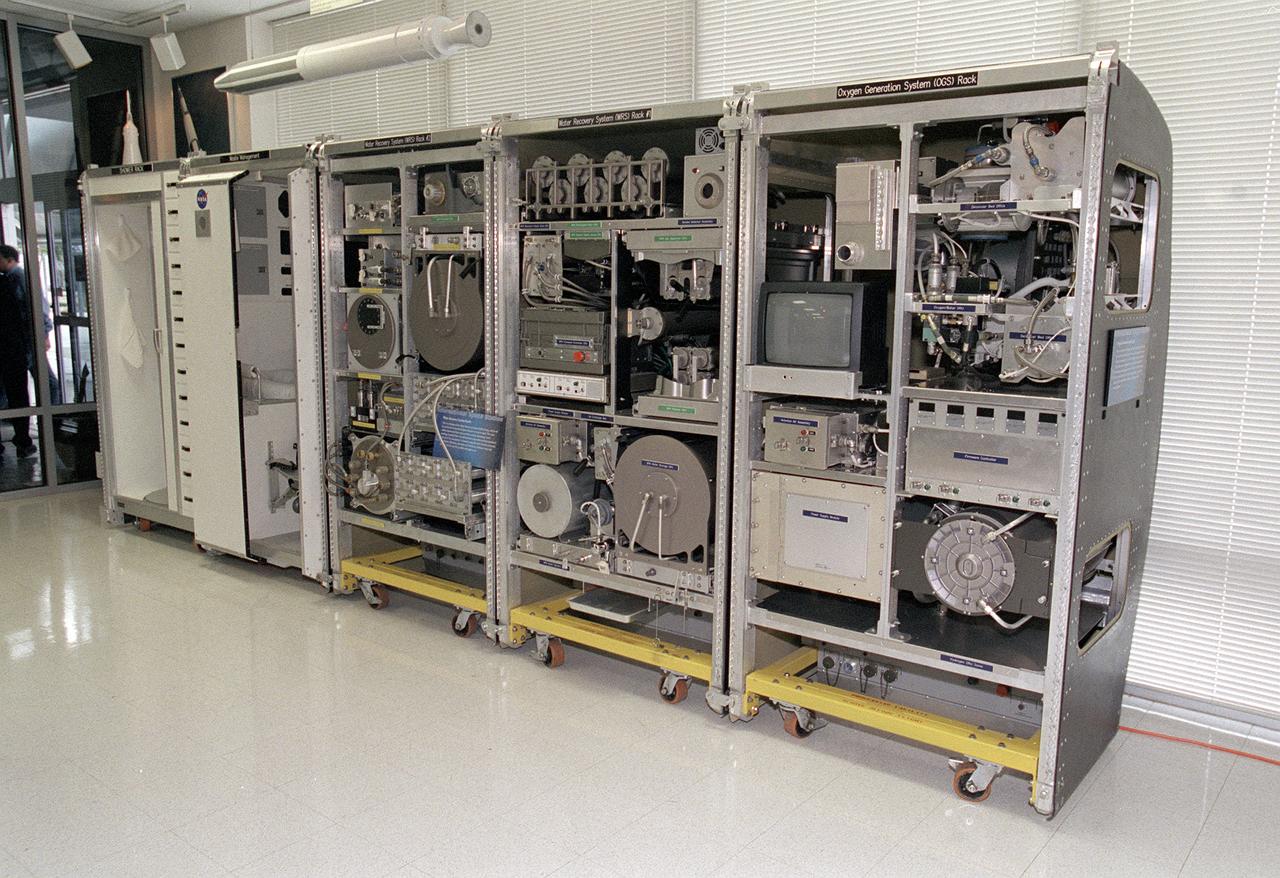
The Environmental Control and Life Support System (ECLSS) Group of the Flight Projects Directorate at the Marshall Space Flight Center in Huntsville, Alabama, is responsible for designing and building the life support systems that will provide the crew of the International Space Station (ISS) a comfortable environment in which to live and work. This photograph shows the mockup of the the ECLSS to be installed in the Node 3 module of the ISS. From left to right, shower rack, waste management rack, Water Recovery System (WRS) Rack #2, WRS Rack #1, and Oxygen Generation System (OGS) rack are shown. The WRS provides clean water through the reclamation of wastewaters and is comprised of a Urine Processor Assembly (UPA) and a Water Processor Assembly (WPA). The UPA accepts and processes pretreated crewmember urine to allow it to be processed along with other wastewaters in the WPA. The WPA removes free gas, organic, and nonorganic constituents before the water goes through a series of multifiltration beds for further purification. The OGS produces oxygen for breathing air for the crew and laboratory animals, as well as for replacing oxygen loss. The OGS is comprised of a cell stack, which electrolyzes (breaks apart the hydrogen and oxygen molecules) some of the clean water provided by the WRS, and the separators that remove the gases from the water after electrolysis.
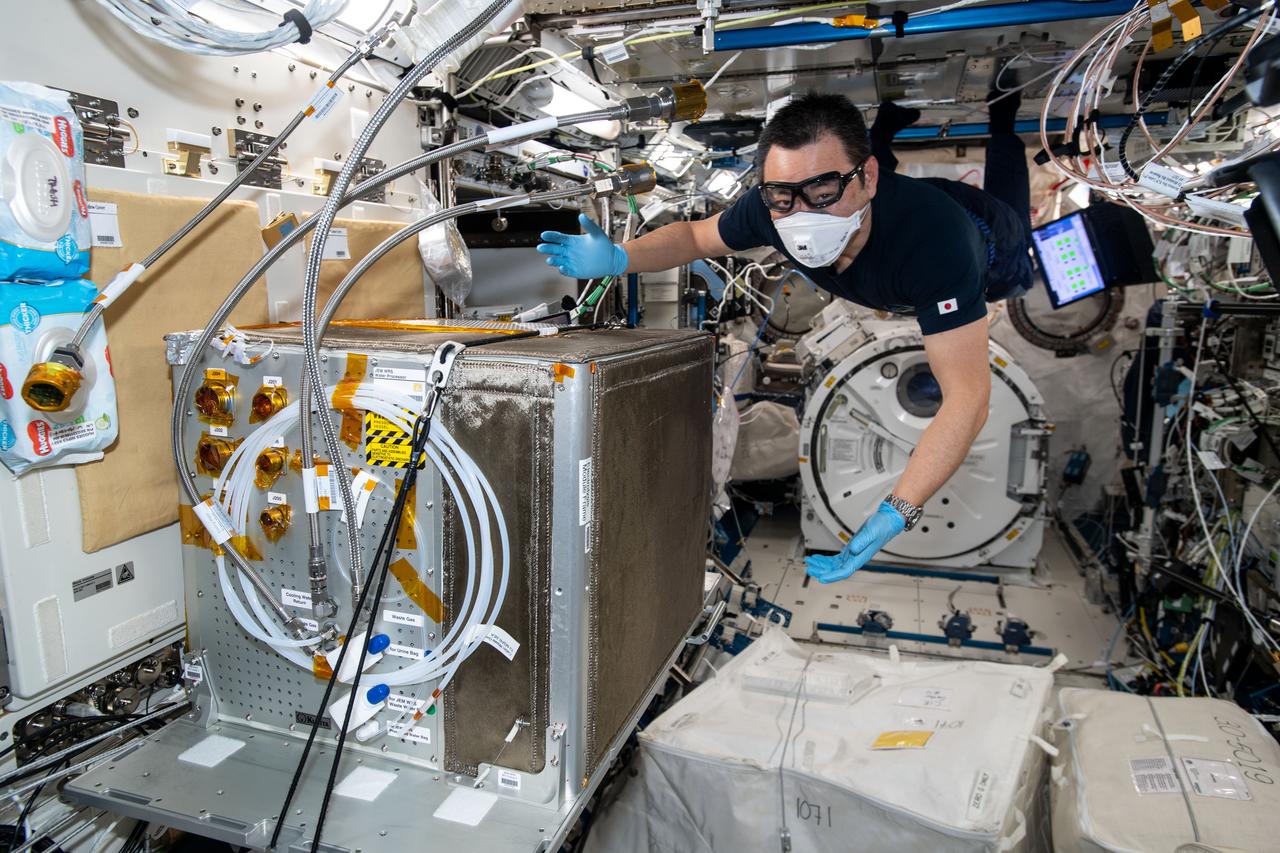
iss065e333421 (8/30/2021) --- Japan Aerospace Exploration Agency (JAXA) astronaut Akihiko Hoshide is photographed during the Japanese Experiment Module (JEM) Water Recovery System (JWRS) Gas Trap and Bypass Line Installation. Future water recovery systems will require high recovery rates, a more compact size, and less power consumption than conventional systems. The JWRS demonstrates new technologies on orbit, aboard the International Space Station (ISS), to meet these requirements.
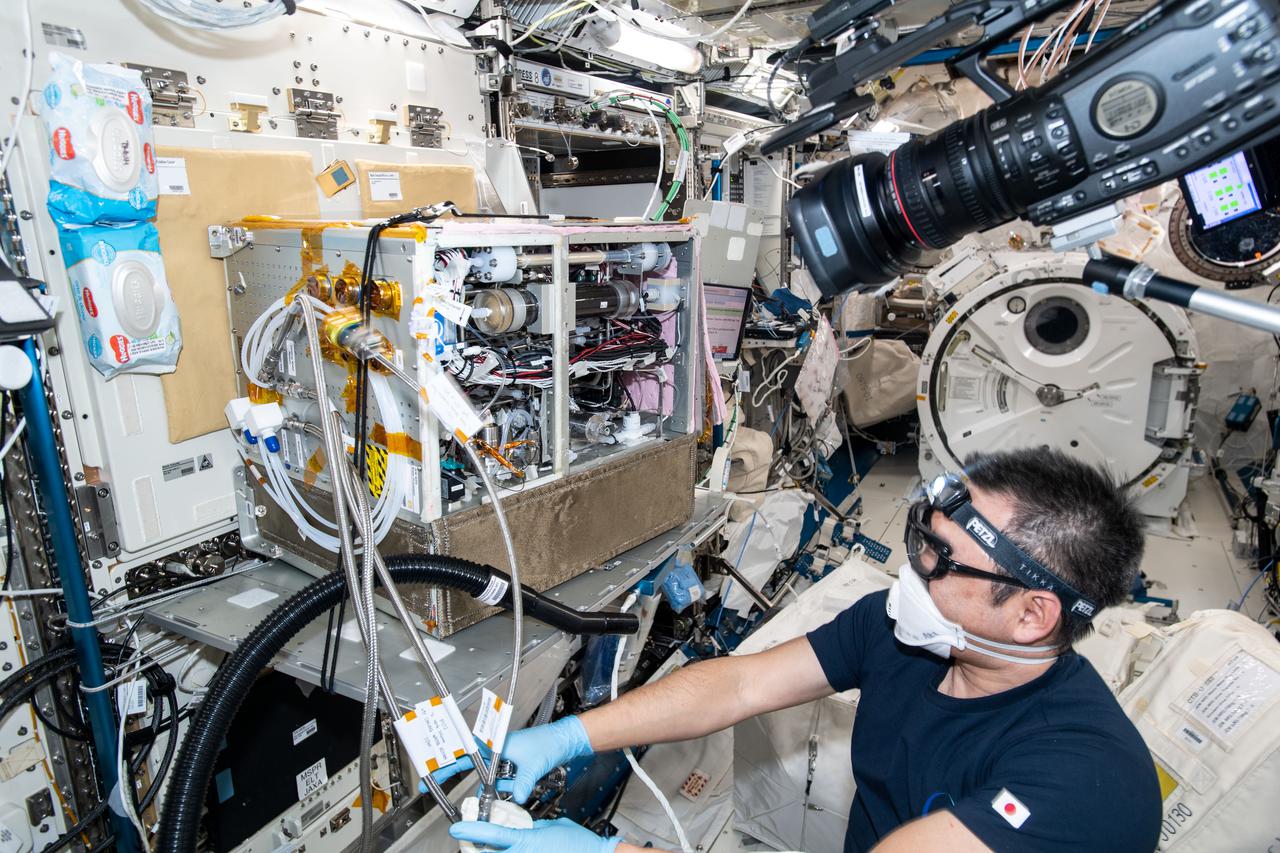
iss065e333427 (8/30/2021) --- Japan Aerospace Exploration Agency (JAXA) astronaut Akihiko Hoshide is photographed during the Japanese Experiment Module (JEM) Water Recovery System (JWRS) Gas Trap and Bypass Line Installation. Future water recovery systems will require high recovery rates, a more compact size, and less power consumption than conventional systems. The JWRS demonstrates new technologies on orbit, aboard the International Space Station (ISS), to meet these requirements.
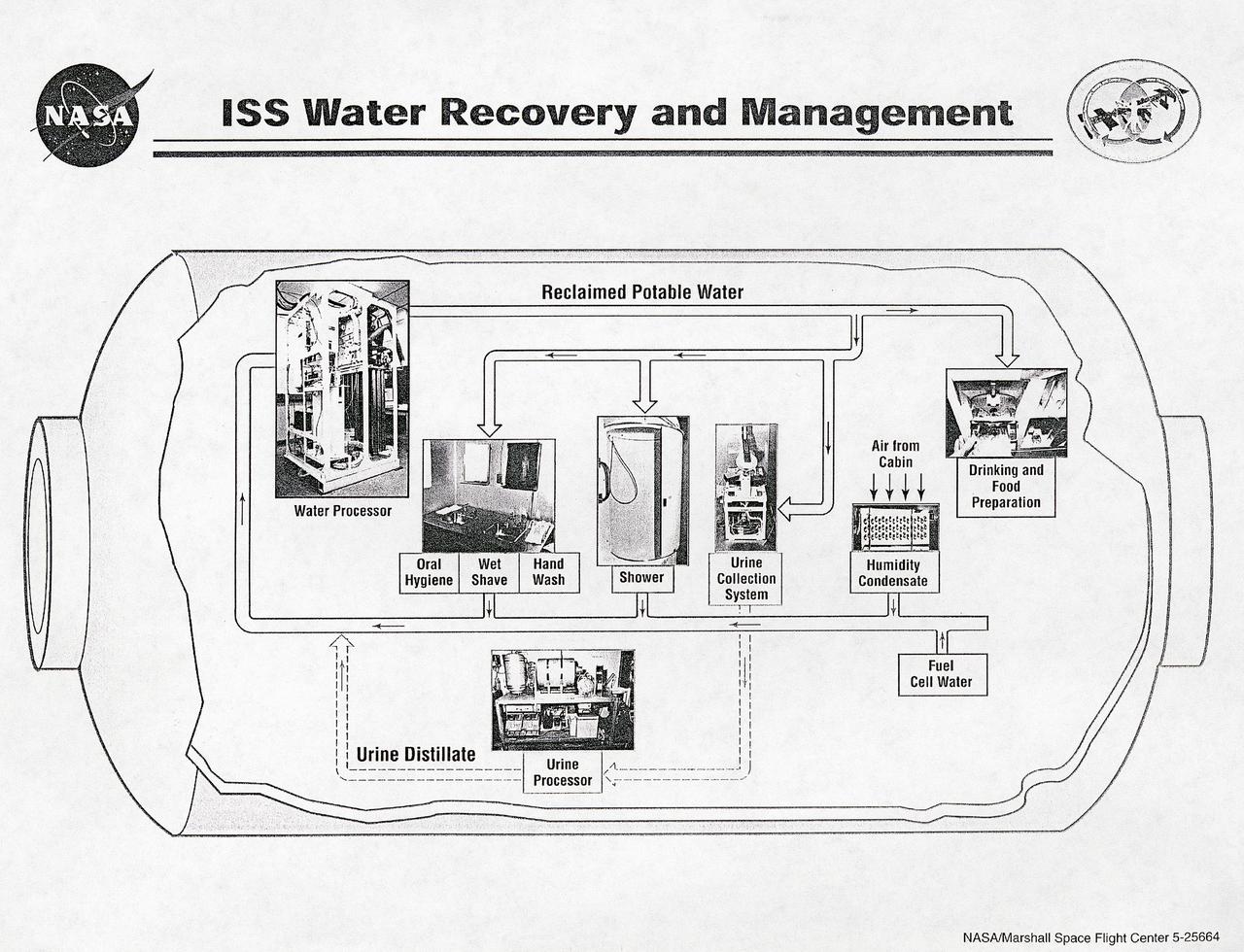
This diagram shows the flow of water recovery and management in the International Space Station (ISS). The Environmental Control and Life Support System (ECLSS) Group of the Flight Projects Directorate at the Marshall Space Flight Center is responsible for the regenerative ECLSS hardware, as well as providing technical support for the rest of the system. The regenerative ECLSS, whose main components are the Water Recovery System (WRS), and the Oxygen Generation System (OGS), reclaims and recycles water oxygen. The ECLSS maintains a pressurized habitation environment, provides water recovery and storage, maintains and provides fire detection/ suppression, and provides breathable air and a comfortable atmosphere in which to live and work within the ISS. The ECLSS hardware will be located in the Node 3 module of the ISS.
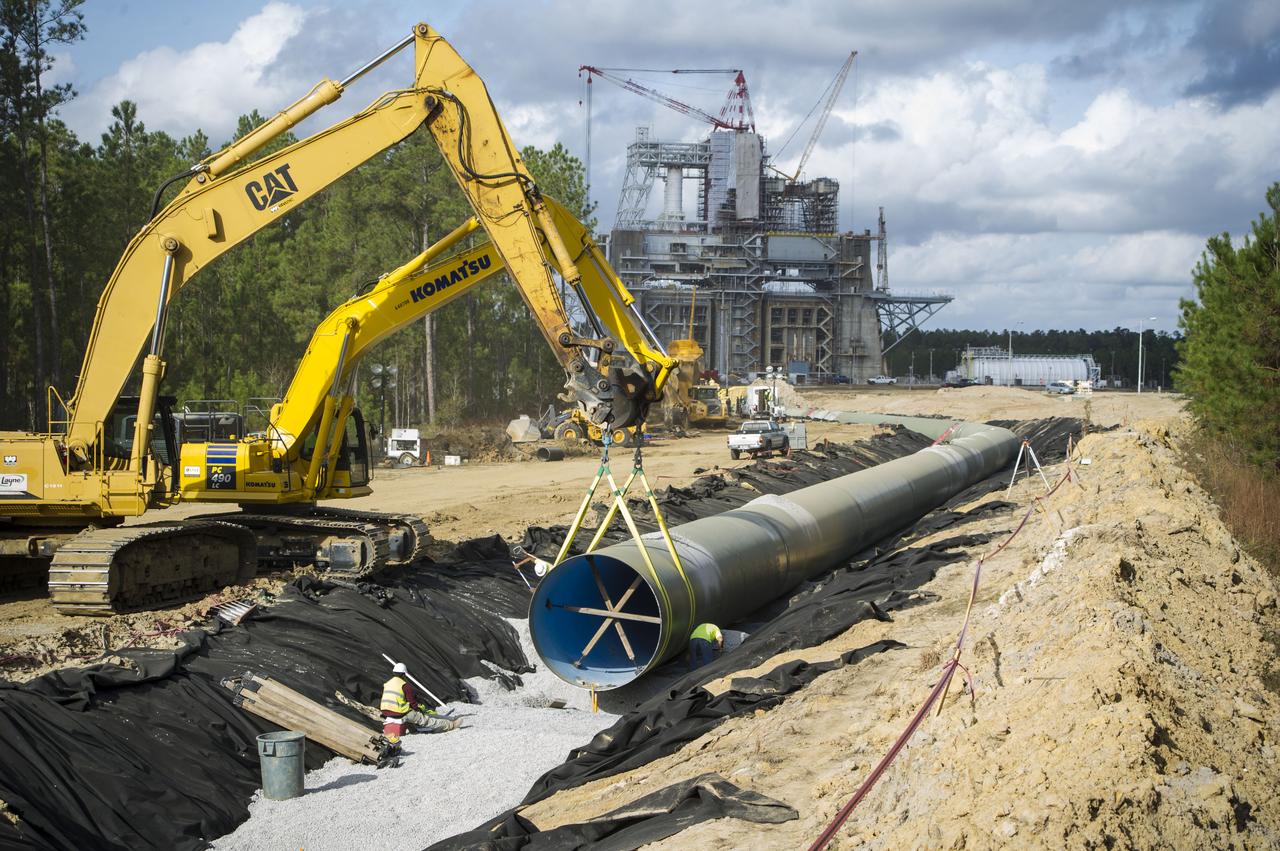
Water piping is installed near the Thad Cochran Test Stand (B-1/B-2) at NASA’s Stennis Space Center in December 2014. The project to replace and upgrade the center’s high pressure industrial water system was a key milestone in preparations to test the SLS (Space Launch System) core stage ahead of the successful Artemis I launch.

The Marshall Space Flight Center (MSFC) is responsible for designing and building the life support systems that will provide the crew of the International Space Station (ISS) a comfortable environment in which to live and work. Scientists and engineers at the MSFC are working together to provide the ISS with systems that are safe, efficient, and cost-effective. These compact and powerful systems are collectively called the Environmental Control and Life Support Systems, or simply, ECLSS. This photograph shows the development Water Processor located in two racks in the ECLSS test area at the Marshall Space Flight Center. Actual waste water, simulating Space Station waste, is generated and processed through the hardware to evaluate the performance of technologies in the flight Water Processor design.
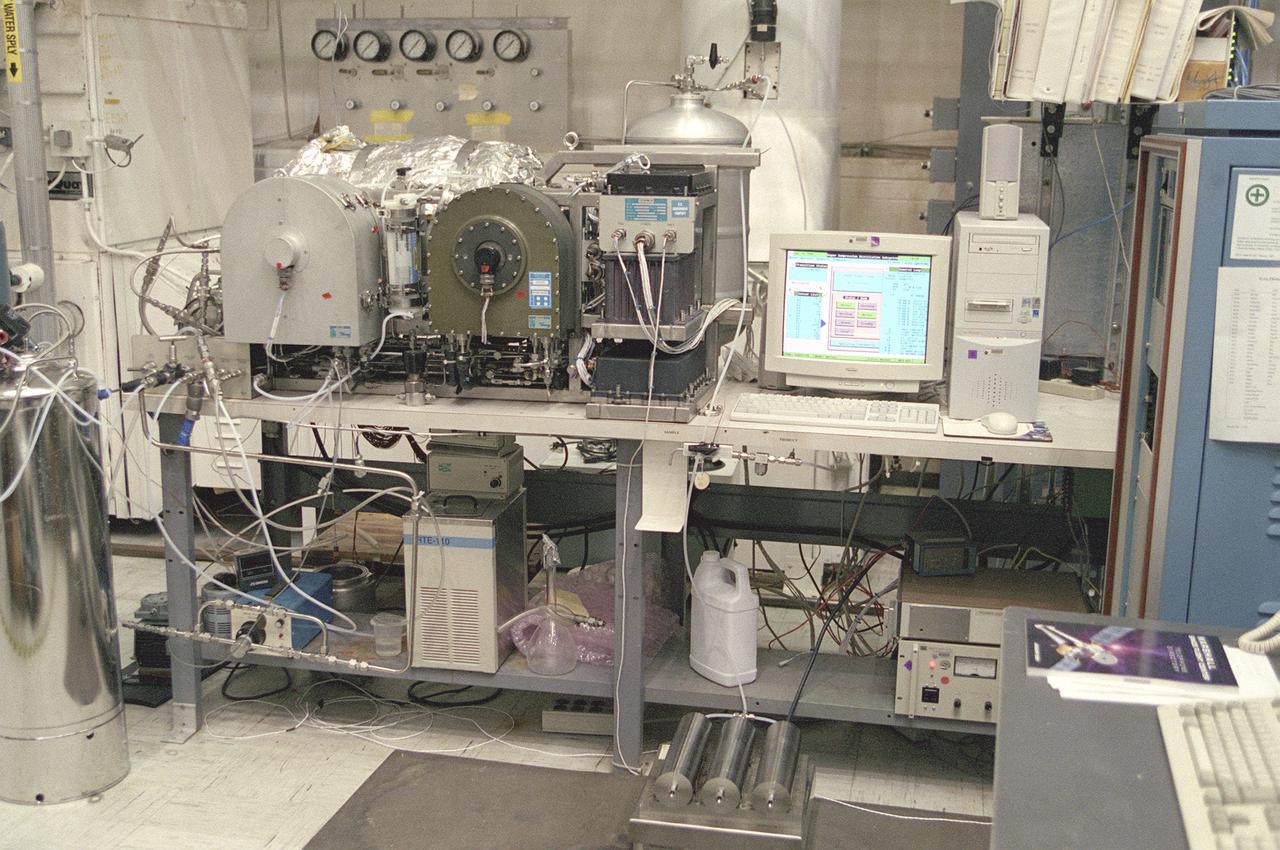
The Marshall Space Flight Center (MSFC) is responsible for designing and building the life support systems that will provide the crew of the International Space Station (ISS) a comfortable environment in which to live and work. Scientists and engineers at the MSFC are working together to provide the ISS with systems that are safe, efficient, and cost-effective. These compact and powerful systems are collectively called the Environmental Control and Life Support Systems, or simply, ECLSS. This photograph shows the fifth generation Urine Processor Development Hardware. The Urine Processor Assembly (UPA) is a part of the Water Recovery System (WRS) on the ISS. It uses a chase change process called vapor compression distillation technology to remove contaminants from urine. The UPA accepts and processes pretreated crewmember urine to allow it to be processed along with other wastewaters in the Water Processor Assembly (WPA). The WPA removes free gas, organic, and nonorganic constituents before the water goes through a series of multifiltration beds for further purification. Product water quality is monitored primarily through conductivity measurements. Unacceptable water is sent back through the WPA for reprocessing. Clean water is sent to a storage tank.
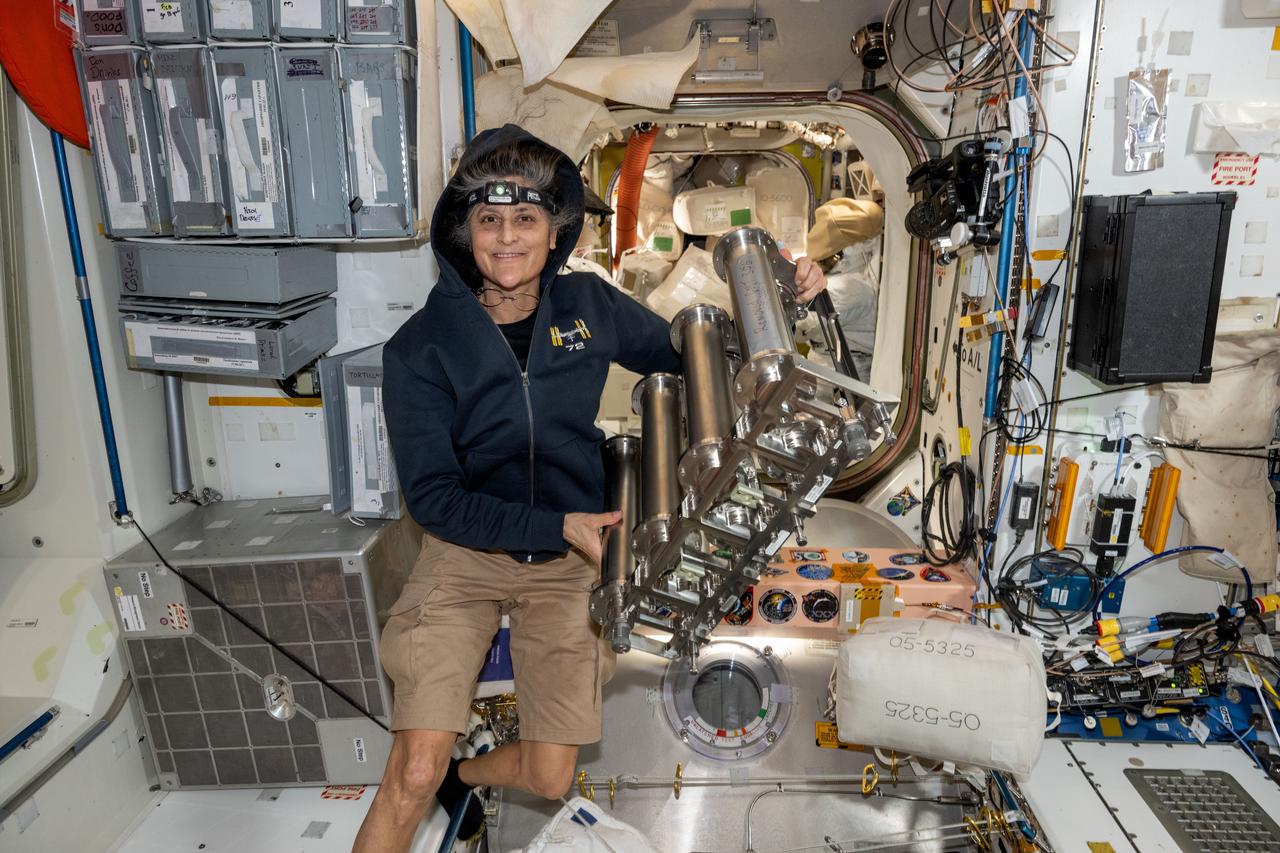
iss072e143163 (Nov. 1, 2024) --- NASA astronaut and Expedition 72 Commander Suni Williams replaces particulate filters on the water recovery system, a component of the Tranquility module's waste and hygiene compartment, the International Space Station's bathroom.
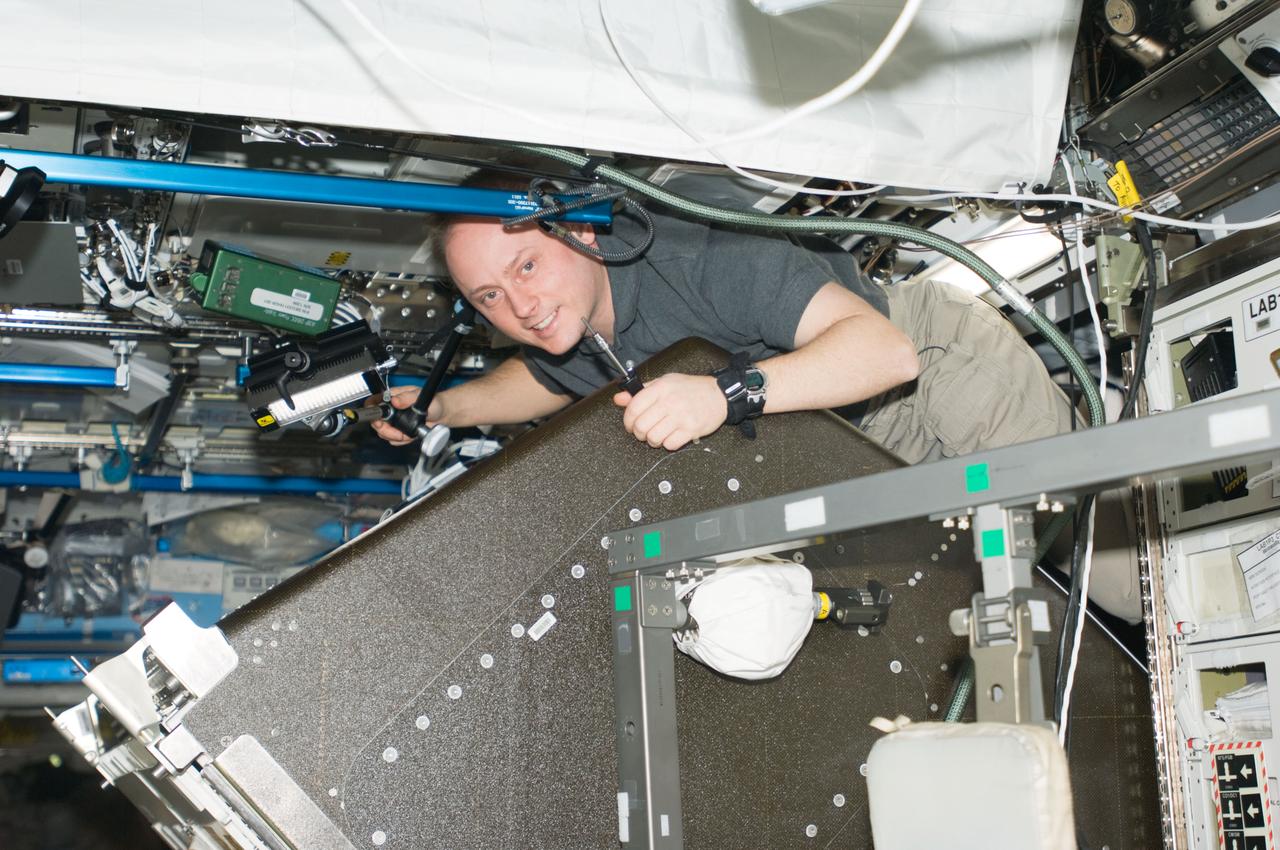
ISS018-E-011530 (8 Dec. 2008) --- Astronaut Michael Fincke, Expedition 18 commander, performs a leak check on the Water Recovery System (WRS) in the Destiny laboratory of the International Space Station.

ISS019-E-018483 (20 May 2009) --- After NASA's Mission Control gave the Expedition 19 astronaut crew aboard the International Space Station a "go" to drink water that the station's new recycling system has purified, the three celebrated with a ?toast? that also involved Mission Control, Houston, and the Payload Operations Center at Marshall Space Flight Center in Huntsville, Ala., which led development of the Water Recovery System. Pictured are Expedition 19 Commander Gennady Padalka (center) and Flight Engineers Mike Barratt (right) and Koichi Wakata, holding drink bags with special commemorative labels in the Destiny laboratory.
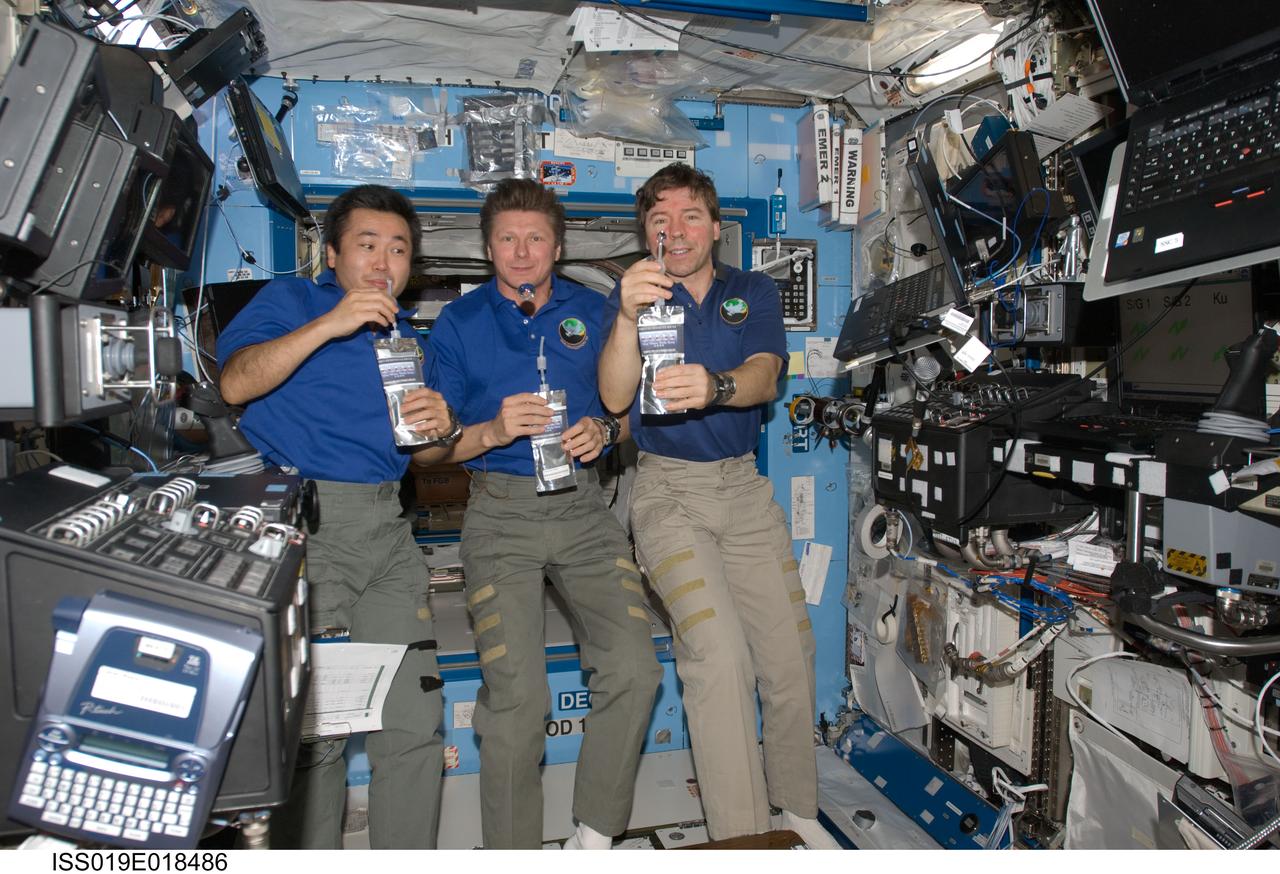
ISS019-E-018486 (20 May 2009) --- After NASA's Mission Control gave the Expedition 19 astronaut crew aboard the International Space Station a "go" to drink water that the station's new recycling system has purified, the three celebrated with a ?toast? that also involved Mission Control, Houston, and the Payload Operations Center at Marshall Space Flight Center in Huntsville, Ala., which led development of the Water Recovery System. Pictured are Expedition 19 Commander Gennady Padalka (center) and Flight Engineers Mike Barratt (right) and Koichi Wakata, holding drink bags with special commemorative labels in the Destiny laboratory.
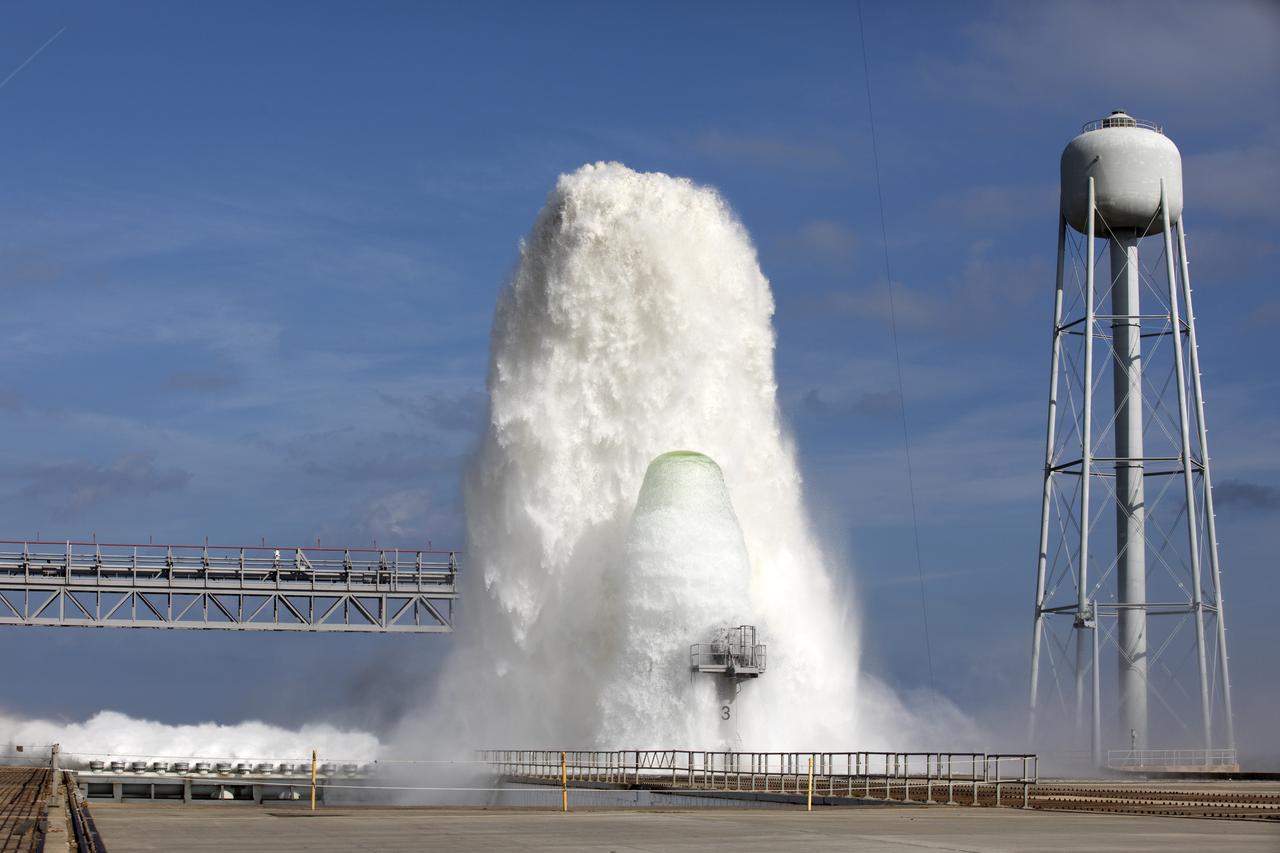
About 450,000 gallons of water flowed at high speed from a holding tank through new and modified piping and valves, the flame trench, flame deflector nozzles and mobile launcher interface risers during a wet flow test at Launch Pad 39B at NASA's Kennedy Space Center in Florida. At peak flow, the water reached about 100 feet in the air above the pad surface. The test was a milestone to confirm and baseline the performance of the Ignition Overpressure/Sound Suppression system. During launch of NASA's Space Launch System rocket and Orion spacecraft, the high-speed water flow will help protect the vehicle from the extreme acoustic and temperature environment during ignition and liftoff.

About 450,000 gallons of water flowed at high speed from a holding tank through new and modified piping and valves, the flame trench, flame deflector nozzles and mobile launcher interface risers during a wet flow test at Launch Pad 39B at NASA's Kennedy Space Center in Florida. At peak flow, the water reached about 100 feet in the air above the pad surface. The test was a milestone to confirm and baseline the performance of the Ignition Overpressure/Sound Suppression system. During launch of NASA's Space Launch System rocket and Orion spacecraft, the high-speed water flow will help protect the vehicle from the extreme acoustic and temperature environment during ignition and liftoff.
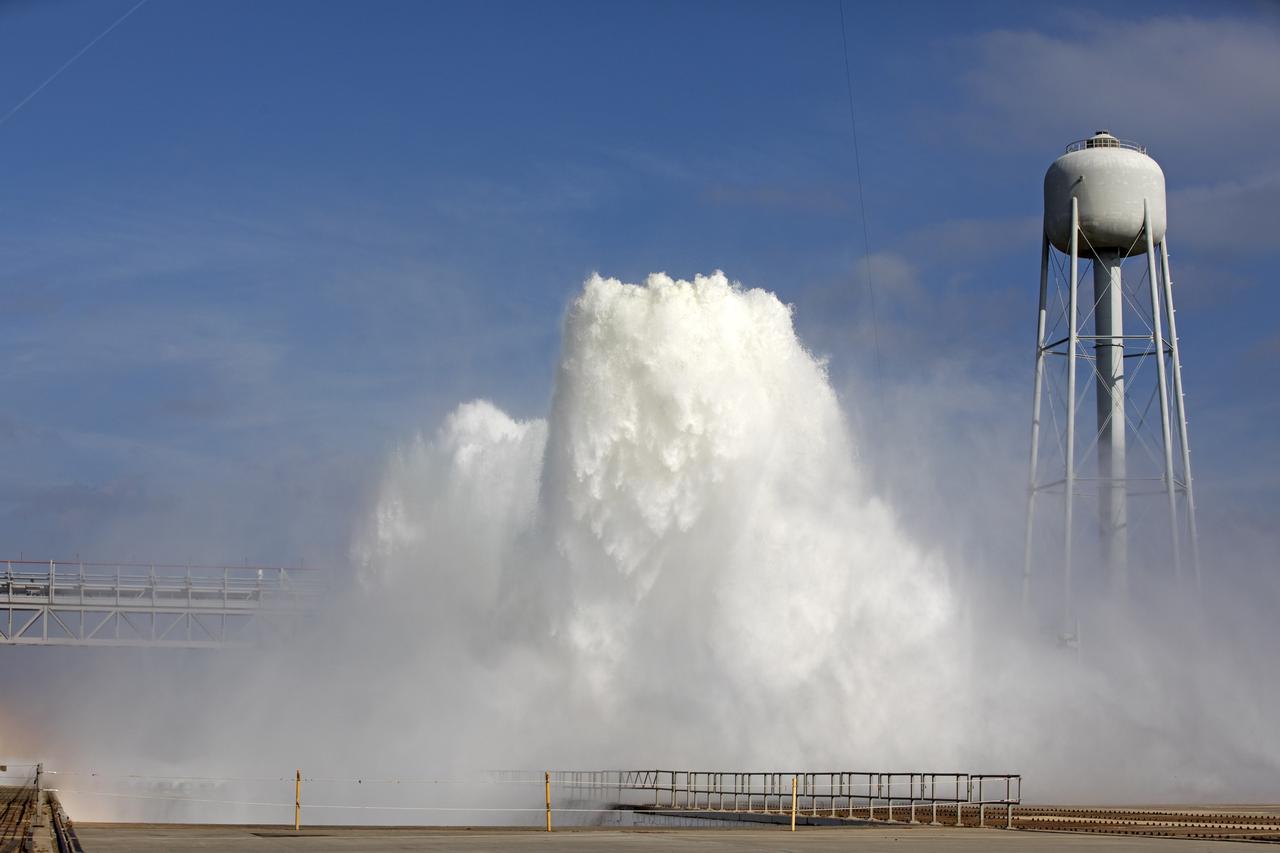
About 450,000 gallons of water flowed at high speed from a holding tank through new and modified piping and valves, the flame trench, flame deflector nozzles and mobile launcher interface risers during a wet flow test at Launch Pad 39B at NASA's Kennedy Space Center in Florida. At peak flow, the water reached about 100 feet in the air above the pad surface. The test was a milestone to confirm and baseline the performance of the Ignition Overpressure/Sound Suppression system. During launch of NASA's Space Launch System rocket and Orion spacecraft, the high-speed water flow will help protect the vehicle from the extreme acoustic and temperature environment during ignition and liftoff.

About 450,000 gallons of water flowed at high speed from a holding tank through new and modified piping and valves, the flame trench, flame deflector nozzles and mobile launcher interface risers during a wet flow test at Launch Pad 39B at NASA's Kennedy Space Center in Florida. At peak flow, the water reached about 100 feet in the air above the pad surface. The test was a milestone to confirm and baseline the performance of the Ignition Overpressure/Sound Suppression system. During launch of NASA's Space Launch System rocket and Orion spacecraft, the high-speed water flow will help protect the vehicle from the extreme acoustic and temperature environment during ignition and liftoff.
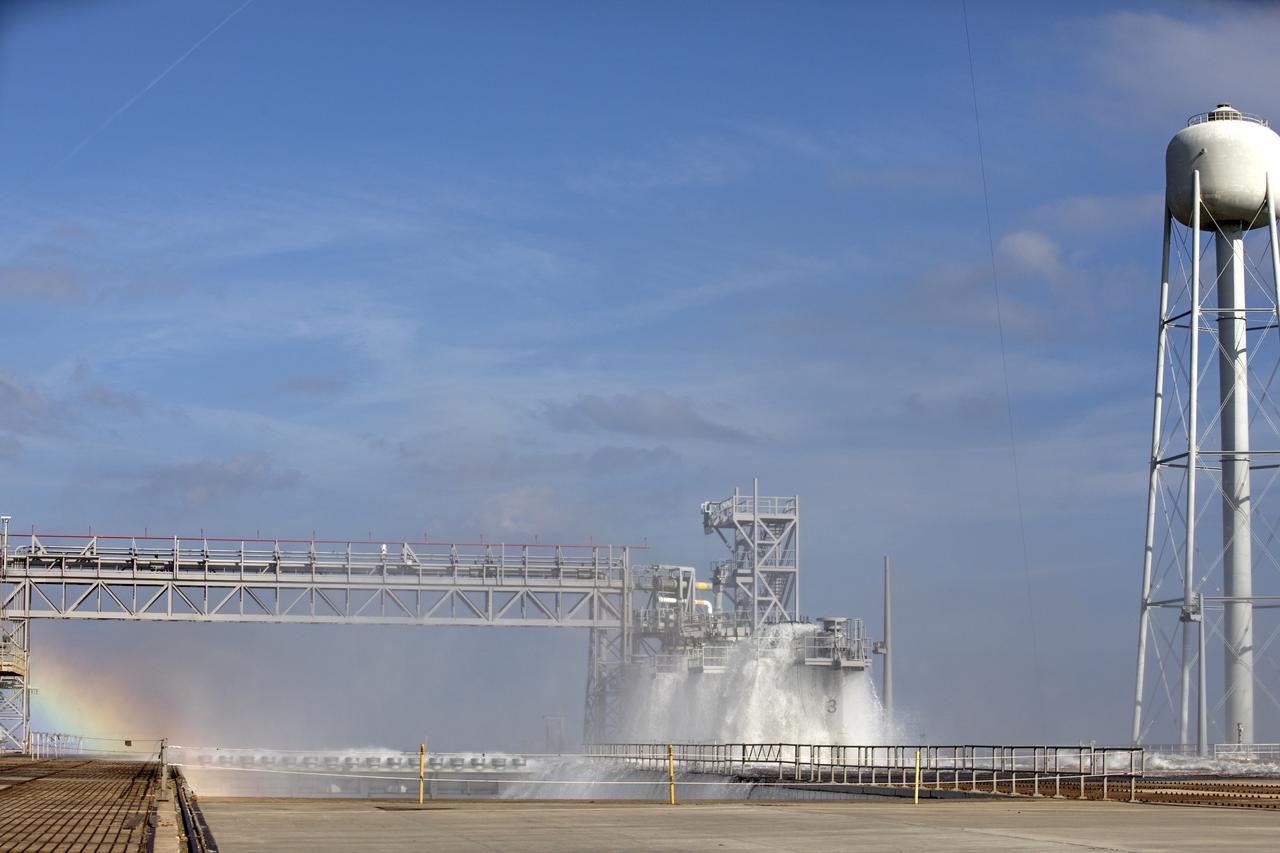
About 450,000 gallons of water flowed at high speed from a holding tank through new and modified piping and valves, the flame trench, flame deflector nozzles and mobile launcher interface risers during a wet flow test at Launch Pad 39B at NASA's Kennedy Space Center in Florida. At peak flow, the water reached about 100 feet in the air above the pad surface. The test was a milestone to confirm and baseline the performance of the Ignition Overpressure/Sound Suppression system. During launch of NASA's Space Launch System rocket and Orion spacecraft, the high-speed water flow will help protect the vehicle from the extreme acoustic and temperature environment during ignition and liftoff.
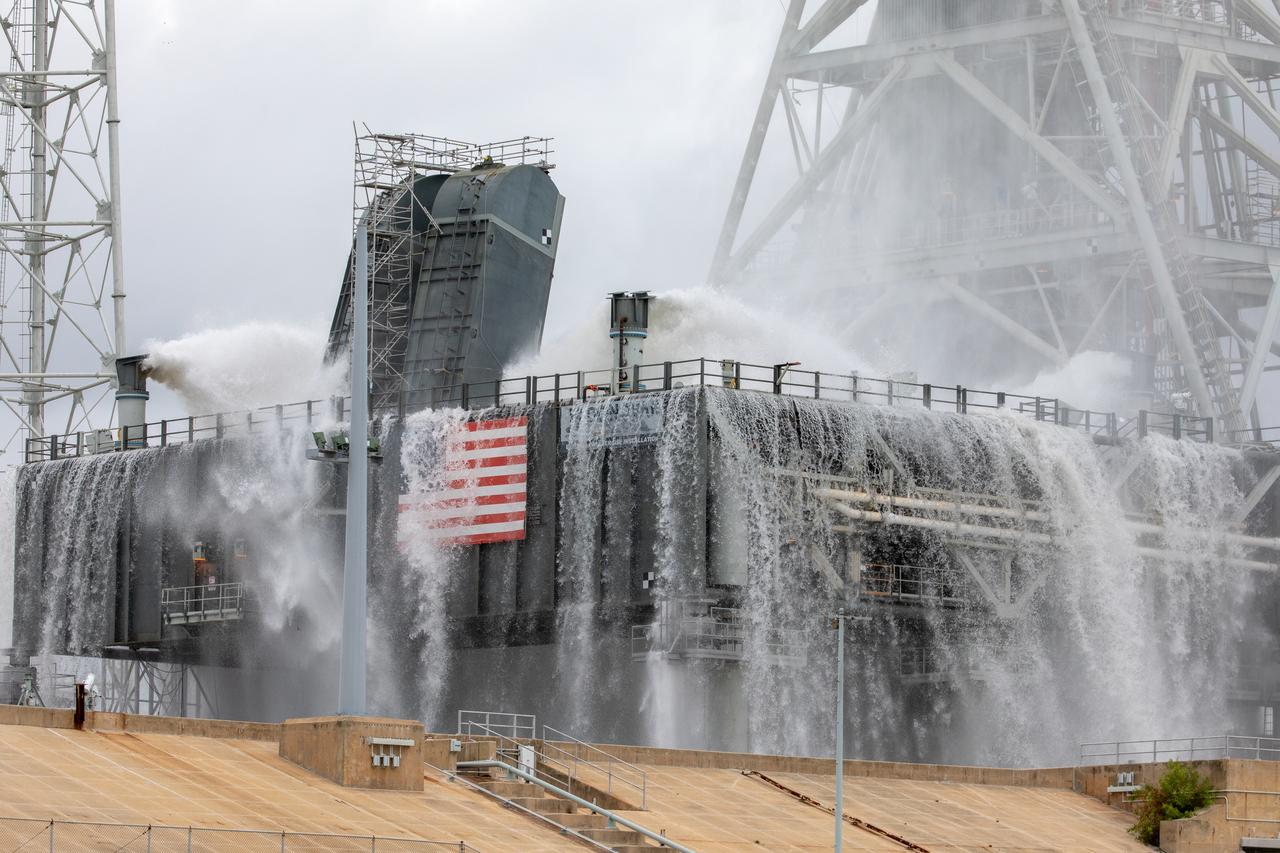
A flow test of the Ignition Overpressure Protection and Sound Suppression water deluge system is underway on the mobile launcher at Launch Pad 39B at NASA's Kennedy Space Center in Florida, on July 25, 2019. The testing is part of a series of tests that Exploration Ground System is doing to verify the system is ready for the new Space Launch System rocket. Modifications were made to the pad after a previous wet flow test, increasing the performance of the system. During the launch of Artemis 1 and subsequent missions, this water deluge system will release about 450,000 gallons of water across the mobile launcher and Flame Deflector to reduce the extreme heat and energy generated by the rocket during ignition and liftoff.
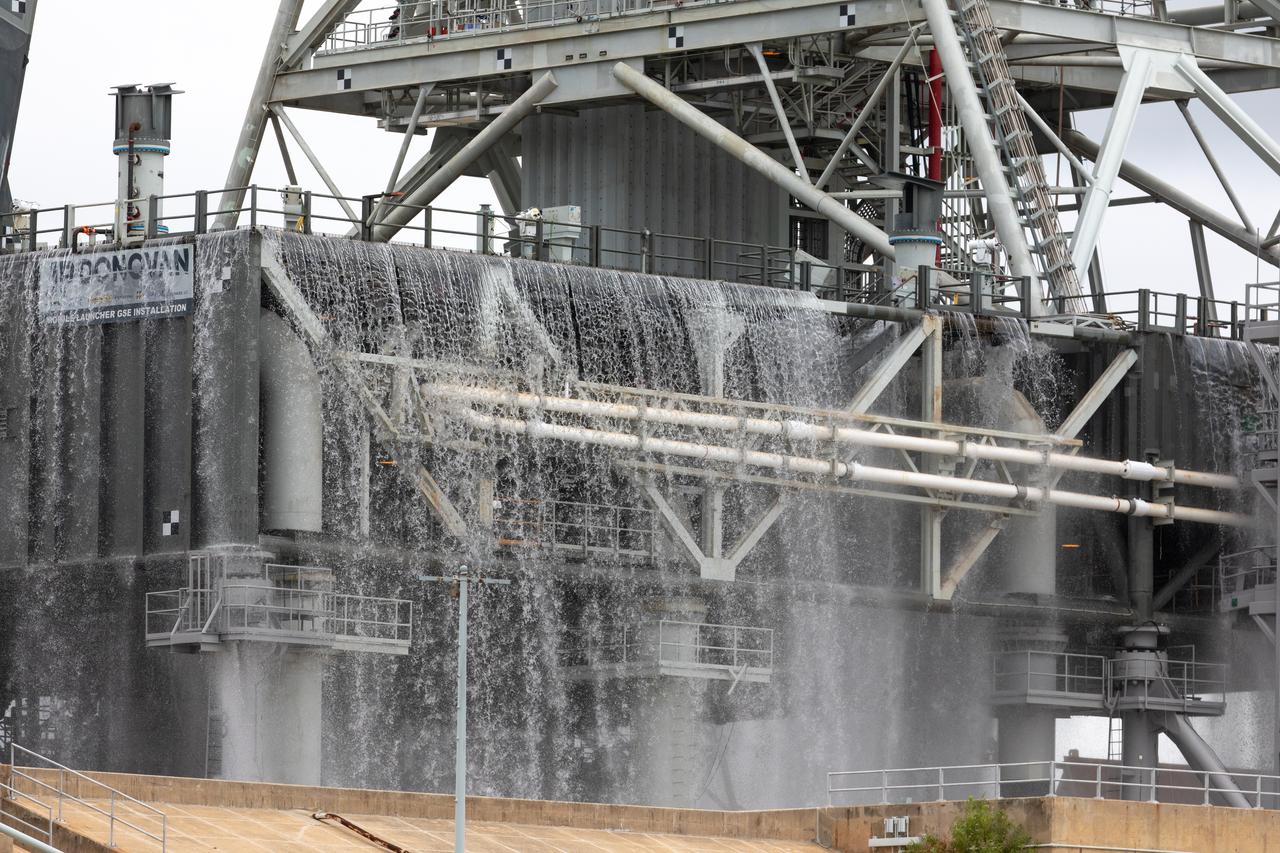
A flow test of the Ignition Overpressure Protection and Sound Suppression water deluge system is underway on the mobile launcher at Launch Pad 39B at NASA's Kennedy Space Center in Florida, on July 25, 2019. The testing is part of a series of tests that Exploration Ground System is doing to verify the system is ready for the new Space Launch System rocket. Modifications were made to the pad after a previous wet flow test, increasing the performance of the system. During the launch of Artemis 1 and subsequent missions, this water deluge system will release about 450,000 gallons of water across the mobile launcher and Flame Deflector to reduce the extreme heat and energy generated by the rocket during ignition and liftoff.
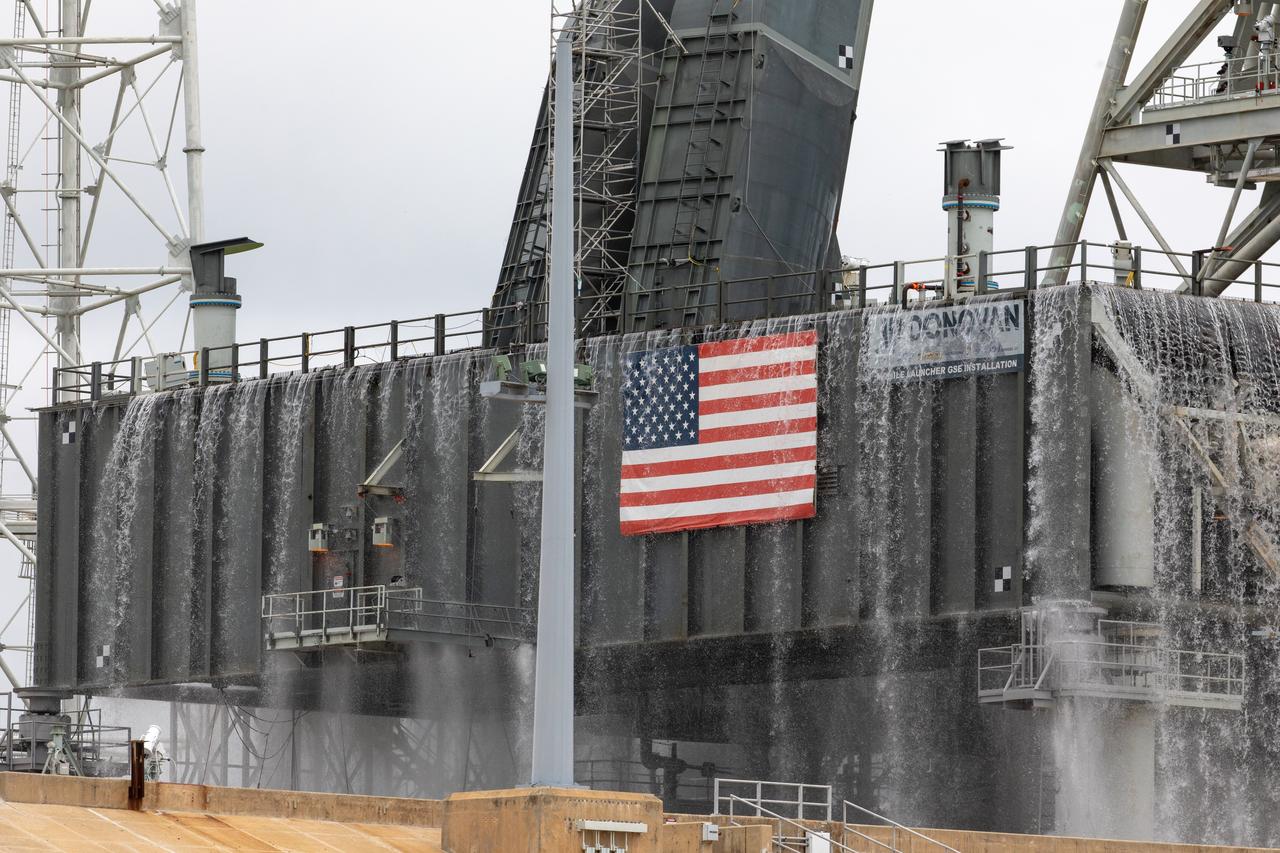
A flow test of the Ignition Overpressure Protection and Sound Suppression water deluge system is underway on the mobile launcher at Launch Pad 39B at NASA's Kennedy Space Center in Florida, on July 25, 2019. The testing is part of a series of tests that Exploration Ground System is doing to verify the system is ready for the new Space Launch System rocket. Modifications were made to the pad after a previous wet flow test, increasing the performance of the system. During the launch of Artemis 1 and subsequent missions, this water deluge system will release about 450,000 gallons of water across the mobile launcher and Flame Deflector to reduce the extreme heat and energy generated by the rocket during ignition and liftoff.

A flow test of the Ignition Overpressure Protection and Sound Suppression water deluge system is underway on the mobile launcher at Launch Pad 39B at NASA's Kennedy Space Center in Florida, on July 25, 2019. The testing is part of a series of tests that Exploration Ground System is doing to verify the system is ready for the new Space Launch System rocket. Modifications were made to the pad after a previous wet flow test, increasing the performance of the system. During the launch of Artemis 1 and subsequent missions, this water deluge system will release about 450,000 gallons of water across the mobile launcher and Flame Deflector to reduce the extreme heat and energy generated by the rocket during ignition and liftoff.
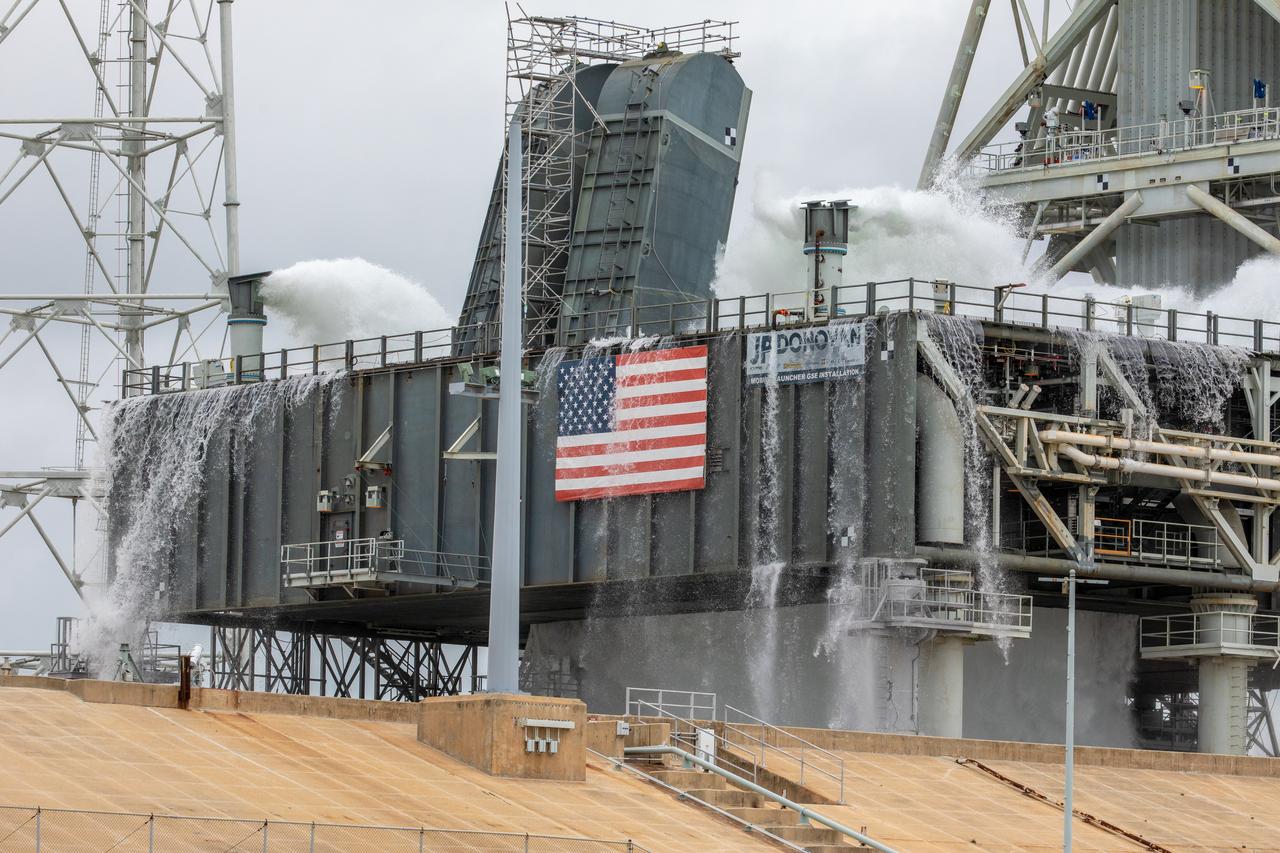
A flow test of the Ignition Overpressure Protection and Sound Suppression water deluge system begins on the mobile launcher at Launch Pad 39B at NASA's Kennedy Space Center in Florida, on July 25, 2019. The testing is part of a series of tests that Exploration Ground System is doing to verify the system is ready for the new Space Launch System rocket. Modifications were made to the pad after a previous wet flow test, increasing the performance of the system. During the launch of Artemis 1 and subsequent missions, this water deluge system will release about 450,000 gallons of water across the mobile launcher and Flame Deflector to reduce the extreme heat and energy generated by the rocket during ignition and liftoff.
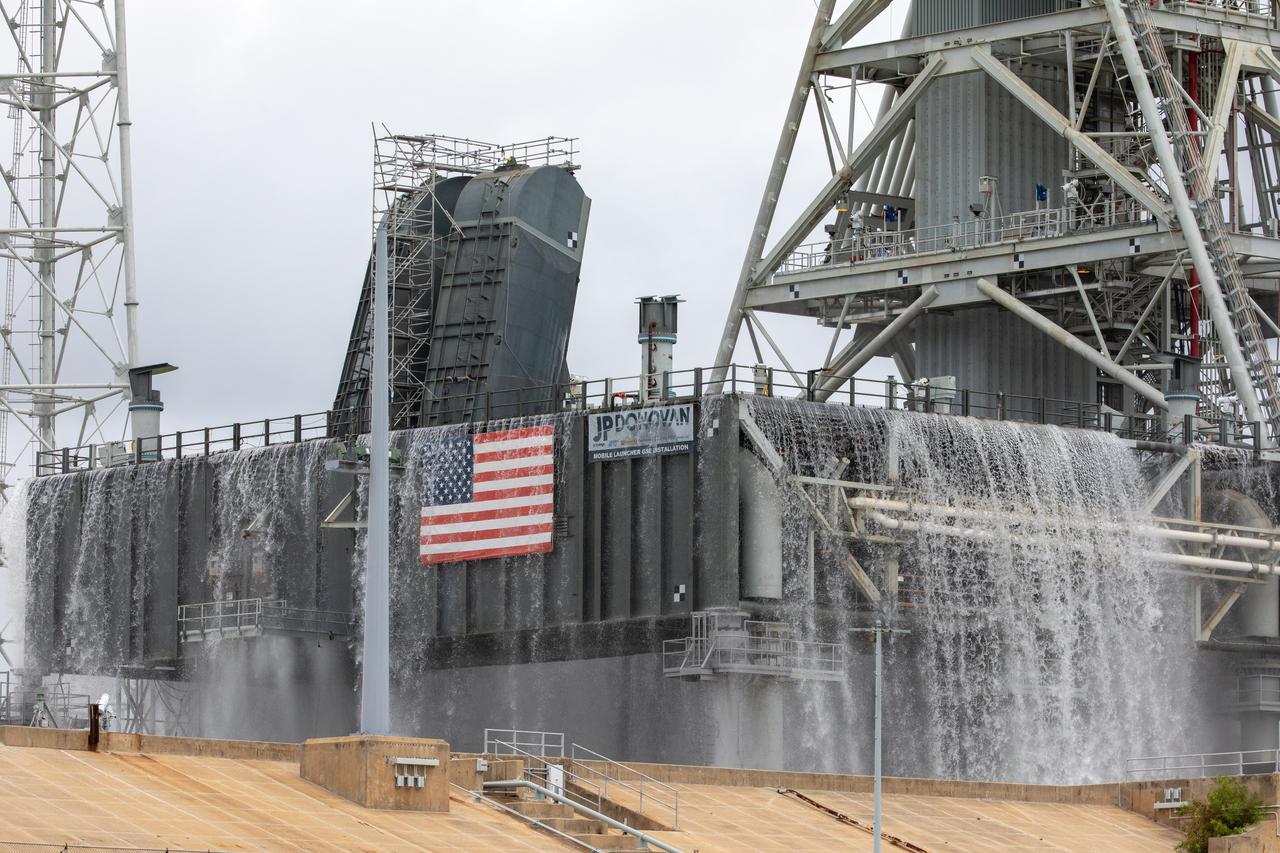
A flow test of the Ignition Overpressure Protection and Sound Suppression water deluge system is underway on the mobile launcher at Launch Pad 39B at NASA's Kennedy Space Center in Florida, on July 25, 2019. The testing is part of a series of tests that Exploration Ground System is doing to verify the system is ready for the new Space Launch System rocket. Modifications were made to the pad after a previous wet flow test, increasing the performance of the system. During the launch of Artemis 1 and subsequent missions, this water deluge system will release about 450,000 gallons of water across the mobile launcher and Flame Deflector to reduce the extreme heat and energy generated by the rocket during ignition and liftoff.
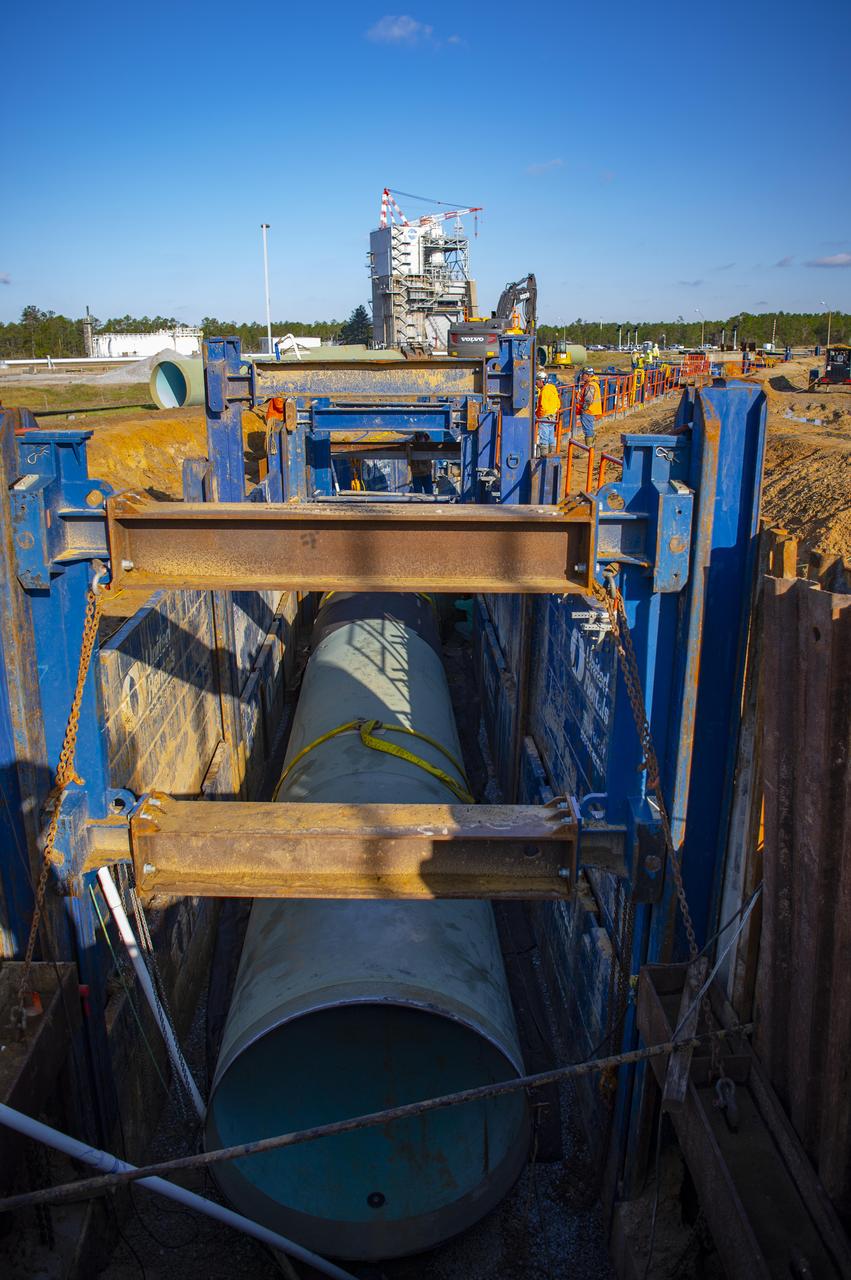
In this March 2022 photo, crews use a shoring system to hold back soil as they install new 75-inch piping leading from the NASA Stennis High Pressure Industrial Water Facility to the valve vault pit serving the Fred Haise Test Stand.
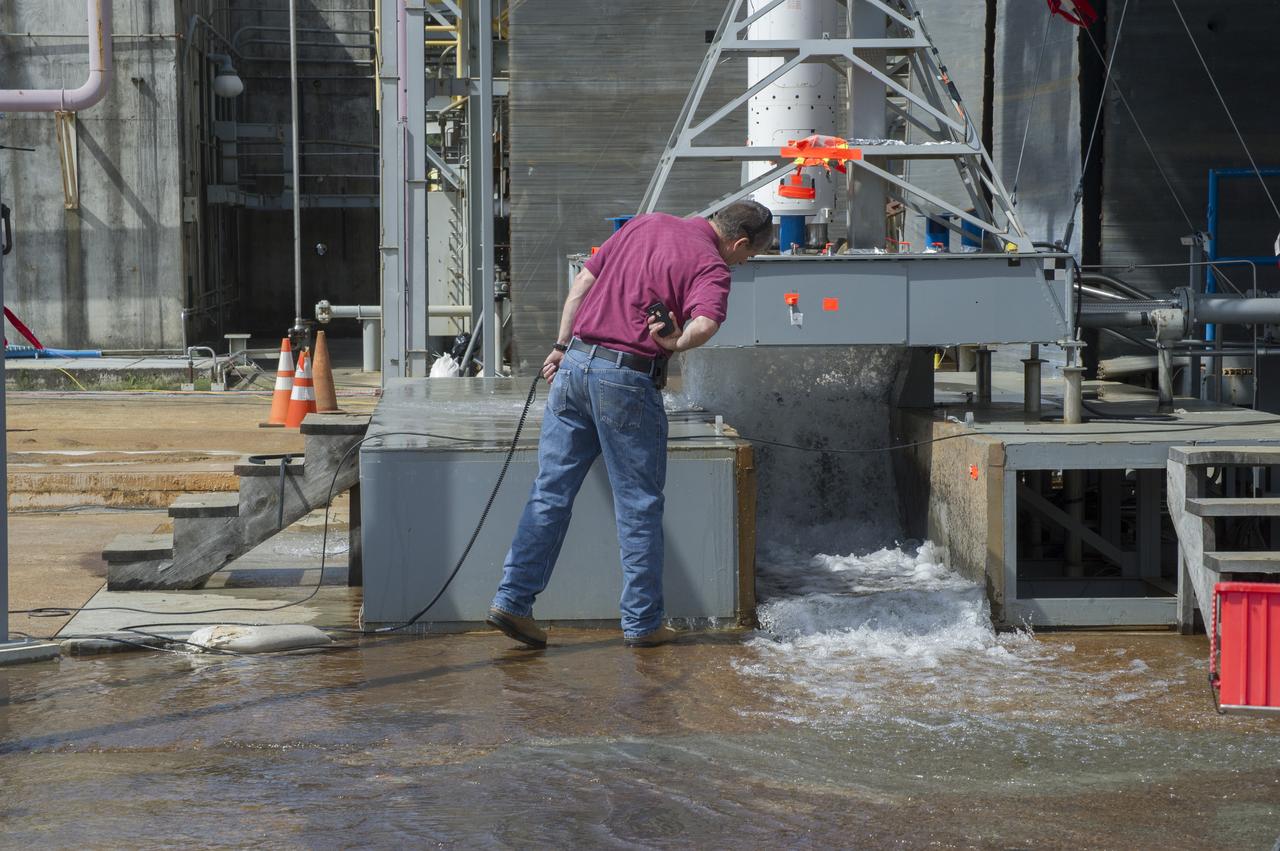
TEST ENGINEER DENNIS STRICKLAND CONDUCTS WATER FLOW TESTS AT TEST STAND 116 FOR SPACE LAUNCH SYSTEM SCALE MODEL ACOUSTIC TEST SERIES (WITH SOLID ROCKET BOOSTERS)
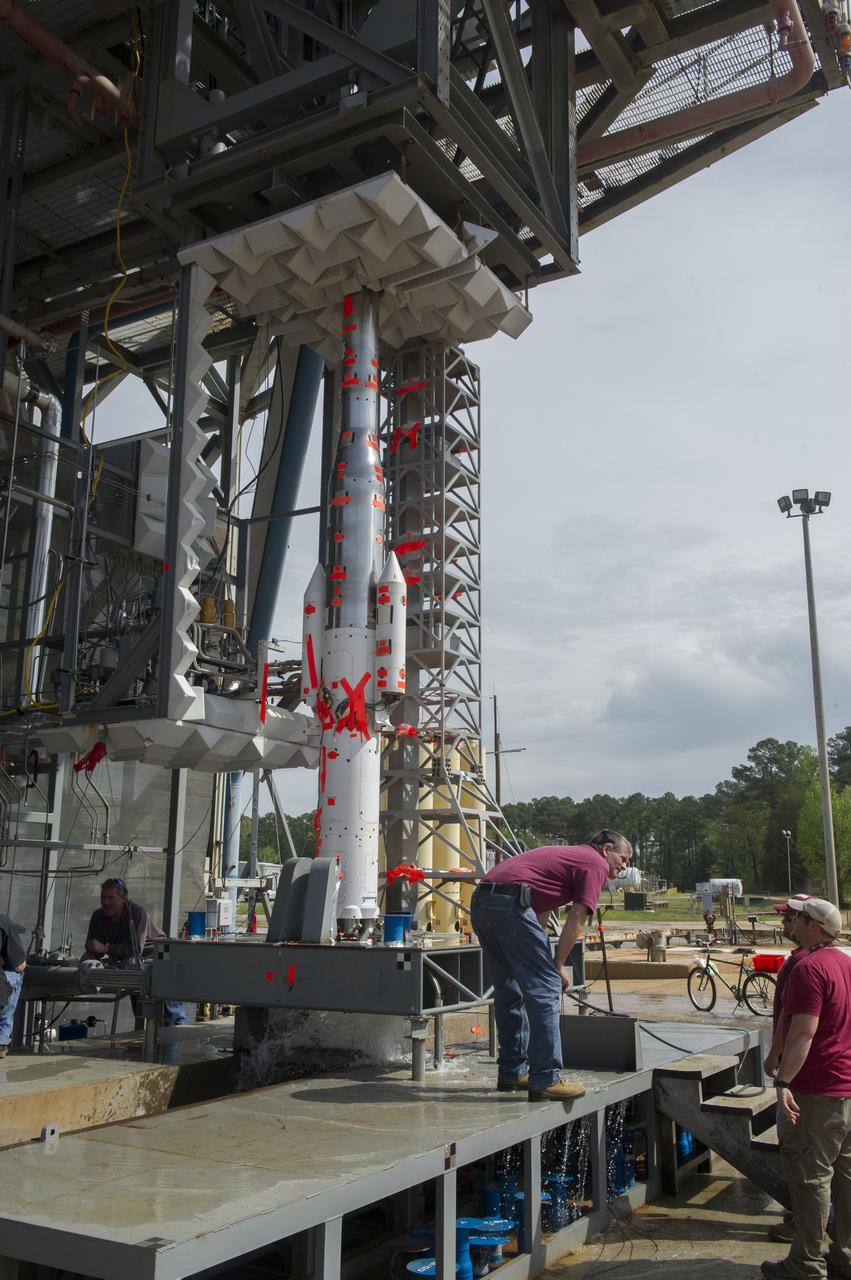
TEST ENGINEER DENNIS STRICKLAND CONDUCTS WATER FLOW TESTS AT TEST STAND 116 FOR SPACE LAUNCH SYSTEM SCALE MODEL ACOUSTIC TEST SERIES (WITH SOLID ROCKET BOOSTERS)
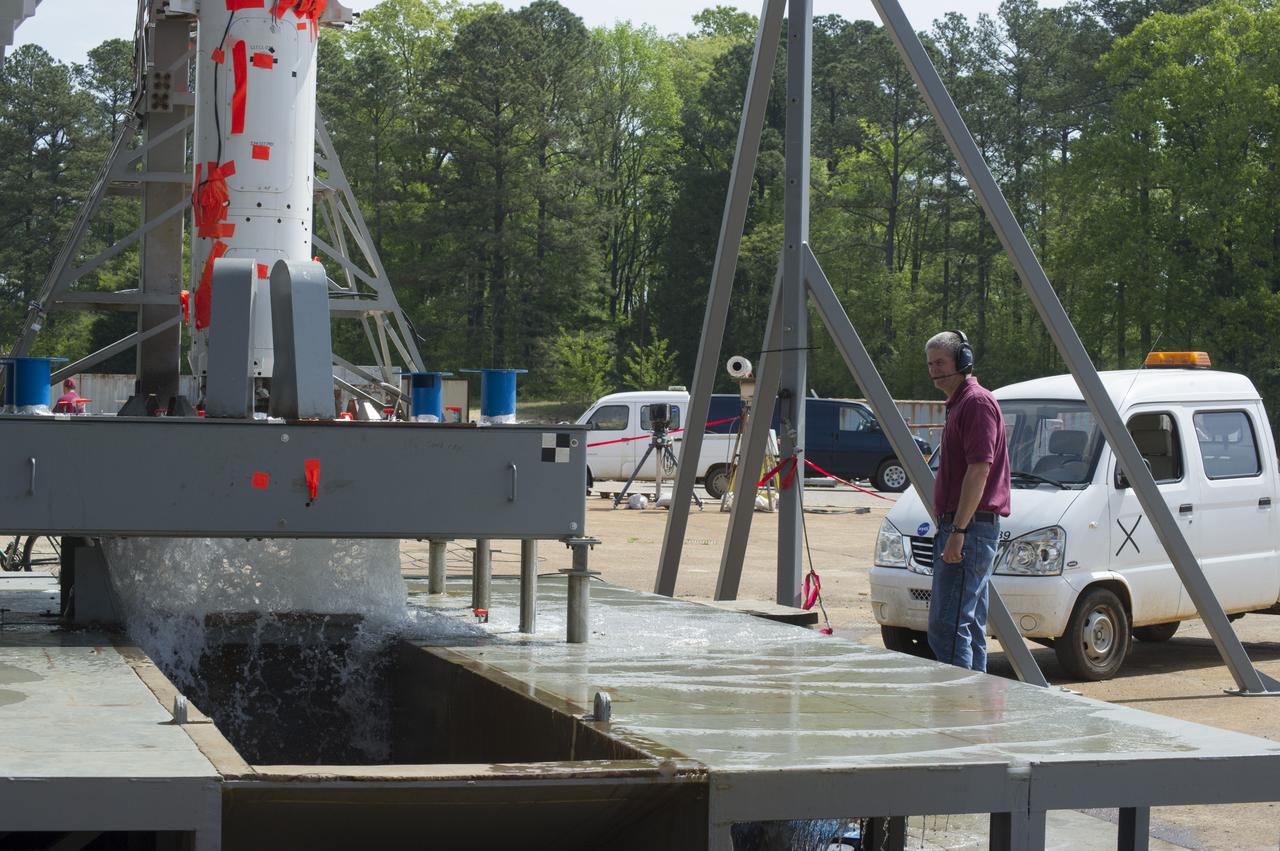
TEST ENGINEER DENNIS STRICKLAND CONDUCTS WATER FLOW TESTS AT TEST STAND 116 FOR SPACE LAUNCH SYSTEM SCALE MODEL ACOUSTIC TEST SERIES (WITH SOLID ROCKET BOOSTERS)
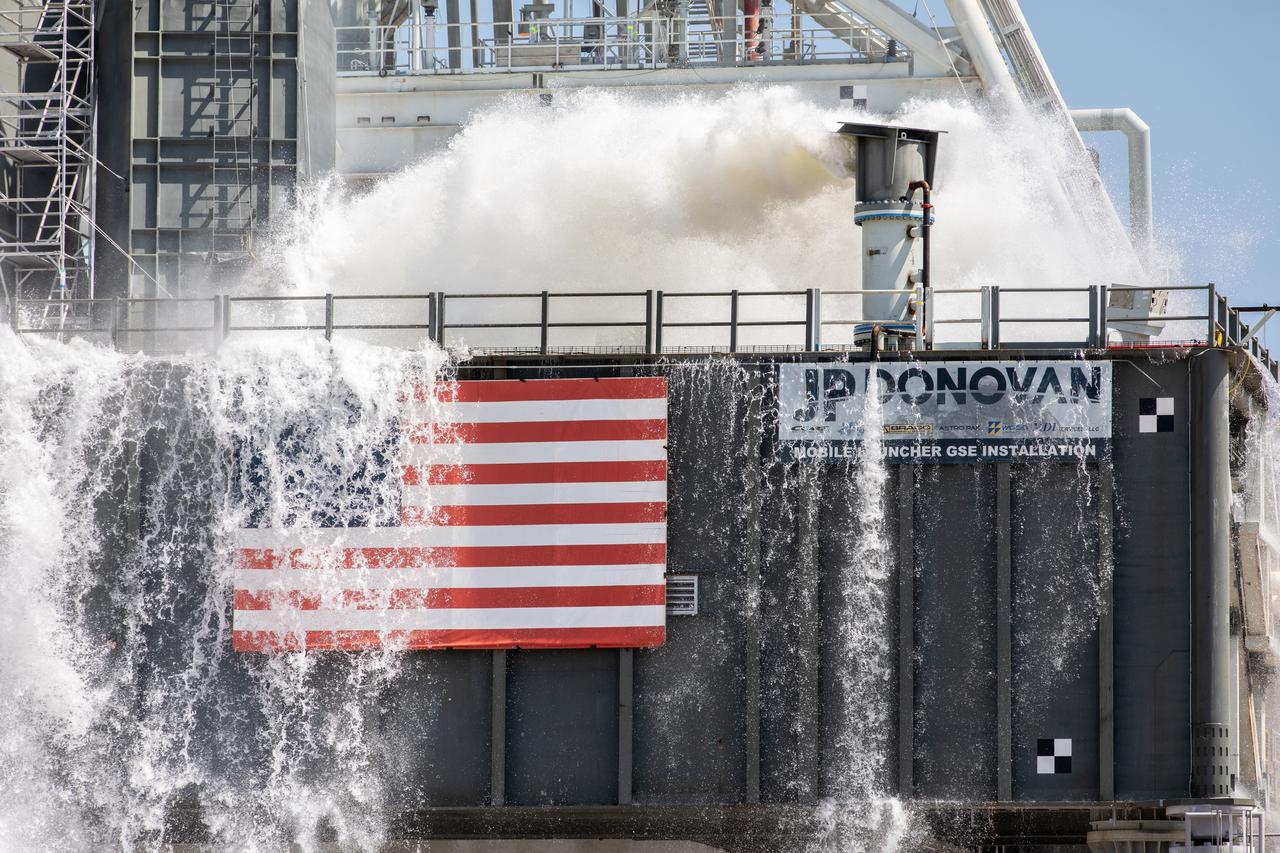
NASA’s Exploration Ground Systems conducts a water flow test with the mobile launcher at Kennedy Space Center’s Pad 39B in Florida on July 2, 2019. It is the first of nine tests to verify the sound suppression system is ready for launch of NASA’s Space Launch System for the first Artemis mission. During launch, 400,000 gallons of water will rush onto the pad to help protect the rocket, NASA’s Orion Spacecraft, mobile launcher, and launch pad from the extreme acoustic and temperature environment.
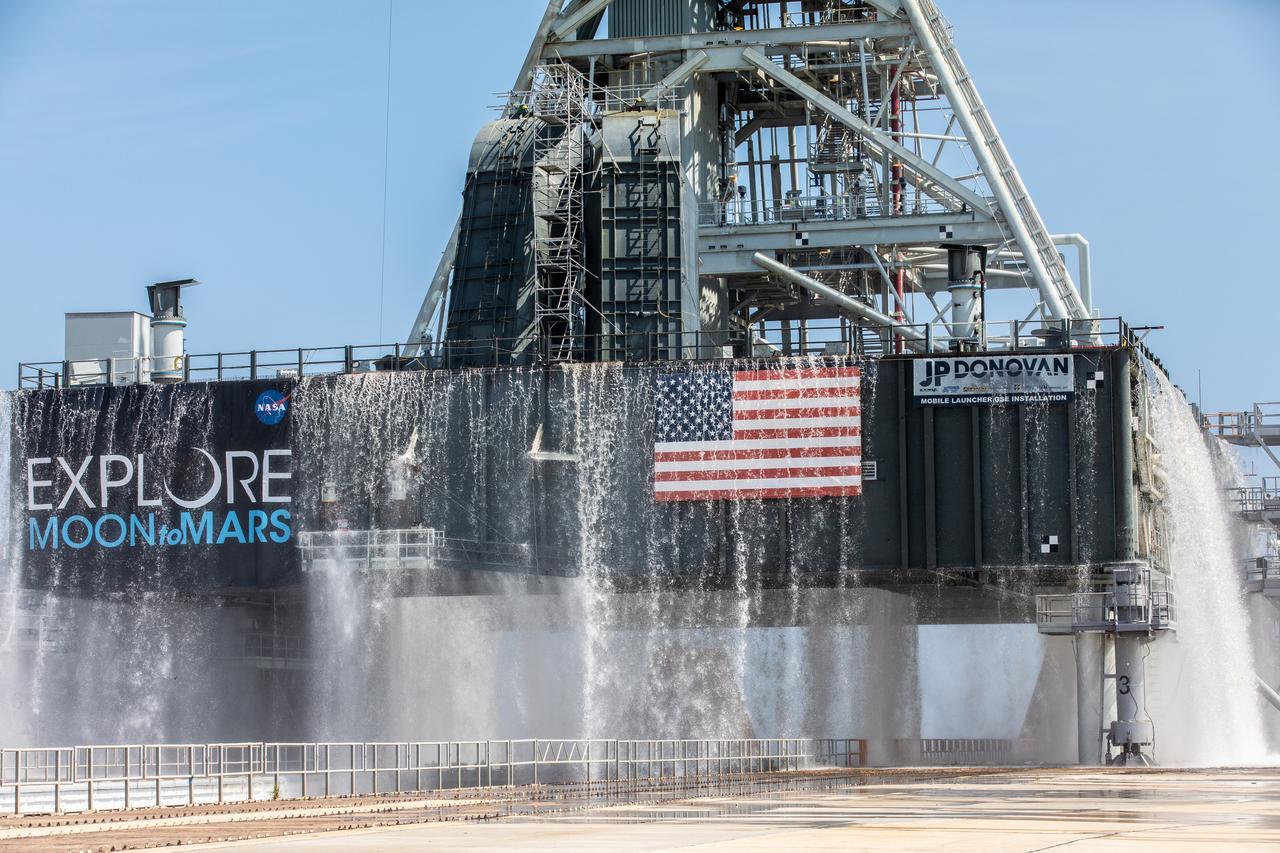
NASA’s Exploration Ground Systems conducts a water flow test with the mobile launcher at Kennedy Space Center’s Pad 39B in Florida on July 2, 2019. It is the first of nine tests to verify the sound suppression system is ready for launch of NASA’s Space Launch System for the first Artemis mission. During launch, 400,000 gallons of water will rush onto the pad to help protect the rocket, NASA’s Orion Spacecraft, mobile launcher, and launch pad from the extreme acoustic and temperature environment.
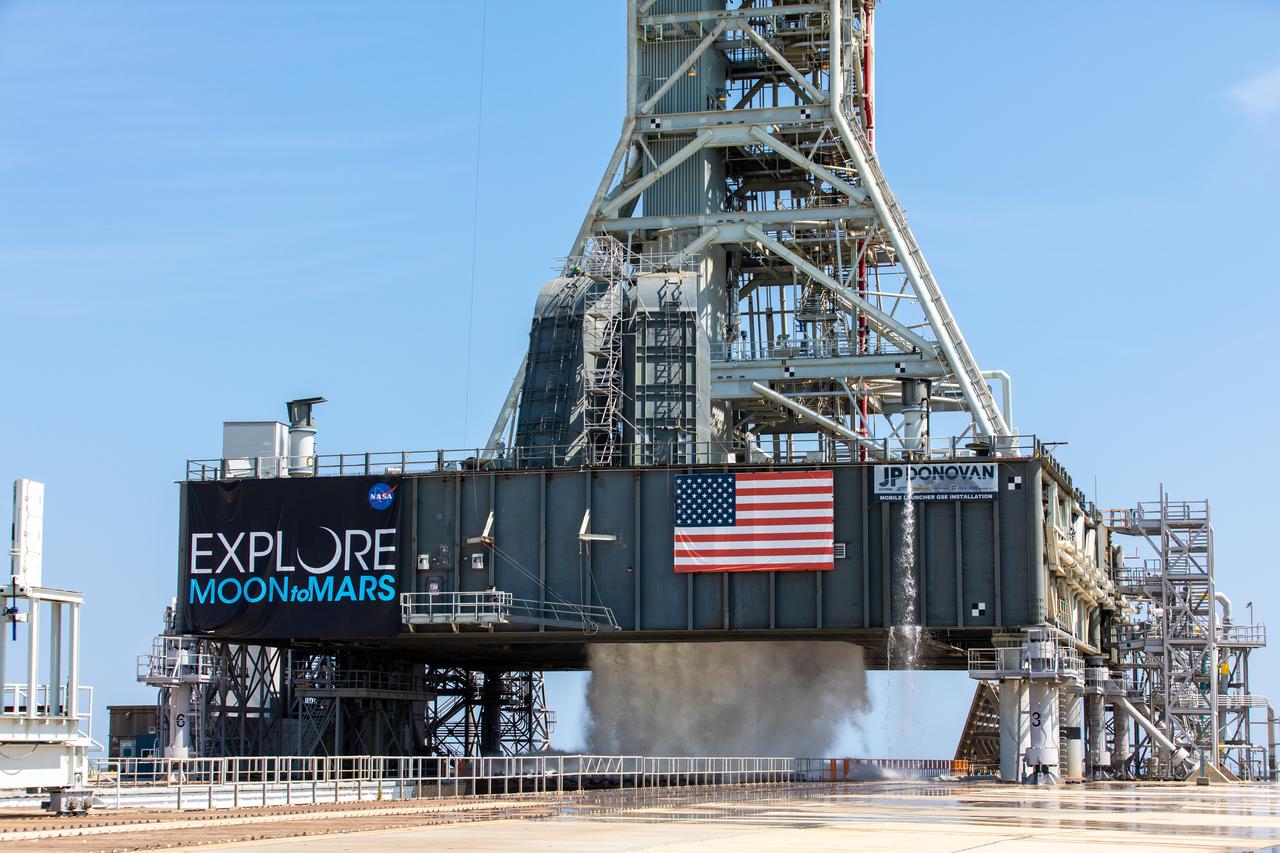
NASA’s Exploration Ground Systems conducts a water flow test with the mobile launcher at Kennedy Space Center’s Pad 39B in Florida on July 2, 2019. It is the first of nine tests to verify the sound suppression system is ready for launch of NASA’s Space Launch System for the first Artemis mission. During launch, 400,000 gallons of water will rush onto the pad to help protect the rocket, NASA’s Orion Spacecraft, mobile launcher, and launch pad from the extreme acoustic and temperature environment.
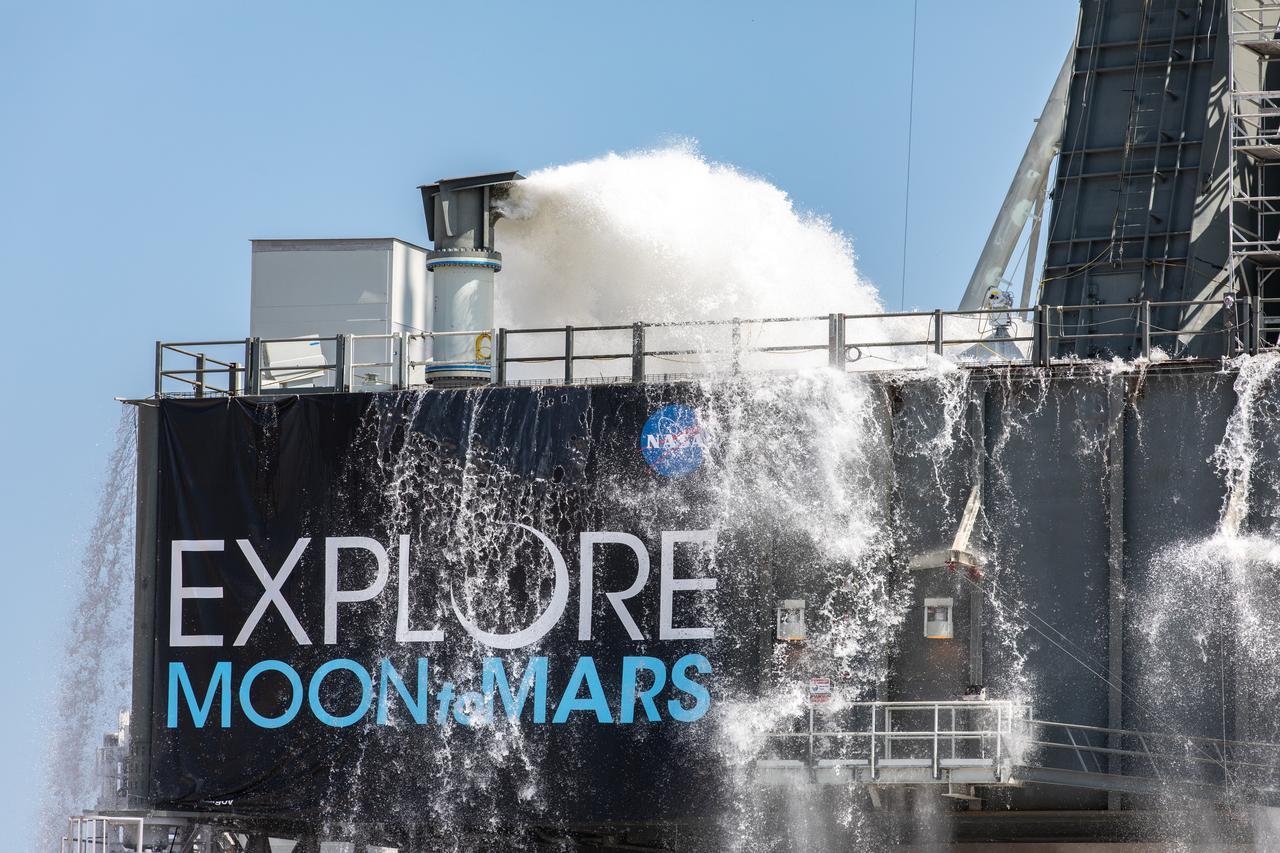
NASA’s Exploration Ground Systems conducts a water flow test with the mobile launcher at Kennedy Space Center’s Pad 39B in Florida on July 2, 2019. It is the first of nine tests to verify the sound suppression system is ready for launch of NASA’s Space Launch System for the first Artemis mission. During launch, 400,000 gallons of water will rush onto the pad to help protect the rocket, NASA’s Orion Spacecraft, mobile launcher, and launch pad from the extreme acoustic and temperature environment.
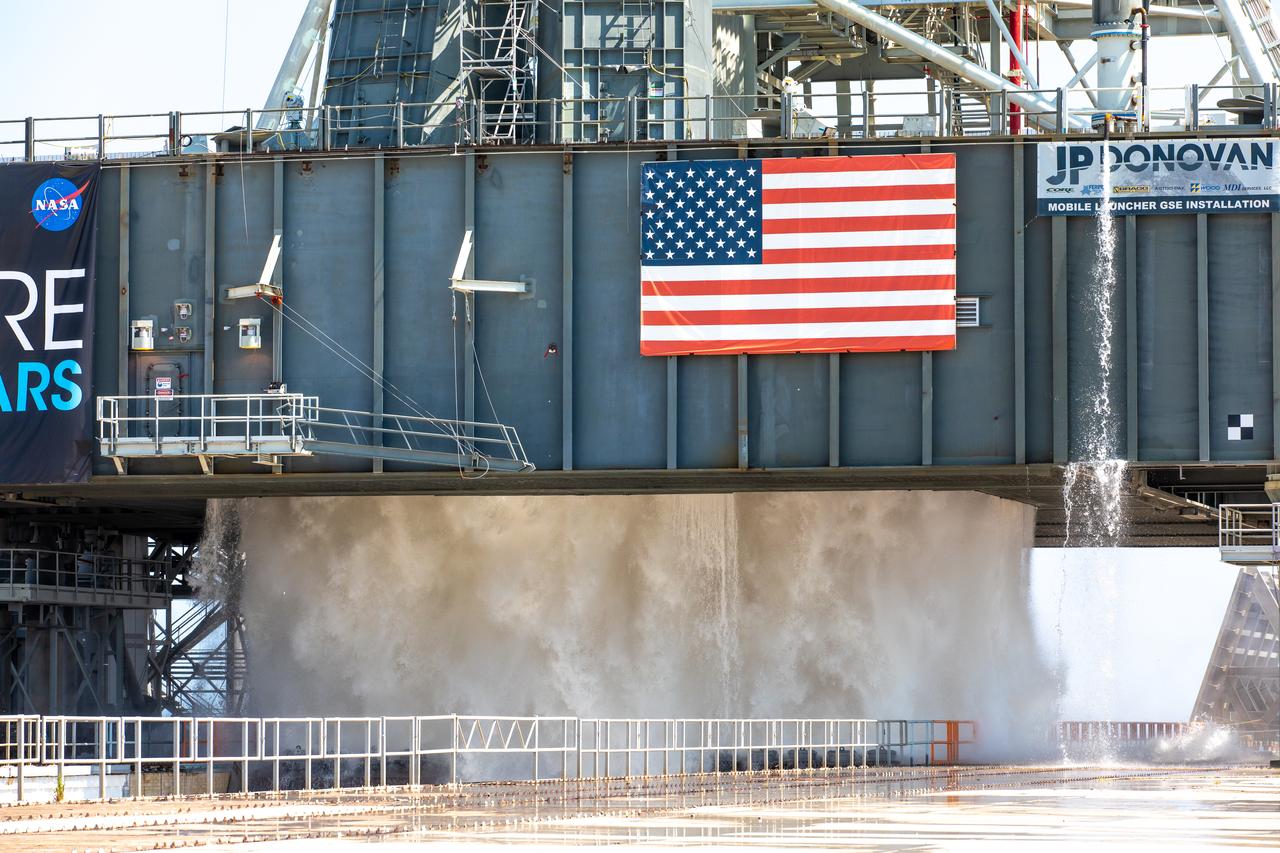
NASA’s Exploration Ground Systems conducts a water flow test with the mobile launcher at Kennedy Space Center’s Pad 39B in Florida on July 2, 2019. It is the first of nine tests to verify the sound suppression system is ready for launch of NASA’s Space Launch System for the first Artemis mission. During launch, 400,000 gallons of water will rush onto the pad to help protect the rocket, NASA’s Orion Spacecraft, mobile launcher, and launch pad from the extreme acoustic and temperature environment.
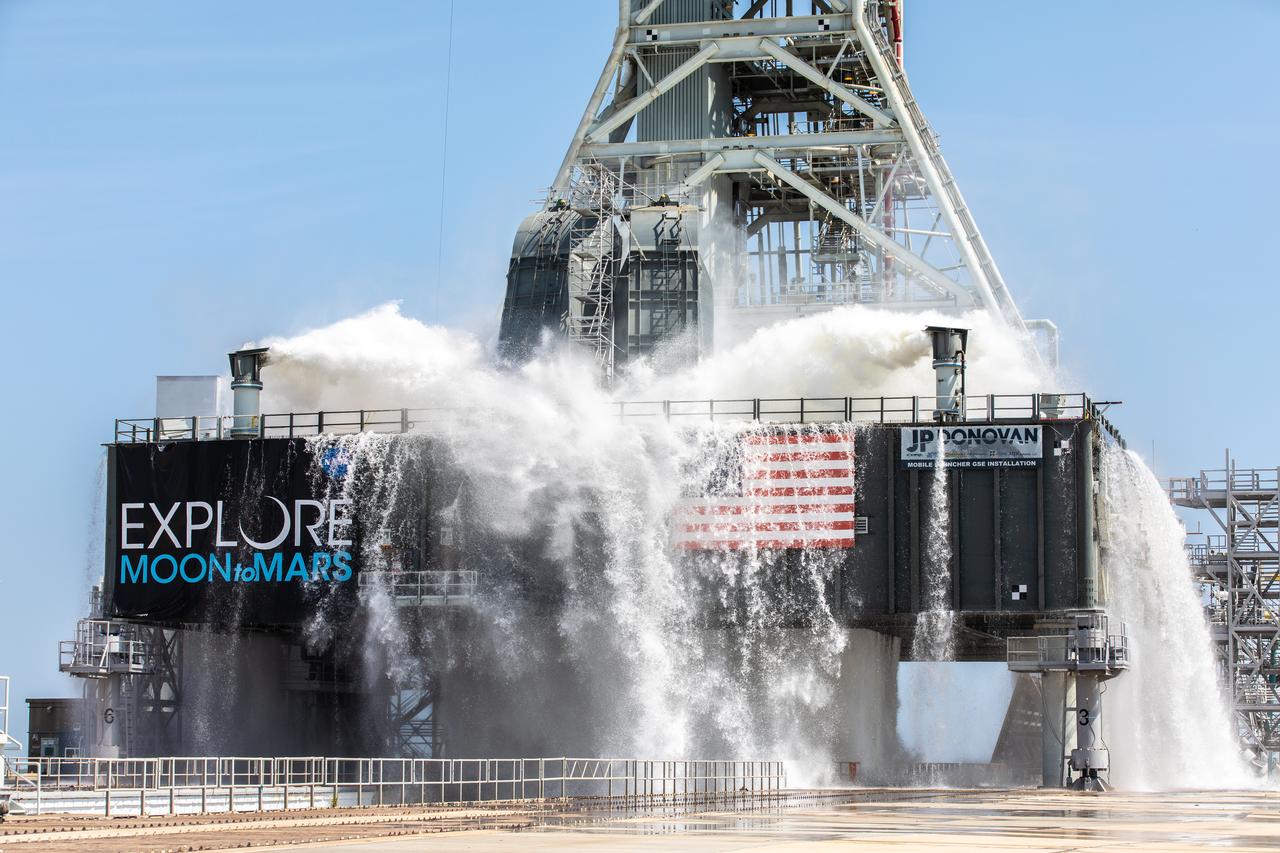
NASA’s Exploration Ground Systems conducts a water flow test with the mobile launcher at Kennedy Space Center’s Pad 39B in Florida on July 2, 2019. It is the first of nine tests to verify the sound suppression system is ready for launch of NASA’s Space Launch System for the first Artemis mission. During launch, 400,000 gallons of water will rush onto the pad to help protect the rocket, NASA’s Orion Spacecraft, mobile launcher, and launch pad from the extreme acoustic and temperature environment.
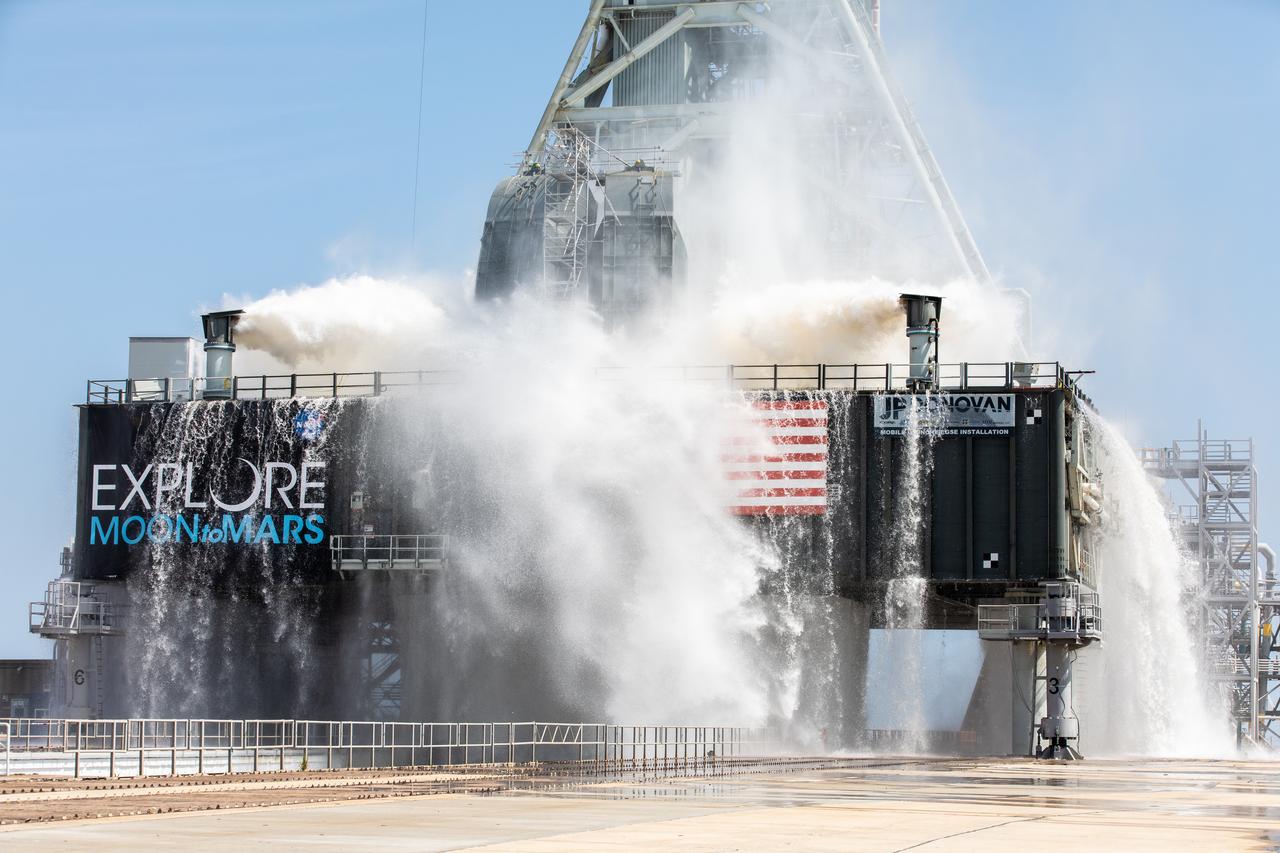
NASA’s Exploration Ground Systems conducts a water flow test with the mobile launcher at Kennedy Space Center’s Pad 39B in Florida on July 2, 2019. It is the first of nine tests to verify the sound suppression system is ready for launch of NASA’s Space Launch System for the first Artemis mission. During launch, 400,000 gallons of water will rush onto the pad to help protect the rocket, NASA’s Orion Spacecraft, mobile launcher, and launch pad from the extreme acoustic and temperature environment.
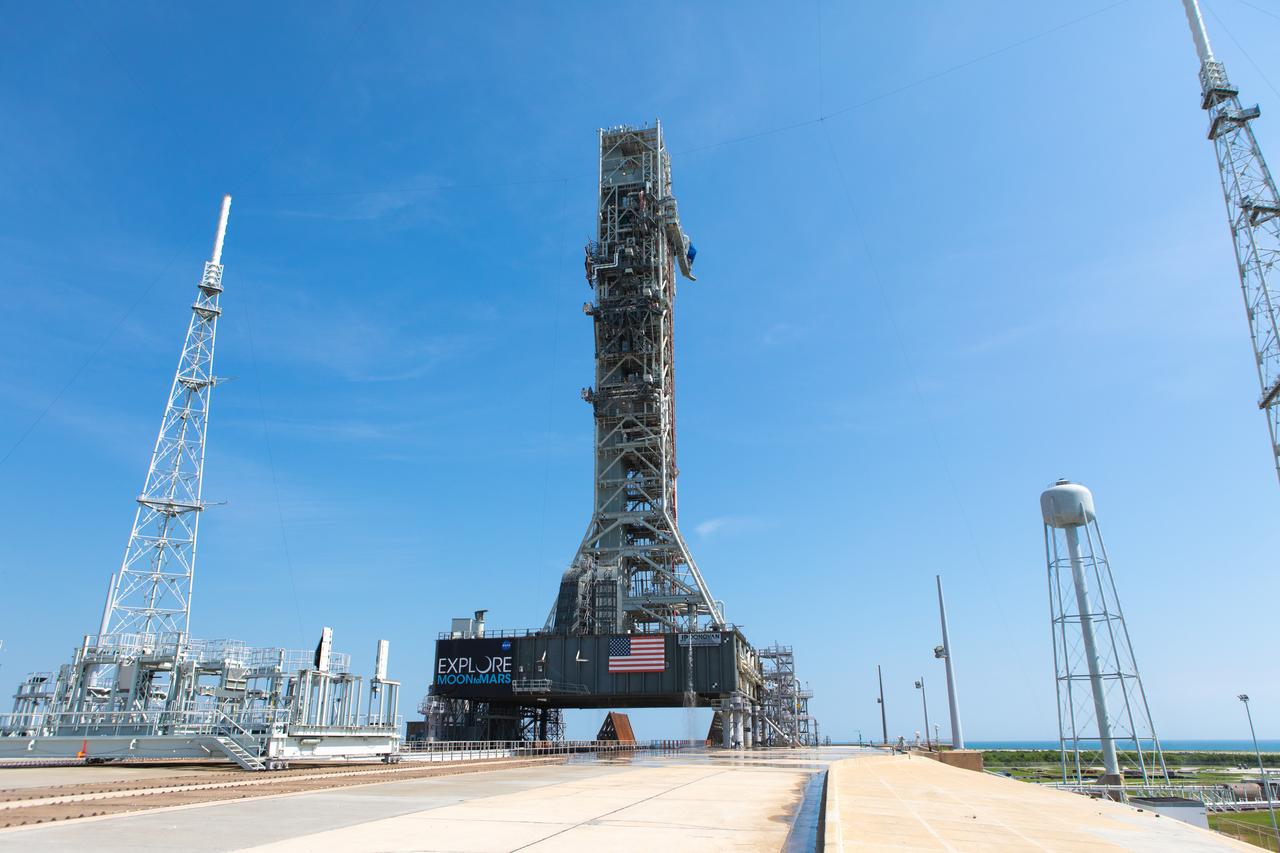
NASA’s Exploration Ground Systems conducts a water flow test with the mobile launcher at Kennedy Space Center’s Pad 39B in Florida on July 2, 2019. It is the first of nine tests to verify the sound suppression system is ready for launch of NASA’s Space Launch System for the first Artemis mission. During launch, 400,000 gallons of water will rush onto the pad to help protect the rocket, NASA’s Orion Spacecraft, mobile launcher, and launch pad from the extreme acoustic and temperature environment.
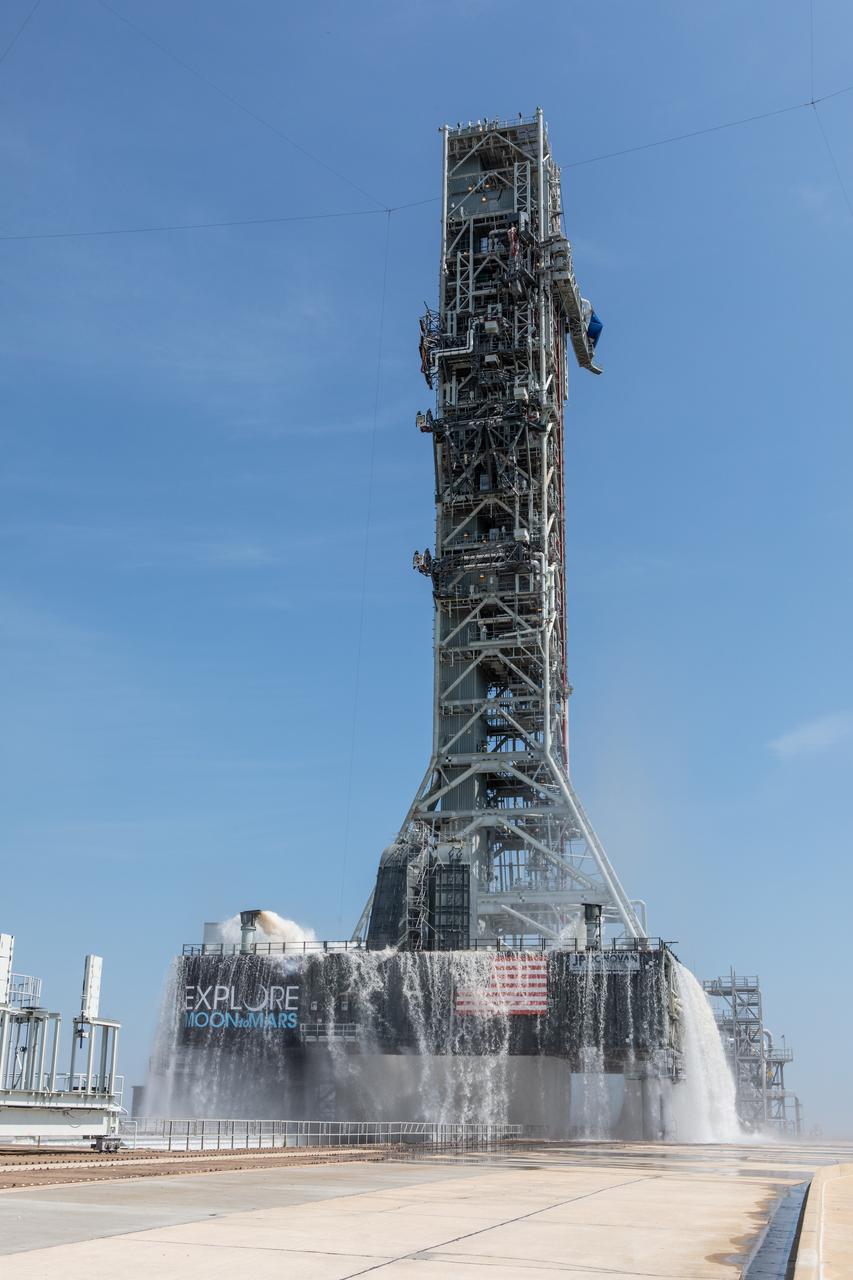
NASA’s Exploration Ground Systems conducts a water flow test with the mobile launcher at Kennedy Space Center’s Pad 39B in Florida on July 2, 2019. It is the first of nine tests to verify the sound suppression system is ready for launch of NASA’s Space Launch System for the first Artemis mission. During launch, 400,000 gallons of water will rush onto the pad to help protect the rocket, NASA’s Orion Spacecraft, mobile launcher, and launch pad from the extreme acoustic and temperature environment.
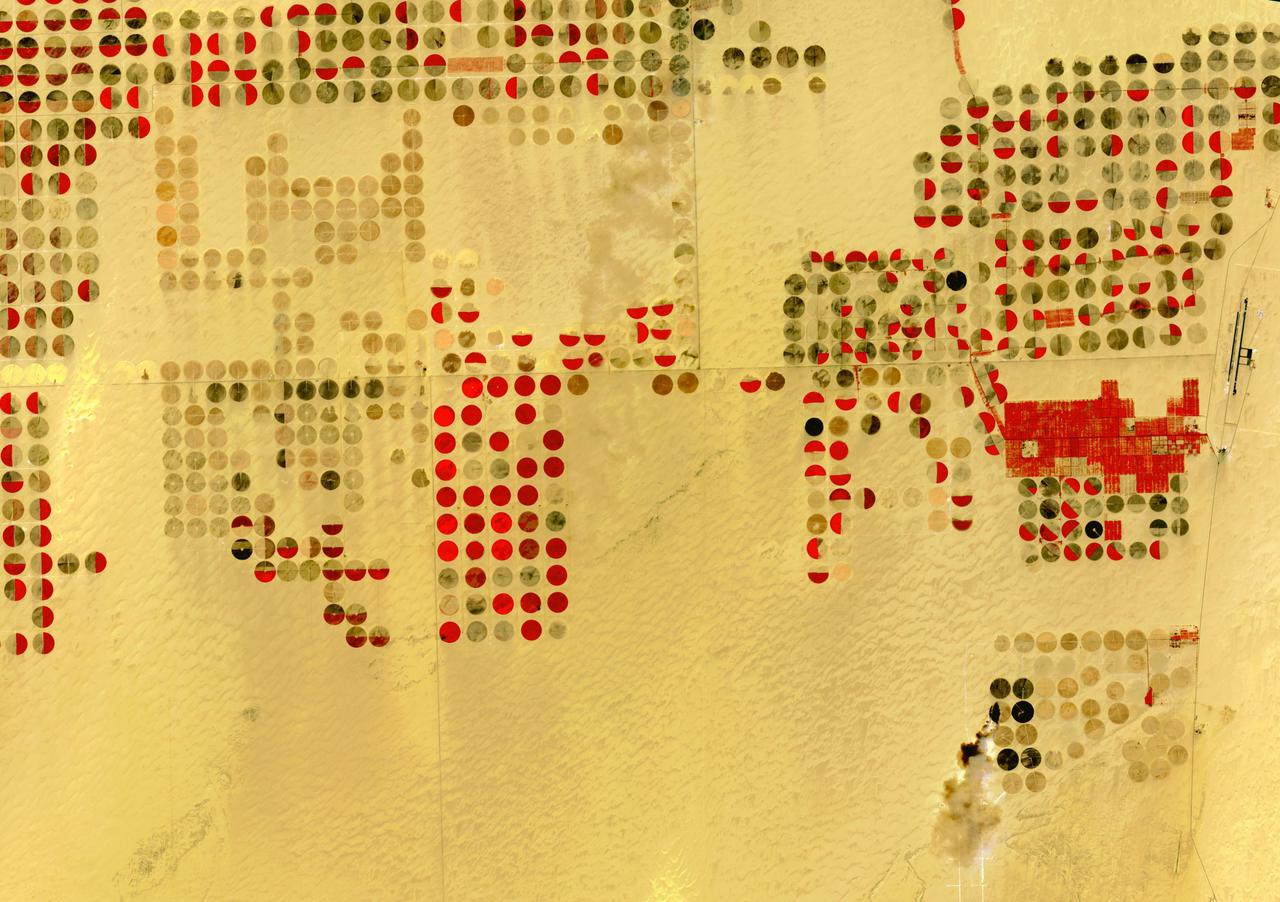
The Nubian Sandstone Aquifer System is the world's largest fossil water aquifer system. It covers an estimated area of 2.6 million square kilometers, including parts of Sudan, Chad, Libya, and most of Egypt. In the southwestern part of Egypt, the East Oweinat development project uses central pivot irrigation to mine the fossil water for extensive agricultural development. Crops include wheat and potatoes; they are transported via the airport on the eastern side. The image was acquired October 12, 2015, covers an area of 33.3 by 47.2 km, and is located near 22.6 degrees north, 28.5 degrees east. https://photojournal.jpl.nasa.gov/catalog/PIA24616
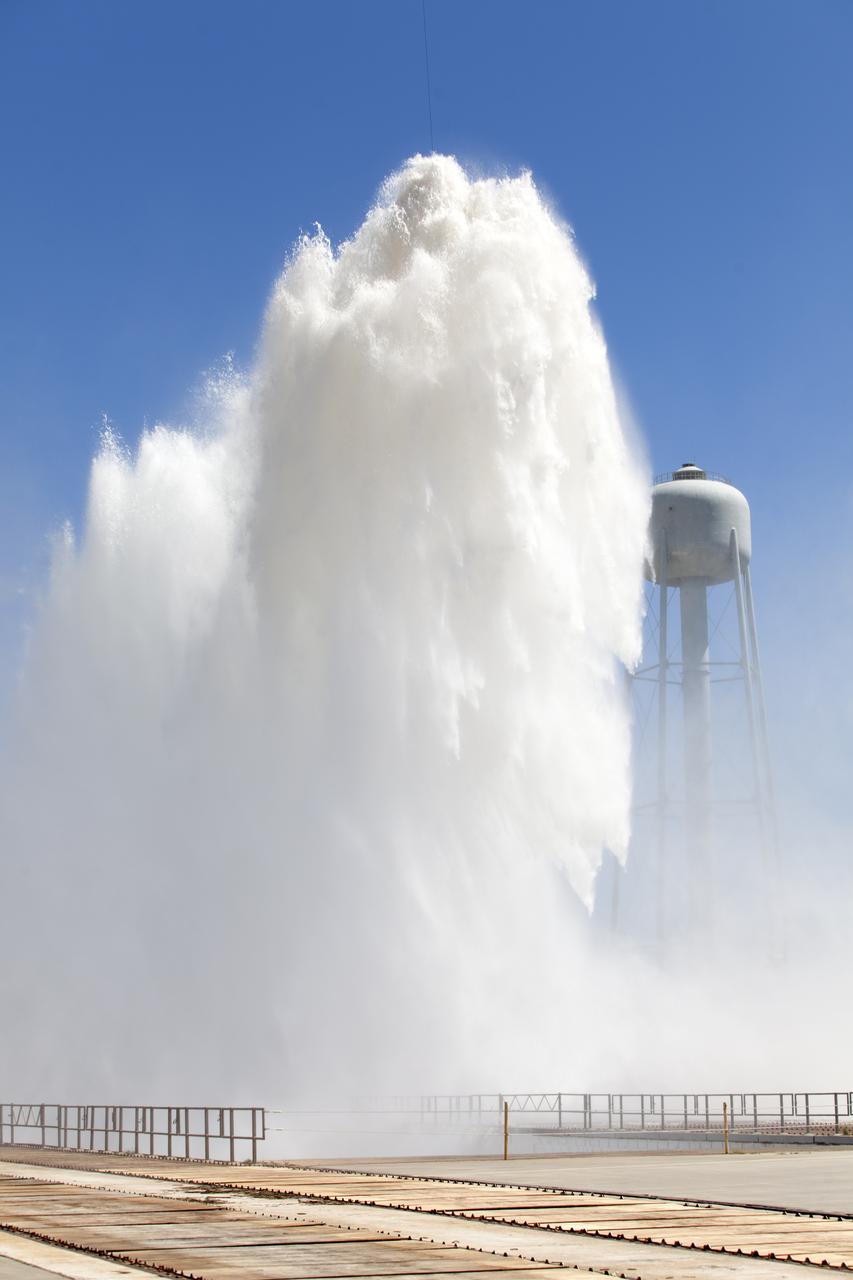
About 450,000 gallons of water flow at high speed from a holding tank through new and modified piping and valves, the flame trench, flame deflector nozzles and mobile launcher interface risers during a wet flow test on May 24, 2018, at Launch Pad 39B at NASA's Kennedy Space Center in Florida. At peak flow, the water reached about 100 feet in the air above the pad surface. The test was performed by Exploration Ground Systems to confirm the performance of the Ignition Overpressure/Sound Suppression system. During launch of NASA's Space Launch System rocket and Orion spacecraft, the high-speed water flow will help protect the vehicle from the extreme acoustic and temperature environment during ignition and liftoff.

About 450,000 gallons of water flow at high speed from a holding tank through new and modified piping and valves, the flame trench, flame deflector nozzles and mobile launcher interface risers during a wet flow test on May 24, 2018, at Launch Pad 39B at NASA's Kennedy Space Center in Florida. At peak flow, the water reached about 100 feet in the air above the pad surface. The test was performed by Exploration Ground Systems to confirm the performance of the Ignition Overpressure/Sound Suppression system. During launch of NASA's Space Launch System rocket and Orion spacecraft, the high-speed water flow will help protect the vehicle from the extreme acoustic and temperature environment during ignition and liftoff.
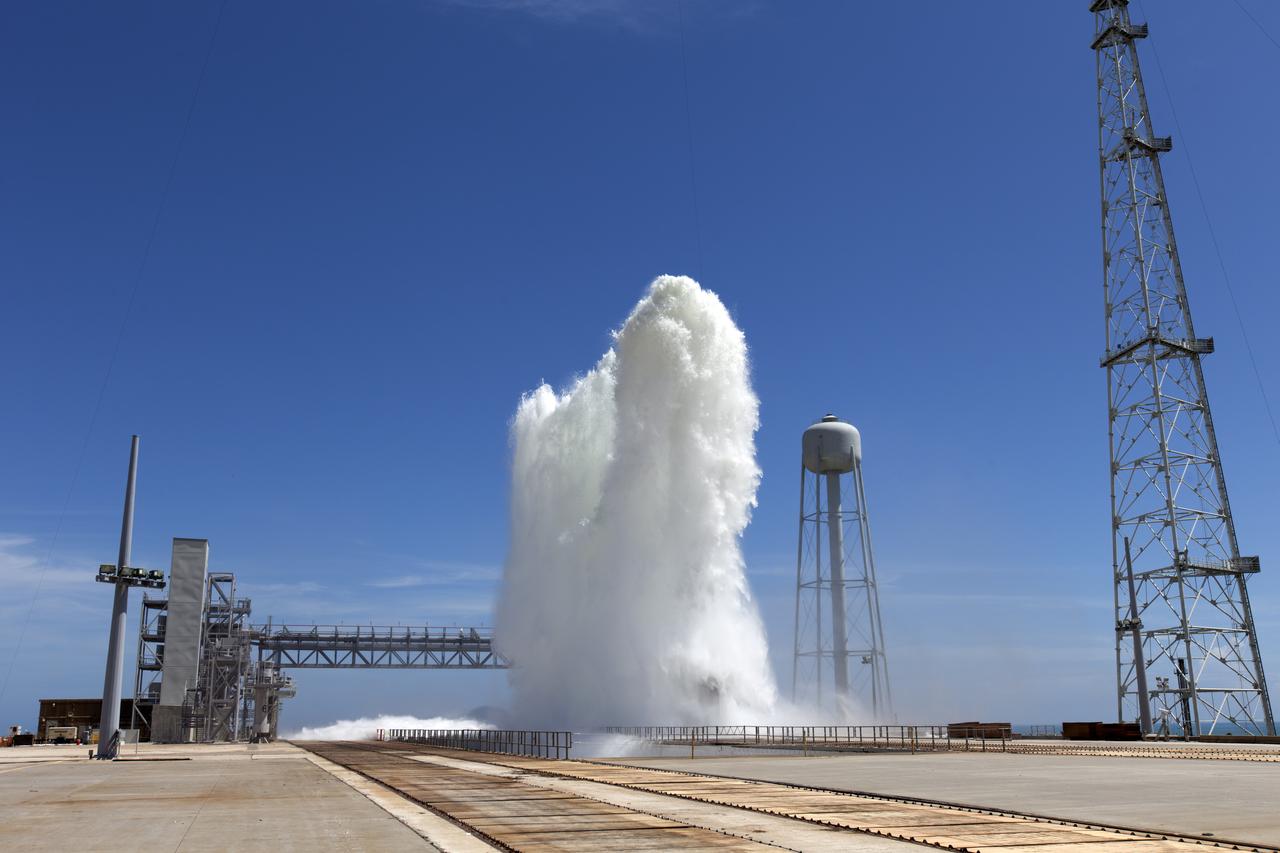
About 450,000 gallons of water flow at high speed from a holding tank through new and modified piping and valves, the flame trench, flame deflector nozzles and mobile launcher interface risers during a wet flow test on May 24, 2018, at Launch Pad 39B at NASA's Kennedy Space Center in Florida. At peak flow, the water reached about 100 feet in the air above the pad surface. The test was performed by Exploration Ground Systems to confirm the performance of the Ignition Overpressure/Sound Suppression system. During launch of NASA's Space Launch System rocket and Orion spacecraft, the high-speed water flow will help protect the vehicle from the extreme acoustic and temperature environment during ignition and liftoff.
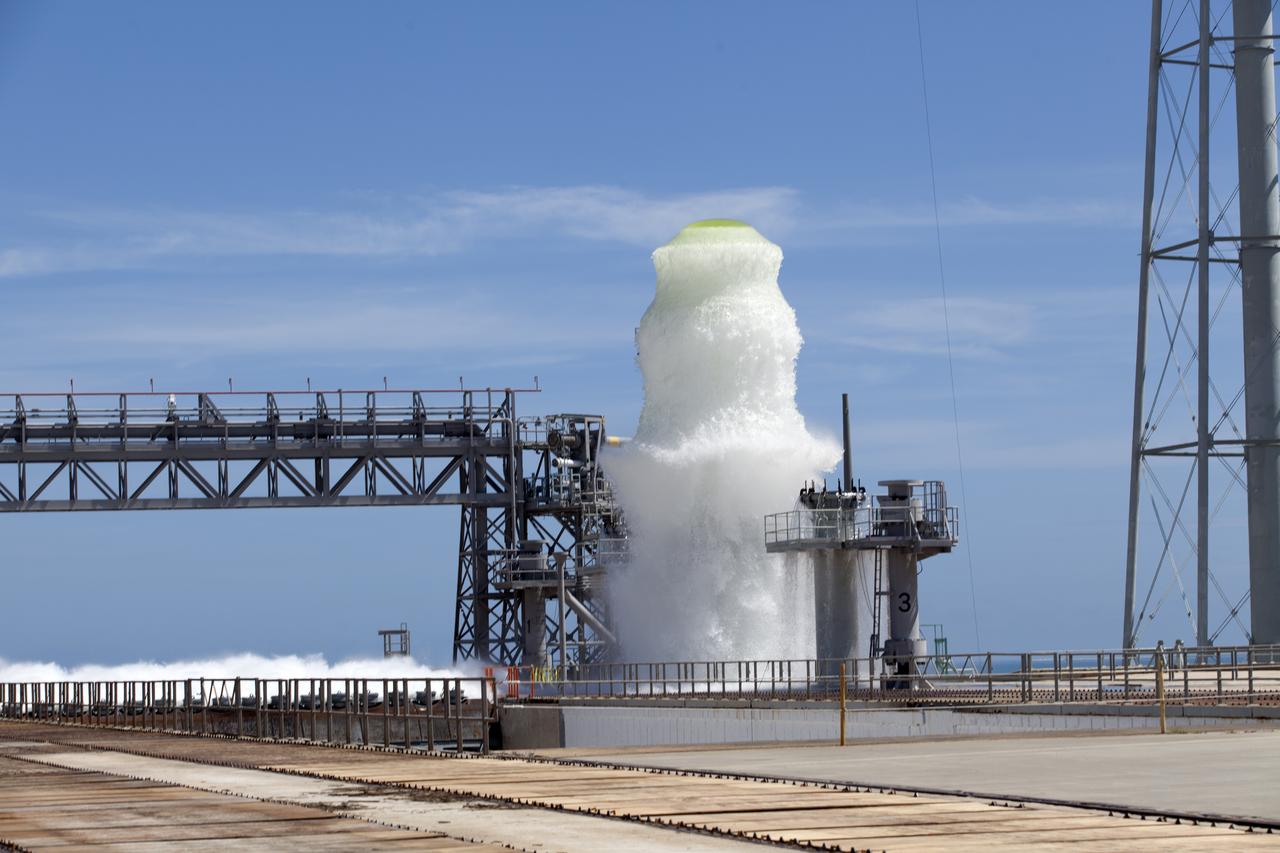
About 450,000 gallons of water flow at high speed from a holding tank through new and modified piping and valves, the flame trench, flame deflector nozzles and mobile launcher interface risers during a wet flow test on May 24, 2018, at Launch Pad 39B at NASA's Kennedy Space Center in Florida. At peak flow, the water reached about 100 feet in the air above the pad surface. The test was performed by Exploration Ground Systems to confirm the performance of the Ignition Overpressure/Sound Suppression system. During launch of NASA's Space Launch System rocket and Orion spacecraft, the high-speed water flow will help protect the vehicle from the extreme acoustic and temperature environment during ignition and liftoff.
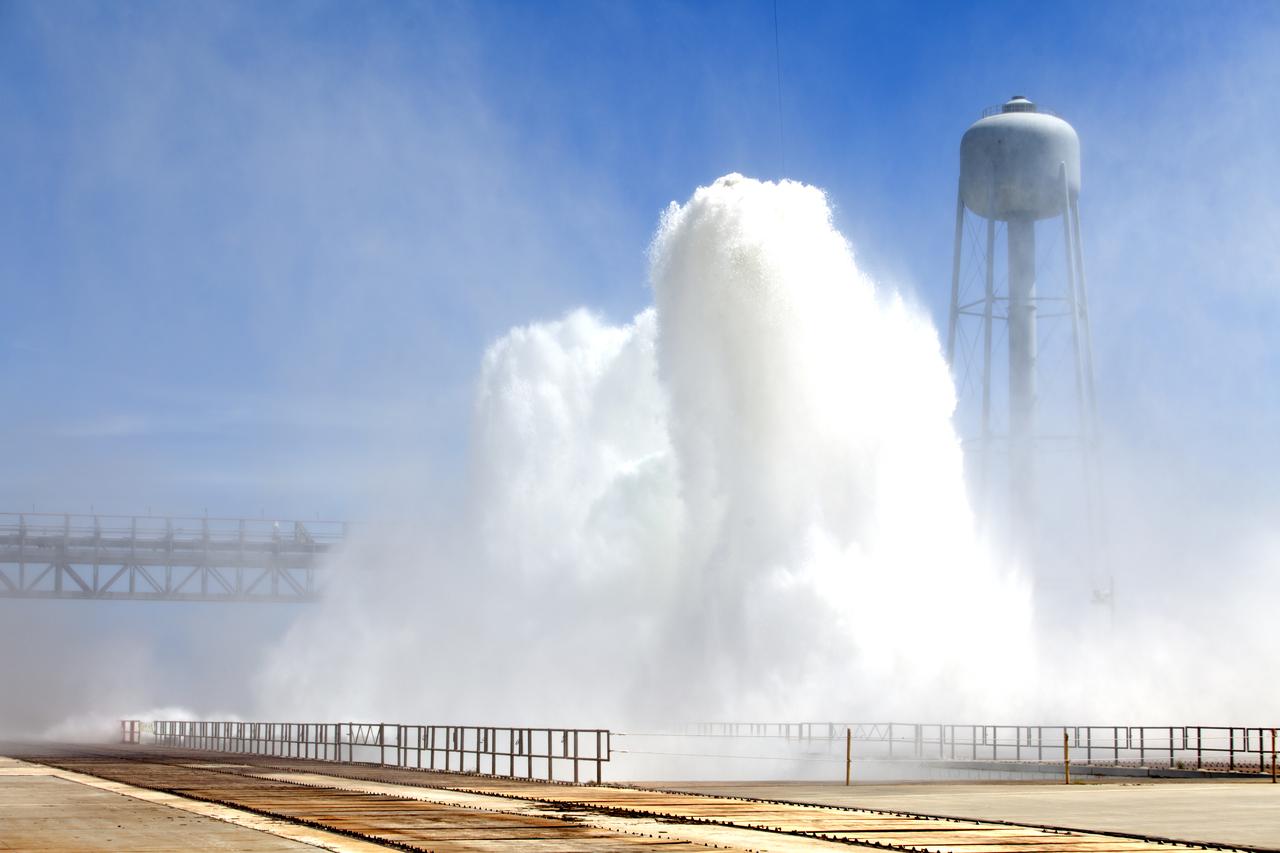
About 450,000 gallons of water flow at high speed from a holding tank through new and modified piping and valves, the flame trench, flame deflector nozzles and mobile launcher interface risers during a wet flow test on May 24, 2018, at Launch Pad 39B at NASA's Kennedy Space Center in Florida. At peak flow, the water reached about 100 feet in the air above the pad surface. The test was performed by Exploration Ground Systems to confirm the performance of the Ignition Overpressure/Sound Suppression system. During launch of NASA's Space Launch System rocket and Orion spacecraft, the high-speed water flow will help protect the vehicle from the extreme acoustic and temperature environment during ignition and liftoff.
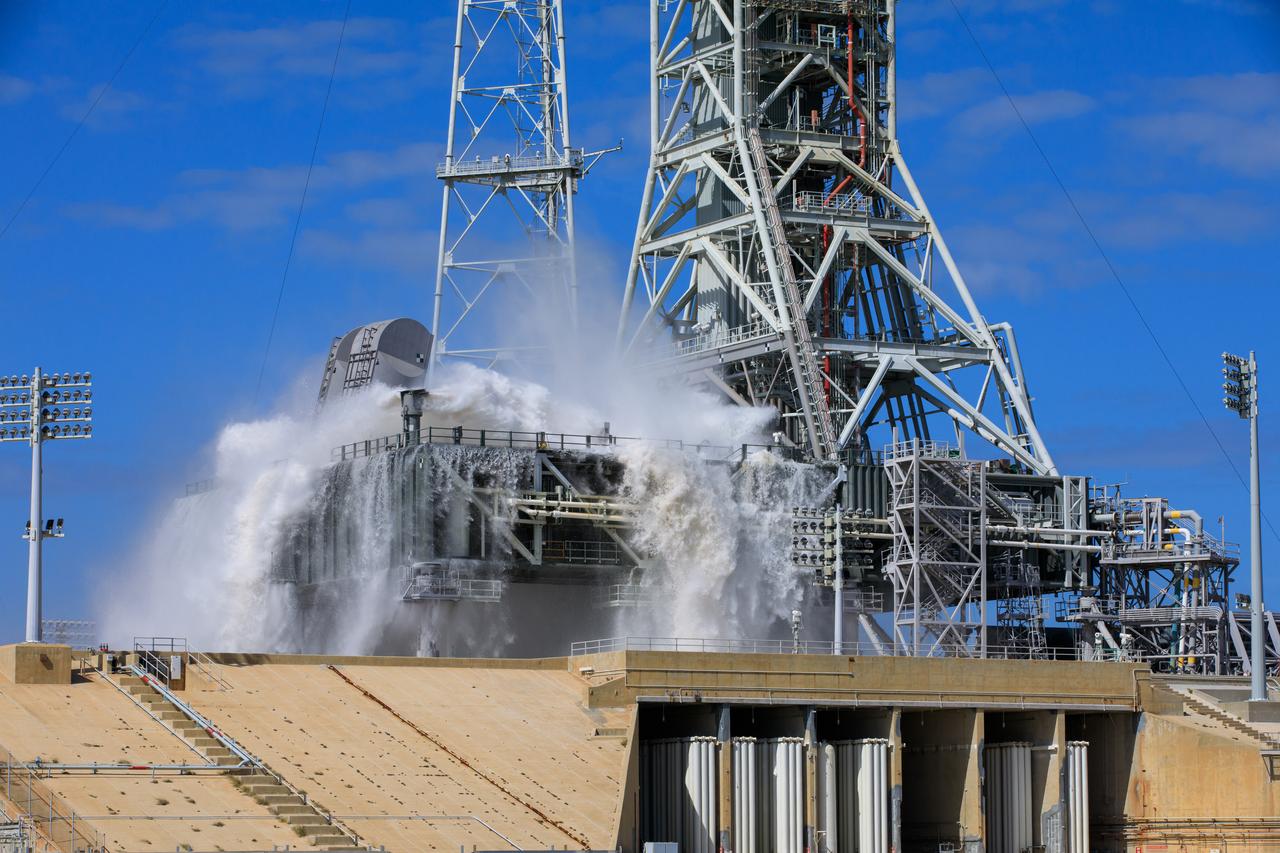
NASA’s Exploration Ground Systems conducts a water flow test with the mobile launcher at Kennedy Space Center’s Launch Complex 39B in Florida on Oct. 24, 2023. It is the third in a series of tests to verify the overpressure protection and sound suppression system is ready for launch of the Artemis II mission. During liftoff, 400,000 gallons of water will rush onto the pad to help protect NASA’s SLS (Space Launch System) rocket, Orion spacecraft, mobile launcher, and launch pad from any over pressurization and extreme sound produced during ignition and liftoff.
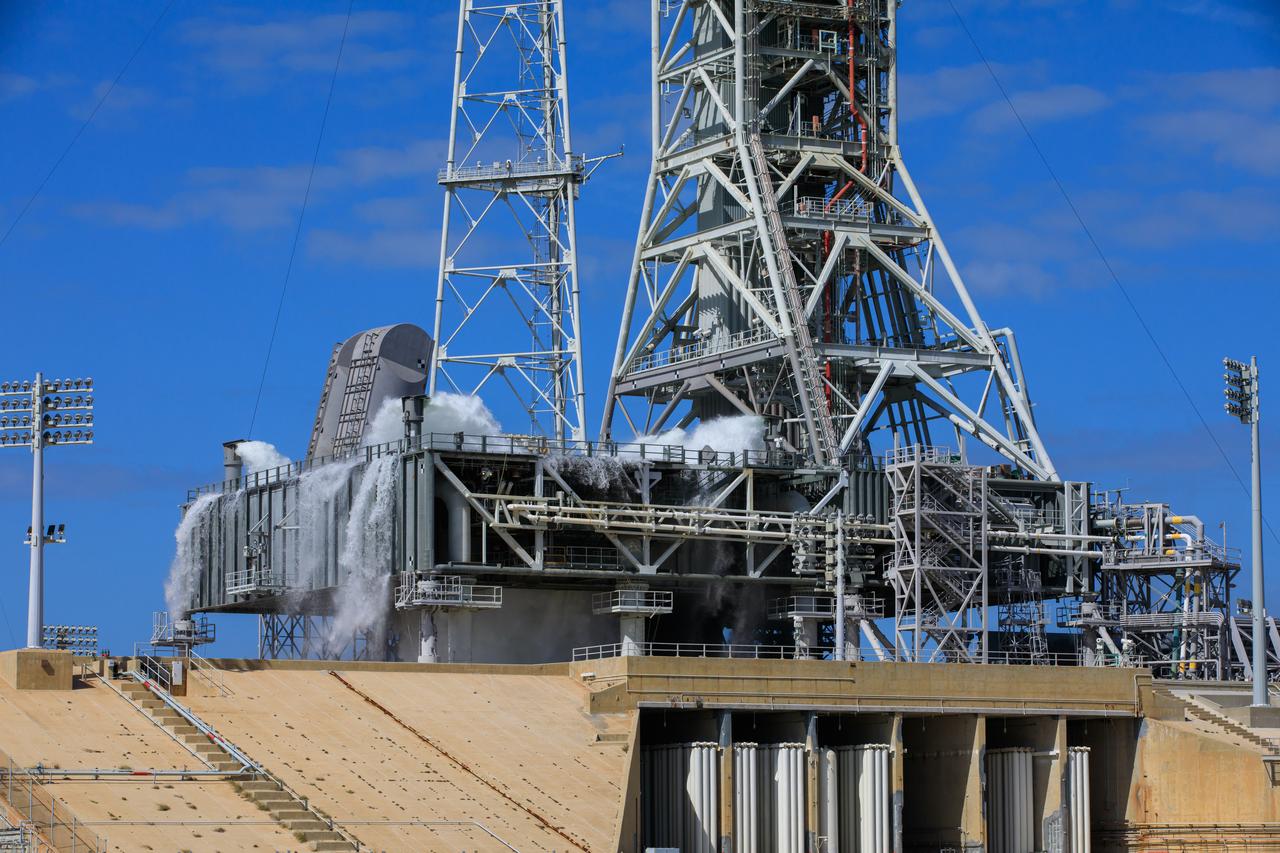
NASA’s Exploration Ground Systems conducts a water flow test with the mobile launcher at Kennedy Space Center’s Launch Complex 39B in Florida on Oct. 24, 2023. It is the third in a series of tests to verify the overpressure protection and sound suppression system is ready for launch of the Artemis II mission. During liftoff, 400,000 gallons of water will rush onto the pad to help protect NASA’s SLS (Space Launch System) rocket, Orion spacecraft, mobile launcher, and launch pad from any over pressurization and extreme sound produced during ignition and liftoff.
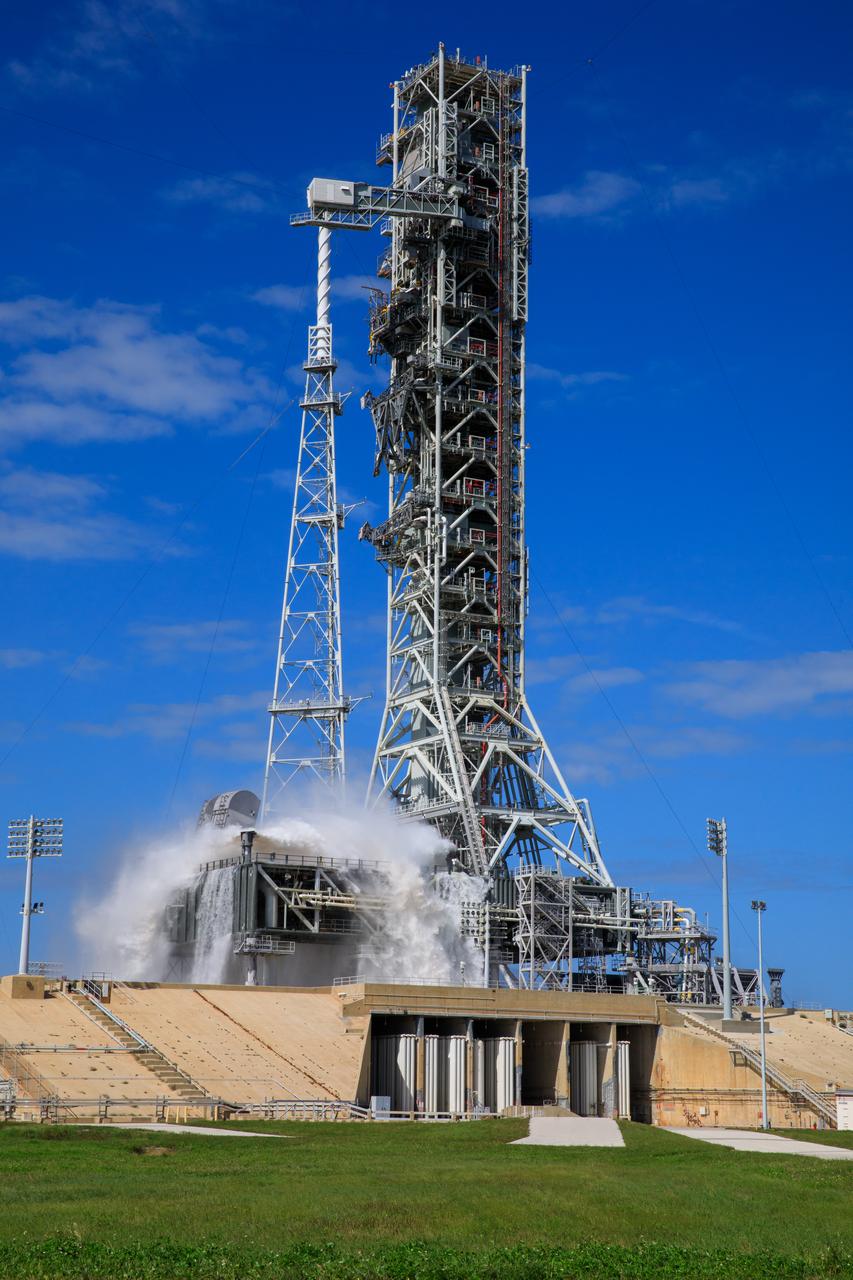
NASA’s Exploration Ground Systems conducts a water flow test with the mobile launcher at Kennedy Space Center’s Launch Complex 39B in Florida on Oct. 24, 2023. It is the third in a series of tests to verify the overpressure protection and sound suppression system is ready for launch of the Artemis II mission. During liftoff, 400,000 gallons of water will rush onto the pad to help protect NASA’s SLS (Space Launch System) rocket, Orion spacecraft, mobile launcher, and launch pad from any over pressurization and extreme sound produced during ignition and liftoff.
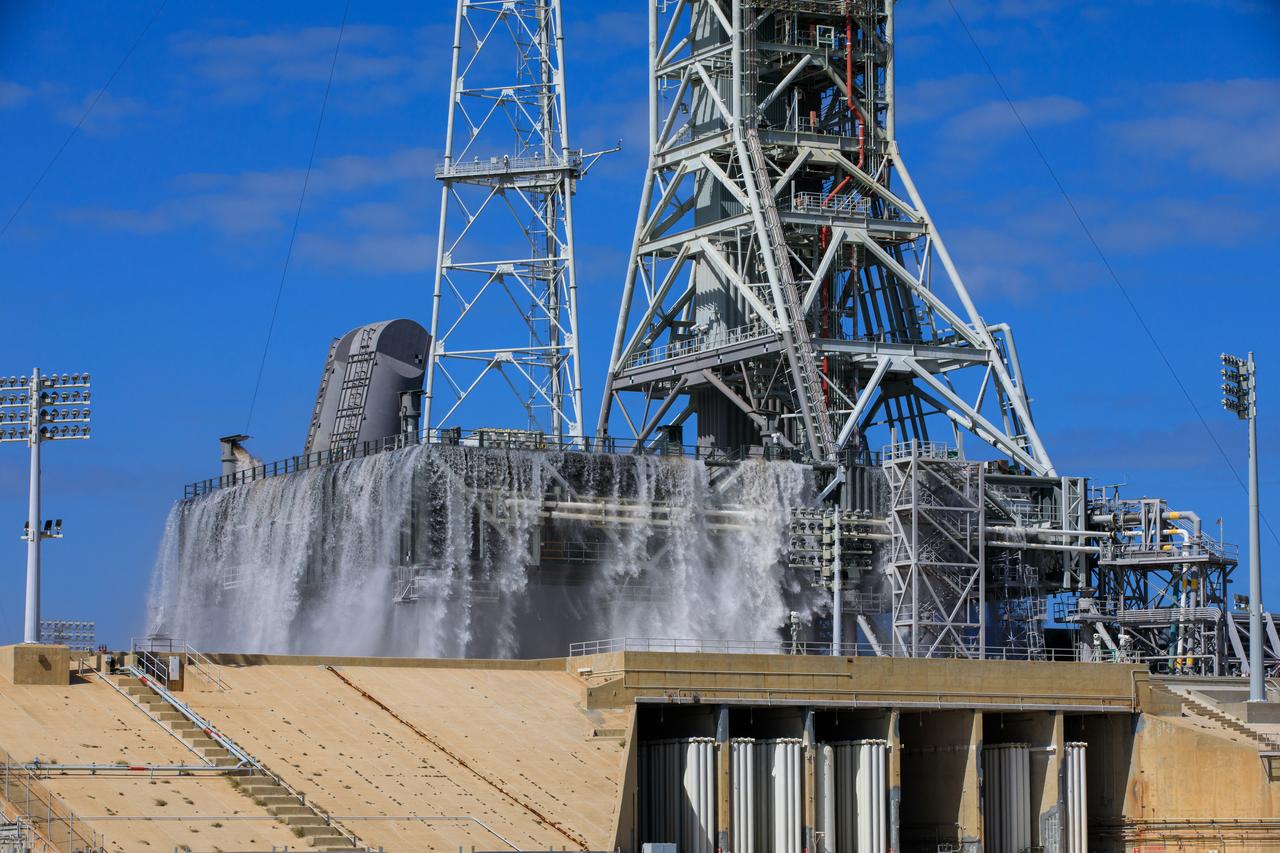
NASA’s Exploration Ground Systems conducts a water flow test with the mobile launcher at Kennedy Space Center’s Launch Complex 39B in Florida on Oct. 24, 2023. It is the third in a series of tests to verify the overpressure protection and sound suppression system is ready for launch of the Artemis II mission. During liftoff, 400,000 gallons of water will rush onto the pad to help protect NASA’s SLS (Space Launch System) rocket, Orion spacecraft, mobile launcher, and launch pad from any over pressurization and extreme sound produced during ignition and liftoff.
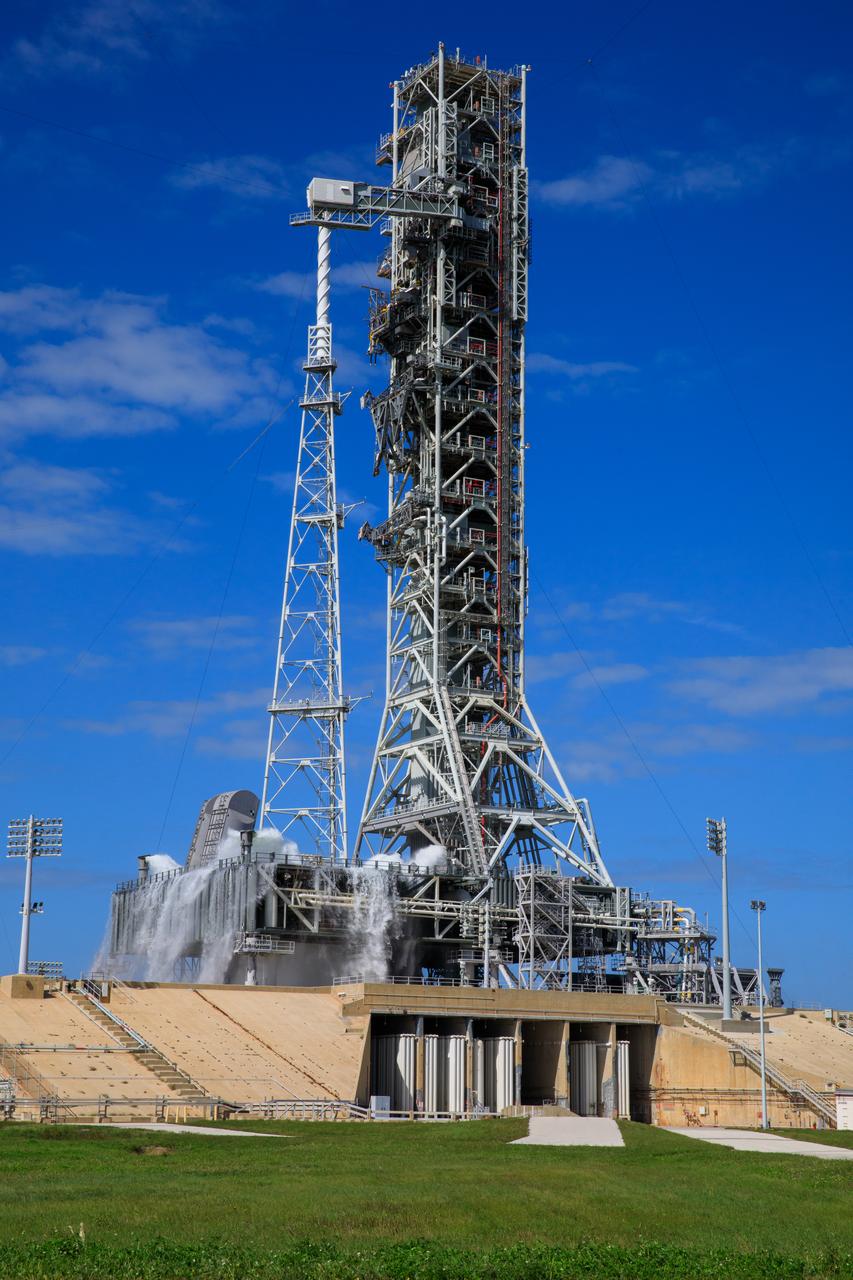
NASA’s Exploration Ground Systems conducts a water flow test with the mobile launcher at Kennedy Space Center’s Launch Complex 39B in Florida on Oct. 24, 2023. It is the third in a series of tests to verify the overpressure protection and sound suppression system is ready for launch of the Artemis II mission. During liftoff, 400,000 gallons of water will rush onto the pad to help protect NASA’s SLS (Space Launch System) rocket, Orion spacecraft, mobile launcher, and launch pad from any over pressurization and extreme sound produced during ignition and liftoff.

NASA’s Exploration Ground Systems conducts a water flow test with the mobile launcher at Kennedy Space Center’s Launch Complex 39B in Florida on Oct. 24, 2023. It is the third in a series of tests to verify the overpressure protection and sound suppression system is ready for launch of the Artemis II mission. During liftoff, 400,000 gallons of water will rush onto the pad to help protect NASA’s SLS (Space Launch System) rocket, Orion spacecraft, mobile launcher, and launch pad from any over pressurization and extreme sound produced during ignition and liftoff.
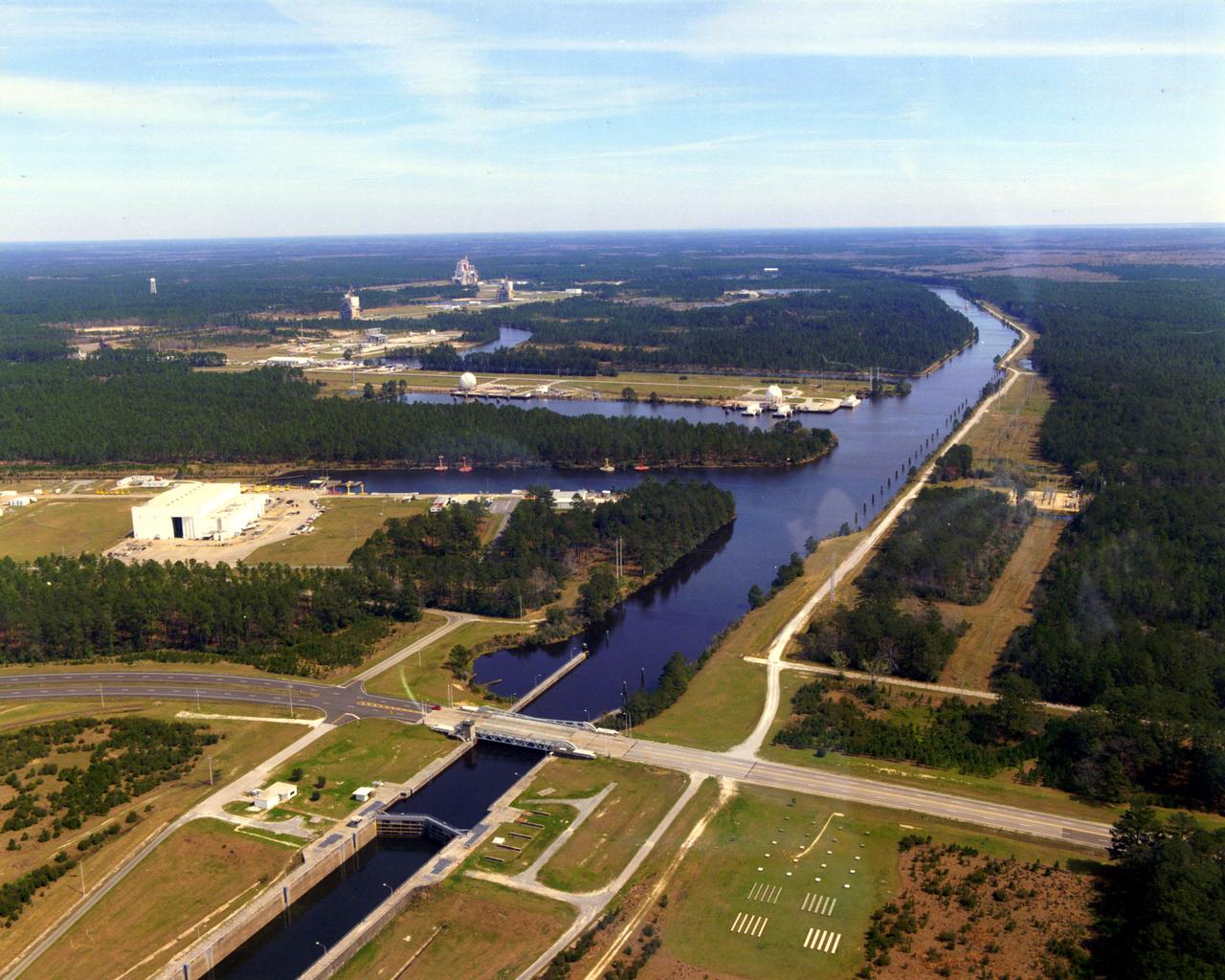
This aerial view of Stennis Space Center's unique lock and canal system
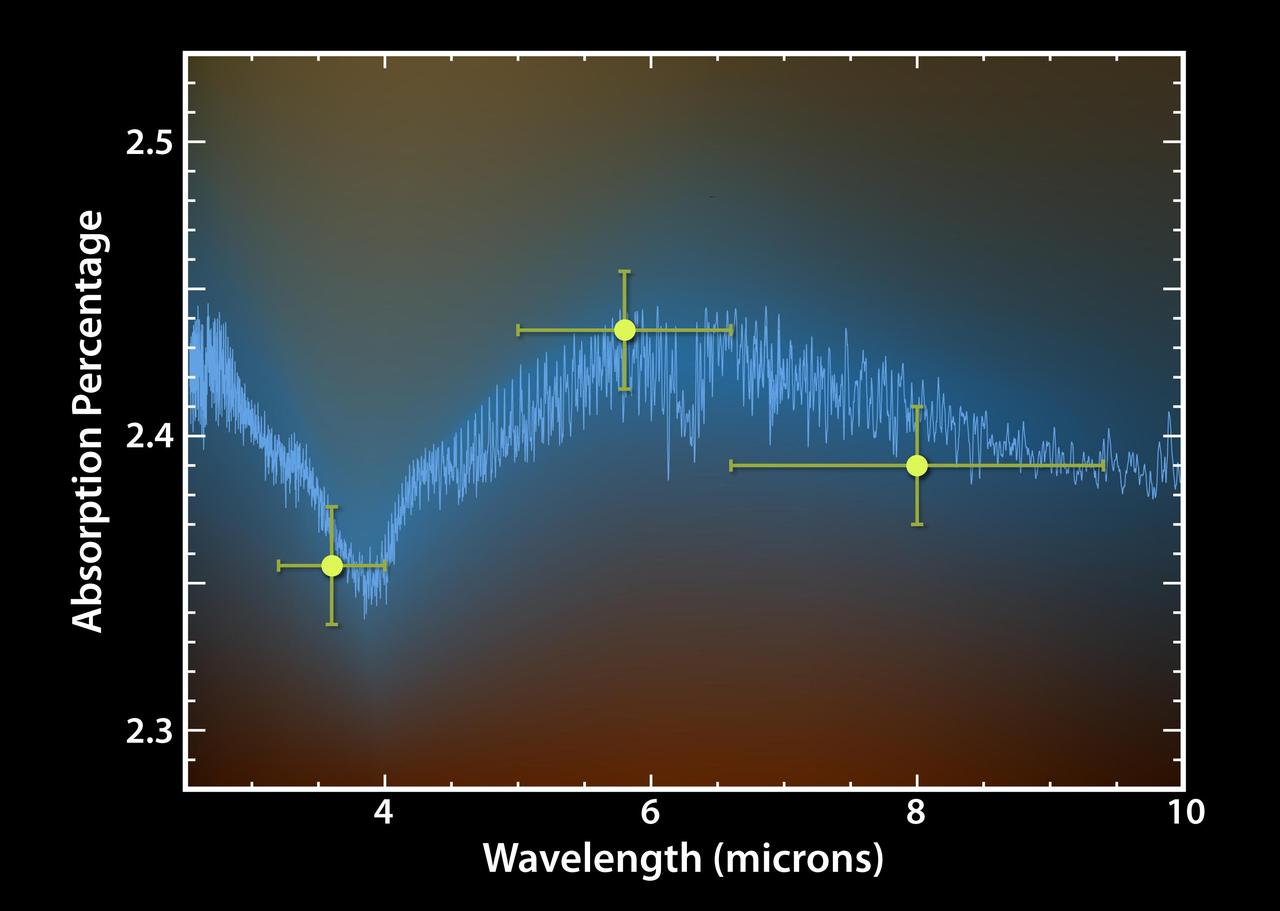
This plot of data from NASA Spitzer Space Telescope tells astronomers that a toasty gas exoplanet, or a planet beyond our solar system, contains water vapor.

This diagram illustrates the earliest journeys of water in a young, forming star system. NASA Spitzer Space Telescope was able to probe a crucial phase of this stellar evolution.
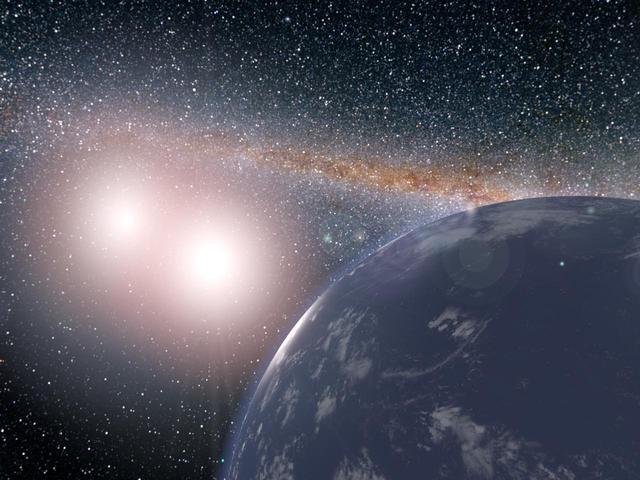
This artist's concept shows a hypothetical planet covered in water around the binary star system of Kepler-35A and B. In a 2017 study in the journal Nature Communications, researchers investigating the climates of exoplanets determined that this hypothetical planet could be habitable, depending on its distance from the two stars. On the far edge of the habitable zone, the hypothetical water-covered planet would have a lot of variation in its surface temperatures. But closer to the stars, near the inner edge of the habitable zone, the global average surface temperatures on the same planet would stay almost constant. https://photojournal.jpl.nasa.gov/catalog/PIA21470
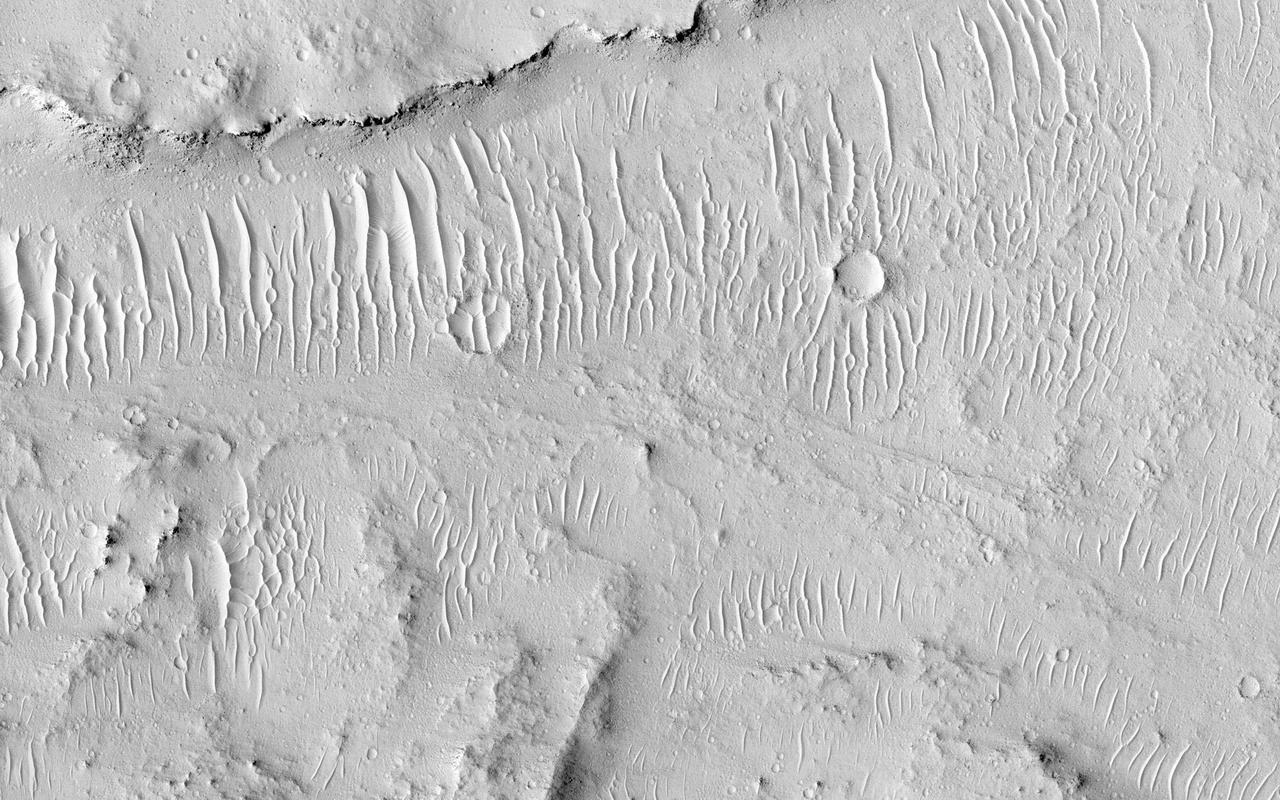
Kasei Valles is a valley system was likely carved by some combination of flowing water and lava. In some areas, erosion formed cliffs along the flow path resulting in water or lava falls. In some areas, erosion formed cliffs along the flow path resulting in water or lava falls. The flowing liquid is gone but the channels and "dry falls" remain. Since its formation, Kasei Valles has suffered impacts-resulting in craters-and has been mantled in dust, sand, and fine gravel as evidenced by the rippled textures. http://photojournal.jpl.nasa.gov/catalog/PIA20004
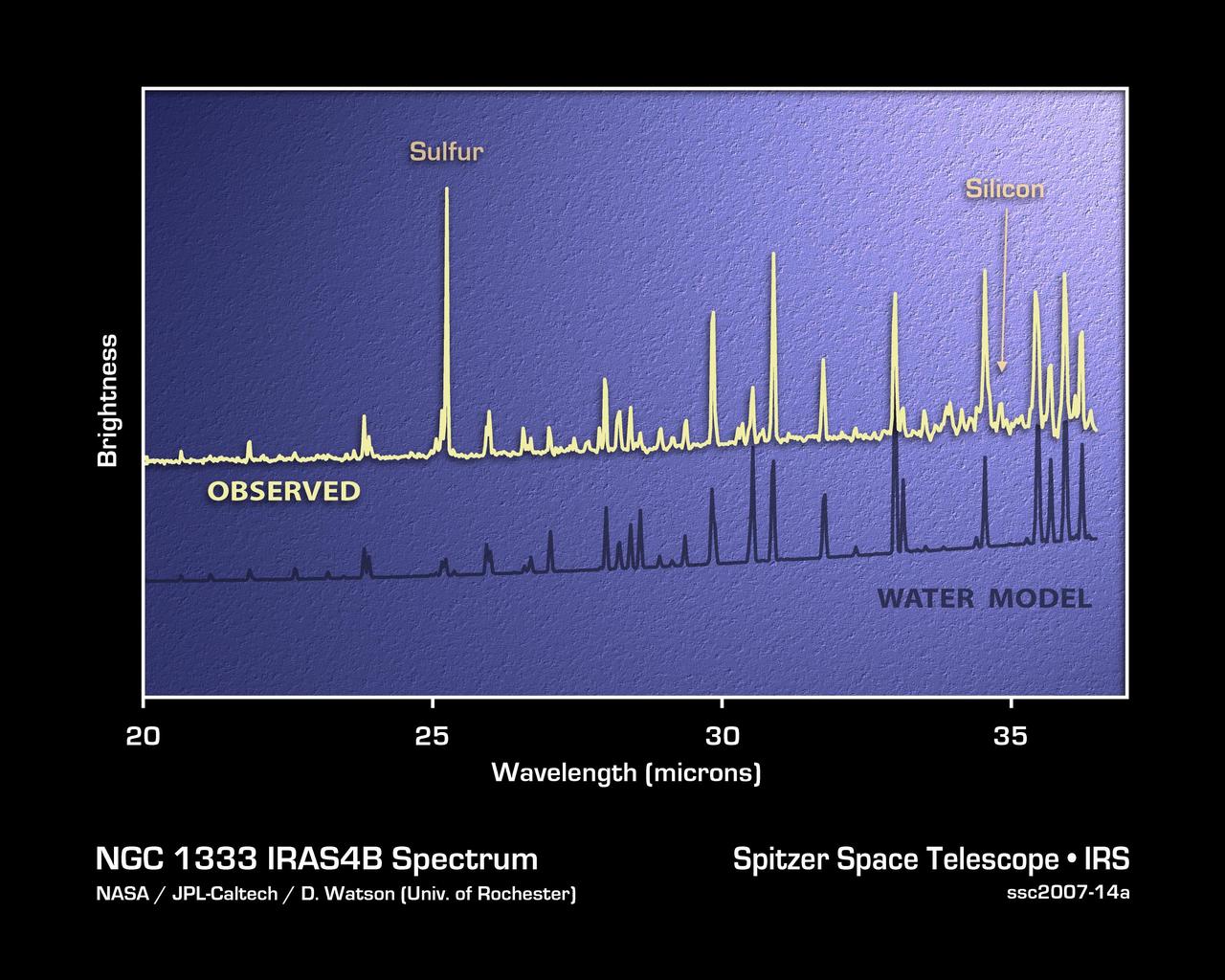
This plot of infrared data, called a spectrum, shows the strong signature of water vapor deep within the core of an embryonic star system, called NGC 1333-IRAS 4B. The data were captured by NASA Spitzer Space Telescope.
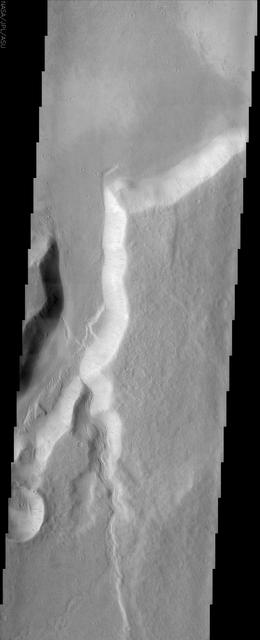
One of the many branches of the Mangala Vallis channel system is seen in this image from NASA Mars Odyssey spacecraft. The water that likely carved the channels emerged from a huge graben or fracture almost 1000 km to the south.
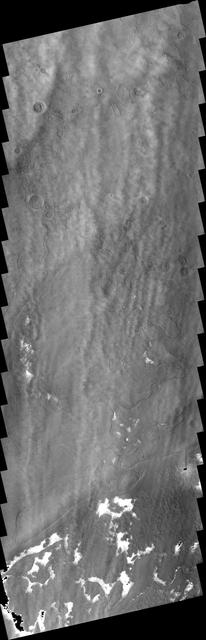
This image from NASA 2001 Mars Odyssey spacecraft shows a system of clouds just off the margin of the South Polar cap. Taken during the summer season, these clouds contain both water-ice and dust.

This diagram compares our own solar system to Kepler-22, a star system containing the first habitable zone planet -- the sweet spot around a star where temperatures are right for water to exist in its liquid form, discovered by NASA Kepler mission.

iss069e088358 (9/14/2023) --- Japan Aerospace Exploration Agency (JAXA) astronaut Satoshi Furukawa is seen processing samples from the JEM Water Recovery System (JWRS) in the KIBO module aboard the International Space Station (ISS). The JWRS demonstrates that potable water can be generated from urine. In the past, urine and wastewater were collected and stored, or vented overboard. However, for long-term space missions, water supply could become a limiting factor. Demonstrating the function of this water recovery system on orbit contributes to updating the Environmental Control and Life Support System (ECLSS) to support astronauts on the space station and future exploration missions.
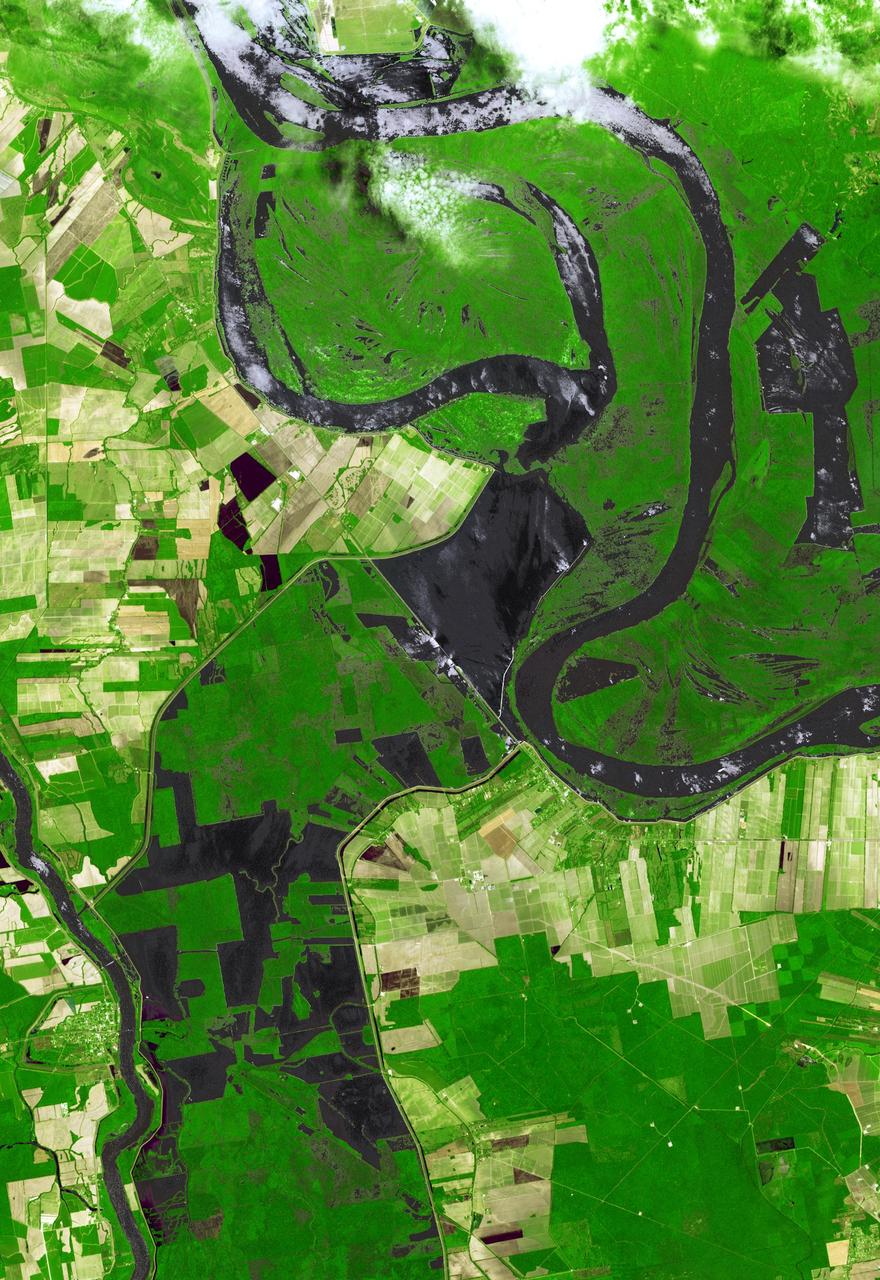
NASA Terra spacecraft shows the water flow after the U.S. Army Corps of Engineers opened the Morganza Spillway, a flood control structure along the western bank of the Mississippi River in Louisiana, to ease flooding along levee systems on May 14, 2011.
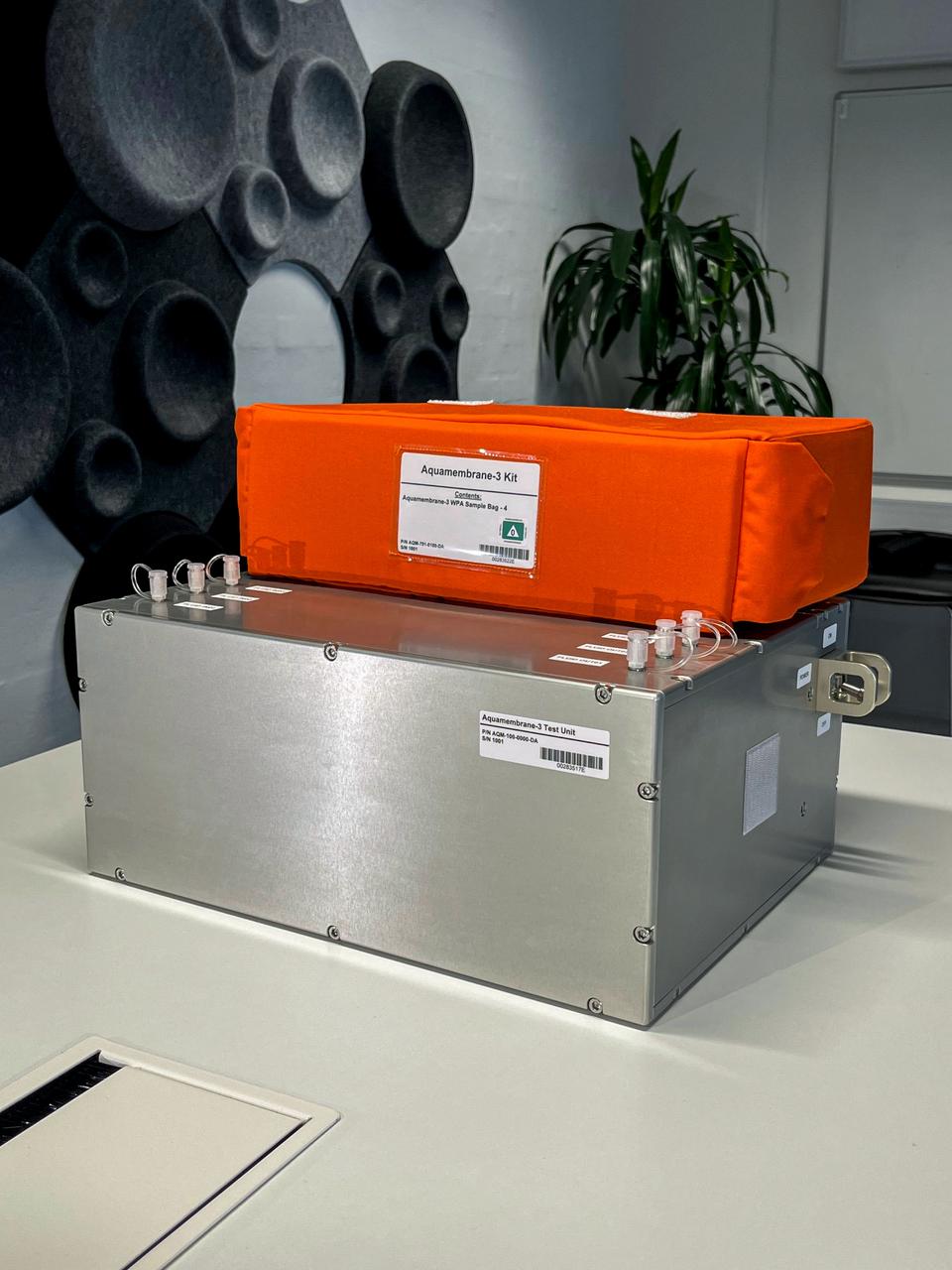
jsc2023e055872 (10/5/2023) --- The Testing Contaminant Rejection of Aquaporin Inside® HFFO Module (Aquamembrane-3) hardware consists of three separate and parallel systems to quantify the membrane's water flux and contamination rejection in microgravity, which are key parameters for a full water recovery system. This image shows the complete experiment hardware.

A flow test of the Ignition Overpressure Protection and Sound Suppression water deluge system is in progress at Launch Pad 39B at NASA's Kennedy Space Center in Florida, on Oct. 15, 2018. At peak flow, the water reaches about 100 feet in the air above the pad surface. It flows at high speed from a holding tank through new and modified piping and valves, the flame trench, flame deflector nozzles and mobile launcher interface risers. The testing is part of Exploration Ground System's preparation for the new Space Launch System rocket. Modifications were made to the pad after a previous wet flow test, increasing the performance of the system. During the launch of Exploration Mission-1 and subsequent missions, this water deluge system will release about 450,000 gallons of water across the mobile launcher and Flame Deflector to reduce the extreme heat and energy generated by the rocket during ignition and liftoff.

A flow test of the Ignition Overpressure Protection and Sound Suppression water deluge system is in progress at Launch Pad 39B at NASA's Kennedy Space Center in Florida, on Oct. 15, 2018. At peak flow, the water reaches about 100 feet in the air above the pad surface. It flows at high speed from a holding tank through new and modified piping and valves, the flame trench, flame deflector nozzles and mobile launcher interface risers. The testing is part of Exploration Ground System's preparation for the new Space Launch System rocket. Modifications were made to the pad after a previous wet flow test, increasing the performance of the system. During the launch of Exploration Mission-1 and subsequent missions, this water deluge system will release about 450,000 gallons of water across the mobile launcher and Flame Deflector to reduce the extreme heat and energy generated by the rocket during ignition and liftoff.
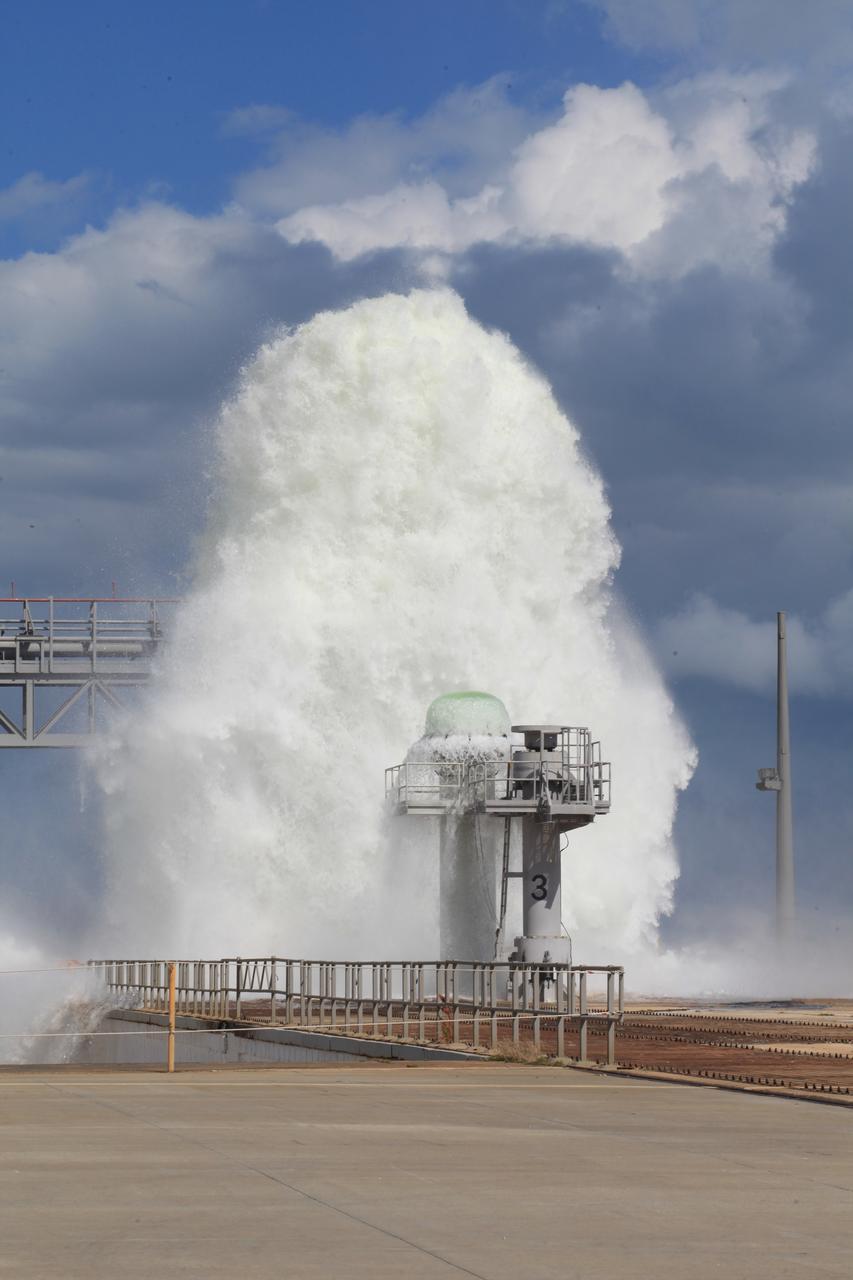
A flow test of the Ignition Overpressure Protection and Sound Suppression water deluge system is in progress at Launch Pad 39B at NASA's Kennedy Space Center in Florida, on Oct. 15, 2018. At peak flow, the water reaches about 100 feet in the air above the pad surface. It flows at high speed from a holding tank through new and modified piping and valves, the flame trench, flame deflector nozzles and mobile launcher interface risers. The testing is part of Exploration Ground System's preparation for the new Space Launch System rocket. Modifications were made to the pad after a previous wet flow test, increasing the performance of the system. During the launch of Exploration Mission-1 and subsequent missions, this water deluge system will release about 450,000 gallons of water across the mobile launcher and Flame Deflector to reduce the extreme heat and energy generated by the rocket during ignition and liftoff.

A flow test of the Ignition Overpressure Protection and Sound Suppression water deluge system is in progress at Launch Pad 39B at NASA's Kennedy Space Center in Florida, on Oct. 15, 2018. At peak flow, the water reaches about 100 feet in the air above the pad surface. It flows at high speed from a holding tank through new and modified piping and valves, the flame trench, flame deflector nozzles and mobile launcher interface risers. The testing is part of Exploration Ground System's preparation for the new Space Launch System rocket. Modifications were made to the pad after a previous wet flow test, increasing the performance of the system. During the launch of Exploration Mission-1 and subsequent missions, this water deluge system will release about 450,000 gallons of water across the mobile launcher and Flame Deflector to reduce the extreme heat and energy generated by the rocket during ignition and liftoff.
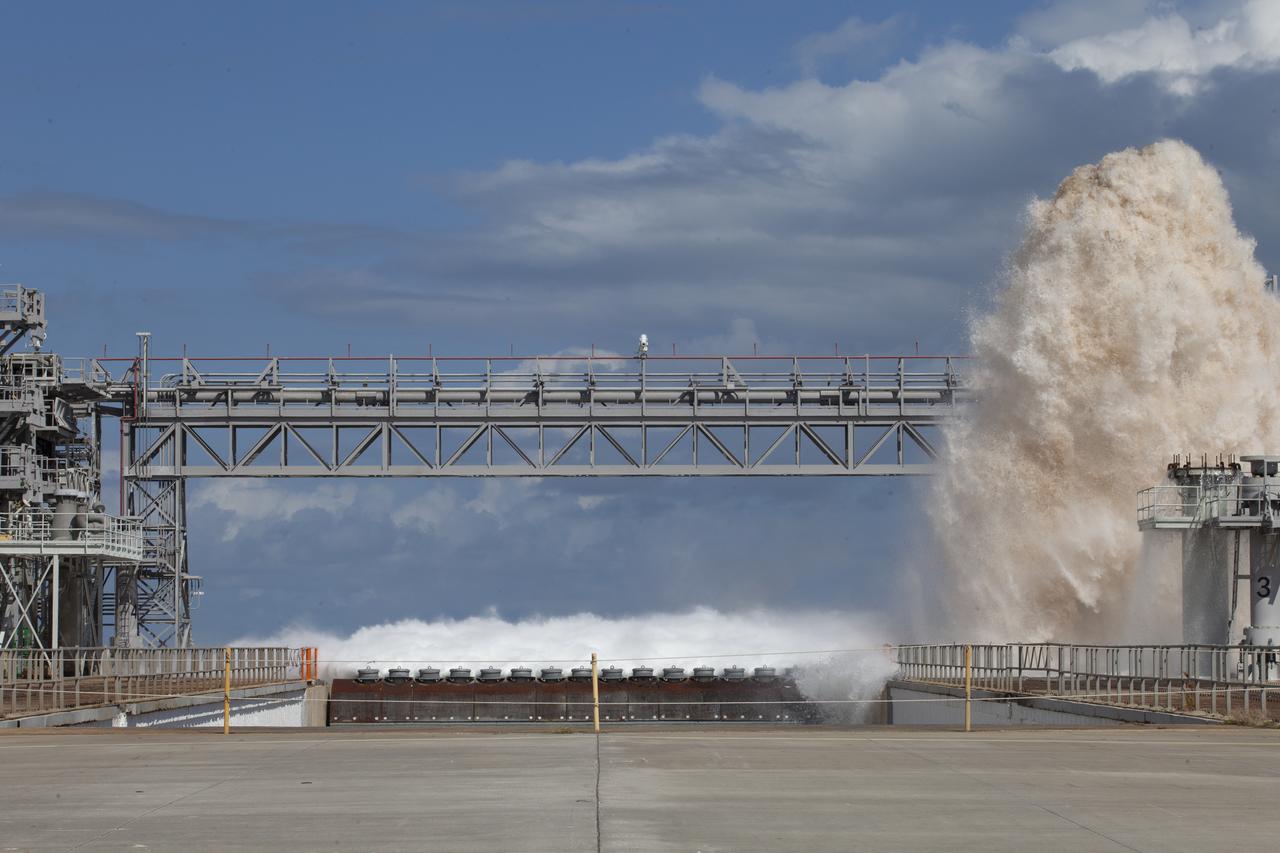
A flow test of the Ignition Overpressure Protection and Sound Suppression water deluge system is in progress at Launch Pad 39B at NASA's Kennedy Space Center in Florida, on Oct. 15, 2018. At peak flow, the water reaches about 100 feet in the air above the pad surface. It flows at high speed from a holding tank through new and modified piping and valves, the flame trench, flame deflector nozzles and mobile launcher interface risers. The testing is part of Exploration Ground System's preparation for the new Space Launch System rocket. Modifications were made to the pad after a previous wet flow test, increasing the performance of the system. During the launch of Exploration Mission-1 and subsequent missions, this water deluge system will release about 450,000 gallons of water across the mobile launcher and Flame Deflector to reduce the extreme heat and energy generated by the rocket during ignition and liftoff.
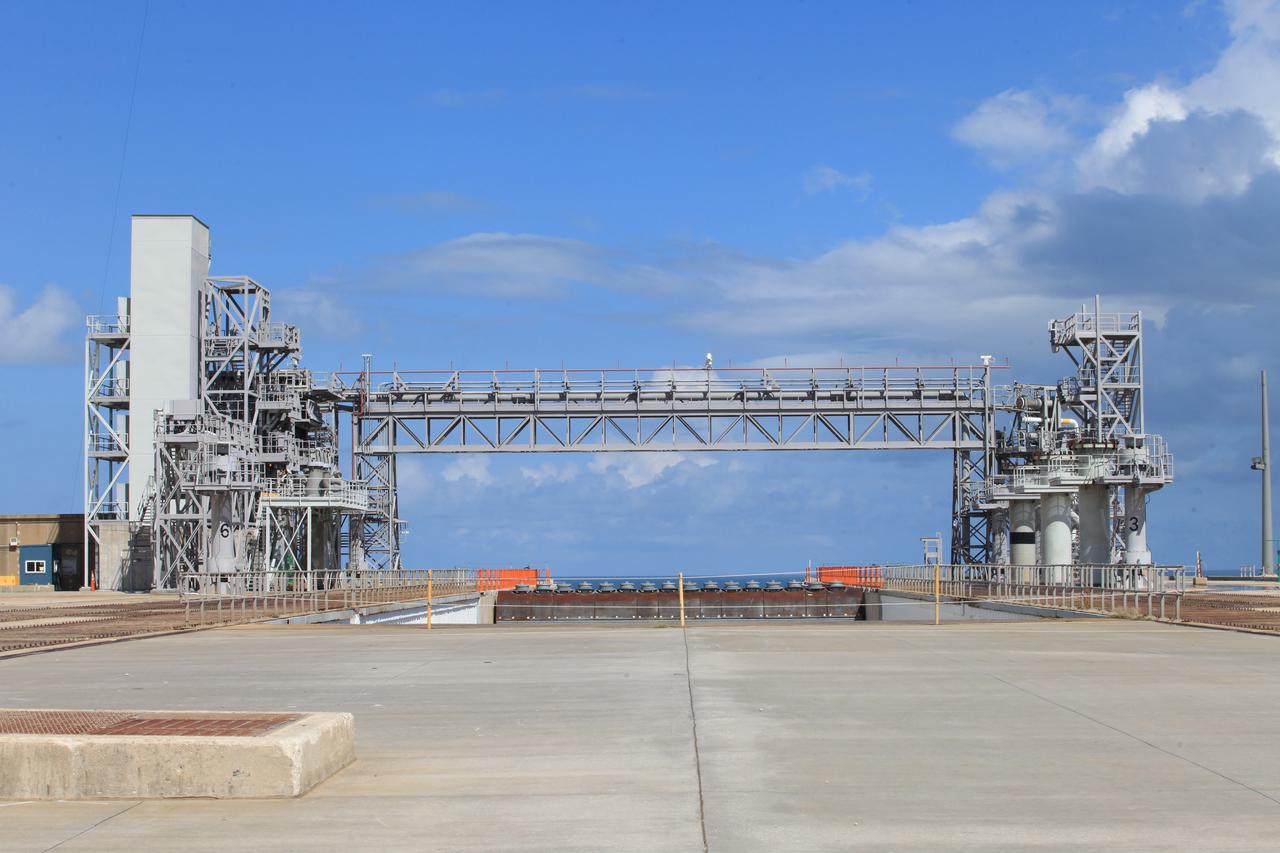
A flow test of the Ignition Overpressure Protection and Sound Suppression water deluge system begins at Launch Pad 39B at NASA's Kennedy Space Center in Florida, on Oct. 15, 2018. At peak flow, the water will reach about 100 feet in the air above the pad surface. The testing is part of Exploration Ground System's preparation for the new Space Launch System rocket. Modifications were made to the pad after a previous wet flow test, increasing the performance of the system. During the launch of Exploration Mission-1 and subsequent missions, this water deluge system will release about 450,000 gallons of water across the mobile launcher and Flame Deflector to reduce the extreme heat and energy generated by the rocket during ignition and liftoff.
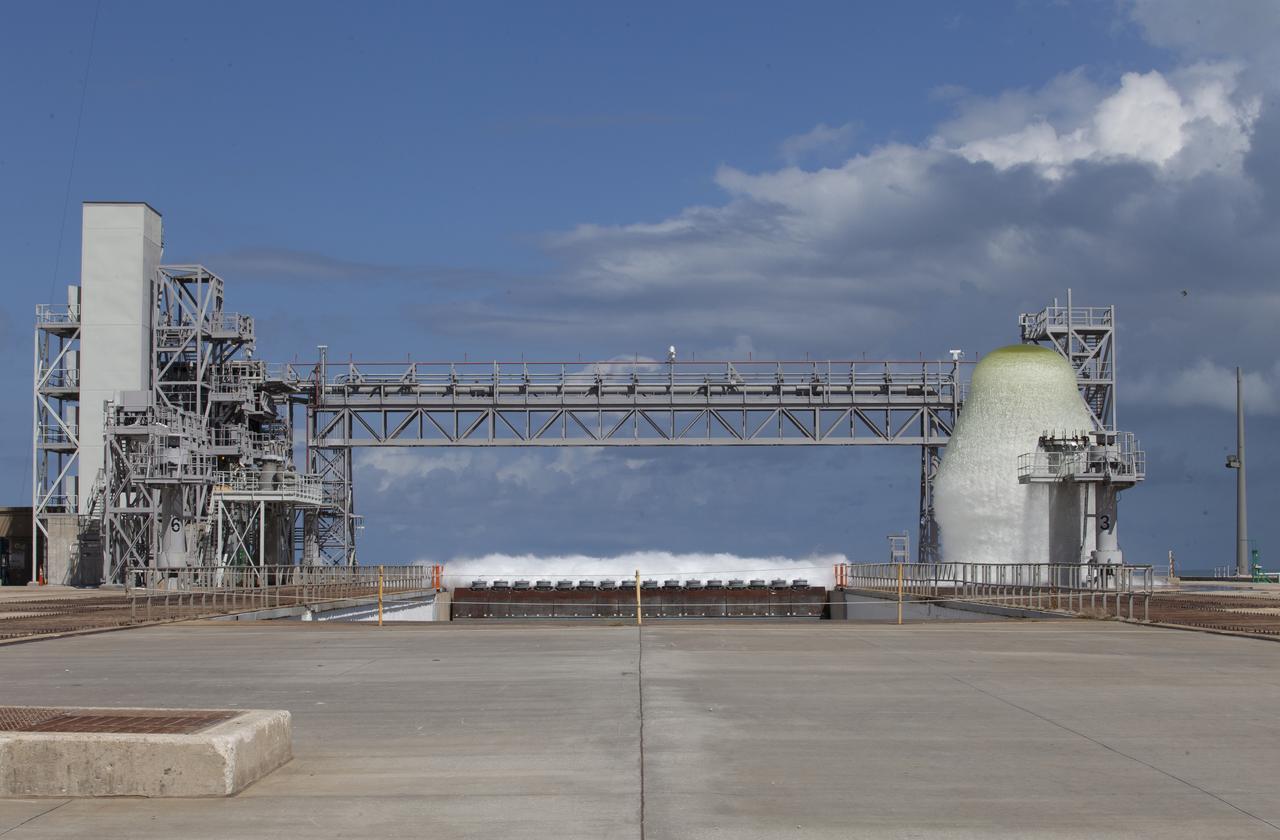
A flow test of the Ignition Overpressure Protection and Sound Suppression water deluge system is in progress at Launch Pad 39B at NASA's Kennedy Space Center in Florida, on Oct. 15, 2018. At peak flow, the water will reach about 100 feet in the air above the pad surface. It will flow at high speed from a holding tank through new and modified piping and valves, the flame trench, flame deflector nozzles and mobile launcher interface risers. The testing is part of Exploration Ground System's preparation for the new Space Launch System rocket. Modifications were made to the pad after a previous wet flow test, increasing the performance of the system. During the launch of Exploration Mission-1 and subsequent missions, this water deluge system will release about 450,000 gallons of water across the mobile launcher and Flame Deflector to reduce the extreme heat and energy generated by the rocket during ignition and liftoff.

A flow test of the Ignition Overpressure Protection and Sound Suppression water deluge system is in progress at Launch Pad 39B at NASA's Kennedy Space Center in Florida, on Oct. 15, 2018. At peak flow, the water reaches about 100 feet in the air above the pad surface. It flows at high speed from a holding tank through new and modified piping and valves, the flame trench, flame deflector nozzles and mobile launcher interface risers. The testing is part of Exploration Ground System's preparation for the new Space Launch System rocket. Modifications were made to the pad after a previous wet flow test, increasing the performance of the system. During the launch of Exploration Mission-1 and subsequent missions, this water deluge system will release about 450,000 gallons of water across the mobile launcher and Flame Deflector to reduce the extreme heat and energy generated by the rocket during ignition and liftoff.
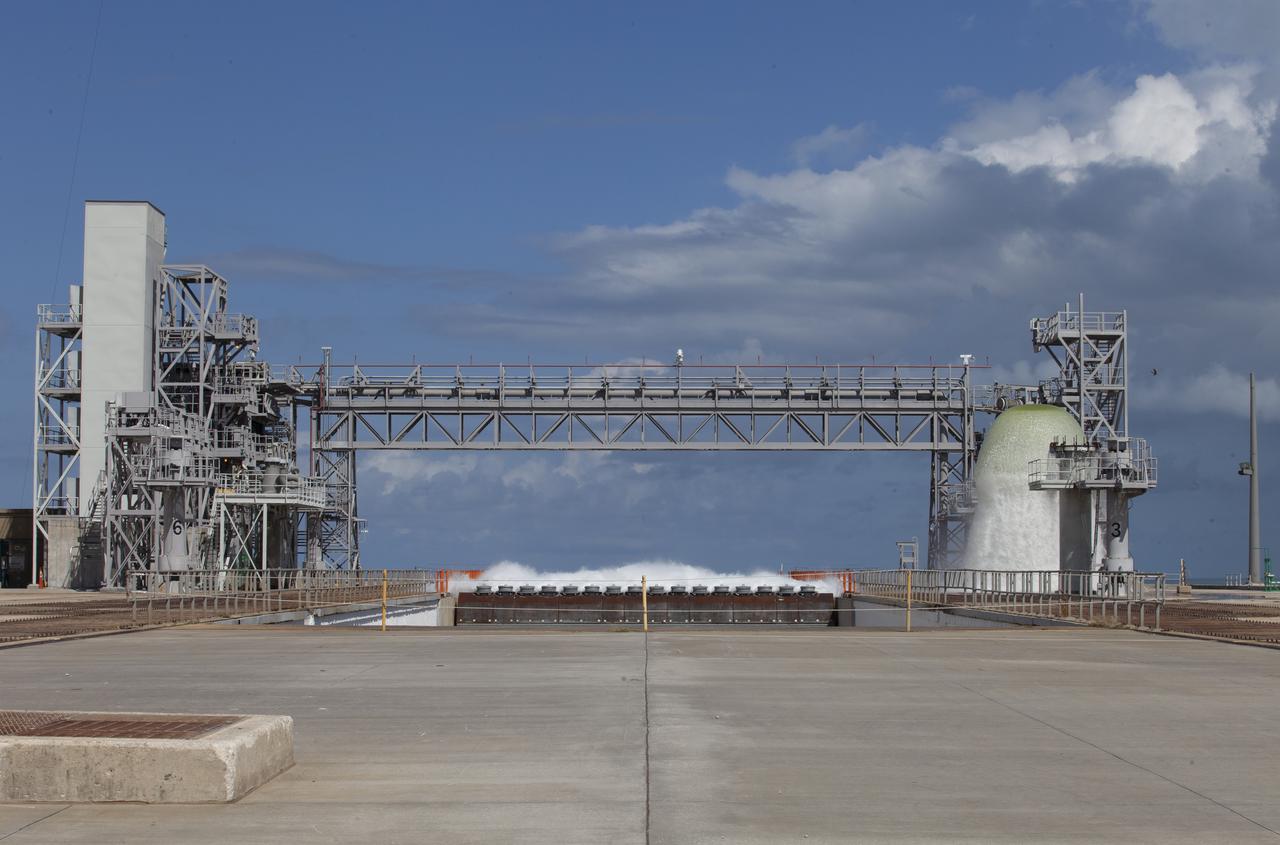
A flow test of the Ignition Overpressure Protection and Sound Suppression water deluge system begins at Launch Pad 39B at NASA's Kennedy Space Center in Florida, on Oct. 15, 2018. At peak flow, the water will reach about 100 feet in the air above the pad surface. It will flow at high speed from a holding tank through new and modified piping and valves, the flame trench, flame deflector nozzles and mobile launcher interface risers. The testing is part of Exploration Ground System's preparation for the new Space Launch System rocket. Modifications were made to the pad after a previous wet flow test, increasing the performance of the system. During the launch of Exploration Mission-1 and subsequent missions, this water deluge system will release about 450,000 gallons of water across the mobile launcher and Flame Deflector to reduce the extreme heat and energy generated by the rocket during ignition and liftoff.
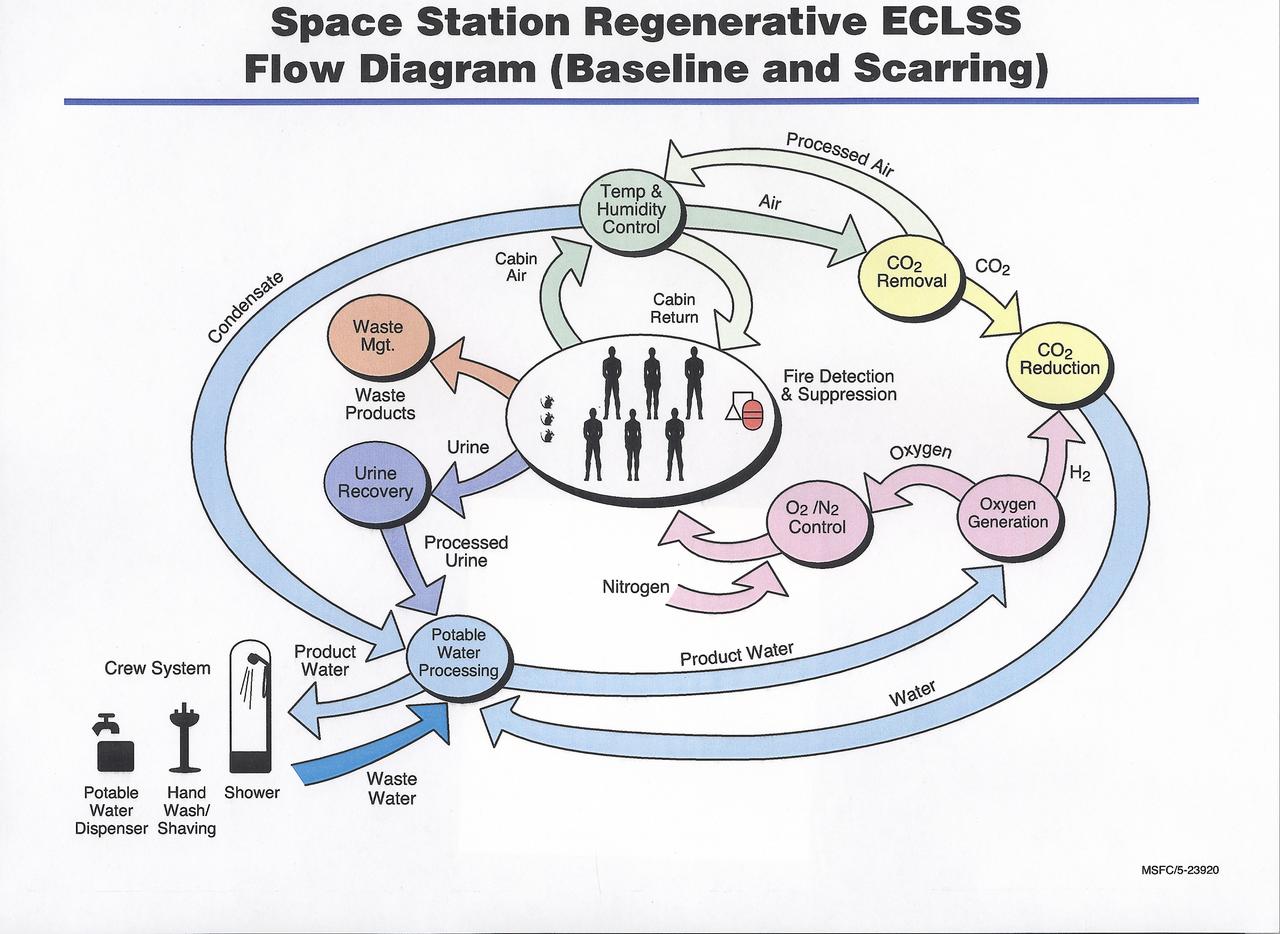
This diagram shows the flow of recyclable resources in the International Space Station (ISS). The Environmental Control and Life Support System (ECLSS) Group of the Flight Projects Directorate at the Marshall Space Flight Center is responsible for the regenerative ECLSS hardware, as well as providing technical support for the rest of the system. The regenerative ECLSS, whose main components are the Water Recovery System (WRS), and the Oxygen Generation System (OGS), reclaims and recycles water and oxygen. The ECLSS maintains a pressurized habitation environment, provides water recovery and storage, maintains and provides fire detection / suppression, and provides breathable air and a comfortable atmosphere in which to live and work within the ISS. The ECLSS hardware will be located in the Node 3 module of the ISS.
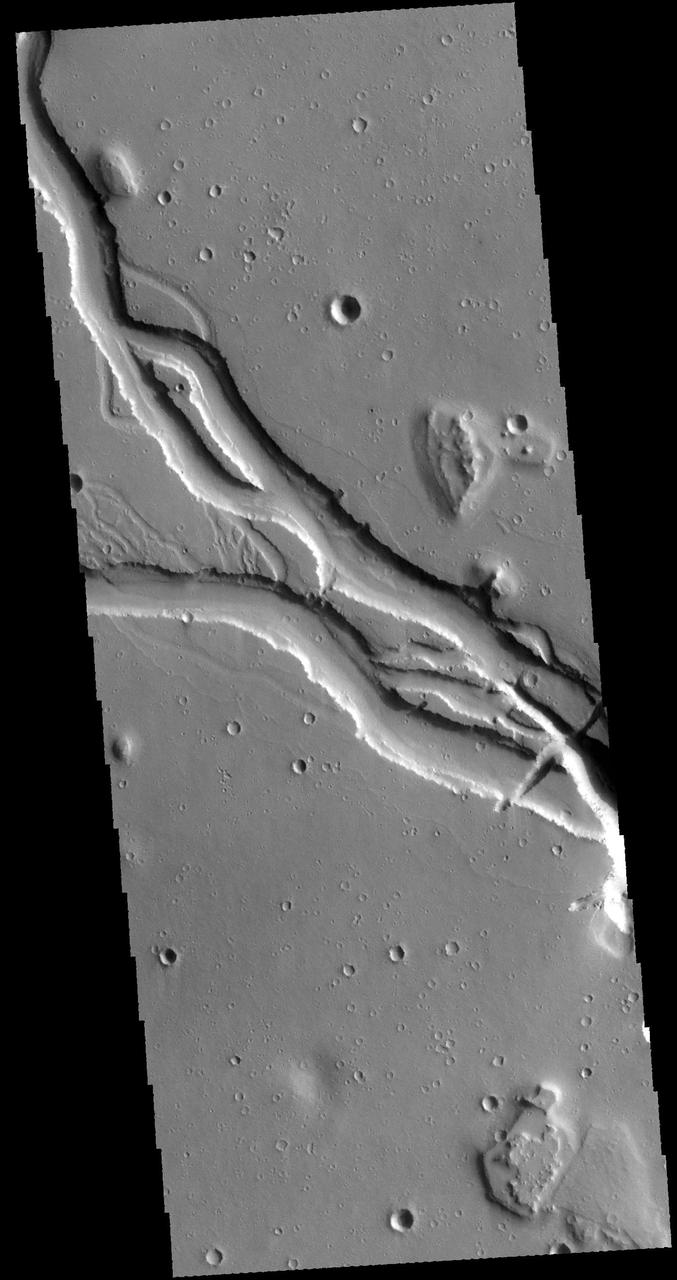
This image captured by NASA 2001 Mars Odyssey spacecraft shows a portion of Hebrus Valles. This channel system was formed by liquid flow of either water or lava, or a combination of both. There is a streamlined island in this image and channels at several different elevations. Orbit Number: 61733 Latitude: 17.9819 Longitude: 127.921 Instrument: VIS Captured: 2015-11-13 20:40 http://photojournal.jpl.nasa.gov/catalog/PIA20234
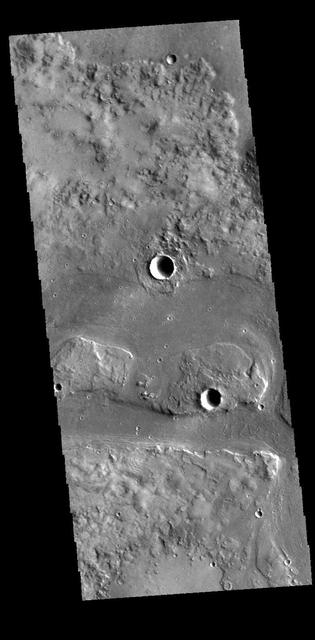
Today's VIS image shows a portion of Granicus Valles. This channel system is located west of Elysium Mons and likely was created by both lava and water flow related to the Elysium Mons volcanic complex. Orbit Number: 61084 Latitude: 28.5697 Longitude: 129.782 Instrument: VIS Captured: 2015-09-21 10:03 http://photojournal.jpl.nasa.gov/catalog/PIA20098
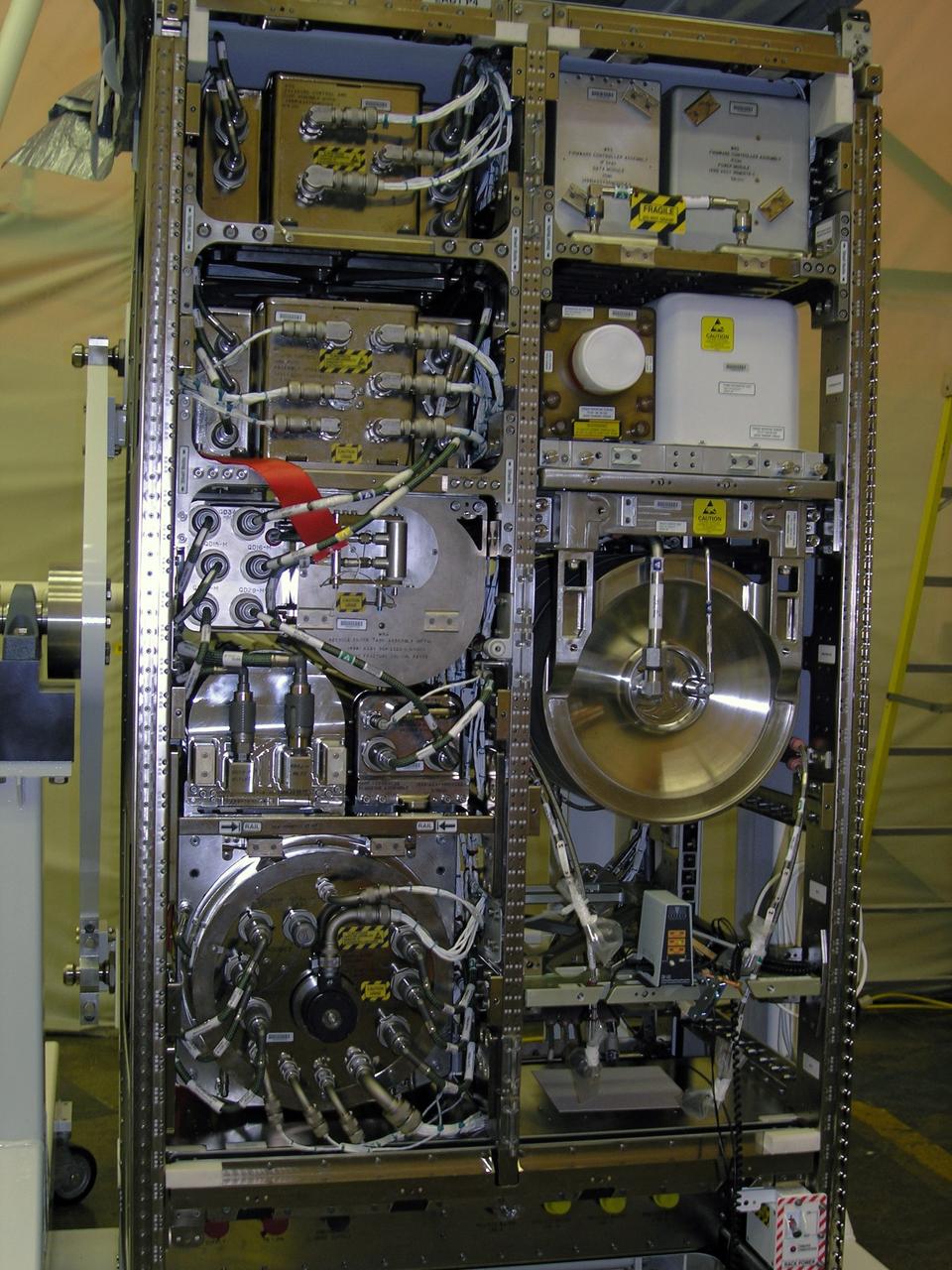
CAPE CANAVERAL, Fla. – This photo shows the Water Recovery System's rack 2, that will be delivered to the International Space Station aboard space shuttle Endeavour on the STS-126 mission. Its primary purpose is to process urine and waster water so that Waste Recovery System's rack 1 can perform the final cleanup. The two units of the Water Recovery System are designed to provide drinking-quality water through the reclamation of wastewater, including urine and hygiene wastes. The water that’s produced will be used to support the crew and work aboard the station. Endeavour and its crew of seven are scheduled to lift off at 7:55 p.m. Nov. 14 for the 15-day STS-126 mission. Photo credit: NASA
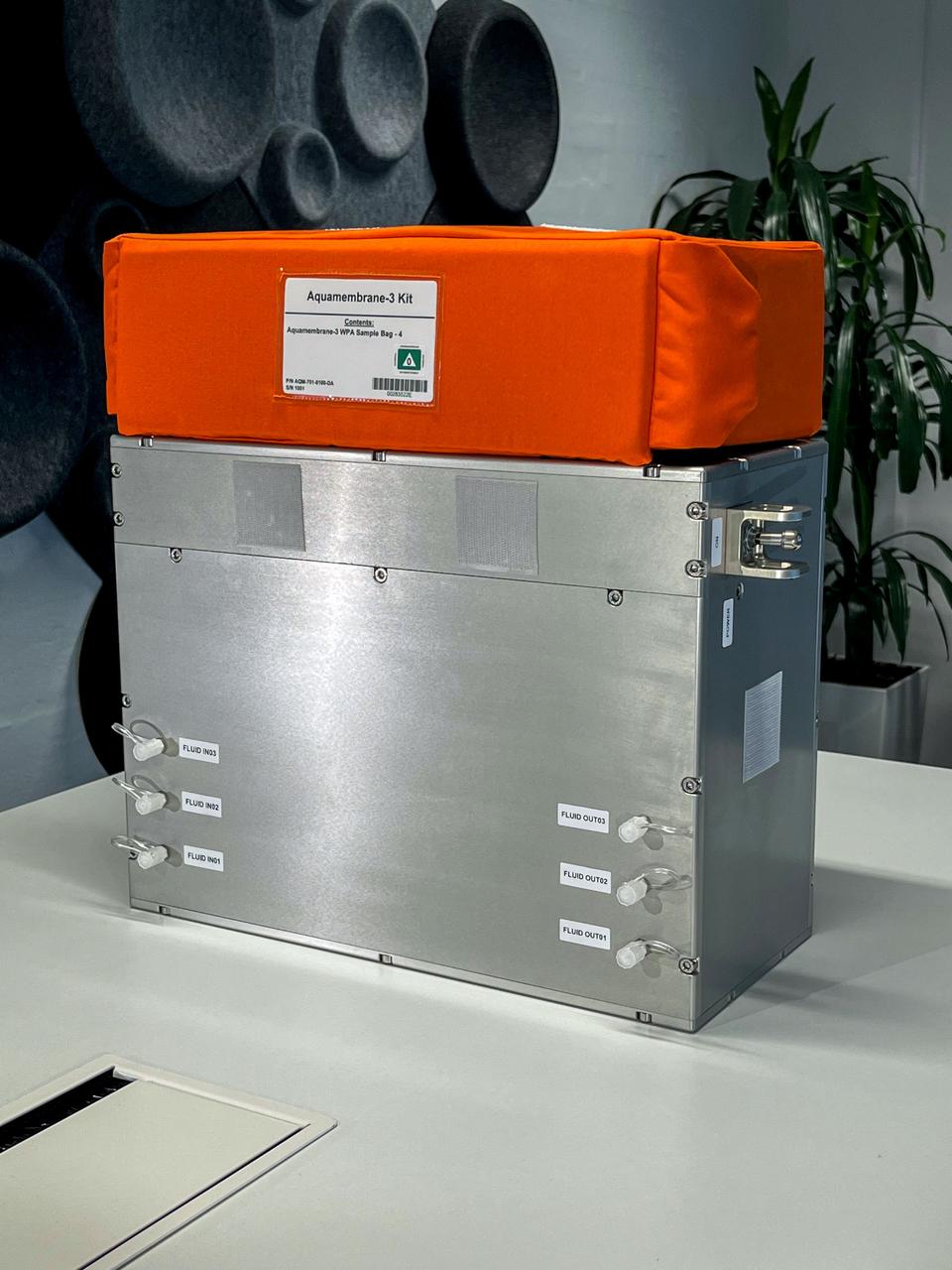
jsc2023e055870 (10/5/2023) --- The Testing Contaminant Rejection of Aquaporin Inside® HFFO Module (Aquamembrane-3) hardware consists of three separate and parallel systems to quantify the membrane's water flux and contamination rejection in microgravity, which are key parameters for a full water recovery system. Aquamembrane-3 tests Aquaporin Inside™ membranes for spacecraft use, a unique water filtration method that mimics fluid transport found in every living cell. Image courtesy of Danish Aerospace Company.
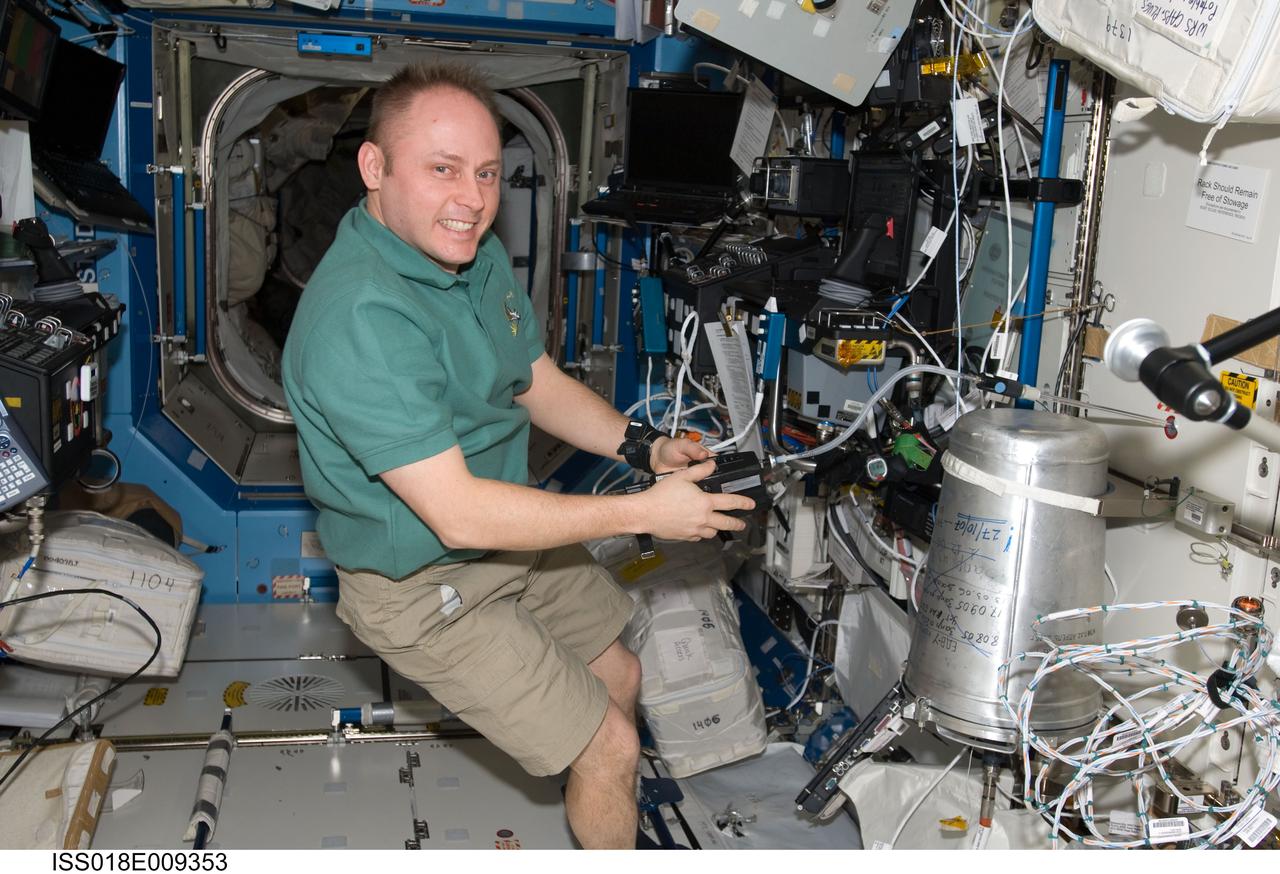
ISS018-E-009353 (20 Nov. 2008) --- Astronaut Michael Fincke, Expedition 18 commander, works in the Destiny laboratory of the International Space Station while Space Shuttle Endeavour (STS-126) remains docked with the station.
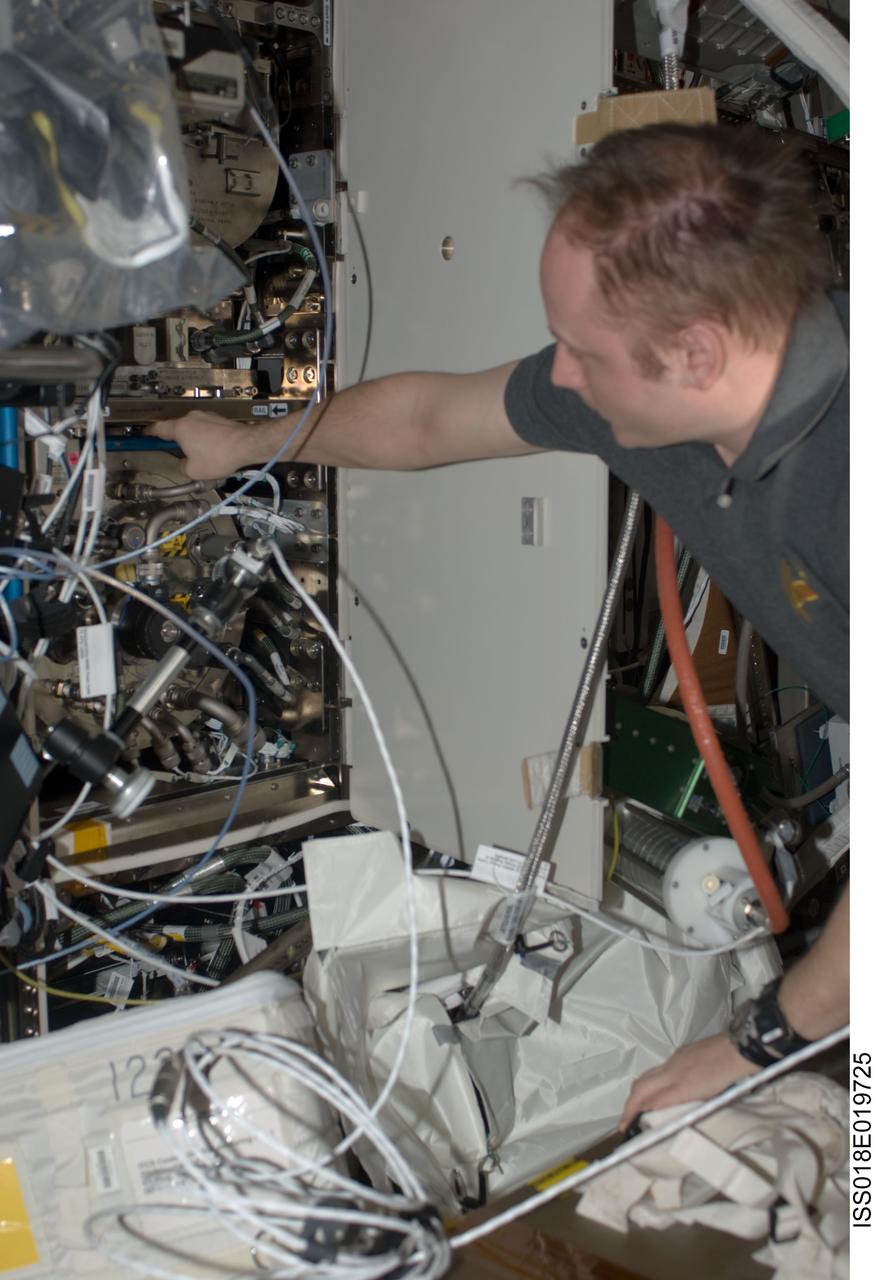
ISS018-E-019725 (9 Jan. 2009) --- Astronaut Michael Fincke, Expedition 18 commander, works on hardware in the Destiny laboratory of the International Space Station.
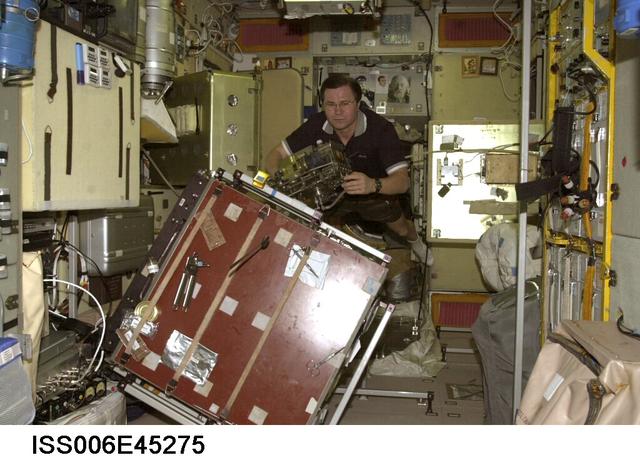
ISS006-E-45275 (21 March 2003) --- Cosmonaut Nikolai M. Budarin, Expedition Six flight engineer, holds a piece of hardware near a worktable in the Zvezda Service Module on the International Space Station (ISS). Budarin represents Rosaviakosmos.
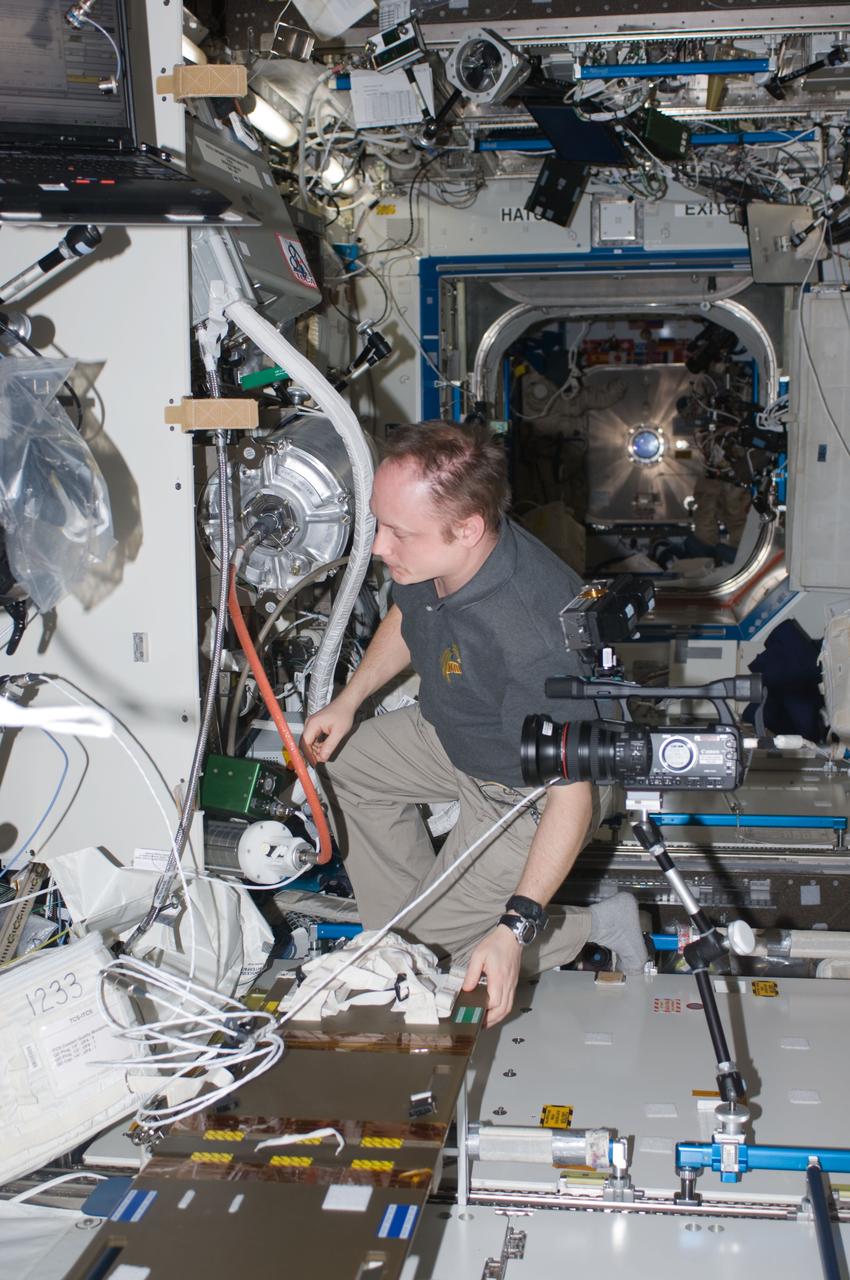
ISS018-E-019723 (9 Jan. 2009) --- Astronaut Michael Fincke, Expedition 18 commander, works on hardware in the Destiny laboratory of the International Space Station.
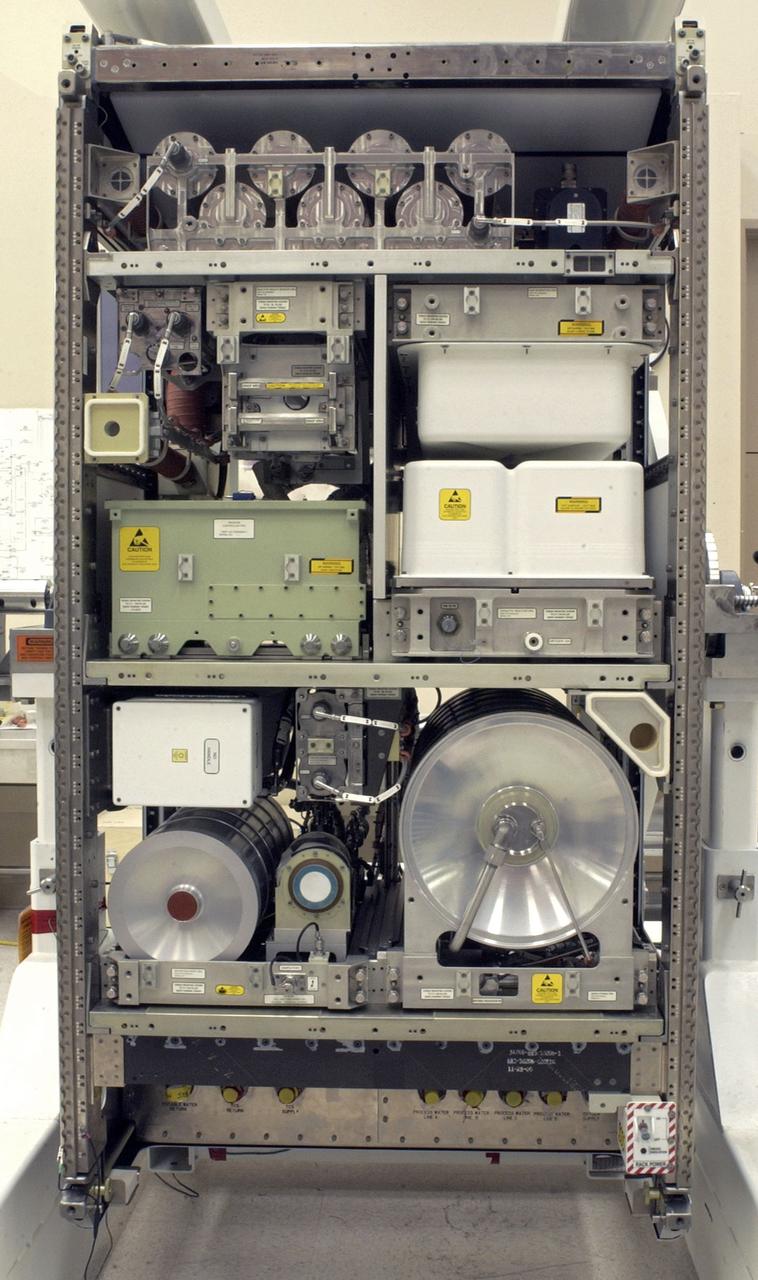
CAPE CANAVERAL, Fla. – This photo shows the Water Recovery System's rack 1 that will be delivered to the International Space Station aboard space shuttle Endeavour on the STS-126 mission. The two units of the Water Recovery System are designed to provide drinking-quality water through the reclamation of wastewater, including urine and hygiene wastes. The water that’s produced will be used to support the crew and work aboard the station. Endeavour and its crew of seven are scheduled to lift off at 7:55 p.m. Nov. 14 for the 15-day STS-126 mission. Photo credit: NASA
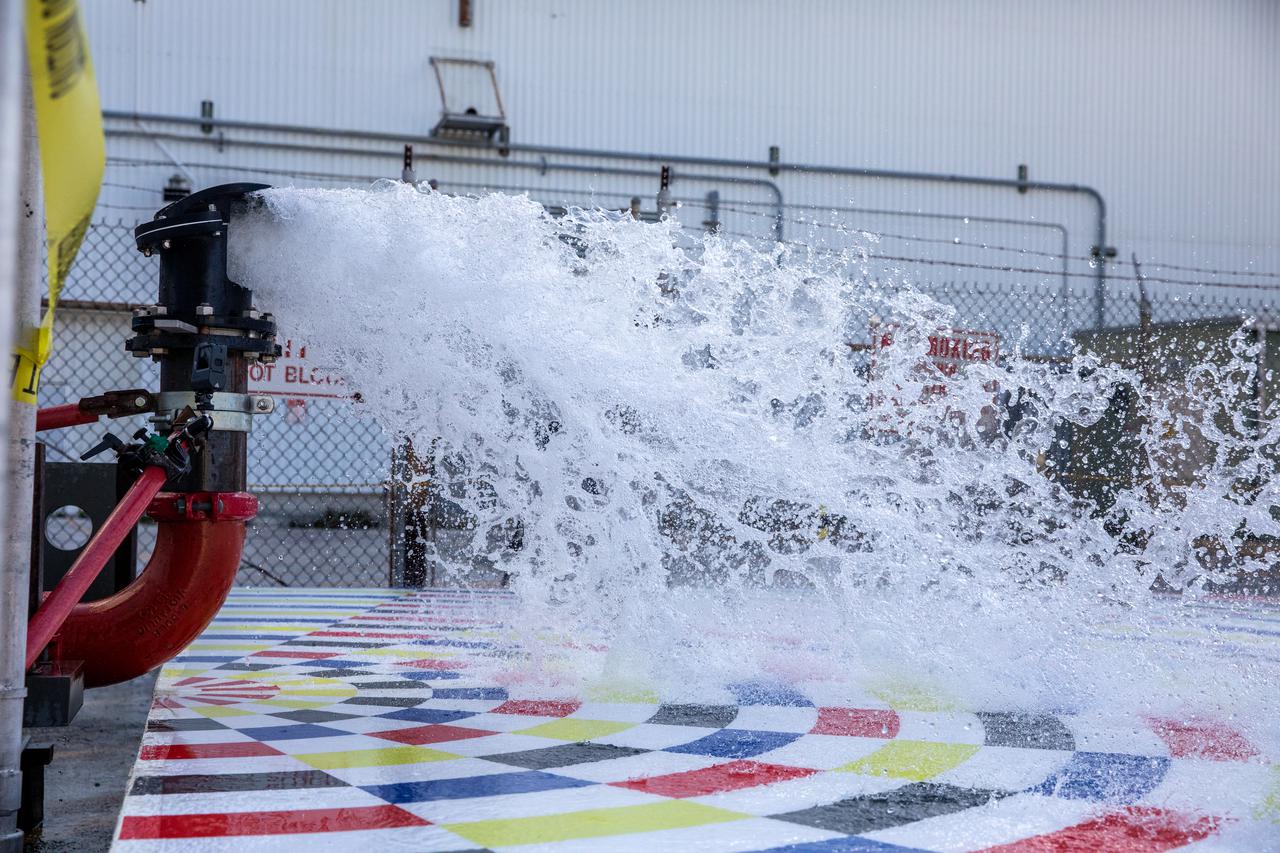
Water flows through a small-scale, 3D-printed nozzle during prototype testing of a new rainbird system on March 24, 2021, at NASA’s Kennedy Space Center in Florida. Rainbirds are large water nozzles located on the mobile launcher (ML) that release a high volume of water when the Space Launch System (SLS) rocket lifts off, protecting the vehicle, launch pad, and ML by absorbing some of the heat and energy generated during launch. The test involved running various water pressures through smaller nozzles to capture data that can be used to develop full-scale replacement nozzles for future missions under the Artemis program.
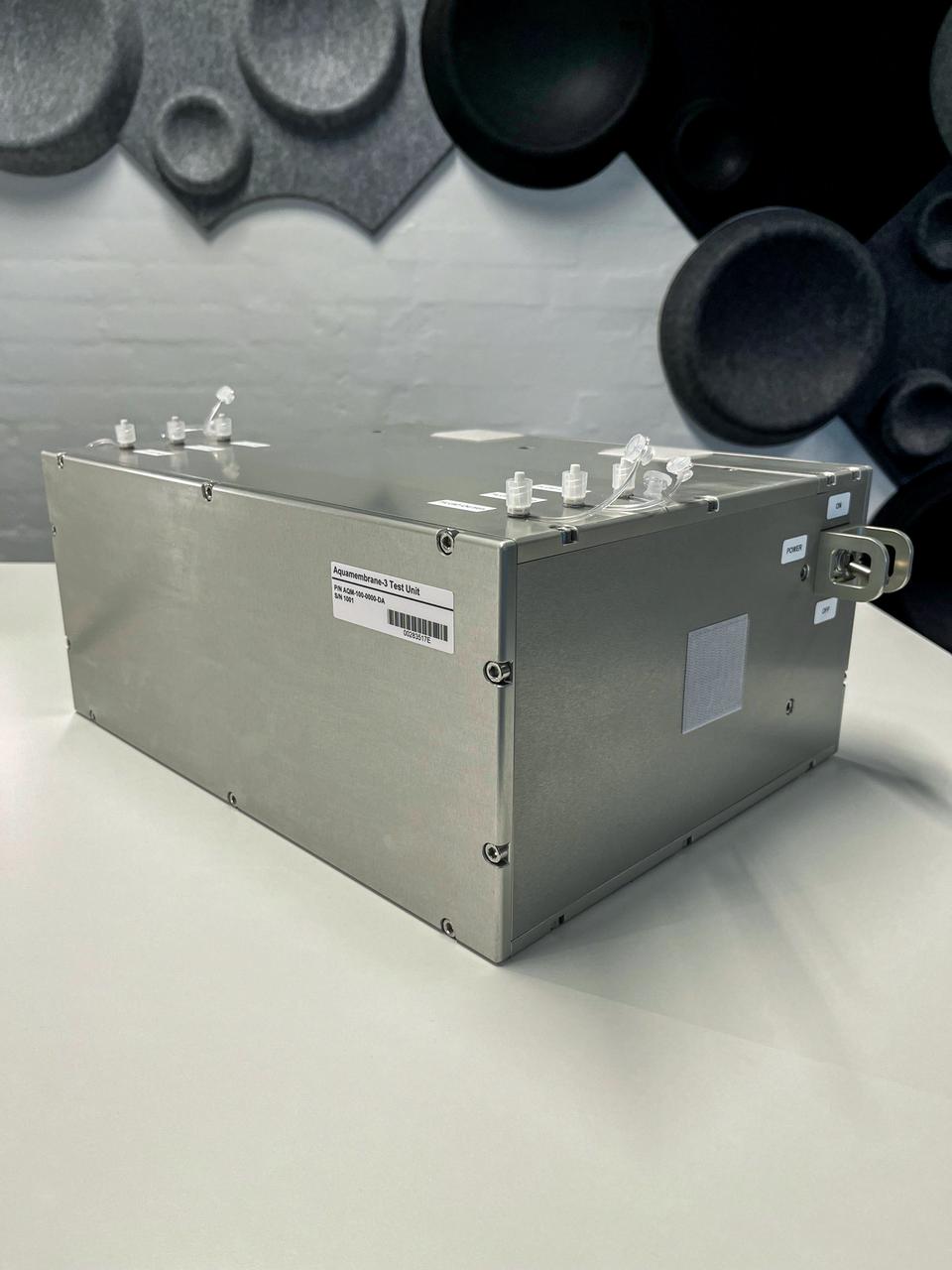
jsc2023e055873 (10/5/2023) --- The Testing Contaminant Rejection of Aquaporin Inside® HFFO Module (Aquamembrane-3) hardware consists of three separate and parallel systems to quantify the membrane's water flux and contamination rejection in microgravity, which are key parameters for a full water recovery system. This image shows the unit containing the forward osmosis membranes and other fluid system components.
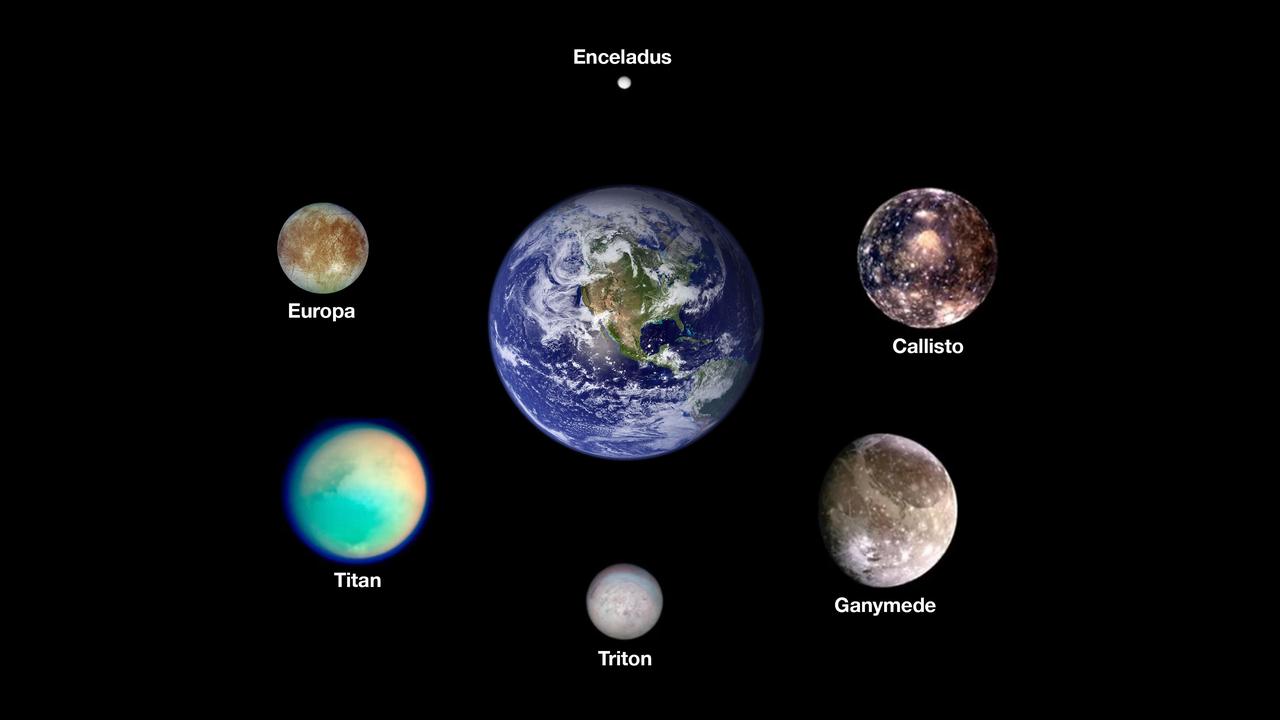
Scientists think six icy moons in our solar system may currently host oceans of liquid water beneath their outer surfaces. Arranged around Earth are images from NASA spacecraft of, clockwise from the top, Saturn's moon Enceladus, Jupiter's moons Callisto and Ganymede, Neptune's moon Triton, Saturn's moon Titan, and Jupiter's moon Europa, the target of NASA's Europa Clipper mission. The worlds here are shown to scale. The images of the Saturnian moons were taken by NASA's Cassini mission. The images of the Jovian moons were taken by NASA's Galileo mission. The image of Triton was taken by NASA's Voyager 2 mission. The image of Earth was stitched together using months of satellite-based observations, mostly using data from the Moderate Resolution Imaging Spectroradiometer (MODIS) on NASA's Terra satellite. https://photojournal.jpl.nasa.gov/catalog/PIA26103
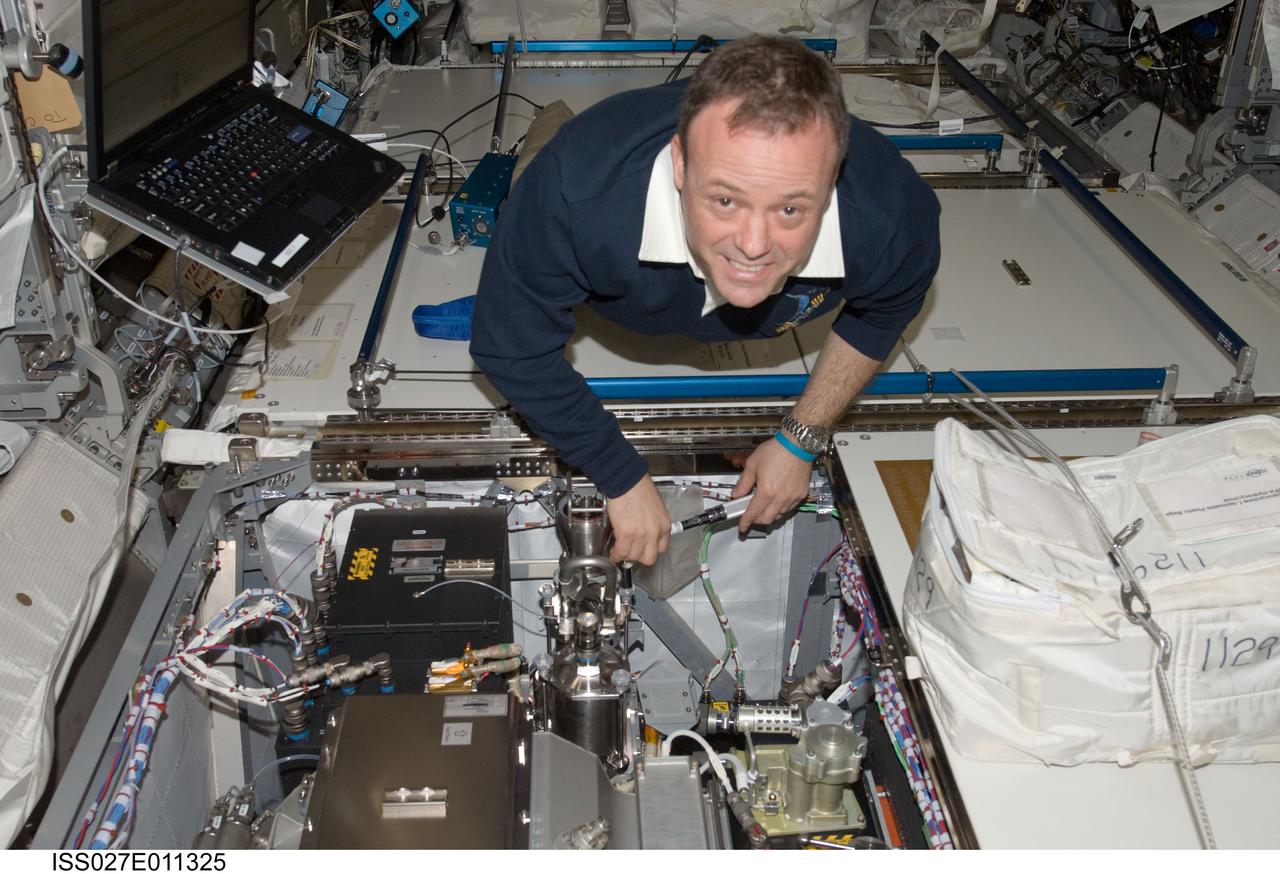
ISS027-E-011325 (8 April 2011) --- NASA astronaut Ron Garan, Expedition 27 flight engineer, works on degassing the water loop of the running Water Pump Assembly 2 / Thermal Control System (WPA2/TCS) in the Columbus laboratory of the International Space Station.
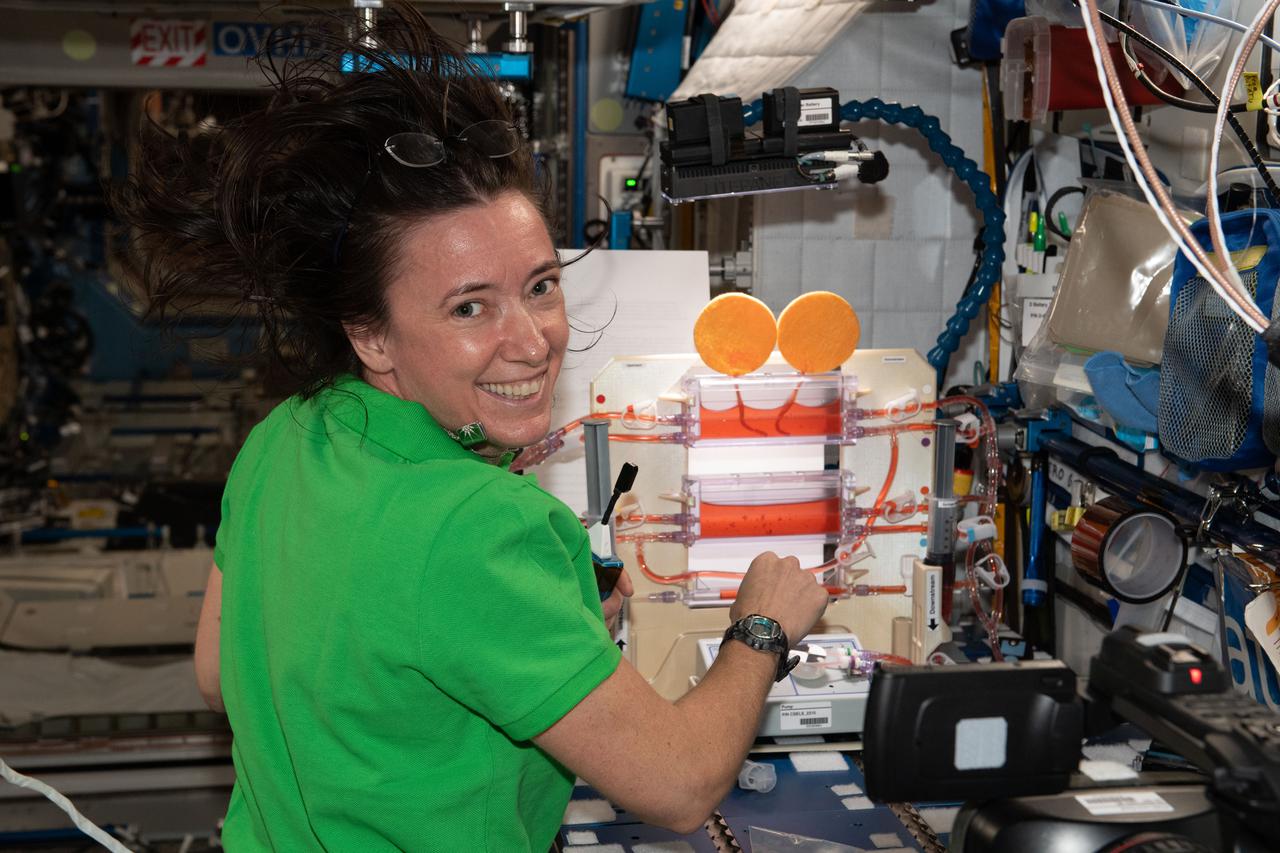
iss065e206774 (July 27, 2021) --- NASA astronaut and Expedition 65 Flight Engineer Megan McArthur works on the Plant Water Management space botany study that explores operating hydroponics in microgravity and may also improve watering systems on Earth.
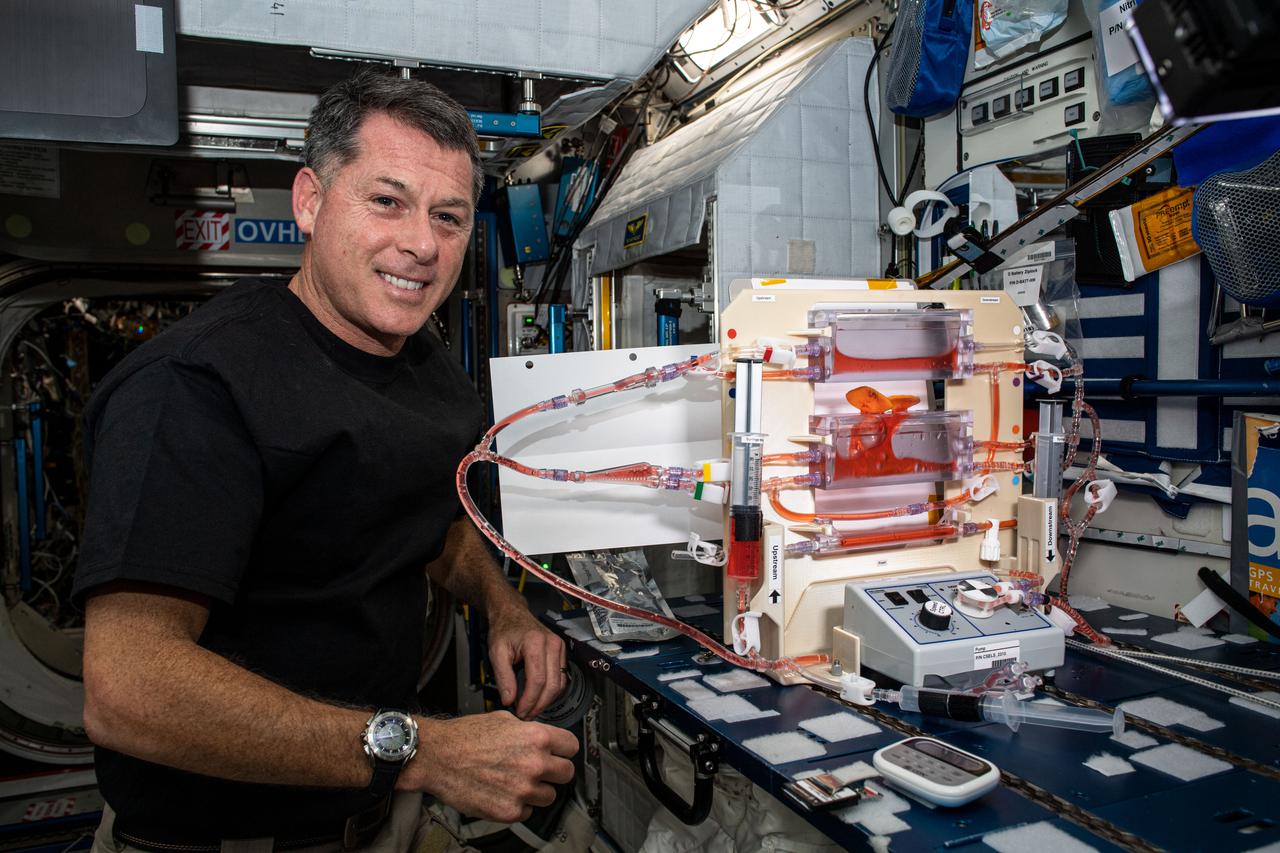
iss065e074538 (May 27, 2021) --- NASA astronaut and Expedition 65 Flight Engineer Shane Kimbrough conducts cylinder test operations for the Plant Water Management experiment. The space botany study explores hydroponics in microgravity and may also improve watering systems on Earth.
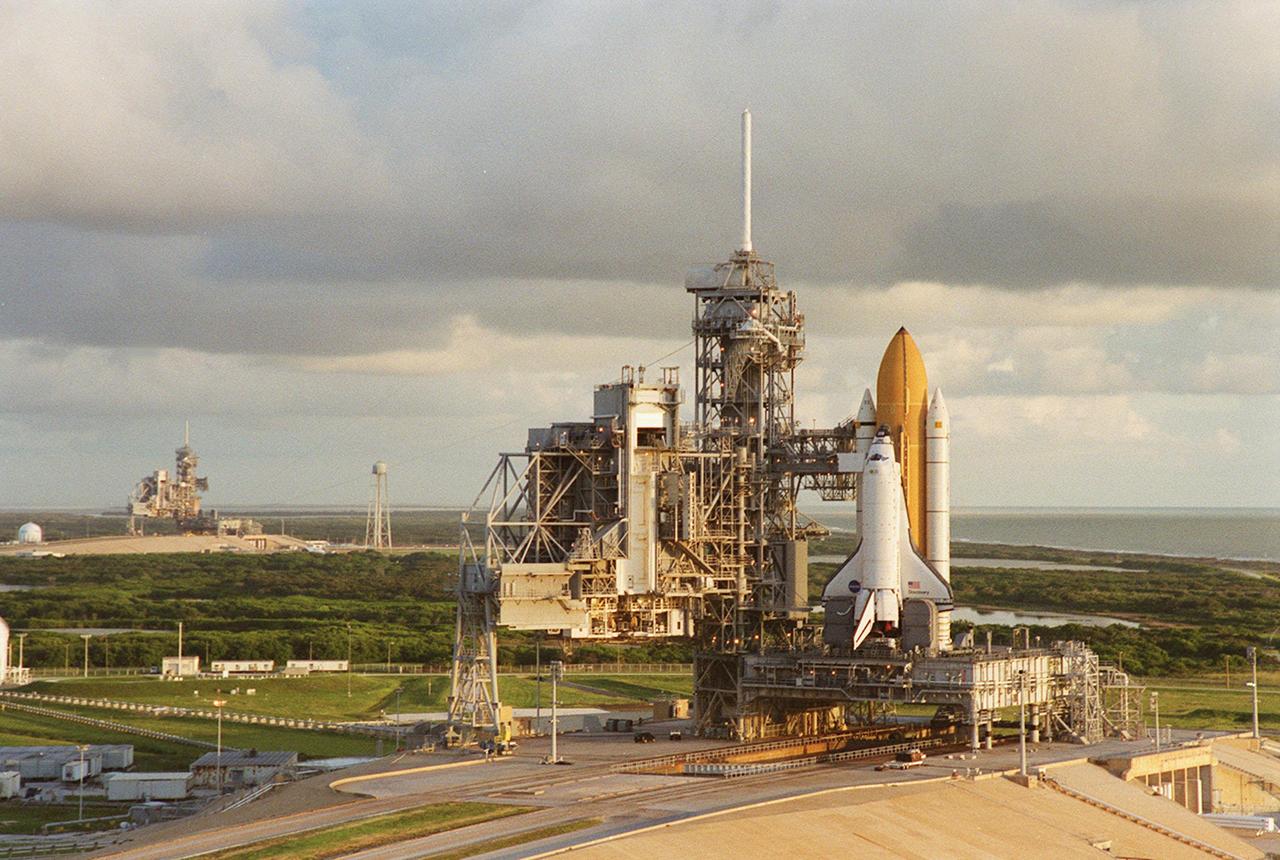
Cloudy skies form a backdrop for Launch Pads 39B (left) and 39A (foreground). Space Shuttle Discovery waits on top of the pad for its launch Oct. 5 to the International Space Station. Between the pads can be seen the 300,000-gallon water tank that provides water for the sound suppression system during launch.

ISS027-E-011324 (8 April 2011) --- NASA astronaut Ron Garan, Expedition 27 flight engineer, works on degassing the water loop of the running Water Pump Assembly 2 / Thermal Control System (WPA2/TCS) in the Columbus laboratory of the International Space Station.
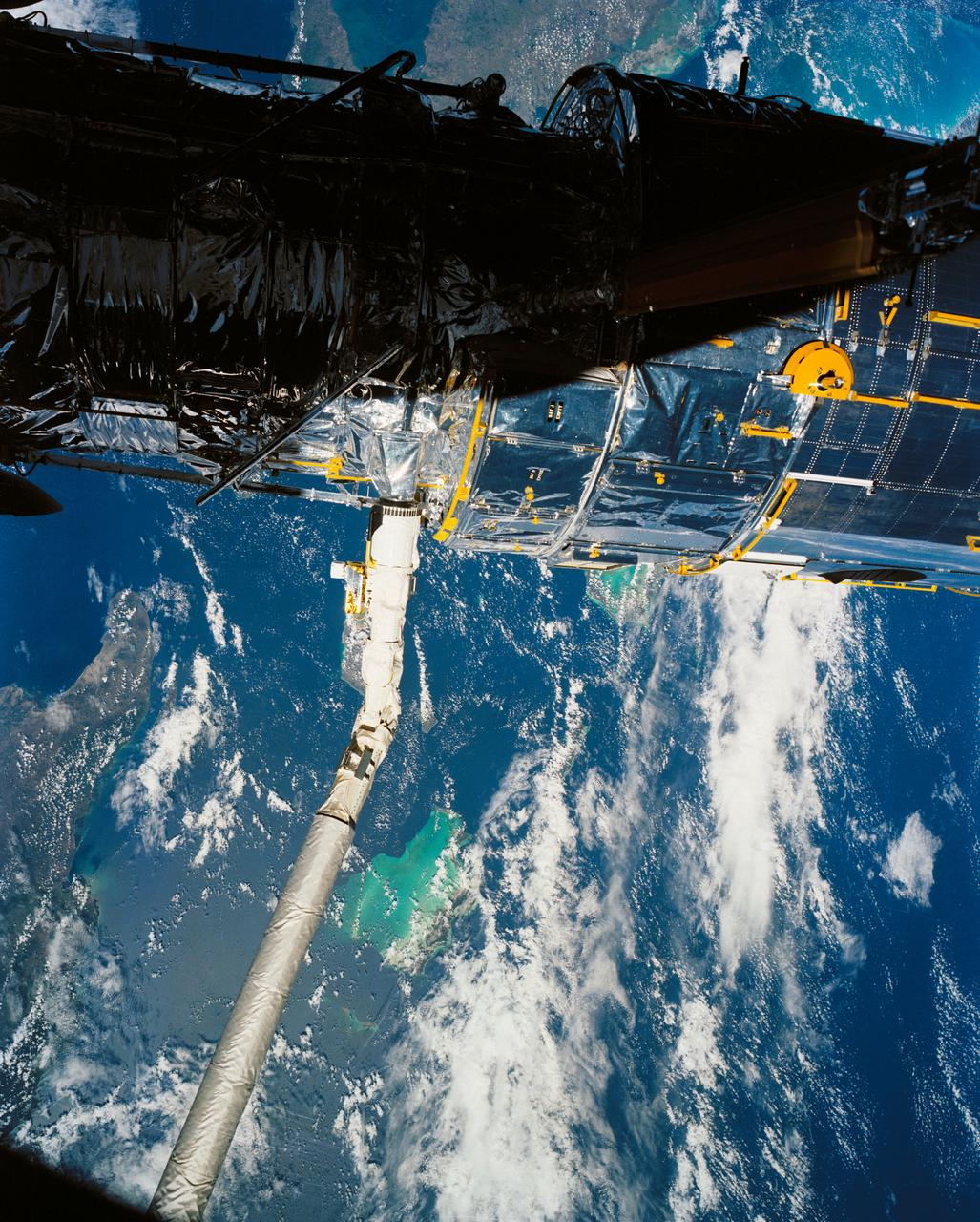
A close up deploy view of the Hubble Space Telescope on the end of the space shuttle remote manipulator system (RMS) with Eastern Cuba, (20.0N, 74.0W) seen on the left side of the telescope and northern Haiti seen on the right side of the telescope. The light colored blue feature in the water north of Haiti is the shallow waters of the Caicos Bank.
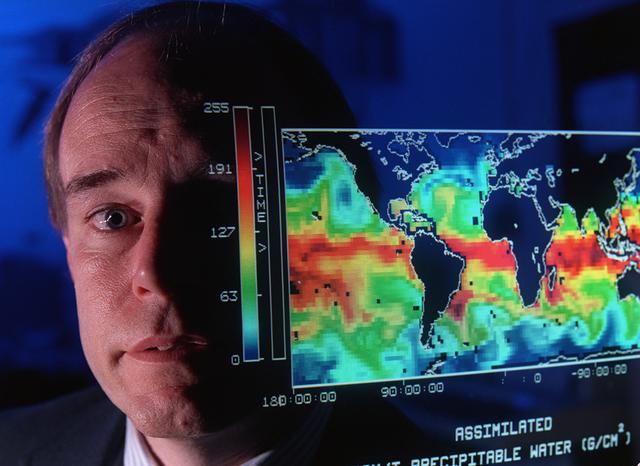
This map shows the presence of water vapor over global oceans. The imagery was produced by combining Special Sensor Microwave Imager measurements and computer models. This data will help scientists better understand how weather systems move water vapor from the tropics toward the poles producing precipitation.
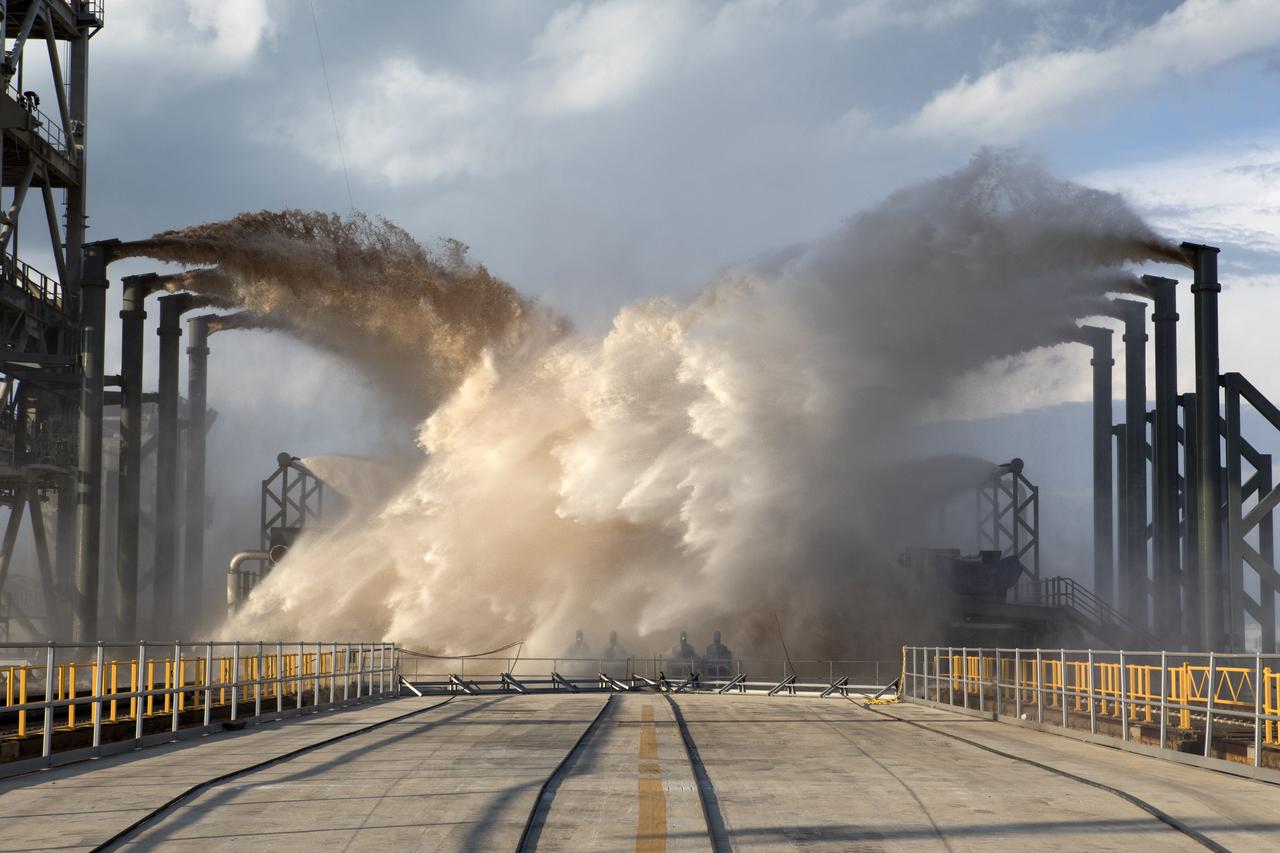
Water sprays onto Launch Complex 39A during a test by SpaceX of the sound suppression system at the launch pad. The water deluge diminishes vibration at the pad during a liftoff to protect the pad structures and rocket itself from excessive shaking. Photo credit: NASA/Kim Shiflett
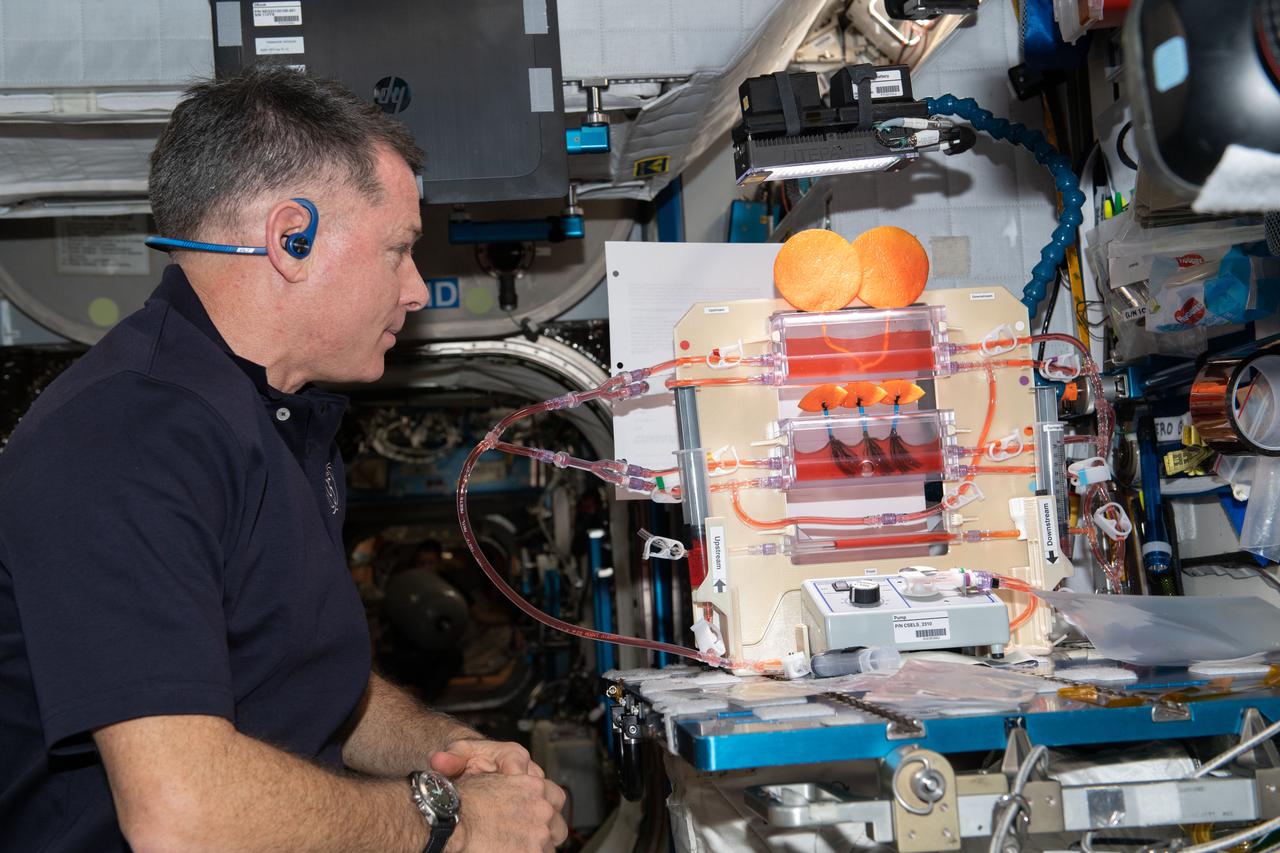
iss065e208539 (July 28, 2021) --- NASA astronaut and Expedition 65 Flight Engineer Shane Kimbrough works on the Plant Water Management space botany study that explores operating hydroponics in microgravity and may also improve watering systems on Earth.
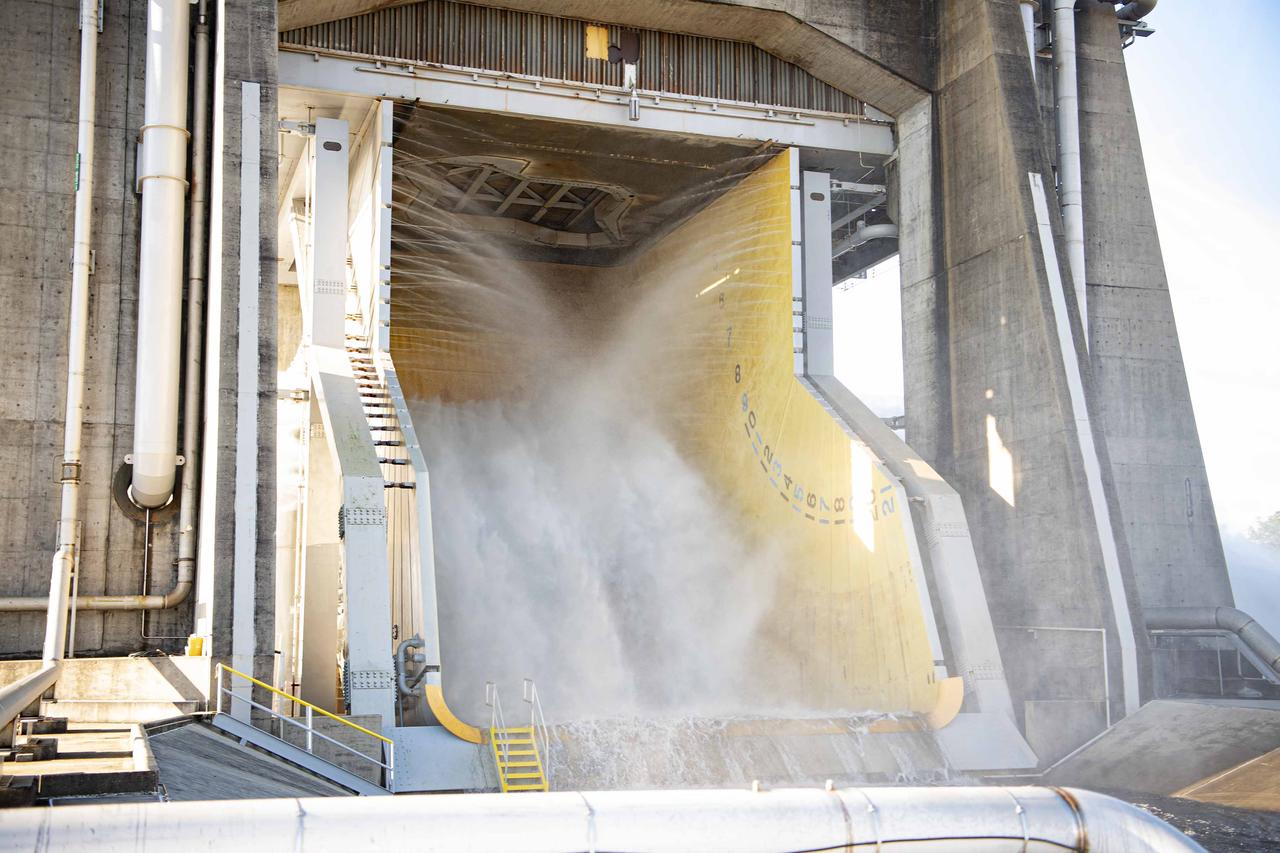
Crews conduct a planned flame deflector water flow system flush on the Fred Haise Test Stand at NASA’s Stennis Space Center on Oct. 22, following the recent completion of upgrades to the High Pressure Industrial Water Facility’s underground piping network. The flush, a periodic procedure to ensure system functionality and performance, involves flowing 150,000 gallons or more per minute from the High Pressure Industrial Water Facility to the stand. It also continues stand preparations for testing RS-25 flight engines for use on future Artemis missions to the Moon and beyond.
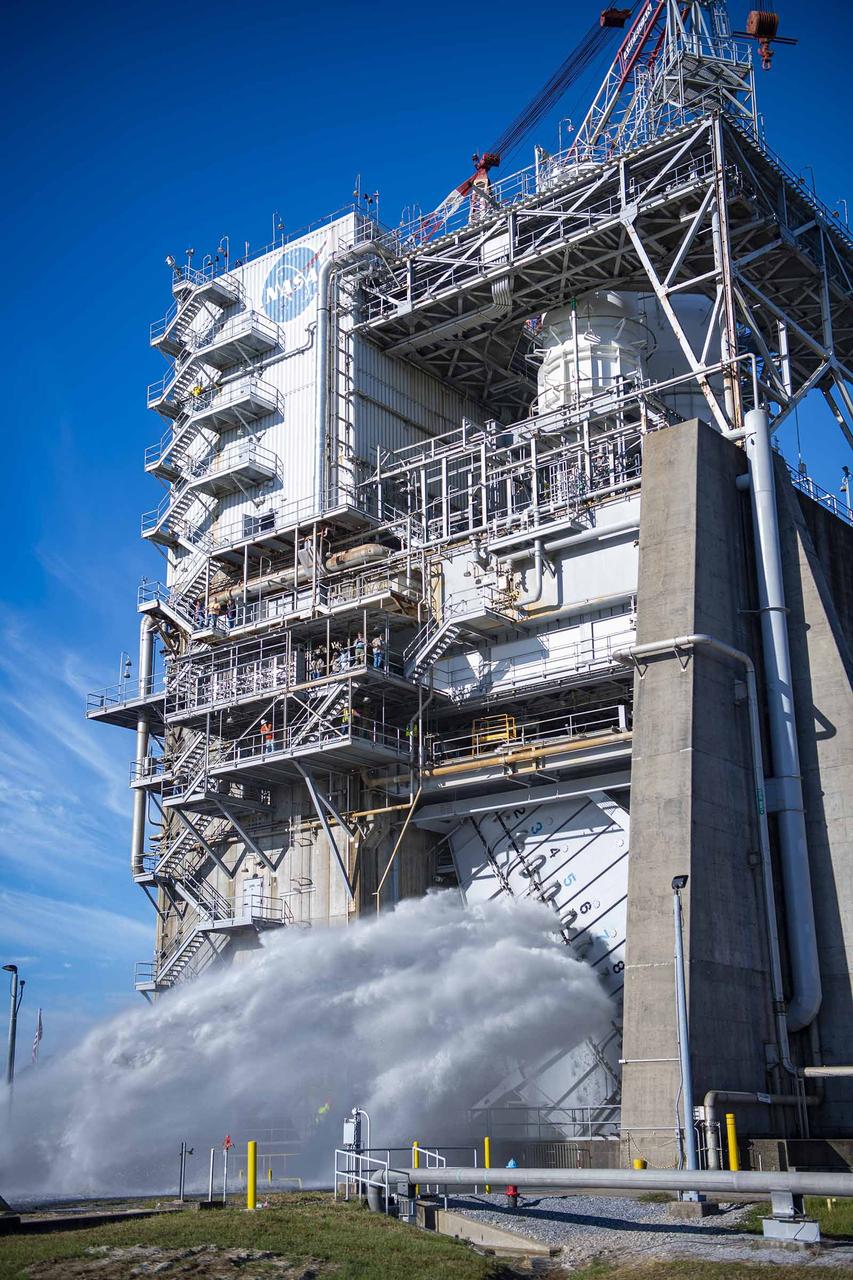
Crews conduct a planned flame deflector water flow system flush on the Fred Haise Test Stand at NASA’s Stennis Space Center on Oct. 22, following the recent completion of upgrades to the High Pressure Industrial Water Facility’s underground piping network. The flush, a periodic procedure to ensure system functionality and performance, involves flowing 150,000 gallons or more per minute from the High Pressure Industrial Water Facility to the stand. It also continues stand preparations for testing RS-25 flight engines for use on future Artemis missions to the Moon and beyond.
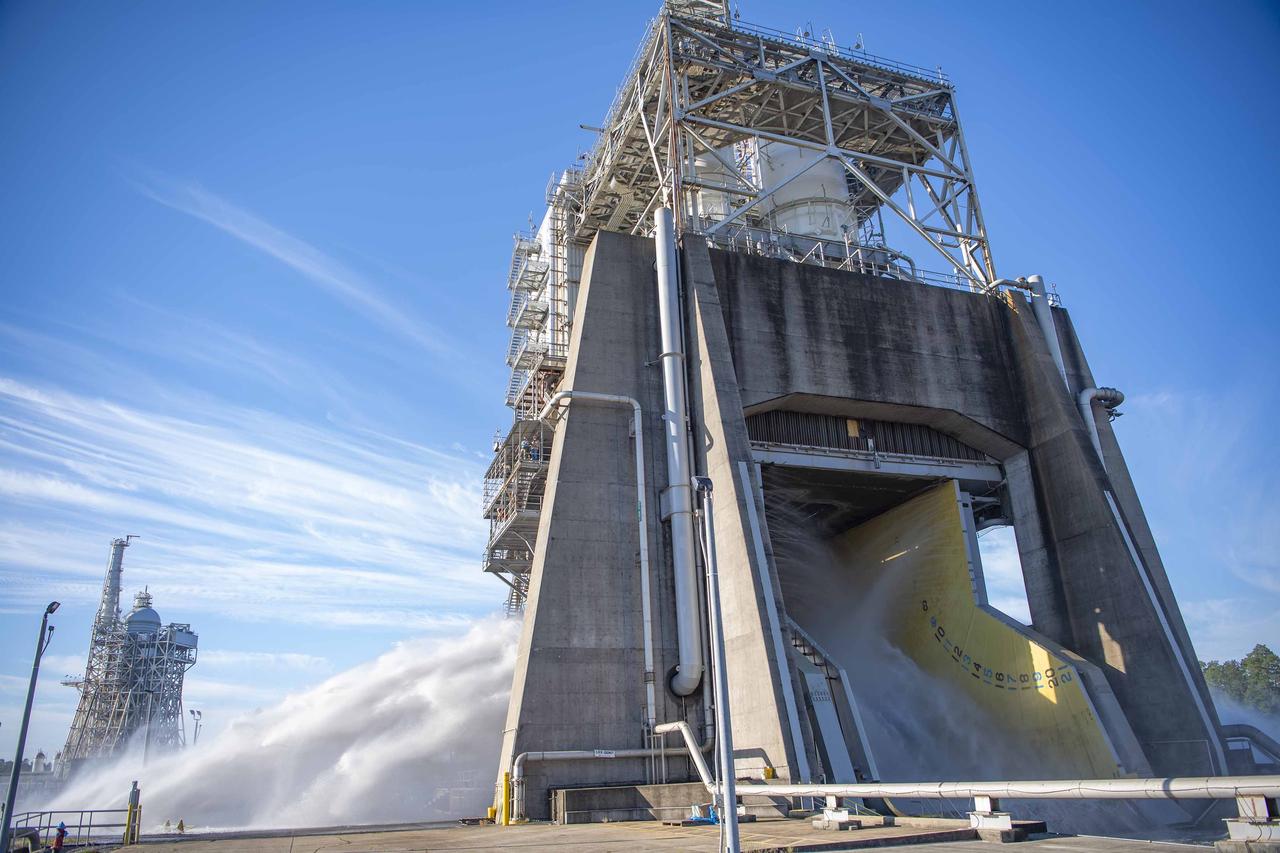
Crews conduct a planned flame deflector water flow system flush on the Fred Haise Test Stand at NASA’s Stennis Space Center on Oct. 22, following the recent completion of upgrades to the High Pressure Industrial Water Facility’s underground piping network. The flush, a periodic procedure to ensure system functionality and performance, involves flowing 150,000 gallons or more per minute from the High Pressure Industrial Water Facility to the stand. It also continues stand preparations for testing RS-25 flight engines for use on future Artemis missions to the Moon and beyond.