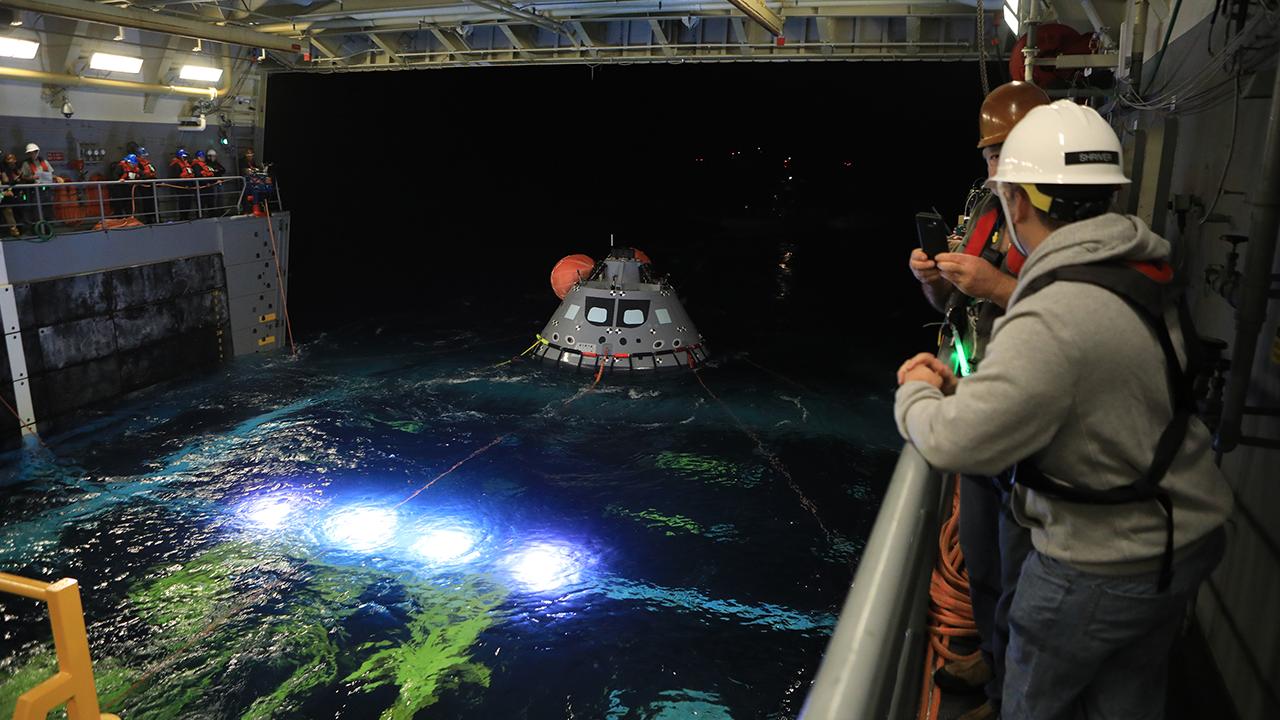
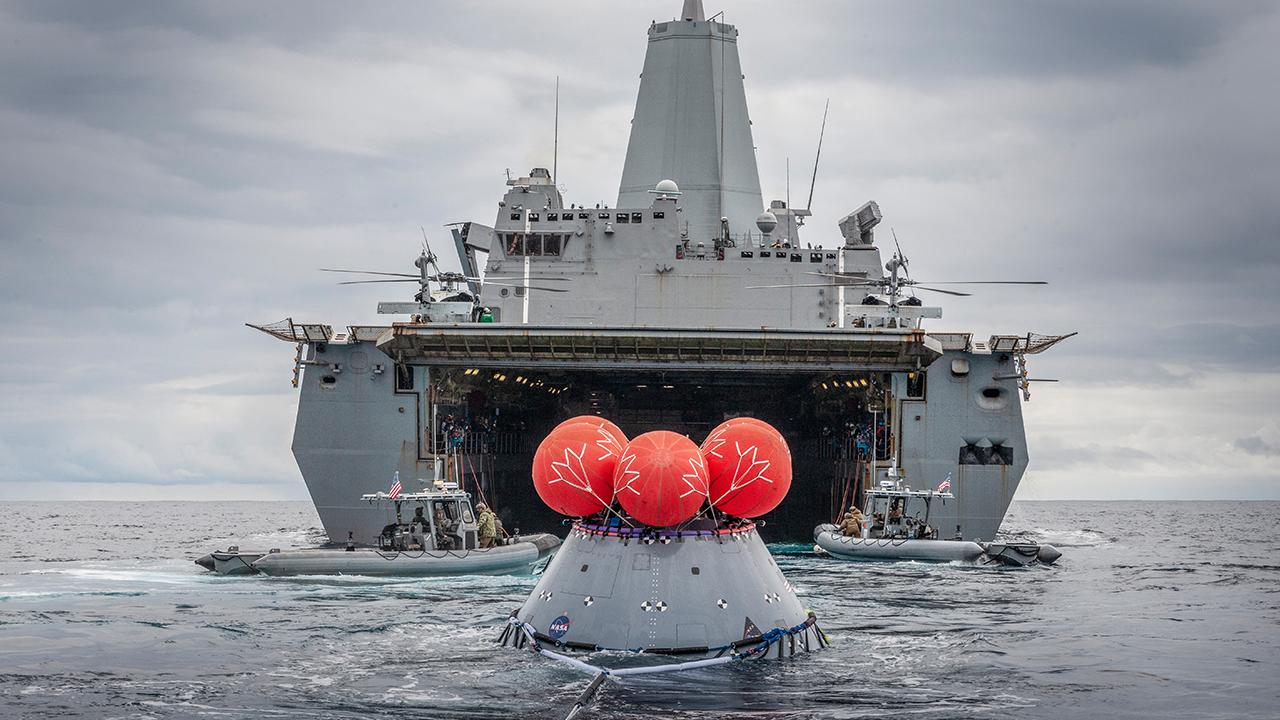
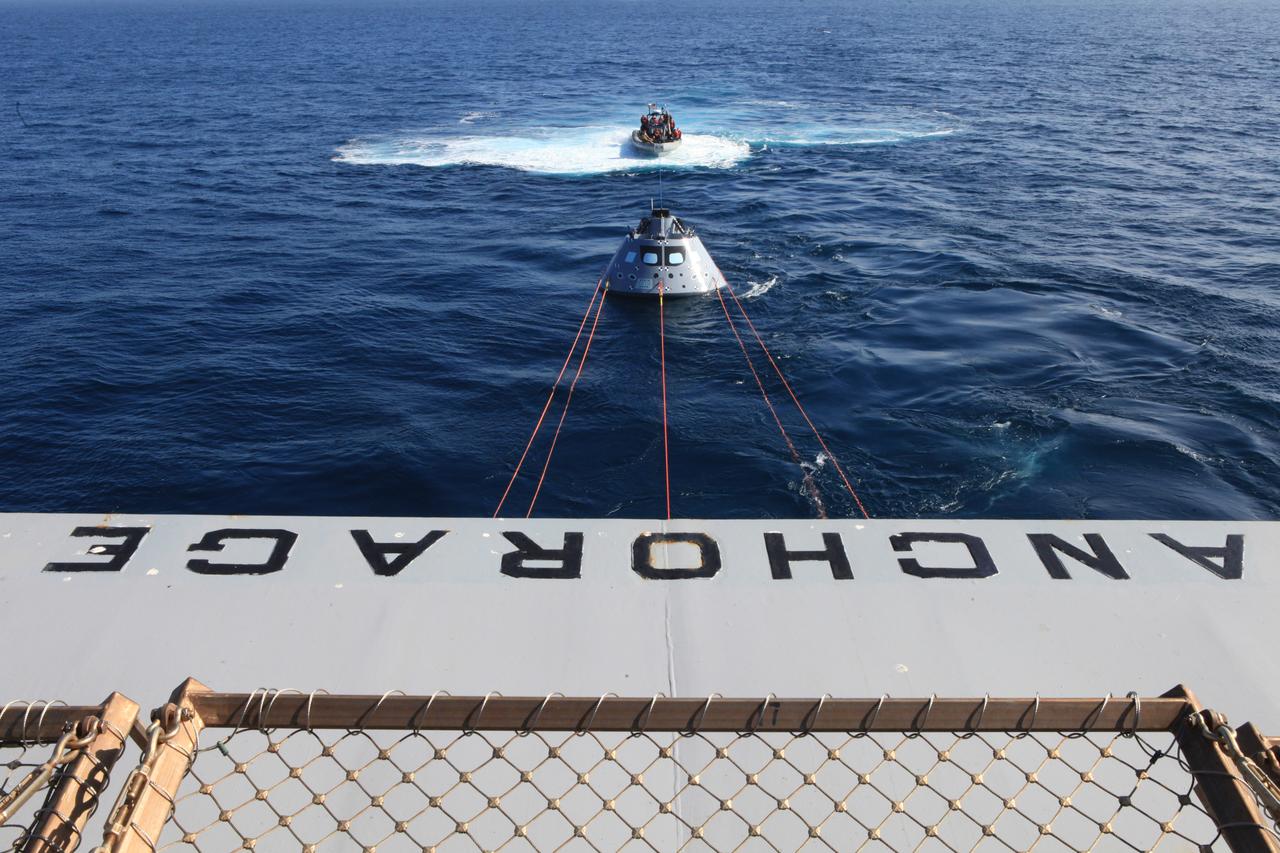
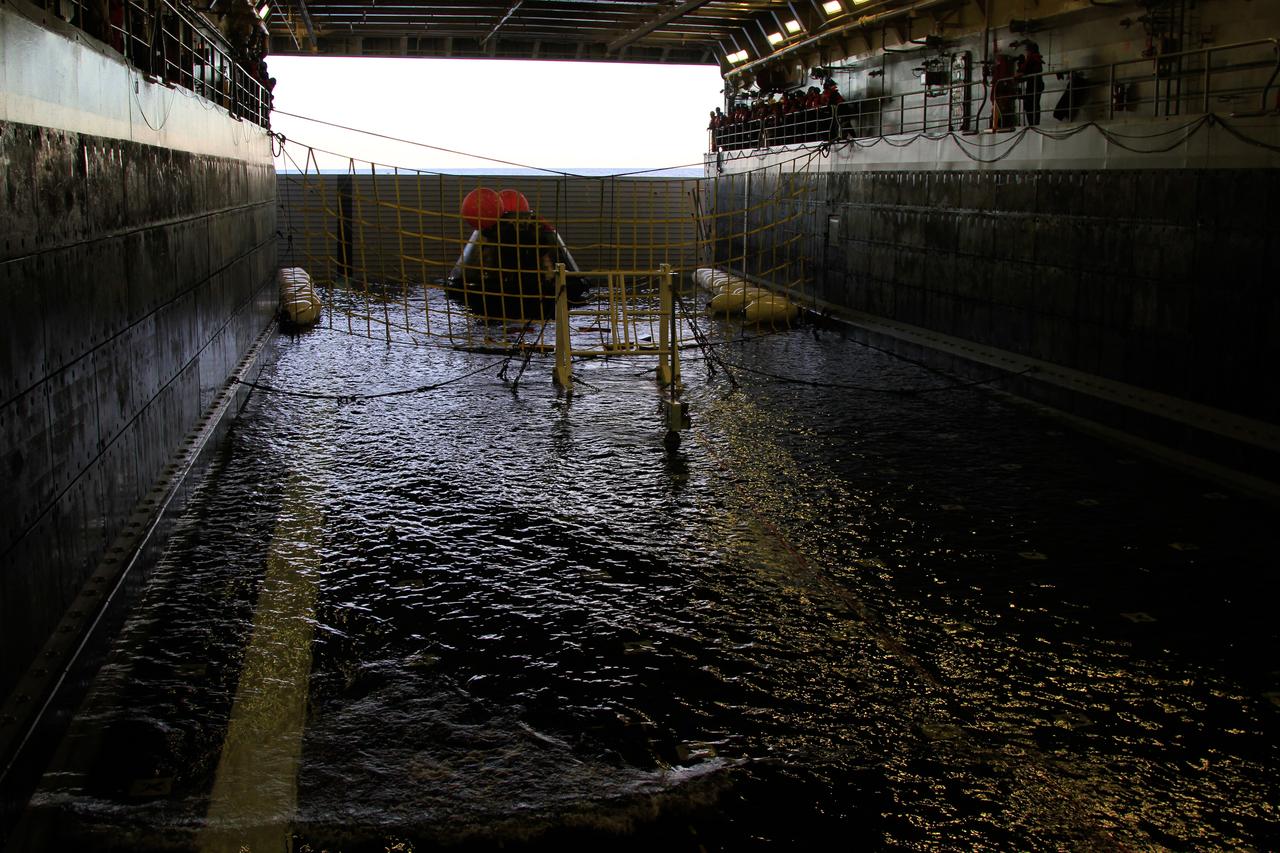
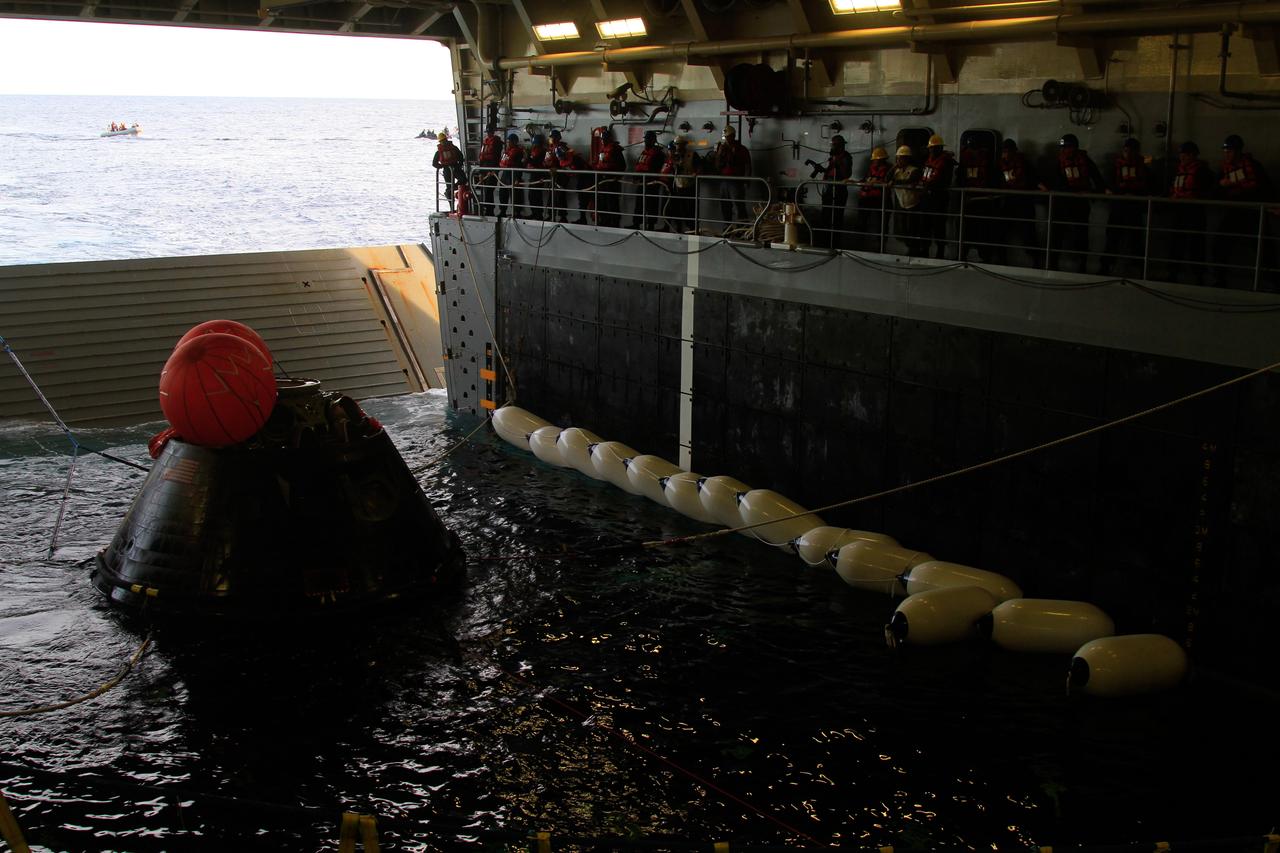
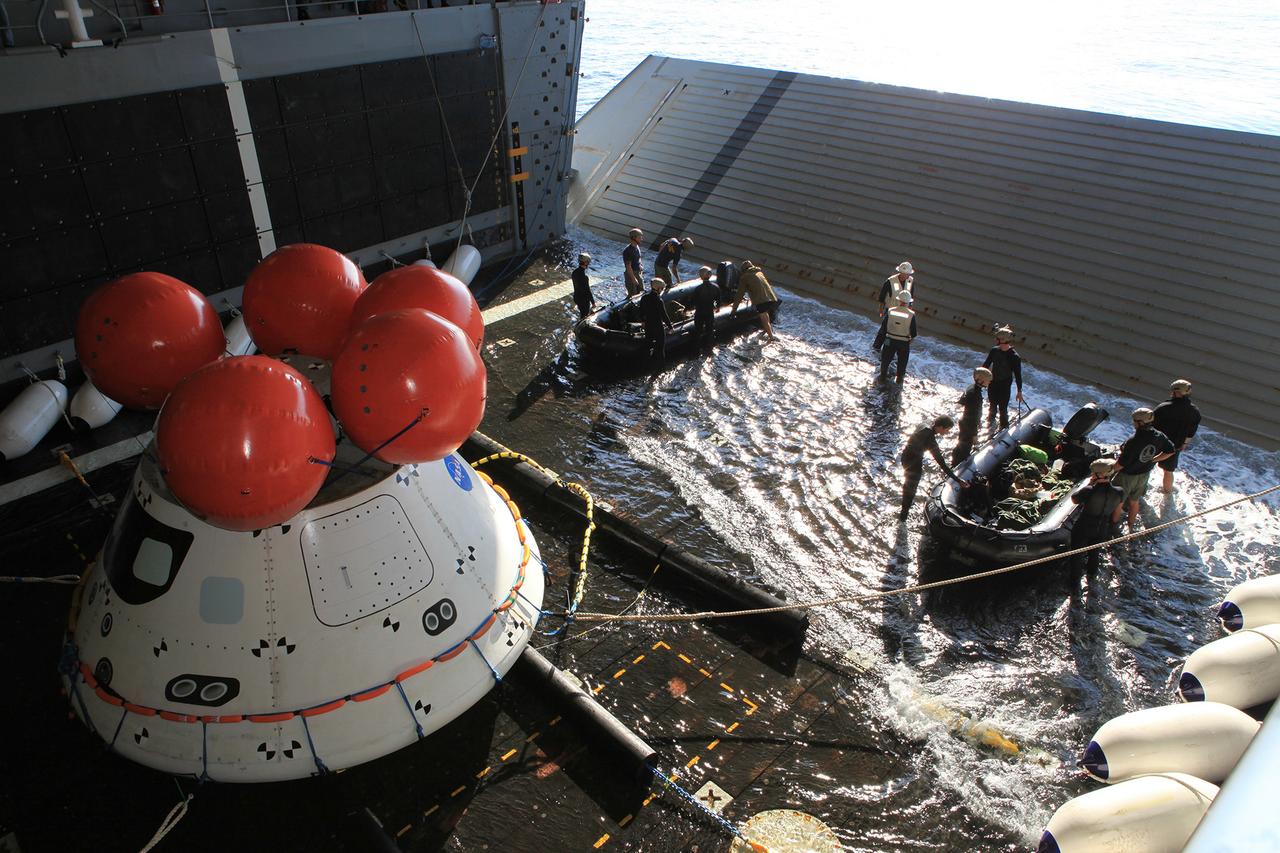
Off the rear of the USS Anchorage, the Orion test article is pulled in by a winch line at the rear of the USS Anchorage’s well deck that brings the capsule into the ship, along with four manned LLAMAs (Line Load Attenuation Mechanism Assembly) that control the capsule’s side-to-side movement and a tending line attached to a rigid hull inflatable boat for controlling Orion’s movement behind the ship. The Underway Recovery Test 6 (URT-6) is spearheaded by Kennedy Space Center's NASA Recovery Team. In partnership with the U.S. Navy, the testing will provide important data that is being used to improve recovery procedures and hardware ahead of Orion's next flight, Exploration Mission-1, when it splashes down in the Pacific Ocean.
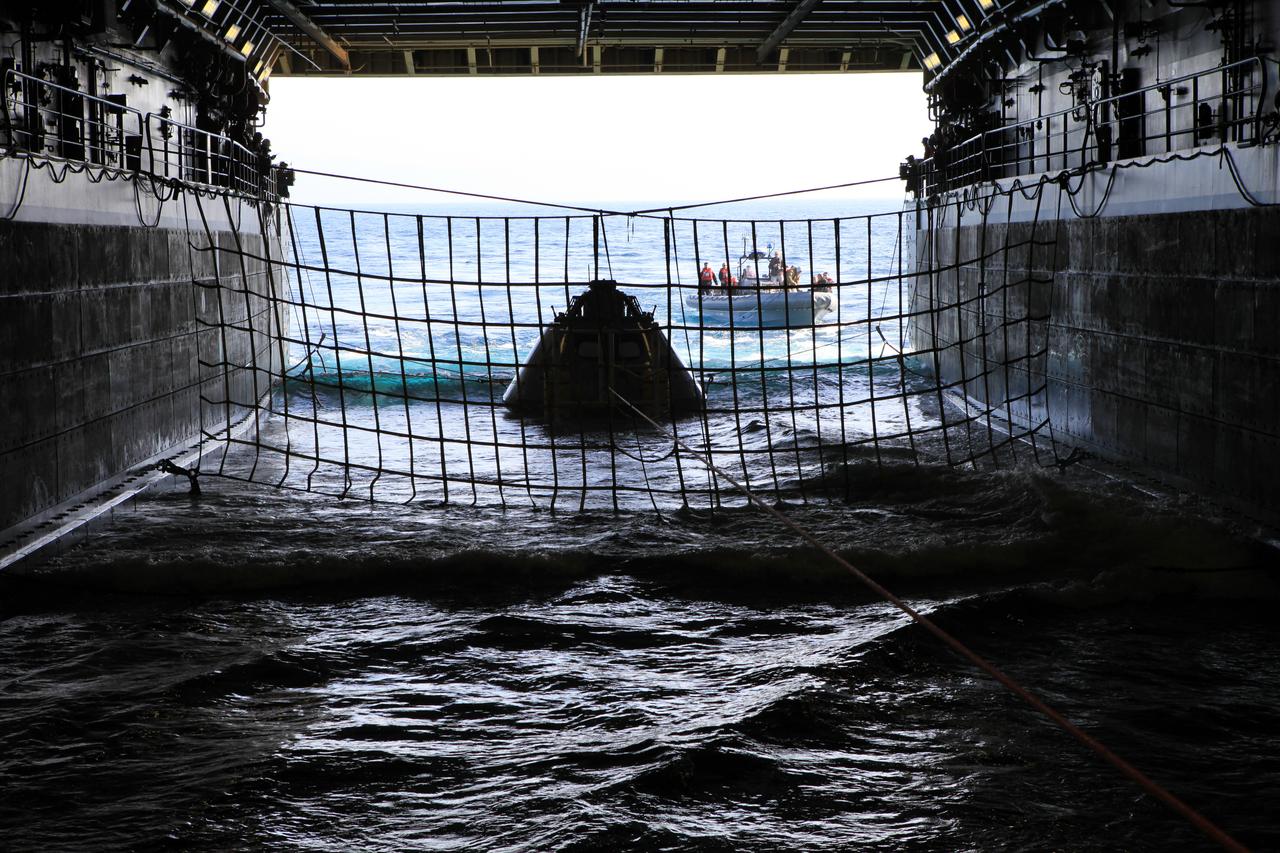
As part of Underway Recovery Test 6 on Jan. 18, 2018, the Orion test article is pulled in by a winch line at the rear of the USS Anchorage’s well deck that brings the capsule into the ship, along with four manned LLAMAs (Line Load Attenuation Mechanism Assembly) that control the capsule’s side-to-side movement and a tending line attached to a rigid hull inflatable boat for controlling Orion’s movement behind the ship. The testing with Kennedy Space Center's NASA Recovery Team and the U.S. Navy will provide important data that is being used to improve recovery procedures and hardware ahead of Orion's next flight, Artemis I, when it splashes down in the Pacific Ocean.
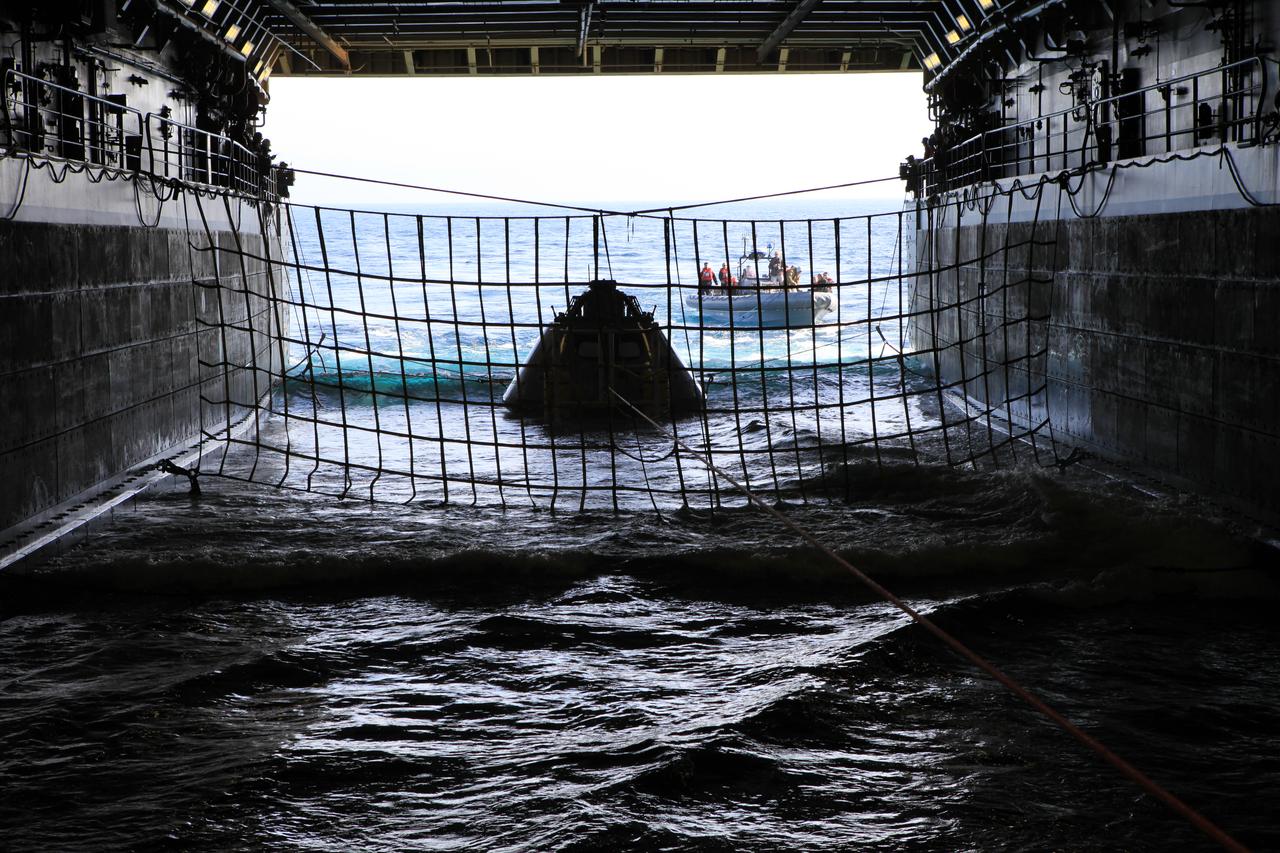
As part of Underway Recovery Test 6, the Orion test article is pulled in by a winch line at the rear of the USS Anchorage’s well deck that brings the capsule into the ship, along with four manned LLAMAs (Line Load Attenuation Mechanism Assembly) that control the capsule’s side-to-side movement and a tending line attached to a rigid hull inflatable boat for controlling Orion’s movement behind the ship. The testing with Kennedy Space Center's NASA Recovery Team and the U.S. Navy will provide important data that is being used to improve recovery procedures and hardware ahead of Orion's next flight, Exploration Mission-1, when it splashes down in the Pacific Ocean.
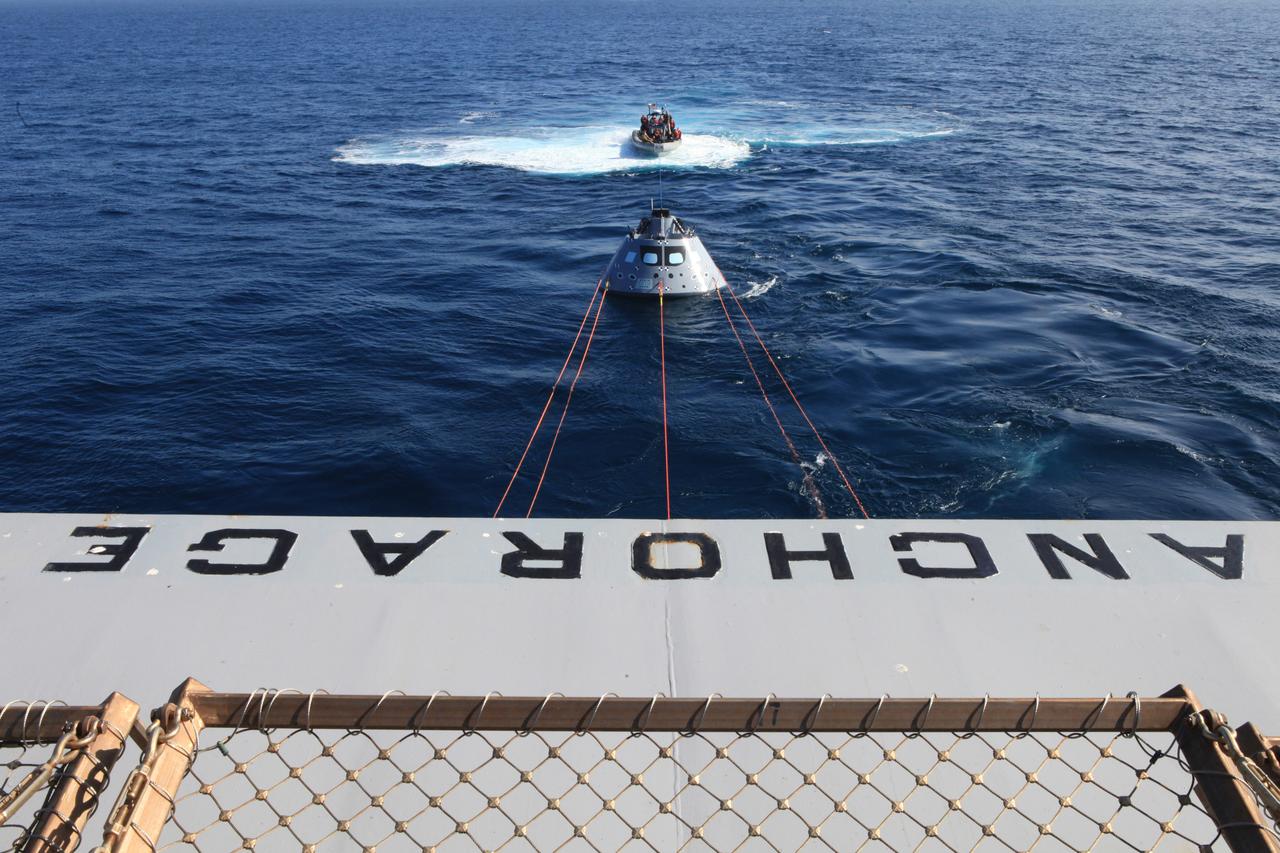
Off the rear of the USS Anchorage on Jan. 18, 2018, the Orion test article is pulled in by a winch line at the rear of the USS Anchorage’s well deck that brings the capsule into the ship, along with four manned LLAMAs (Line Load Attenuation Mechanism Assembly) that control the capsule’s side-to-side movement and a tending line attached to a rigid hull inflatable boat for controlling Orion’s movement behind the ship. The Underway Recovery Test 6 (URT-6) is spearheaded by Kennedy Space Center's NASA Recovery Team. In partnership with the U.S. Navy, the testing will provide important data that is being used to improve recovery procedures and hardware ahead of Orion's next flight, Artemis I, when it splashes down in the Pacific Ocean.
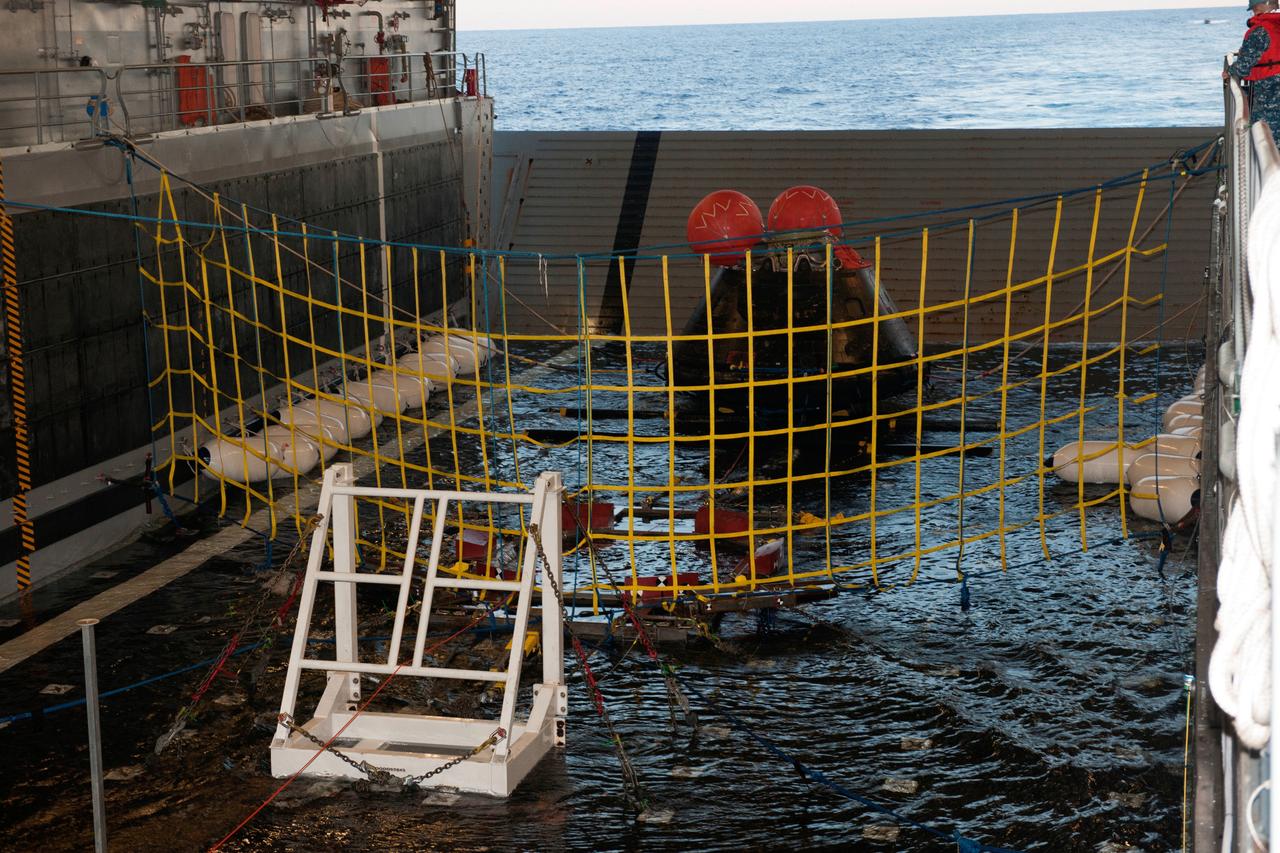
NASA’s Orion spacecraft is pulled safely into the well deck of the U.S. Navy’s USS Anchorage, following its splashdown in the Pacific Ocean. Orion launched into space on a two-orbit, 4.5-test flight at 7:05 am EST on Dec. 5, and returned safely to Earth, where a combined team from NASA, the Navy and Orion prime contractor Lockheed Martin retrieved it for return to shore. It's now being transported back to shore on board the Anchorage. It is expected to be off loaded at Naval Base San Diego on Monday. Part of Batch image transfer from Flickr.
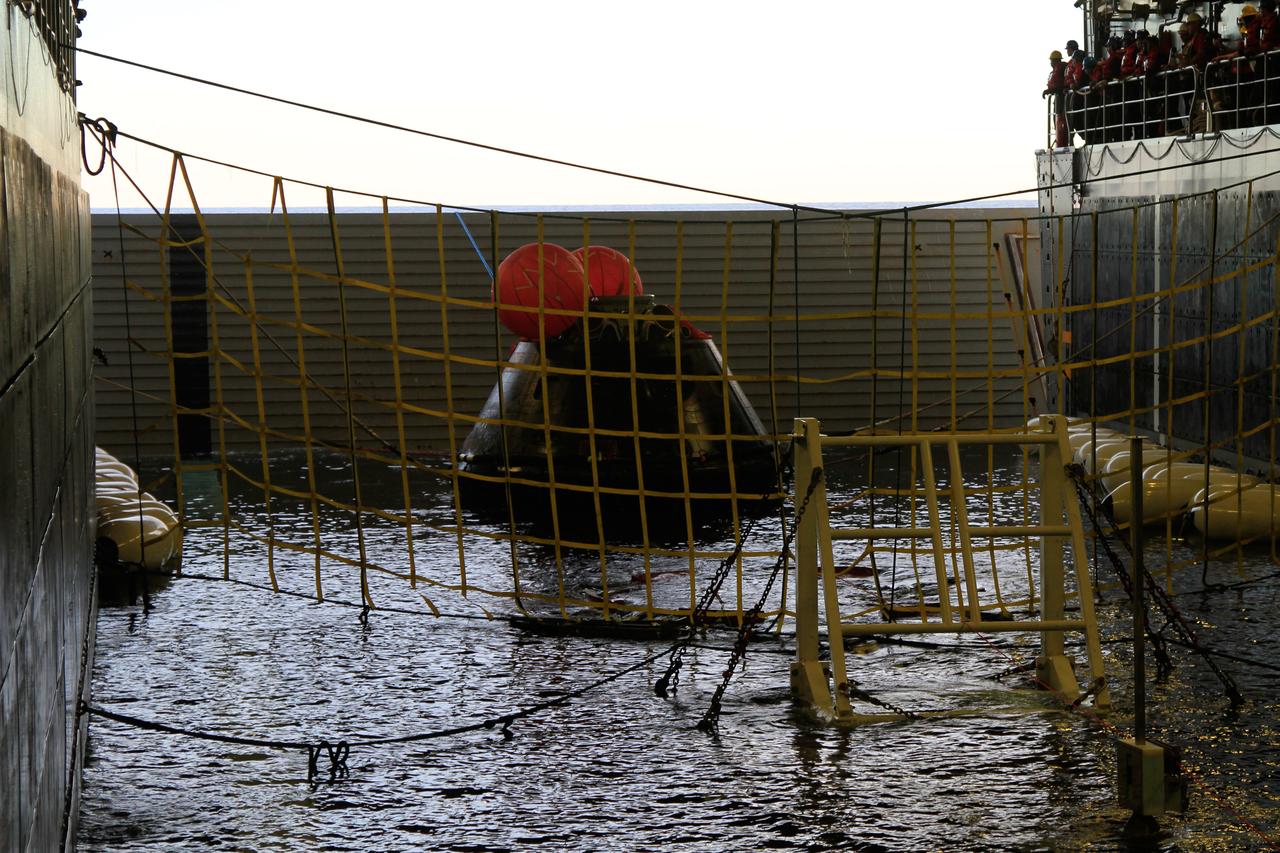
NASA’s Orion spacecraft is pulled safely into the well deck of the U.S. Navy’s USS Anchorage, following its splashdown in the Pacific Ocean. Orion launched into space on a two-orbit, 4.5-test flight at 7:05 am EST on Dec. 5, and returned safely to Earth, where a combined team from NASA, the Navy and Orion prime contractor Lockheed Martin retrieved it for return to shore. Over the next several days, the team will perform an initial check out of Orion while the Anchorage transports the spacecraft back to shore. It is expected to be off loaded at Naval Base San Diego on Monday. Part of Batch image transfer from Flickr.
NASA’s Orion spacecraft is pulled safely into the well deck of the U.S. Navy’s USS Anchorage, following its splashdown in the Pacific Ocean. Orion launched into space on a two-orbit, 4.5-test flight at 7:05 am EST on Dec. 5, and returned safely to Earth, where a combined team from NASA, the Navy and Orion prime contractor Lockheed Martin retrieved it for return to shore. Over the next several days, the team will perform an initial check out of Orion while the Anchorage transports the spacecraft back to shore. It is expected to be off loaded at Naval Base San Diego on Monday. Part of Batch image transfer from Flickr.
NASA’s Orion spacecraft is pulled safely into the well deck of the U.S. Navy’s USS Anchorage, following its splashdown in the Pacific Ocean. Orion launched into space on a two-orbit, 4.5-test flight at 7:05 am EST on Dec. 5, and returned safely to Earth, where a combined team from NASA, the Navy and Orion prime contractor Lockheed Martin retrieved it for return to shore. Over the next several days, the team will perform an initial check out of Orion while the Anchorage transports the spacecraft back to shore. It is expected to be off loaded at Naval Base San Diego on Monday. Part of Batch image transfer from Flickr.
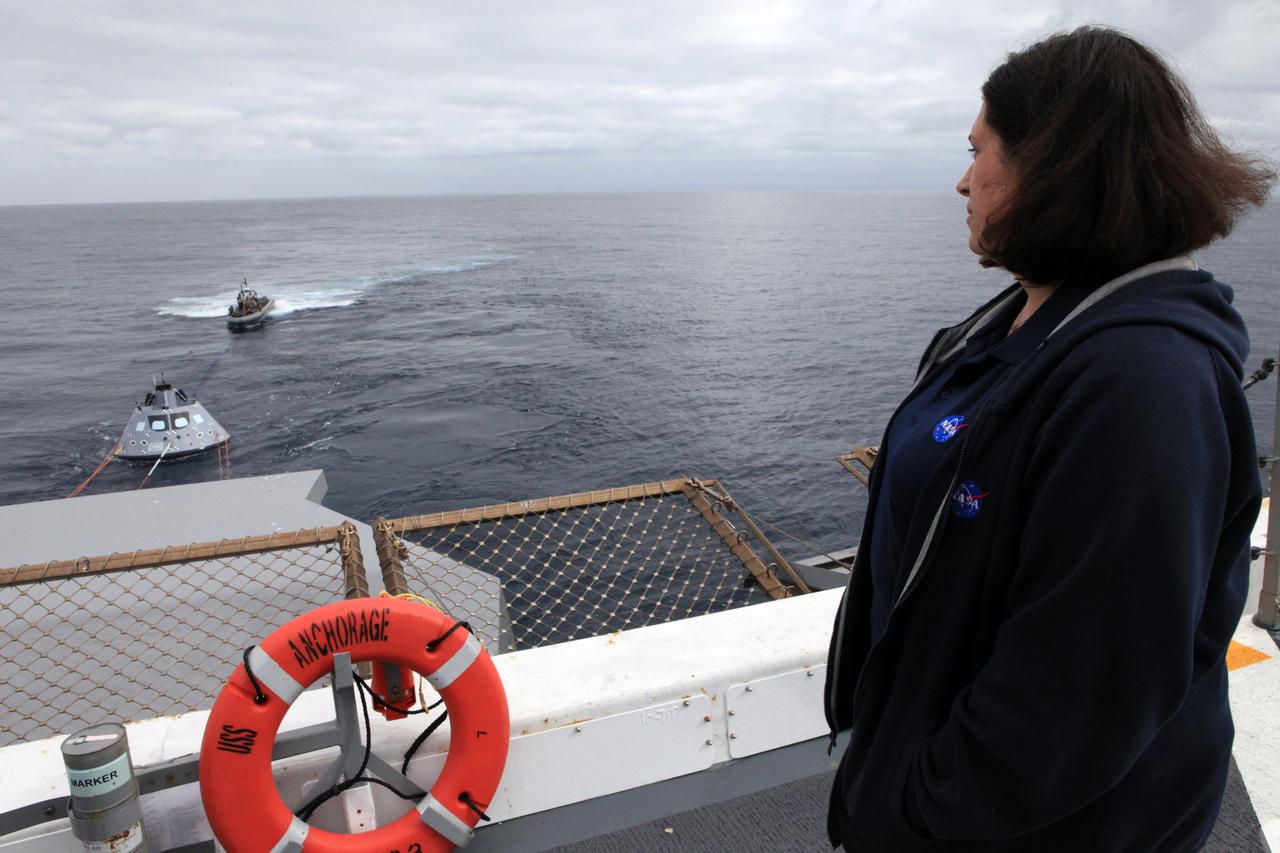
NASA Recovery Director Melissa Jones watches part of Underway Recovery Test 6, from the flight deck of the USS Anchorage. During this portion, the Orion test article is intentionally subjected to an increased sea state as the NASA Recovery Team works hard to keep control of the spacecraft. The testing with Kennedy Space Center's NASA Recovery Team and the U.S. Navy will provide important data that is being used to improve recovery procedures and hardware ahead of Orion's next flight, Exploration Mission-1, when it splashes down in the Pacific Ocean.
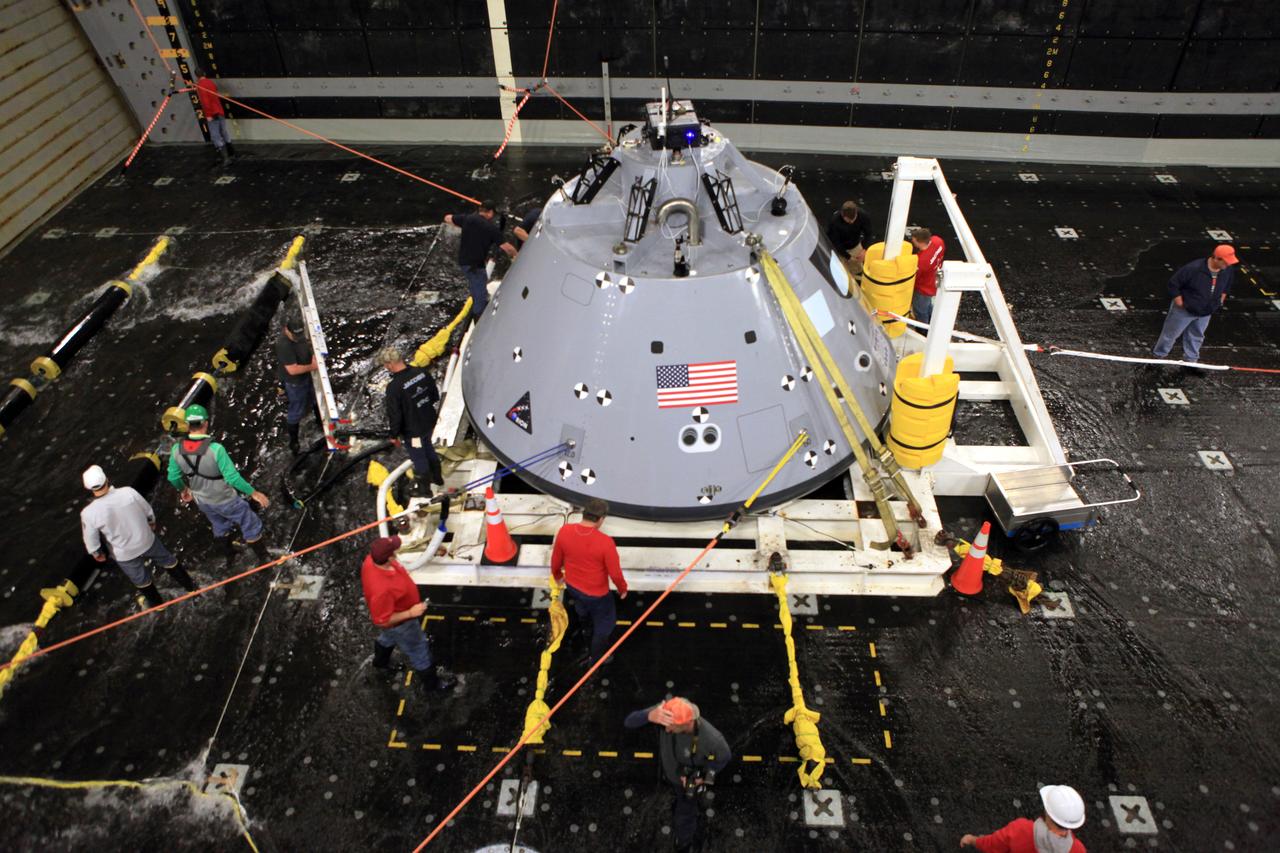
After a day of working with the Orion test article under rough seas on Jan. 19, 2018, the NASA Recovery Team inspects the capsule and their lines. As part of Underway Recovery Test 6, the Orion test article was intentionally subjected to an increased sea state to ensure the team could control the spacecraft under all possible scenarios. The testing with Kennedy Space Center's NASA Recovery Team and the U.S. Navy will provide important data that is being used to improve recovery procedures and hardware ahead of Orion's next flight, Artemis I, when it splashes down in the Pacific Ocean.

NASA astronaut Stephen Bowen gets a birds-eye view of the rough seas during part of Underway Recovery Test 6. Bowen is watching the testing so he can provide the team with an astronaut’s perspective. The testing with Kennedy Space Center's NASA Recovery Team and the U.S. Navy will provide important data that is being used to improve recovery procedures and hardware ahead of Orion's next flight, Exploration Mission-1, when it splashes down in the Pacific Ocean.
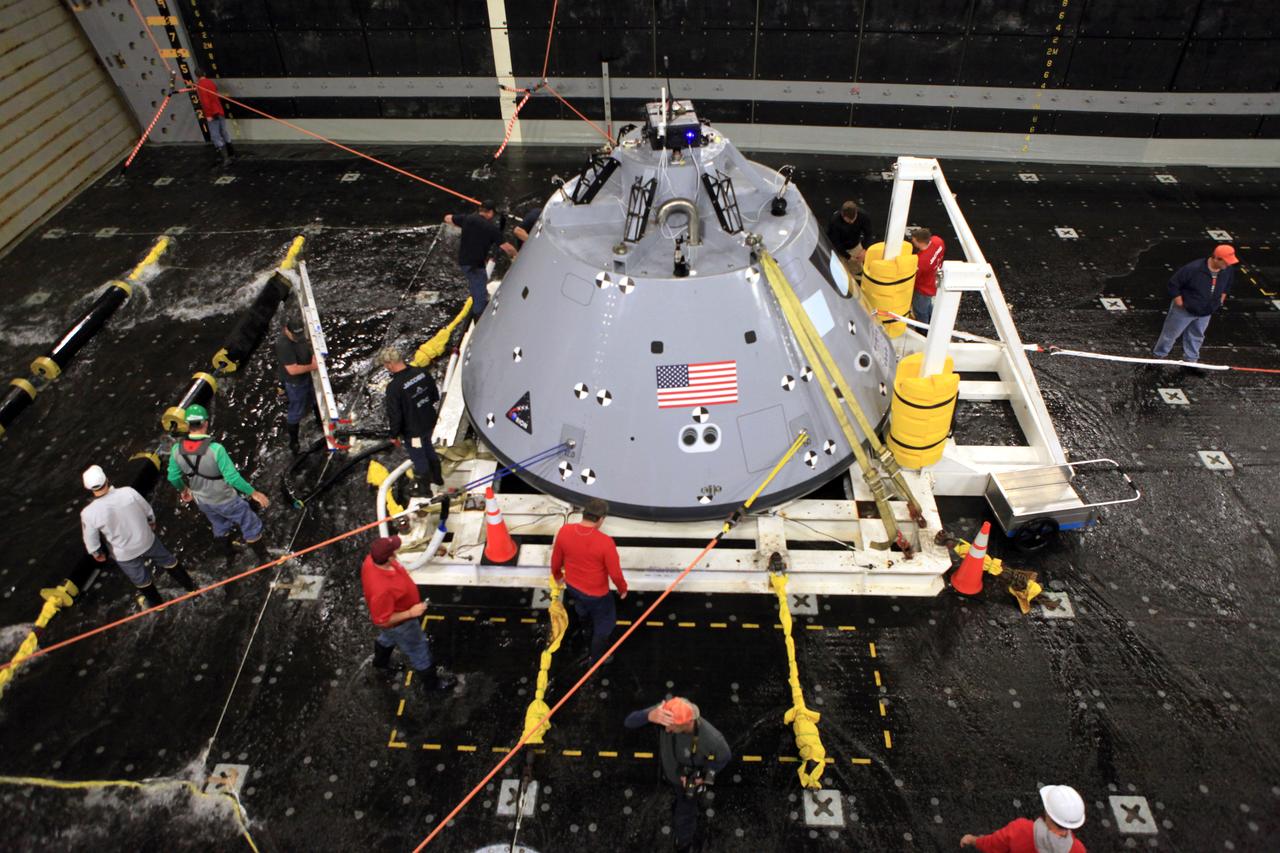
After a day of working with the Orion test article under rough seas, the NASA Recovery Team inspects the capsule and their lines. As part of Underway Recovery Test 6, the Orion test article was intentionally subjected to an increased sea state to ensure the team could control the spacecraft under all possible scenarios. The testing with Kennedy Space Center's NASA Recovery Team and the U.S. Navy will provide important data that is being used to improve recovery procedures and hardware ahead of Orion's next flight, Exploration Mission-1, when it splashes down in the Pacific Ocean.
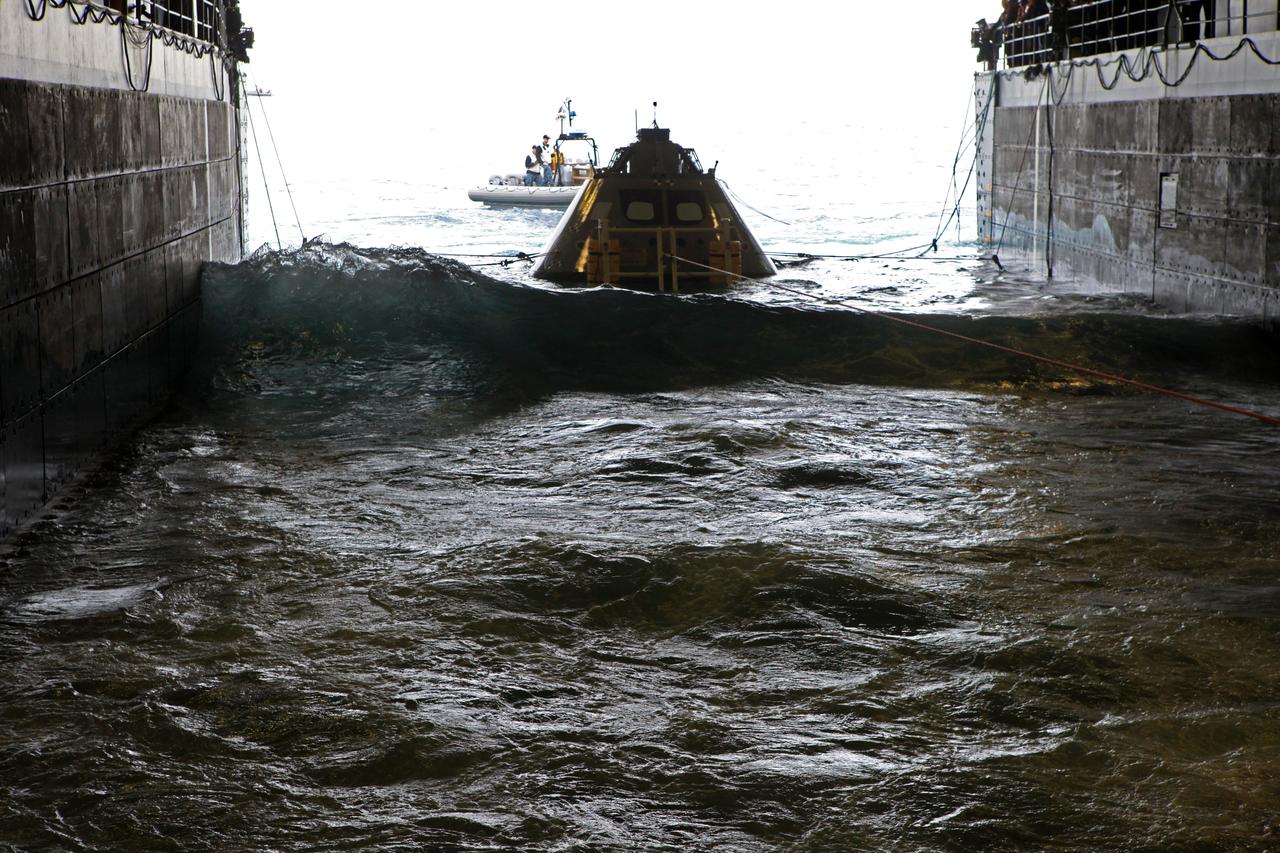
As part of Underway Recovery Test 6, the Orion test article is intentionally subjected to an increased sea state as the NASA Recovery Team works hard to keep control of the spacecraft. The testing with Kennedy Space Center's NASA Recovery Team and the U.S. Navy will provide important data that is being used to improve recovery procedures and hardware ahead of Orion's next flight, Exploration Mission-1, when it splashes down in the Pacific Ocean.
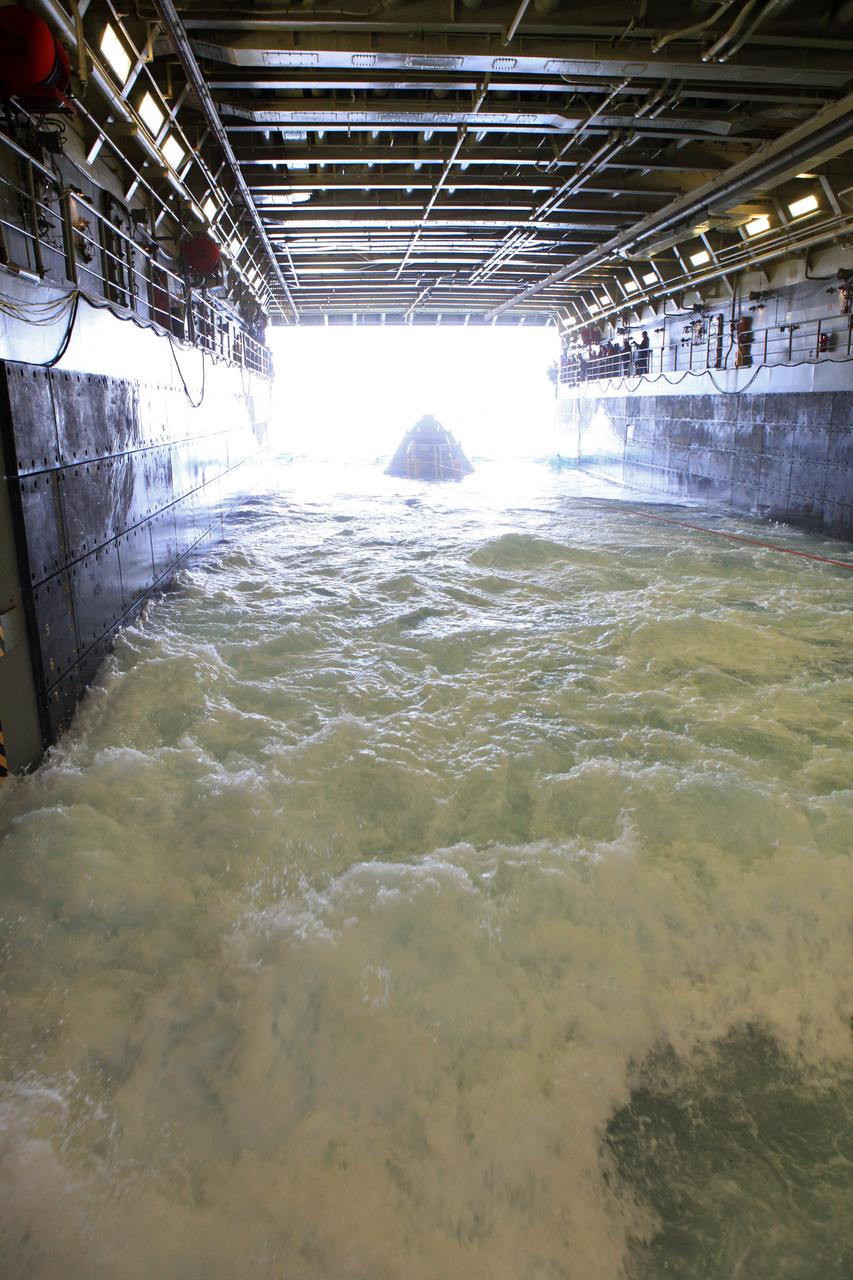
As part of Underway Recovery Test 6, the Orion test article is intentionally subjected to an increased sea state as the NASA Recovery Team works hard to keep control of the spacecraft. The testing with Kennedy Space Center's NASA Recovery Team and the U.S. Navy will provide important data that is being used to improve recovery procedures and hardware ahead of Orion's next flight, Exploration Mission-1, when it splashes down in the Pacific Ocean.
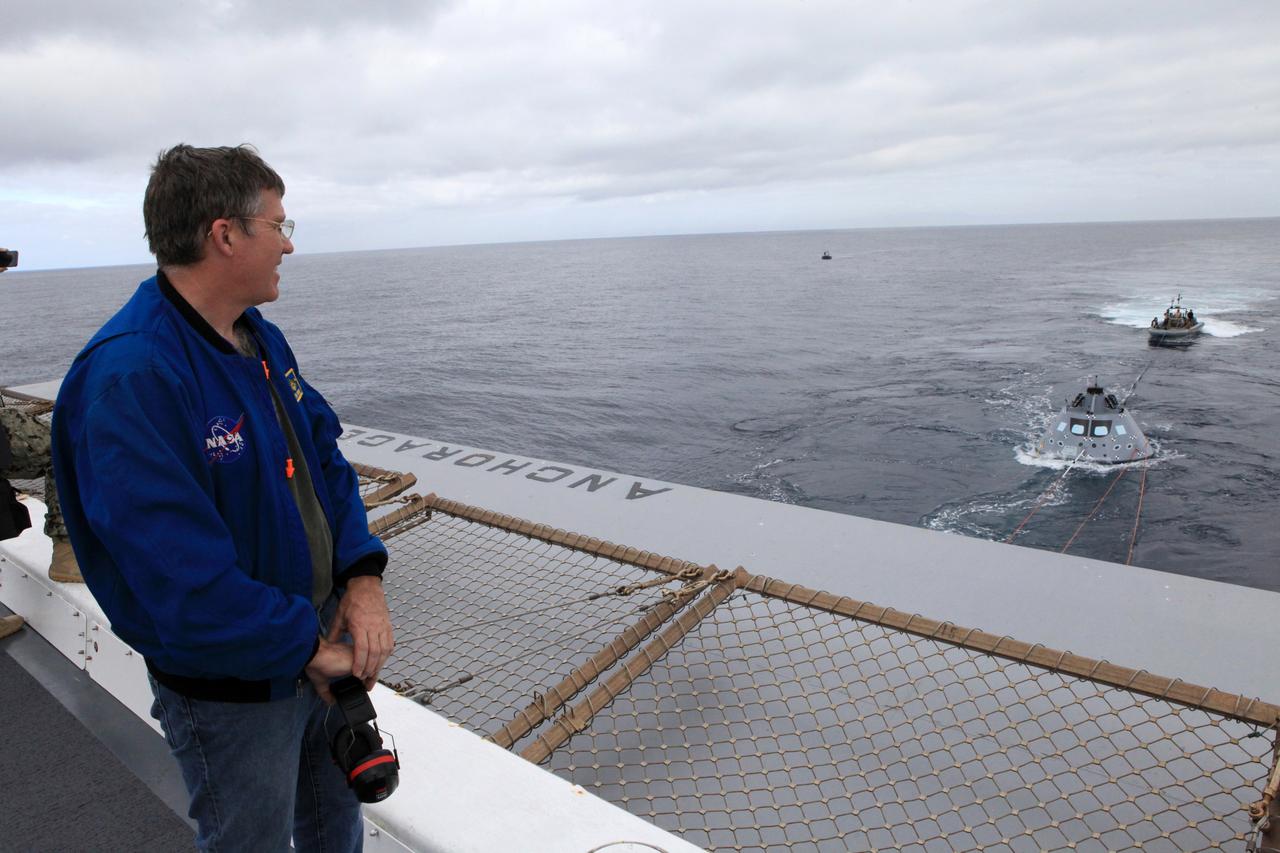
NASA astronaut Stephen Bowen gets a birds-eye view of the rough seas during part of Underway Recovery Test 6 on Jan. 19, 2018. Bowen is watching the testing so he can provide the team with an astronaut’s perspective. The testing with Kennedy Space Center's NASA Recovery Team and the U.S. Navy will provide important data that is being used to improve recovery procedures and hardware ahead of Orion's next flight, Artemis I, when it splashes down in the Pacific Ocean.
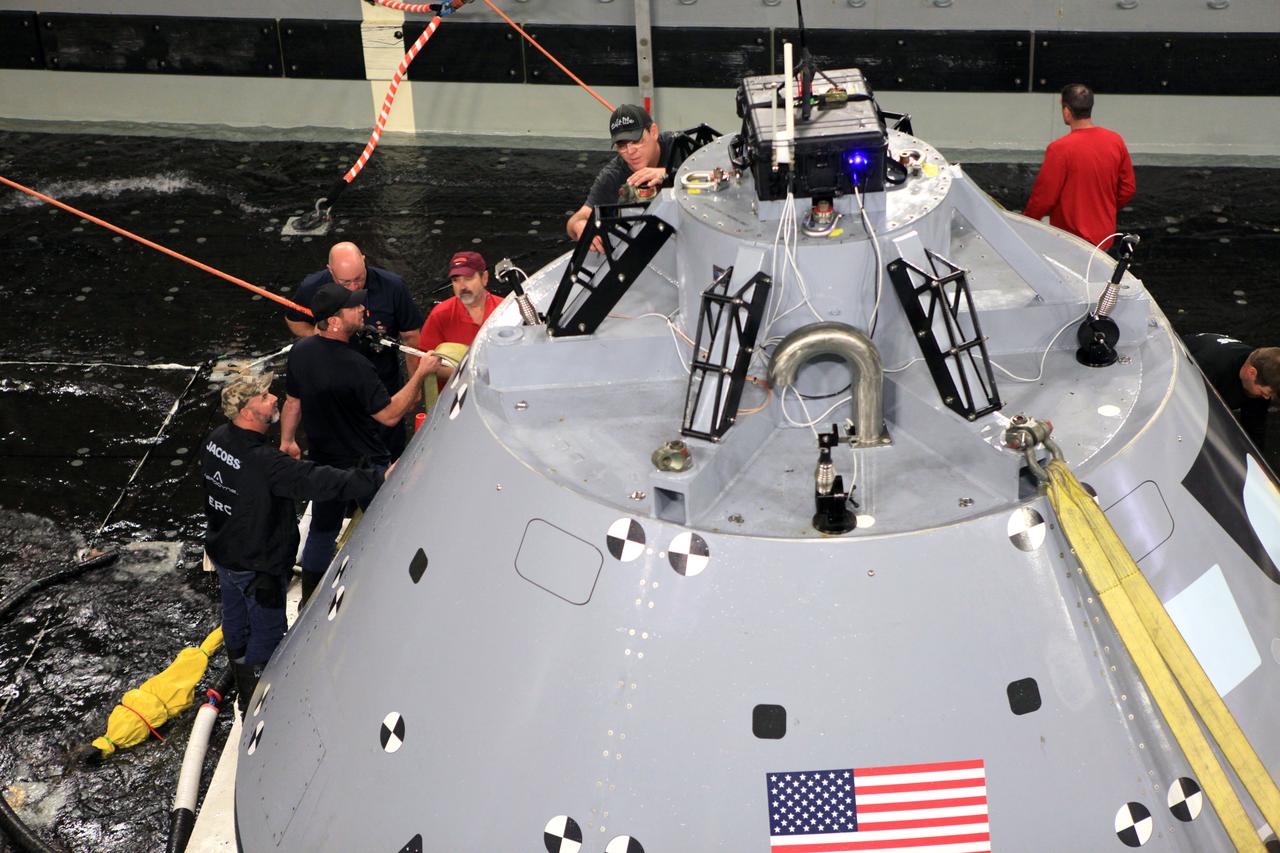
After a day of working with the Orion test article under rough seas, the NASA Recovery Team inspects the capsule and their lines. As part of Underway Recovery Test 6, the Orion test article was intentionally subjected to an increased sea state to ensure the team could control the spacecraft under all possible scenarios. The testing with Kennedy Space Center's NASA Recovery Team and the U.S. Navy will provide important data that is being used to improve recovery procedures and hardware ahead of Orion's next flight, Exploration Mission-1, when it splashes down in the Pacific Ocean.
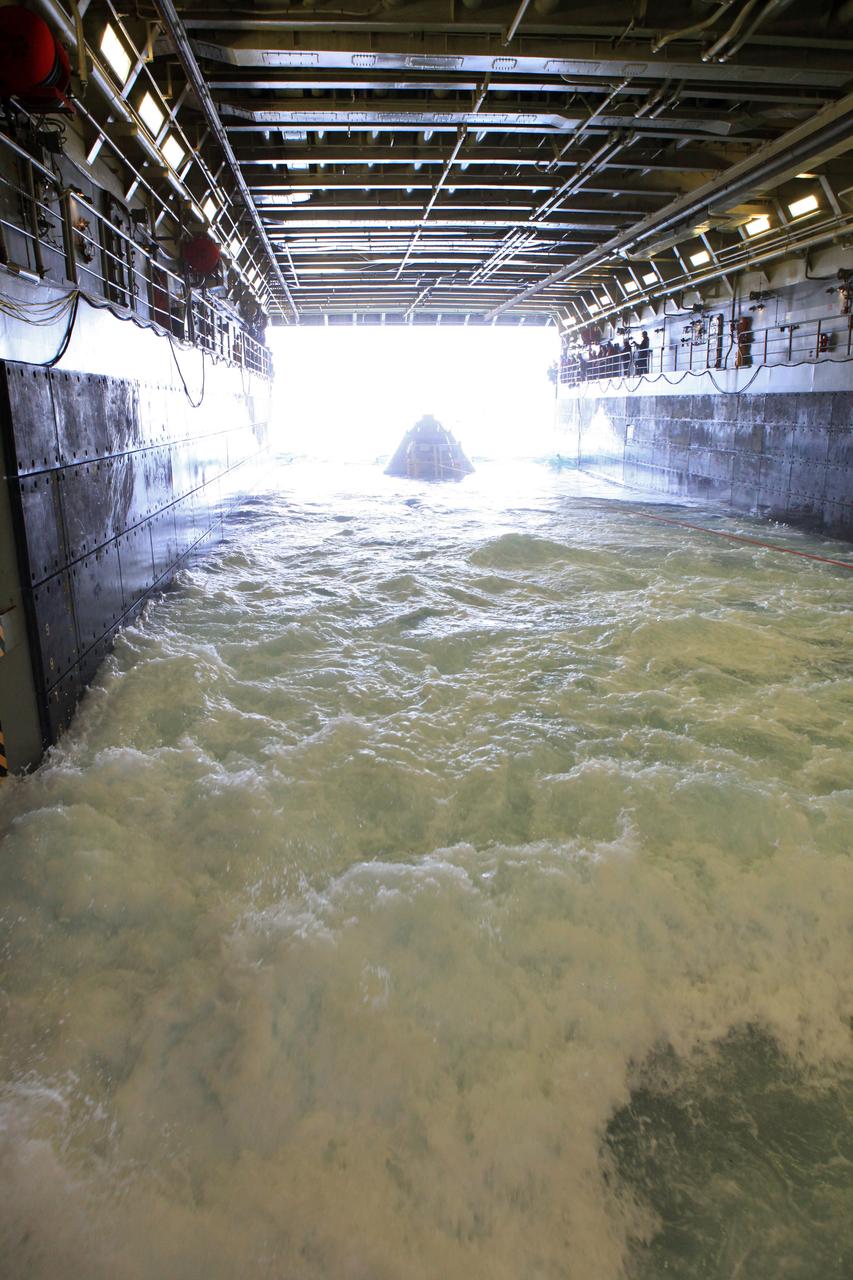
As part of Underway Recovery Test 6 on Jan. 19, 2018, the Orion test article is intentionally subjected to an increased sea state as the NASA Recovery Team works hard to keep control of the spacecraft. The testing with Kennedy Space Center's NASA Recovery Team and the U.S. Navy will provide important data that is being used to improve recovery procedures and hardware ahead of Orion's next flight, Artemis I, when it splashes down in the Pacific Ocean.
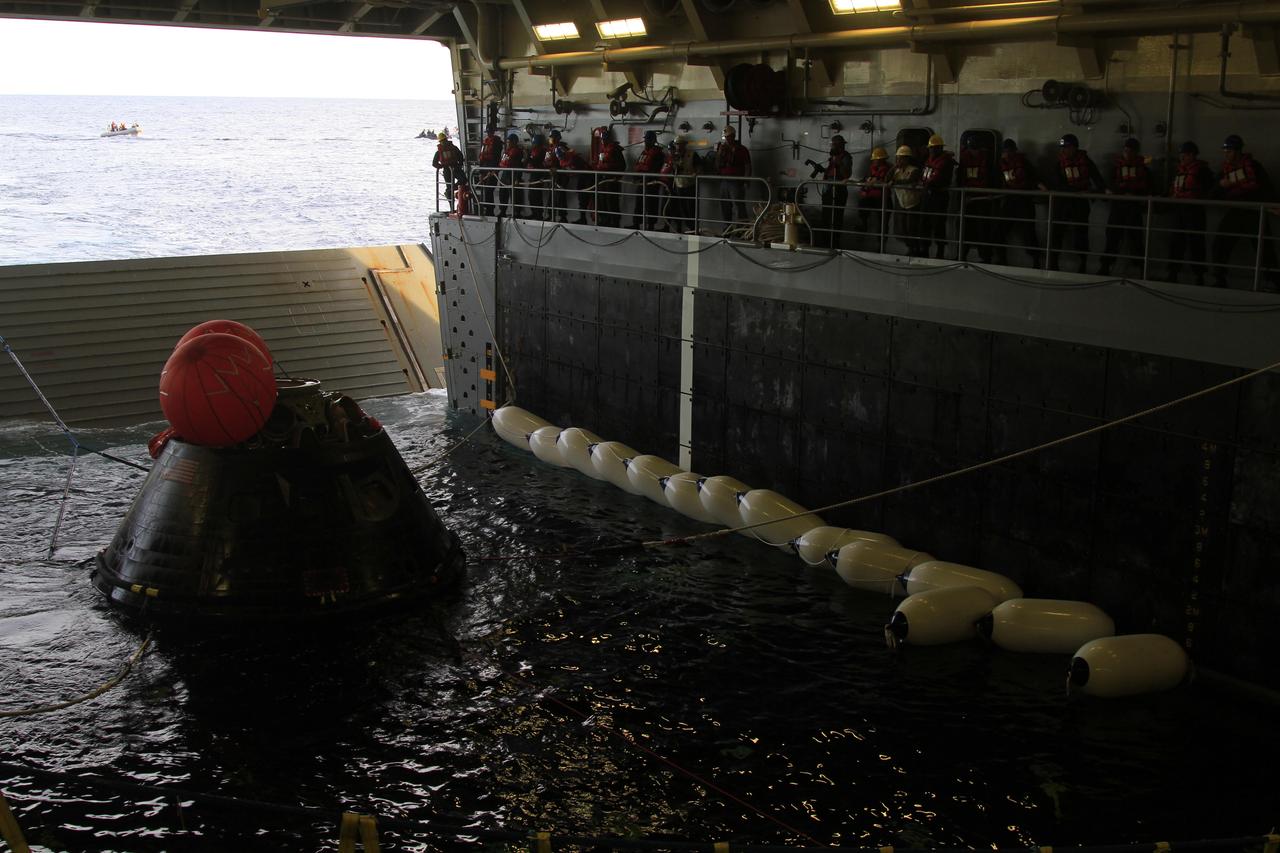
NASA's Orion spacecraft is secured with tether lines inside the flooded well deck of the USS Anchorage in the Pacific Ocean about 600 miles off the coast of San Diego, California. After lifting off at 7:05 a.m. EST atop a Delta IV Heavy rocket from Space Launch Complex 37 at Cape Canaveral Air Force Station in Florida, Orion completed a two-orbit, four-and-a-half hour mission to test systems critical to crew safety, including the launch abort system, the heat shield and the parachute system. NASA, the U.S. Navy and Lockheed Martin coordinated efforts to recover Orion after splashdown. The Ground Systems Development and Operations Program is leading the recovery efforts.
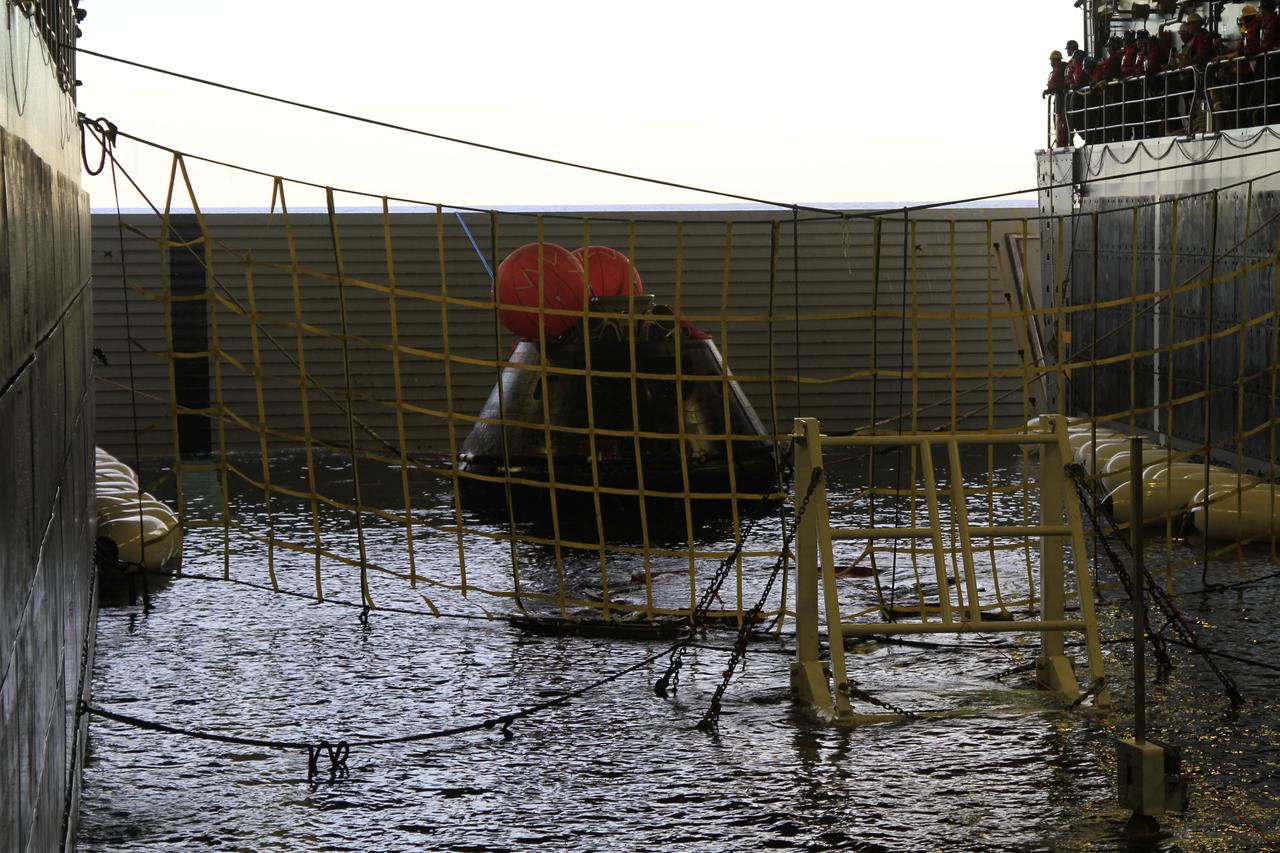
NASA's Orion spacecraft has been recovered inside the flooded well deck of the USS Anchorage in the Pacific Ocean about 600 miles off the coast of San Diego, California. After lifting off at 7:05 a.m. EST atop a Delta IV Heavy rocket from Space Launch Complex 37 at Cape Canaveral Air Force Station in Florida, Orion completed a two-orbit, four-and-a-half hour mission to test systems critical to crew safety, including the launch abort system, the heat shield and the parachute system. NASA, the U.S. Navy and Lockheed Martin coordinated efforts to recover Orion after splashdown. The Ground Systems Development and Operations Program is leading the recovery efforts.
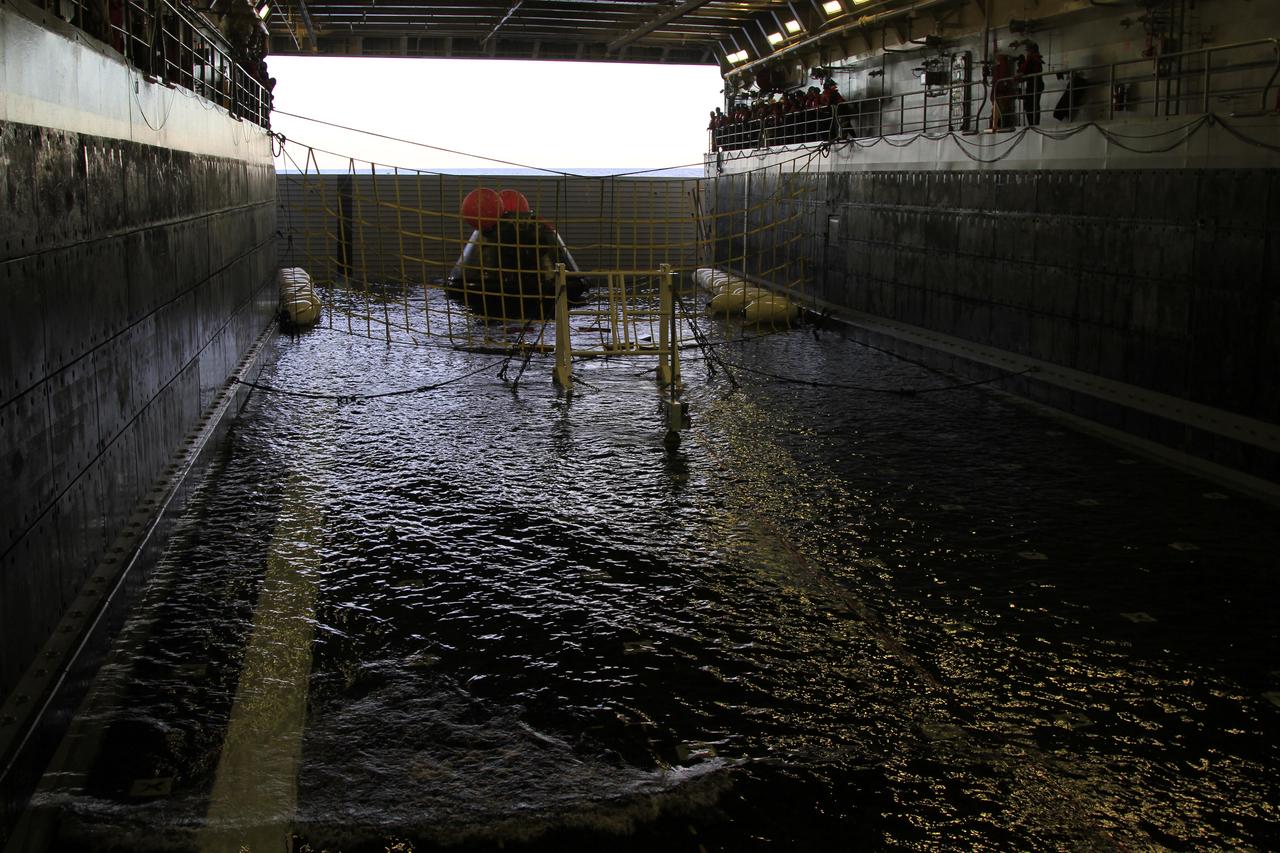
After splashdown, NASA's Orion spacecraft has been recovered and is positioned on rubber "speed bumps" inside the flooded well deck of the USS Anchorage in the Pacific Ocean about 600 miles off the coast of San Diego, California. After lifting off at 7:05 a.m. EST atop a Delta IV Heavy rocket from Space Launch Complex 37 at Cape Canaveral Air Force Station in Florida, Orion completed a two-orbit, four-and-a-half hour mission to test systems critical to crew safety, including the launch abort system, the heat shield and the parachute system. NASA, the U.S. Navy and Lockheed Martin coordinated efforts to recover Orion after splashdown. The Ground Systems Development and Operations Program is leading the recovery efforts.
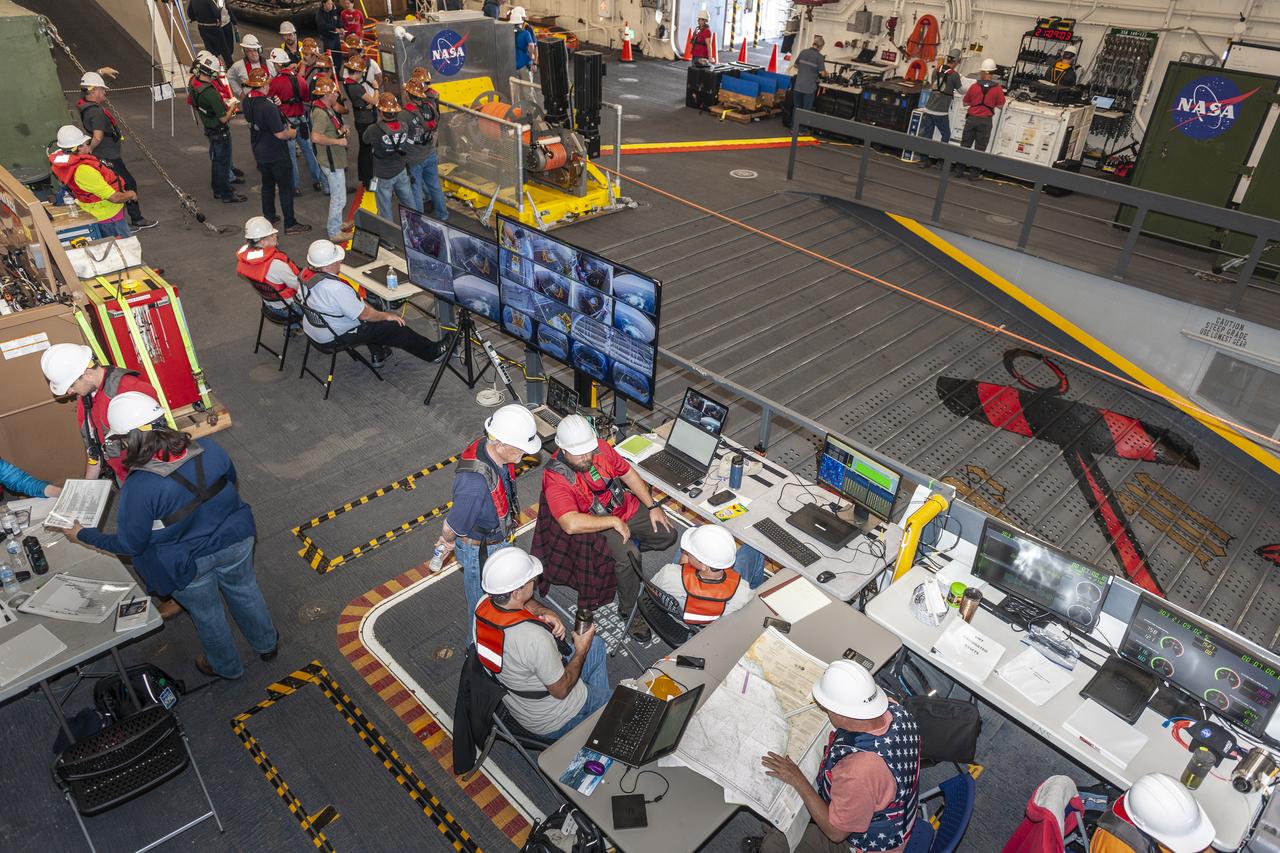
NASA Recovery Team members with Exploration Ground Systems (EGS) and the U.S. Navy prepare for Underway Recovery Test-7 (URT-7) on Oct. 30, 2018, in the well deck of the USS John P Murtha. URT-7 is one in a series of tests that the EGS Recovery Team, along with the U.S. Navy, are conducting to verify and validate procedures and hardware that will be used to recover the Orion spacecraft after it splashes down in the Pacific Ocean following deep space exploration missions. Orion will have emergency abort capability, sustain the crew during space travel and provide safe re-entry from deep space return velocities.
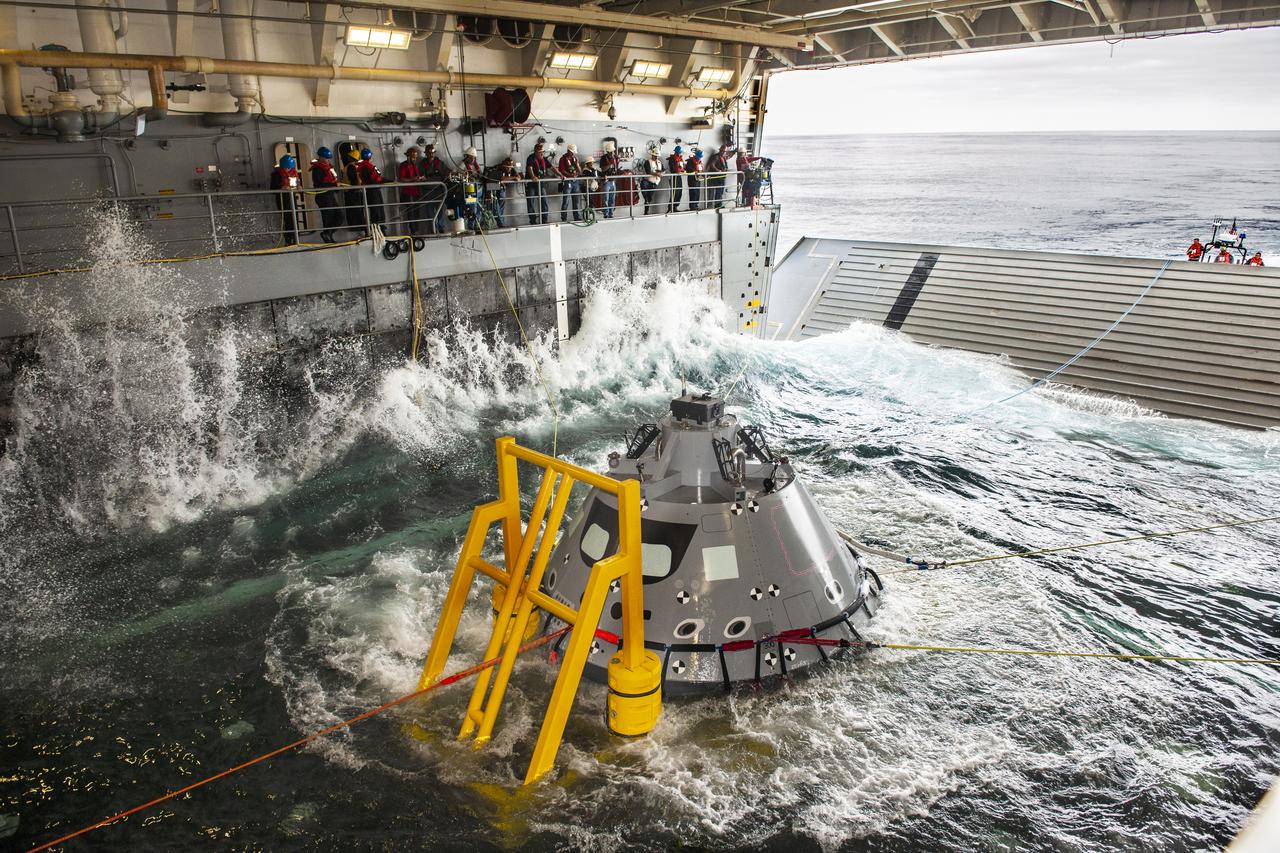
NASA Recovery Team members watch as a test version of the Orion capsule is pulled into the flooded well deck of the USS John P. Murtha, during Underway Recovery Test-7 (URT-7) on Oct. 30, 2018. URT-7 is one in a series of tests that the Exploration Ground Systems Recovery Team, along with the U.S. Navy, are conducting to verify and validate procedures and hardware that will be used to recover the Orion spacecraft after it splashes down in the Pacific Ocean following deep space exploration missions. Orion will have emergency abort capability, sustain the crew during space travel and provide safe re-entry from deep space return velocities.
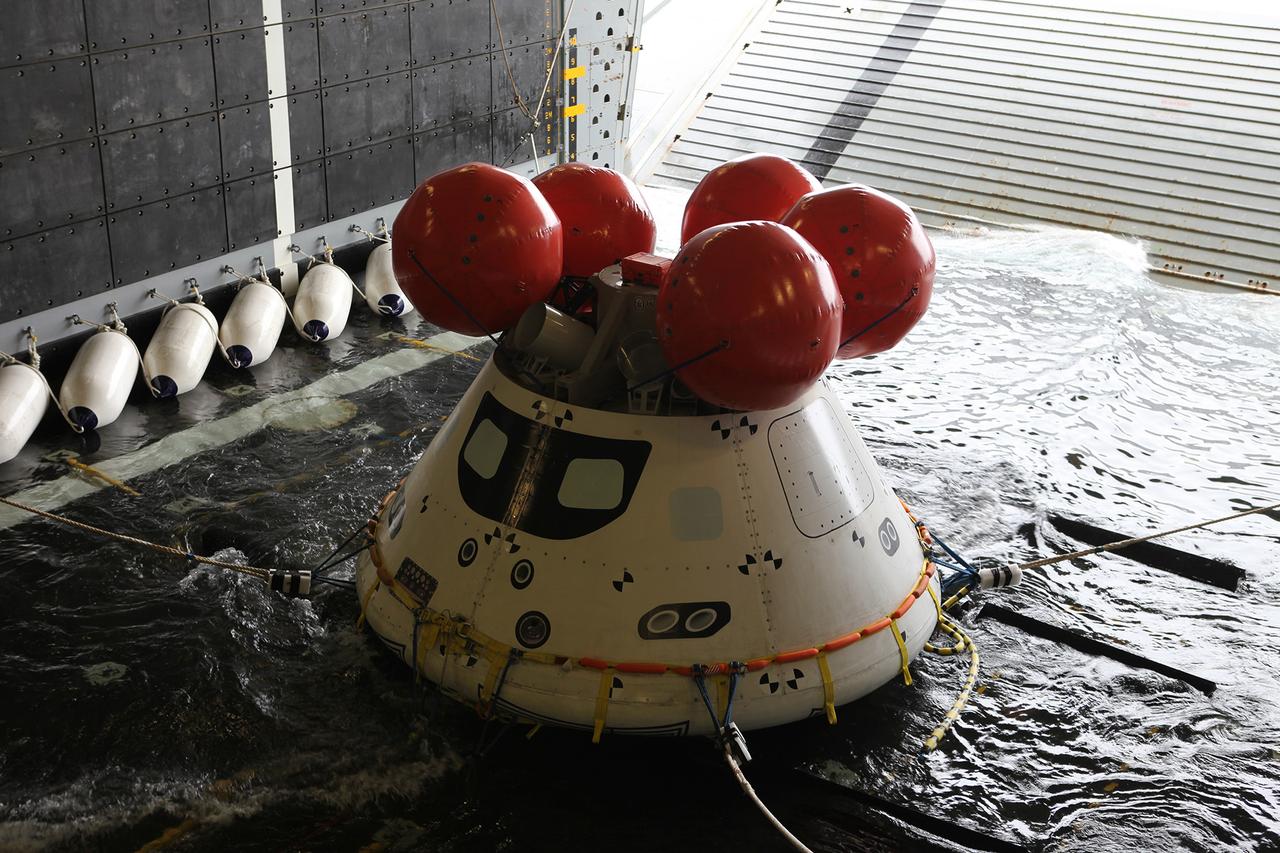
Recovery team members work with a test version of Orion floating in the well deck of the U.S.S. Anchorage on Aug. 2, 2014. A combined NASA and U.S. Navy team practiced recovery techniques off the coast of California in preparation for Exploration Flight Test-1 (EFT-1). Part of Batch image transfer from Flickr.
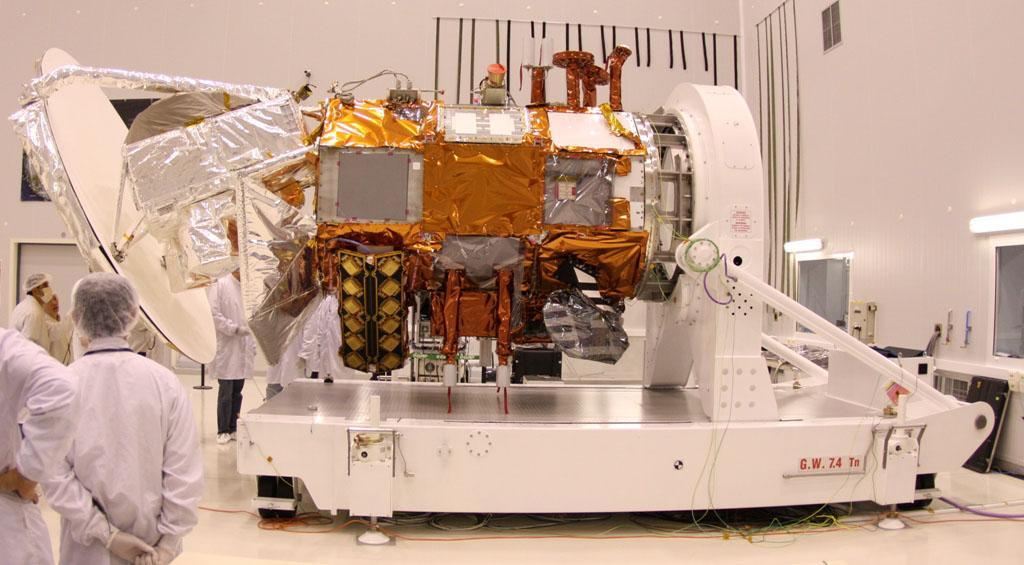
A fit check of half the sunshade is completed to verify the clearance of NASA Aquarius ground lug as well as the blanket interface with the service platform top deck.
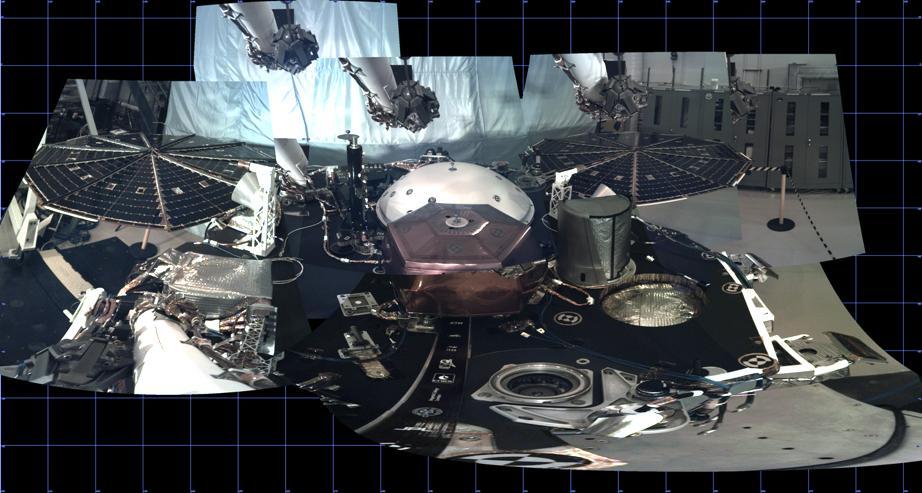
This panorama, created from multiple images, shows the deck of NASA's InSight lander, as well as its solar panels, during the assembly, test and launch operations phase at Lockheed Martin Space, Denver. The panorama, which uses images from InSight's Instrument Deployment Camera on its robotic arm, is a cylindrical projection. https://photojournal.jpl.nasa.gov/catalog/PIA22826
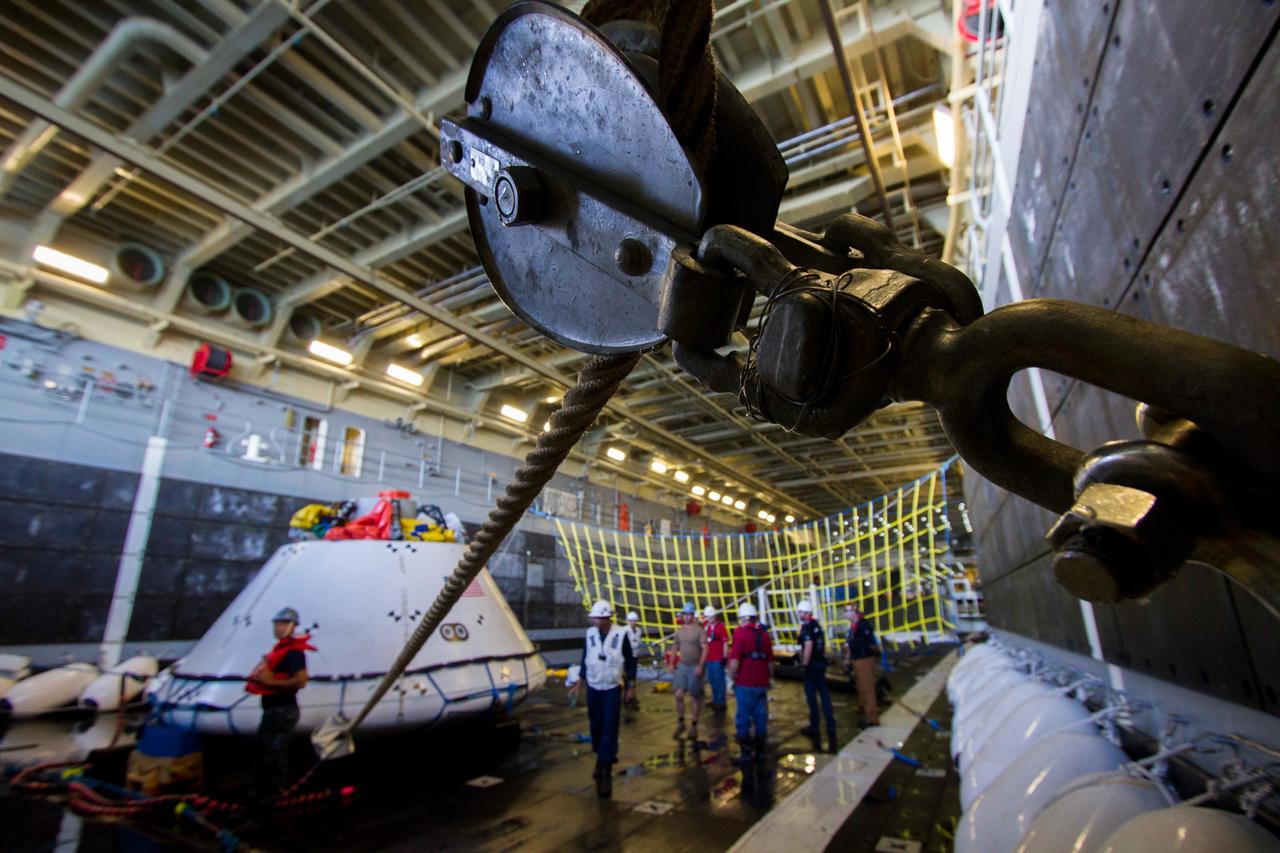
Lines secure a test version of Orion inside of the USS Anchorage's well deck during recovery tests off the coast of California on Sept. 15, 2014. The well deck can be flooded with water to allow Orion to float in following its splashdown when it returns from space. Part of Batch image transfer from Flickr.
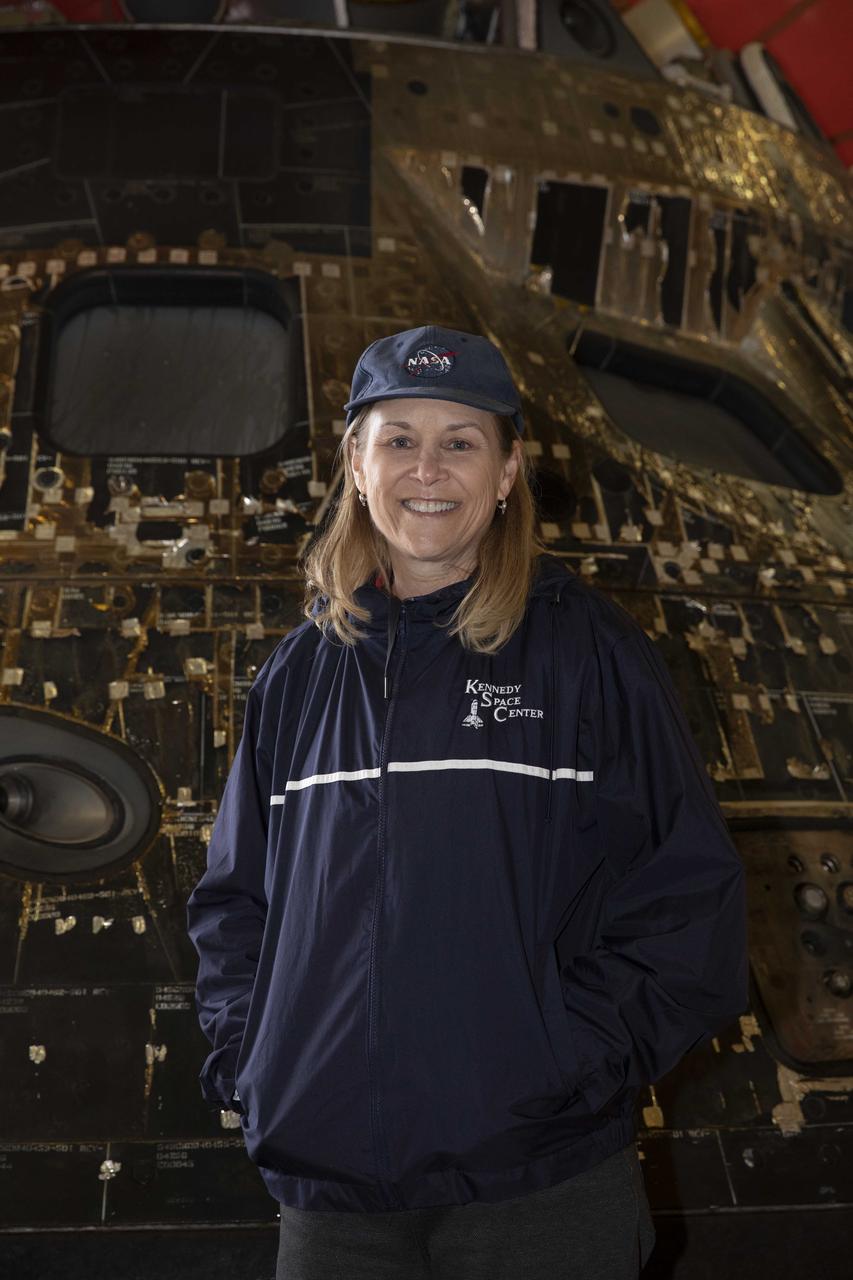
Kennedy Space Center Director Janet Petro stands near the Artemis I Orion spacecraft inside the well deck of the USS Portland at U.S. Naval Base San Diego on Dec. 13, 2022. The Orion spacecraft is secured inside the well deck after splashing down at 12:40 p.m. EST on Dec. 11, 2022. U.S. Navy divers helped recover the Orion spacecraft. NASA, the Navy and other Department of Defense partners worked together to secure the spacecraft inside the ship’s well deck approximately five hours after Orion splashed down in the Pacific Ocean off the coast of Baja, California.
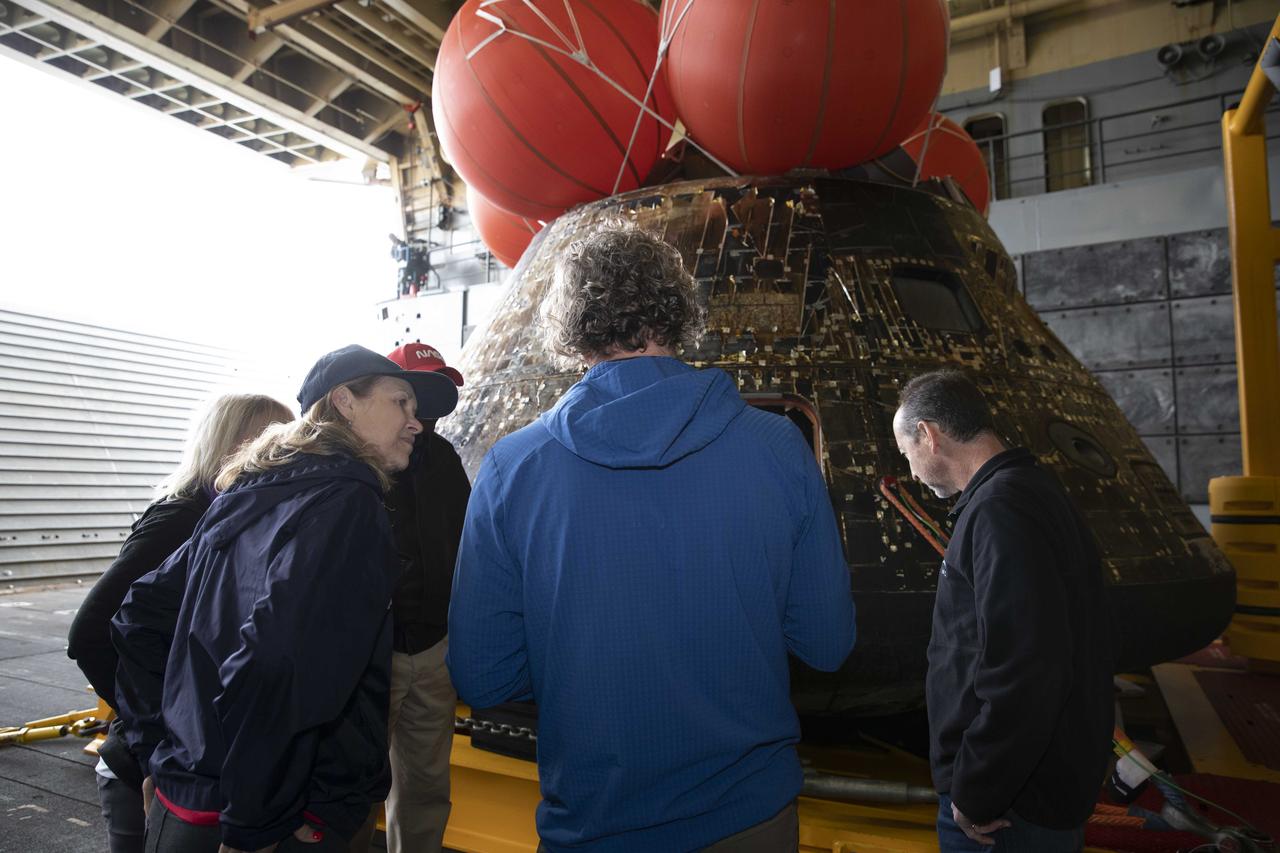
Kennedy Space Center Director Janet Petro, third from left, and recovery team members look at the Artemis I Orion spacecraft inside the well deck of the USS Portland at U.S. Naval Base San Diego on Dec. 13, 2022. The Orion spacecraft is secured inside the well deck after splashing down at 12:40 p.m. EST on Dec. 11, 2022. U.S. Navy divers helped recover the Orion spacecraft. NASA, the Navy and other Department of Defense partners worked together to secure the spacecraft inside the ship’s well deck approximately five hours after Orion splashed down in the Pacific Ocean off the coast of Baja, California.
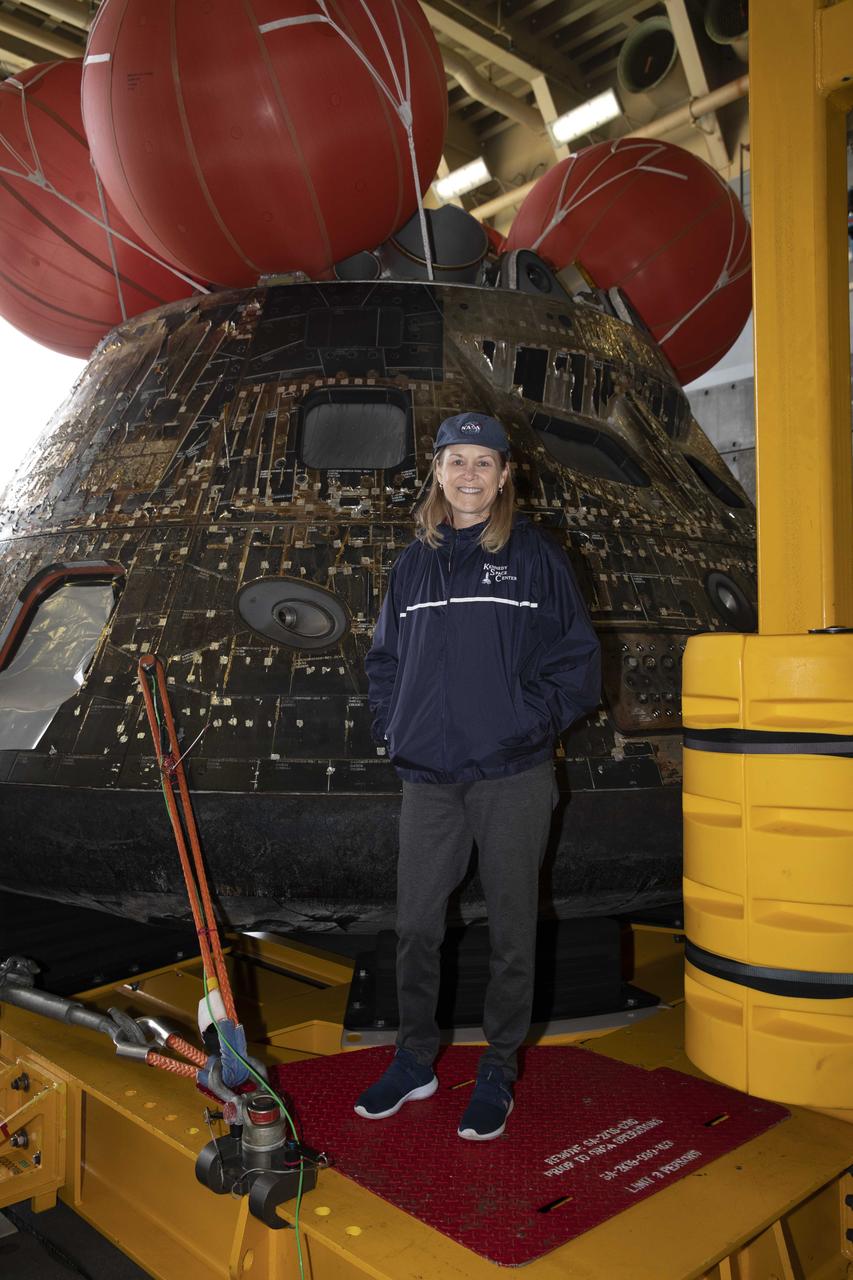
Kennedy Space Center Director Janet Petro stands near the Artemis I Orion spacecraft inside the well deck of the USS Portland at U.S. Naval Base San Diego on Dec. 13, 2022. The Orion spacecraft is secured inside the well deck after splashing down at 12:40 p.m. EST on Dec. 11, 2022. U.S. Navy divers helped recover the Orion spacecraft. NASA, the Navy and other Department of Defense partners worked together to secure the spacecraft inside the ship’s well deck approximately five hours after Orion splashed down in the Pacific Ocean off the coast of Baja, California.
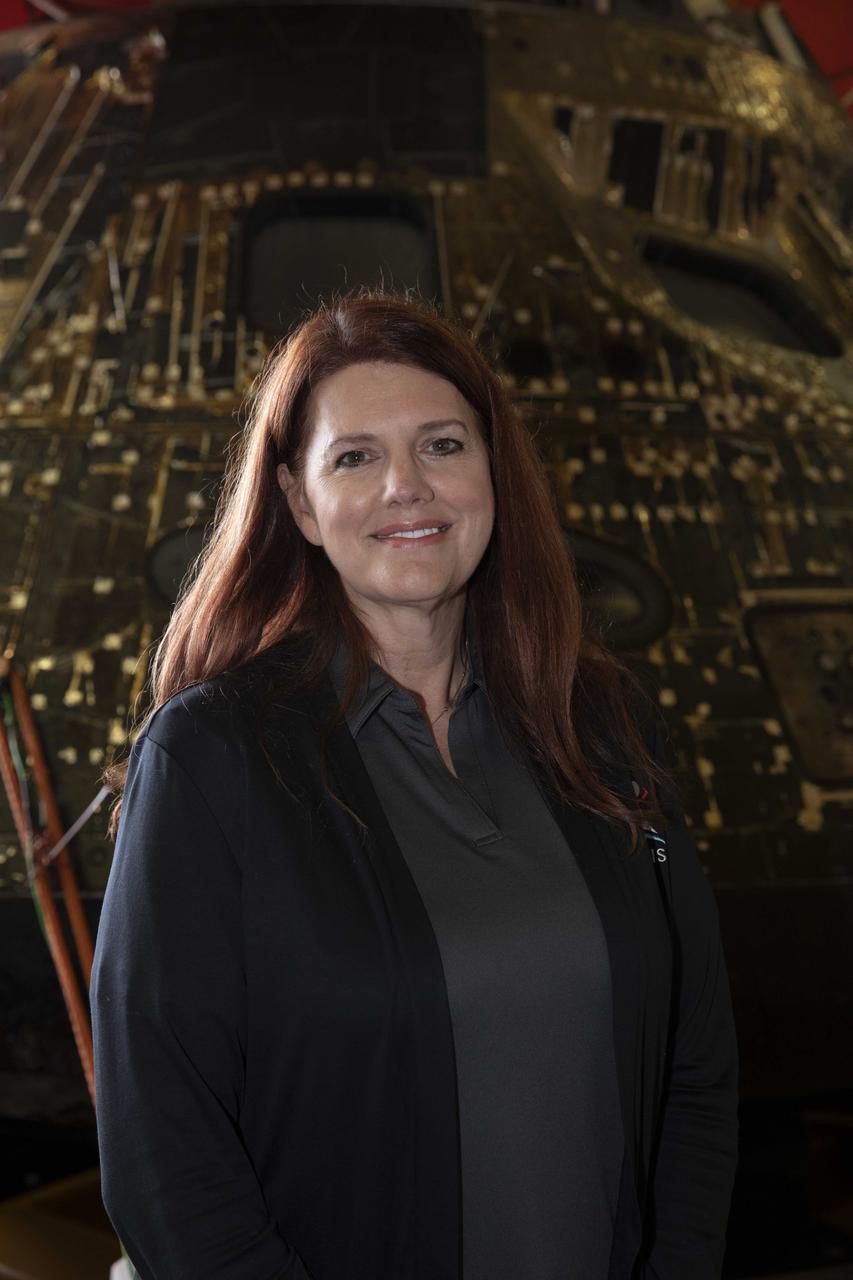
NASA Artemis Launch Director Charlie Blackwell-Thompson, with the Exploration Ground Systems program, stands near the Artemis I Orion spacecraft inside the well deck of the USS Portland at U.S. Naval Base San Diego on Dec. 13, 2022. The Orion spacecraft is secured inside the well deck after splashing down at 12:40 p.m. EST on Dec. 11, 2022. U.S. Navy divers helped recover the Orion spacecraft. NASA, the Navy and other Department of Defense partners worked together to secure the spacecraft inside the ship’s well deck approximately five hours after Orion splashed down in the Pacific Ocean off the coast of Baja, California.
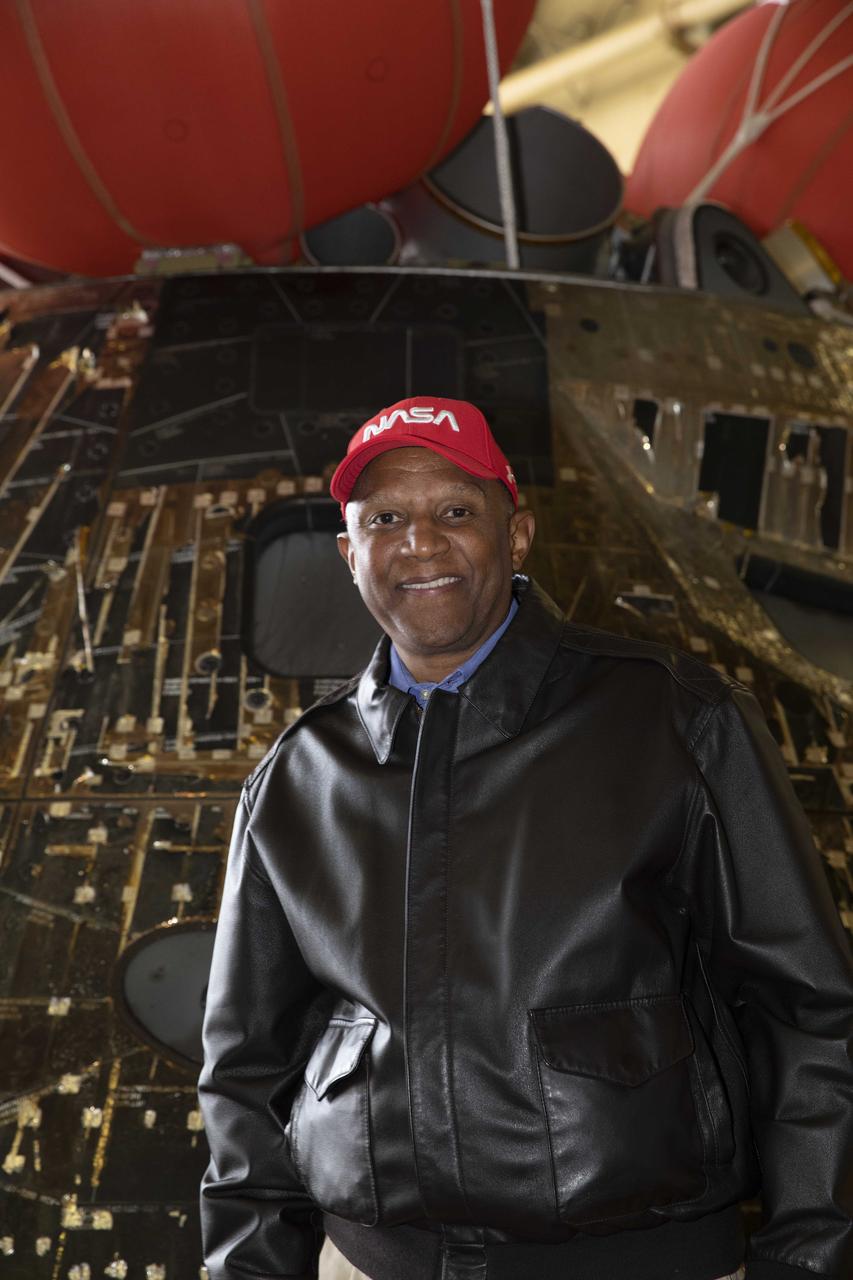
Kennedy Space Center Deputy Director Kelvin Manning stands near the Artemis I Orion spacecraft inside the well deck of the USS Portland at U.S. Naval Base San Diego on Dec. 13, 2022. The Orion spacecraft is secured inside the well deck after splashing down at 12:40 p.m. EST on Dec. 11, 2022. U.S. Navy divers helped recover the Orion spacecraft. NASA, the Navy and other Department of Defense partners worked together to secure the spacecraft inside the ship’s well deck approximately five hours after Orion splashed down in the Pacific Ocean off the coast of Baja, California.
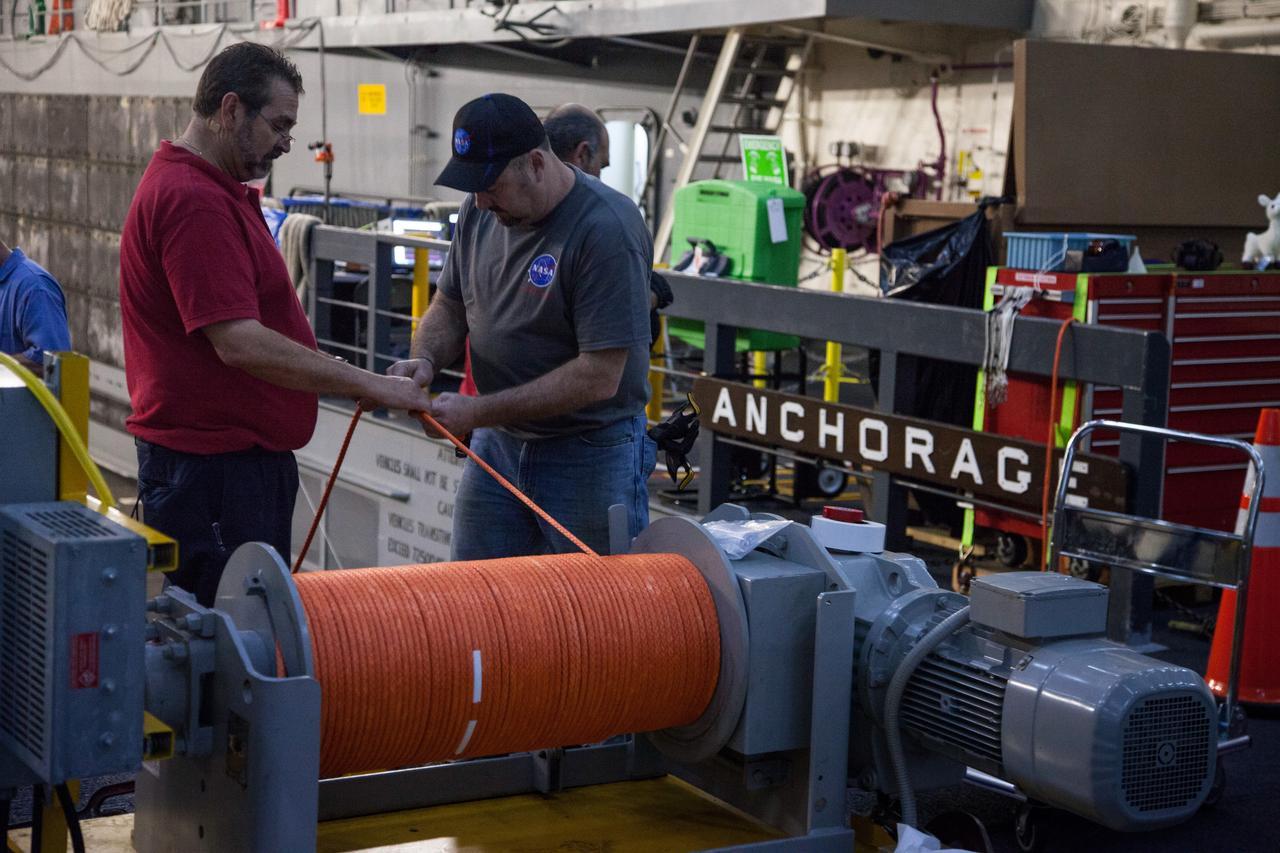
Orion recovery team members make preparations for Orion's splashdown inside the well deck of the U.S. Navy's USS Anchorage on Dec. 2, 2014. A combined NASA/Navy team will tow Orion into the Anchorage's flooded well deck using the orange line after the spacecraft lands in the Pacific Ocean following Exploration Flight Test-1 (EFT-1) on Dec. 4. Part of Batch image transfer from Flickr.
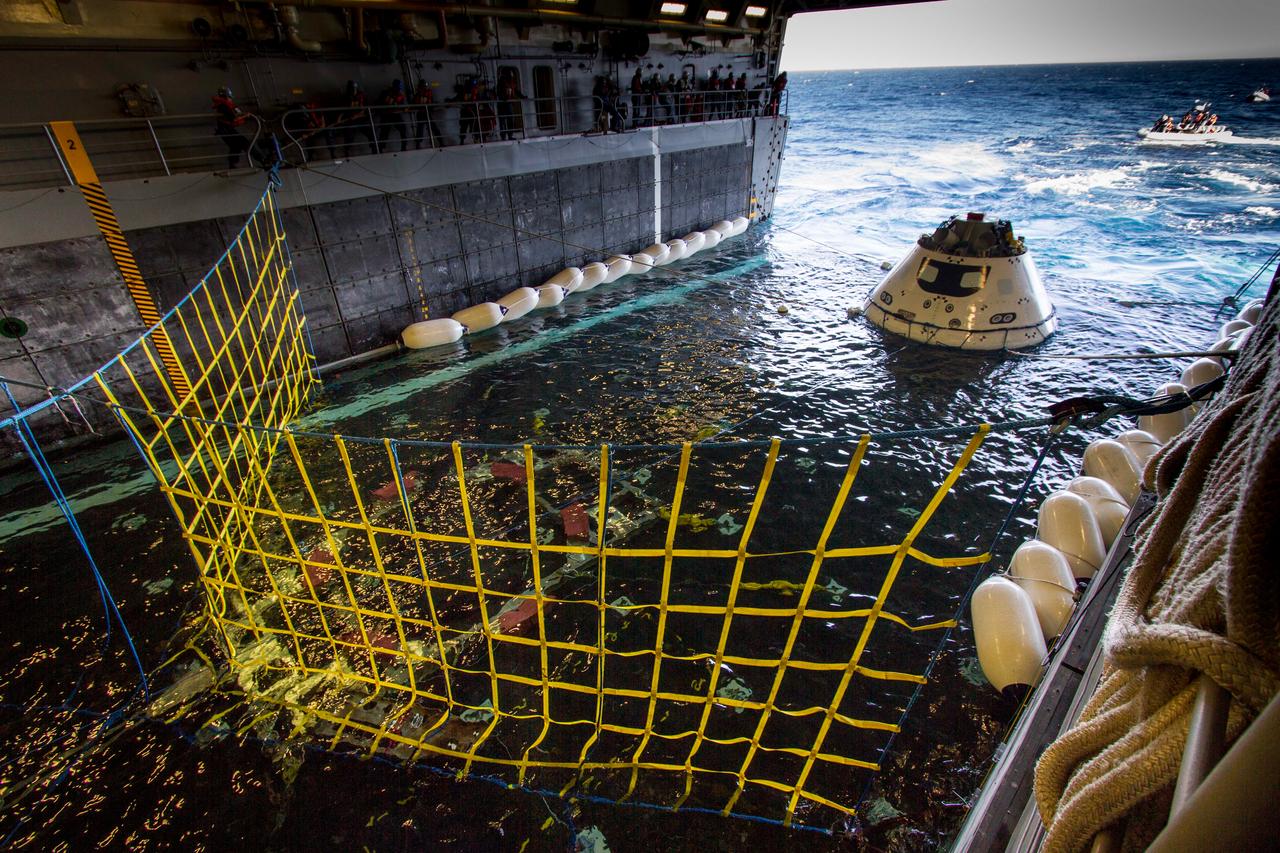
A test version of Orion floats into the well deck of the Navy's USS Anchorage during recovery tests off the coast of California on Sept. 15, 2014. The well deck can be flooded with water to allow Orion to float in, and then drained when the spacecraft is secured. A combined NASA and U.S. Navy team has been practicing recovery techniques in preparation for Exploration Flight Test-1 (EFT-1). Part of Batch image transfer from Flickr.
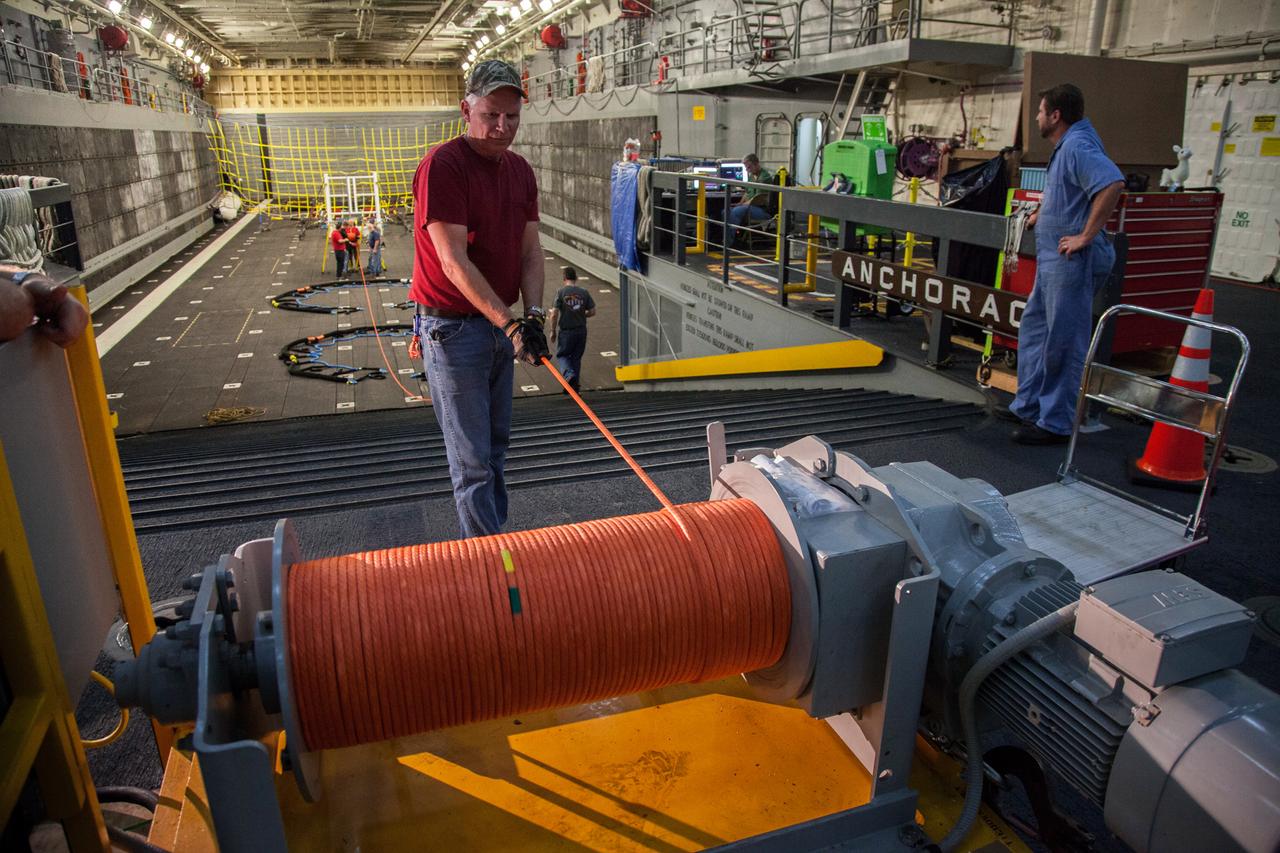
Orion recovery team members make preparations for Orion's splashdown inside the well deck of the U.S. Navy's USS Anchorage Dec. 2, 2014. A combined NASA/Navy team will tow Orion into the Anchorage's flooded well deck using the orange line after the spacecraft lands in the Pacific Ocean following Exploration Flight Test-1 (EFT-1) on Dec. 4. Part of Batch image transfer from Flickr.
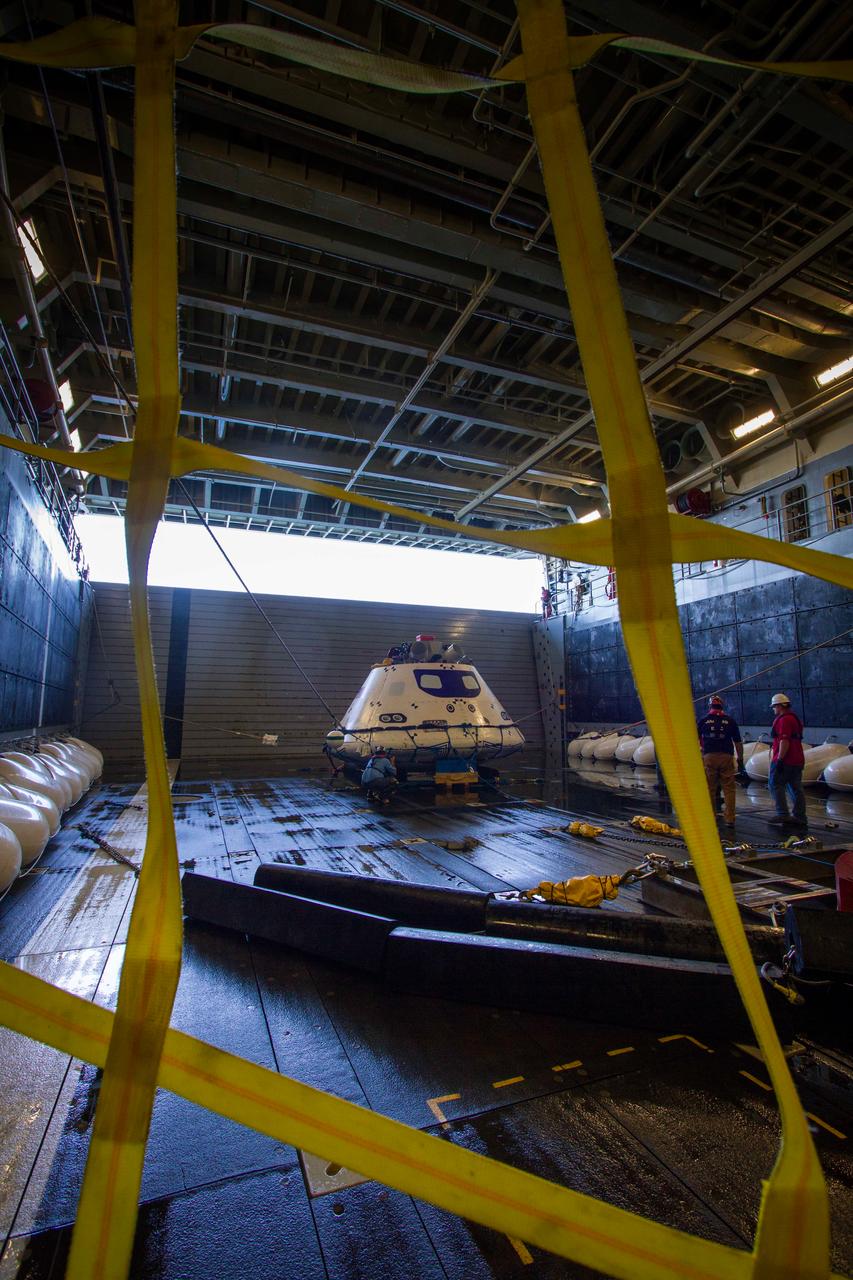
A test version of Orion awaits the next round of recovery tests inside of the USS Anchorage's well deck as the ship travels off the coast of California on Sept. 15, 2014. The well deck can be flooded with water to allow Orion to float in following its splashdown when it returns from space. Part of Batch image transfer from Flickr.
A test version of the Orion spacecraft is tethered inside the well deck of the USS San Diego on Feb. 18, 2014, prior to tests that will allow NASA and the Navy to practice the procedures they'll use to recover Orion from the Pacific Ocean on Exploration Flight Test-1 (EFT-1). To safely bring Orion home after splashdown, it will be towed into the flooded well deck and secured in a specially-designed cradle before the water is drained. Part of Batch image transfer from Flickr.
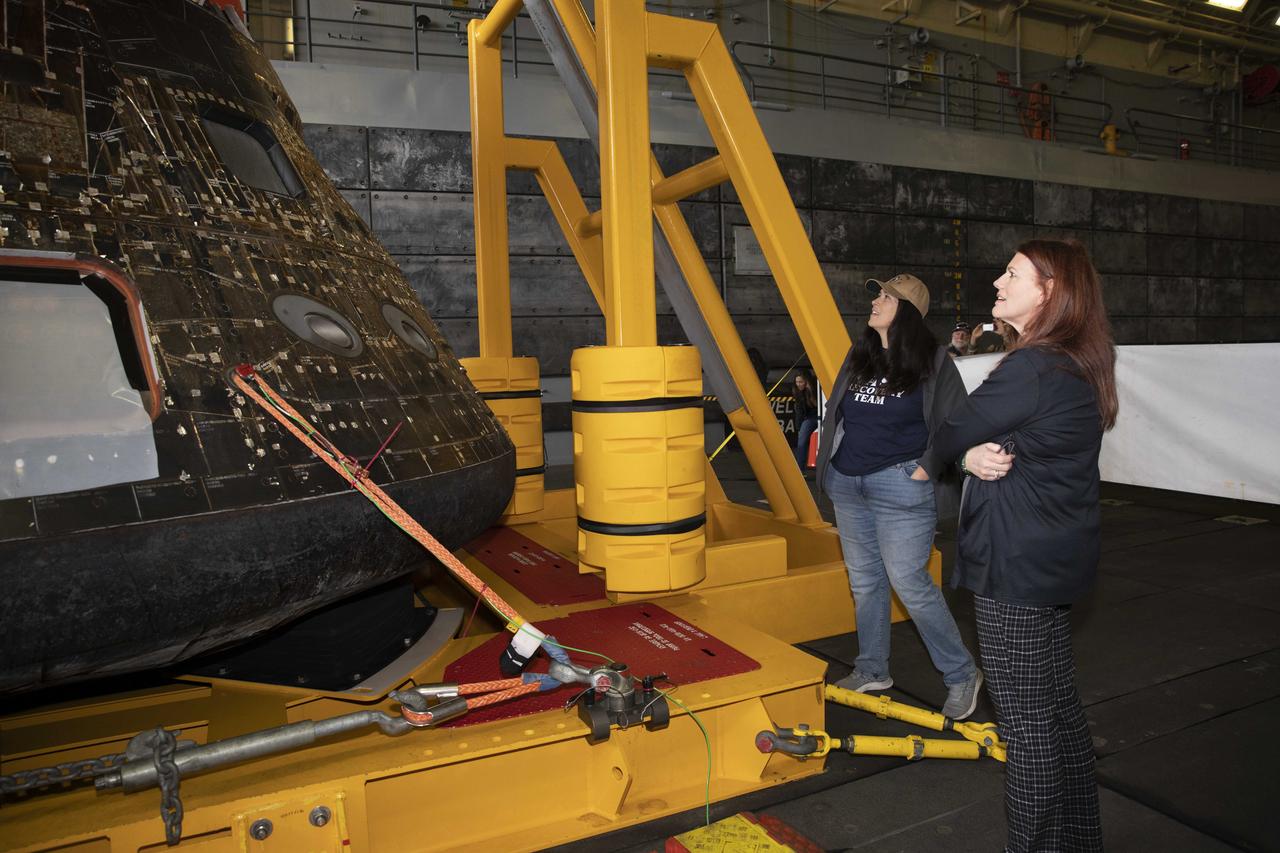
NASA Artemis Launch Director Charlie Blackwell-Thompson, at right, and Melissa Jones, NASA’s Artemis I Recovery director, both with the Exploration Ground Systems program, look at the Artemis I Orion spacecraft inside the well deck of the USS Portland at U.S. Naval Base San Diego on Dec. 13, 2022. The Orion spacecraft is secured inside the well deck after splashing down at 12:40 p.m. EST on Dec. 11, 2022. U.S. Navy divers helped recover the Orion spacecraft. NASA, the Navy and other Department of Defense partners worked together to secure the spacecraft inside the ship’s well deck approximately five hours after Orion splashed down in the Pacific Ocean off the coast of Baja, California.
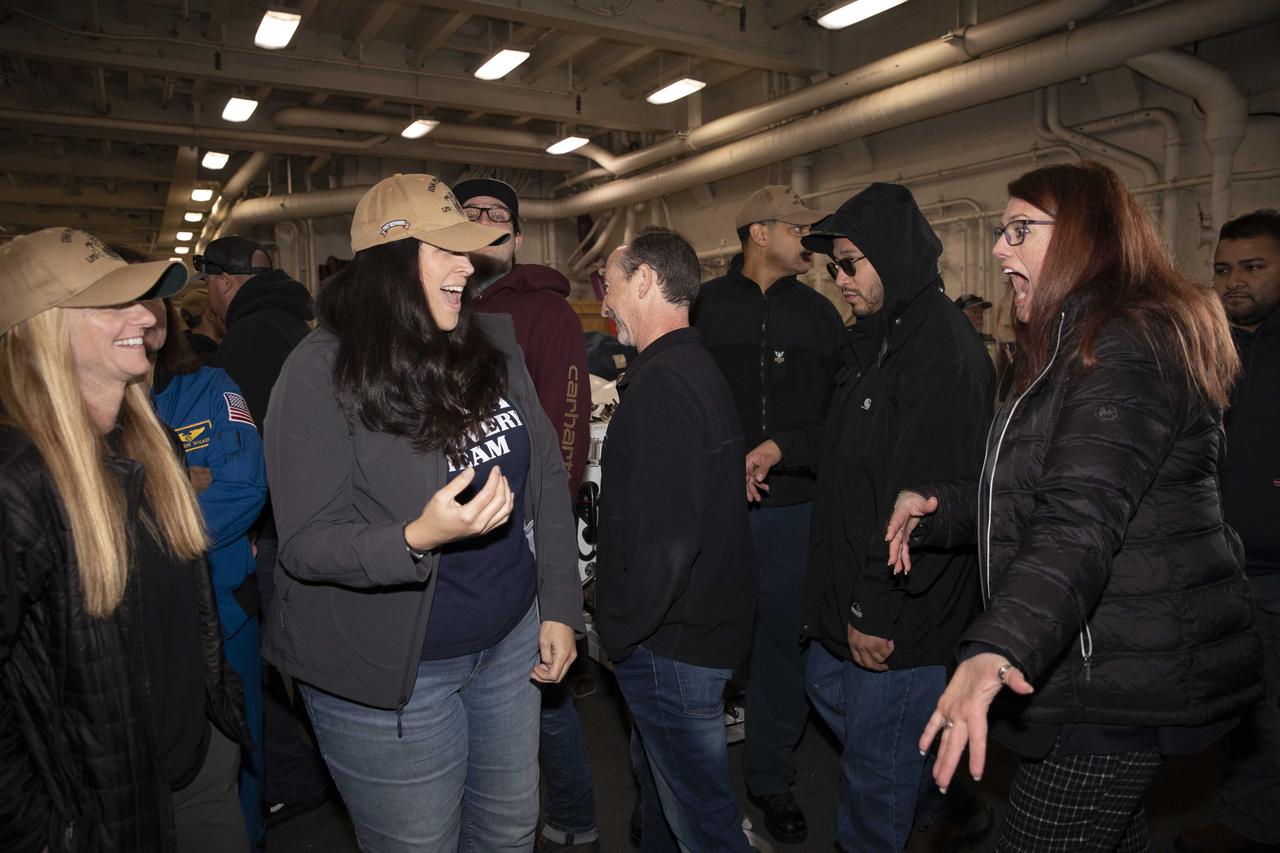
NASA Artemis Launch Director Charlie Blackwell-Thompson, at right, and Melissa Jones, NASA’s Artemis I Recovery director, second from left, both with the Exploration Ground Systems program, along with other recovery team members, exchange congratulations inside the well deck of the USS Portland at U.S. Naval Base San Diego on Dec. 13, 2022. The Orion spacecraft is secured inside the well deck after splashing down at 12:40 p.m. EST on Dec. 11, 2022. U.S. Navy divers helped recover the Orion spacecraft. NASA, the Navy and other Department of Defense partners worked together to secure the spacecraft inside the ship’s well deck approximately five hours after Orion splashed down in the Pacific Ocean off the coast of Baja, California.
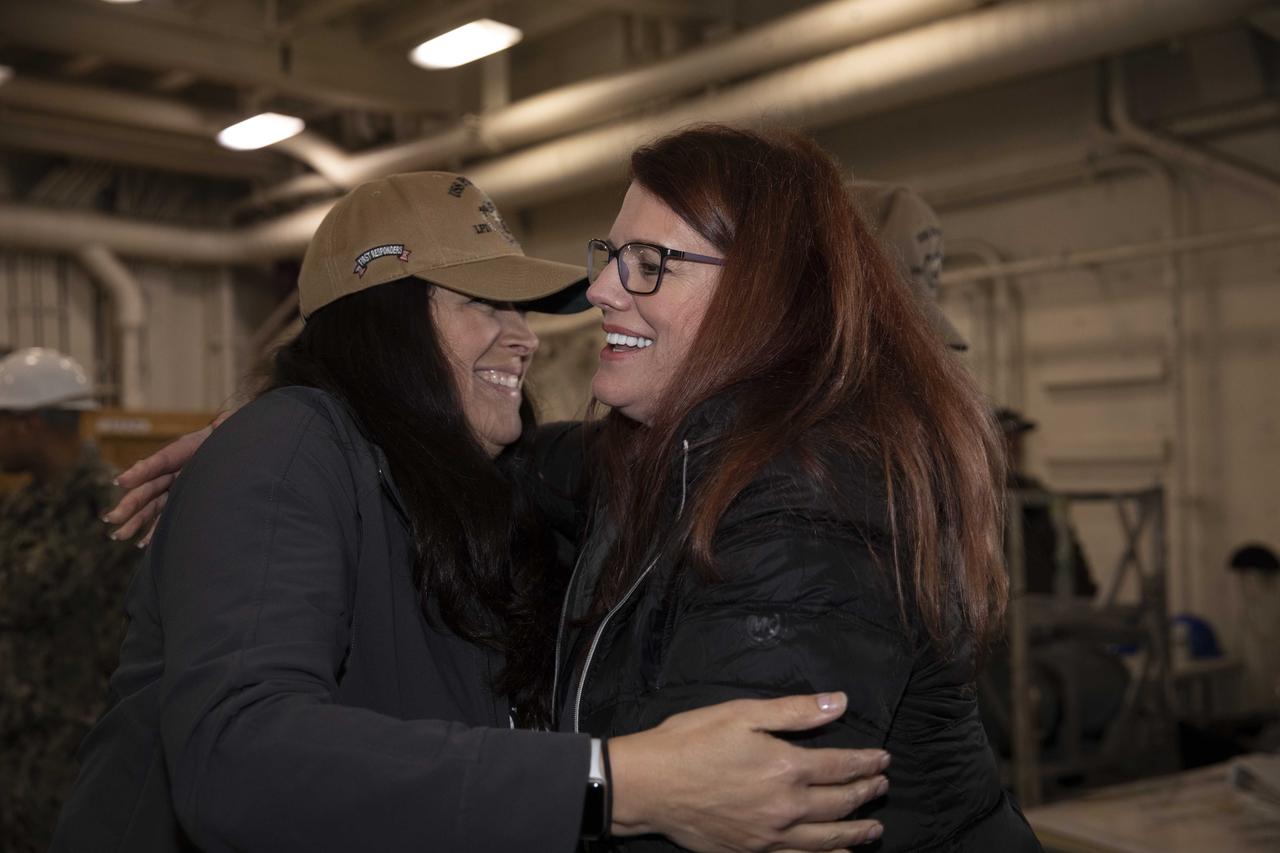
NASA Artemis Launch Director Charlie Blackwell-Thompson, at right, and Melissa Jones, NASA’s Artemis I Recovery director, both with the Exploration Ground Systems program, exchange congratulations inside the well deck of the USS Portland at U.S. Naval Base San Diego on Dec. 13, 2022. The Orion spacecraft is secured inside the well deck after splashing down at 12:40 p.m. EST on Dec. 11, 2022. U.S. Navy divers helped recover the Orion spacecraft. NASA, the Navy and other Department of Defense partners worked together to secure the spacecraft inside the ship’s well deck approximately five hours after Orion splashed down in the Pacific Ocean off the coast of Baja, California.
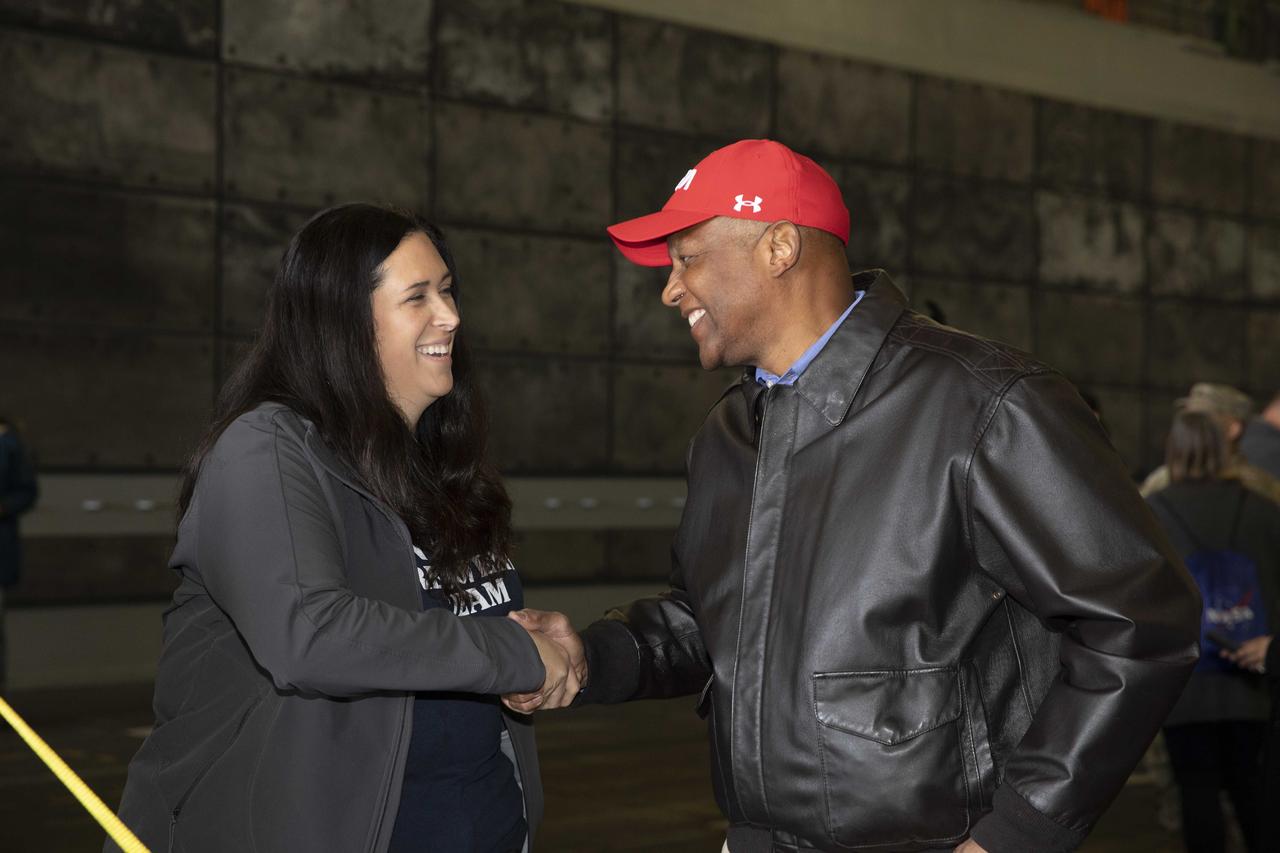
NASA Artemis I Recovery Director Melissa Jones, at right, with Exploration Ground Systems, shakes hands with Kennedy Space Center Deputy Director Kelvin Manning inside the well deck of the USS Portland at U.S. Naval Base San Diego on Dec. 13, 2022. The Artemis I Orion spacecraft is secured inside the well deck after splashing down at 12:40 p.m. EST on Dec. 11, 2022. U.S. Navy divers helped recover the Orion spacecraft. NASA, the Navy and other Department of Defense partners worked together to secure the spacecraft inside the ship’s well deck approximately five hours after Orion splashed down in the Pacific Ocean off the coast of Baja, California.
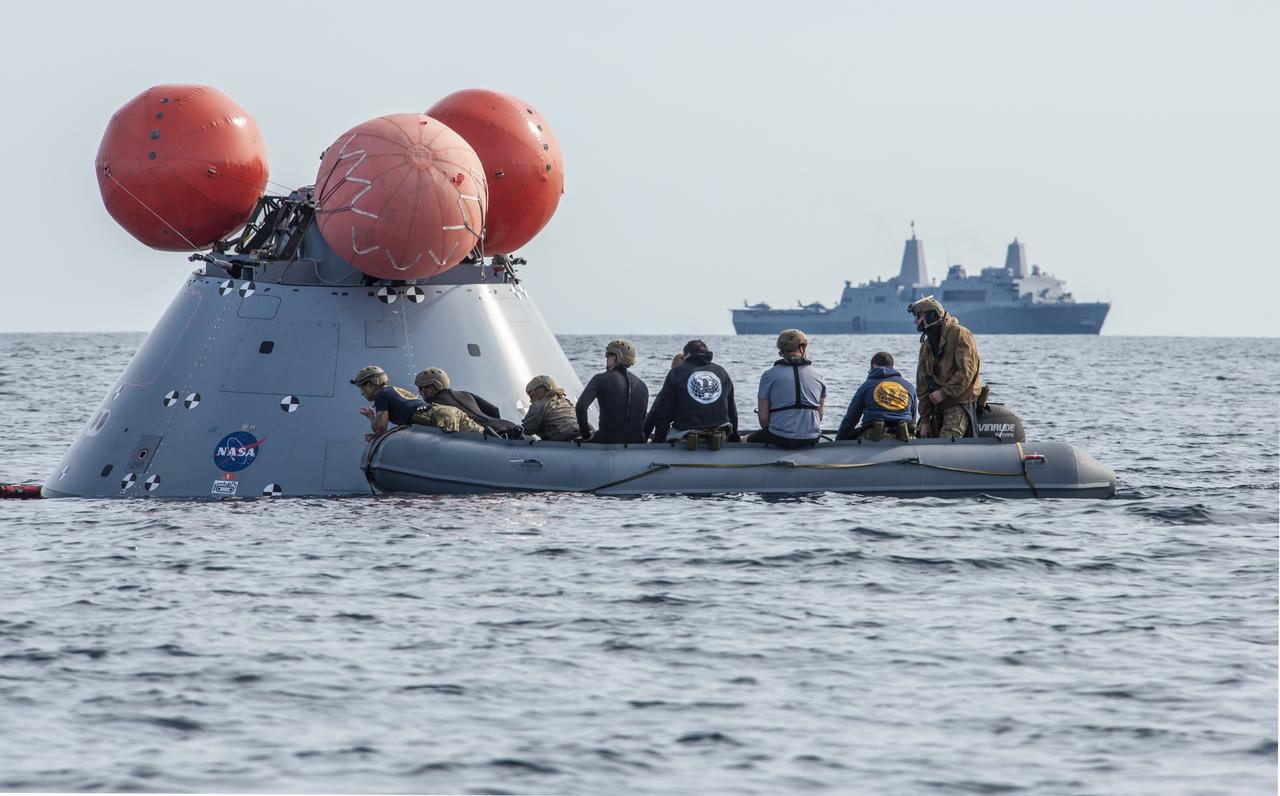
NASA's Landing and Recovery Team practices bringing a mock Orion capsule into the well deck of the USS Portland (LPD 27) ahead of the Artemis I Orion splashdown slated for Dec. 11.
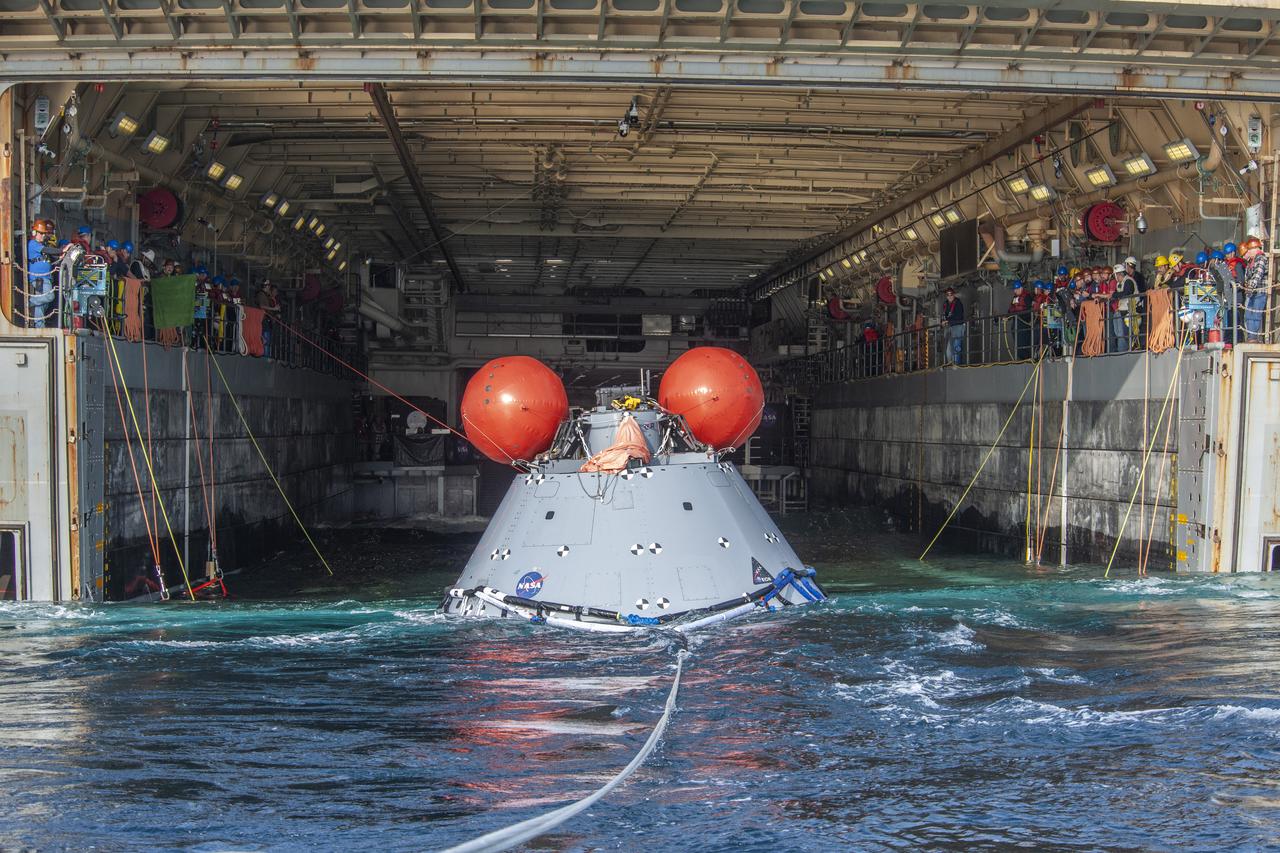
NASA's Landing and Recovery Team practices bringing a mock Orion capsule into the well deck of the USS Portland (LPD 27) ahead of the Artemis I Orion splashdown slated for Dec. 11.
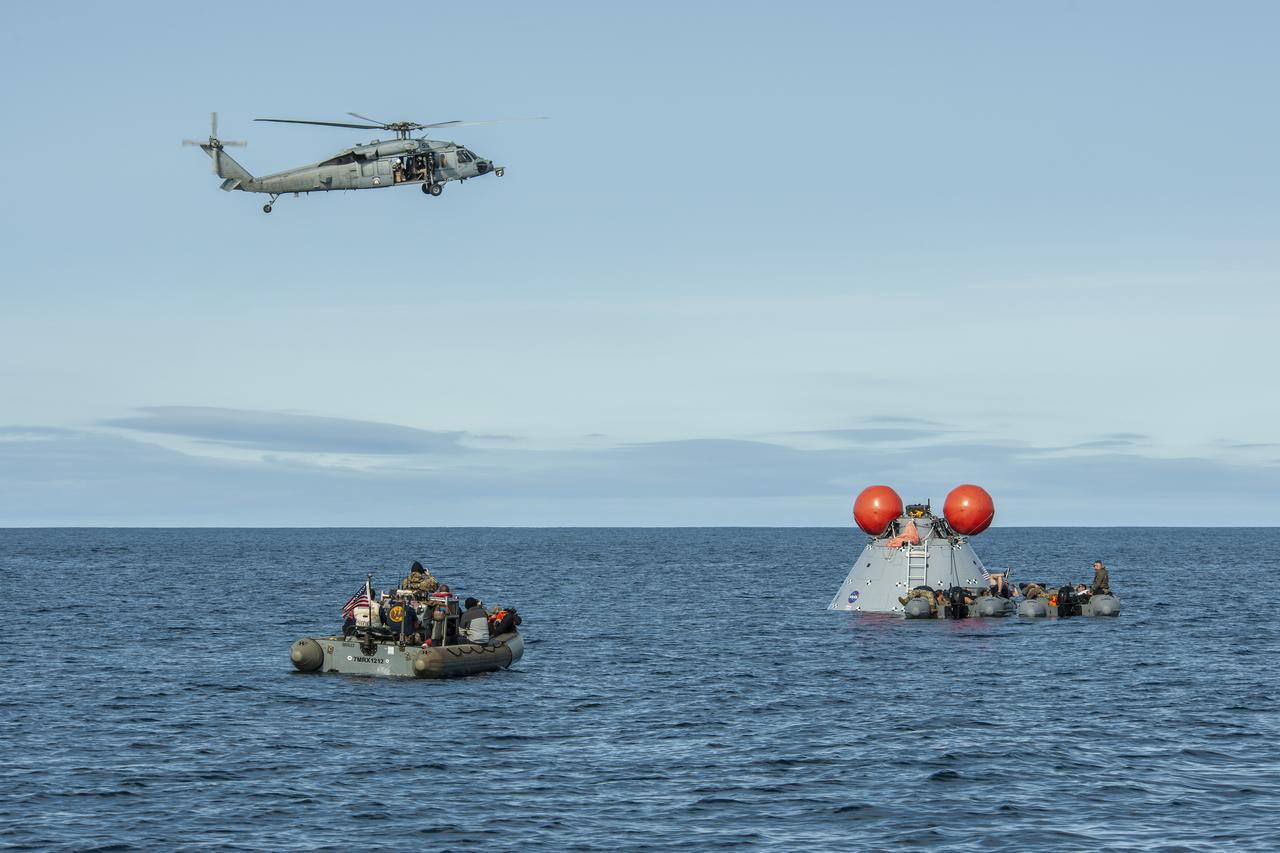
NASA's Landing and Recovery Team practices bringing a mock Orion capsule into the well deck of the USS Portland (LPD 27) ahead of the Artemis I Orion splashdown slated for Dec. 11.
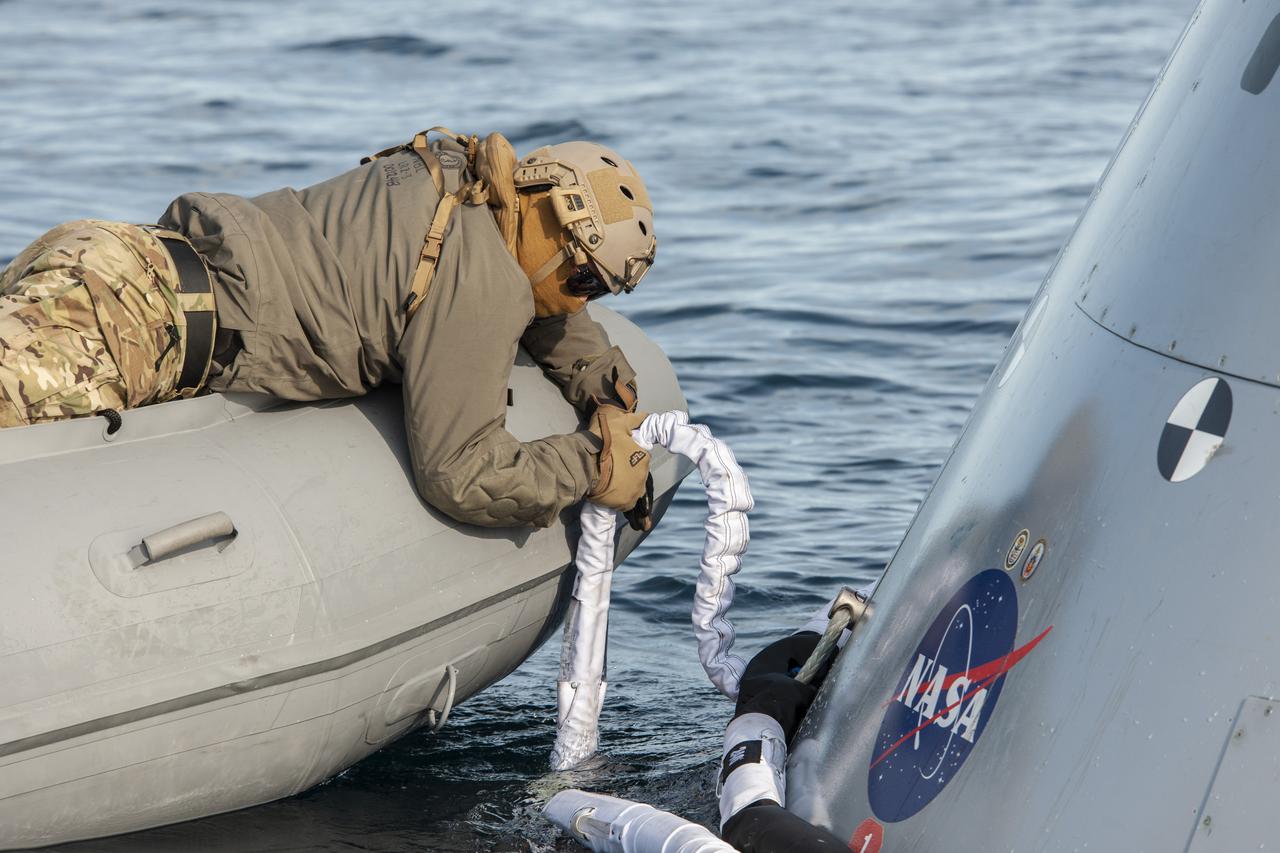
NASA's Landing and Recovery Team practices bringing a mock Orion capsule into the well deck of the USS Portland (LPD 27) ahead of the Artemis I Orion splashdown slated for Dec. 11.
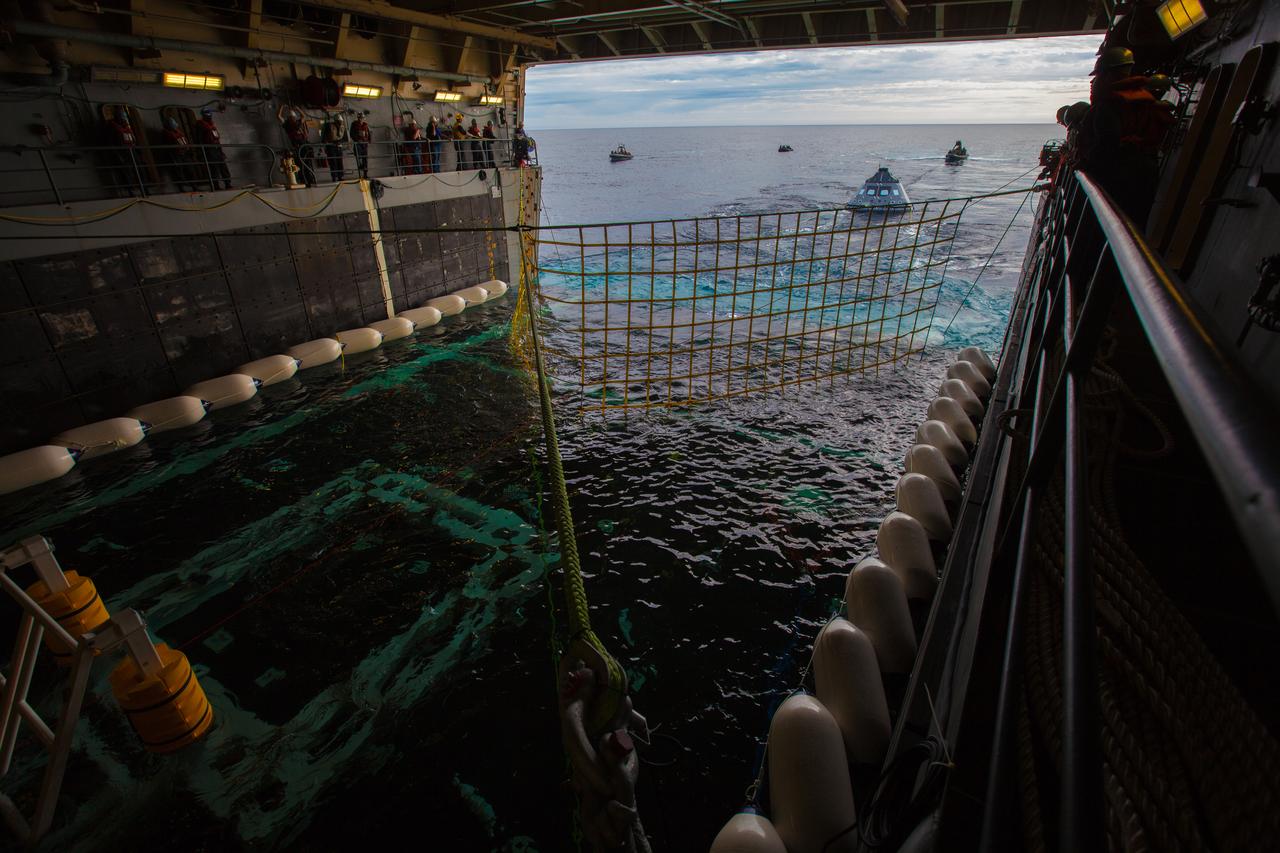
A test version of the Orion crew module is guided toward the flooded well deck of the USS San Diego during Underway Recovery Test 5 on Oct. 28, 2016. NASA's Ground Systems Development and Operations Program and the U.S. Navy are conducting a series of tests using the ship's well deck, the test module, various watercraft and equipment to prepare for recovery of Orion on its return from deep space missions. The test will allow the team to demonstrate and evaluate recovery processes, procedures, hardware and personnel in open waters. Part of Batch images transfer from Flickr.
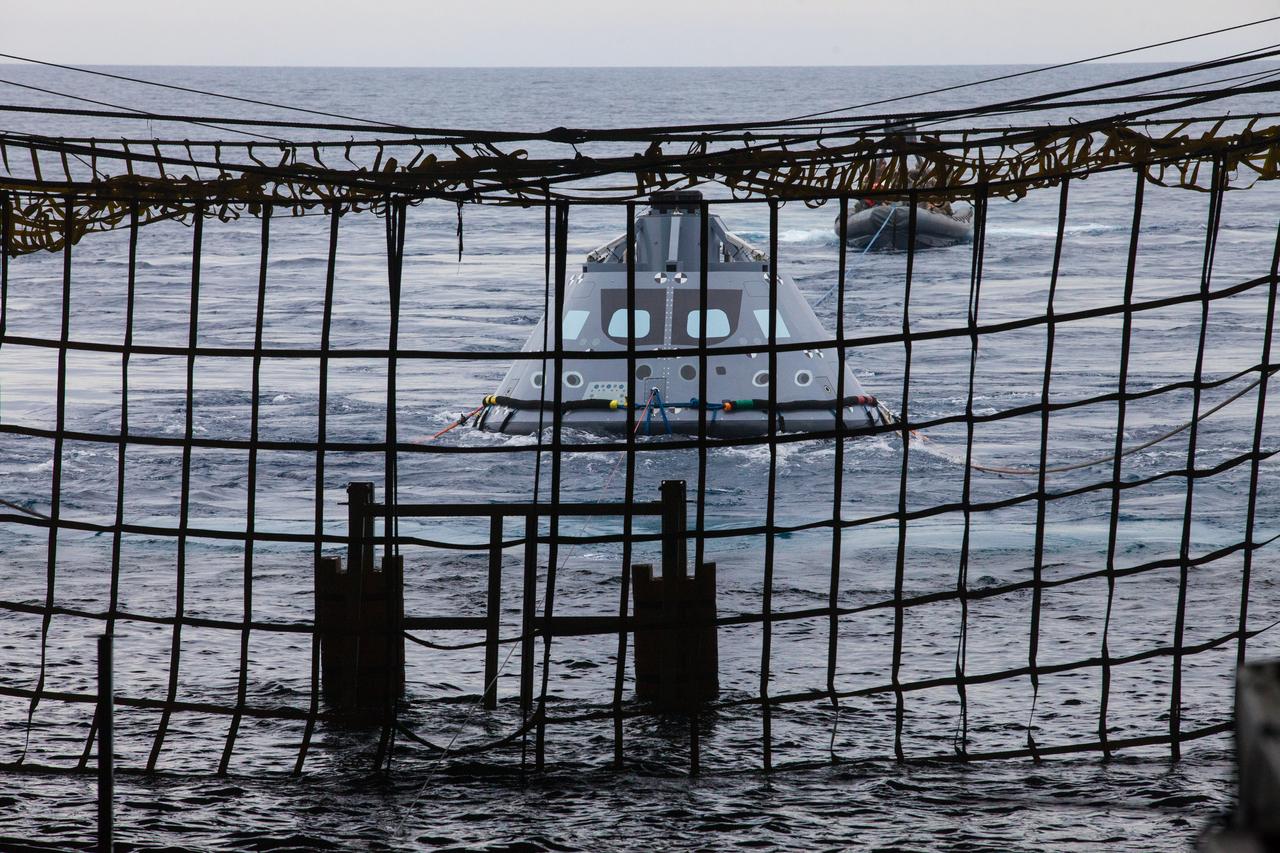
A test version of the Orion crew module is secured in the well deck of the USS San Diego for Underway Recovery Test 5 on Oct. 26, 2016. NASA's Ground Systems Development and Operations Program and the U.S. Navy will conduct a series of tests using the ship's well deck, the test module, various watercraft and equipment to prepare for recovery of Orion on its return from deep space missions. The test will allow the team to demonstrate and evaluate recovery processes, procedures, hardware and personnel in open waters. Part of Batch images transfer from Flickr.

A test version of the Orion crew module is secured in the well deck of the USS San Diego for Underway Recovery Test 5 on Oct. 26, 2016. NASA's Ground Systems Development and Operations Program and the U.S. Navy will conduct a series of tests using the ship's well deck, the test module, various watercraft and equipment to prepare for recovery of Orion on its return from deep space missions. The test will allow the team to demonstrate and evaluate recovery processes, procedures, hardware and personnel in open waters. Part of Batch images transfer from Flickr.
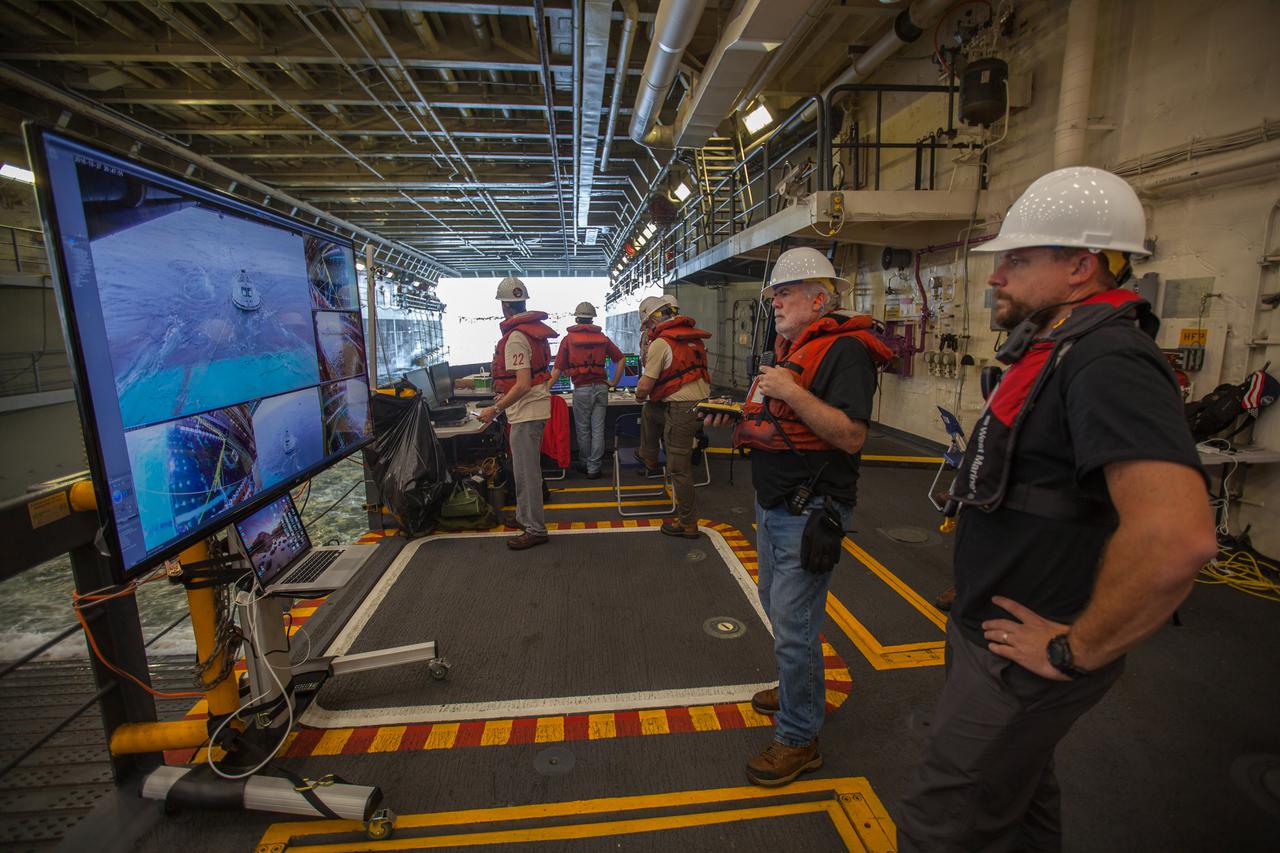
In the well deck of the USS San Diego, recovery team members monitor a portion of Underway Recovery Test 5 in the Pacific Ocean off the coast of California on Oct. 27, 2016. A test version of the Orion crew module is floating in open waters. NASA's Ground Systems Development and Operations Program and the U.S. Navy are conducting a series of tests using the ship's well deck, the test module, various watercraft and equipment to prepare for recovery of Orion on its return from deep space missions. The test will allow the team to demonstrate and evaluate recovery processes, procedures, hardware and personnel in open waters. Part of Batch images transfer from Flickr.
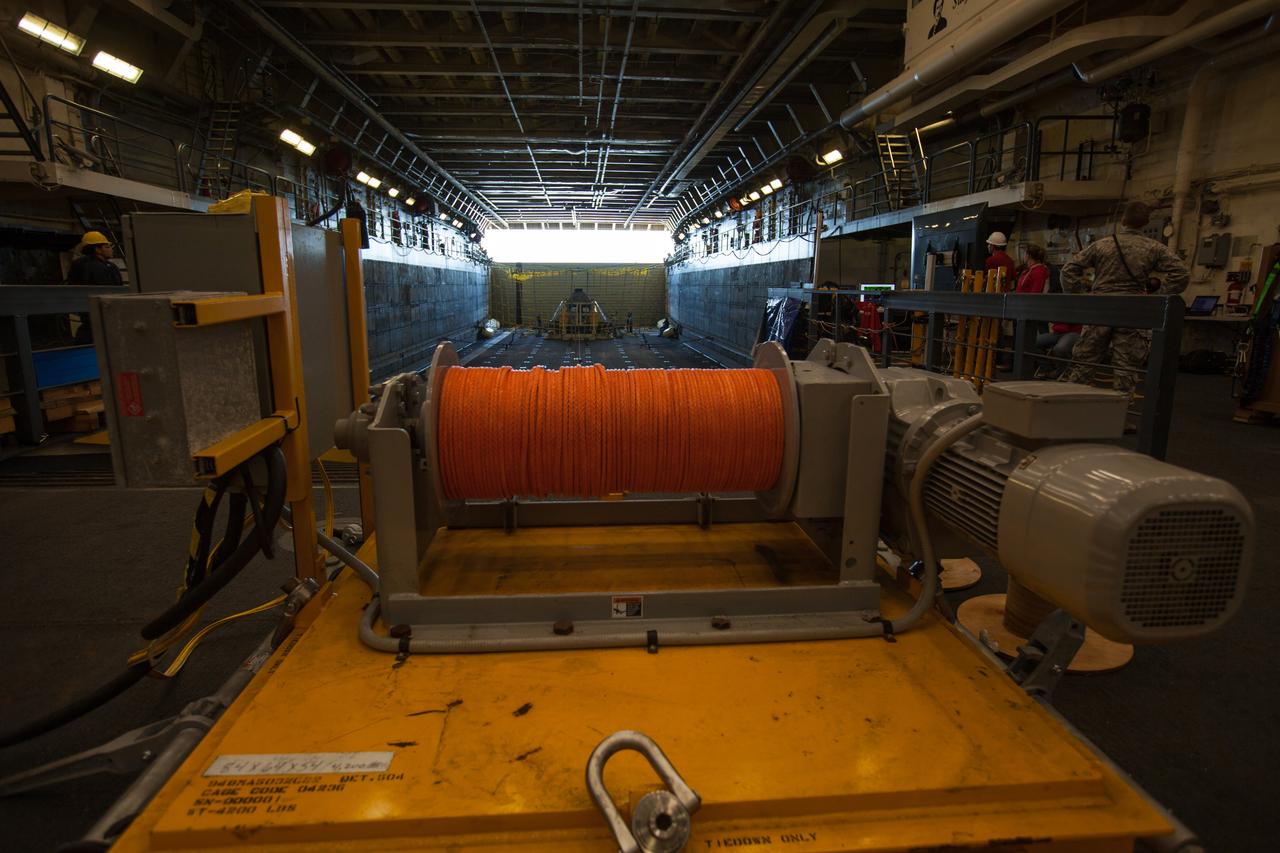
A test version of the Orion crew module is secured in the well deck of the USS San Diego for Underway Recovery Test 5 on Oct. 26, 2016. NASA's Ground Systems Development and Operations Program and the U.S. Navy will conduct a series of tests using the ship's well deck, the test module, various watercraft and equipment to prepare for recovery of Orion on its return from deep space missions. The test will allow the team to demonstrate and evaluate recovery processes, procedures, hardware and personnel in open waters. Part of Batch images transfer from Flickr.
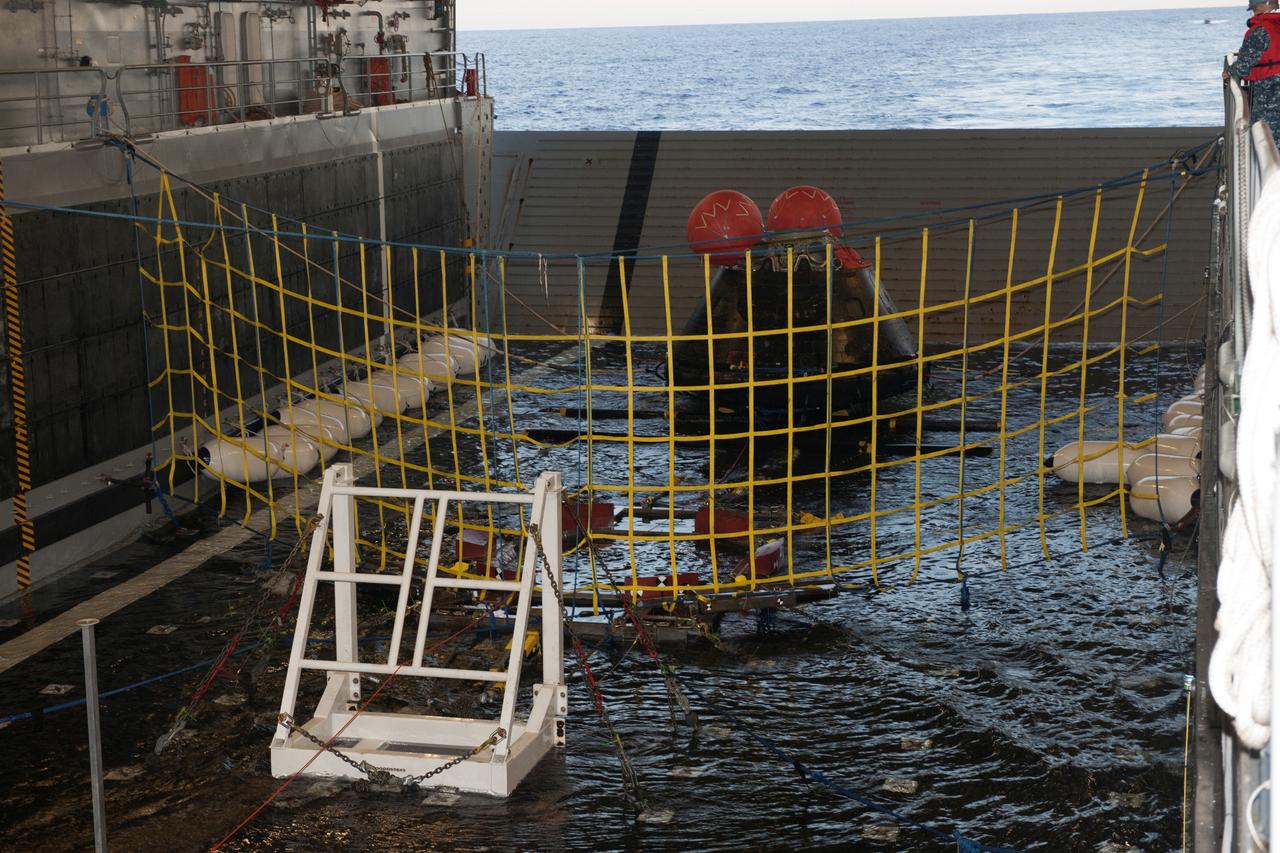
NASA's Orion spacecraft is on rubber bumpers in the flooded well deck of the USS Anchorage in the Pacific Ocean about 600 miles off the coast of San Diego, California. Orion splashed down after its first flight test in Earth orbit. NASA, the U.S. Navy and Lockheed Martin are coordinating efforts to recover Orion and secure the spacecraft in the well deck of the USS Anchorage. Orion completed a two-orbit, four-and-a-half hour mission, to test systems critical to crew safety, including the launch abort system, the heat shield and the parachute system. The Ground Systems Development and Operations Program is leading the recovery efforts.
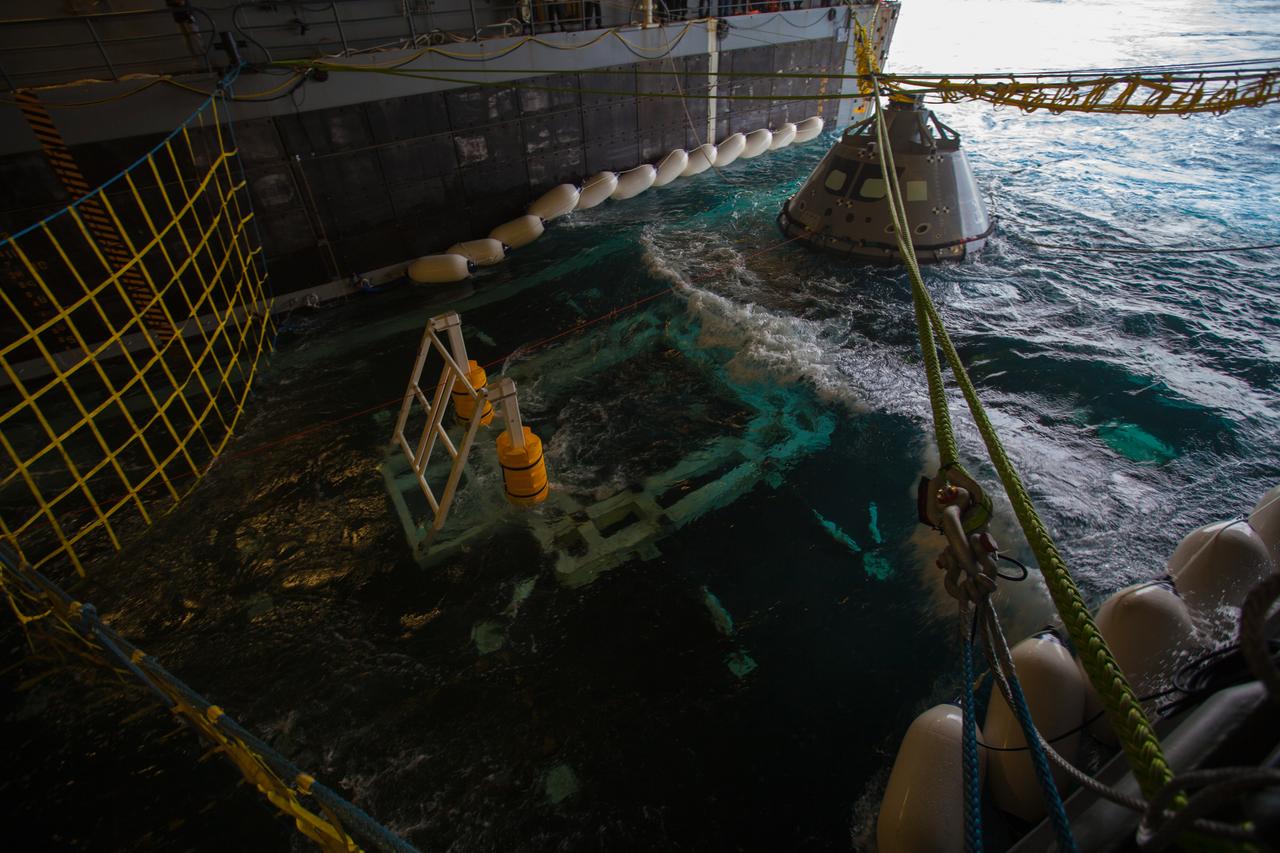
A test version of the Orion crew module is secured in the well deck of the USS San Diego for Underway Recovery Test 5 on Oct. 26, 2016. NASA's Ground Systems Development and Operations Program and the U.S. Navy will conduct a series of tests using the ship's well deck, the test module, various watercraft and equipment to prepare for recovery of Orion on its return from deep space missions. The test will allow the team to demonstrate and evaluate recovery processes, procedures, hardware and personnel in open waters. Part of Batch images transfer from Flickr.
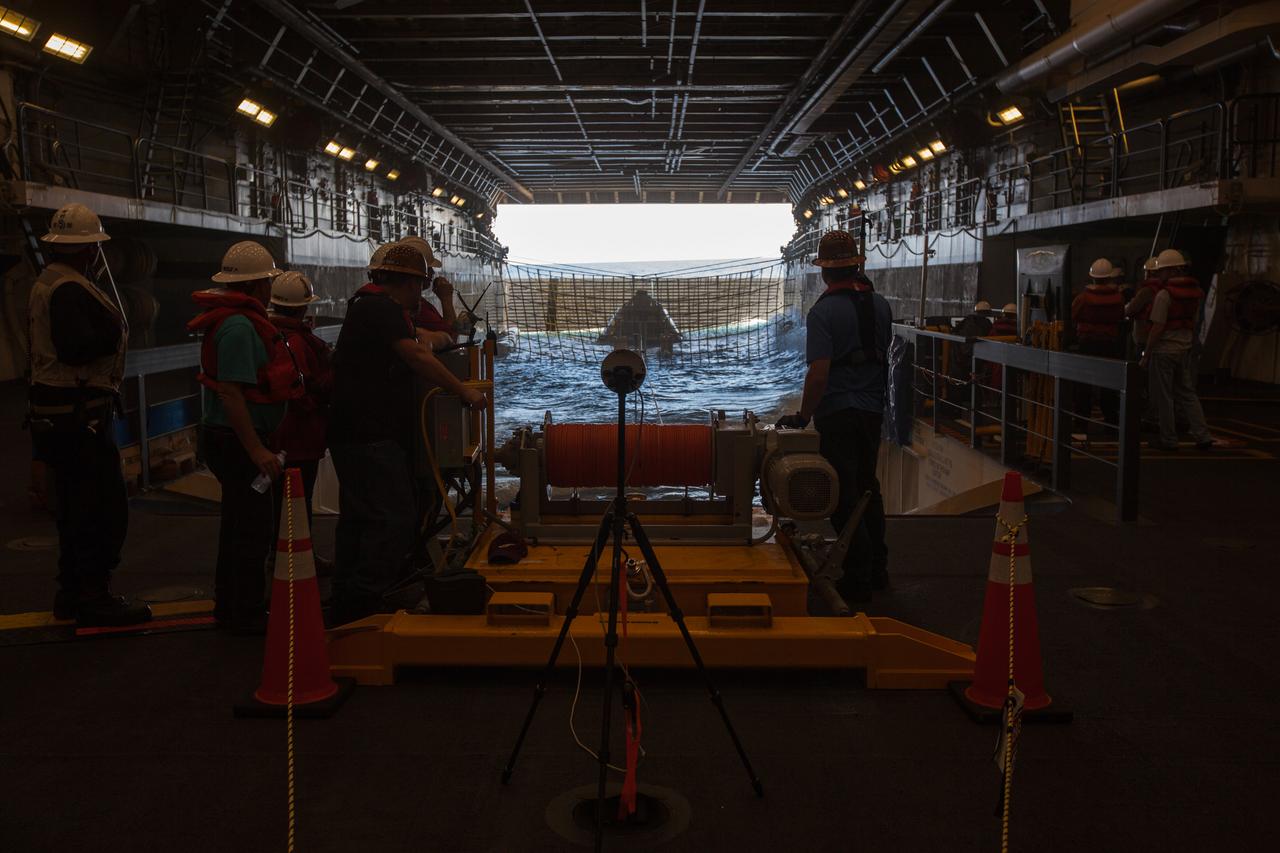
Winch team operators help guide a test version of the Orion crew module in the flooded well deck of the USS San Diego during Underway Recovery Test 5 in the Pacific Ocean off the coast of California on Oct. 29, 2016. NASA's Ground Systems Development and Operations Program and the U.S. Navy are conducting a series of tests using the ship's well deck, the test module, various watercraft and equipment to prepare for recovery of Orion on its return from deep space missions. The testing will allow the team to demonstrate and evaluate recovery processes, procedures, hardware and personnel in open waters. Part of Batch images transfer from Flickr.
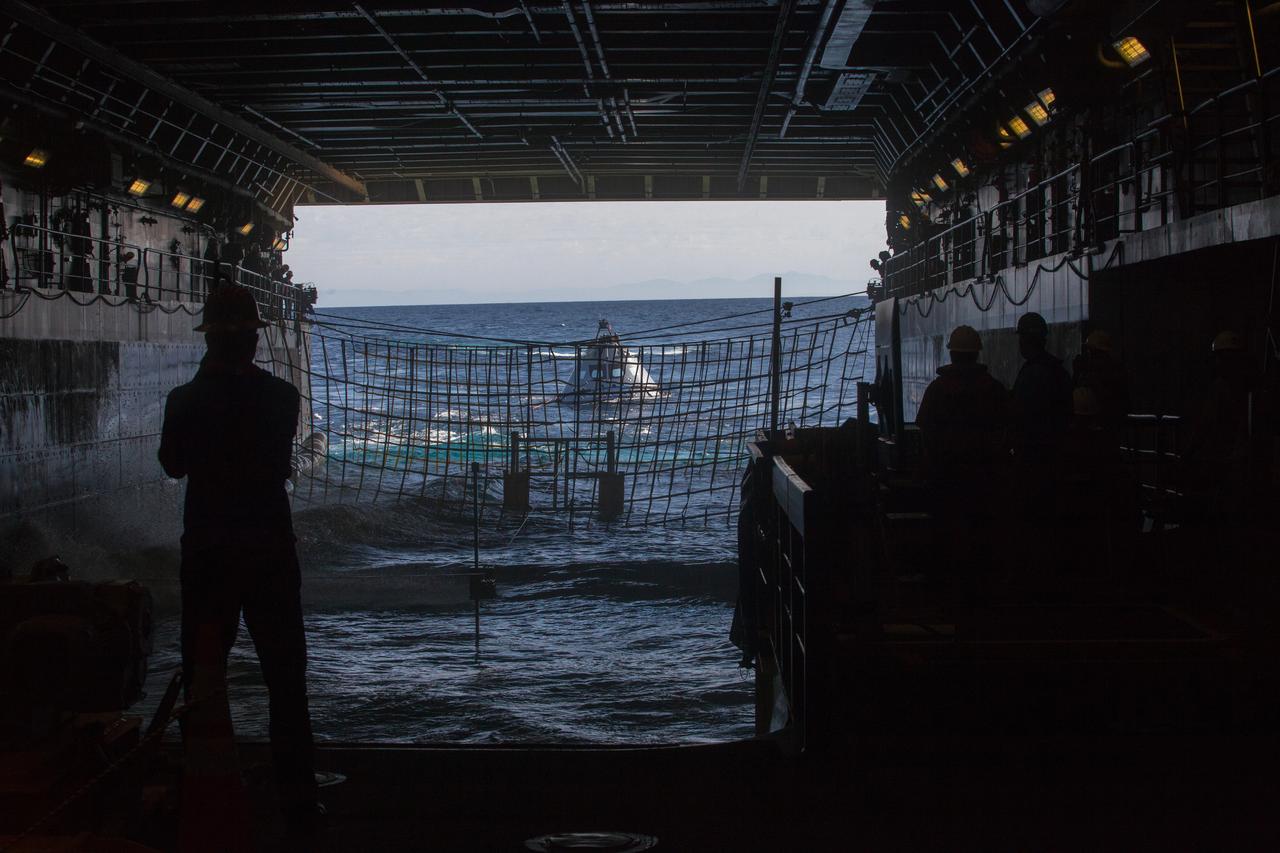
A test version of the Orion crew module floats outside the well deck of the USS San Diego during Underway Recovery Test 5 in the Pacific Ocean off the coast of California on Oct. 29, 2016. NASA's Ground Systems Development and Operations Program and the U.S. Navy are conducting a series of tests using the ship's well deck, several watercraft, support equipment and personnel to prepare for recovery of Orion on its return from deep space missions. The testing will allow the team to demonstrate and evaluate recovery processes, procedures, hardware and personnel in open waters. Part of Batch images transfer from Flickr.

Members of the recovery team watch as the test version of the Orion crew module is guided into the flooded well deck of the USS San Diego during Underway Recovery Test 5 in the Pacific Ocean off the coast of California on Oct. 30, 2016. NASA's Ground Systems Development and Operations Program and the U.S. Navy are conducting a series of tests using the ship's well deck, the test module, various watercraft and equipment to prepare for recovery of Orion on its return from deep space missions. The testing will allow the team to demonstrate and evaluate recovery processes, procedures, hardware and personnel in open waters. Part of Batch images transfer from Flickr.
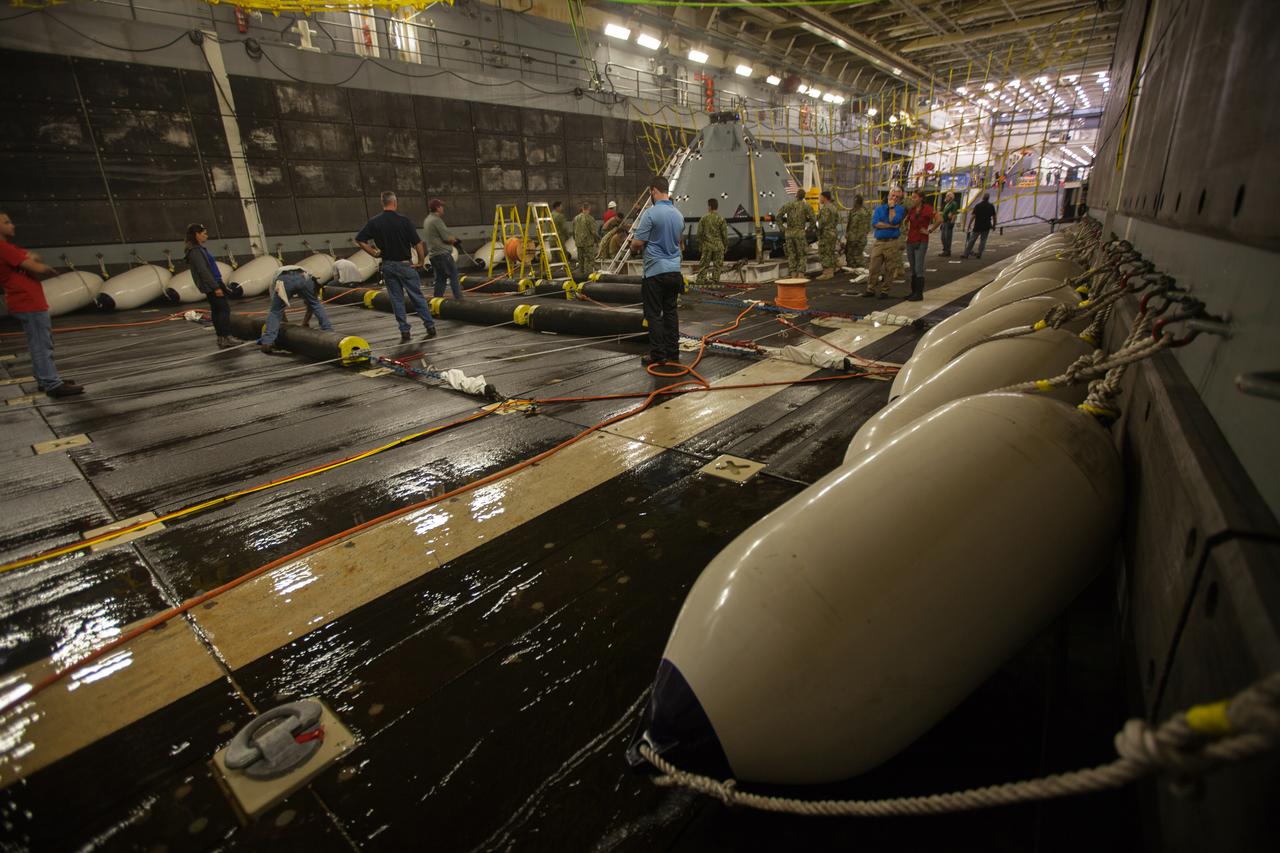
A test version of the Orion crew module is secured in the well deck of the USS San Diego for Underway Recovery Test 5 on Oct. 26, 2016. NASA's Ground Systems Development and Operations Program and the U.S. Navy will conduct a series of tests using the ship's well deck, the test module, various watercraft and equipment to prepare for recovery of Orion on its return from deep space missions. The test will allow the team to demonstrate and evaluate recovery processes, procedures, hardware and personnel in open waters. Part of Batch images transfer from Flickr.

An Orion recovery team member makes preparations for Orion's splashdown inside the well deck of the U.S. Navy's USS Anchorage on Dec. 2, 2014. A combined NASA/Navy team will tow Orion into the Anchorage's flooded well deck using the orange line after the spacecraft lands in the Pacific Ocean following Exploration Flight Test-1 (EFT-1) on Dec. 4. Orion will sit in the metal ring behind the yellow netting for the trip back to shore, and then be moved into the white cradle in the foreground for transport back to NASA's Kennedy Space Center. Part of Batch image transfer from Flickr.
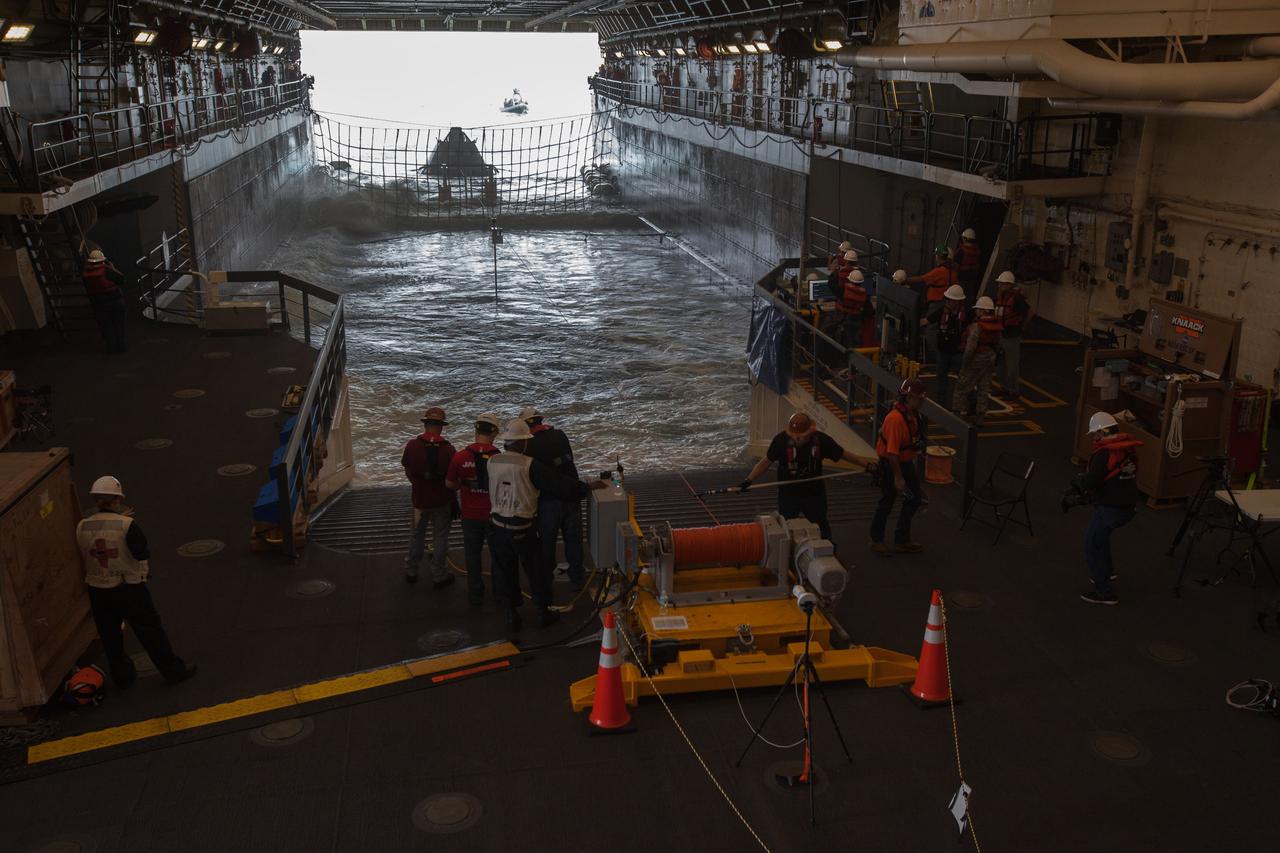
Winch team operators help guide a test version of the Orion crew module into the flooded well deck of the USS San Diego during Underway Recovery Test 5 in the Pacific Ocean off the coast of California on Oct. 30, 2016. NASA's Ground Systems Development and Operations Program and the U.S. Navy are conducting a series of tests using the ship's well deck, the test module, various watercraft and equipment to prepare for recovery of Orion on its return from deep space missions. The testing will allow the team to demonstrate and evaluate recovery processes, procedures, hardware and personnel in open waters. Part of Batch images transfer from Flickr.
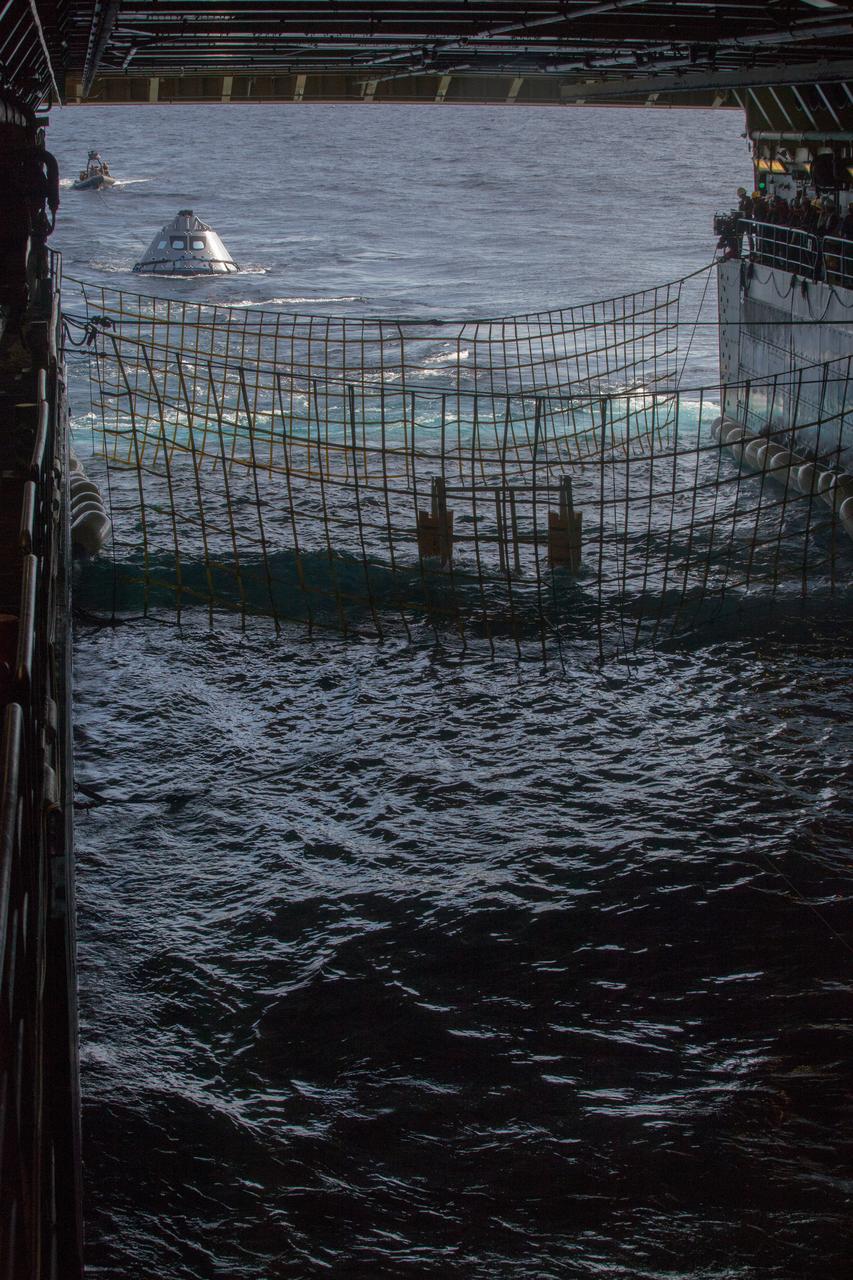
A test version of the Orion crew module floats outside the well deck of the USS San Diego during Orion Underway Recovery Test 5 in the Pacific Ocean off the coast of California on Oct. 29, 2016. In the distance are U.S. Navy divers in a rigid hull inflatable boat. NASA's Ground Systems Development and Operations Program and the U.S. Navy are practicing recovery techniques using the well deck of the ship and the test version of the crew module to prepare for recovery of Orion on its return from deep space missions. The testing will allow the team to demonstrate and evaluate recovery processes, procedures, hardware and personnel in open waters. Part of Batch images transfer from Flickr.

Recovery team members use a crane to lift a test version of Orion off the deck of the Navy's USS Salvor on Sept. 13, 2014. A combined NASA and U.S. Navy team practiced recovery techniques off the coast of California over the course of the next week -- first with the crane, as seen here, then using the USS Anchorage's well deck -- in preparation for Exploration Flight Test-1 (EFT-1). Part of Batch image transfer from Flickr.
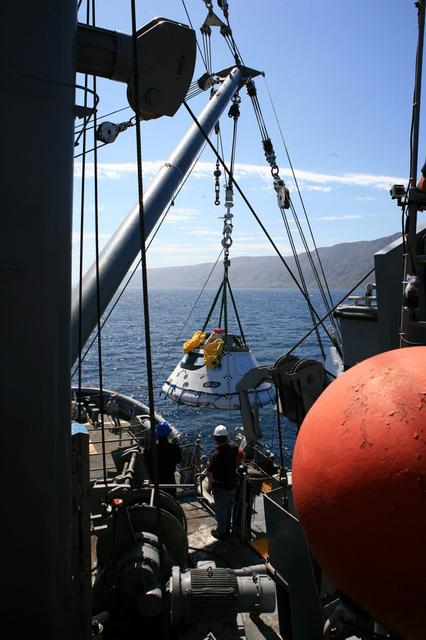
Recovery team members use a crane to lift a test version of Orion off the deck of the Navy's USS Salvor on Sept. 13, 2014. A combined NASA and U.S. Navy team practiced recovery techniques off the coast of California over the course of the next week -- first with the crane, as seen here, then using the USS Anchorage's well deck -- in preparation for Exploration Flight Test-1 (EFT-1). Part of Batch image transfer from Flickr.
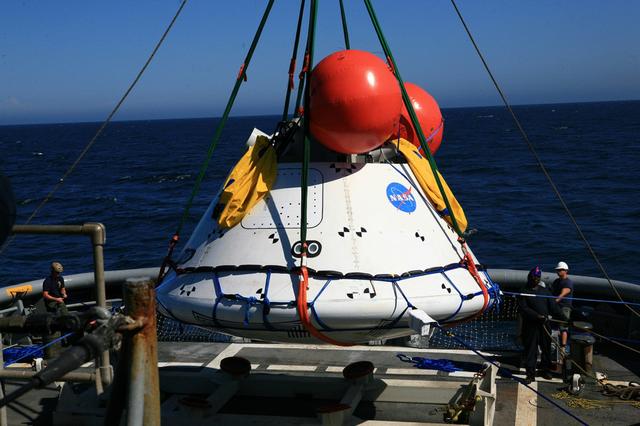
Recovery team members lower a test version of Orion onto the deck of the Navy's USS Salvor on Sept. 13, 2014. A combined NASA and U.S. Navy team is practiced recovery techniques off the coast of California over the course of the the week -- first with a crane on board the Salvor, then using the USS Anchorage's well deck -- in preparation for Exploration Flight Test-1 (EFT-1). Part of Batch image transfer from Flickr.
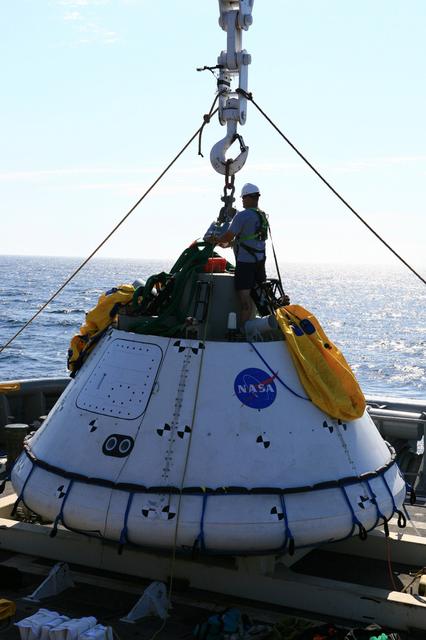
A recovery team members prepares a test version of Orion to be lifted off the deck of the Navy's USS Salvor on Sept. 13, 2014. A combined NASA and U.S. Navy team practiced recovery techniques off the coast of California over the course of the next week -- first with the crane, as seen here, then using the USS Anchorage's well deck -- in preparation for Exploration Flight Test-1 (EFT-1). Part of Batch image transfer from Flickr.
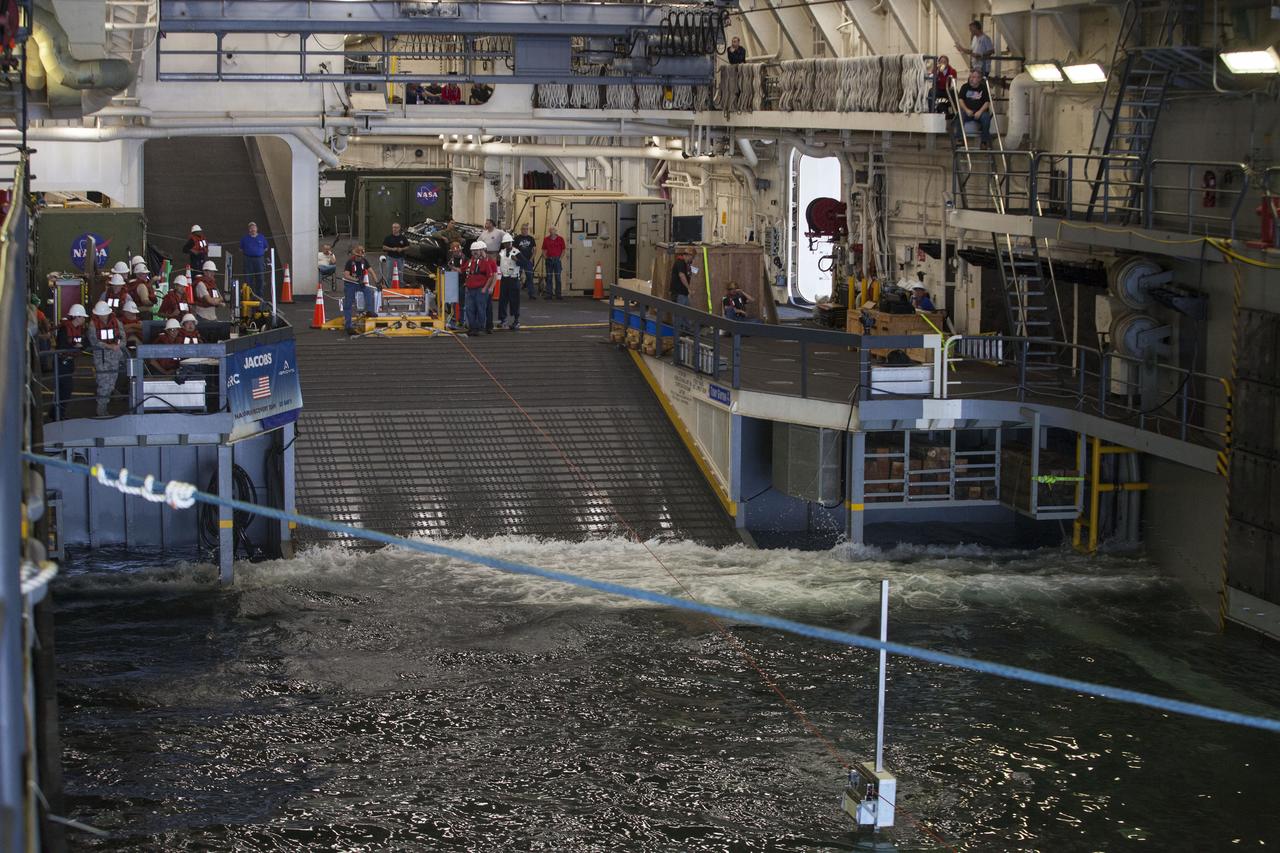
In the flooded well deck of the USS San Diego, recovery team members watch as a winch line is operated to help guide a test version of the Orion crew module into the well deck during Orion Underway Recovery Test 5 in the Pacific Ocean off the coast of California. NASA's Ground Systems Development and Operations Program and the U.S. Navy will practice recovery techniques using the well deck of the ship and a test version of the Orion crew module to prepare for recovery of Orion on its return from deep space missions. The testing will allow the team to demonstrate and evaluate recovery processes, procedures, hardware and personnel in open waters. Orion is the exploration spacecraft designed to carry astronauts to destinations not yet explored by humans, including an asteroid and NASA's Journey to Mars. It will have emergency abort capability, sustain the crew during space travel and provide safe re-entry from deep space return velocities. Orion is scheduled to launch on NASA's Space Launch System in late 2018. For more information, visit http://www.nasa.gov/orion.
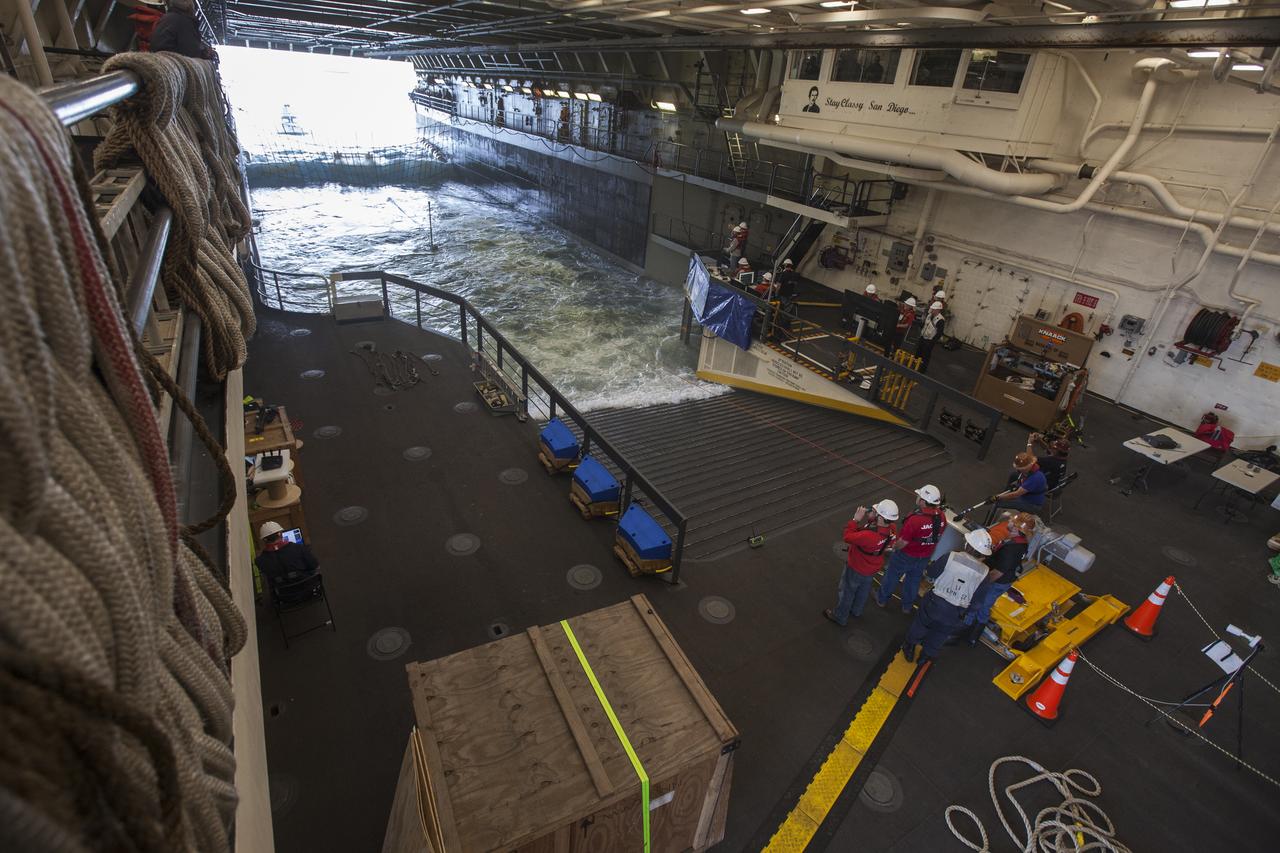
Winch operators, at right, watch from the flooded well deck of the USS San Diego as a test version of the Orion crew module is guided to the well deck during Underway Recovery Test 5 in the Pacific Ocean off the coast of California. NASA's Ground Systems Development and Operations Program and the U.S. Navy are conducting a series of tests using the well deck of the USS San Diego, several watercraft, support equipment and personnel to prepare for recovery of Orion on its return from deep space missions. The testing will allow the team to demonstrate and evaluate recovery processes, procedures, hardware and personnel in open waters. Orion is the exploration spacecraft designed to carry astronauts to destinations not yet explored by humans, including an asteroid and NASA's Journey to Mars. It will have emergency abort capability, sustain the crew during space travel and provide safe re-entry from deep space return velocities. Orion is scheduled to launch on NASA's Space Launch System in late 2018. For more information, visit http://www.nasa.gov/orion.
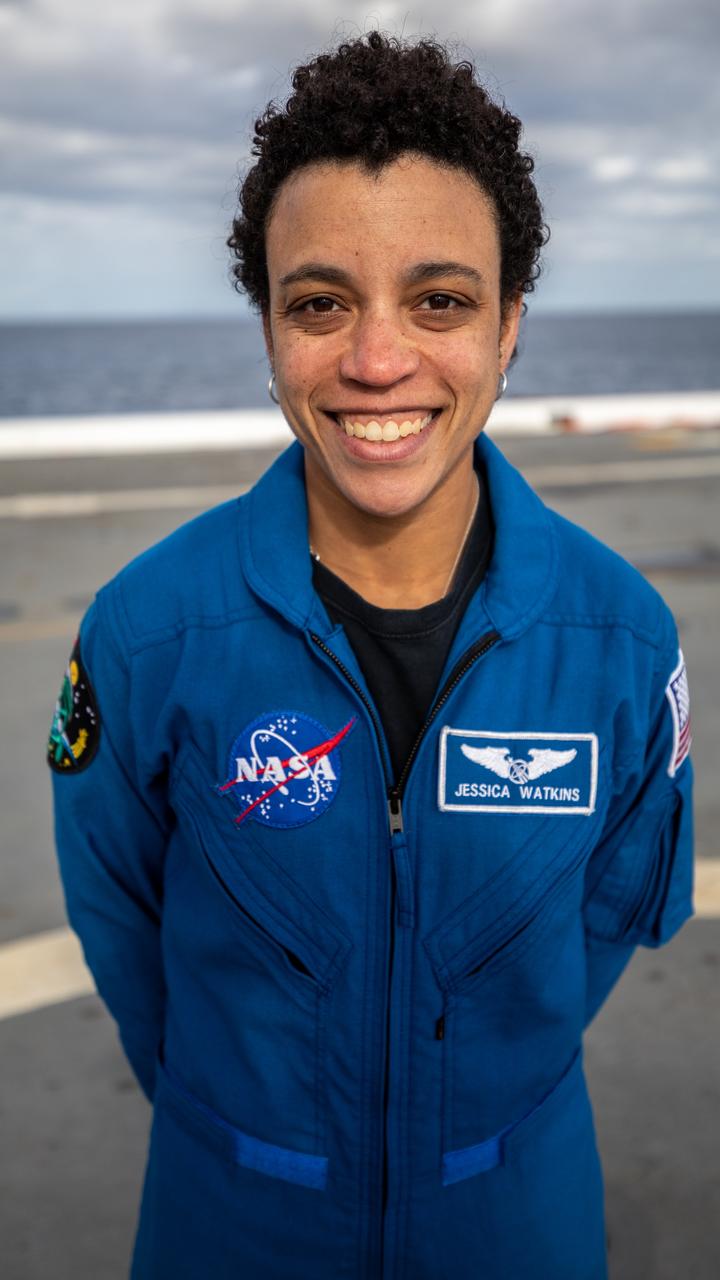
Astronaut Jessica Watkins observes Underway Recovery Test-8 aboard the USS John P. Murtha. During the test, NASA’s Landing and Recovery Team practiced bringing Orion into the well deck of the ship to ensure recovery procedure timelines are validated as NASA plans to send Artemis I around the Moon and splashdown in the Pacific Ocean.
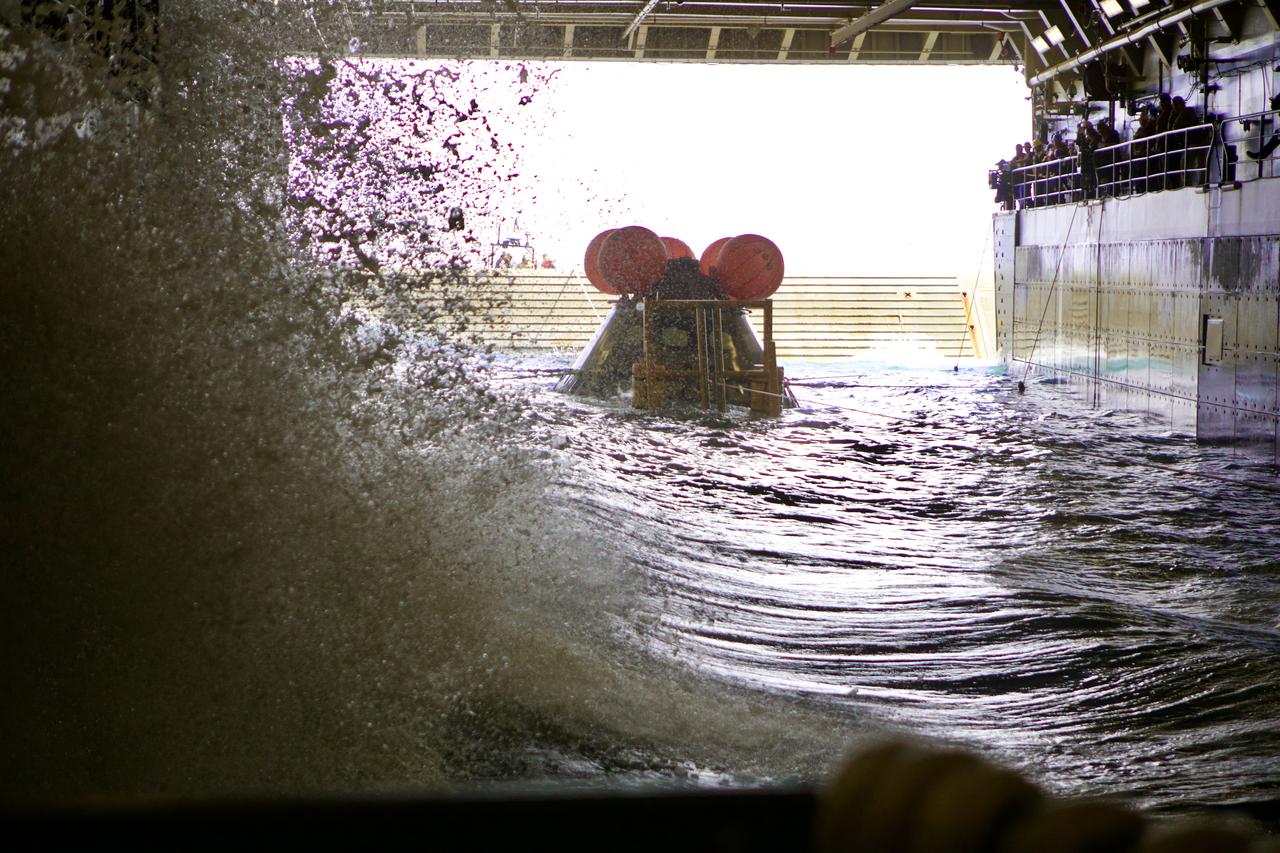
NASA’s Landing and Recovery team practice bringing a test version of the Orion capsule into the well deck of a Navy ship during Underway Recovery Test-8. During the test, the team practiced to ensure recovery procedure timelines are validated as NASA plans to send Artemis I around the Moon and splashdown in the Pacific Ocean.

NASA’s Landing and Recovery team, composed of members from the Department of Defense, NASA and contractor Jacobs, practiced securing a test version of Orion into the well deck of a ship. During the test, the team practiced to ensure recovery procedure timelines are validated as NASA plans to send Artemis I around the Moon and splashdown in the Pacific Ocean.
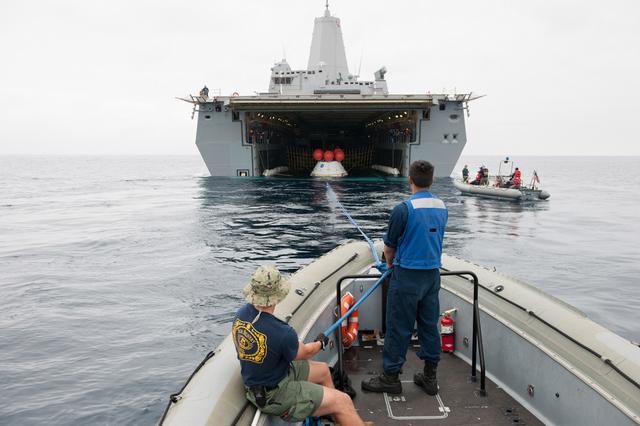
Recovery team members work with a test version of Orion floating in the well deck of the U.S.S. Anchorage on Aug. 2, 2014. A combined NASA and U.S. Navy team practiced recovery techniques off the coast of California in preparation for Exploration Flight Test-1 (EFT-1). Part of Batch image transfer from Flickr.
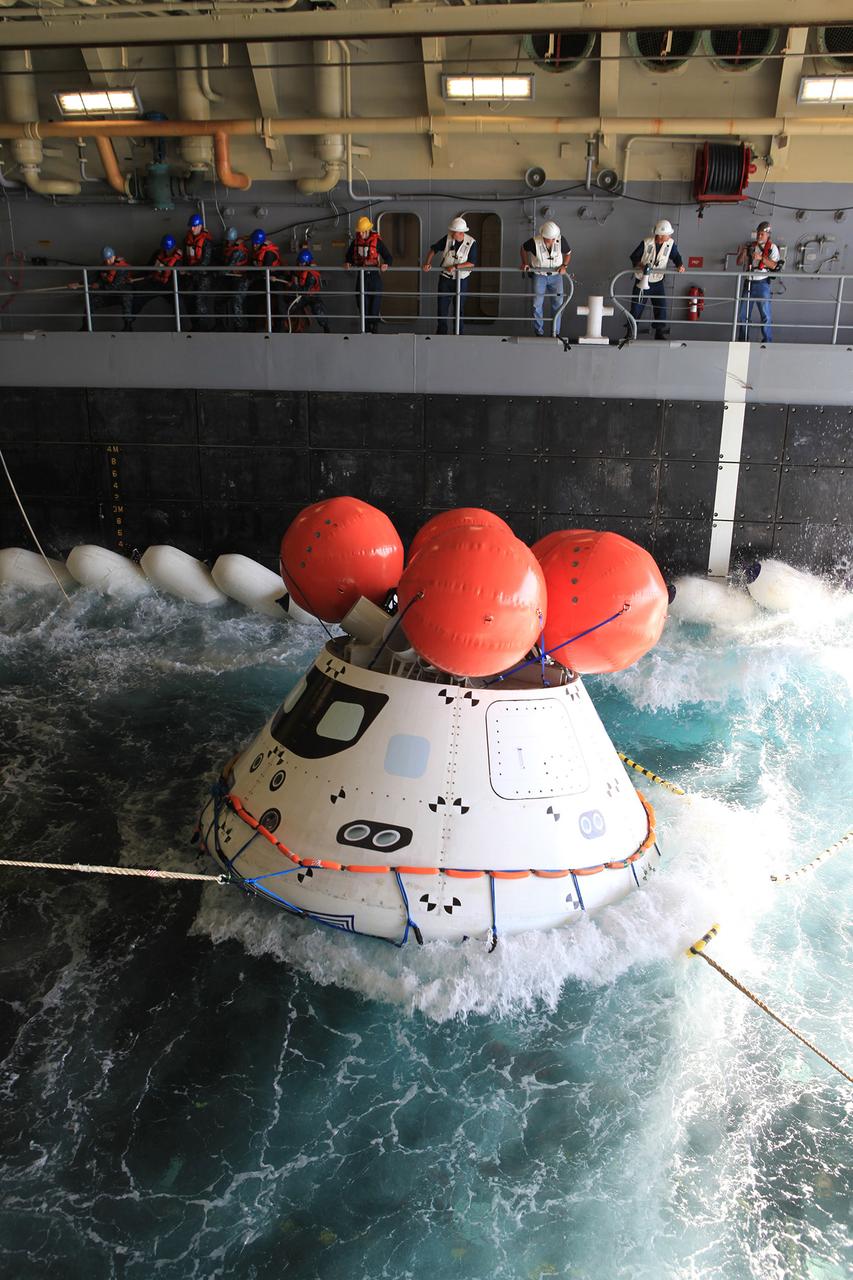
The Orion boilerplate test article inside the well deck of the USS Anchorage during recovery practice operations Aug. 4, 2014. NASA and U.S. Navy practiced recovery techniques off the coast of California, in preparation for Exploration Flight Test-1 (EFT-1). Part of Batch image transfer from Flickr.
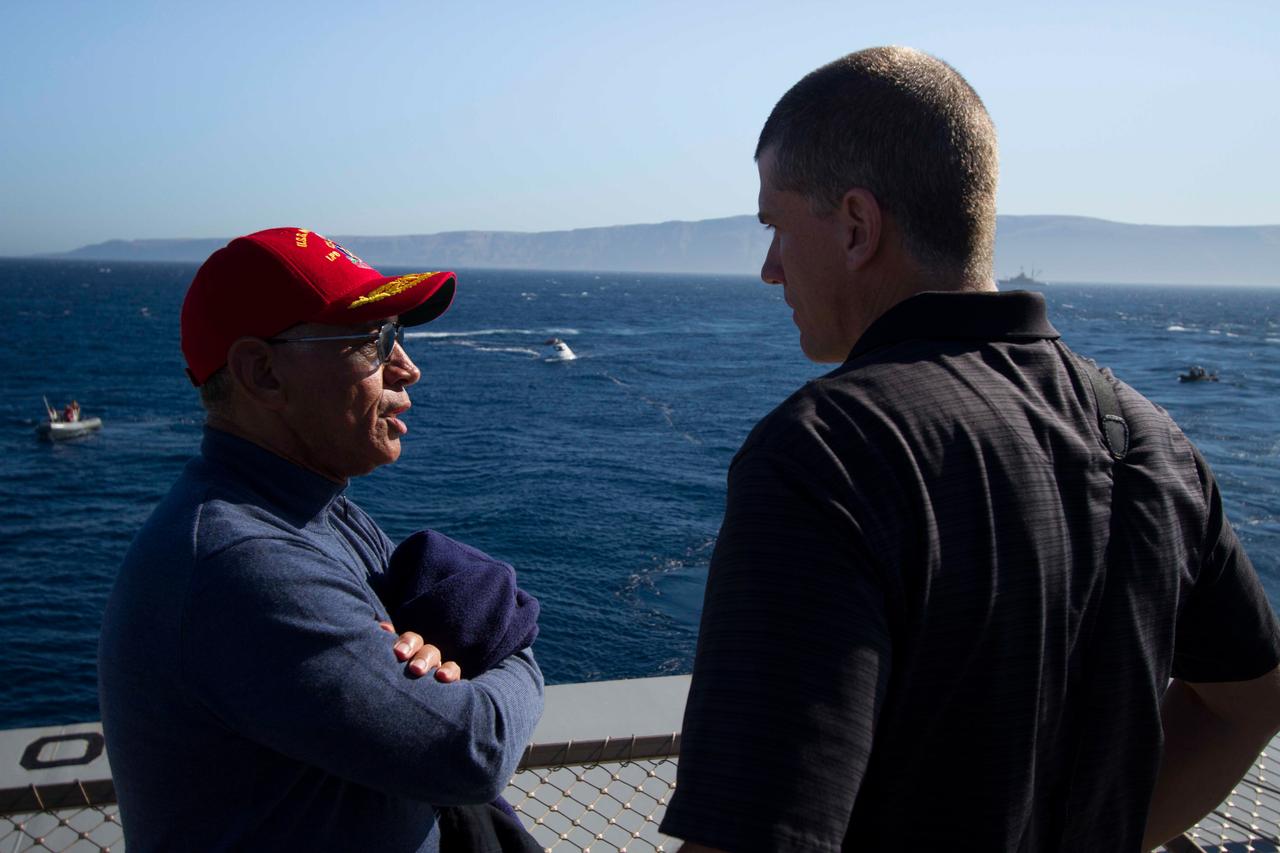
NASA Administrator Charles Bolden talks with a member of the Orion recovery team on board the USS Anchorage as a test version of Orion is reeled into the Anchorage's well deck in the background on Sept. 15, 2014. Part of Batch image transfer from Flickr.
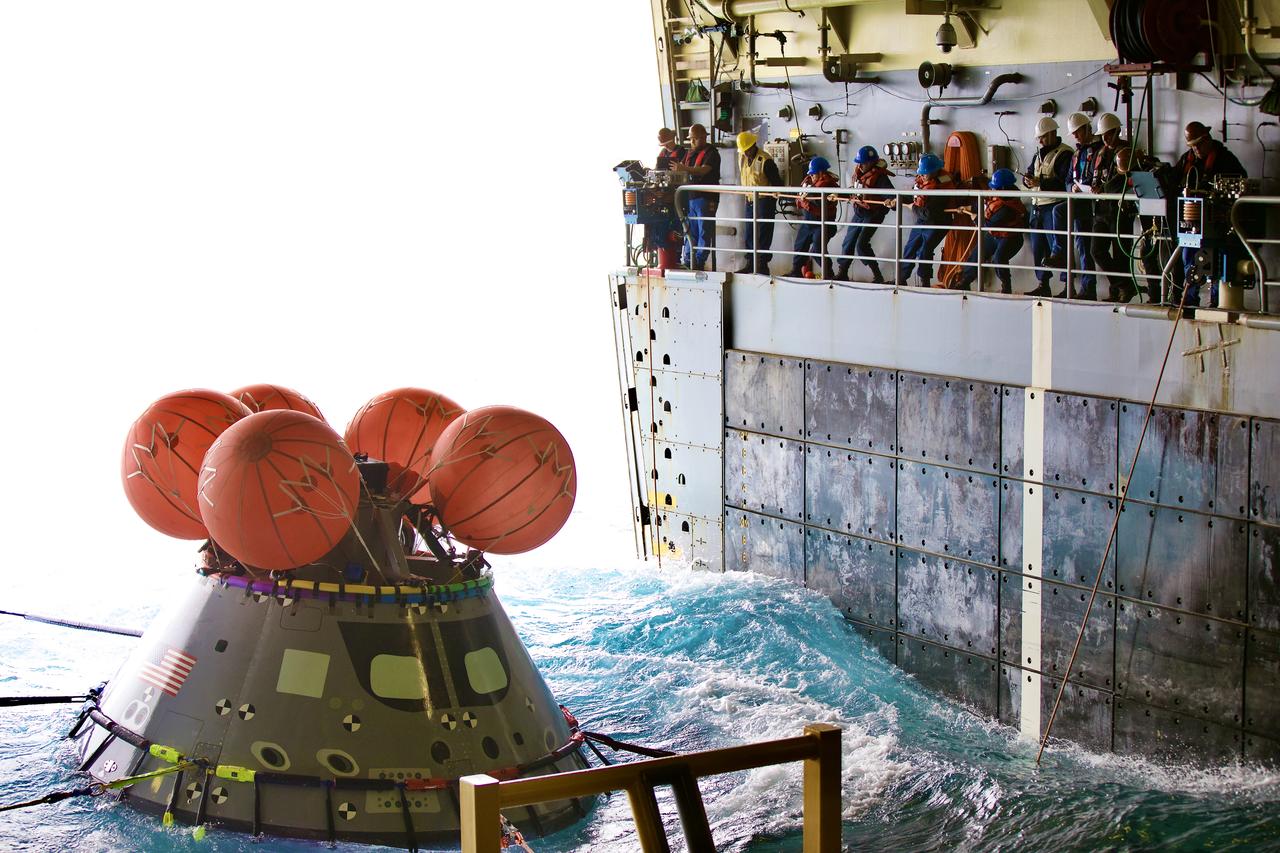
NASA’s Landing and Recovery team, composed of members from the Department of Defense, NASA and contractor Jacobs, practiced securing a test version of Orion into the well deck of a ship. During the test, the team practiced to ensure recovery procedure timelines are validated as NASA plans to send Artemis I around the Moon and splashdown in the Pacific Ocean.
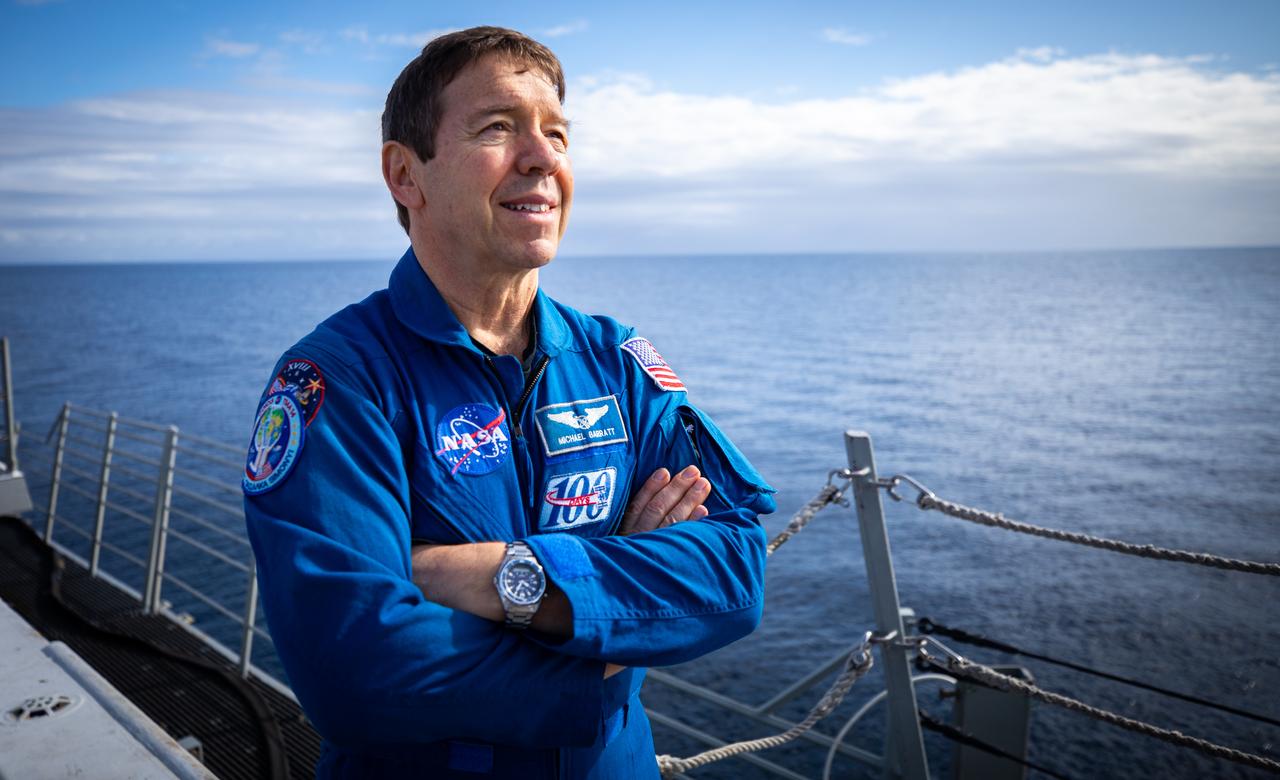
Astronaut Michael Barratt observes Underway Recovery Test-8 aboard the USS John P. Murtha. During the test, NASA’s Landing and Recovery Team practiced bringing Orion into the well deck of the ship to ensure recovery procedure timelines are validated as NASA plans to send Artemis I around the Moon and splashdown in the Pacific Ocean.
The Orion boilerplate test article inside the well deck of the USS Anchorage during recovery practice operations on Aug. 4, 2014. NASA and U.S. Navy practiced recovery techniques off the coast of California, in preparation for Exploration Flight Test-1 (EFT-1). Part of Batch image transfer from Flickr.
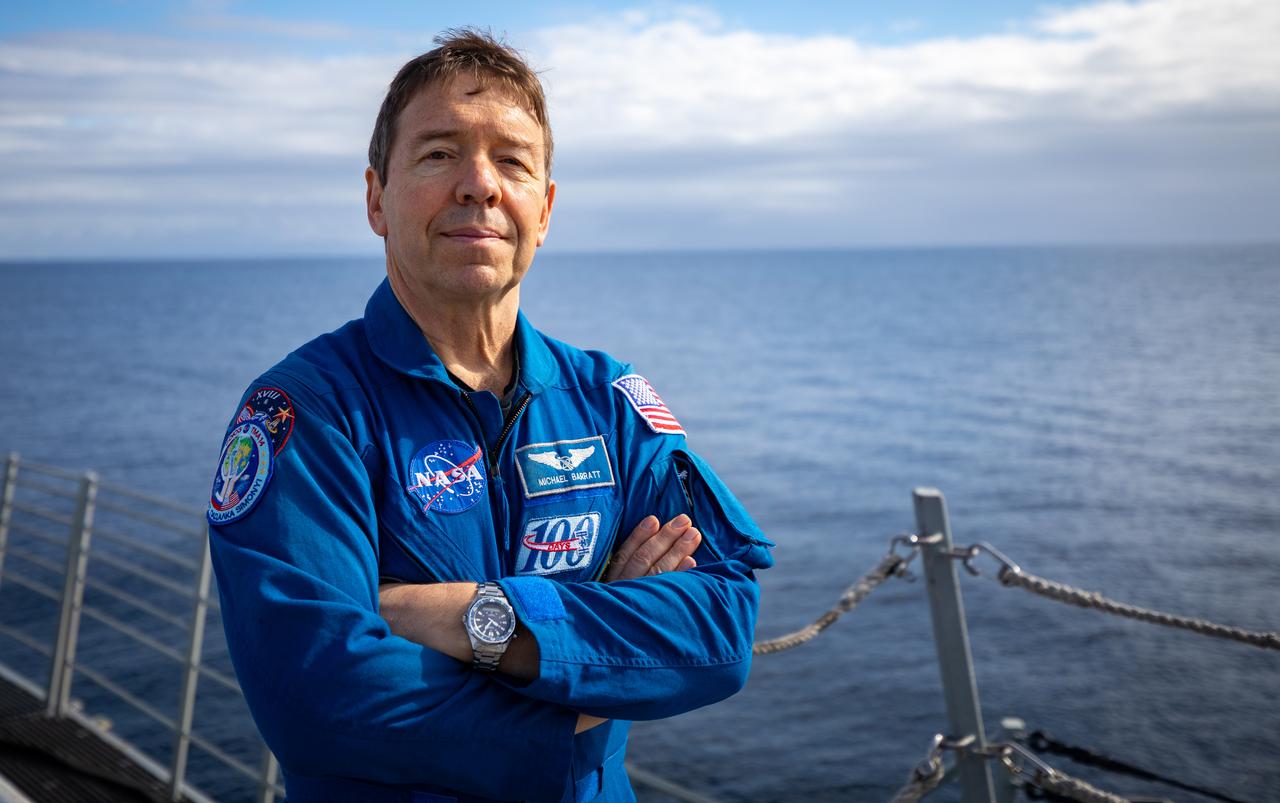
Astronaut Michael Barratt observes Underway Recovery Test-8 aboard the USS John P. Murtha. During the test, NASA’s Landing and Recovery Team practiced bringing Orion into the well deck of the ship to ensure recovery procedure timelines are validated as NASA plans to send Artemis I around the Moon and splashdown in the Pacific Ocean.
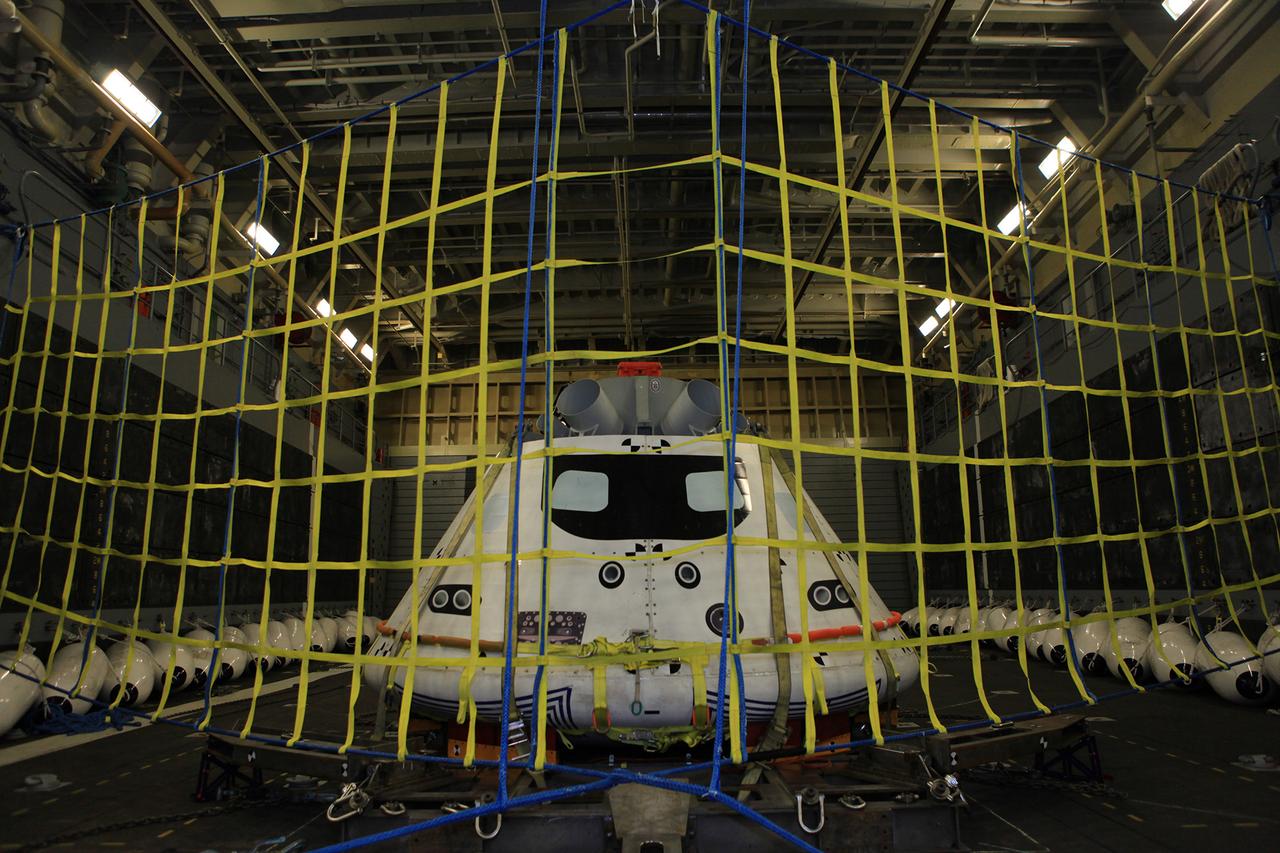
A test version of Orion waits inside of the well deck of the U.S.S. Anchorage on July 31, 2014. A combined NASA and U.S. Navy team practiced recovery techniques off the coast of Californiain preparation for Exploration Flight Test-1 (EFT-1). Part of Batch image transfer from Flickr.
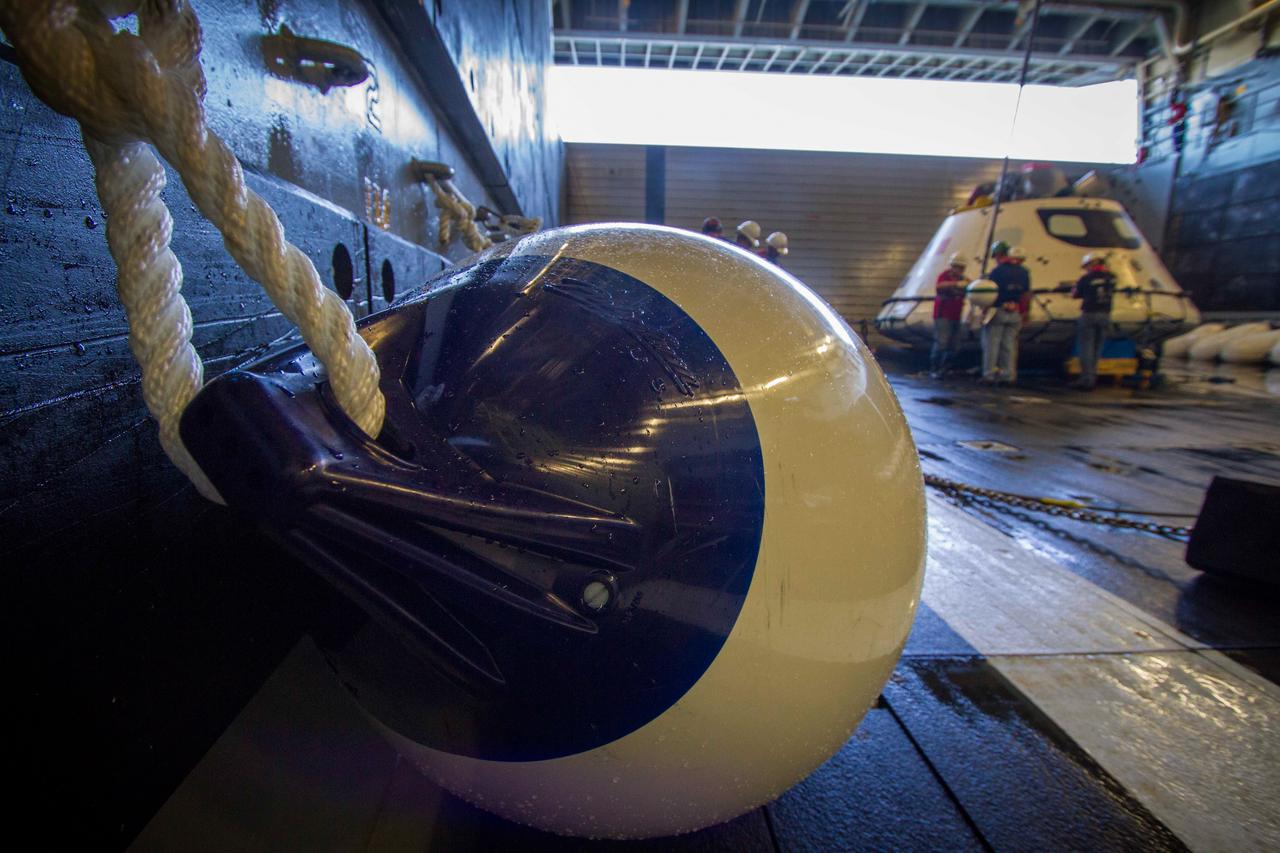
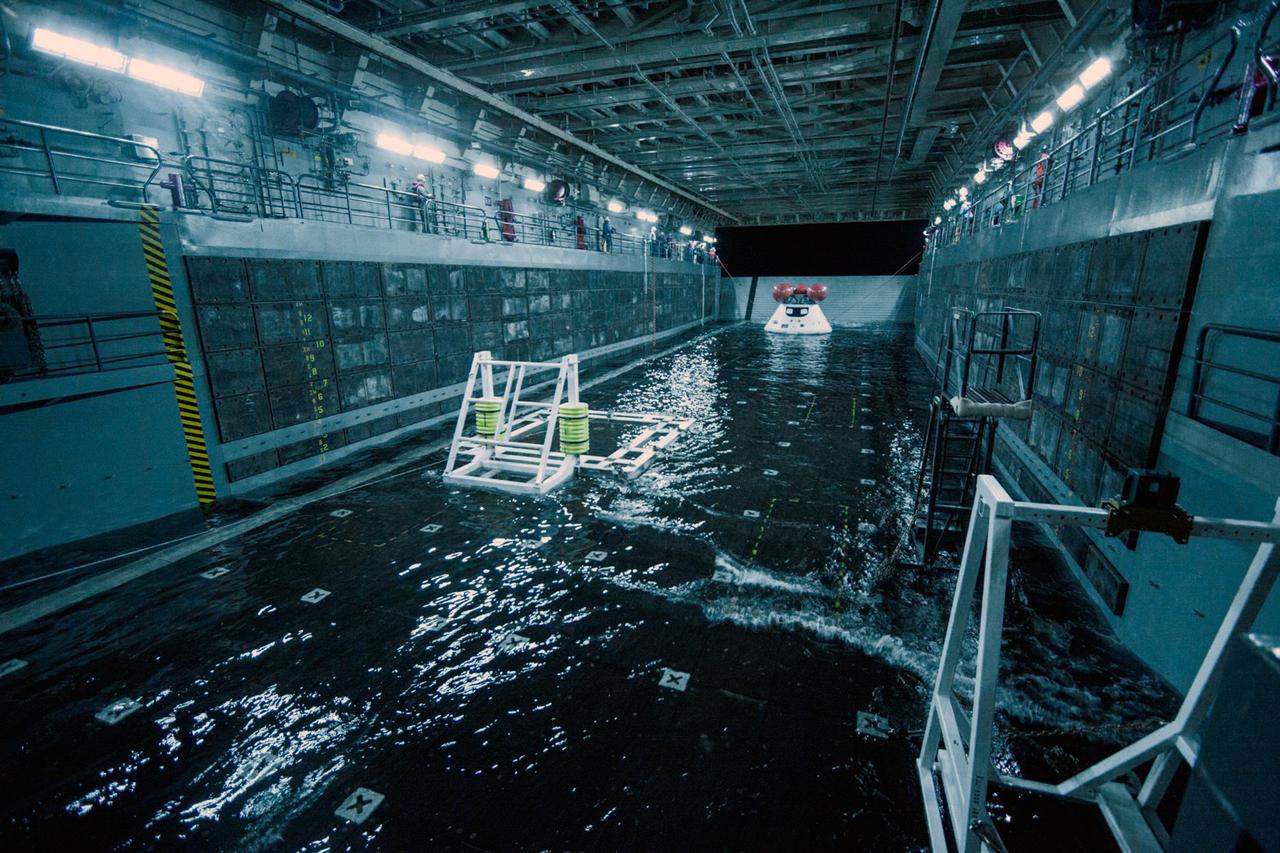
The well deck of the USS Anchorage, which NASA and the Navy use for Orion recovery tests on Sept. 15, 2014, can be flooded with water to allow Orion to float in following its splashdown when it returns from space. Part of Batch image transfer from Flickr.
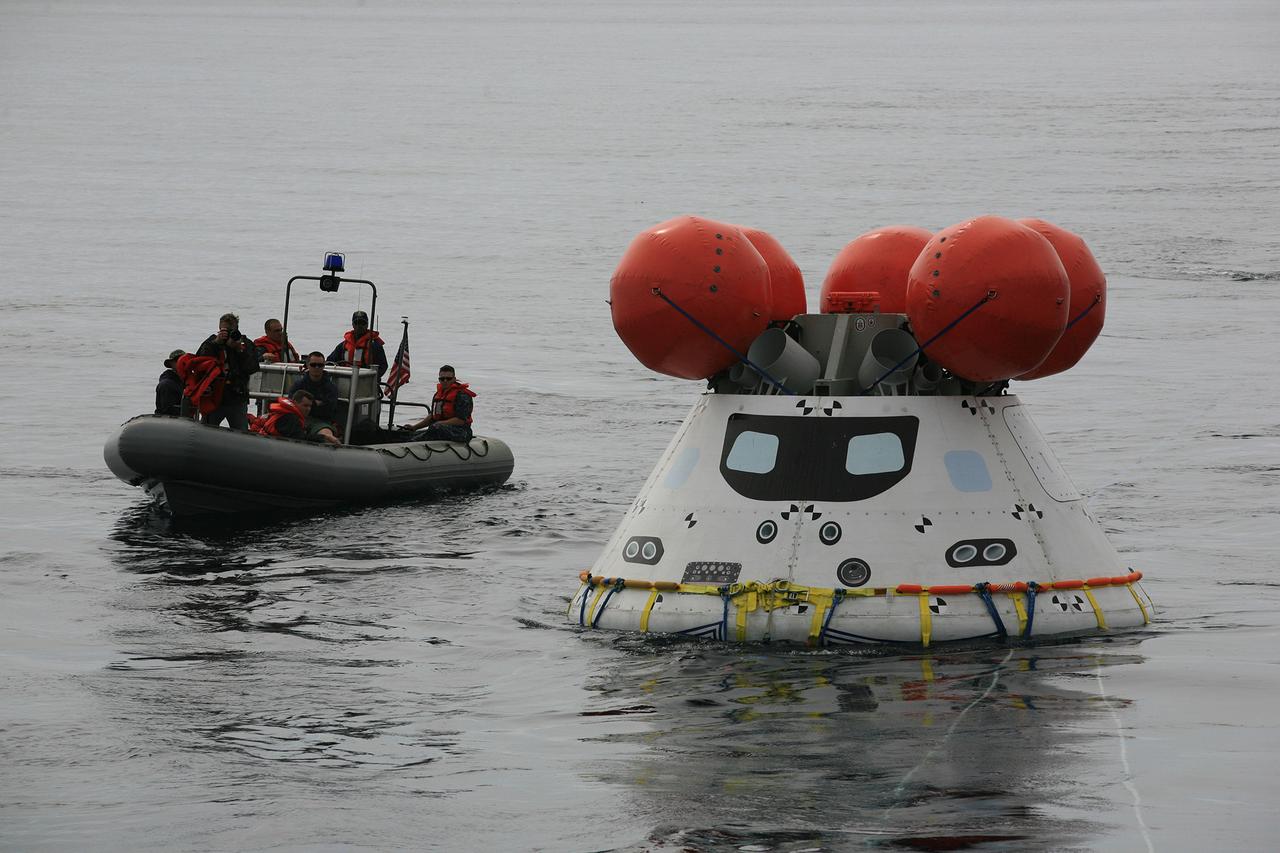
Recovery team members work with a test version of Orion floating in the well deck of the U.S.S. Anchorage on Aug. 2, 2014. A combined NASA and U.S. Navy team practiced recovery techniques off the coast of California in preparation for Exploration Flight Test-1 (EFT-1). Part of Batch image transfer from Flickr.
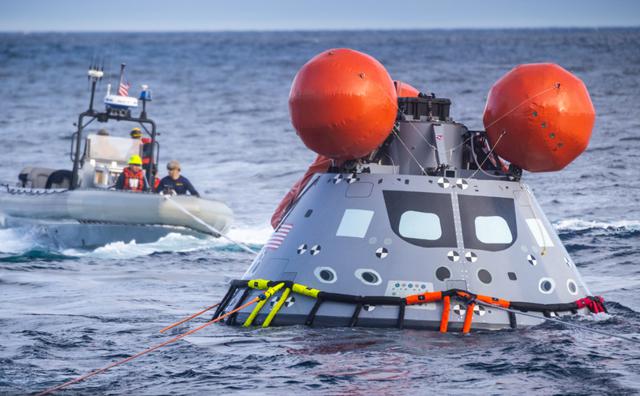
During Underway Recovery Test 9 (URT-9), NASA’s Landing and Recovery Team practices bringing a mock Orion capsule into the well deck of the USS John P. Murtha (LPD 26 The team is performing their final mission certification ahead of Artemis I.
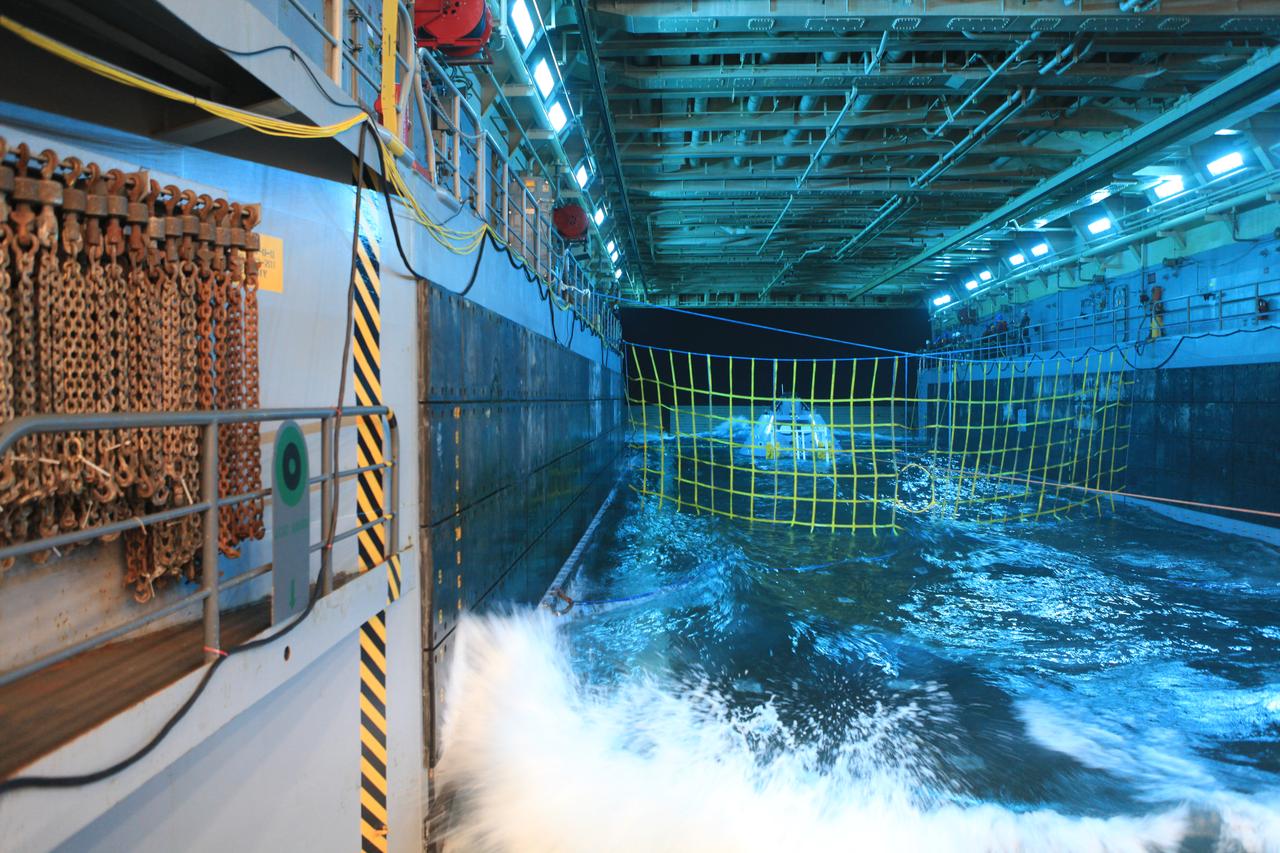
A test article of Orion floats in 6-feet of water in the well deck of the USS Anchorage. The NASA Recovery Team from Kennedy Space Center is working with the U.S. Navy to improve recovery procedures and hardware ahead of Orion’s next flight, Exploration Mission-1, when it splashes down in the Pacific Ocean.
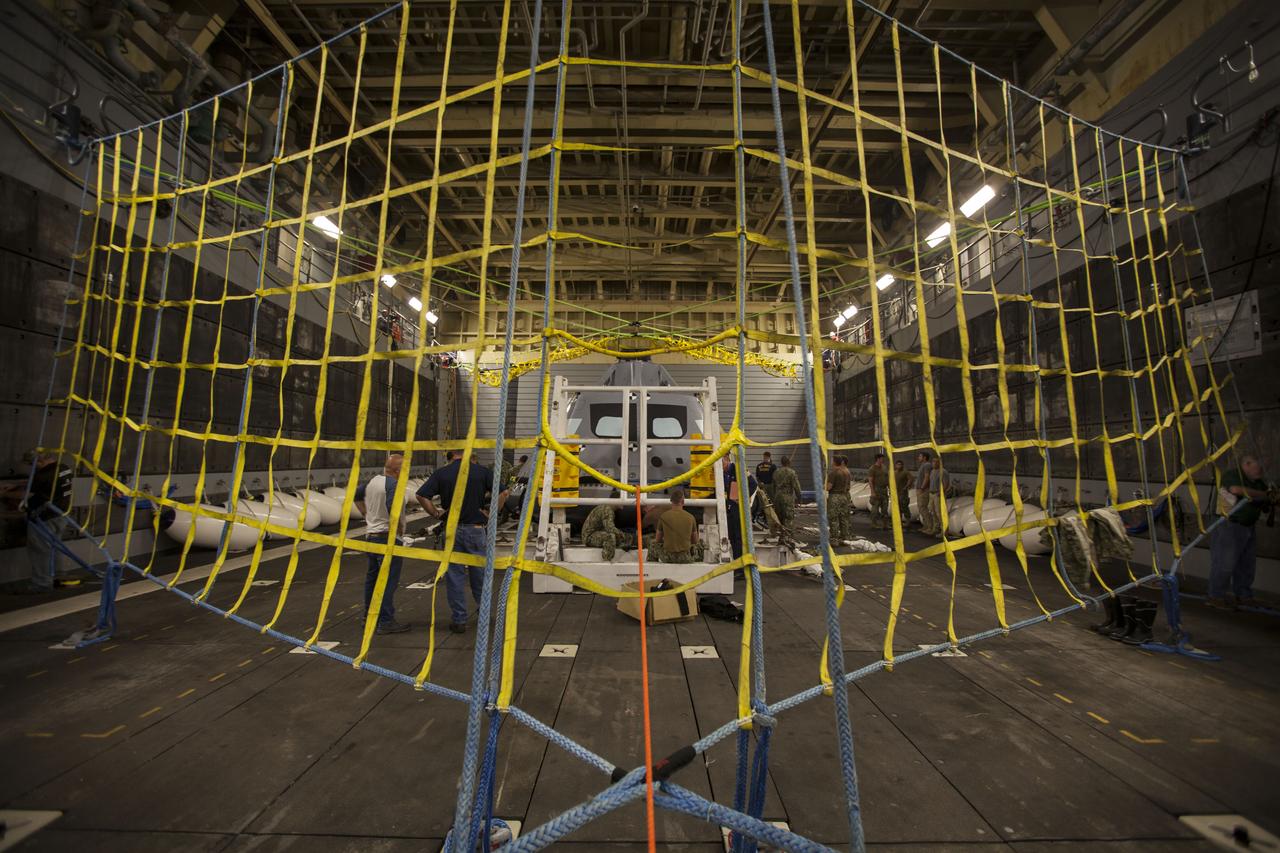
A test version of the Orion crew module is secured in the well deck of the USS San Diego for Underway Recovery Test 5. NASA's Ground Systems Development and Operations Program and the U.S. Navy will conduct a series of tests using the ship's well deck, the test module, various watercraft and equipment to prepare for recovery of Orion on its return from deep space missions. The test will allow the team to demonstrate and evaluate recovery processes, procedures, hardware and personnel in open waters. Orion is the exploration spacecraft designed to carry astronauts to destinations not yet explored by humans, including an asteroid and NASA's Journey to Mars. It will have emergency abort capability, sustain the crew during space travel and provide safe re-entry from deep space return velocities. Orion is scheduled to launch on NASA's Space Launch System in late 2018. For more information, visit http://www.nasa.gov/orion.
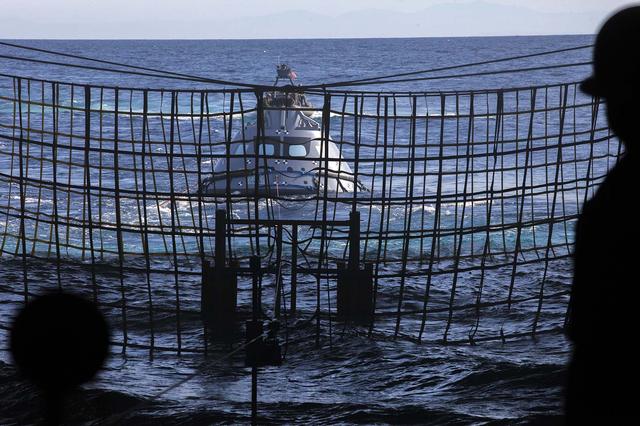
A test version of the Orion crew module floats outside the well deck of the USS San Diego on the fourth day of Underway Recovery Test 5 in the Pacific Ocean off the coast of California. NASA's Ground Systems Development and Operations Program and the U.S. Navy are practicing retrieving and securing the crew module in the well deck of the ship using tethers and a winch system to prepare for recovery of Orion on its return from deep space missions. The testing will allow the team to demonstrate and evaluate recovery processes, procedures, hardware and personnel in open waters. Orion is the exploration spacecraft designed to carry astronauts to destinations not yet explored by humans, including an asteroid and NASA's Journey to Mars. It will have emergency abort capability, sustain the crew during space travel and provide safe re-entry from deep space return velocities. Orion is scheduled to launch on NASA's Space Launch System in late 2018. For more information, visit http://www.nasa.gov/orion.
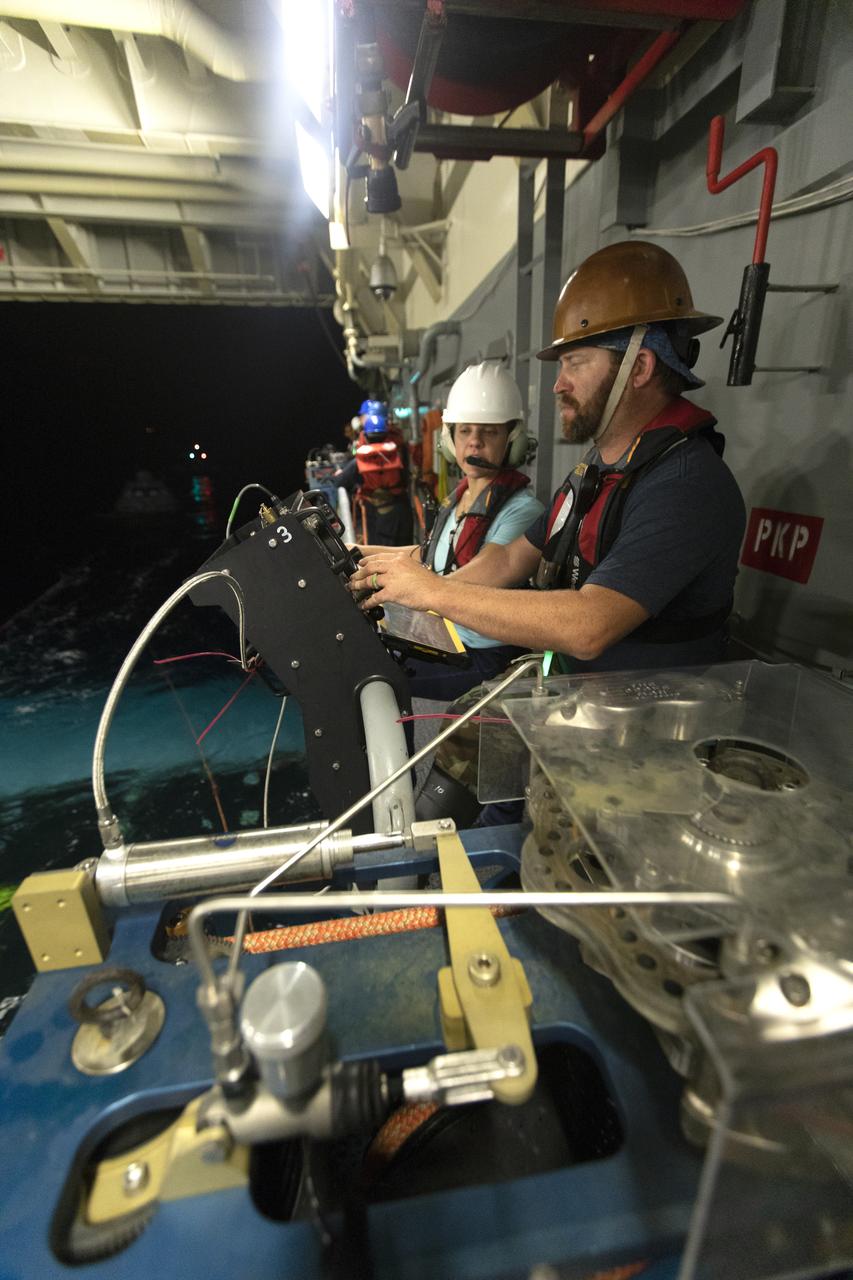
NASA Recovery Team members assist during Underway Recovery Test-7 (URT-7) inside the well deck of the USS John P. Murtha on Nov. 4, 2018. During URT-7, the team practices recovering a test version of the Orion capsule from the Pacific Ocean and towing it into the well deck of the ship. URT-7 is one in a series of tests conducted by the Exploration Ground Systems Recovery Team to verify and validate procedures and hardware that will be used to recover the Orion spacecraft after it splashes down in the Pacific Ocean following deep space exploration missions. Orion will have emergency abort capability, sustain the crew during space travel and provide safe re-entry from deep space return velocities.
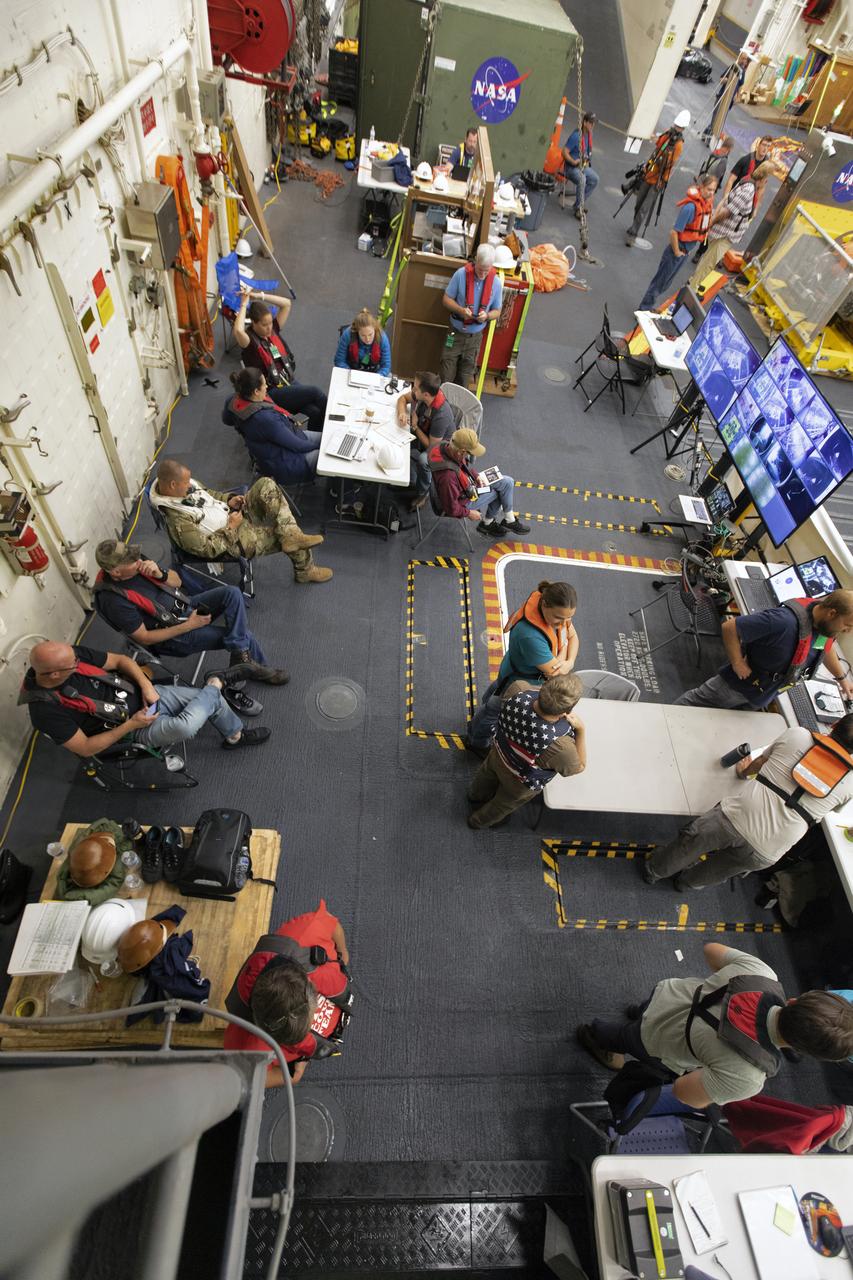
NASA Recovery Team members monitor activities during Underway Recovery Test-7 (URT-7) in the well deck of the USS John P. Murtha on Nov. 4, 2018. During URT-7, the team practices recovering a test version of the Orion capsule from the Pacific Ocean and towing it into the well deck of the ship. URT-7 is one in a series of tests conducted by the Exploration Ground Systems Recovery Team to verify and validate procedures and hardware that will be used to recover the Orion spacecraft after it splashes down in the Pacific Ocean following deep space exploration missions. Orion will have emergency abort capability, sustain the crew during space travel and provide safe re-entry from deep space return velocities.
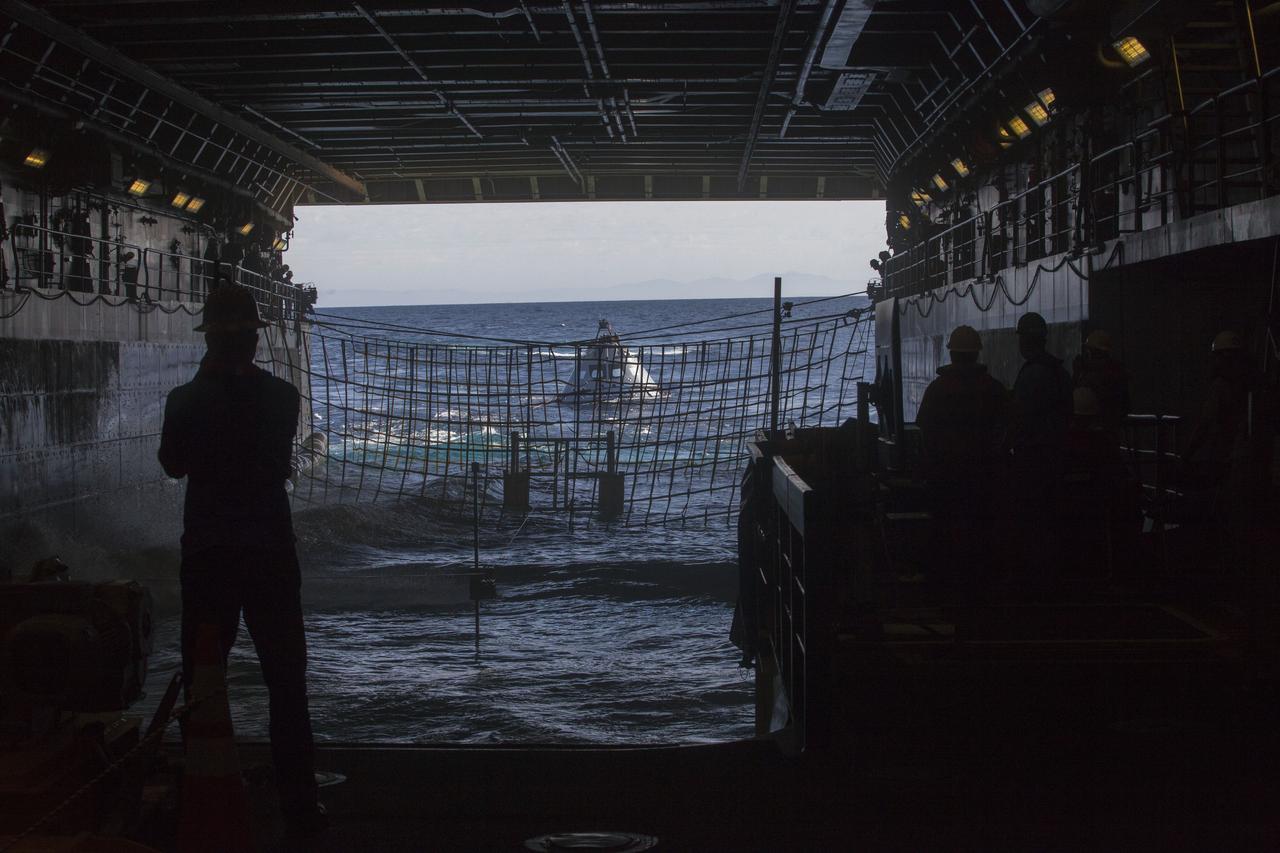
A test version of the Orion crew module floats outside the well deck of the USS San Diego during Underway Recovery Test 5 in the Pacific Ocean off the coast of California. NASA's Ground Systems Development and Operations Program and the U.S. Navy are conducting a series of tests using the ship's well deck, several watercraft, support equipment and personnel to prepare for recovery of Orion on its return from deep space missions. The testing will allow the team to demonstrate and evaluate recovery processes, procedures, hardware and personnel in open waters. Orion is the exploration spacecraft designed to carry astronauts to destinations not yet explored by humans, including an asteroid and NASA's Journey to Mars. It will have emergency abort capability, sustain the crew during space travel and provide safe re-entry from deep space return velocities. Orion is scheduled to launch on NASA's Space Launch System in late 2018. For more information, visit http://www.nasa.gov/orion.
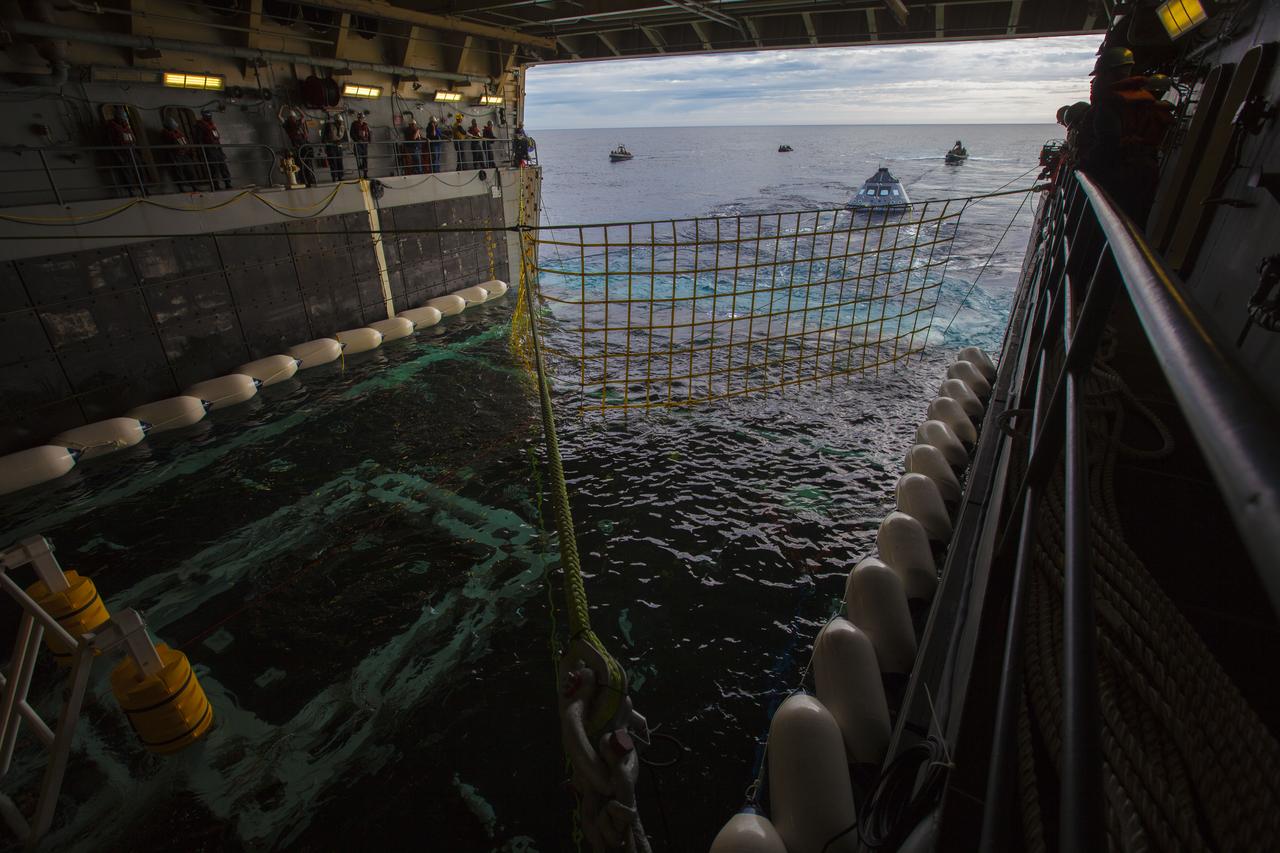
A test version of the Orion crew module is guided toward the flooded well deck of the USS San Diego during Underway Recovery Test 5. NASA's Ground Systems Development and Operations Program and the U.S. Navy are conducting a series of tests using the ship's well deck, the test module, various watercraft and equipment to prepare for recovery of Orion on its return from deep space missions. The test will allow the team to demonstrate and evaluate recovery processes, procedures, hardware and personnel in open waters. Orion is the exploration spacecraft designed to carry astronauts to destinations not yet explored by humans, including an asteroid and NASA's Journey to Mars. It will have emergency abort capability, sustain the crew during space travel and provide safe re-entry from deep space return velocities. Orion is scheduled to launch on NASA's Space Launch System in late 2018. For more information, visit http://www.nasa.gov/orion.
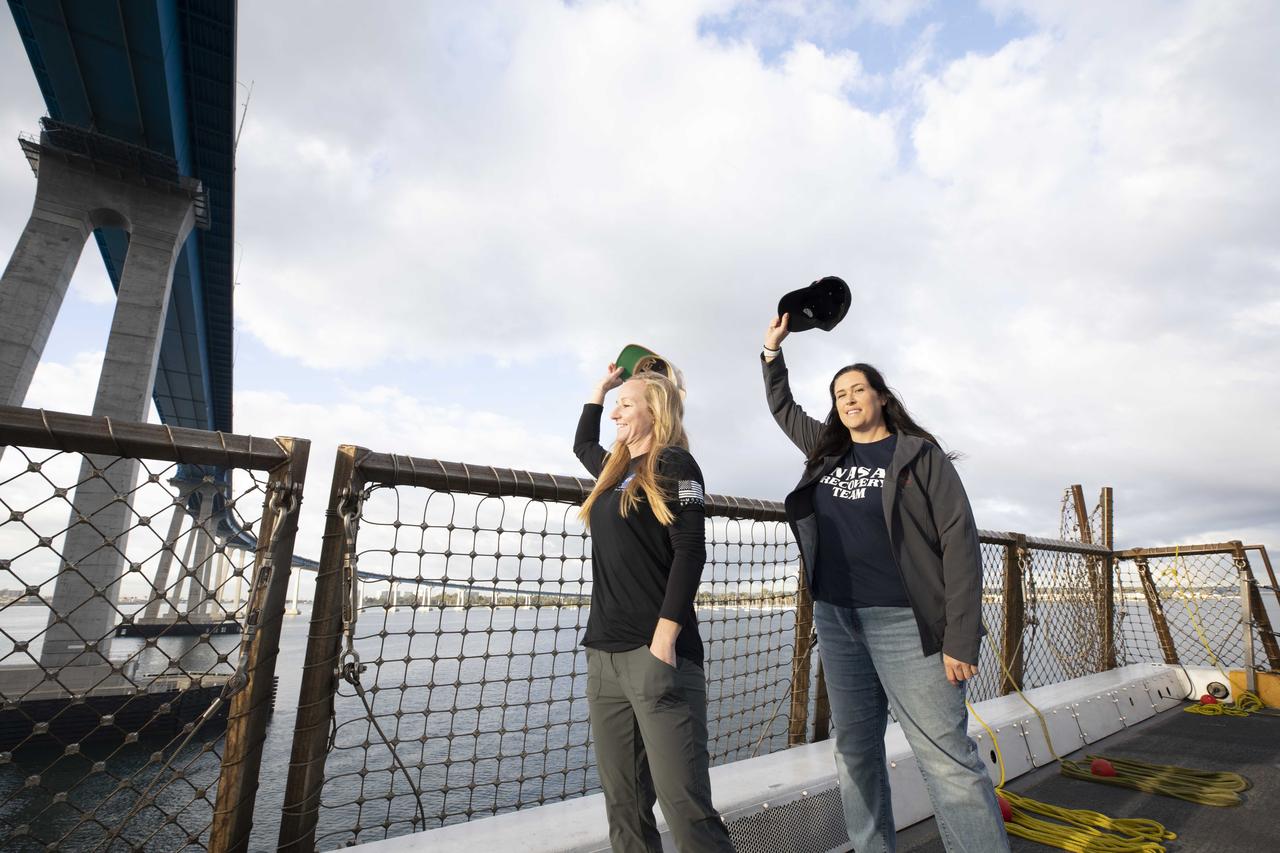
While returning to port after successfully recovering the Orion spacecraft for the Artemis I mission, NASA Artemis Recovery Director Melissa Jones, at right, and Assistant NASA Recovery Director Carla Rekucki, throw their hats in the air aboard the USS Portland as they pass under the San Diego-Coronado bridge on Dec. 13, 2022. The Artemis I Orion spacecraft is secured inside the ship’s well deck after splashing down at 12:40 p.m. EST on Dec. 11, 2022. U.S. Navy divers helped recover the Orion spacecraft. NASA, the Navy and other Department of Defense partners worked together to secure the spacecraft inside the ship’s well deck approximately five hours after Orion splashed down in the Pacific Ocean off the coast of Baja, California.
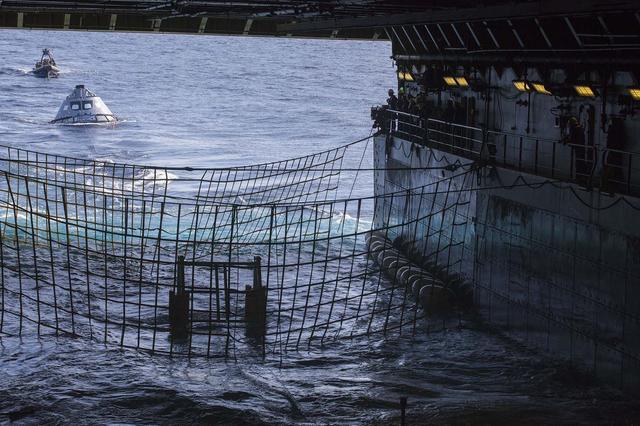
A test version of the Orion crew module floats outside the well deck of the USS San Diego on the fourth day of Underway Recovery Test 5 in the Pacific Ocean off the coast of California. NASA's Ground Systems Development and Operations Program and the U.S. Navy are practicing retrieving and securing the crew module in the well deck of the ship using tethers and a winch system to prepare for recovery of Orion on its return from deep space missions. The testing will allow the team to demonstrate and evaluate recovery processes, procedures, hardware and personnel in open waters. Orion is the exploration spacecraft designed to carry astronauts to destinations not yet explored by humans, including an asteroid and NASA's Journey to Mars. It will have emergency abort capability, sustain the crew during space travel and provide safe re-entry from deep space return velocities. Orion is scheduled to launch on NASA's Space Launch System in late 2018. For more information, visit http://www.nasa.gov/orion.
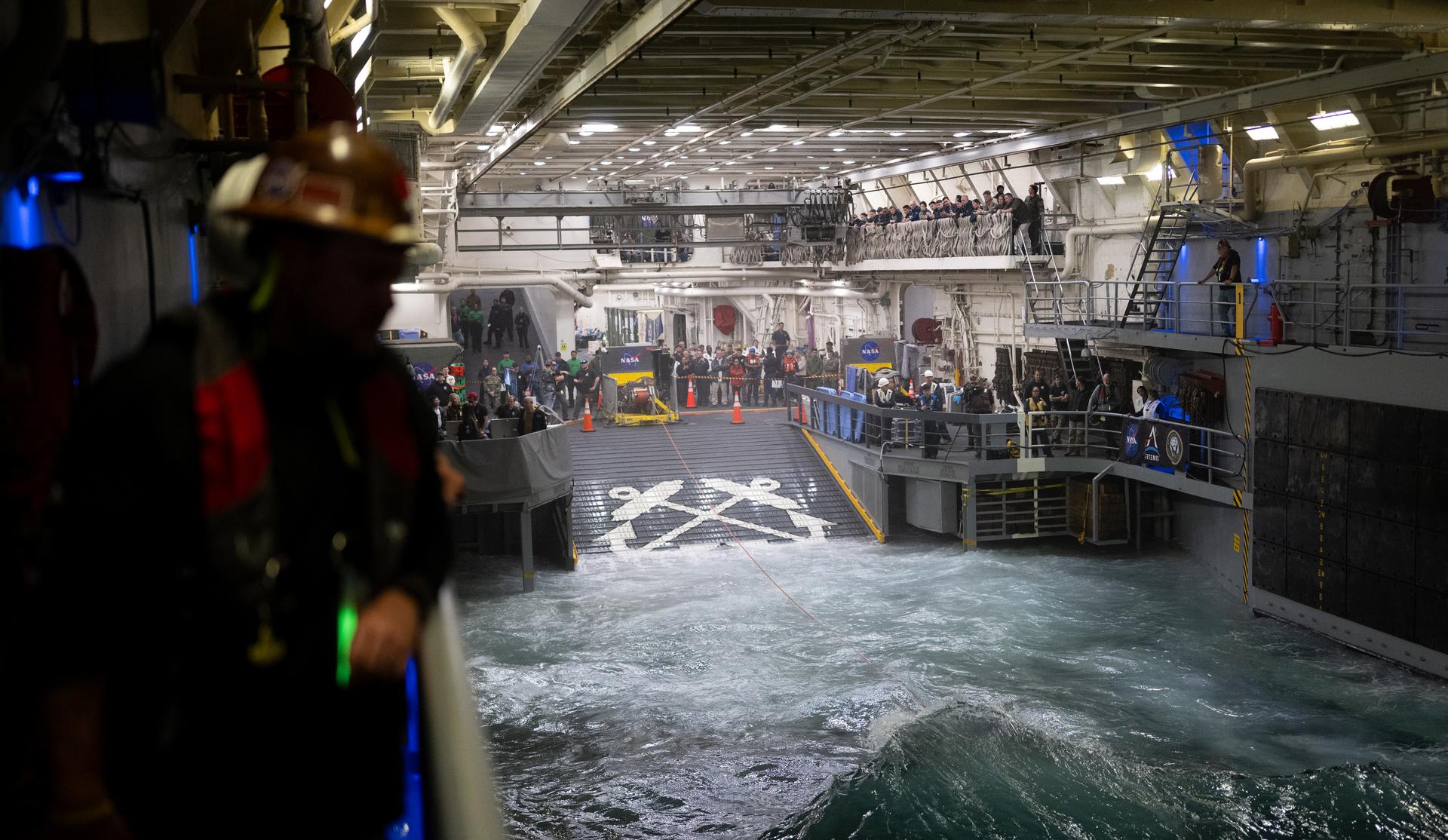
NASA and Navy personnel gather outside the safety clears in the well deck of USS John P. Murtha to watch as the agency’s Landing and Recovery team, along with U.S. Navy personnel work to recover the Orion spacecraft into the well deck of USS John P. Murtha in the Pacific Ocean off the coast of California, Friday, April 10, 2026. NASA’s Artemis II mission, which took NASA astronauts Reid Wiseman, commander; Victor Glover, pilot; Christina Koch, mission specialist; and CSA (Canadian Space Agency) astronaut Jeremy Hansen, mission specialist on a nearly 10-day journey around the Moon and back to Earth, splashed down at 5:07 p.m. PDT (8:07 p.m. EDT). Photo Credit: (NASA/Joel Kowsky)
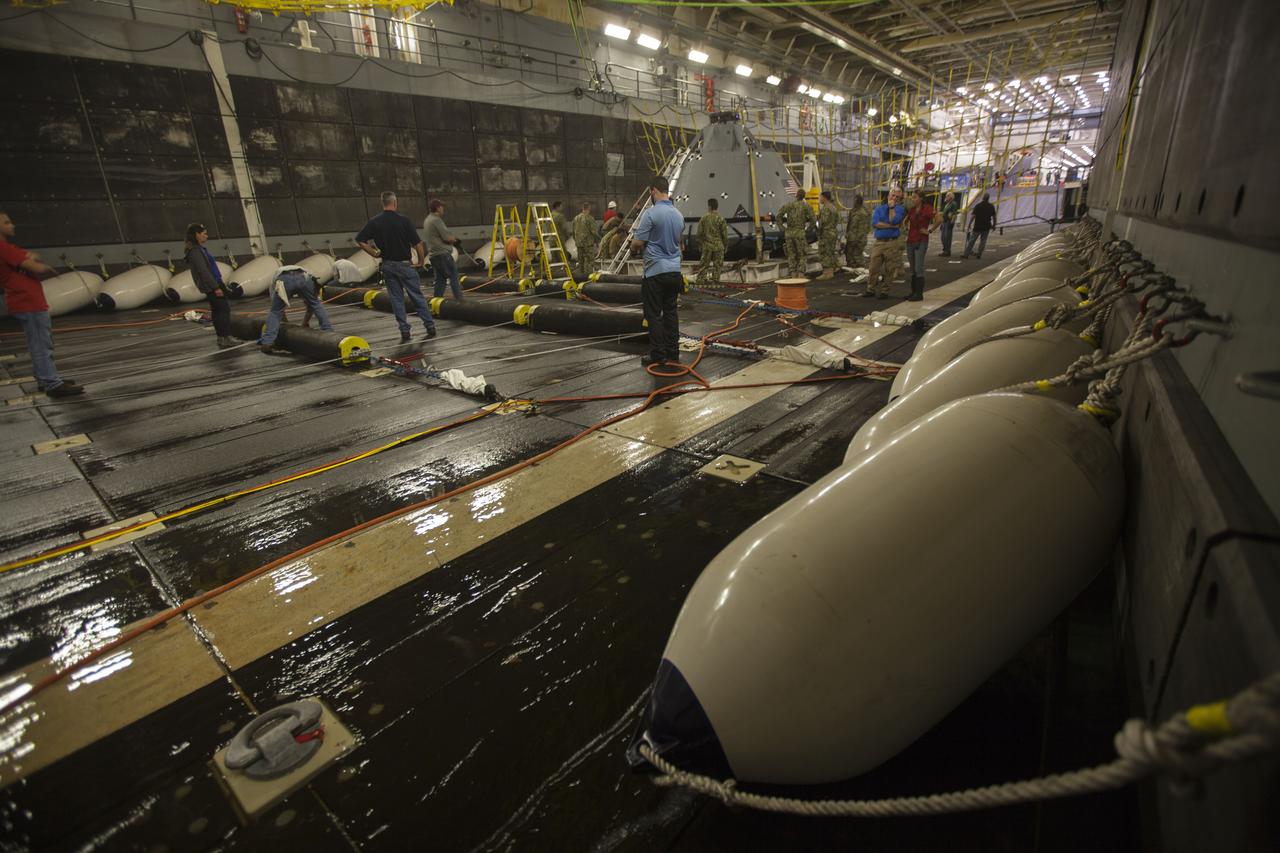
A test version of the Orion crew module is secured in the well deck of the USS San Diego and recovery team members are preparing for Underway Recovery Test 5 in the Pacific Ocean off the coast of California. NASA's Ground Systems Development and Operations Program and the U.S. Navy will conduct a series of tests using the ship's well deck, the test module, various watercraft and equipment to prepare for recovery of Orion on its return from deep space missions. The test will allow the team to demonstrate and evaluate recovery processes, procedures, hardware and personnel in open waters. Orion is the exploration spacecraft designed to carry astronauts to destinations not yet explored by humans, including an asteroid and NASA's Journey to Mars. It will have emergency abort capability, sustain the crew during space travel and provide safe re-entry from deep space return velocities. Orion is scheduled to launch on NASA's Space Launch System in late 2018. For more information, visit http://www.nasa.gov/orion.
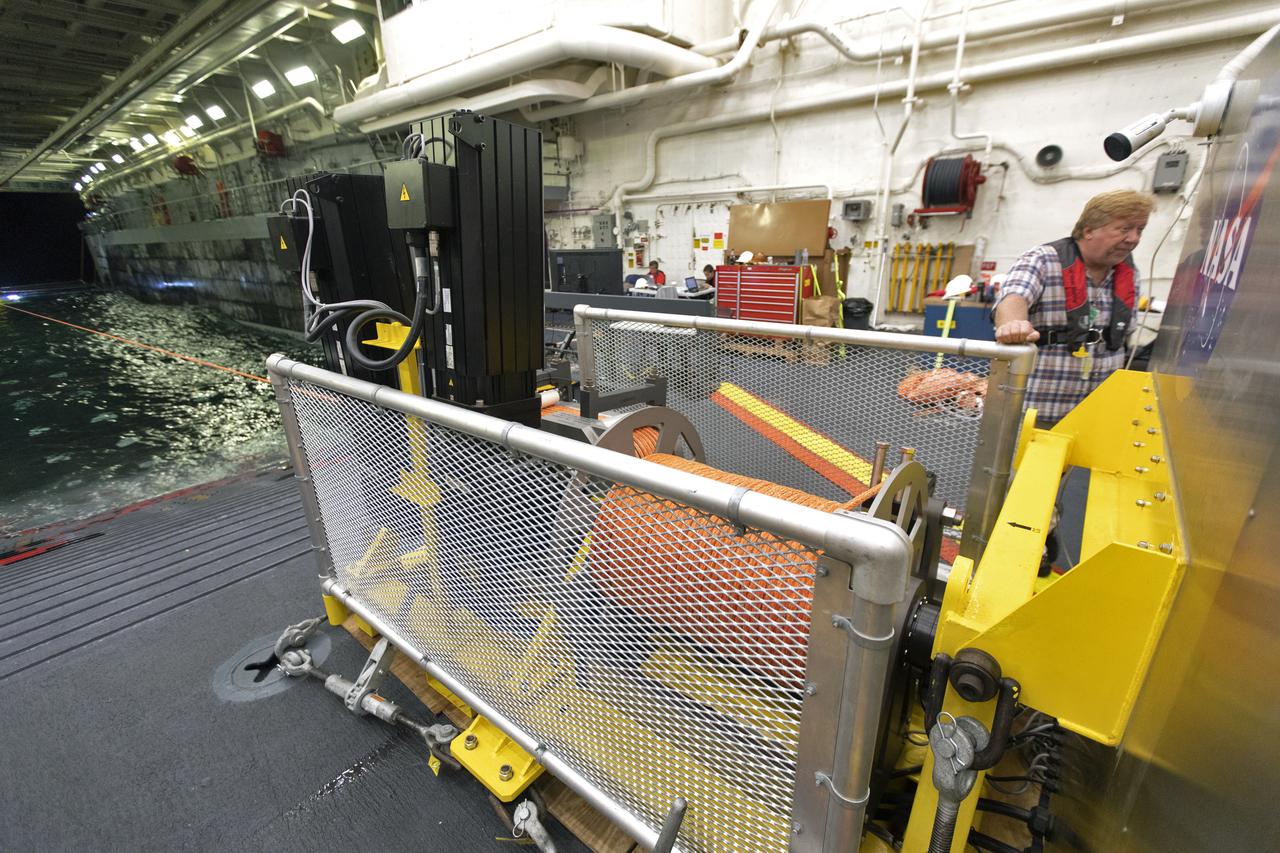
Inside the well deck of the USS John P. Murtha, a winch line is being used to tow a test version of the Orion crew module into the well deck during Underway Recovery Test-7 (URT-7), during the evening on Nov. 4, 2018. NASA's Recovery Team, along with the U.S. Navy, are practicing recovery of the Orion capsule as part of URT-7 in the Pacific Ocean. URT-7 is one in a series of tests to verify and validate procedures and hardware that will be used to recover the Orion spacecraft after it splashes down in the Pacific Ocean following deep space exploration missions. Orion will have emergency abort capability, sustain the crew during space travel and provide safe re-entry from deep space return velocities.
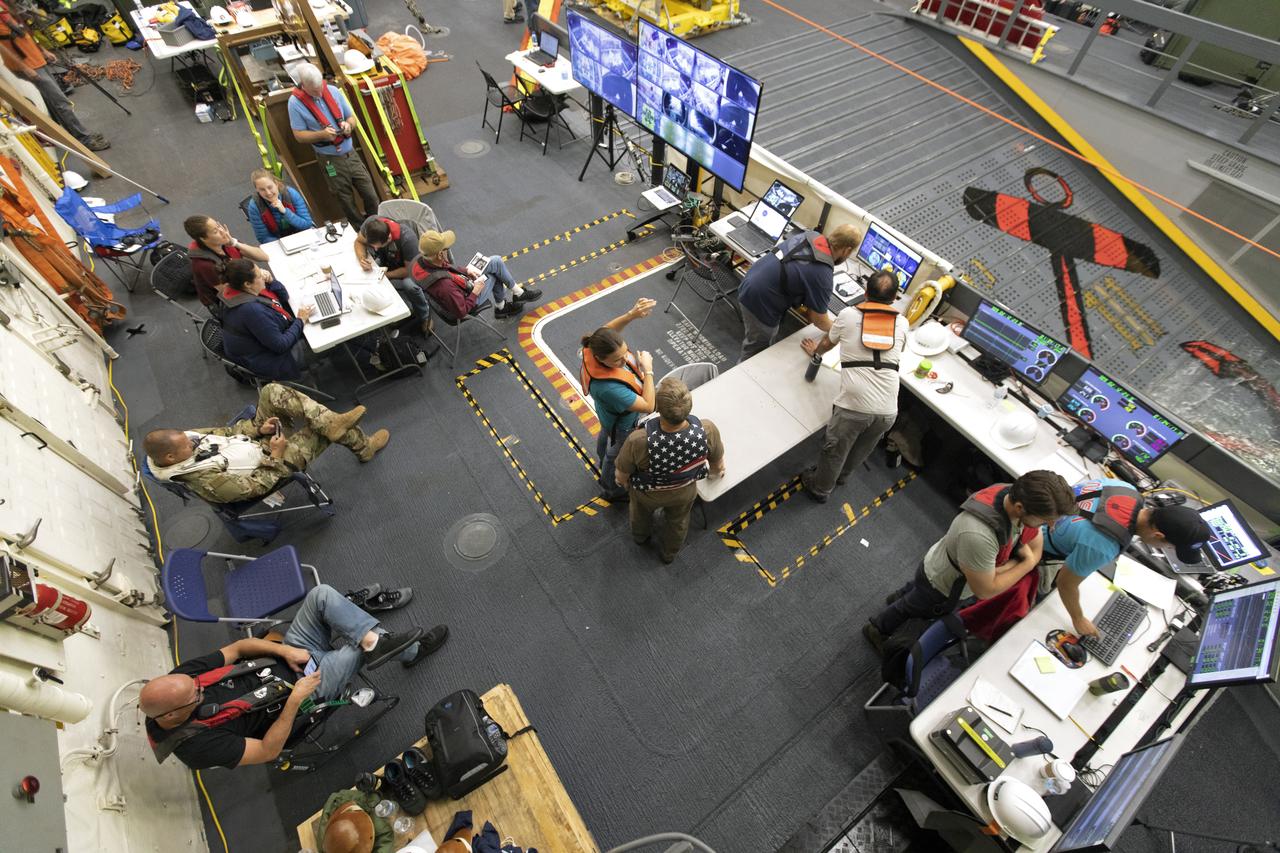
NASA Recovery Team members monitor activities during Underway Recovery Test-7 (URT-7) in the well deck of the USS John P. Murtha on Nov. 4, 2018. During URT-7, the team practices recovering a test version of the Orion capsule from the Pacific Ocean and towing it into the well deck of the ship. URT-7 is one in a series of tests conducted by the Exploration Ground Systems Recovery Team to verify and validate procedures and hardware that will be used to recover the Orion spacecraft after it splashes down in the Pacific Ocean following deep space exploration missions. Orion will have emergency abort capability, sustain the crew during space travel and provide safe re-entry from deep space return velocities.
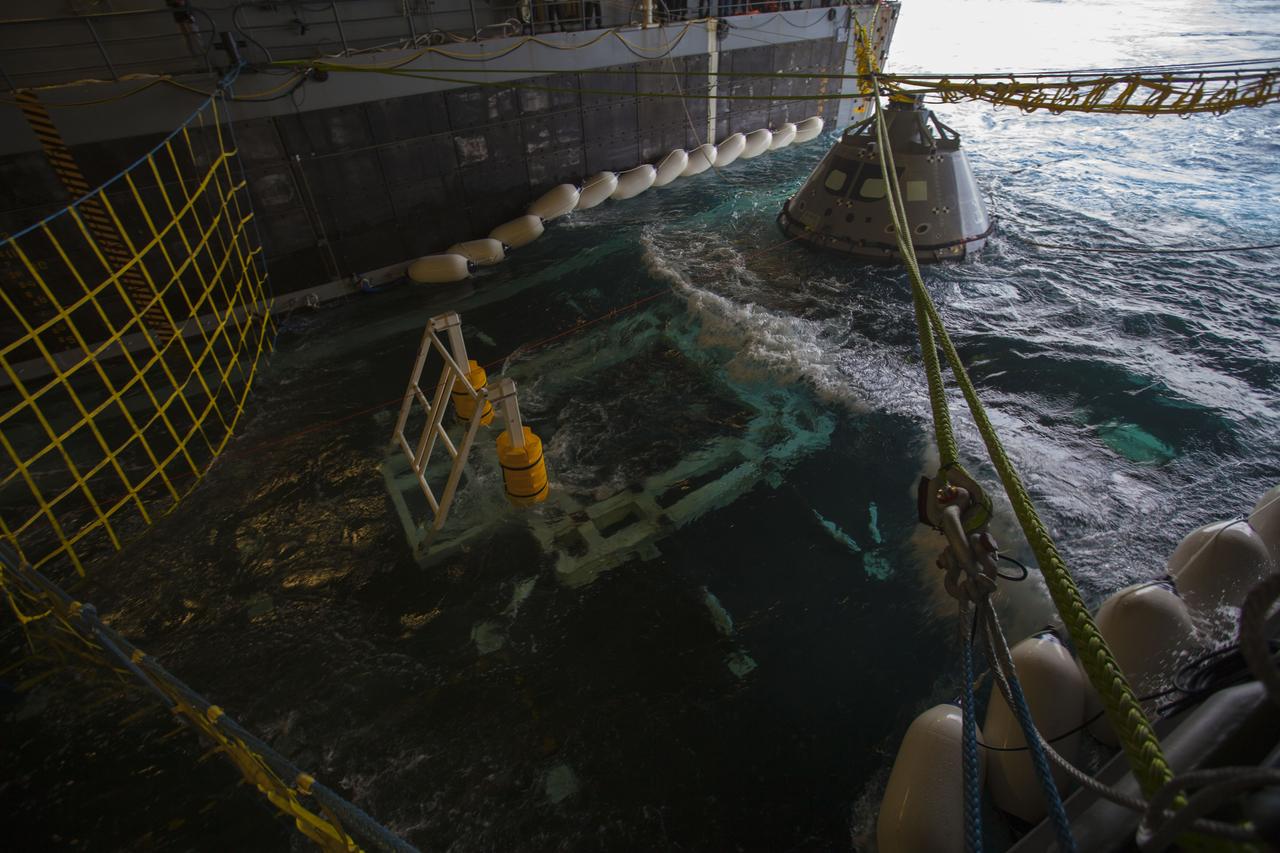
A test version of the Orion crew module is guided into the flooded well deck of the USS San Diego for Underway Recovery Test 5. NASA's Ground Systems Development and Operations Program and the U.S. Navy will conduct a series of tests using the ship's well deck, the test module, various watercraft and equipment to prepare for recovery of Orion on its return from deep space missions. The test will allow the team to demonstrate and evaluate recovery processes, procedures, hardware and personnel in open waters. Orion is the exploration spacecraft designed to carry astronauts to destinations not yet explored by humans, including an asteroid and NASA's Journey to Mars. It will have emergency abort capability, sustain the crew during space travel and provide safe re-entry from deep space return velocities. Orion is scheduled to launch on NASA's Space Launch System in late 2018. For more information, visit http://www.nasa.gov/orion.
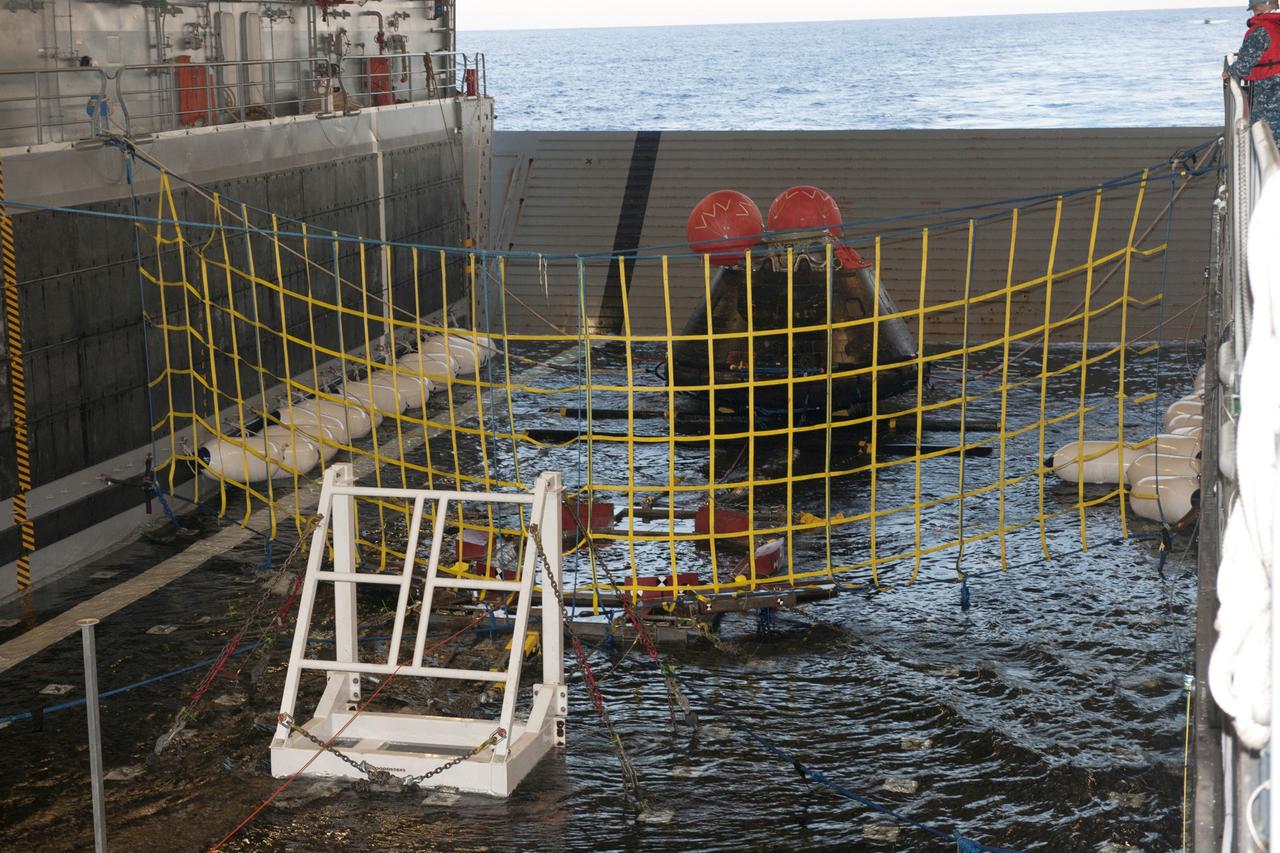
SAN DIEGO, Calif. -- NASA's Orion spacecraft is on rubber bumpers in the flooded well deck of the USS Anchorage in the Pacific Ocean about 600 miles off the coast of San Diego, California. Orion splashed down after its first flight test in Earth orbit. NASA, the U.S. Navy and Lockheed Martin are coordinating efforts to recover Orion and secure the spacecraft in the well deck of the USS Anchorage. Orion completed a two-orbit, four-and-a-half hour mission, to test systems critical to crew safety, including the launch abort system, the heat shield and the parachute system. The Ground Systems Development and Operations Program is leading the recovery efforts. For more information, visit www.nasa.gov/orion Photo credit: NASA/Kenny Allen
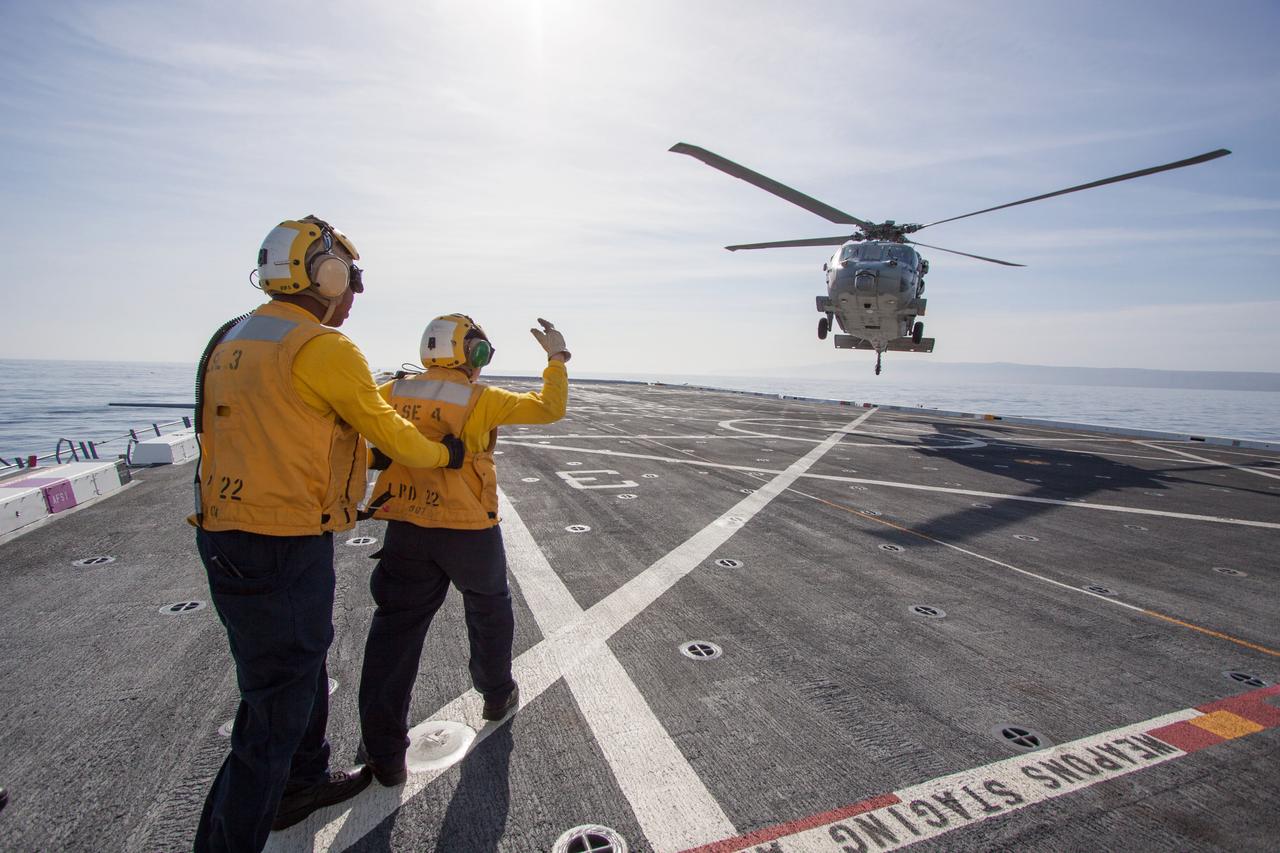
On the top deck of the USS San Diego, a helicopter flies overhead to monitor conditions as the Orion underway recovery test begins in the Pacific Ocean, about 100 miles off the coast of San Diego, California on Feb. 20, 2014. The Orion boilerplate test vehicle and other hardware are secured in the well deck of the ship in preparation for the test. NASA and the U.S. Navy conducted tests to prepare for the recovery of the Orion crew module, forward bay cover and parachutes on its return from a deep space mission. The underway recovery test will allow the teams to demonstrate and evaluate the recovery processes, procedures, hardware and personnel in open waters. Part of Batch image transfer from Flickr.
On the top deck of the USS San Diego, a helicopter flies overhead to monitor conditions as the Orion underway recovery test begins in the Pacific Ocean, about 100 miles off the coast of San Diego, California on Feb. 20, 2014. The Orion boilerplate test vehicle and other hardware are secured in the well deck of the ship in preparation for the test. NASA and the U.S. Navy conducted tests to prepare for the recovery of the Orion crew module, forward bay cover and parachutes on its return from a deep space mission. The underway recovery test will allow the teams to demonstrate and evaluate the recovery processes, procedures, hardware and personnel in open waters. Part of Batch image transfer from Flickr.
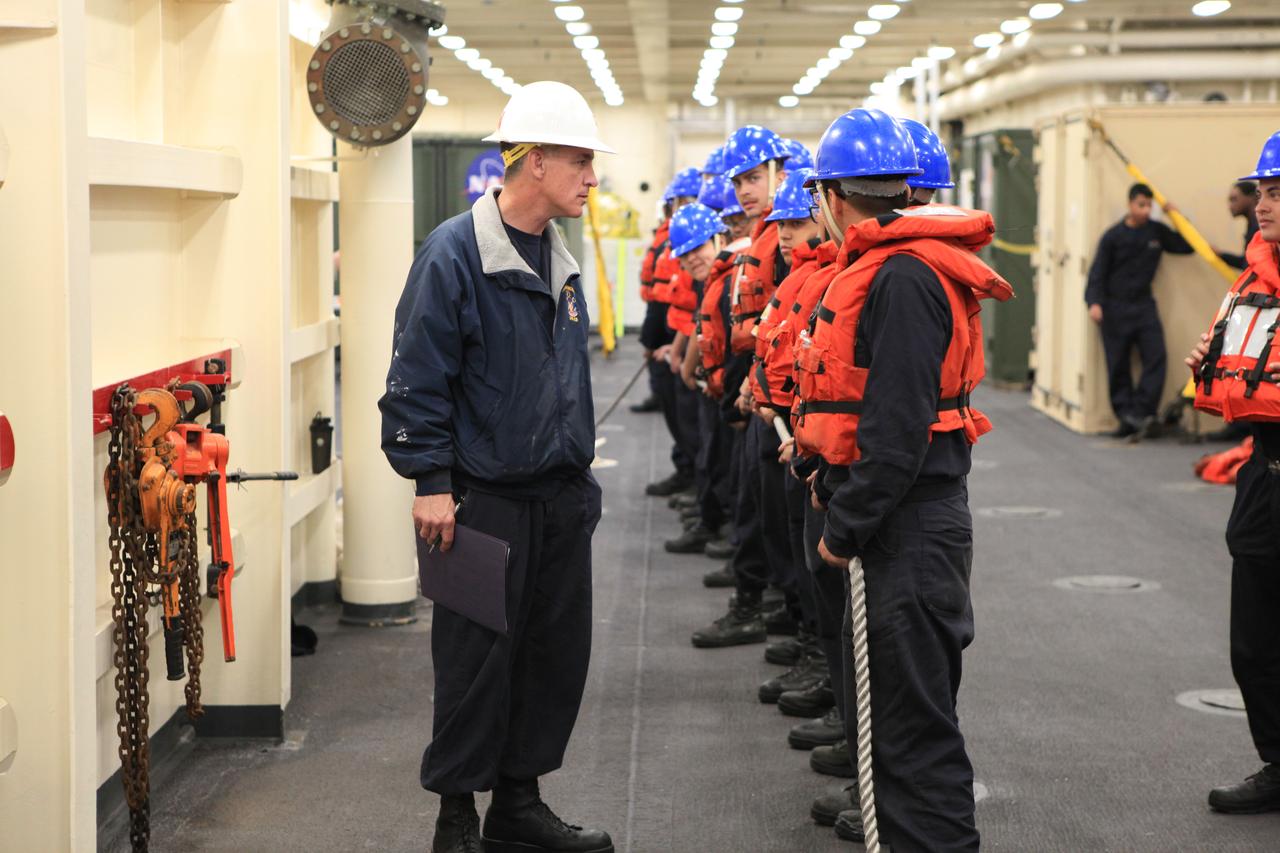
Chief Warrant Officer Ferrari from the USS Anchorage inspects the Deck Department as they prepare to bring in “Oscar,” a dummy used for man overboard drills. During Underway Recovery Test 6, the USS Anchorage’s man overboard drill gave Kennedy Space Center’s NASA Recovery Team a glimpse of one way an astronaut could be brought from a small boat onto the ship using a stretcher. Once the Orion capsule splashes down in the Pacific Ocean, astronauts can choose to stay in the capsule until it is pulled into the well deck of the Navy vessel, or have a diver retrieve them first and then get the capsule later.
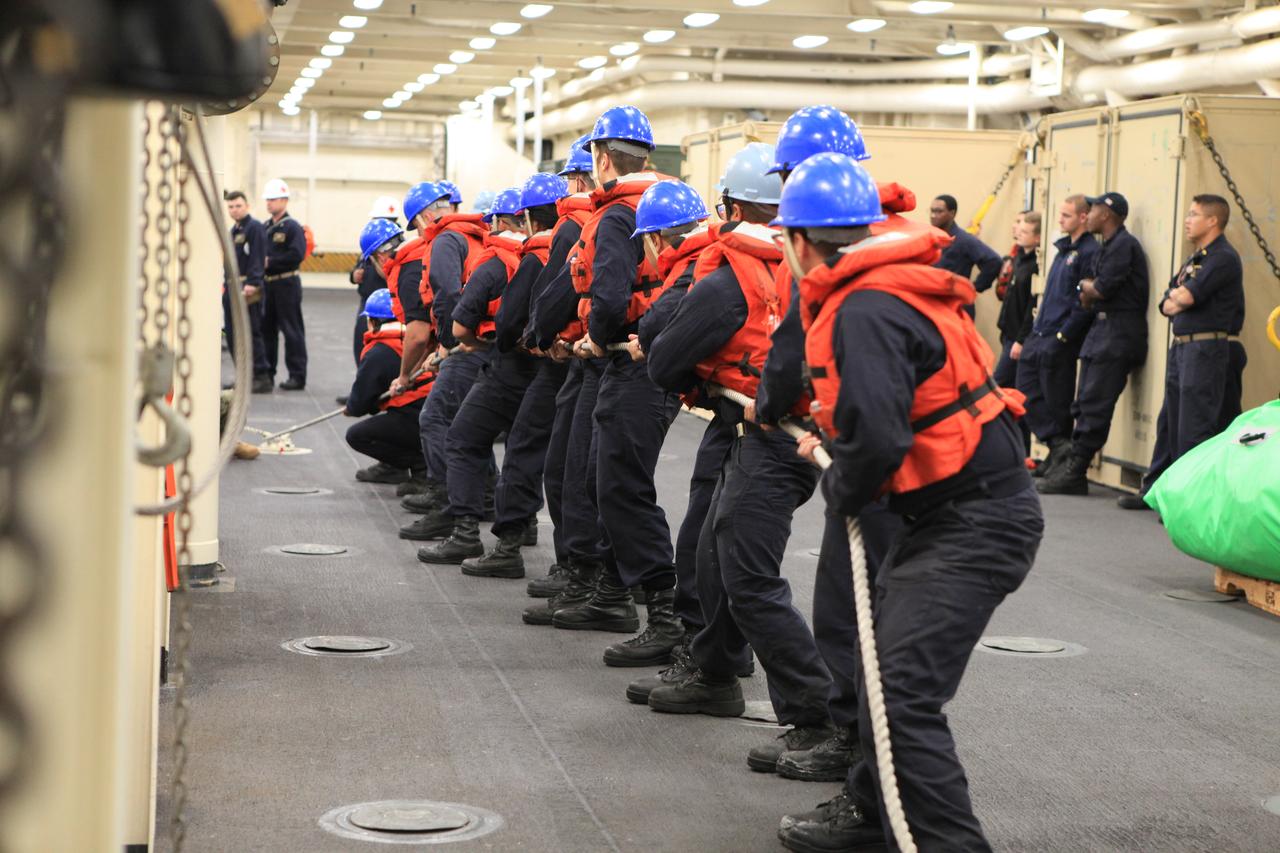
USS Anchorage’s Deck Department is heaving around the line as they bring up “Oscar,” a dummy used for man overboard drills. During Underway Recovery Test 6, the USS Anchorage’s man overboard drill gave Kennedy Space Center’s NASA Recovery Team a glimpse of one way an astronaut could be brought from a small boat onto the ship using a stretcher. Once the Orion capsule splashes down in the Pacific Ocean, astronauts can choose to stay in the capsule until it is pulled into the well deck of the Navy vessel, or have a diver retrieve them first and then get the capsule later.
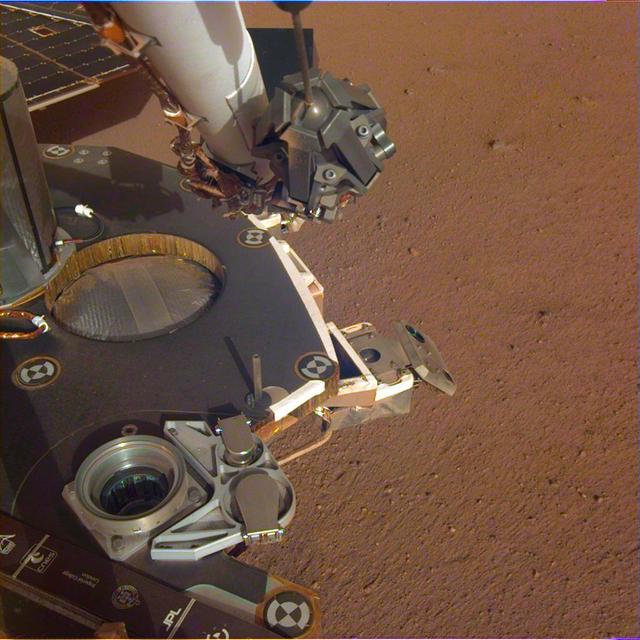
A partial view of the deck of NASA's InSight lander, where it stands on the Martian plains Elysium Planitia. The color-calibrated image was received on Dec. 4, 2018 (Sol 8). InSight's robotic arm with its stowed grapple can be seen above the deck, and jutting out from the front of the deck is one of the boxy attitude control system thrusters that helped control the spacecraft's landing. The circular silver inset of the propellant tank can also be seen in the middle of the image, as well as one of the connections for the aeroshell and parachute, which looks like a cupholder in the foreground. Next to the propellant tank is the UHF antenna, which helps the lander communicate with Earth. In the background, part of one of InSight's solar panels is visible. https://photojournal.jpl.nasa.gov/catalog/PIA22873