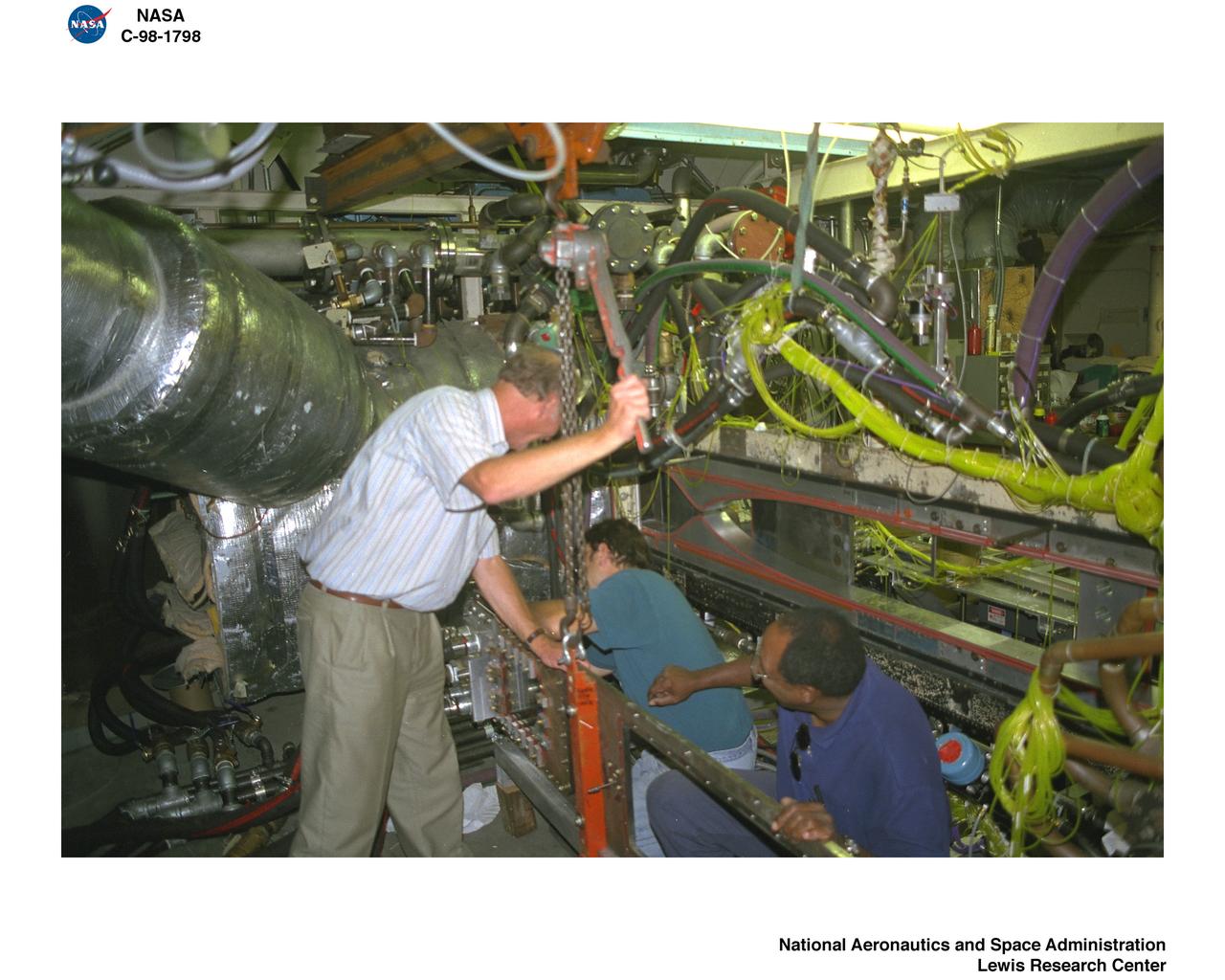
REASSEMBLY OF DUCT LAB SWT MACH 4-5 NOZZLE WITH MACH 2.0 INJECTION

Two scientists at NASA Marshall Space Flight Center, atmospheric scientist Paul Meyer (left) and solar physicist Dr. David Hathaway, have developed promising new software, called Video Image Stabilization and Registration (VISAR), that may help law enforcement agencies to catch criminals by improving the quality of video recorded at crime scenes, VISAR stabilizes camera motion in the horizontal and vertical as well as rotation and zoom effects; produces clearer images of moving objects; smoothes jagged edges; enhances still images; and reduces video noise of snow. VISAR could also have applications in medical and meteorological imaging. It could steady images of Ultrasounds which are infamous for their grainy, blurred quality. It would be especially useful for tornadoes, tracking whirling objects and helping to determine the tornado's wind speed. This image shows two scientists reviewing an enhanced video image of a license plate taken from a moving automobile.
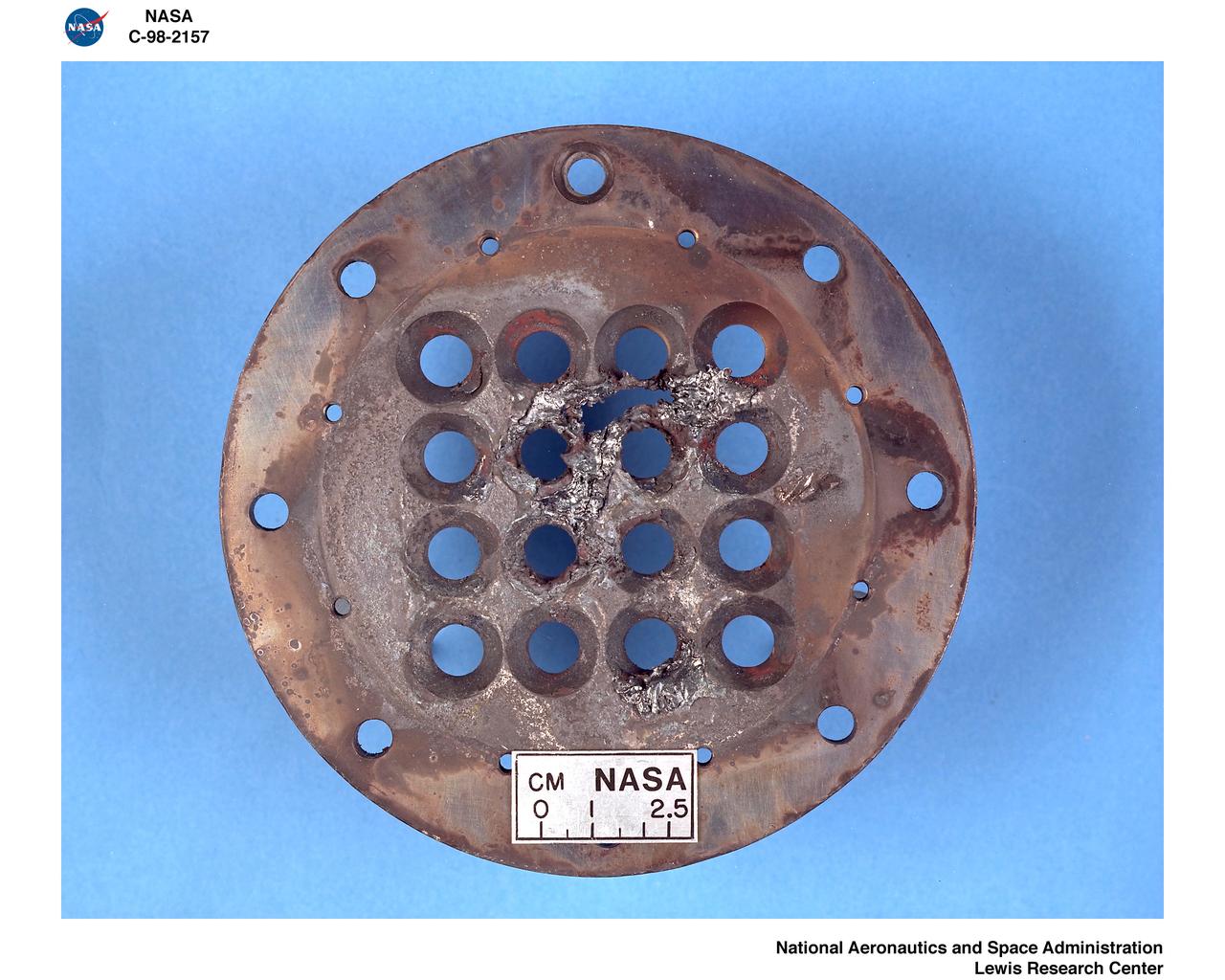
AEROJET 16 FLAMETUBE EXPERIMENT
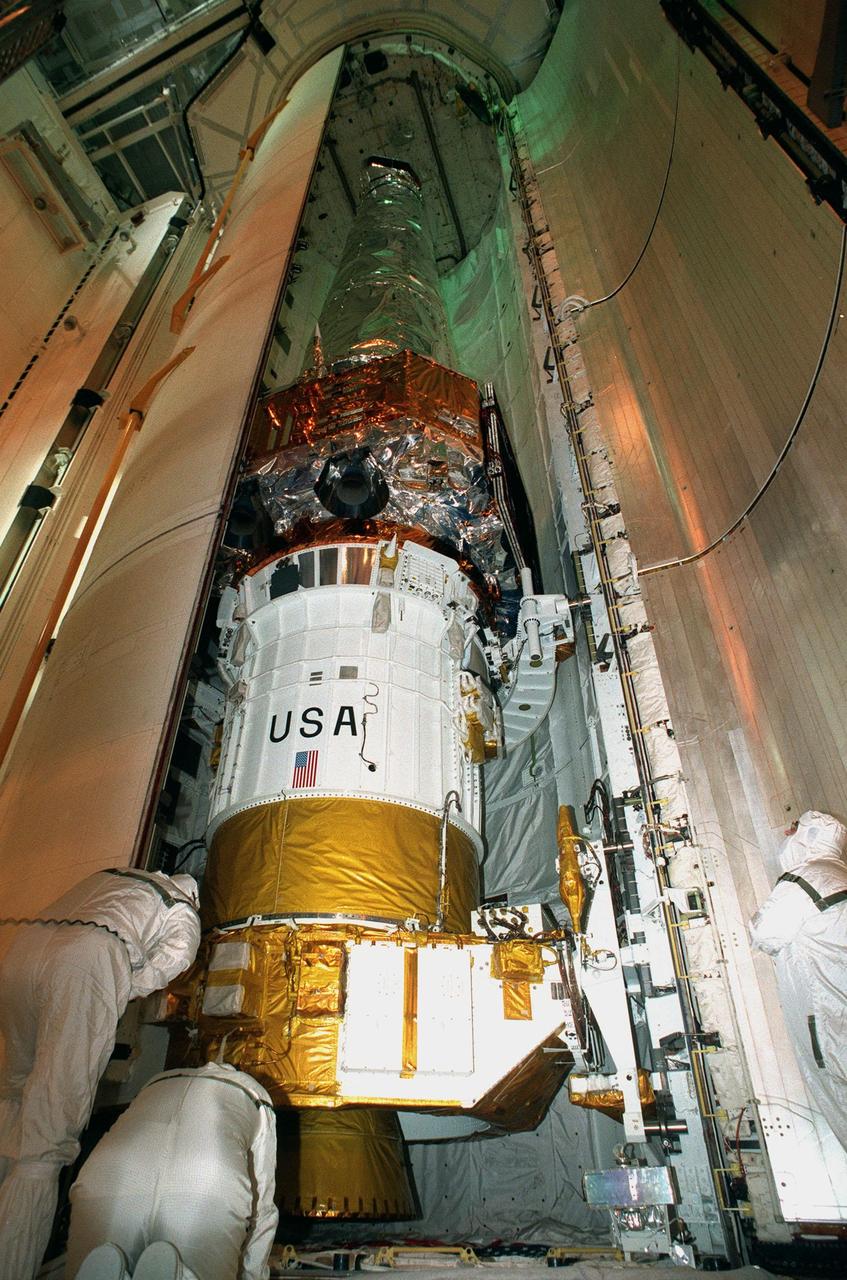
At Launch Pad 39-B, the Space Shuttle Columbia's payload bay doors close around the Chandra X-ray Observatory inside, while workers monitor the activity. Chandra is the primary payload on mission STS-93, scheduled to launch aboard Columbia July 20 at 12:36 a.m. EDT. The combined Chandra/Inertial Upper Stage, seen here, measures 57 feet long and weighs 50,162 pounds. Fully deployed with solar arrays extended, the observatory measures 45.3 feet long and 64 feet wide. The world's most powerful X-ray telescope, Chandra will allow scientists from around the world to see previously invisible black holes and high-temperature gas clouds, giving the observatory the potential to rewrite the books on the structure and evolution of our universe
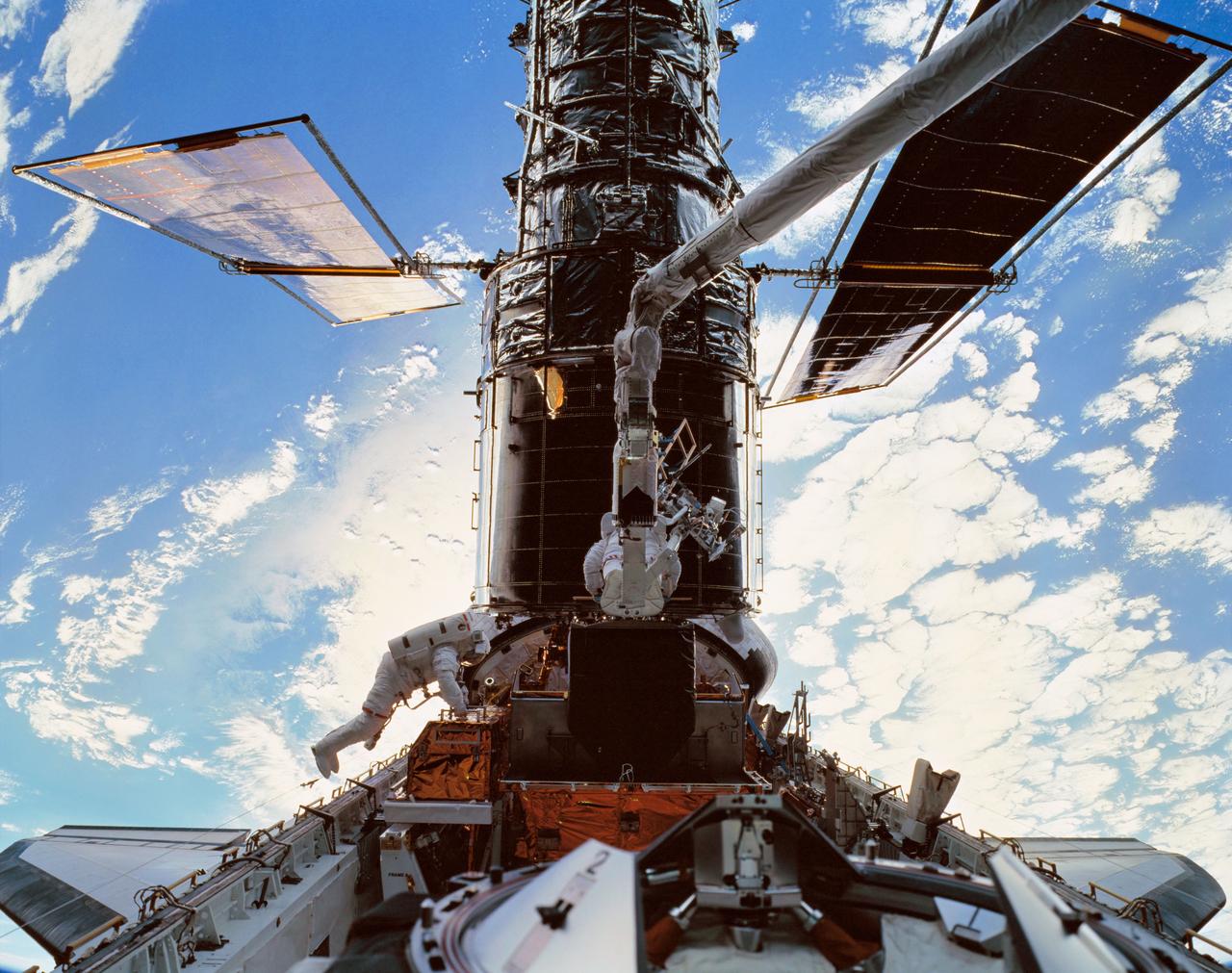
STS103-501-026 (19 - 27 December 1999) --- Astronauts C. Michael Foale, left, and Claude Nicollier (on Discovery's robotic arm) install a Fine Guidance Sensor (FGS) into a protective enclosure in the Shuttle’s payload bay. Foale and Nicollier performed the second of three space walks to service the Hubble Space Telescope (HST) on the STS-103 mission. A large format camera inside Discovery's cabin was used to record this high-resolution image, while the Shuttle was orbiting above ocean and clouds.
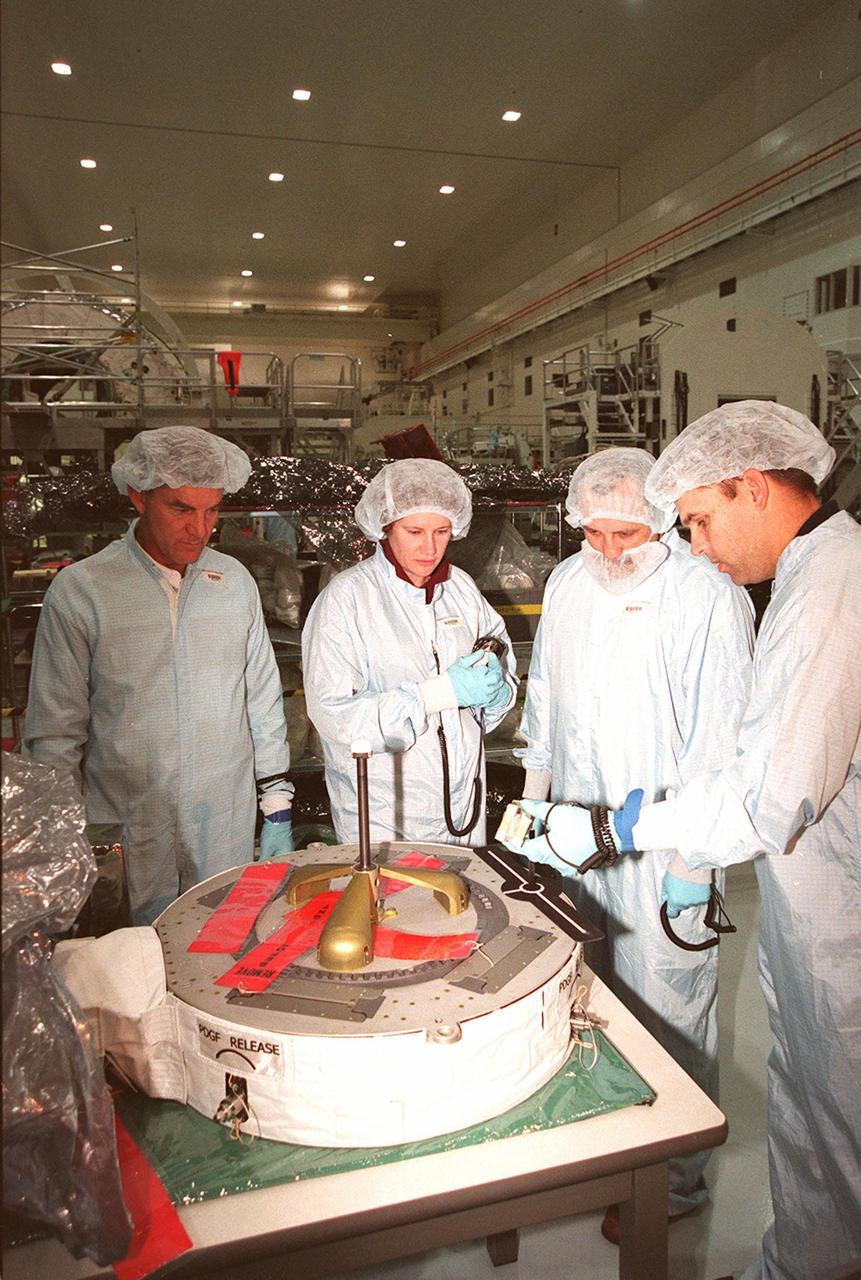
Inside the Space Station Processing Facility (SSPF), a technician (right) explains use of the equipment in front of (left) STS-102 Mission Specialists James Voss, Susan Helms and Yuri Usachev, with the Russian Space Agency (RSA). STS-102 is a resupply mission to the International Space Station, transporting the Leonardo Multi-Purpose Logistics Module (MPLM) with equipment to assist in outfitting the U.S. Lab, which will already be in place. The mission is also transporting Helms, Voss and Usachev as the second resident crew (designated Expedition crew 2) to the station. In exchange, the mission will return to Earth the first expedition crew on ISS: William Shepherd, Sergei Krikalev (RSA) and Yuri Gidzenko (RSA). STS-102 is scheduled to launch no earlier than Oct. 19, 2000
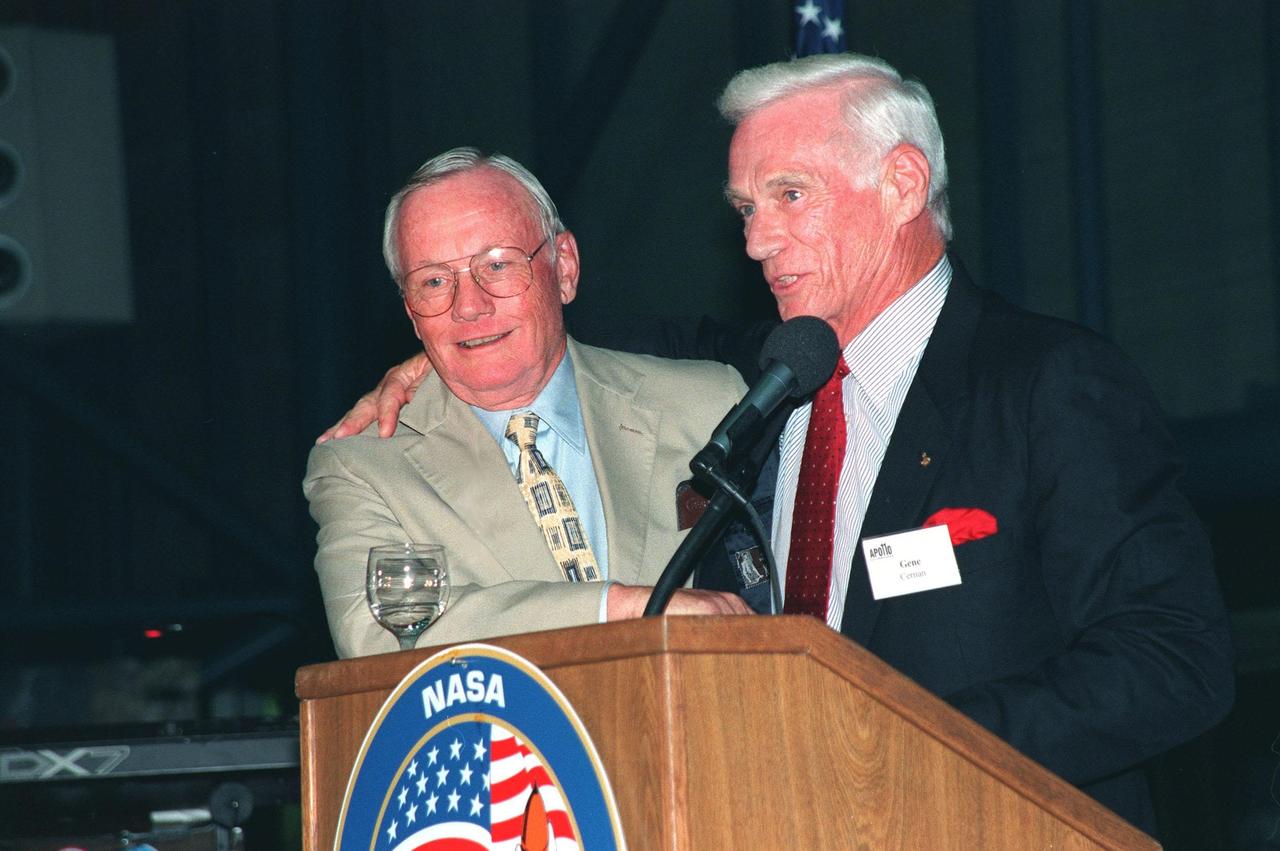
KENNEDY SPACE CENTER, FLA. -- During an anniversary banquet honoring the Apollo program team, the people who made the entire lunar landing program possible, former Apollo astronauts Neil Armstrong (left) and Gene Cernan talk about their experiences. The banquet was held in the Apollo/Saturn V Center, part of the KSC Visitor Complex. This is the 30th anniversary of the Apollo 11 launch and moon landing, July 16 and July 20, 1969. Other guests at the banquet were astronauts Wally Schirra, Edwin "Buzz" Aldrin and Walt Cunningham. Neil Armstrong was the first man to walk on the moon; Gene Cernan was the last
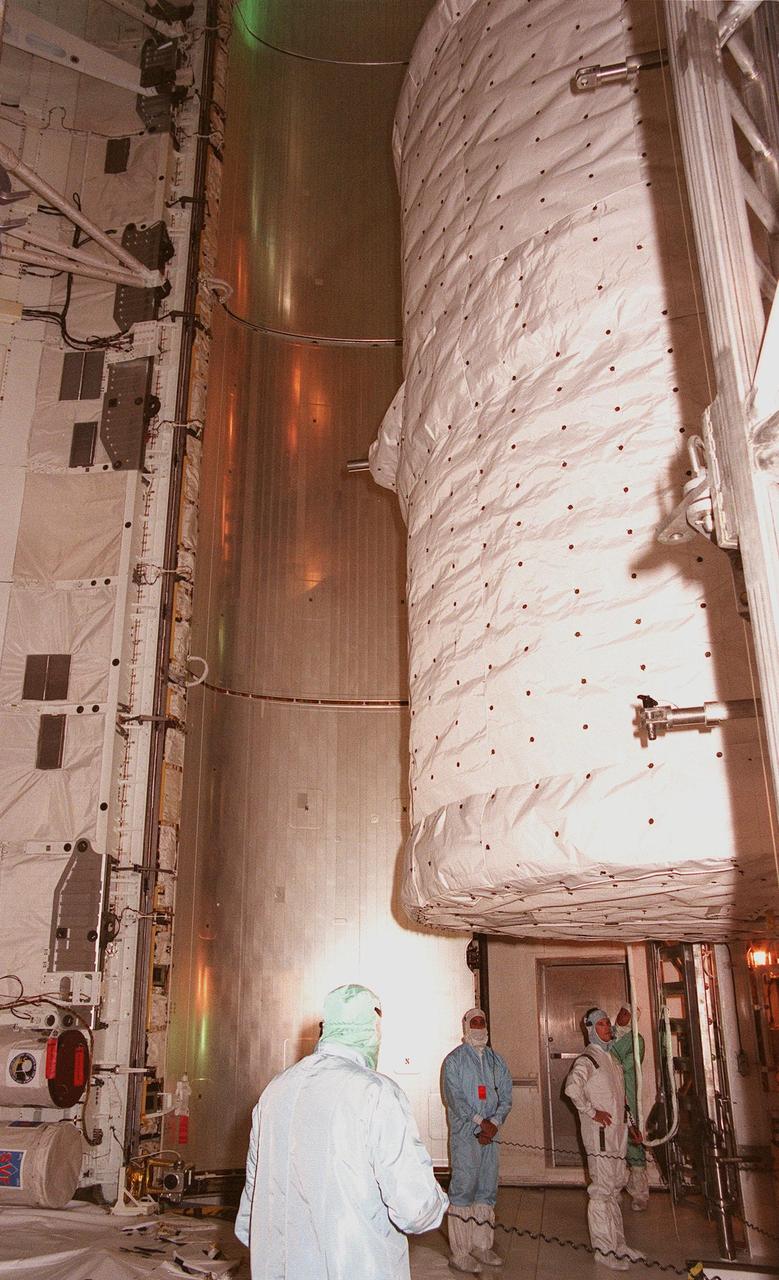
KENNEDY SPACE CENTER, FLA. -- In the payload changeout room at Launch Pad 39B, the SPACEHAB Double module is moved from the payload canister before being placed in Space Shuttle Discovery's payload bay for mission STS-96. The second flight supporting construction of the International Space Station, STS-96 is a logistics and resupply mission, carrying more than 5,000 pounds of supplies, a Russian-built crane and a U.S.-built crane, plus experiments such as STARSHINE, which was developed by and for students. Comprising the crew are Commander Kent V. Rominger, Pilot Rick Douglas Husband, and Mission Specialists Ellen Ochoa (Ph.D.), Tamara E. Jernigan (Ph.D.), Daniel Barry (M.D., Ph.D.), Julie Payette, with the Canadian Space Agency, and Valery Ivanovich Tokarev, with the Russian Space Agency. Liftoff is scheduled for May 20 at 9:32 a.m. EDT
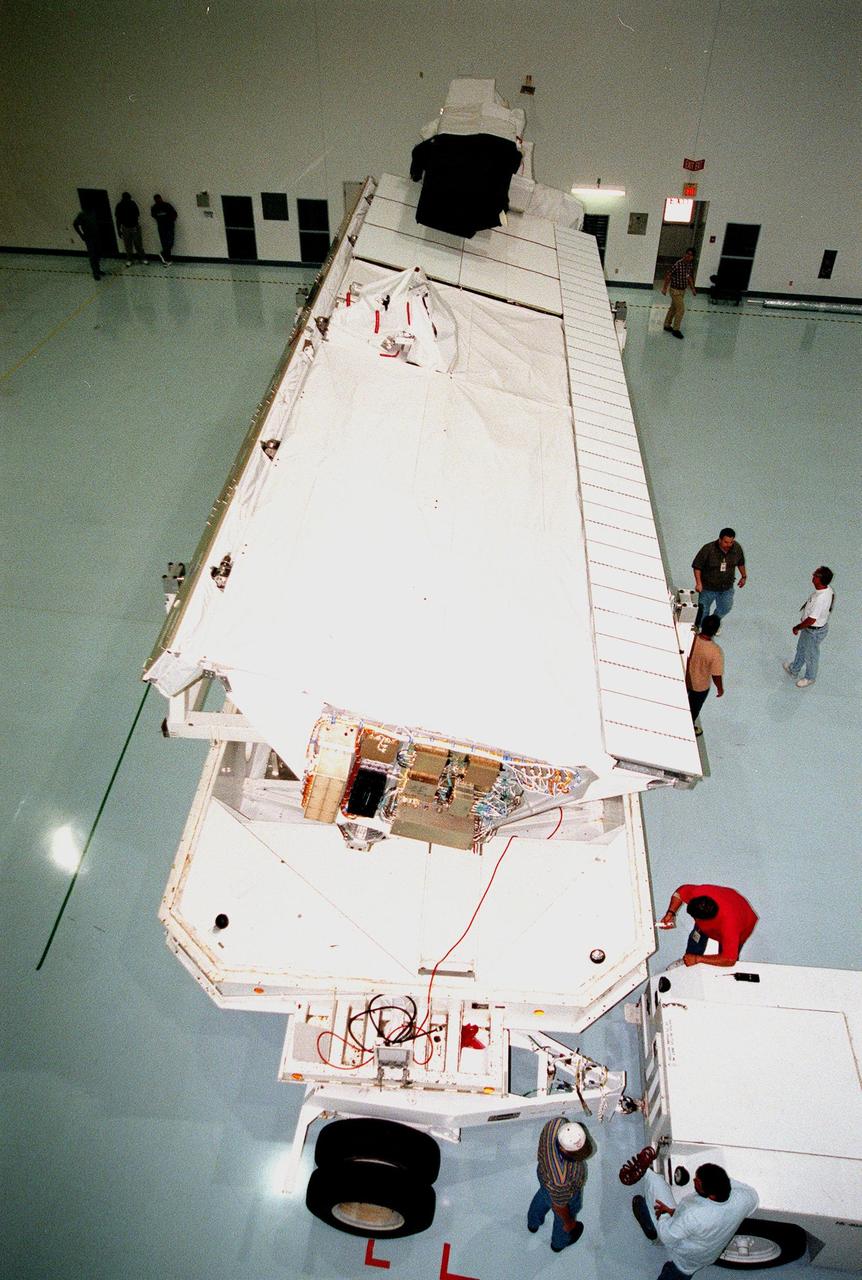
In the Space Station Processing Facility (SSPF), workers (lower right) disconnect the transport vehicle from the Shuttle Radar Topography Mission (SRTM) after moving it into the building for pre-launch preparations. The primary payload on mission STS-99, the SRTM consists of a specially modified radar system that will fly onboard the Space Shuttle during the 11-day mission targeted for launch in September 1999. This radar system will gather data that will result in the most accurate and complete topographic map of the Earth's surface that has ever been assembled. SRTM is an international project spearheaded by the National Imagery and Mapping Agency and NASA, with participation of the German Aerospace Center DLR. Its objective is to obtain the most complete high-resolution digital topographic database of the Earth
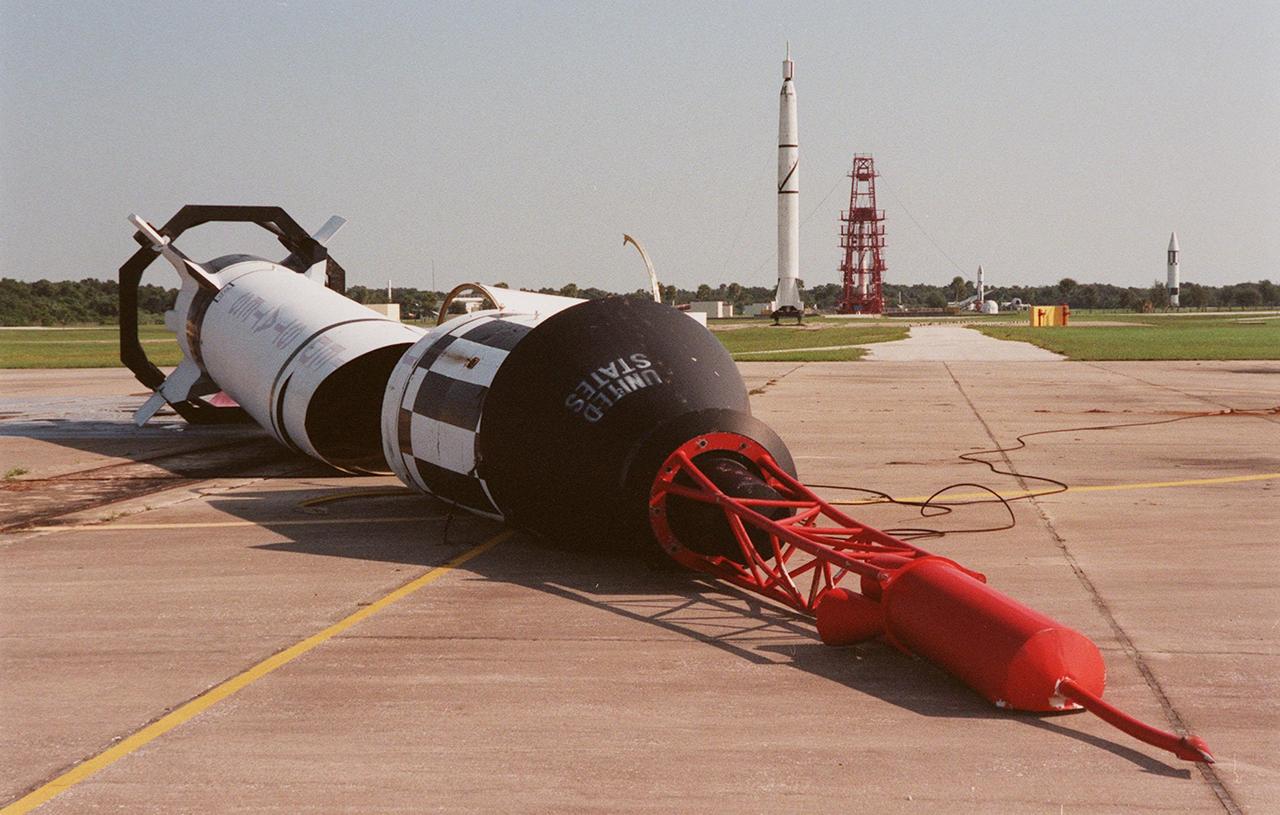
At Cape Canaveral Air Station's Complex 5/6, a Redstone rocket lies broken on the pad after Hurricane Floyd passed along the East Coast of Florida, Sept. 14-15. Still standing behind it are the Explorer I (center) and Jupiter C (right) rockets. The complex, now dismantled, was the site of the first manned launch May 5, 1961. At a weather tower located between Shuttle Launch Pad 39A and Launch Complex 41, the highest winds recorded during the superstorm were 91 mph from the NNW at 4:50 a.m. on Wednesday, Sept. 15. The maximum sustained winds were recorded at 66 mph. The highest amount of rain recorded at KSC was 2.82 inches as the eye of Hurricane Floyd passed 121 miles east of Cape Canaveral at 4 a.m. Wednesday. A preliminary review of conditions at the Kennedy Space Center was positive, however, after the worst of Hurricane Floyd passed. There appeared to be no major damage to NASA assets, including the launch pads, the four Space Shuttle Orbiters, and flight hardware

STS096-707-039 (5 June 1999) --- The Student-Tracked Atmospheric Research Satellite for Heuristic International Networking Experiment (STARSHINE) satellite leaves the cargo bay of the Space Shuttle Discovery near the completion of the almost ten-day STS-96 mission. SpaceHab, the stowed Canadian-built remote manipulator system (RMS) arm and the shuttle's docking mechanism which earlier was connected to the International Space Station (ISS) are all visible in the foreground.
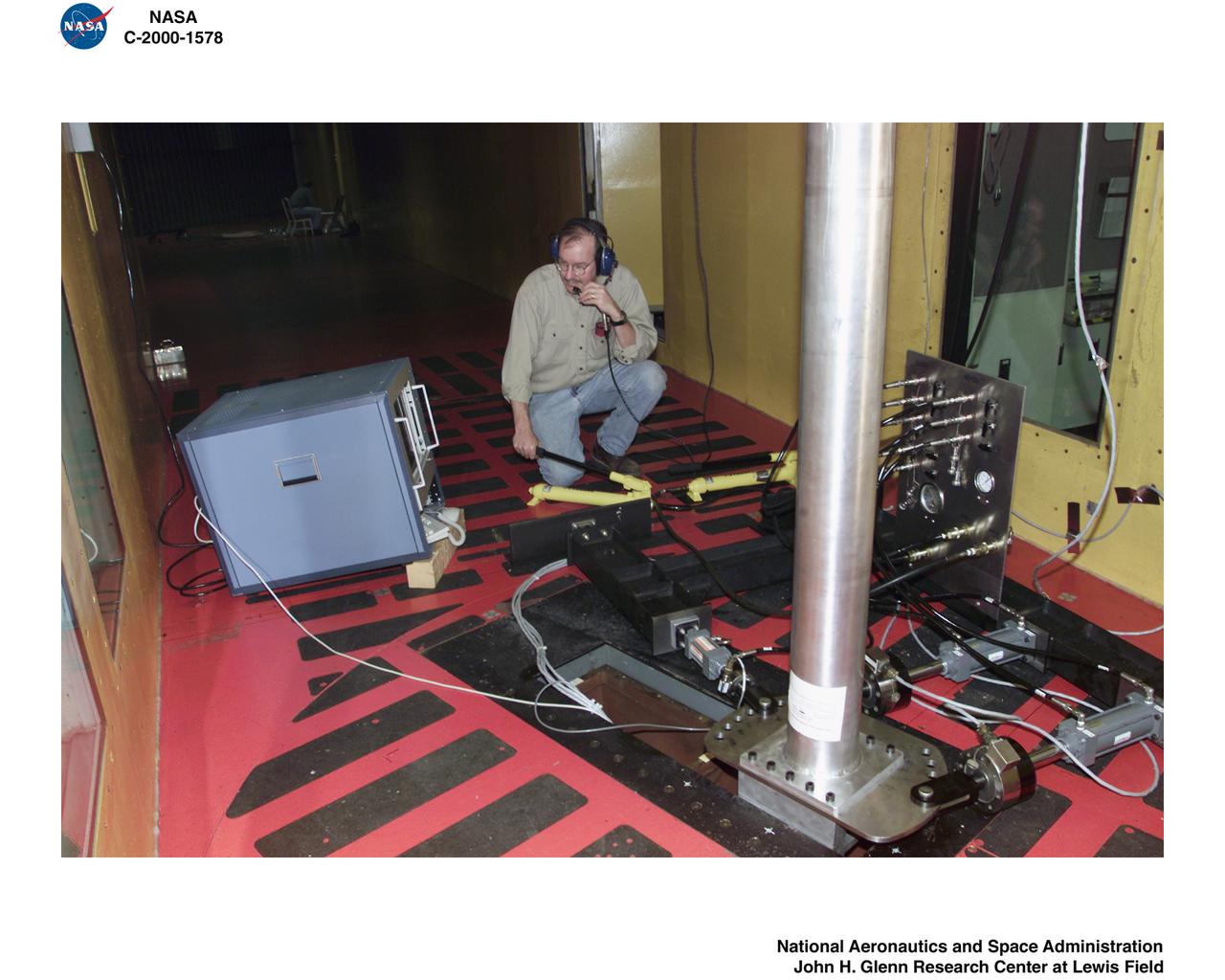
ICING RESEARCH TUNNEL IRT FORCE BALANCE CALIBRATION HARDWARE
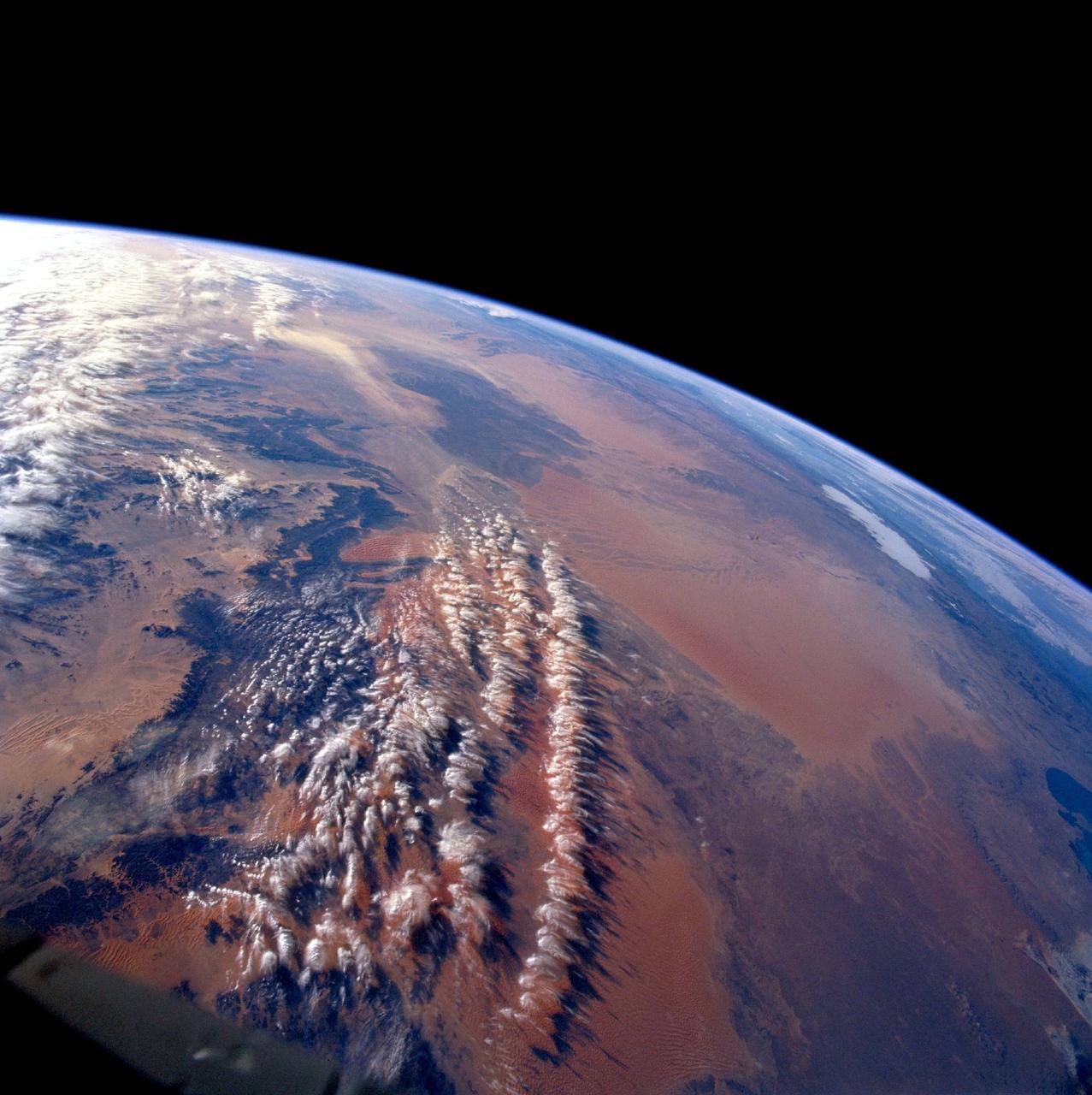
STS103-710-084 (19-27 December 1999)--- One of the astronauts aboard the Earth-orbiting Space Shuttle Discovery used a handheld 70mm camera to photograph the great sand seas which occupy northern Algeria. They are Grand Erg Oriental (Eastern Sand Sea) and Grand Erg Occidental (Western Sand Sea). Both sand seas occupy depressions that are separated by a north-south rise called Mizab. Ergs are areas of large accumulations of sand that take the form of actively shifting dunes, fossilized dunes, or extensive sand sheets.
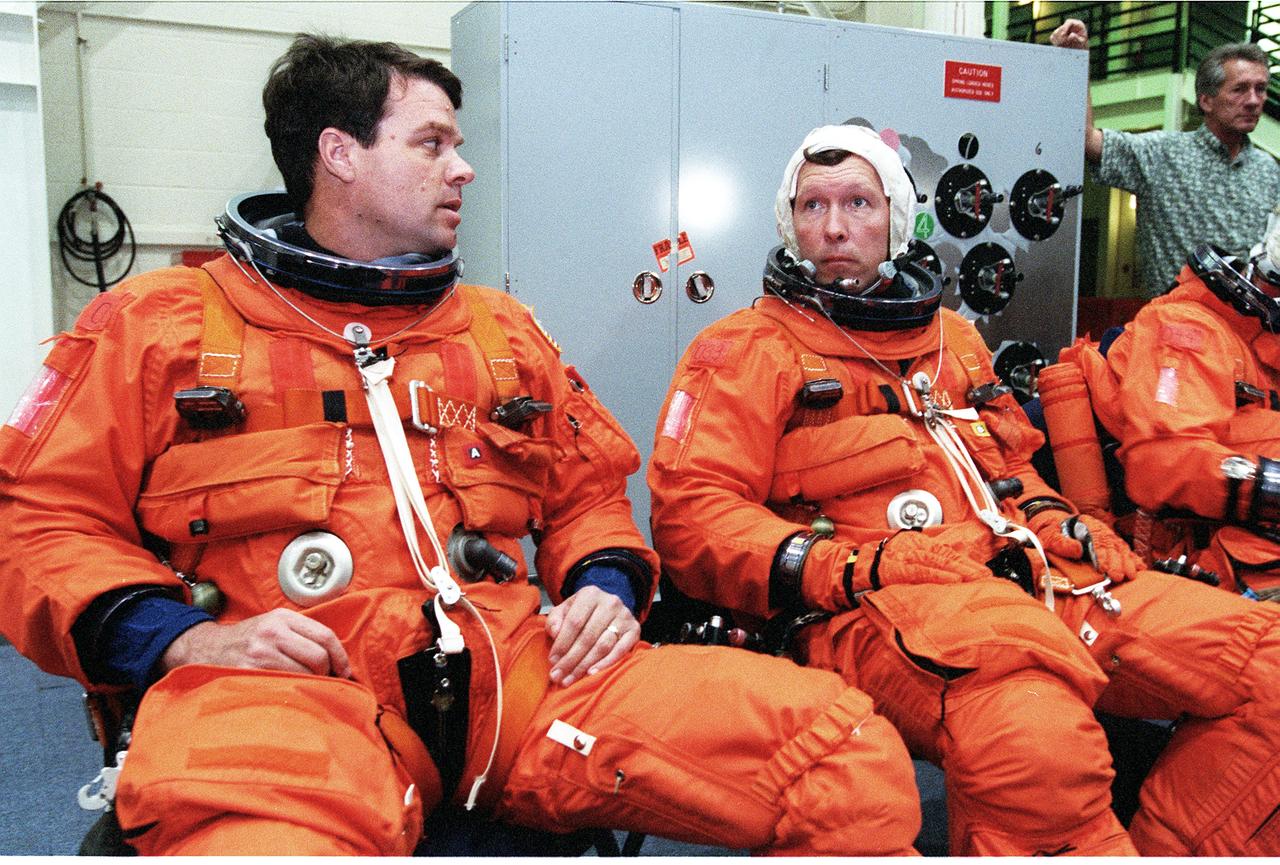
S99-05619 (19 May 1999) --- Astronauts Kevin R. Kregel (left) and Dominic L. Gorie, mission commander and pilot, respectively, for STS-99, are pictured during the briefing portion of emergency bailout training at the Johnson Space Center's Systems Integration Facility. Other members of the crew are out of frame at right.
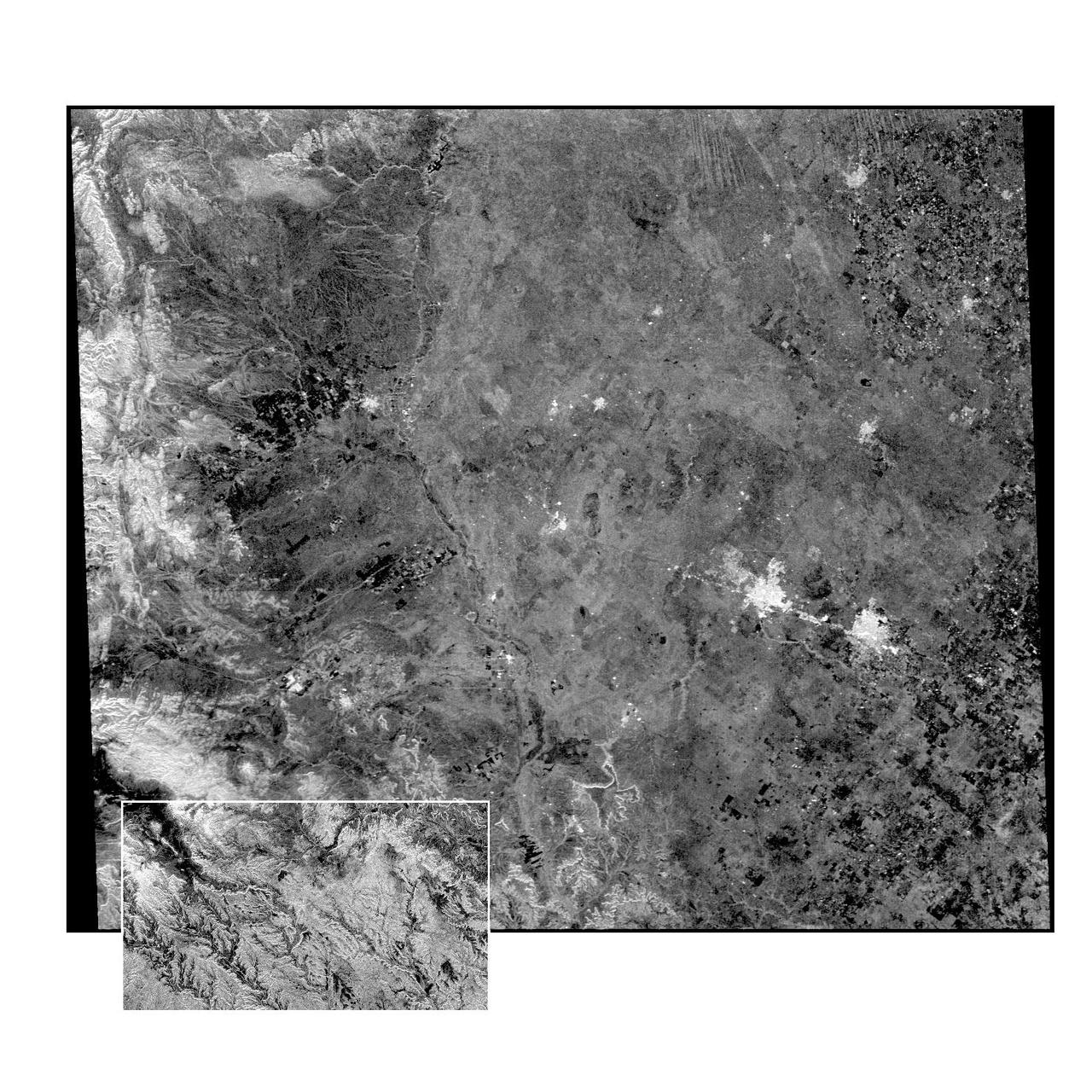
This radar image of the Midland/Odessa region of West Texas, demonstrates an experimental technique, called ScanSAR, that allows scientists to rapidly image large areas of the Earth's surface. The large image covers an area 245 kilometers by 225 kilometers (152 miles by 139 miles). It was obtained by the Spaceborne Imaging Radar-C/X-Band Synthetic Aperture Radar (SIR-C/X-SAR) flying aboard the space shuttle Endeavour on October 5, 1994. The smaller inset image is a standard SIR-C image showing a portion of the same area, 100 kilometers by 57 kilometers (62 miles by 35 miles) and was taken during the first flight of SIR-C on April 14, 1994. The bright spots on the right side of the image are the cities of Odessa (left) and Midland (right), Texas. The Pecos River runs from the top center to the bottom center of the image. Along the left side of the image are, from top to bottom, parts of the Guadalupe, Davis and Santiago Mountains. North is toward the upper right. Unlike conventional radar imaging, in which a radar continuously illuminates a single ground swath as the space shuttle passes over the terrain, a Scansar radar illuminates several adjacent ground swaths almost simultaneously, by "scanning" the radar beam across a large area in a rapid sequence. The adjacent swaths, typically about 50 km (31 miles) wide, are then merged during ground processing to produce a single large scene. Illumination for this L-band scene is from the top of the image. The beams were scanned from the top of the scene to the bottom, as the shuttle flew from left to right. This scene was acquired in about 30 seconds. A normal SIR-C image is acquired in about 13 seconds. The ScanSAR mode will likely be used on future radar sensors to construct regional and possibly global radar images and topographic maps. The ScanSAR processor is being designed for 1996 implementation at NASA's Alaska SAR Facility, located at the University of Alaska Fairbanks, and will produce digital images from the forthcoming Canadian RADARSAT satellite. http://photojournal.jpl.nasa.gov/catalog/PIA01787
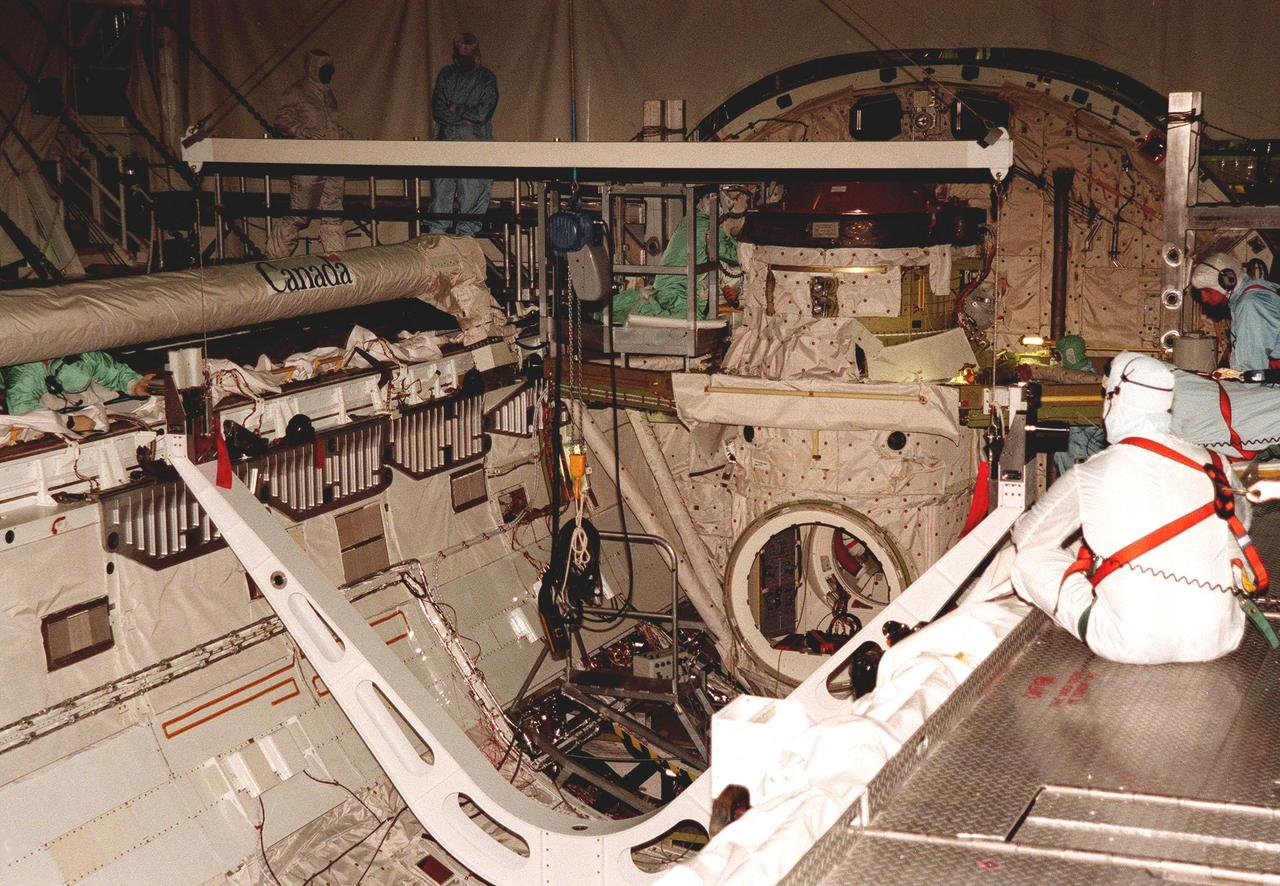
KENNEDY SPACE CENTER, FLA. -- Workers in the Orbiter Processing Facility (OPF) Bay 1 check the Keel Yoke Device (KYD) installed in the orbiter Discovery. The KYD will support the International Cargo Carrier (ICC) to be fitted in the orbiter for mission STS-96. The ICC will carry unpressurized cargo such as the external Russian cargo crane known as STRELA, the SPACEHAB Oceaneering Space System Box (SHOSS), which is a logistics items carrier, and an ORU Transfer Device (OTD), a U.S.-built crane that will be stowed on the station for use during future ISS assembly missions. The primary payload of STS-96 is the SPACEHAB Double Module, an element of the International Space Station. STS-96 is targeted for launch on May 20 at 9:32 a.m. from Launch Pad 39B

S99-16060 (28 December 1999) --- George W.S. Abbey, JSC Director, addresses a crowd on hand for the STS-103 crew return event at Ellington Field.
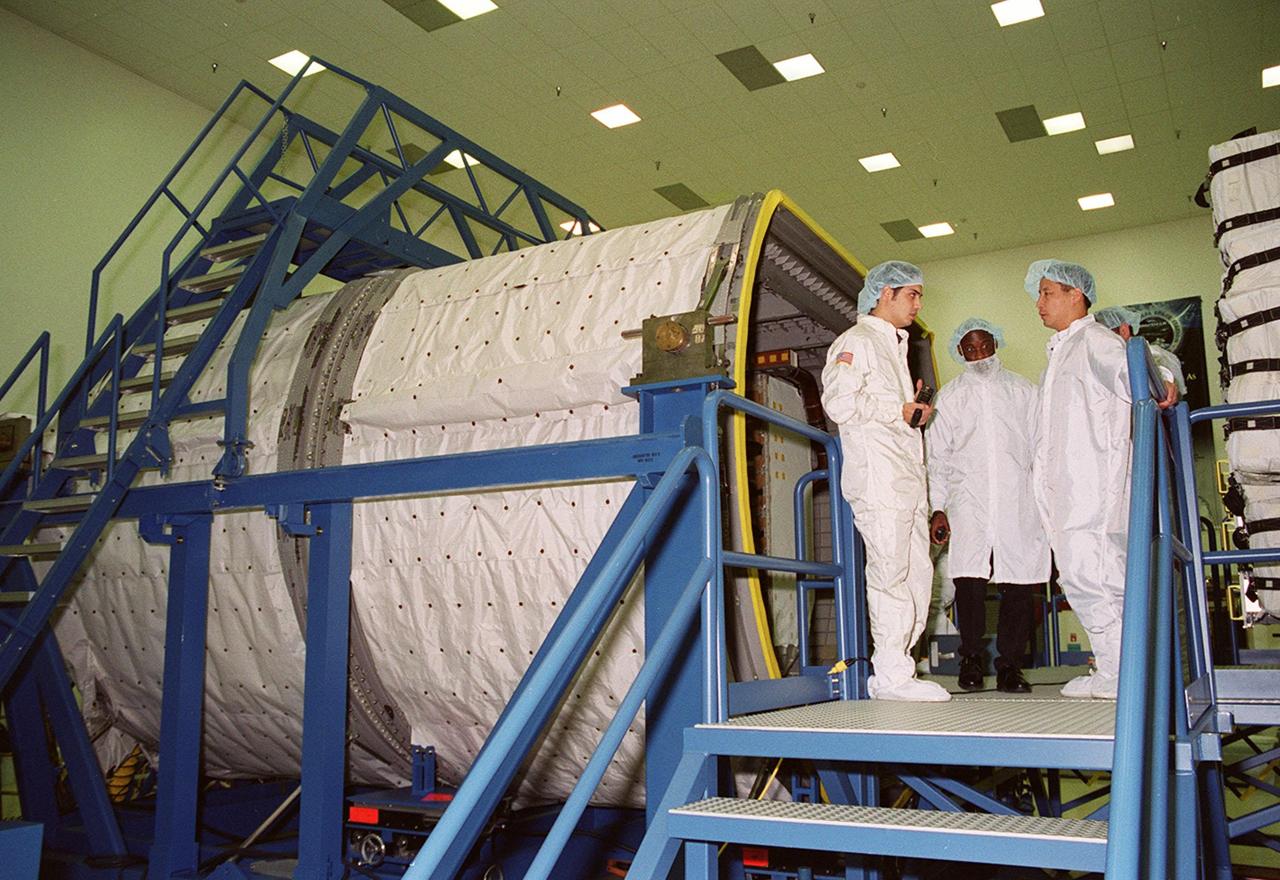
KENNEDY SPACE CENTER, FLA. -- At SPACEHAB, in Titusville, Fla., STS-101 Mission Specialists Edward Tsang Lu (Ph.D.), at right, talks with workers about the SPACEHAB Logistics Double Module at left. The module is part of the payload for the mission. Lu and other crew members Commander James Donald Halsell Jr., Pilot Scott J. "Doc" Horowitz (Ph.D.), and Mission Specialists Mary Ellen Weber (Ph.D), Jeffrey N. Williams, and Boris W. Morukov and Yuri Malenchenko , who are with the Russian Space Agency , are taking part in a Crew Equipment Interface Test. The primary objective of the STS-101 mission is to complete the initial outfitting of the International Space Station, making it fully ready for the first long-term crew. The seven-member crew will transfer almost two tons of equipment and supplies from SPACEHAB. Additionally, they will unpack a shipment of supplies delivered earlier by a Russian Progress space tug and begin outfitting the newly arrived Zvezda Service Module. Three astronauts will perform two space walks to transfer and install parts of the Russian Strela cargo boom that are attached to SPACEHAB's Integrated Cargo Container, connect utility cables between Zarya and Zvezda, and install a magnetometer/pole assembly on the Service Module. Additional activities for the STS-101 astronauts include working with the Space Experiment Module (SEM-06) and the Mission to America's Remarkable Schools (MARS), two educational initiatives. STS-101 is scheduled for launch no earlier than March 16, 2000
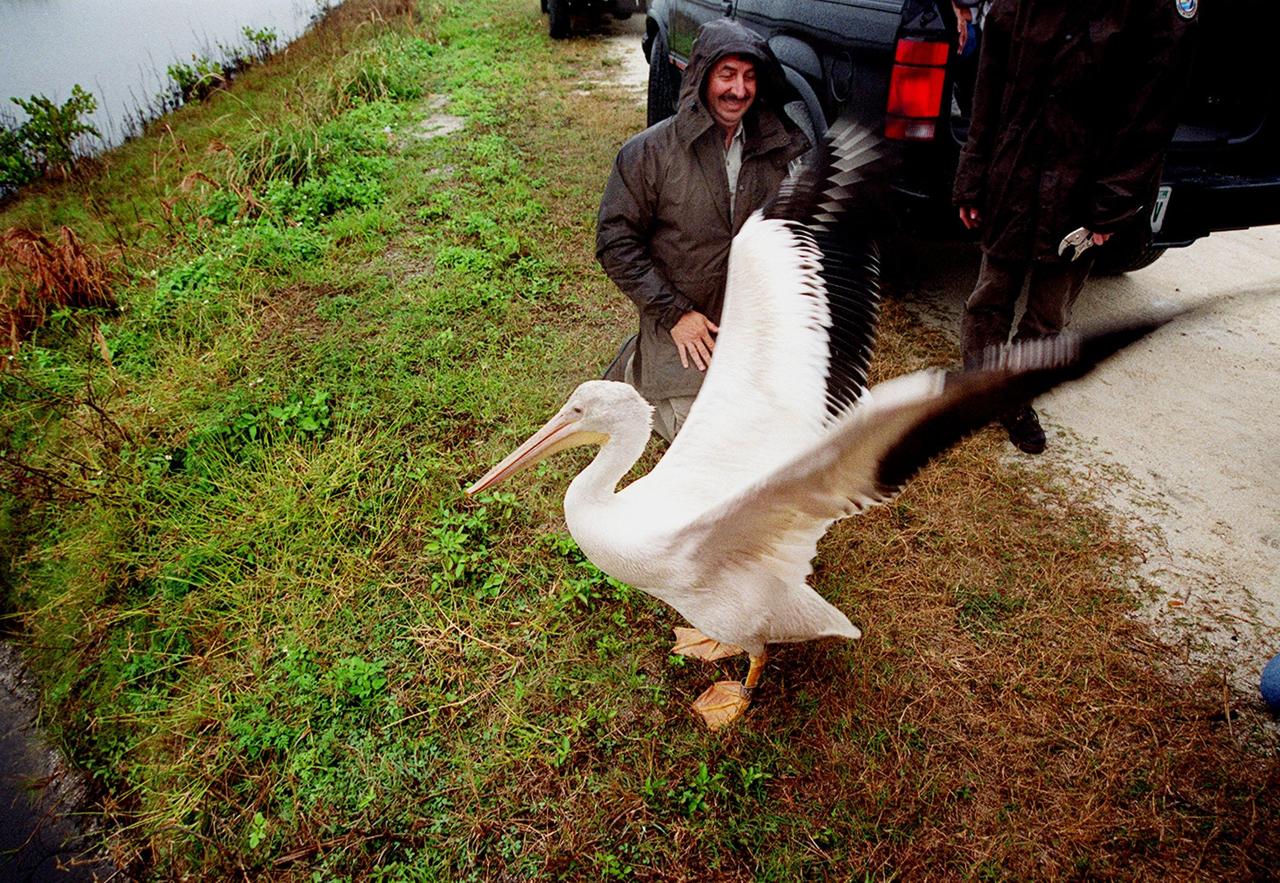
A rescued white pelican, dubbed "Fisheater" by his rescuers, takes a tentative step and stretches its wings after being let go at the Merritt Island National Wildlife Refuge. Looking on is Mark Epstein, with the U.S. Fish and Wildlife Service, who had held the bird while Kat Royer, also with the U.S. Fish and Wildlife Service, placed on it a leg band issued by the U.S. Department of the Interior's Bird Banding Laboratory. The pelican was found covered in crude oil from a contaminated ditch in northern Indiana in November, and was rescued by a local Police Department, treated, and flown to the Back to Nature Wildlife Refuge in Orlando, Fla. for care and rest. It is being released to join a flock of about 30 other white pelicans that are wintering on the refuge. White pelicans inhabit marshy lakes and along the Pacific and Texas coasts. They winter from Florida and southern California south to Panama, chiefly in coastal lagoons. They are frequently seen flying in long lines, flapping and sailing in unison, but also ride rising air currents to soar gracefully in circles. The Merritt Island National Wildlife Refuge, which encompasses 92,000 acres that are a habitat for more than 331 species of birds, 31 mammals, 117 fishes, and 65 amphibians and reptiles. The marshes and open water of the refuge provide wintering areas for 23 species of migratory waterfowl, as well as a year-round home for great blue herons, great egrets, wood storks, cormorants, brown pelicans and other species of marsh and shore birds, as well as a variety of insects
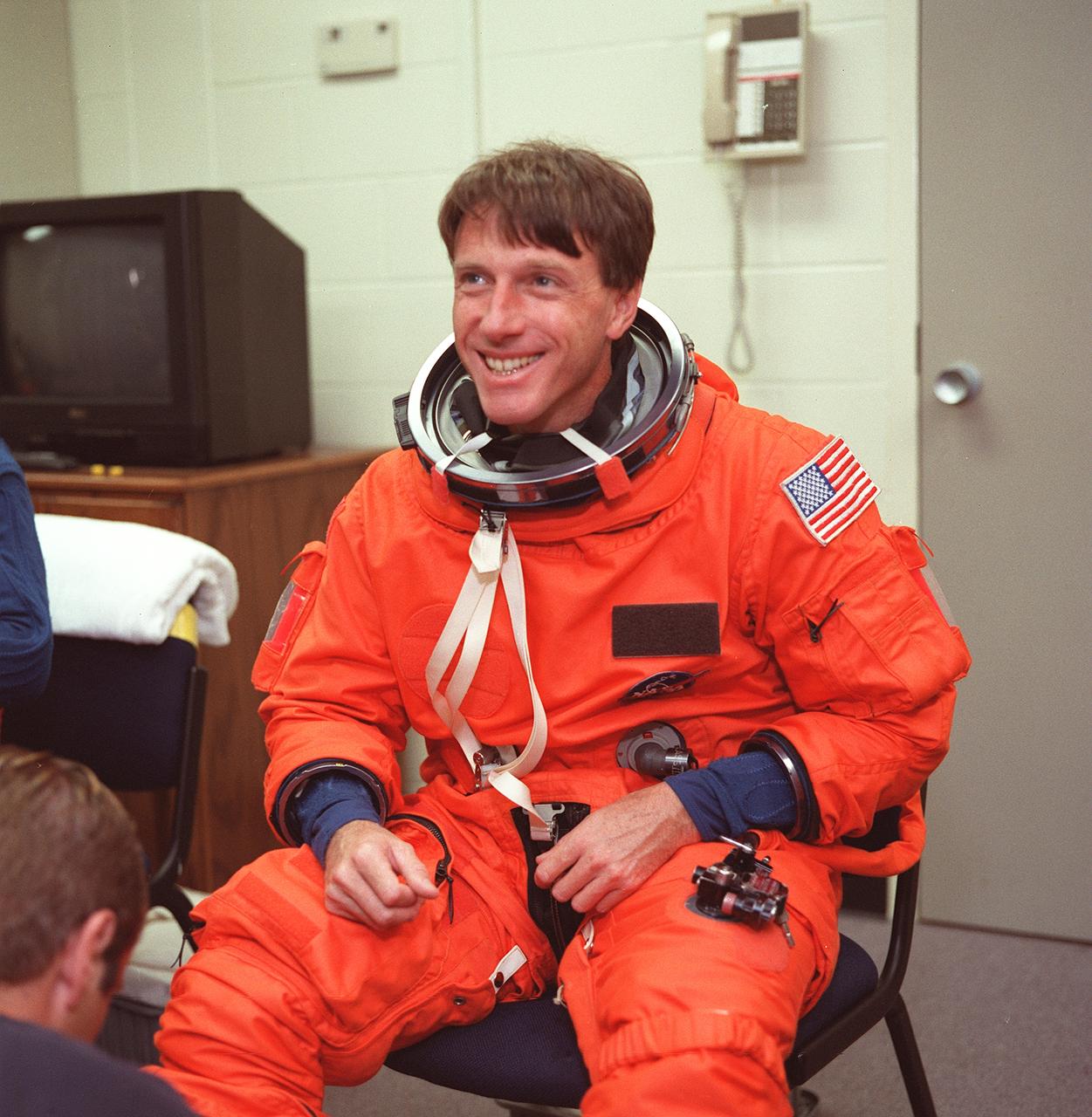
S99-08648 (24 May 1999) --- Suit technicians assist astronaut C. Michael Foale, mission specialist, in readying for a session of emergency bailout training in the Systems Integration Facility at the Johnson Space Center (JSC). Foale, wearing a training version of the partial-pressure launch and entry garment, and his six STS-103 crew mates are currently in training for the third servicing visit to the Hubble Space Telescope (HST) since its 1990 deployment.
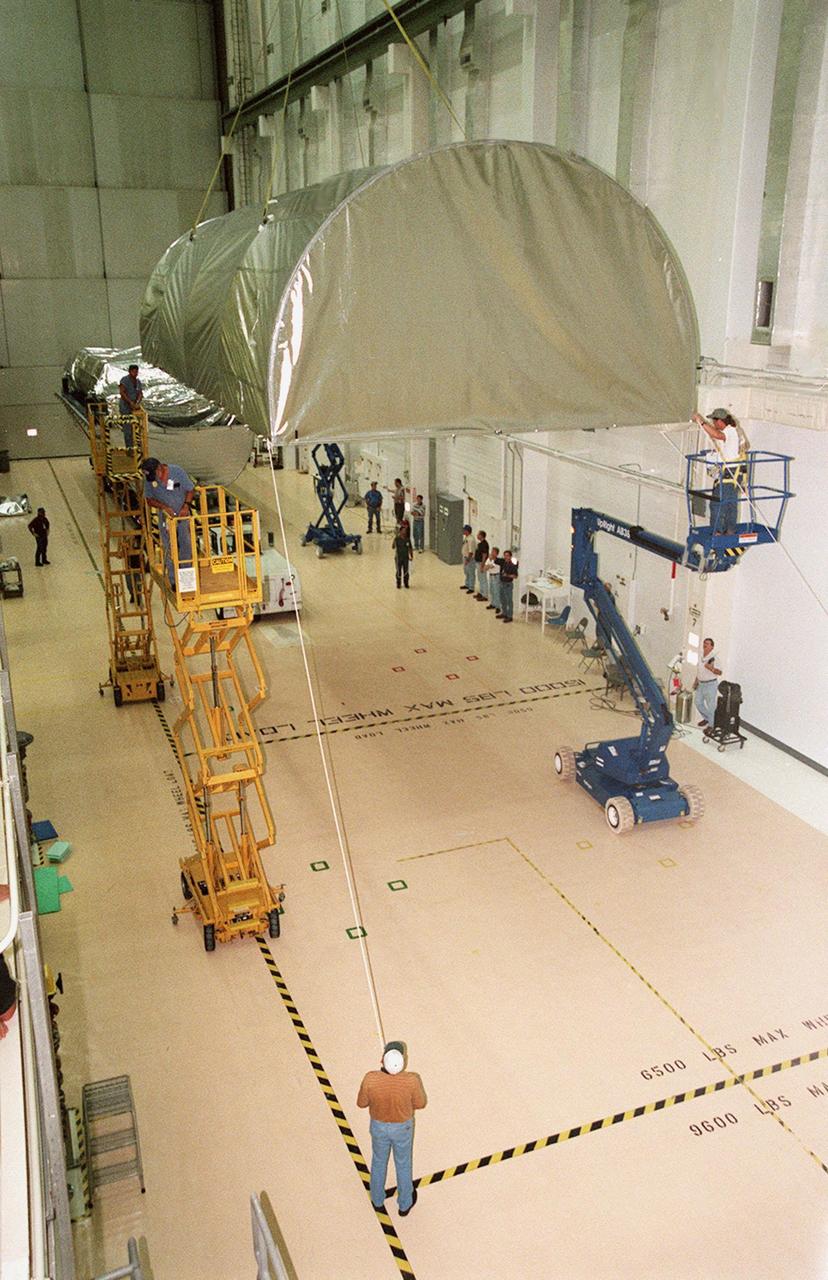
KENNEDY SPACE CENTER, FLA. -- Inside the Operations and Checkout Building, the top of the Guppy cargo carrier is lifted off the S1 truss (background). Manufactured by the Boeing Co. in Huntington Beach, Calif., this component of the International Space Station is the first starboard (right-side) truss segment, whose main job is providing structural support for the orbiting research facility's radiator panels that cool the Space Station's complex power system. The S1 truss segment also will house communications systems, external experiment positions and other subsystems. Primarily constructed of aluminum, the truss segment is 45 feet long, 15 feet wide and 6 feet tall. When fully outfitted, it will weigh 31,137 pounds. The truss is slated for flight in 2001
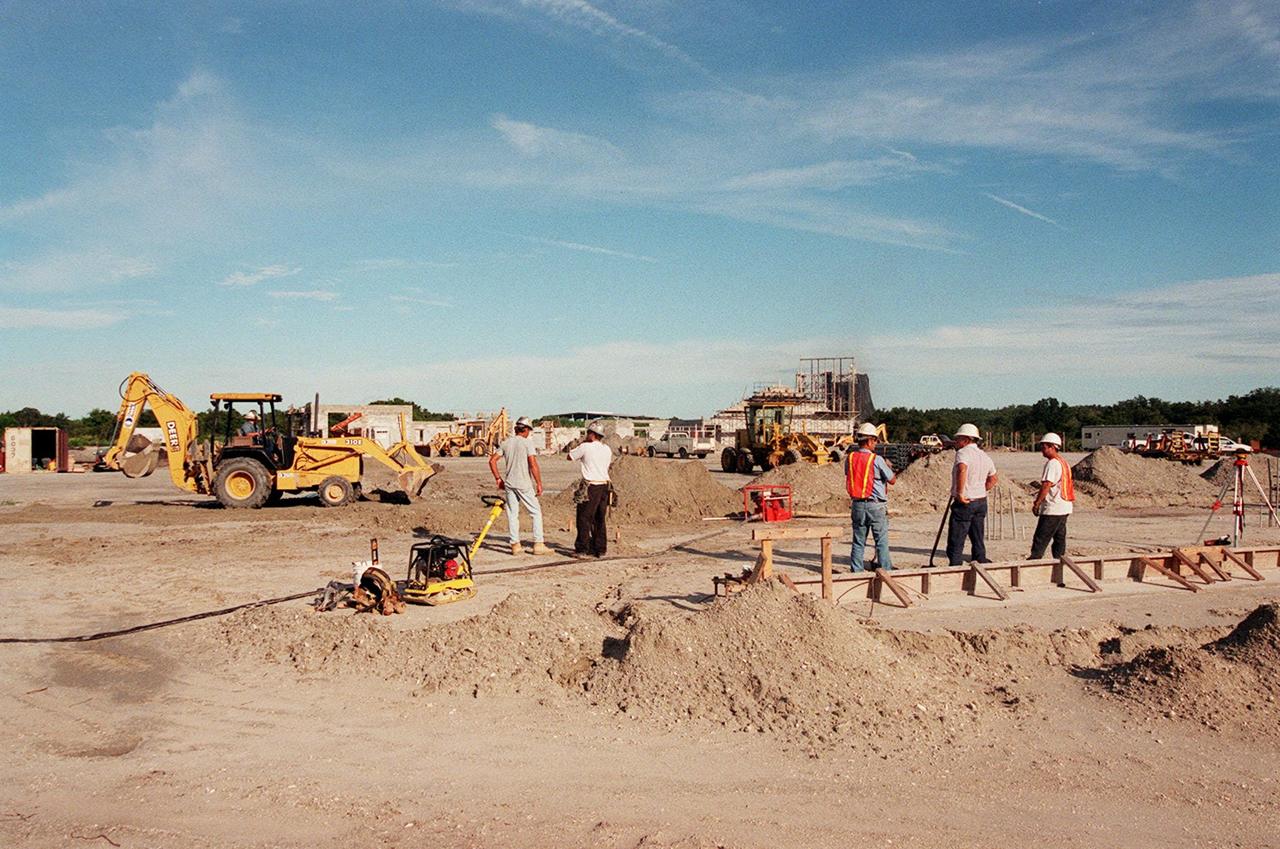
Construction is under way for the X-33/X-34 hangar complex near the Shuttle Landing Facility at KSC. The Reusable Launch Vehicle (RLV) complex will include facilities for related ground support equipment and administrative/ technical support. It will be available to accommodate the Space Shuttle; the X-34 RLV technology demonstrator; the L-1011 carrier aircraft for Pegasus and X-34; and other RLV and X-vehicle programs. The complex is jointly funded by the Spaceport Florida Authority, NASA's Space Shuttle Program and KSC. The facility will be operational in early 2000
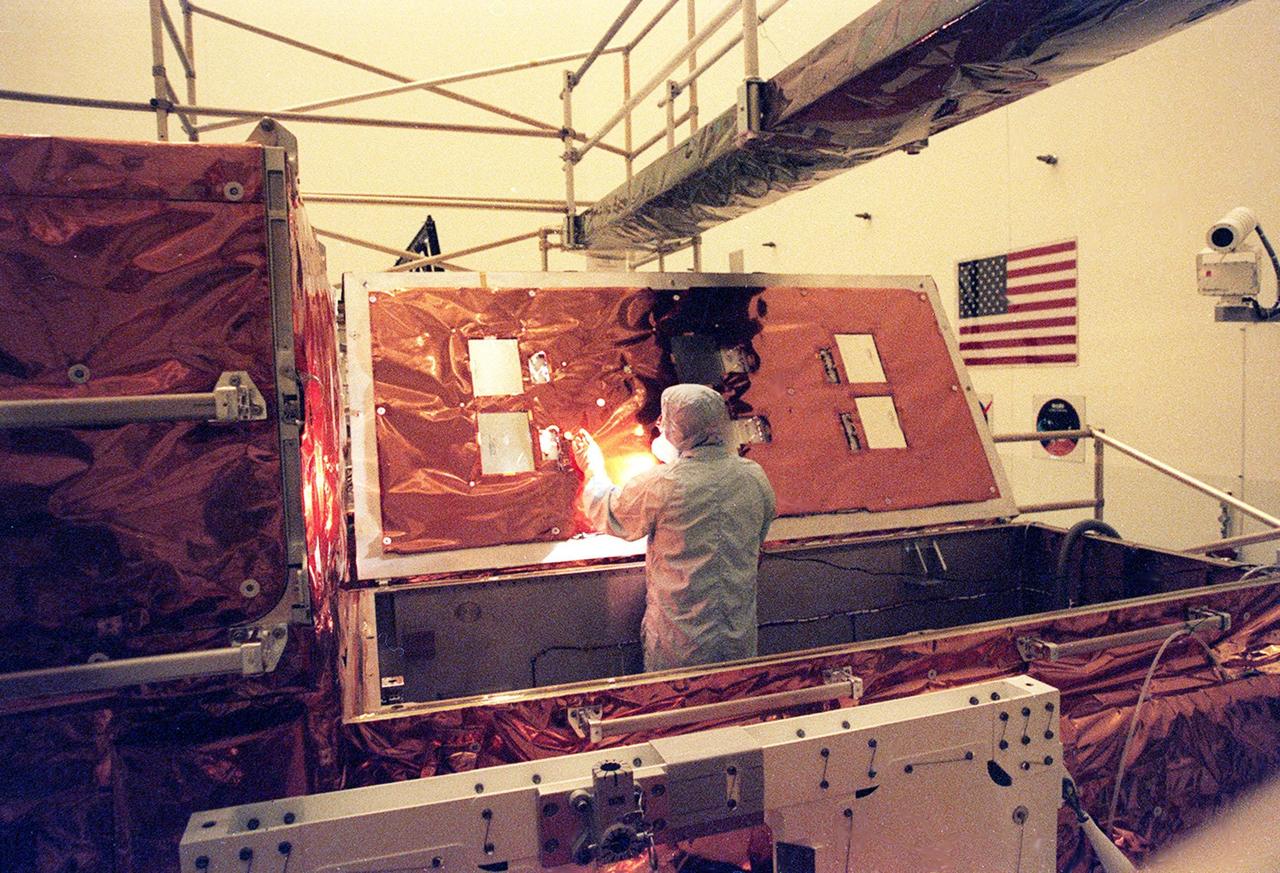
In the Payload Hazardous Servicing Facility, a worker gives a black light inspection to part of the servicing equipment for the third Hubble Space Telescope Servicing Mission (SM-3A), STS-103. The hardware is undergoing final testing and integration of payload elements. Mission STS-103 is a "call-up" due to the need to replace portions of the Hubble's pointing system, the gyros, which have begun to fail. Although Hubble is operating normally and conducting its scientific observations, only three of its six gyroscopes are working properly. The gyroscopes allow the telescope to point at stars, galaxies and planets. The STS-103 crew will not only replace gyroscopes, it will also replace a Fine Guidance Sensor and an older computer with a new enhanced model, an older data tape recorder with a solid state digital recorder, a failed spare transmitter with a new one, and degraded insulation on the telescope with new thermal insulation. The crew will also install a Battery Voltage/Temperature Improvement Kit to protect the spacecraft batteries from overcharging and overheating when the telescope goes into a safe mode. The scheduled launch date in October is under review

KENNEDY SPACE CENTER, FLA. -- A crawler transporter moves Space Shuttle Discovery, hidden by its external tank and solid rocket boosters, from Pad 39B back to the Vehicle Assembly Building (VAB) for repair of damage to the external tank foam insulation caused by hail. The external tank/solid rocket booster stack for mission STS-93 was moved out of High Bay 1 to make room for Discovery and can be seen on the horizon between Discovery and the VAB. The necessary repair work could not be performed at the pad due to limited access to the damaged areas. The work is expected to take two to three days, allowing Discovery to roll back to Pad 39B by midweek for launch of mission STS-96, the 94th launch in the Space Shuttle Program. This is only the 13th time since 1981 that a Shuttle has had to roll back from the pad. Liftoff will occur no earlier than May 27. STS-96 is a logistics and resupply mission for the International Space Station, carrying such payloads as a Russian crane, the Strela; a U.S.-built crane; the Spacehab Oceaneering Space System Box (SHOSS), a logistics items carrier; and STARSHINE, a student-shared experiment
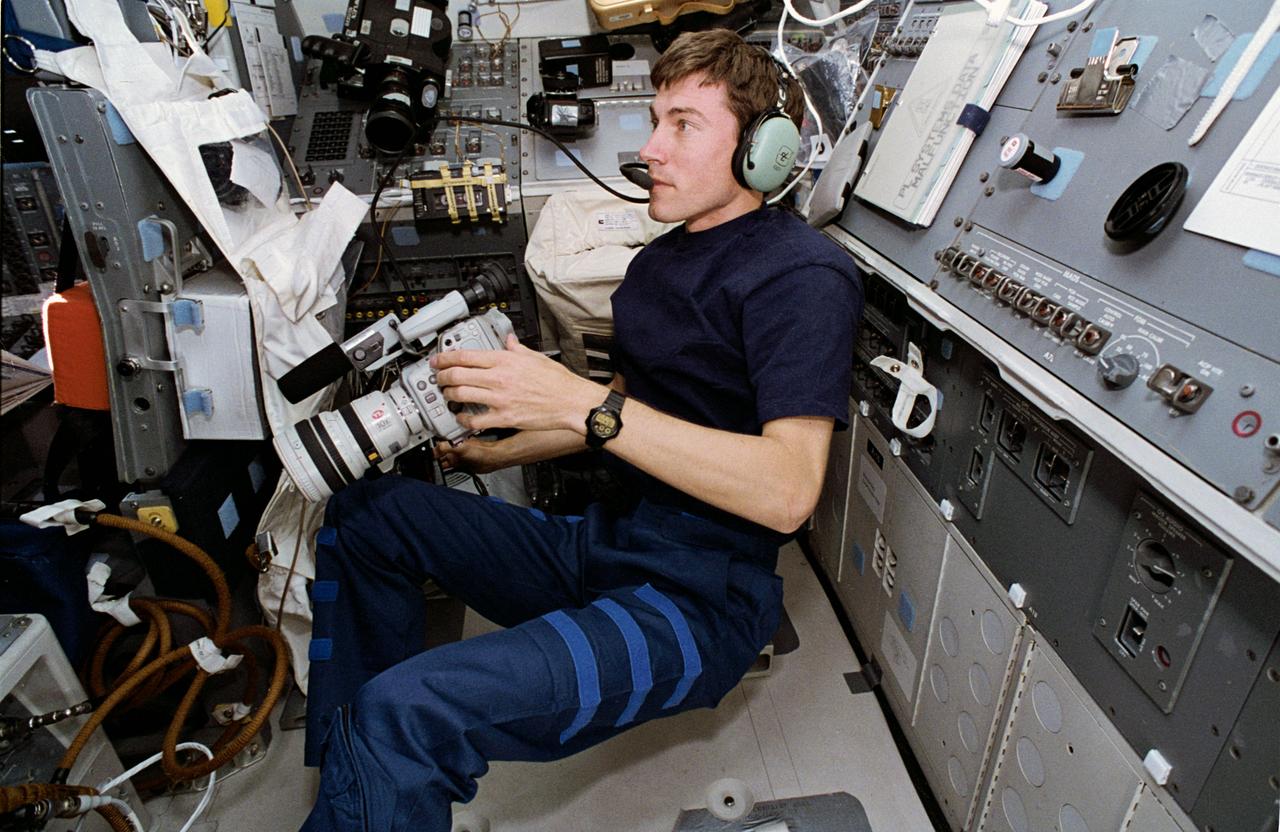
STS60-29-009 (10 Feb 1994) --- On the Space Shuttle Discovery's aft flight deck, Russian cosmonaut Sergei K. Krikalev prepares for one chore while performing another. Using the Shuttle Amateur Radio Experiment (SAREX) gear, the mission specialist was talking with students in Maine. He holds a camcorder, which was later called into action to record inflight activities. Krikalev joined five NASA astronauts for eight days in space aboard Discovery.
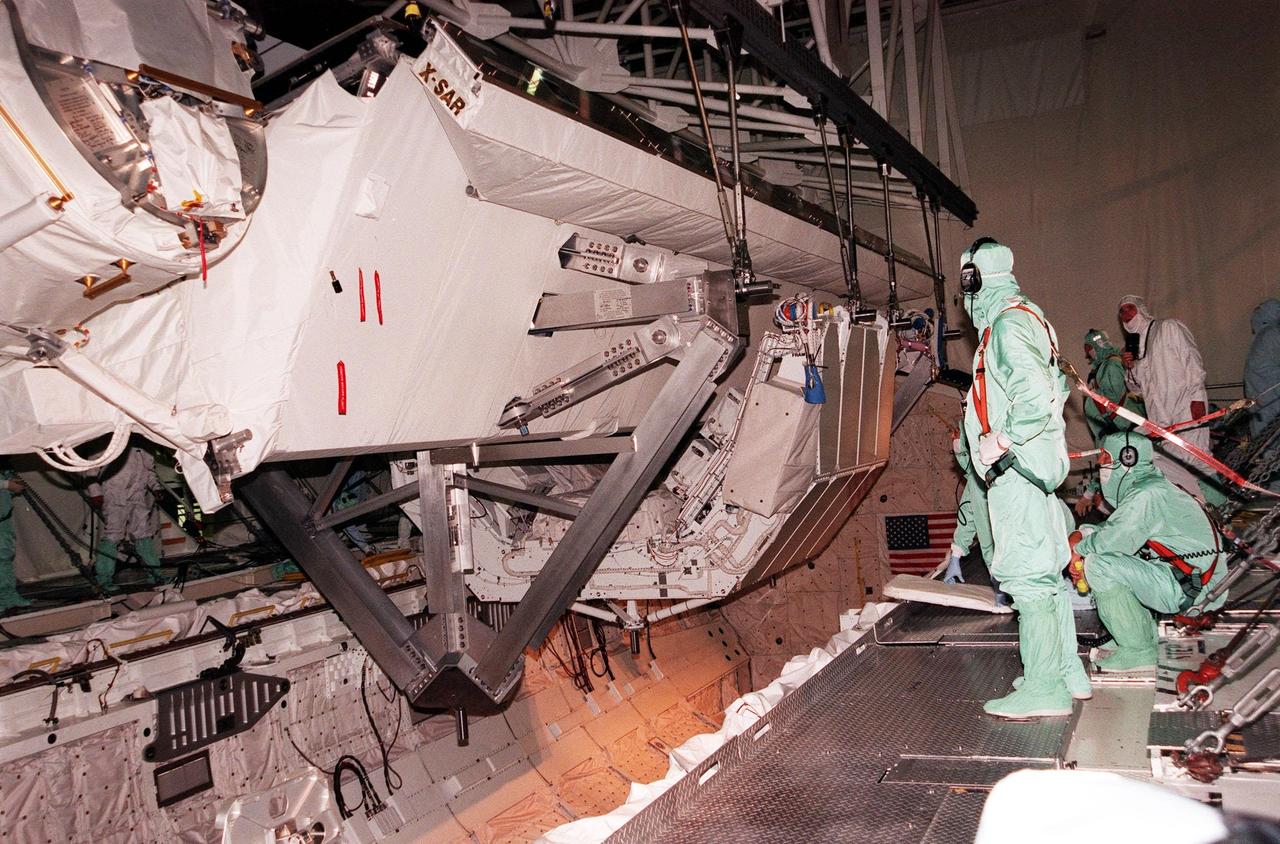
KENNEDY SPACE CENTER, FLA. -- A crane lowers the Shuttle Radar Topography Mission (SRTM), the primary payload on STS-99, into the payload bay of the orbiter Endeavour in Orbiter Processing Facility bay 2. The SRTM consists of a specially modified radar system that will gather data for the most accurate and complete topographic map of the Earth's surface that has ever been assembled. SRTM will make use of radar interferometry, wherein two radar images are taken from slightly different locations. Differences between these images allow for the calculation of surface elevation. The SRTM hardware includes one radar antenna in the Shuttle payload bay and a second radar antenna attached to the end of a mast extended 60 meters (195 feet) from the shuttle. STS-99 is scheduled to launch Sept. 16 at 8:47 a.m. from Launch Pad 39A
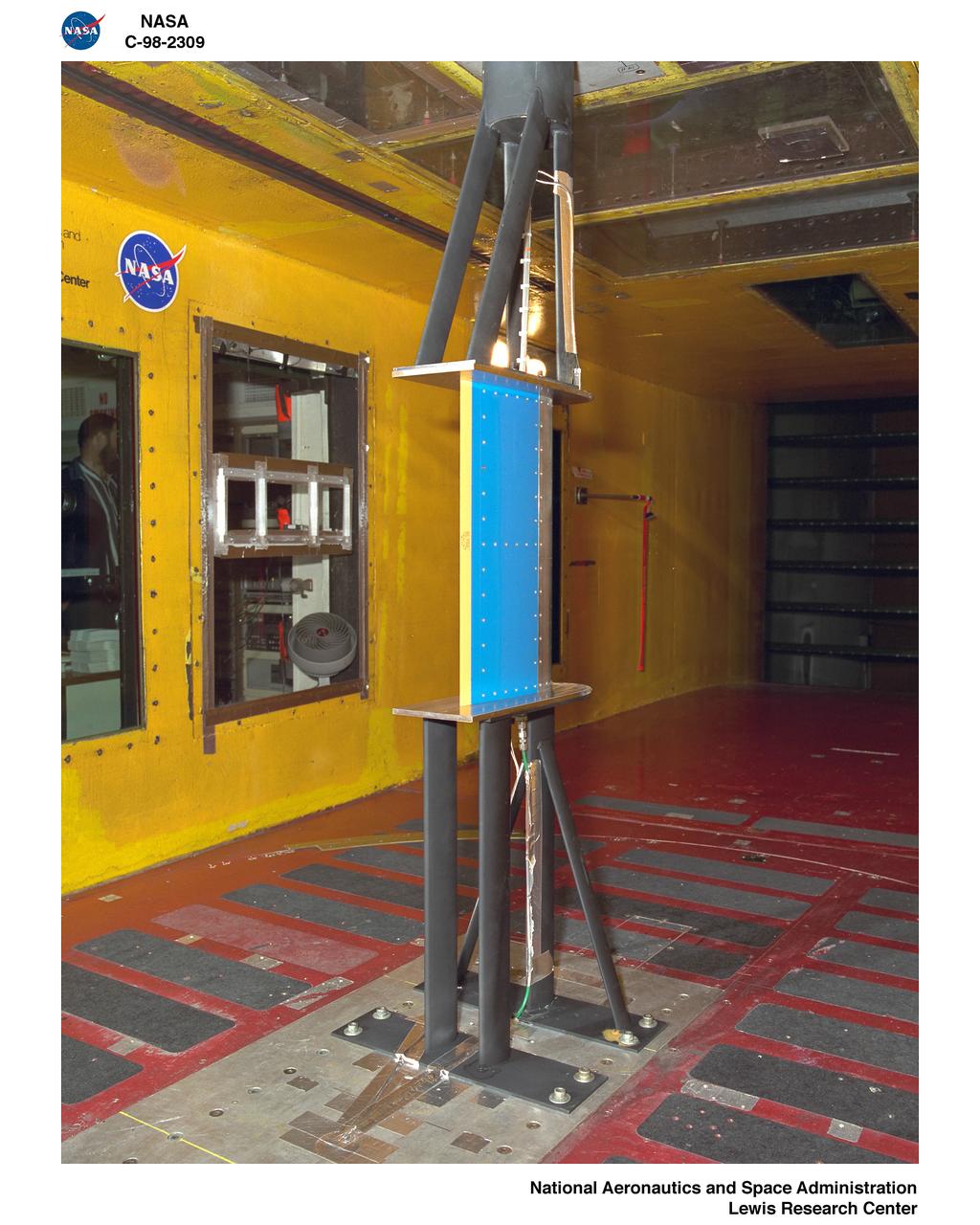
FAA FEDERAL AVIATION ADMINISTRATION FACILITY STANDARD NACA 0012 12 INCH CHORD
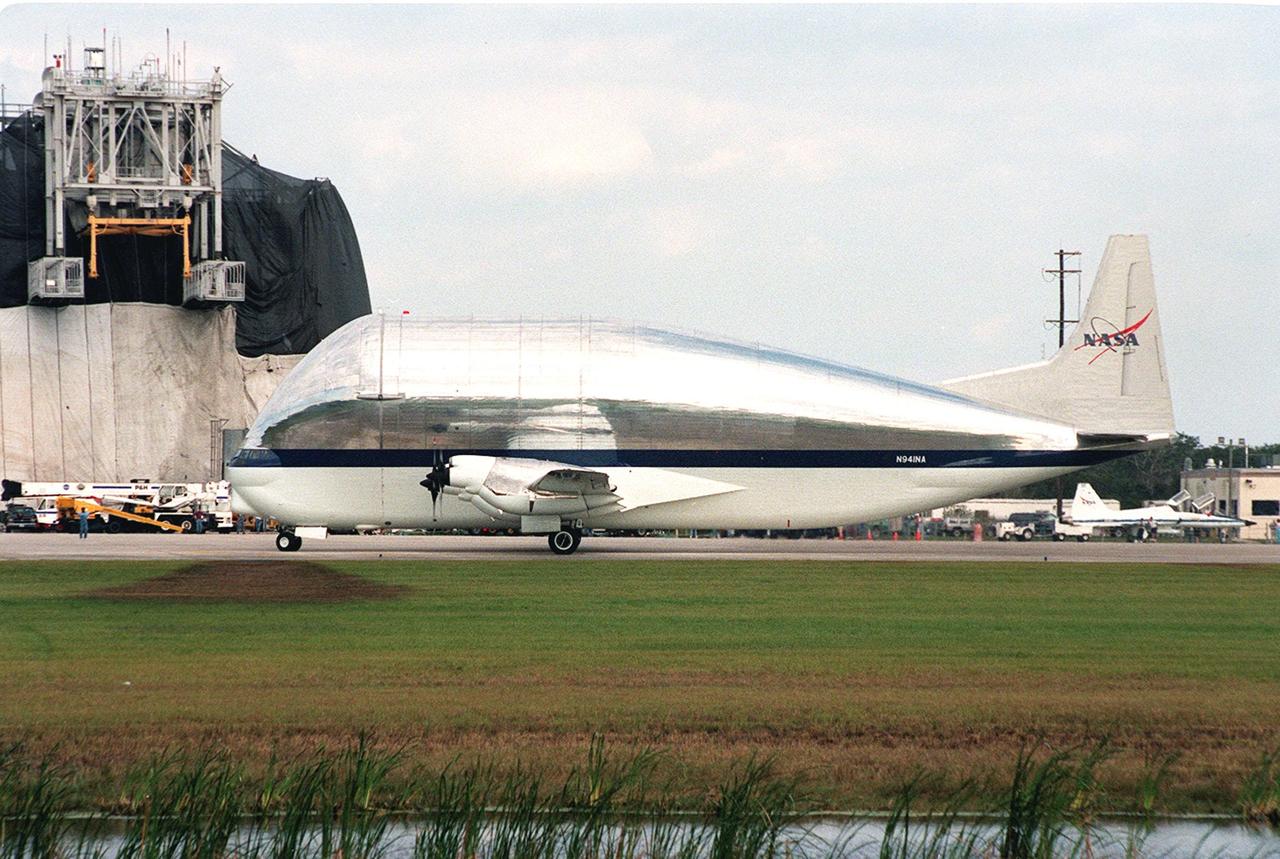
KENNEDY SPACE CENTER, FLA. -- NASA's Super Guppy aircraft arrives at Kennedy Space Center's Shuttle Landing Facility. The plane carries a component for the International Space Station (ISS), the port-side P3 truss. The truss is scheduled to be added to the ISS on mission STS-115 in 2002 aboard Space Shuttle Atlantis. The second port truss segment, P3 will be attached to the first port truss segment (P1). The P3 truss will be taken to the Operations and Checkout Building
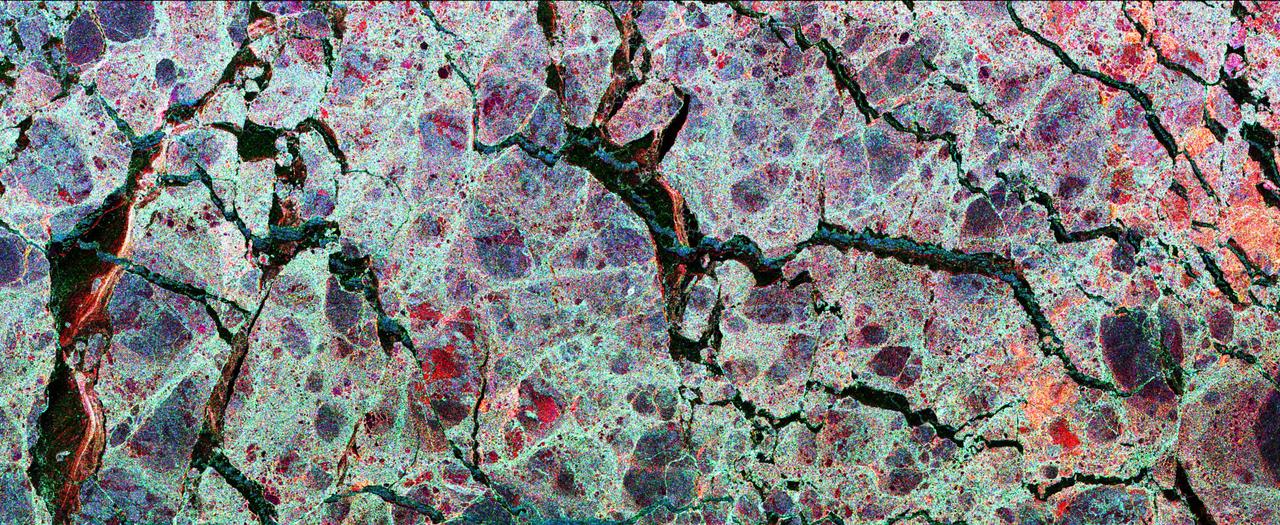
This is the first calibrated, multi-frequency, multi-polarization spaceborne radar image of the seasonal sea-ice cover in the Weddell Sea, Antarctica. The multi-channel data provide scientists with details about the ice pack they cannot see any other way and indicates that the large expanse of sea-ice is, in fact, comprised of many smaller rounded ice floes, shown in blue-gray. These data are particularly useful in helping scientists estimate the thickness of the ice cover which is often extremely difficult to measure with other remote sensing systems. The extent, and especially thickness, of the polar ocean's sea-ice cover together have important implications for global climate by regulating the loss of heat from the ocean to the cold polar atmosphere. The image was acquired on October 3, 1994, by the Spaceborne Imaging Radar-C/X-Band Synthetic Aperture Radar (SIR-C/X-SAR) onboard the space shuttle Endeavour. This image is produced by overlaying three channels of radar data in the following colors: red (C-band, HH-polarization), green (L-band HV-polarization), and blue (L-band, HH-polarization). The image is oriented almost east-west with a center location of 58.2 degrees South and 21.6 degrees East. Image dimensions are 45 kilometers by 18 kilometers (28 miles by 11 miles). Most of the ice cover is composed of rounded, undeformed blue-gray floes, about 0.7 meters (2 feet) thick, which are surrounded by a jumble of red-tinged deformed ice pieces which are up to 2 meters (7 feet) thick. The winter cycle of ice growth and deformation often causes this ice cover to split apart, exposing open water or "leads." Ice growth within these openings is rapid due to the cold, brisk Antarctic atmosphere. Different stages of new-ice growth can be seen within the linear leads, resulting from continuous opening and closing. The blue lines within the leads are open water areas in new fractures which are roughened by wind. The bright red lines are an intermediate stage of new-ice growth perhaps 5 to 10 centimeters (2 to 4 inches) thick. The more extensive dark zones are covered by a slightly thicker layer of smooth, level ice up to 70 centimeters (28 inches) thick. http://photojournal.jpl.nasa.gov/catalog/PIA01786
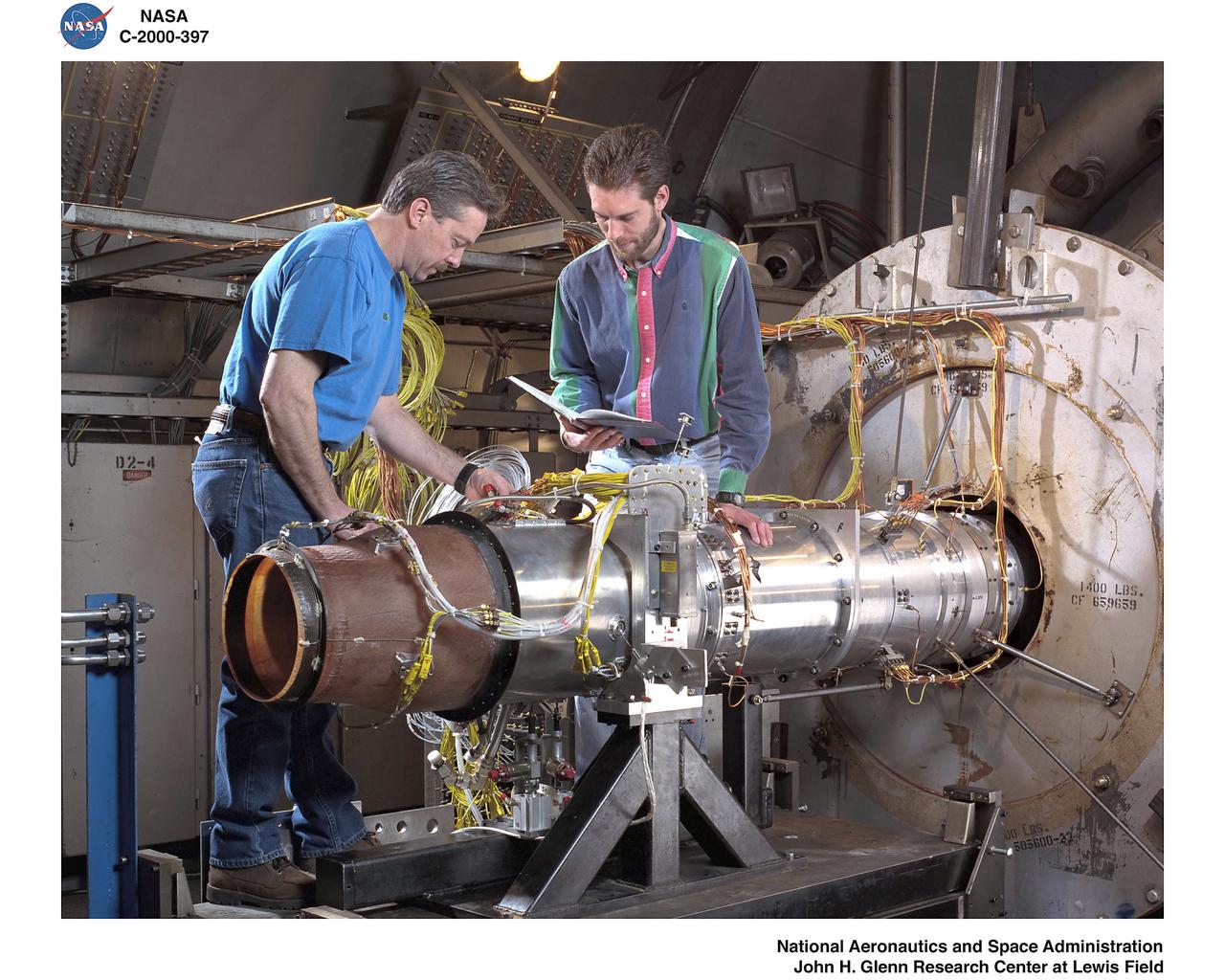
GENERAL AVIATION PROGRAM / WILLIAMS INTERNATIONAL FJX-2 ENGINE INSTALLATION - WILLIAM GUCKIAN WITH WILLIAMS INTERNATIONAL AND RAY CASTNER FROM NASA
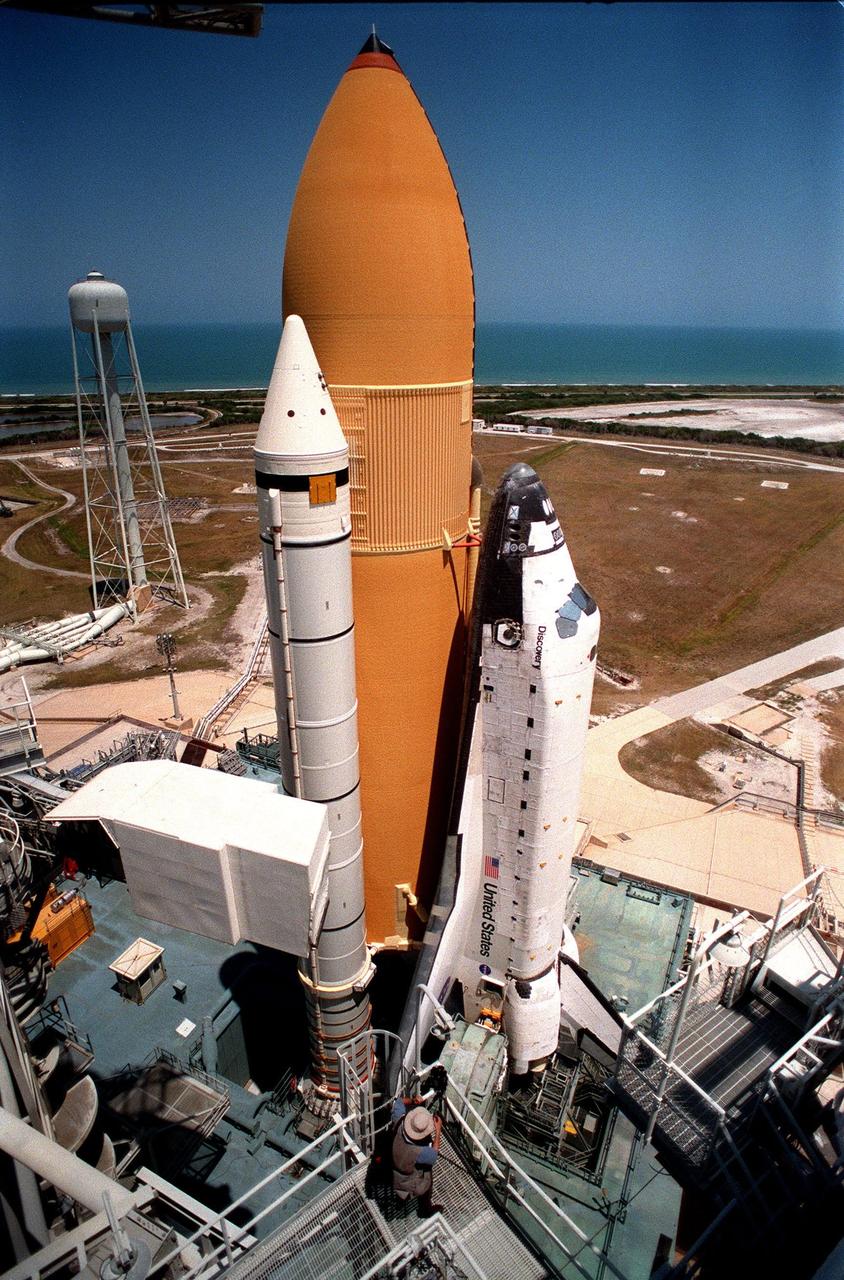
KENNEDY SPACE CENTER, FLA. -- Space Shuttle Discovery sits on Launch Pad 39B against a backdrop of blue sky and the blue-green Atlantic Ocean. At the top left is the 290-foot-high water tank that holds 300,000 gallons of water for the sound suppression system during liftoff. At the bottom, on the Rotating Service Structure, is photographer John Sexton, taking photos for a book. Liftoff of Discovery on mission STS-96 is targeted for May 20 at 9:32 a.m. EDT. STS-96 is a logistics and resupply mission for the International Space Station, carrying such payloads as a Russian crane, the Strela; a U.S.-built crane; the Spacehab Oceaneering Space System Box (SHOSS), a logistics items carrier; and STARSHINE, a student-led experiment
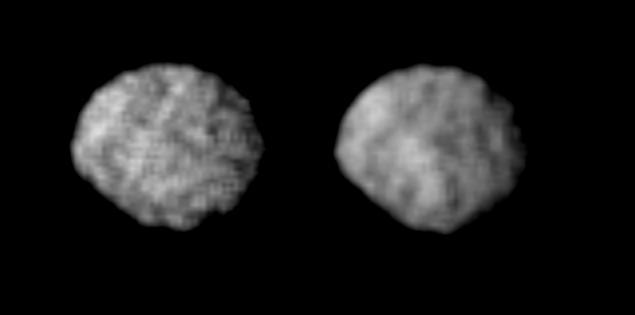
Satellite 1989N2
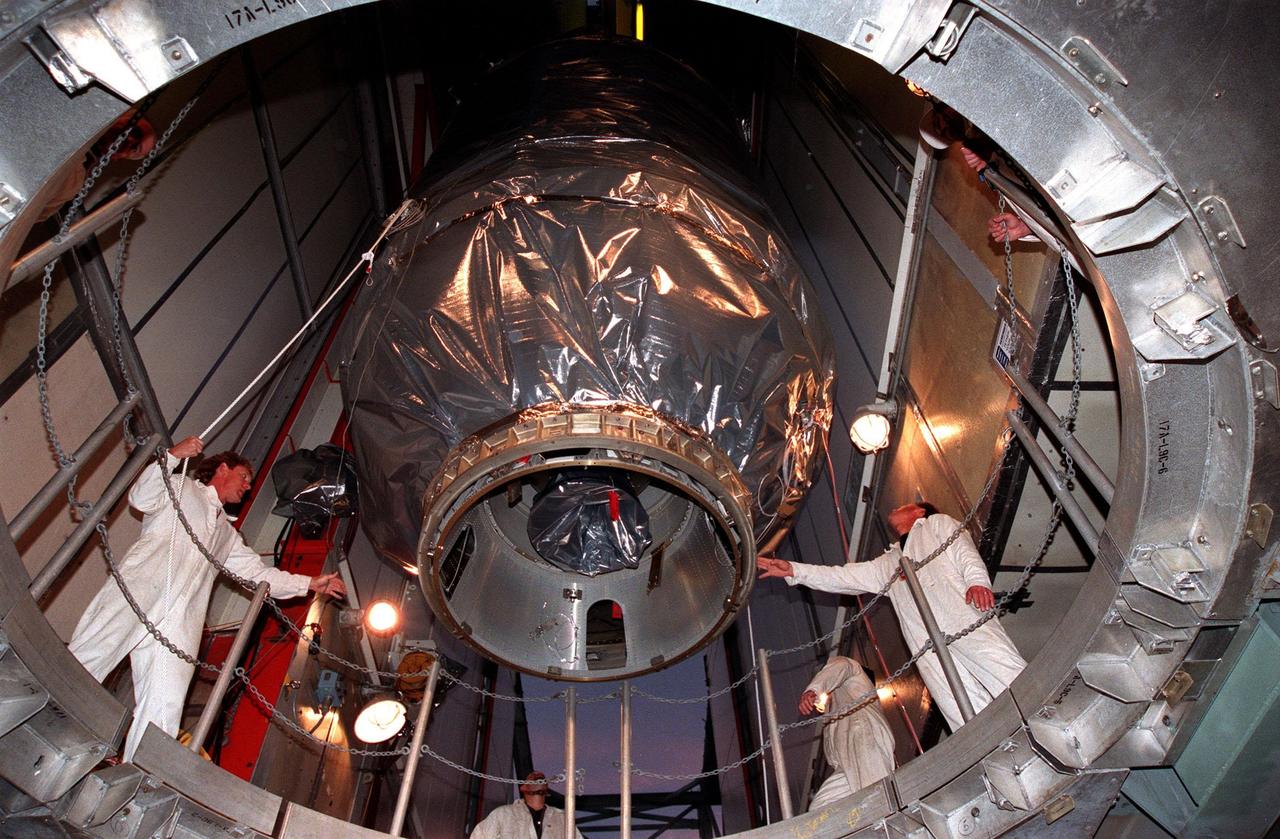
Workers inside the launch tower at Pad 17-A, Cape Canaveral Air Station, guide the third stage of a Boeing Delta II rocket, and the Stardust spacecraft connected to it, through an opening to the second stage of the rocket below. The second and third stages of teh rocket will be mated next as preparations continue for liftoff on Feb. 6. Stardust is destined for a close encounter with the comet Wild 2 in January 2004. Using a silicon-based substance called aerogel, Stardust will capture comet particles flying off the nucleus of the comet. The spacecraft also will bring back samples of interstellar dust. These materials consist of ancient pre-solar interstellar grains and other remnants left over from the formation of the solar system. Scientists expect their analysis to provide important insights into the evolution of the sun and planets and possibly into the origin of life itself. The collected samples will return to Earth in a sample return capsule to be jettisoned as Stardust swings by Earth in January 2006
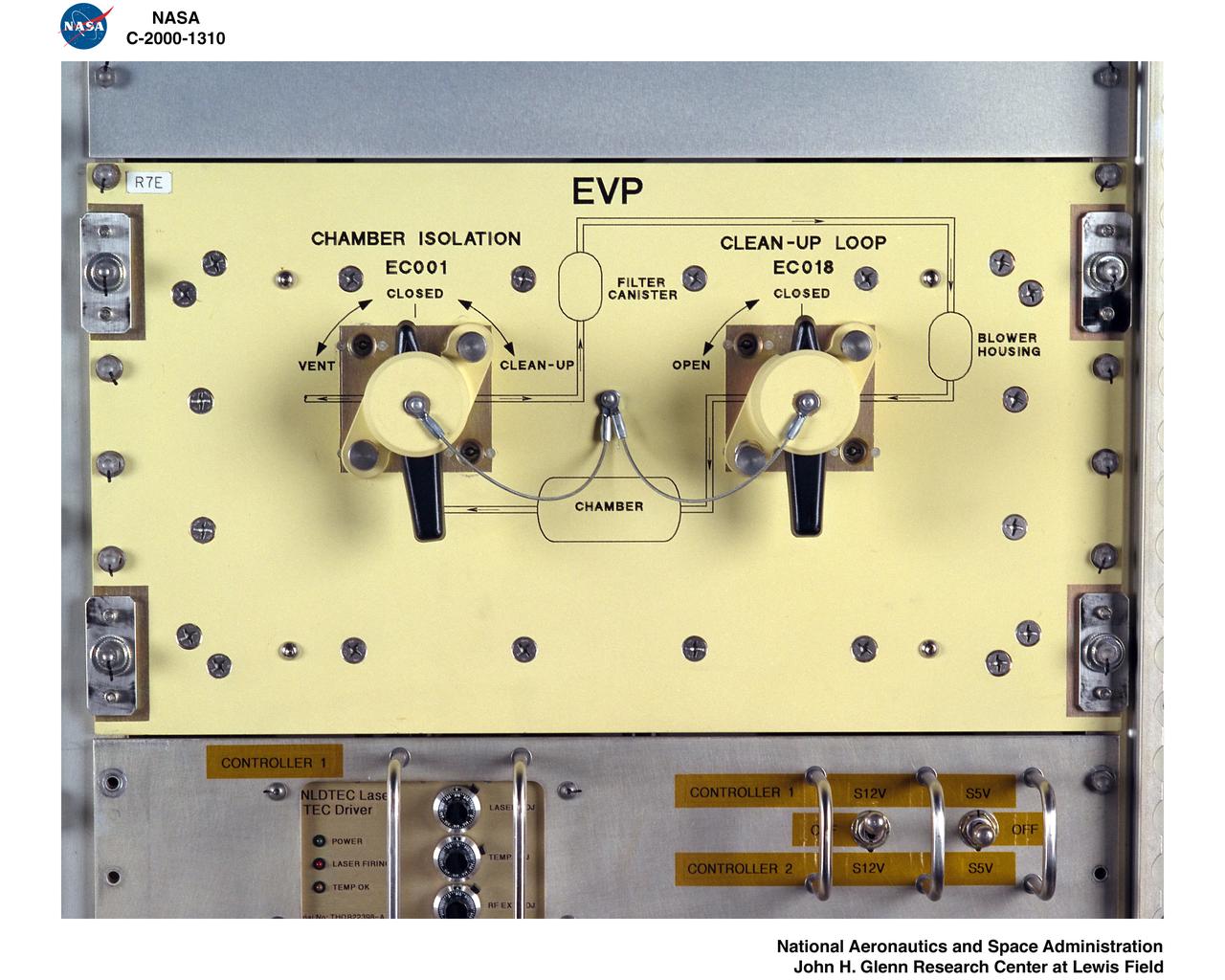
COMBUSTION MODULE 2 FLIGHT HARDWARE PRE SHIP
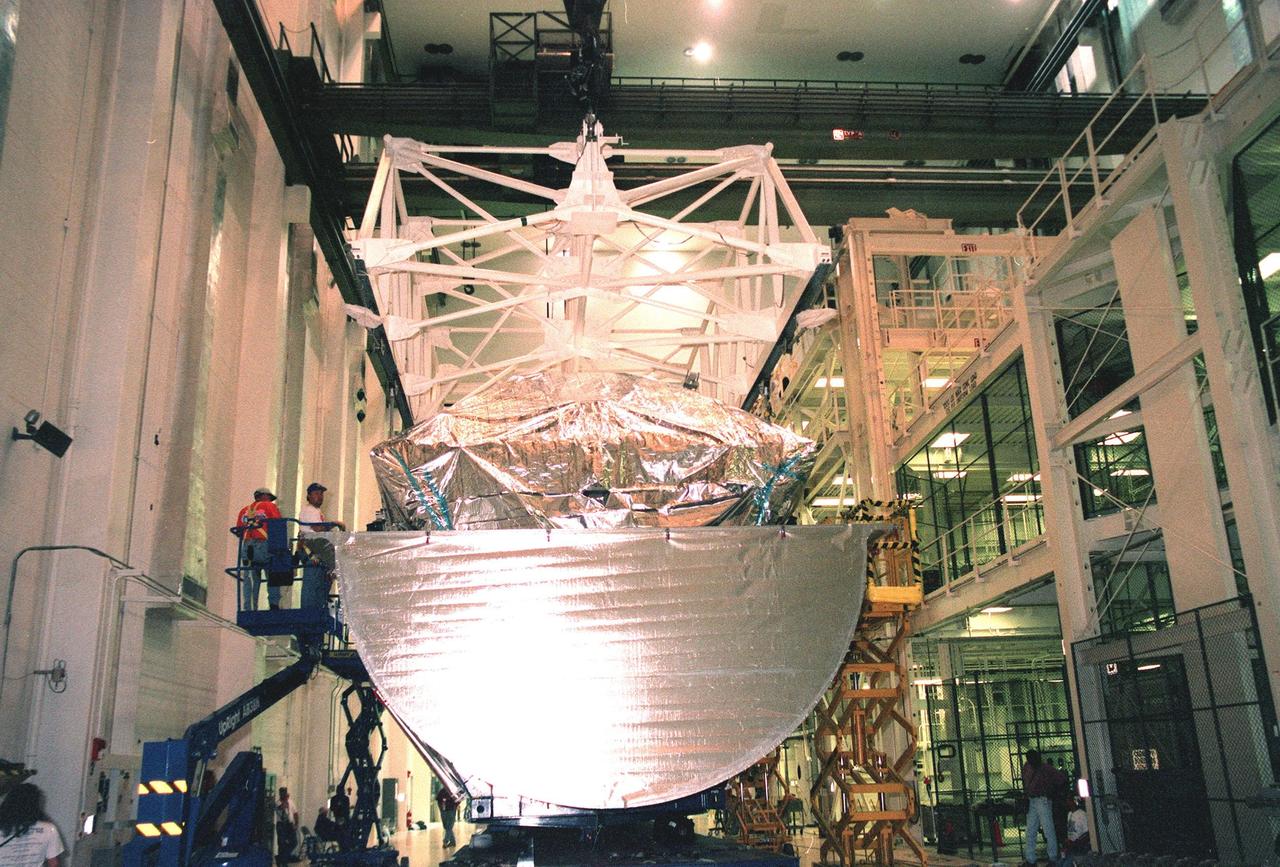
KENNEDY SPACE CENTER, FLA. -- Inside the Operations and Checkout Bldg. (O&C), workers (at left) watch over the maneuvering of the overhead crane toward the S0 truss segment below it. The S0 truss will undergo processing in the O&C during which the Canadian Mobile Transporter, power distribution system modules, a heat pipe radiator for cooling, computers, and a pair of rate gyroscopes will be installed. Four Global Positioning System antennas are already installed. A 44by 15-foot structure weighing 30,800 pounds when fully outfitted and ready for launch, the truss will be at the center of the ISS 10-truss, girderlike structure that will ultimately extend the length of a football field. Eventually the S0 truss will be attached to the U.S. Lab, "Destiny," which is scheduled to be added to the ISS in April 2000. Later, other trusses will be attached to the S0 on-orbit. The S0 truss is scheduled to be launched in the first quarter of 2001 on mission STS-108
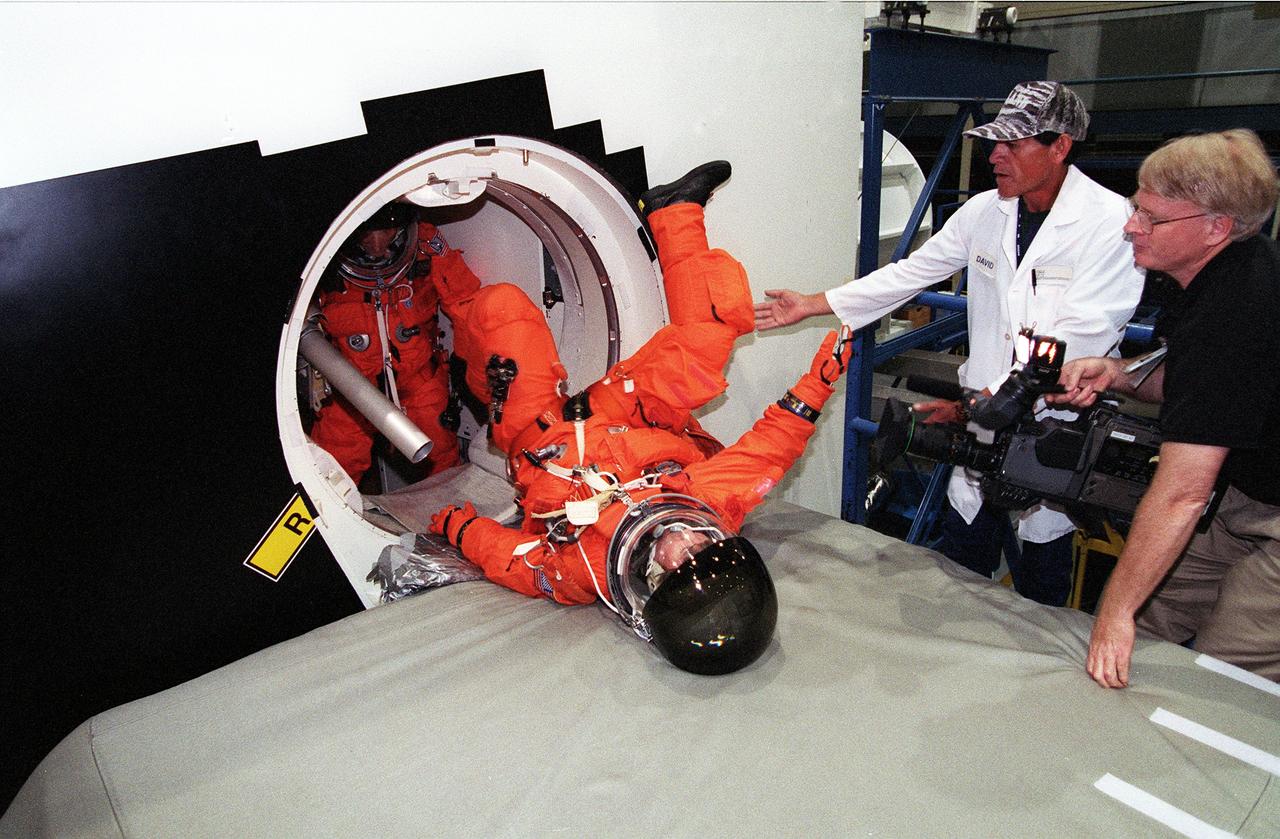
S99-05615 (19 May 1999) --- Astronaut Gerhard P.J. Thiele, mission specialist representing the European Space Agency (ESA), slides off the shuttle escape pole onto a soft surface during emergency bailout training for the STS-99 crew members. A second STS-99 crew member awaits his turn. Looking on are technician David Borjas (second right) and videographer Charles Clendaniel (right). The training took place at the crew compartment trainer (CCT) in the Systems Integration Facility at the Johnson Space Center (JSC).
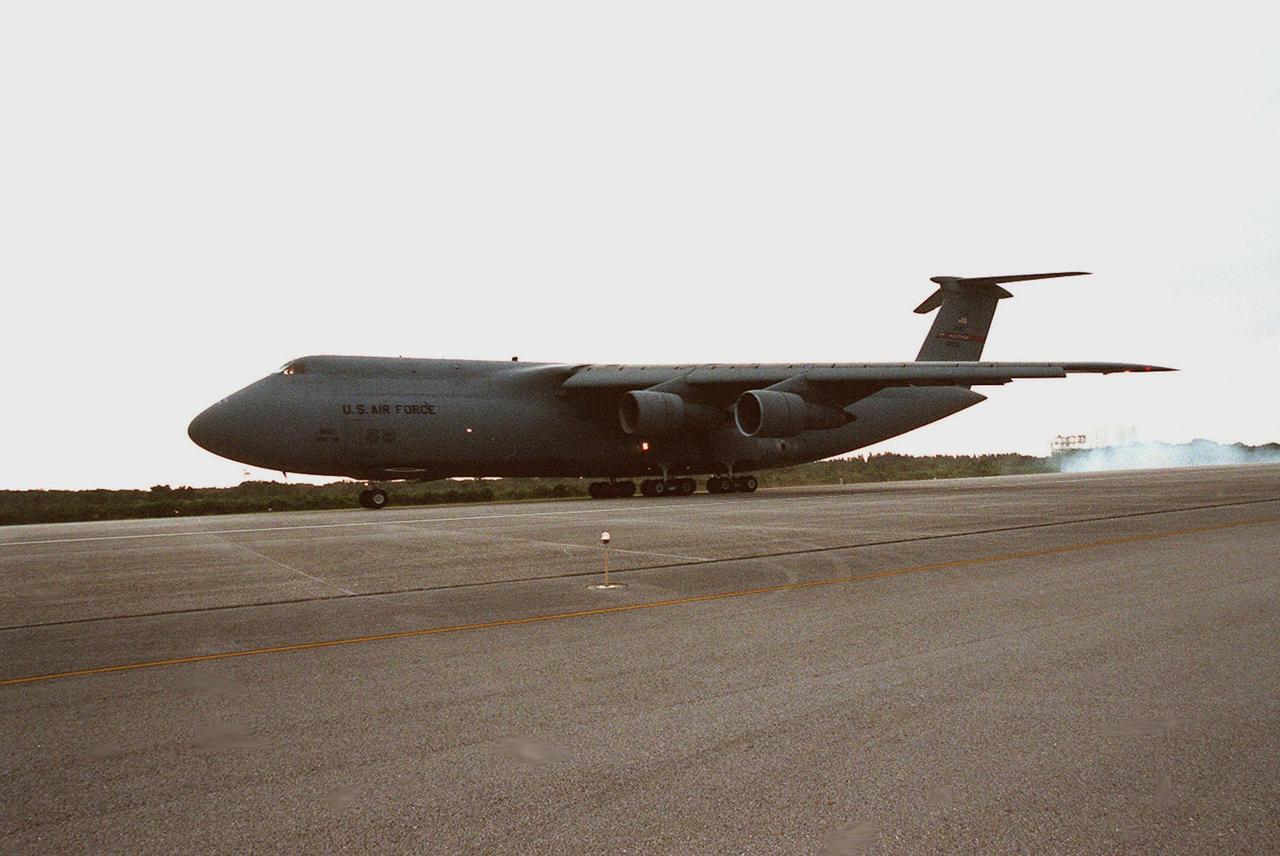
A C-5 air cargo plane lands at Kennedy Space Center carrying the payload flight hardware for the Third Hubble Space Telescope Servicing Mission (SM-3A). The hardware will be taken to the Payload Hazardous Servicing Facility for final testing and integration of payload elements. Mission STS-103 is a "call-up" mission which is being planned due to the need to replace portions of the Hubble's pointing system, the gyros, which have begun to fail. Although Hubble is operating normally and conducting its scientific observations, only three of its six gyroscopes are working properly. The gyroscopes allow the telescope to point at stars, galaxies and planets. The STS-103 crew will not only replace gyroscopes, it will also replace a Fine Guidance Sensor and an older computer with a new enhanced model, an older data tape recorder with a solid state digital recorder, a failed spare transmitter with a new one, and degraded insulation on the telescope with new thermal insulation. The crew will also install a Battery Voltage/Temperature Improvement Kit to protect the spacecraft batteries from overcharging and overheating when the telescope goes into a safe mode. Launch of STS-93 is currently targeted for Oct. 14 but under review, pending the launch date of a prior mission, STS-99, also under review

This contrast enhanced color picture of Neptune was acquired by NASA Voyager 2 on Aug. 14, 1989. As Voyager 2 approached Neptune, rapidly increasing image resolution is revealed striking new details. Bright, wispy clouds are seen overlying the Great Dar
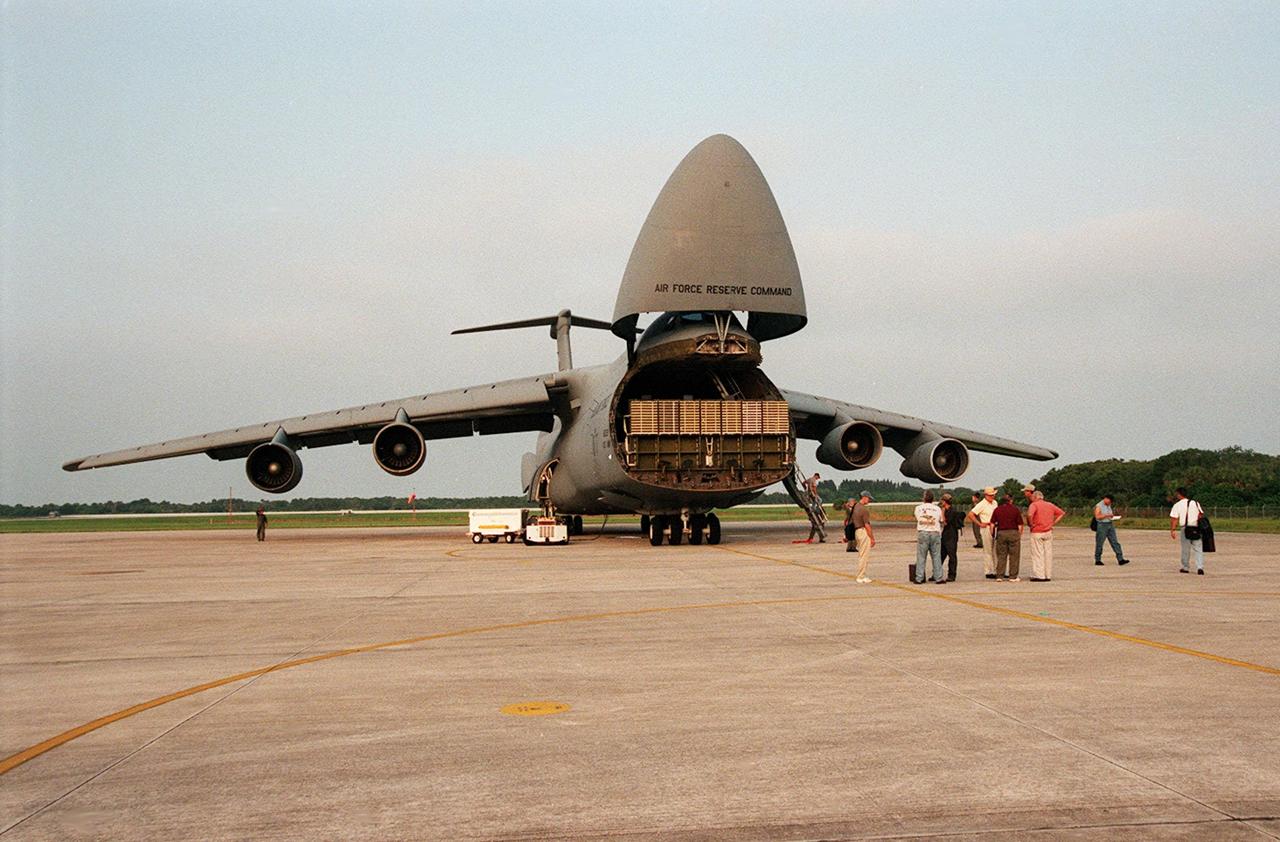
A C-5 air cargo plane opens to reveal a shipping container with payload flight hardware for the Third Hubble Space Telescope Servicing Mission (SM-3A). The hardware will be taken to the Payload Hazardous Servicing Facility for final testing and integration of payload elements. Mission STS-103 is a "call-up" mission which is being planned due to the need to replace portions of the Hubble's pointing system, the gyros, which have begun to fail. Although Hubble is operating normally and conducting its scientific observations, only three of its six gyroscopes are working properly. The gyroscopes allow the telescope to point at stars, galaxies and planets. The STS-103 crew will not only replace gyroscopes, it will also replace a Fine Guidance Sensor and an older computer with a new enhanced model, an older data tape recorder with a solid state digital recorder, a failed spare transmitter with a new one, and degraded insulation on the telescope with new thermal insulation. The crew will also install a Battery Voltage/Temperature Improvement Kit to protect the spacecraft batteries from overcharging and overheating when the telescope goes into a safe mode. Launch of STS-93 is currently targeted for Oct. 14 but under review, pending the launch date of a prior mission, STS-99, also under review
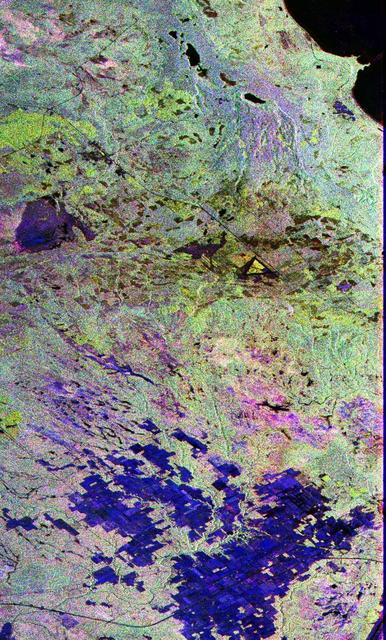
This image is a false-color composite of Raco, Michigan, centered at 46.39 degrees north latitude, 84.88 degrees west longitude. This image was acquired by the Spaceborne Imaging Radar-C and X-Band Synthetic Aperture Radar (SIR-C/X-SAR) aboard the space shuttle Endeavour on its sixth orbit and during the first full-capability test of the instrument on April 9, 1994. This image was produced using both L-band and C-band data. The area shown is approximately 20 kilometers by 50 kilometers (12 by 30 miles). Raco is located at the eastern end of Michigan's upper peninsula, west of Sault Ste. Marie and south of Whitefish Bay on Lake Superior. The site is located at the boundary between the boreal forests and the northern temperate forests, a transitional zone that is expected to be ecologically sensitive to anticipated global changes resulting from climatic warming. On any given day, there is a 60 percent chance that this area will be obscured to some extent by cloud clover which makes it difficult to image using optical sensors. http://photojournal.jpl.nasa.gov/catalog/PIA01700
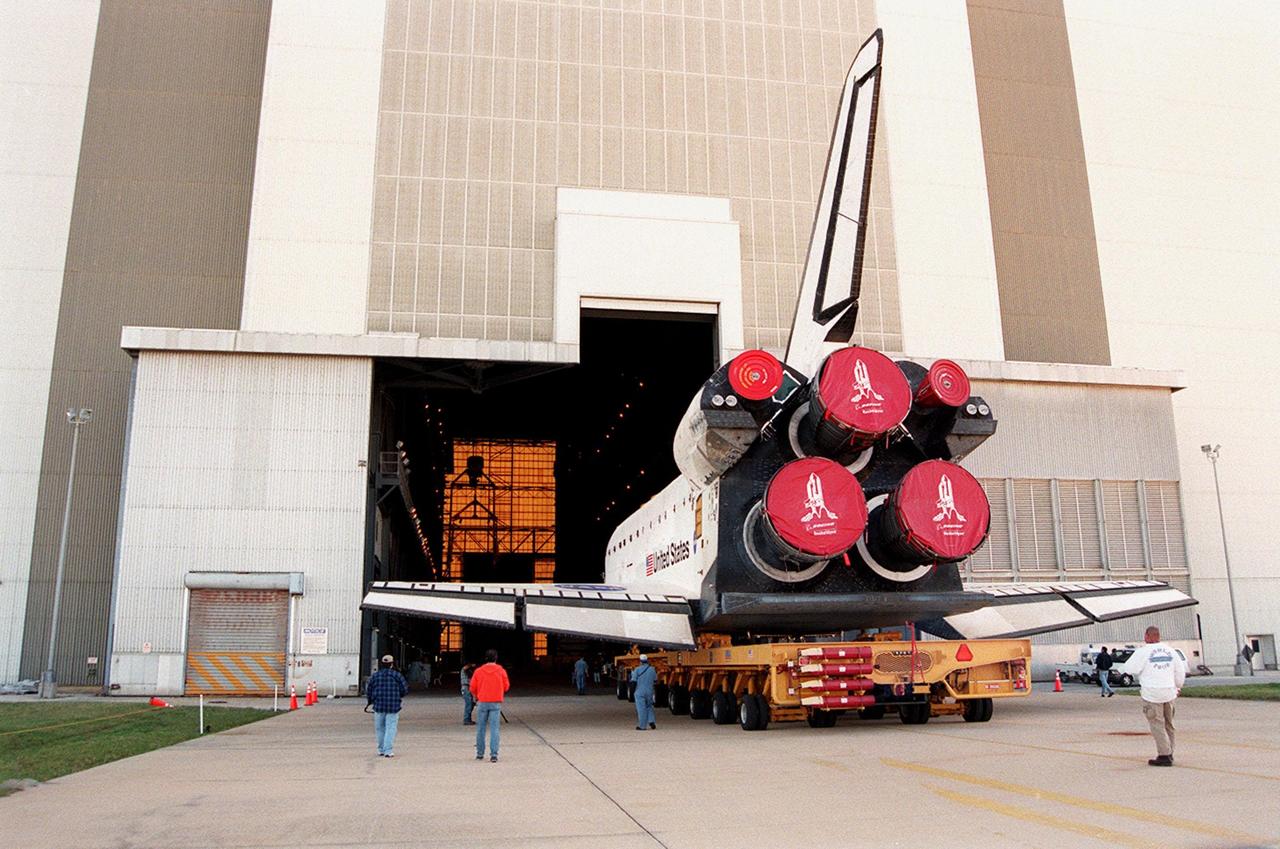
KENNEDY SPACE CENTER, FLA. -- Orbiter Endeavour rolls into the Vehicle Assembly Building on its orbiter transfer vehicle. In high bay 1 it will be mated to the external tank and solid rocket boosters. Space Shuttle Endeavour is targeted for launch on mission STS-99 Jan. 13, 2000 at 1:11 p.m. EST. STS-99 is the Shuttle Radar Topography Mission, an international project spearheaded by the National Imagery and Mapping Agency and NASA, with participation of the German Aerospace Center DLR. The SRTM consists of a specially modified radar system that will gather data for the most accurate and complete topographic map of the Earth's surface that has ever been assembled. SRTM will make use of radar interferometry, wherein two radar images are taken from slightly different locations. Differences between these images allow for the calculation of surface elevation, or change. The SRTM hardware will consist of one radar antenna in the shuttle payload bay and a second radar antenna attached to the end of a mast extended 60 meters (195 feet) out from the shuttle
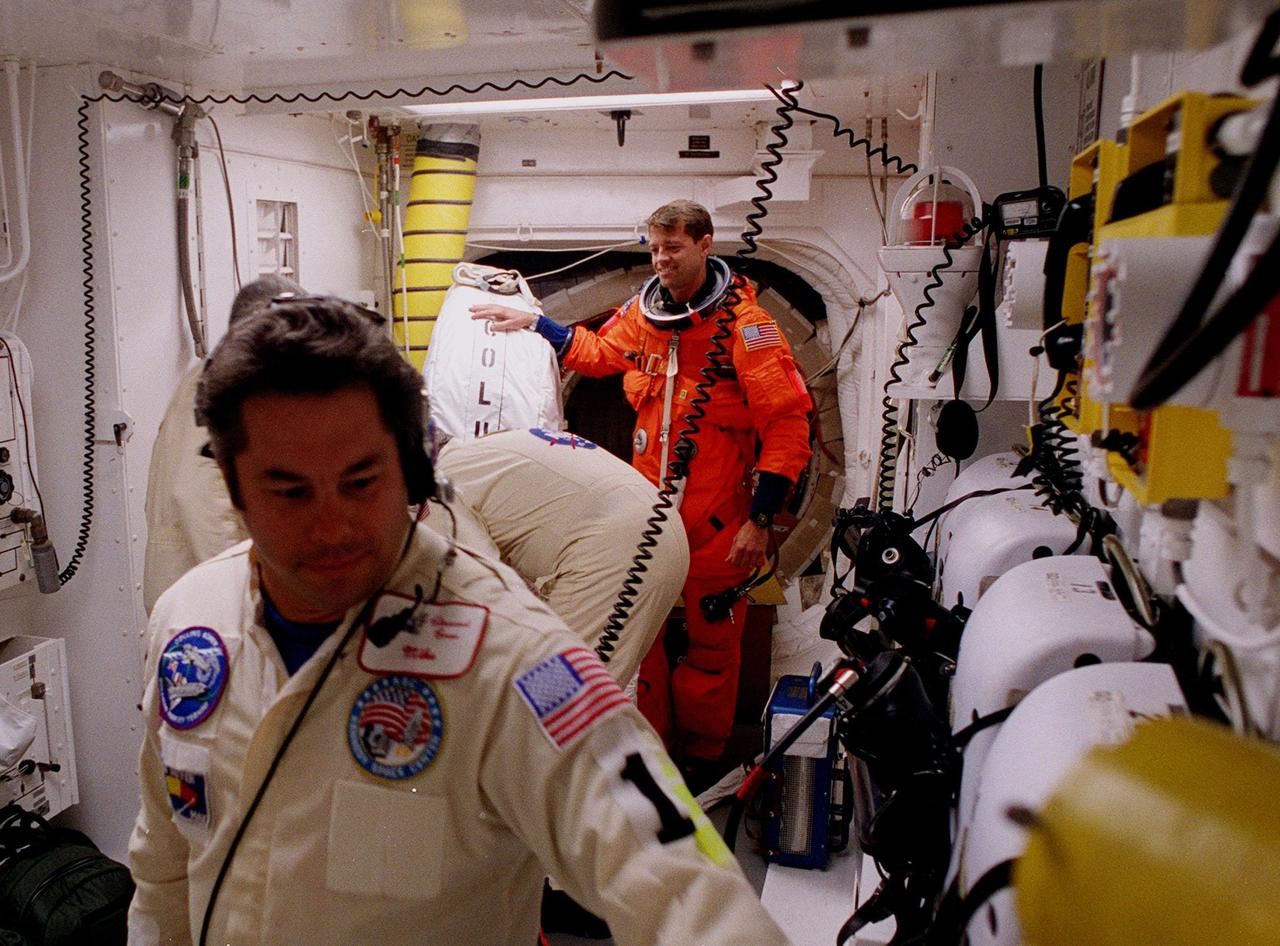
STS-93 Pilot Jeffrey S. Ashby is checked out by white room closeout crew members before entering the orbiter Columbia. The white room is an environmental chamber at the end of the orbiter access arm that provides entry to the orbiter crew compartment. STS-93 is a five-day mission primarily to release the Chandra X-ray Observatory, which will allow scientists from around the world to study some of the most distant, powerful and dynamic objects in the universe. After Space Shuttle Columbia's July 20 and 22 launch attempts were scrubbed, the launch was again rescheduled for Friday, July 23, at 12:24 a.m. EDT. The target landing date is July 27 at 11:20 p.m. EDT
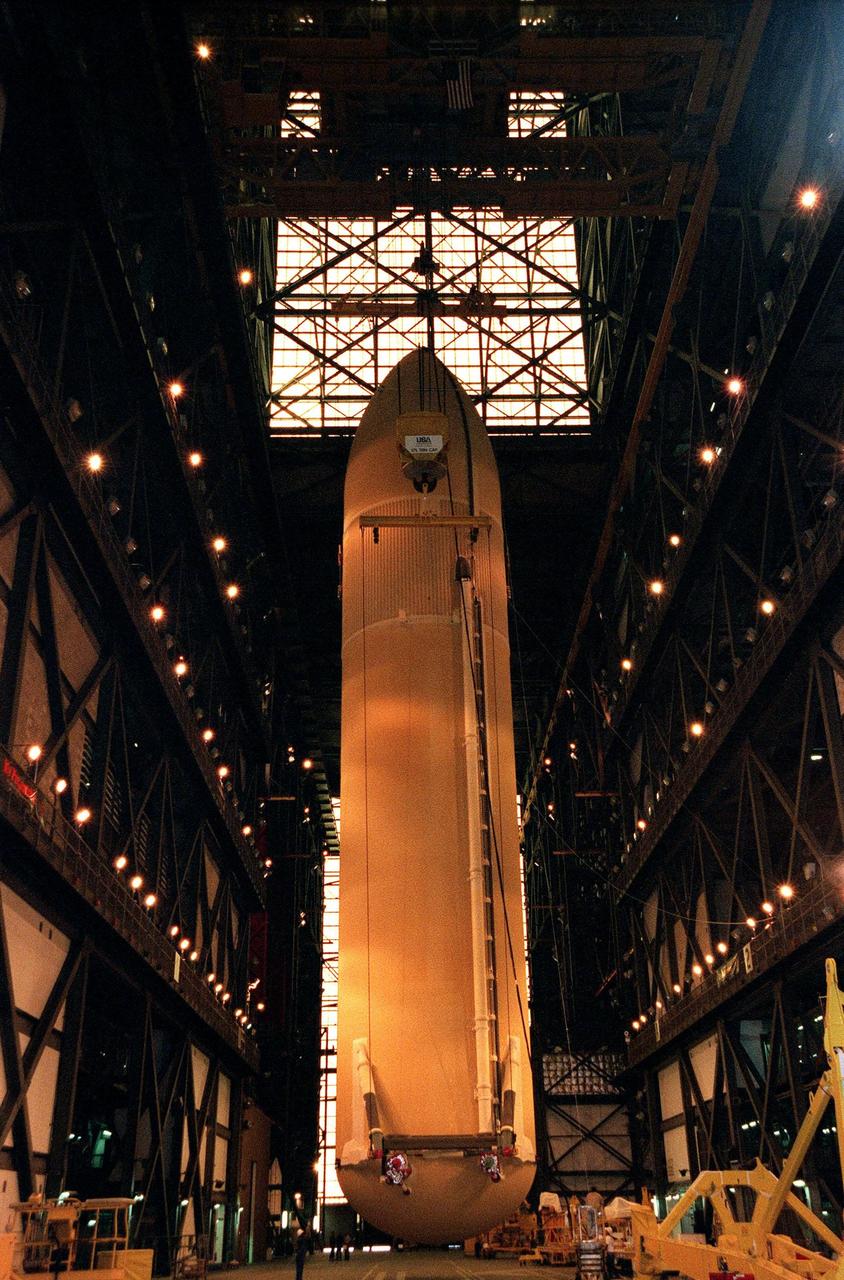
KENNEDY SPACE CENTER, FLA. -- An external tank is suspended in the transfer aisle of the Vehicle Assembly Building before being placed into its storage compartment. The largest and heaviest element of the Space Shuttle, an external tank contains the liquid hydrogen fuel and liquid oxygen oxidizer for the three Space Shuttle main engines (SSMEs) in the orbiter during liftoff and ascent. When the SSMEs are shut down, the external tank is jettisoned, breaking up as it enters the Earth's atmopshere and impacting in a remote ocean area. It is not recovered
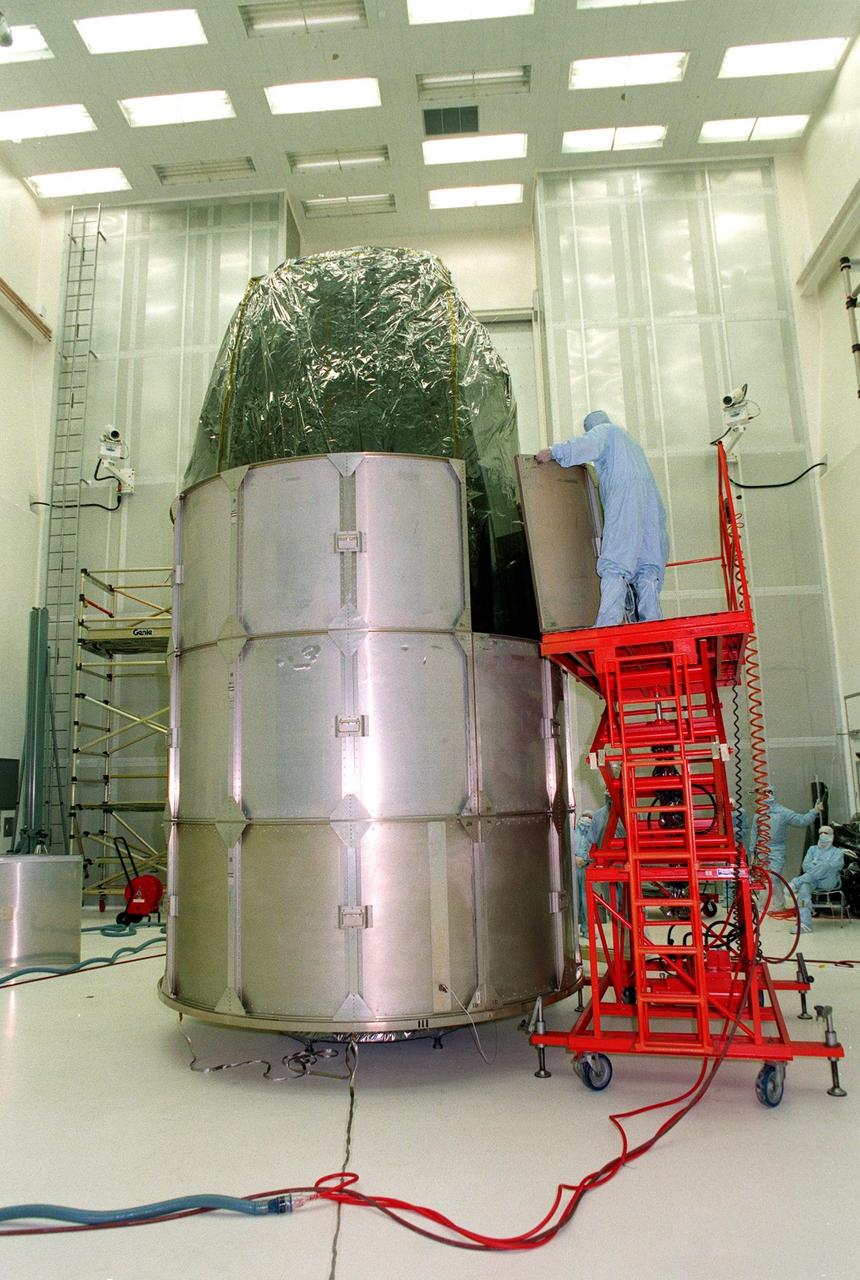
NASA's Far Ultraviolet Spectroscopic Explorer (FUSE) satellite is fitted with another row of canister segments before being moved to Launch Pad 17A, CCAS. FUSE was developed by The Johns Hopkins University under contract to Goddard Space Flight Center, Greenbelt, Md., to investigate the origin and evolution of the lightest elements in the universe hydrogen and deuterium. In addition, the FUSE satellite will examine the forces and process involved in the evolution of the galaxies, stars and planetary systems by investigating light in the far ultraviolet portion of the electromagnetic spectrum. FUSE is scheduled to be launched June 23 aboard a Boeing Delta II rocket
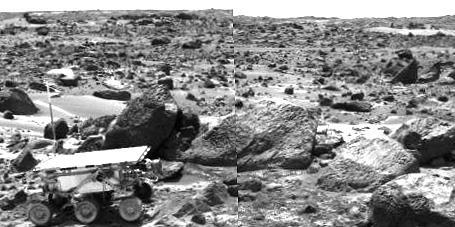
Sojourner Rover Leaving the Rock
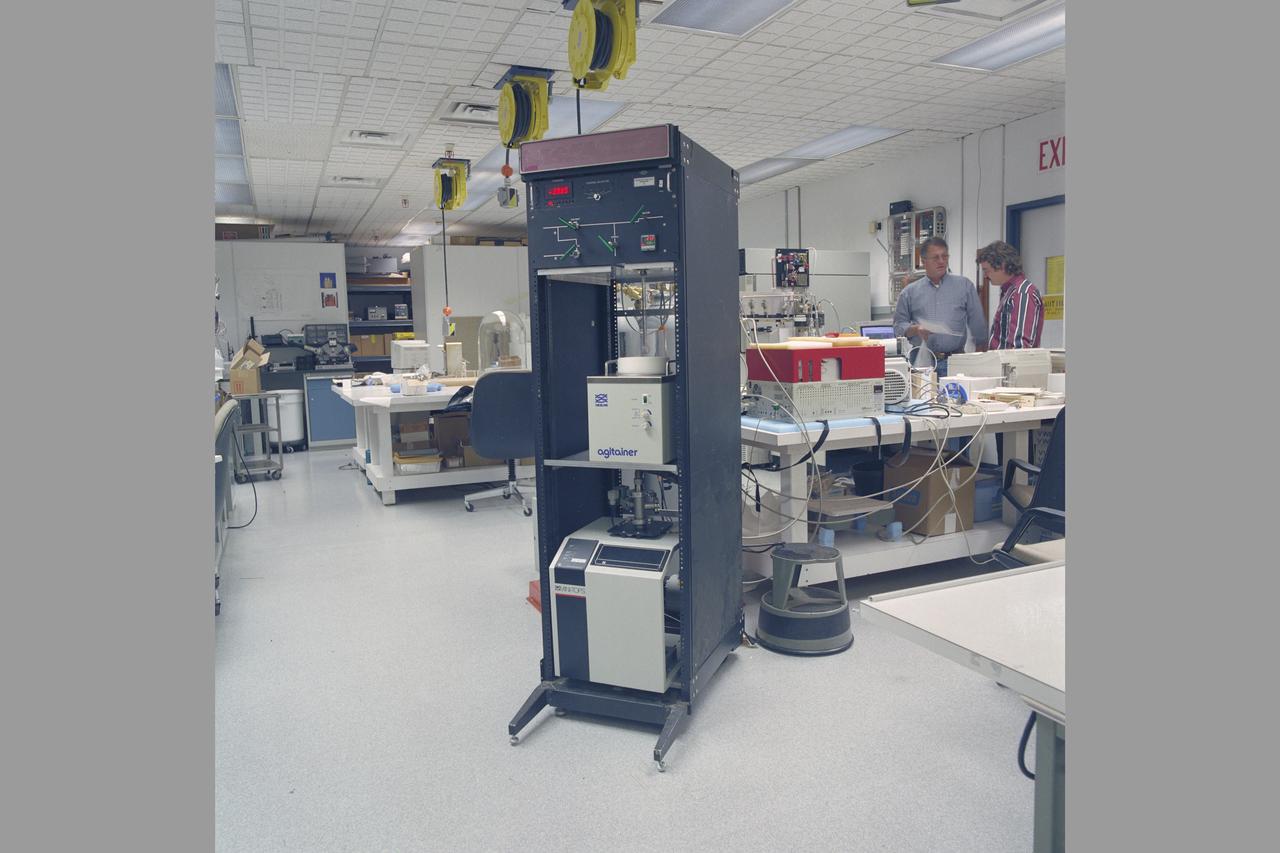
Mars Environmental Chamber. Absorption Compression for Mars ISRU (In-SITU Resource Utilization) N-239.

COMBUSTOR FACILITIES
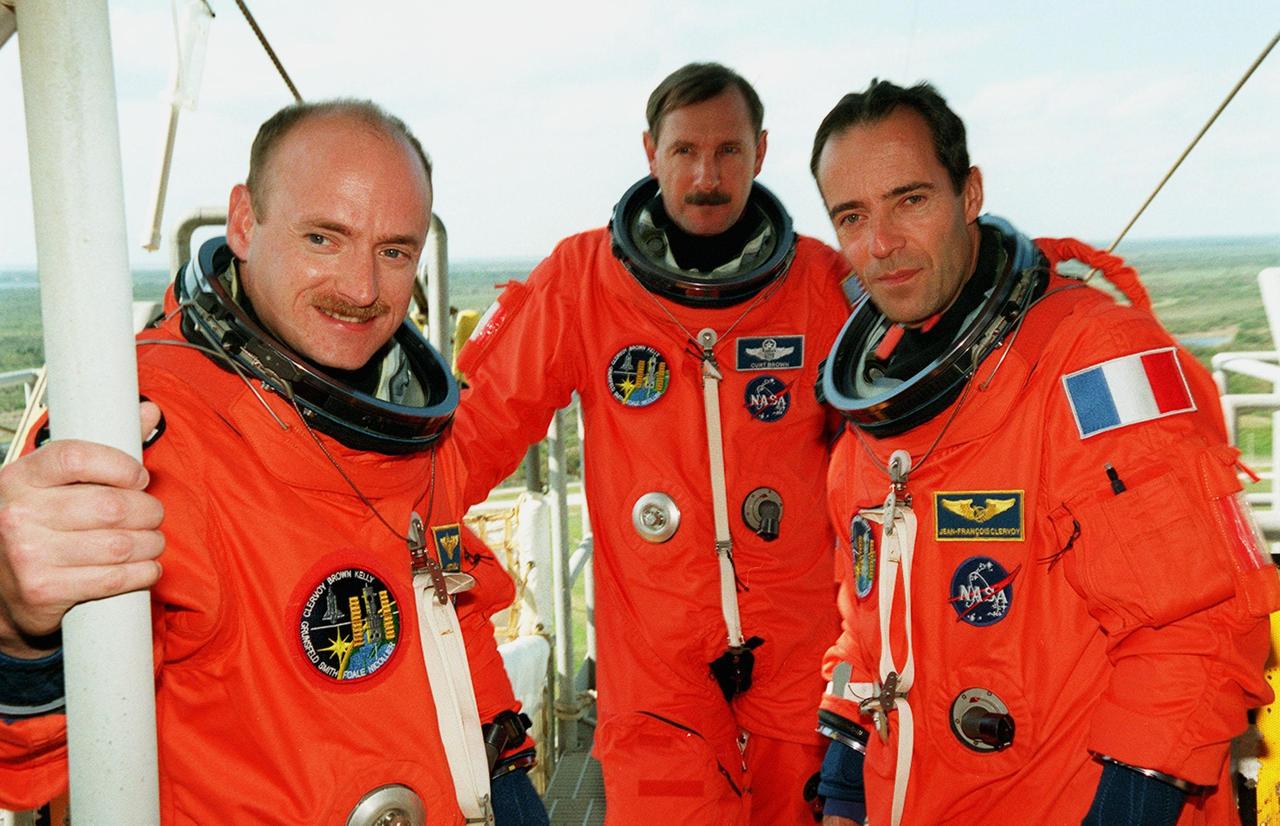
Standing left to right, STS-103 Pilot Scott J. Kelly, Commander Curtis L. Brown Jr., and Mission Specialist Jean-François Clervoy of France take a break during practice using the slidewire baskets, part of Terminal Countdown Demonstration Test (TCDT) activities in preparation for launch. The other crew members taking part are Mission Specialists Steven L. Smith, C. Michael Foale (Ph.D.), John M. Grunsfeld (Ph.D.), and Claude Nicollier of Switzerland. Clervoy and Nicollier are with the European Space Agency. The baskets are part of the emergency egress system for persons in the Shuttle vehicle or on the Rotating Service Structure. Seven slidewires extend from the orbiter access arm, with a netted, flatbottom basket suspended from each wire. The TCDT also provides the crew with opportunities to inspect their mission payloads in the orbiter's payload bay, and simulated countdown exercises. STS-103 is a "call-up" mission due to the need to replace and repair portions of the Hubble Space Telescope, including the gyroscopes that allow the telescope to point at stars, galaxies and planets. The STS-103 crew will be replacing a Fine Guidance Sensor, an older computer with a new enhanced model, an older data tape recorder with a solid-state digital recorder, a failed spare transmitter with a new one, and degraded insulation on the telescope with new thermal insulation. The crew will also install a Battery Voltage/Temperature Improvement Kit to protect the spacecraft batteries from overcharging and overheating when the telescope goes into a safe mode. Four EVA's are planned to make the necessary repairs and replacements on the telescope. The mission is targeted for launch Dec. 6 at 2:37 a.m. EST
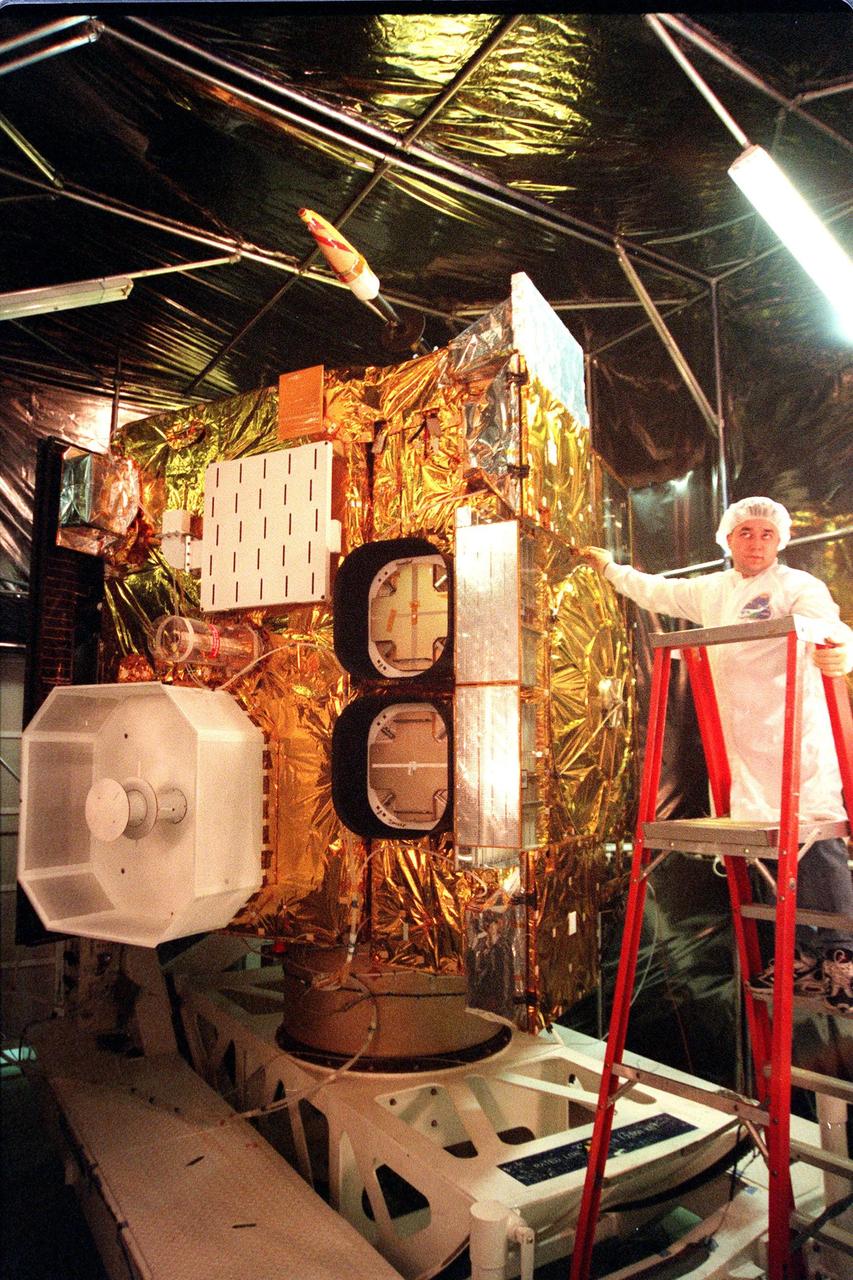
In a specially built clean room at Astrotech, Titusville, Fla., Loral technician Roberto Caballero checks the position of the <a href="http://www-pao.ksc.nasa.gov/kscpao/captions/subjects/goes-l.htm">GOES-L</a> weather satellite before beginning deployment of the sounder instrument's cooler cover door. The sounder, one of two meteorological instruments on the satellite, measures temperature and moisture in a vertical column of air from the satellite to Earth. Its findings will help forecast weather. GOES-L, which is to be launched from Cape Canaveral Air Station aboard an Atlas II rocket in late March, is the fourth of a new advanced series of geostationary weather satellites for the National Oceanic and Atmospheric Administration. It is a three-axis inertially stabilized spacecraft that will provide pictures as well as perform the atmospheric sounding. Once launched, the satellite, to be designated GOES-11, will undergo checkout and provide backup capabilities for the existing, aging GOES East weather satellite
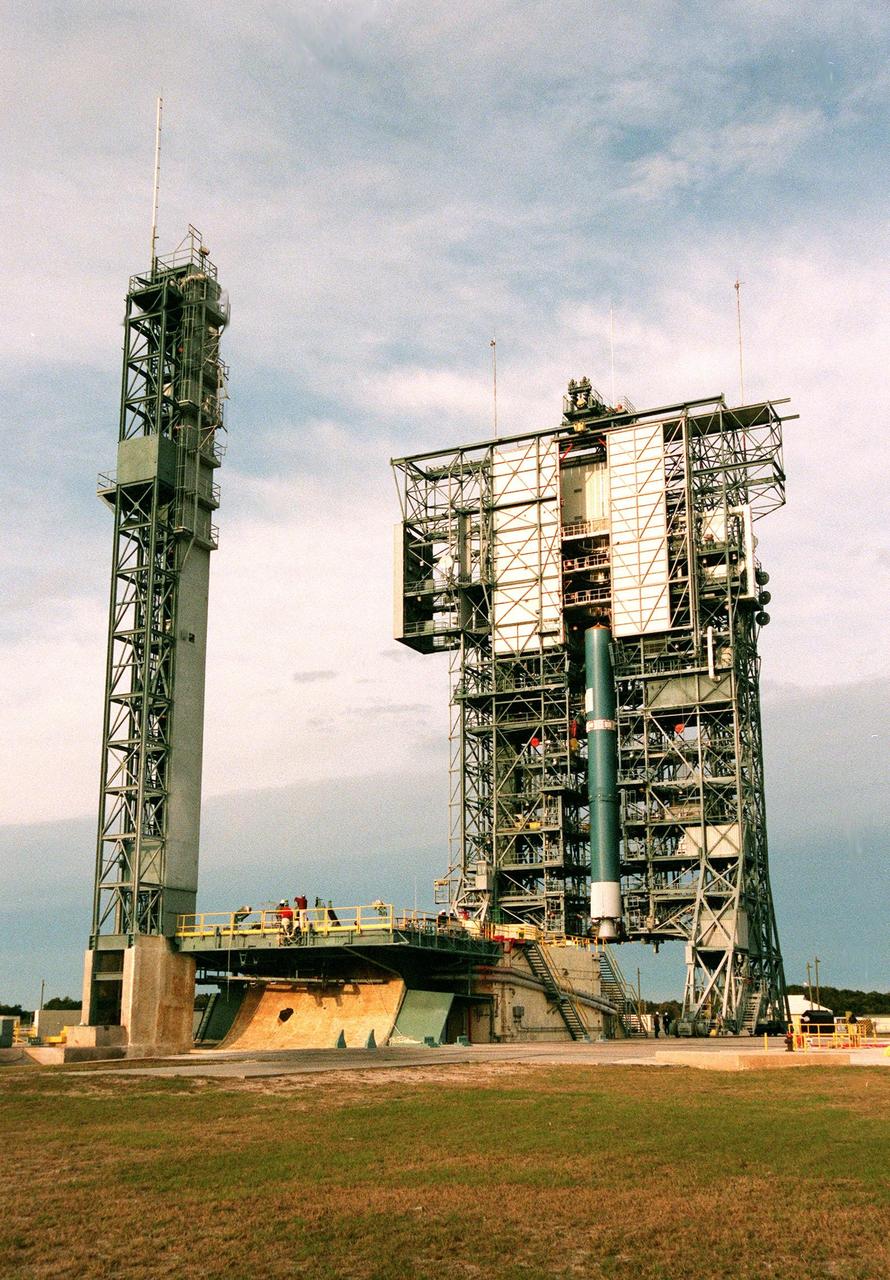
The first stage of a Boeing Delta II rocket is in position on the mobile tower (at right) at Launch Complex 17. At left is the launch tower. The rocket will carry the Stardust spacecraft into space for a close encounter with the comet Wild 2 in January 2004. Using a medium called aerogel, it will capture comet particles flying off the nucleus of the comet, plus collect interstellar dust for later analysis. The collected samples will return to Earth in a Sample Return Capsule to be jettisoned as Stardust swings by Earth in January 2006. Stardust is scheduled to be launched on Feb. 6, 1999

As tower rollback begins, the Boeing Delta II rocket carrying the Stardust spacecraft waits on Launch Pad 17-A, Cape Canaveral Air Station, for the second launch attempt at 4:04 p.m. EST. The original launch was scrubbed on Feb. 6 for 24 hours. Stardust is destined for a close encounter with the comet Wild 2 in January 2004. Using a silicon-based substance called aerogel, Stardust will capture comet particles flying off the nucleus of the comet. The spacecraft also will bring back samples of interstellar dust. These materials consist of ancient pre-solar interstellar grains and other remnants left over from the formation of the solar system. Scientists expect their analysis to provide important insights into the evolution of the sun and planets and possibly into the origin of life itself. The collected samples will return to Earth in a sample return capsule to be jettisoned as Stardust swings by Earth in January 2006

Atlas Image mosaic, covering 14.8 x 20.0 on the sky, of the Trifid Nebula, aka Messier 20 and NGC 6514. The Trifid is only about 1.5 degrees northwest on the sky of the larger Lagoon Nebula Messier 8 in the constellation Sagittarius
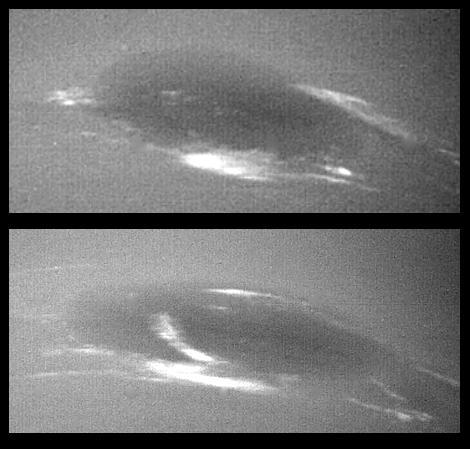
The bright cirrus-like clouds of Neptune change rapidly, often forming and dissipating over periods of several to tens of hours. In this sequence NASA Voyager 2 observed cloud evolution in the region around the Great Dark Spot GDS.
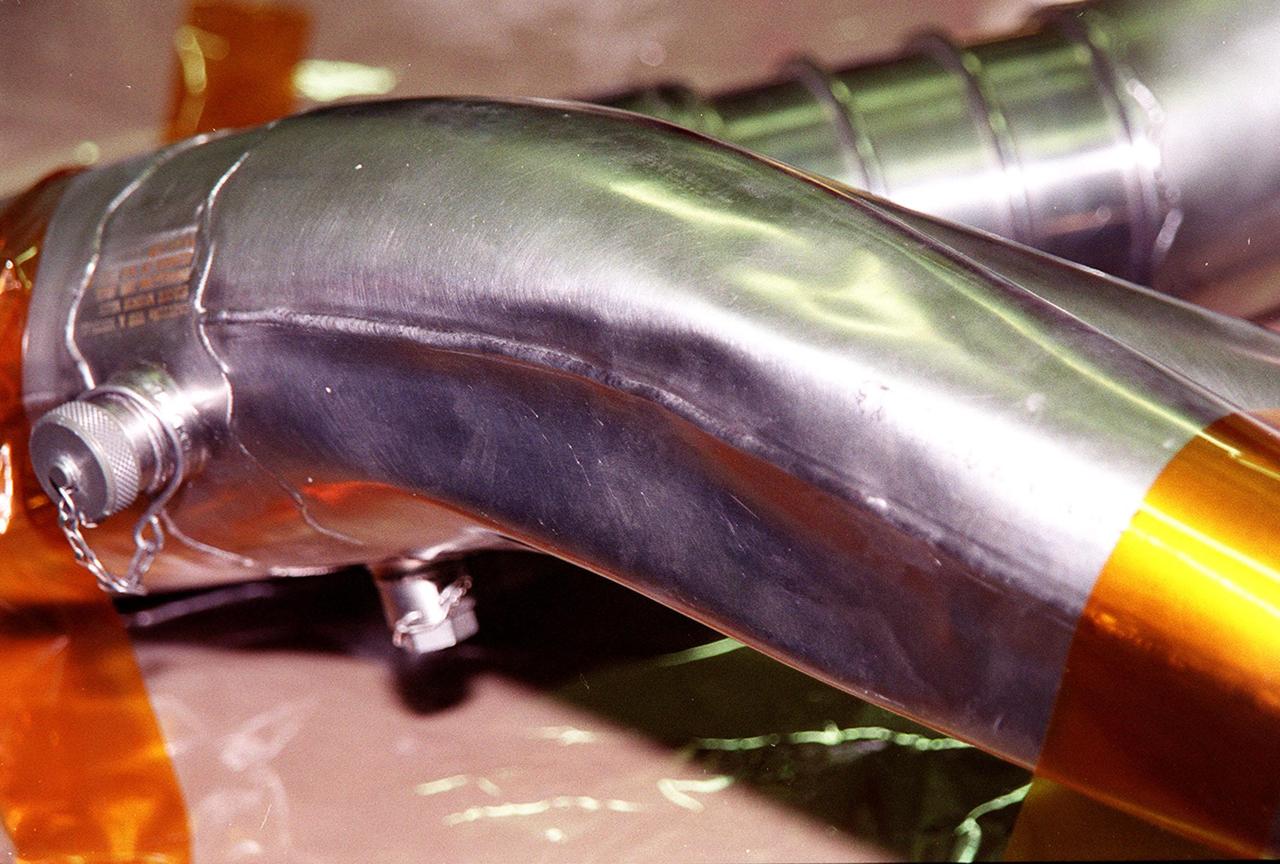
This close-up shows the 12-inch-long dent on Shuttle Discovery's main propulsion system liquid hydrogen recirculation line that was discovered during routine aft compartment inspections Tuesday, Dec. 7. The line recirculates hydrogen from the Shuttle main engines back to the external tank during prelaunch engine conditioning. The line is being replaced and managers expect the replacement work to take about 3 days, followed by system retests and final aft compartment close-outs. Preliminary assessments reflect a launch date of Space Shuttle Discovery on mission STS-103 no earlier than Dec. 16. STS-103 is the third servicing mission for the Hubble Space Telescope
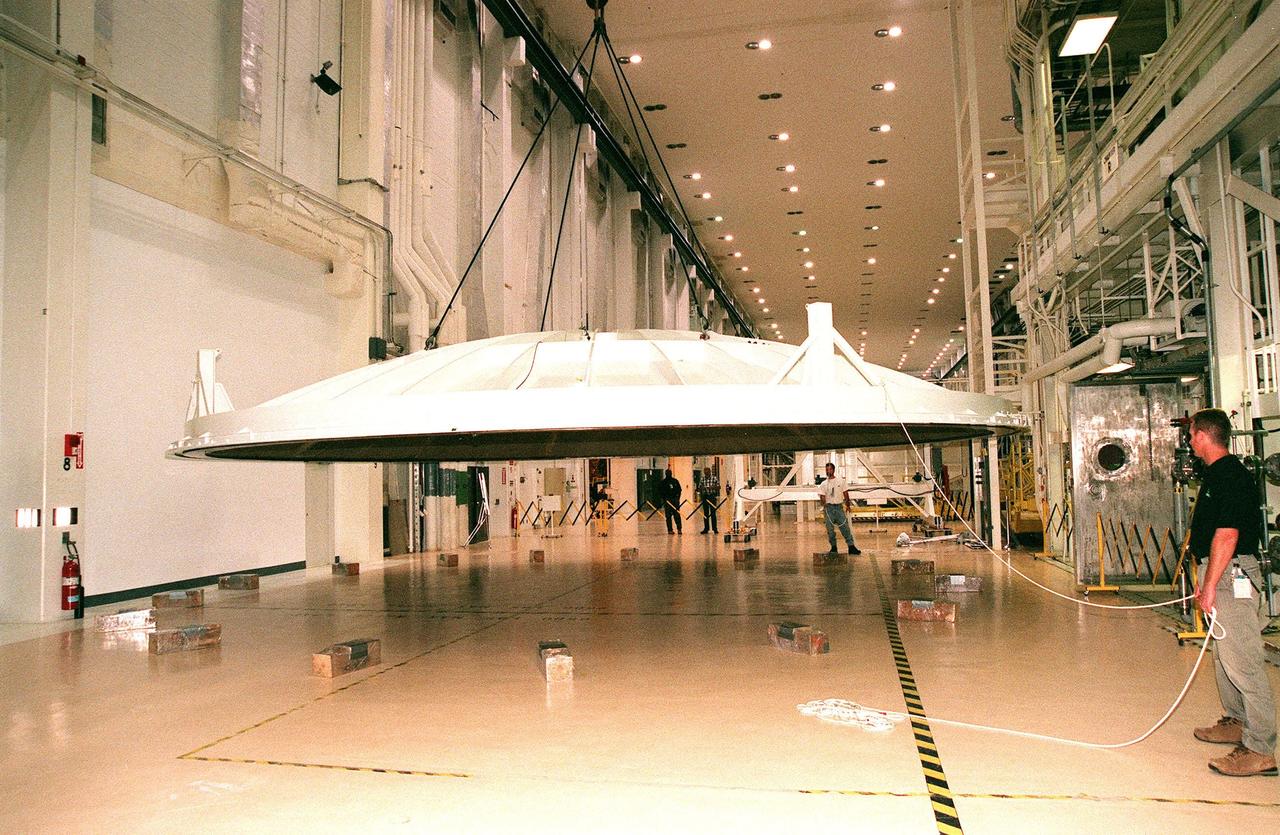
KENNEDY SPACE CENTER, FLA. -- An overhead crane lifts the saucer-like 27.5-ton lid of an altitude chamber in the Operations and Checkout Building high bay. The chamber was recently reactivated, after a 24-year hiatus, to perform leak tests on International Space Station pressurized modules at the launch site. Originally, two chambers were built to test Apollo Program flight hardware. They were last used in 1975 during the Apollo-Soyuz Test Project. After installation of new vacuum pumping equipment and controls, a new control room, and a new rotation handling fixture, the chamber again became operational in February 1999. The chamber, which is 33 feet in diameter and 50 feet tall, is constructed of stainless steel. The first module that will be tested for leaks is the U.S. Laboratory. No date has been determined for the test
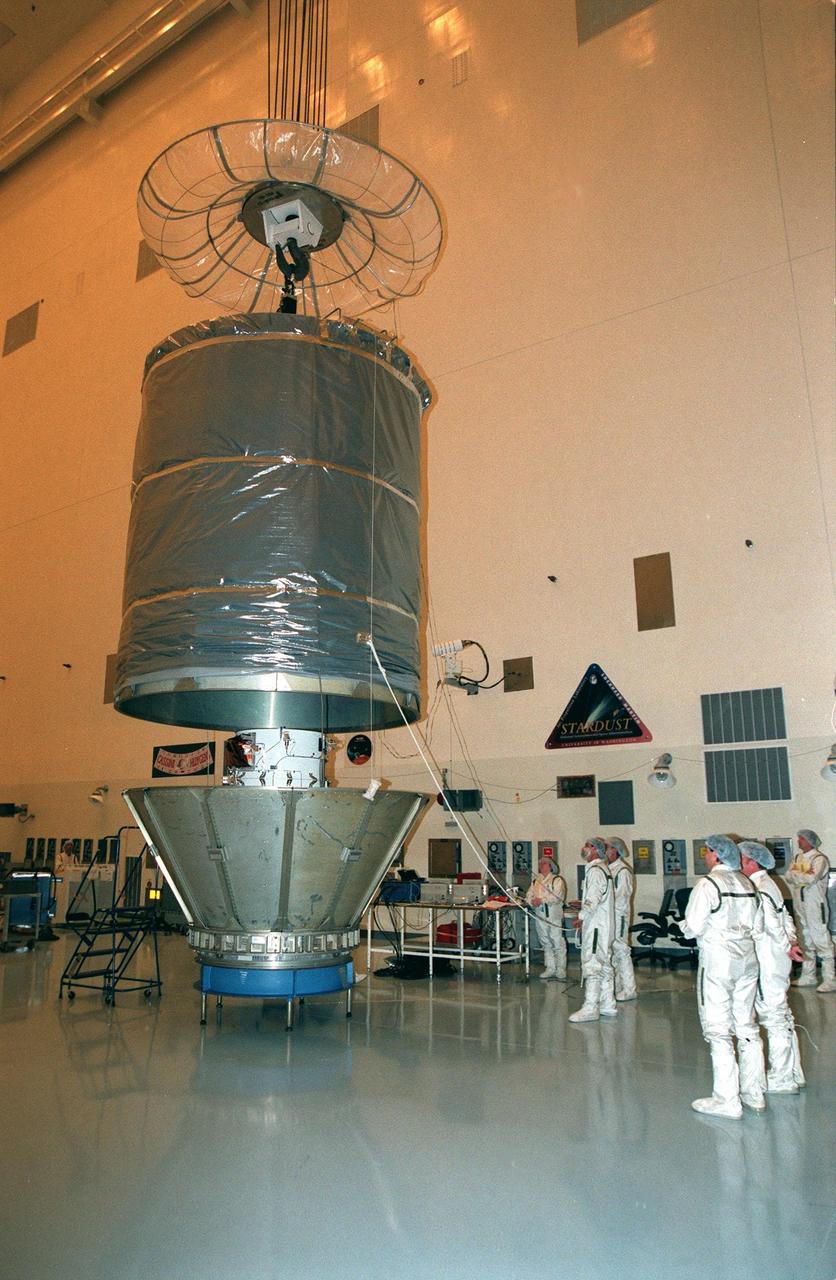
The cover is removed from the Stardust spacecraft in the Payload Hazardous Servicing Facility prior to a media presentation. Stardust is targeted for launch on Feb. 6 aboard a Boeing Delta II rocket from Launch Pad 17-A, Cape Canaveral Air Station. The spacecraft is destined for a close encounter with the comet Wild 2 in January 2004. Using a silicon-based substance called aerogel, Stardust will capture comet particles flying off the nucleus of the comet. The spacecraft also will bring back samples of interstellar dust. These materials consist of ancient pre-solar interstellar grains and other remnants left over from the formation of the solar system. Scientists expect their analysis to provide important insights into the evolution of the sun and planets and possibly into the origin of life itself. The collected samples will return to Earth in a sample return capsule (the white-topped, blunt-nosed cone seen on the top of the spacecraft) to be jettisoned as Stardust swings by Earth in January 2006
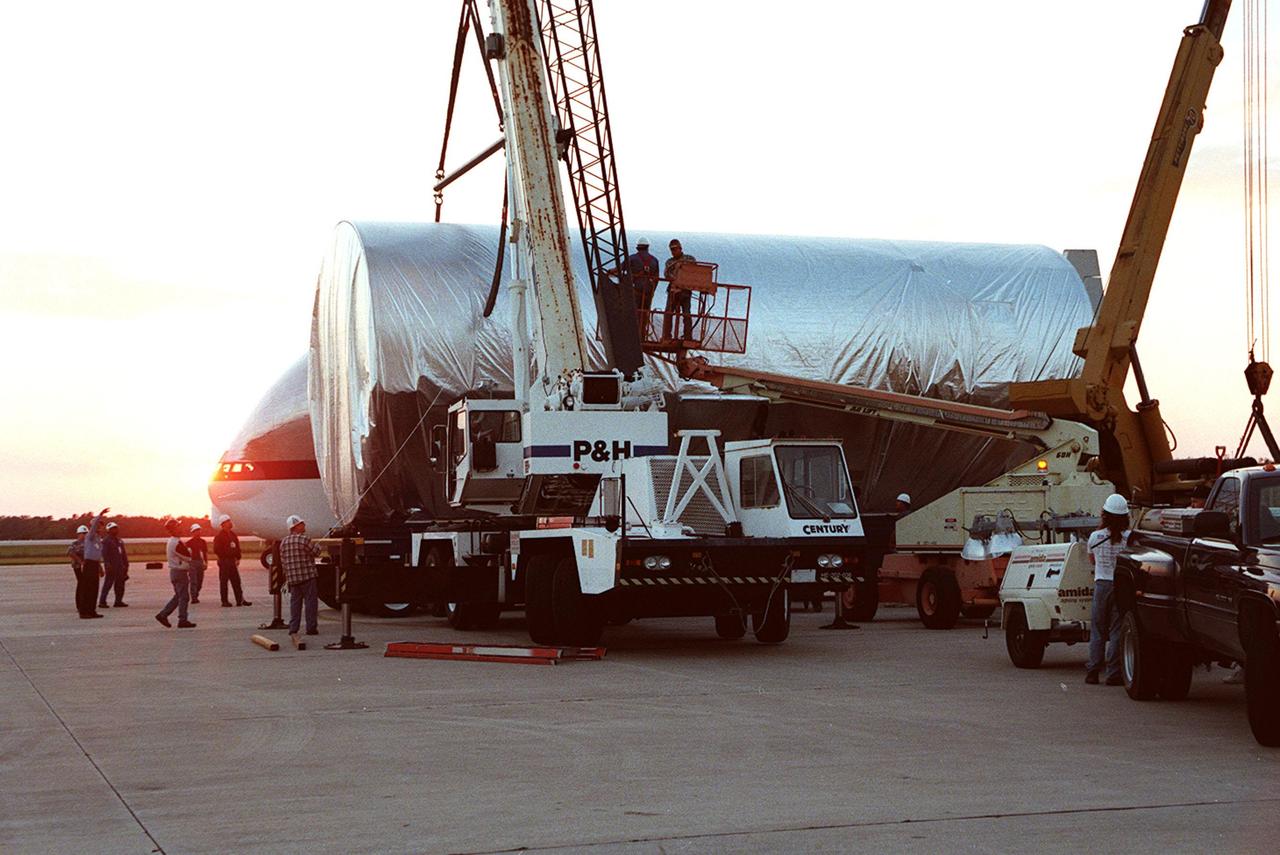
KENNEDY SPACE CENTER, FLA. -- Workers secure the P3 truss on the transporter for the trip to the Operations and Checkout Building. The second port-side truss is a segment of the International Space Station (ISS), scheduled to be added to the ISS on mission STS-115 in 2002 aboard Space Shuttle Atlantis. P3 will be attached to the first port truss segment (P1).
![[14] ISO: 100 Aprt: F4 Shut: 60 Lens: 35 Exps: P Prog: Po ExpC: -1.3 Metr: Mtrx Fl s: Norm D md: S F md: S F ar: Spot Dist: 1.6m](https://images-assets.nasa.gov/image/s93e5050/s93e5050~medium.jpg)
[14] ISO: 100 Aprt: F4 Shut: 60 Lens: 35 Exps: P Prog: Po ExpC: -1.3 Metr: Mtrx Fl s: Norm D md: S F md: S F ar: Spot Dist: 1.6m

August Witt, Massachusetts Institute of Technology, principal investigator for the research program designed to lead to the identification and control of gravitational effects which adversely impact, through their interference with the growth process, the achievement of critical application specific properties in opto-electronic materials.
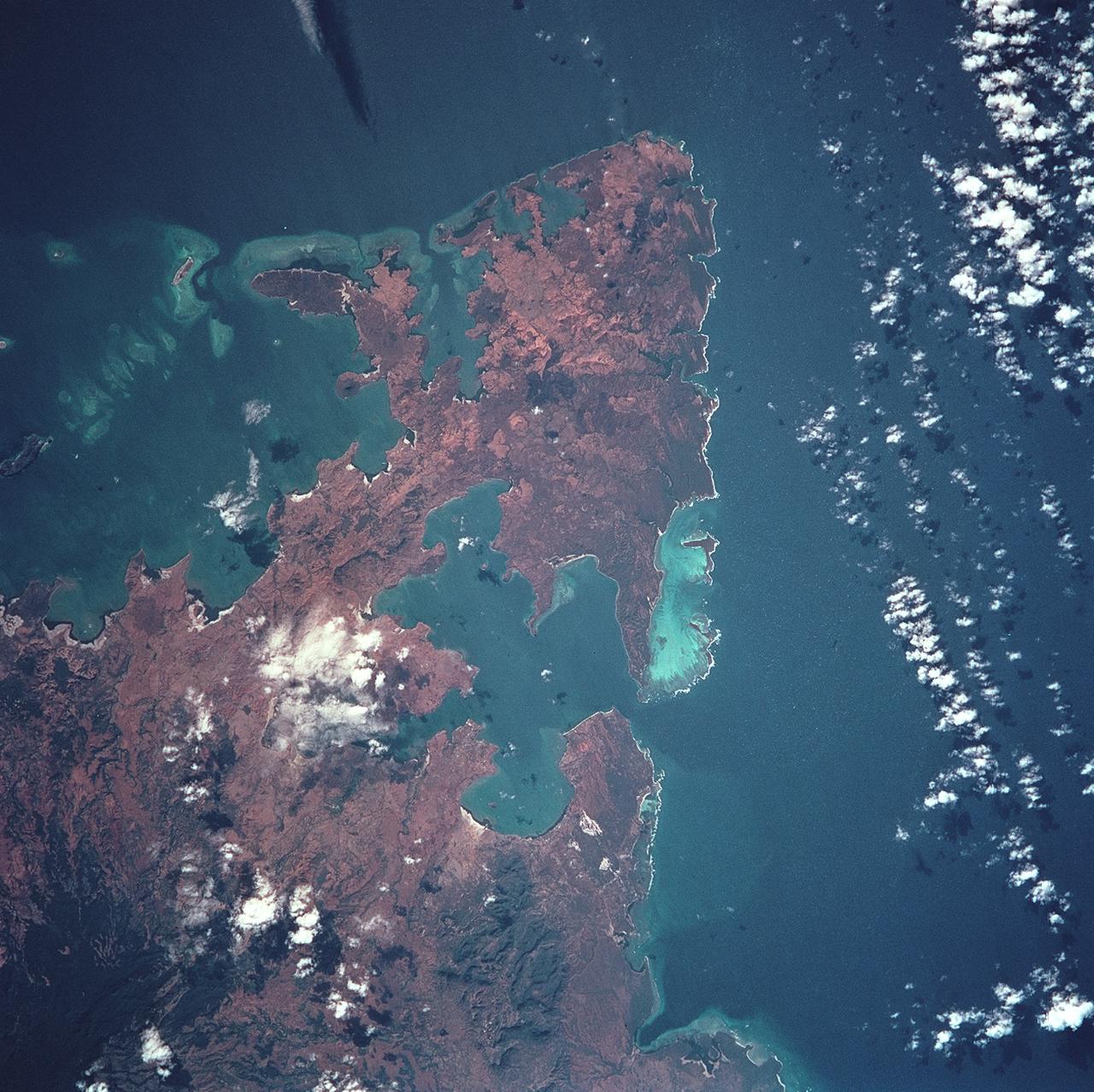
STS093-722-051 (23-27 July 1999) --- The STS-93 astronauts aboard the Space Shuttle Columbia took this picture over the Indian Ocean. The distinctive arrowhead shape of the northern tip of the island of Madagascar is easily recognizable. The land appears red with patches of dark green on the upper slopes. According to NASA scientists studying the STS-93 photo collection, the dark areas are the remnants of forests and the red areas are cleared land. When the photo was taken, the shuttle was flying over a point located at 14.7 degrees south latitude and 44.0 degrees east longitude. Data back information on the 70mm film listed the date and time of the photo as 11:38:20 GMT, July 24, 1999 (Orbit 21).
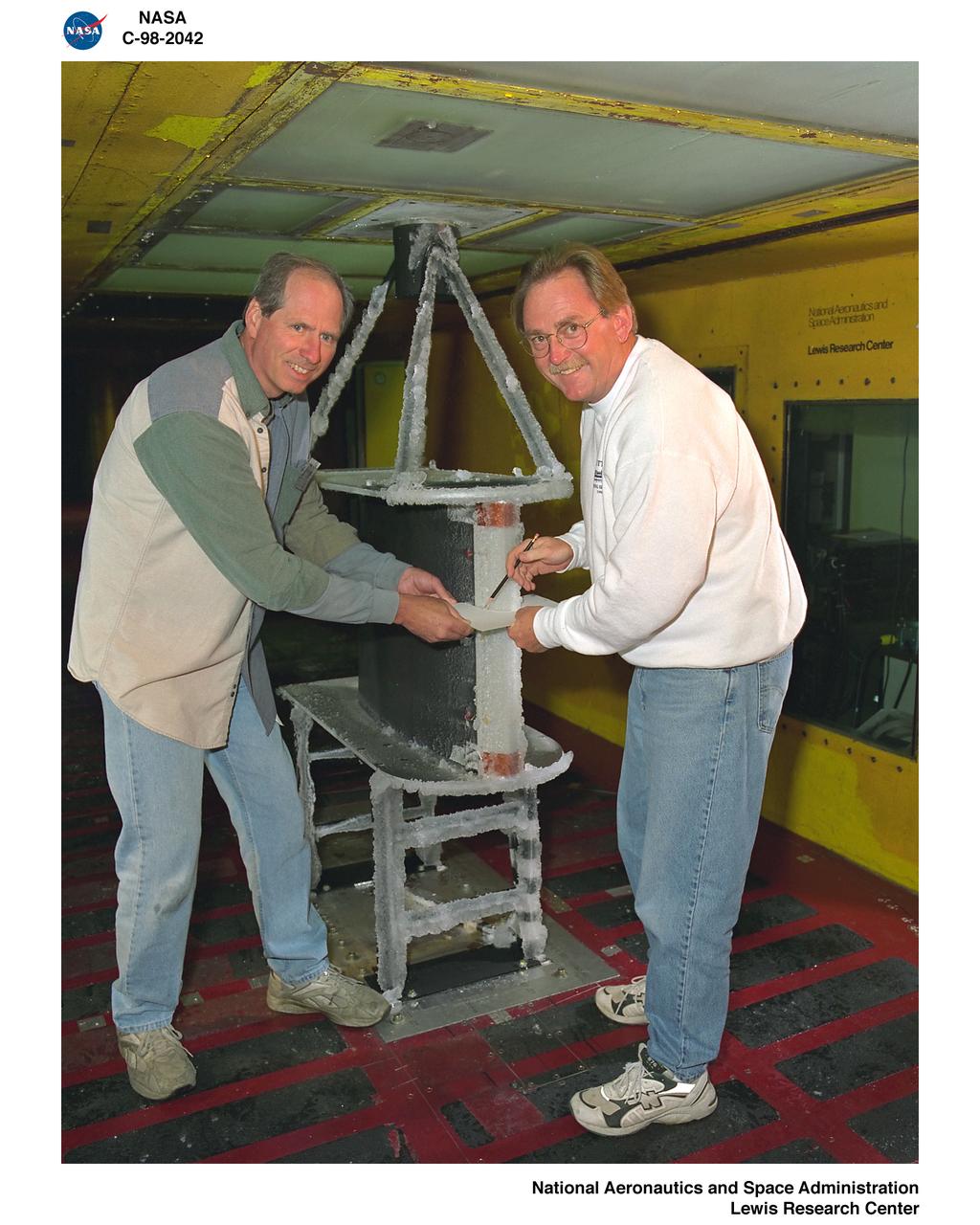
LANCAIR AIRFOIL THERMO ICE PROTECTION
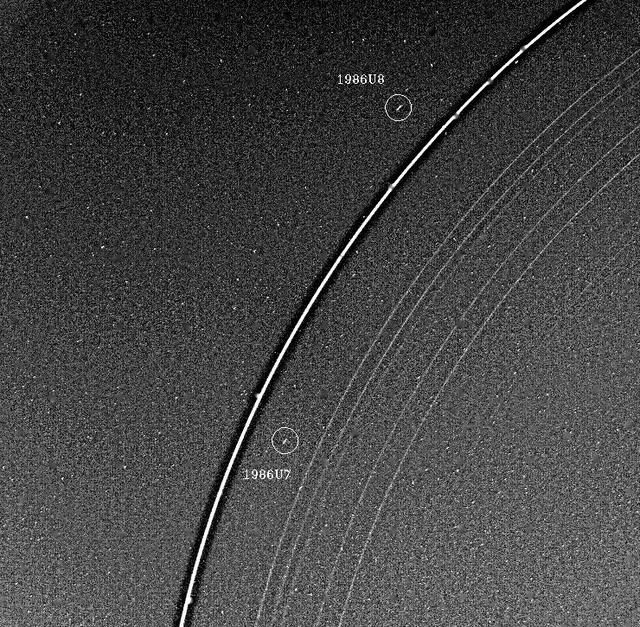
Voyager 2 has discovered two hepherd satellites associated with the rings of Uranus. The two moons, designated 1986U7 and 1986U8, are seen here on either side of the bright epsilon ring; all nine of the known Uranian rings are visible.
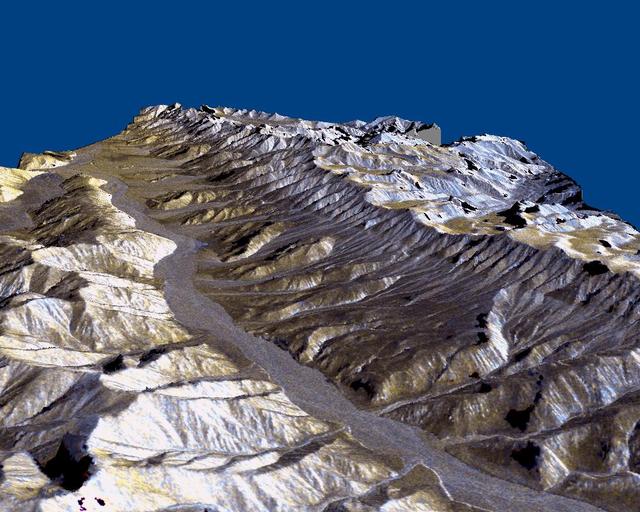
This three-dimensional perspective of the remote Karakax Valley in the northern Tibetan Plateau of western China was created by combining two spaceborne radar images using a technique known as interferometry. Visualizations like this are helpful to scientists because they reveal where the slopes of the valley are cut by erosion, as well as the accumulations of gravel deposits at the base of the mountains. These gravel deposits, called alluvial fans, are a common landform in desert regions that scientists are mapping in order to learn more about Earth's past climate changes. Higher up the valley side is a clear break in the slope, running straight, just below the ridge line. This is the trace of the Altyn Tagh fault, which is much longer than California's San Andreas fault. Geophysicists are studying this fault for clues it may be able to give them about large faults. Elevations range from 4000 m (13,100 ft) in the valley to over 6000 m (19,700 ft) at the peaks of the glaciated Kun Lun mountains running from the front right towards the back. Scale varies in this perspective view, but the area is about 20 km (12 miles) wide in the middle of the image, and there is no vertical exaggeration. http://photojournal.jpl.nasa.gov/catalog/PIA01800

S103-E-5248 (22 December 1999) --- Astronaut Steven L. Smith, payload commander, waves to a crew mate located inside the Space Shuttle Discovery's cabin during the first space walk of NASA's third servicing visit to the Hubble Space Telescope (HST). The photo was taken with an electronic still camera (ESC).
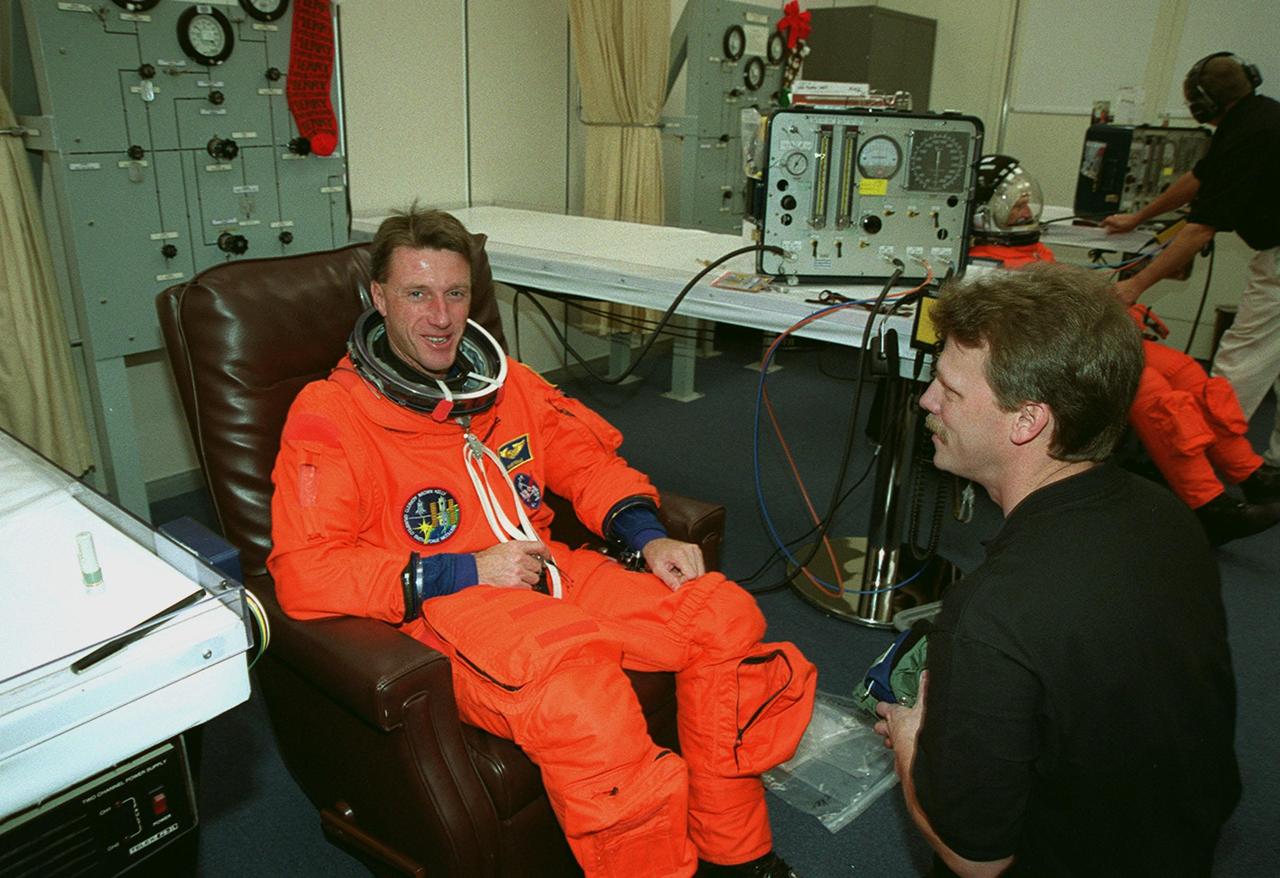
STS-103 Mission Specialist C. Michael Foale (Ph.D.) dons his launch and entry suit for the second time in two days before heading out to Launch Pad 39B and liftoff of Space Shuttle Discovery. The previous launch attempt on Dec. 17 was scrubbed about 8:52 p.m. due to numerous violations of weather launch commit criteria at KSC. Foale and other crew members Commander Curtis L. Brown Jr., Pilot Scott J. Kelly and Mission Specialists Steven L. Smith, John M. Grunsfeld (Ph.D.), Claude Nicollier of Switzerland and Jean-Francois Clervoy of France are scheduled to lift off at 7:50 p.m. EST Dec. 19 on mission STS-103, servicing the Hubble Space Telescope. Objectives for the nearly eight-day mission include replacing gyroscopes and an old computer, installing another solid state recorder, and replacing damaged insulation in the telescope. Discovery is expected to land at KSC Monday, Dec. 27, at about 5:24 p.m. EST
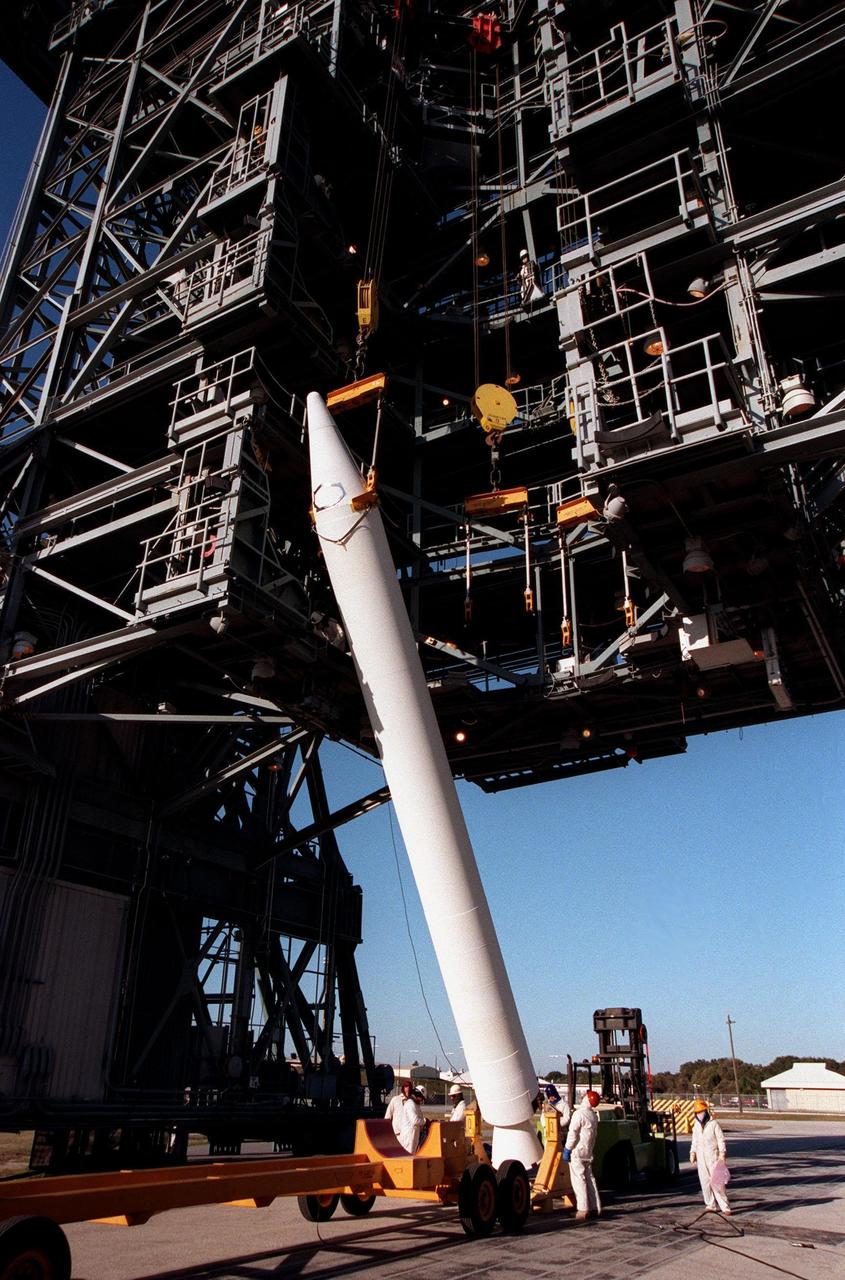
A solid rocket booster is raised to a vertical position before lifting it up the mobile launch tower at Pad 17A, Cape Canaveral Air Station. It will be mated with a Boeing Delta II rocket that will carry the Stardust spacecraft into space for a close encounter with the comet Wild 2 in January 2004. Using a medium called aerogel, Stardust will capture comet particles flying off the nucleus of the comet, plus collect interstellar dust for later analysis. The collected samples will return to Earth in a sample return capsule to be jettisoned as Stardust swings by Earth in January 2006. Stardust is scheduled to be launched on Feb. 6, 1999

This image of the Earth is one of 60 frames taken by NASA Voyager 1 spacecraft on Feb. 14, 1990 from a distance of approximately 4 billion miles and about 32 degrees above the ecliptic plane.
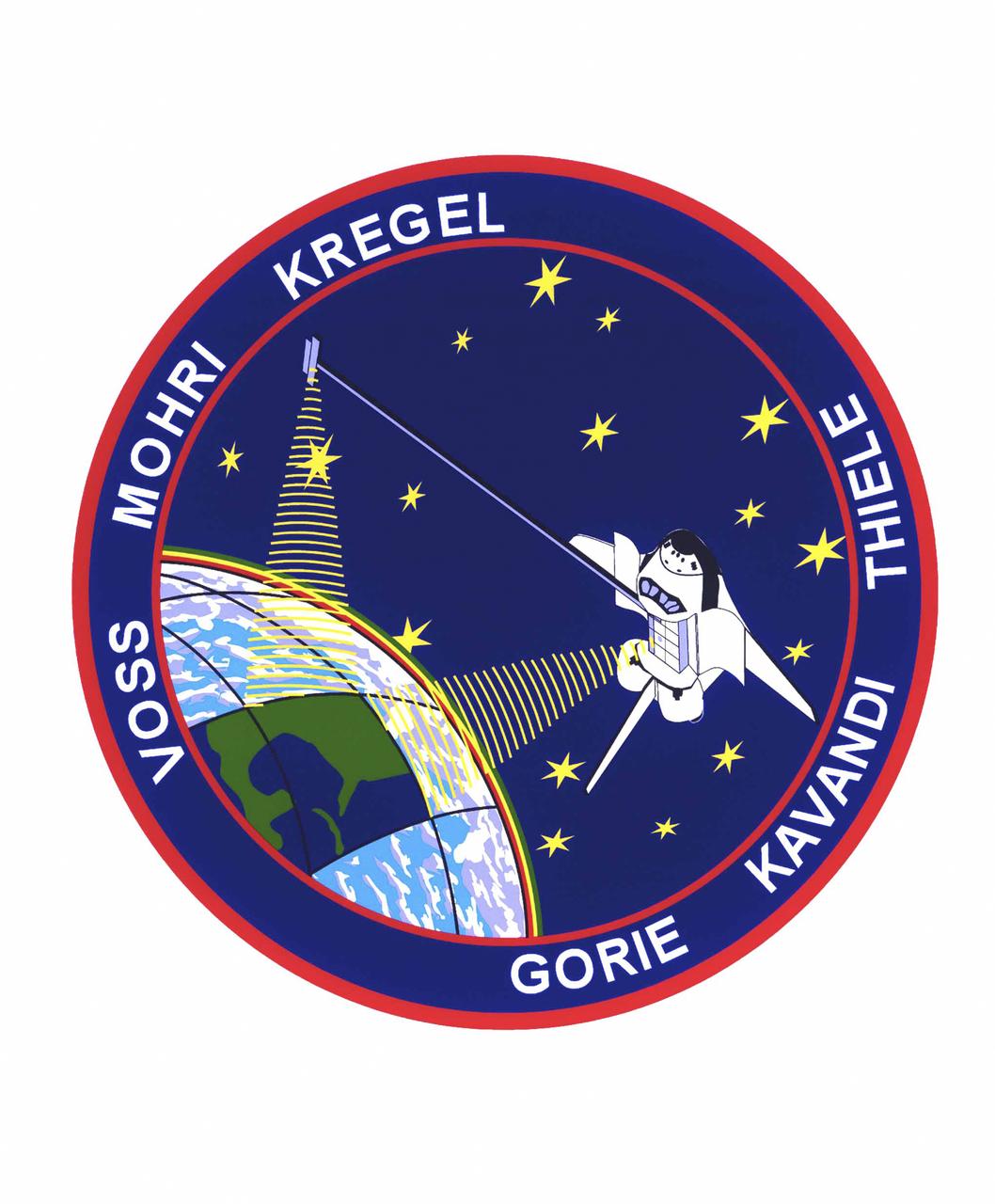
The STS-99 crew members designed the flight insignia for the Shuttle Radar Topography Mission (SRTM), the most ambitious Earth mapping mission to date. Two radar anternas, one located in the Shuttle bay and the other located on the end of a 60-meter deployable mast, was used during the mission to map Earth's features. The goal was to provide a 3-dimensional topographic map of the world's surface up to the Arctic and Antarctic Circles. In the patch, the clear portion of Earth illustrates the radar beams penetrating its cloudy atmosphere and the unique understanding of the home planet that is provided by space travel. The grid on Earth reflects the mapping character of the SRTM mission. The patch depicts the Space Shuttle Endeavour orbiting Earth in a star spangled universe. The rainbow along Earth's horizon resembles an orbital sunrise. The crew deems the bright colors of the rainbow as symbolic of the bright future ahead because of human beings' venturing into space. The crew of six launched aboard the Space Shuttle Endeavor on February 11, 2000 and completed 222 hours of around the clock radar mapping gathering enough information to fill more than 20,000 CDs.
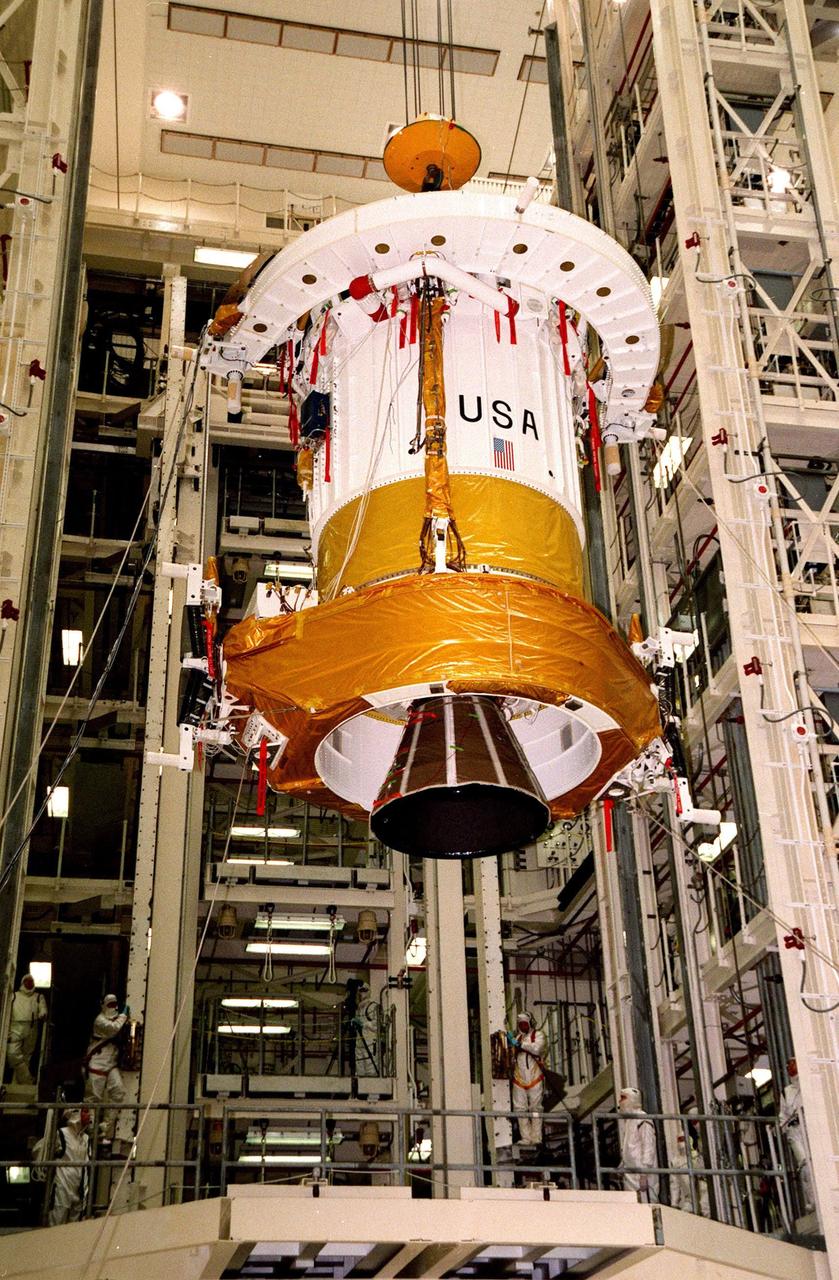
The Inertial Upper Stage (IUS) booster is moved toward a workstand in Kennedy Space Center's Vertical Processing Facility. The IUS will be mated with the Chandra X-ray Observatory and then undergo testing to validate the IUS/Chandra connections and check the orbiter avionics interfaces. Following that, an end-to-end test (ETE) will be conducted to verify the communications path to Chandra, commanding it as if it were in space. With the world's most powerful X-ray telescope, Chandra will allow scientists from around the world to see previously invisible black holes and high-temperature gas clouds, giving the observatory the potential to rewrite the books on the structure and evolution of our universe. Chandra is scheduled for launch July 22 aboard Space Shuttle Columbia, on mission STS-93
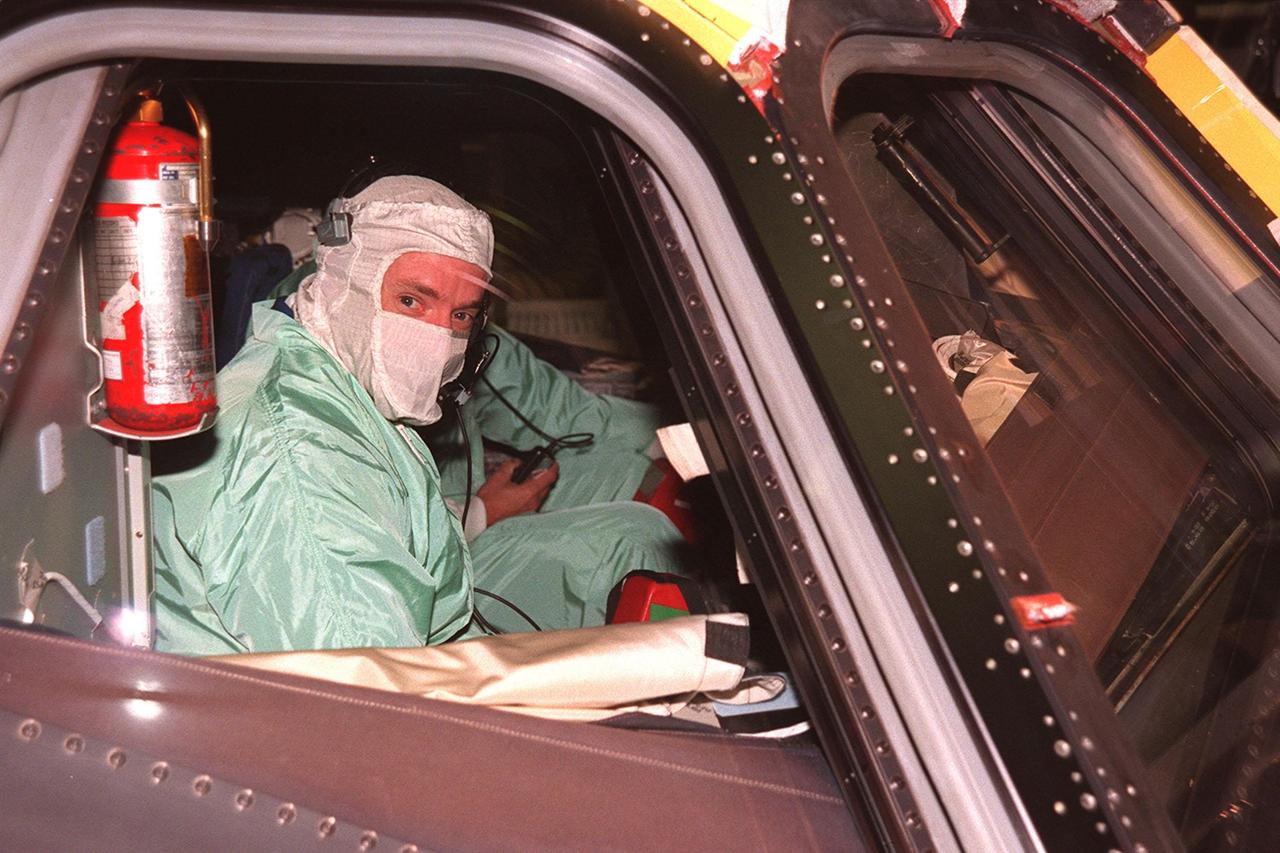
In the Orbiter Processing Facility (OPF) bay 1, STS-103 Pilot Scott J. Kelly sits in the pilot's seat of the orbiter Discovery, inspecting the window. The mission will be Kelly's first Space Shuttle flight. Kelly and other crew members are at KSC to take part in a Crew Equipment Interface Test. The rest of the crew are Commander Curtis L. Brown Jr. and Mission Specialists Steven L. Smith, C. Michael Foale (Ph.D.), John M. Grunsfeld (Ph.D.), Claude Nicollier of Switzerland, and Jean-François Clervoy of France. Nicollier and Clervoy are with the European Space Agency. Mission STS-103 is a "call-up" due to the need to replace portions of the pointing system, the gyros, which have begun to fail on the Hubble Space Telescope. Although Hubble is operating normally and conducting its scientific observations, only three of its six gyroscopes are working properly. The gyroscopes allow the telescope to point at stars, galaxies and planets. The STS-103 crew will not only replace gyroscopes, it will also replace a Fine Guidance Sensor and an older computer with a new enhanced model, an older data tape recorder with a solid-state digital recorder, a failed spare transmitter with a new one, and degraded insulation on the telescope with new thermal insulation. The crew will also install a Battery Voltage/Temperature Improvement Kit to protect the spacecraft batteries from overcharging and overheating when the telescope goes into a safe mode. The scheduled launch date in October is under review

These three images of Neptune were acquired 90 minutes apart by NASA Voyager 2 spacecraft on April 3, 1989, from a range of 208 million kilometers 129 million miles. Several atmospheric features clouds are visible.
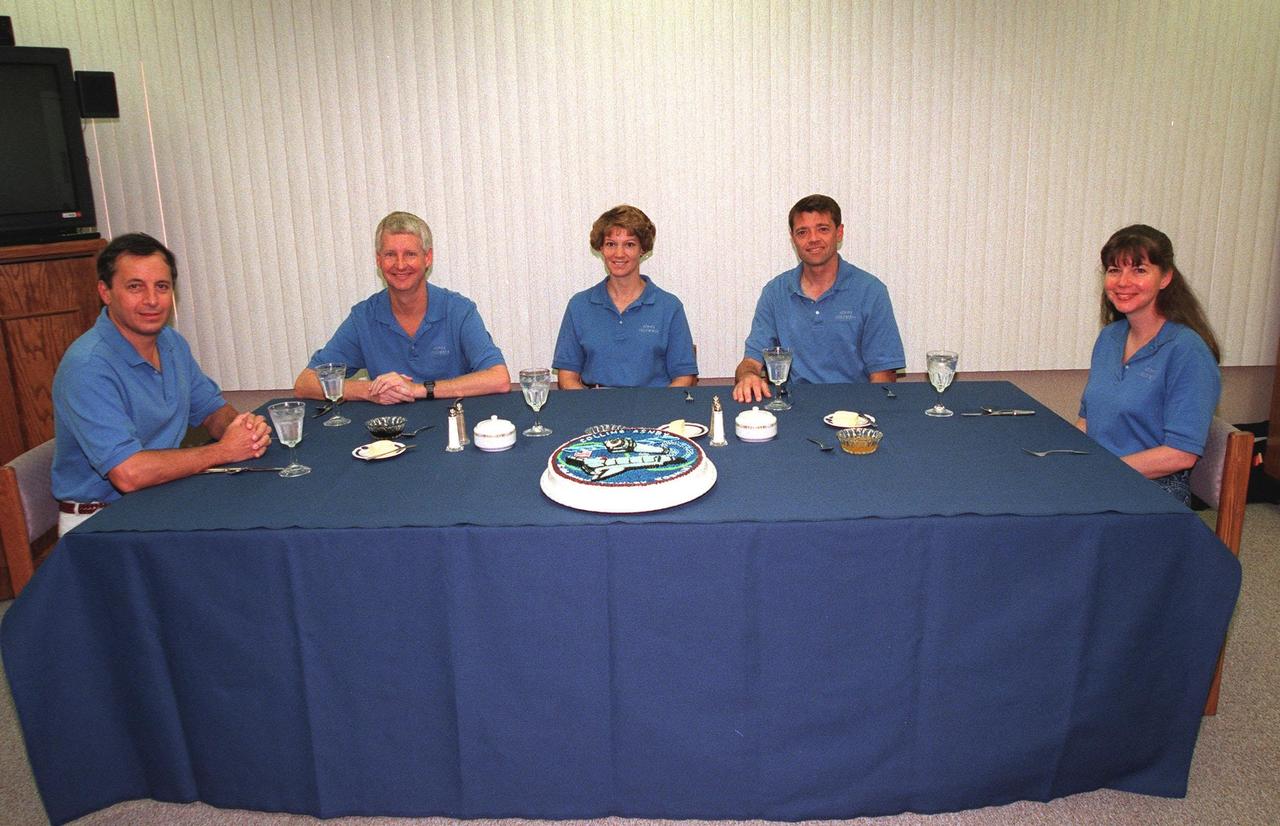
The STS-93 crew gathers a second time for a pre-launch breakfast in the Operations and Checkout Building before suiting up for launch. After Space Shuttle Columbia's July 20 launch attempt was scrubbed at the T-7 second mark in the countdown, the launch was rescheduled for Thursday, July 22, at 12:28 a.m. EDT. Seated from left are Mission Specialists Michel Tognini, of France, who represents the Centre National d'Etudes Spatiales (CNES), and Steven A. Hawley (Ph.D.), Commander Eileen M. Collins, Pilot Jeffrey S. Ashby, and Mission Specialist Catherine G. Coleman (Ph.D.). STS-93 is a five-day mission primarily to release the Chandra X-ray Observatory, which will allow scientists from around the world to study some of the most distant, powerful and dynamic objects in the universe. The new telescope is 20 to 50 times more sensitive than any previous X-ray telescope and is expected unlock the secrets of supernovae, quasars and black holes. Collins is the first woman to serve as commander of a Shuttle mission. The target landing date is July 26, 1999, at 11:24 p.m. EDT
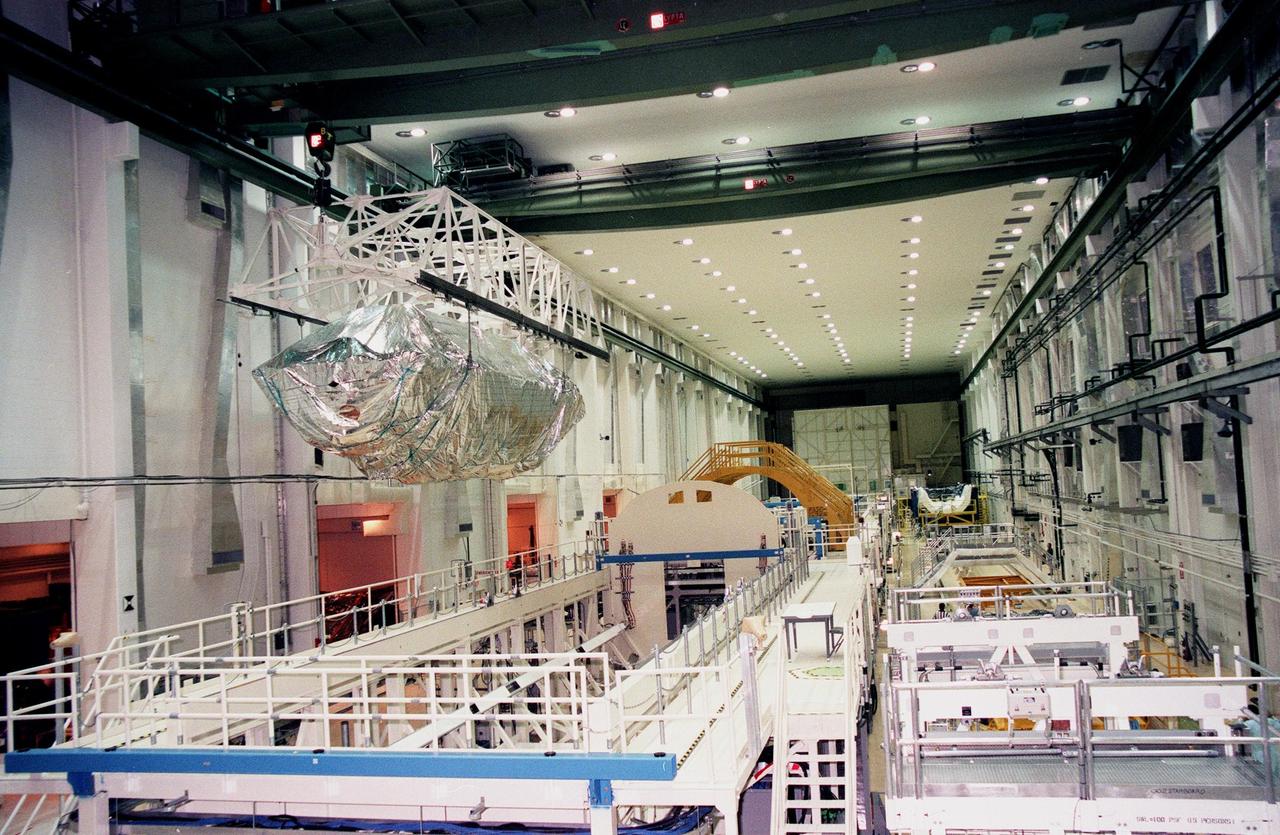
KENNEDY SPACE CENTER, FLA. -- In the Operations and Checkout Bldg. (O&C), an overhead crane moves the S0 truss segment toward a workstand. The S0 truss will undergo processing in the O&C during which the Canadian Mobile Transporter, power distribution system modules, a heat pipe radiator for cooling, computers, and a pair of rate gyroscopes will be installed. Four Global Positioning System antennas are already installed. A 44by 15-foot structure weighing 30,800 pounds when fully outfitted and ready for launch, the truss will be at the center of the ISS 10-truss, girderlike structure that will ultimately extend the length of a football field. Eventually the S0 truss will be attached to the U.S. Lab, "Destiny," which is scheduled to be added to the ISS in April 2000. Later, other trusses will be attached to the S0 on-orbit. The S0 truss is scheduled to be launched in the first quarter of 2001 on mission STS-108
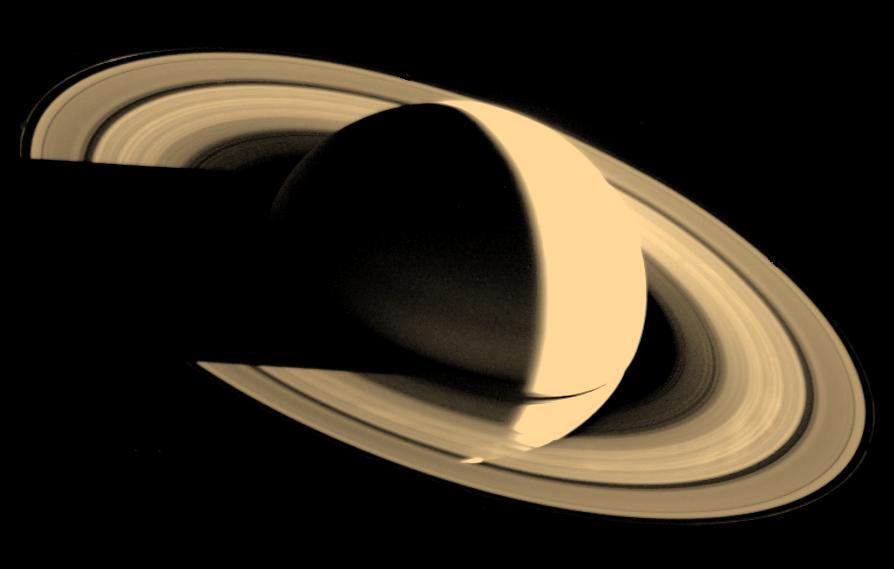
Saturn and its Rings
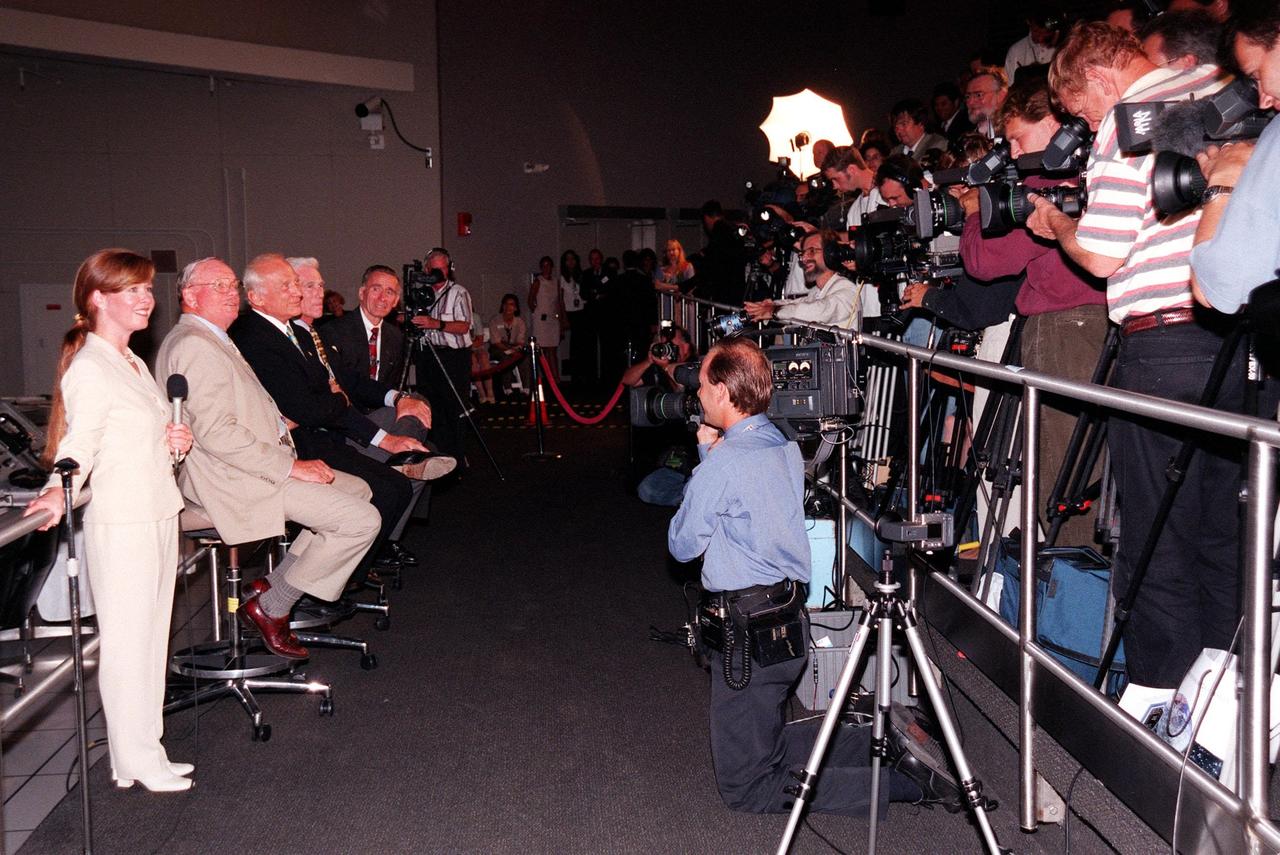
KENNEDY SPACE CENTER, FLA. -- In the Apollo/Saturn V Center, Lisa Malone (left), chief of KSC's Media Services branch, waits for photographers to take photos of former Apollo astronauts (left to right) Neil A. Armstrong and Edwin "Buzz" Aldrin who flew on Apollo 11, the launch to the moon; Gene Cernan, who flew on Apollo 10 and 17; and Walt Cunningham, who flew on Apollo 7. The four met with the media prior to an anniversary banquet highlighting the contributions of aerospace employees who made the Apollo program possible. The banquet celebrated the 30th anniversary of the launch and moon landing, July 16 and July 20, 1969. Neil Armstrong was the first man to set foot on the moon
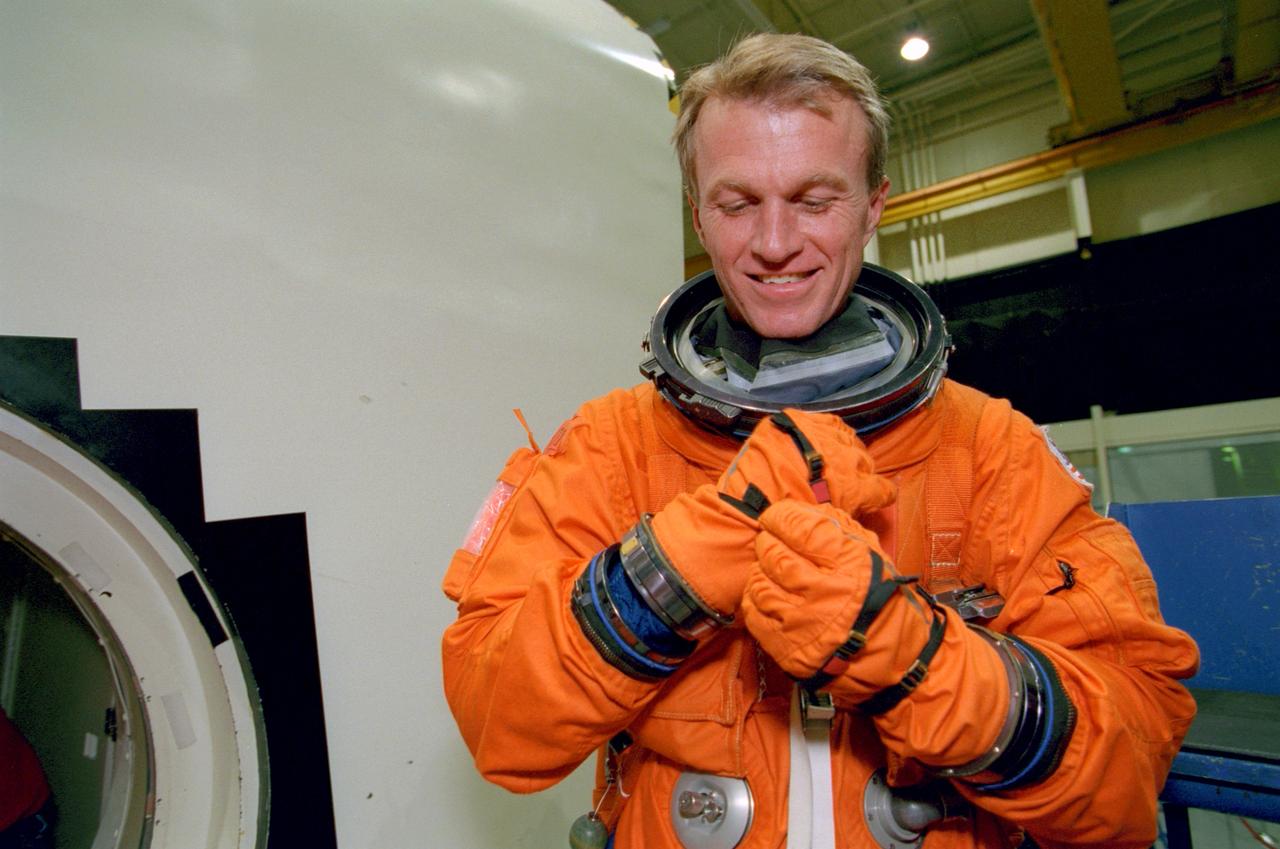
S99-07627 (15 July 1999) --- Astronant Brent W. Jett, STS-97 mission commander, adjusts a glove on his pressure suit during an emergency egress training excercise with the crew compartment trainer (CCT) in the Johnson Space Center's Systems Integration Facility.

LASER DISPLACEMENT MEASUREMENTS IN THE 9X15 FOOT WIND TUNNEL TEST SECTION
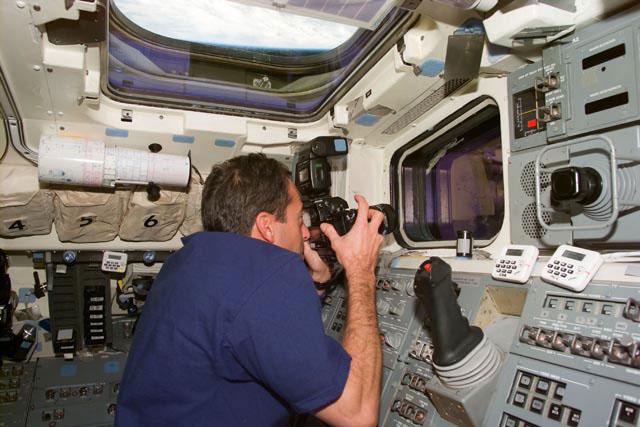
S103-E-5247 (22 December 1999) --- Astronaut Jean-Francois Clervoy, mission specialist representing the European Space Agency (ESA), takes out-the-window pictures during the first space walk on this third visit by NASA astronauts to service the Hubble Space Telescope (HST).

Prior to the commencement of Apollo 11th's 30th arniversary festivities at Marshall Space Flight Center, visiting Saturn astronauts take a tour of the Center. Pictured are (L/R): Dick Gordon, Owen Garriott and Edgar Mitchell
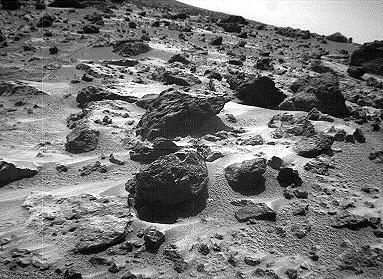
North View from Sojourner - Left Eye
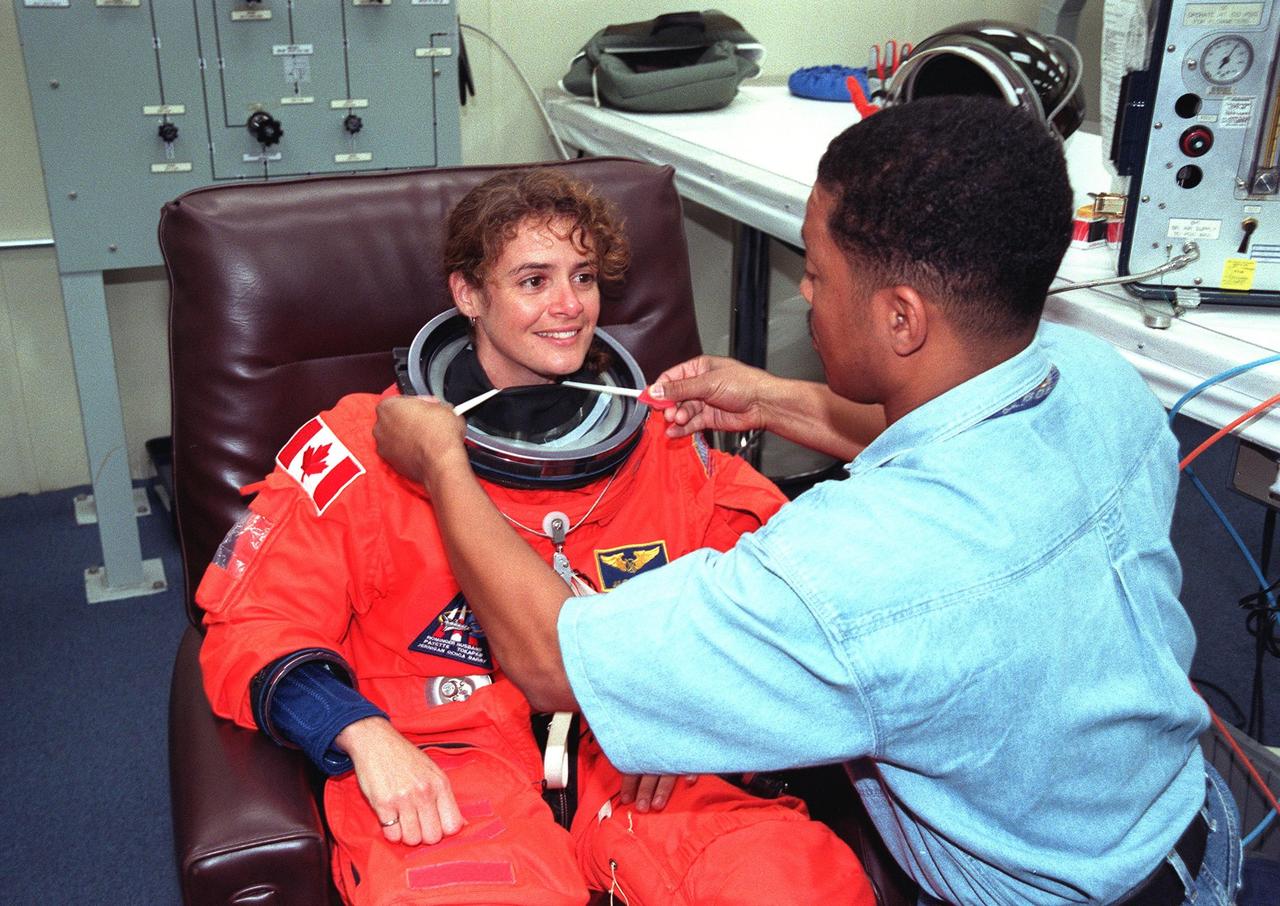
In the Operations and Checkout Building, STS-96 Mission Specialist Julie Payette is assisted by a suit technician in donning her launch and entry suit during final launch preparations. Payette is with the Canadian Space Agency. STS-96 is a 10-day logistics and resupply mission for the International Space Station, carrying about 4,000 pounds of supplies, to be stored aboard the station for use by future crews, including laptop computers, cameras, tools, spare parts, and clothing. The mission also includes such payloads as a Russian crane, the Strela; a U.S.-built crane; the Spacehab Oceaneering Space System Box (SHOSS), a logistics items carrier; and STARSHINE, a student-involved experiment. It will include a space walk to attach the cranes to the outside of the ISS for use in future construction.. Space Shuttle Discovery is due to launch today at 6:49 a.m. EDT. Landing is expected at the SLF on June 6 about 1:58 a.m. EDT
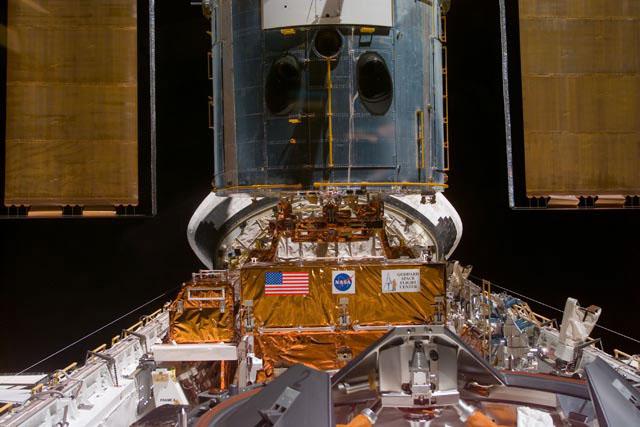
S103-E-5169 (21 December 1999) --- This electronic still camera's view and others in this series showing the Hubble Space Telescope (HST) berthed in Discovery's bay were recorded during capture and downlinked at the completion of the mission's first space walk on the following day by the busy STS-103 astronauts. The image was recorded at 19:49:22 GMT, Dec. 21, 1999.
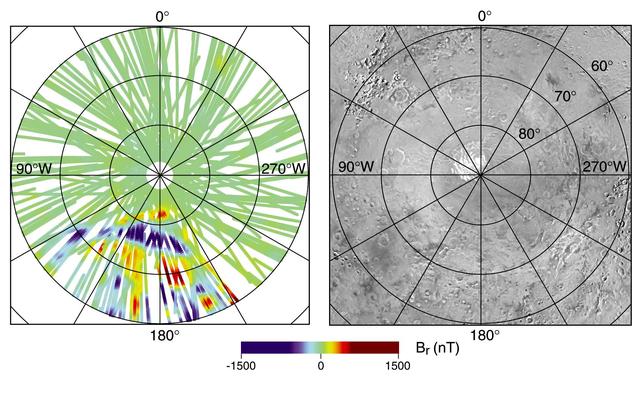
South Polar Magnetic Anomaly Map MAG/ER
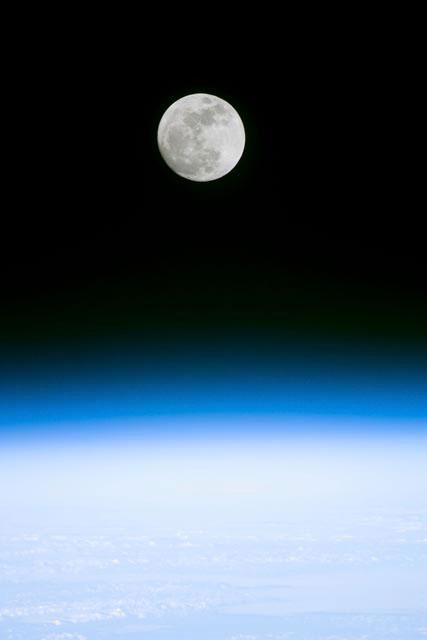
STS103-E-5040 (21 December 1999) --- This photo of the Moon over the airglow of Earth's atmosphere was taken by the STS-103 crew members aboard Discovery. Time of the electronic still camera's (ESC) image was 15:15:41 GMT, Dec. 21, 1999.

Inside the Vehicle Assembly Building, two STS-93 crew members, (center) Mission Specialist Michel Tognini of France and Pilot Jeffrey S. Ashby, get a close look at something seldom seen, the tip of an external tank. With them are Roland Nedelkovich (far left), with the Vertical Integration Test Team, and John Hlavacka (far right). STS-93 is scheduled to launch July 9 aboard Space Shuttle Columbia and has the primary mission of the deployment of the Chandra X-ray Observatory. Formerly called the Advanced X-ray Astrophysics Facility, Chandra comprises three major elements: the spacecraft, the science instrument module (SIM), and the world's most powerful X-ray telescope. Chandra will allow scientists from around the world to see previously invisible black holes and high-temperature gas clouds, giving the observatory the potential to rewrite the books on the structure and evolution of our universe. Other STS-93 crew members are Commander Eileen M. Collins and Mission Specialists Catherine G. Coleman and Steven A. Hawley
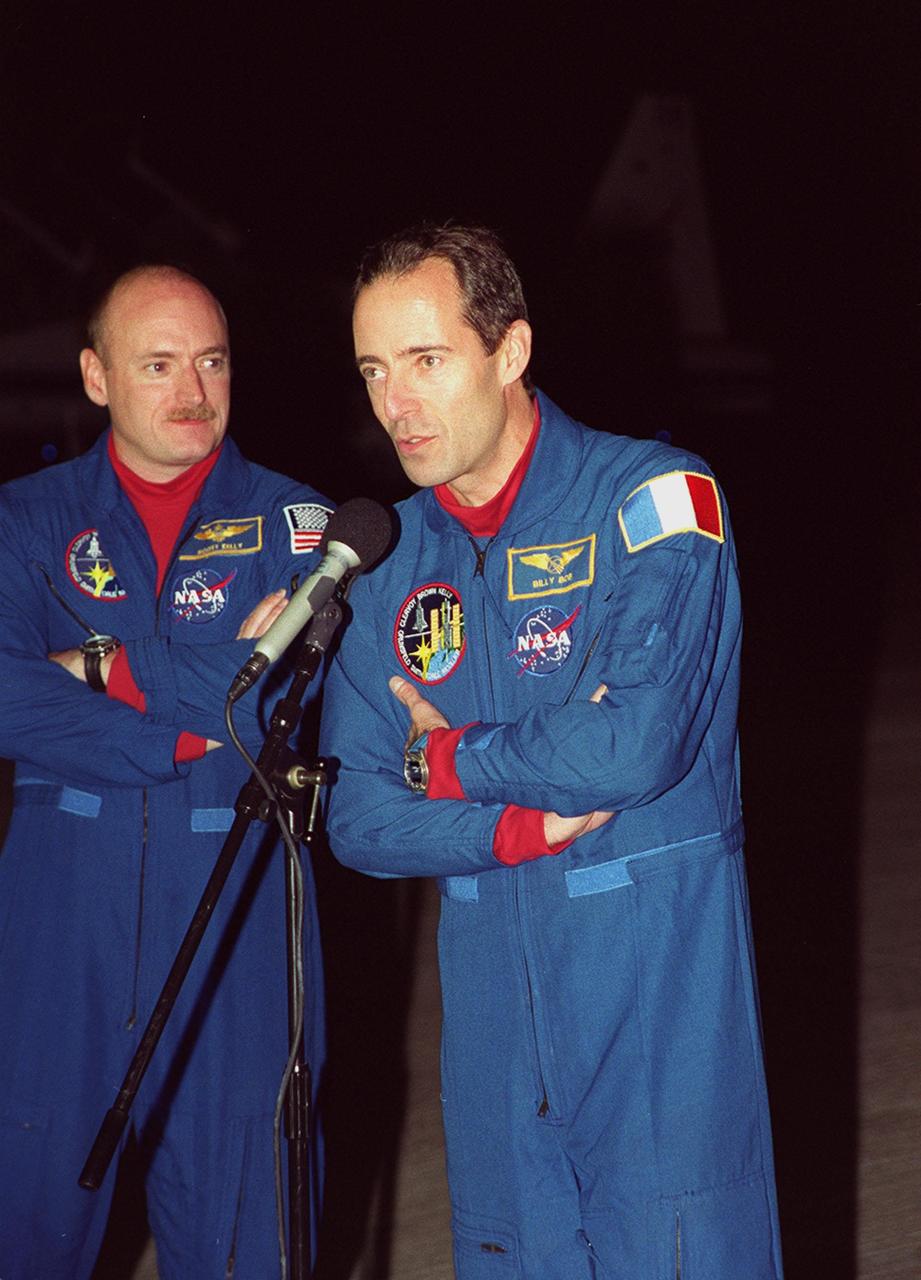
STS-103 Mission Specialist Jean-François Clervoy of France (at microphone) greets the media at the Shuttle Landing Facility as Pilot Scott J. Kelly looks on. The crew arrived at KSC aboard T-38 jets to make final preparations for their launch. The other STS-103 crew members are Commander Curtis L. Brown Jr. and Mission Specialists Steven L. Smith, C. Michael Foale (Ph.D.), John M. Grunsfeld (Ph.D.), and Claude Nicollier of Switzerland. Nicollier and Clervoy are with the European Space Agency. The mission, to service the Hubble Space Telescope a third time, is scheduled for launch Dec. 11 at 12:13 a.m. EST from Launch Pad 39B
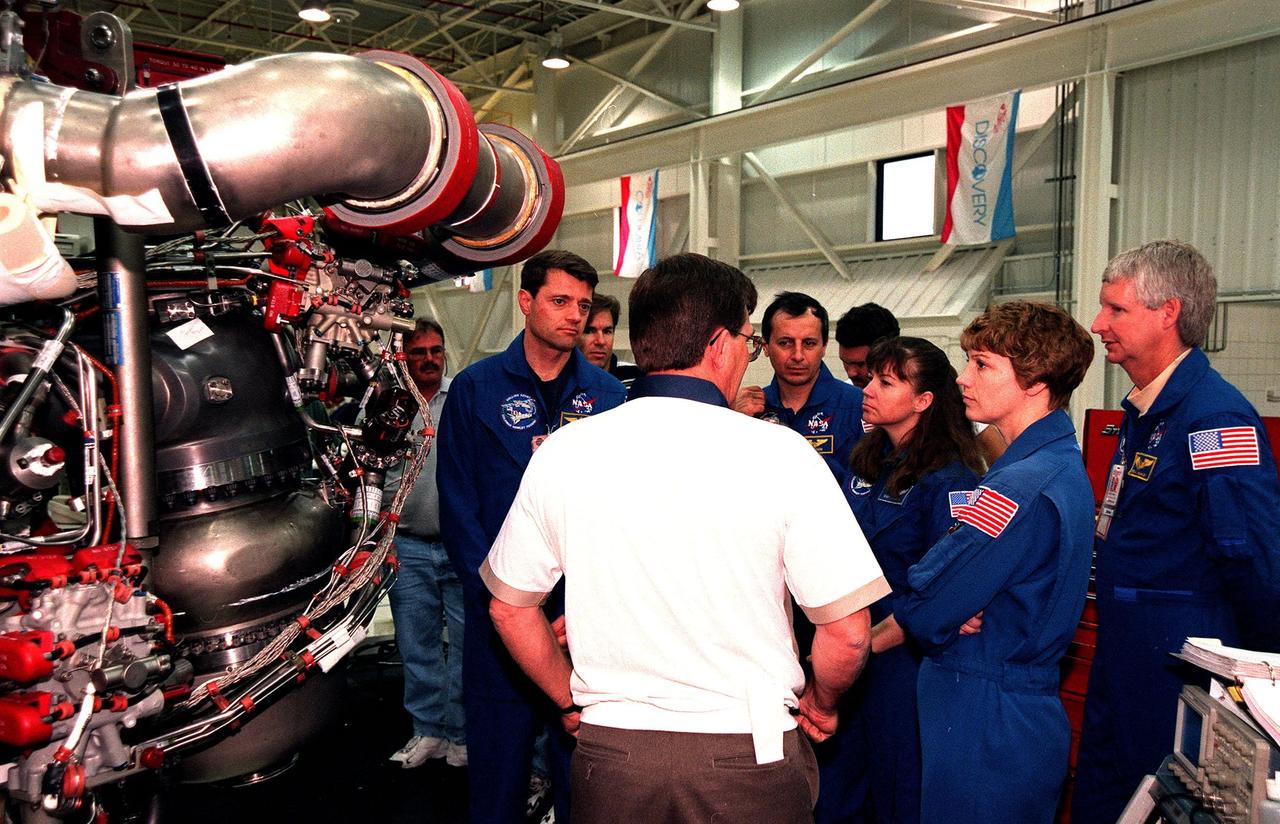
In the Space Shuttle Main Engine Facility, , STS-93 crew members listen to Site Director Dan Hausman, with Rocketdyne, while looking over the main engine of the Space Shuttle Columbia. From left, they are Pilot Jeffrey S. Ashby, Mission Specialists Michel Tognini of France, who represents the Centre National d'Etudes Spatiales (CNES), and Mission Specialist Catherine G. Coleman, Commander Eileen Collins and Mission Specialist Steven A. Hawley. STS-93, scheduled to launch July 9 aboard Space Shuttle Columbia, has the primary mission of the deployment of the Chandra X-ray Observatory. Formerly called the Advanced X-ray Astrophysics Facility, Chandra comprises three major elements: the spacecraft, the science instrument module (SIM), and the world's most powerful X-ray telescope. Chandra will allow scientists from around the world to see previously invisible black holes and high-temperature gas clouds, giving the observatory the potential to rewrite the books on the structure and evolution of our universe
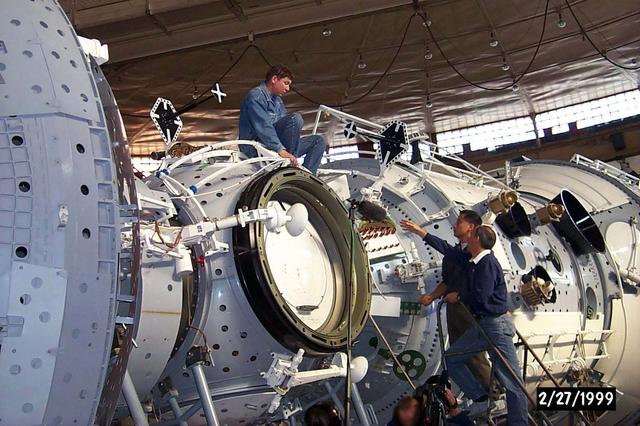
99-E-14665 (27 February 1999) --- Astronauts Edward T. Lu (left) and Jeffrey N. Williams check out full-scale training hardware for the International Space Station (ISS) in the Hydrolab facility at Star City, Russia. The two mission specialists, along with other members of the STS-101 crew, are currently in training at the Gagarin Cosmonaut Training Center for next year's STS-101 mission to the International Space Station (ISS). Editor's Note: Since this photograph was taken, changes in crew personnel have been made. Cosmonauts Yuri I. Malenchenko and Boris V. Morukov, along with astronaut Edward T. Lu were moved to STS-106. Astronauts James S. Voss and Susan J. Helms, and cosmonaut Yury V. Usachev were added to the STS-101 crew. Malenchenko, Morukov and Usachev all represent the Russian Space Agency (RSA).
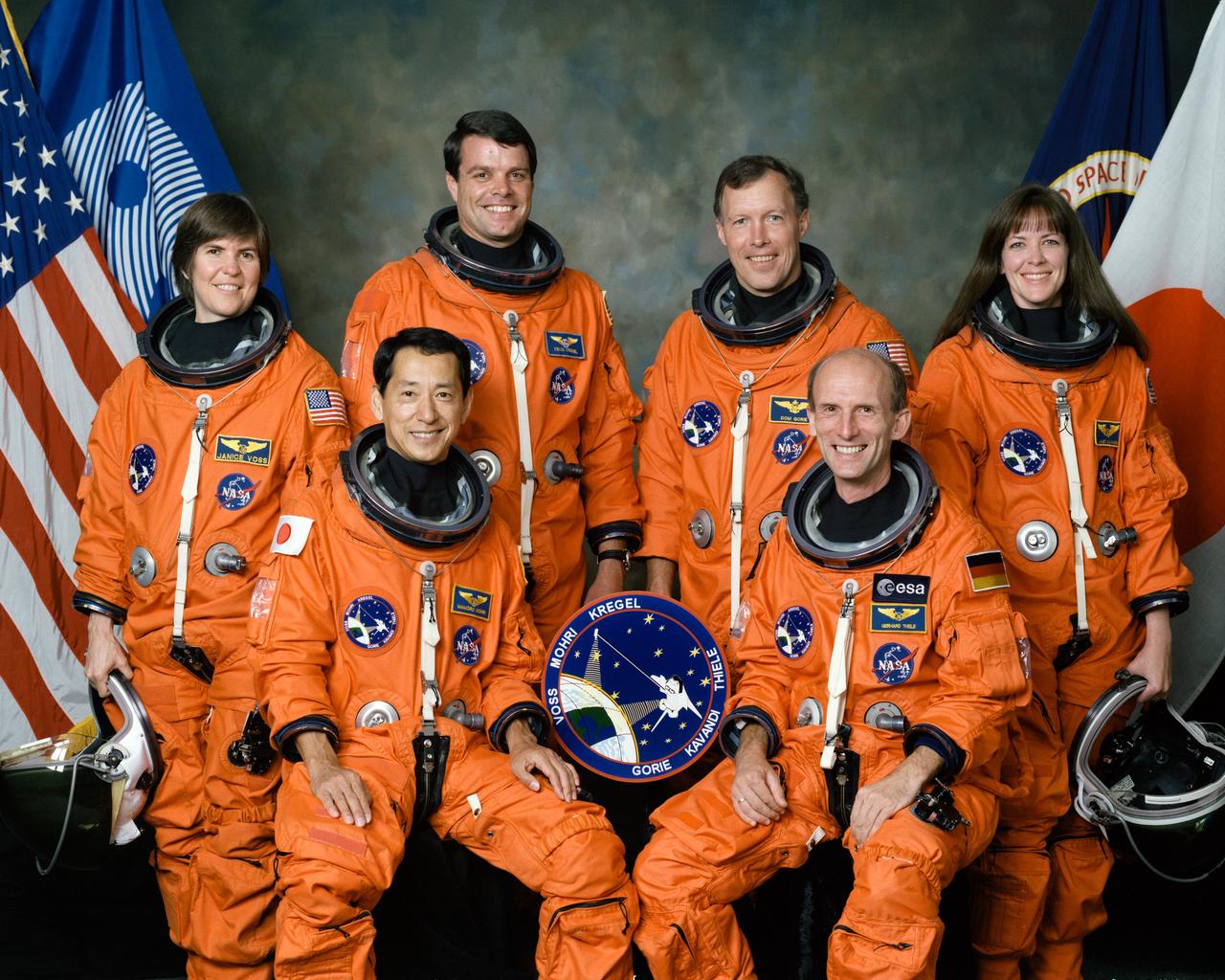
STS099-S-002 (June 1999) --- An international crew assigned to STS-99 takes a break from training to pose for the traditional crew portrait at NASA's Johnson Space Center (JSC). In front are international astronauts Mamoru Mohri and Gerhard P.J. Thiele, both mission specialists. In back are astronauts Janice Voss, mission specialist; Kevin R. Kregel, mission commander; Dominic L. Gorie, pilot; and Janet L. Kavandi, mission specialist. Mohri represents Japan's National Space Development Agency (NASDA) and Thiele represents the European Space Agency (ESA). The mission is scheduled as an eleven-day flight for late summer/early autumn of this year.
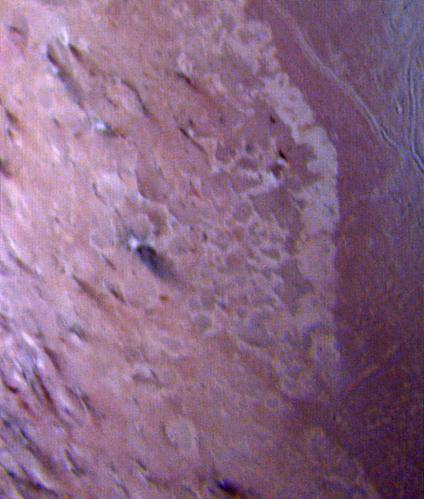
This false color image of Triton is a composite of images taken through the violet, green and ultraviolet filters. The image was taken early on Aug. 25, 1989 when Voyager 2 was about 190,000 kilometers 118,000 miles from Triton surface.
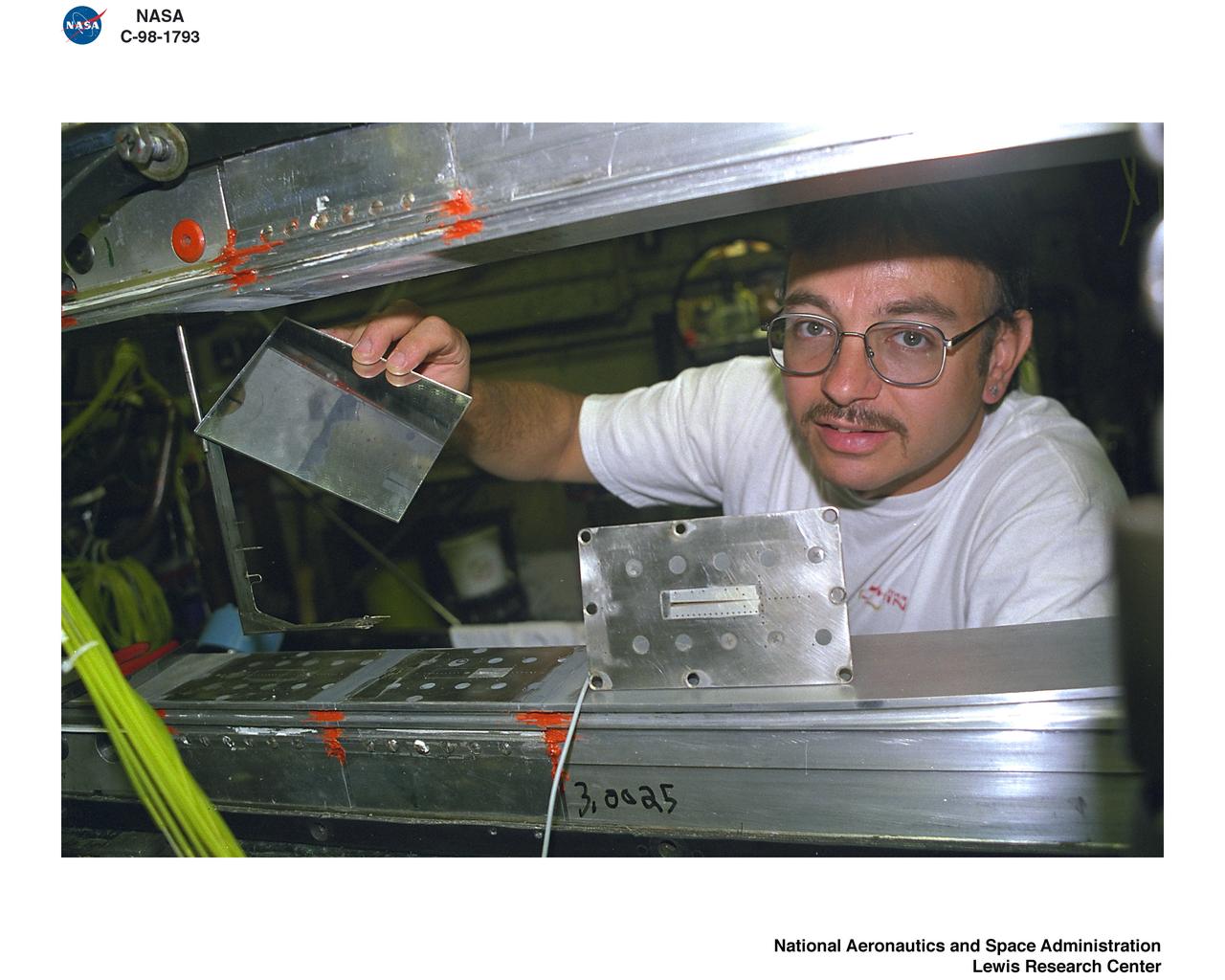
REASSEMBLY OF DUCT LAB SWT MACH 4-5 NOZZLE WITH MACH 2.0 INJECTION
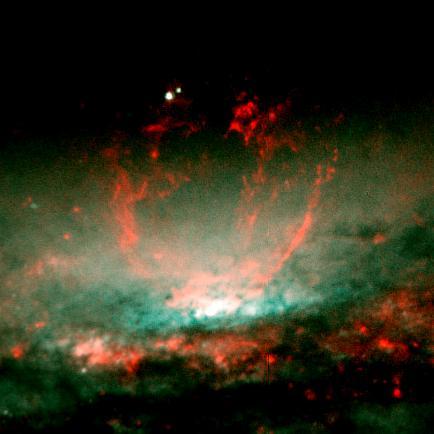
A lumpy bubble of hot gas rises from a cauldron of glowing matter in a distant galaxy, as seen by NASA Hubble Space Telescope.

KENNEDY SPACE CENTER, FLA. --Official portrait of Michael E. "Mike" Wetmore, deputy director of Shuttle Processing.
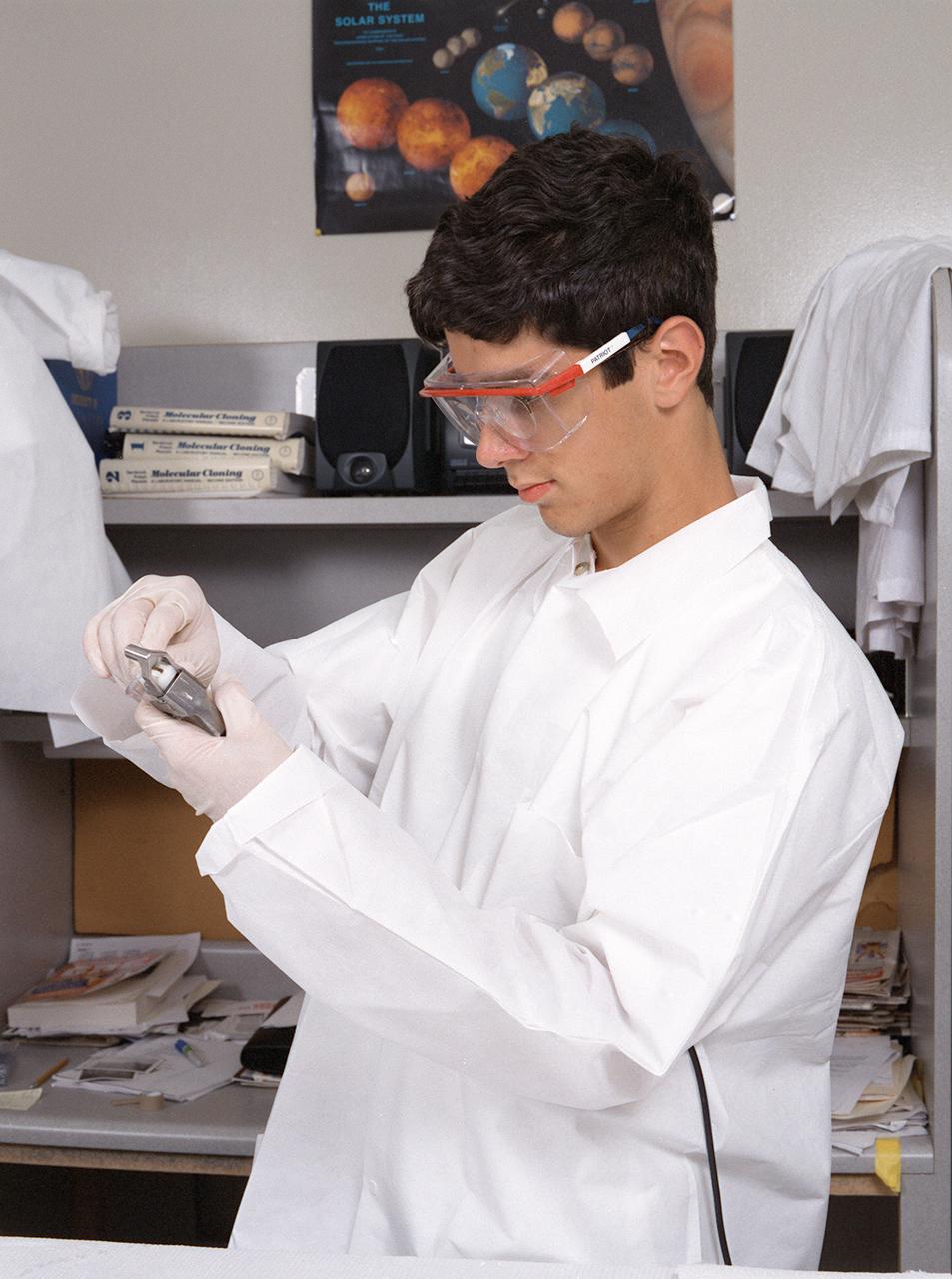
A Memphis student working at the University of Alabama in Huntsville prepares samples for the first protein crystal growth experiments plarned to be performed aboard the International Space Station (ISS). The proteins are placed in plastic tubing that is heat-sealed at the ends, then flash-frozen and preserved in a liquid nitrogen Dewar. Aboard the ISS, the nitrogen will be allowed to evaporated so the samples thaw and then slowly crystallize. They will be analyzed after return to Earth. Photo credit: NASA/Marshall Space Flight Center (MSFC)
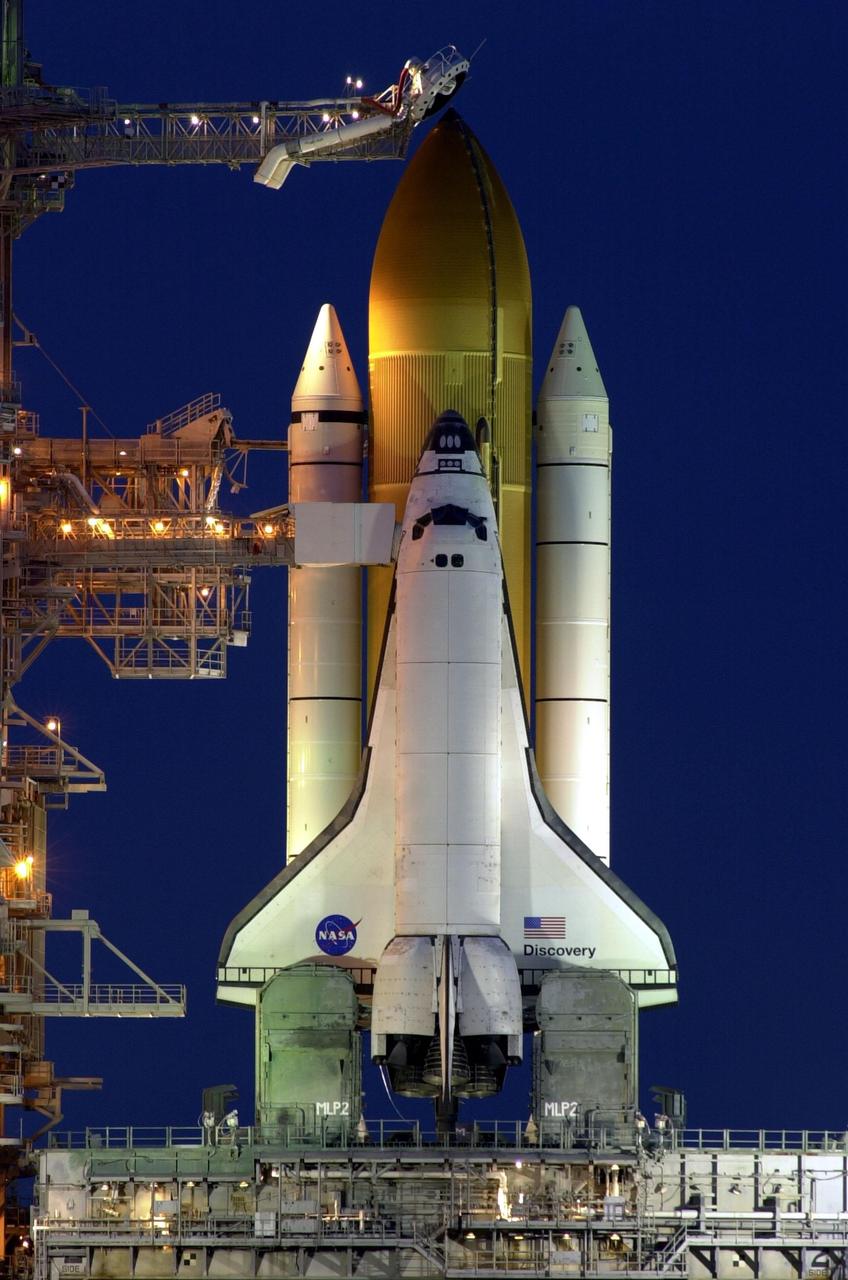
Just after sundown, Space Shuttle Discovery is framed with light from the Fixed Service Structure on Launch Pad 39B as it waits for liftoff on mission STS-103. At the top is seen the external tank gaseous oxygen vent arm system with the vent hood (commonly called the "beanie cap") poised above the external tank. The retractable arm and the beanie cap are designed to vent gaseous oxygen vapors away from the Space Shuttle. The arm truss section is 65 feet long and the diameter of the beanie cap is 13 feet. Extending toward the cabin of the orbiter is the orbiter access arm, with the environmental chamber (called the White Room) at the end. Through this chamber the crew enters the orbiter. The STS-103 mission, to service the Hubble Space Telescope, is scheduled for launch Dec. 17 at 8:47 p.m. EST. Mission objectives include replacing gyroscopes and an old computer, installing another solid state recorder, and replacing damaged insulation in the telescope. The mission is expected to last about 8 days and 21 hours. Discovery is expected to land at KSC Sunday, Dec. 26, at about 6:25 p.m. EST
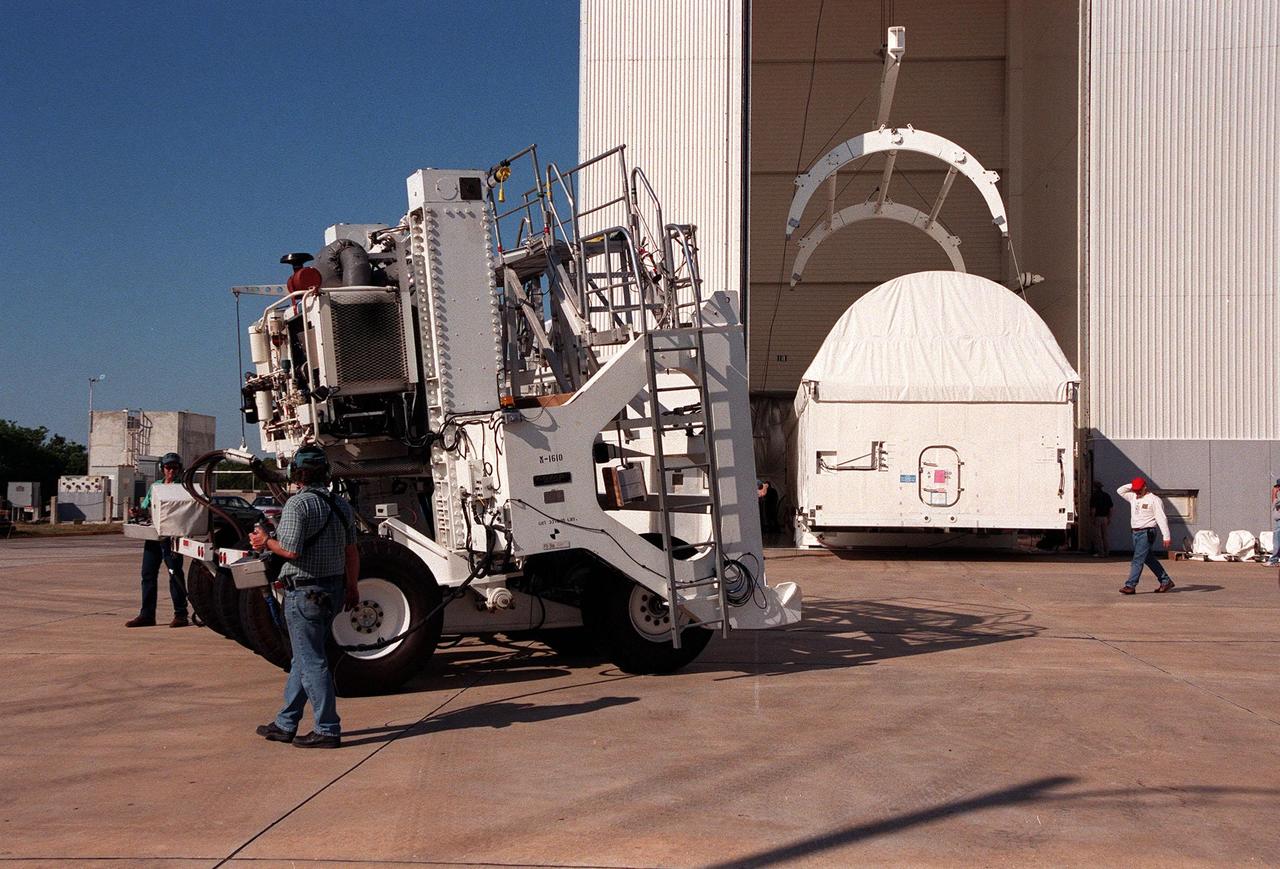
At the Vertical Processing Facility (VPF), workers (left) drive, by remote control, the rear bogie away from the VPF. The bogie is part of the tractor-trailer rig called the Space Cargo Transportation System that helped move the Chandra X-ray Observatory (right) from the Shuttle Landing Facility into the VPF. Chandra arrived at KSC on Thursday, Feb. 4, aboard an Air Force C-5 Galaxy aircraft. In the VPF, the telescope will undergo final installation of associated electronic components; it will also be tested, fueled and mated with the Inertial Upper Stage booster. A set of integrated tests will follow. Chandra is scheduled for launch July 9 aboard Space Shuttle Columbia, on mission STS-93 . Formerly called the Advanced X-ray Astrophysics Facility, Chandra comprises three major elements: the spacecraft, the science instrument module (SIM), and the world's most powerful X-ray telescope. Chandra will allow scientists from around the world to see previously invisible black holes and high-temperature gas clouds, giving the observatory the potential to rewrite the books on the structure and evolution of our universe
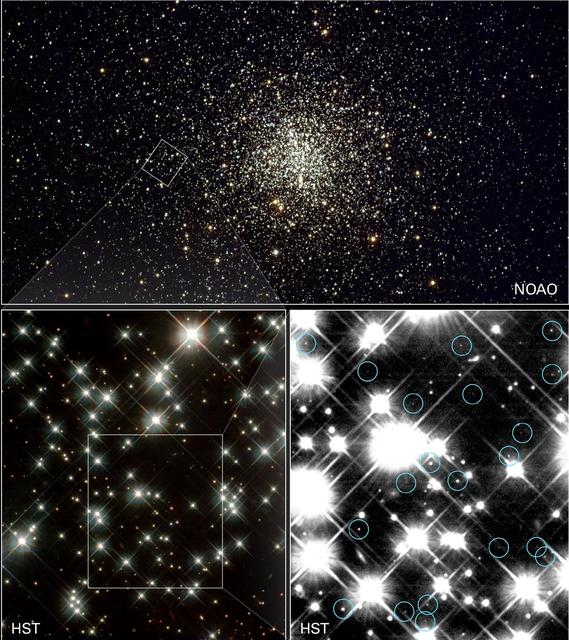
Peering deep inside a cluster of several hundred thousand stars, NASA Hubble Space Telescope has uncovered the oldest burned-out stars in our Milky Way Galaxy, giving astronomers a fresh reading on the age of the universe.
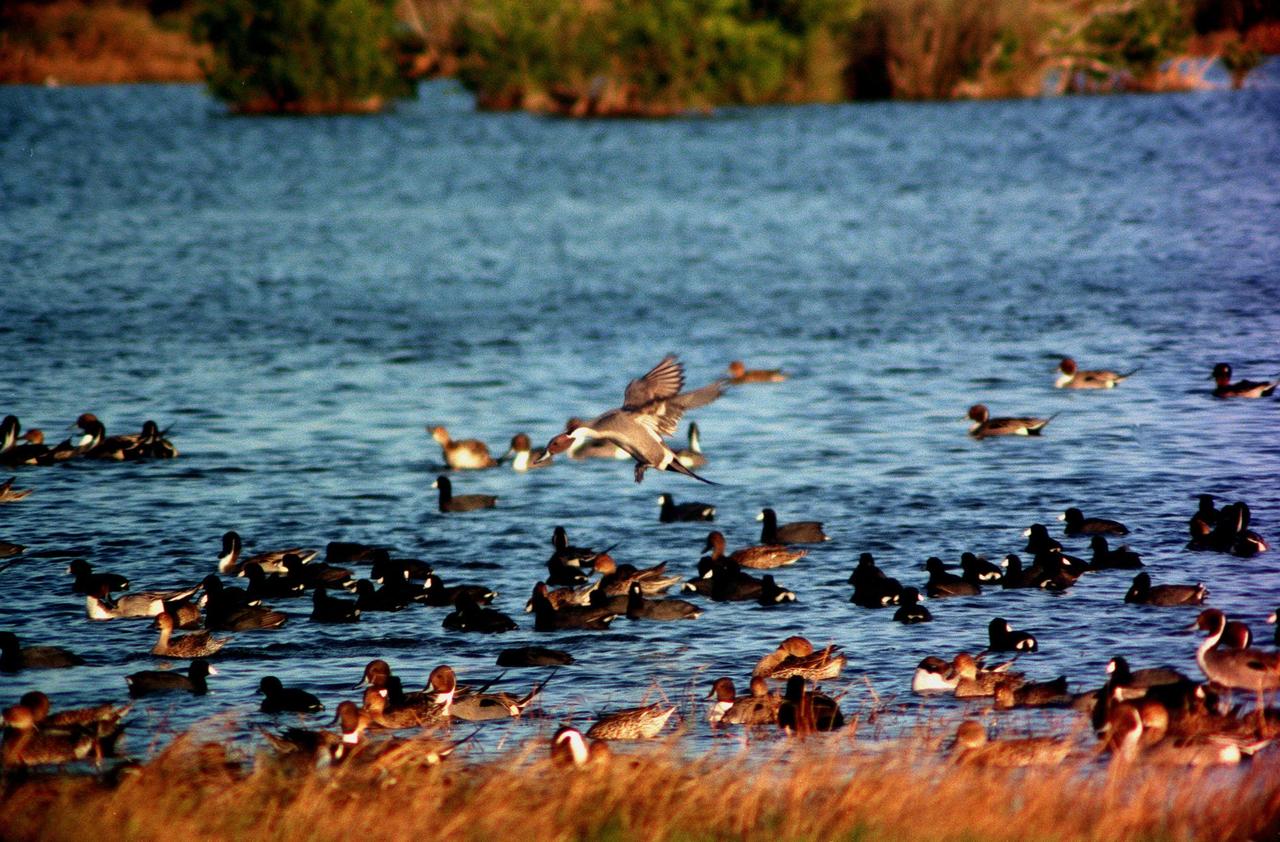
KENNEDY SPACE CENTER, FLA. -- A pintail duck is poised for landing, joining other ducks and coots on the waters of the Merritt Island National Wildlife Refuge at Kennedy Space Center. The refuge is winter home to hundreds of waterfowl such as these coots and pintail ducks. The smaller coot inhabits open ponds and marshes, wintering in saltwater bays and inlets. They range from southern Canada to northern South America. The pintail can be found in marshes, prairie ponds and tundra, and salt marshes in winter. They range from Alaska and Greenland south to Central America and the West Indies
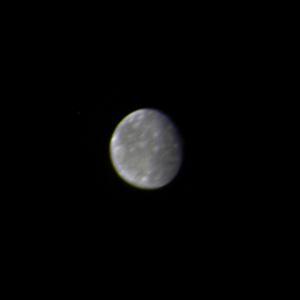
Callisto From 8,023,000 kilometers
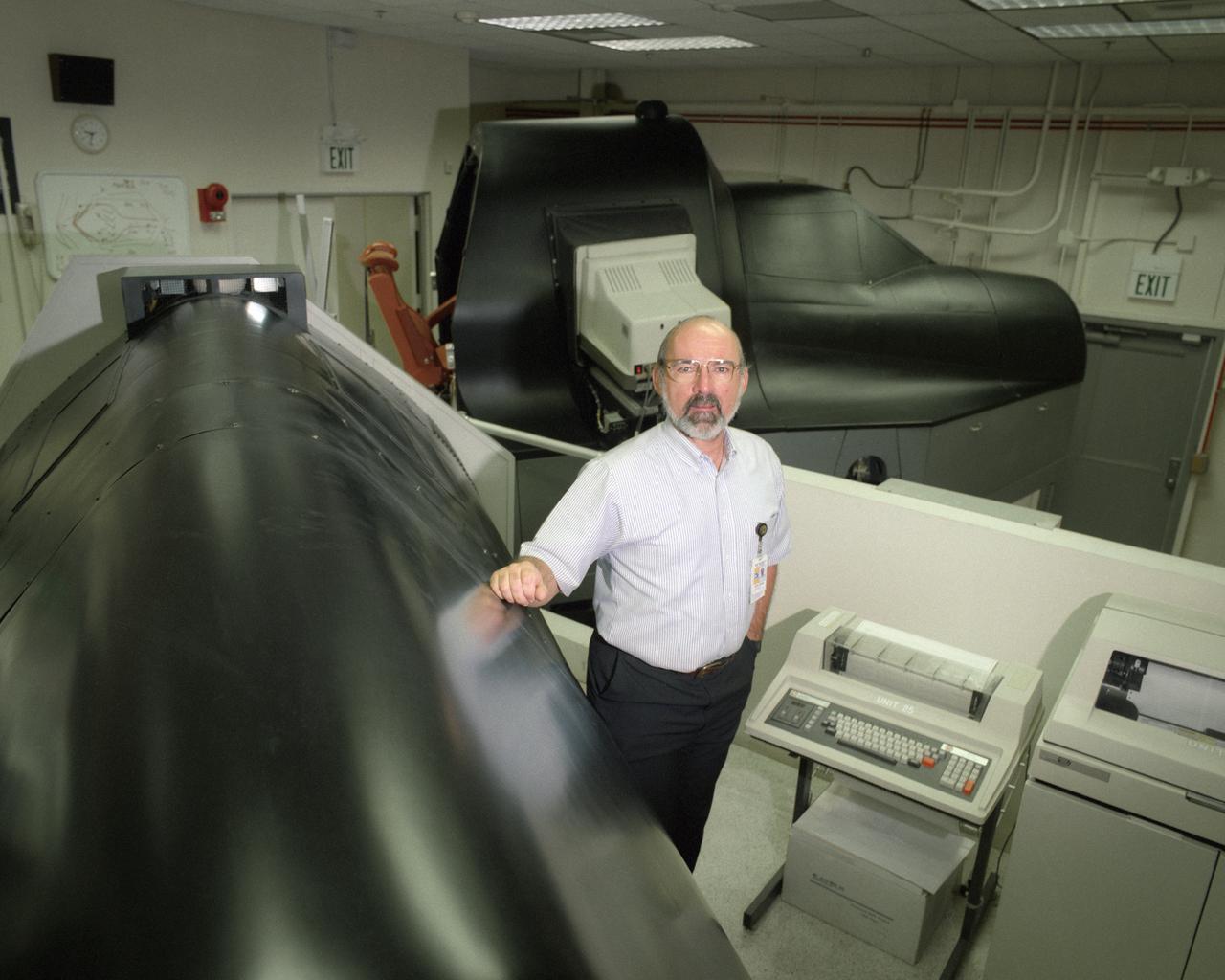
Electronics technician Joe Ciganek was responsible for operation and maintenance of the SR-71 simulator while it was at NASA's Dryden Flight Research Center.