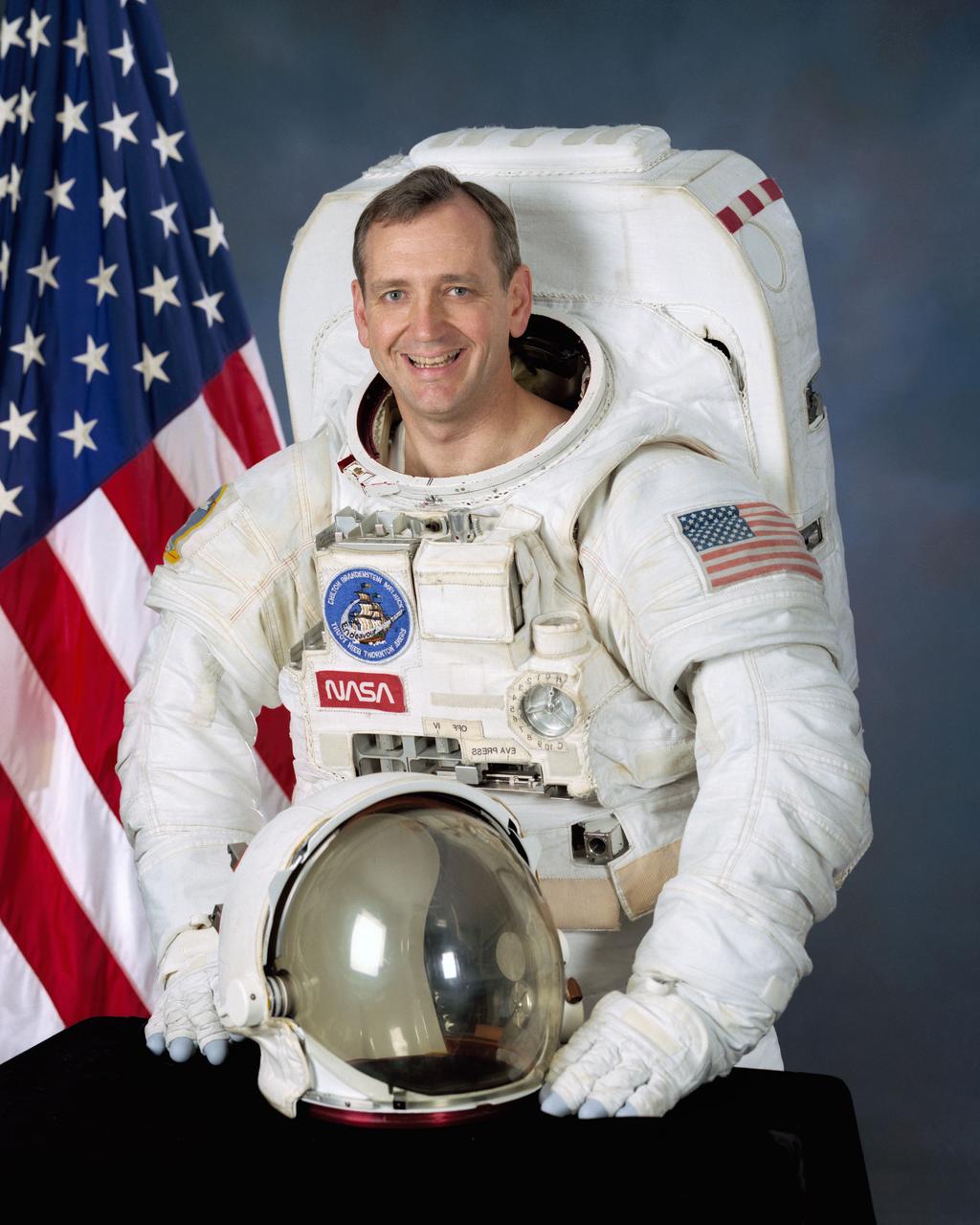
S92-42896 (7 Aug. 1992) --- Astronaut Thomas D. Akers.
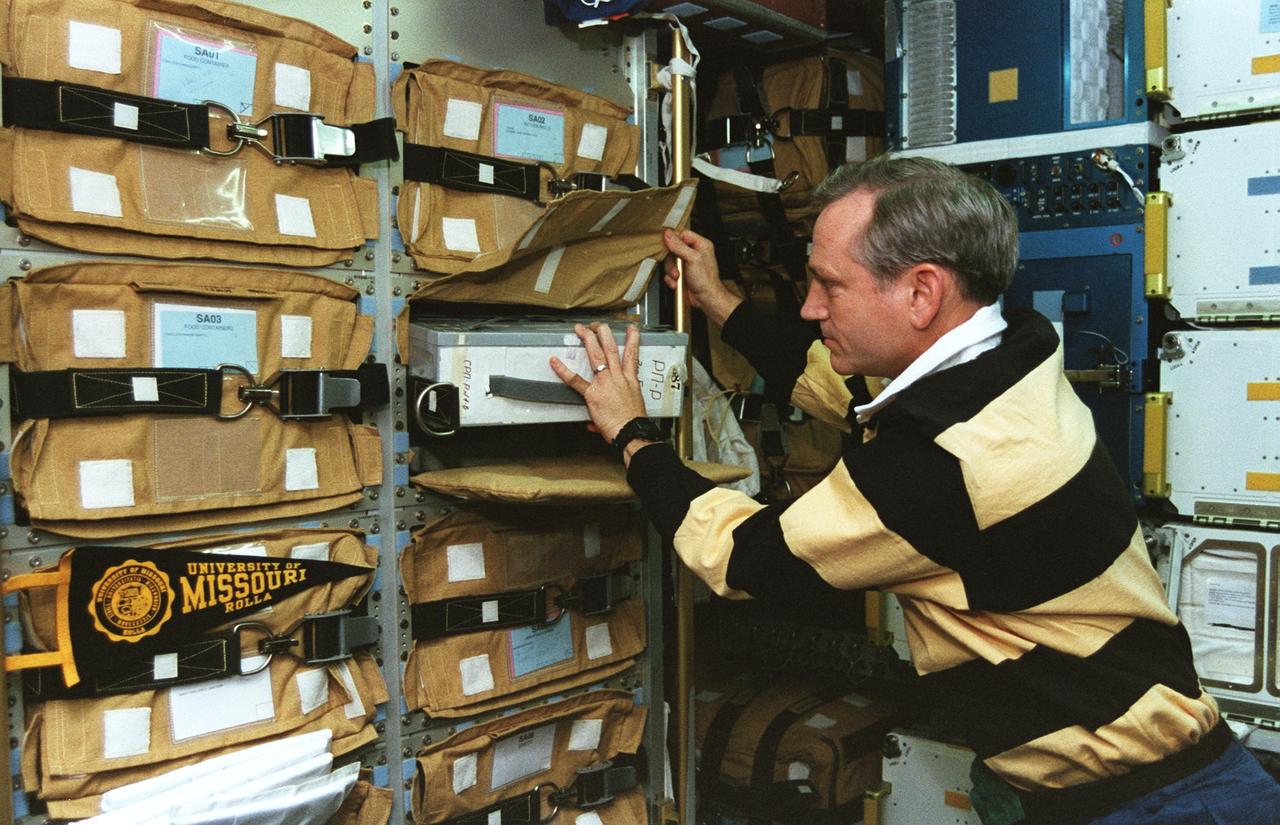
STS079-365-009 (16-26 Sept. 1996) --- Astronaut Thomas D. Akers, mission specialist, continues his busy task of supply transfer. Akers referred to this corner of the Spacehab Module as "transfer headquarters," where he was responsible for keeping up with a large supply of food, batteries, flight gear and a number of other supplies. This flight marked the first for the double module Spacehab configuration.
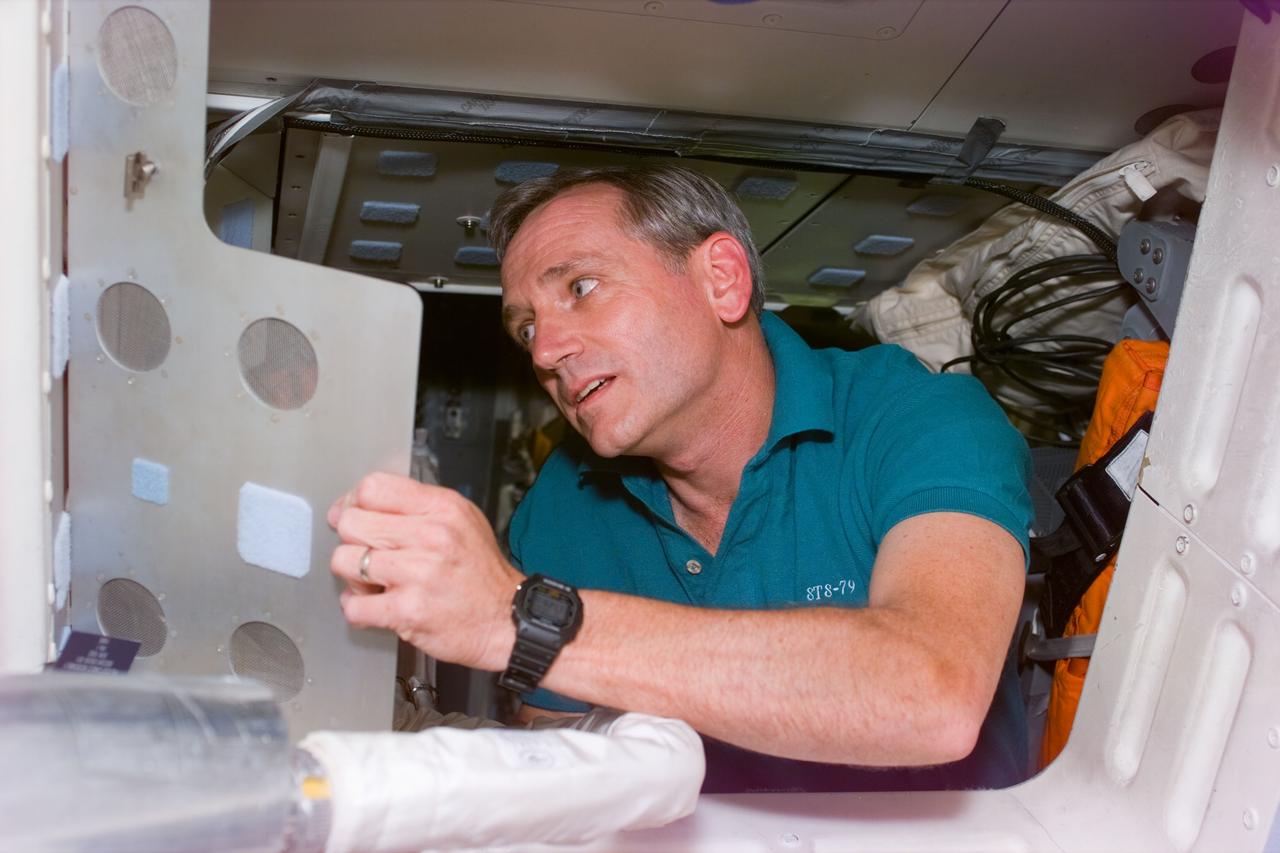
STS79-E-5026 (18 September 1996) --- Thomas D. Akers, mission specialist, prepares to retrieve gear for an experiment in the Spacehab Module, onboard the Space Shuttle Atlantis on Flight Day 3.
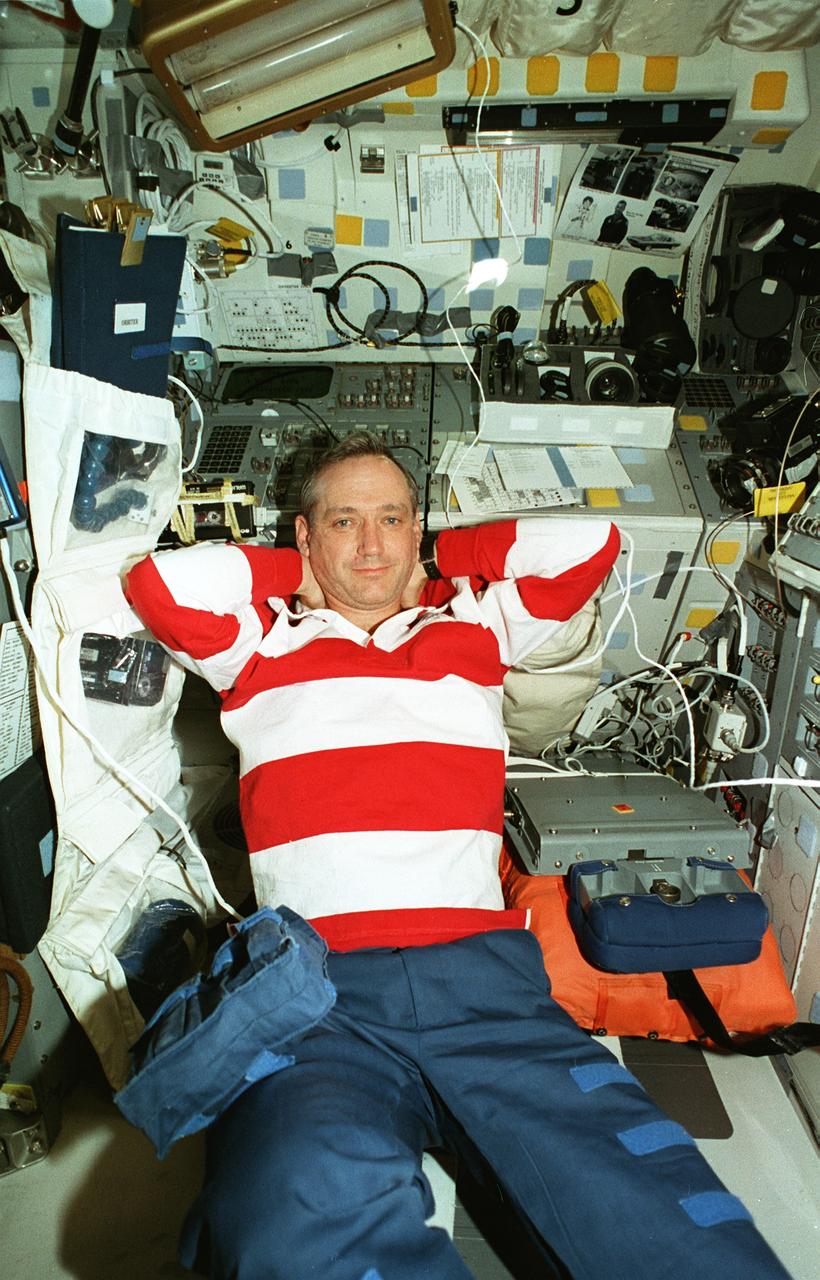
STS079-354-016 (20 Sept. 1996) --- Astronaut Thomas D. Akers, mission specialist, spends a few moments of his off-duty time aboard the Space Shuttle Atlantis in a rare relaxed posture. Akers is on the aft flight deck, looking toward overhead windows (out of frame) through which he could see several of the components of Russia's Mir Space Station, docked for several days to Atlantis. Later, during a post-flight presentation to an assembly of co-workers in Houston, astronaut William F. Readdy, mission commander, recalled this moment as the only one on the STS-79 flight during which he witnessed Akers not busy with transfer chores or Spacehab experiment tasks. Several pieces of camera equipment and a stowed chair used during launch and entry are identifiable among the items on the flight deck.
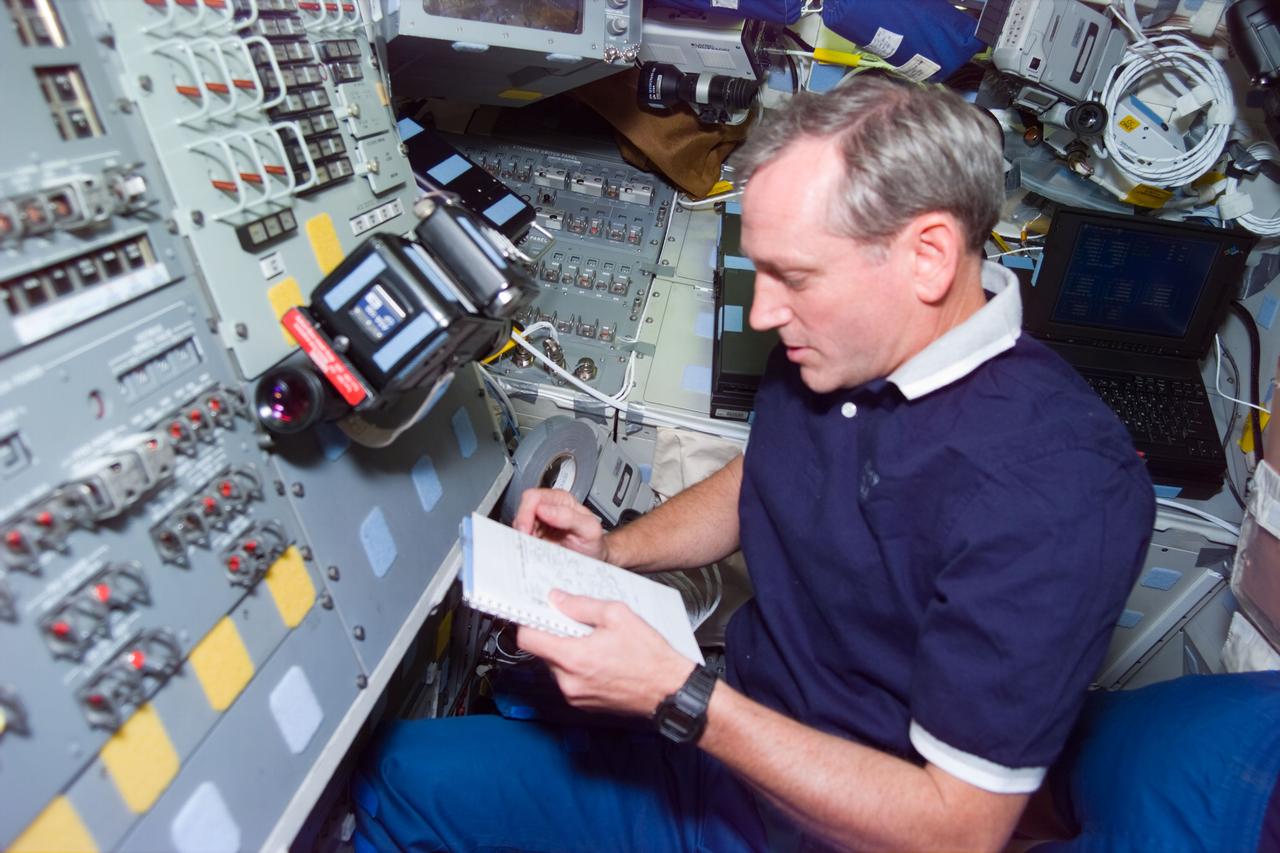
STS79-E-5013 (17 September 1996) --- Astronaut Thomas D. Akers, mission specialist, on the Space Shuttle Atlantis' flight deck soon after STS-79 crew begins its in-space activities, on Flight Day 2.
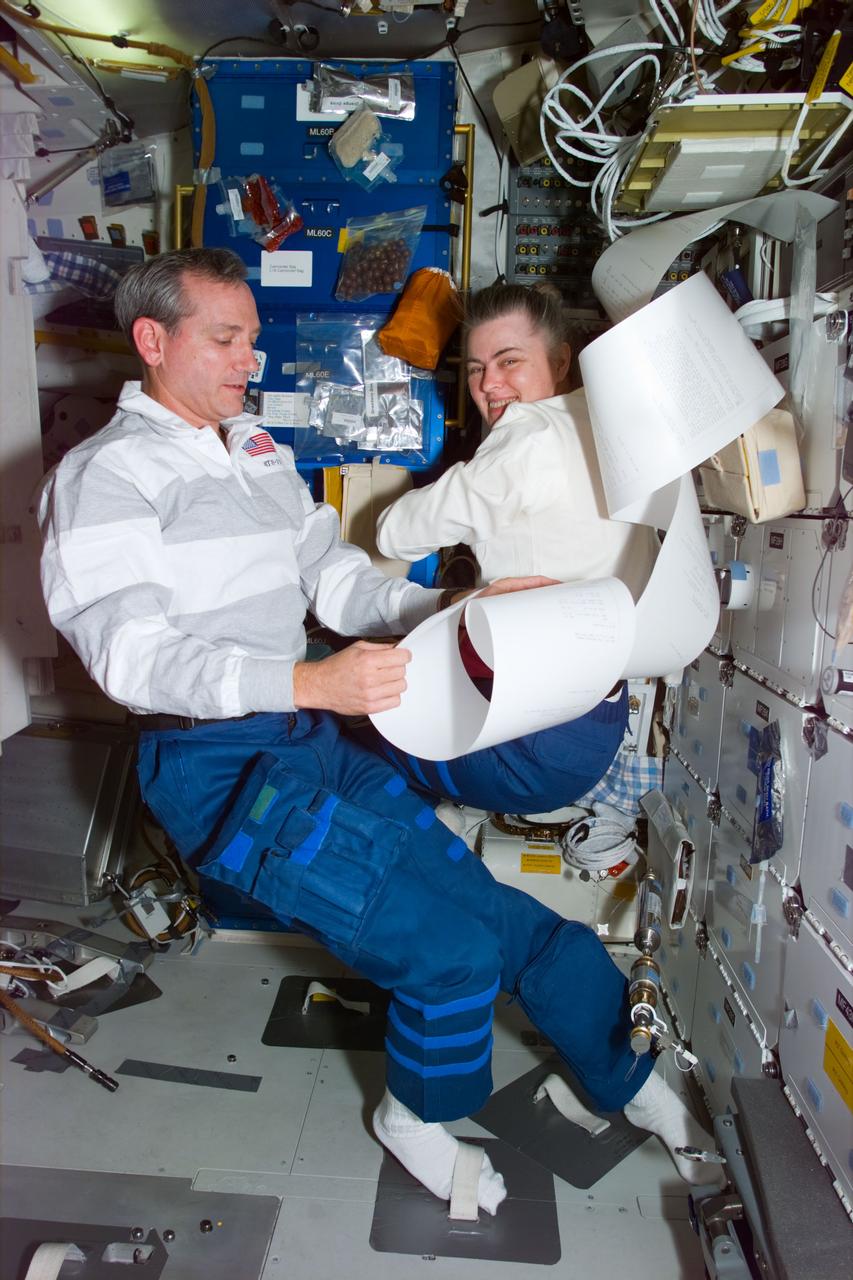
STS79-E-5246 (22 September 1996) --- Astronauts Thomas D. Akers and Shannon W. Lucid check the latest send-up of "mail" on the Space Shuttle Atlantis' mid deck, during Flight Day 7. The Thermal Imaging Printing System (TIPS) messages likely include information pertinent to the final day of joint activities with the Mir-22 crew members whom Lucid will leave behind for her return to Earth later this week.

S87-45895 (15 Oct 1987) --- Astronaut Thomas D. Akers, astronaut candidate.
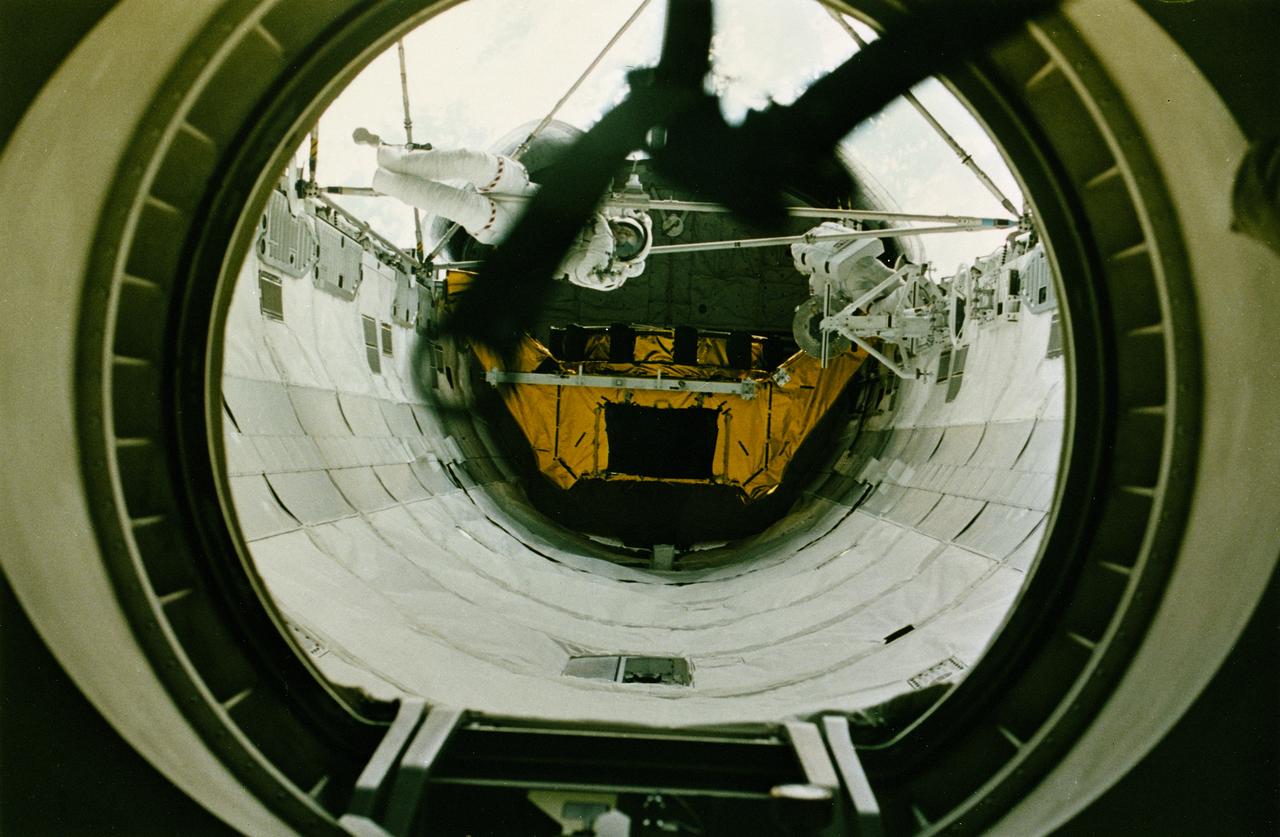
STS-49, the first flight of the Space Shuttle Orbiter Endeavour, lifted off from launch pad 39B on May 7, 1992 at 6:40 pm CDT. The STS-49 mission was the first U.S. orbital flight to feature 4 extravehicular activities (EVAs), and the first flight to involve 3 crew members working simultaneously outside of the spacecraft. The primary objective was the capture and redeployment of the INTELSAT VI (F-3), a communication satellite for the International Telecommunication Satellite organization, which was stranded in an unusable orbit since its launch aboard the Titan rocket in March 1990. A view through Endeavour’s busy airlock reveals astronauts Thomas Akers and Kathryn Thornton.
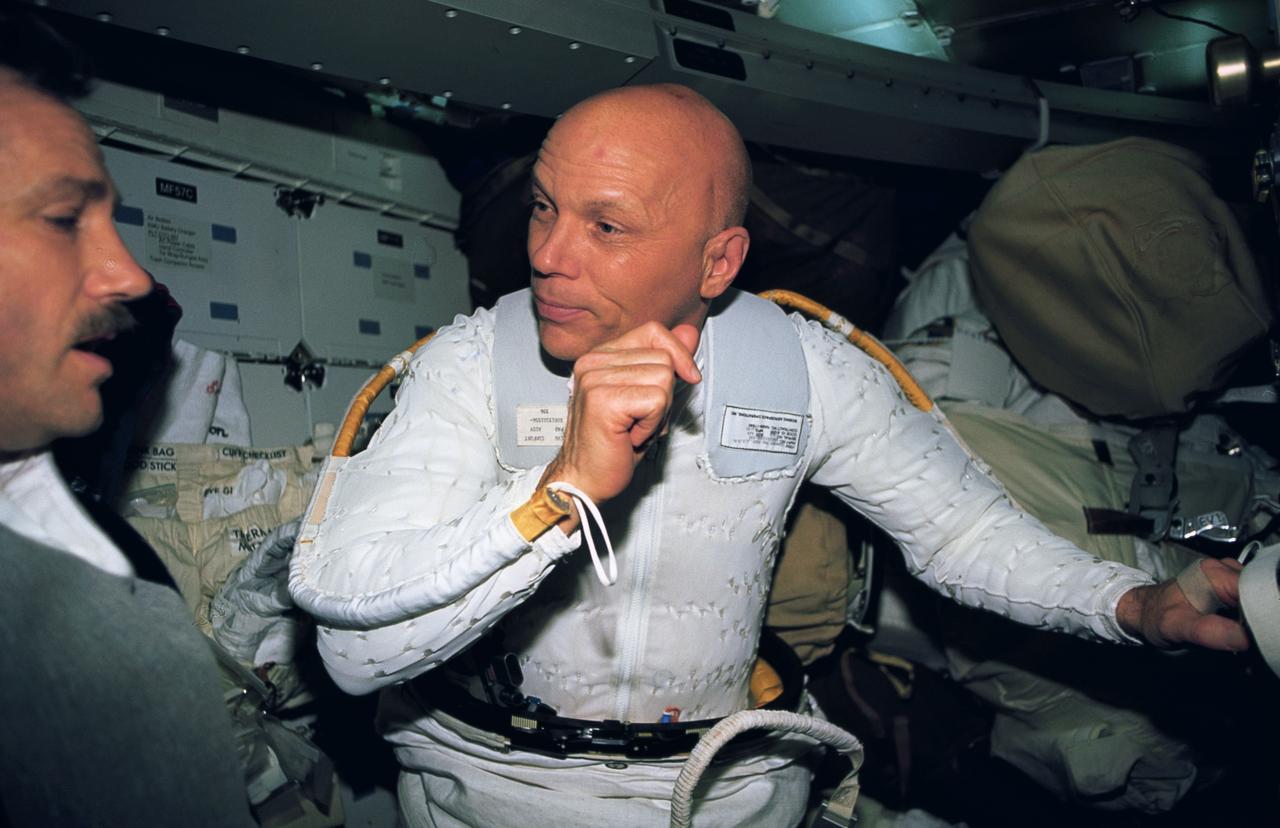
STS061-38-014 (9 Dec 1993) --- Astronaut F. Story Musgrave gets assistance from astronaut Thomas D. Akers while suiting up for the final space walk on the eleven-day, Hubble Space Telescope (HST) servicing mission. Musgrave joined astronaut Jeffrey A. Hoffman (out of frame) on three space walks, while Akers teamed with astronaut Kathryn D. Thornton for two.
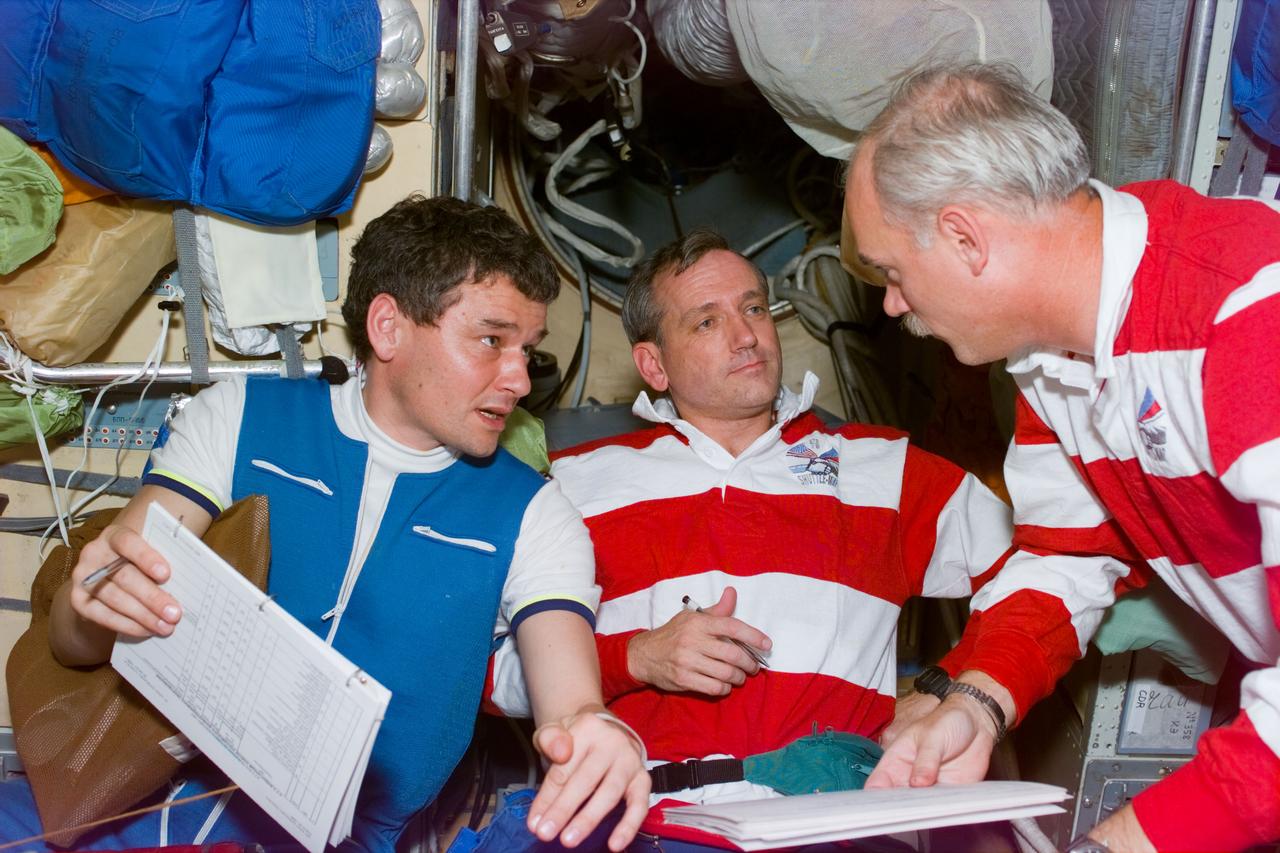
STS79-E-5088 (19 September 1996) --- Left to right, Valeri G. Korzun, Thomas D. Akers and William F. Readdy discuss the agenda of their shared activities for the next few days, on Flight Day 4. Korzun and Readdy share common positions - that of commander - for the Mir-22 and STS-79 missions, respectively. Akers is a STS-79 mission specialist.
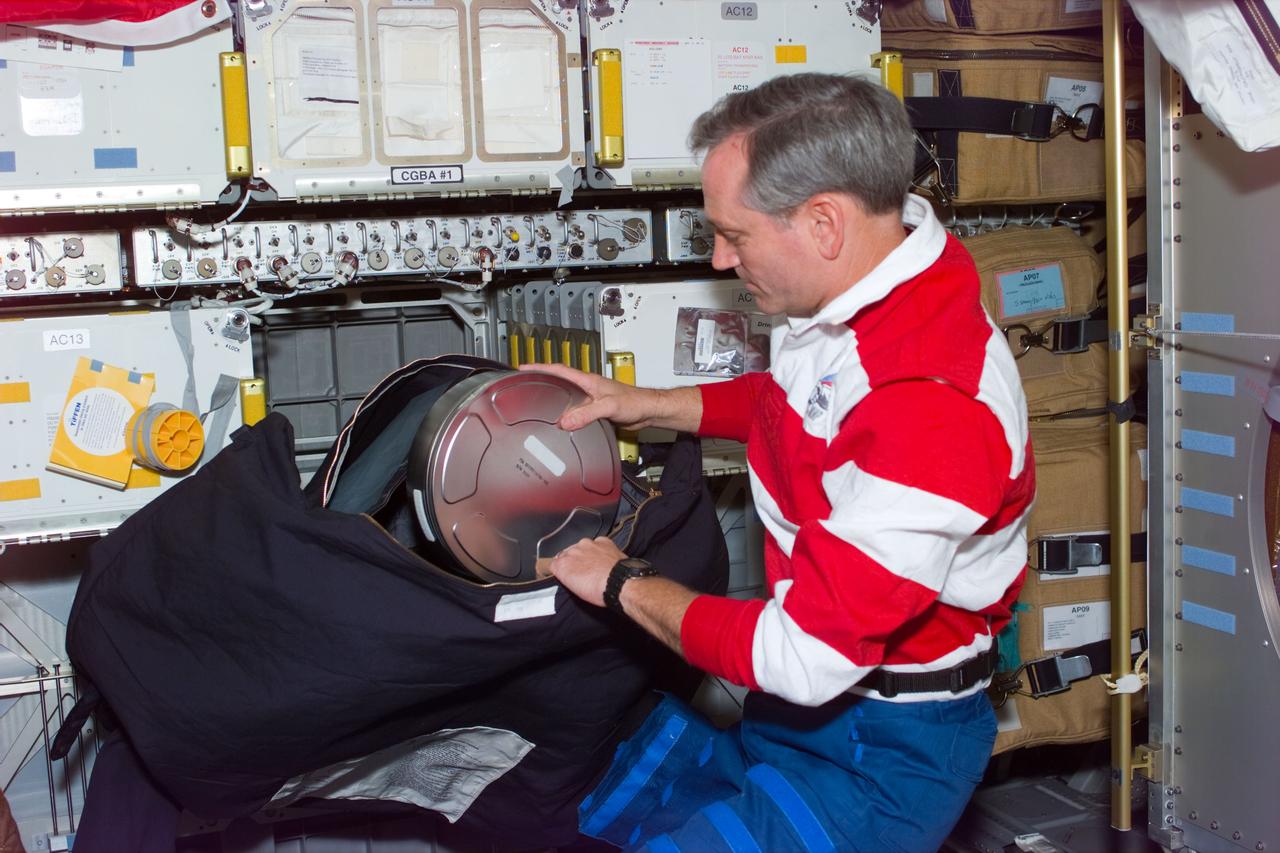
STS79-E-5274 (23 September 1996) --- Onboard Spacehab, in the Earth-orbiting Space Shuttle Atlantis, astronaut Thomas D. Akers stows an exposed film can from the IMAX in-cabin camera, during Flight Day 8.

S61-E-012 (5 Dec 1993) --- This view of astronauts Kathryn C. Thornton (top) and Thomas D. Akers working on the Hubble Space Telescope (HST) was photographed with an Electronic Still Camera (ESC), and down linked to ground controllers soon afterward. Thornton, anchored to the end of the Remote Manipulator System (RMS) arm, is teaming with Akers to install the +V2 Solar Array Panel as a replacement for the original one removed earlier. Akers uses tethers and a foot restraint to remain in position for the task. Electronic still photography is a relatively new technology which provides the means for a handheld camera to electronically capture and digitize an image with resolution approaching film quality. The electronic still camera has flown as an experiment on several other shuttle missions.

S61-E-014 (5 Dec 1993) --- This view of astronauts Kathryn C. Thornton (bottom) and Thomas D. Akers working on the Hubble Space Telescope (HST) was photographed with an Electronic Still Camera (ESC), and down linked to ground controllers soon afterward. Thornton, anchored to the end of the Remote Manipulator System (RMS) arm, is teaming with Akers to install the +V2 Solar Array Panel as a replacement for the original one removed earlier. Akers uses tethers and a foot restraint to remain in position for the task. Electronic still photography is a relatively new technology which provides the means for a handheld camera to electronically capture and digitize an image with resolution approaching film quality. The electronic still camera has flown as an experiment on several other shuttle missions.
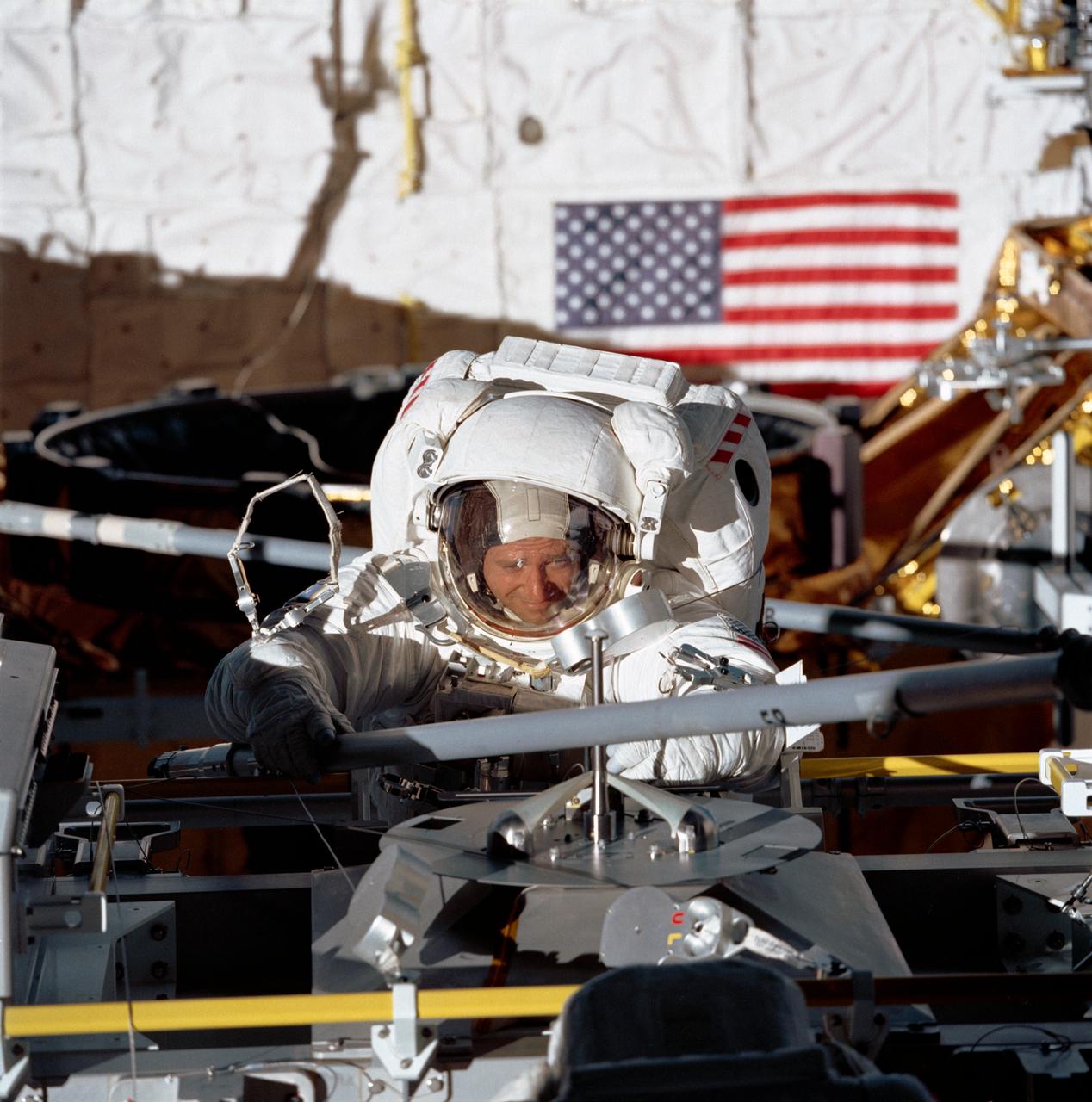
STS049-77-028 (14 May 1992) --- Astronaut Thomas D. Akers, STS-49 mission specialist, grabs a strut device as fourth period of extravehicular activity (EVA) gets underway in the Space Shuttle Endeavour's cargo bay. Akers is positioned near the Multi-purpose Support Structure (MPESS). The purpose of the final EVA on this nine-day mission was the evaluation of Assembly of Station by EVA Methods (ASEM). The scene was recorded on 70mm film by a fellow crew member in the space shuttle's cabin. Astronaut Kathryn C. Thornton (out of frame) joined Akers on the 7 1/2 hour EVA.
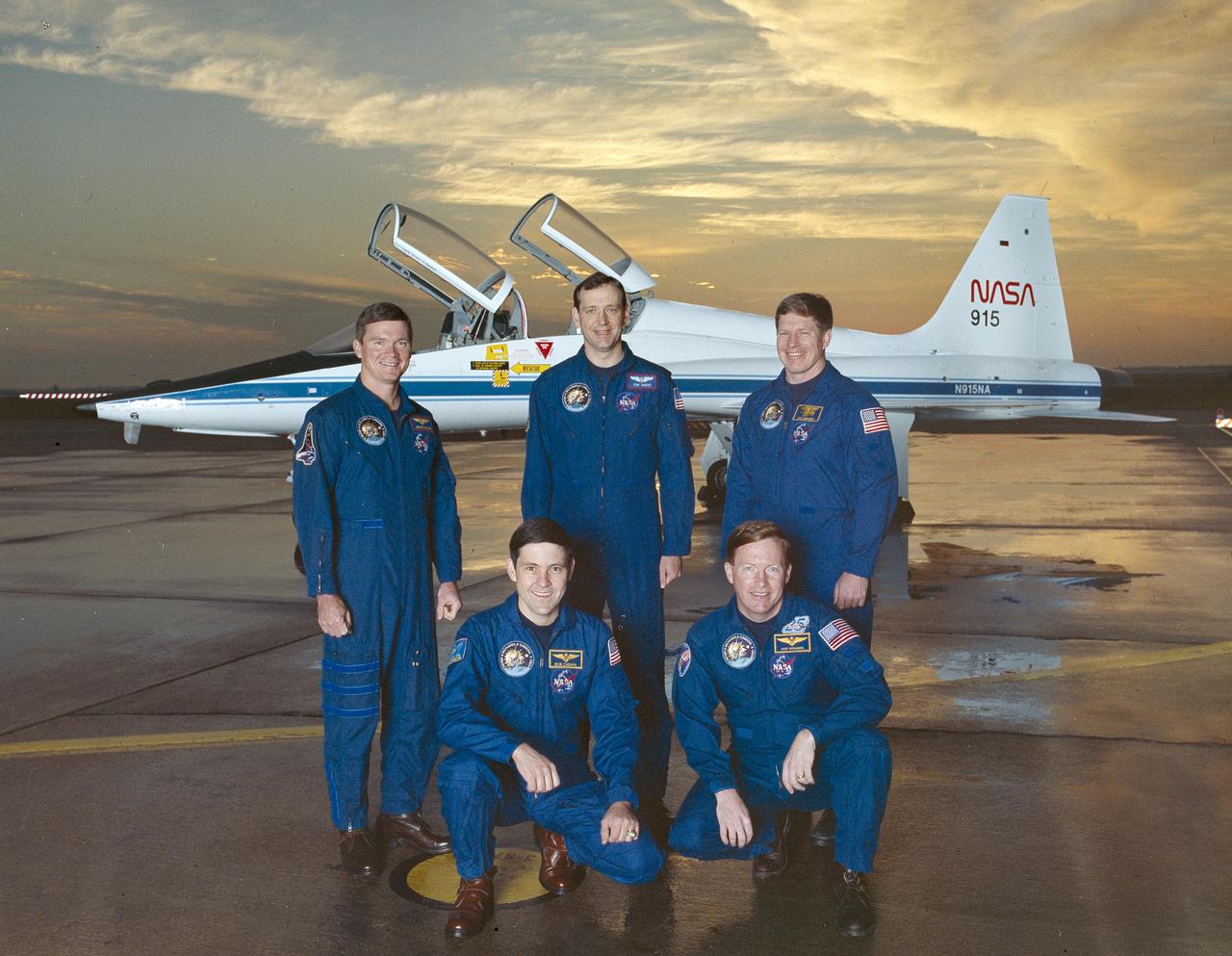
The 5 member crew of the STS-41 mission included (left to right): Bruce E. Melnick, mission specialist 2; Robert D. Cabana, pilot; Thomas D. Akers, mission specialist 3; Richard N. Richards, commander; and William M. Shepherd, mission specialist 1. Launched aboard the Space Shuttle Discovery on October 6, 1990 at 7:47:15 am (EDT), the primary payload for the mission was the ESA built Ulysses Space Craft made to explore the polar regions of the Sun. Other main payloads and experiments included the Shuttle Solar Backscatter Ultraviolet (SSBUV) experiment and the INTELSAT Solar Array Coupon (ISAC).
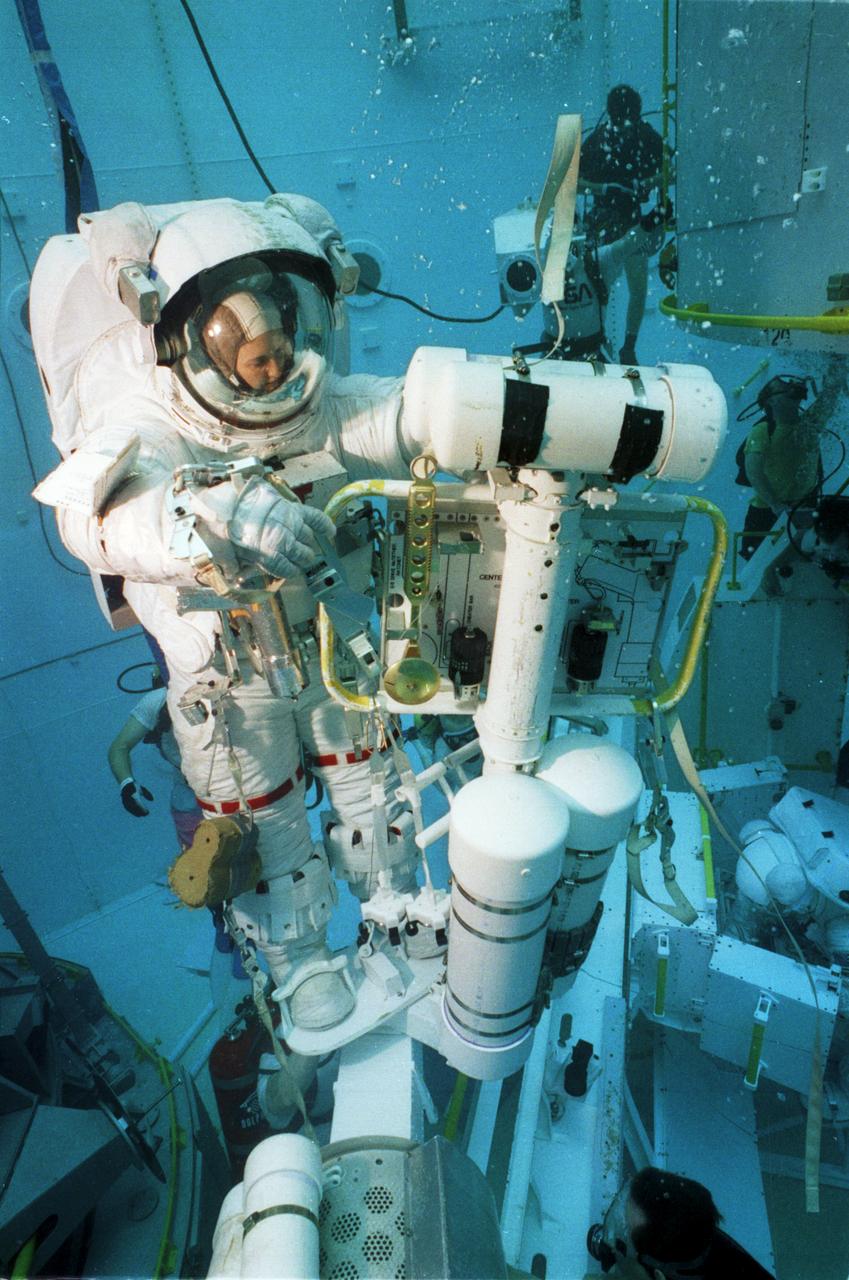
This close-up of astronaut and mission specialist, Kathryn Thornton, was captured under water in the Marshall Space Flight Center (MSFC) Neural Buoyancy Simulator (NBS) where she is participating in a training session for the STS-61 mission. The NBS provided the weightless environment encountered in space needed for testing and the practices of Extravehicular Activities (EVA). Launched on December 2, 1993 aboard the Space Shuttle Orbiter Endeavor, STS-61 was the first Hubble Space Telescope (HST) serving mission. During the 2nd EVA of the mission, Thornton, along with astronaut and mission specialist Thomas Akers, performed the task of replacing the solar arrays. The EVA lasted 6 hours and 35 minutes.
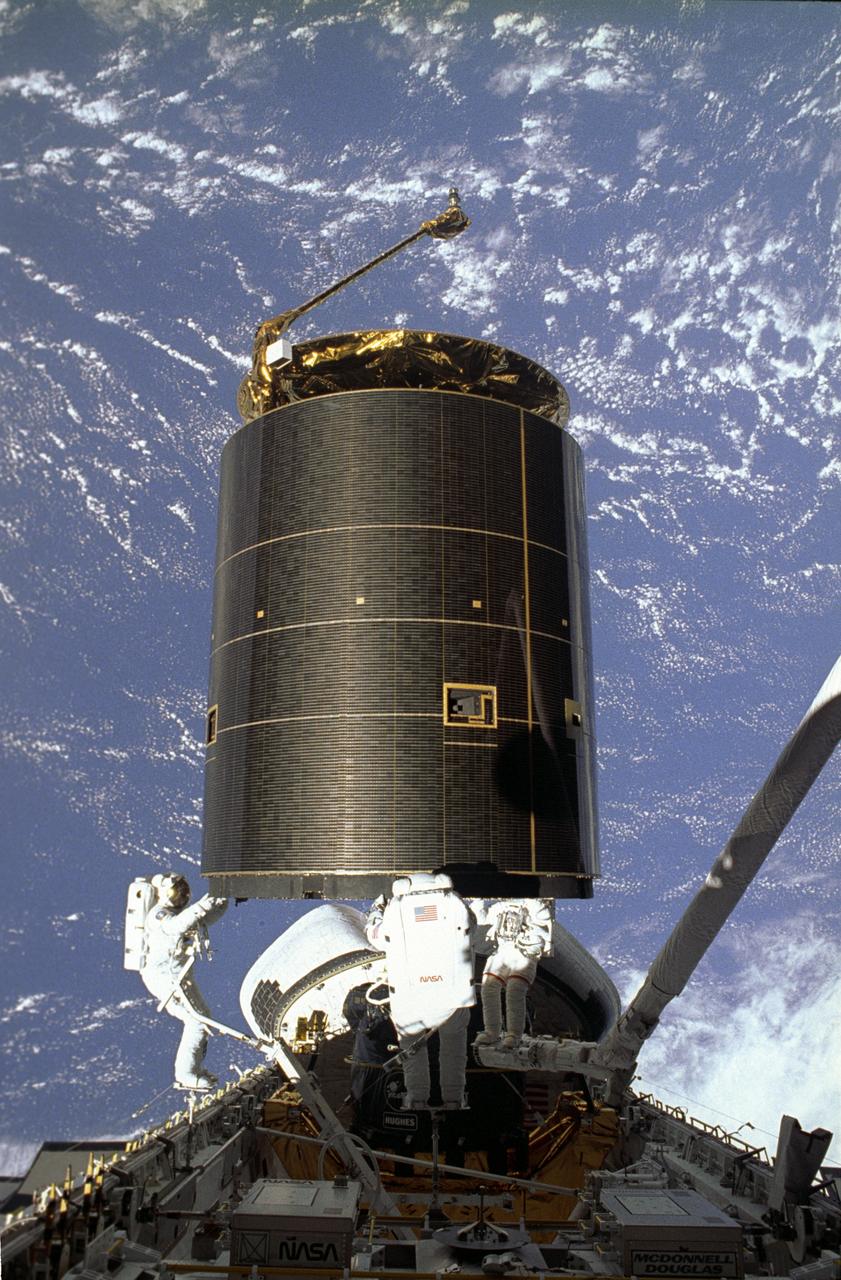
STS-49, the first flight of the Space Shuttle Orbiter Endeavour, lifted off from launch pad 39B on May 7, 1992 at 6:40 pm CDT. The STS-49 mission was the first U.S. orbital flight to feature 4 extravehicular activities (EVAs), and the first flight to involve 3 crew members working simultaneously outside of the spacecraft. The primary objective was the capture and redeployment of the INTELSAT VI (F-3), a communication satellite for the International Telecommunication Satellite organization, which was stranded in an unusable orbit since its launch aboard the Titan rocket in March 1990. In this onboard photo, astronauts Hieb, Akers, and Thuot have handholds on the satellite.
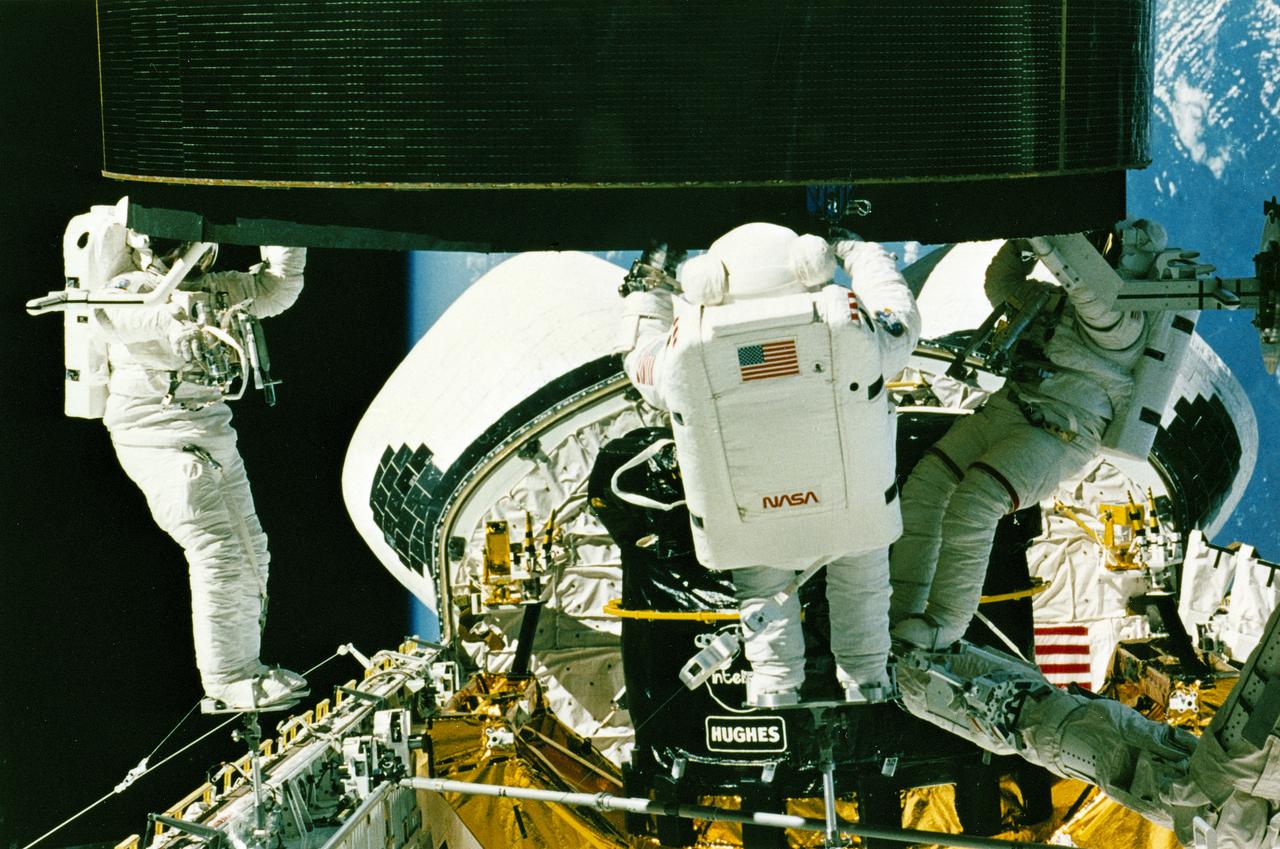
STS-49, the first flight of the Space Shuttle Orbiter Endeavour, lifted off from launch pad 39B on May 7, 1992 at 6:40 pm CDT. The STS-49 mission was the first U.S. orbital flight to feature 4 extravehicular activities (EVAs), and the first flight to involve 3 crew members working simultaneously outside of the spacecraft. The primary objective was the capture and redeployment of the INTELSAT VI (F-3), a communication satellite for the International Telecommunication Satellite organization, which was stranded in an unusable orbit since its launch aboard the Titan rocket in March 1990. In this onboard photo, astronauts Hieb, Akers, and Thuot have handholds on the satellite.
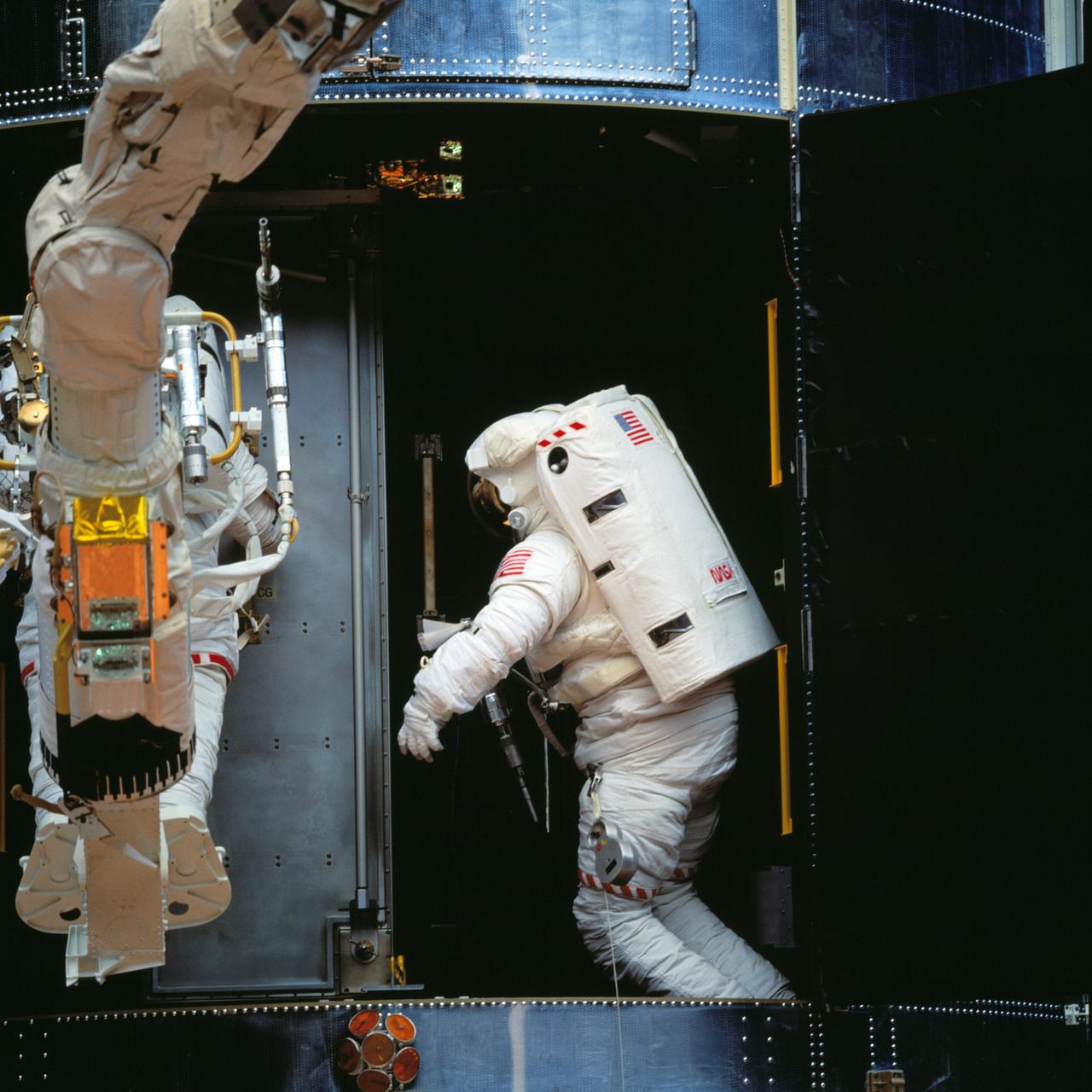
STS061-94-059 (8 Dec. 1993) --- Astronaut Thomas D. Akers maneuvers inside the bay which will house the Corrective Optics Space Telescope Axial Replacement (COSTAR) while assisting astronaut Kathryn C. Thornton with the installation of the 640-pound instrument. Thornton, anchored on the end of the Remote Manipulator System (RMS) arm, is partially visible as she prepares to install the COSTAR.
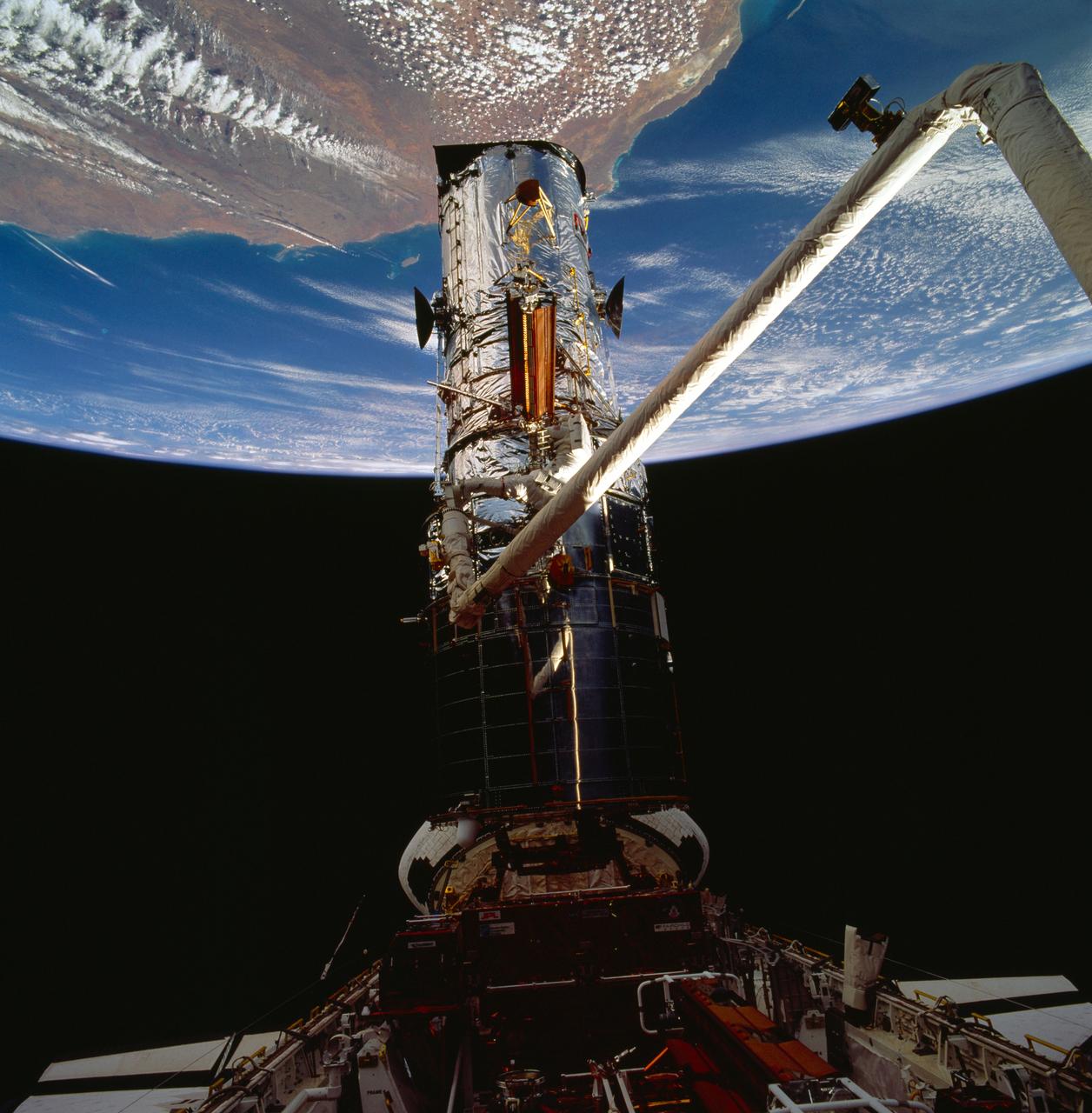
STS061-95-075 (6 Dec 1993) --- Astronauts Kathryn C. Thornton and Thomas D. Akers work to remove one of the solar arrays on the Hubble Space Telescope (HST) on the second of five extravehicular activity?s (EVA). The two space walkers later replaced both solar array panels. Part of Australia is in the background.
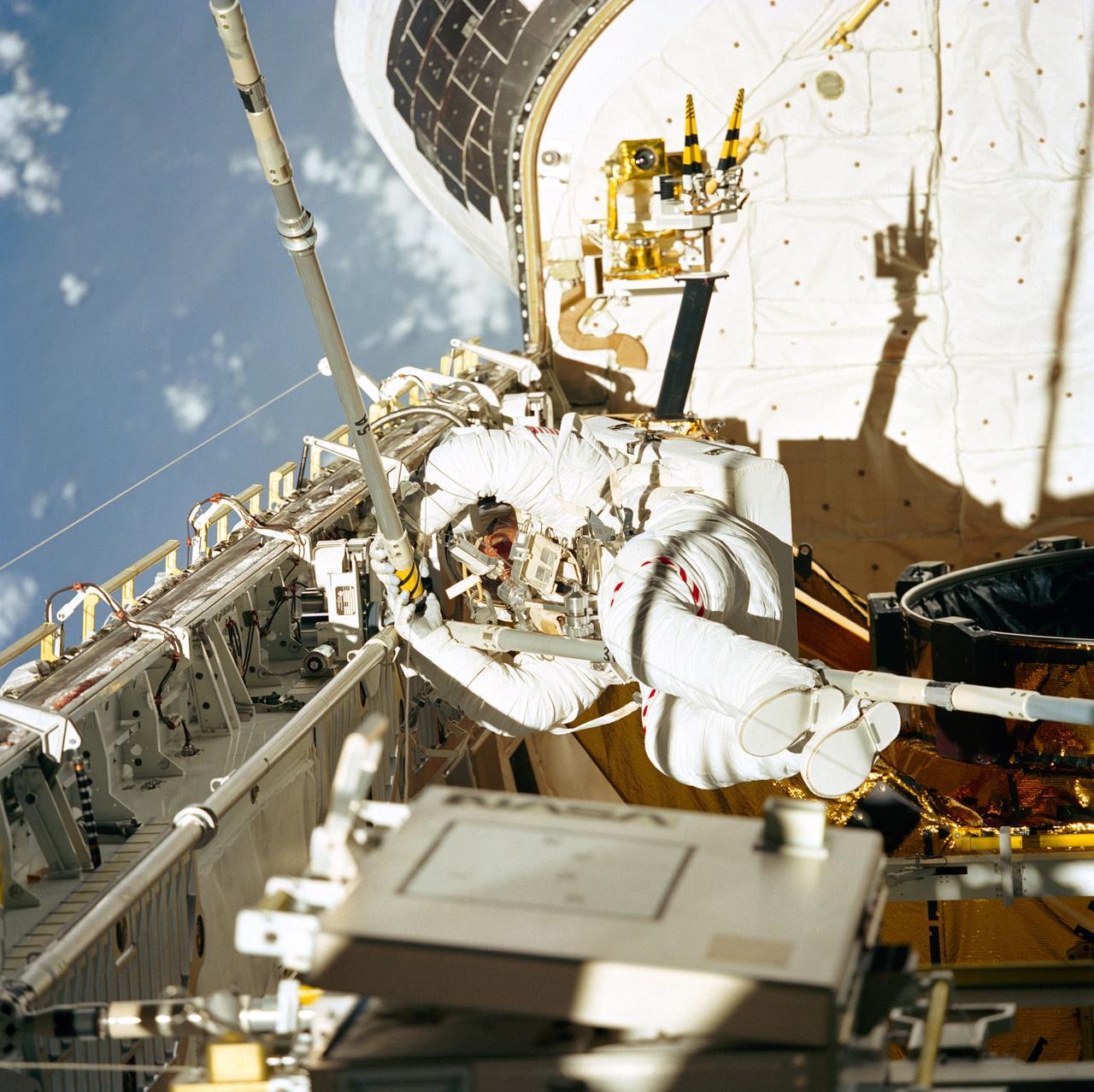
STS049-77-023 (14 May 1992) --- Astronaut Thomas D. Akers joins three struts together, as fourth period of extravehicular activity (EVA) proceeds in the Space Shuttle Endeavour's cargo bay. The purpose of the final EVA on this nine-day mission was the evaluation of Assembly of Station by EVA Methods (ASEM). The scene was recorded on 70mm film by a fellow crew member in the Space Shuttle's cabin. Astronaut Kathryn C. Thornton (out of frame) joined Akers on the 7 1/2 hour EVA.
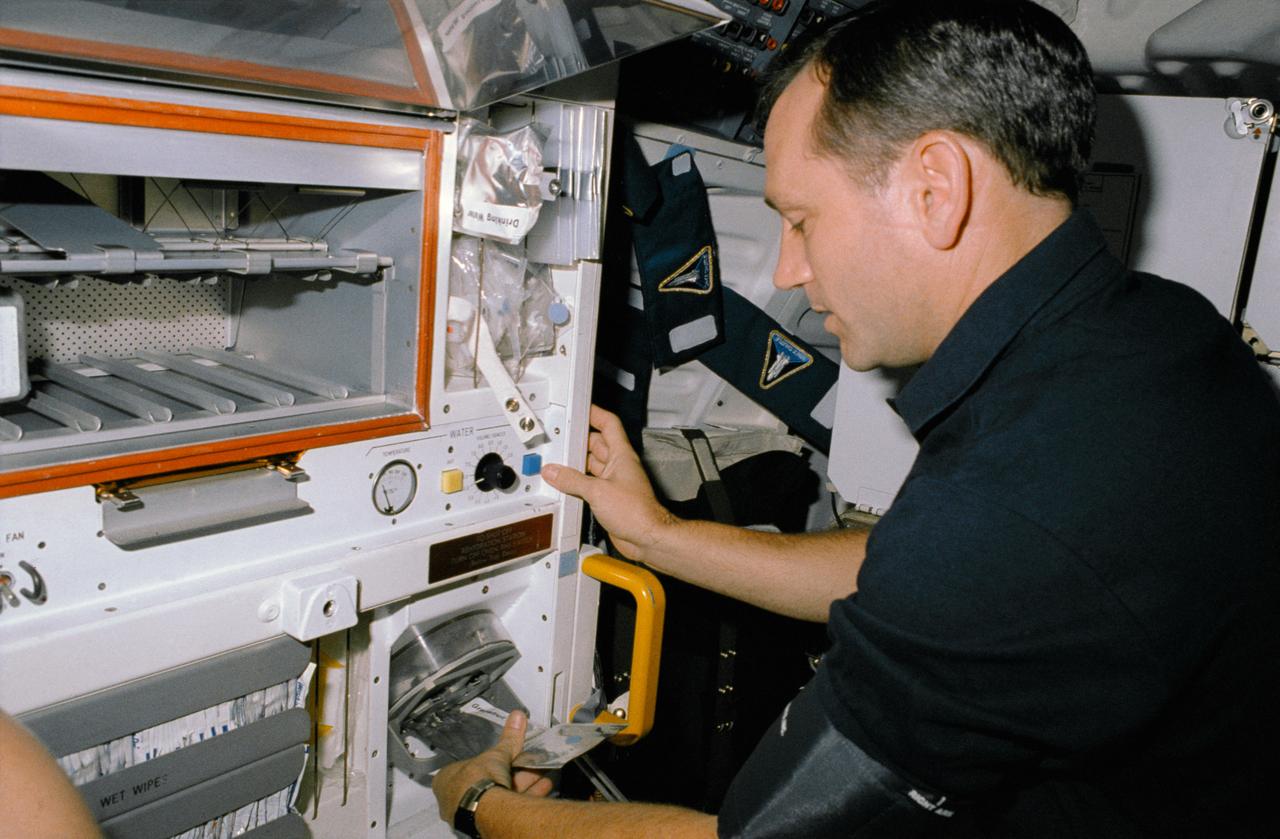
STS041-06-004 (6-10 Oct 1990) --- A 35mm scene of astronaut Thomas D. Akers, STS-41 mission specialist, using Space Shuttle Discovery?s galley water feed to rehydrate a package of food.
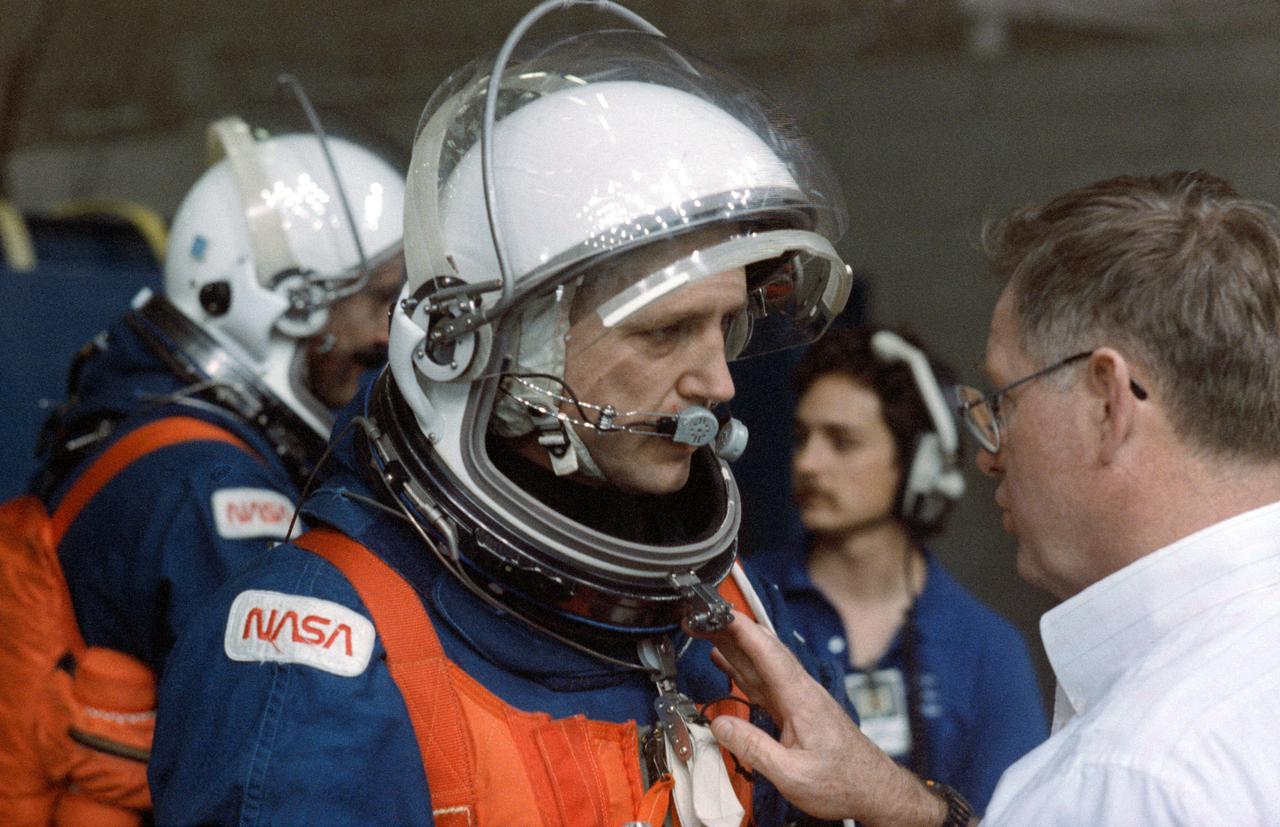
S92-26413 (March 1992) --- Astronaut Thomas D. Akers, left, is briefed by suit technician Alan M. Rochford of JSC's EVA branch office during a bailout training exercise in the Johnson Space Center's weightless environment training facility (WET-F). Akers was joined by six crewmates for the training session in the Johnson Space Center's Shuttle Mockup and Integration Laboratory. The seven will be aboard Endeavour in May for a week-long mission, during which a satellite will be retrieved and boosted toward a higher orbit, and extravehicular activity evaluations for Space Station Freedom assembly techniques will be conducted.
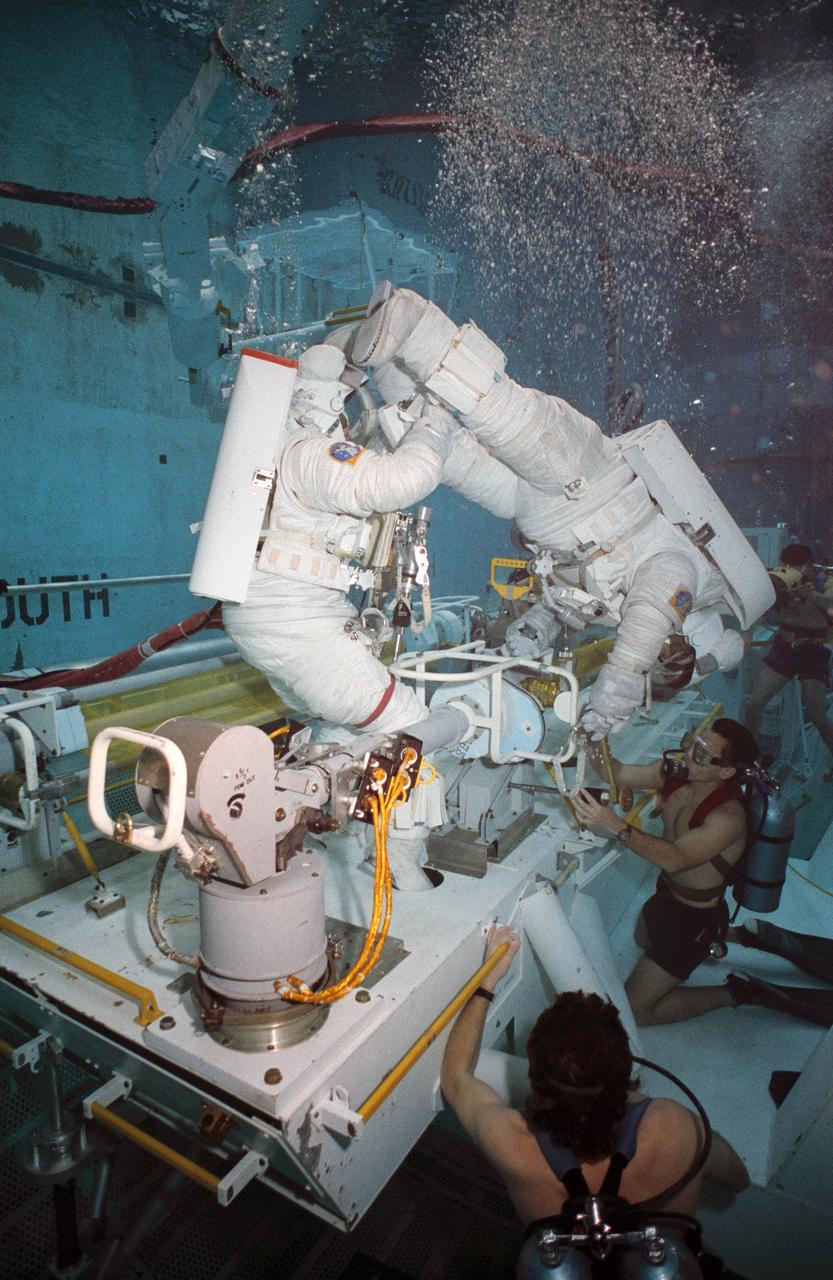
S93-30238 (5 Mar 1993) --- Wearing training versions of Space Shuttle Extravehicular Mobility Units (EMU), astronauts Thomas D. Akers (red stripe) and Kathryn C. Thornton use the spacious pool of the Johnson Space Center's (JSC) Weightless Environment Training Facility (WET-F) to rehearse for the Hubble Space Telescope (HST) repair mission. They are working with a full scale mockup of a solar array fixture.
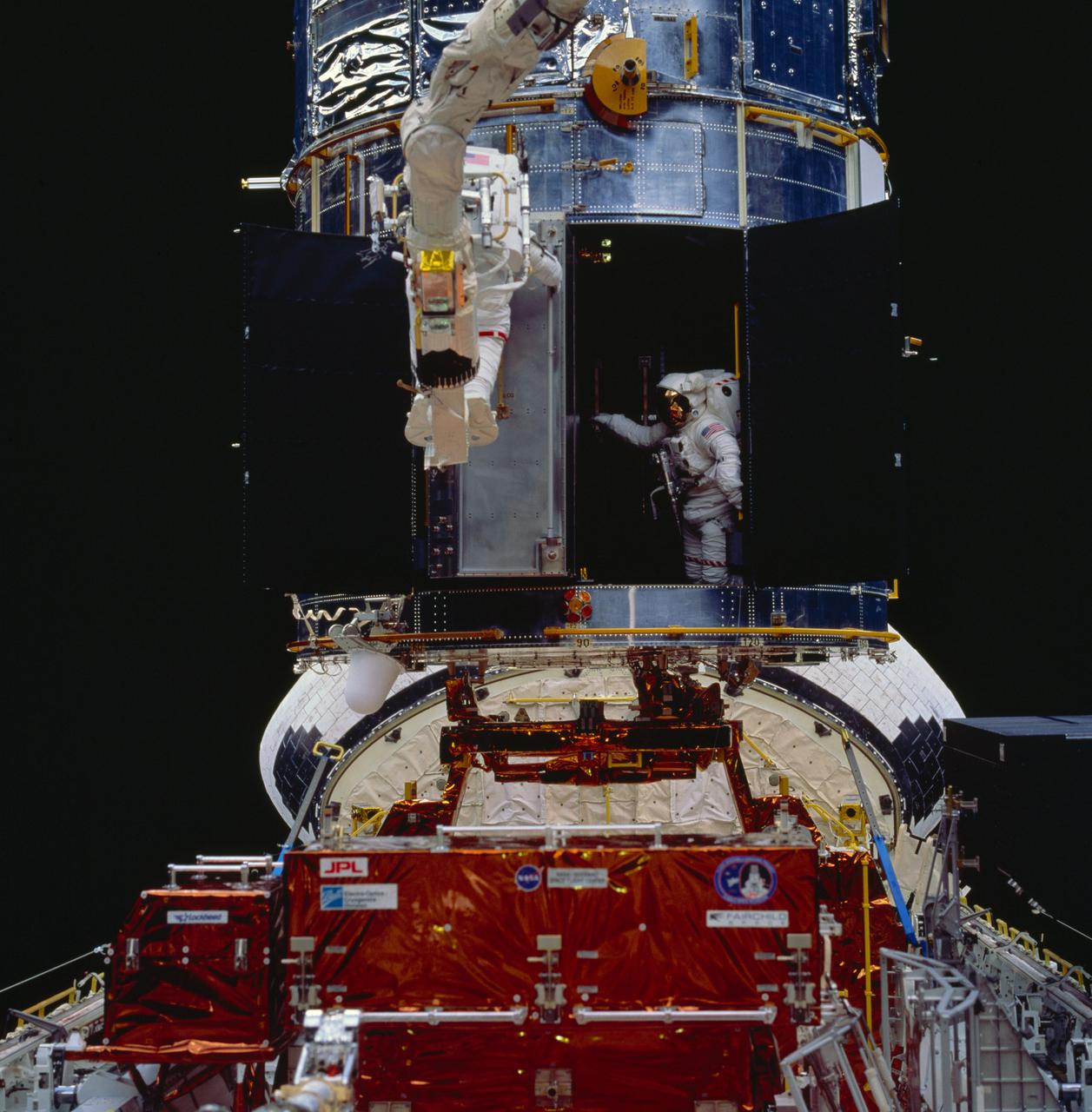
STS061-94-050 (8 Dec 1993) --- Astronaut Thomas D. Akers maneuvers inside the bay which will house the Corrective Optics Space Telescope Axial Replacement (COSTAR) while assisting astronaut Kathryn C. Thornton with the installation of the 640-pound instrument. Thornton, anchored on the end of the Remote Manipulator System (RMS) arm, is partially visible as she prepares to install the COSTAR, during their extravehicular activity (EVA).
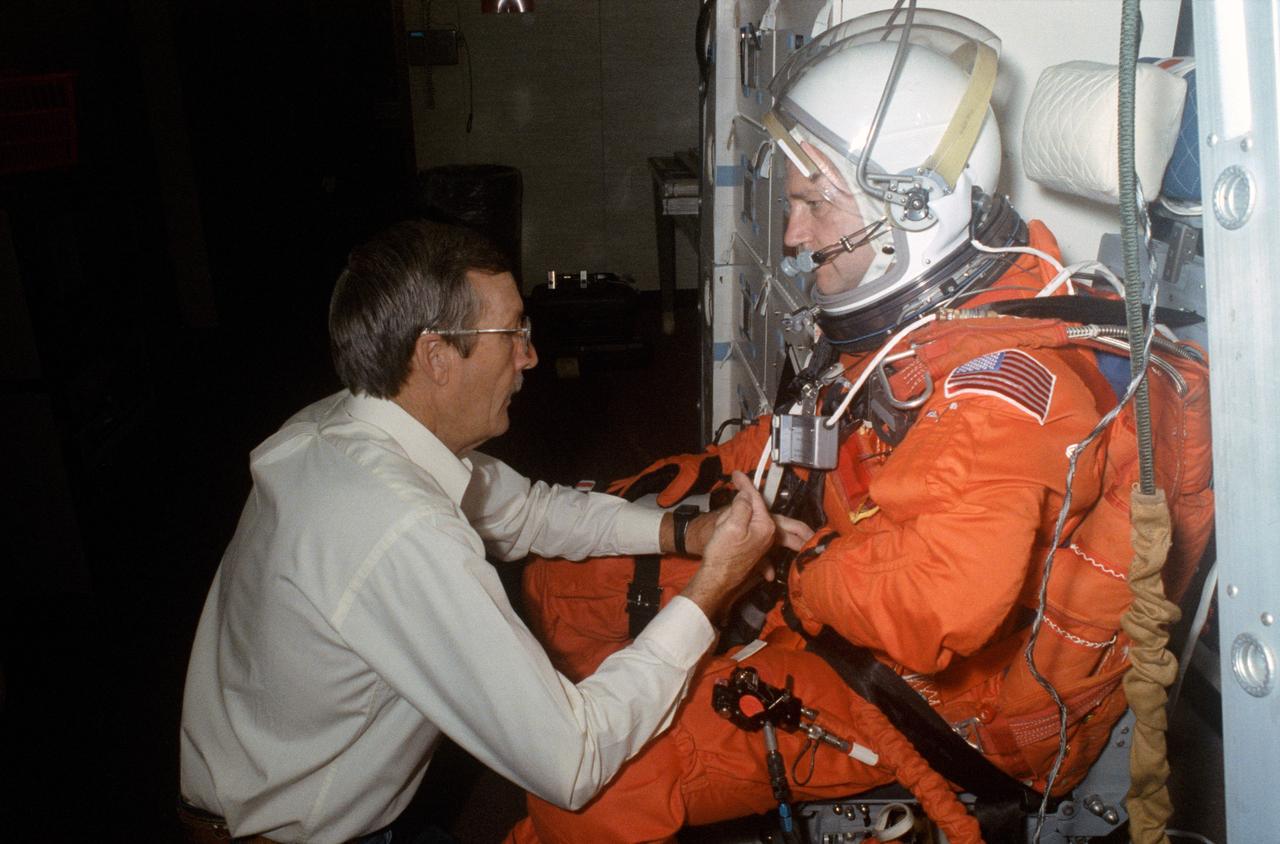
S90-47148 (21 Aug 1990) --- Astronaut Thomas D. Akers, STS-41mission specialist, is assisted by Troy M. Stewart of the Shuttle support branch in NASA's Crew and Thermal Systems Division. The astronaut was about to join his four crewmates in participating in a simulation of their scheduled flight in JSC's fixed-base Shuttle mission simulator (SMS).
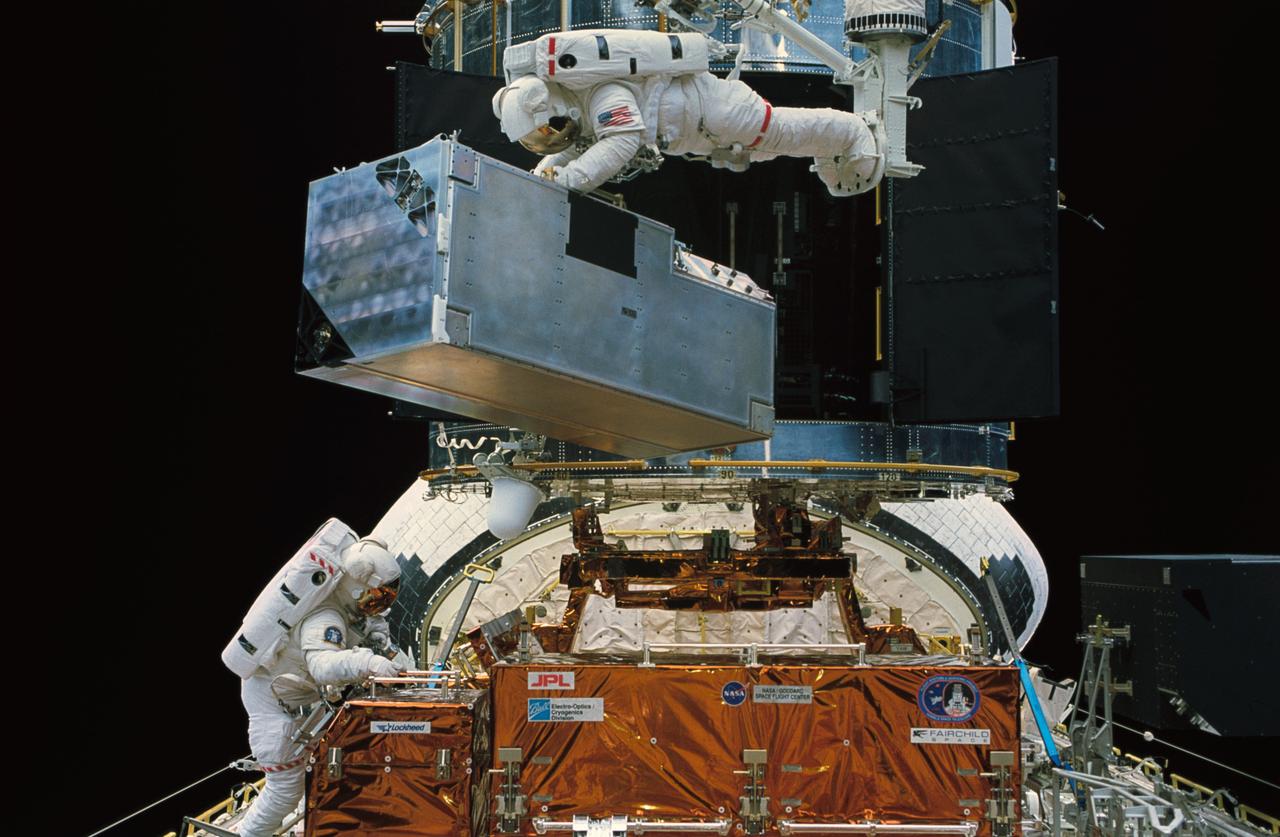
STS061-47-014 (8 Dec 1993) --- Astronaut Kathryn C. Thornton lifts the Corrective Optics Space Telescope Axial Replacement (COSTAR) prior to its installation on the Hubble Space Telescope (HST). Thornton is anchored to a foot restraint on the end of the Remote Manipulator System (RMS) arm. Astronaut Thomas D. Akers, who assisted in the COSTAR installation, is at lower left.
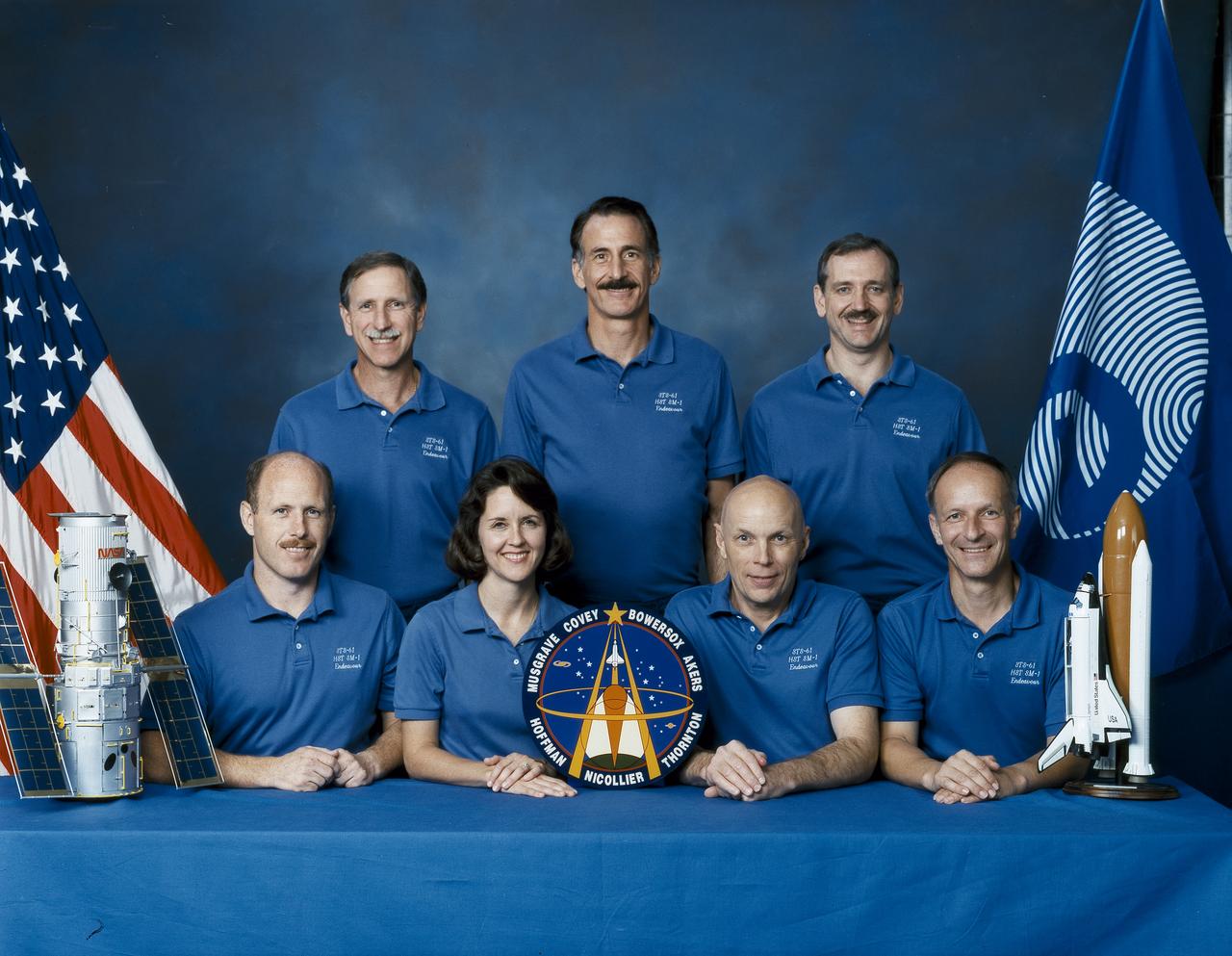
Astronauts included in the STS-61 crew portrait include (standing in rear left to right) Richard O. Covey, commander; and mission specialists Jeffrey A. Hoffman, and Thomas D. Akers. Seated left to right are Kenneth D. Bowersox, pilot; Kathryn C. Thornton, mission specialist; F. Story Musgrave, payload commander; and Claude Nicollier, mission specialist. Launched aboard the Space Shuttle Endeavor on December 2, 1993 at 4:27:00 am (EST), the STS-61 mission was the first Hubble Space Telescope (HST) servicing mission, and the last mission of 1993.
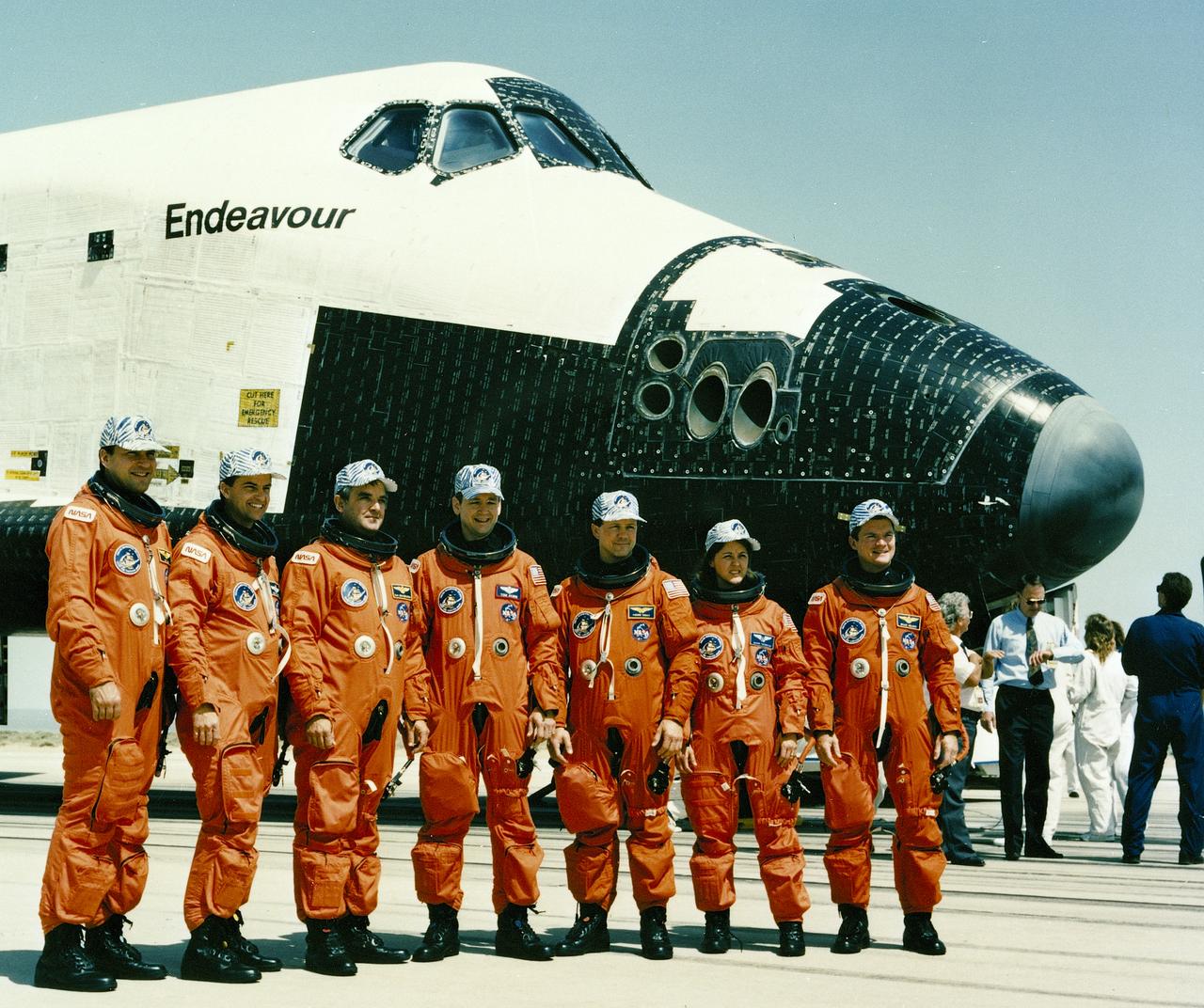
The STS-49 crew members pose near Endeavour after landing. Pictured left to right are: Richard J. Hieb, mission specialist; Kevin P. Chiltin, pilot; Daniel C. Brandenstein, commander; and mission specialists Thomas D. Akers, Pierre J. Thuot, Kathryn C. Thornton, and Bruce E. Melnick. Launched on May 7, 1992 at 7:40:00 pm (EDT), the crew of seven was the first to fly aboard the Space Shuttle Endeavor. The mission was the first US orbital flight to feature 4 extravehicular activities (EVAs), and the first flight to involve 3 crew members simultaneously working outside of the spacecraft. The primary objective was the capture and redeployment of the INTELSAT VI (F-3) which was stranded in an unusable orbit since its launch aboard the Titan rocket in March 1990.
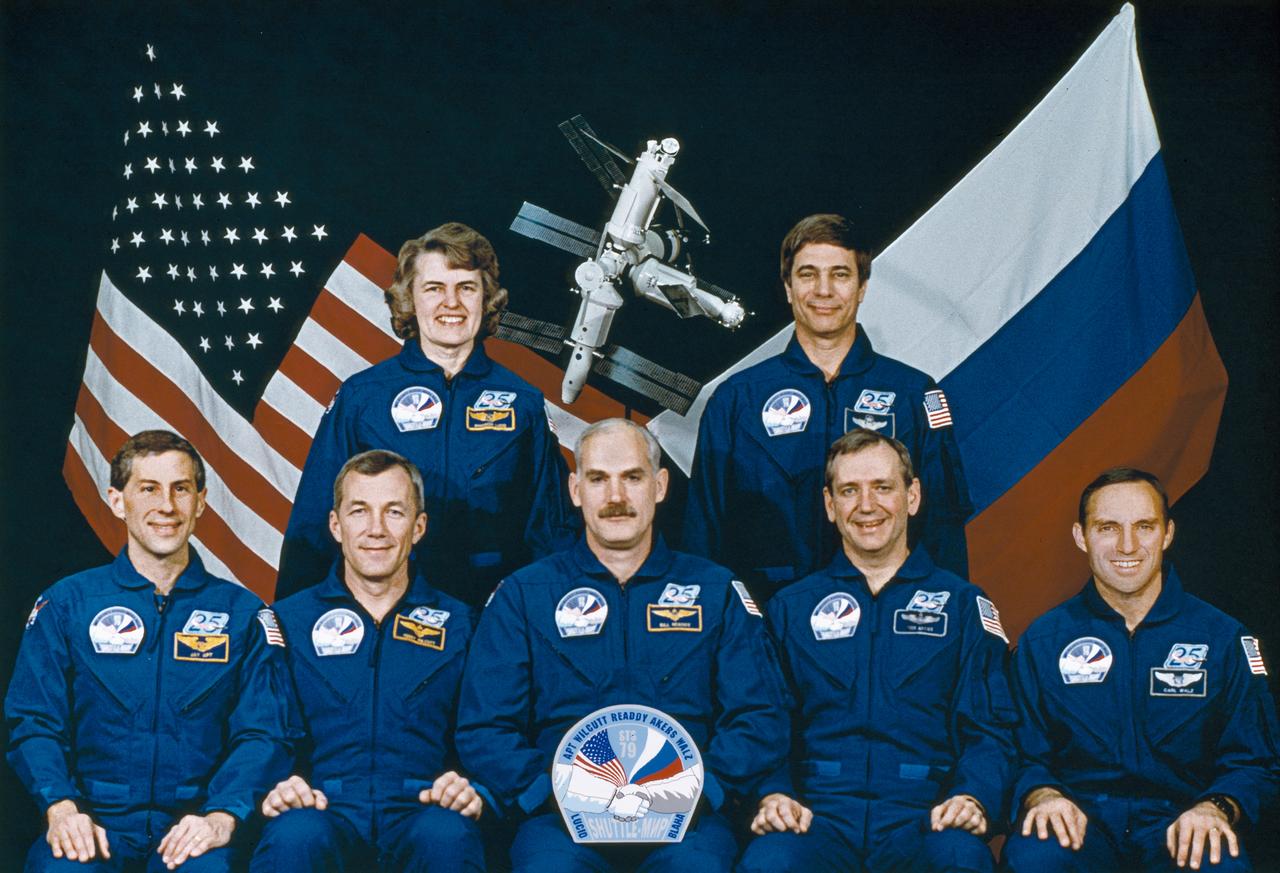
The crew assigned to the STS-79 mission included (seated front left to right) Jerome (Jay) Apt, mission specialist; Terrence W. Wilcutt, pilot; William F. Readdy, commander; Thomas D. Akers, and Carl E. Walz, both mission specialists. On the back row (left to right) are mission specialists Shannon W. Lucid, and John E. Blaha. Launched aboard the Space Shuttle Atlantis on September 16, 1996 at 4:54:49 am (EDT), the STS-79 mission marked the fourth U.S. Space Shuttle-Russian Space Station Mir docking, the second flight of the SPACEHAB module in support of Shuttle-Mir activities and the first flight of the SPACEHAB Double Module Configuration.
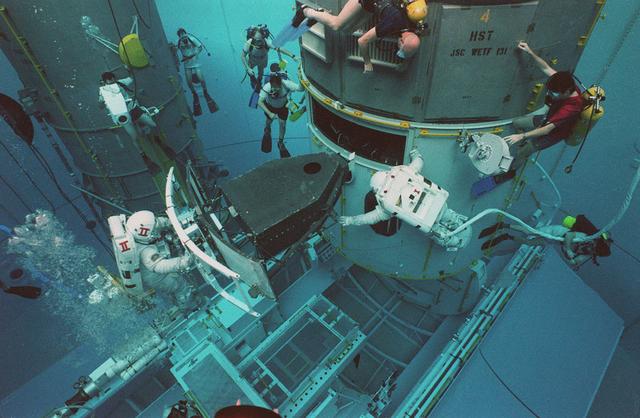
Astronauts Kathy Thornton and Tom Akers practice installing the Wide Field Planetary camera into the Hubble Space Telescope at Marshall's Neutral Buoyancy Simulator (NBS).
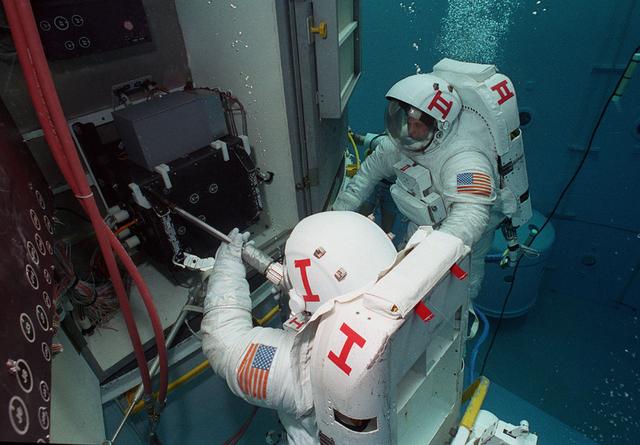
Astronauts Kathy Thornton and Tom Akers practice installing the Wide Field Planetary camera into the Hubble Space Telescope at Marshall's Neutral Buoyancy Simulator (NBS).
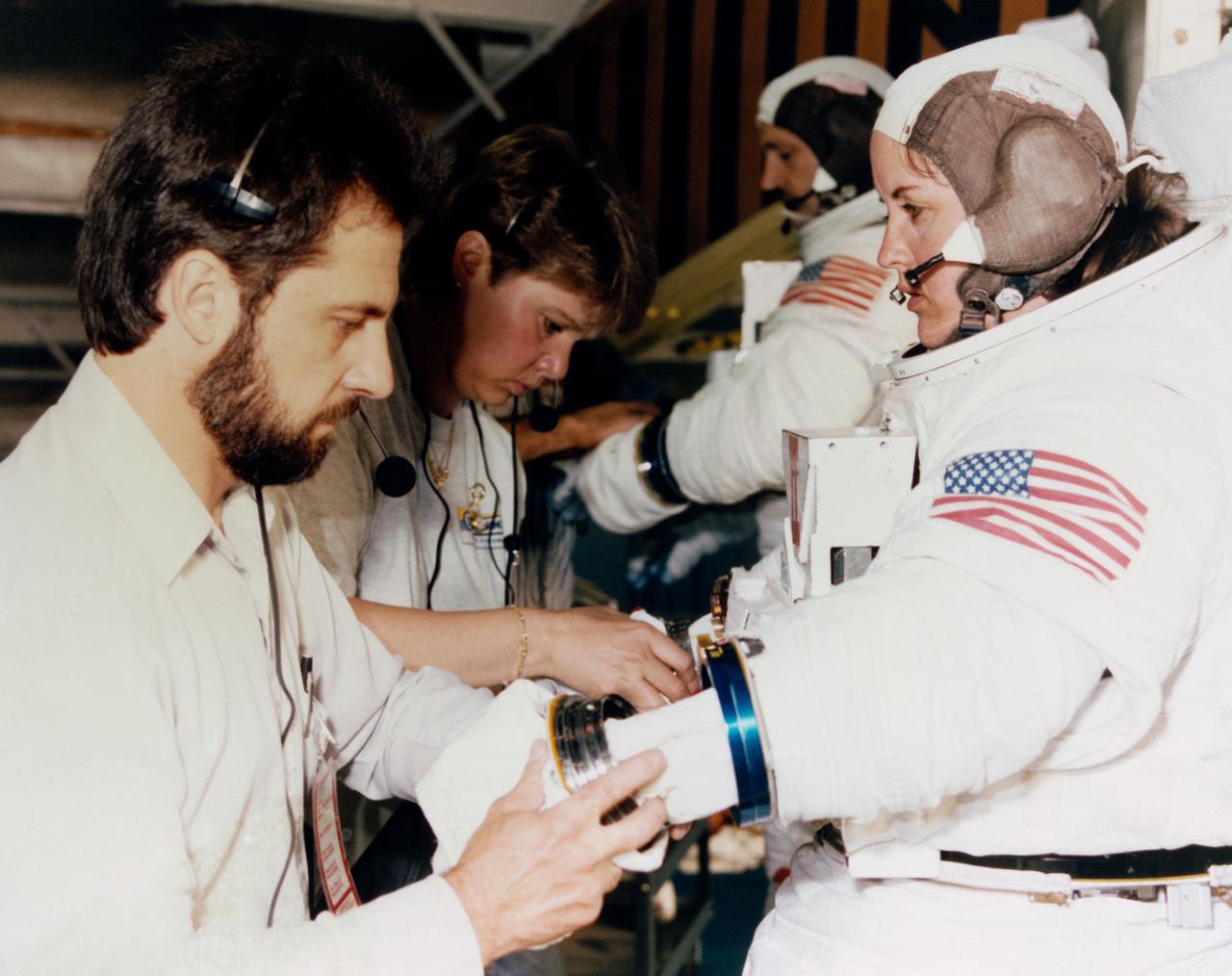
Astronaut Thomas D. Akers gets assistance in donning a training version of the Shuttle extravehicular mobility unit (EMU) space suit prior to a training session in the Neutral Buoyancy Simulator at Marshall Space Flight Center (MSFC) (39735); Astronaut Kathryn C. Thornton (foreground) and Thomas Akers, STS-61 mission specialists scheduled for extravehicular activity (EVA) duty, prepare for an underwater rehearsal session. Thornton recieves assistance from a technician in donning her EMU gloves (39736).
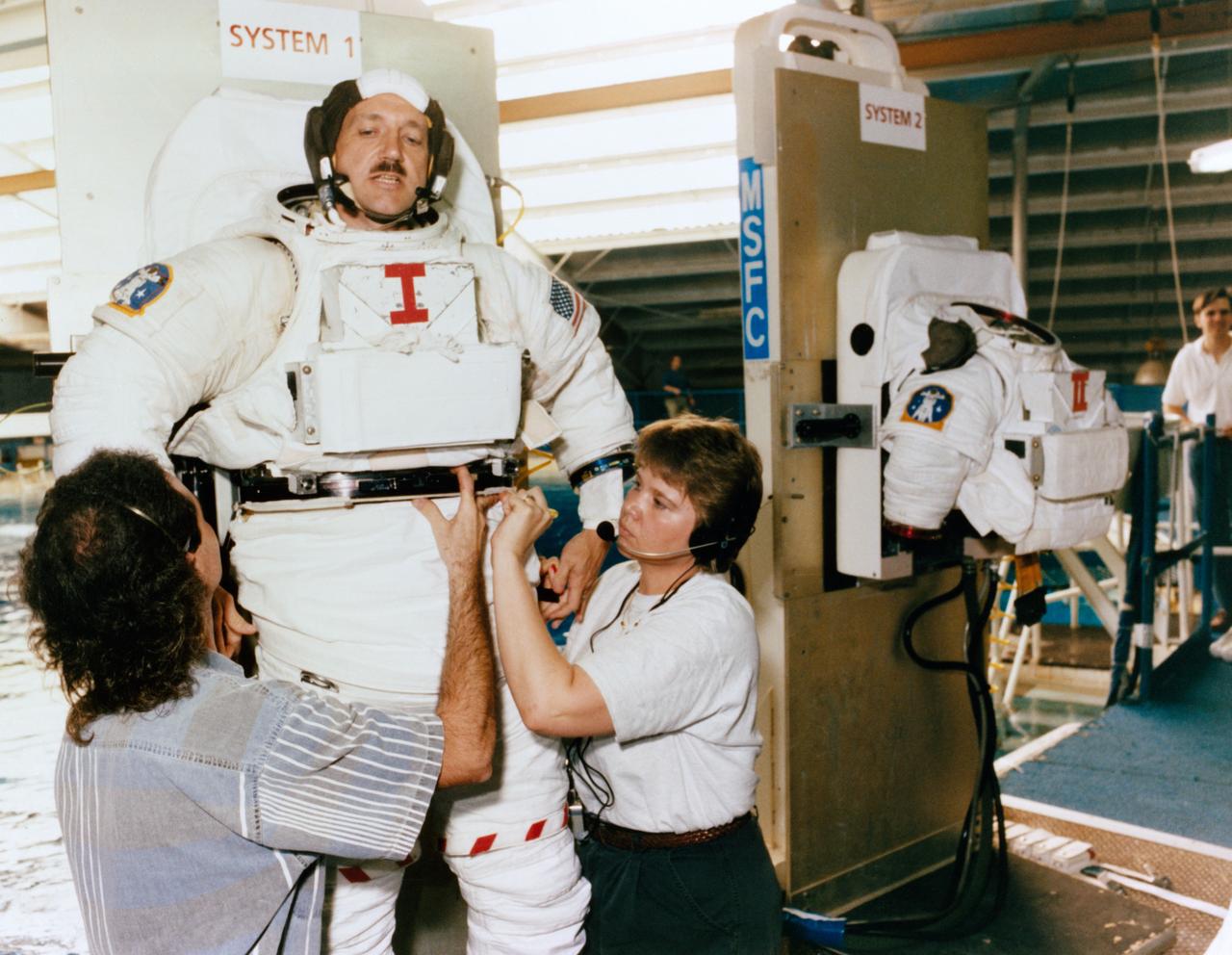
Astronaut Thomas D. Akers gets assistance in donning a training version of the Shuttle extravehicular mobility unit (EMU) space suit prior to a training session in the Neutral Buoyancy Simulator at Marshall Space Flight Center (MSFC) (39735); Astronaut Kathryn C. Thornton (foreground) and Thomas Akers, STS-61 mission specialists scheduled for extravehicular activity (EVA) duty, prepare for an underwater rehearsal session. Thornton recieves assistance from a technician in donning her EMU gloves (39736).
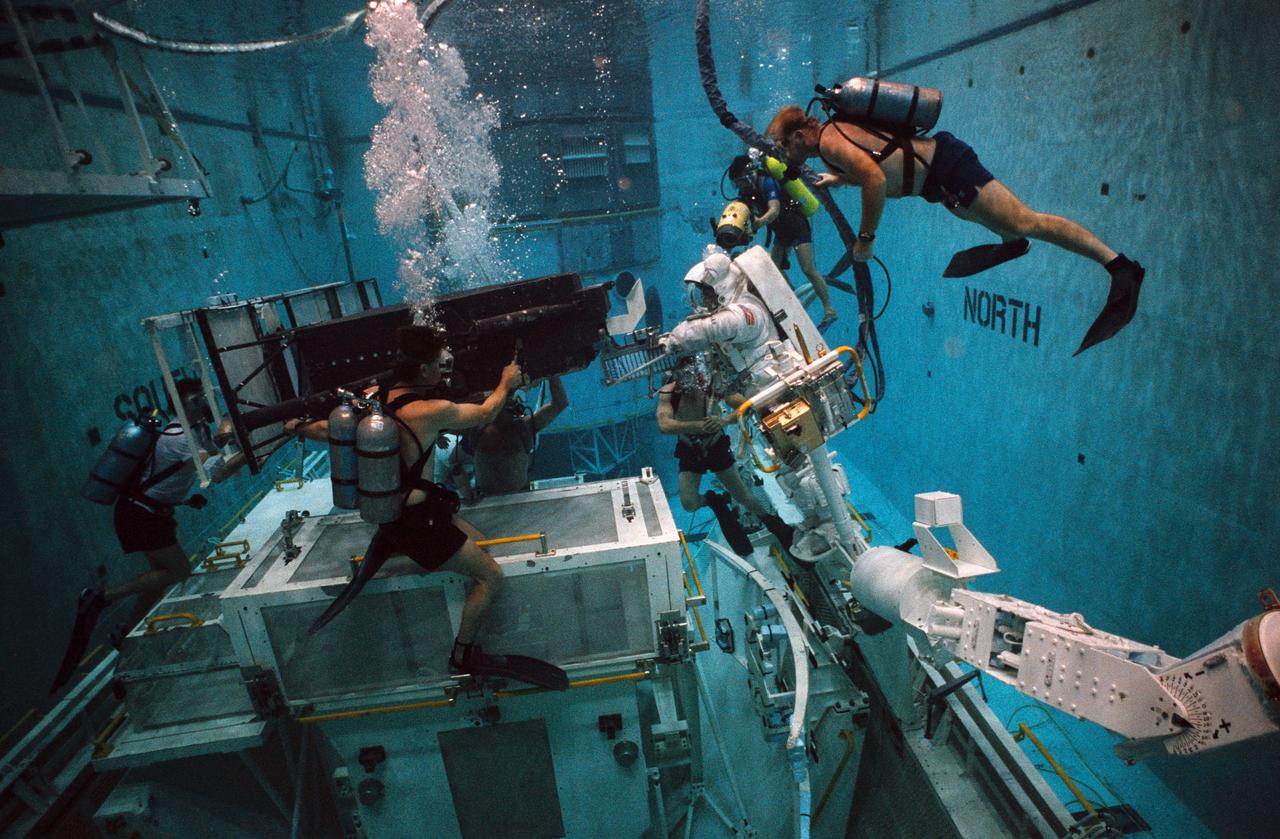
S93-33102 (5 Apr 1993) --- Wearing a training version of Space Shuttle Extravehicular Mobility Unit (EMU), astronaut Thomas D. Akers uses the giant pool of the Johnson Space Center's (JSC) Weightless Environment Training Facility (WET-F) to rehearse for the Hubble Space Telescope (HST) repair mission. Standing on a mobile foot restraint connected to the Shuttle's robot arm, Akers works with a full-scale training version of the Wide Field/Planetary Camera (WF/PC). The current WF/PC on the HST will be replaced with WF/PC-2. The giant box is a stowage area for both WF/PC facilities. Out of frame is astronaut Kathryn C. Thornton, who will join Akers in STS-61 EVA. Several SCUBA-equipped divers assist in the rehearsal. A total of five extravehicular activity (EVA) sessions will be conducted during the scheduled December mission of the Endeavour.
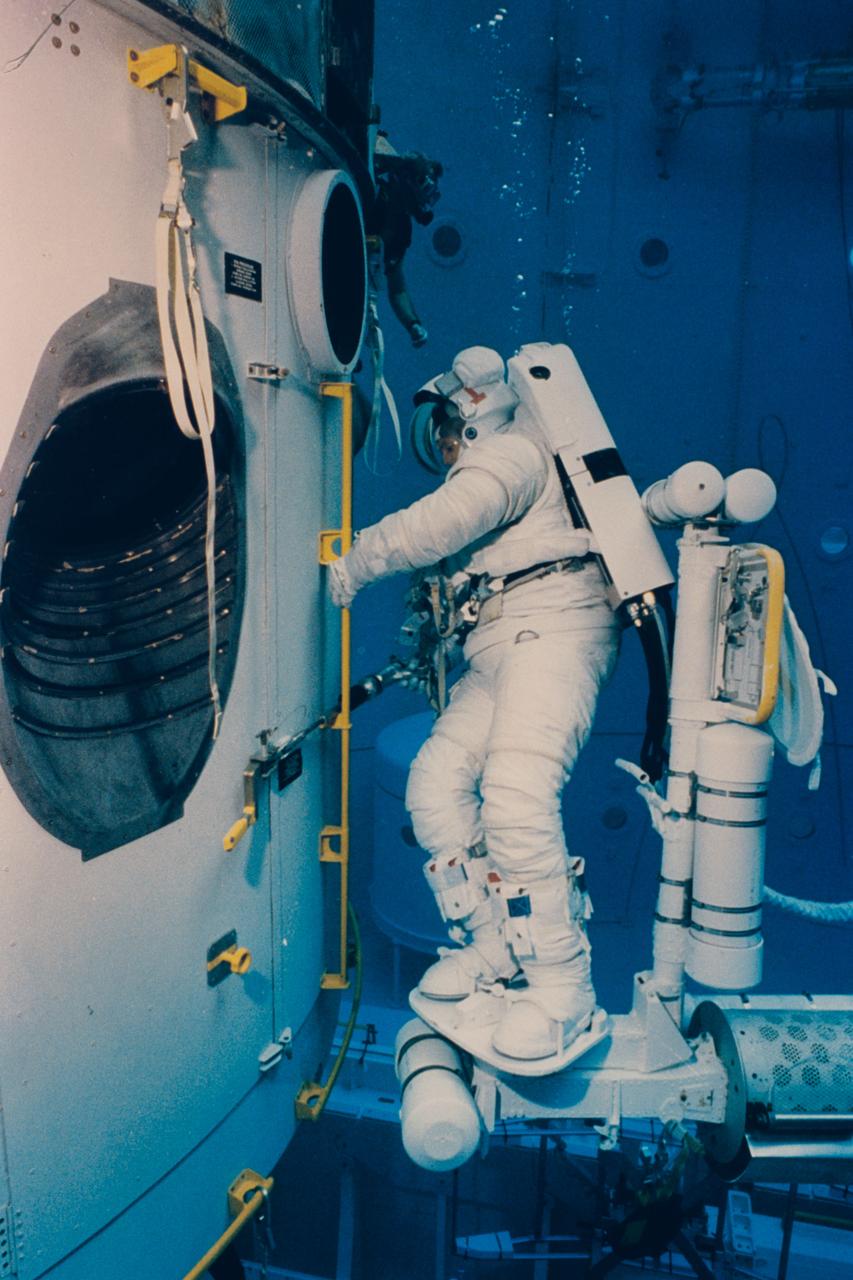
Astronaut Thomas D. Akers uses a power wrench to deploy one of the tools on the Hubble Space Telescope (HST) during a training session in the Neutral Buoyancy Simulator at Marshall Space Flight Center.
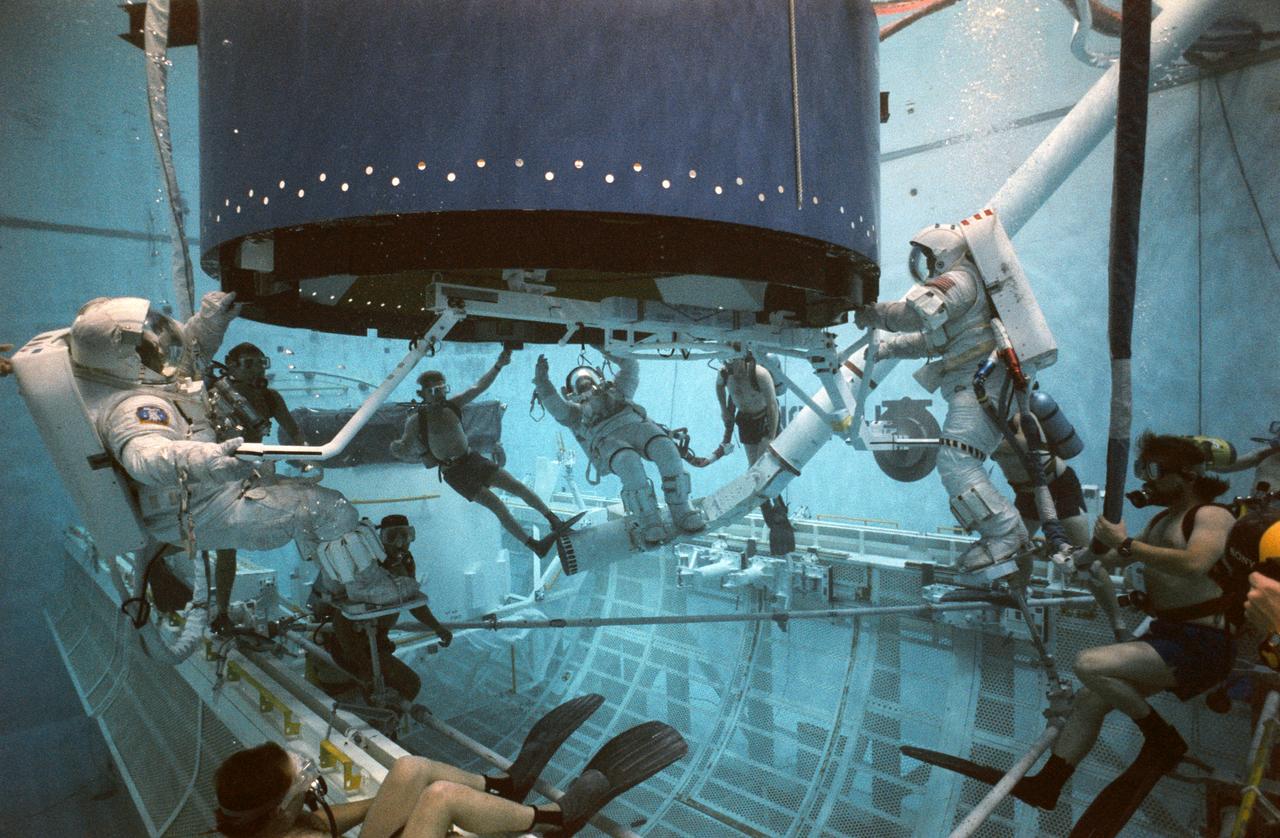
S92-35764 (12 May 1992) --- Wearing extravehicular mobility units (EMU's) and fitted with weights for neutral buoyancy are three trouble-shooting astronauts. The astronauts practiced techniques for capturing Intelsat, and climbing into the airlock mockup in the Weightless Environment Training Facility (WETF). No apparent problems were identified in placing three astronauts in the airlock at one time. Left to right are, Michael R. (Rich) Clifford, Story Musgrave, and James S. Voss. Three Endeavour astronauts, Pierre J. Thuot, Richard J. Hieb and Thomas D. Akers, will attempt to capture Intelsat again on May 13. Clifford played the role of Hieb, Musgrave for Thuot, and Voss, Akers.
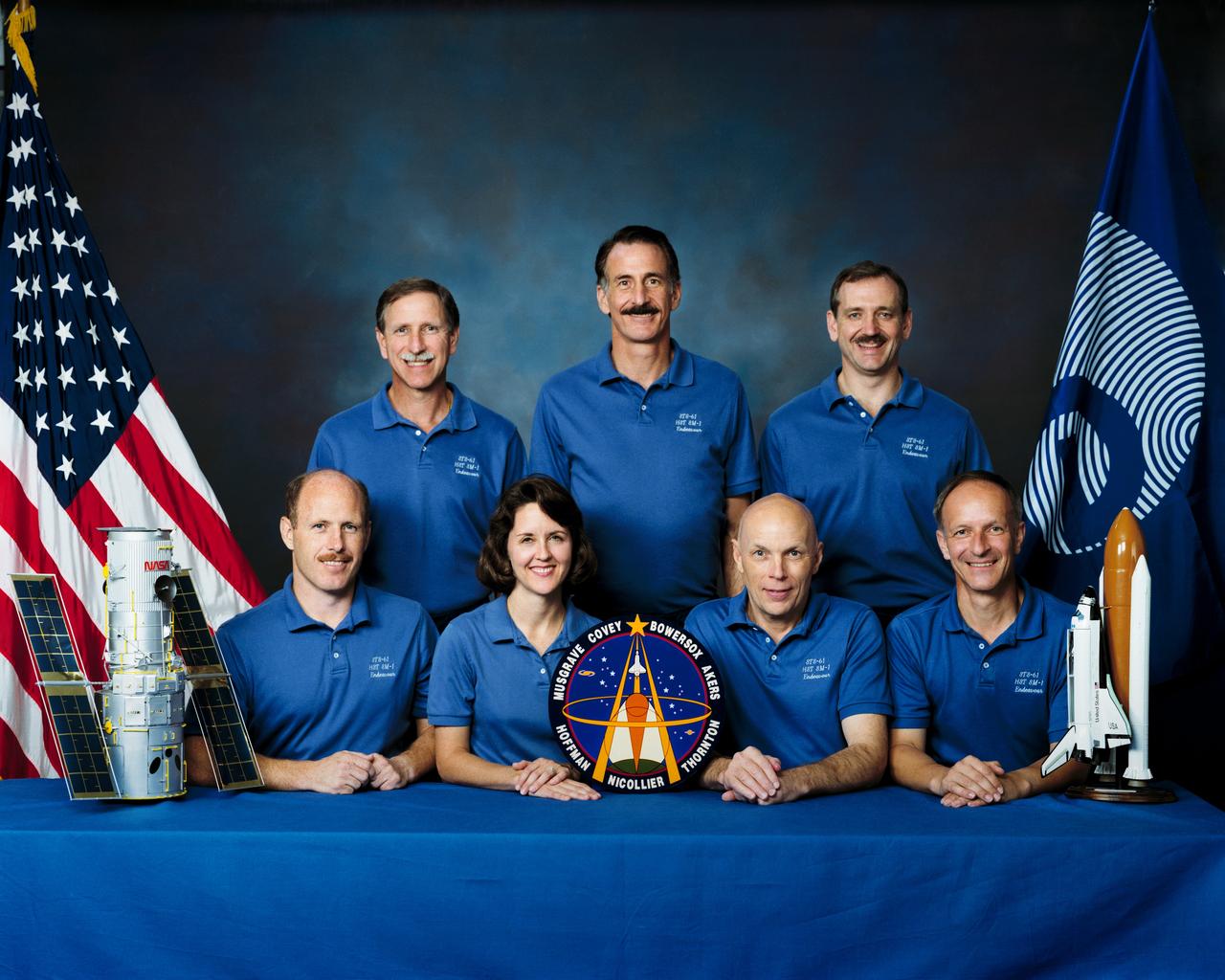
STS061-S-002 (1 Oct. 1993) --- These seven NASA astronauts are currently in training for the Hubble Space Telescope (HST) servicing mission, scheduled for later this year. Astronaut Richard O. Covey, mission commander, is standing at left, with astronaut Kenneth D. Bowersox, pilot, seated at left. The five mission specialists for the mission are (left to right, seated) astronauts Kathryn C. Thornton and F. Story Musgrave, and the European Space Agency (ESA) astronaut Claude Nicollier; and (left to right, standing), astronauts Jeffrey A. Hoffman and Thomas D. Akers. Musgrave, Akers, Thornton and Hoffman are all assigned to participate in five total sessions of extravehicular activity (EVA) for the servicing tasks.
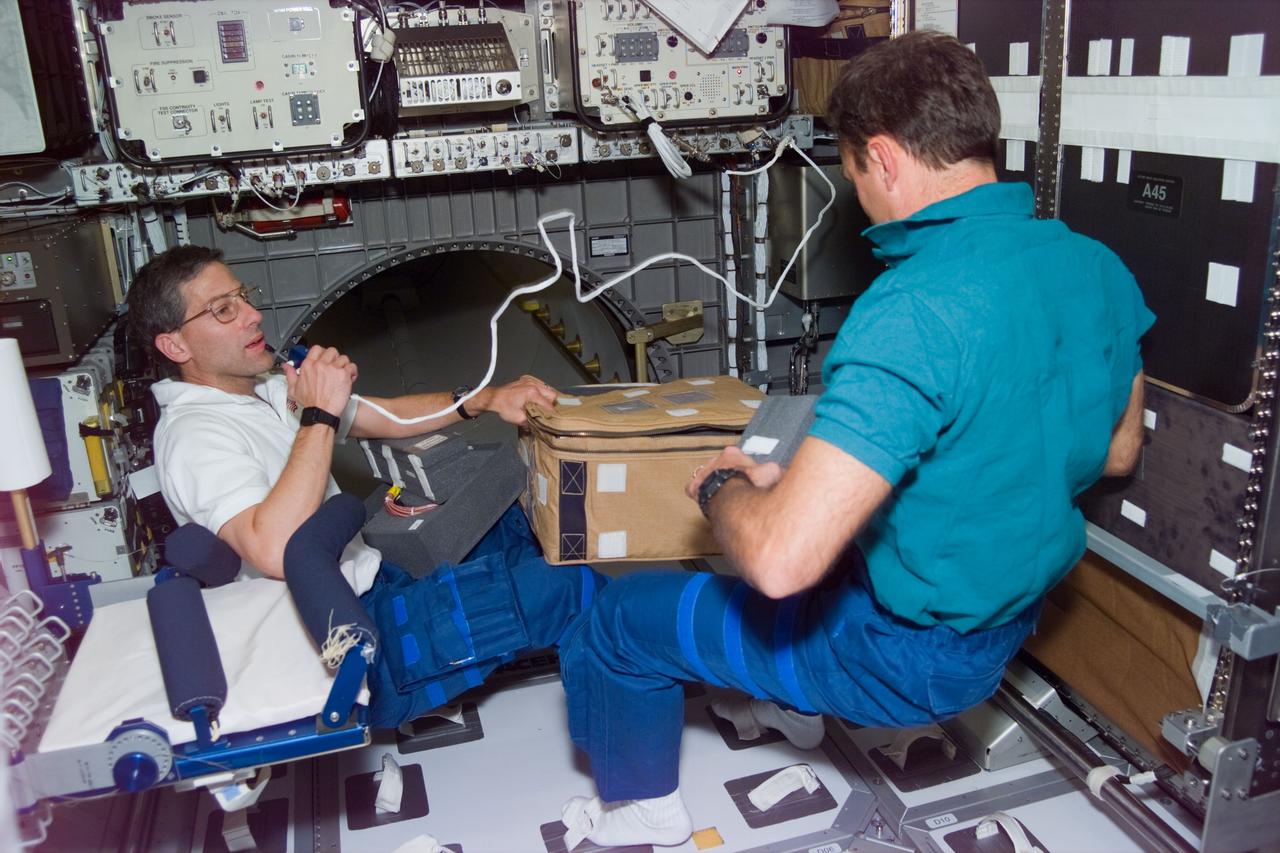
STS79-E-5268 (22 September 1996) --- Astronauts Jerome (Jay) Apt and Thomas D. Akers seal up a transfer stowage bag on the floor at the front end of the Spacehab Module, during Flight Day 7, onboard the Space Shuttle Atlantis.
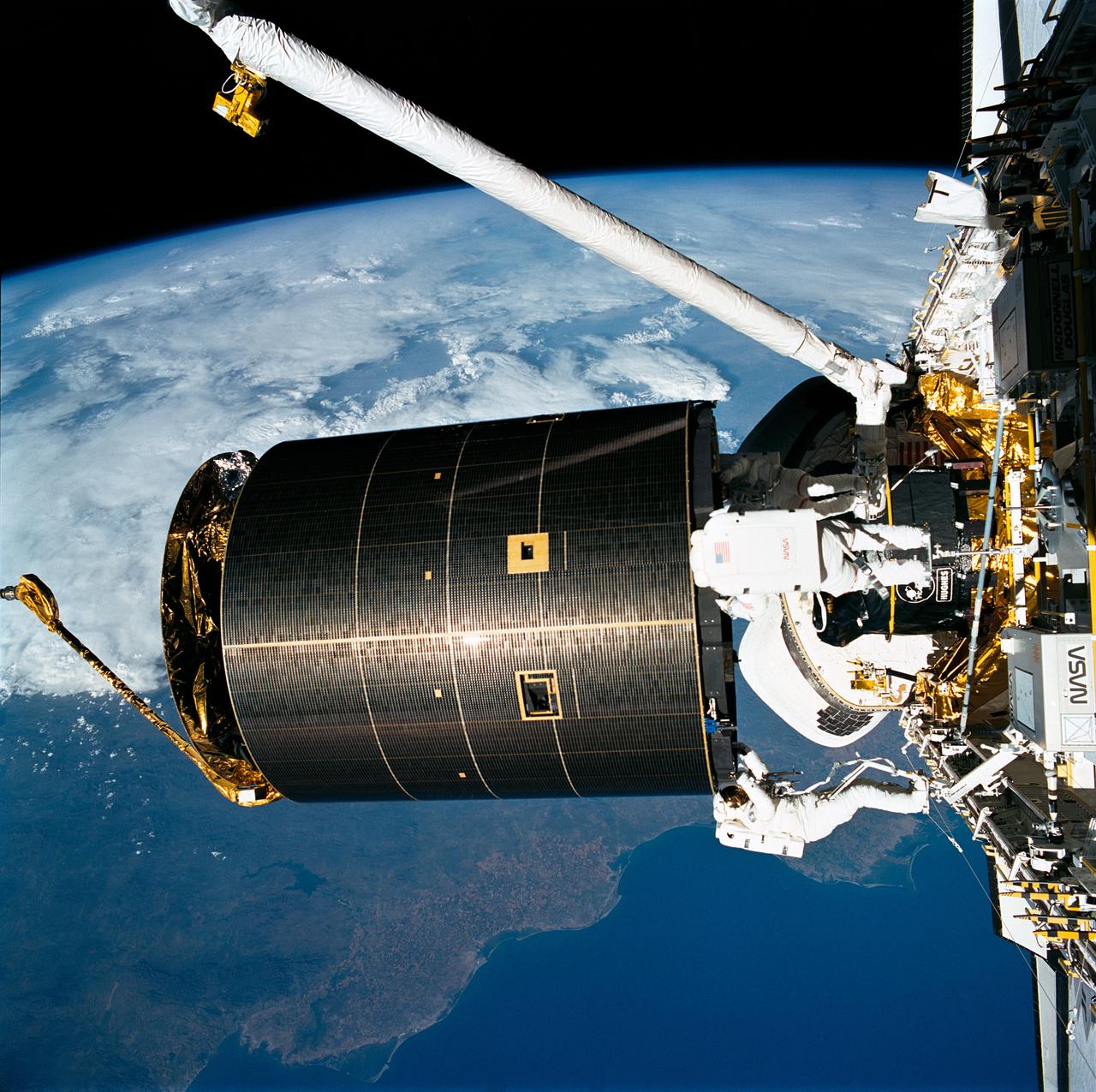
STS049-91-020 (13 May 1992) --- The successful capture of Intelsat VI satellite is recorded over Mexico on this 70mm frame, from inside the Space Shuttle Endeavour's cabin. Left to right, astronauts Richard J. Hieb, Thomas D. Akers and Pierre J. Thuot have handholds on the satellite. Ground coverage in the frame includes an area from Hermosillo, Sonara to Los Mochis in the state of Sinaloa. The nine-day mission accomplished the capture of the Intelsat, subsequent mating of the satellite to a booster and its eventual deployment, as well as a Space Station Freedom preview Extravehicular Activity (EVA). Endeavour's crew members were astronauts Daniel C. Brandenstein, mission commander; Kevin P. Chilton, pilot; and Thomas D. Akers, Richard J. Hieb, Bruce E. Melnick, Kathryn C. Thornton and Pierre J. Thuot, all mission specialists.
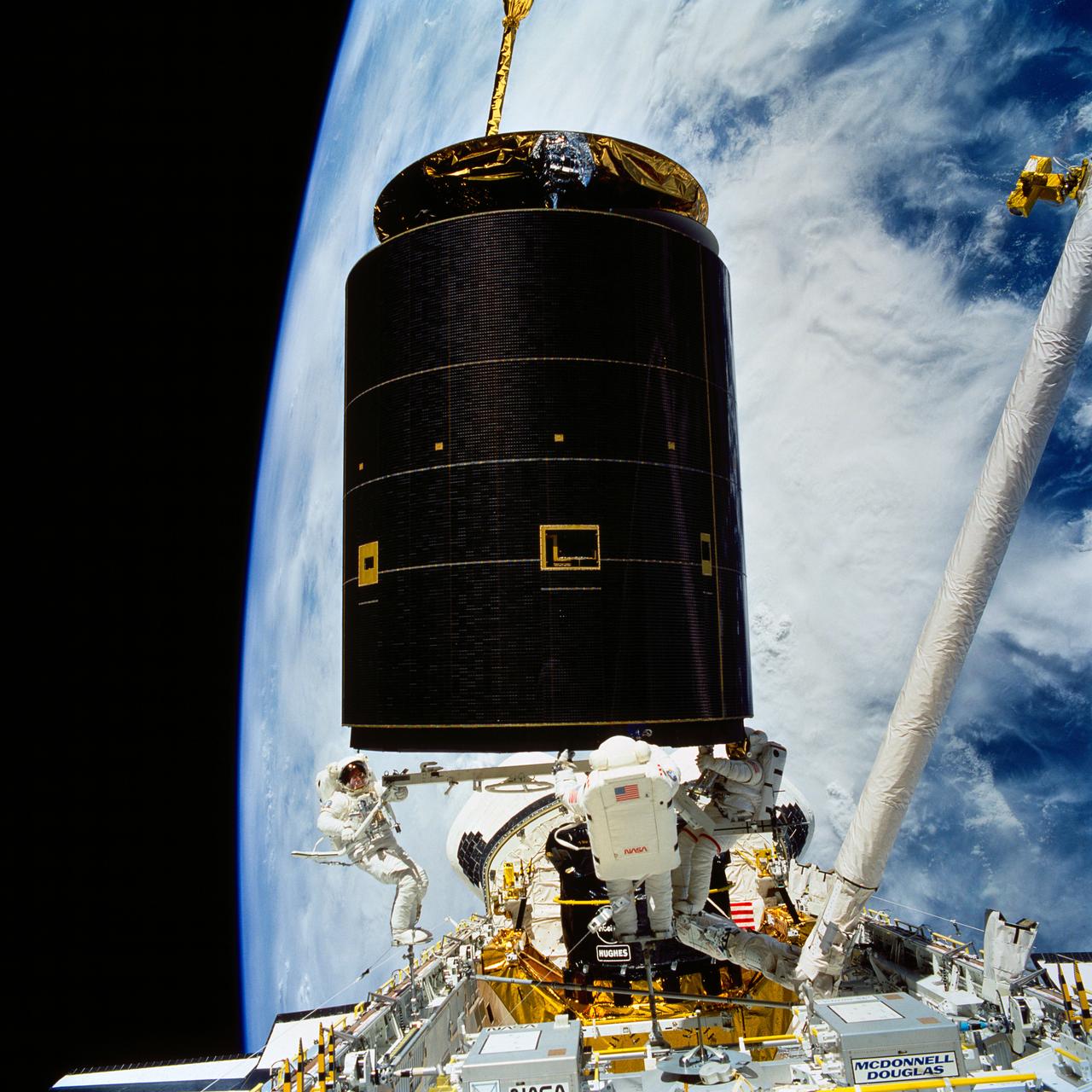
STS049-91-029 (13 May 1992) --- Following the successful capture of Intelsat VI satellite, three astronauts continue their chores toward moving the 4.5 ton communications satellite into the space shuttle Endeavour's cargo bay. A fellow crew member recorded this 70mm still frame from inside Endeavour's cabin. Left to right, astronauts Richard J. Hieb, Thomas D. Akers and Pierre J. Thuot, cooperate on the effort to attach a specially designed grapple bar underneath the satellite. Thuot stands on the end of the Remote Manipulator System's (RMS) arm while Hieb and Akers are on Portable Foot Restraints (PFR) affixed to Endeavour's portside and the Multipurpose Support Structure (MPESS), respectively. The sections of Earth which form the backdrop for the scene are blanketed with thousands of square miles of clouds. Photo credit: NASA
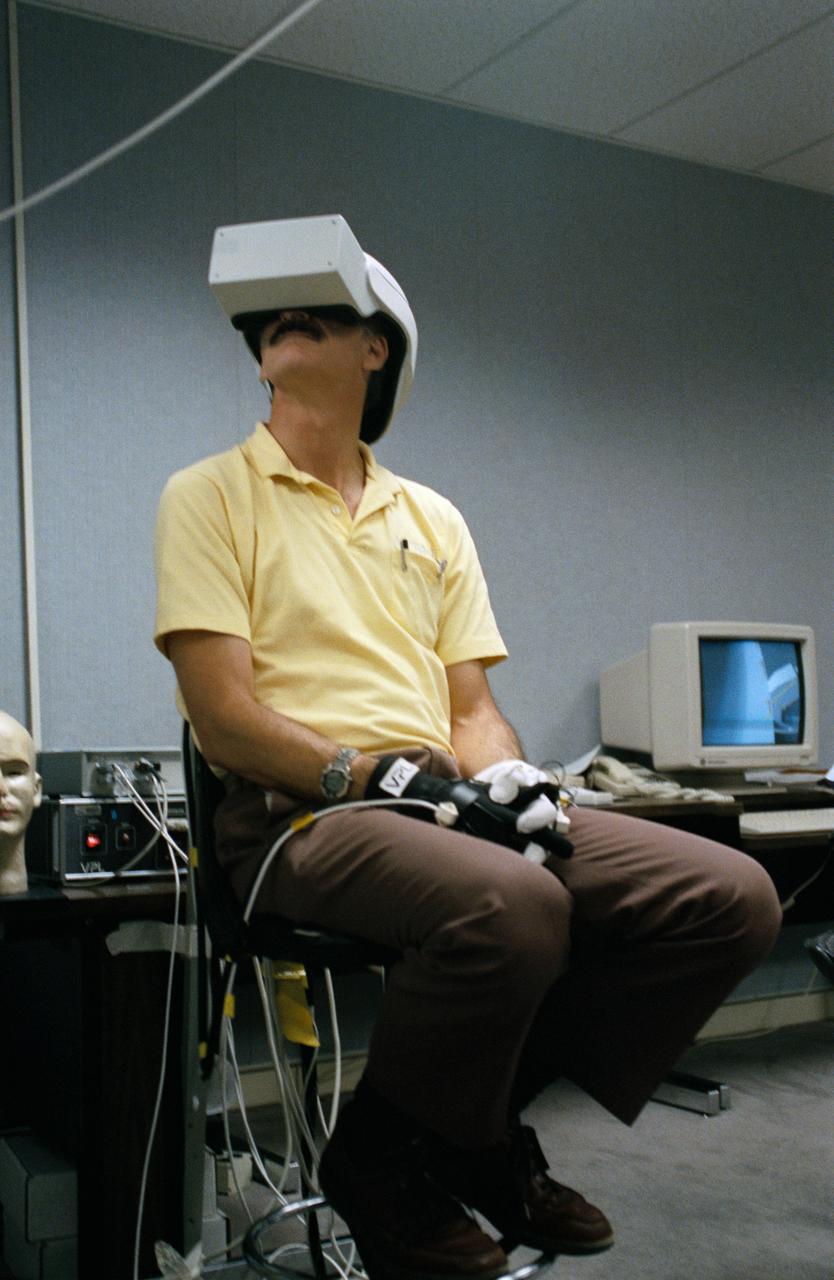
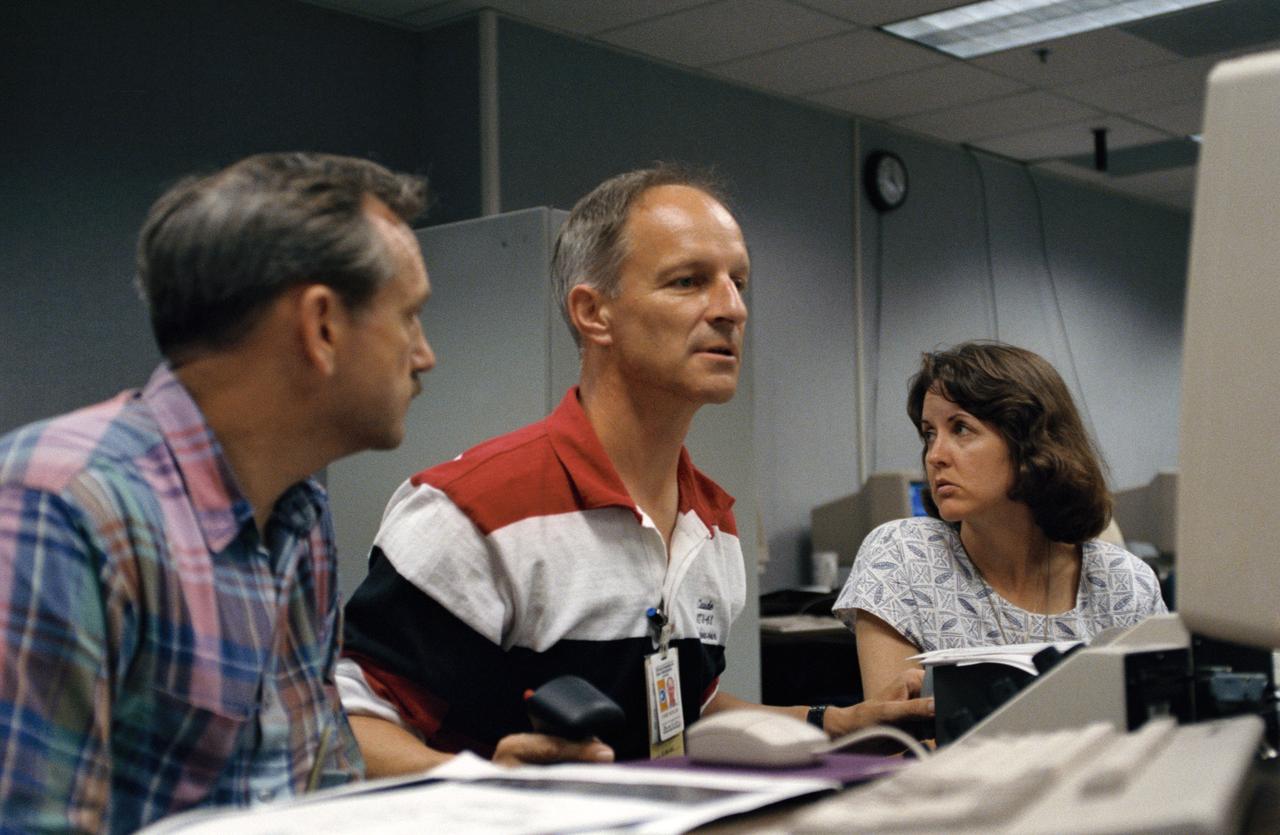
Astronaut Jeffrey A. Hoffman, one of four crewmembers for STS-61 that will conduct scheduled spacewalks during the flight, wears a special helmet and gloves designed to assist in proper positioning near the telescope while on the end of the robot arm. Crewmembers are utilizing a new virtual reality training aid which assists in refining positioning patterns for Space Shuttle Endeavour's Remote Manipulator System (RMS) (36890); Astronaut Claude Nicollier looks at a computer display of the Shuttle's robot arm movements as Thomas D. Akers and Kathryn C. Thornton, mission specialists look on. Nicollier will be responsible for maneuvering the astronauts while they stand in a foot restraint on the end of the RMS arm (36891,36894); Hoffman wears a special helmet and gloves designed to assist in proper positioning near the telescope while on the end of the robot arm (35892); Nicollier looks at a computer display of the Shuttle's robot arm movements as Akers looks on (36893); While (l-r) Astronauts Kenneth Bowersox, Kathryn Thornton, Richard O. Covey and Thomas D. Akers watch, Nicollier moves the Robot arm to desired locations in the Shuttle's payload bay using the Virtual Reality program (36895); Bowersox takes his turn maneuvering the RMS while mission specialist Hoffman, wearing the Virtual Reality helmet, follows his own progress on the end of the robot arm. Crewmembers participating during the training session are (l-r) Astronauts Akers, Hoffman, Bowersox, Nicollier, Covey, and Thornton. In the background, David Homan, an engineer in the JSC Engineering Directorate's Automation and Robotics Division, looks on (36896).
Astronaut Jeffrey A. Hoffman, one of four crewmembers for STS-61 that will conduct scheduled spacewalks during the flight, wears a special helmet and gloves designed to assist in proper positioning near the telescope while on the end of the robot arm. Crewmembers are utilizing a new virtual reality training aid which assists in refining positioning patterns for Space Shuttle Endeavour's Remote Manipulator System (RMS) (36890); Astronaut Claude Nicollier looks at a computer display of the Shuttle's robot arm movements as Thomas D. Akers and Kathryn C. Thornton, mission specialists look on. Nicollier will be responsible for maneuvering the astronauts while they stand in a foot restraint on the end of the RMS arm (36891,36894); Hoffman wears a special helmet and gloves designed to assist in proper positioning near the telescope while on the end of the robot arm (35892); Nicollier looks at a computer display of the Shuttle's robot arm movements as Akers looks on (36893); While (l-r) Astronauts Kenneth Bowersox, Kathryn Thornton, Richard O. Covey and Thomas D. Akers watch, Nicollier moves the Robot arm to desired locations in the Shuttle's payload bay using the Virtual Reality program (36895); Bowersox takes his turn maneuvering the RMS while mission specialist Hoffman, wearing the Virtual Reality helmet, follows his own progress on the end of the robot arm. Crewmembers participating during the training session are (l-r) Astronauts Akers, Hoffman, Bowersox, Nicollier, Covey, and Thornton. In the background, David Homan, an engineer in the JSC Engineering Directorate's Automation and Robotics Division, looks on (36896).
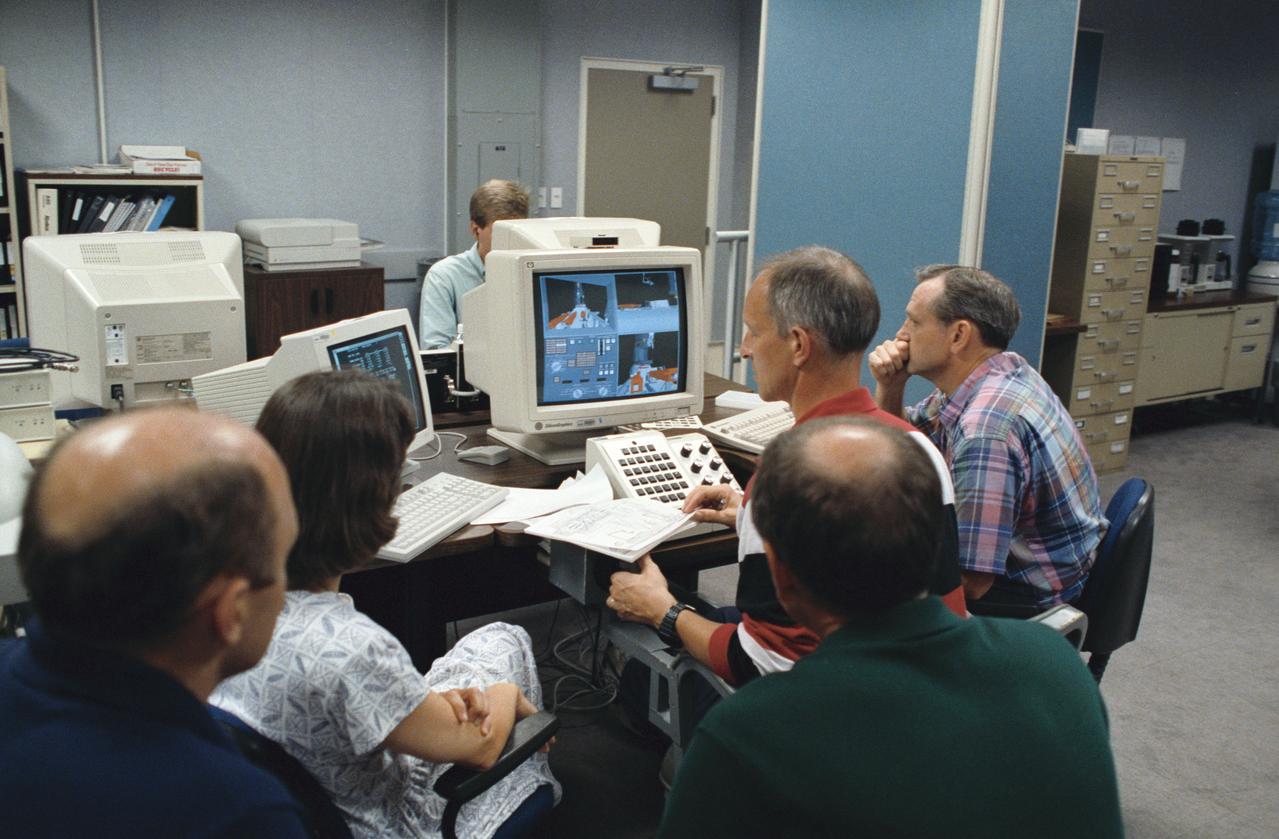
Astronaut Jeffrey A. Hoffman, one of four crewmembers for STS-61 that will conduct scheduled spacewalks during the flight, wears a special helmet and gloves designed to assist in proper positioning near the telescope while on the end of the robot arm. Crewmembers are utilizing a new virtual reality training aid which assists in refining positioning patterns for Space Shuttle Endeavour's Remote Manipulator System (RMS) (36890); Astronaut Claude Nicollier looks at a computer display of the Shuttle's robot arm movements as Thomas D. Akers and Kathryn C. Thornton, mission specialists look on. Nicollier will be responsible for maneuvering the astronauts while they stand in a foot restraint on the end of the RMS arm (36891,36894); Hoffman wears a special helmet and gloves designed to assist in proper positioning near the telescope while on the end of the robot arm (35892); Nicollier looks at a computer display of the Shuttle's robot arm movements as Akers looks on (36893); While (l-r) Astronauts Kenneth Bowersox, Kathryn Thornton, Richard O. Covey and Thomas D. Akers watch, Nicollier moves the Robot arm to desired locations in the Shuttle's payload bay using the Virtual Reality program (36895); Bowersox takes his turn maneuvering the RMS while mission specialist Hoffman, wearing the Virtual Reality helmet, follows his own progress on the end of the robot arm. Crewmembers participating during the training session are (l-r) Astronauts Akers, Hoffman, Bowersox, Nicollier, Covey, and Thornton. In the background, David Homan, an engineer in the JSC Engineering Directorate's Automation and Robotics Division, looks on (36896).
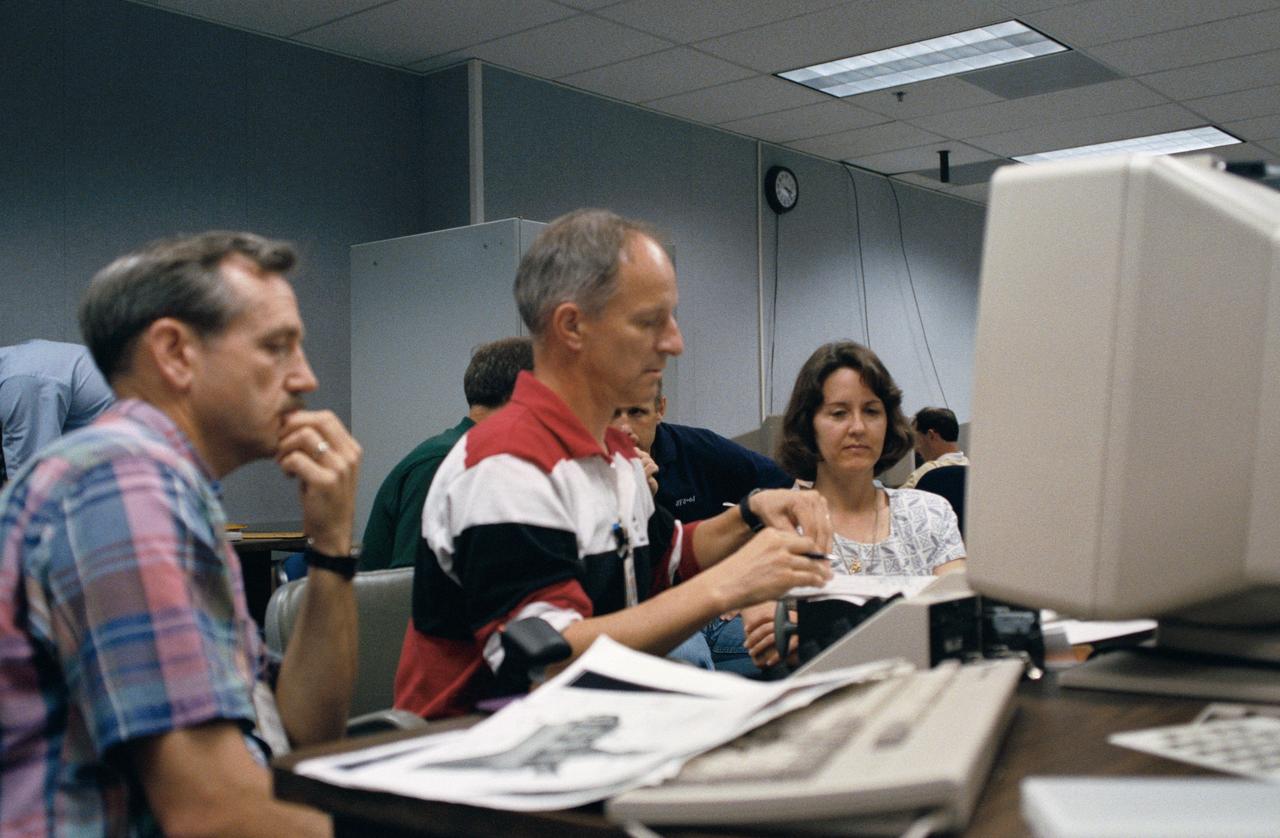
Astronaut Jeffrey A. Hoffman, one of four crewmembers for STS-61 that will conduct scheduled spacewalks during the flight, wears a special helmet and gloves designed to assist in proper positioning near the telescope while on the end of the robot arm. Crewmembers are utilizing a new virtual reality training aid which assists in refining positioning patterns for Space Shuttle Endeavour's Remote Manipulator System (RMS) (36890); Astronaut Claude Nicollier looks at a computer display of the Shuttle's robot arm movements as Thomas D. Akers and Kathryn C. Thornton, mission specialists look on. Nicollier will be responsible for maneuvering the astronauts while they stand in a foot restraint on the end of the RMS arm (36891,36894); Hoffman wears a special helmet and gloves designed to assist in proper positioning near the telescope while on the end of the robot arm (35892); Nicollier looks at a computer display of the Shuttle's robot arm movements as Akers looks on (36893); While (l-r) Astronauts Kenneth Bowersox, Kathryn Thornton, Richard O. Covey and Thomas D. Akers watch, Nicollier moves the Robot arm to desired locations in the Shuttle's payload bay using the Virtual Reality program (36895); Bowersox takes his turn maneuvering the RMS while mission specialist Hoffman, wearing the Virtual Reality helmet, follows his own progress on the end of the robot arm. Crewmembers participating during the training session are (l-r) Astronauts Akers, Hoffman, Bowersox, Nicollier, Covey, and Thornton. In the background, David Homan, an engineer in the JSC Engineering Directorate's Automation and Robotics Division, looks on (36896).
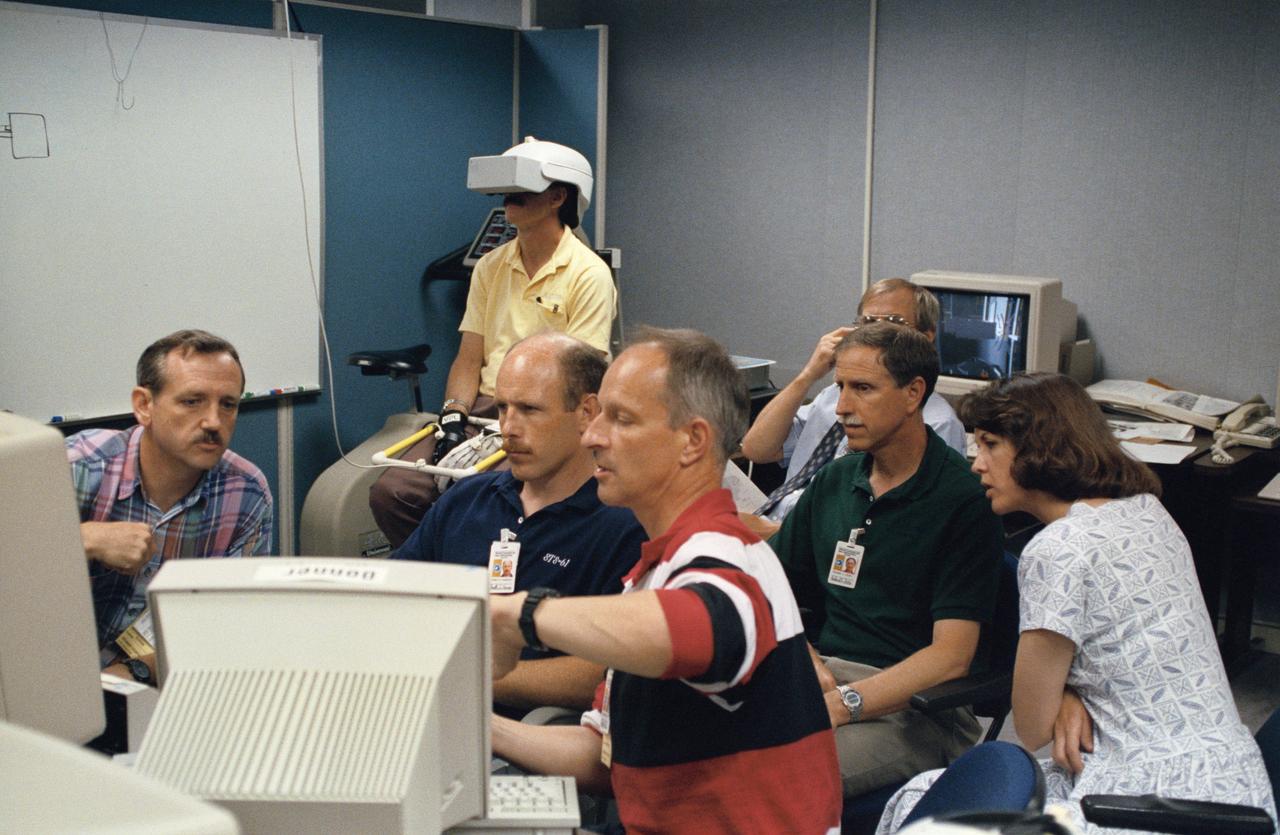
Astronaut Jeffrey A. Hoffman, one of four crewmembers for STS-61 that will conduct scheduled spacewalks during the flight, wears a special helmet and gloves designed to assist in proper positioning near the telescope while on the end of the robot arm. Crewmembers are utilizing a new virtual reality training aid which assists in refining positioning patterns for Space Shuttle Endeavour's Remote Manipulator System (RMS) (36890); Astronaut Claude Nicollier looks at a computer display of the Shuttle's robot arm movements as Thomas D. Akers and Kathryn C. Thornton, mission specialists look on. Nicollier will be responsible for maneuvering the astronauts while they stand in a foot restraint on the end of the RMS arm (36891,36894); Hoffman wears a special helmet and gloves designed to assist in proper positioning near the telescope while on the end of the robot arm (35892); Nicollier looks at a computer display of the Shuttle's robot arm movements as Akers looks on (36893); While (l-r) Astronauts Kenneth Bowersox, Kathryn Thornton, Richard O. Covey and Thomas D. Akers watch, Nicollier moves the Robot arm to desired locations in the Shuttle's payload bay using the Virtual Reality program (36895); Bowersox takes his turn maneuvering the RMS while mission specialist Hoffman, wearing the Virtual Reality helmet, follows his own progress on the end of the robot arm. Crewmembers participating during the training session are (l-r) Astronauts Akers, Hoffman, Bowersox, Nicollier, Covey, and Thornton. In the background, David Homan, an engineer in the JSC Engineering Directorate's Automation and Robotics Division, looks on (36896).
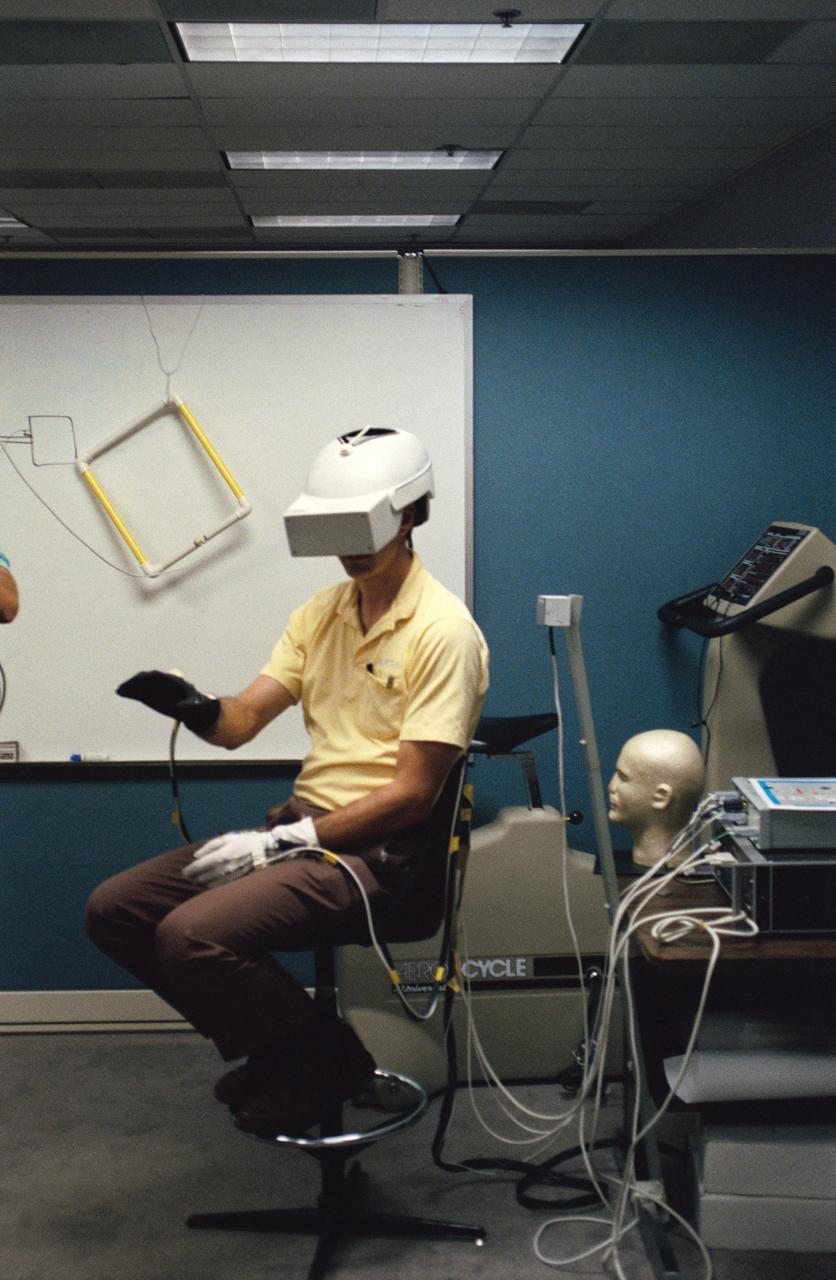
Astronaut Jeffrey A. Hoffman, one of four crewmembers for STS-61 that will conduct scheduled spacewalks during the flight, wears a special helmet and gloves designed to assist in proper positioning near the telescope while on the end of the robot arm. Crewmembers are utilizing a new virtual reality training aid which assists in refining positioning patterns for Space Shuttle Endeavour's Remote Manipulator System (RMS) (36890); Astronaut Claude Nicollier looks at a computer display of the Shuttle's robot arm movements as Thomas D. Akers and Kathryn C. Thornton, mission specialists look on. Nicollier will be responsible for maneuvering the astronauts while they stand in a foot restraint on the end of the RMS arm (36891,36894); Hoffman wears a special helmet and gloves designed to assist in proper positioning near the telescope while on the end of the robot arm (35892); Nicollier looks at a computer display of the Shuttle's robot arm movements as Akers looks on (36893); While (l-r) Astronauts Kenneth Bowersox, Kathryn Thornton, Richard O. Covey and Thomas D. Akers watch, Nicollier moves the Robot arm to desired locations in the Shuttle's payload bay using the Virtual Reality program (36895); Bowersox takes his turn maneuvering the RMS while mission specialist Hoffman, wearing the Virtual Reality helmet, follows his own progress on the end of the robot arm. Crewmembers participating during the training session are (l-r) Astronauts Akers, Hoffman, Bowersox, Nicollier, Covey, and Thornton. In the background, David Homan, an engineer in the JSC Engineering Directorate's Automation and Robotics Division, looks on (36896).
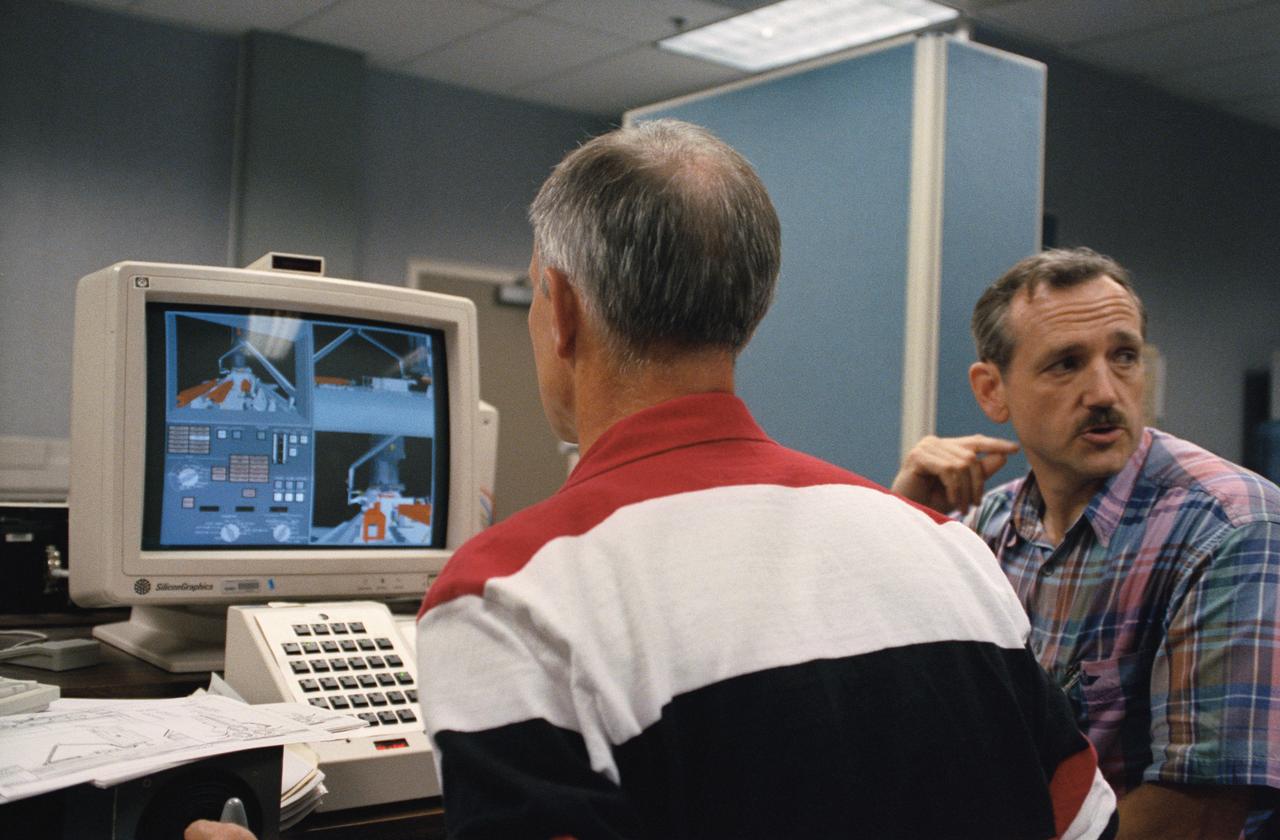
Astronaut Jeffrey A. Hoffman, one of four crewmembers for STS-61 that will conduct scheduled spacewalks during the flight, wears a special helmet and gloves designed to assist in proper positioning near the telescope while on the end of the robot arm. Crewmembers are utilizing a new virtual reality training aid which assists in refining positioning patterns for Space Shuttle Endeavour's Remote Manipulator System (RMS) (36890); Astronaut Claude Nicollier looks at a computer display of the Shuttle's robot arm movements as Thomas D. Akers and Kathryn C. Thornton, mission specialists look on. Nicollier will be responsible for maneuvering the astronauts while they stand in a foot restraint on the end of the RMS arm (36891,36894); Hoffman wears a special helmet and gloves designed to assist in proper positioning near the telescope while on the end of the robot arm (35892); Nicollier looks at a computer display of the Shuttle's robot arm movements as Akers looks on (36893); While (l-r) Astronauts Kenneth Bowersox, Kathryn Thornton, Richard O. Covey and Thomas D. Akers watch, Nicollier moves the Robot arm to desired locations in the Shuttle's payload bay using the Virtual Reality program (36895); Bowersox takes his turn maneuvering the RMS while mission specialist Hoffman, wearing the Virtual Reality helmet, follows his own progress on the end of the robot arm. Crewmembers participating during the training session are (l-r) Astronauts Akers, Hoffman, Bowersox, Nicollier, Covey, and Thornton. In the background, David Homan, an engineer in the JSC Engineering Directorate's Automation and Robotics Division, looks on (36896).
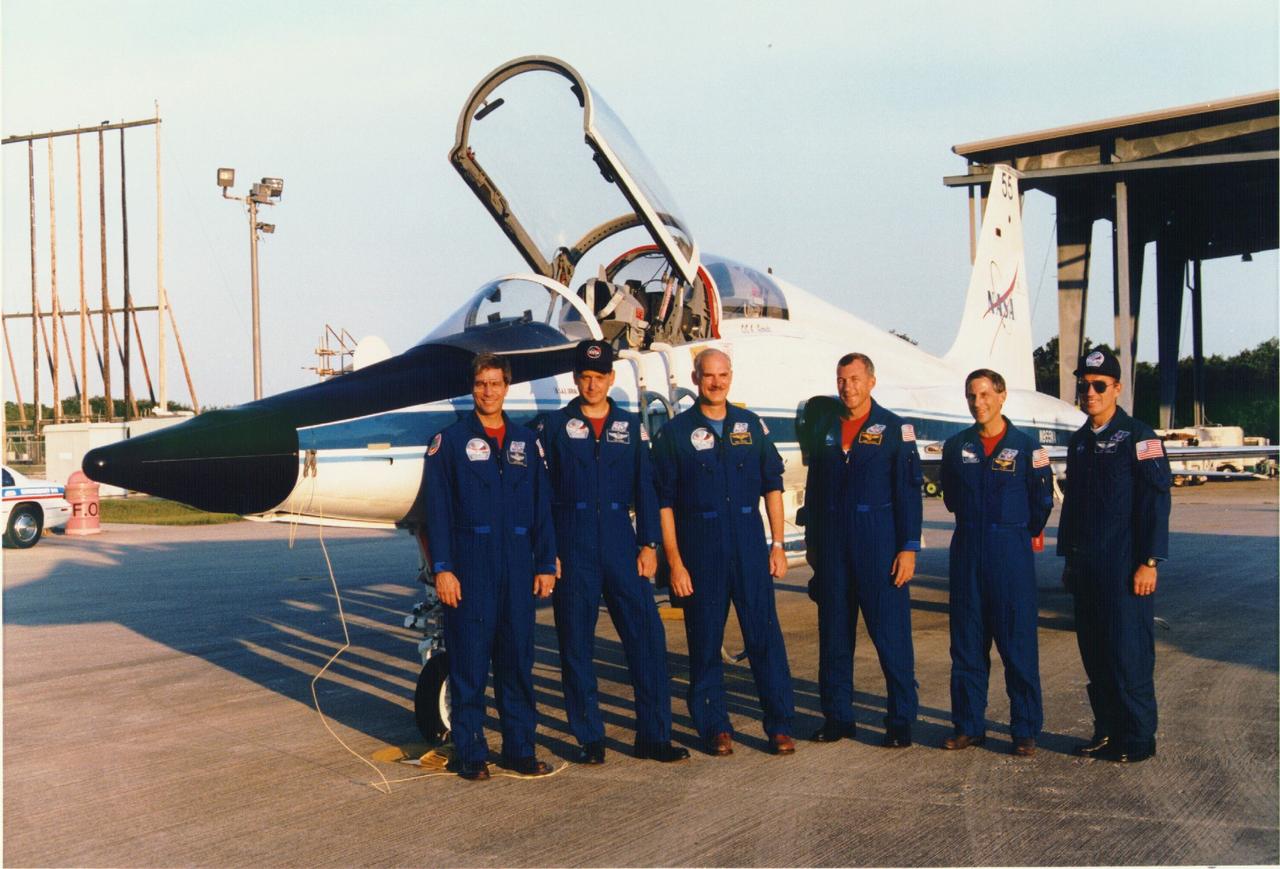
KENNEDY SPACE CENTER, FLA. - The STS-79 astronauts arrive at KSC's Shuttle Landing Facility in their T-38 aircraft from Johnson Space Center in Houston. From left are Mission Specialists John E. Blaha and Tom Akers; Commander William F. Readdy; PIlot Terrence W. Wilcutt; and Mission Specialists Jay Apt and Carl E. Walz. The astronauts are at KSC for the Terminal Countdown Demonstration Test, a dress rehearsal for launch. They are scheduled to lift off around Sept. 12 on Mission STS-79, the fourth docking between the U.S. Shuttle and Russian Space Station Mir.
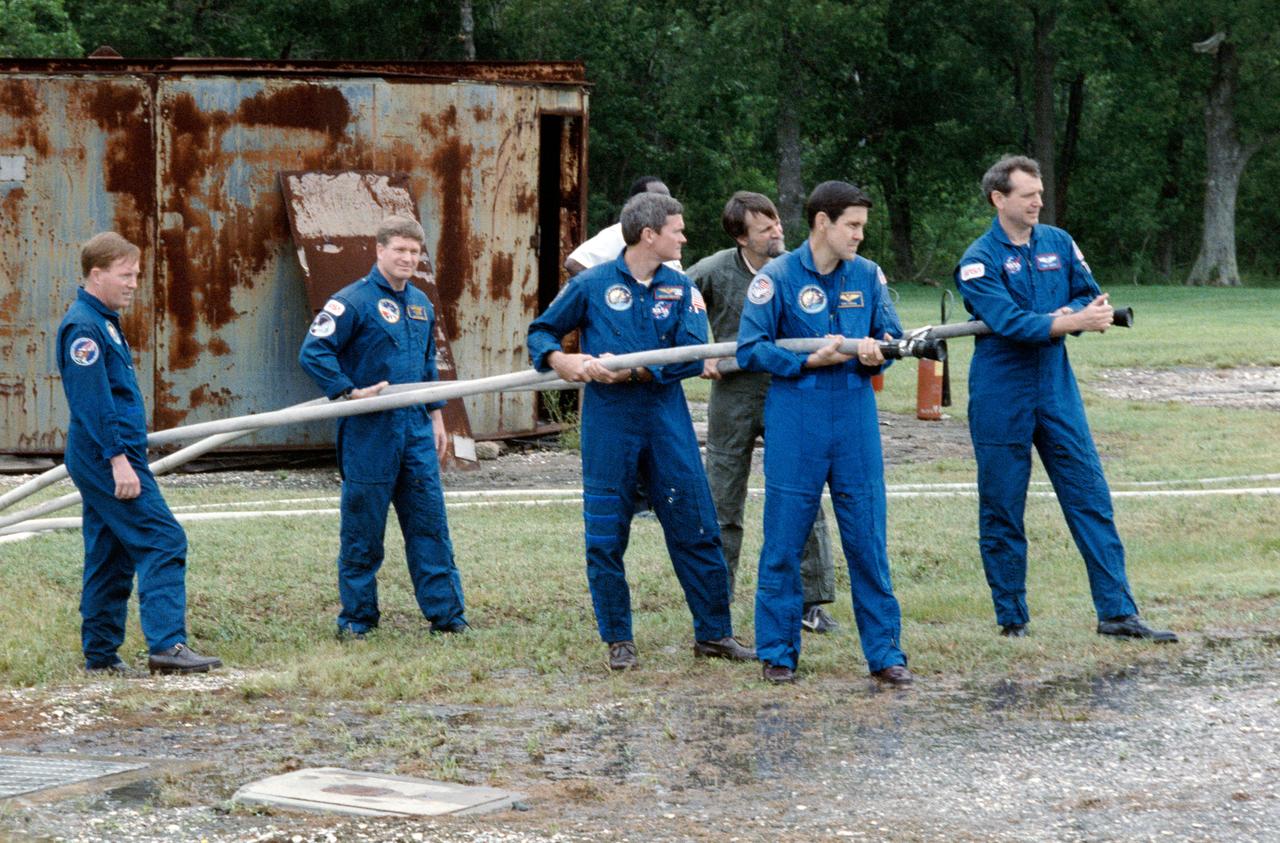
S90-38926 (4 May 1990) --- The STS-41 astronaut crew and a STS-35 backup payload specialist participate in fire control training exercises at the Johnson Space Center (JSC). Left to right are Richard N. Richards, William M. Shepherd, Bruce E. Melnick, Kenneth Nordsieck, Robert D. Cabana and Thomas D. Akers. Nordsieck is Astro-1 backup payload specialist in training for STS-35. This type training is provided all crewmembers assigned to seats aboard Space Shuttle.
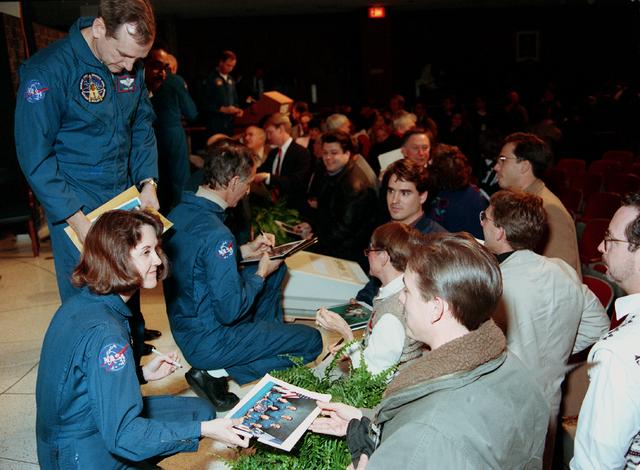
STS-61 astronauts Kathryn Thornton, Jeffrey Hoffman and Thomas Akers (standing) sign autographs in Marshall Space Flight Center's Morris Auditorium, January 19, 1994. Space Shuttle crews traditionally visited NASA field centers following each mission to present mission highlights and recognize employees who made contributions to the Shuttle program. Many of the techniques used during the STS-61 Hubble Space Telescope Servicing mission were rehearsed at the Center's Neutral Buoyancy Simulator.
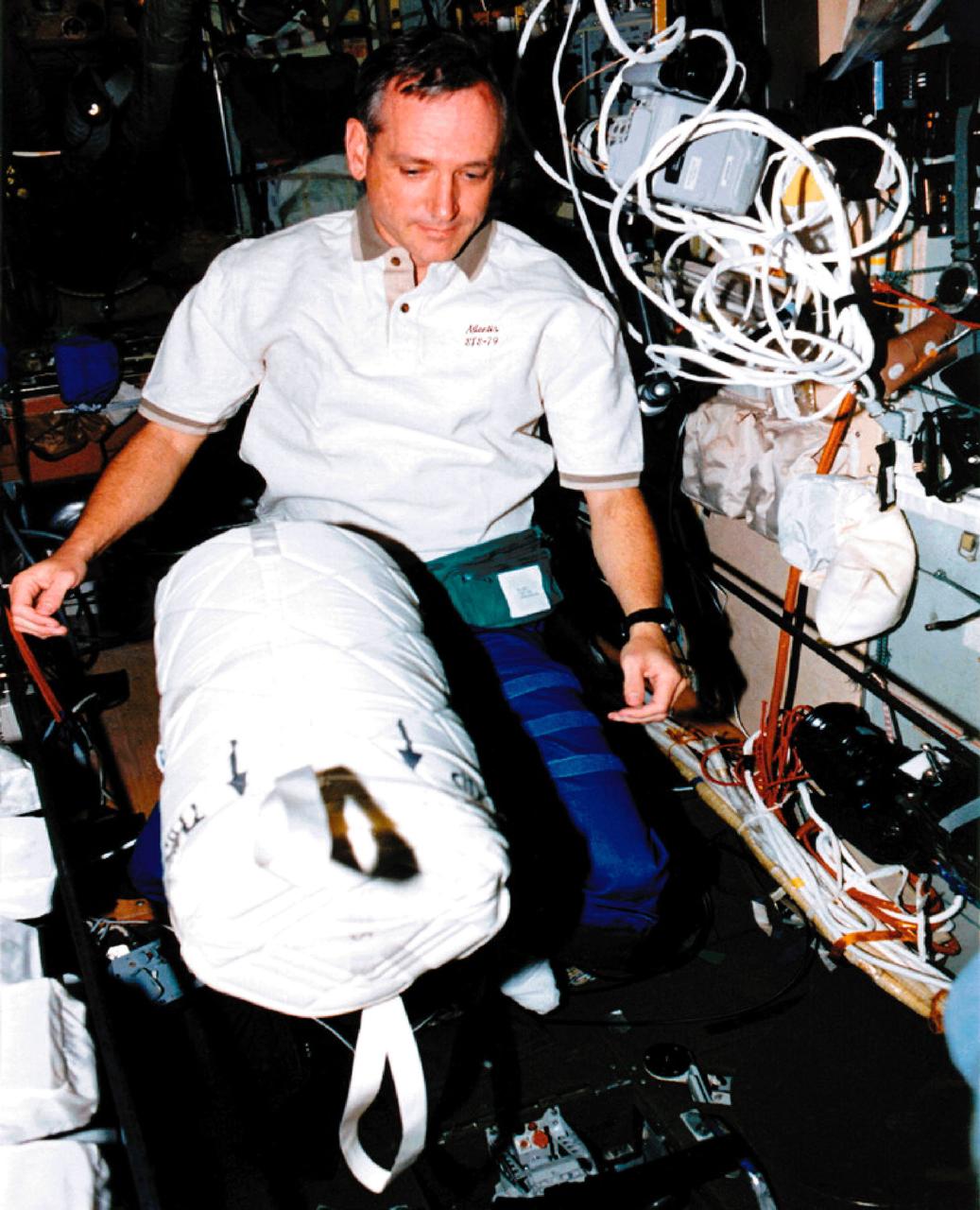
Astronaut Tom Akers places a liquid nitrogen Dewar containing frozen protein solutions aboard Russia's space Station Mir during a visit by the Space Shuttle (STS-79). The protein samples were flash-frozen on Earth and will be allowed to thaw and crystallize in the microgravity environment on Mir Space Station. A later crew will return the Dewar to Earth for sample analysis. Dr. Alexander McPherson of the University of California at Riverside is the principal investigator. Photo credit: NASA/Johnson Space Center.

STS049-S-002 (16 Jan. 1992) --- These seven NASA astronauts are currently training for the first flight of the Space Shuttle Endeavour, seen in the background. Daniel C. Brandenstein, center, is mission commander; and Kevin P. Chilton, third from right, is pilot. Mission specialists are, left to right, Kathryn C. Thornton, Bruce E. Melnick, Pierre J. Thout, Thomas D. Akers and Richard J. Hieb.
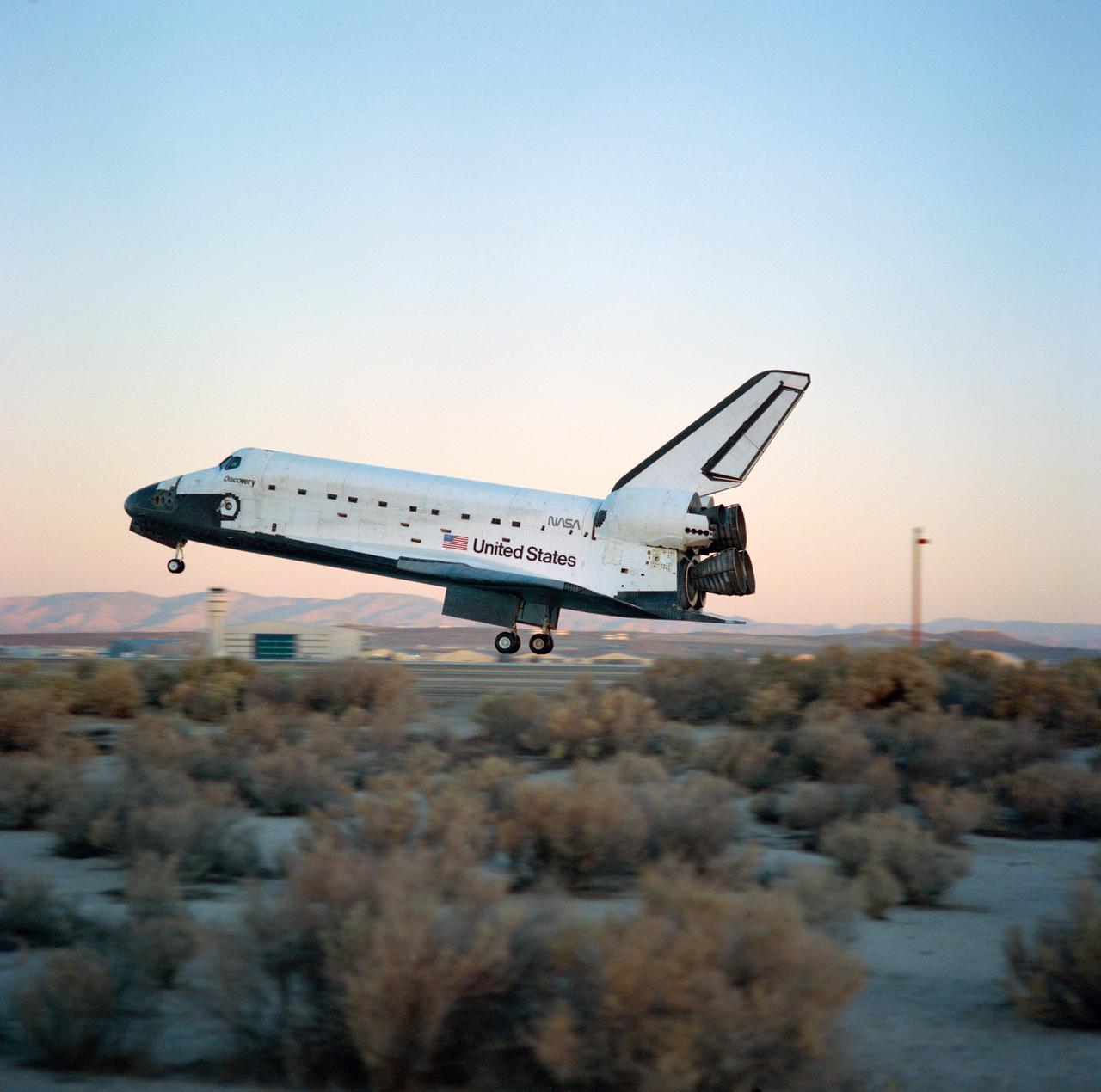
STS041-S-093 (10 Oct 1990) --- Discovery is only moments away from touchdown at Edwards Air Force Base to end a four-day mission in space for its five-man crew. The vehicle landed at 6:57 a.m. PDT, Oct. 10, 1990. Onboard the spacecraft were Astronauts Richard N. Richards, Robert D. Cabana, William M. Shepherd, Bruce E. Melnick and Thomas D. Akers.

STS049-S-269 (16 May 1992) --- The seven crewmembers of STS-49 pose near Endeavour for a post-flight shot soon after getting their feet on terra firma following nine days in Earth orbit. Left to right are astronauts Richard J. Hieb, Kevin P. Chilton, Daniel C. Brandenstein, Thomas D. Akers, Pierre J. Thuot, Kathryn C. Thornton and Bruce E. Melnick. Brandenstein was mission commander; Chilton, pilot; and the others, mission specialists.
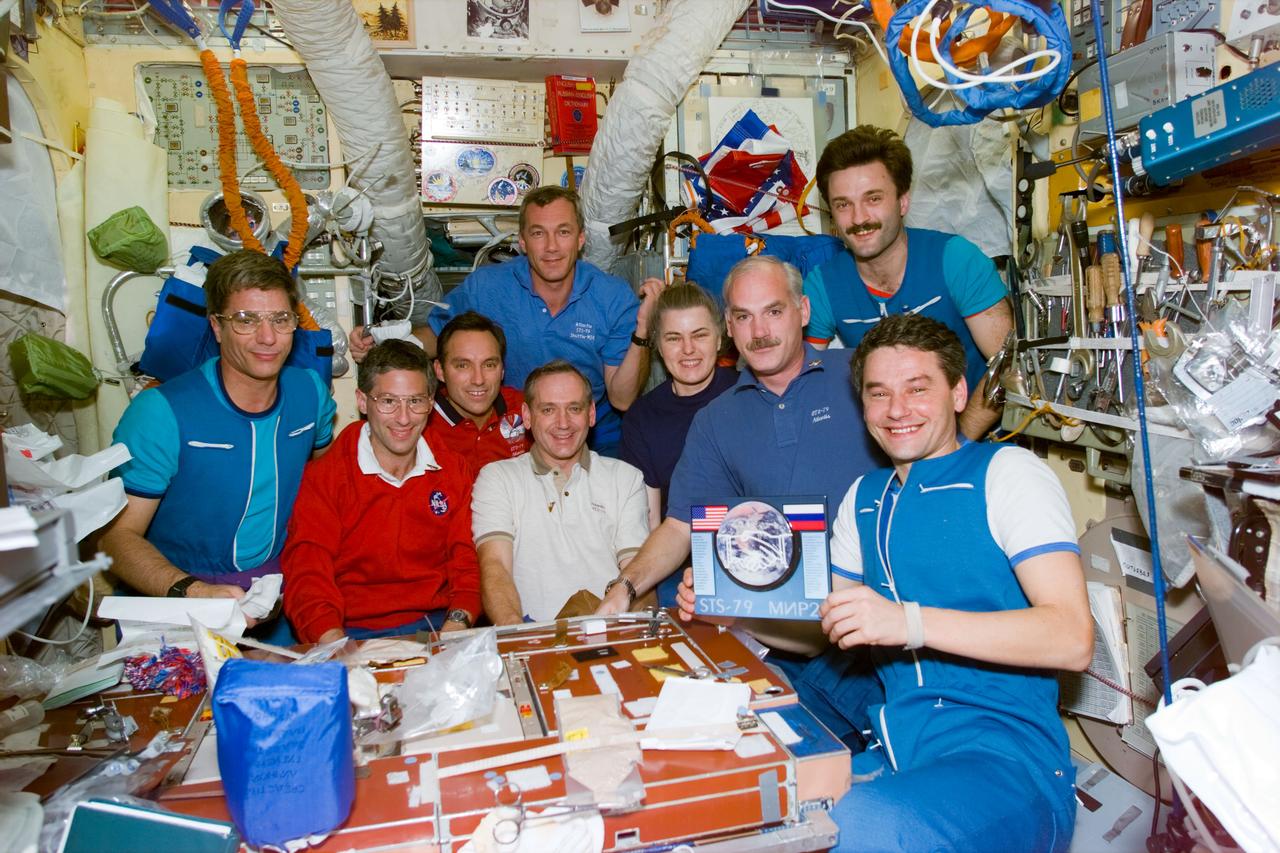
STS79-E-5180 (20 September 1996) --- The entire crews of STS-79 and Mir-22 are shown during a gift exchange ceremony aboard Russia's Mir Space Station's Base Block, during Flight Day 5. Front row, from the left, John E. Blaha, Jerome (Jay) Apt, Carl E. Walz, Thomas D. Akers, Shannon W. Lucid, William F. Readdy and Valeri G. Korzun. Back row: Terrence W. Wilcutt and Aleksandr Y. Kaleri.
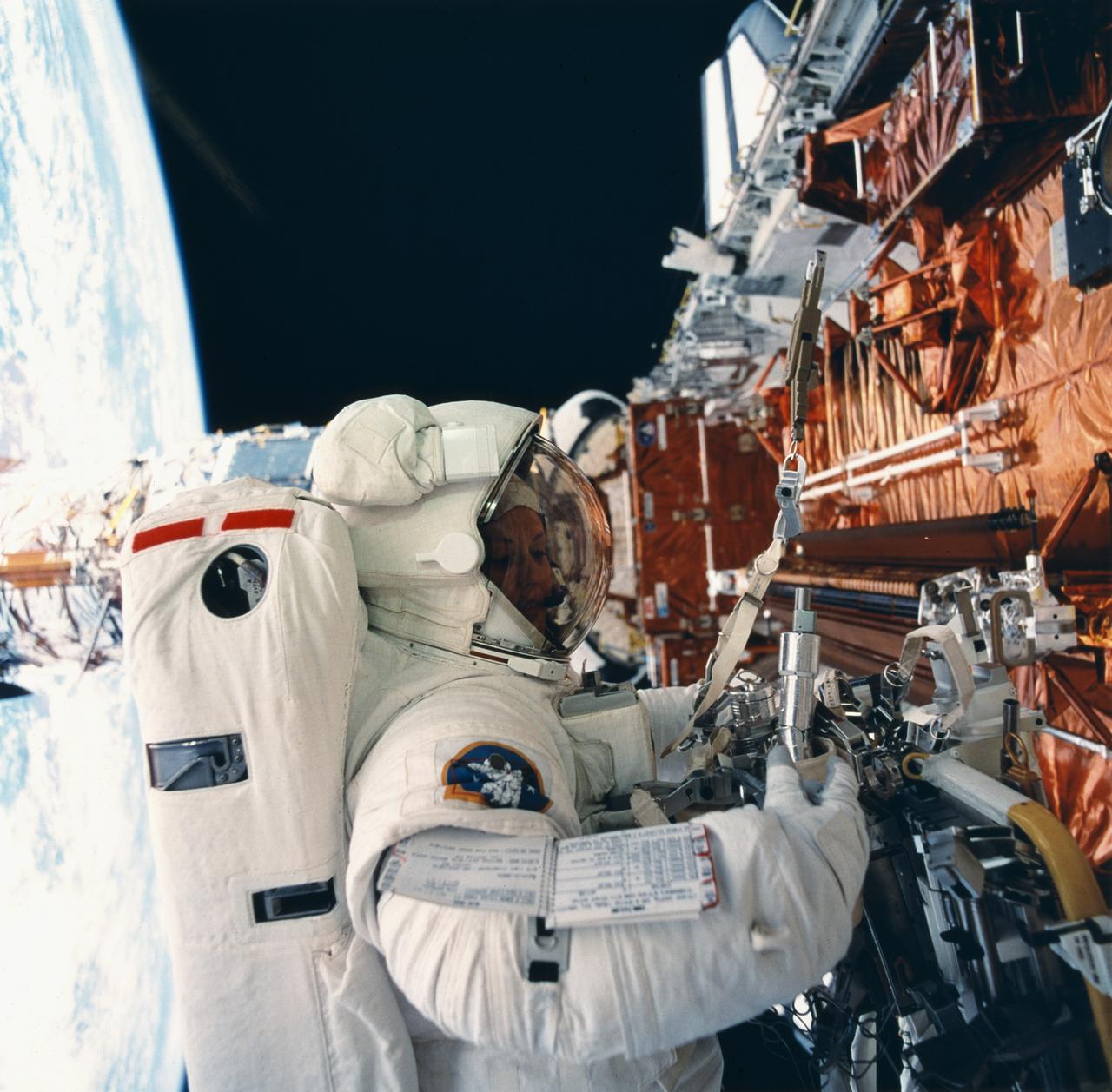
This STS-61 onboard photo depicts Astronaut and mission specialist Kathryn Thornton performing the 2nd extra-vehicular activity (EVA) of the STS-61 mission. Thornton, along with astronaut and mission specialist Thomas Akers (out of frame), performed the task of replacing the solar arrays. The EVA lasted 6 hours and 35 minutes. Launched December 1, 1993 aboard the Space Shuttle Orbiter Endeavor, the STS-61 mission was solely dedicated to servicing the HST.
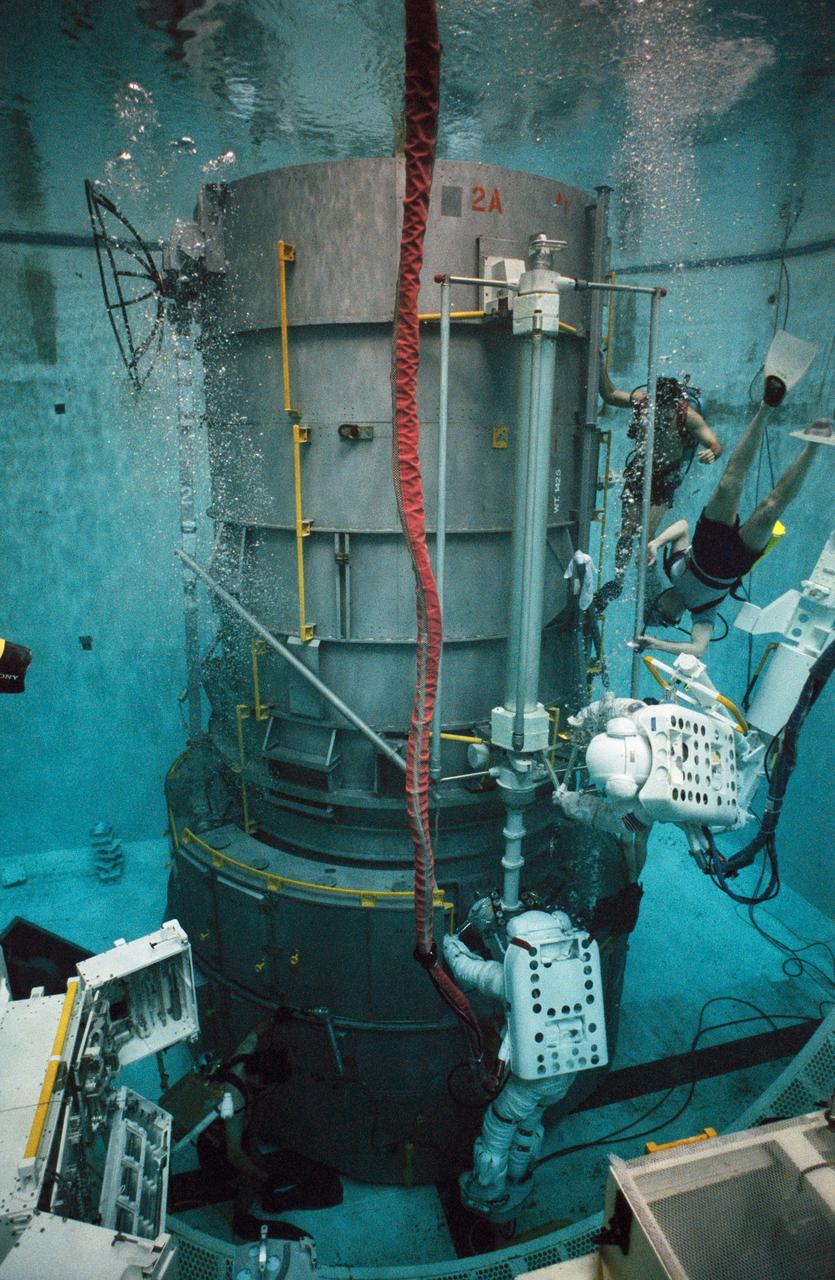
S93-30237 (5 Mar 1993) --- Wearing training versions of Space Shuttle Extravehicular Mobility Units (EMU), astronauts Thomas D. Akers (red stripe) and Kathryn C. Thornton use the spacious pool of the Johnson Space Center's (JSC) Weightless Environment Training Facility (WET-F) to rehearse for the Hubble Space Telescope (HST) servicing mission. They are working with part of a full-scale mockup of HST.
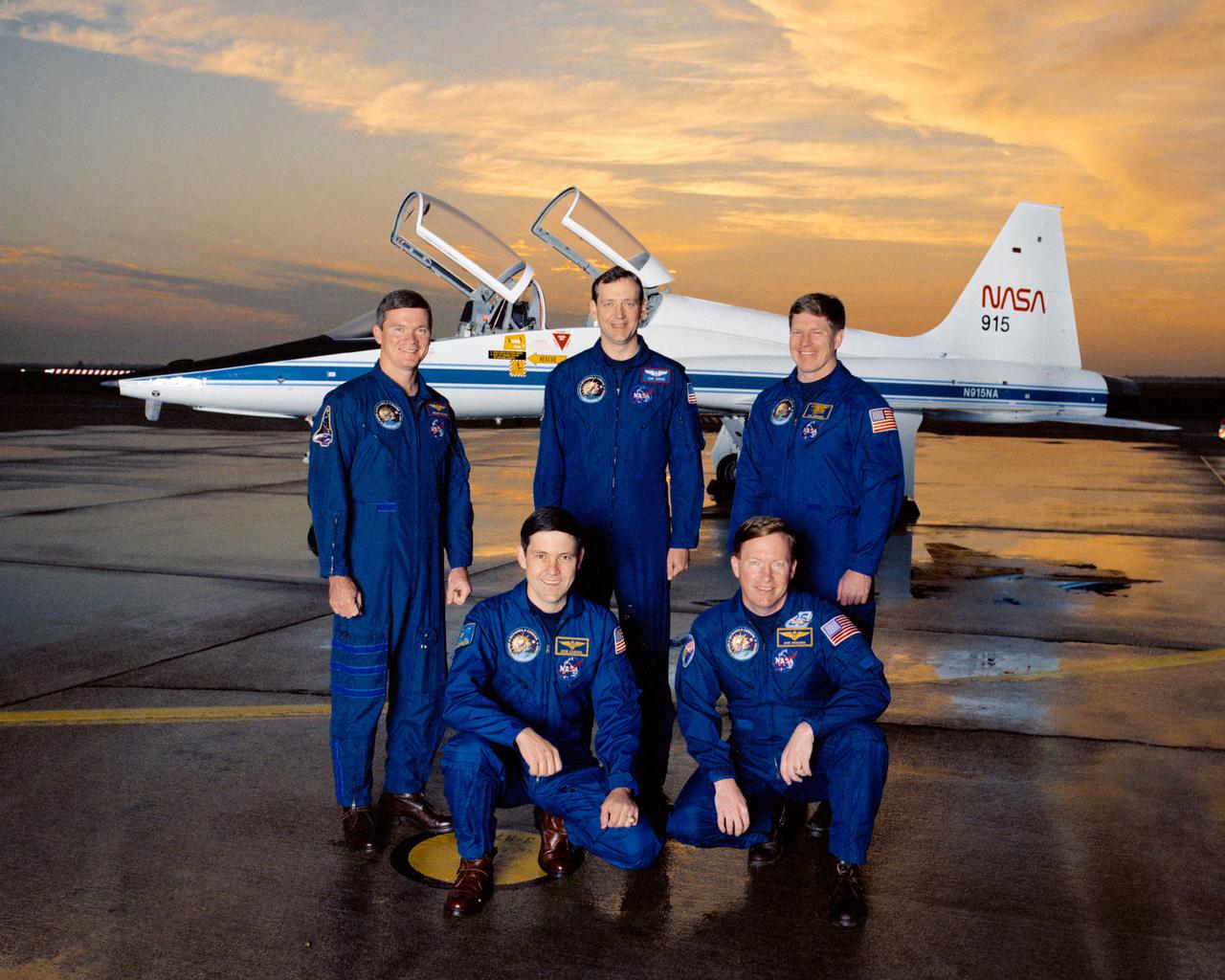
KENNEDY SPACE CENTER, Fla. – STS-41 crewmembers -- These five astronauts have been assigned to fly the STS-41 mission for NASA. Pictured are (kneeling, from the left) Robert D. Cabana, pilot, and Richard N. Richards, mission commander; and (standing from left) Bruce E. Melnick, Thomas D. Akers and William M. Shepard. All three are mission specialists.
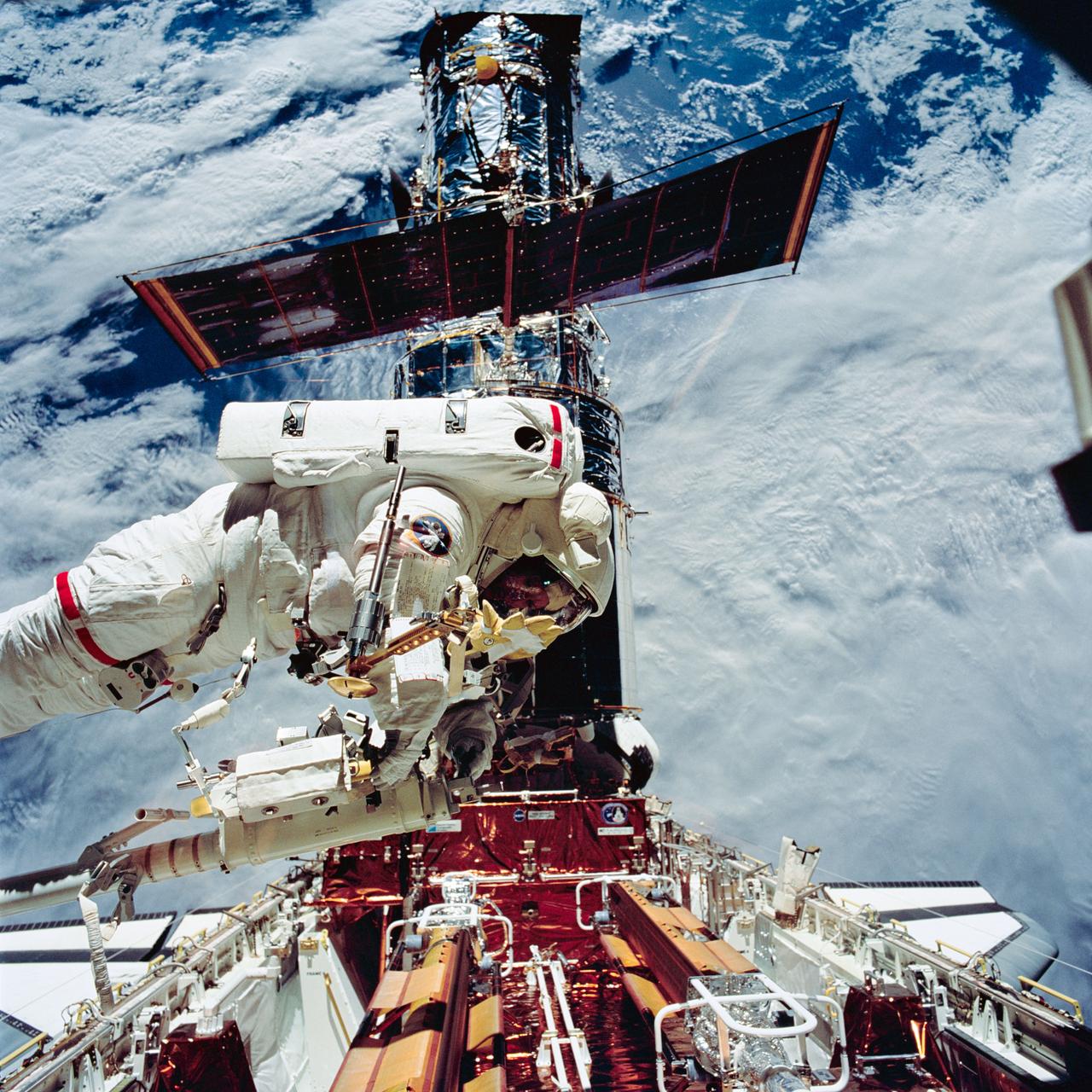
STS061-95-028 (6 Dec 1993) --- Astronaut Kathryn C. Thornton, on the end of the Space Shuttle Endeavour's Remote Manipulator System (RMS) arm, hovers over equipment associated with servicing chores on the Hubble Space Telescope (HST) during the second extravehicular activity (EVA) on the eleven-day mission. Astronauts Thornton and Thomas D. Akers changed out the solar array panels during this EVA.
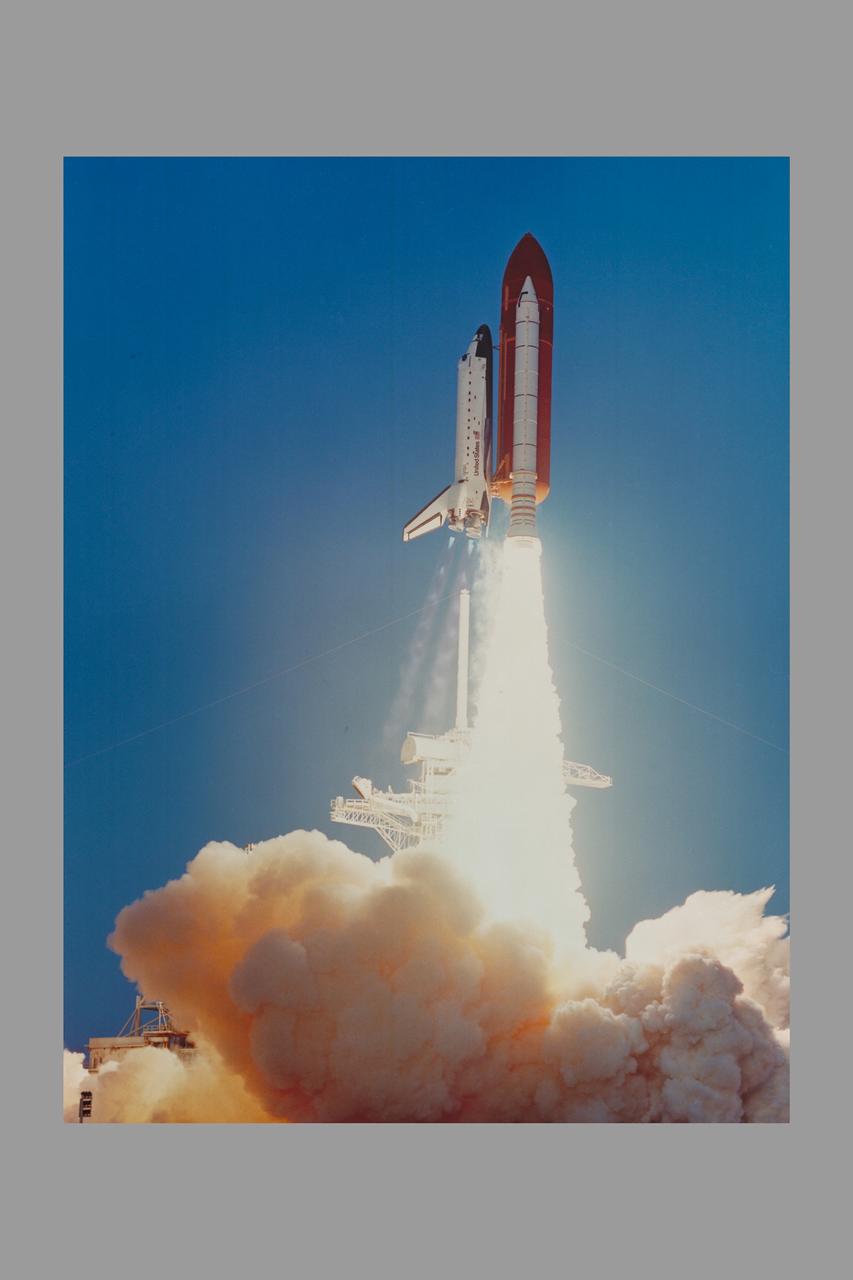
STS-41 Discovery lifts off from Launch Complex 39 at the Kennedy Space Center to begin a four-day mission in space for its five-man crew. Onboard the spacecraft were Astronauts Richard N. Richards, Robert D Cabana, William M Sheperd, Bruce E. Melnick and Thomas D. Akers. Lift off was at 7:47 a.m. EDT on oct 6, 1990. A feww hours after this photo was made, the crewmembers released the Ulysses spacecraft onits way to a long-awaited mission.
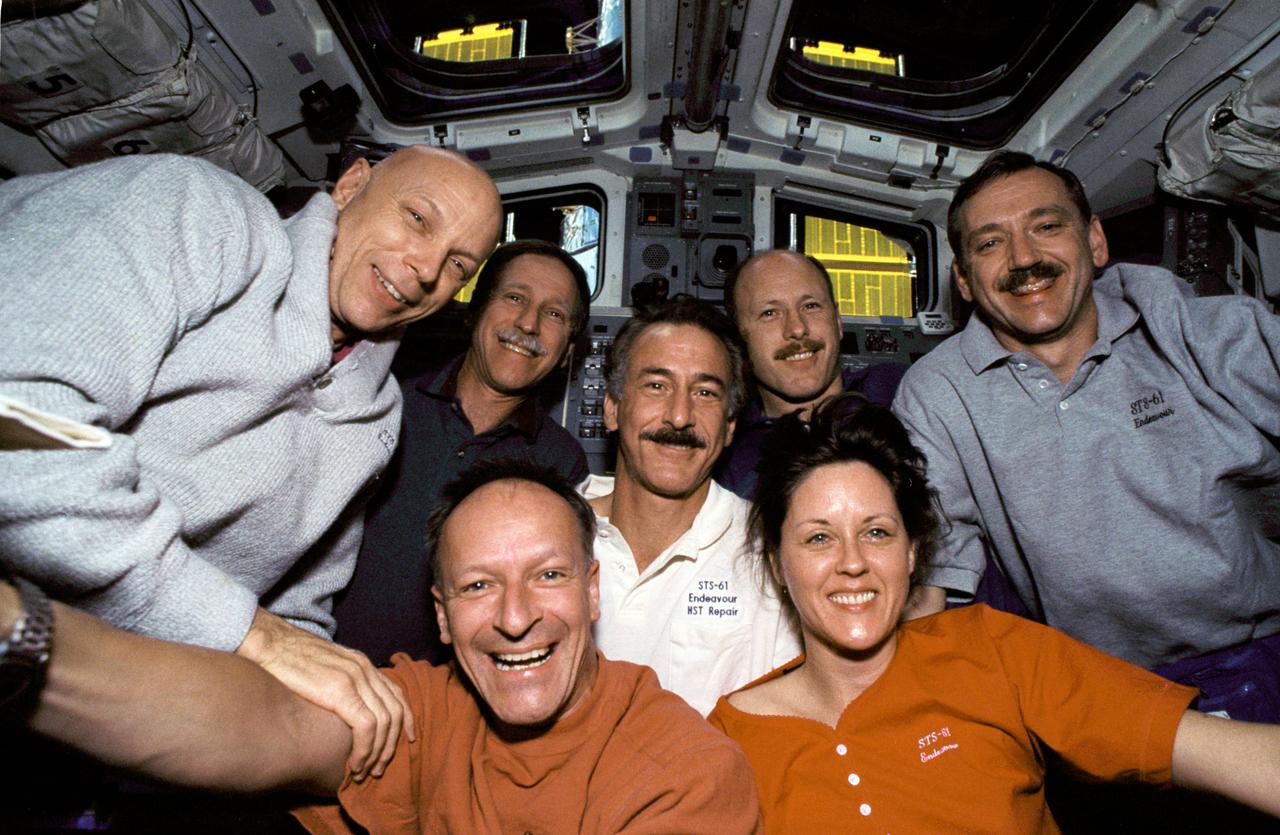
STS061-05-031 (2-13 Dec 1993) --- With the Hubble Space Telescope (HST) berthed in Endeavour's cargo bay, crew members for the STS-61 mission pause for a crew portrait on the flight deck. Left to right are F. Story Musgrave, Richard O. Covey, Claude Nicollier, Jeffrey A. Hoffman, Kenneth D. Bowersox, Kathryn C. Thornton and Thomas D. Akers.
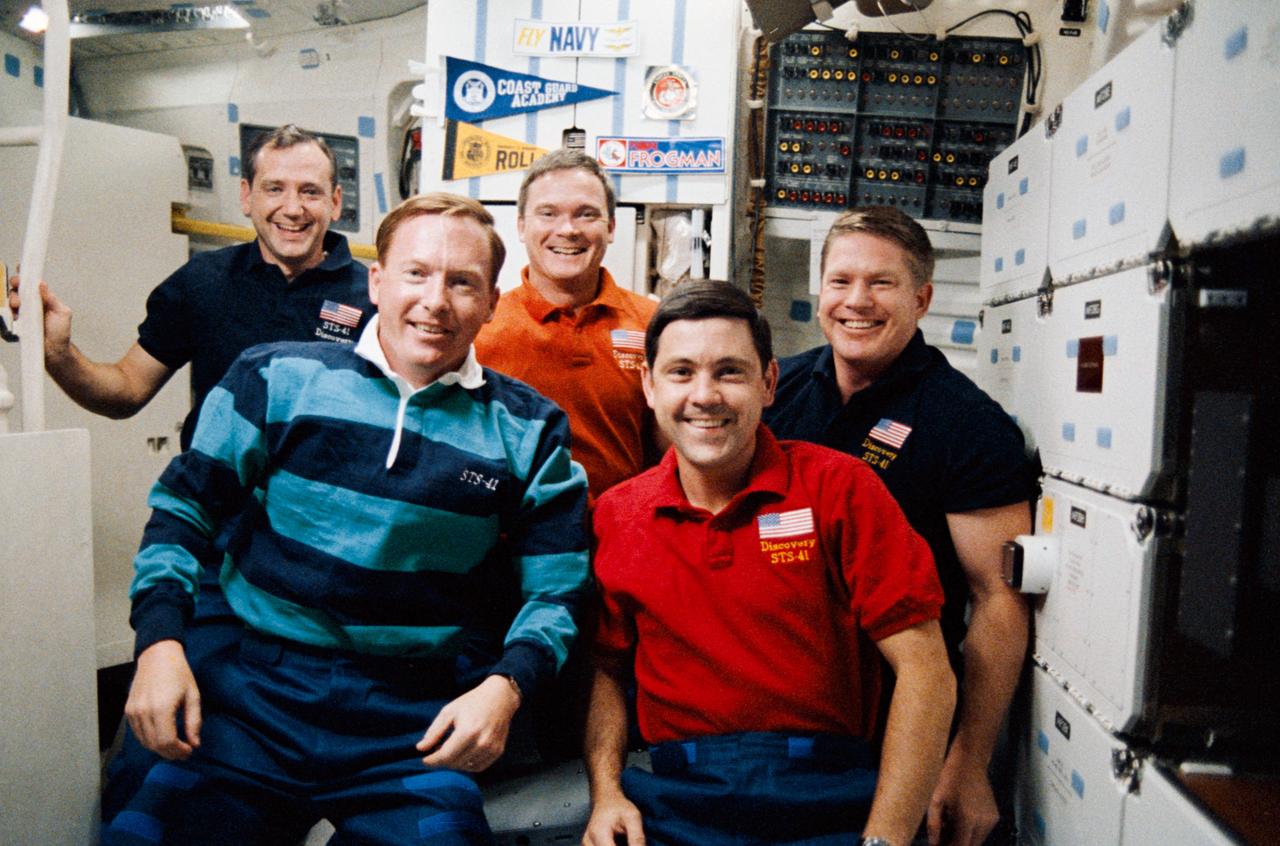
STS041-26-007 (6-10 Oct 1990) --- A 35mm preset camera on Discovery's middeck captures the traditional in-space portrait of the STS-41 crewmembers. In front are (l.-r.) Astronauts Richard N. Richards, mission commander; and Robert D. Cabana, pilot. In the rear are (l.-r.) Astronauts Thomas D. Akers, Bruce E. Melnick and William M. Shepherd.
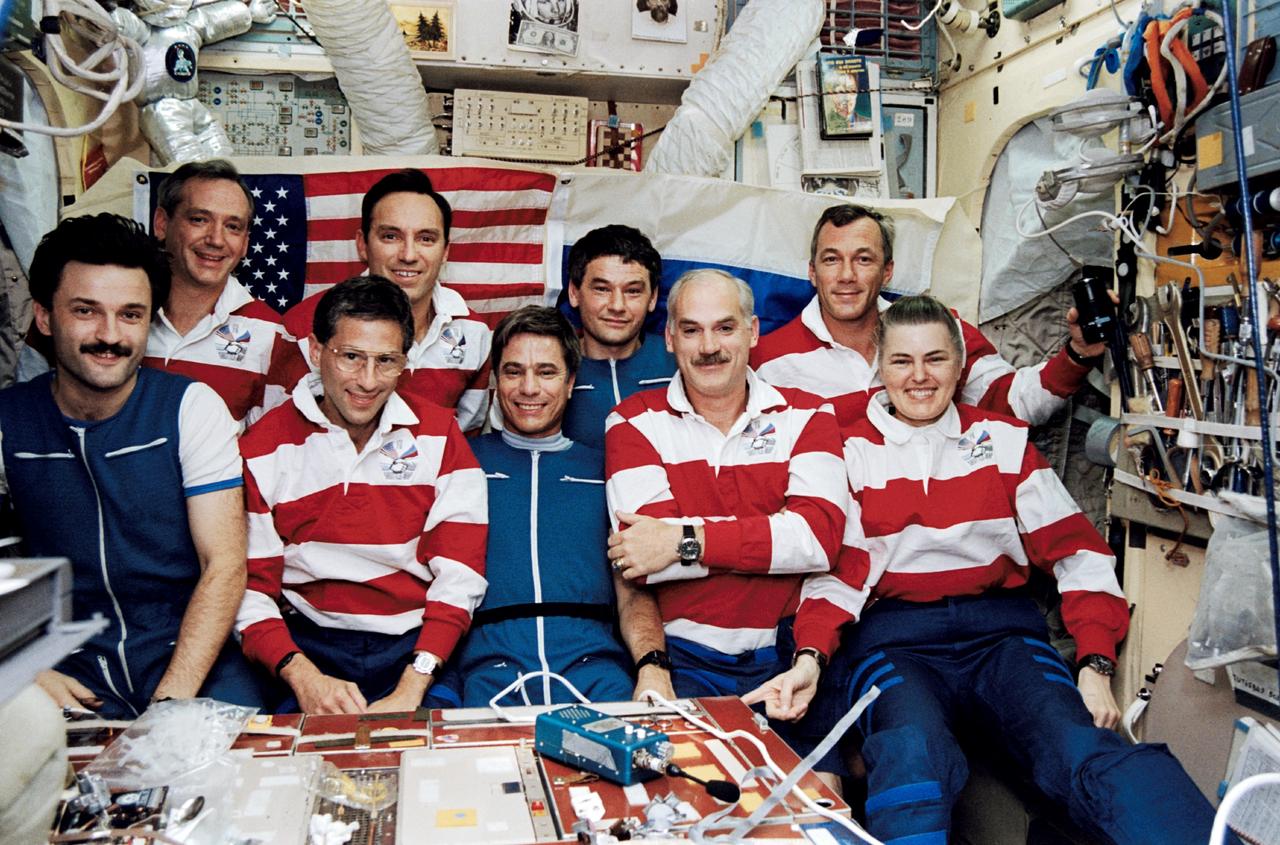
STS079-349-022 (16-26 Sept. 1996) --- The traditional inflight crew portrait, taken in Russia's Mir Space Station base block. Front row, left to right, Aleksandr Y. Kaleri, Jerome (Jay) Apt, John E. Blaha, William F. Readdy and Shannon W. Lucid. Back row, left to right, Thomas D. Akers, Carl E. Walz, Valeri G. Korzun and Terrence W. Wilcutt. This photograph is one of fifteen 35mm frames (along with four 70mm frames) of still photography documenting the activities of NASA's STS-79 mission, which began with a September 16, 1996, liftoff from Launch Pad 39A the Kennedy Space Center (KSC) and ended with a landing at KSC on September 26, 1996. Onboard for the launch were astronauts Readdy, commander; Wilcutt, pilot; Blaha, Apt, Akers and Walz, all mission specialists. On flight day 4, the crew docked with the Mir Space Station. Lucid, who had spent six months aboard Mir, switched cosmonaut guest researcher roles with Blaha. The latter joined fellow Mir-22 crewmembers Korzun, commander, and Kaleri, flight engineer.
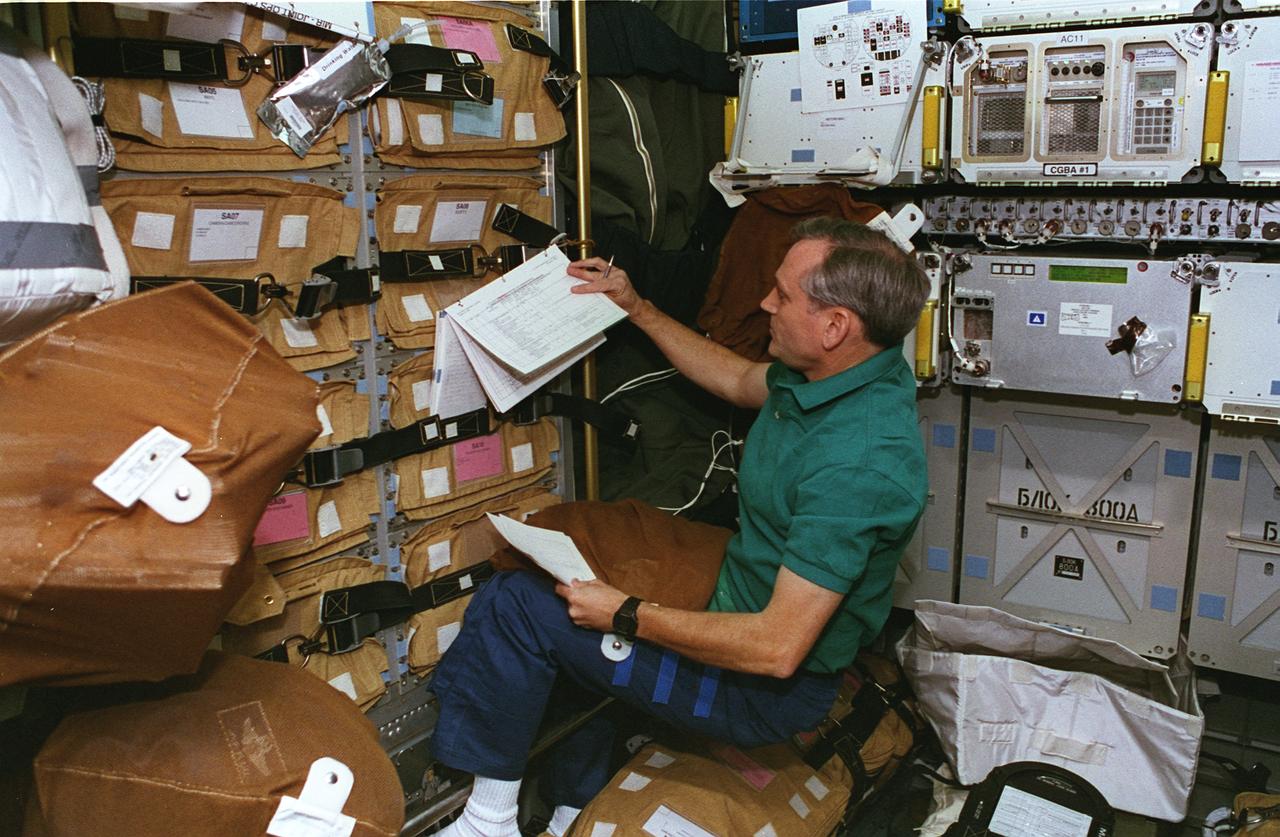
STS079-309-022 (16-26 Sept. 1996) --- Astronaut Thomas D. Akers, in the Spacehab, goes over an inventory of supplies which will be transferred to the Russia's Mir Space Station. This photograph is one of fifteen 35mm frames (along with four 70mm frames) of still photography documenting the activities of NASA's STS-79 mission, which began with a September 16, 1996, liftoff from Launch Pad 39A the Kennedy Space Center (KSC) and ended with a landing at KSC on September 26, 1996. Onboard for the launch were astronauts William F. Readdy, commander; Terrence W. Wilcutt, pilot; John E. Blaha, Jerome (Jay) Apt, Akers and Carl E. Walz, all mission specialists. On flight day 4, the crew docked with the Mir Space Station. Shannon W. Lucid, who had spent six months aboard Mir, switched cosmonaut guest researcher roles with Blaha. The latter joined fellow Mir-22 crew members Valeri G. Korzun, commander, and Aleksandr Y. Kaleri, flight engineer.
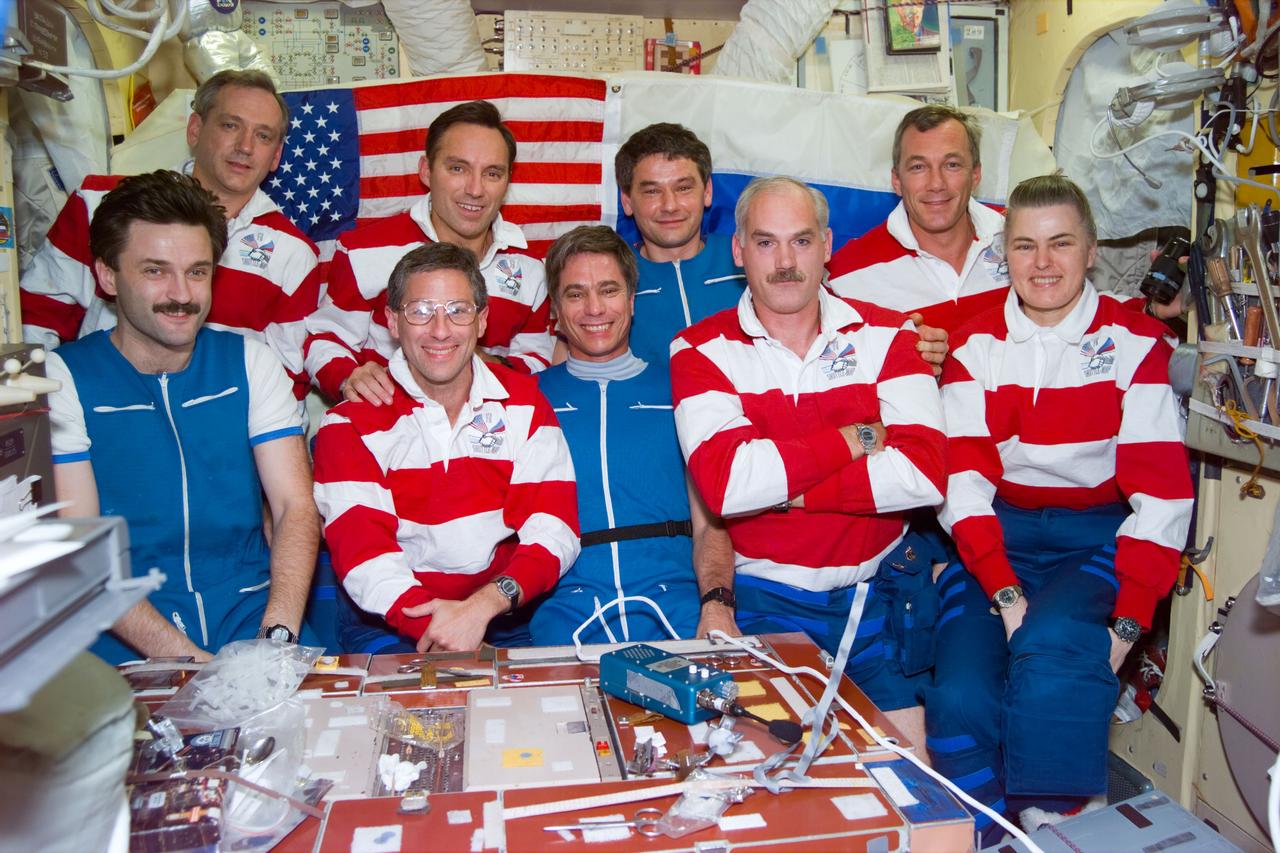
STS79-E-5289 (23 September 1996) --- Crew members of STS-79 and Mir-22 pose for final group portrait aboard Russia's Mir Space Station's Core Module before going separate ways in Earth-orbit, during Flight Day 8. Front row, left to right, are Aleksandr Y. Kaleri, Jerome (Jay) Apt, William F. Readdy and Shannon W. Lucid. On the back row are, left to right, Thomas D. Akers, Carl E. Walz, Valeri G. Korzun and Terrence W. Wilcutt. Note Blaha, the new cosmonaut researcher for Mir-22, is now wearing the uniform of that crew and Lucid's garment is uniform with the STS-79 astronauts.
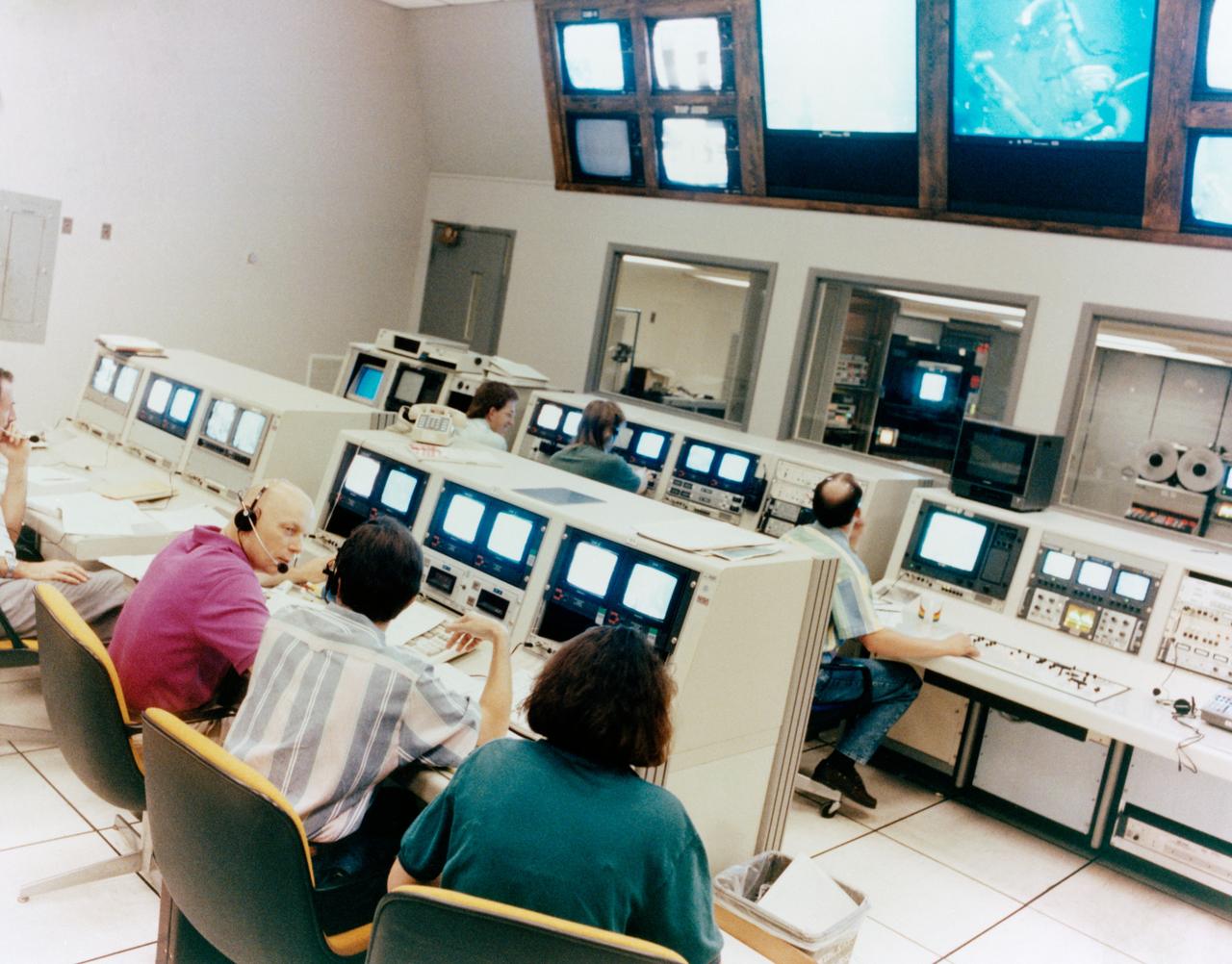
Astronauts Jeffrey A. Hoffman (far left) and F. Story Musgrave (second left) monitor a training session from consoles in the control room for the Neutral Buoyancy Simulator (NBS) at the Marshall Space Flight Center (MSFC). Seen underwater in the NBS on the big screen and the monitors at the consoles is astronaut Thomas D. Akers. The three mission specialists, along with astronaut Kathryn C. Thornton, are scheduled to be involved in a total of five sessions of extravehicular activity (EVA) to service the Hubble Space Telescope (HST) in orbit during the STS-61 mission, scheduled for December 1993.
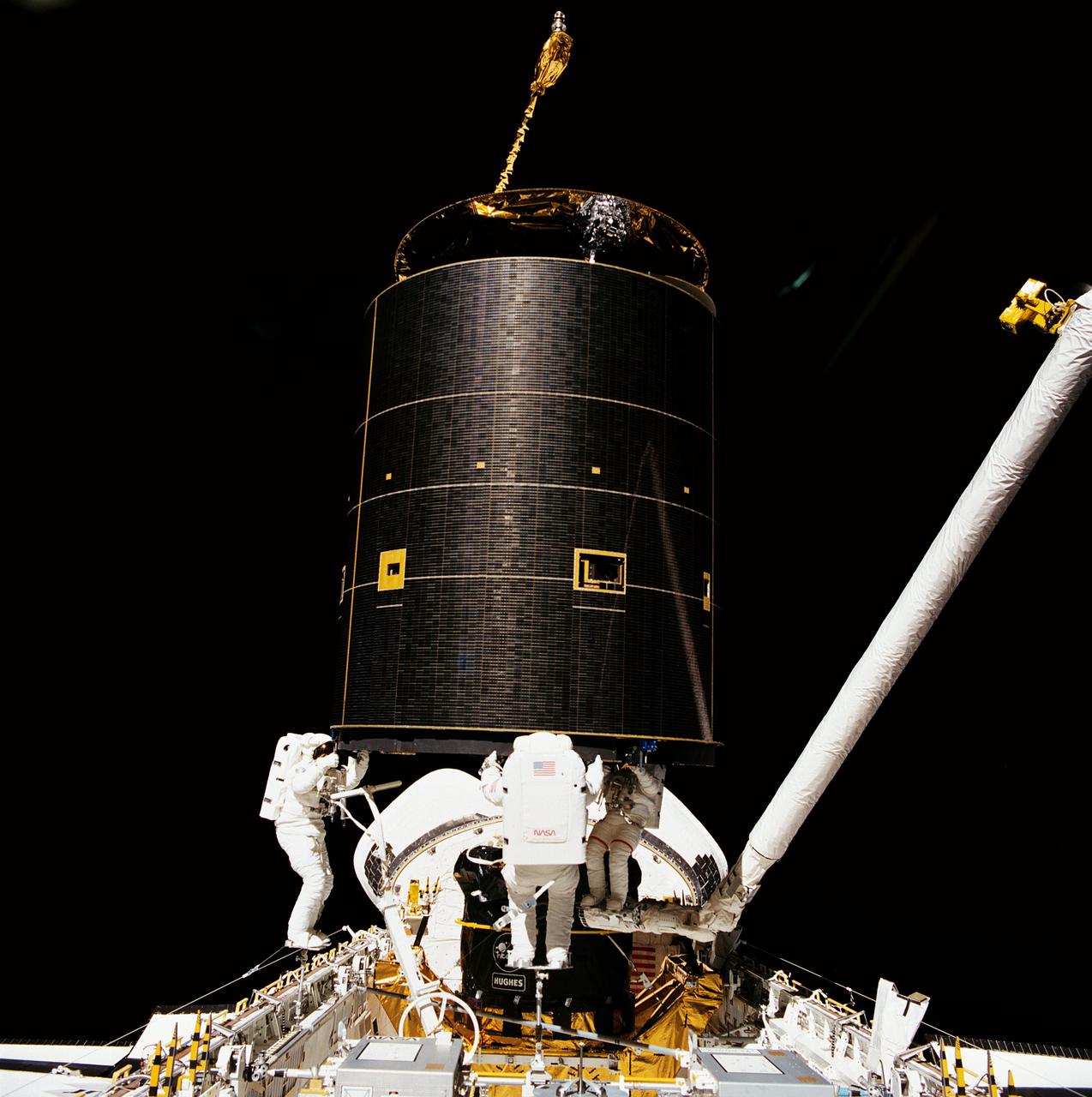
STS049-91-026 (13 May 1992) --- Three astronauts hold onto the 4.5-ton Intelsat VI satellite after a six-handed "capture" was made minutes earlier. Left to right are astronauts Richard J. Hieb, Thomas D. Akers and Pierre J. Thuot. Thuot stands on the end of the remote manipulator system arm, from which he had made two earlier unsuccessful grapple attempts on two-person extravehicular activity sessions. Ground controllers and crew members agreed that a third attempt, using three mission specialists in the cargo bay of the space shuttle Endeavour, was the effort needed to accomplish the capture feat.
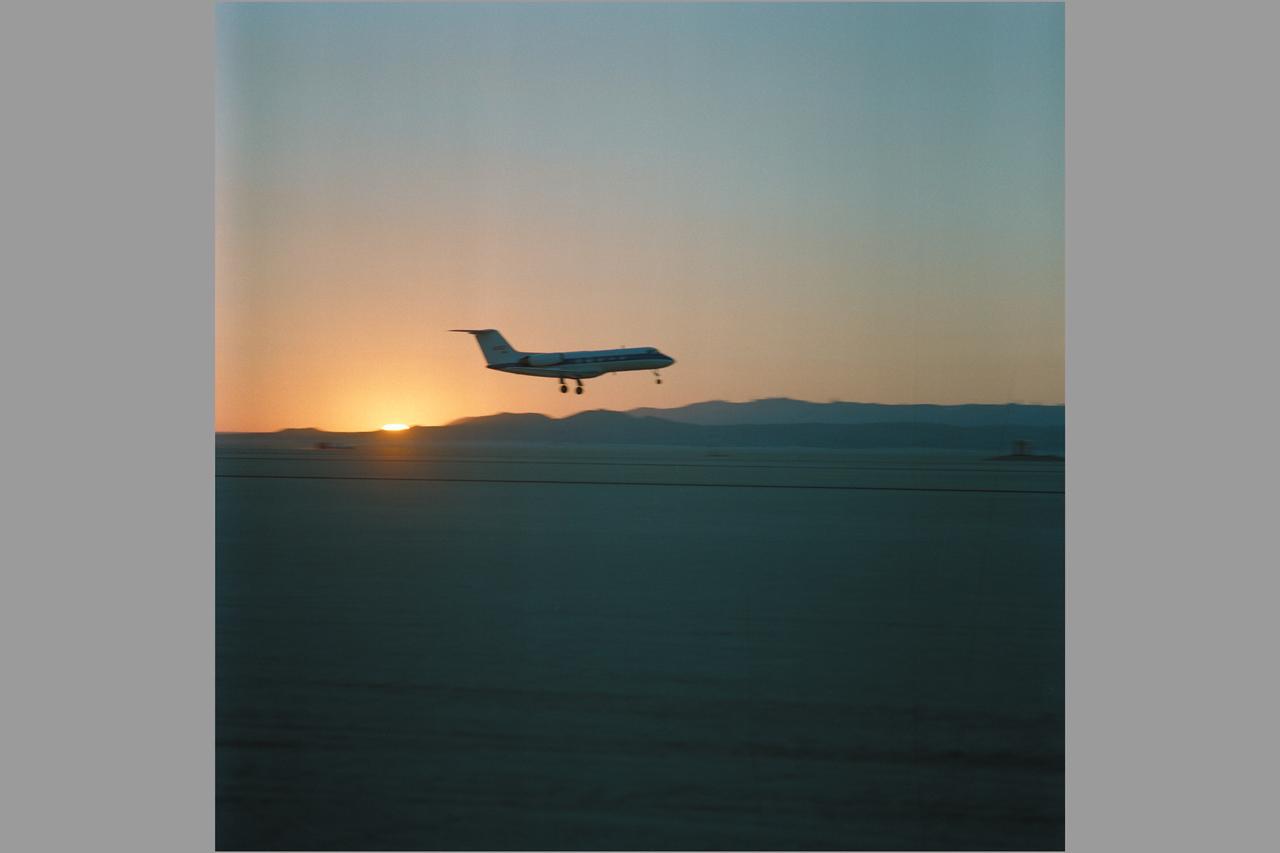
Dryden Fllight Reseach Facility, Edwards, California STA (Shuttle Training Aircraft, Gulf Stream II) flys chase as STS-41returns from it's mission to Deploy Ulysses Spacecraft... Discovery's main gear is about to touch down at Edwards Air Foce Base to end a four-day mission in space for it's five-man crew. The vehicle landed at 6:57 a.m. Onboard the spacecraft were Astronauts Richard N. Richards, Robert D Cabana, William M Sheperd, Bruce E. Melnick and Thomas D. Akers.
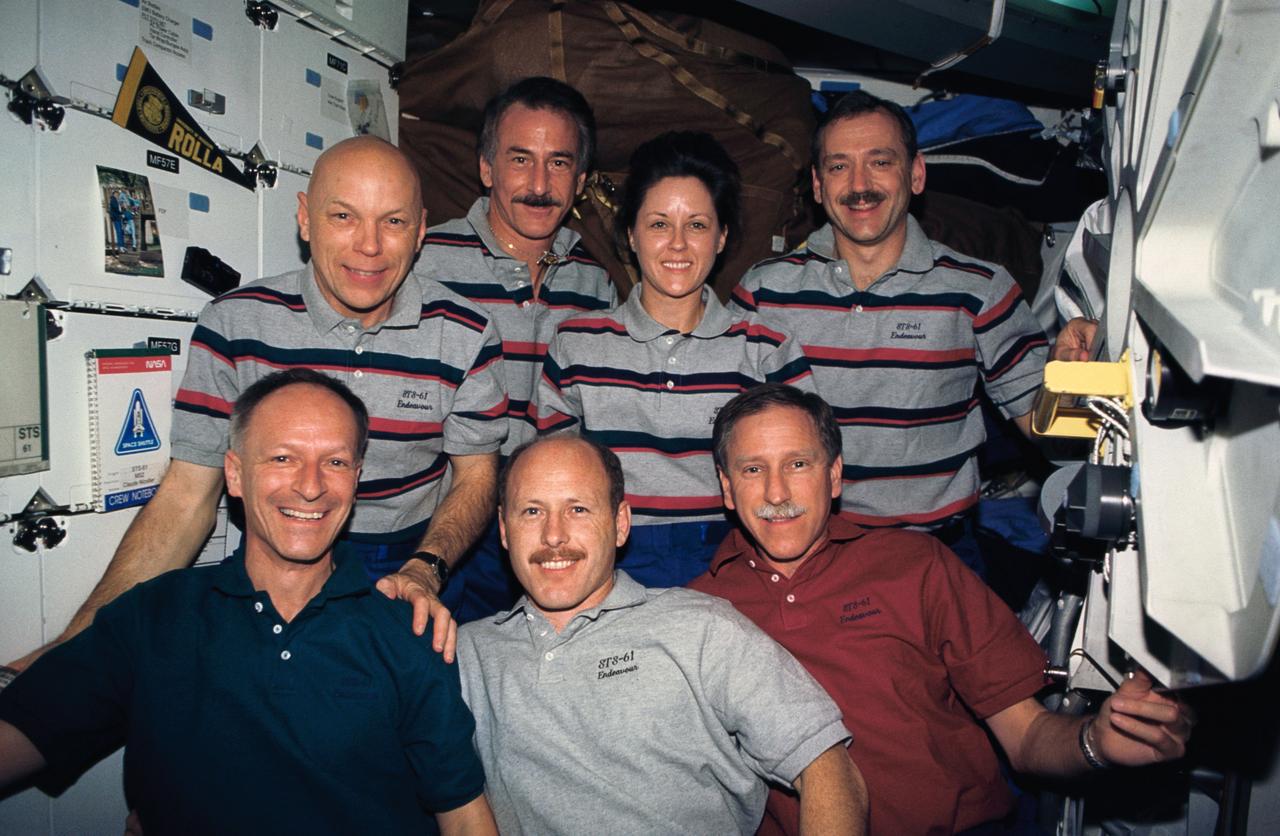
STS061-11-004 (2-13 Dec 1993) --- Traditional inflight portrait for the crew of the Hubble Space Telescope (HST) servicing mission. On the front row are the three crew members who assisted from inside the Space Shuttle Endeavour's cabin throughout the five space walks. They are, left to right, Swiss scientist Claude Nicollier, mission specialist, along with astronauts Kenneth D. Bowersox, pilot; and Richard O. Covey, mission commander. Back row -- all space walkers on this flight -- are astronauts F. Story Musgrave, payload commander; Jeffrey A. Hoffman, Kathryn D. Thornton and Thomas D. Akers, all mission specialists.
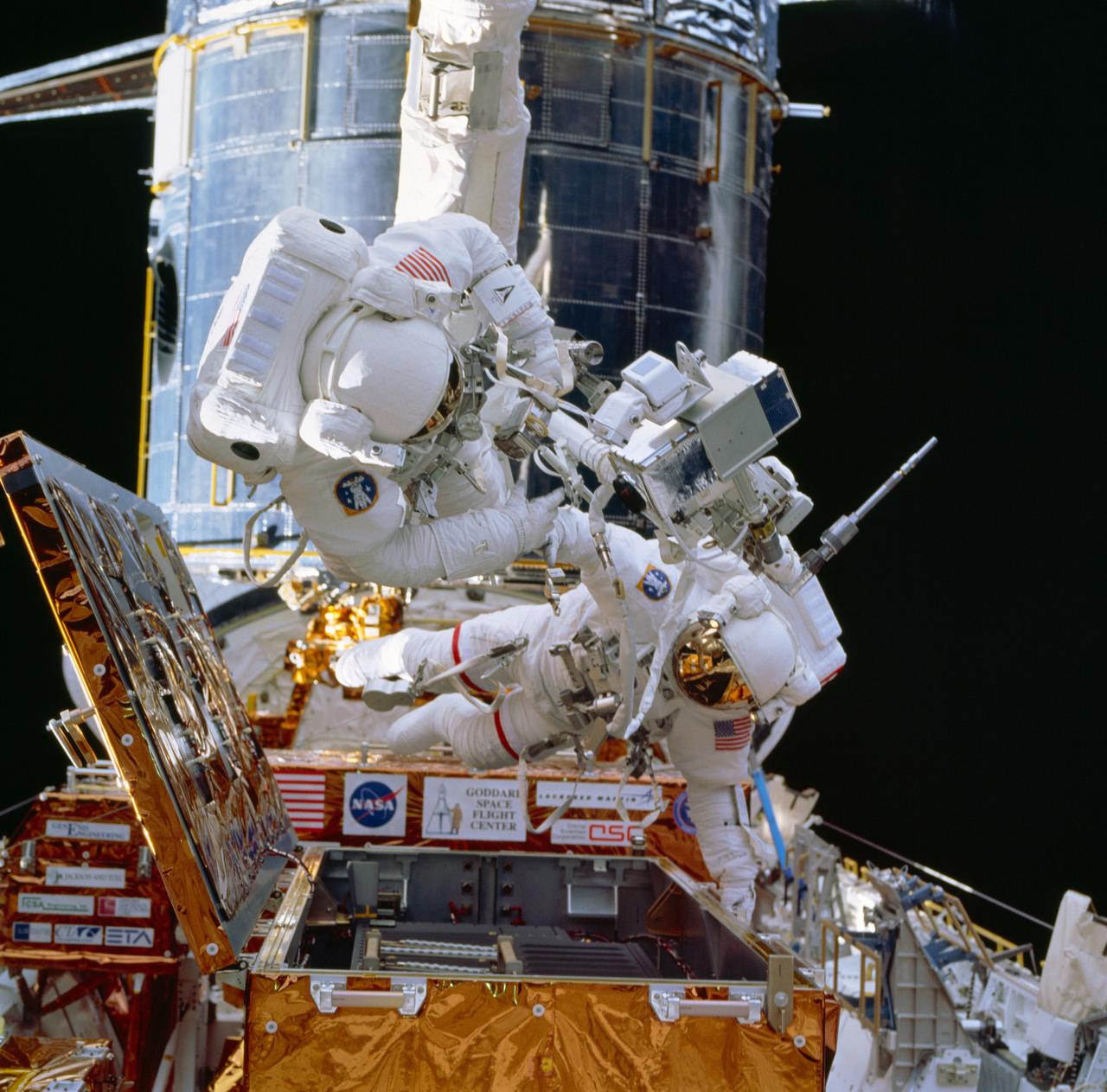
STS049-81-093 (14 May 1992) --- Astronaut Kathryn C. Thornton joins three struts together, as fourth period of extravehicular activity (EVA) proceeds in the Space Shuttle Endeavour's cargo bay. The purpose of the final EVA on this nine-day mission was the evaluation of Assembly of Station by EVA Methods (ASEM). Clouds over the ocean share the background with part of Endeavour's Remote Manipulator System (RMS). The scene was recorded on 70mm film from the Space Shuttle's flight deck. Astronaut Thomas D. Akers (out of frame) joined Thornton on the 7 1/2 hour EVA.
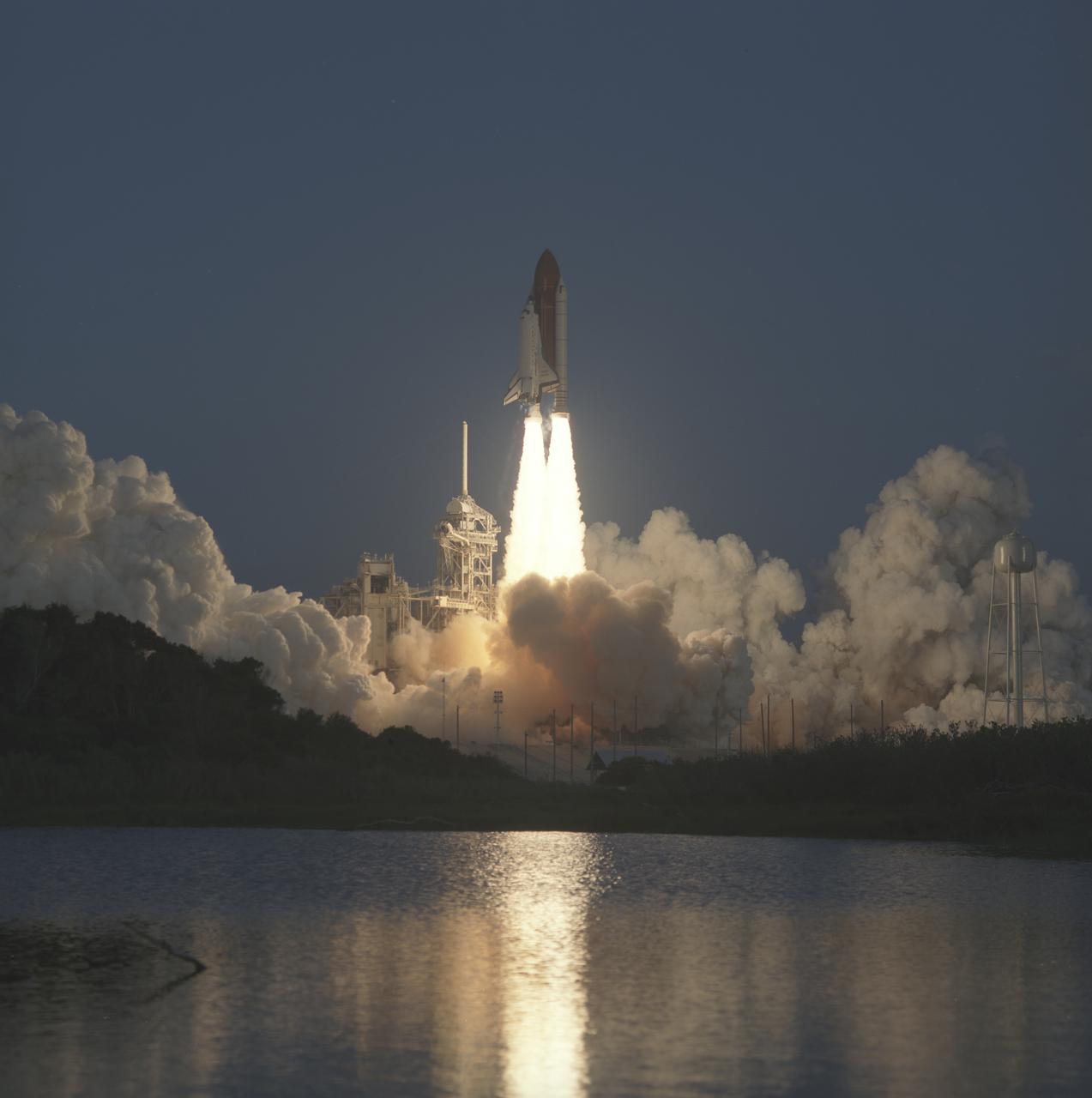
Launched aboard the Space Shuttle Discovery on October 6, 1990 at 7:47:15 am (EDT), the STS-41 mission consisted of 5 crew members. Included were Richard N. Richards, commander; Robert D. Cabana, pilot; and Bruce E. Melnick, Thomas D. Akers, and William M. Shepherd, all mission specialists. The primary payload for the mission was the European Space Agency (ESA) built Ulysses Space Craft made to explore the polar regions of the Sun. Other main payloads and experiments included the Shuttle Solar Backscatter Ultraviolet (SSBUV) experiment and the INTELSAT Solar Array Coupon (ISAC).
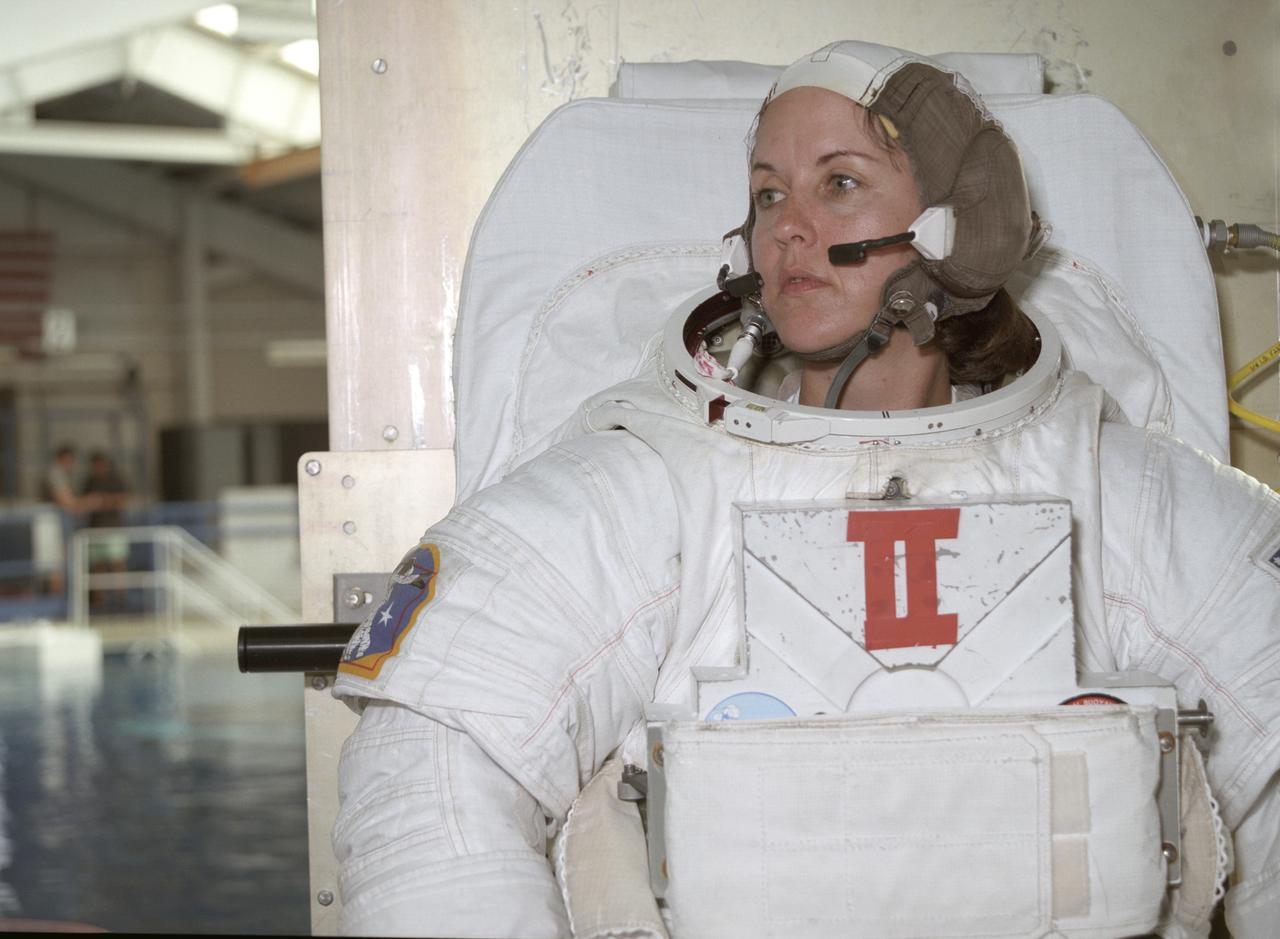
This close-up of astronaut and mission specialist Kathryn Thornton readies herself for submersion into the water in the Marshall Space Flight Center (MSFC) Neutral Buoyancy Simulator (NBS) where she is participating in a training session for the STS-61 mission. The NBS provided the weightless environment encountered in space needed for testing and the practices of Extravehicular Activities (EVA). Launched on December 2, 1993 aboard the Space Shuttle Orbiter Endeavor, STS-61 was the first Hubble Space Telescope (HST) serving mission. During the 2nd EVA of the mission, Thornton, along with astronaut and mission specialist Thomas Akers, performed the task of replacing the solar arrays. The EVA lasted 6 hours and 35 minutes.
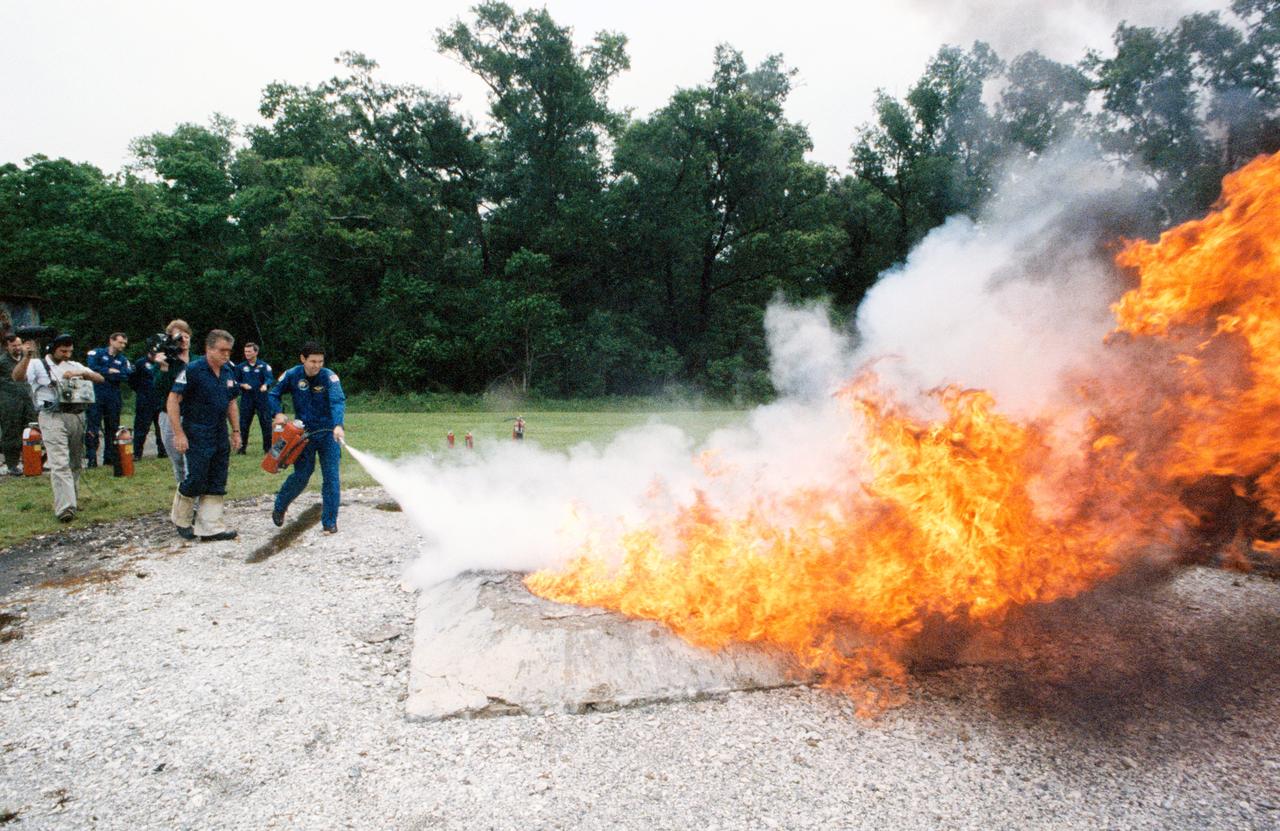
S90-38933 (4 May 1990) --- The STS-41 astronaut crew participates in fire control training exercises at the Johnson Space Center (JSC). Controlling the fire extinguisher at left frame is astronaut Robert D. Cabana, STS-41 pilot. Watching in the background are other STS-41 astronauts who participated in the session. They were Richard N. Richards, William M. Shepherd, Bruce E. Melnick and Thomas D. Akers. This type training is provided all crewmembers assigned to seats aboard Space Shuttle. Members of the both the Houston and Pasadena fire departments instruct the sessions.
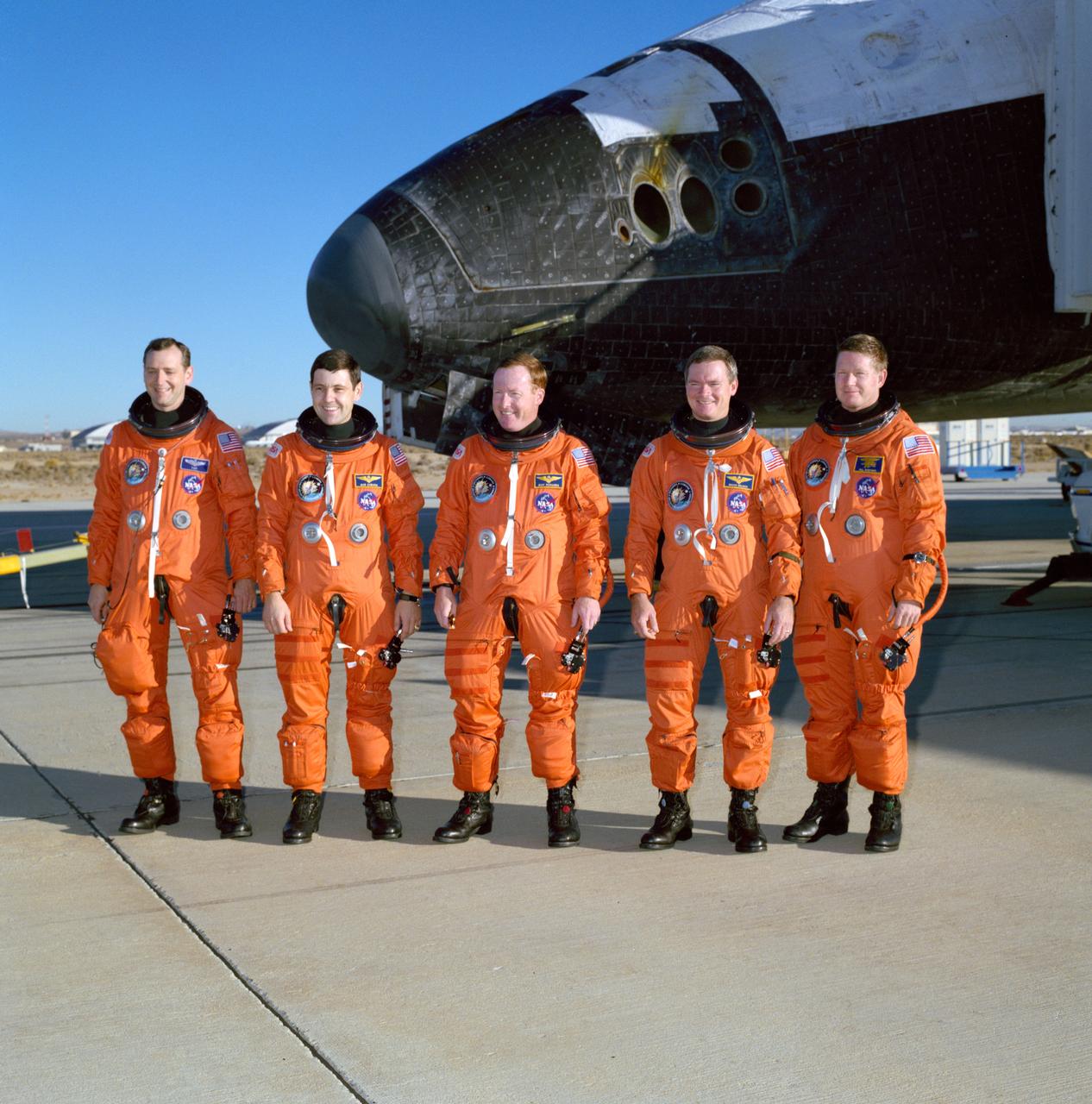
STS041-S-096 (10 Oct 1990) --- The five astronaut crewmembers of Discovery's most recent flight pose for their first photo back on terra firma following their successful four day mission in earth orbit. Discovery, partially visible in this frame, touched down at Edwards Air Force Base at 6:57 a.m. PDT, Oct. 10, 1990. Astronaut Richard N. Richards (center) was mission commander. He is flanked here by (left to right) Astronauts Thomas D. Akers, Robert D. Cabana, Bruce E. Melnick and William M. Shepherd.
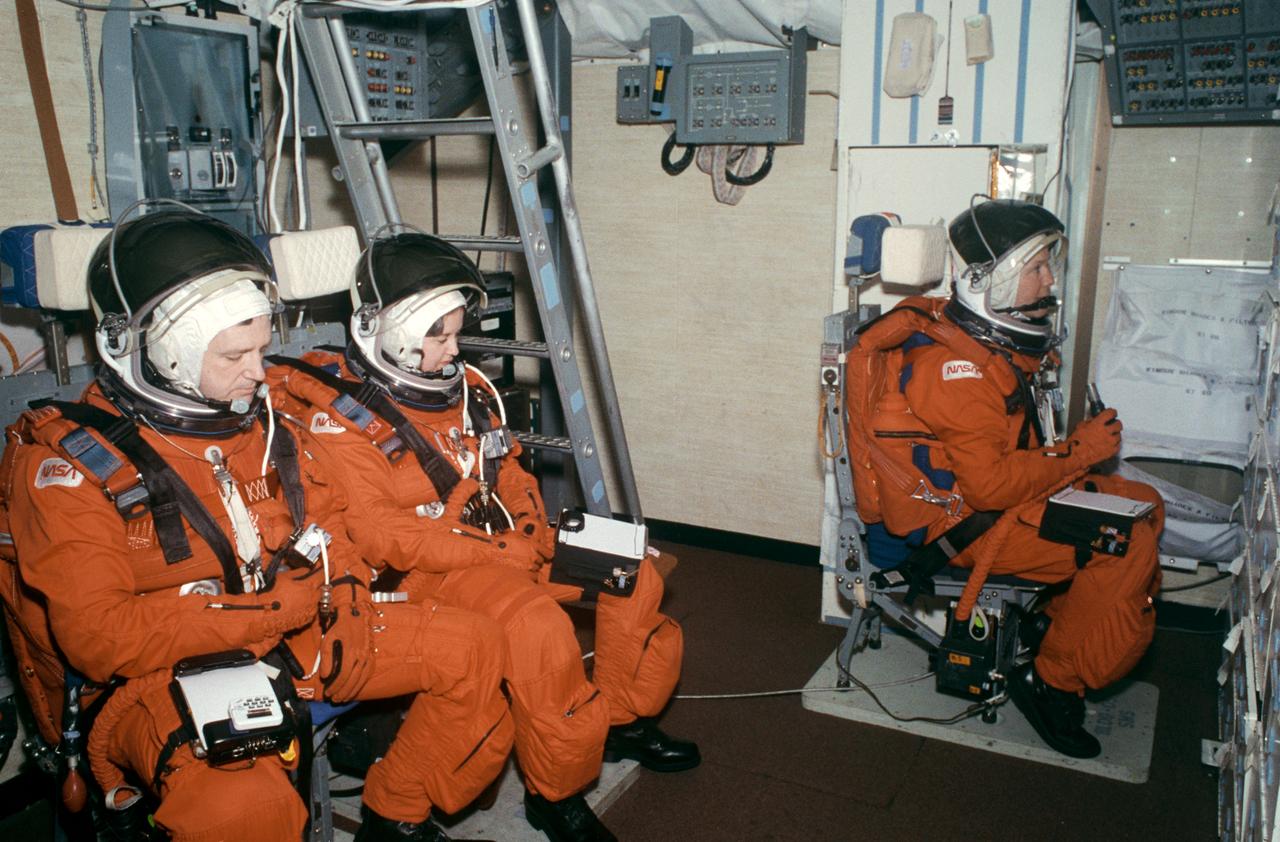
S92-29406 (Feb 1992) --- Three mission specialists assigned to the STS-49 flight occupy temporary stations on the "middeck" of a Johnson Space Center (JSC) Shuttle trainer during a rehearsal of Endeavour's launch and entry phases. Left to right are astronauts Thomas D. Akers, Kathryn C. Thornton and Pierre J. Thuot. The three, along with four other NASA astronauts, will be aboard Endeavour in May for a week-long mission during which a satellite will be retrieved and boosted toward a higher orbit and extravehicular activity evaluations for Space Station Freedom assembly techniques will be conducted.
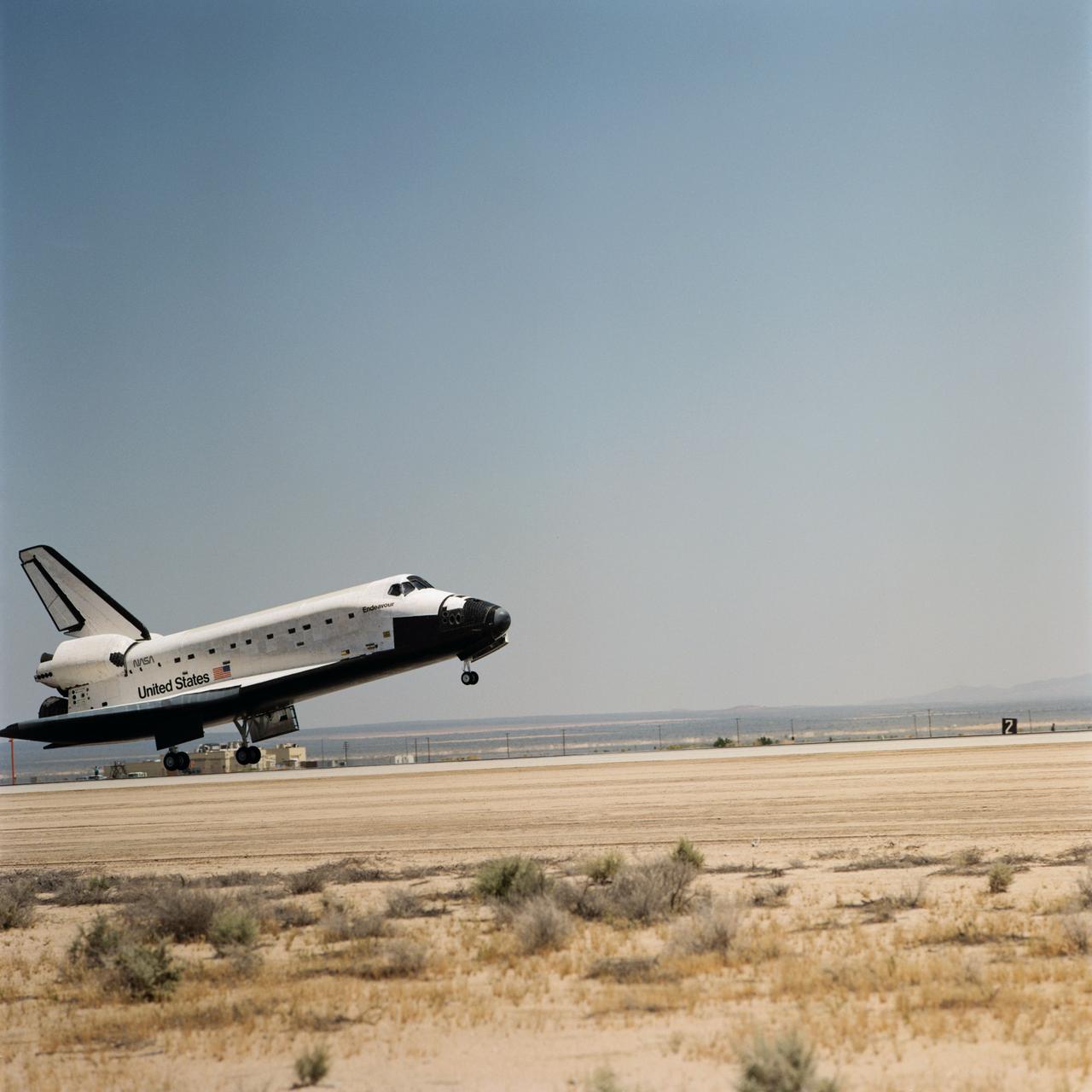
STS049-S-325 (16 May 1992) --- The main landing gear of Endeavour is just about to touch down at Edwards Air Force Base to draw to an end NASA's nine-day STS-49 mission. Crewmembers onboard were astronauts Daniel C. Brandenstein, mission commander; Kevin P. Chilton, pilot; and Thomas D. Akers, Richard J. Hieb, Bruce E. Melnick, Kathryn C. Thornton and Pierre J. Thout, all mission specialists. Landing occurred at 1:36:38 p.m. (PDT), May 16, 1992.
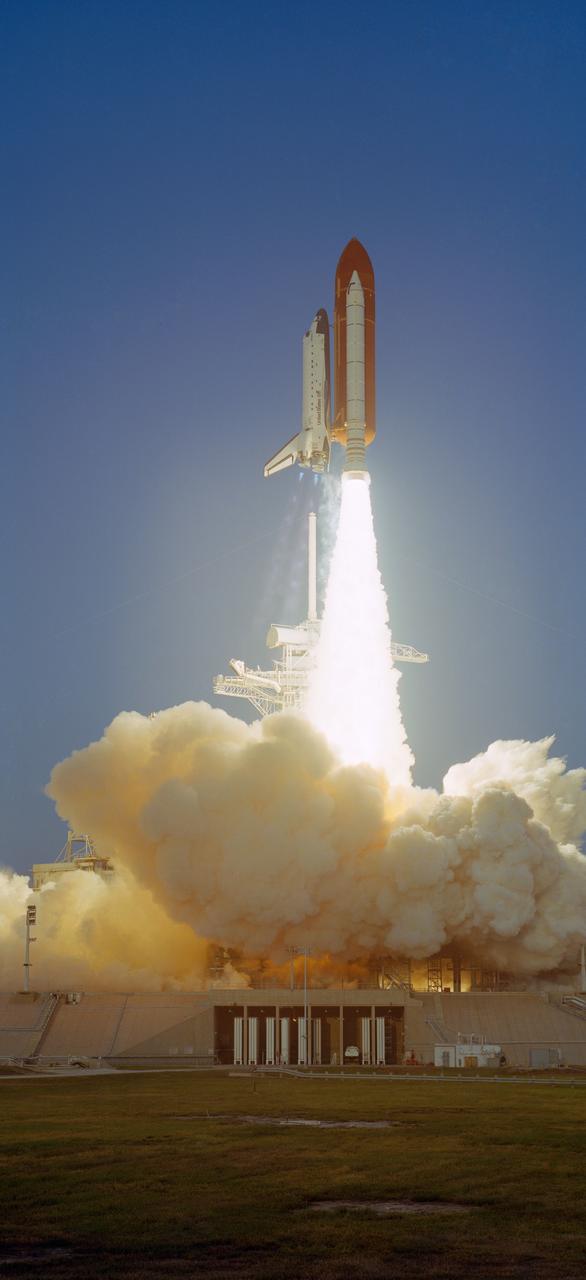
STS041-S-101 (6 Oct 1990) --- Discovery lifts off from Launch Complex 39 at the Kennedy Space Center to begin a four-day mission in space for its five-man crew. Onboard the spacecraft are Astronauts Richard N. Richards, Robert D. Cabana, William M. Shepherd, Bruce E. Melnick and Thomas D. Akers. Discovery lifted off at 7:47 a.m. EDT on Oct. 6, 1990. A few hours after this photo was made, the crewmembers released the Ulysses spacecraft on its way to a long-awaited mission.
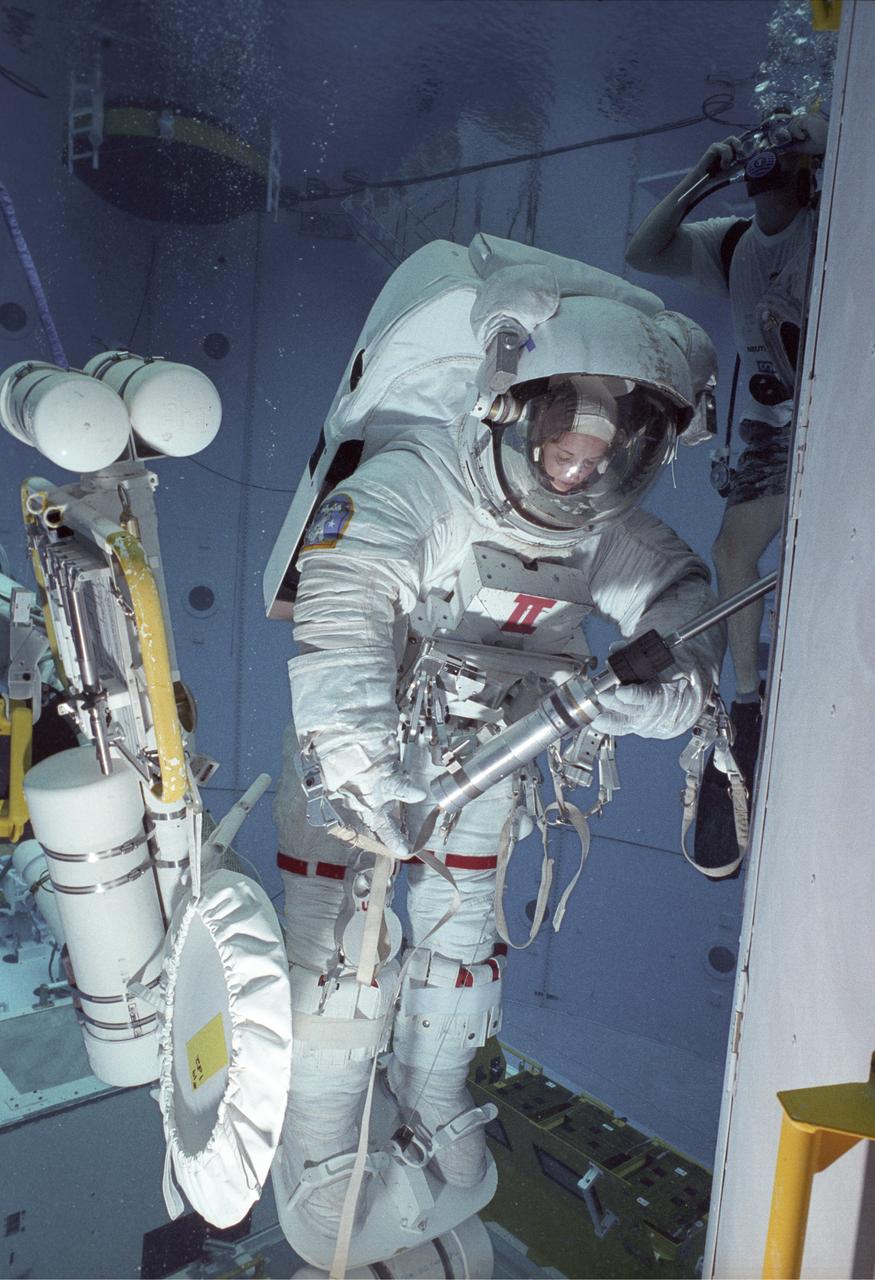
This close-up of astronaut and mission specialist Kathryn Thornton was captured under water in the Marshall Space Flight Center (MSFC) Neural Buoyancy Simulator (NBS) where she is participating in a training session for the STS-61 mission. The NBS provided the weightless environment encountered in space needed for testing and the practices of Extravehicular Activities (EVA). Launched on December 2, 1993 aboard the Space Shuttle Orbiter Endeavor, STS-61 was the first Hubble Space Telescope (HST) serving mission. During the 2nd EVA of the mission, Thornton, along with astronaut and mission specialist Thomas Akers, performed the task of replacing the solar arrays. The EVA lasted 6 hours and 35 minutes.
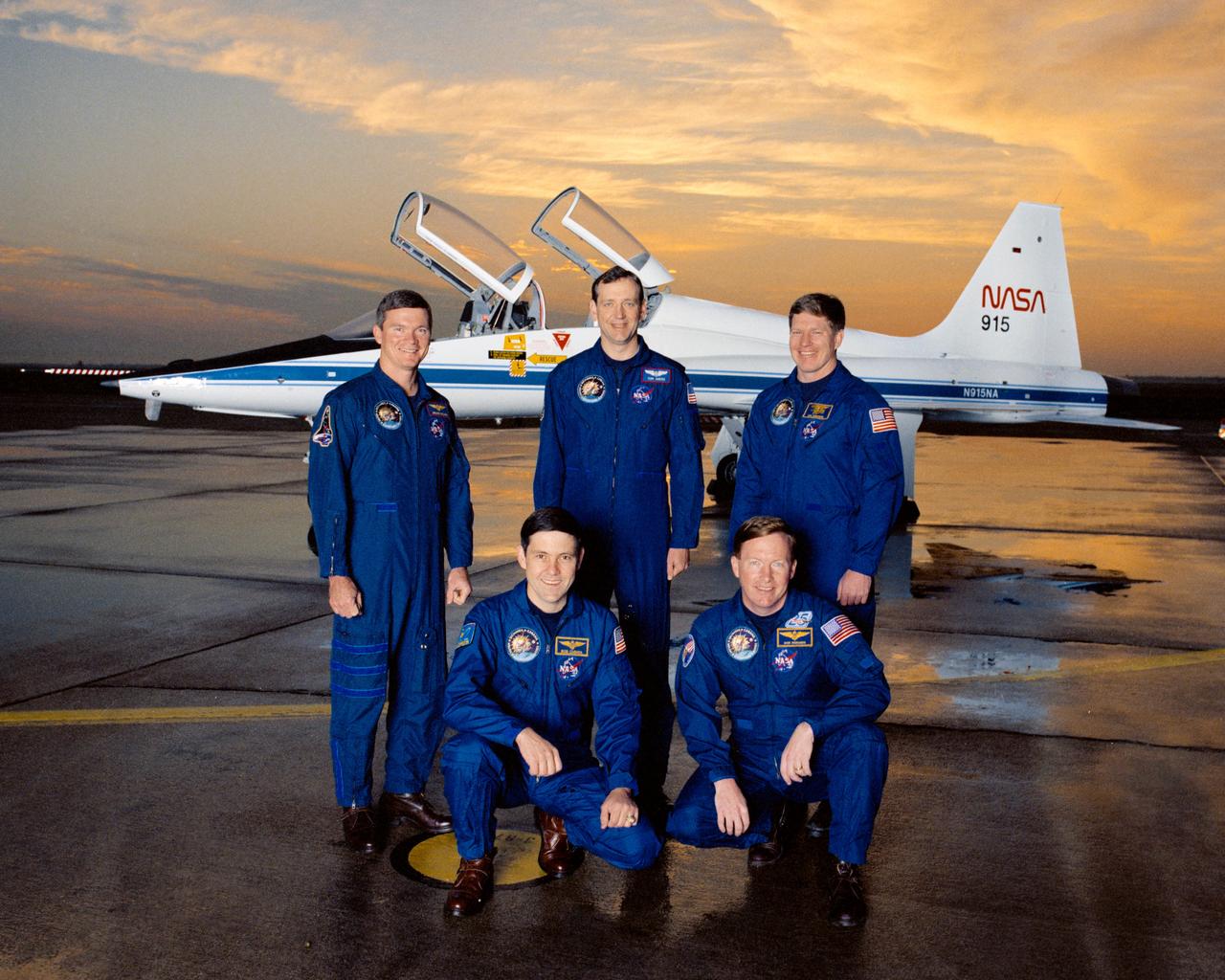
STS041-S-002 (7 May 1990) --- These five astronauts have been assigned to fly the STS-41 mission for the National Aeronautics and Space Administration (NASA). Pictured near the flight line at Ellington Field prior to an early morning flight in NASA T-38s are (kneeling, from the left) Robert D. Cabana, pilot; and Richard N. Richards, mission commander; and (standing, from left) Bruce E. Melnick, Thomas D. Akers and William M. Shepherd, all mission specialists. Primary payload for the Space Shuttle Discovery on the STS 41 mission is Ulysses.
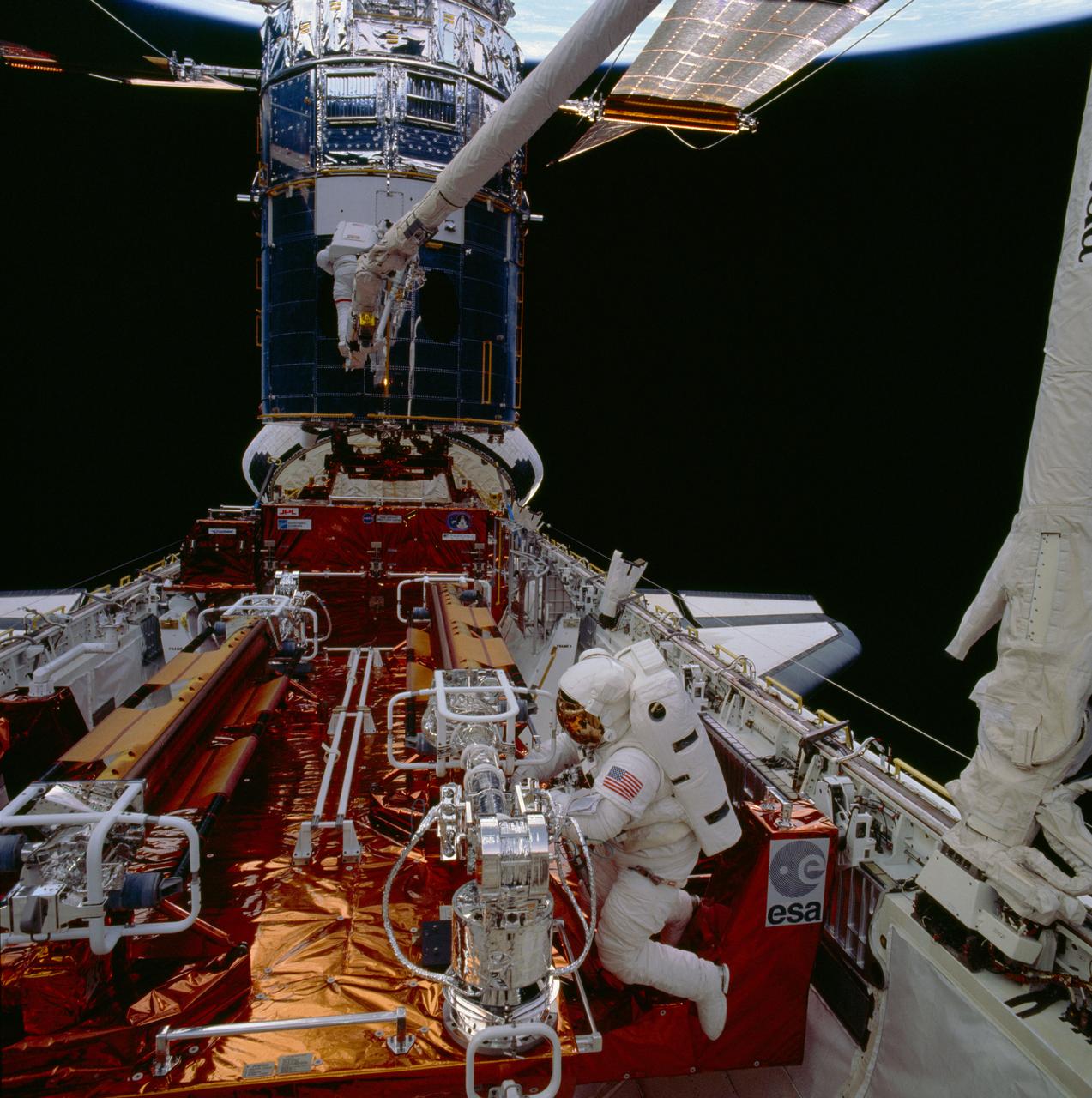
STS061-86-048 (5 Dec 1993) --- Astronauts F. Story Musgrave (foreground) and Jeffrey A. Hoffman are pictured near the end of the first of five extravehicular activity?s (EVA). Musgrave works at the Solar Array Carrier (SAC) in the Space Shuttle Endeavour's cargo bay. Hoffman, anchored to a foot restraint mounted on the end of the Space Shuttle Endeavour's Remote Manipulator System (RMS) arm, waits to be maneuvered to the forward payload bay. The original solar array panels are partially visible at top, while their replacements remain stowed in foreground. The crew's second pair of space walkers -- astronauts Kathryn C. Thornton and Thomas D. Akers -- later changed the solar arrays on the mission's second EVA.
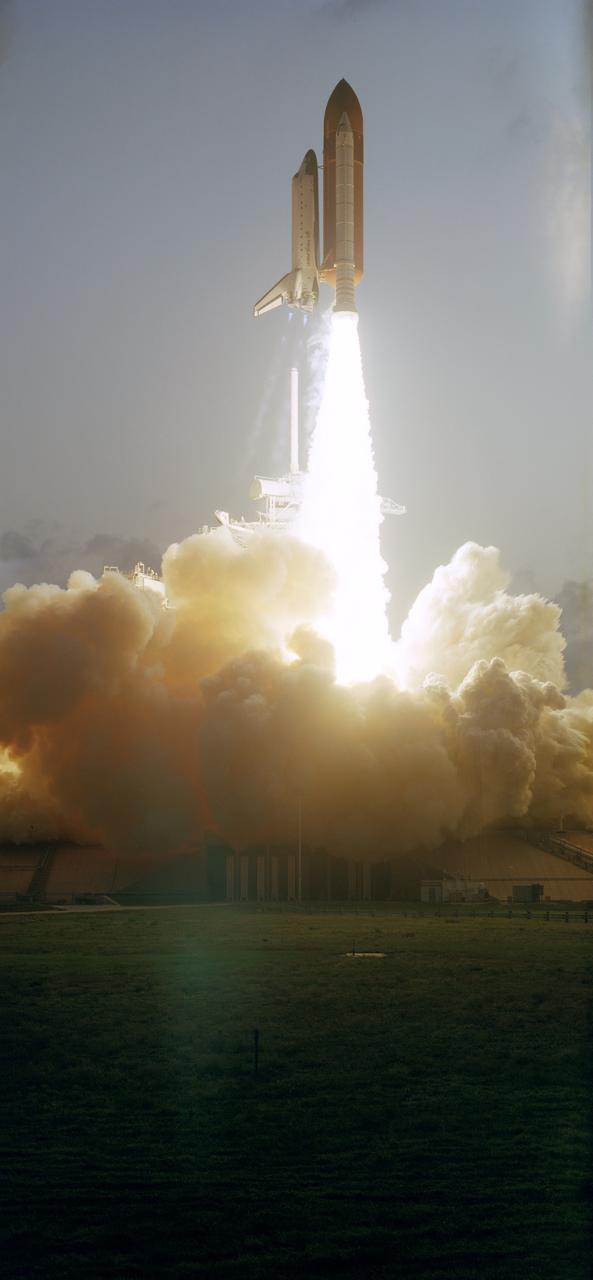
STS049-S-251 (7 May 1992) --- The Space Shuttle Endeavour soars toward Earth orbit where a crew of seven NASA astronauts will spend at least a week. Endeavour, the newest orbiter in NASA's Space Shuttle fleet, lifted off from Pad 39B at 7:40 p.m. (EDT), May 7, 1992. A diamond shock effect can be seen beneath the three main engines. Onboard are astronauts Daniel C. Brandenstein, mission commander; Kevin P. Chilton, pilot; and Richard J. Hieb, Bruce E. Melnick, Pierre J. Thuot, Kathryn C. Thornton and Thomas D. Akers, all mission specialists.

STS061-S-071 (13 Dec 1993) --- A rear view of the Space Shuttle Endeavour as it touches down on the Shuttle Landing Facility at Kennedy Space Center (KSC), at 05:25:57:27 GMT (12:26 a.m. EST) December 13, 1993. Onboard the spacecraft were Richard O. Covey, mission commander; Kenneth D. Bowersox, pilot; mission specialists Thomas D. Akers; Jeffrey A. Hoffman; F. Story Musgrave; Kathryn C. Thornton and Swiss scientist Claude Nicollier. This is the second night landing at KSC in the history of the Shuttle Program.
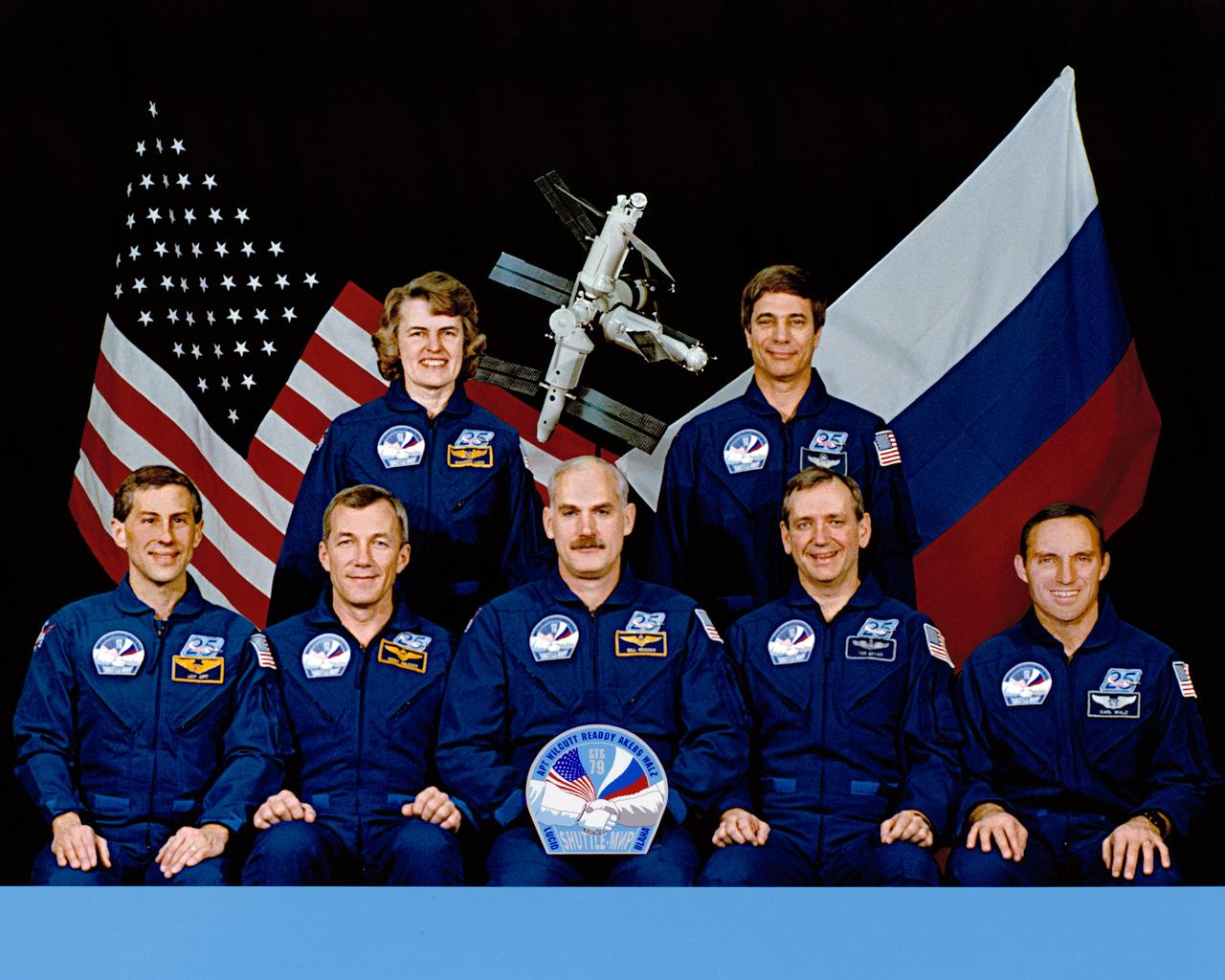
STS079-S-002 (May 1996) --- In various venues, these seven astronauts have been in training for several months for the different phases of the STS-79 mission scheduled for launch in August, 1996. Front row, left to right, are astronauts Jerome (Jay) Apt, mission specialist; Terrence W. Wilcutt, pilot; William F. Readdy, mission commander; Thomas D. Akers and Carl E. Walz, both mission specialists. On the back row are astronauts Shannon W. Lucid and John E. Blaha, both mission specialists. Lucid is currently aboard Russia’s Mir Space Station, having been delivered there by the Space Shuttle Atlantis crew of STS-76 in March, 1996. She will return to Earth with this crew, while Blaha will launch with this crew and remain onboard Mir for a subsequent tour of duty as a cosmonaut guest researcher.
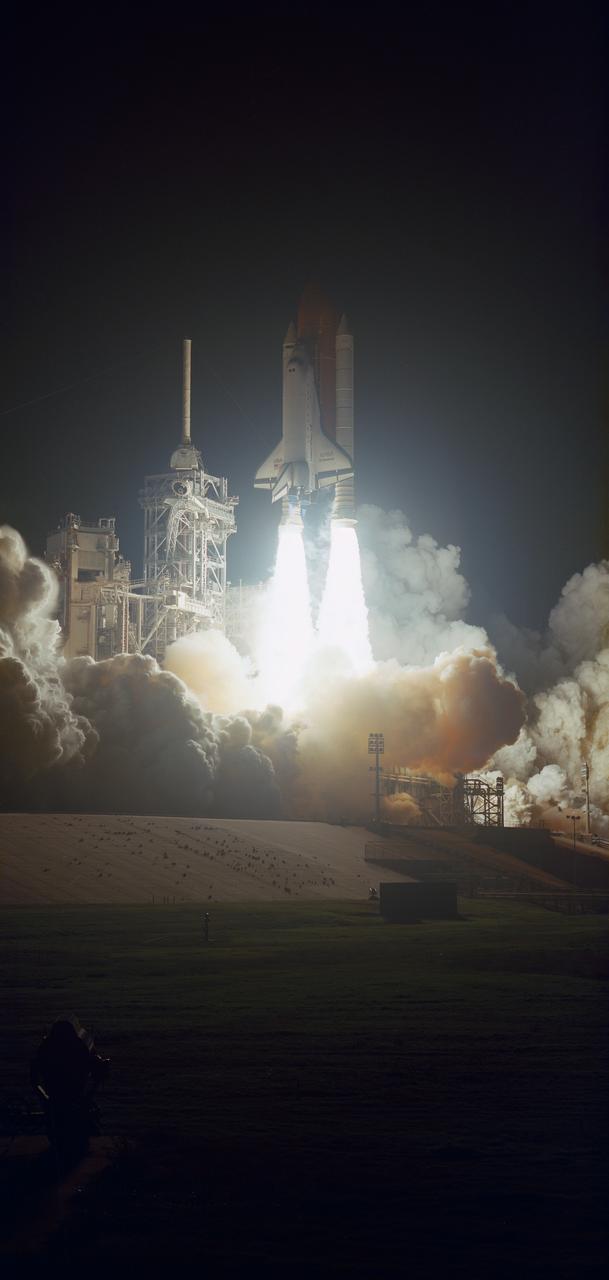
STS061-S-088 (2 Dec 1993) --- The Space Shuttle Endeavour lifts off from Launch Pad 39B with a crew of six NASA astronauts, a Swiss mission specialist and a variety of special tools aboard. Launch occurred at 4:27:00 a.m. (EST), December 2, 1993. The seven member crew will team to perform a variety of service tasks on the Hubble Space Telescope (HST). Four of the group will break into pairs on alternating sessions to carry out a total of five days Extravehicular Activity (EVA). Onboard are astronauts Richard O. Covey, Kenneth D. Bowersox, F. Story Musgrave, Kathy C. Thornton, Jeffrey A. Hoffman and Thomas D. Akers, along with Swiss scientist Claude Nicollier.
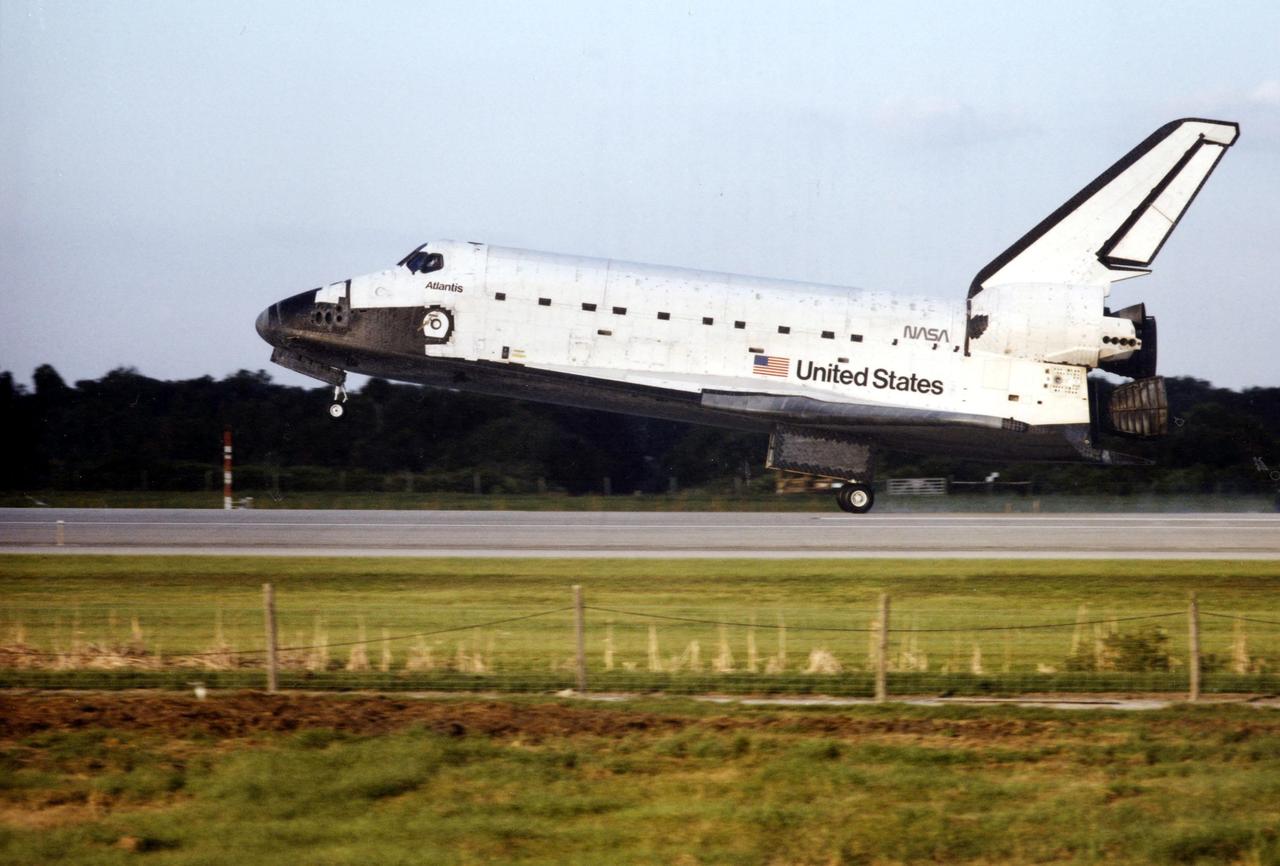
KENNEDY SPACE CENTER, FLA. -- The STS-79 mission comes to a successful conclusion as the orbiter Atlantis touches down on Runway 15 of KSC's Shuttle Landing Facility at 8:13:15 a.m. EDT, September 26. On board is U.S. astronaut Shannon W. Lucid, who has been living and working on the Russian Space Station Mir for about six months. Lucid has spent 188 days in space from launch aboard Atlantis in March to her return today, establishing a U.S. record for long-duration spaceflight as well as representing the longest spaceflight for a woman. Succeeding Lucid on Mir is U.S. astronaut John E. Blaha, who embarked to Mir with the STS-79 crew. The commander of Mission STS-79 is William F. Readdy; Terrence W. Wilcutt is the pilot, and the three mission specialists are Jay Apt, Thomas D. Akers and Carl E. Walz
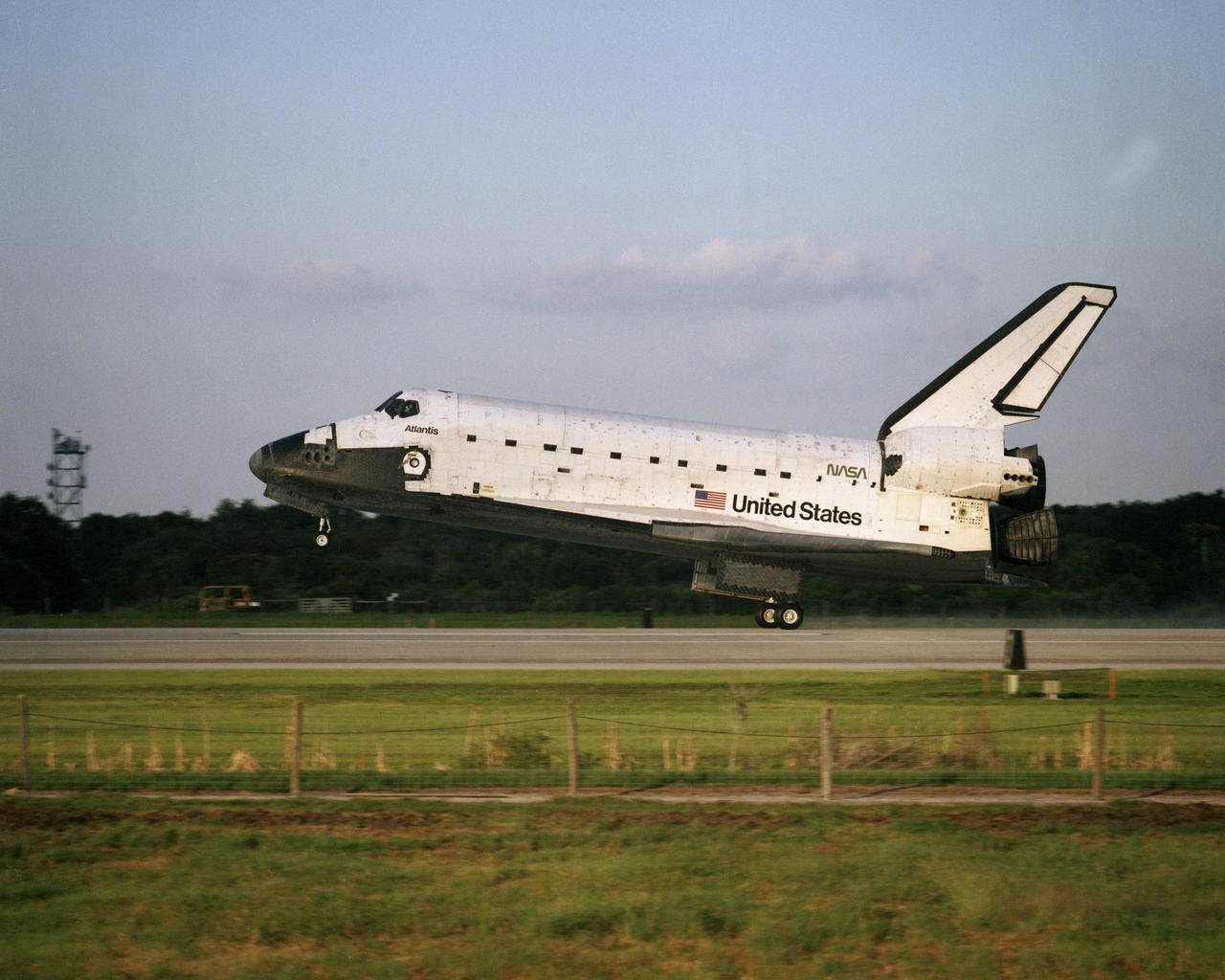
STS079-S-022 (26 Sept. 1996) --- The main landing gear of the space shuttle Atlantis touches down on Runway 15 at the Shuttle Landing Facility (SLF) at the Kennedy Space Center (KSC), bringing an end to the successful ten-day mission. Landing occurred at 8:13:15 a.m. (EDT), Sept. 26, 1996. The touchdown marked the end of 188 days in space for astronaut Shannon W. Lucid, following her in-space exchange with astronaut John E. Blaha, who is now aboard Russia's Mir Space Station. Returning along with Lucid were her STS-79 crew mates - astronauts William F. Readdy, commander; Terrence W. Wilcutt, pilot; and Thomas D. Akers, Jerome (Jay) Apt and Carl E. Walz, mission specialists.
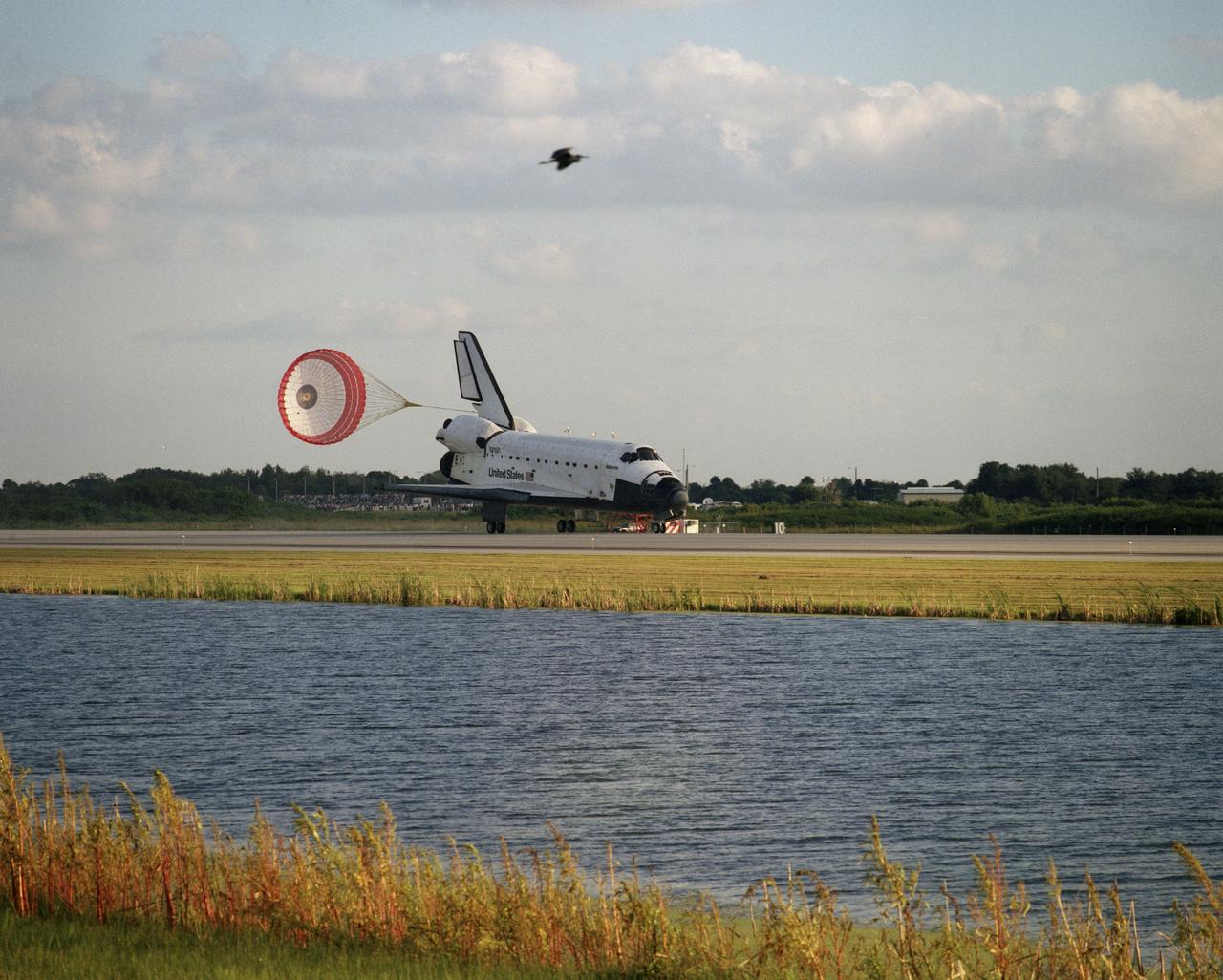
STS079-S-021 (26 Sept. 1996) --- The drag chute on the space shuttle Atlantis is fully deployed as the orbiter rolls down Runway 15 at the Shuttle Landing Facility (SLF) at the Kennedy Space Center (KSC), bringing an end to the successful ten-day mission. Landing occurred at 8:13:15 a.m. (EDT), Sept. 26, 1996. The touchdown marked the end of 188 days in space for astronaut Shannon W. Lucid, following her in-space exchange with astronaut John E. Blaha, who is now aboard Russia's Mir Space Station. Returning along with Lucid were her STS-79 crew mates - astronauts William F. Readdy, commander; Terrence W. Wilcutt, pilot; and Thomas D. Akers, Jerome (Jay) Apt and Carl E. Walz, mission specialists.
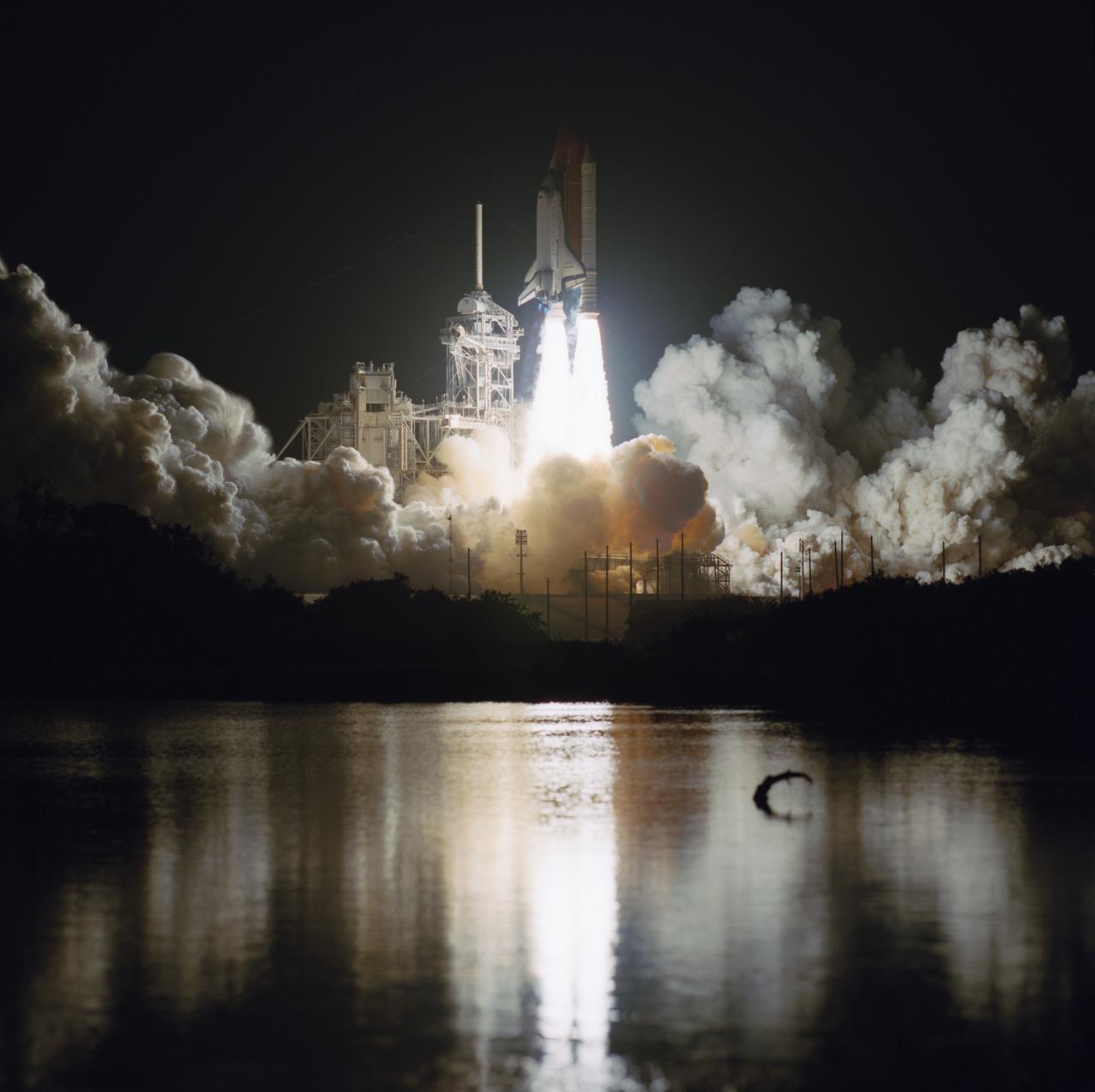
STS061-S-089 (2 Dec 1993) --- The Space Shuttle Endeavour lifts off from Launch Pad 39B with a crew of six NASA astronauts, a Swiss mission specialist and a variety of special tools aboard. Launch occurred at 4:27:00 a.m. (EST), December 2, 1993. The seven member crew will team to perform a variety of service tasks on the Hubble Space Telescope (HST). Four of the group will break into pairs on alternating sessions to carry out a total of five days Extravehicular Activity (EVA). Onboard are astronauts Richard O. Covey, Kenneth D. Bowersox, F. Story Musgrave, Kathy C. Thornton, Jeffrey A. Hoffman and Thomas D. Akers, along with Swiss scientist Claude Nicollier.
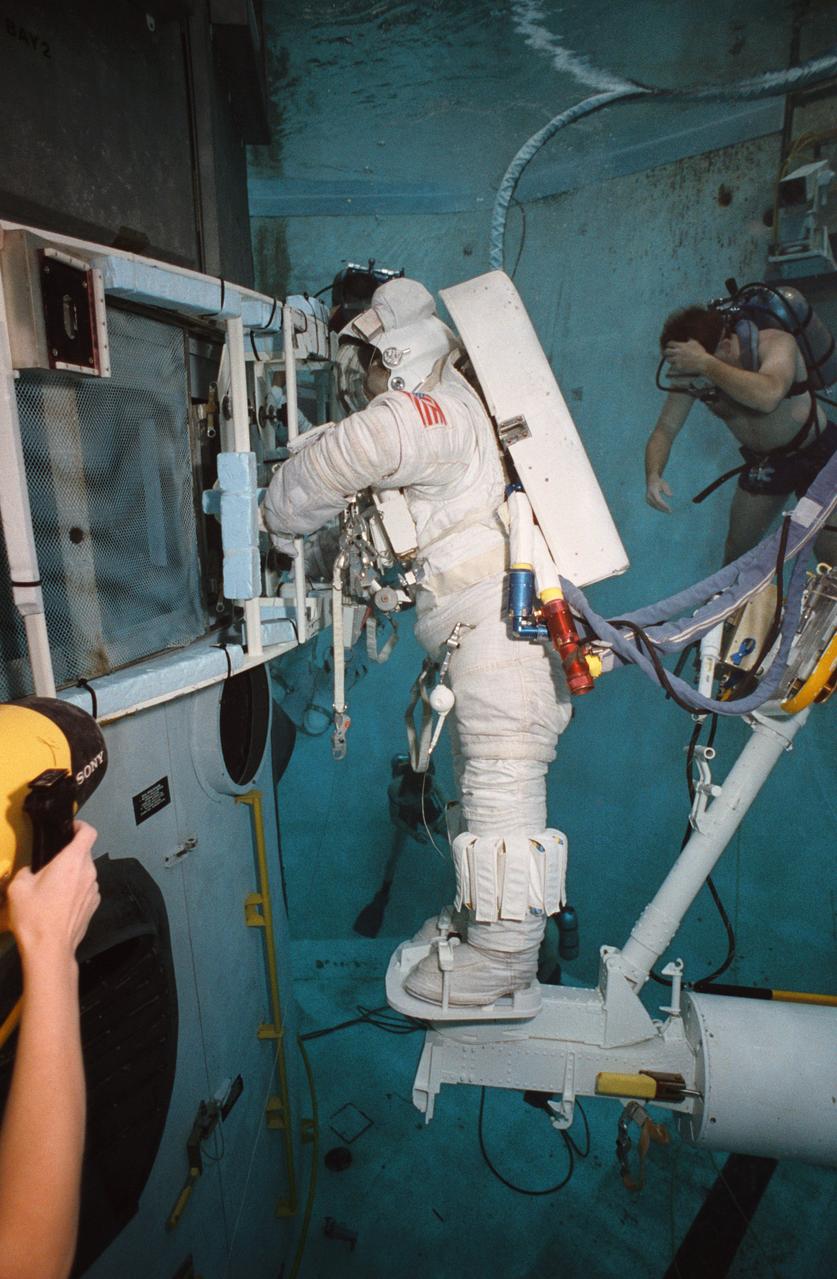
S93-33101 (5 Apr 1993) --- Wearing a training version of Space Shuttle Extravehicular Mobility Unit (EMU), astronaut Kathryn C. Thornton uses the giant pool of the Johnson Space Center's (JSC) Weightless Environment Training Facility (WET-F) to rehearse for the Hubble Space Telescope (HST) repair mission. Standing on a mobile foot restraint connected to the Shuttle's robot arm, Thornton grasps a large structure which attaches to the Wide Field/Planetary Camera (WF/PC). The current WF/PC on the HST will be replaced with WF/PC-2. Out of frame is astronaut Thomas D. Akers, who will join Thornton in STS-61 EVA. A SCUBA-equipped diver can be seen in the background. A number of divers are on hand for all training sessions in the WET-F. A total of five extravehicular activity (EVA) sessions will be conducted during the scheduled December mission of the Endeavour.
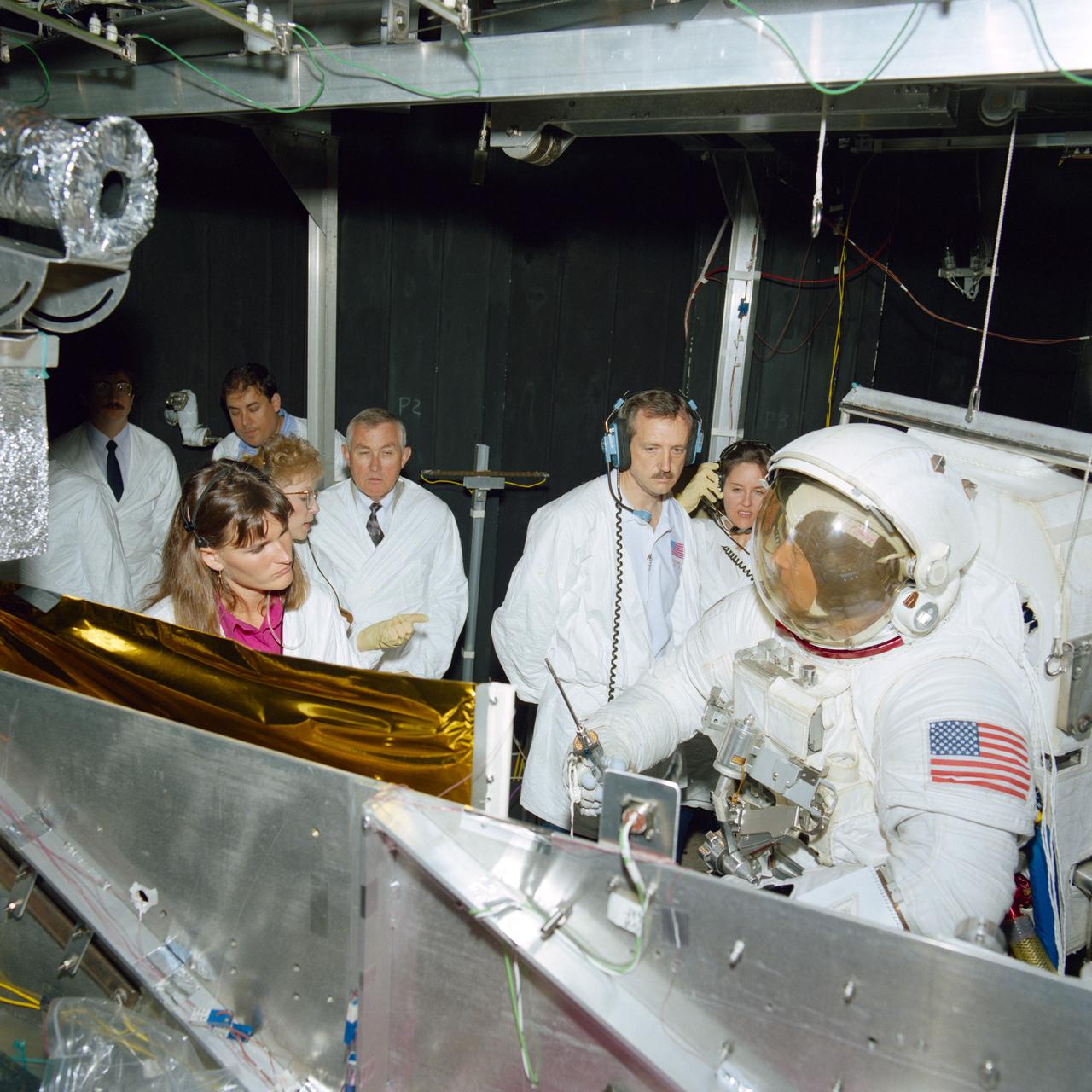
S93-34001 (26 May 1993) --- Astronaut F. Story Musgrave, wearing a training version of the Extravehicular Mobility Unit (EMU), participates in a dry run for tests in a thermal vacuum chamber. The payload commander will be among four suited crew members participating in task rehearsals and testing the tools that will be used on the Hubble Space Telescope (HST) repair mission. The test, conducted in Chamber B of the Space Environment and Simulation Laboratory (SESL) at the Johnson Space Center (JSC), verified that the tools being designed for the mission will work in the cold vacuum of space. Others pictured, from the left, are Andrea Tullar and Donna Fender, test directors; Leonard S. Nicholson, acting director of engineering; and astronauts Thomas D. Akers and Kathryn C. Thornton, mission specialists, along with Musgrave.
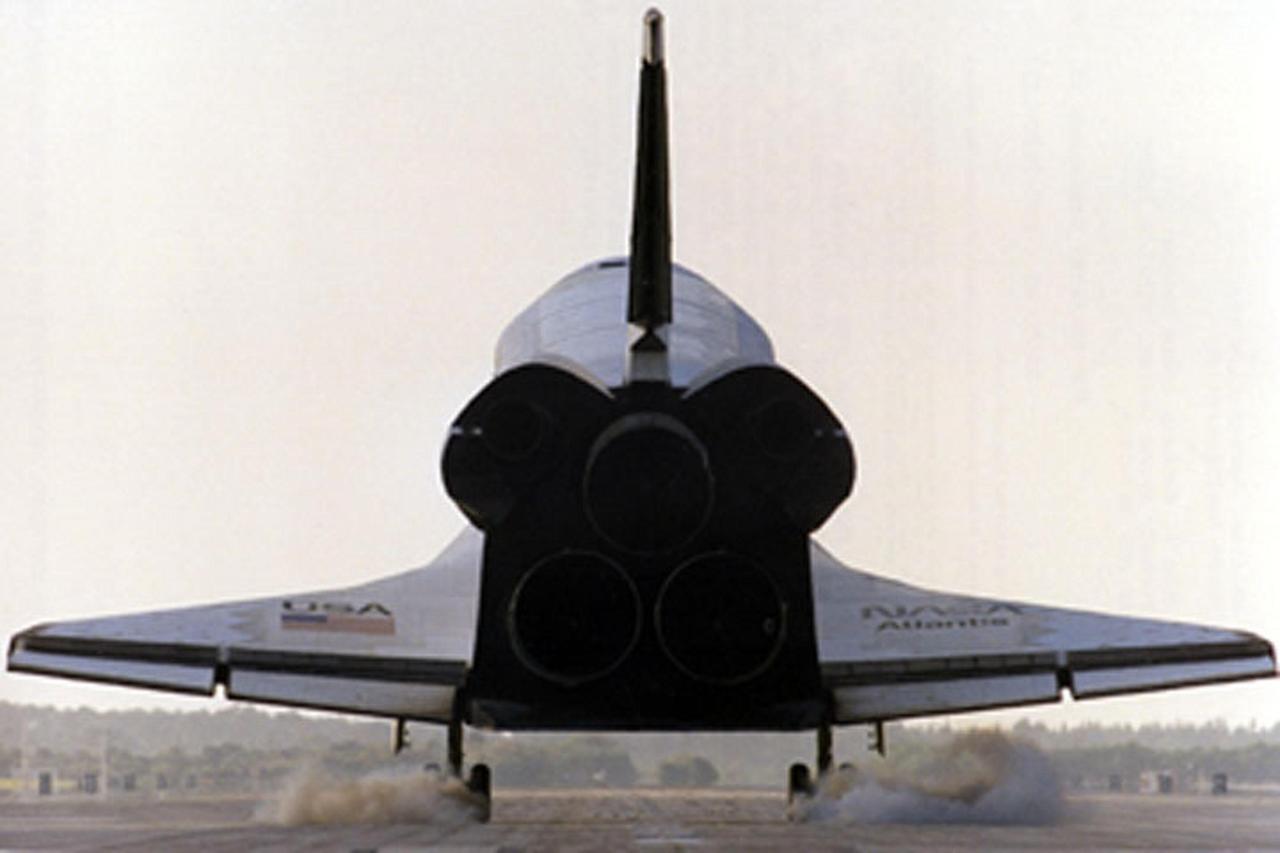
KENNEDY SPACE CENTER, FLA. -- The STS-79 mission comes to a successful conclusion as the orbiter Atlantis touches down on Runway 15 of KSC's Shuttle Landing Facility at 8:13:15 a.m. EDT, September 26. On board is U.S. astronaut Shannon W. Lucid, who has been living and working on the Russian Space Station Mir for about six months. Lucid has spent 188 days in space from launch aboard Atlantis in March to her return today, establishing a U.S. record for long-duration spaceflight as well as representing the longest spaceflight for a woman. Succeeding Lucid on Mir is U.S. astronaut John E. Blaha, who embarked to Mir with the STS-79 crew. The commander of Mission STS-79 is William F. Readdy; Terrence W. Wilcutt is the pilot, and the three mission specialists are Jay Apt, Thomas D. Akers and Carl E. Walz.
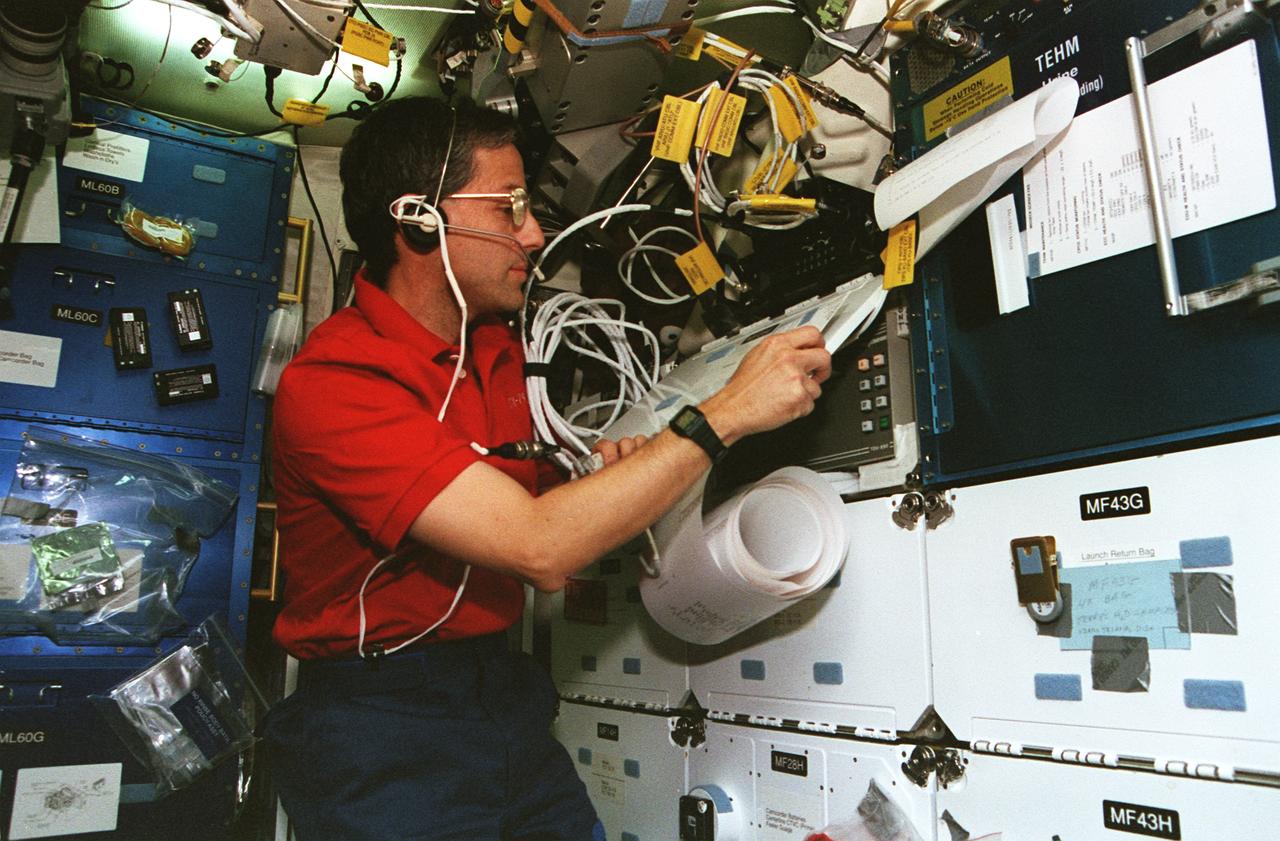
STS079-365-004 (16-26 Sept. 1996) --- During off-duty time, Jerome (Jay) Apt, a licensed amateur radio operator, talks to ground contacts via the Shuttle Amateur Radio Experiment (SAREX). The radio was also used for communications between the Space Shuttle Atlantis and Russia's Mir Space Station during docking and undocking activities. This photograph is one of fifteen 35mm frames (along with four 70mm frames) of still photography documenting the activities of NASA's STS-79 mission, which began with a September 16, 1996, liftoff from Launch Pad 39A the Kennedy Space Center (KSC) and ended with a landing at KSC on September 26, 1996. Onboard for the launch were astronauts William F. Readdy, commander; Terrence W. Wilcutt, pilot; John E. Blaha, Apt, Thomas D. Akers and Carl E. Walz, all mission specialists. On flight day 4, the crew docked with Mir. Shannon W. Lucid, who had spent six months aboard Mir, switched cosmonaut guest researcher roles with Blaha. The latter joined fellow Mir-22 crew members Valeri G. Korzun, commander, and Aleksandr Y. Kaleri, flight engineer.

STS079-813-023 (16-26 Sept. 1996) --- The docked Russian Mir Space Station is partially visible through the Spacehab viewing port, onboard the space shuttle Atlantis. This photograph is one of four 70mm frames (along with fifteen 35mm frames) of still photography documenting the activities of NASA's STS-79 mission, which began with a Sept. 16, 1996, liftoff from Launch Pad 39A the Kennedy Space Center (KSC) and ended with a landing at KSC on Sept. 26, 1996. Onboard for the launch were astronauts William F. Readdy, commander; Terrence W. Wilcutt, pilot; John E. Blaha, Jerome (Jay) Apt, Thomas D. Akers and Carl E. Walz, all mission specialists. On flight day 4, the crew docked with the Mir Space Station. Shannon W. Lucid, who had spent six months aboard Mir, switched cosmonaut guest researcher roles with Blaha. The latter joined fellow Mir-22 crewmembers Valeri G. Korzun, commander, and Aleksandr Y. Kaleri, flight engineer.
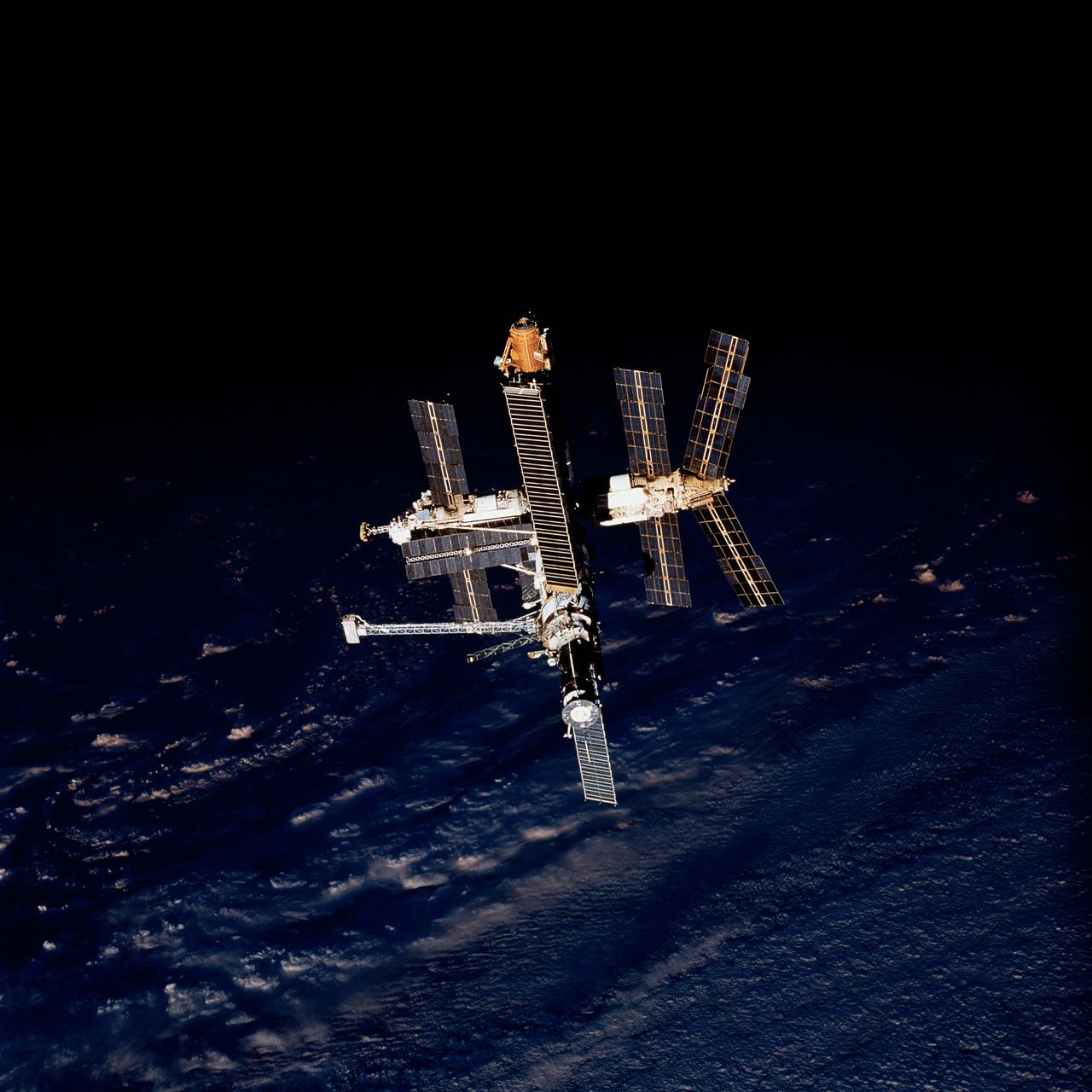
STS079-821-036 (16-26 Sept. 1996) --- Following the Space Shuttle Atlantis - Russian Mir Space Station undocking activities, a crew member captured this 70mm frame of Mir as the two crews shared their final common sunset scene. This photograph is one of four 70mm frames (along with fifteen 35mm frames) of still photography documenting the activities of NASA's STS-79 mission, which began with a September 16, 1996, liftoff from Launch Pad 39A the Kennedy Space Center (KSC) and ended with a landing at KSC on September 26, 1996. Onboard for the launch were astronauts William F. Readdy, commander; Terrence W. Wilcutt, pilot; John E. Blaha, Jerome (Jay) Apt, Thomas D. Akers and Carl E. Walz, all mission specialists. On flight day 4, the crew docked with Mir. Shannon W. Lucid, who had spent six months aboard Mir, switched cosmonaut guest researcher roles with Blaha. The latter joined fellow Mir-22 crew members Valeri G. Korzun, commander, and Aleksandr Y. Kaleri, flight engineer.
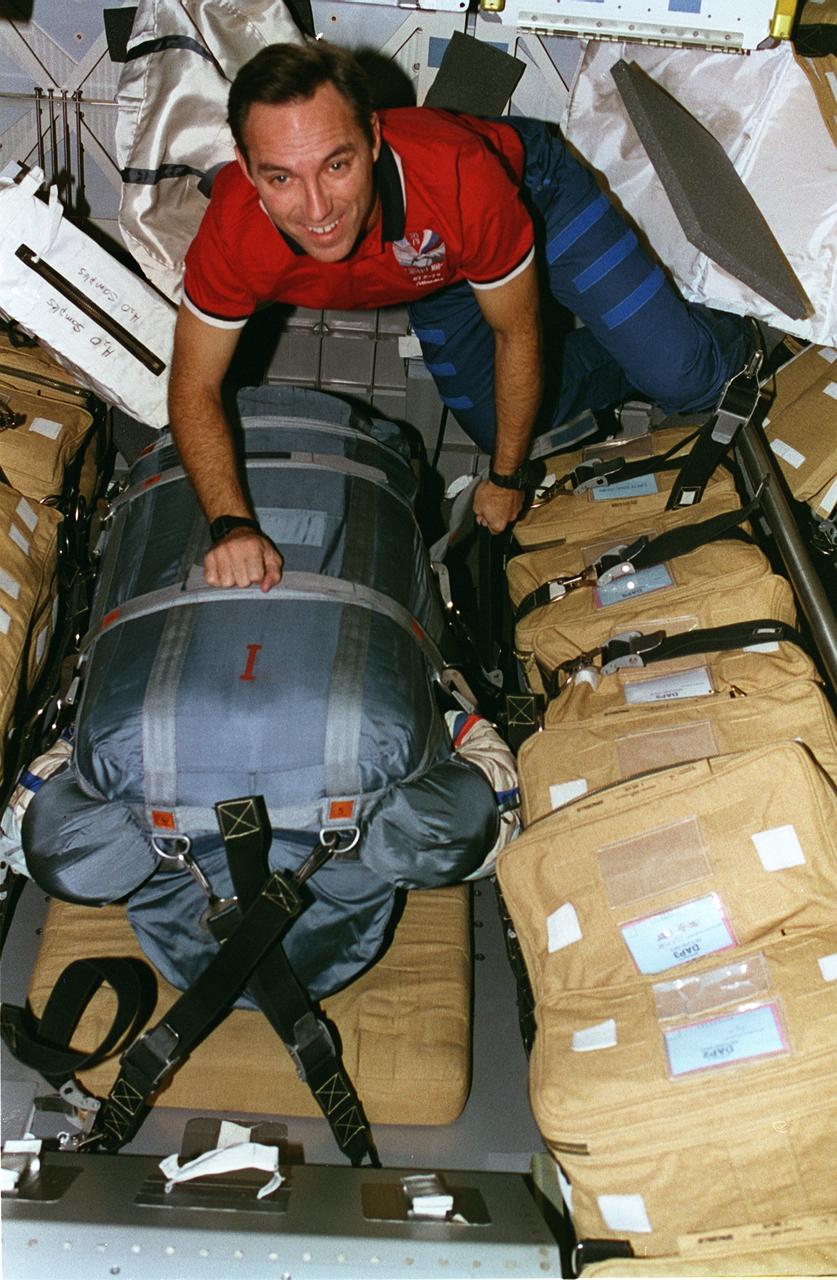
STS079-304-001 (16 Sept. 1996)--- Astronaut Carl E. Walz totes a bag carrying a space suit used by the cosmonauts. At the completion of the STS-79 mission, the suit was brought back to Earth for analysis. This photograph is one of fifteen 35mm frames (along with four 70mm frames) of still photography documenting the activities of NASA's STS-79 mission, which began with a September 16, 1996, liftoff from Launch Pad 39A the Kennedy Space Center (KSC) and ended with a landing at KSC on September 26, 1996. Onboard for the launch were astronauts William F. Readdy, commander; Terrence W. Wilcutt, pilot; John E. Blaha, Jerome (Jay) Apt, Thomas D. Akers and Walz, all mission specialists. On flight day 4, the crew docked with Russia's Mir Space Station. Shannon W. Lucid, who had spent six months aboard Mir, switched cosmonaut guest researcher roles with Blaha. The latter joined fellow Mir-22 crew members Valeri G. Korzun, commander, and Aleksandr Y. Kaleri, flight engineer.
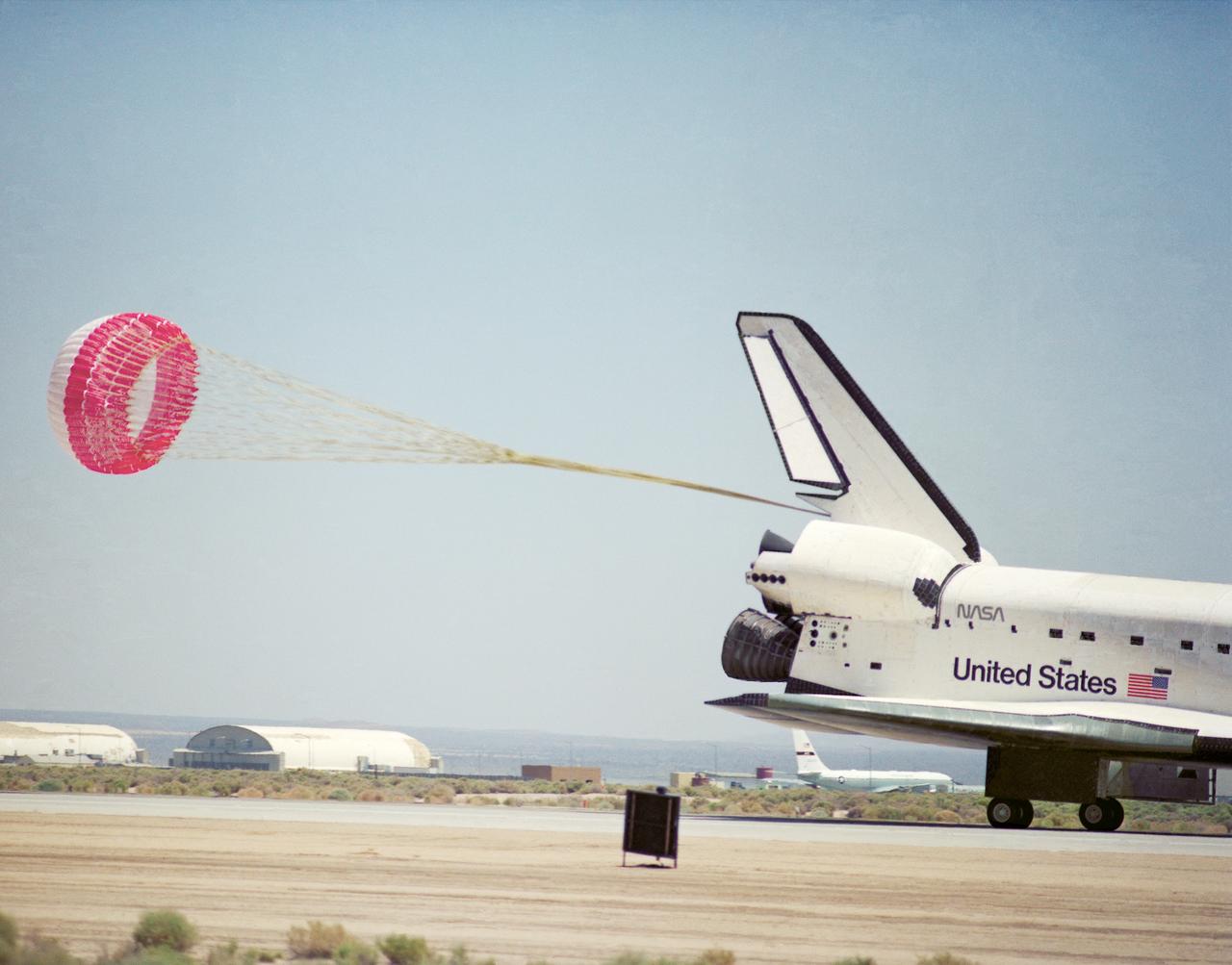
The Space Shuttle Endeavour concludes mission STS-49 at NASA's Ames-Dryden Flight Research Facility (later redesignated Dryden Flight Research Center), Edwards, California, with a 1:57 p.m. (PDT) landing 16 May on Edward's concrete runway 22. The planned 7-day mission, which began with a launch from Kennedy Space Center, Florida, at 4:41 p.m. (PFT), 7 May, was extended two days to allow extra time to rescue the Intelsat VI satellite and complete Space Station assembly techniques originally planned. After a perfect rendezvous in orbit and numerous attempts to grab the satellite, space walking astronauts Pierre Thuot, Rick Hieb and Tom Akers successfully rescued it by hand on the third space walk with the support of mission specialists Kathy Thornton and Bruce Melnick. The three astronauts, on a record space walk, took hold of the satellite and directed it to the shuttle where a booster motor was attached to launch it to its proper orbit. Commander Dan Brandenstein and Pilot Kevin Chilton brought Endeavours's record setting maiden voyage to a perfect landing at Edwards AFB with the first deployment of a drag chute on a shuttle mission.
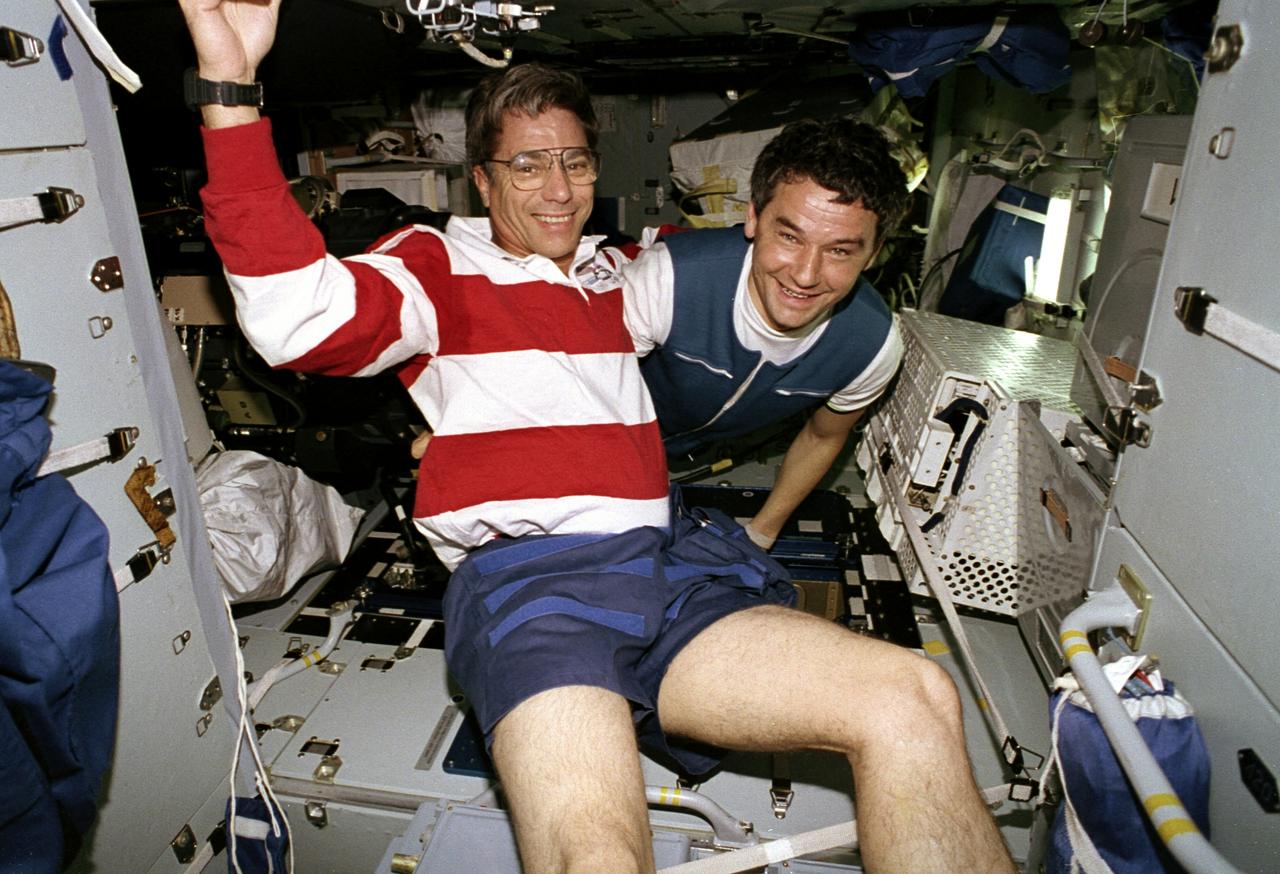
STS079-350-028 (16-26 Sept. 1996) --- Aboard Russian Mir Space Station's Spektr Module, astronaut John E. Blaha, now a cosmonaut guest researcher, visits with Valeri G. Korzun, his mission commander for Mir-22. This photograph is one of fifteen 35mm frames (along with four 70mm frames) of still photography documenting the activities of NASA's STS-79 mission, which began with a Sept. 16, 1996, liftoff from Launch Pad 39A the Kennedy Space Center (KSC) and ended with a landing at KSC on September 26, 1996. Onboard for the launch were astronauts William F. Readdy, commander; Terrence W. Wilcutt, pilot; Blaha, Jerome (Jay) Apt, Thomas D. Akers and Carl E. Walz, all mission specialists. On flight day 4, the crew docked with Mir. Shannon W. Lucid, who had spent six months aboard Mir, switched cosmonaut guest researcher roles with Blaha. The latter joined fellow Mir-22 crewmembers Korzun, and Aleksandr Y. Kaleri, flight engineer.
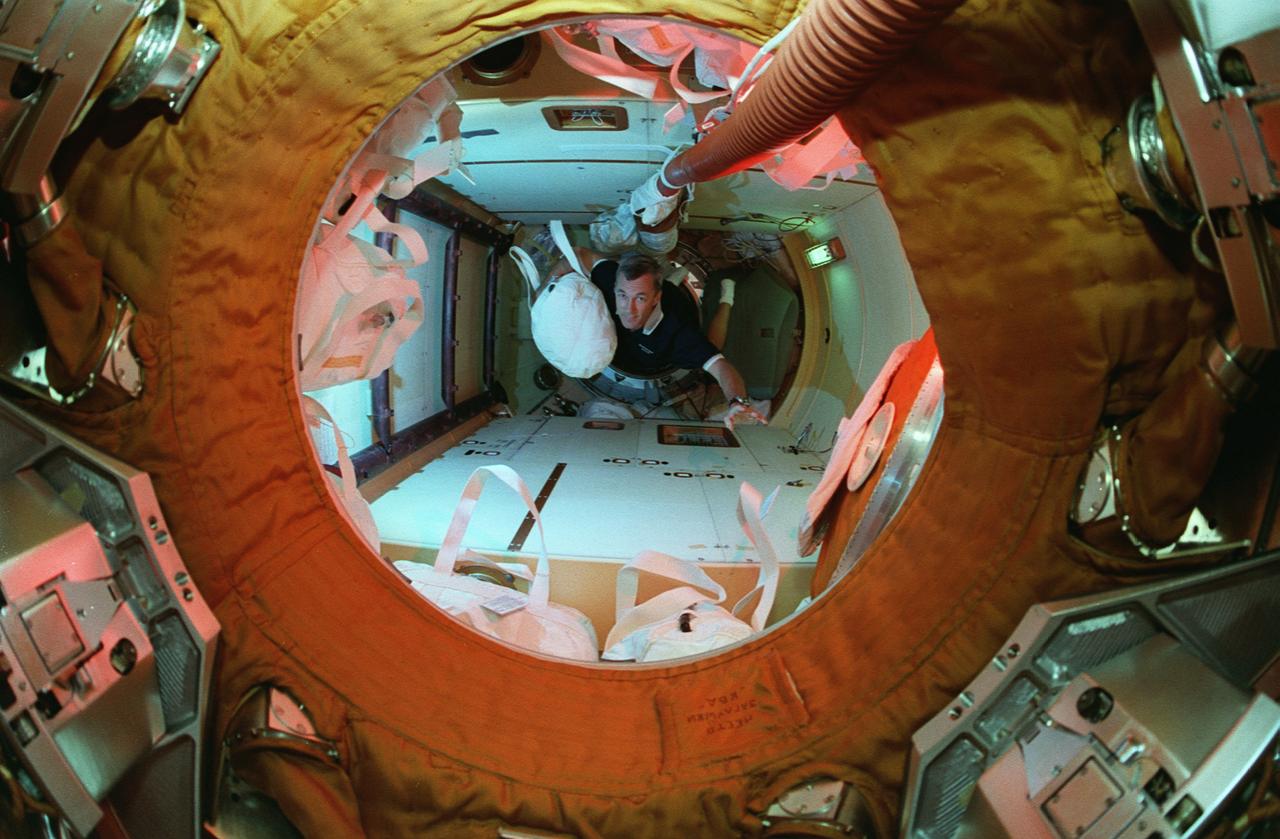
STS079-335-001 (16-26 Sept. 1996) --- Astronaut Terrence W. Wilcutt traverses into Russia's Mir Space Station Kristall Module toting a water bag from the Space Shuttle Atlantis to be used on Mir. This photograph is one of fifteen 35mm frames (along with four 70mm frames) of still photography documenting the activities of NASA's STS-79 mission, which began with a Sept. 16, 1996, liftoff from Launch Pad 39A the Kennedy Space Center (KSC) and ended with a landing at KSC on September 26, 1996. Onboard for the launch were astronauts William F. Readdy, commander; Wilcutt, pilot; John E. Blaha, Jerome (Jay) Apt, Thomas D. Akers and Carl E. Walz, all mission specialists. On flight day 4, the crew docked with Mir. Shannon W. Lucid, who had spent six months aboard Mir, switched cosmonaut guest researcher roles with Blaha. The latter joined fellow Mir-22 crewmembers Valeri G. Korzun, commander, and Aleksandr Y. Kaleri, flight engineer.
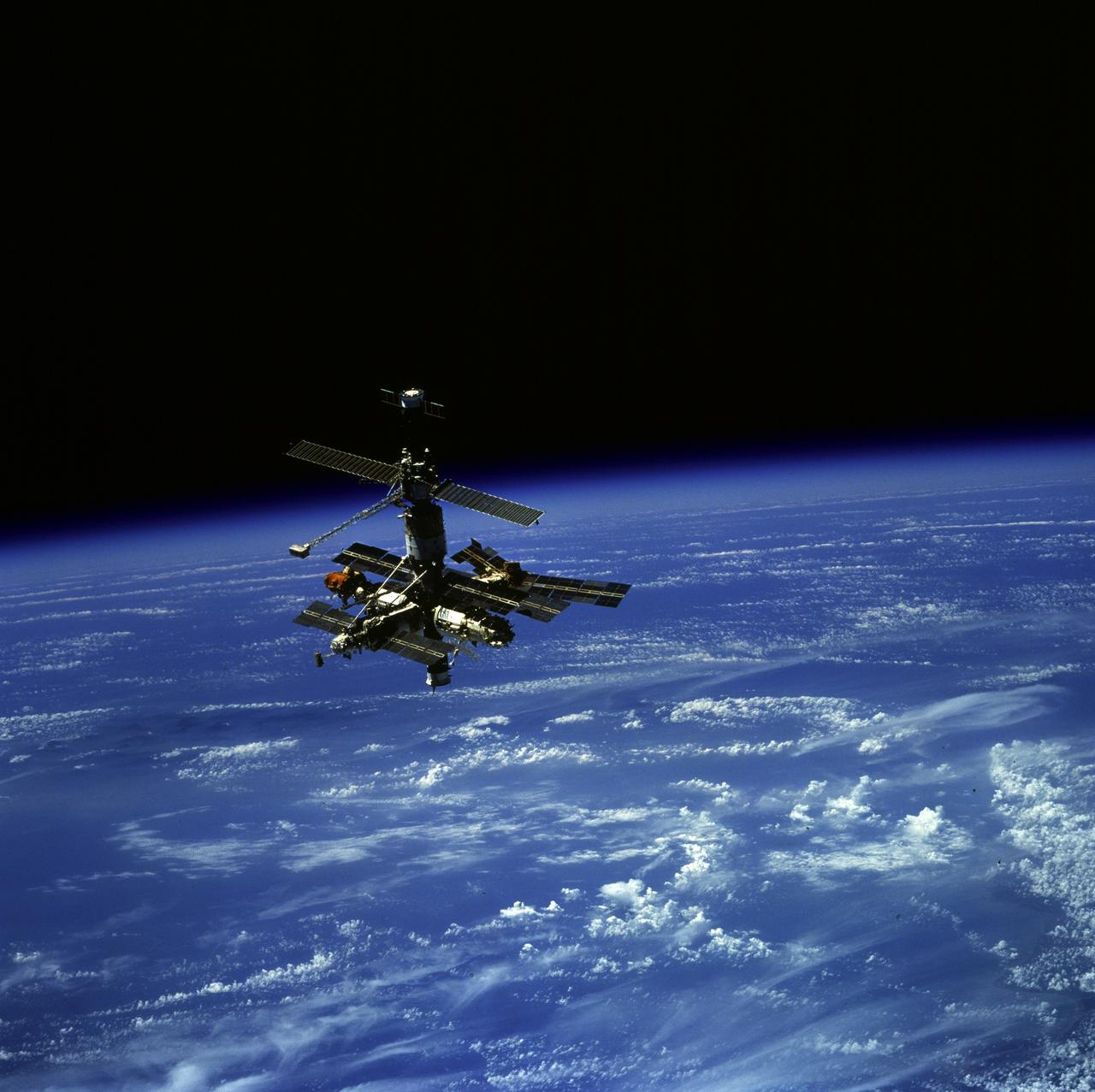
STS079-810-028 (24 Sept. 1996) --- Russia's Mir Space Station, backdropped over Earth's horizon, was photographed by one of the STS-79 crew members aboard the space shuttle Atlantis as it performed its final fly around following undocking operations. The STS-79 flight began with a Sept. 16, 1996, liftoff from Launch Pad 39A at the Kennedy Space Center and ended with a landing at KSC on Sept. 26, 1996. Onboard for the launch were astronauts William F. Readdy, commander; Terrence W. Wilcutt, pilot; John E. Blaha, Jerome (Jay) Apt, Thomas D. Akers and Carl E. Walz, all mission specialists. On flight day four, the crew docked with Mir. Shannon W. Lucid, who had spent six months aboard Mir, switched cosmonaut guest researcher roles with Blaha. The latter joined fellow Mir-22 crew members Valeri G. Korzun, commander, and Aleksandr Y. Kaleri, flight engineer. Photo credit: NASA