
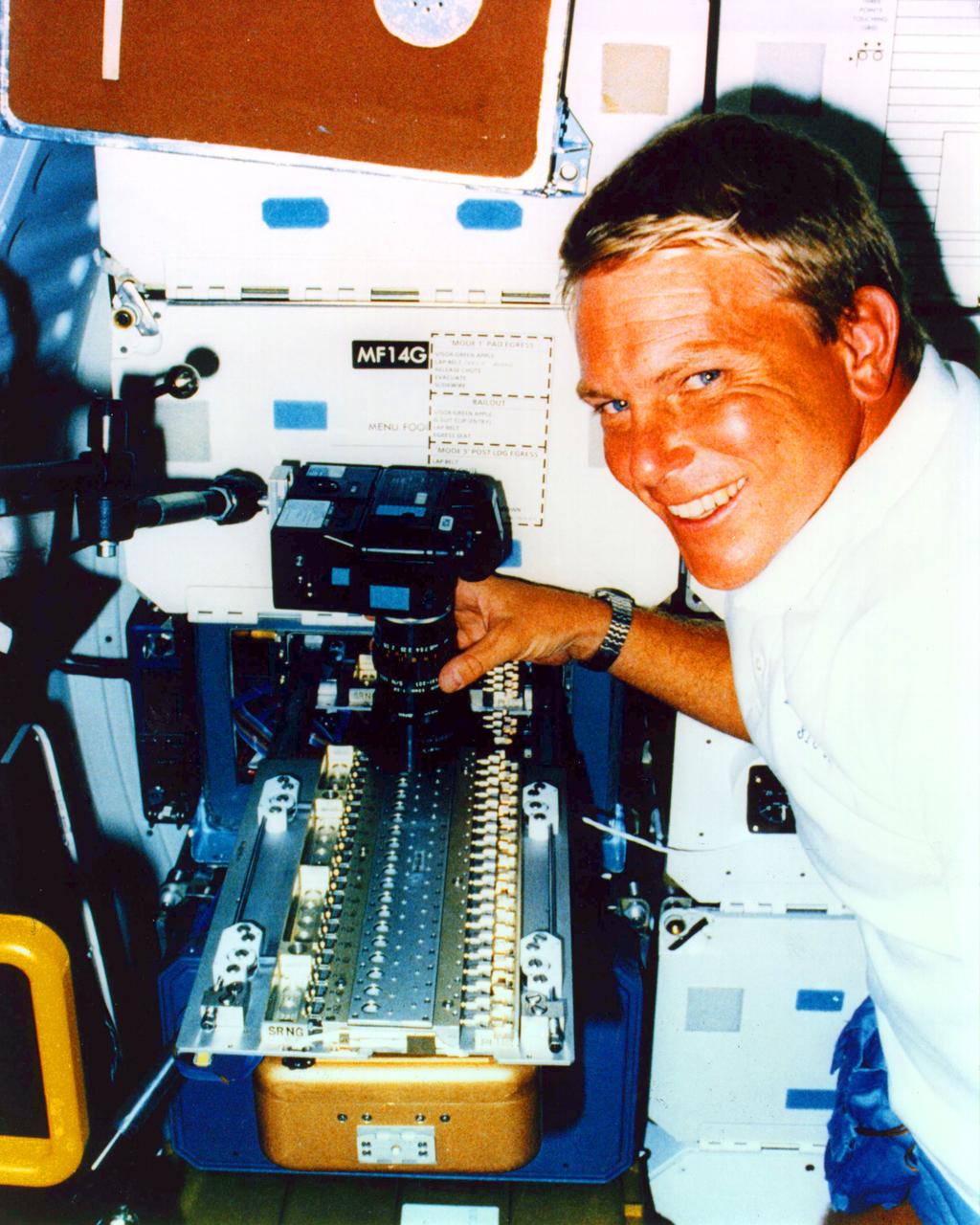
STS009-05-0153 (28 Nov. - 8 Dec. 1983) --- Though STS-9 was the space shuttle Columbia's sixth spaceflight, it was the first opportunity for an onboard galley, some of the results of which are shown in this 35mm scene on the flight deck. The metal tray makes for easy preparation and serving of in-space meals for crew members. This crewman is seated at the pilot's station on the flight deck. The actual galley is located in the middeck. Photo credit: NASA
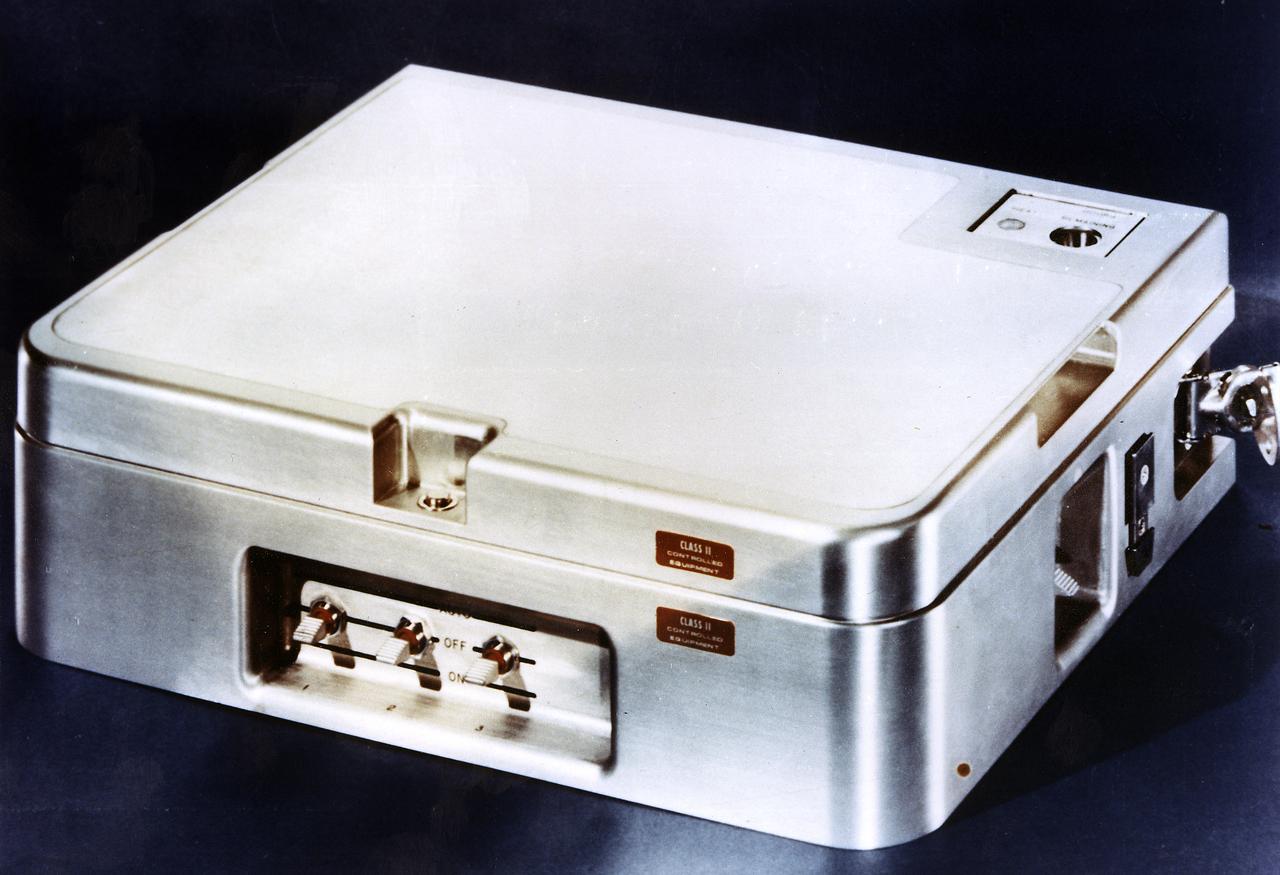
Shown here is the Skylab food heating and serving tray in its stowed position. The Marshall Space Flight Center had program management responsibility for the development of Skylab hardware and experiments.
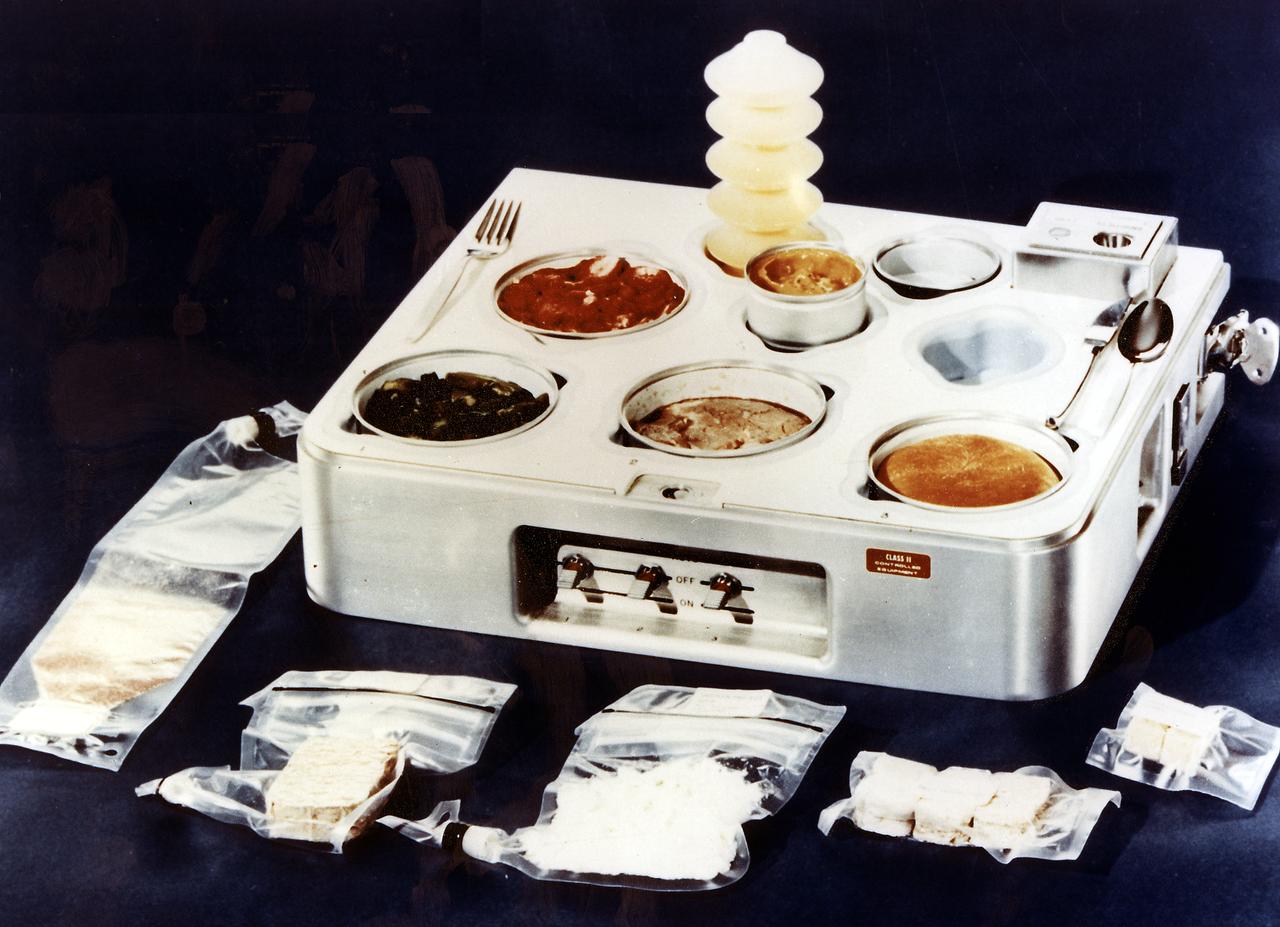
Shown here is the Skylab food heating and serving tray with food, drink, and utensils. The tray contained heating elements for preparing the individual food packets. The food on Skylab was a great improvement over that on earlier spaceflights. It was no longer necessary to squeeze liquified food from plastic tubes. Skylab's kitchen in the Orbital Workshop wardroom was so equipped that each crewman could select his own menu and prepare it to his own taste. The Marshall Space Flight Center had program management responsibility for the development of Skylab hardware and experiments.
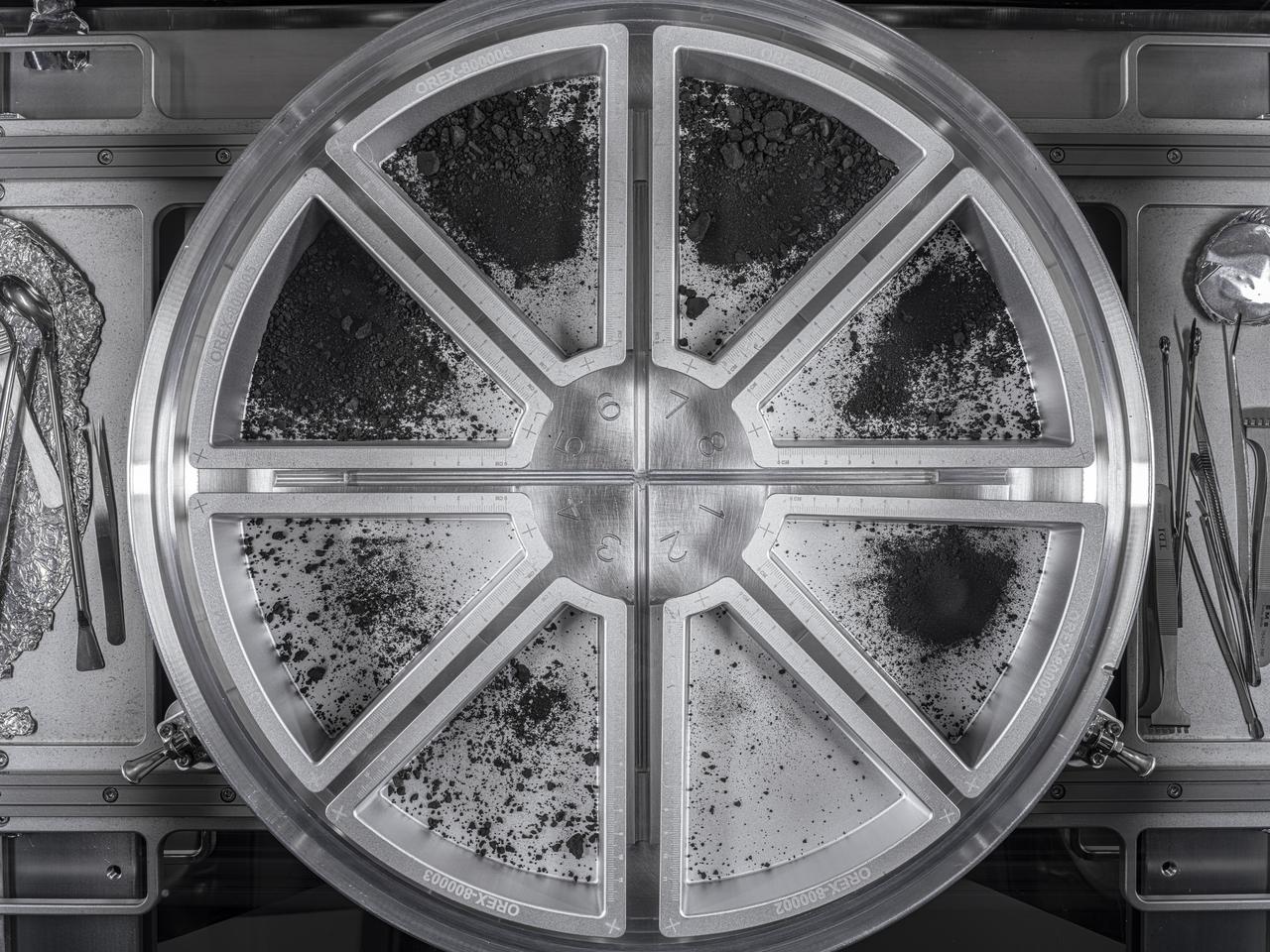
A view of eight sample trays containing the final material from asteroid Bennu. The dust and rocks were poured into the trays from the top plate of the Touch-and-Go Sample Acquisition Mechanism (TAGSAM) head. 51.2 grams were collected from this pour, bringing the final mass of asteroid sample to 121.6 grams. Credit: NASA/Erika Blumenfeld & Joseph Aebersold
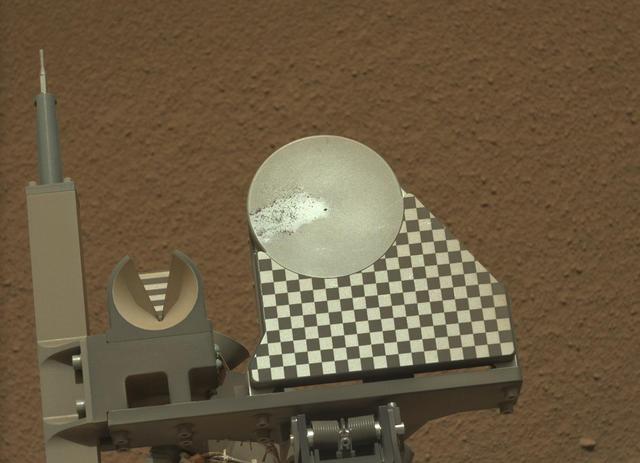
The robotic arm on NASA Mars rover Curiosity delivered a sample of Martian soil to the rover observation tray for the first time during the mission 70th Martian day, or sol Oct. 16, 2012.
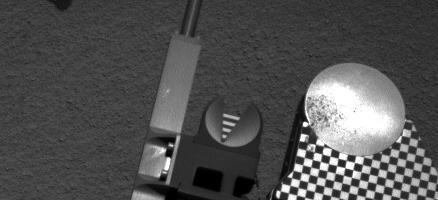
Sample material from the fourth scoop of Martian soil collected by NASA Mars rover Curiosity is on the rover observation tray in this image taken during the mission 78th Martian sol, Oct. 24, 2012 by Curiosity left Navigation Camera.
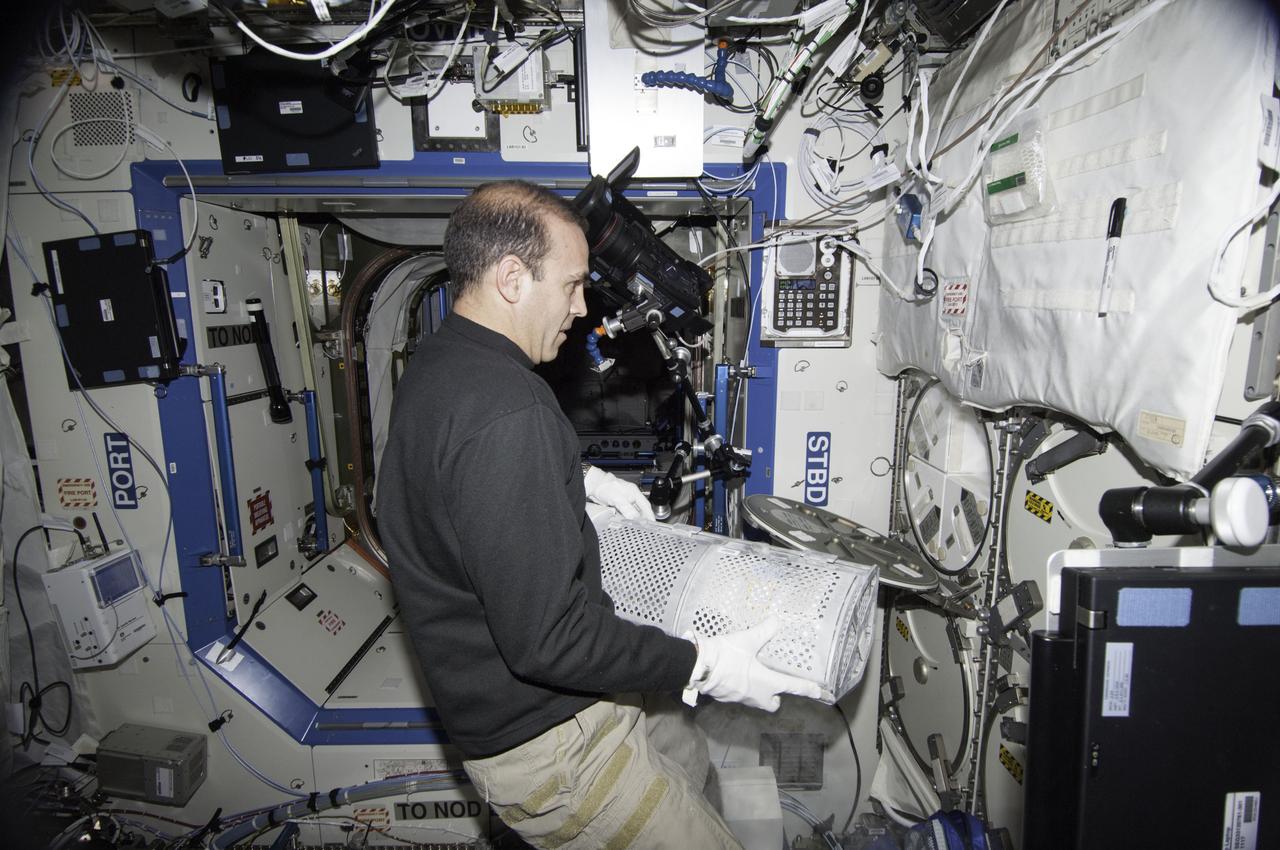
ISS038-E-006765 (21 Nov. 2013) --- In the International Space Station's Destiny laboratory, NASA astronaut Rick Mastracchio, Expedition 38 flight engineer, prepares to replace a dewar tray in the Minus Eighty Laboratory Freezer for ISS (MELFI) after inserting biological samples into the trays.
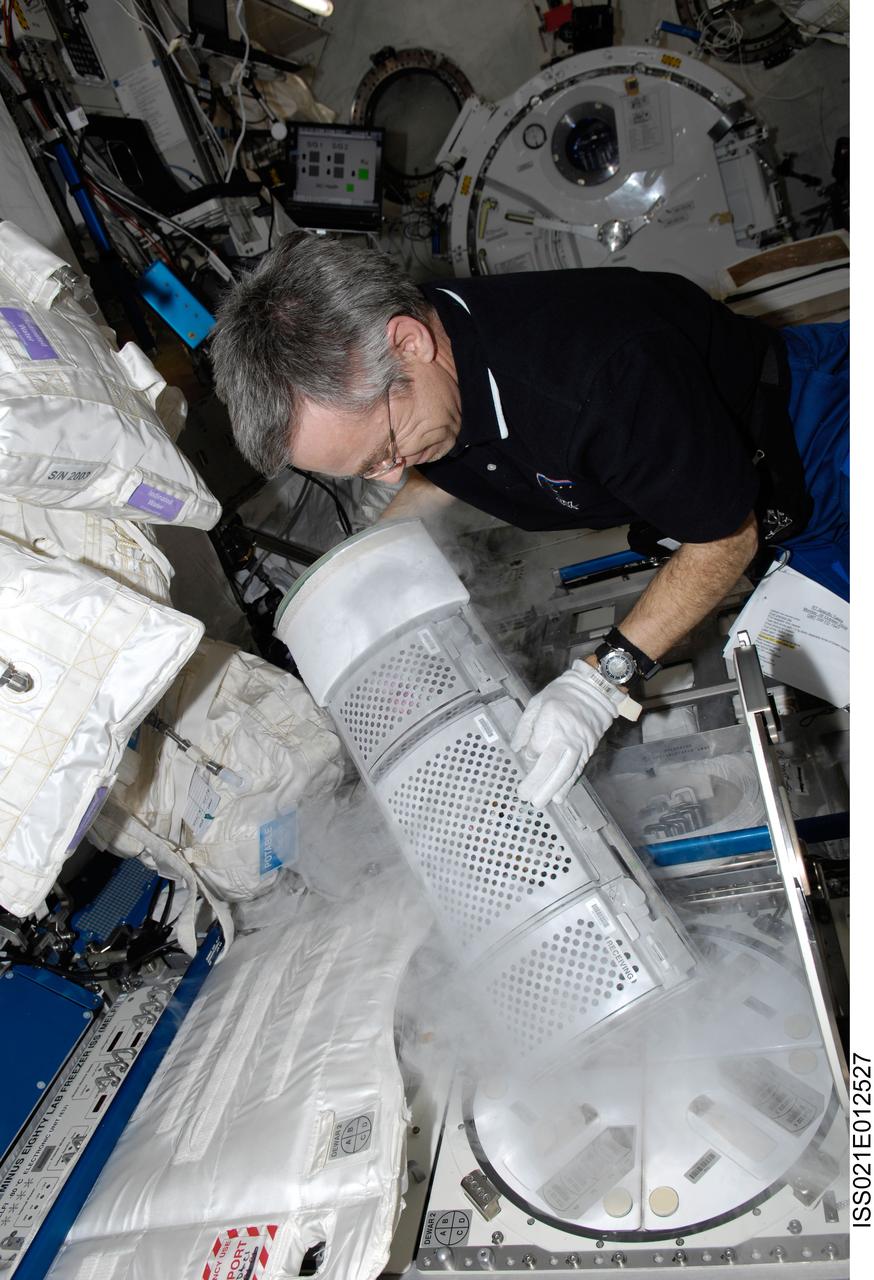
ISS021-E-012527 (26 Oct. 2009) --- Canadian Space Agency astronaut Robert Thirsk, Expedition 21 flight engineer, removes a dewar tray from the Minus Eighty Laboratory Freezer for ISS (MELFI) in order to insert biological samples into the trays in the Kibo laboratory of the International Space Station.
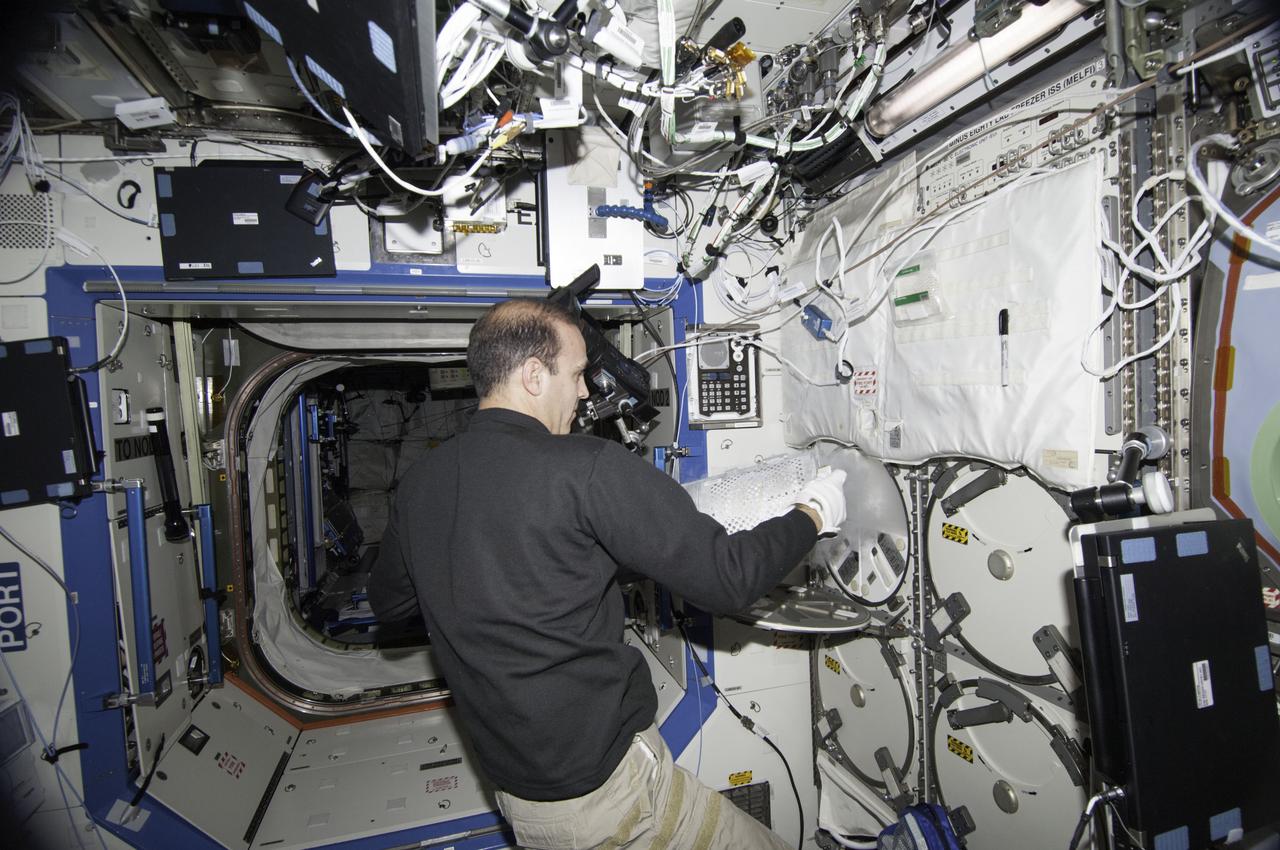
ISS038-E-006757 (21 Nov. 2013) --- In the International Space Station's Destiny laboratory, NASA astronaut Rick Mastracchio, Expedition 38 flight engineer, removes a dewar tray from the Minus Eighty Laboratory Freezer for ISS (MELFI) in order to insert biological samples into the trays.
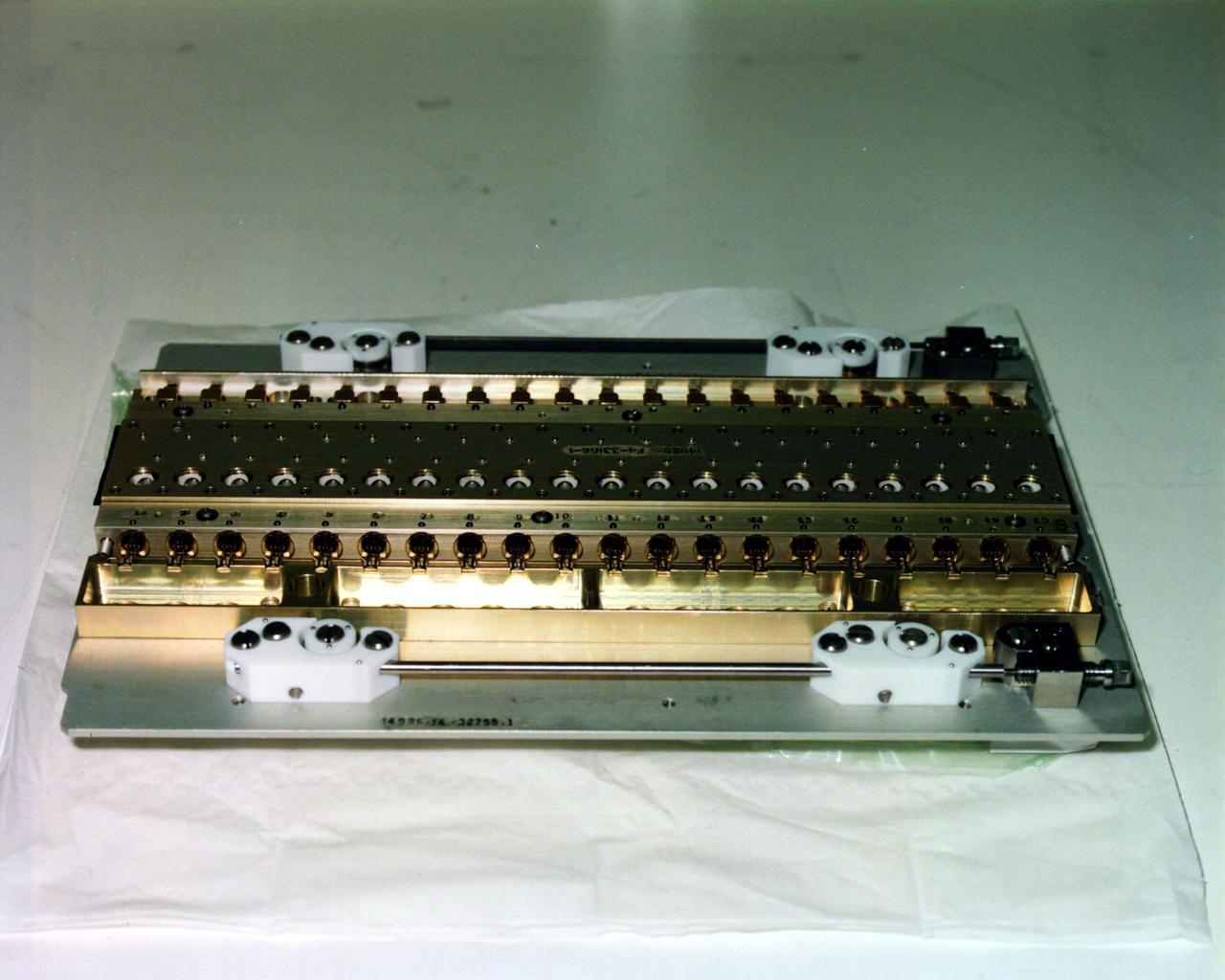
These Vapor Diffusion Apparatus (VDA) trays were first flown in the Thermal Enclosure System (TES) during the USMP-2 (STS-62) mission. Each tray can hold 20 protein crystal growth chambers. Each chamber contains a double-barrel syringe; one barrel holds protein crystal solution and the other holds precipitant agent solution. During the microgravity mission, a torque device is used to simultaneously retract the plugs in all 20 syringes. The two solutions in each chamber are then mixed. After mixing, droplets of the combined solutions are moved onto the syringe tips so vapor diffusion can begin. During the length of the mission, protein crystals are grown in the droplets. Shortly before the Shuttle's return to Earth, the experiment is deactivated by retracting the droplets containing protein crystals, back into the syringes.
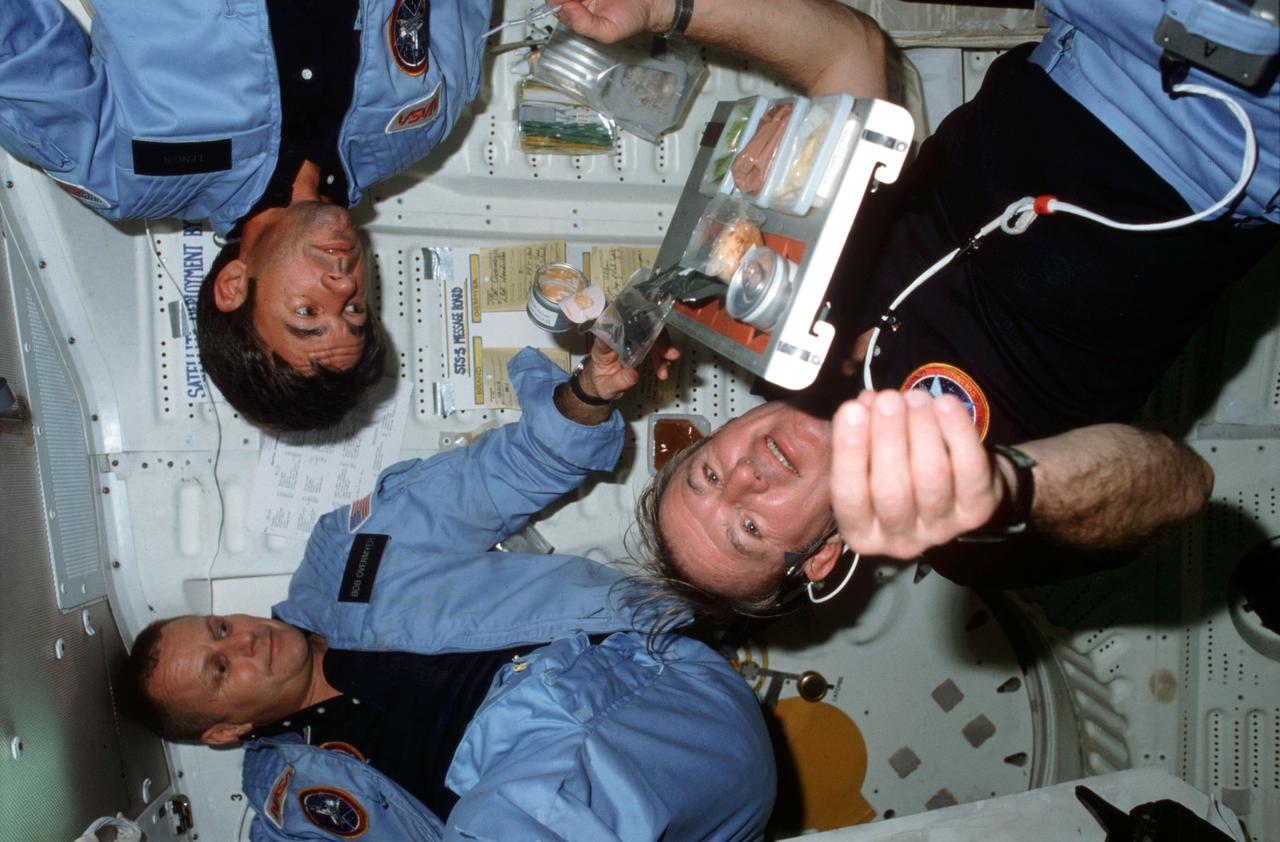
STS005-06-210 (16 Nov. 1982) --- Astronaut Vance D. Brand (in dark blue shirt), STS-5 commander; Robert F. Overmyer (left), pilot; and William B. Lenoir, mission specialist, conduct microgravity experiments with food containers and meal tray assemblies in front of middeck port side wall and side hatch. Brand prepares to eat as meal tray assembly floats above his chest and Overmeyer and Lenoir look on. Sign on port side wall is labeled STS-5 message board. Photo credit: NASA
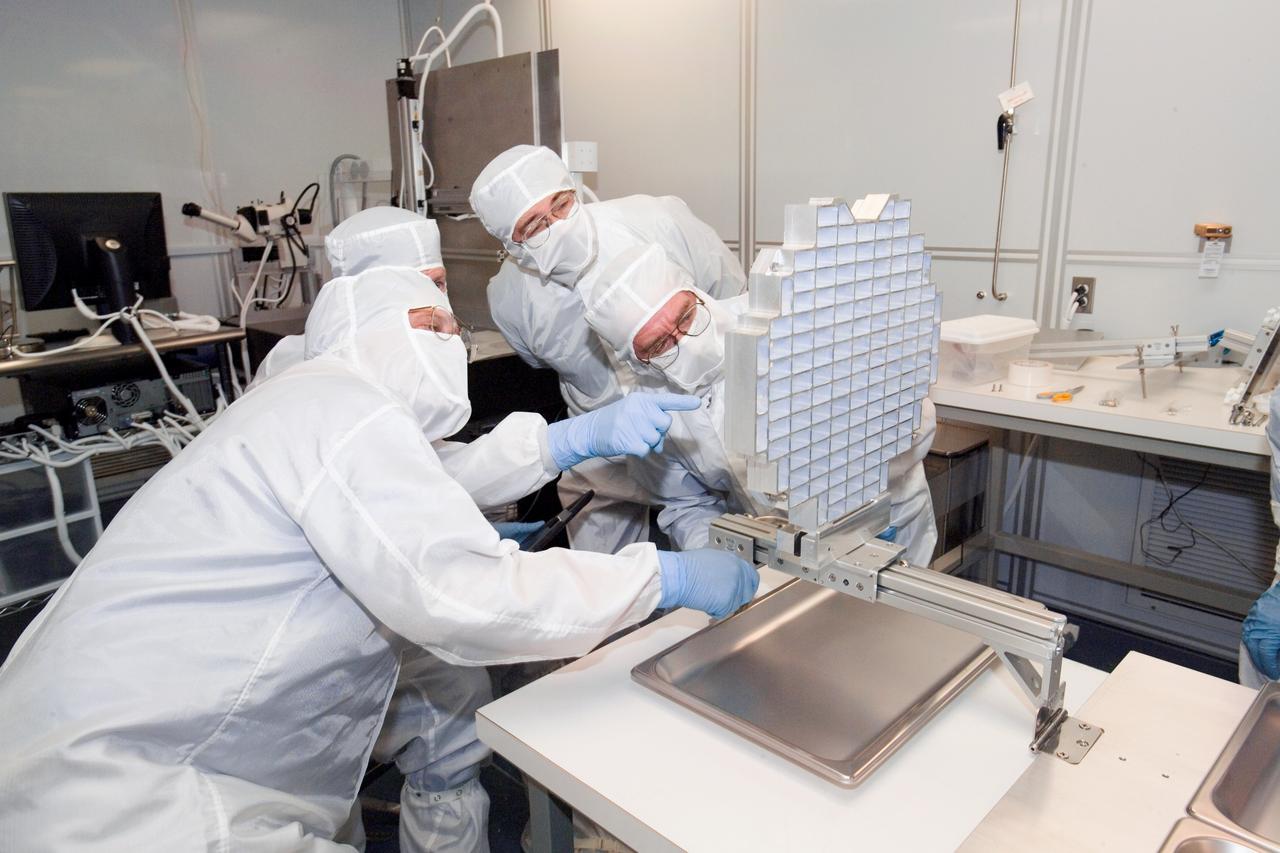
Stardust Photo documentation of Stardust Sample Return and Tray Separation at bldg 31, Stardust laboratory at JSC. The JSC Curation Team begins work with sample containers.
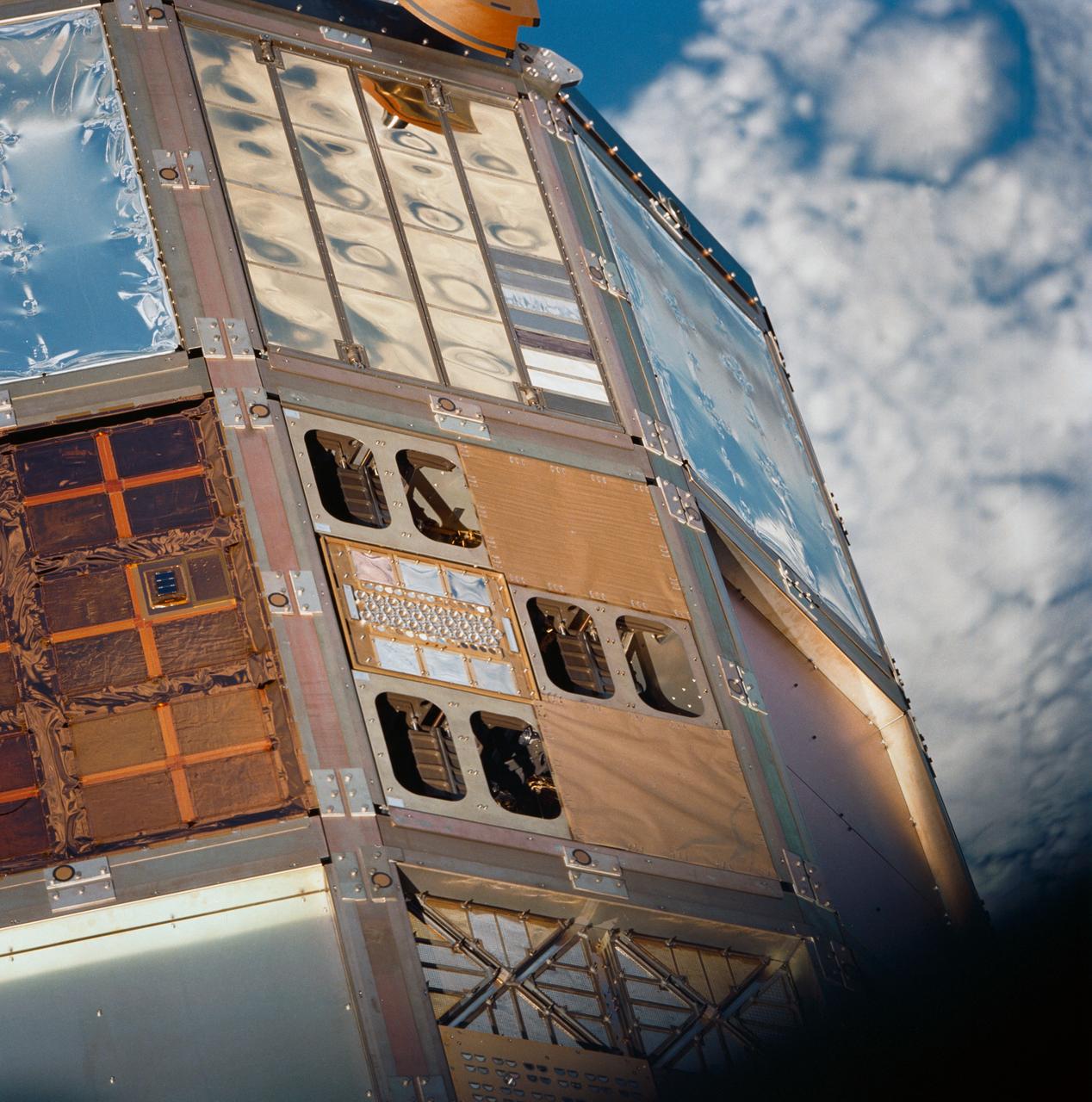
Closeup of Long Duration Exposure Facility (LDEF) experiment trays is documented during STS-32 retrieval activity and photo survey conducted by crewmembers onboard Columbia, Orbiter Vehicle (OV) 102. Partially visible is the Polymer Matrix Composite Materials Experiment. In the background is the surface of the Earth.
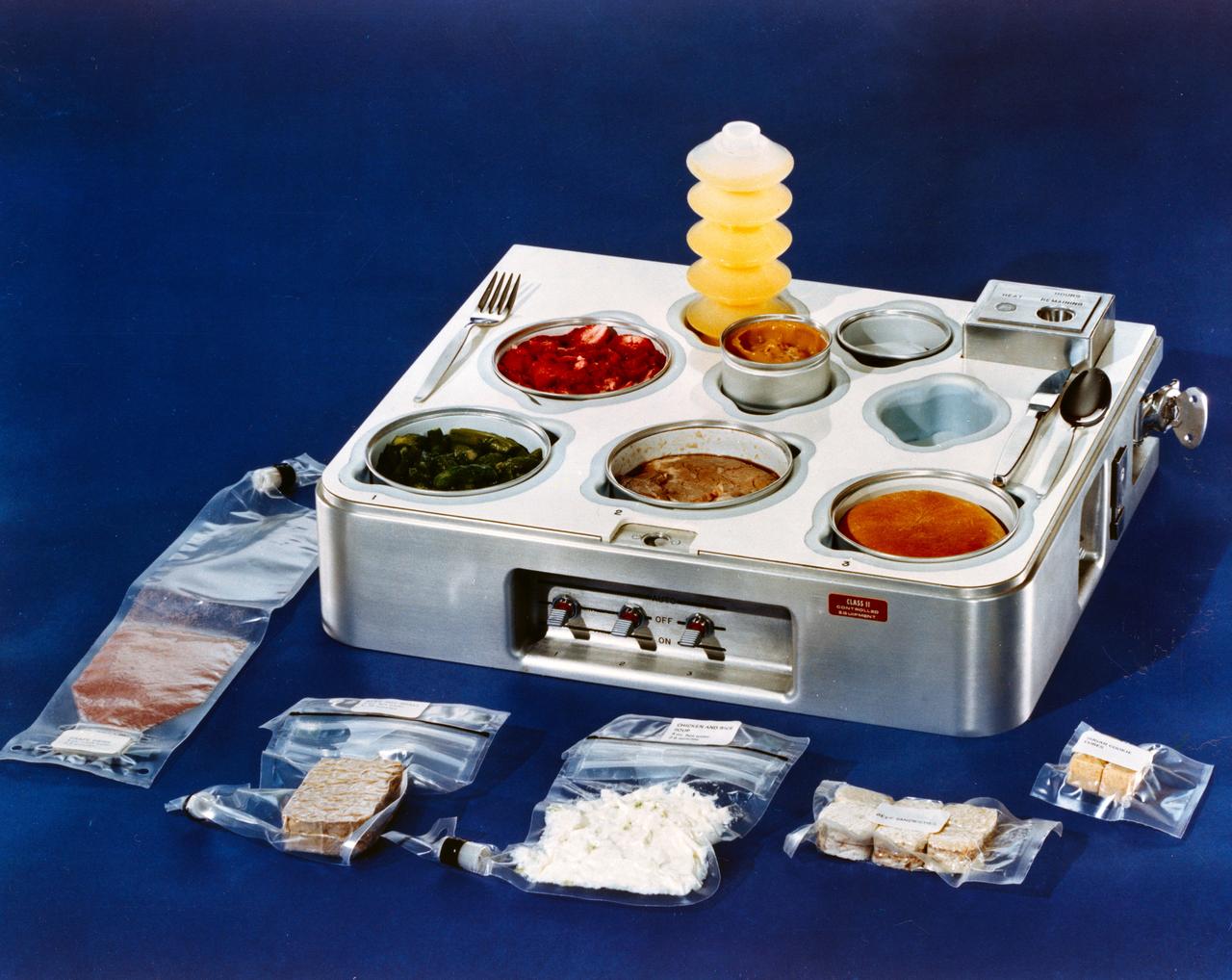
S72-15409 (1972) --- A close-up view of a food tray which is scheduled to be used in the Skylab program. Several packages of space food lie beside the tray. The food in the tray is ready to eat. Out of tray, starting from bottom left: grape drink, beef pot roast, chicken and rice, beef sandwiches and sugar cookie cubes. In tray, from back left: orange drink, strawberries, asparagus, prime rib, dinner roll and butterscotch pudding in the center. Photo credit: NASA
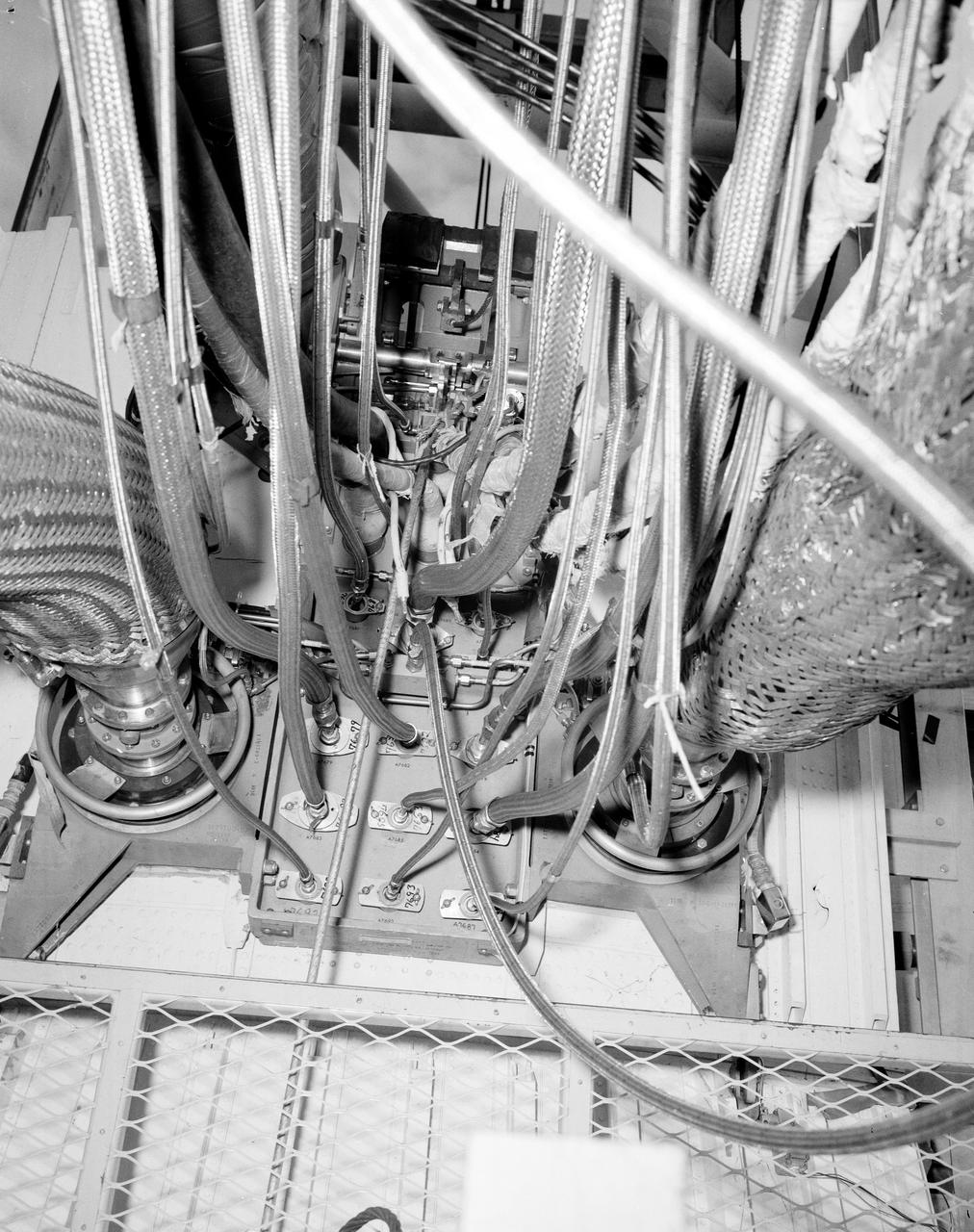
The Marshall Space Flight Center (MSFC) played a crucial role in the development of the huge Saturn rockets that delivered humans to the moon in the 1960s. Many unique facilities existed at MSFC for the development and testing of the Saturn rockets. Affectionately nicknamed “The Arm Farm”, the Random Motion/ liftoff Simulator was one of those unique facilities. This facility was developed to test the swing arm mechanisms that were used to hold the rocket in position until liftoff. The Arm Farm provided the capability of testing the detachment and reconnection of various arms under brutally realistic conditions. The 18-acre facility consisted of more than a half dozen arm test positions and one position for testing access arms used by the Apollo astronauts. Each test position had two elements: a vehicle simulator for duplicating motions during countdown and launch; and a section duplicating the launch tower. The vehicle simulator duplicated the portion of the vehicle skin that contained the umbilical connections and personnel access hatches. Driven by a hydraulic servo system, the vehicle simulator produced relative motion between the vehicle and tower. On the Arm Farm, extreme environmental conditions (such as a launch scrub during an approaching Florida thunderstorm) could be simulated. The dramatic scenes that the Marshall engineers and technicians created at the Arm Farm permitted the gathering of crucial technical and engineering data to ensure a successful real time launch from the Kennedy Space Center. This photo depicts a general view of the S-IV-B aft swing arm umbilical carrier line tray modification.
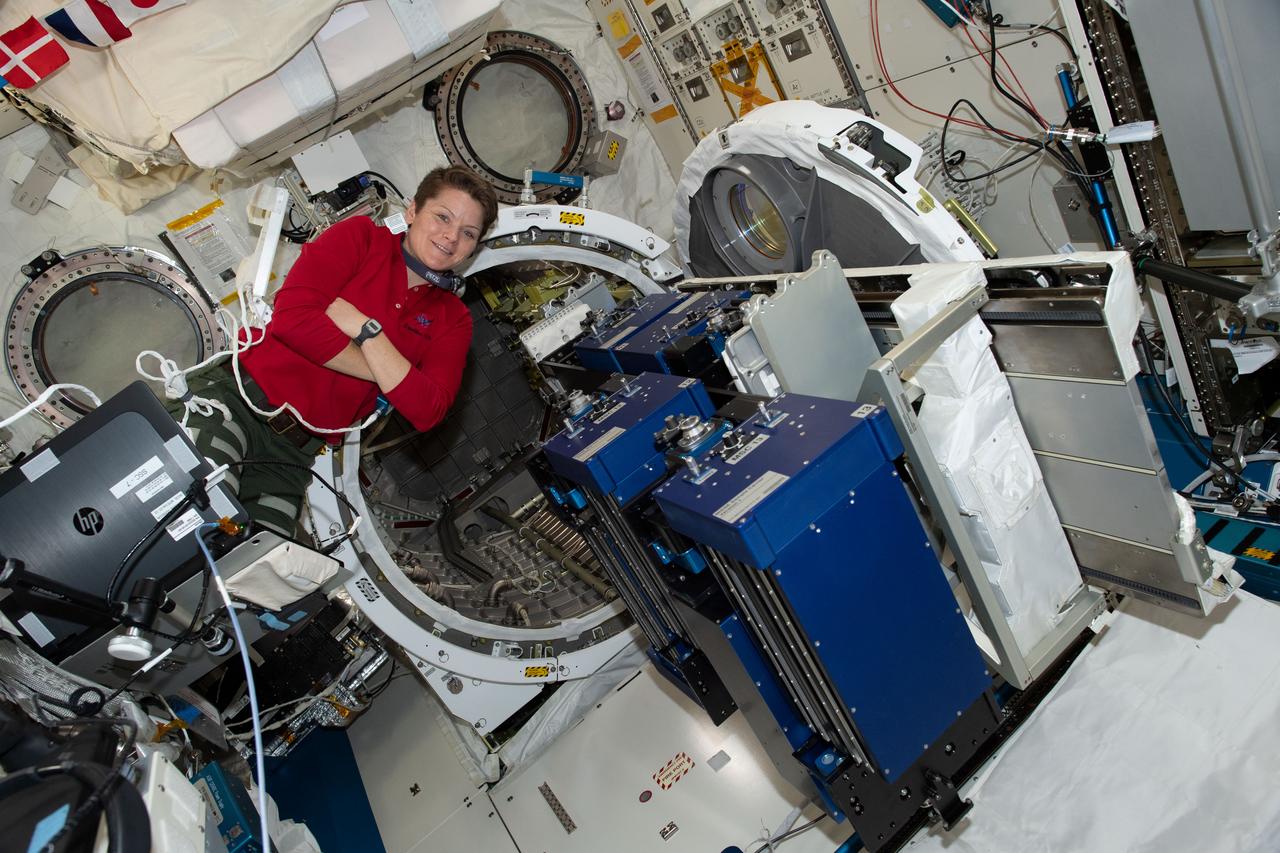
iss058e001000 (Dec. 26, 2018) --- NASA astronaut and Expedition 58 Flight Engineer Anne McClain works inside Japan's Kibo laboratory module installing the Material Transfer Tray before inserting it into the module's airlock.
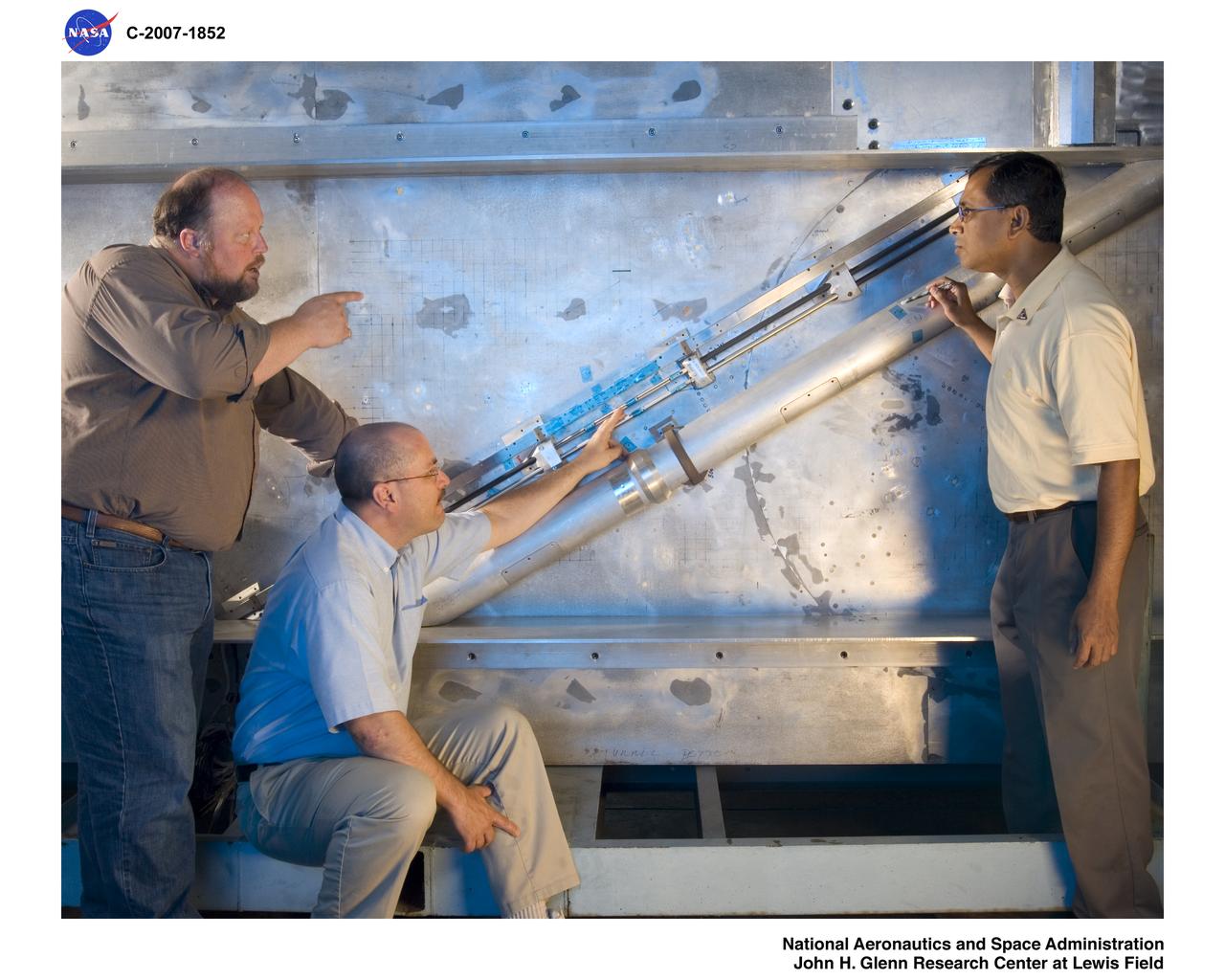
Wind Tunnel Cable Tray Model
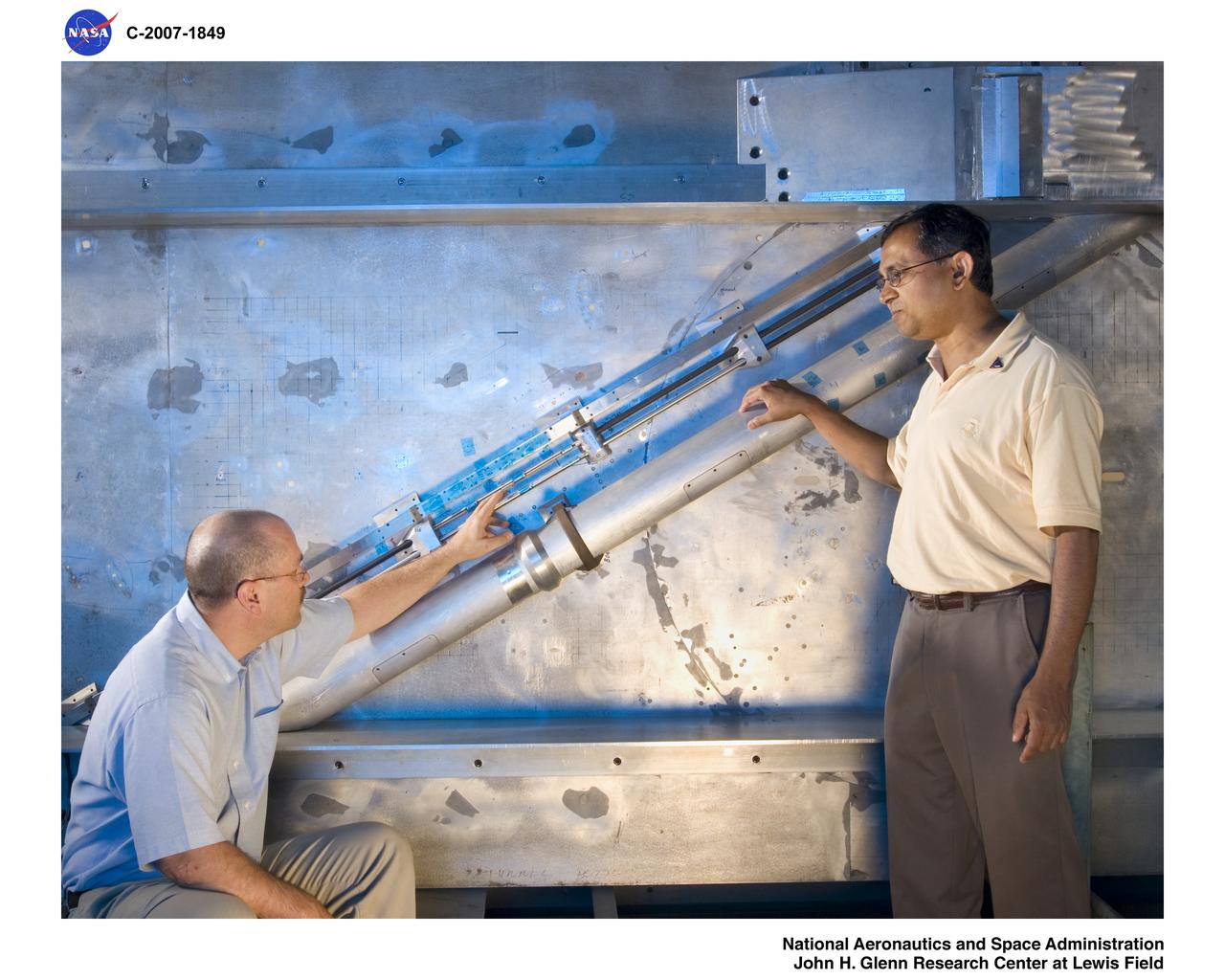
Wind Tunnel Cable Tray Model
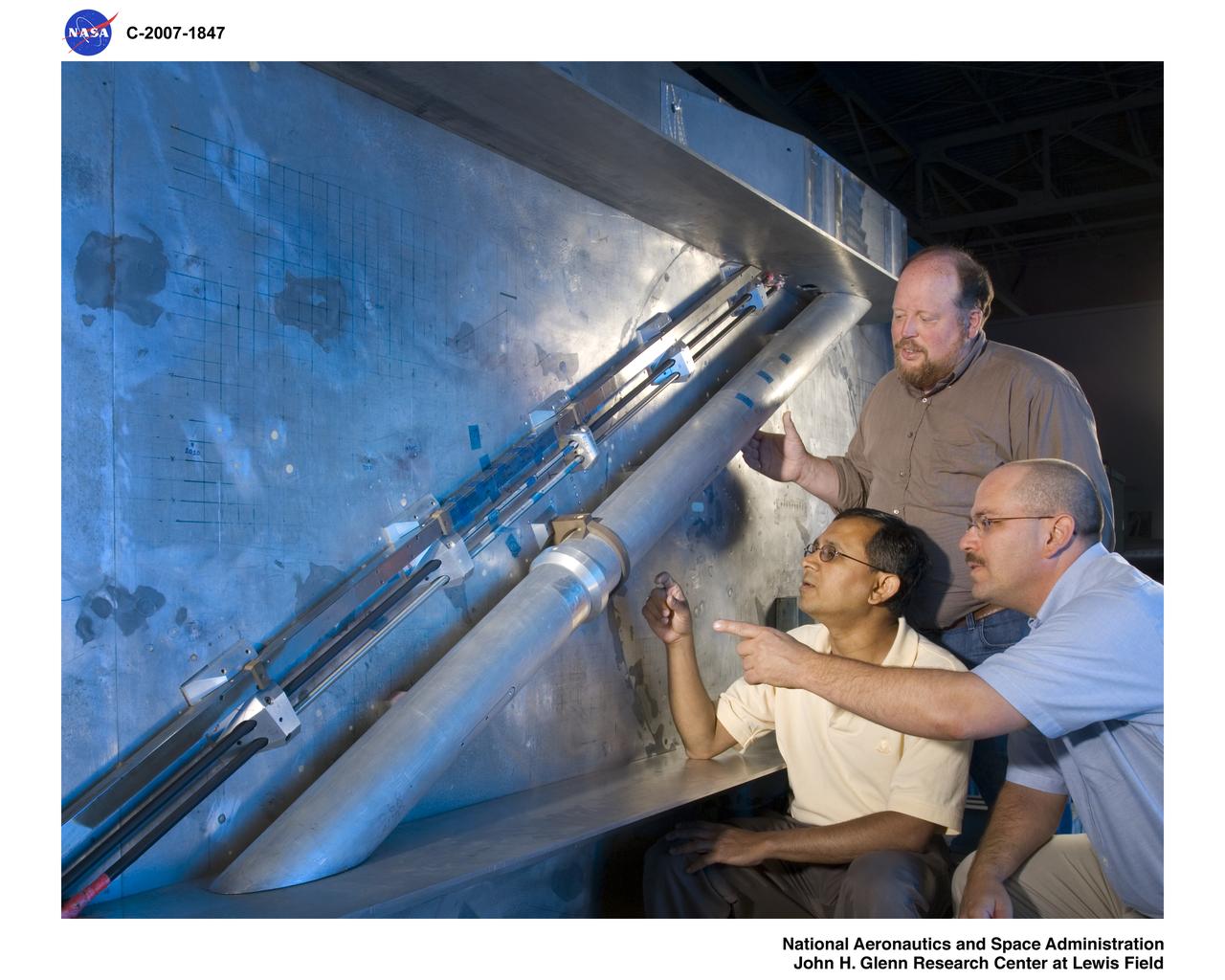
Wind Tunnel Cable Tray Model
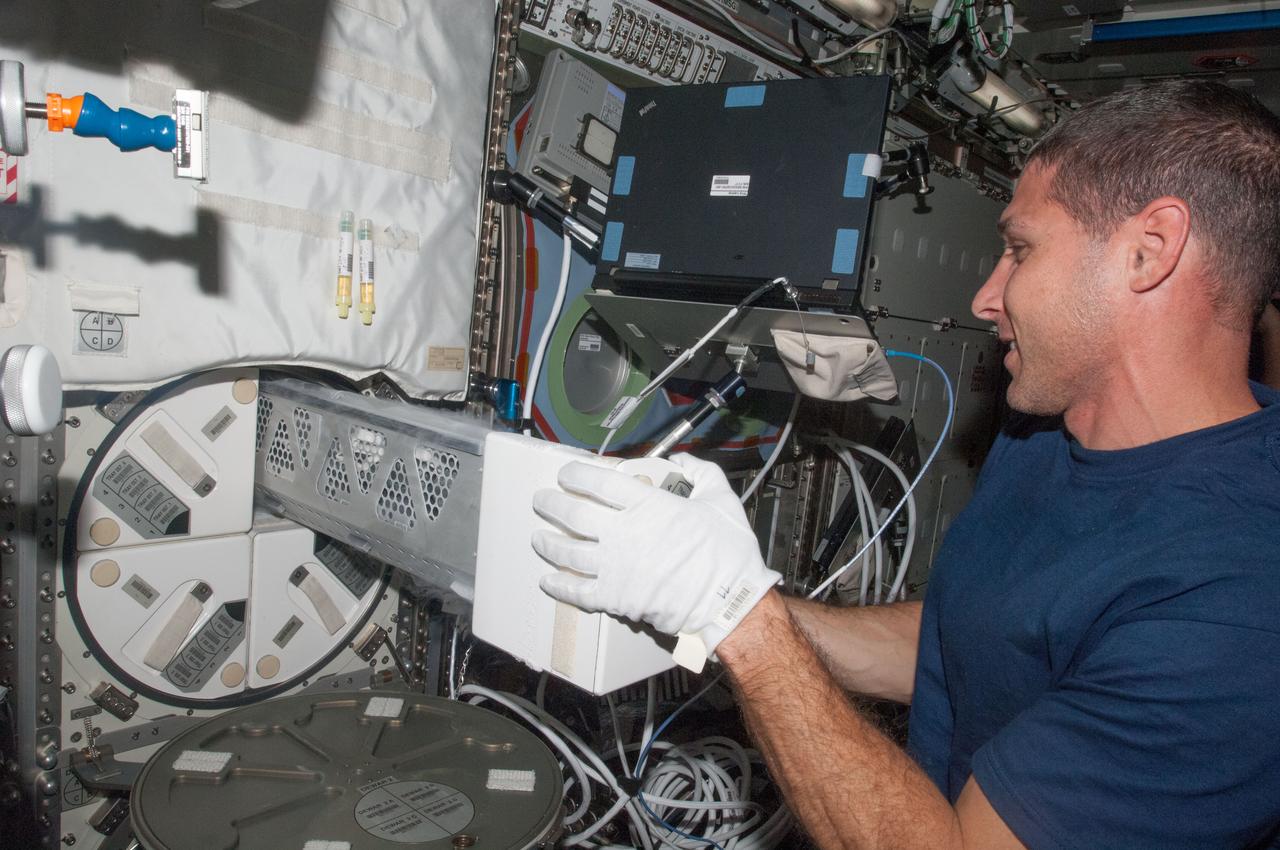
ISS037-E-010711 (5 Oct. 2013) --- In the International Space Station’s Destiny laboratory, NASA astronaut Michael Hopkins, Expedition 37 flight engineer, removes a dewar tray from the Minus Eighty Laboratory Freezer for ISS (MELFI) in order to insert biological samples into the trays.
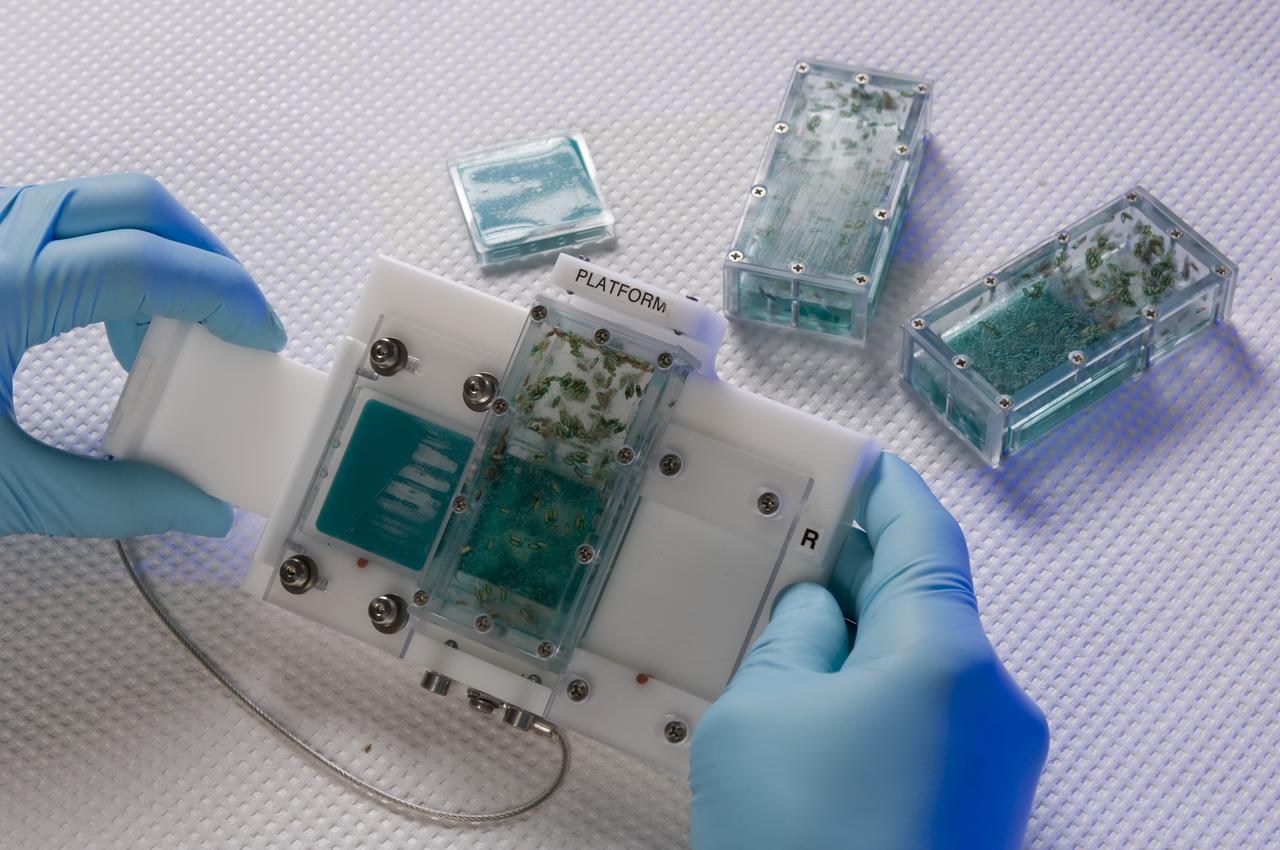
Space shuttle STS-121 FIT (Fly Immunity and Tumors) payload. Using Drosophila (fruit fly) to complete the experiments. Platform used by astronauts to change out old food trays with new food trays in space to facilitate culturing new flies.
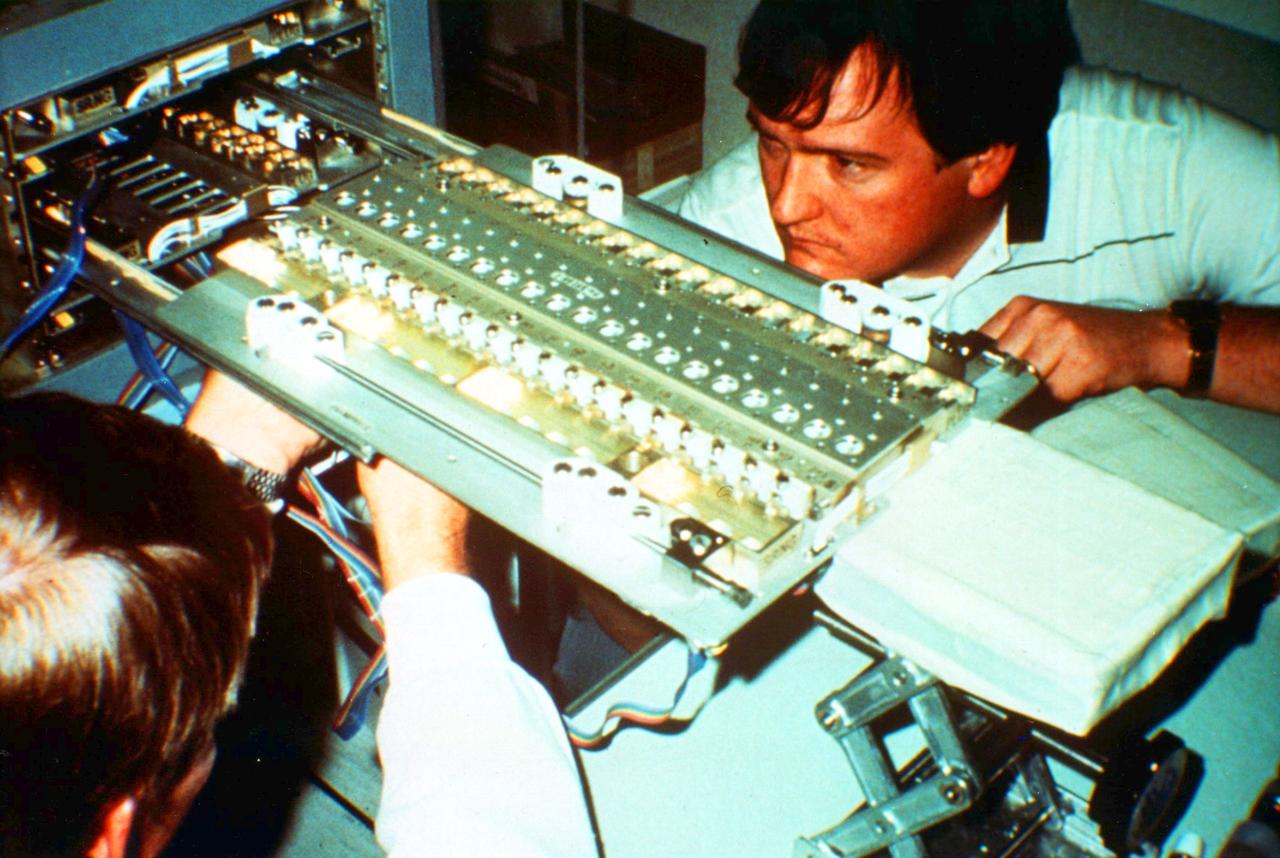
Final (VDA) Vapor Diffusion Apparatus Tray adjustments before loading into shuttle.
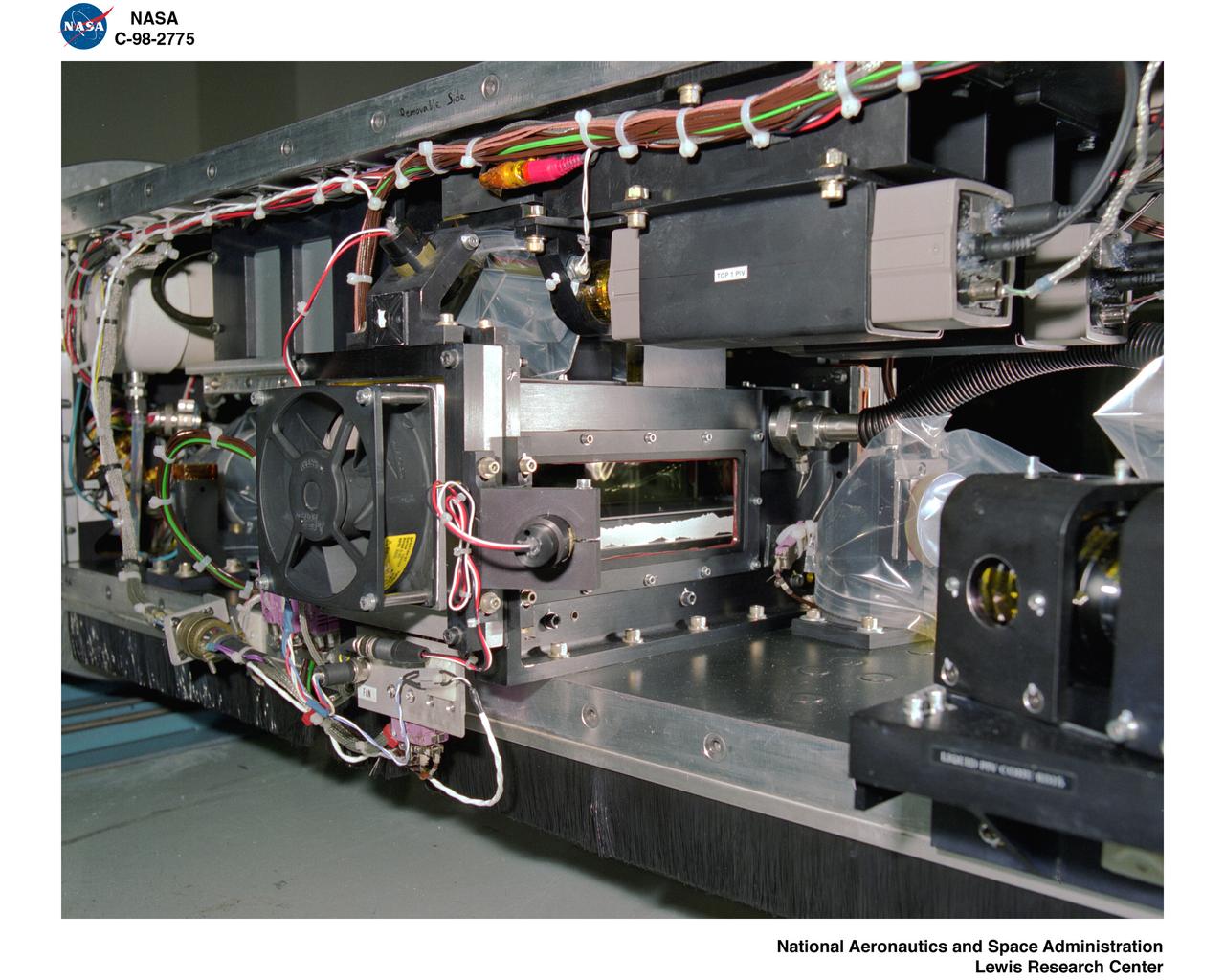
SPREAD ACROSS LIQUIDS SAL 5 TRAY INLET / OUTLET SURFACES
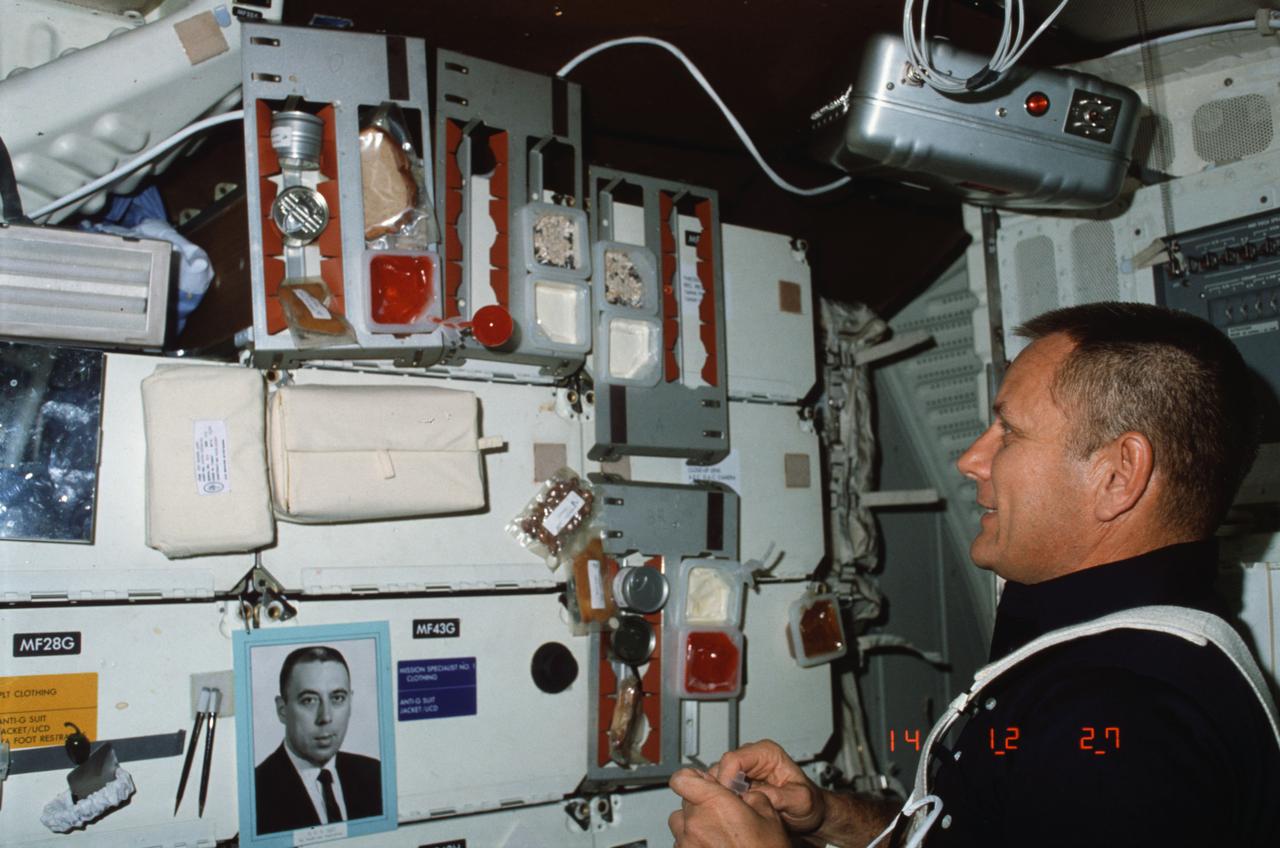
STS005-07-255 (19 Nov. 1982) --- Astronaut Robert F. Overmyer, STS-5 pilot, using beverage container and drinking straw secured in meal tray assembly (ASSY), experiments with microgravity characteristics of liquid on middeck in front of forward lockers. Overmyer also looks over packages of food attached to middeck lockers in meal tray assemblies. Carry-on food warmer appears overhead and other meal tray assemblies, personal hygiene mirror assembly, personal hygiene kit, and portrait of G.W.S. Abbey, Johnson Space Center's (JSC) Director of Flight Operations, appear on lockers. Photo credit: NASA
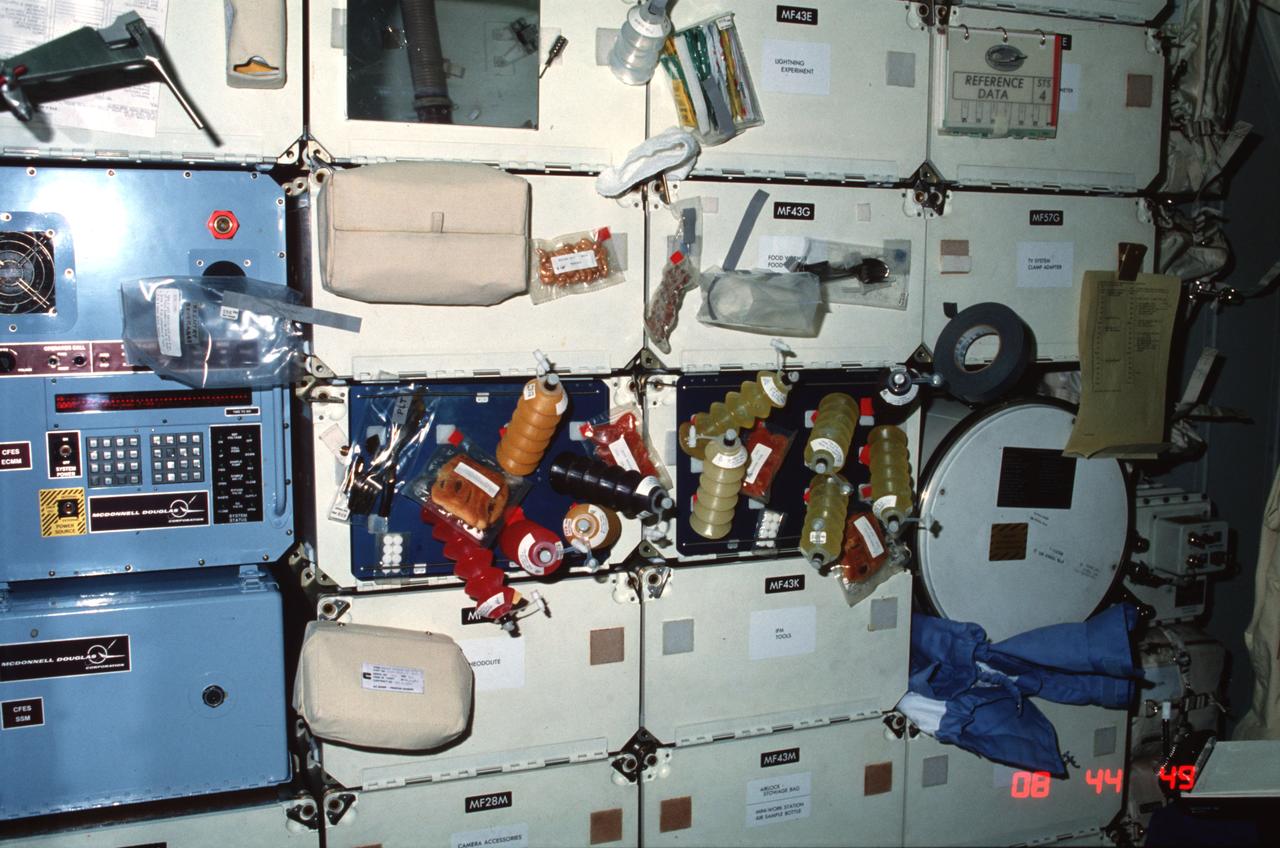
STS004-28-330 (27 June-4 July 1982) --- Thanks to a variety of juices and other food items, this array in the middeck area probably represents the most colorful area onboard the Earth-orbiting space shuttle Columbia. Most of the meal items have been carefully fastened to food trays and locker doors (or both). What has not been attached by conventional methods has been safely ?tucked? under something heavy (note jacket shoved into space occupied by one of Columbia?s experiments). The Monodisperse Latex Reflector (MLR), making its second flight on Columbia, is designed to test the feasibility of making large-size, monodisperse (same size), and polystyrene latex micro-spheres using the products of the STS-3 mission as seed particles. The latex spheres are used in calibration of scientific and industrial equipment and have potential medical and research applications. This frame was exposed with a 35mm camera. Onboard the space vehicle for seven days were astronauts Thomas K. Mattingly II and Henry W. Hartsfield Jr. Photo credit: NASA
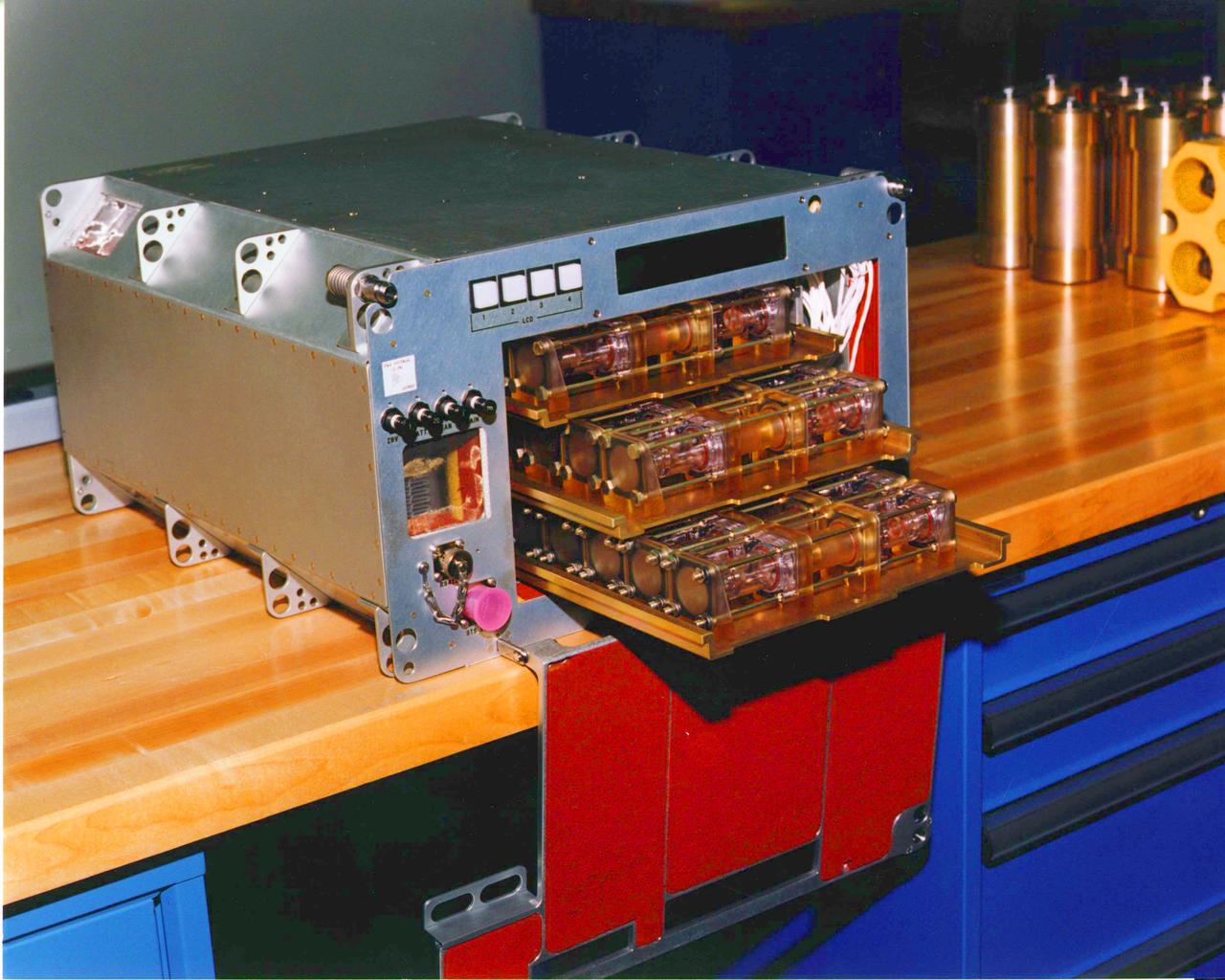
(DCAM) Diffusion Controlled Crystallization Apparatus for Microgravity Trays mounted in (STES) Single Locker Thermal Enclosure System.
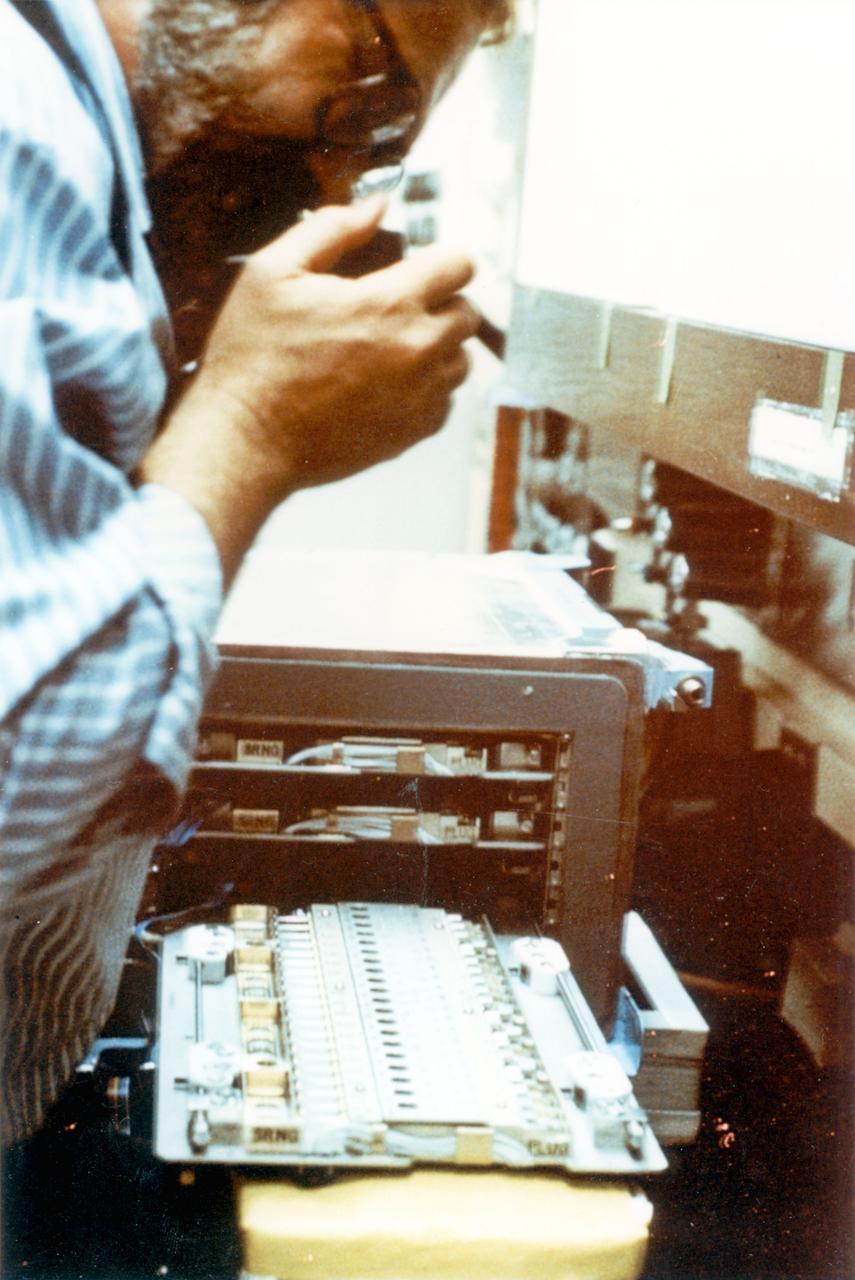
Scientist photographs STS- 26 Post-flight (VDA) Vapor Diffusion Apparatus Tray with (PCG) Protein Crystal Growth Samples.
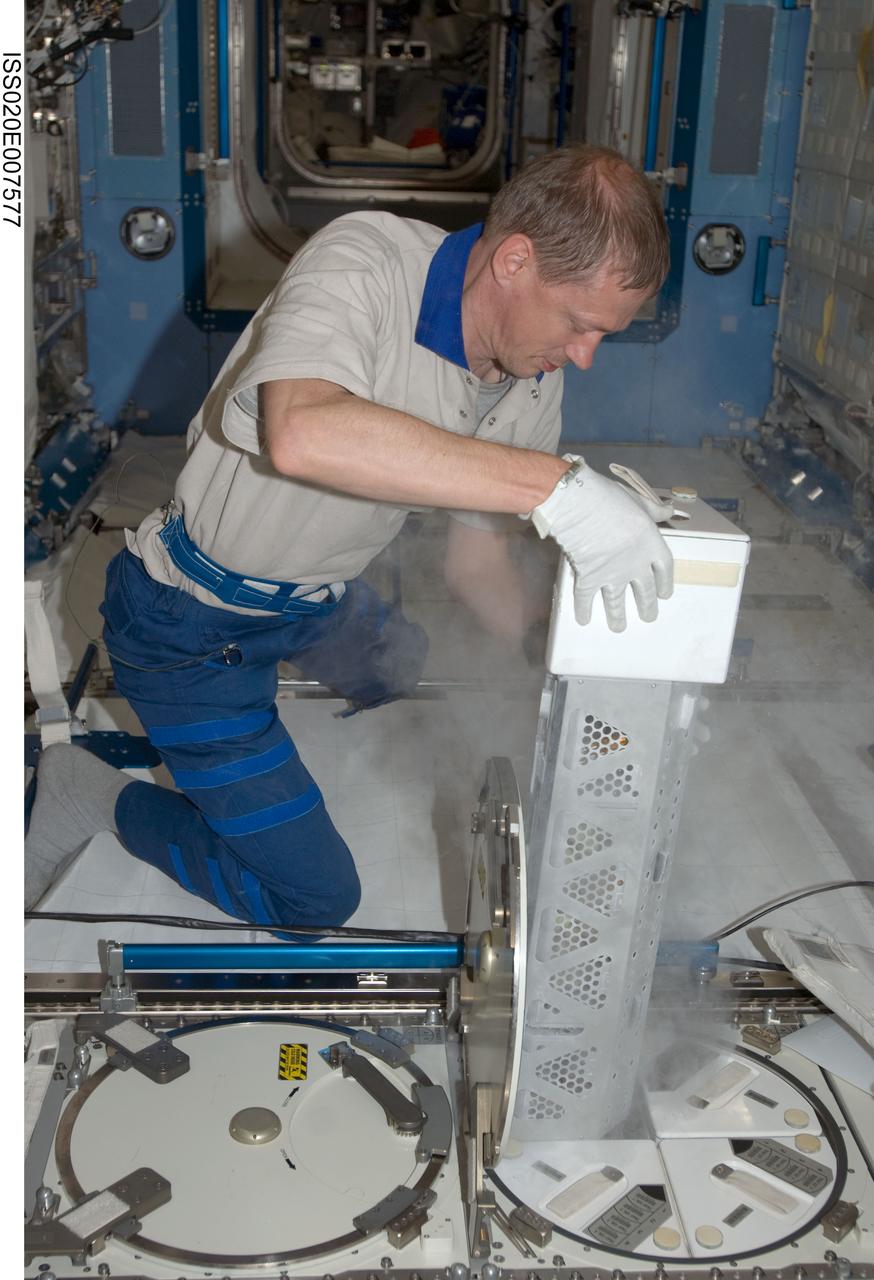
ISS020-E-007577 (6 June 2009) --- European Space Agency astronaut Frank De Winne, Expedition 20 flight engineer, returns a dewar tray to the Minus Eighty Laboratory Freezer for ISS (MELFI) after inserting biological samples into the trays in the Kibo laboratory of the International Space Station. Samples were taken as part of the Nutritional Status Assessment (Nutrition) with Repository experiment, a study done by NASA to date of human physiologic changes during long-duration spaceflight.
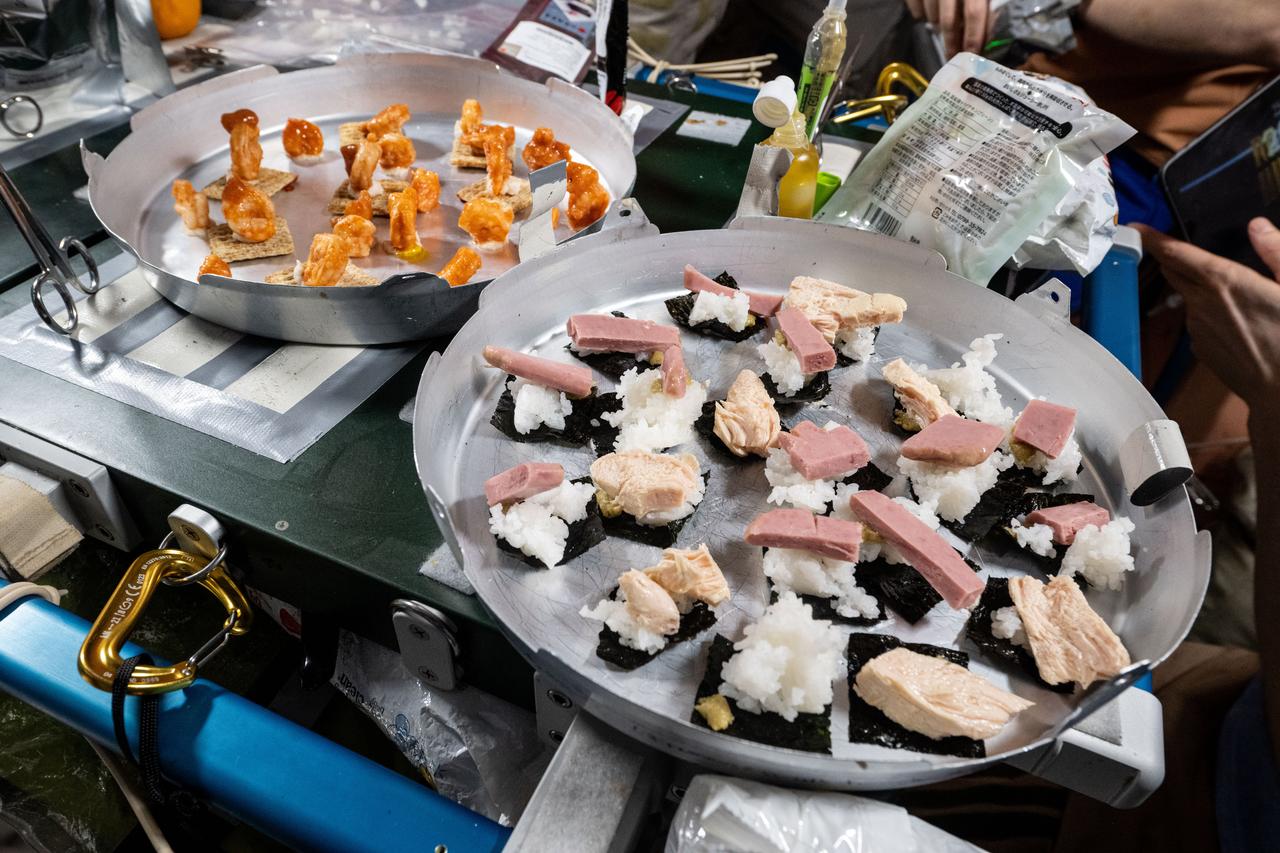
iss073e0508106 (Aug. 15, 2025) --- Dinner is served aboard the International Space Station! One tray features shrimp cocktail on whole grain wheat crackers, while the other holds sushi made with seaweed, spam, tuna, and rice. Both trays are secured with Velcro strips to keep them stable inside the Unity module’s galley. The shrimp and crackers are held in place by condiments, while the sushi stays put thanks to surface tension from its moisture.
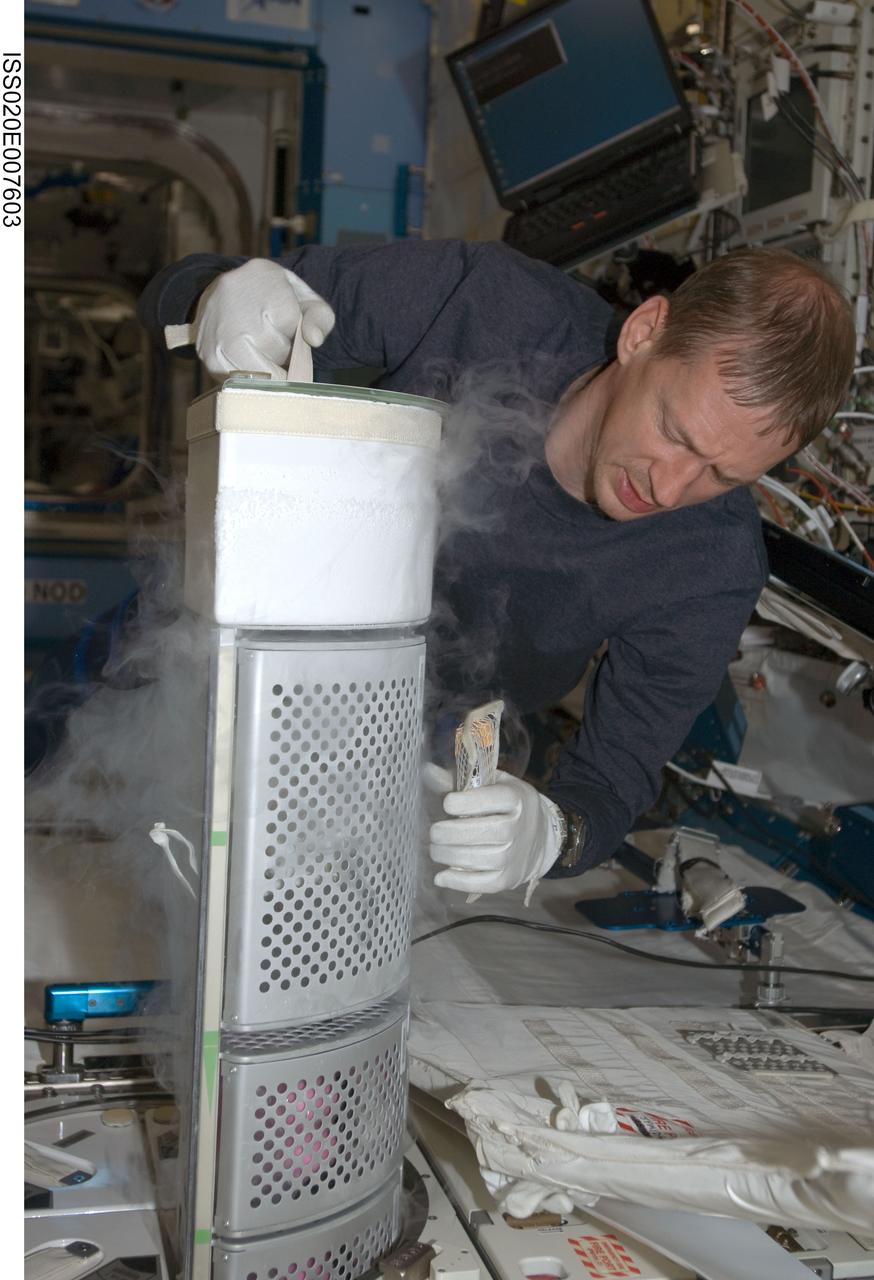
ISS020-E-007603 (7 June 2009) --- European Space Agency astronaut Frank De Winne, Expedition 20 flight engineer, removes a dewar tray from the Minus Eighty Laboratory Freezer for ISS (MELFI) in order to insert biological samples into the trays in the Kibo laboratory of the International Space Station. Samples were taken as part of the Nutritional Status Assessment (Nutrition) with Repository experiment, a study done by NASA to date of human physiologic changes during long-duration spaceflight.
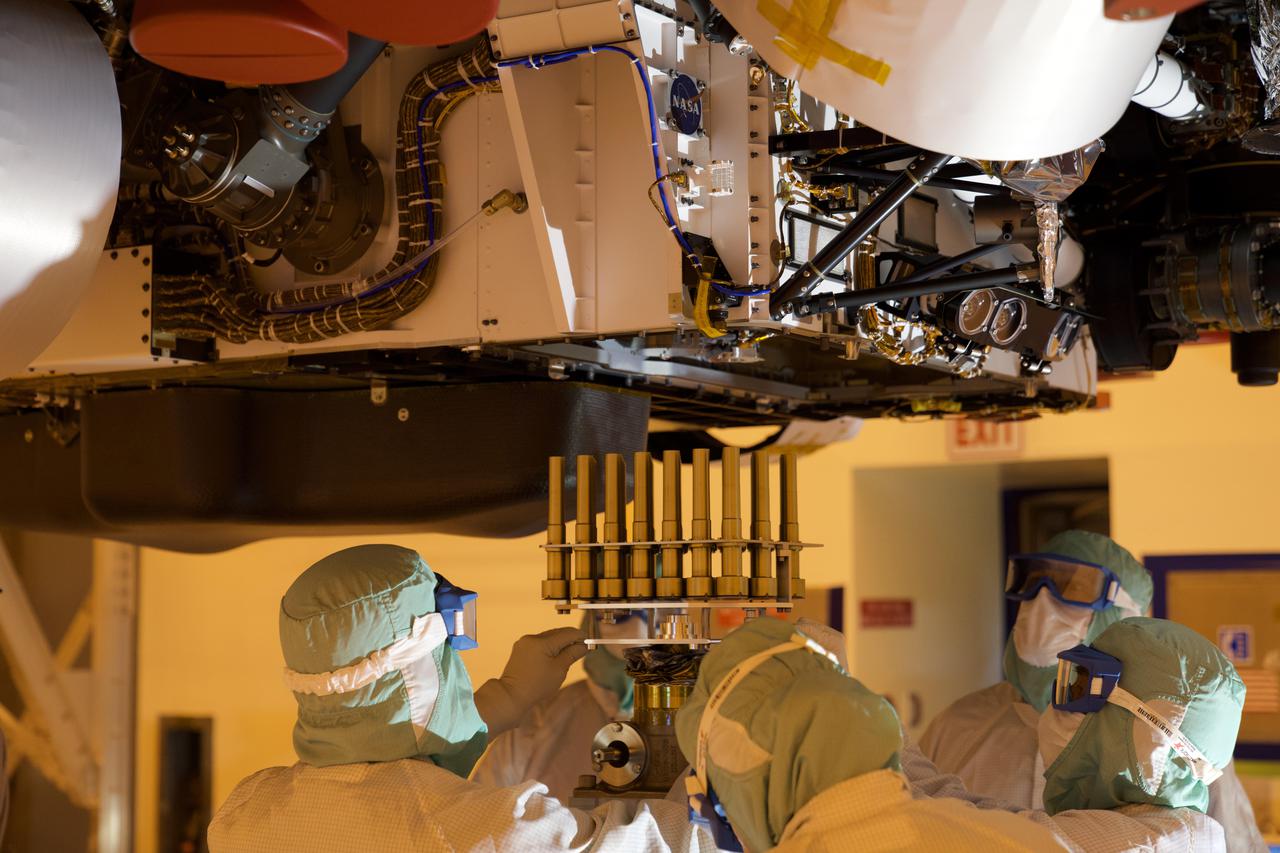
A tray holding 39 sample tubes headed to Mars is installed into the Perseverance rover on May 21, 2020, in a clean room at NASA's Kennedy Space Center in Florida during final installation for launch. Each tube is enveloped in its own gold-colored titanium sheath that protects it until the sample handling arm within the rover retrieves it to begin the process of collecting a sample of Martian rock or regolith (dust and crushed rock). In total, the rover carries 43 sample tubes. https://photojournal.jpl.nasa.gov/catalog/PIA24305
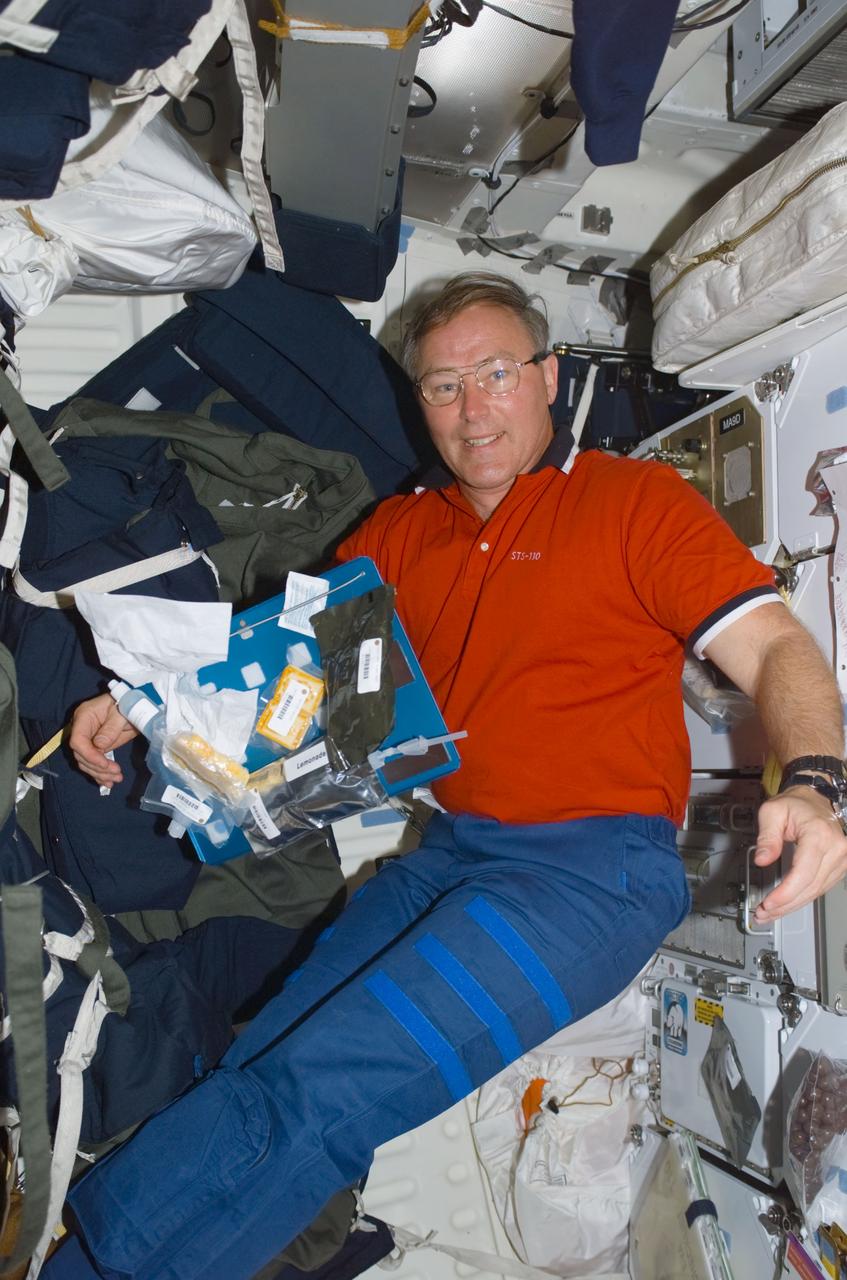
STS110-E-5035 (8 April 2002) --- Astronaut Jerry L. Ross, STS-110 mission specialist, along with a tray of food, floats on the mid deck of the Space Shuttle Atlantis. The image was taken with a digital still camera.
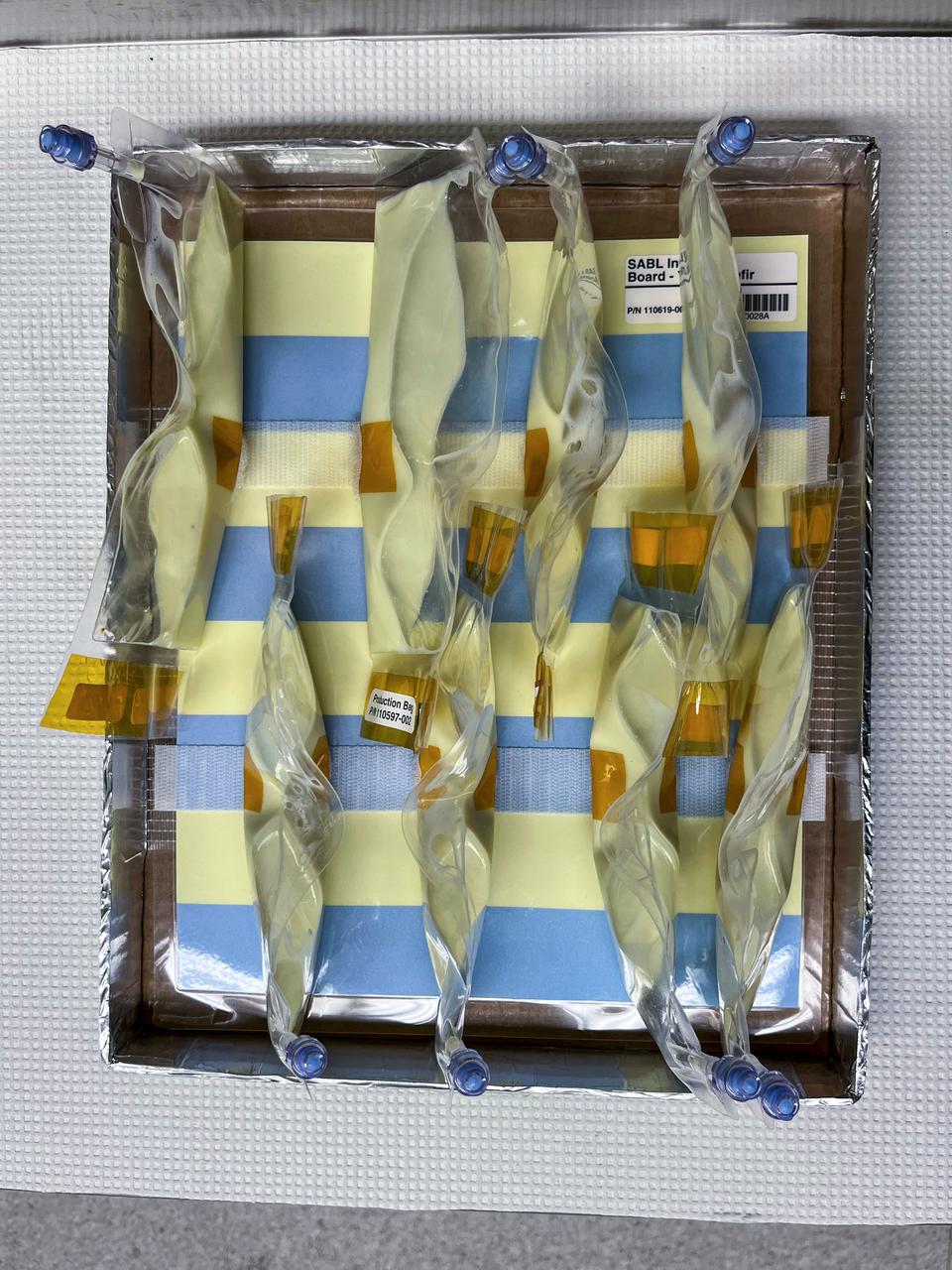
jsc2022e031236 (3/28/2022) --- A preflight image of BioNutrients-2 Yogurt Bags on SABL Tray Mockup, after 4hrs of incubation. As the yogurt organisms grow, the solution more acidic, and the pH indicator changes from blue to yellow.
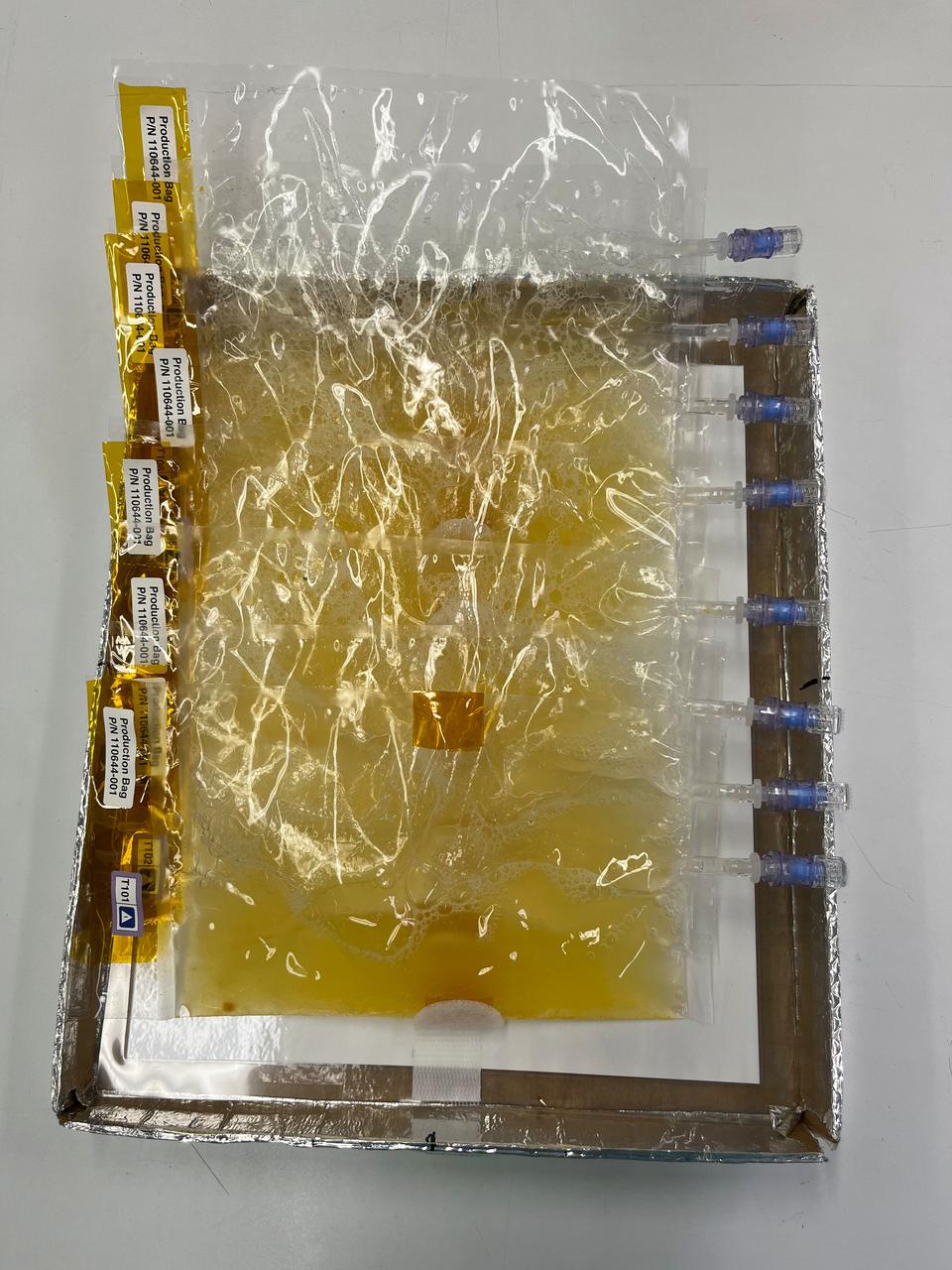
Eight BioNutrients-3 production bags containing yeast (S. cerevisiae Y55 strain 1034) attached to the SABL Tray mockup during the BioNutrients-3 Experiment Verification Test Photo Credit: NASA Ames

jsc2022e031237 (3/28/2022) --- A preflight image of BioNutrients-2 Yogurt Bags on SABL Tray Mockup, after completing 24hr incubation. The fully-yellow color of the bag’s contents indicates the yogurt has grown to completion.
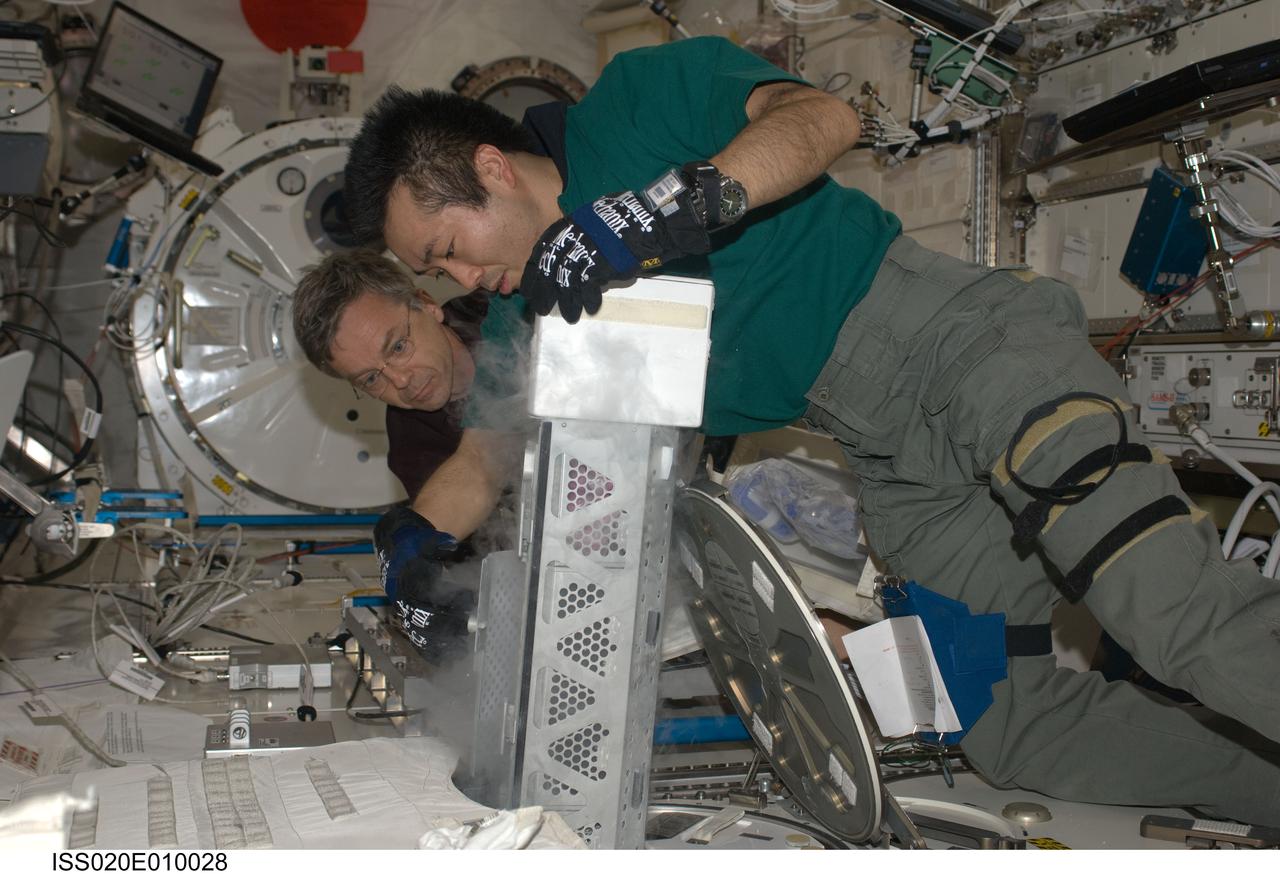
ISS020-E-010028 (15 June 2009) --- Japan Aerospace Exploration Agency (JAXA) astronaut Koichi Wakata, Expedition 20 flight engineer, returns a dewar tray to the Minus Eighty Laboratory Freezer for ISS (MELFI) after inserting biological samples into the trays in the Kibo laboratory of the International Space Station. Samples were taken as part of the Nutritional Status Assessment (Nutrition) with Repository experiment, a study done by NASA to date of human physiologic changes during long-duration spaceflight. Canadian Space Agency astronaut Robert Thirsk, flight engineer, assisted Wakata.
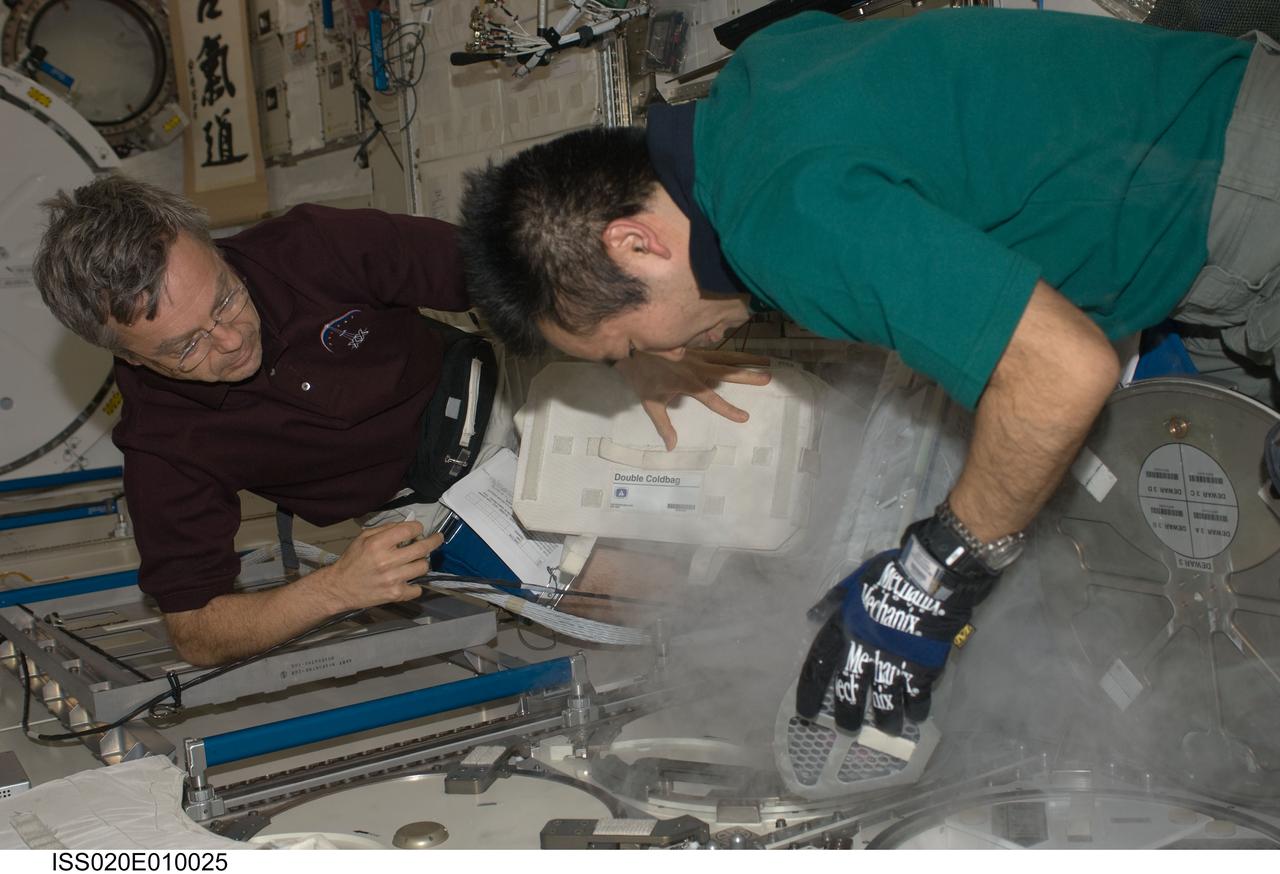
ISS020-E-010025 (15 June 2009) --- Japan Aerospace Exploration Agency (JAXA) astronaut Koichi Wakata, Expedition 20 flight engineer, removes a dewar tray from the Minus Eighty Laboratory Freezer for ISS (MELFI) in order to insert biological samples into the trays in the Kibo laboratory of the International Space Station. Samples were taken as part of the Nutritional Status Assessment (Nutrition) with Repository experiment, a study done by NASA to date of human physiologic changes during long-duration spaceflight. Canadian Space Agency astronaut Robert Thirsk, flight engineer, assisted Wakata.

S81-26158 (Feb 1981) --- A close-up view of a training version of a STS-40/SLS-1 blood kit. Blood samples from crewmembers are critical to a number of Space Life Sciences-1 (SLS-1) investigations. One day's collection equipment, color coded for each crewmember, is neatly organized in the kit.
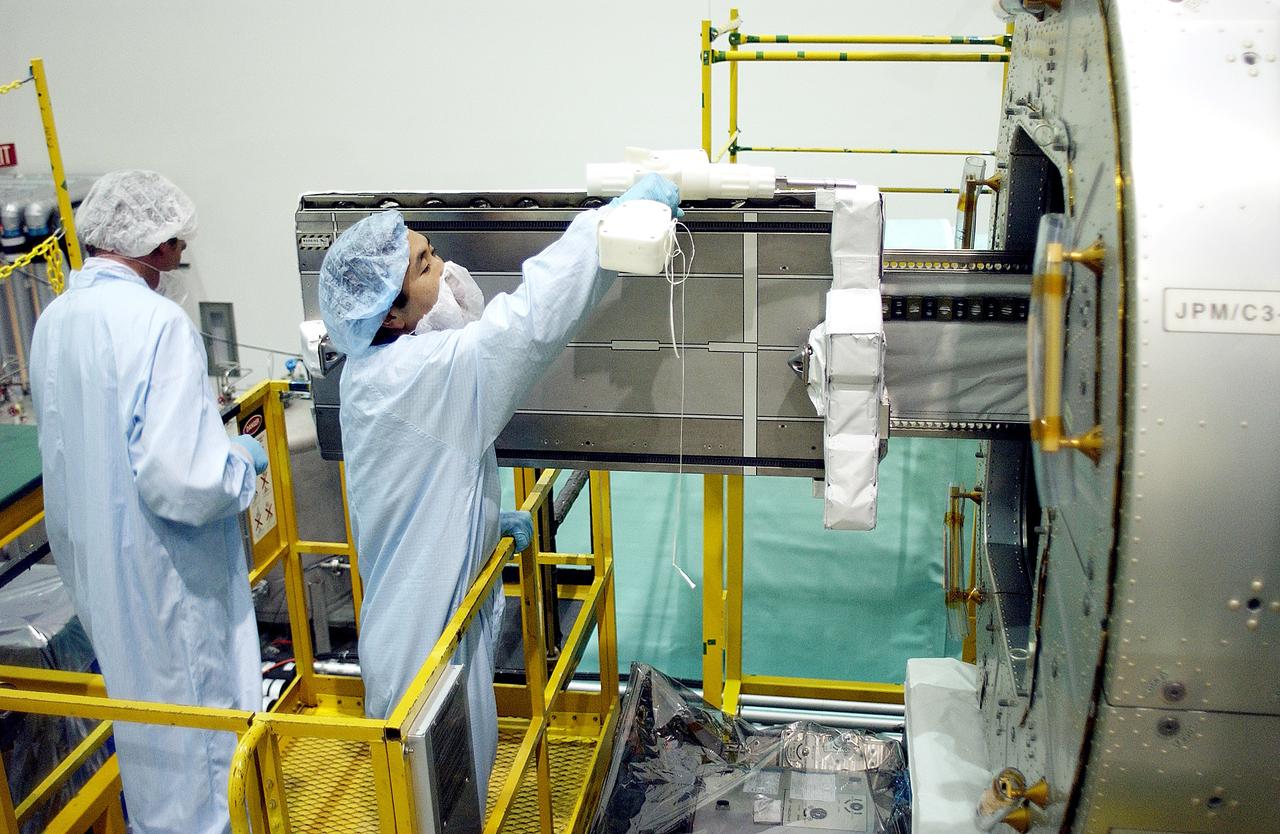
KENNEDY SPACE CENTER, FLA. - Japanese astronaut Koichi Wakata (right) works with a tray extended from inside the Pressurized Module, or PM, part of the Japanese Experiment Module (JEM). The PM provides a shirt-sleeve environment in which astronauts on the International Space Station can conduct microgravity experiments. There are a total of 23 racks, including 10 experiment racks, inside the PM providing a power supply, communications, air conditioning, hardware cooling, water control and experiment support functions.
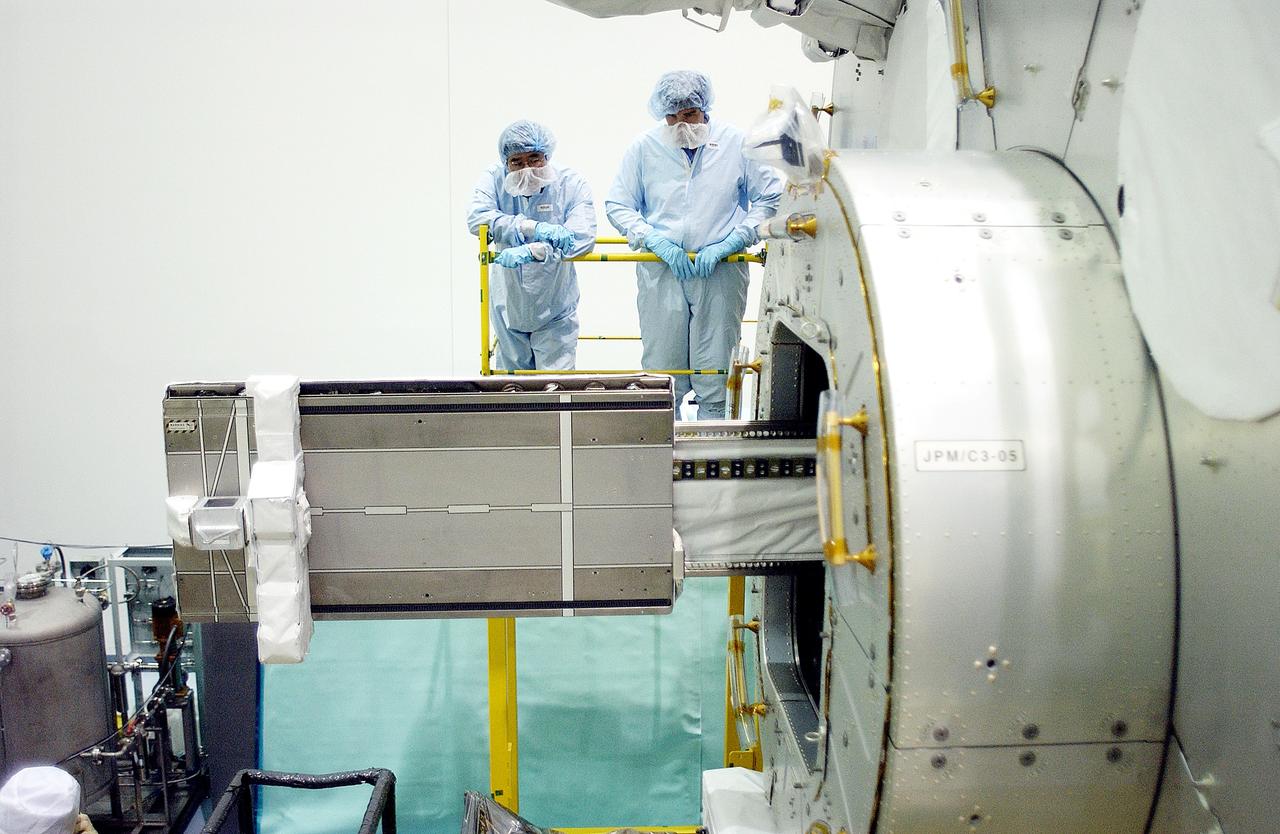
KENNEDY SPACE CENTER, FLA. - In the Space Station Processing Facility, Japanese astronaut Koichi Wakata (top left) and technicians watch as a tray is extended from inside the Pressurized Module, or PM, part of the Japanese Experiment Module (JEM). The PM provides a shirt-sleeve environment in which astronauts on the International Space Station can conduct microgravity experiments. There are a total of 23 racks, including 10 experiment racks, inside the PM providing a power supply, communications, air conditioning, hardware cooling, water control and experiment support functions.
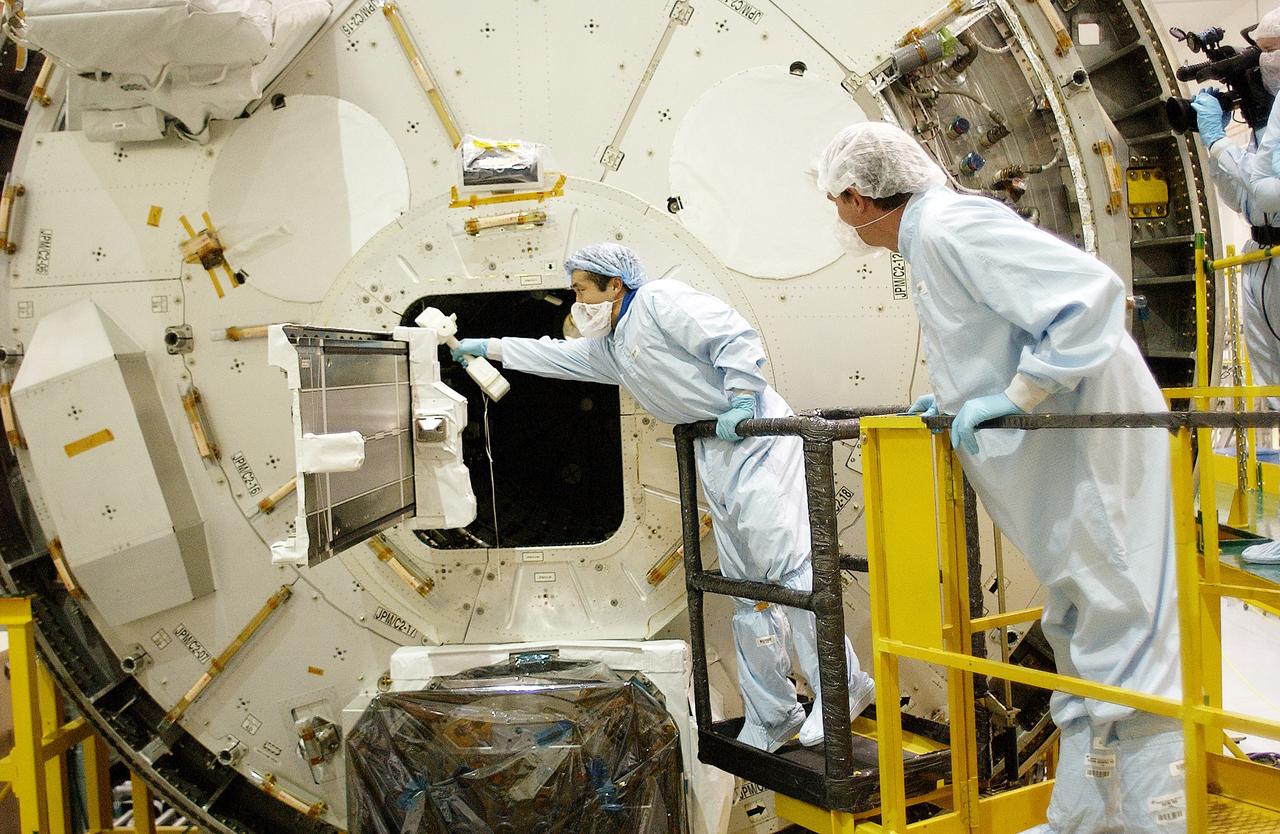
KENNEDY SPACE CENTER, FLA. - Japanese astronaut Koichi Wakata (left) works with a tray extended from inside the Pressurized Module, or PM, part of the Japanese Experiment Module (JEM). The PM provides a shirt-sleeve environment in which astronauts on the International Space Station can conduct microgravity experiments. There are a total of 23 racks, including 10 experiment racks, inside the PM providing a power supply, communications, air conditioning, hardware cooling, water control and experiment support functions.
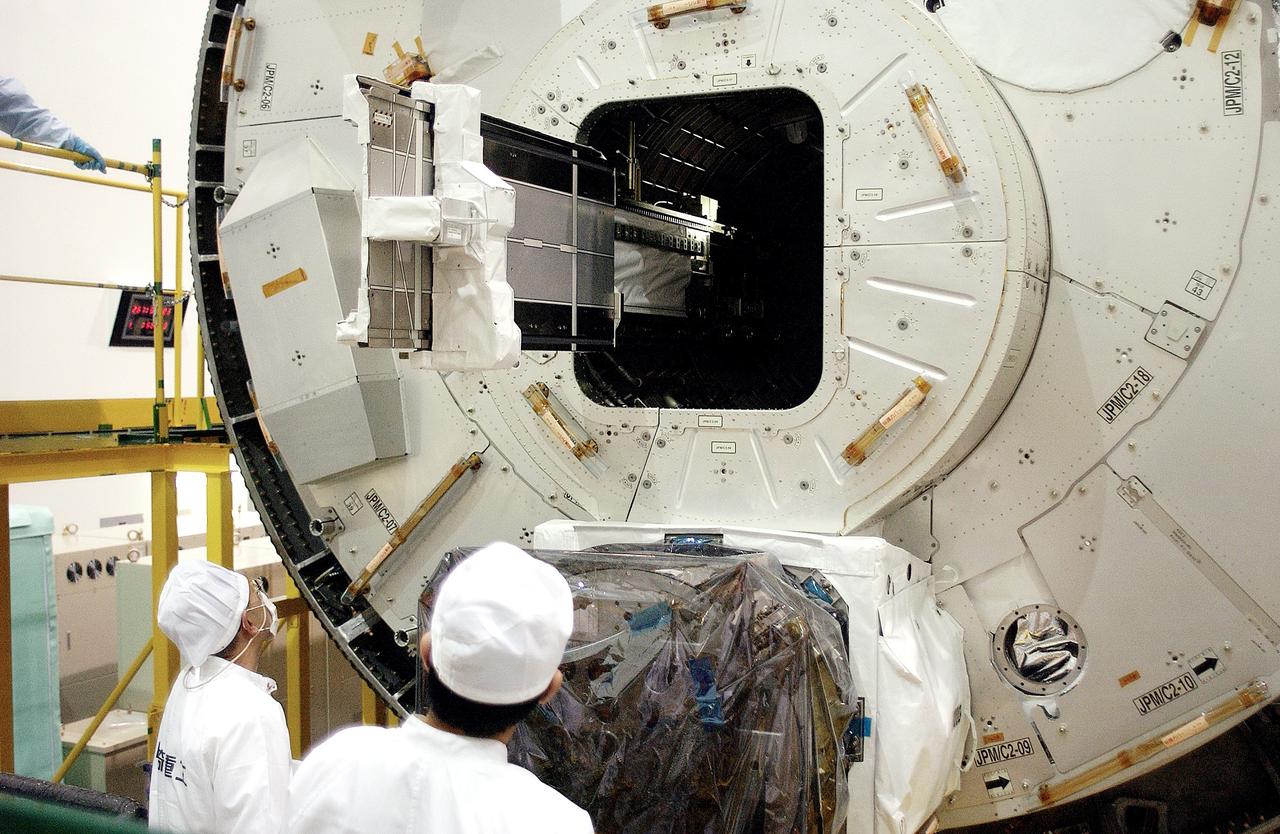
KENNEDY SPACE CENTER, FLA. - In the Space Station Processing Facility, technicians on the floor watch as a tray is extended from inside the Pressurized Module, or PM, part of the Japanese Experiment Module (JEM). The PM provides a shirt-sleeve environment in which astronauts on the International Space Station can conduct microgravity experiments. There are a total of 23 racks, including 10 experiment racks, inside the PM providing a power supply, communications, air conditioning, hardware cooling, water control and experiment support functions.
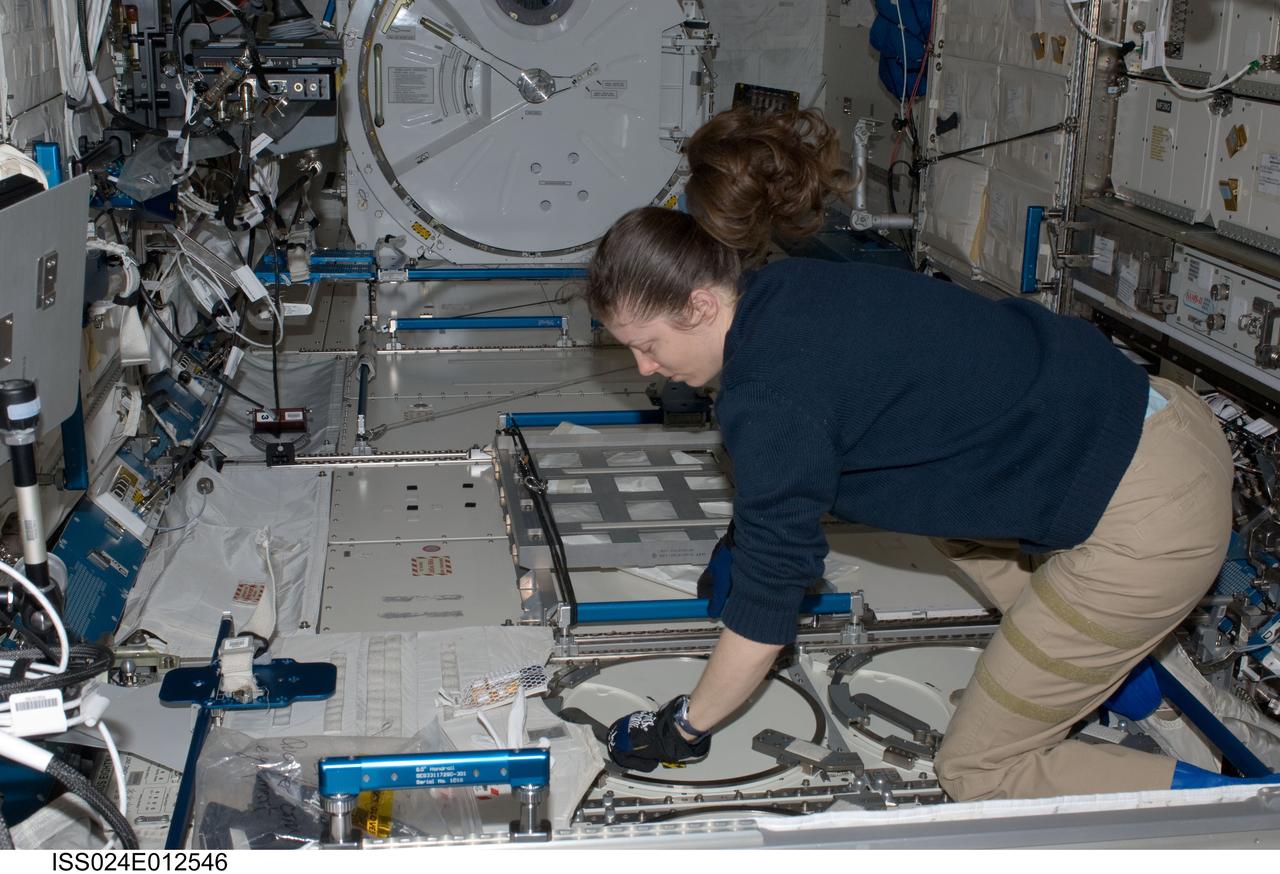
ISS024-E-012546 (26 Aug. 2010) --- NASA astronaut Tracy Caldwell Dyson, Expedition 24 flight engineer, prepares to insert biological samples in a dewar tray in the Minus Eighty Laboratory Freezer for ISS (MELFI-1) in the Kibo laboratory of the International Space Station.

S135-E-008122 (14 July 2011) --- NASA astronaut Chris Ferguson, STS-135 commander, returns a small tool to a tray on the middeck of the space shuttle Atlantis while the spacecraft was docked with the International Space Station. Crewmate Sandy Magnus, mission specialist, is in the background. Photo credit: NASA
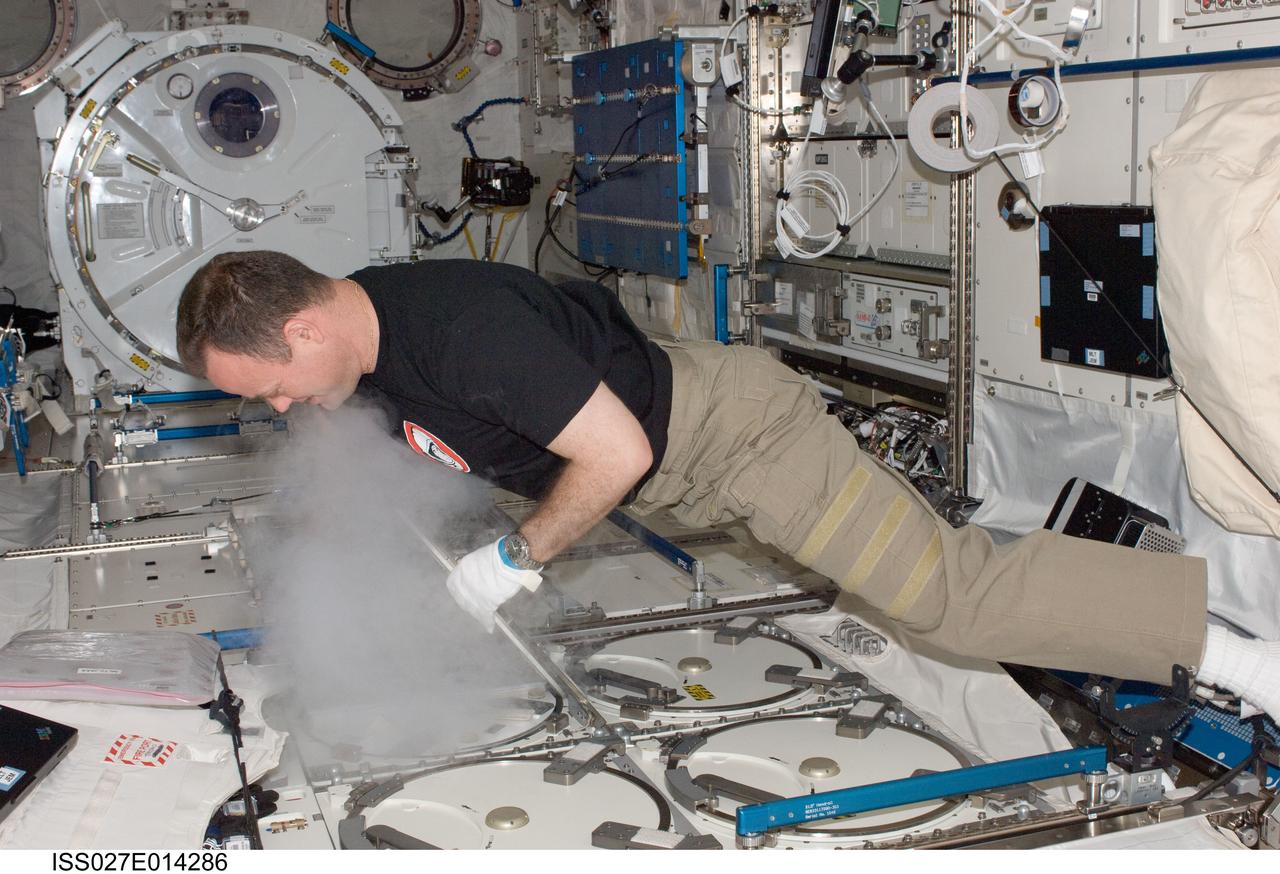
ISS027-E-014286 (14 April 2011) --- NASA astronaut Ron Garan, Expedition 27 flight engineer, replaces a dewar tray containing biological samples in the Minus Eighty Laboratory Freezer for ISS (MELFI-1) in the Kibo laboratory of the International Space Station.
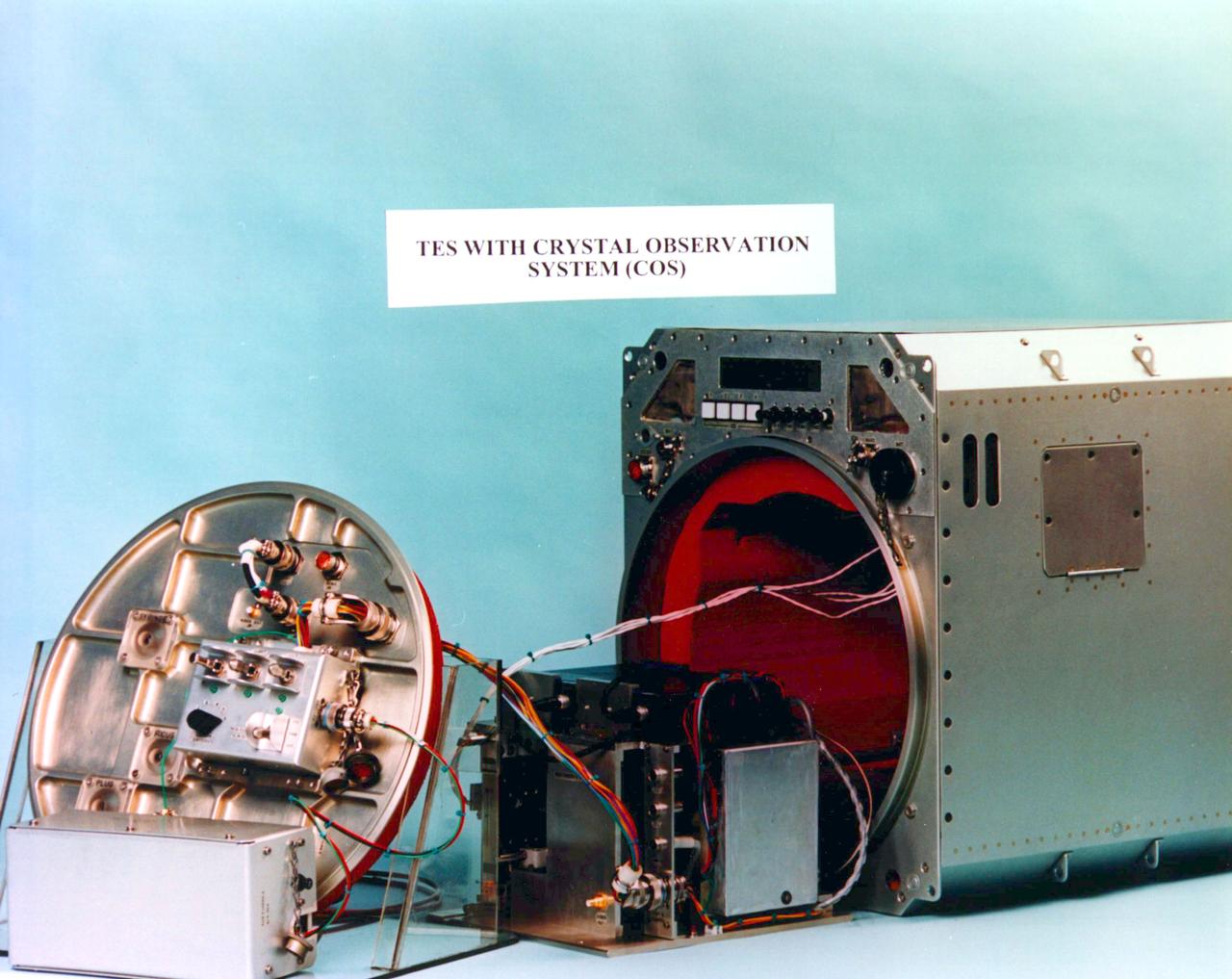
The COS consists of a specially designed (VDA) Vapor Diffusion Apparatus tray with 6 chambers, a video camera for each chamber, a lighting system, and associated hardware. By observing the crystal growth in each chamber, researchers can identify which conditions and concentrations of proteins and precipitants are best for promoting the crystal growth to a particular protein.
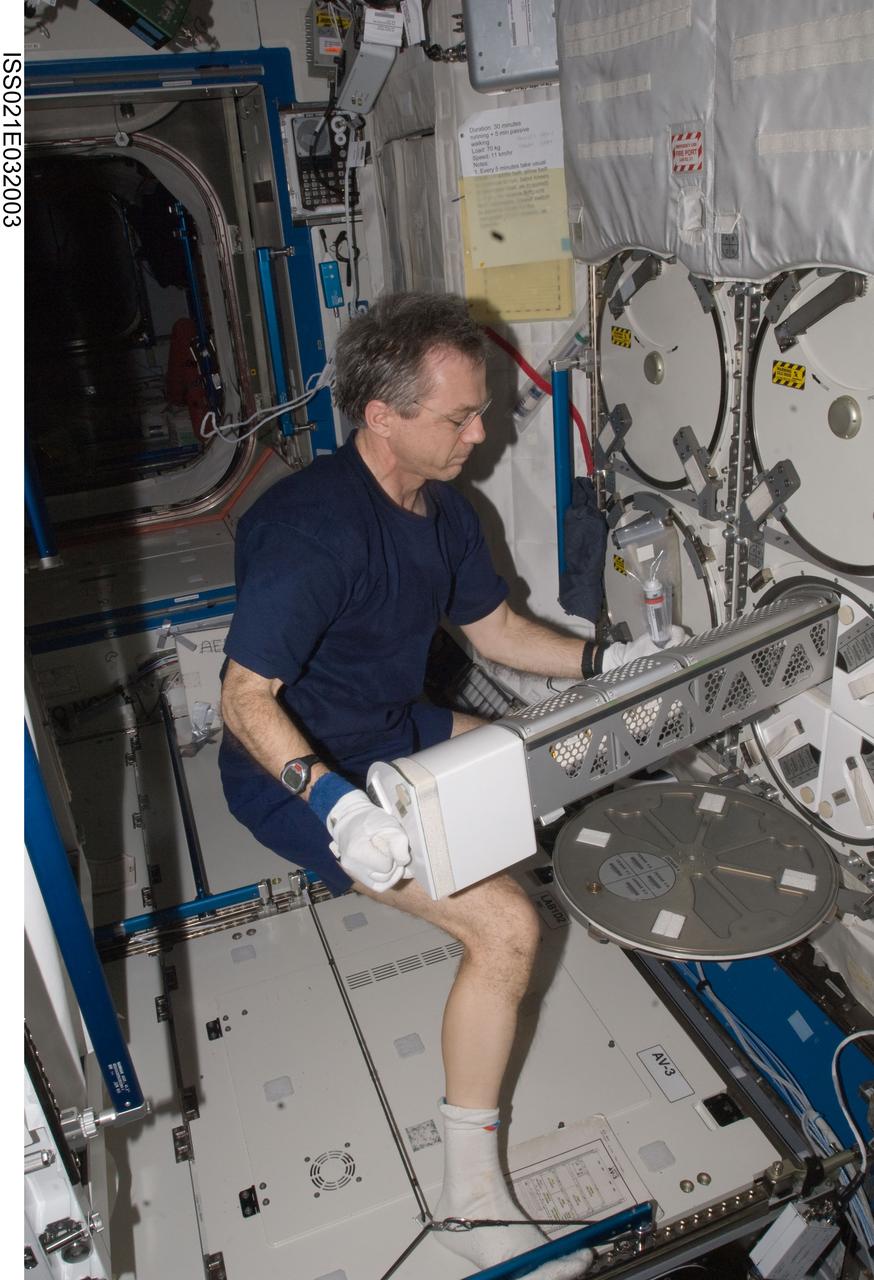
ISS021-E-032003 (22 Nov. 2009) --- Canadian Space Agency astronaut Robert Thirsk, Expedition 21 flight engineer, removes a dewar tray from the Minus Eighty Laboratory Freezer for ISS (MELFI) in the Destiny laboratory of the International Space Station while space shuttle Atlantis (STS-129) remains docked with the station.
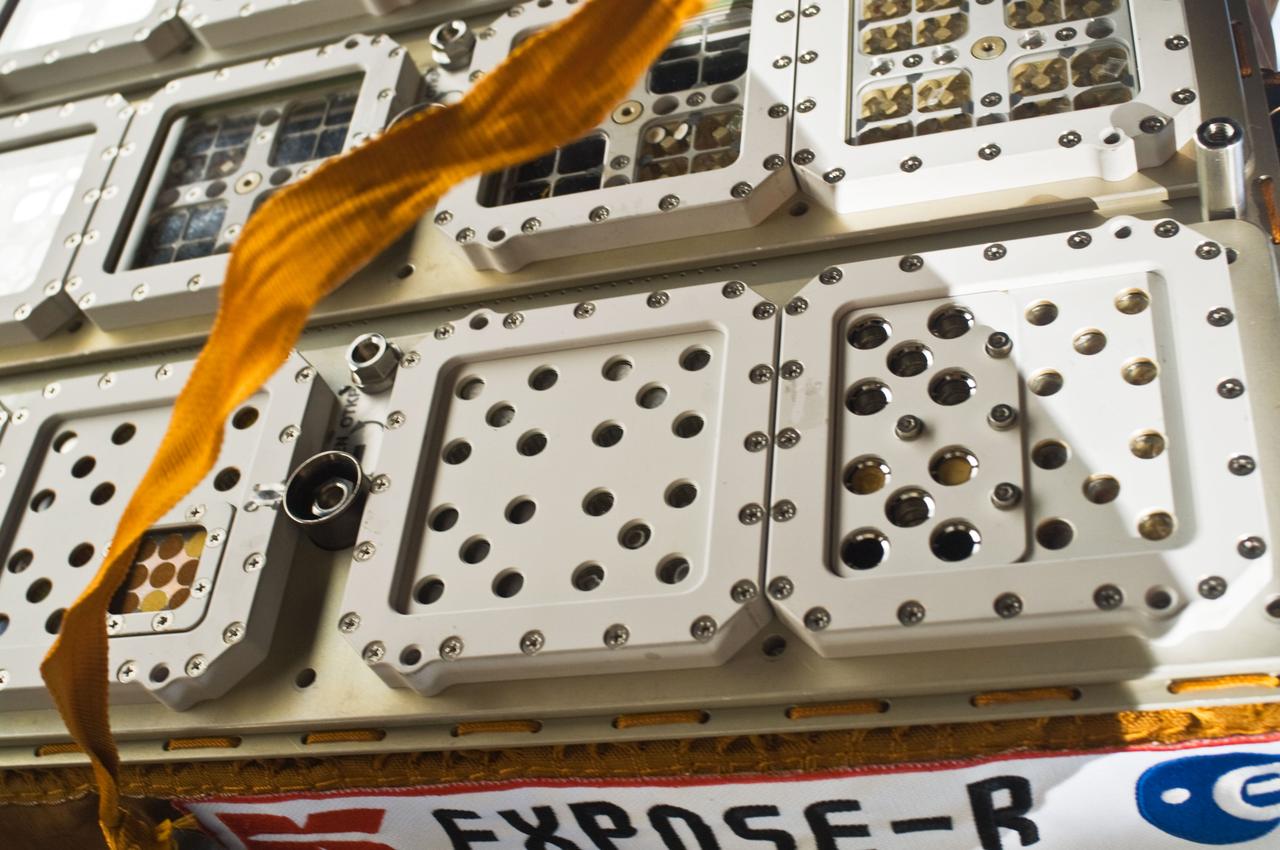
ISS018-E-039227 (10 March 2009) --- One of two Expedition 18 spacewalkers on March 10 provided this close-up image of the Expose-R experiment, reinstalled a short while earlier on the outside of the Russian segment of the International Space Station. The European experiment is equipped with three trays which contain a variety of biological samples.
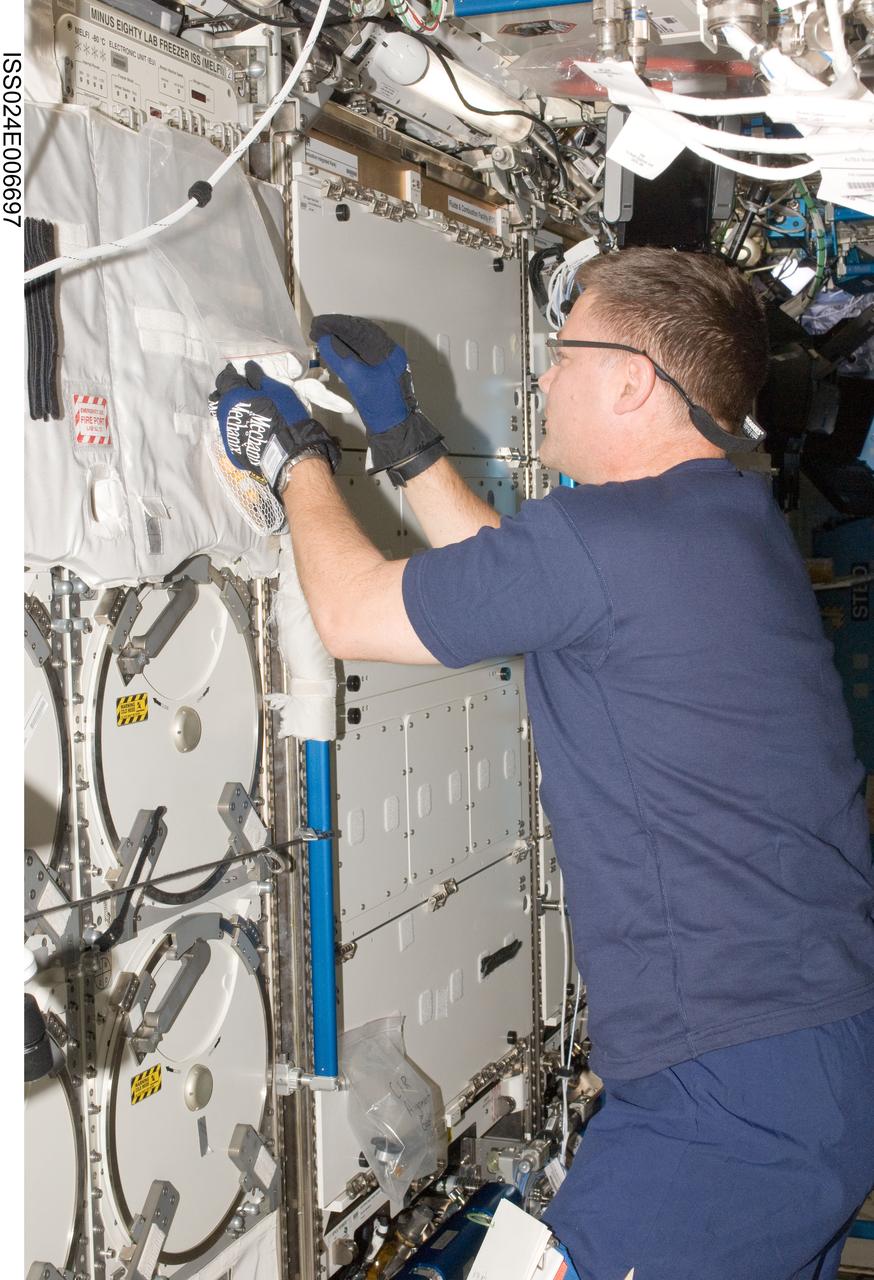
ISS024-E-006697 (28 June 2010) --- NASA astronaut Doug Wheelock, Expedition 24 flight engineer, prepares to insert biological samples into trays in the Minus Eighty Laboratory Freezer for ISS-2 (MELFI-2) in the Destiny laboratory of the International Space Station.
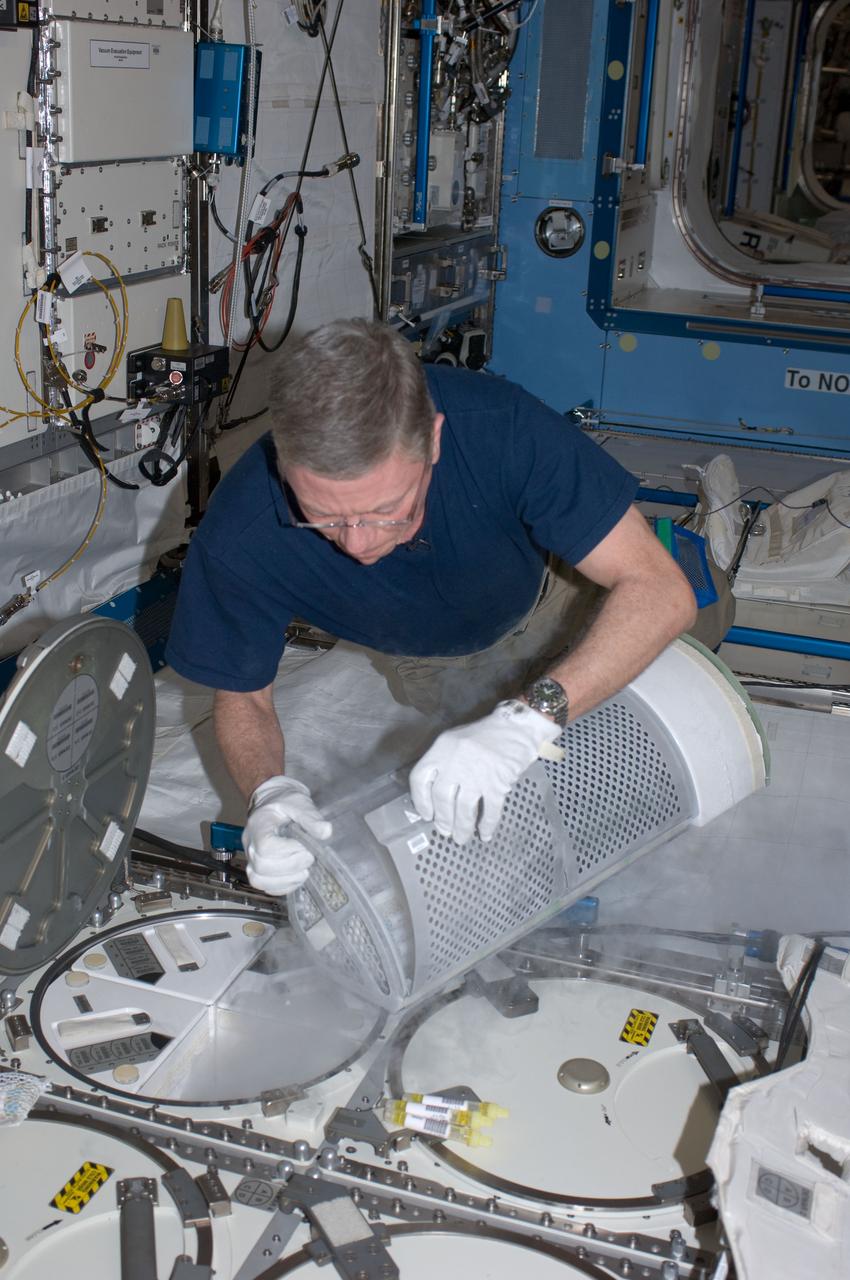
ISS029-E-015096 (4 Oct. 2011) --- In the International Space Station?s Kibo laboratory, NASA astronaut Mike Fossum, Expedition 29 commander, prepares to insert samples into a Minus Eighty Laboratory Freezer for ISS (MELFI-1) dewar tray for the second NUTRITION w/Repository collection period.
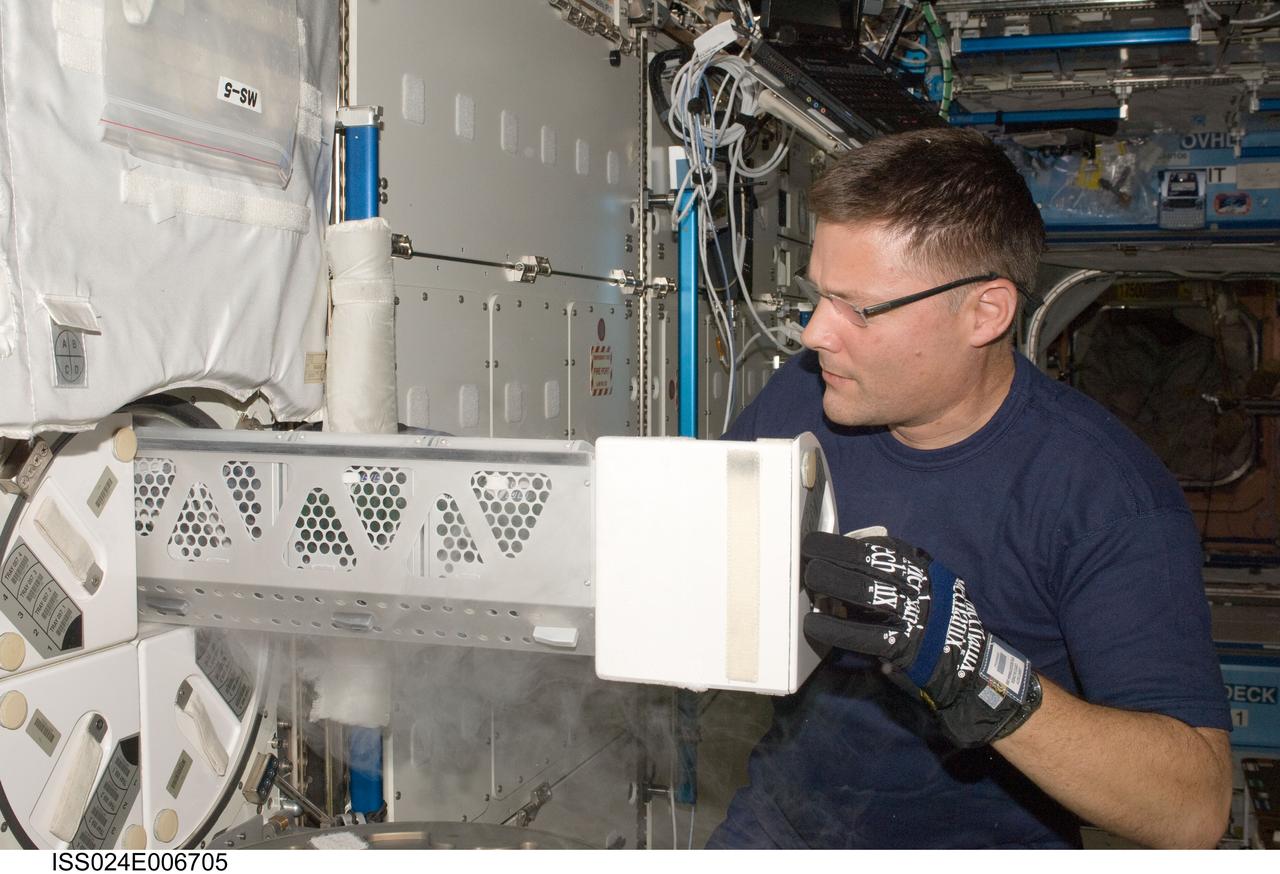
ISS024-E-006705 (28 June 2010) --- After inserting biological samples, NASA astronaut Doug Wheelock, Expedition 24 flight engineer, replaces a dewar tray in the Minus Eighty Laboratory Freezer for ISS-2 (MELFI-2) in the Destiny laboratory of the International Space Station.
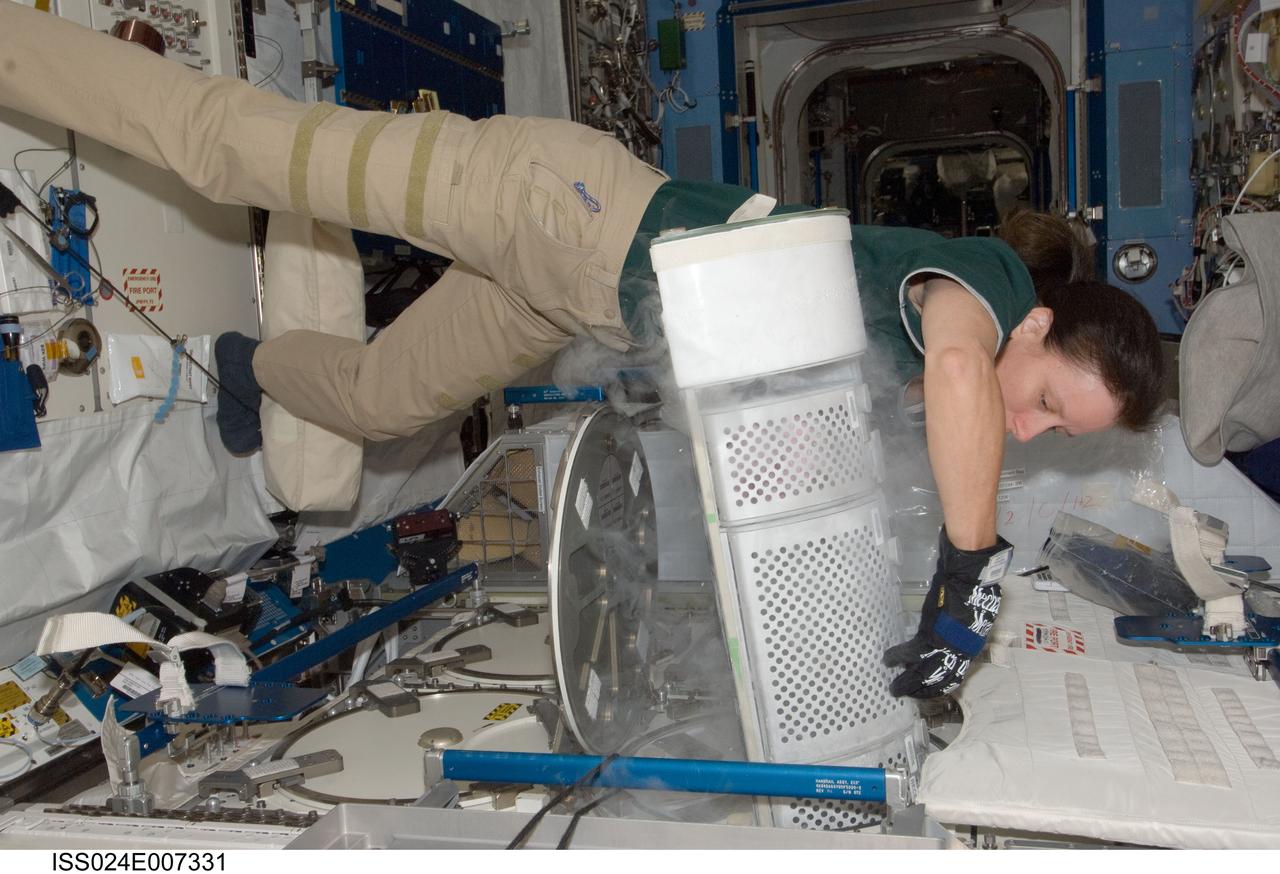
ISS024-E-007331 (2 July 2010) --- After inserting biological samples, NASA astronaut Shannon Walker, Expedition 24 flight engineer, replaces a dewar tray in the Minus Eighty Laboratory Freezer for ISS (MELFI-1) in the Kibo laboratory of the International Space Station.
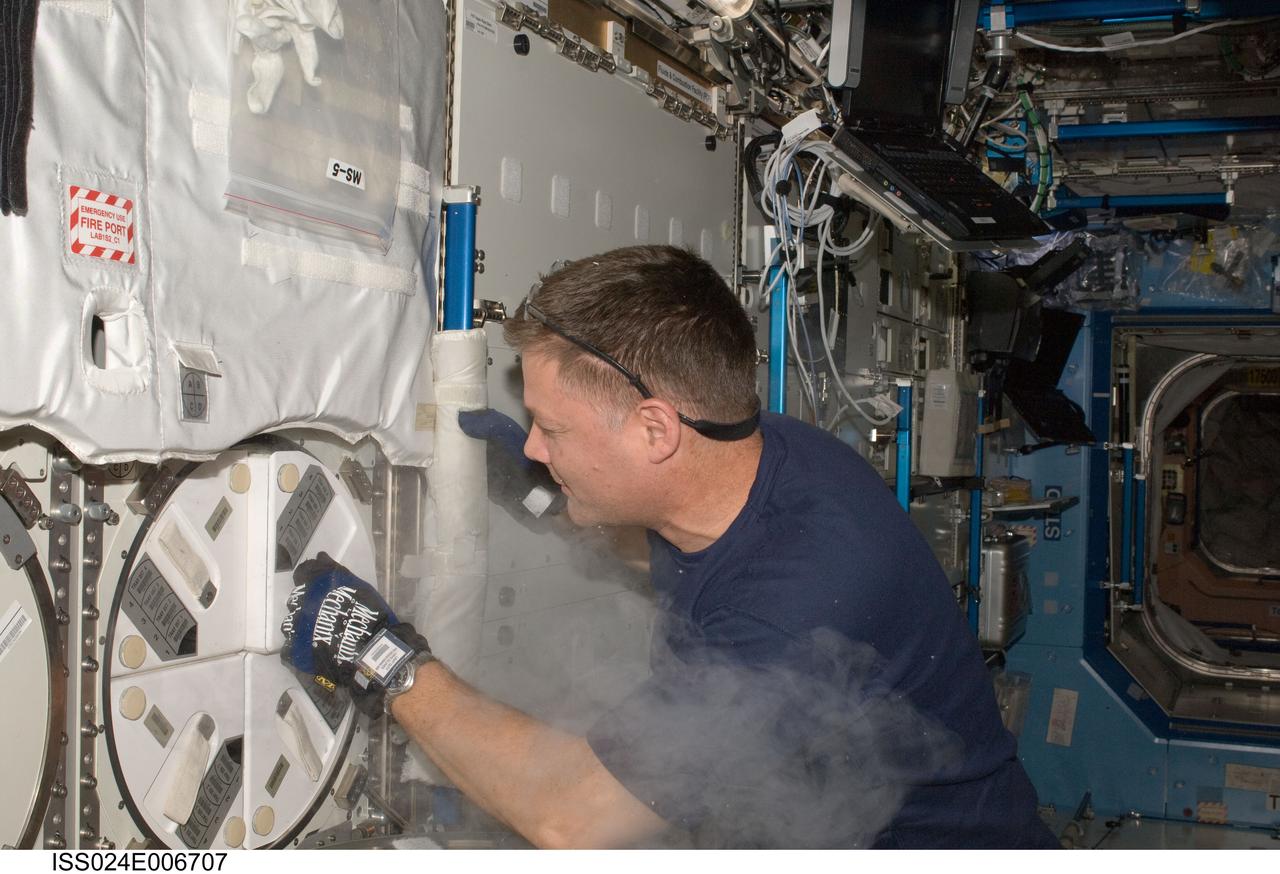
ISS024-E-006707 (28 June 2010) --- After inserting biological samples, NASA astronaut Doug Wheelock, Expedition 24 flight engineer, replaces a dewar tray in the Minus Eighty Laboratory Freezer for ISS-2 (MELFI-2) in the Destiny laboratory of the International Space Station.
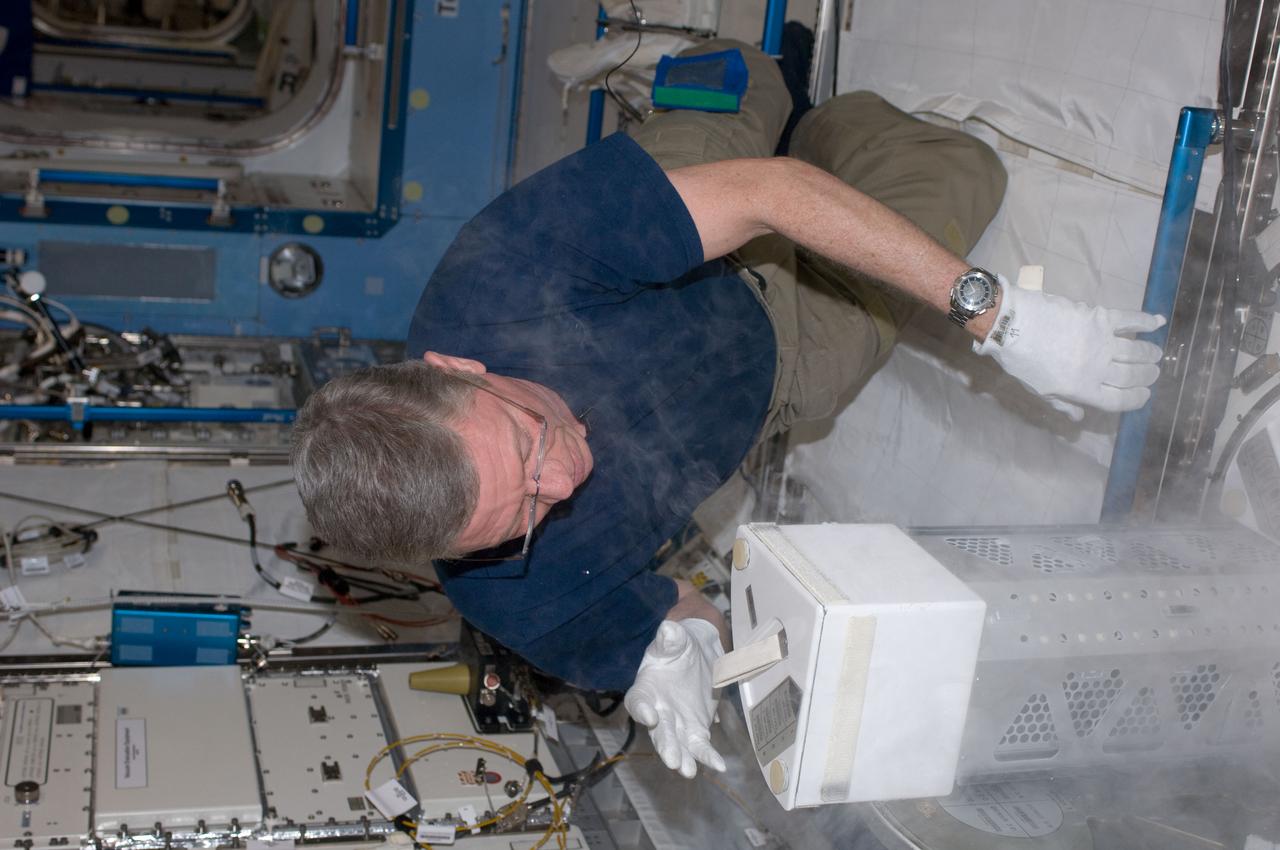
ISS029-E-015110 (4 Oct. 2011) --- In the International Space Station?s Kibo laboratory, NASA astronaut Mike Fossum, Expedition 29 commander, inserts a dewar tray of samples into the Minus Eighty Laboratory Freezer for ISS (MELFI-1) for the second NUTRITION w/Repository collection period.
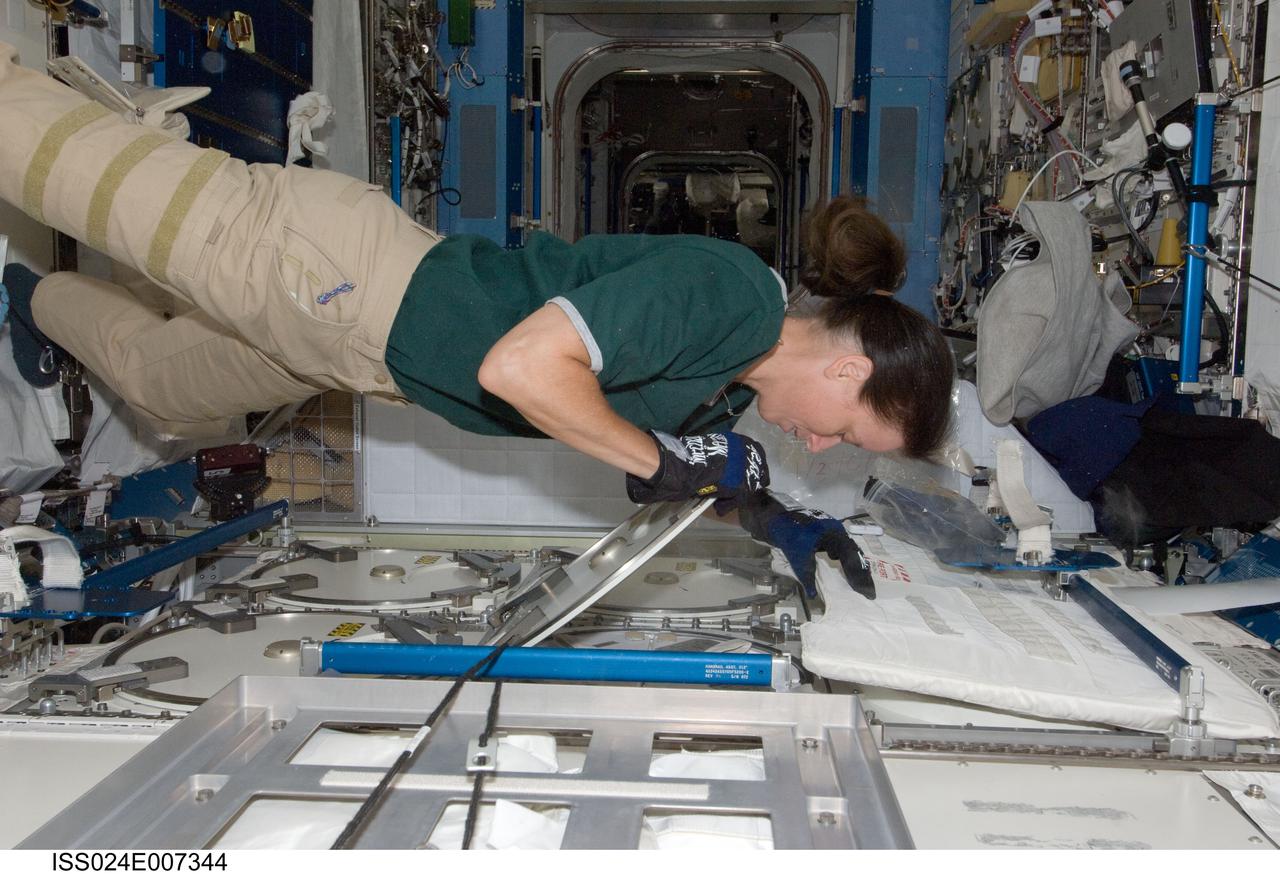
ISS024-E-007344 (2 July 2010) --- After inserting biological samples, NASA astronaut Shannon Walker, Expedition 24 flight engineer, replaces a dewar tray in the Minus Eighty Laboratory Freezer for ISS (MELFI-1) in the Kibo laboratory of the International Space Station.

ISS024-E-012555 (26 Aug. 2010) --- NASA astronaut Tracy Caldwell Dyson, Expedition 24 flight engineer, replaces a dewar tray containing biological samples in the Minus Eighty Laboratory Freezer for ISS (MELFI-1) in the Kibo laboratory of the International Space Station.
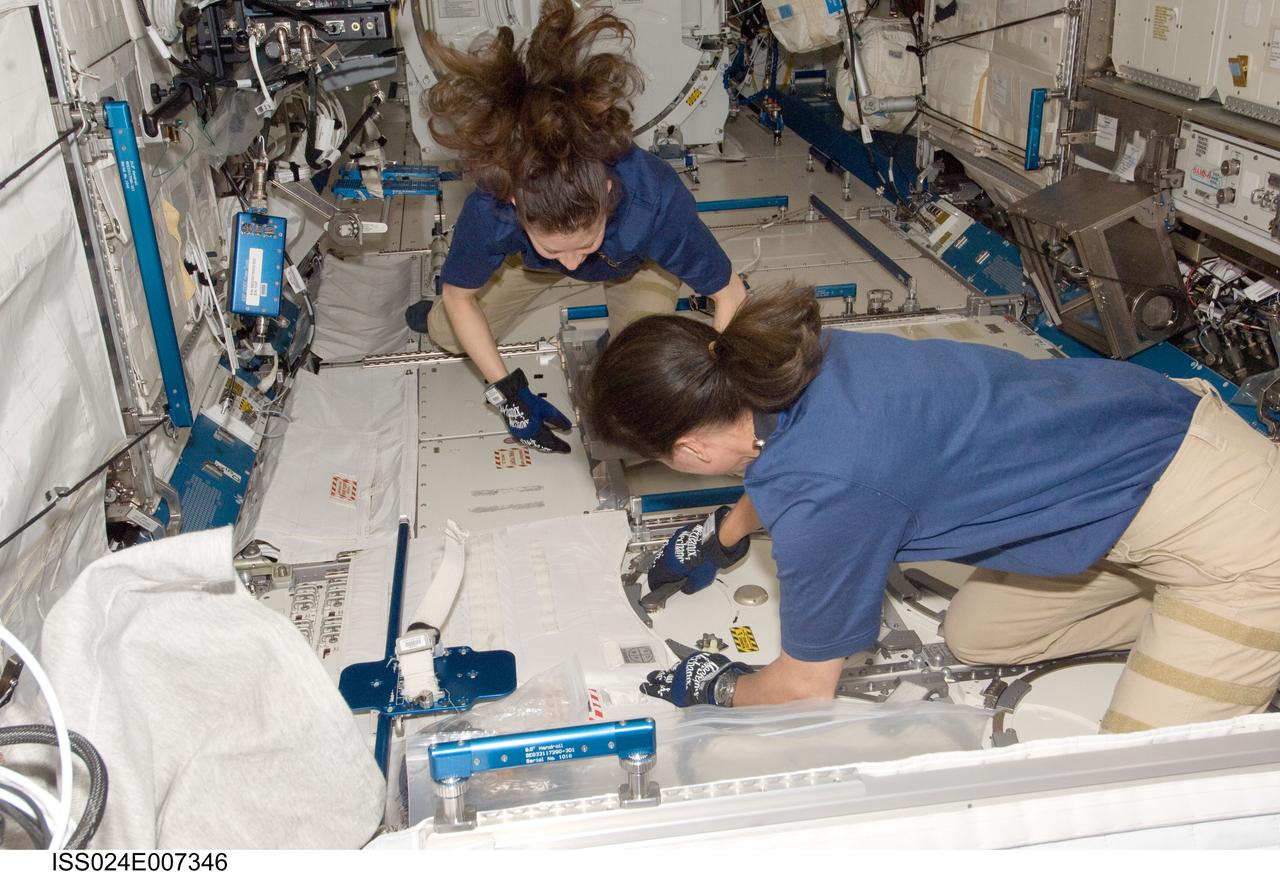
ISS024-E-007346 (2 July 2010) --- NASA astronauts Tracy Caldwell Dyson (background) and Shannon Walker, both Expedition 24 flight engineers, prepare to insert biological samples in a dewar tray in the Minus Eighty Laboratory Freezer for ISS (MELFI-1) in the Kibo laboratory of the International Space Station.
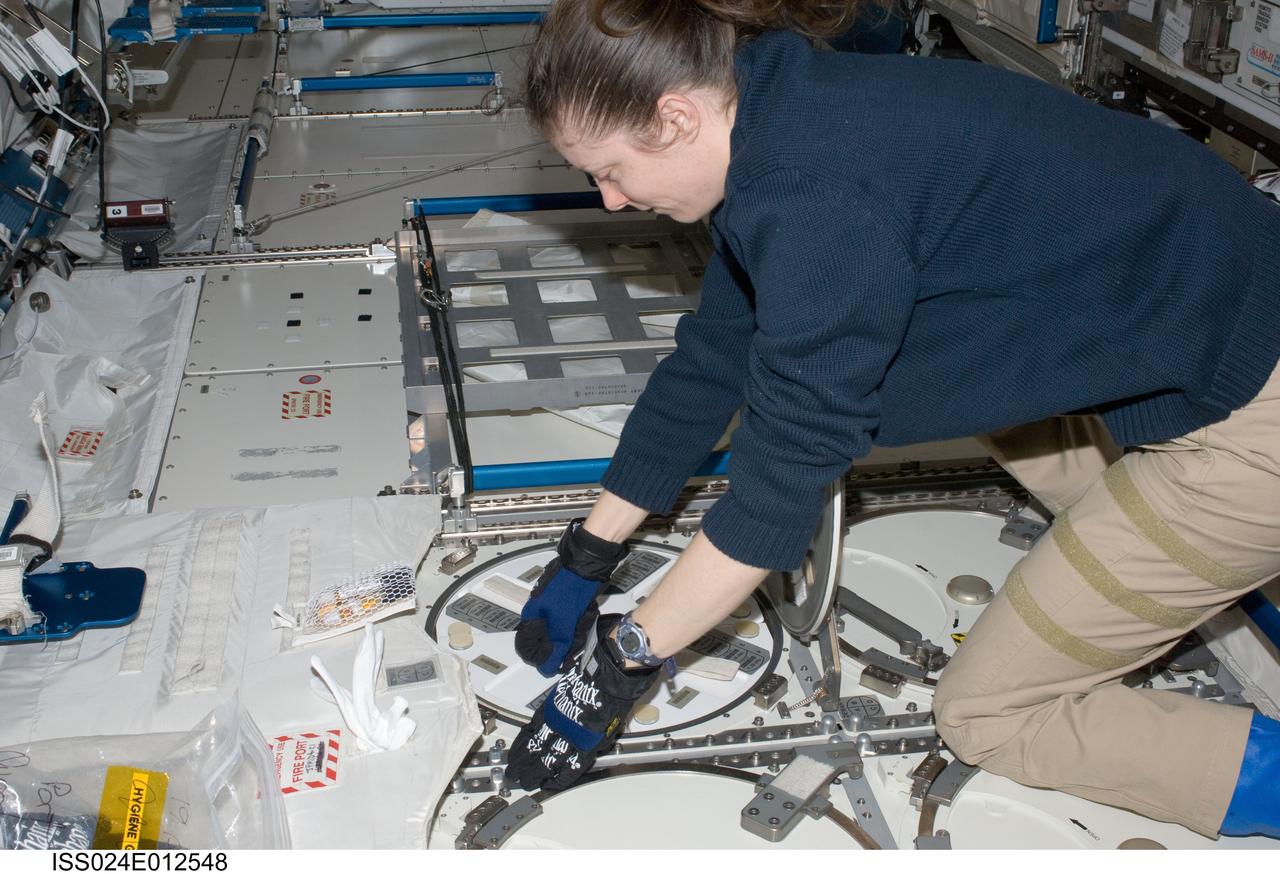
ISS024-E-012548 (26 Aug. 2010) --- NASA astronaut Tracy Caldwell Dyson, Expedition 24 flight engineer, prepares to insert biological samples in a dewar tray in the Minus Eighty Laboratory Freezer for ISS (MELFI-1) in the Kibo laboratory of the International Space Station.
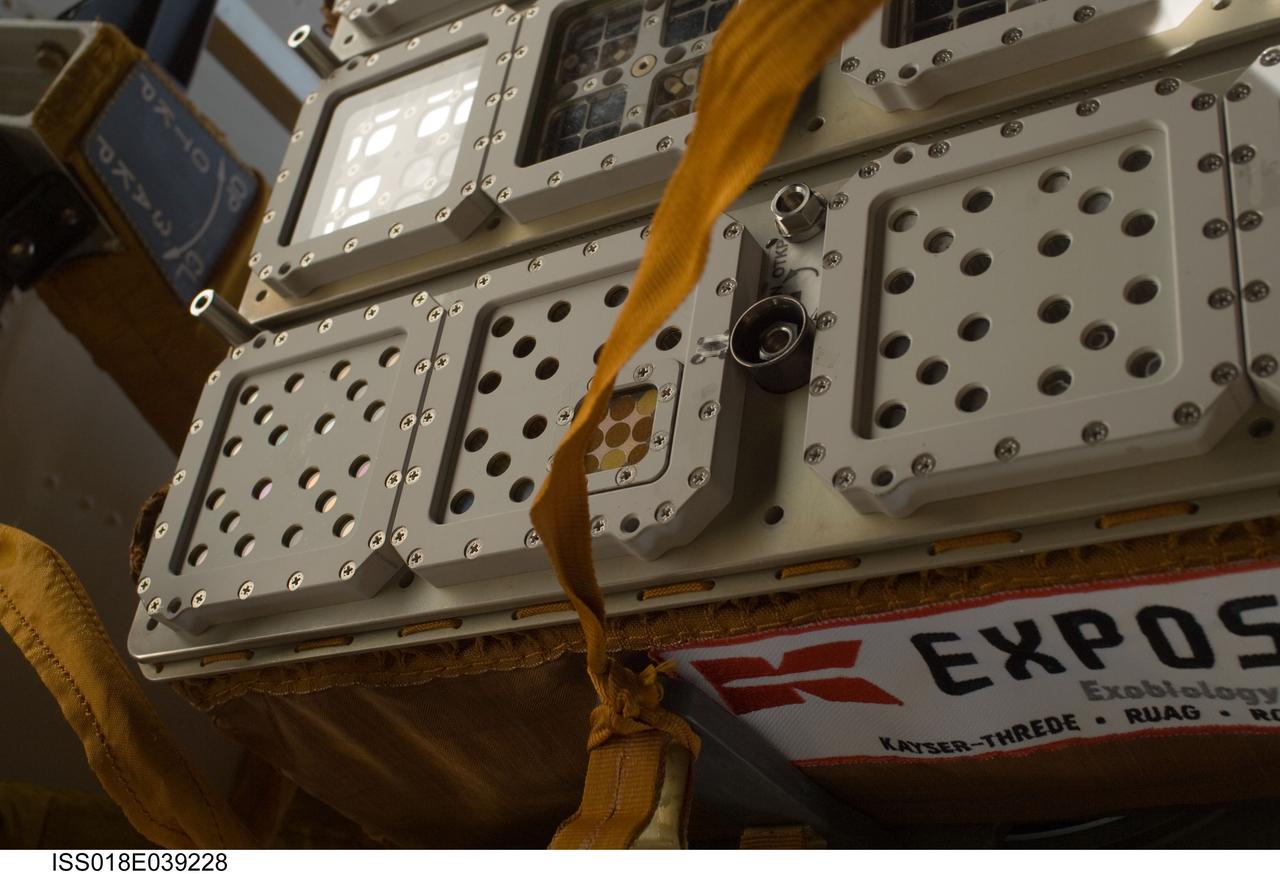
ISS018-E-039228 (10 March 2009) --- One of two Expedition 18 spacewalkers on March 10 provided this close-up image of the Expose-R experiment, reinstalled a short while earlier on the outside of the Russian segment of the International Space Station. The European experiment is equipped with three trays which contain a variety of biological samples.
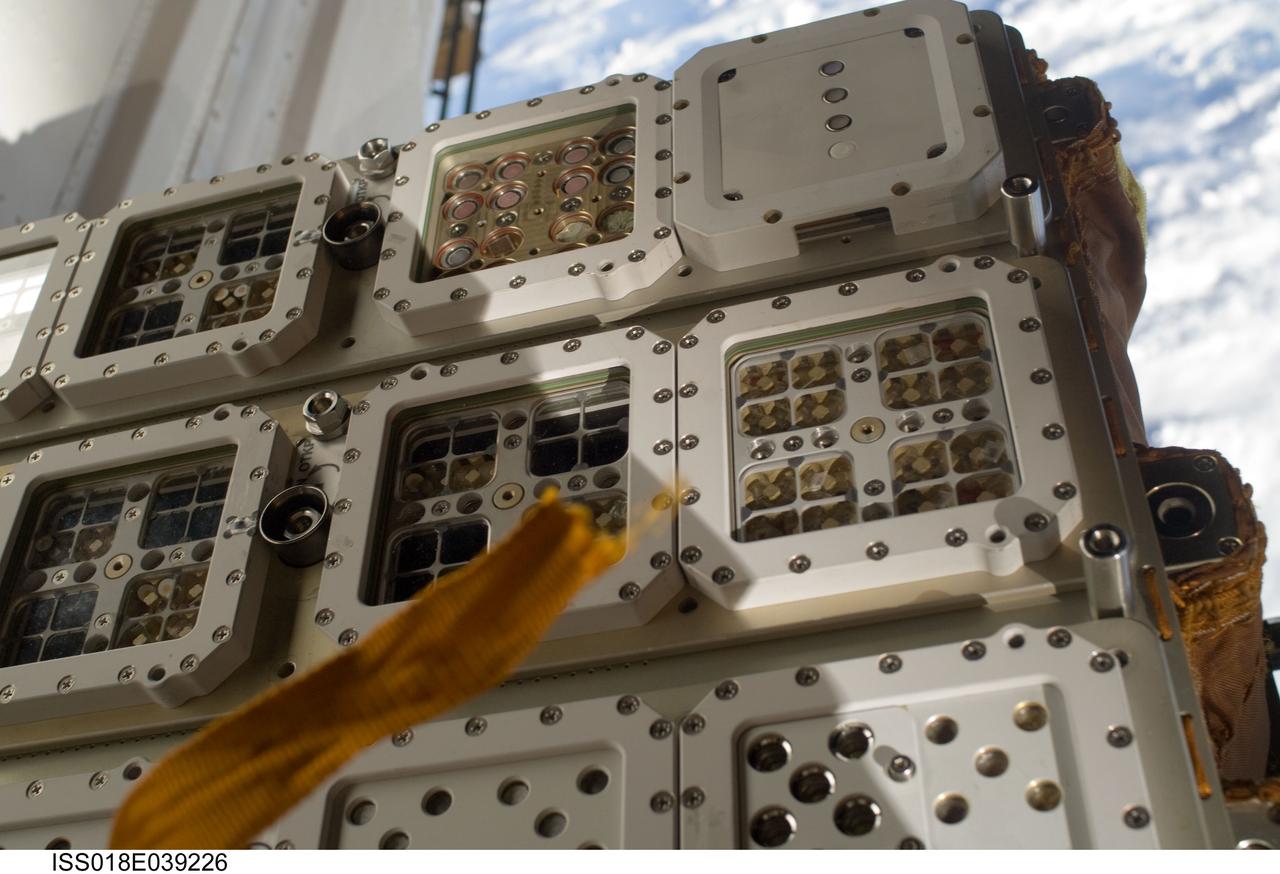
ISS018-E-039226 (10 March 2009) --- One of two Expedition 18 spacewalkers on March 10 provided this close-up image of the Expose-R experiment, reinstalled a short while earlier on the outside of the Russian segment of the International Space Station. The European experiment is equipped with three trays which contain a variety of biological samples.
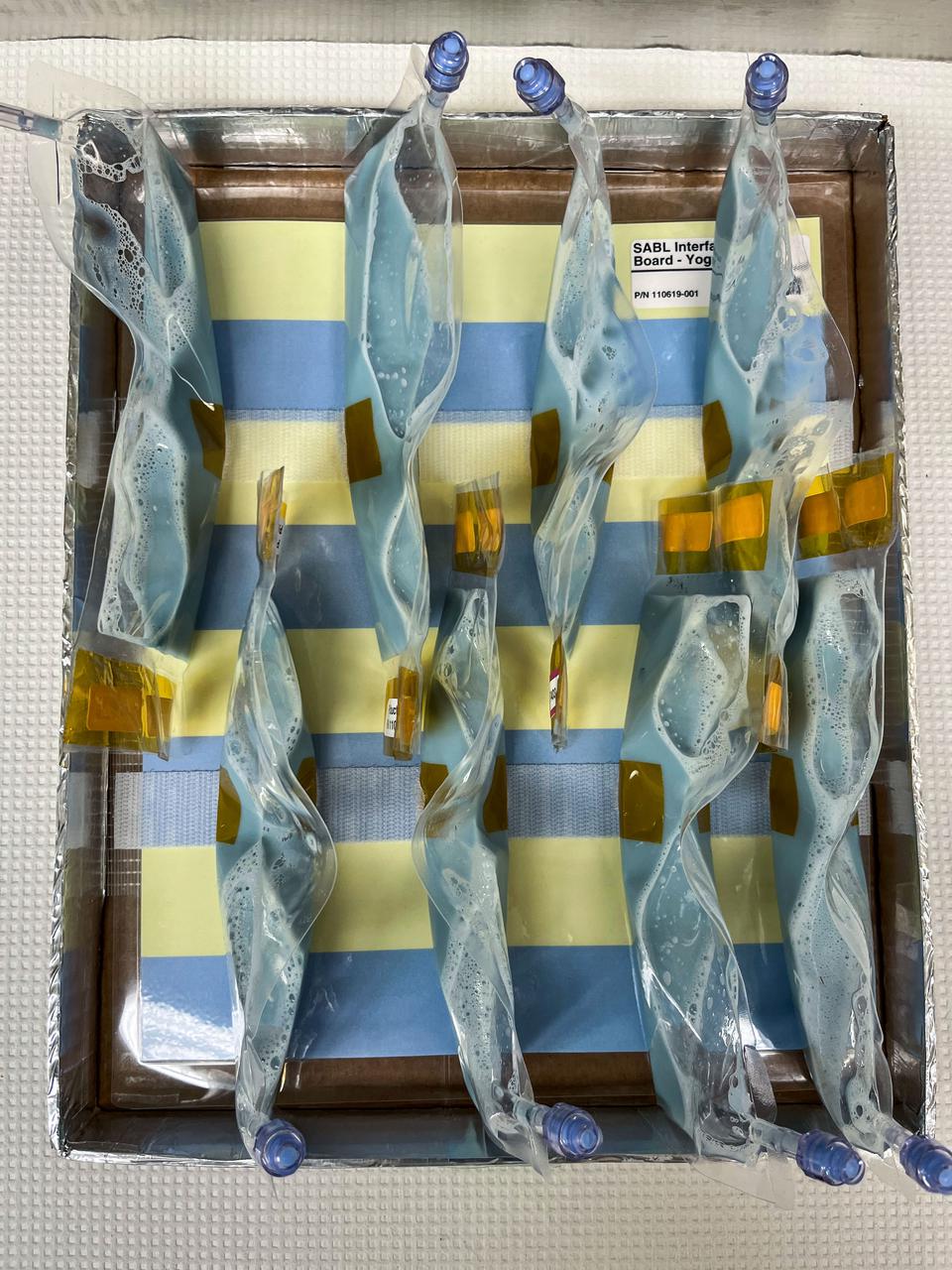
jsc2022e031235 (3/28/2022) --- Preflight images of BioNutrients-2 Yogurt Bags on SABL Tray Mockup, after initial hydration. The blue color of the bag’s contents comes from the pH Indicator. The SABL interface board, behind the bags, provides a reference for the starting and ending colors.
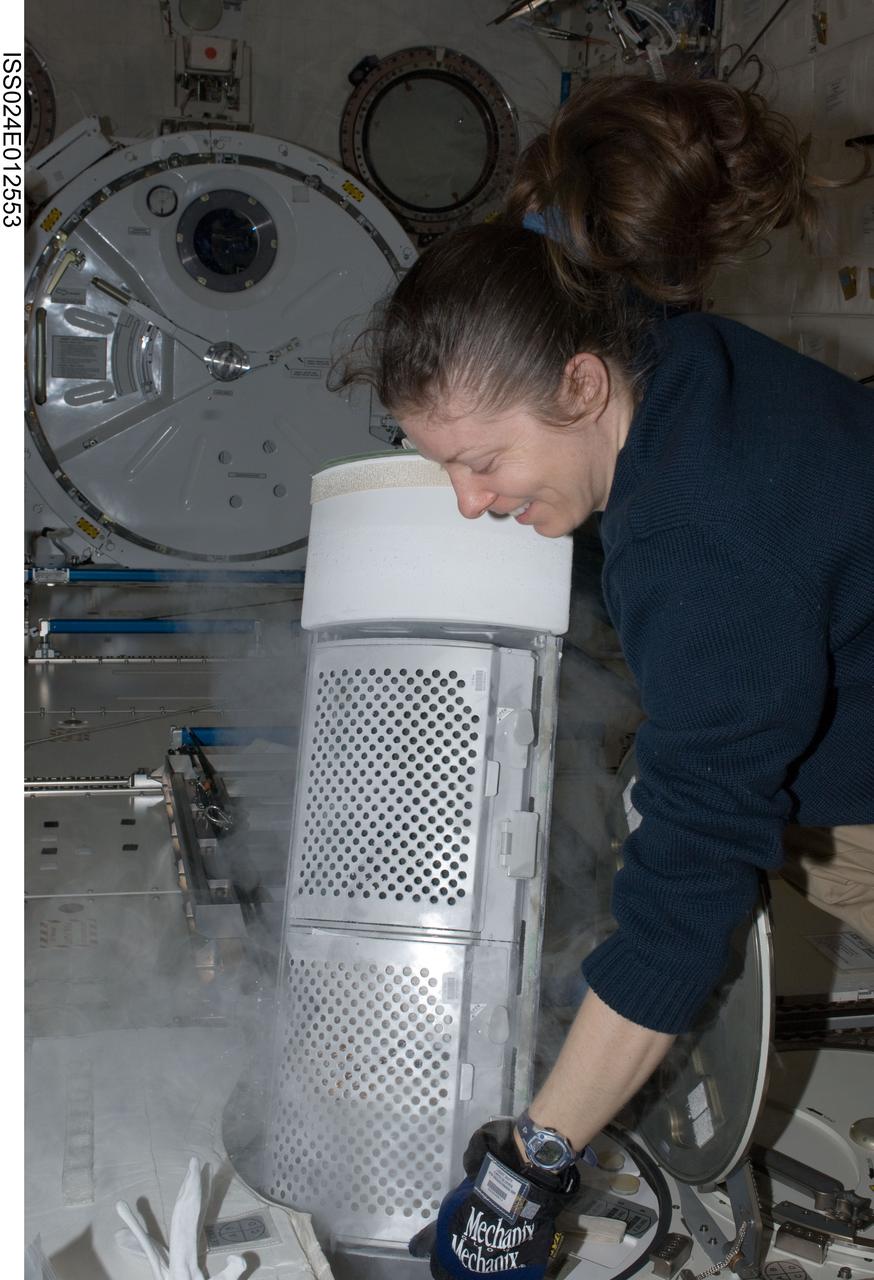
ISS024-E-012553 (26 Aug. 2010) --- NASA astronaut Tracy Caldwell Dyson, Expedition 24 flight engineer, replaces a dewar tray containing biological samples in the Minus Eighty Laboratory Freezer for ISS (MELFI-1) in the Kibo laboratory of the International Space Station.
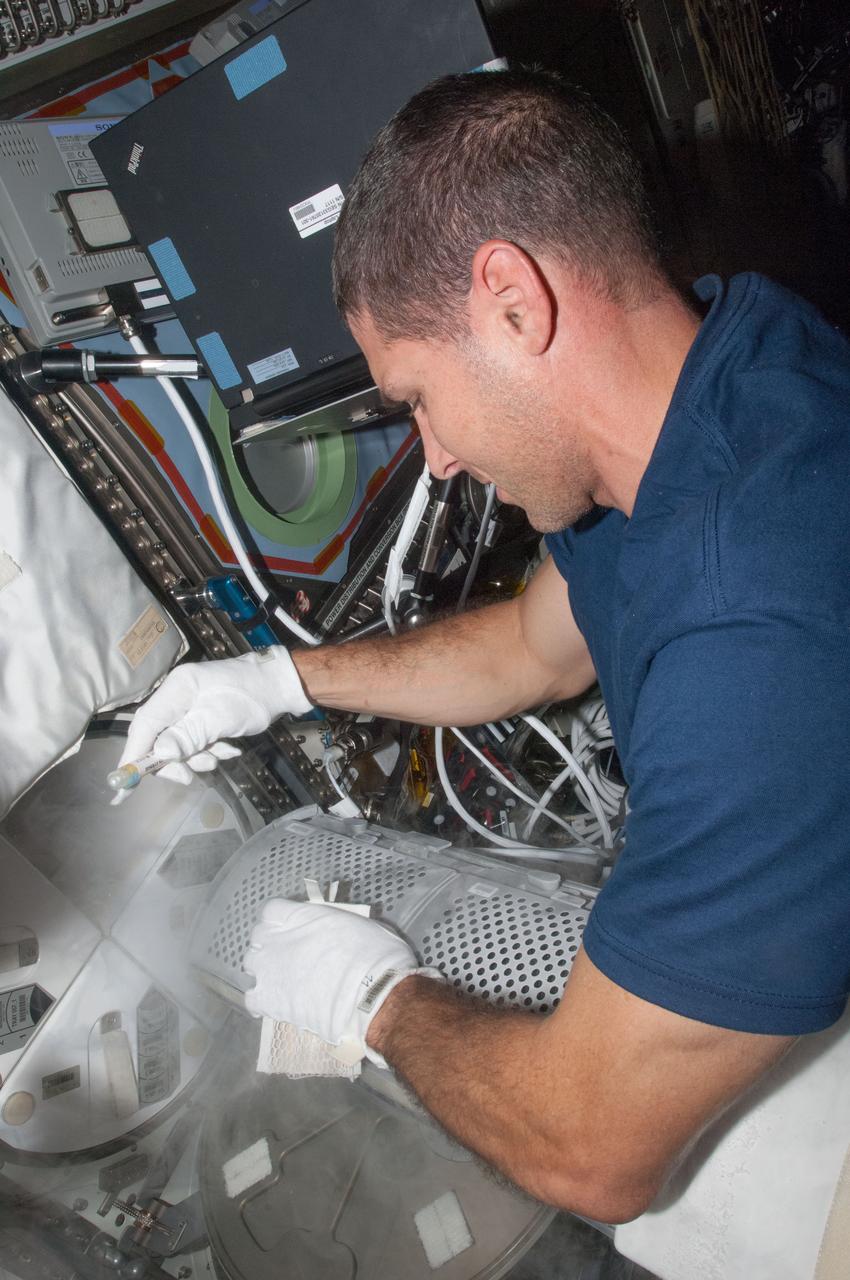
ISS037-E-010725 (5 Oct. 2013) --- NASA astronaut Michael Hopkins, Expedition 37 flight engineer, prepares to insert samples into a Minus Eighty Laboratory Freezer for ISS (MELFI) dewar tray in the International Space Station’s Destiny laboratory.
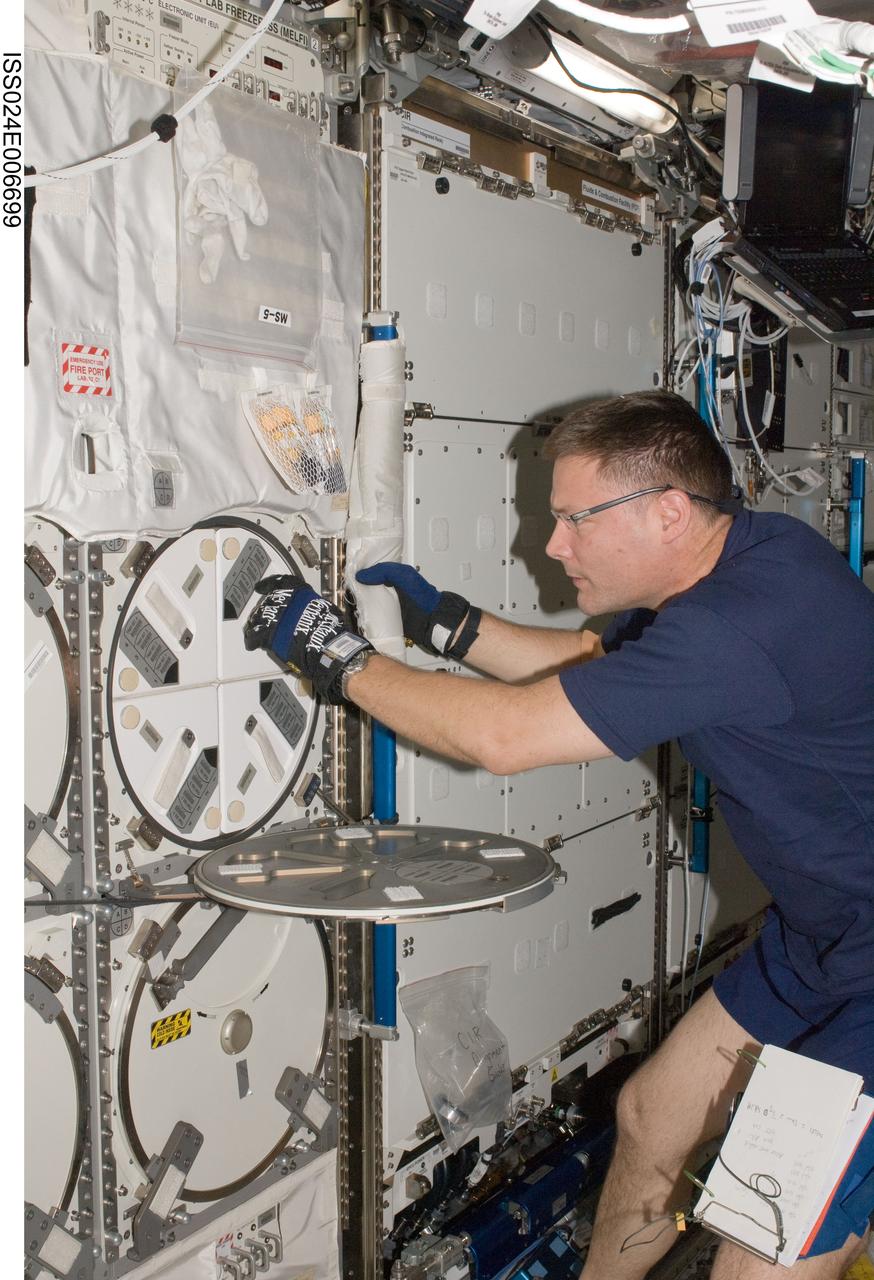
ISS024-E-006699 (28 June 2010) --- NASA astronaut Doug Wheelock, Expedition 24 flight engineer, prepares to insert biological samples into trays in the Minus Eighty Laboratory Freezer for ISS-2 (MELFI-2) in the Destiny laboratory of the International Space Station.
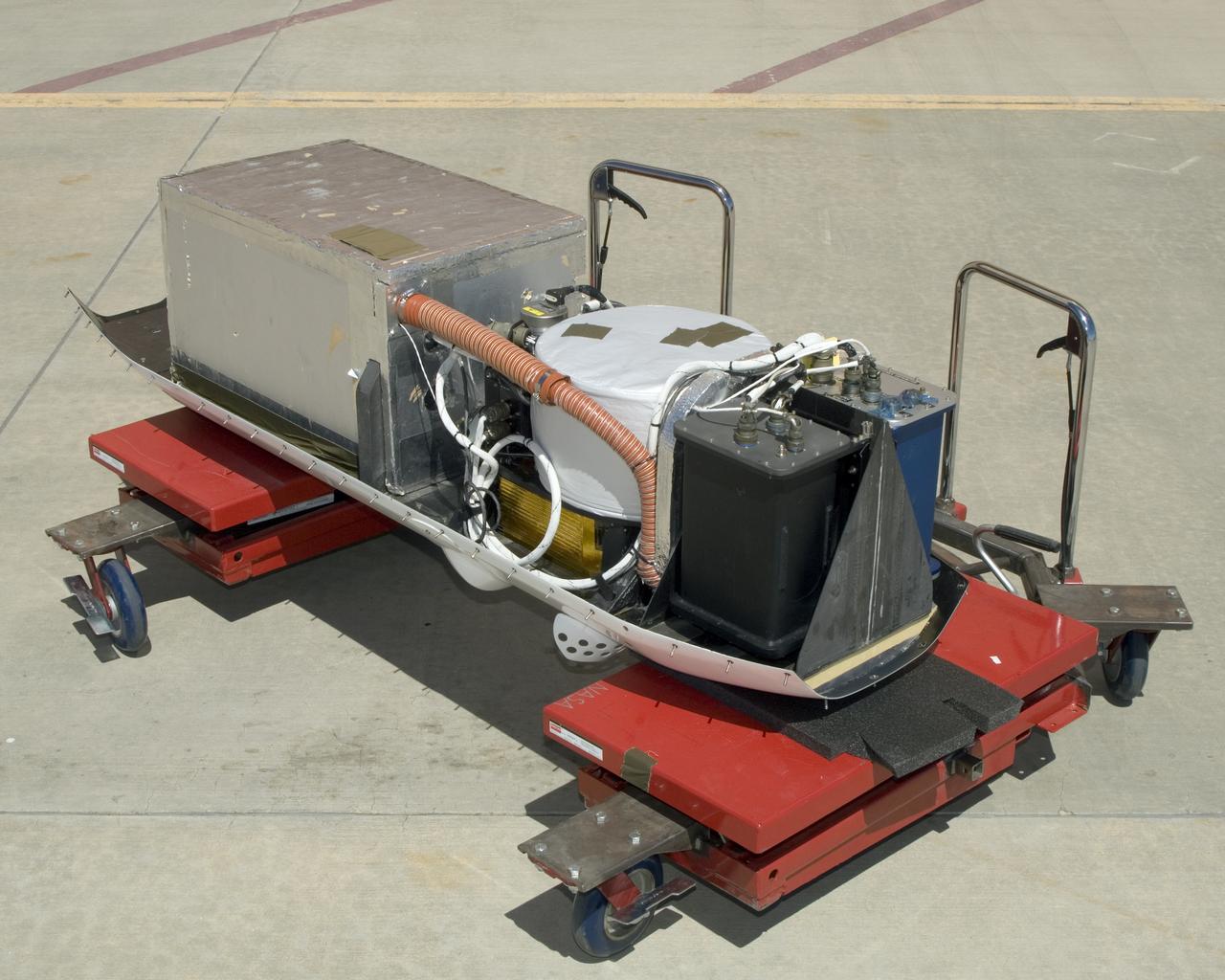
The instruments that make up the Ames Autonomous Module Scanner (AMS) that provided precise thermal-infrared imaging during the Western States Fire Mission in 2007 are detailed in this photo of the AMS as mounted on Ikhana's pod tray. The large foil-covered foam-insulated box at left covers the pressure vessel containing the data system computers and other electronics. The round white-topped assembly is the scan head, including the scan mirror, folded telescope, blackbody references, spectrometer and detectors. Two pressure boxes visible at the forward end of the tray contain the Applanix POS/AV precision navigation subsystem (black) and the power distributor including circuit breakers and ancillary wiring, scan motor controller and the blackbody reference temperature controller (blue).
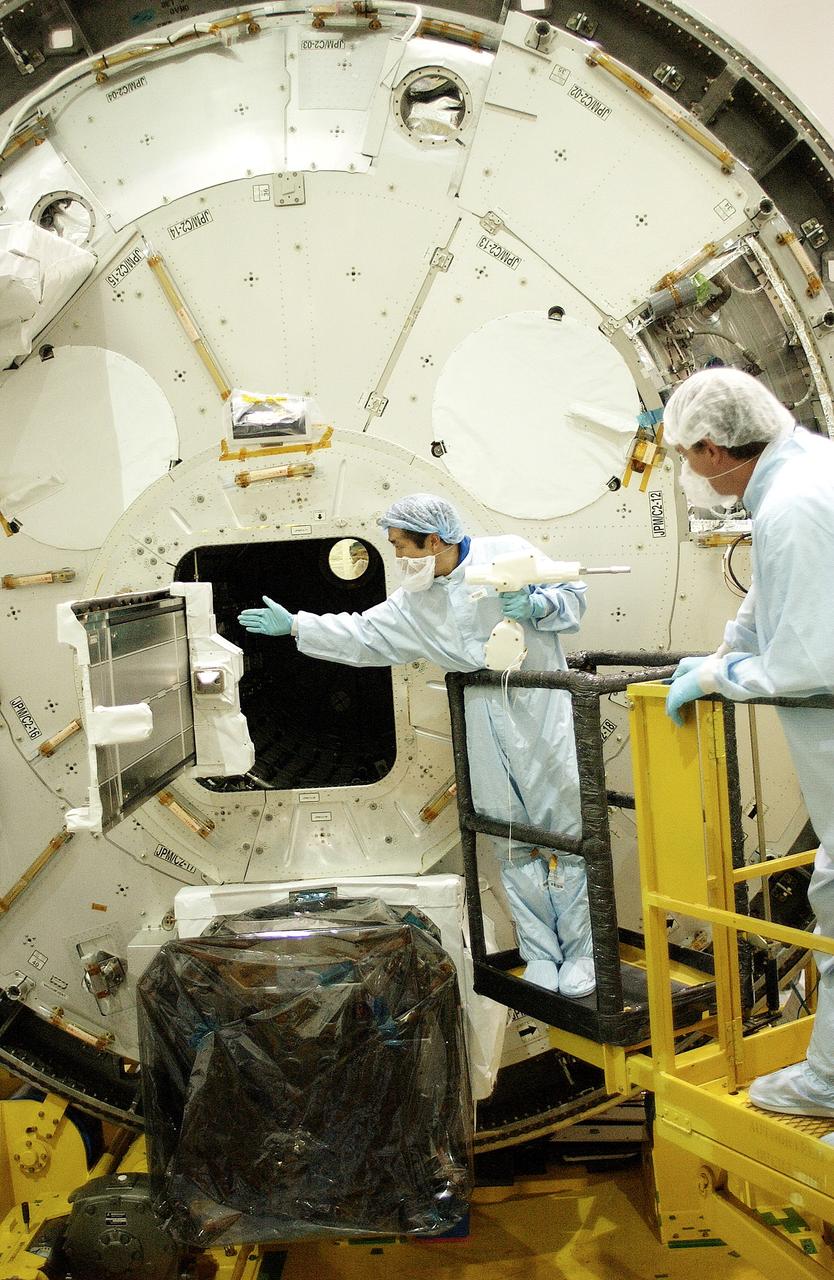
KENNEDY SPACE CENTER, FLA. - Japanese astronaut Koichi Wakata (left) releases a tray extended from inside the Pressurized Module, or PM, that he was working with. Part of the Japanese Experiment Module (JEM), the PM provides a shirt-sleeve environment in which astronauts on the International Space Station can conduct microgravity experiments. There are a total of 23 racks, including 10 experiment racks, inside the PM providing a power supply, communications, air conditioning, hardware cooling, water control and experiment support functions. The JEM/PM is in the Space Station Processing Facility.
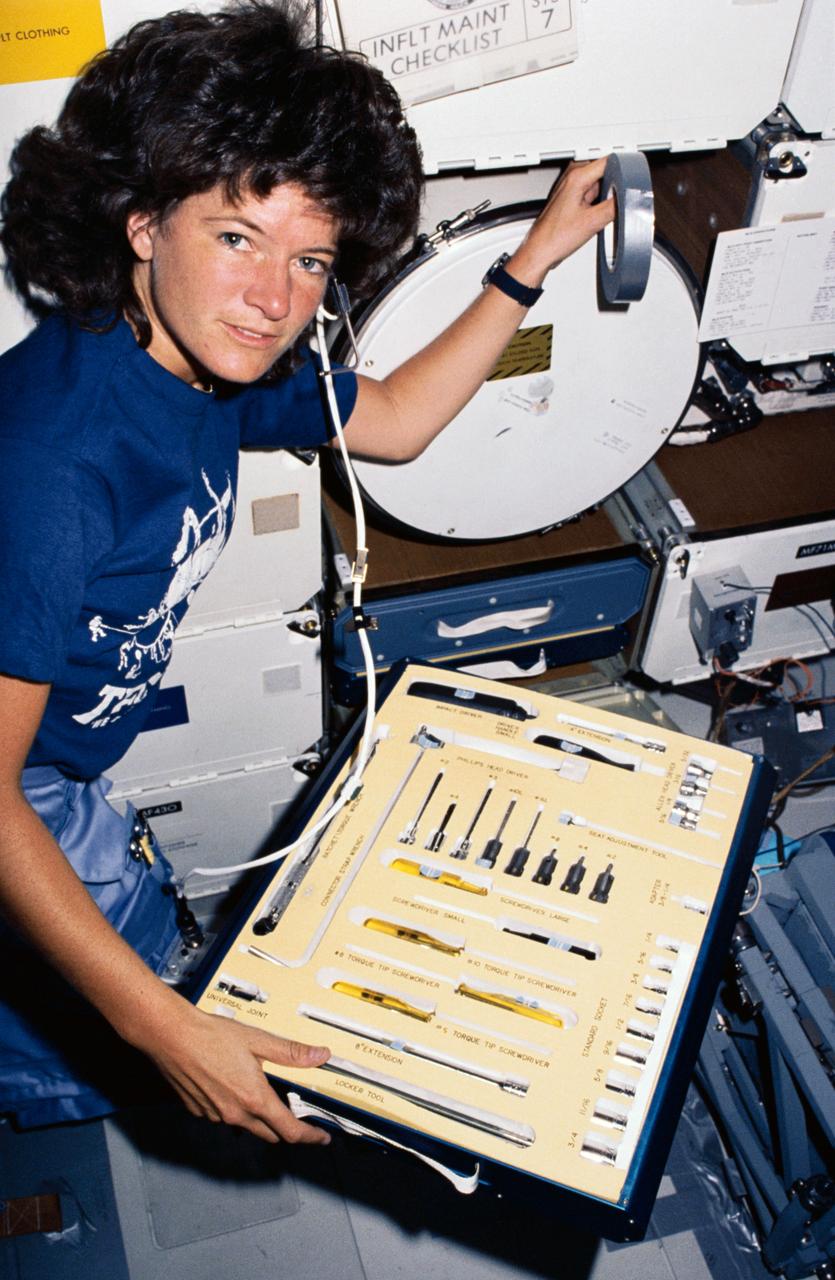
STS007-12-536 (18-24 June 1983) --- Astronaut Sally K. Ride, STS-7 mission specialist, displays the array of tools at her disposal on the mid deck of the Earth-orbiting Space Shuttle Challenger. Dr. Ride is positioned near the monodisperse latex reactor (MLR) experiment. They cylinder near her elbow is the actual reactor and the device next to it at right frame edge is the MRL apparatus container. Dr. Ride and four other astronauts are sharing duties aboard the reusable spacecraft for a six-day space mission full of “firsts.” This photograph was made with a 35mm camera. It was among the visuals used by crewmembers at their post-flight press conference.
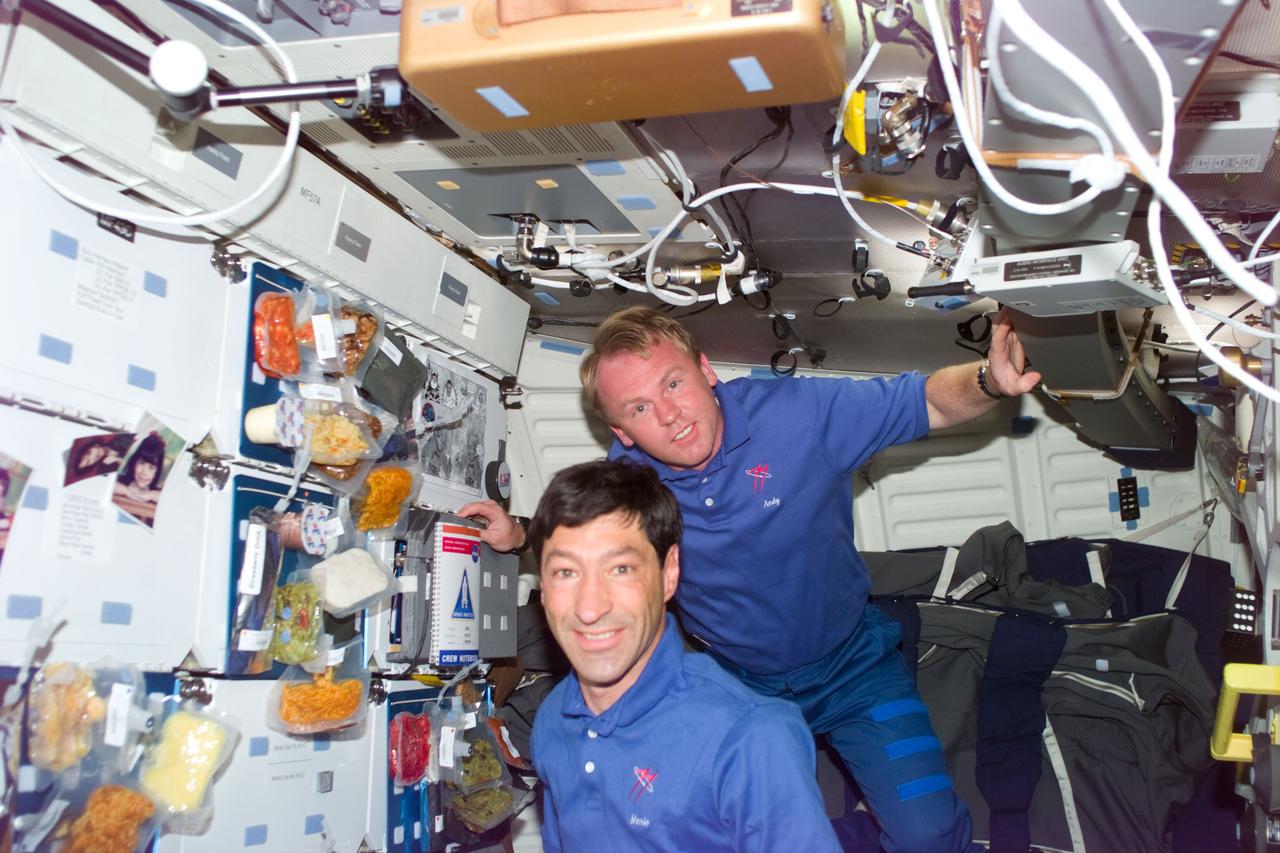
S77-E-5120 (26 May 1996) --- Astronauts Mario Runco, Jr. and Andrew S. W. Thomas, both mission specialists, pose for photo while in the middeck of the Earth-orbiting Space Shuttle Endeavour. The scene was recorded with an Electronic Still Camera (ESC).
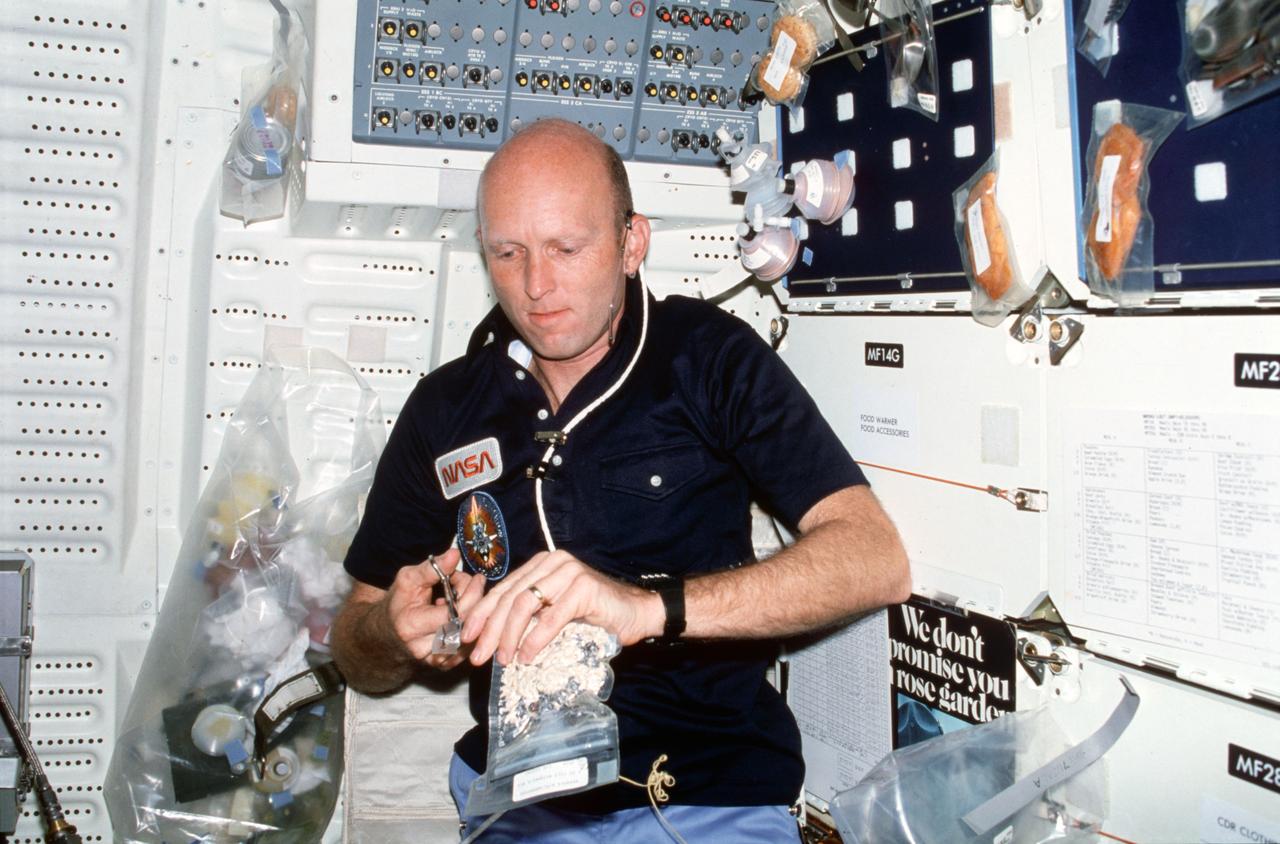
STS003-26-253 (30 March 1982) --- Astronaut Gordon Fullerton, STS-3 pilot, wearing communications kit assembly (assy) mini-headset (HDST), prepares meal on middeck. Fullerton clips corner of rehydratable food (cereal) package with scissors. The opening will allow Fullerton to insert JSC water dispenser kit water gun in order to heat contents with hot water. Meal tray assembly is secured to forward middeck locker and holds additional food packages and beverage containers. Photo credit: NASA
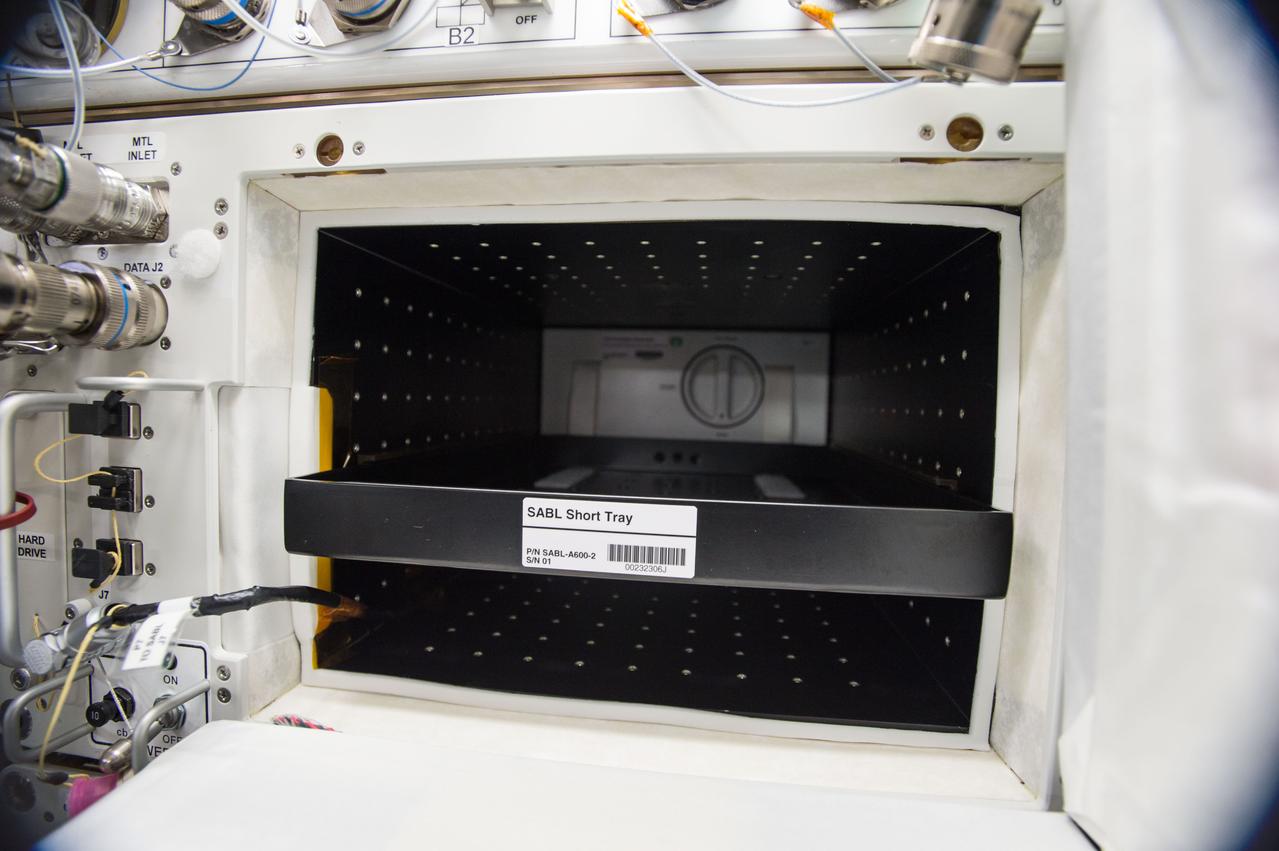
iss048e042380(7/21/2016) --- A view of the Space Automated Bioproduct Laboratory (SABL) Short Tray inside the SABL 2 following installation of the Carbon Dioxide (CO2) Incubator Controller. Image was taken during Heart Cells experiment setup in the Destiny U.S. Laboratory. The Space Automated Bioproduct Laboratory (SABL) supports a wide variety of experiments in the life, physical and material sciences with a focus on supporting research of biological systems and processes.
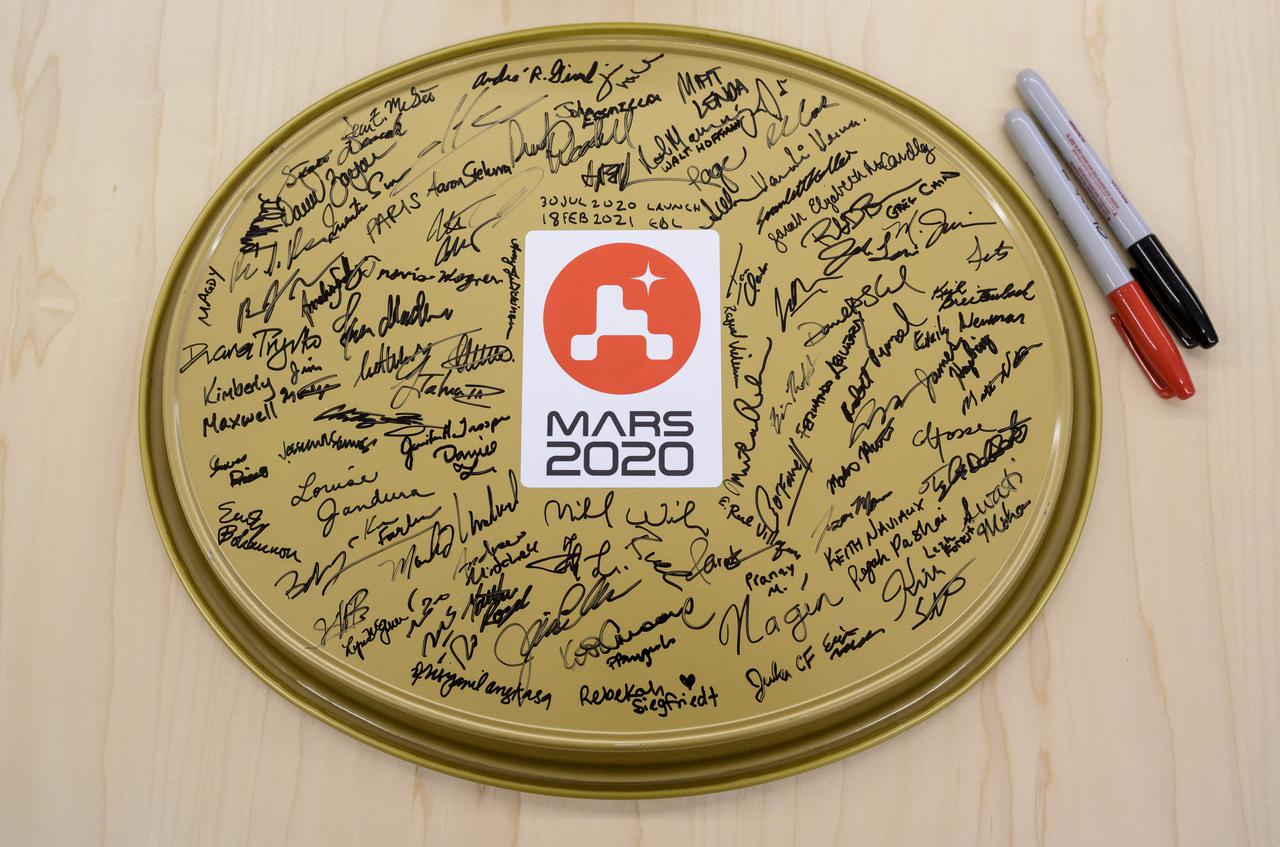
A serving tray with signatures from the NASA Perseverance Mars rover team is seen in mission control, Thursday, Feb. 18, 2021, at NASA's Jet Propulsion Laboratory in Pasadena, California. A key objective for Perseverance’s mission on Mars is astrobiology, including the search for signs of ancient microbial life. The rover will characterize the planet’s geology and past climate, pave the way for human exploration of the Red Planet, and be the first mission to collect and cache Martian rock and regolith. Photo Credit: (NASA/Bill Ingalls)
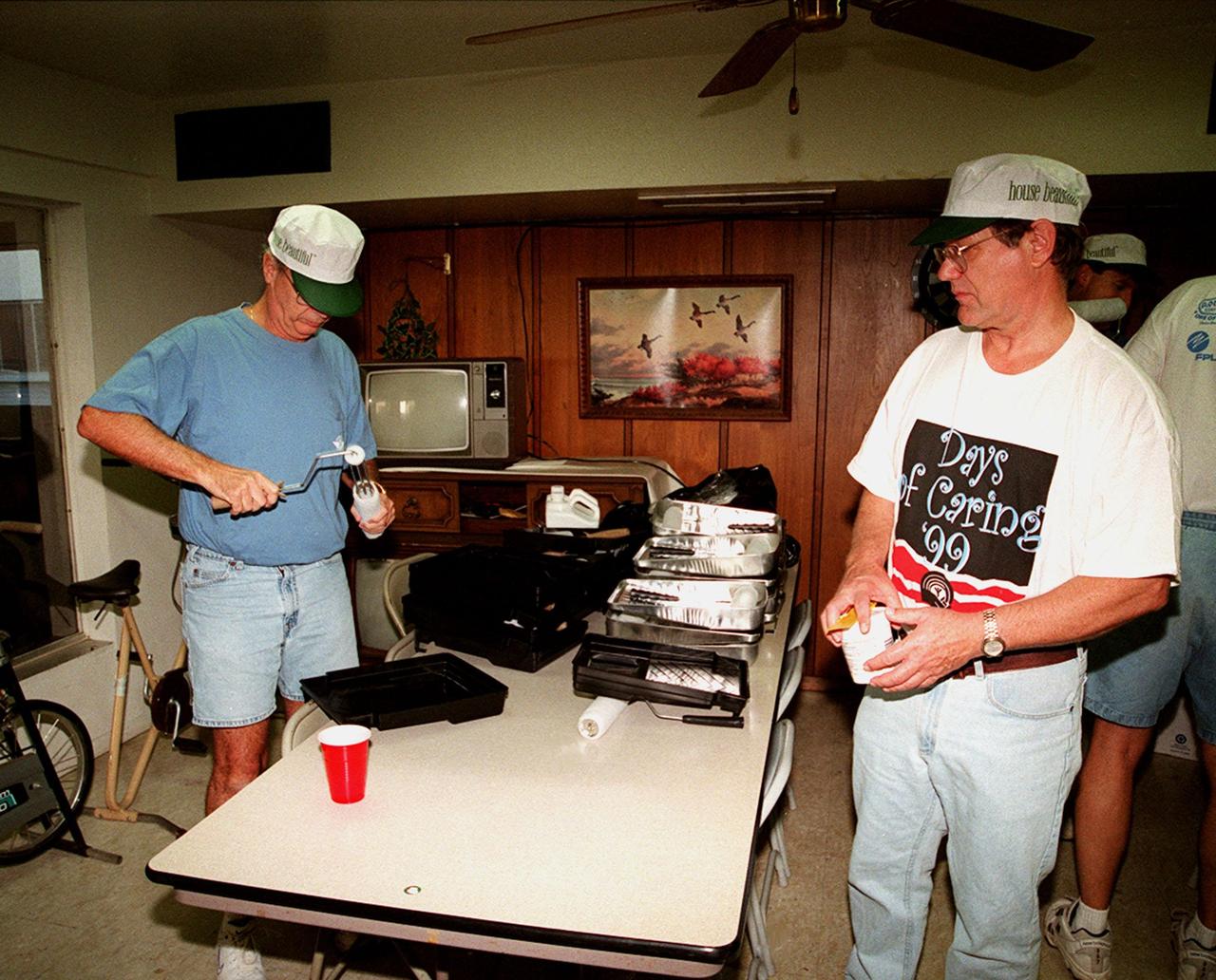
Volunteers for Days of Caring '99 set up the paint trays for painting at Baxley Manor, an apartment building for senior citizens on Merritt Island. Coordinated by the KSC Community Relations Council, Days of Caring provides an opportunity for employees to volunteer their services in projects such as painting, planting flowers, reading to school children, and more. Organizations accepting volunteers include The Embers, Yellow Umbrella, Serene Harbor, Domestic Violence Program, the YMCA of Brevard County, and others
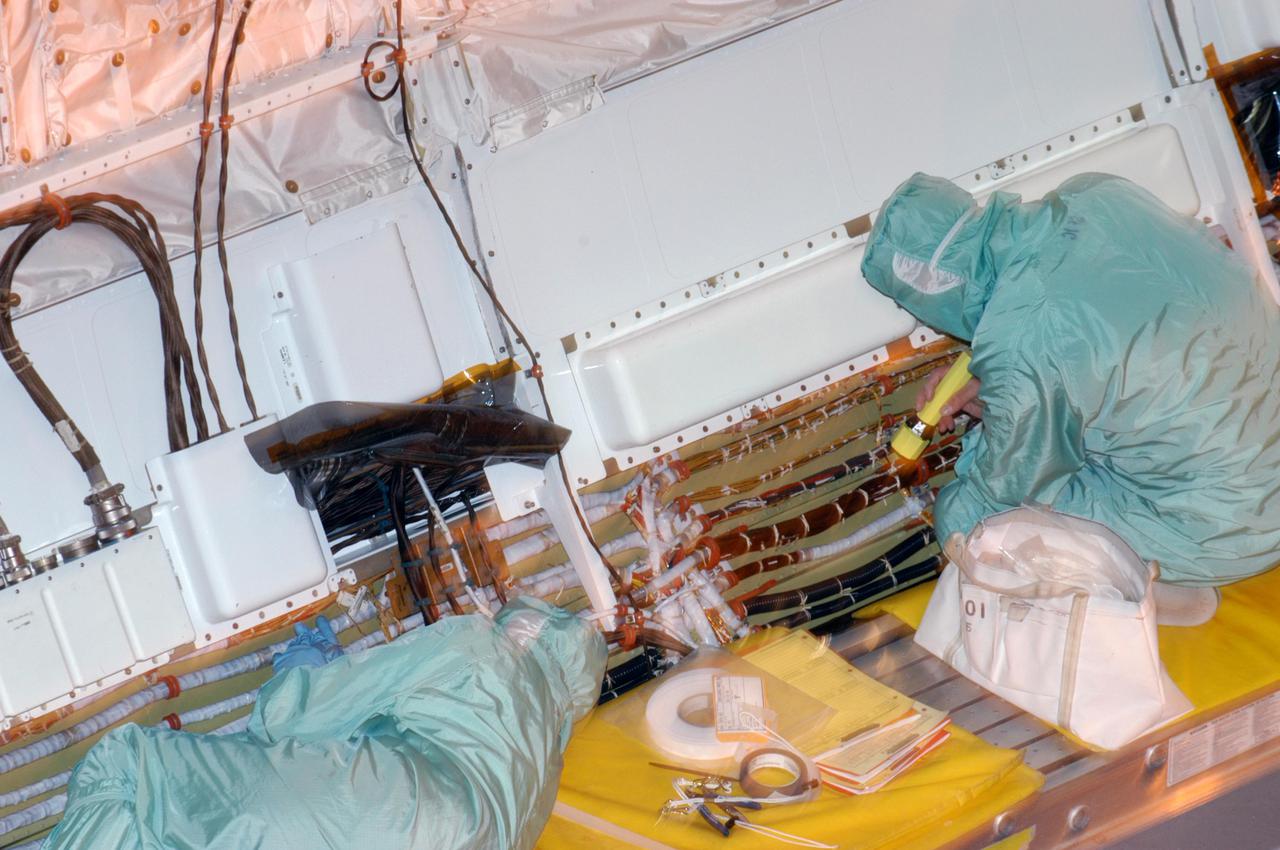
KENNEDY SPACE CENTER, FLA. - In the Orbiter Processing Facility at NASA’s Kennedy Space Center in Florida, workers are removing wire tray covers on Discovery and adding chafe prevention. Boroscope inspections revealed the need for the protection to prevent fasteners from causing minor chafing on the tubing surrounding the wires. Discovery is the designated orbiter for Return to Flight mission STS-114 to the International Space Station. The launch window for the mission is May 15 to June 3, 2005.
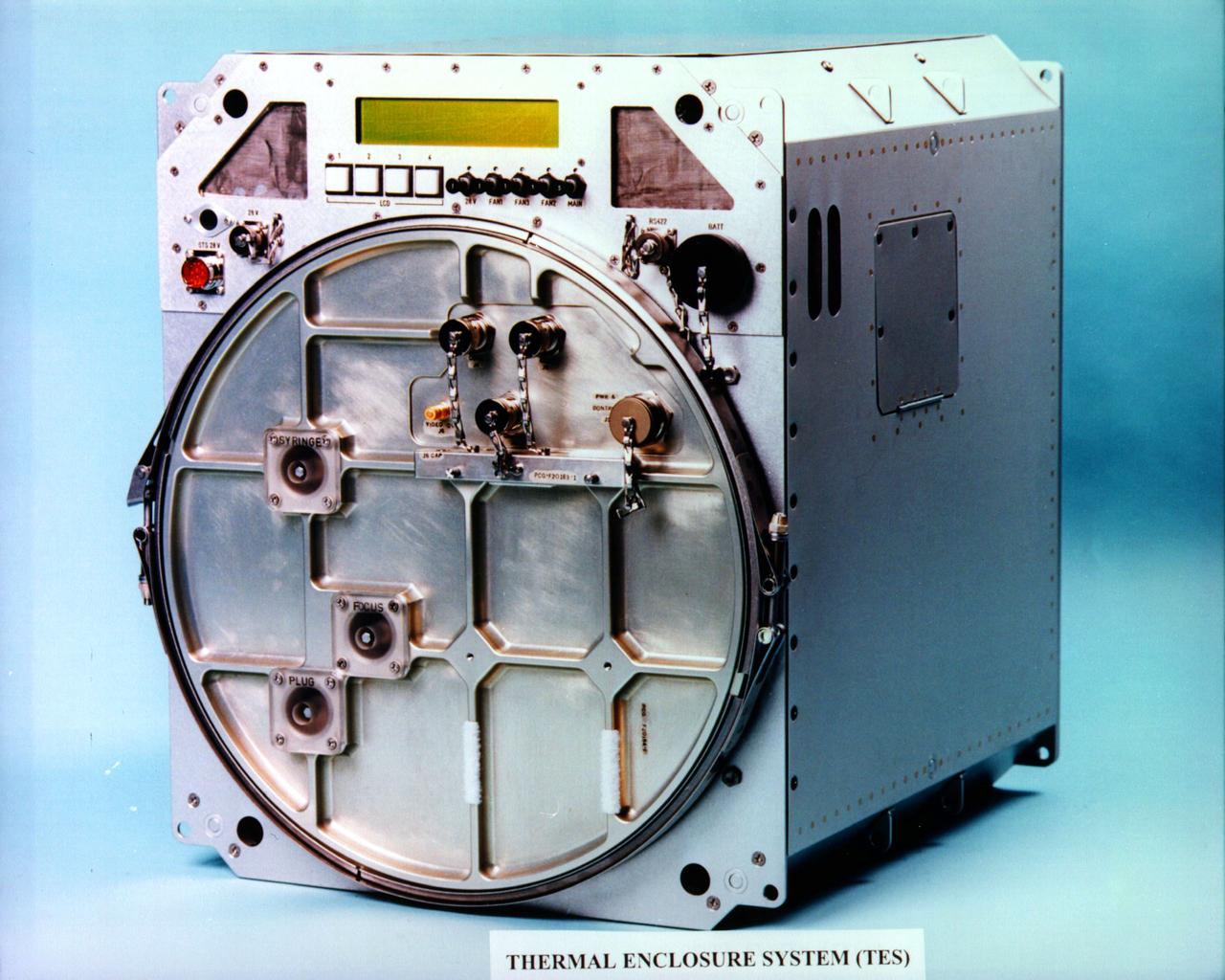
The Thermal Enclosure System (TES) provides thermal control for protein crystal growth experiments. The TES, housed in two middeck lockers on board the Space Shuttle, contains four Vapor Diffusion Apparatus (VDA) trays. Each can act as either a refrigerator or an incubator and its temperature can be controlled to within one-tenth degree C. The first flight of the TES was during USMP-2 (STS-62).
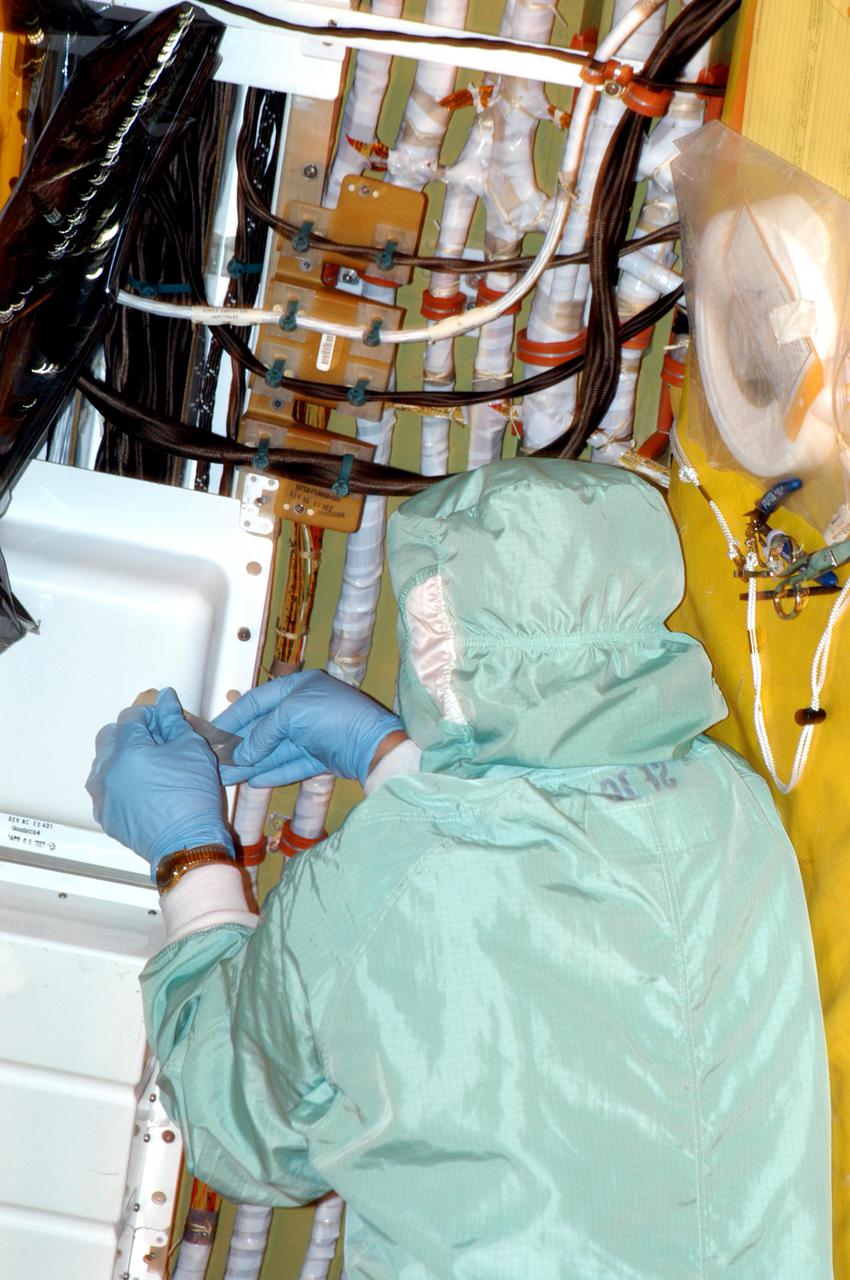
KENNEDY SPACE CENTER, FLA. - In the Orbiter Processing Facility at NASA’s Kennedy Space Center in Florida, a worker are removing wire tray covers on Discovery and adding chafe prevention. Boroscope inspections revealed the need for the protection to prevent fasteners from causing minor chafing on the tubing surrounding the wires. Discovery is the designated orbiter for Return to Flight mission STS-114 to the International Space Station. The launch window for the mission is May 15 to June 3, 2005.
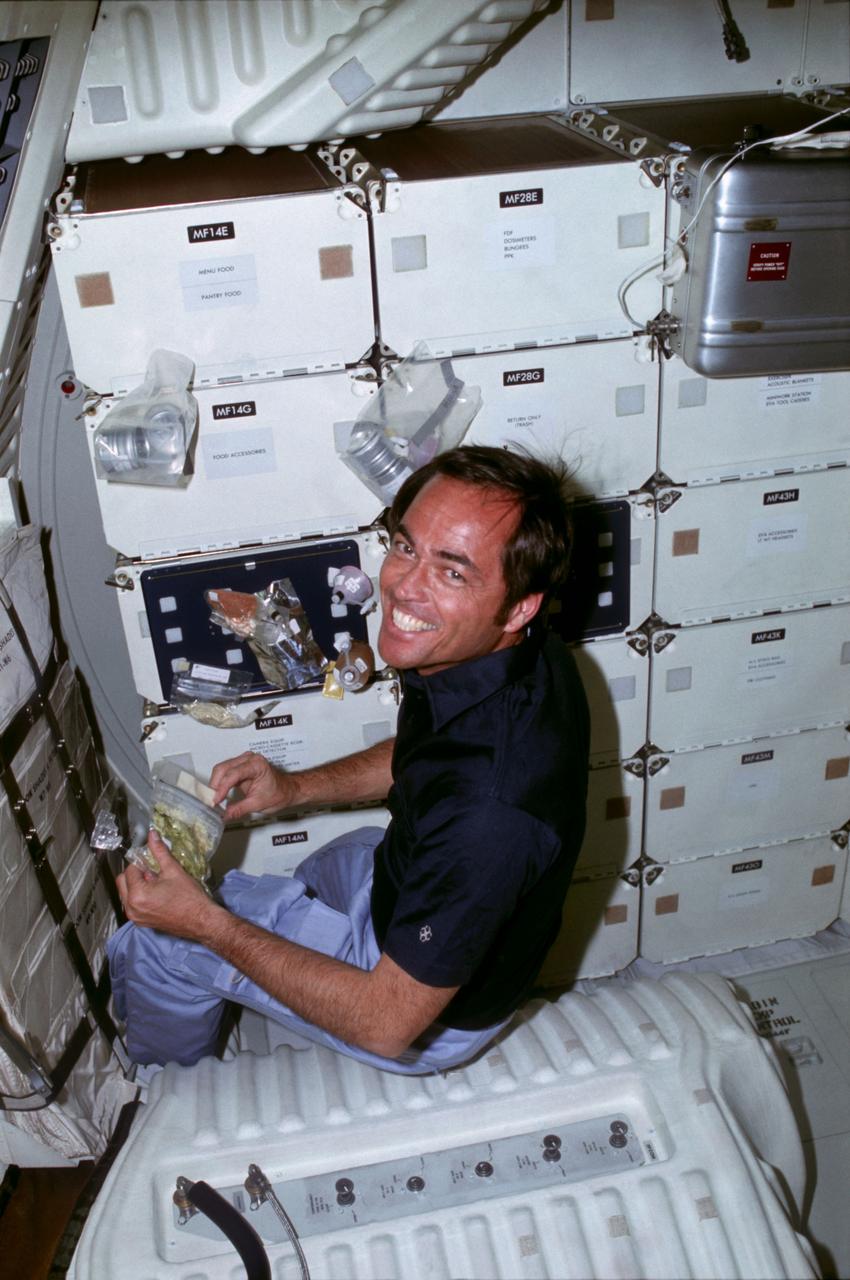
STS001-07-502 (12-14 April 1981) --- A smiling Robert L. Crippen, STS-1 pilot, is about to prepare a meal aboard the space shuttle Columbia in Earth orbit. Prepared meals, which need only water added, and beverages, can be seen attached to trays, which are mounted on locker doors in Columbia's middeck area. Astronaut John W. Young, commander, took this photograph with a 35mm camera. Photo credit: NASA
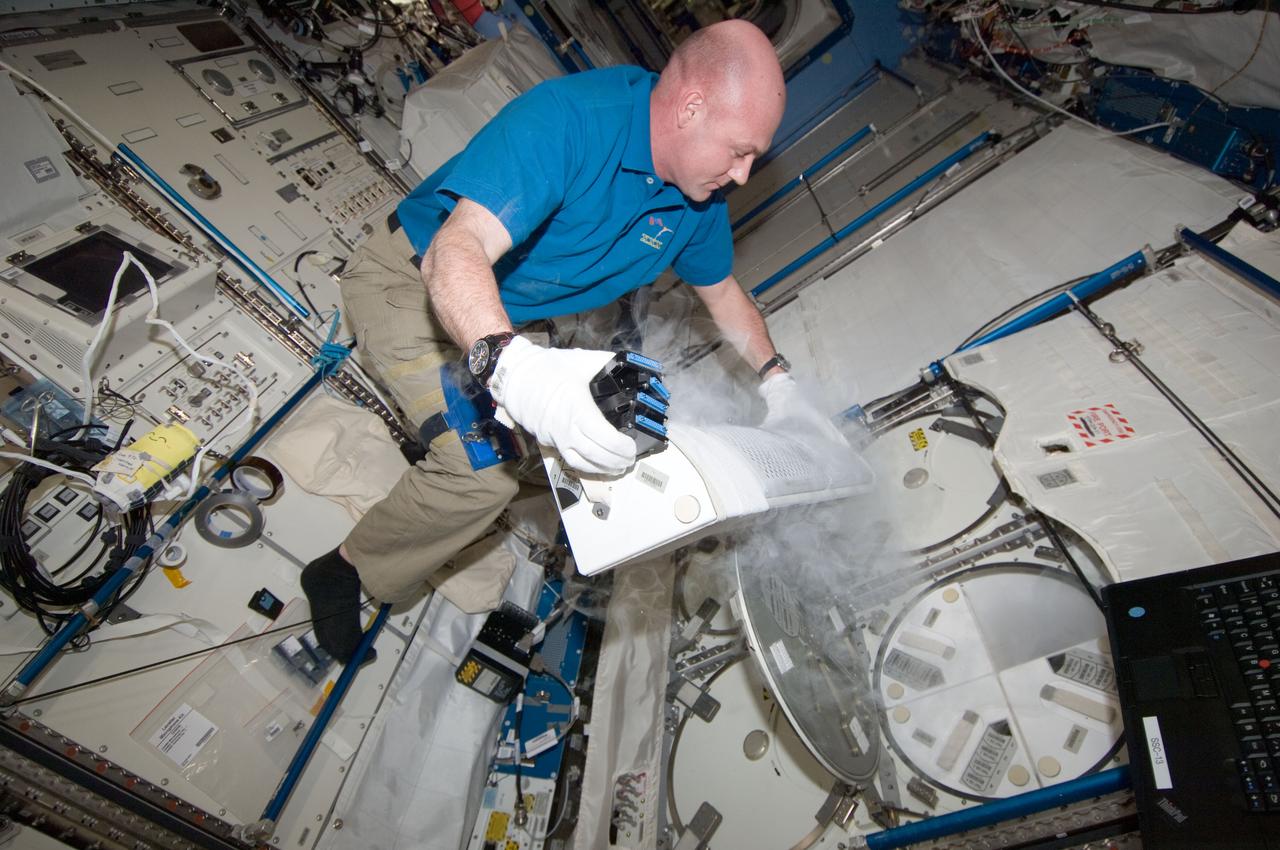
ISS030-E-033272 (24 Dec. 2011) --- European Space Agency astronaut Andre Kuipers, Expedition 30 flight engineer, prepares to insert ESA Role of Apoptosis in Lymphocyte Depression 2 (ROALD-2) experiment samples into a Minus Eighty Laboratory Freezer for ISS (MELFI-1) dewar tray located in the International Space Station's Kibo laboratory.
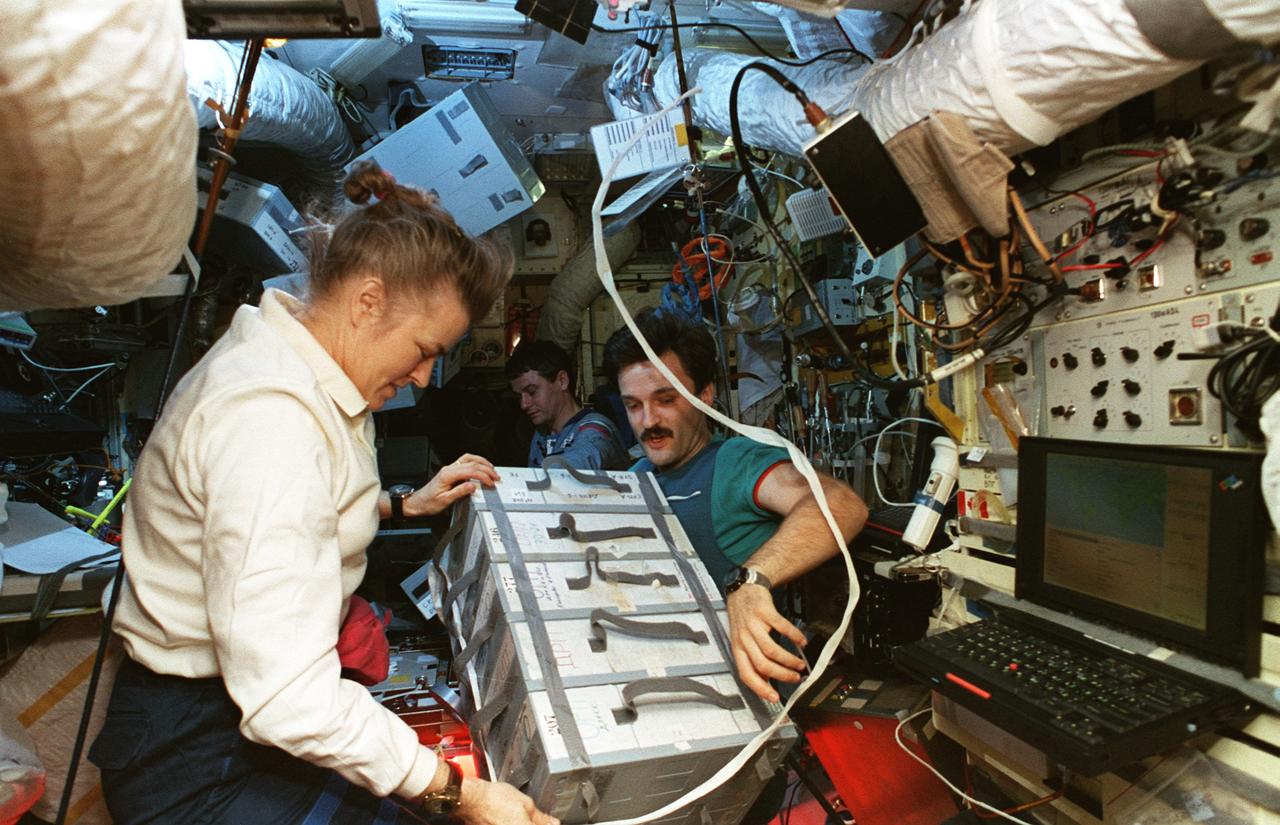
STS079-357-015 (20 Sept. 1996) --- Astronaut Shannon W. Lucid, in one her final opportunities to work with cosmonauts on her record stay in space, joins cosmonaut Aleksandr Kaleri in securing empty food trays to be moved from Russia's Mir Space Station to the Space Shuttle Atlantis. Cosmonaut Valeri Korzun, Mir-22 commander, is busy with other chores in the background.
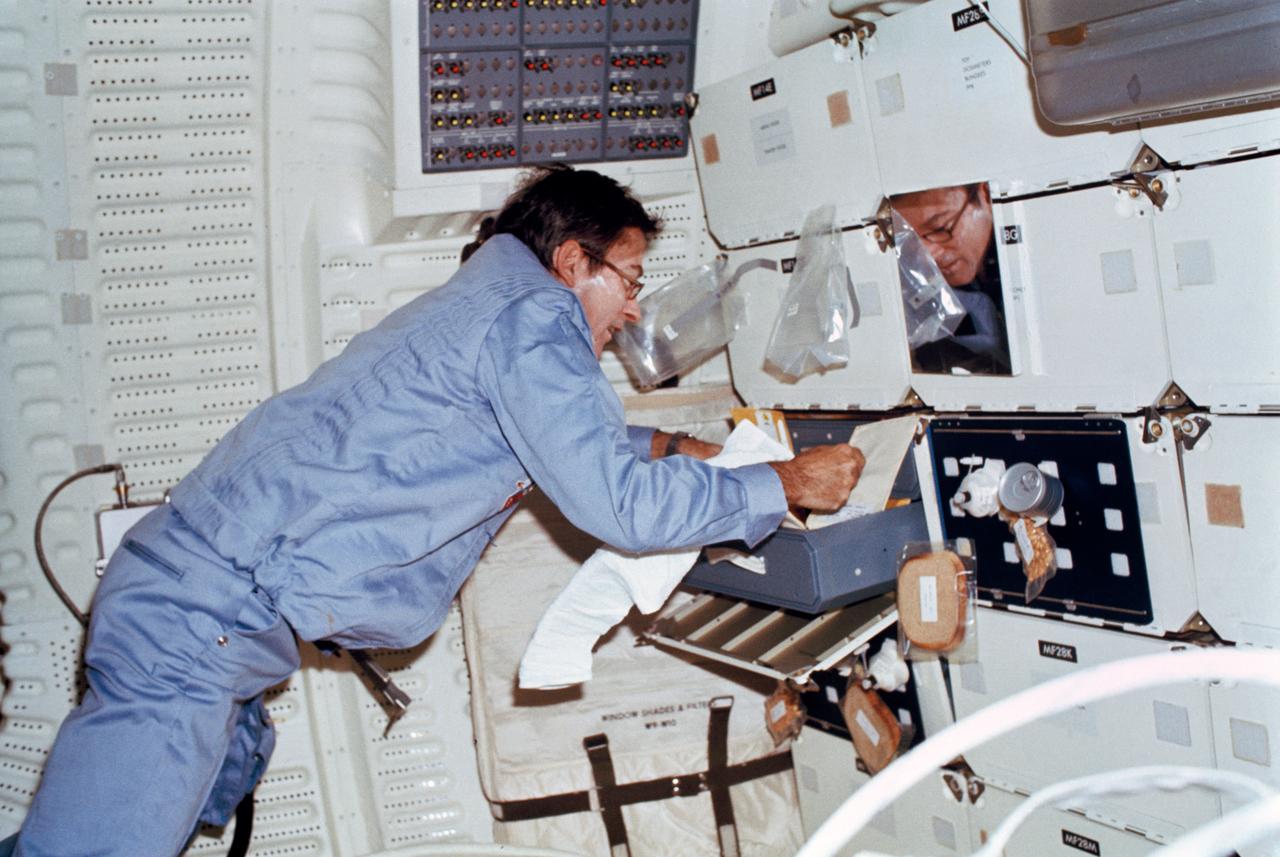
S81-30422 (12-14 April 1981) --- Astronaut John W. Young, STS-1 commander, cleans off his razor after shaving his face on the middeck of the space shuttle orbiter Columbia. A food tray can be seen mounted on a locker door at right. This 35mm frame was exposed by astronaut Robert L. Crippen, pilot. Photo credit: NASA
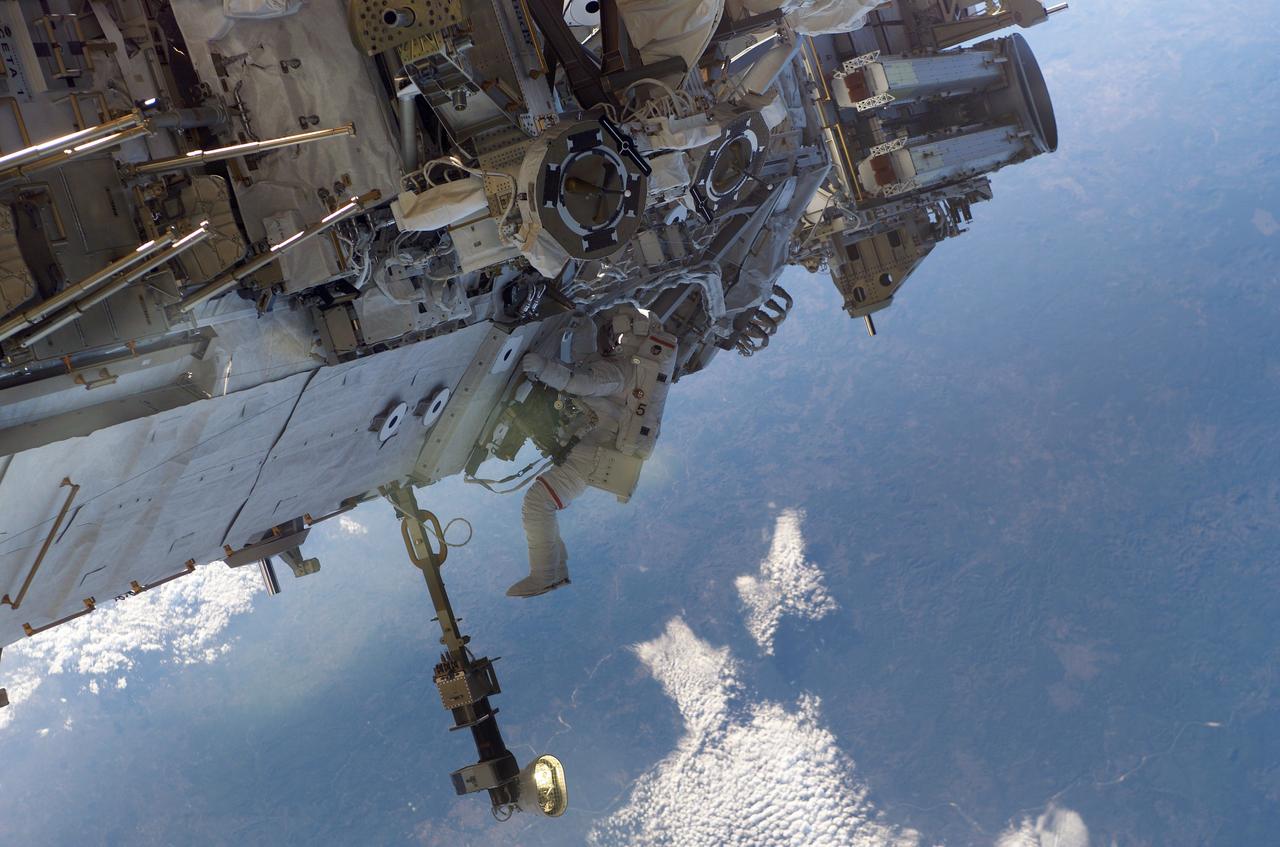
S115-E-05514 (12 Sept. 2006) --- Astronaut Joseph R. Tanner, STS-115 mission specialist, connects cables from P1 to P3 lower utility tray during the Sept. 12 spacewalk, which he shared with astronaut Heidemarie M. Stefanyshyn-Piper, mission specialist. The two participated in the first of three scheduled STS-115 extravehicular activity (EVA) sessions as the Atlantis astronauts and the Expedition 13 crew members join efforts this week to resume construction of the International Space Station.
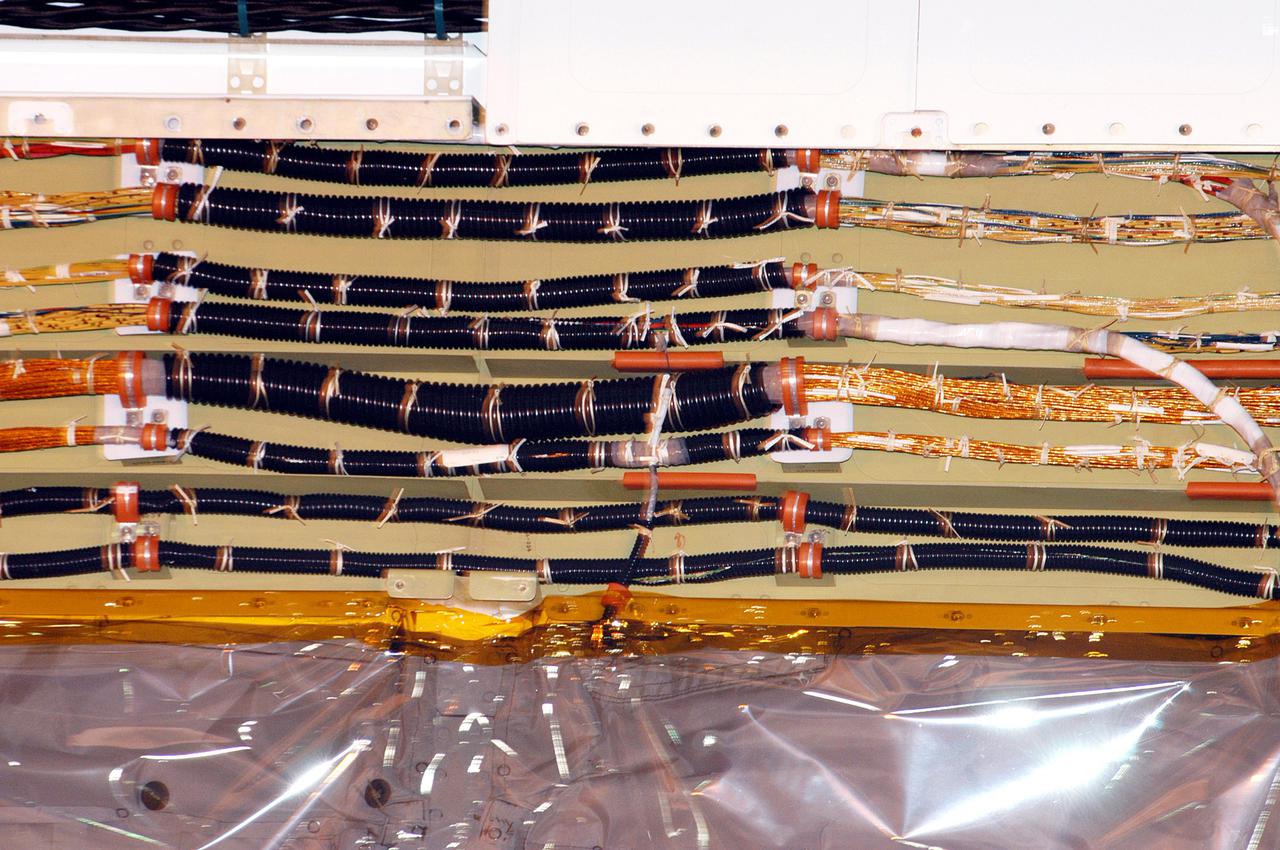
KENNEDY SPACE CENTER, FLA. - In the Orbiter Processing Facility at NASA’s Kennedy Space Center in Florida, workers are removing wire tray covers on Discovery and adding chafe prevention. The wiring is seen here. Boroscope inspections revealed the need for the protection to prevent fasteners from causing minor chafing on the tubing surrounding the wires. Discovery is the designated orbiter for Return to Flight mission STS-114 to the International Space Station. The launch window for the mission is May 15 to June 3, 2005.
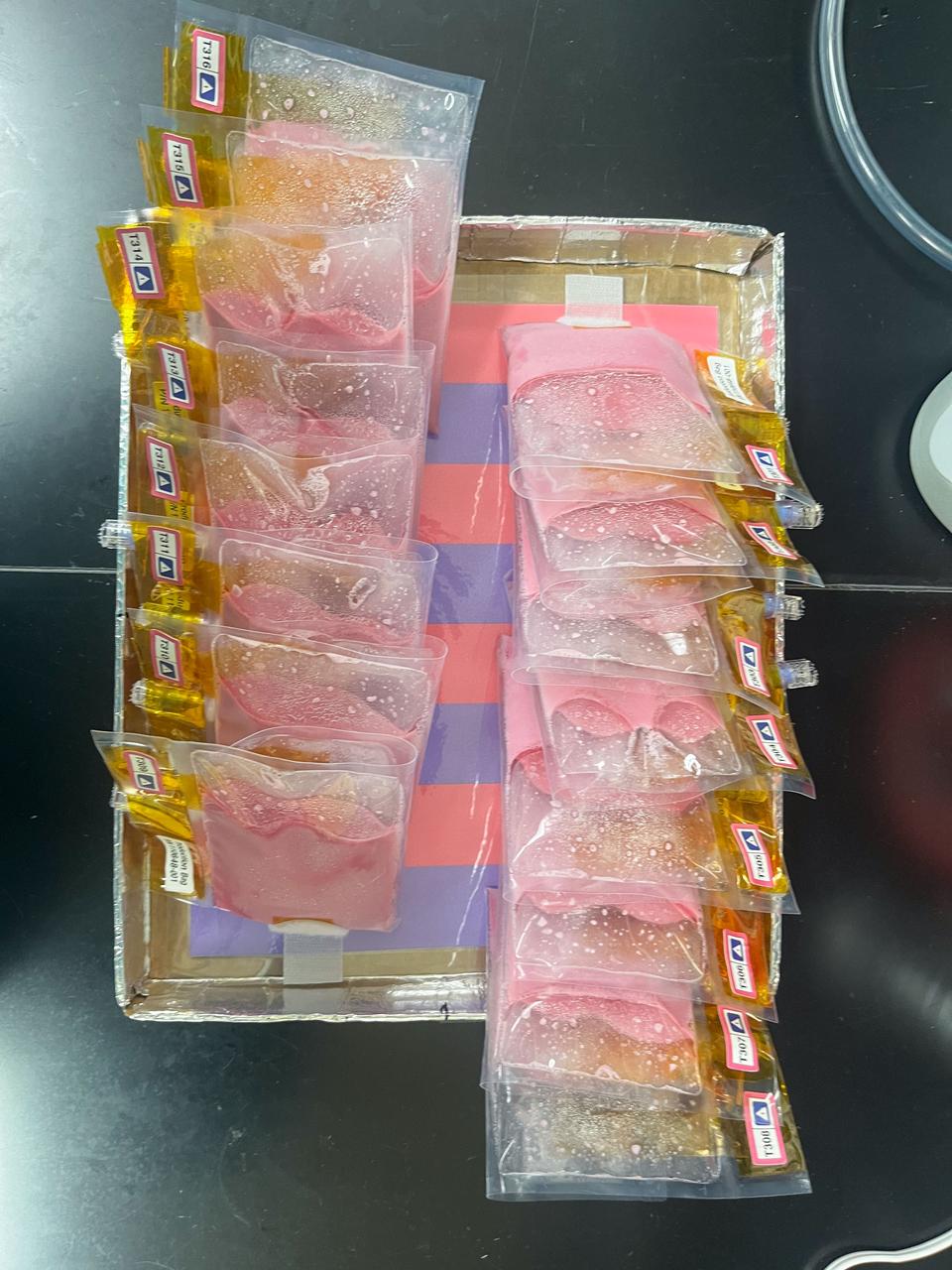
Sixteen BioNutrients-3 yogurt bags attached to the SABL Tray mockup during the BioNutrients-3 Experiment Verification Test. Below the bags, the purple and pink SABL interface board, which is used for pH comparison, is visible. The pink color of the bags indicates that these yogurt bags have completed their incubation, causing the pH indicator to change from purple to pink. Photo Credit: NASA Ames
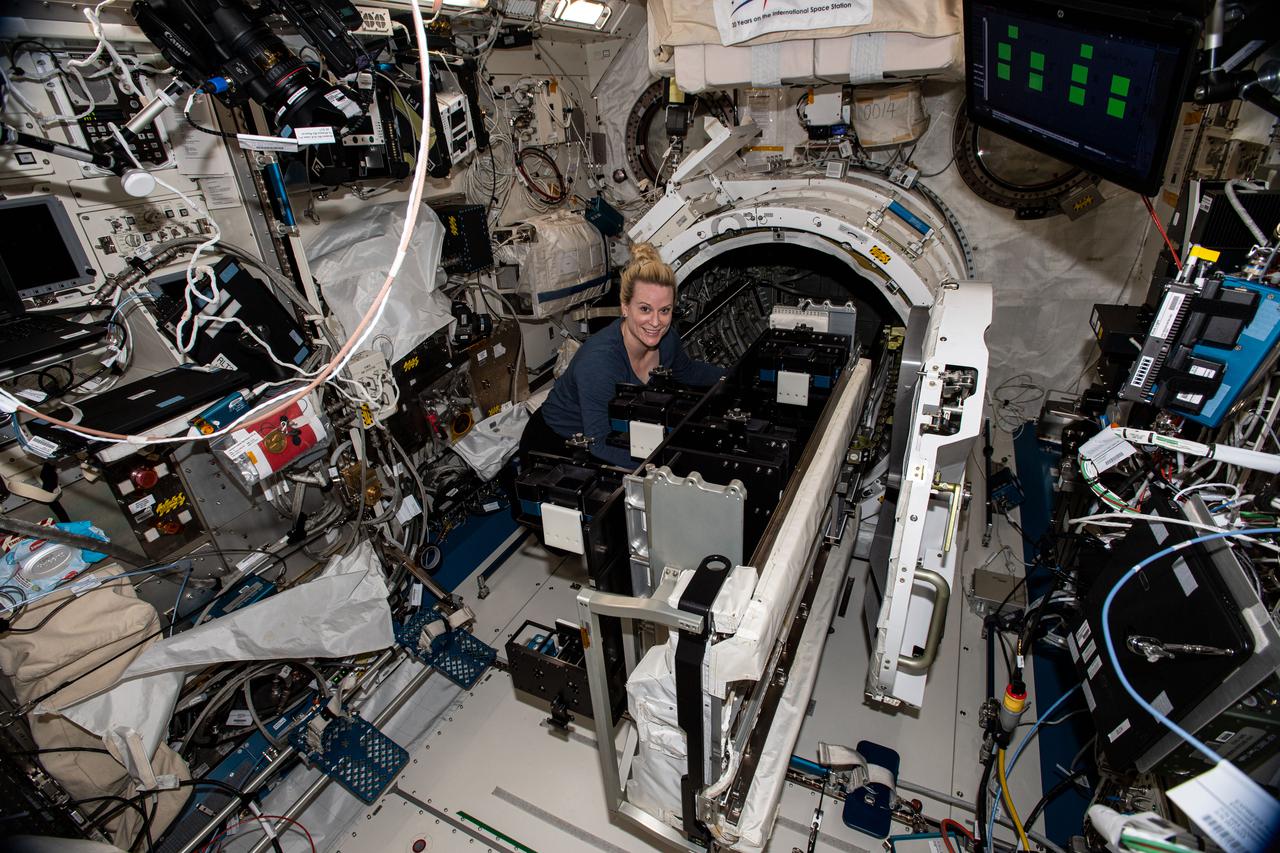
iss064e005561 (November 24, 2020) --- Flight Engineer Kate Rubins pauses for a photo during operations (OPS) to install MISSE (Materials International Space Station Experiment) Transfer Tray 2 (MTT 2) on the JEM (Japanese Experiment Module) Orbital Replacement Unit Transfer Interface (JOTI) attached to the JEM Airlock (JEMAL) Slide Table. Photo was taken in the Kibo JEM.
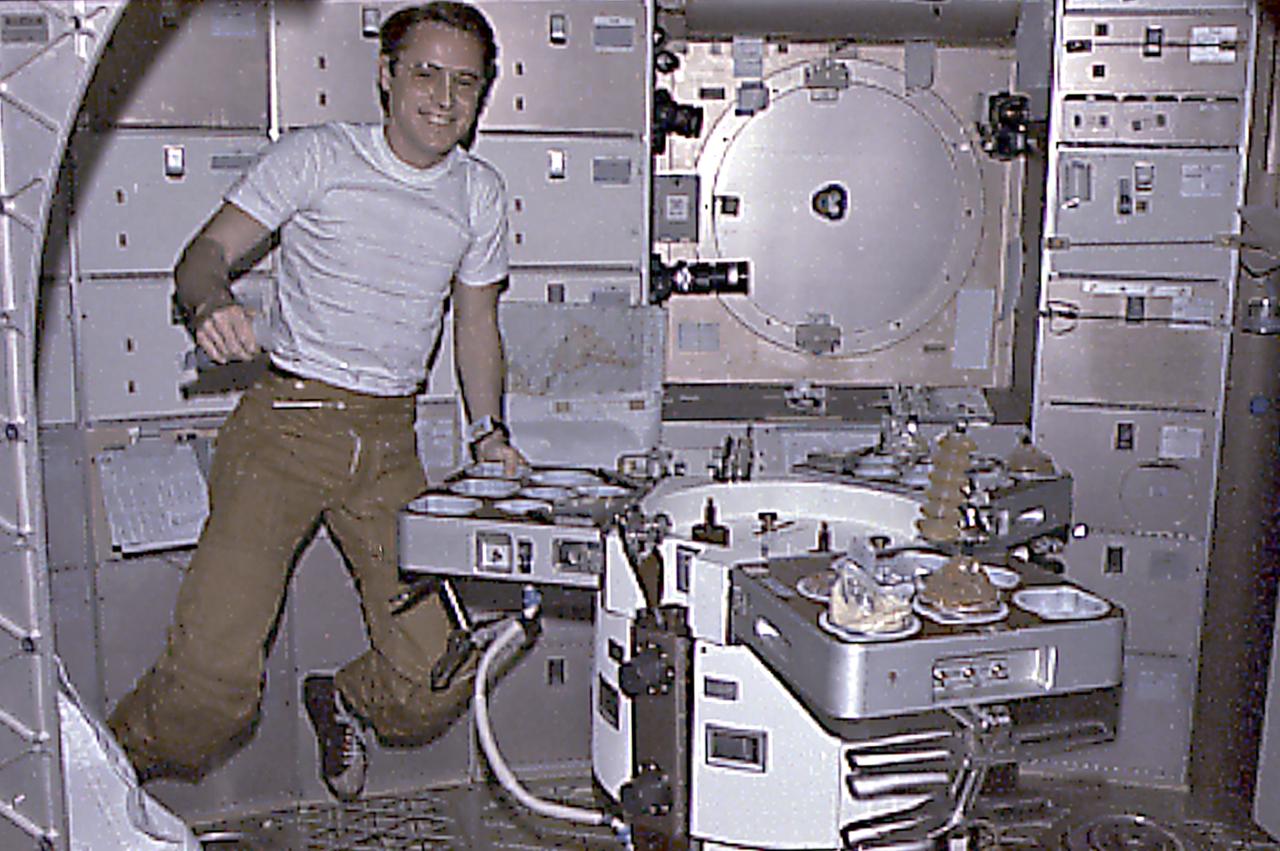
This Skylab-4 mission onboard photograph shows Astronaut Ed Gibson getting ready to prepare his meal in the crew wardroom. The tray contained heating elements for preparing the individual food packets. The food on Skylab was a great improvement over that on earlier spaceflights. It was no longer necessary to squeeze liquified food from plastic tubes. Skylab's kitchen was so equipped that each crewman could select his own menu and prepare it to his own taste.
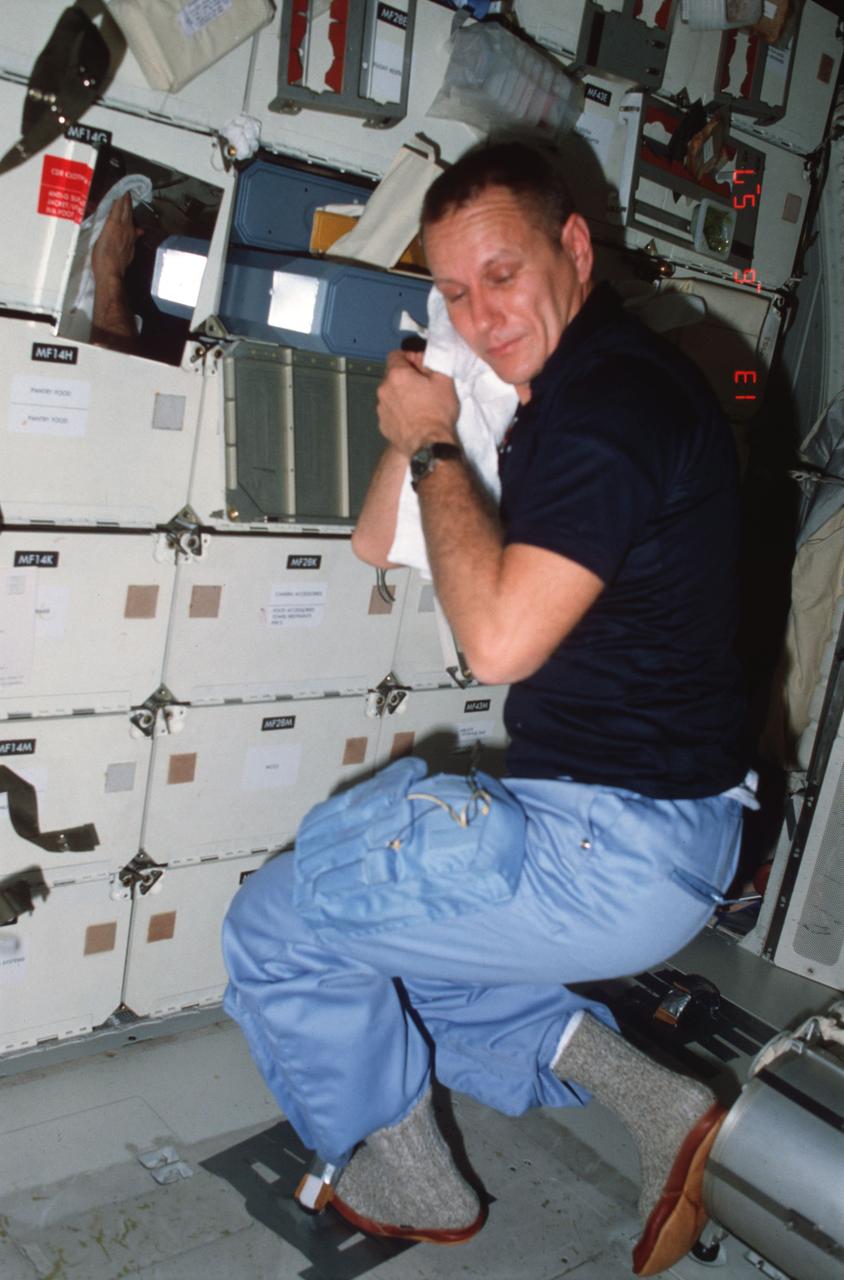
STS005-06-230 (11-16 Nov. 1982) --- On middeck, astronaut Robert F. Overmyer, STS-5 pilot, drying his face with a towel from forward single tray personal item stowage locker, completes personal hygiene activities (shaving) and demonstrates use of intravehicular activity (IVA) foot restraint on floor. Photo credit: NASA
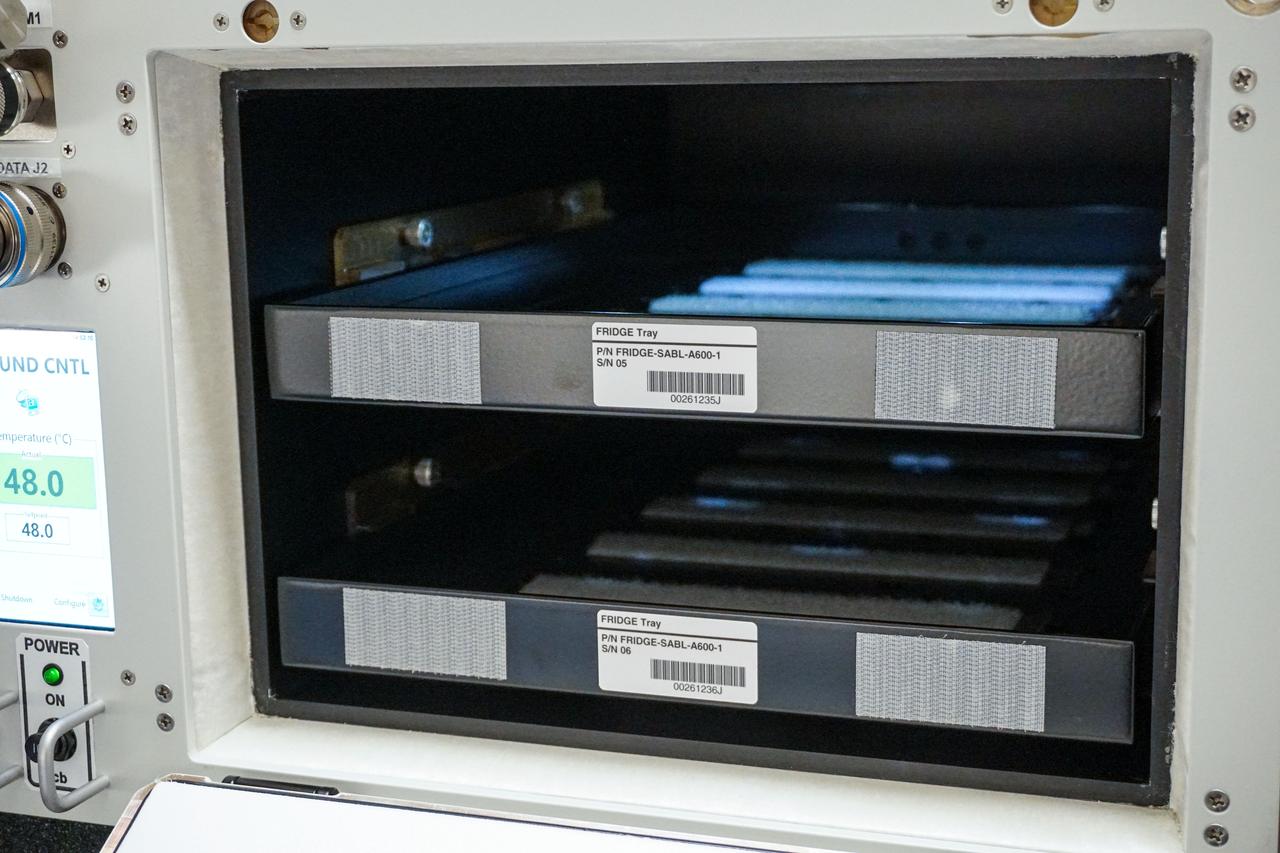
jsc2020e040952 (8/3/2020) --- A prefligt interior view of Freezer / Refrigerator / Incubator Device for Galley and Experimentation (FRIDGE) in nominal configuration with 2 trays. The Galley Refrigerator-Freezer, or Freezer/Refrigerator/Incubator Device for Galley and Experimentation (FRIDGE) is a locker-sized unit that provides active temperature control with a range from -20.0°C to +48.0°C. It can accommodate storage of both crew galley items and scientific research samples and can be fully operated and maintained from the ground.
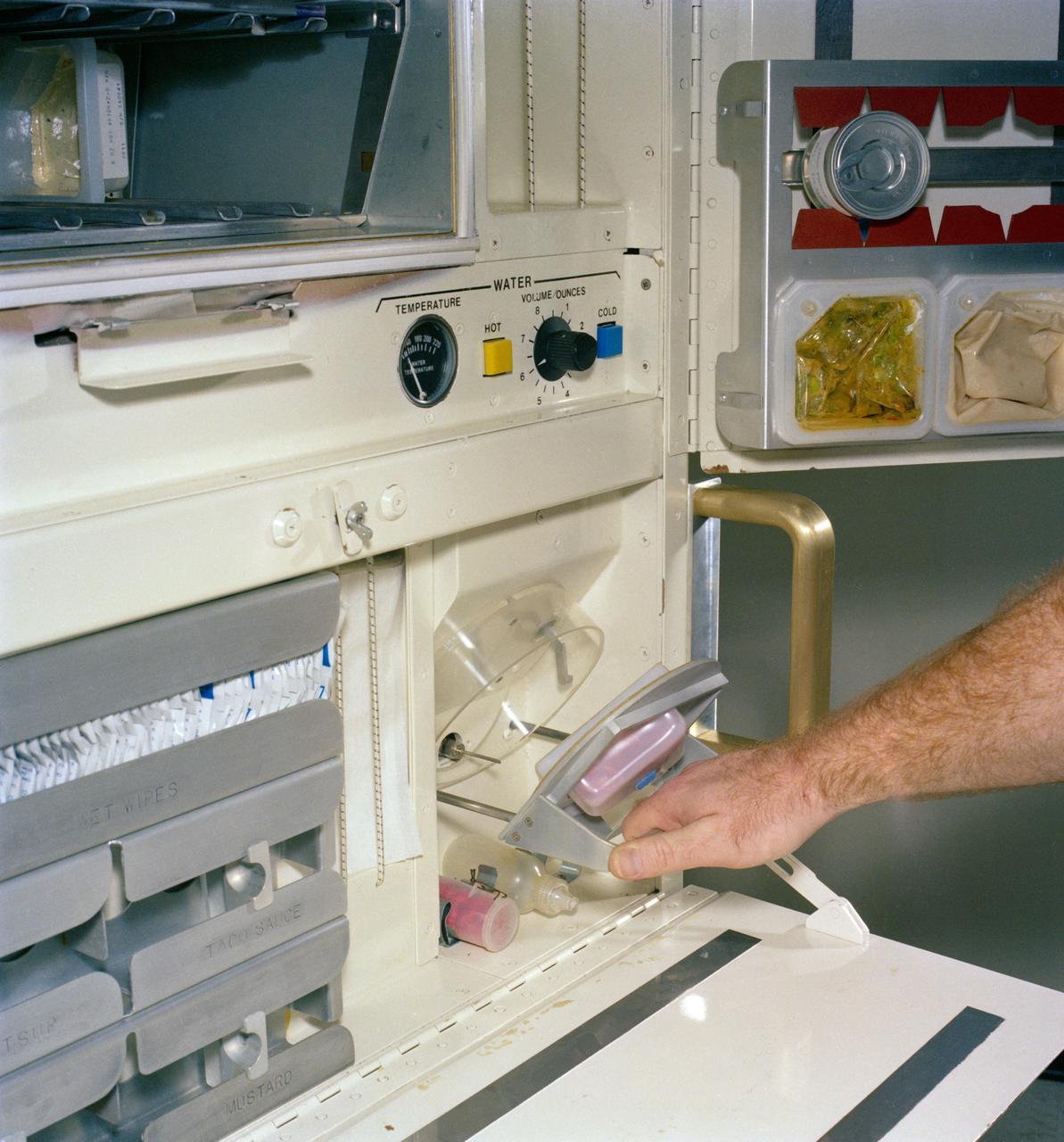
S82-26423 (January 1982) --- This is a close-up view of the rehydration unit to be used in meal preparation on operational space shuttle flights. The unit is located on the middeck of the space shuttles in the NASA fleet. Note the part of the food tray in upper right corner. Its six compartments (not all pictured) are used in space shuttle meal preparation and consumption. Photo credit: NASA
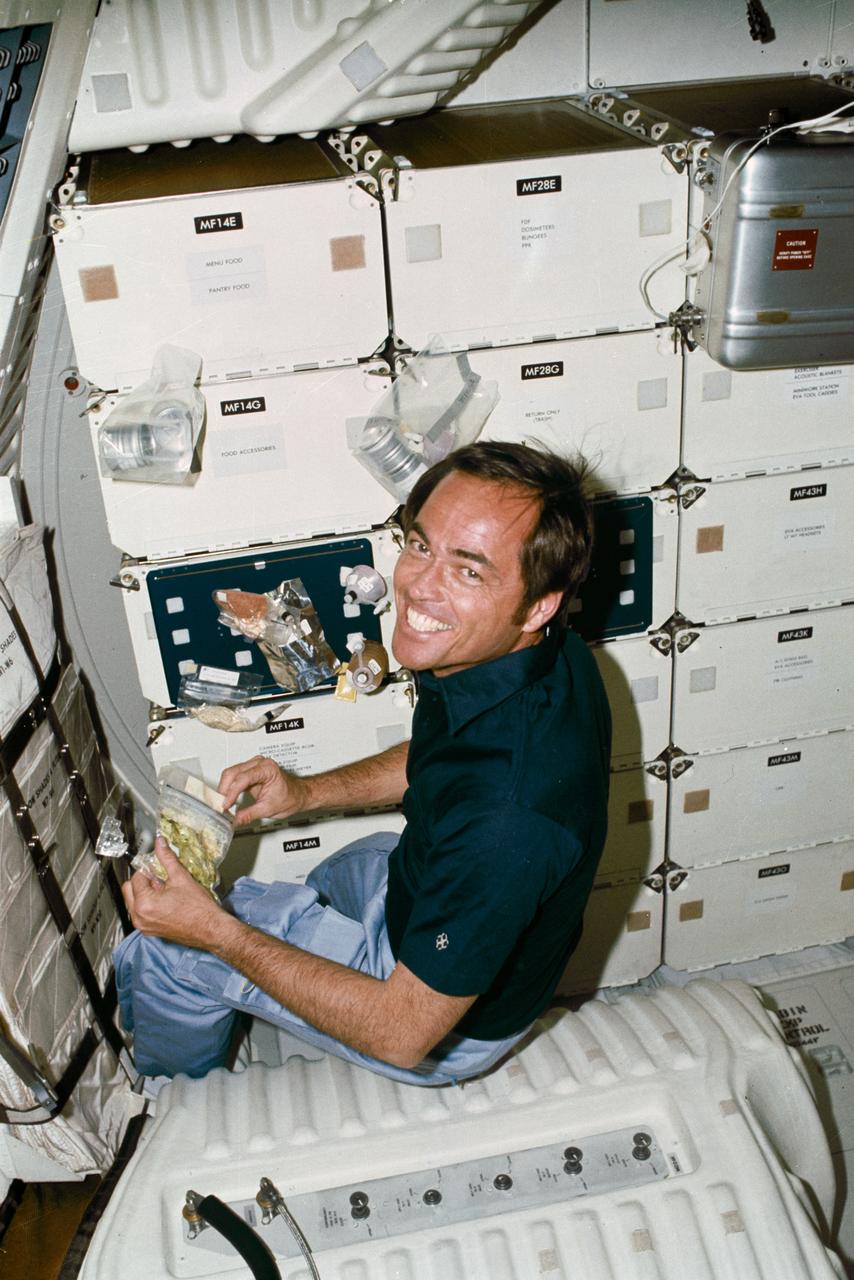
STS001-07-502 (12-14 April 1981) --- A smiling Robert L. Crippen, STS-1 pilot, is about to prepare a meal aboard the space shuttle Columbia in Earth orbit. Prepared meals, which need only water added, and beverages, can be seen attached to trays, which are mounted on locker doors in Columbia's middeck area. Astronaut John W. Young, commander, took this photograph with a 35mm camera. Photo credit: NASA
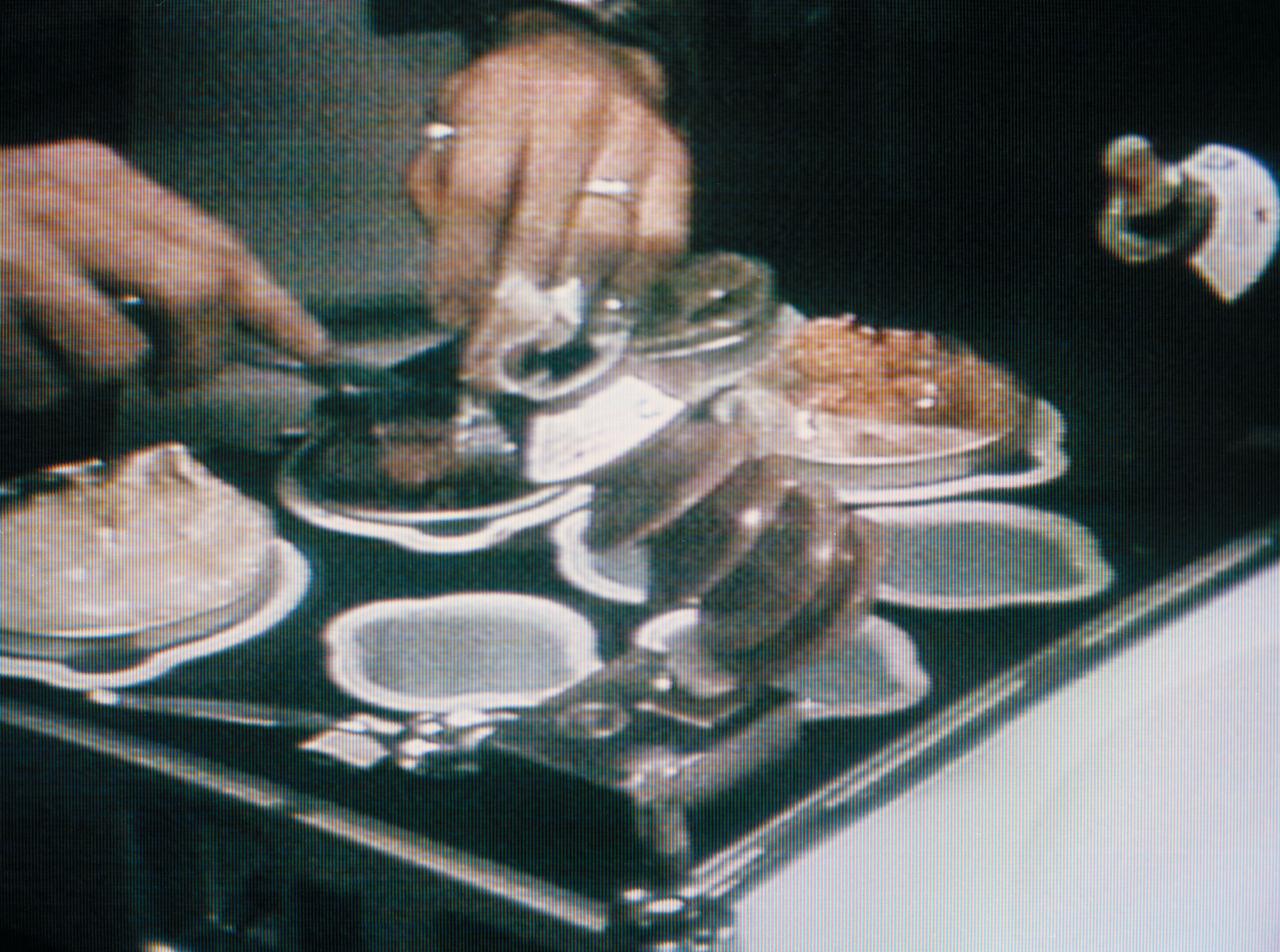
S73-34198 (1 Aug. 1973) --- A close-up view of the hands of astronaut Jack R. Lousma, Skylab 3 pilot, using a silverware utensil to gather food at the food station, in this photographic reproduction taken from a television transmission made by a color TV camera aboard the Skylab space station in Earth orbit. Astronaut Alan L. Bean, commander, had just zoomed the TV camera in for this close-up of the food tray following a series of wide shots of Lousma at the food station. Photo credit: NASA
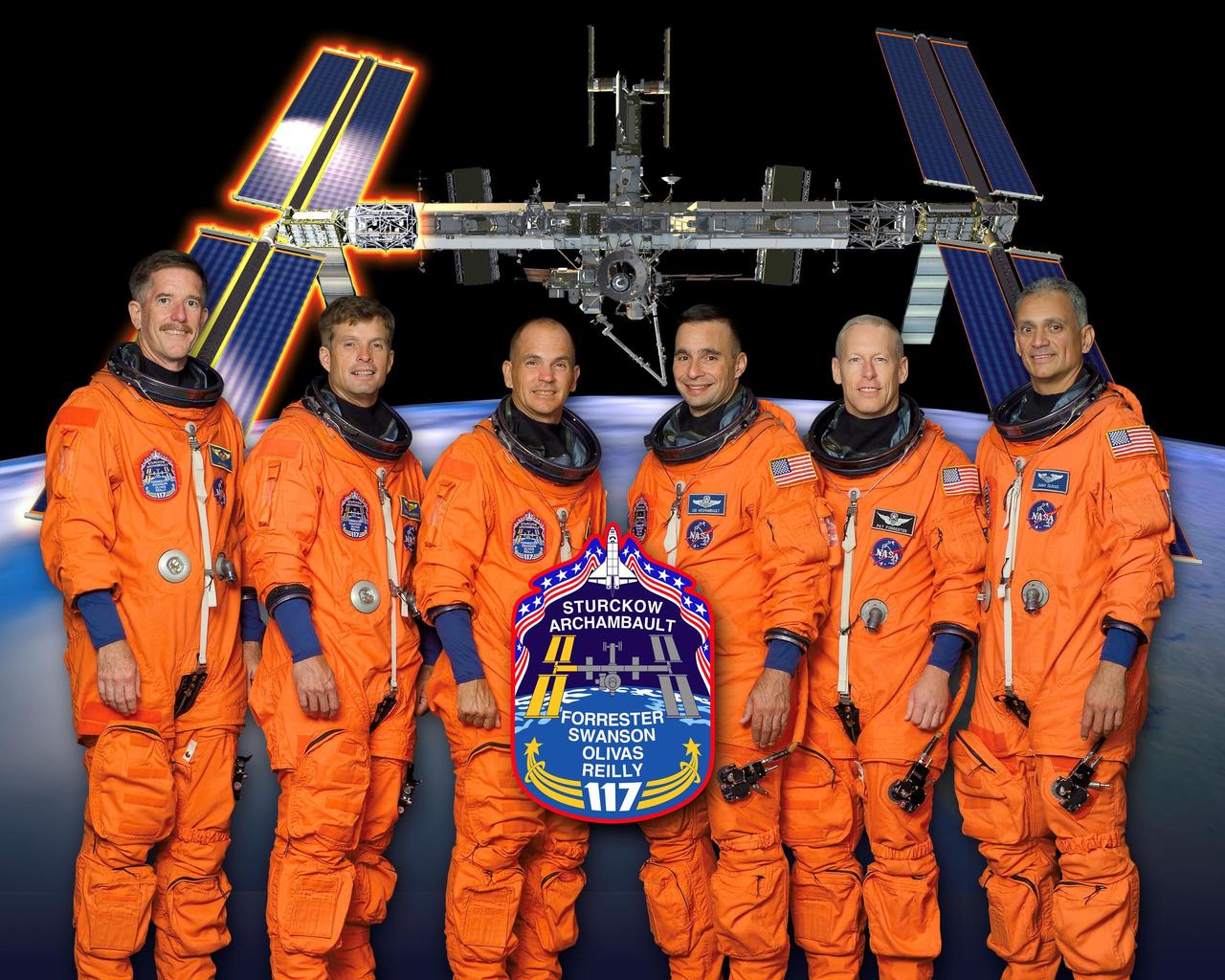
KENNEDY SPACE CENTER, FLA. -- STS117-S-002 -- These six astronauts take a break from traiing to pose for the STS-117 crew portrait. Scheduled to launch aboard the Space Shuttle Atlantis are (from the left) astronauts James F. Reilly II and Steven R. Swanson, mission specialists; Frederick W. (Rick) Sturckow, commander; Lee J. Archambault, pilot; Patrick G. Forrester and John D. (Danny) Olivas, mission specialists. The crew members are attired in training versions of their shuttle launch and entry suits.
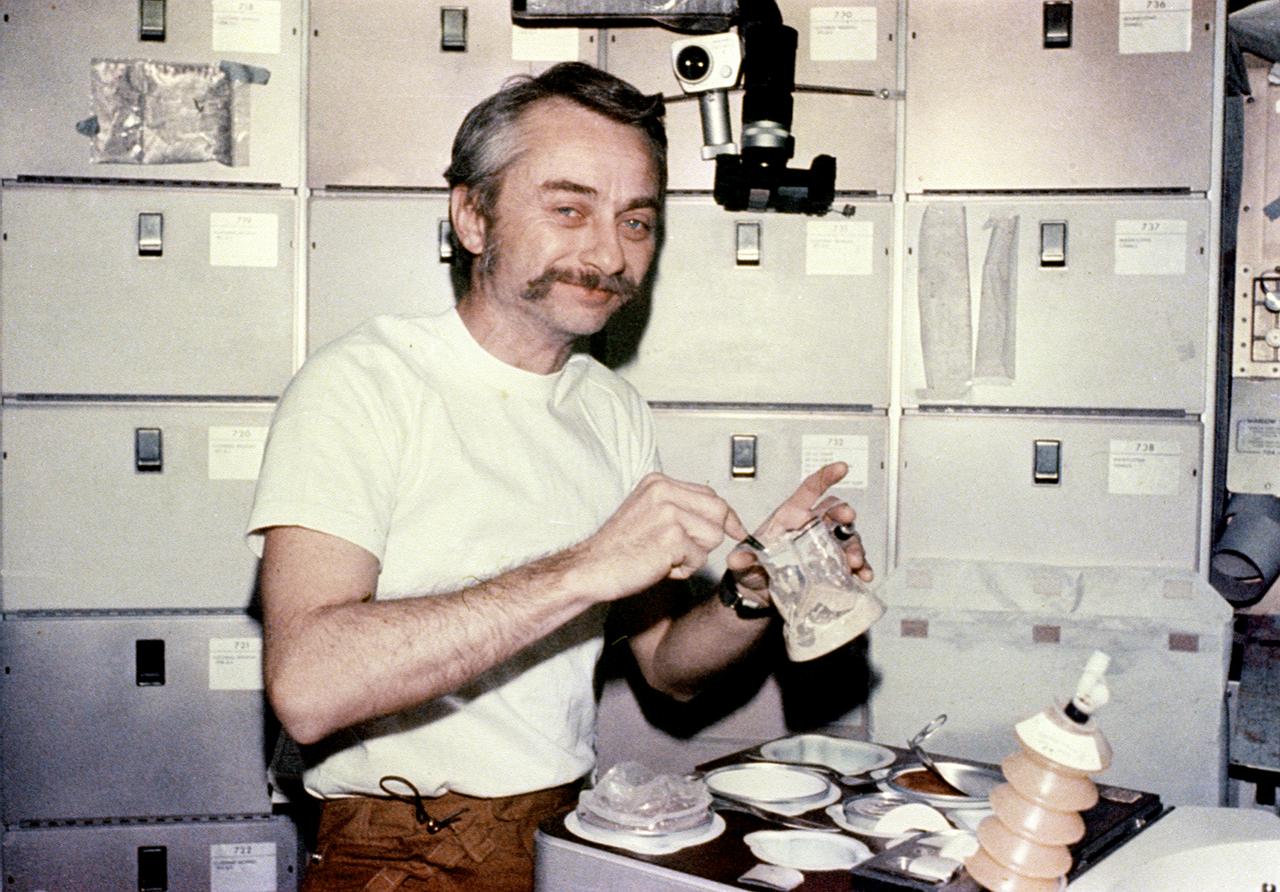
This photograph was taken during the Skylab-3 mission (2nd marned mission), showing Astronaut Owen Garriott enjoying his meal in the Orbital Workshop crew wardroom. The tray contained heating elements for preparing the individual food packets. The food on Skylab was a great improvement over that on earlier spaceflights. It was no longer necessary to squeeze liquified food from plastic tubes. Skylab's kitchen was so equipped that each crewman could select his own menu and prepare it to his own taste.
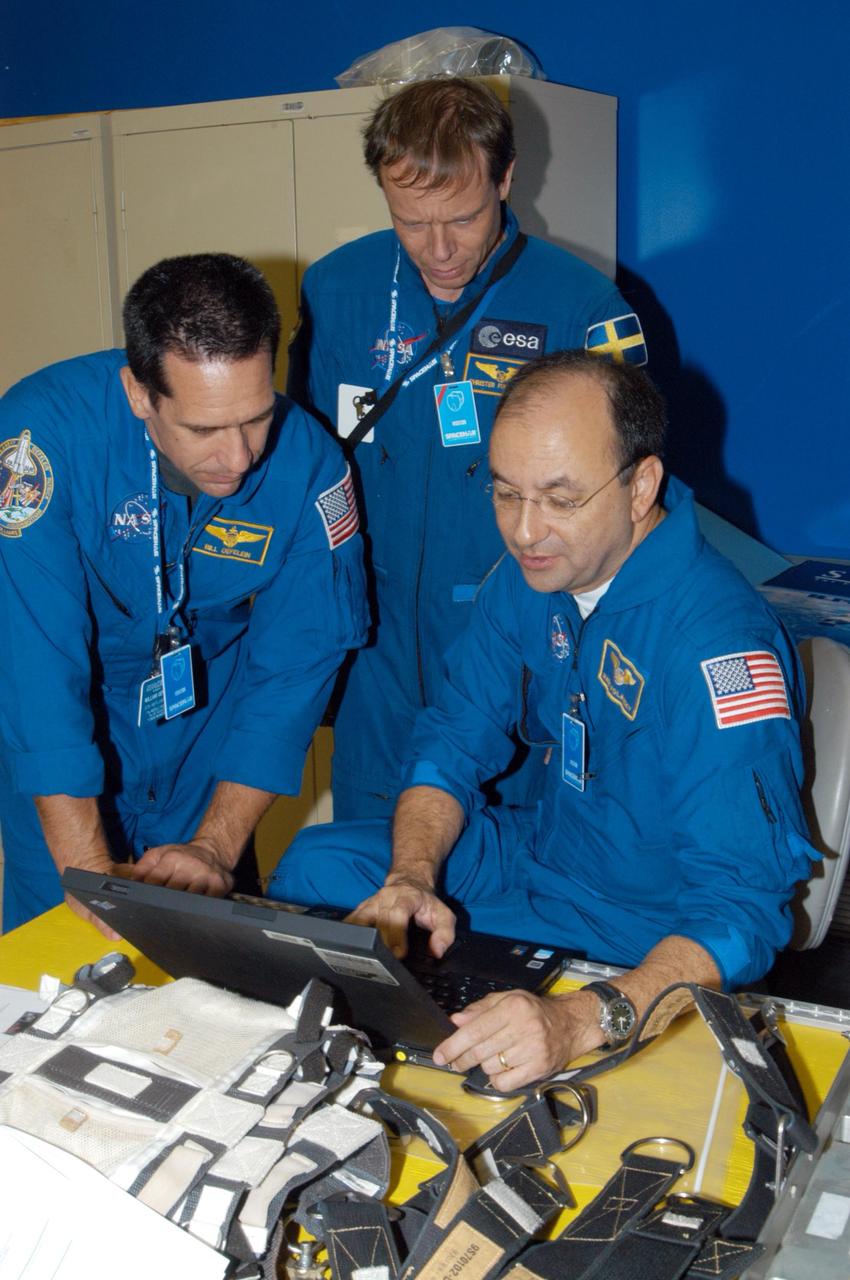
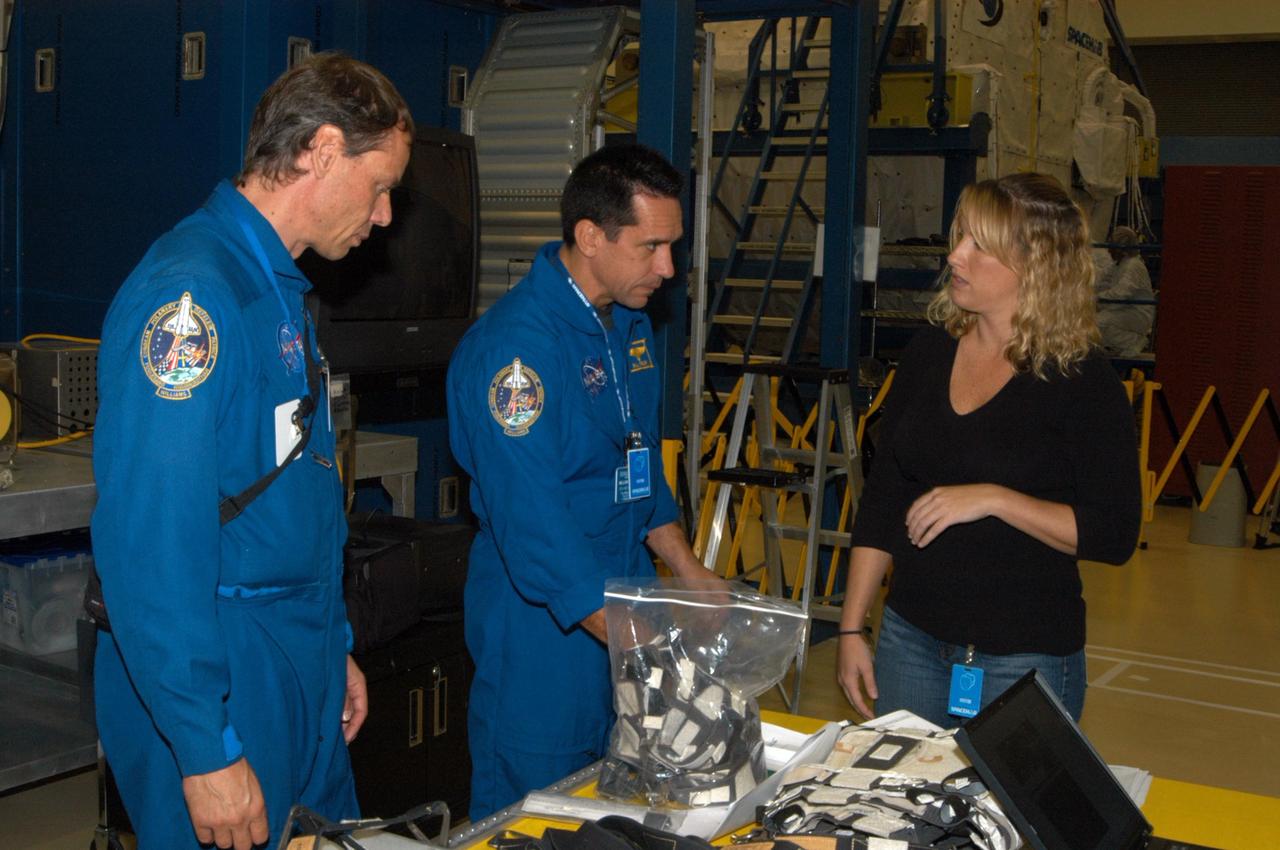
KENNEDY SPACE CENTER, FLA. - At SPACEHAB in Cape Canaveral, Fla., STS-116 Pilot William Oefelein, Mission Specialist Christer Fuglesang and Commander Mark Polansky check data on a computer while examining the rack front stowage trays that are used inside the SPACEHAB module. Mission crews make frequent trips to the Space Coast to become familiar with the equipment and payloads they will be using. STS-116 will be mission number 20 to the International Space Station and construction flight 12A.1. The mission payload is the SPACEHAB module, the P5 integrated truss structure and other key components. Launch is scheduled for no earlier than Dec. 7. Photo credit: NASA/George Shelton
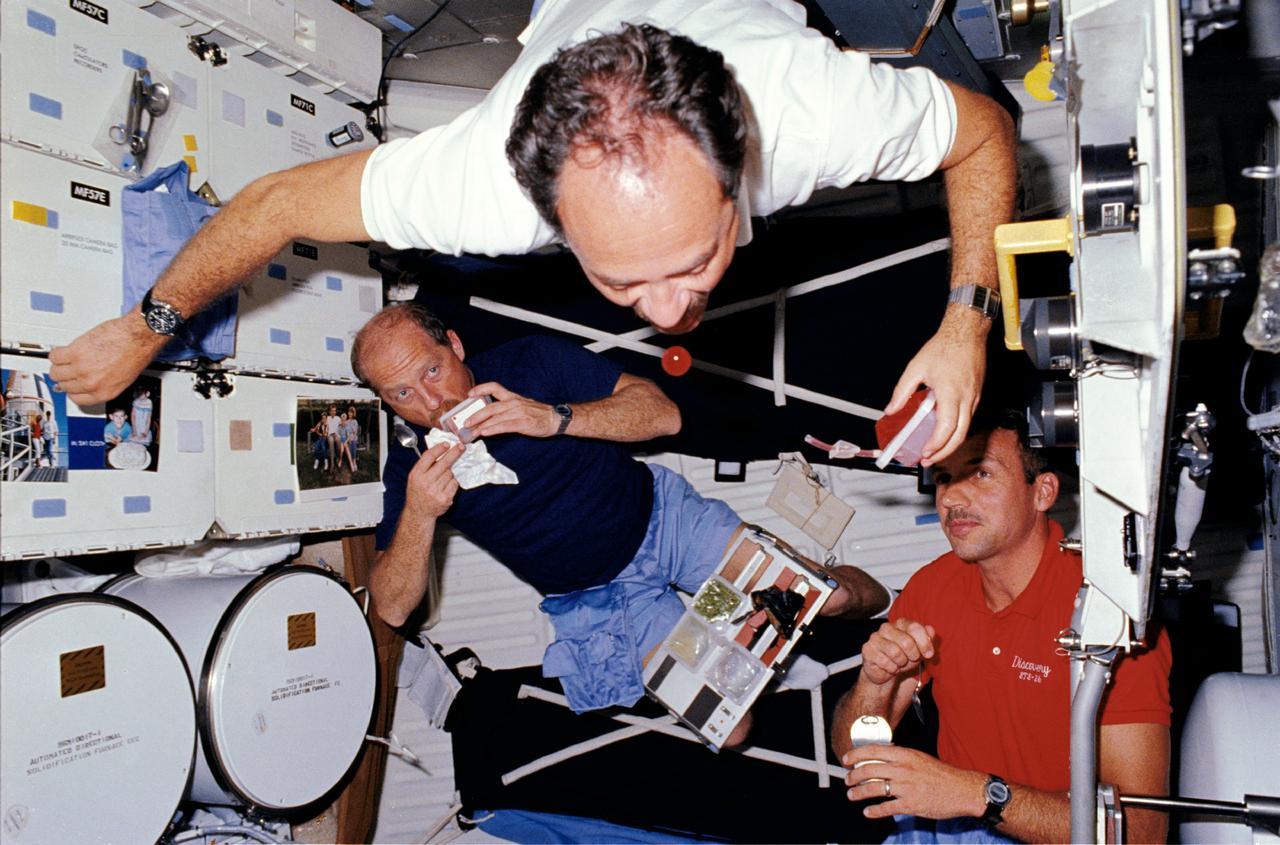
STS026-06-018 (29 Sept. - 3 Oct. 1988) --- Astronaut John M. Lounge, STS-26 mission specialist (MS), using a beverage container, experiments with microgravity as Commander Frederick H. Hauck (left) and MS David C. Hilmers (right) look on. Lounge freefloats as he closes in on a sphere of the red liquid drifting in front of his mouth. Hauck holds a spoon while sipping from a beverage container as he balances a meal tray assembly on his thighs. Hilmers, partially blocked by the open airlock hatch and holding a spoon and a can of food, pauses to watch the experiment. Automated Directional Solidification Furnace (ADSF) and forward middeck lockers appear on Lounge's right.
Mission Specialist George (Pinky) D. Nelson uses a 35 mm camera to photograph a protein crystal grown during the STS-26 Protein Crystal Growth (PCG-II-01) experiment. The protein crystal growth (PCG) carrier is shown deployed from the PCG Refrigerator/Incubator Mocule (R/IM) located in the middeck forward locker. The R/IM contained three Vapor Diffusion Apparatus (VDS) trays (one of which is shown). A total of sixty protein crystal samples were processed during the STS-26 mission.
KENNEDY SPACE CENTER, FLA. - At SPACEHAB in Cape Canaveral, Fla., STS-116 Mission Specialist Christer Fuglesang (left) and Pilot William Oefelein look at the rack front stowage trays that are used inside the SPACEHAB module. Mission crews make frequent trips to the Space Coast to become familiar with the equipment and payloads they will be using. STS-116 will be mission number 20 to the International Space Station and construction flight 12A.1. The mission payload is the SPACEHAB module, the P5 integrated truss structure and other key components. Launch is scheduled for no earlier than Dec. 7. Photo credit: NASA/George Shelton
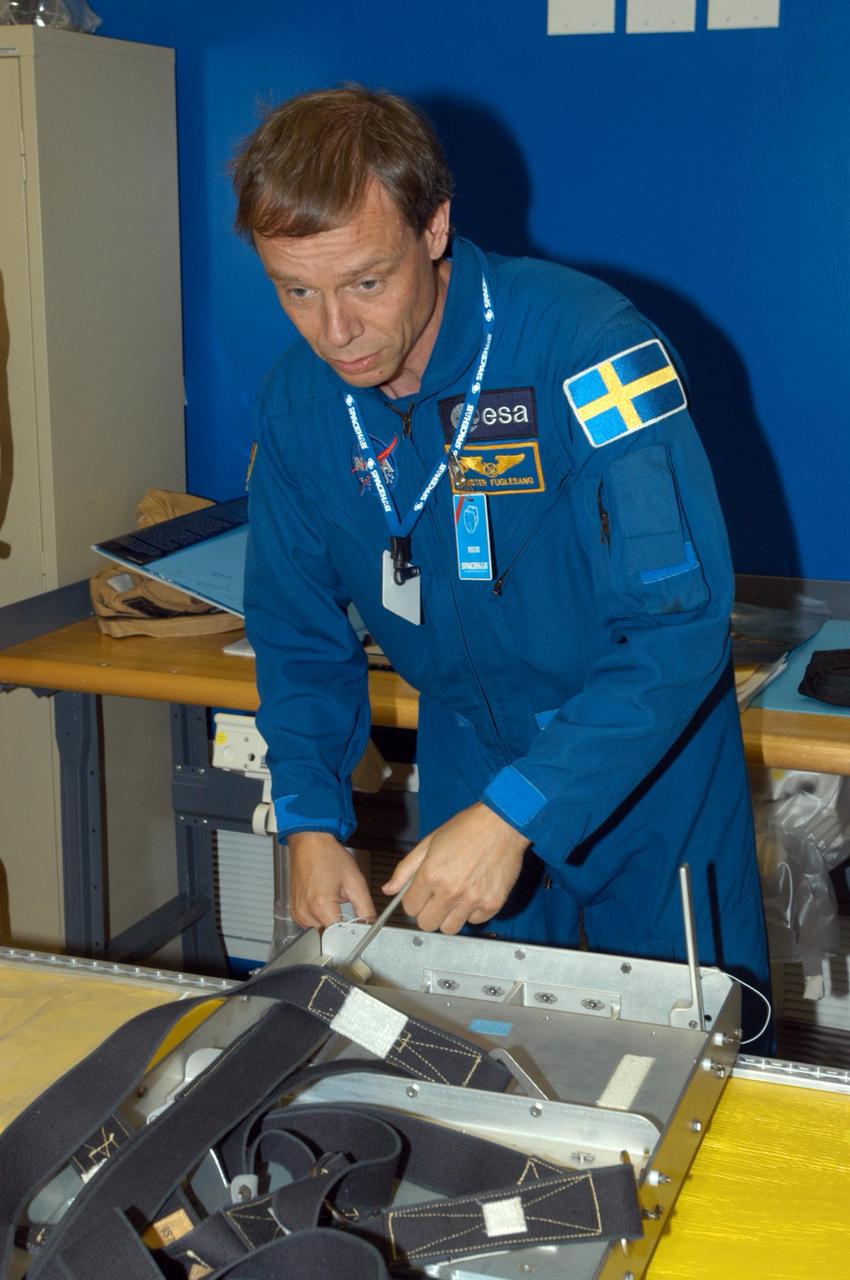
KENNEDY SPACE CENTER, FLA. - At SPACEHAB in Cape Canaveral, Fla., STS-116 Mission Specialist Christer Fuglesang practices techniques for removing and replacing the rack front stowage tray, used inside the SPACEHAB module. Fuglesang , from Sweden, represents the European Space Agency. Mission crews make frequent trips to the Space Coast to become familiar with the equipment and payloads they will be using. STS-116 will be mission number 20 to the International Space Station and construction flight 12A.1. The mission payload is the SPACEHAB module, the P5 integrated truss structure and other key components. Launch is scheduled for no earlier than Dec. 7. Photo credit: NASA/George Shelton
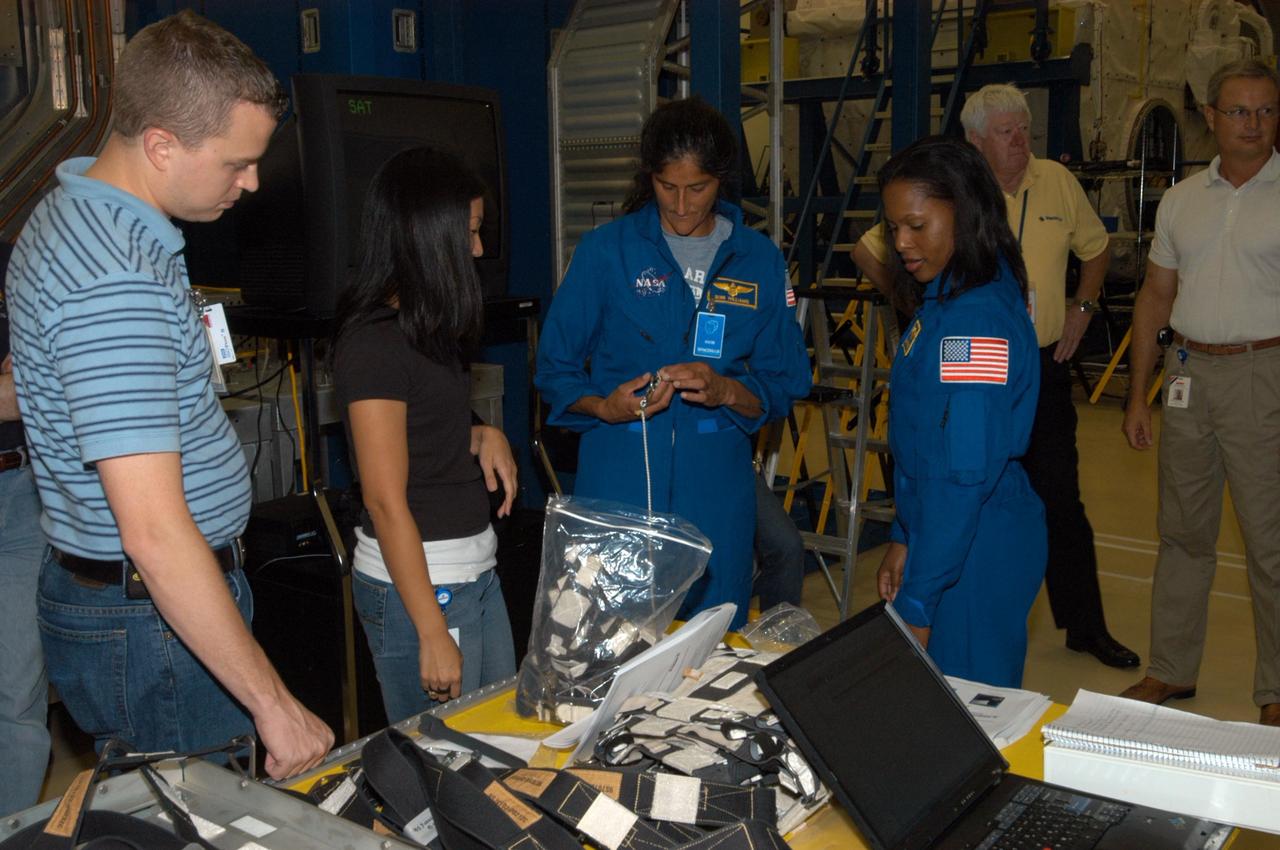
KENNEDY SPACE CENTER, FLA. - At SPACEHAB in Cape Canaveral, Fla., STS-116 Mission Specialists Sunita Williams (left) and Joan Higginbotham get a close look at the rack front stowage trays that are used inside the SPACEHAB module. Mission crews make frequent trips to the Space Coast to become familiar with the equipment and payloads they will be using. STS-116 will be mission number 20 to the International Space Station and construction flight 12A.1. The mission payload is the SPACEHAB module, the P5 integrated truss structure and other key components. Launch is scheduled for no earlier than Dec. 7. Photo credit: NASA/George Shelton

S66-20017 (3 Feb. 1966) --- Astronaut David R. Scott holds maneuvering unit while suspended in a weightless state during extravehicular activity (EVA) training in a C-135 Air Force plane. Photo credit: NASA
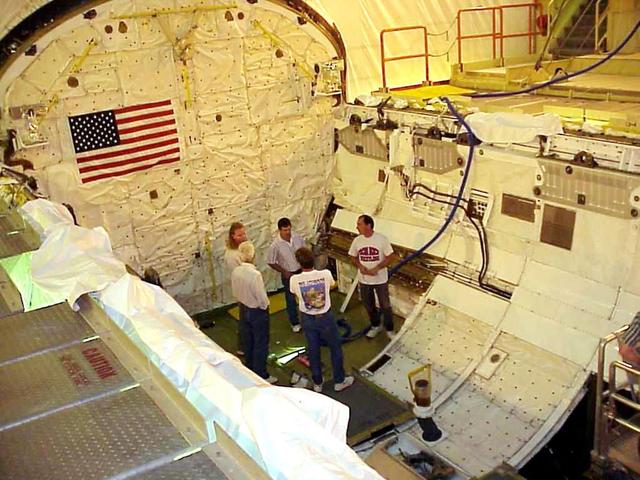
KENNEDY SPACE CENTER, FLA. -- KSC workers stand inside the payload bay of the orbiter Columbia following completion of electrical wiring inspections. At right, behind and below them is the cable tray with the wiring. During launch of Columbia on mission STS-93, a damaged wire caused a short circuit in two separate main engine controllers. As a result of the findings, Shuttle program managers decided to conduct inspections of the wiring in Endeavour's payload bay before its next mission, STS-99. The inspection and possible repair work will lead to a delayed launch date no earlier than Oct.7. The primary payload of the mission is the Shuttle Radar Topography Mission, a specially modified radar system that will gather data for the most accurate and complete topographic map of the Earth's surface that has ever been assembled
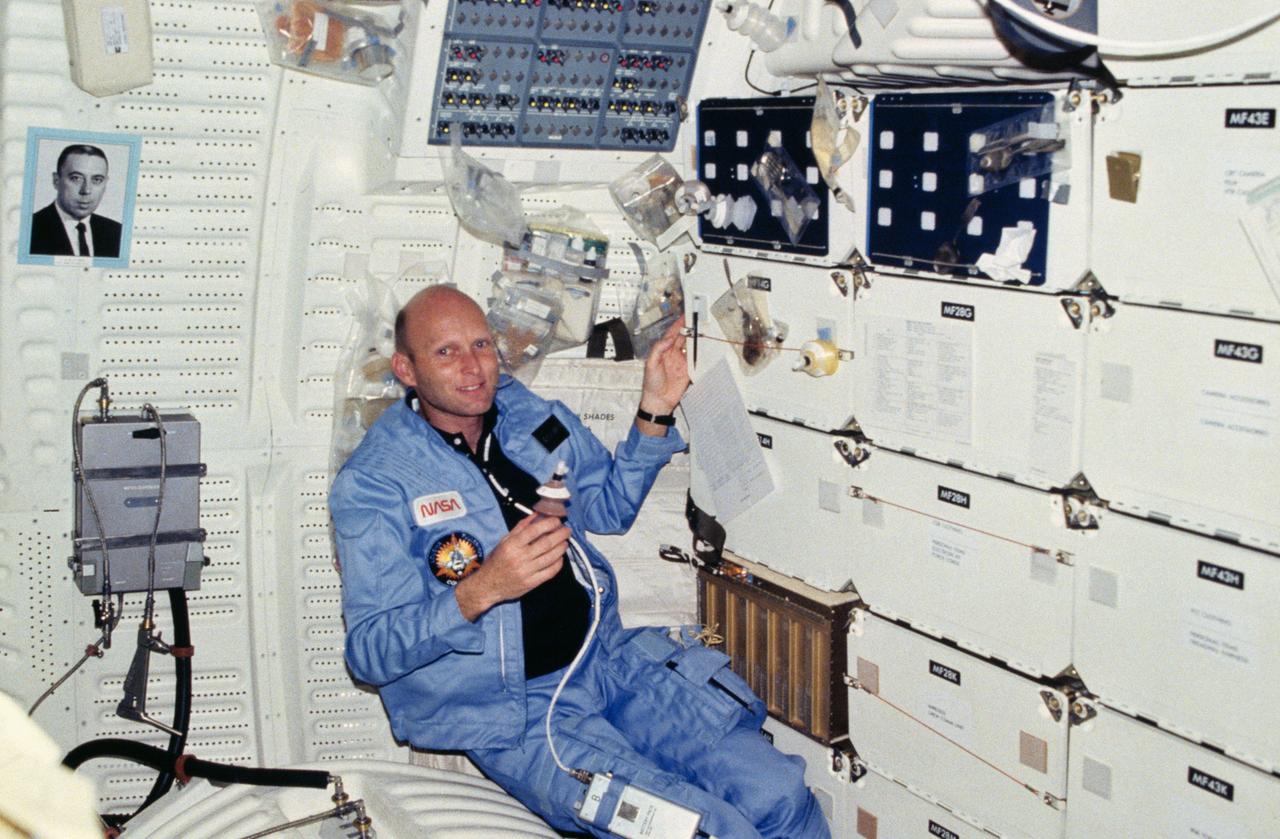
S82-28912 (March 1982) --- This picture, photographed with a 35mm camera operated by astronaut Jack R. Lousma, STS-3 commander, shows astronaut C. Gordon Fullerton, crew pilot, busy with mealtime preparations aboard the Earth-orbiting Columbia. The astronaut has positioned himself in the corner of the middeck area. Fullerton holds a beverage in his right hand in an accordion-like squeeze dispenser. Many packages of pre-packaged dehydrated foods and other meal items can be seen in the photo. Many are fastened to the locker doors and to trays in the locker doors by velcro. Reminiscent of STS-2 days, a portrait of George W. S. Abbey, director of flight operations at JSC, is at left edge. Photo credit: NASA