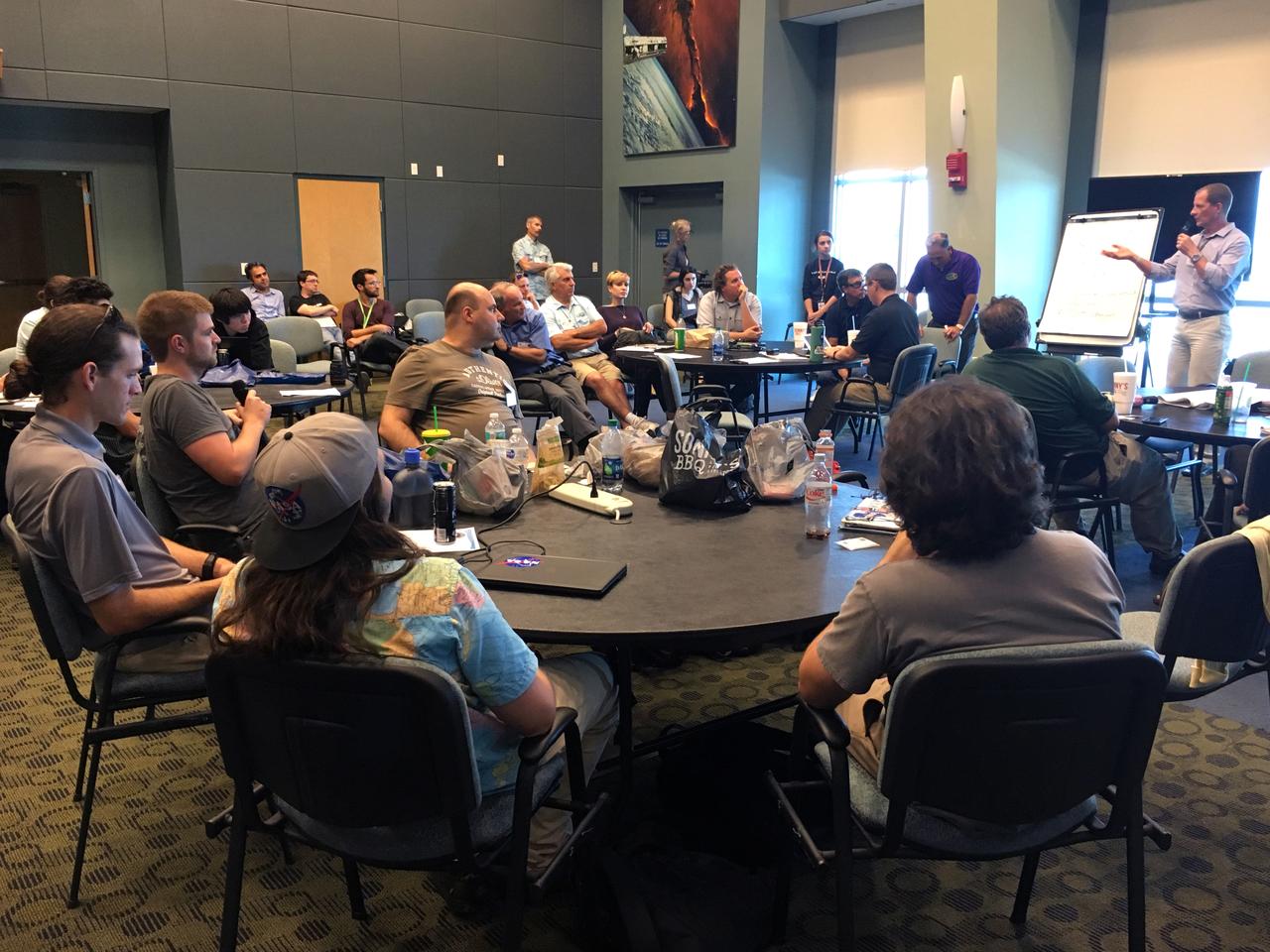
Scientists in the Exploration Research and Technology Directorate brainstorm innovative approaches to food production with industry representatives at the Space Station Processing Facility at NASA's Kennedy Space Center in Florida.
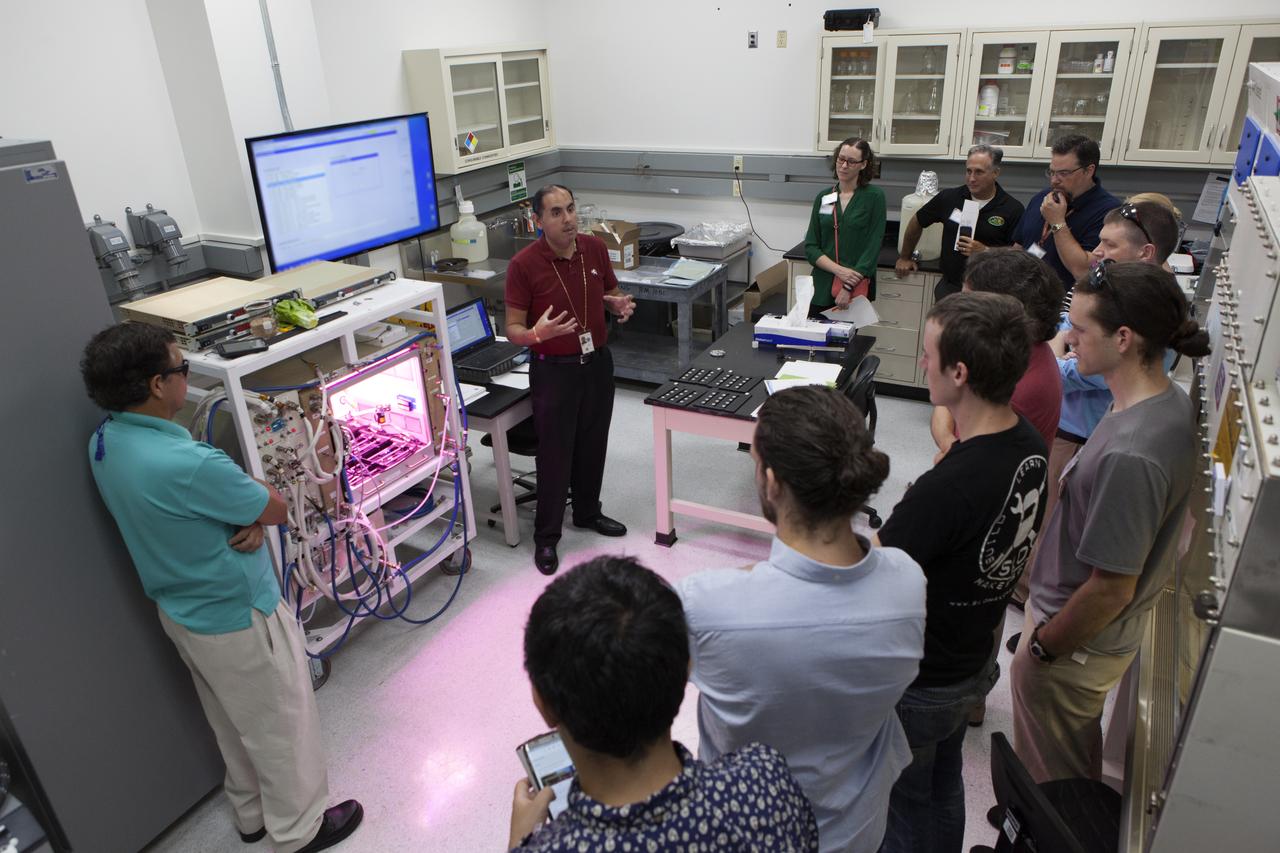
Bryan Onate, Advanced Plant Habitat project manager, with the Exploration Research and Technology Directorate, brainstorms innovative approaches to food production with industry representatives inside a laboratory at the Space Station Processing Facility at NASA's Kennedy Space Center in Florida.
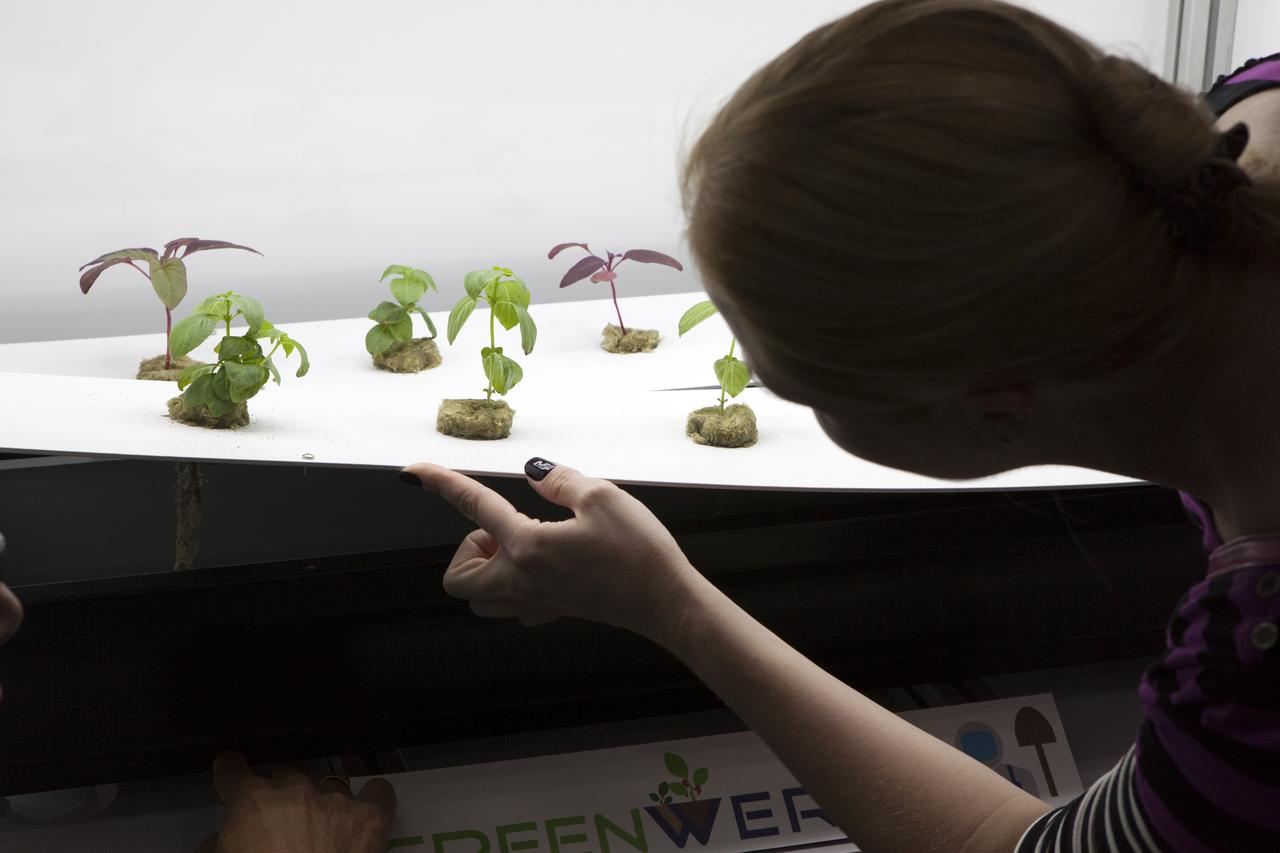
During a brainstorming session on innovative approaches to food production, an industry participant looks at plants growing inside a laboratory in the Space Station Processing Facility at NASA's Kennedy Space Center in Florida. The workshop was hosted by the Exploration Research and Technology Directorate.
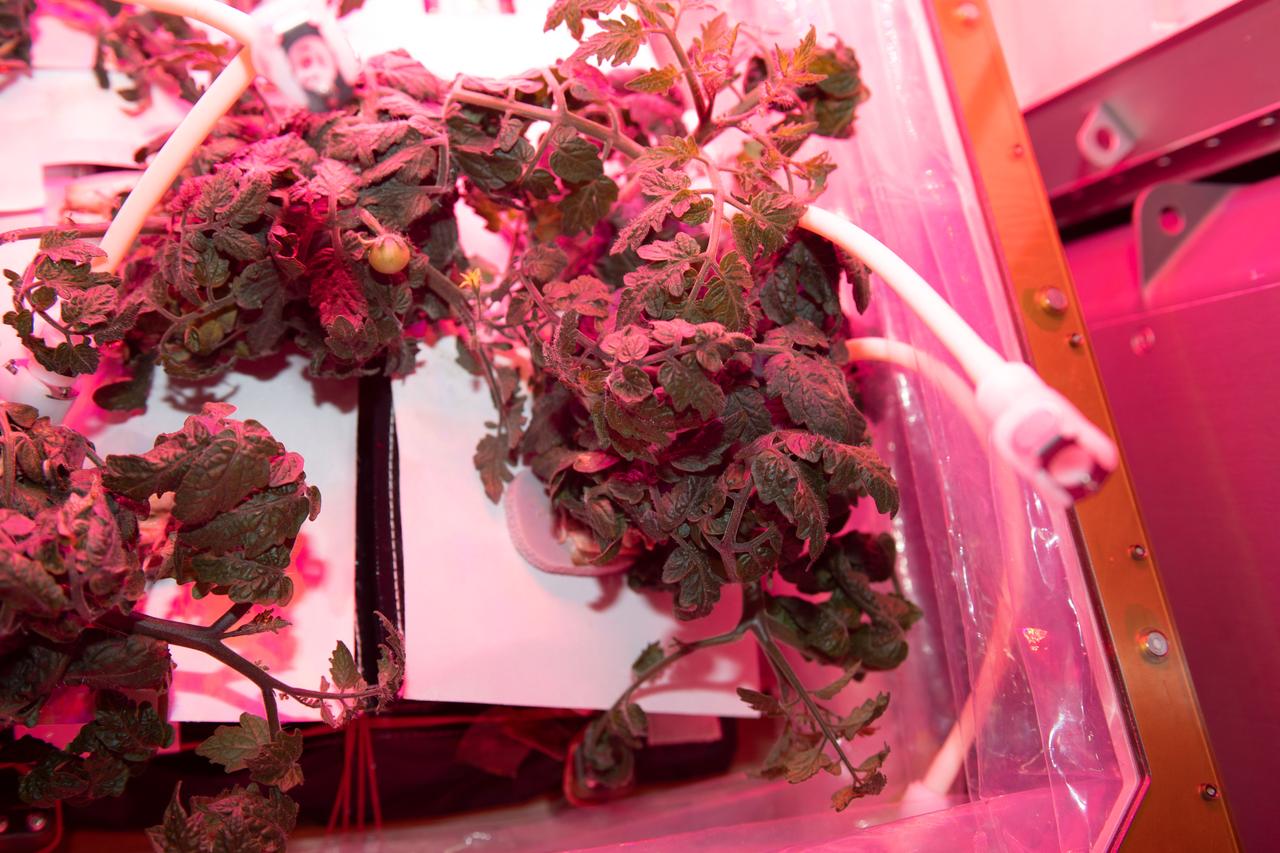
iss068e045298 (Feb. 5, 2023) --- A view of red dwarf tomato plants growing in the Veggie plant growth facility aboard the International Space Station as part of the Pick-and-Eat Salad-Crop Productivity, Nutritional Value, and Acceptability to Supplement the ISS Food System (Veg-05) investigation. Veg-05 is the next step in efforts to address the need for a continuous fresh-food production system in space. This experiment focuses on studying the impact of light quality and fertilizer on fruit production, microbial safety, nutritional value, taste acceptability by the astronauts, and the overall behavioral health benefits of having plants and fresh food in space.
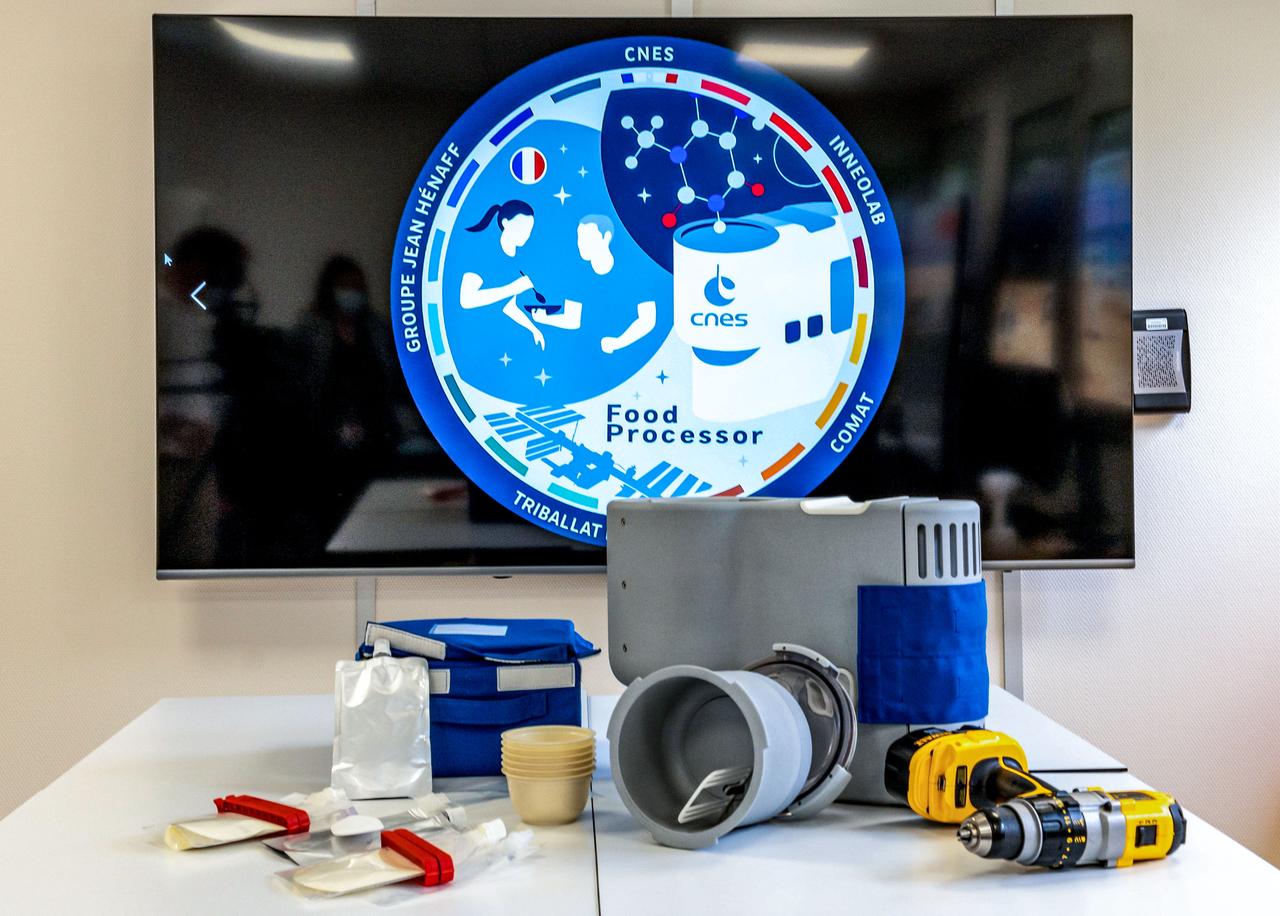
jsc2023e054754 (6/23/2021) --- A preflight view of the Food Processor Instrument and consumables including the drill it will need to use on board the International Space Station (ISS). The objective of the Advanced System for Space Food (Food Processor) investigation on board the International Space Station is to test a prototype equipment demonstrator with one specific recipe that uses basic cooking functions (beating egg whites, mixing products). © CNES/DE PRADA Thierry, 2021.
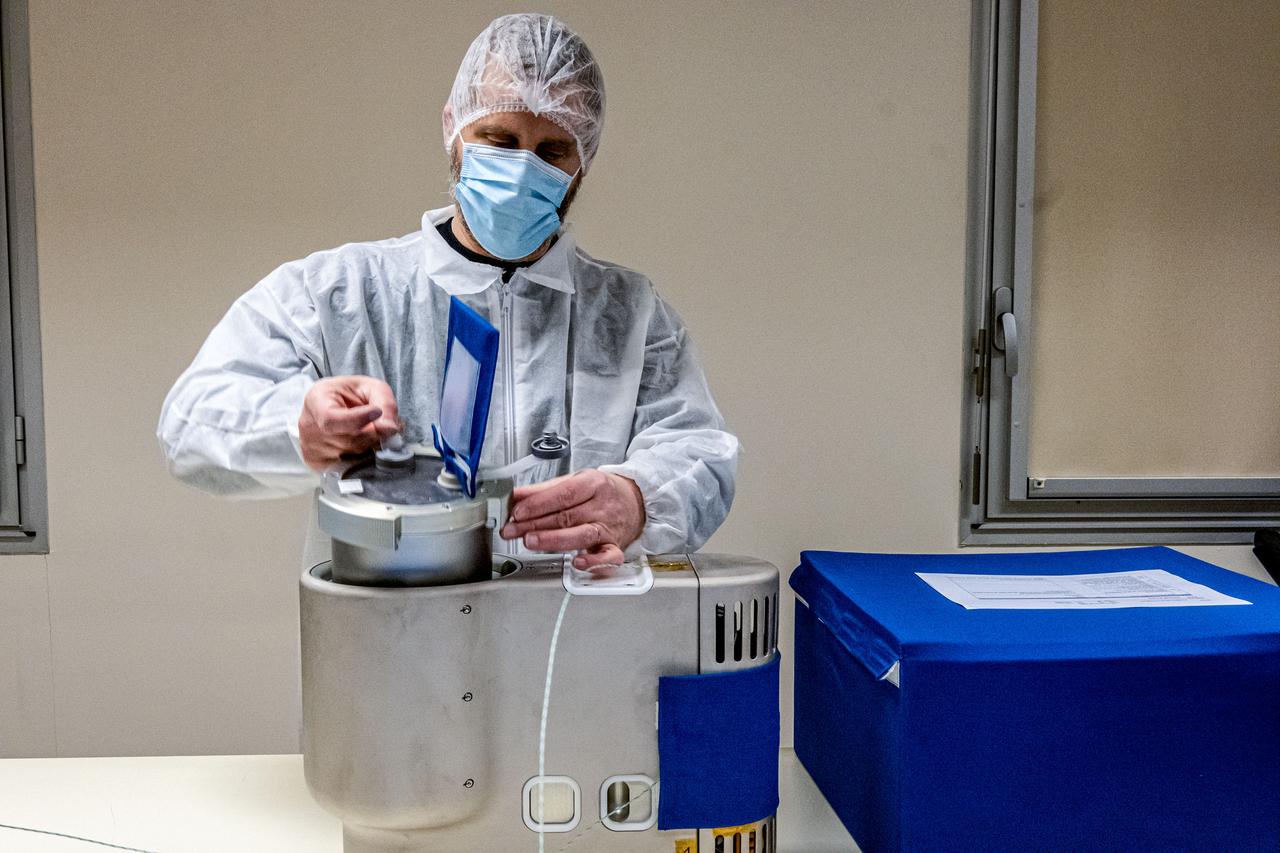
jsc2023e054755 (2/11/2021) --- A preflight view of David Moreeuw (Inneloab) testing the Food Processor assembly. The objective of the Advanced System for Space Food (Food Processor) investigation on board the International Space Station is to test a prototype equipment demonstrator with one specific recipe that uses basic cooking functions (beating egg whites, mixing products). © CNES/DE PRADA Thierry, 2021
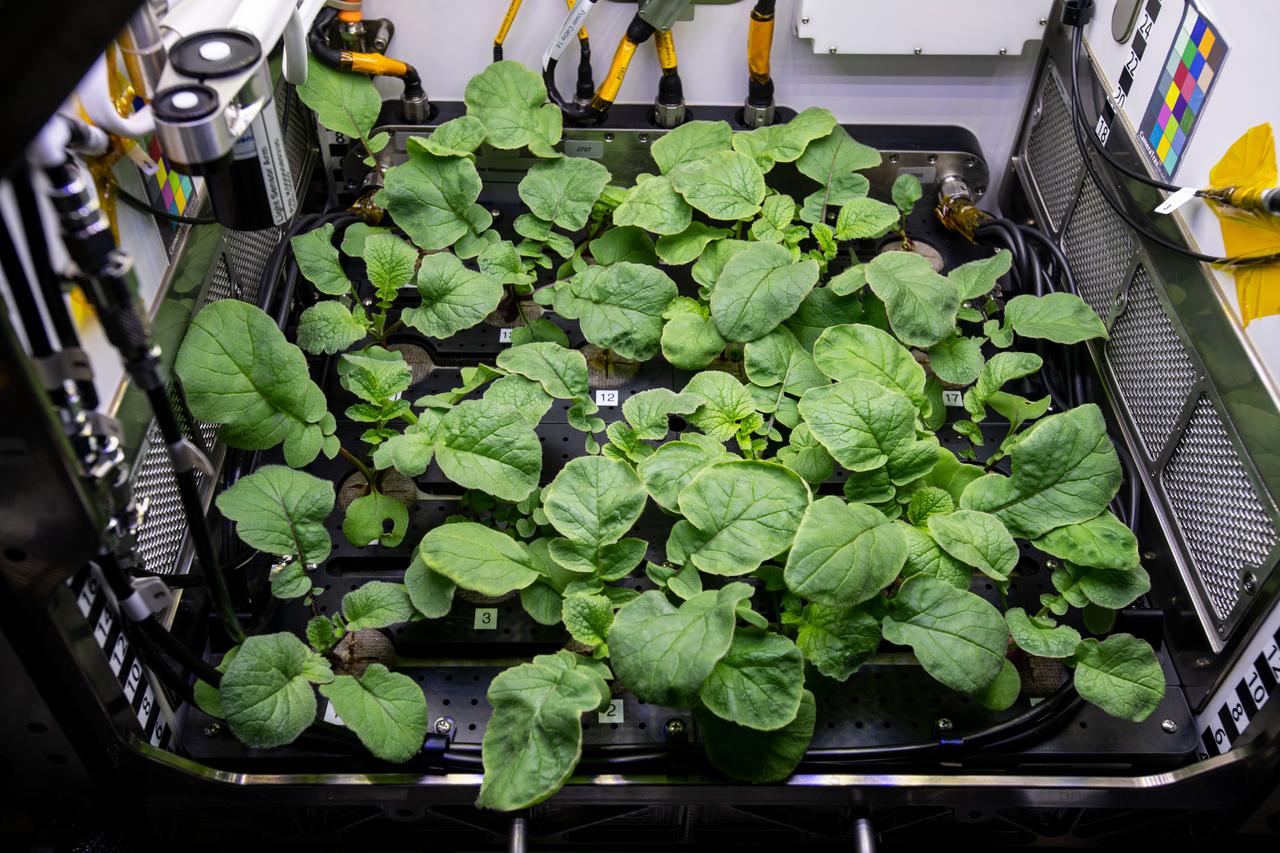
iss064e013129 (Dec. 20, 2020) --- Radish plants are pictured growing inside the International Space Station's Advanced Plant Habitat to help botanists learn about managing food production in space and evaluate nutrition and taste in microgravity.
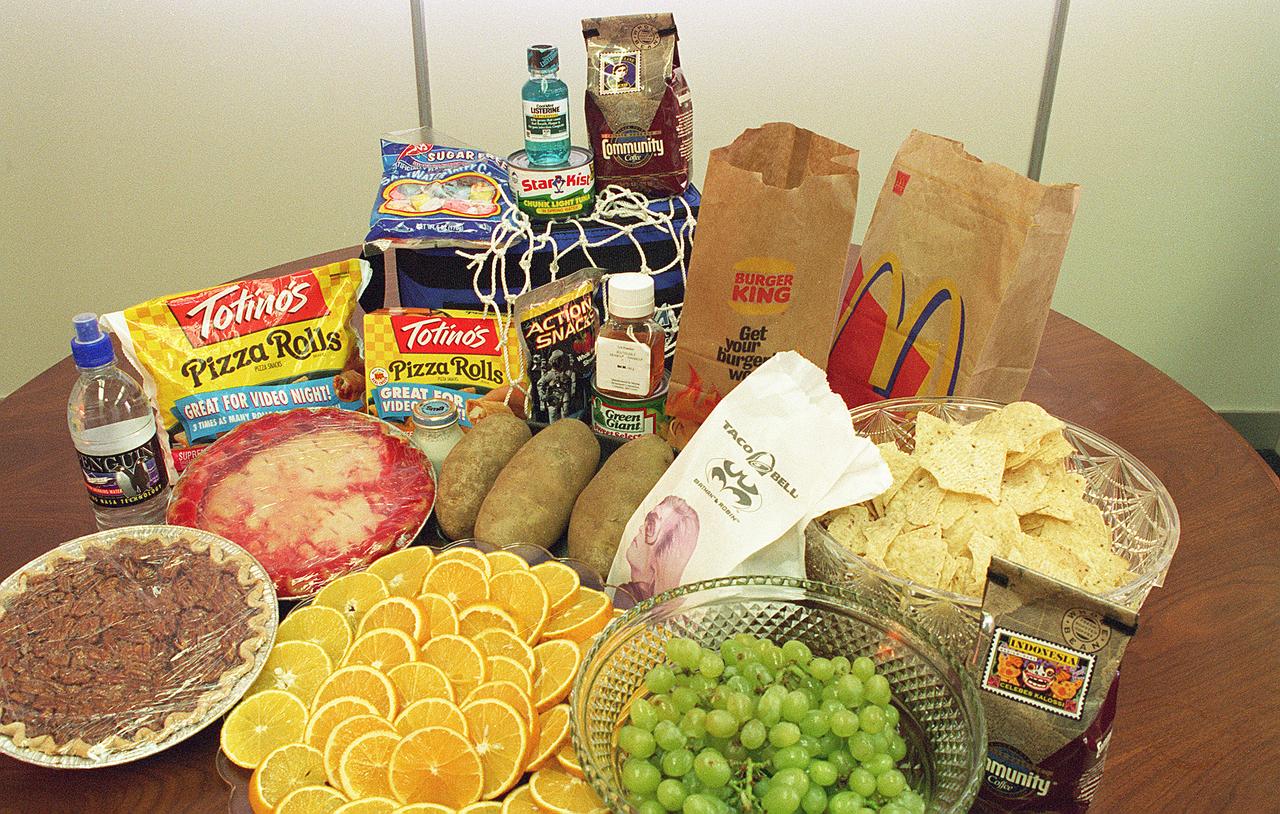
When NASA started plarning for manned space travel in 1959, the myriad challenges of sustaining life in space included a seemingly mundane but vitally important problem: How and what do you feed an astronaut? There were two main concerns: preventing food crumbs from contaminating the spacecraft's atmosphere or floating into sensitive instruments, and ensuring complete freedom from potentially catastrophic disease-producing bacteria, viruses, and toxins. To solve these concerns, NASA enlisted the help of the Pillsbury Company. Pillsbury quickly solved the first problem by coating bite-size foods to prevent crumbling. They developed the hazard analysis and critical control point (HACCP) concept to ensure against bacterial contamination. Hazard analysis is a systematic study of product, its ingredients, processing conditions, handling, storage, packing, distribution, and directions for consumer use to identify sensitive areas that might prove hazardous. Hazard analysis provides a basis for blueprinting the Critical Control Points (CCPs) to be monitored. CCPs are points in the chain from raw materials to the finished product where loss of control could result in unacceptable food safety risks. In early 1970, Pillsbury plants were following HACCP in production of food for Earthbound consumers. Pillsbury's subsequent training courses for Food and Drug Administration (FDA) personnel led to the incorporation of HACCP in the FDA's Low Acid Canned Foods Regulations, set down in the mid-1970s to ensure the safety of all canned food products in the U.S.
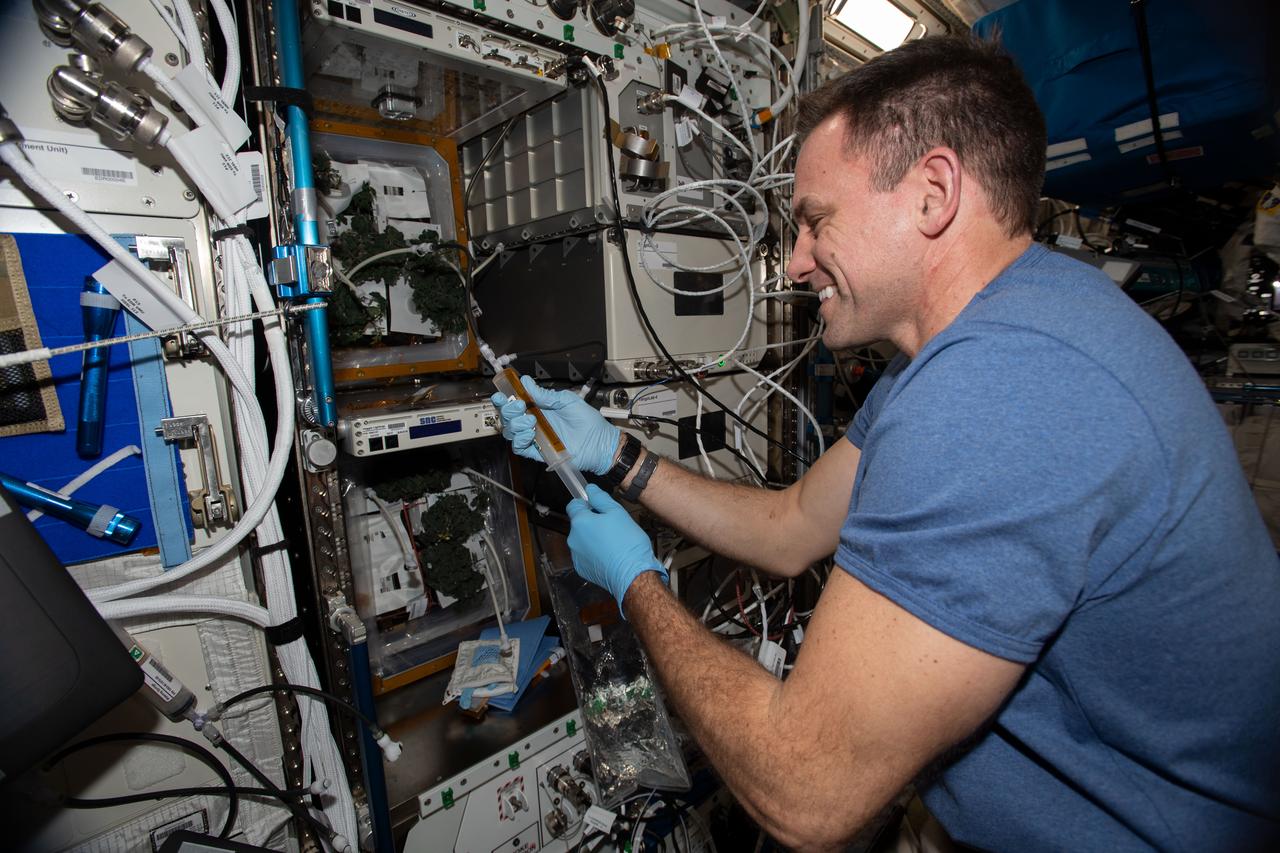
iss068e045013 (Feb. 2, 2023) --- NASA astronaut and Expedition 68 Flight Engineer Josh Cassada uses a watering syringe to water tomato plants for the the Veg-05 experiment, the next step in efforts to address the need for a continuous fresh-food production system in space. The experiment uses the space station’s Veggie facility to grow dwarf tomatoes, seen in its early growing stages on station in the bottom photo. The experiment examines the effect of light quality and fertilizer on fruit production, microbial food safety, nutritional value, and taste acceptability. Growing plants can also enhance the overall living experience for crew members.
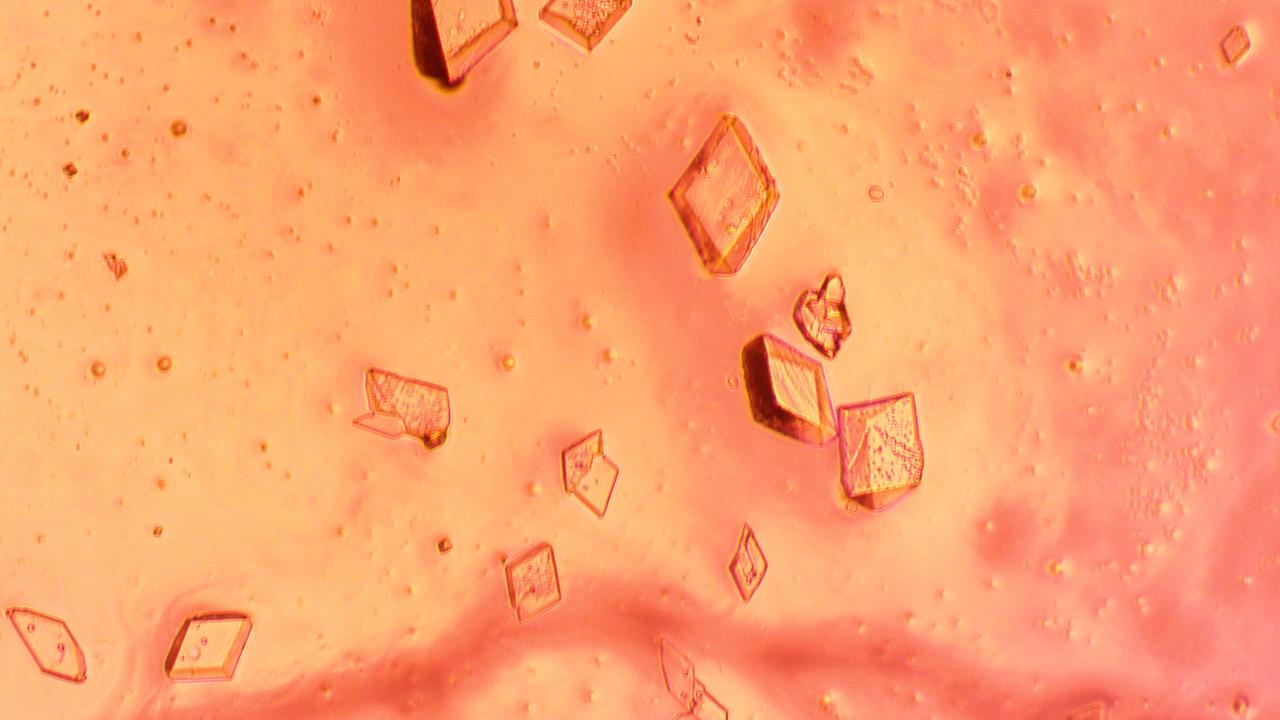
jsc2024e038396 (6/5/2024) --- Insulin crystals grown with Redwire's PIL-BOX aboard the International Space Station. This image was taken after the crystals returned to Earth in April 2024. This control compound helps the body convert food into energy and store it for later use. The ADSEP-PIL-02 investigation aims to study the effect of microgramInsulin crystals grown with Redwire's PIL-BOX aboard the International Space Station. This image was taken after the crystals returned to Earth in April 2024. This control compound helps the body convert food into energy and store it for later use. The In-Space Production Application – Pharmaceutical In-space Laboratory – 02 (InSPA-PIL-02) (ADSEP-PIL-02) investigation aims to study the effect of microgravity on the production of various types of crystals. Image courtesy of Redwire. on the production of various types of crystals. Image courtesy of Redwire.
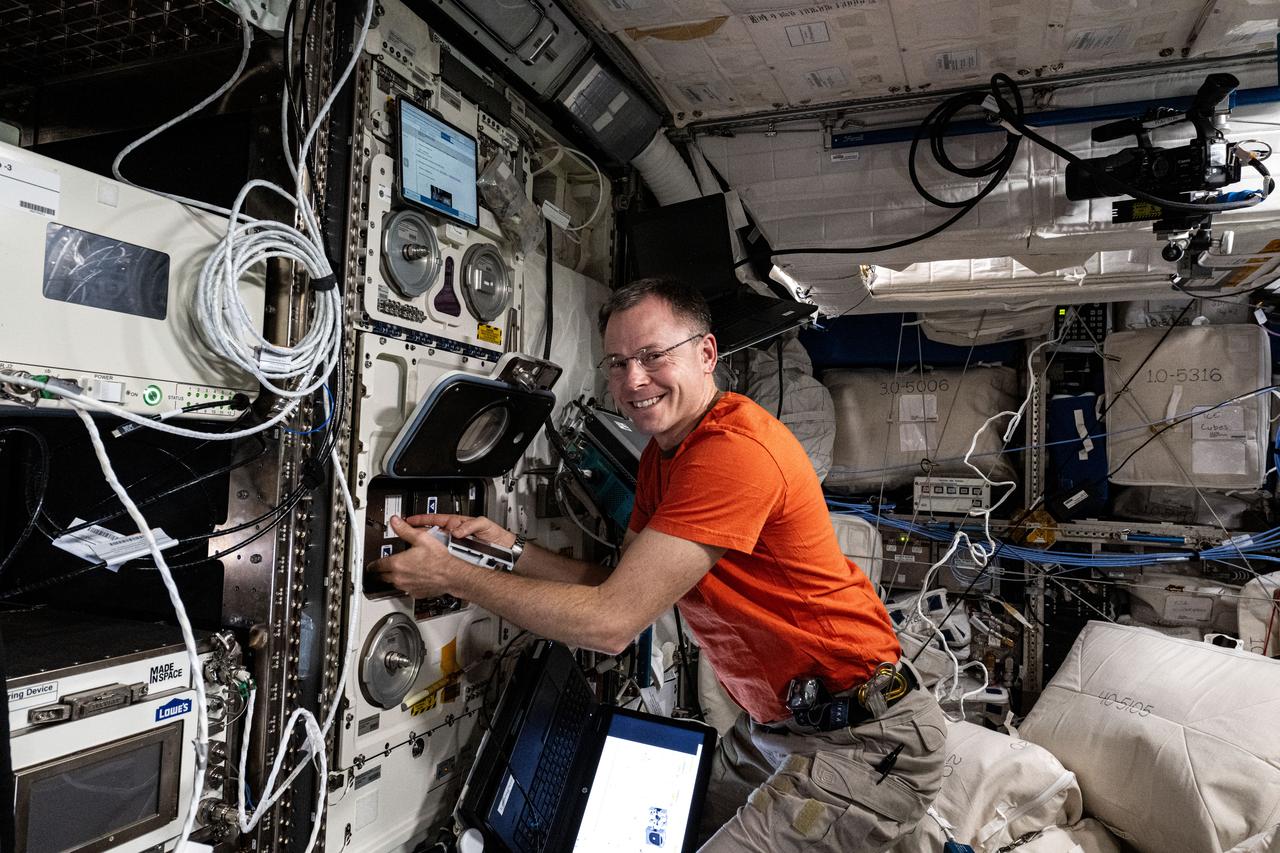
iss072e280746 (Nov. 26, 2024) --- NASA astronaut and Expedition 72 Flight Engineer Nick Hague processes radiation-resistant samples of Arthrospira C micro-algae and stows them in an incubator for analysis inside the International Space Station's Columbus laboratory module. The samples will be exposed to different light intensities to observe how they affect the micro-algae’s cell growth and oxygen production. Results may advance the development of spacecraft life support systems and fresh food production in space.

iss072e189176 (Nov. 15, 2024) --- NASA astronaut and Expedition 72 Flight Engineer Nick Hague services samples of the Arthrospira C micro-algae for incubation and analysis. Scientists will expose the radiation-resistant samples to different light intensities while monitoring their cell growth and oxygen production. Results may advance life support systems and fresh food production in space.

In the Space Life Sciences Laboratory at NASA's Kennedy Space Center in Florida, student interns are joining agency scientists, contributing in the area of plant growth research for food production in space. The agency attracts its future workforce through the NASA Internship, Fellowships and Scholarships, or NIFS, Program.
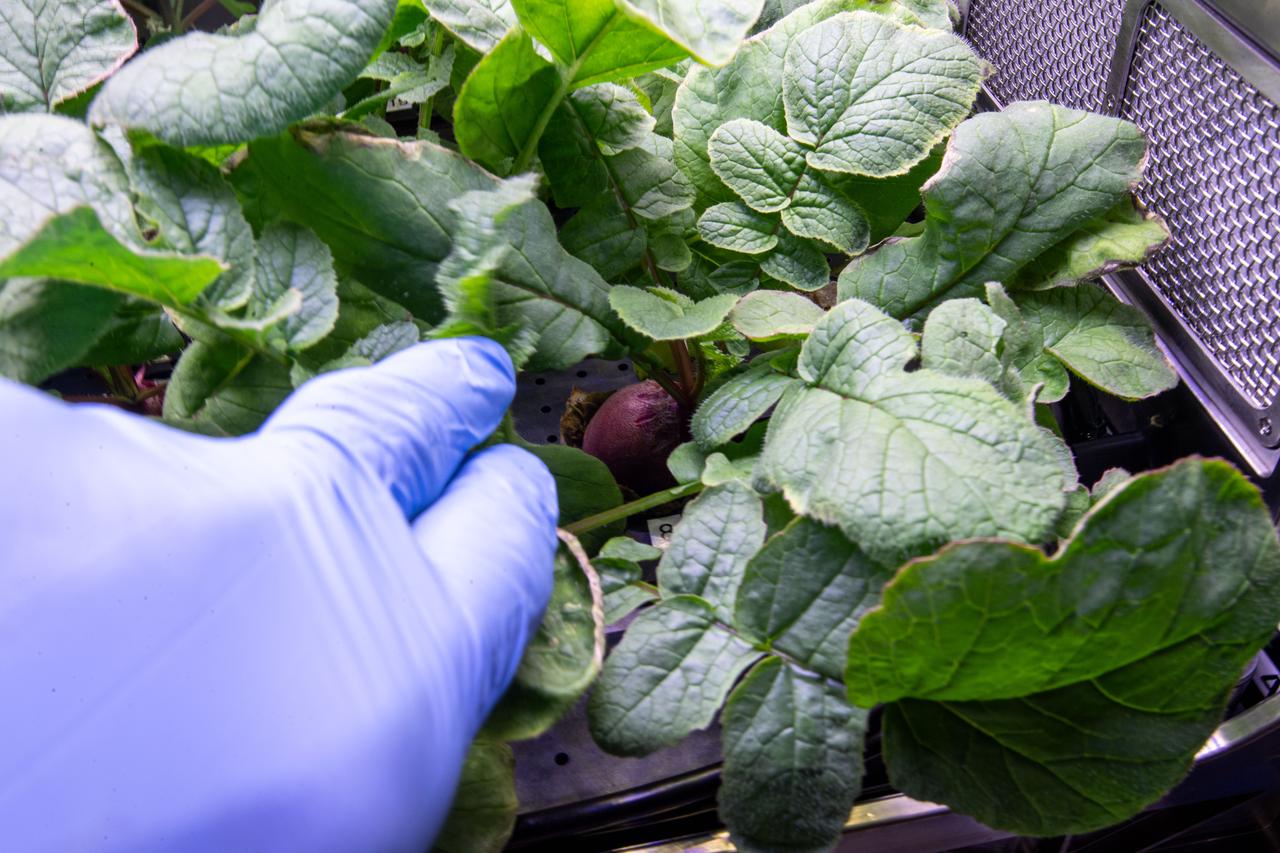
iss064e016025 (Dec. 27, 2020) --- A radish bulb is pictured amongst radish plants growing inside the International Space Station's Advanced Plant Habitat to help botanists learn about managing food production in space and evaluate nutrition and taste in microgravity.
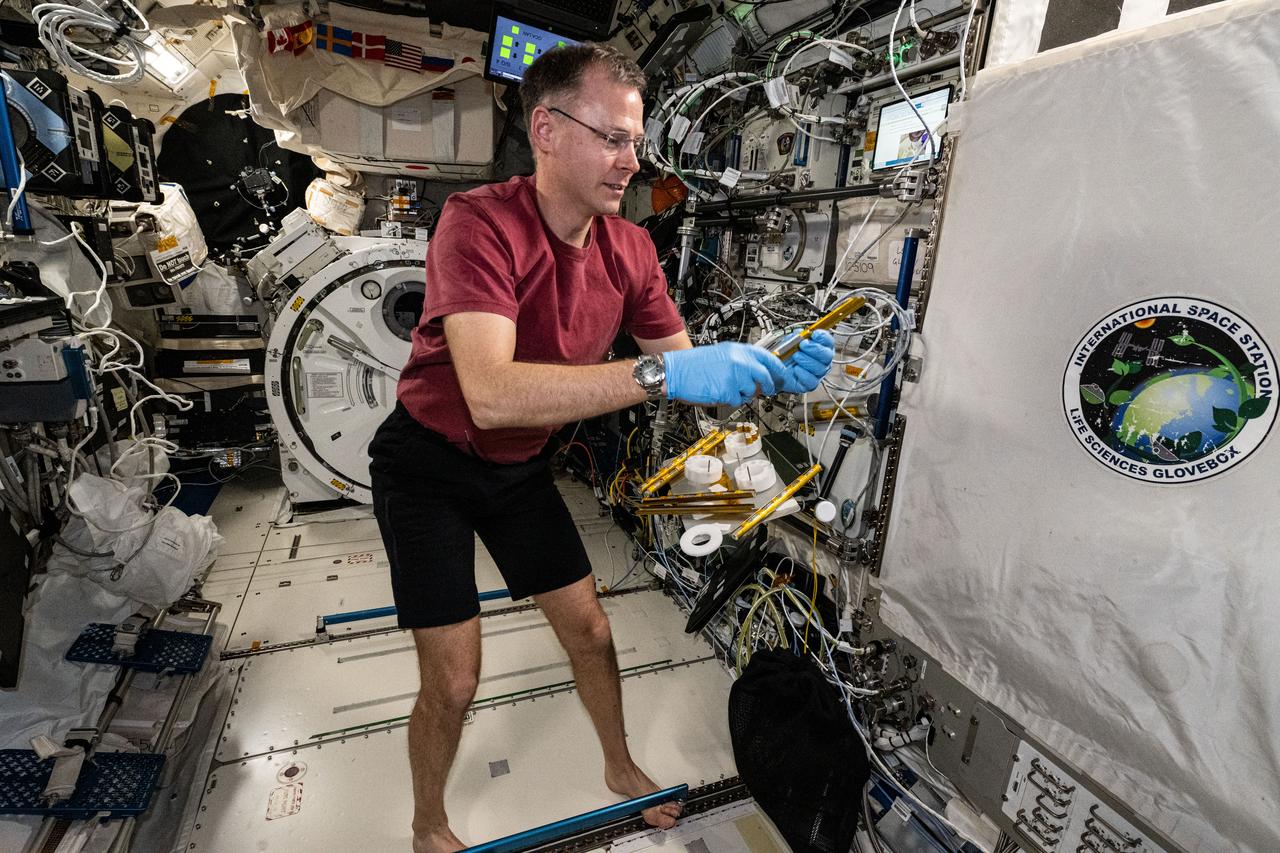
iss072e277661 (Nov. 23, 2024) --- NASA astronaut and Expedition 72 Flight Engineer Nick Hague services research hardware for the Rhodium Biomanufacturing-03 experiment inside the International Space Station's Kibo laboratory module. The investigation explores using bacteria and yeast samples as a method to potentially enable the production of food and medicine in space.
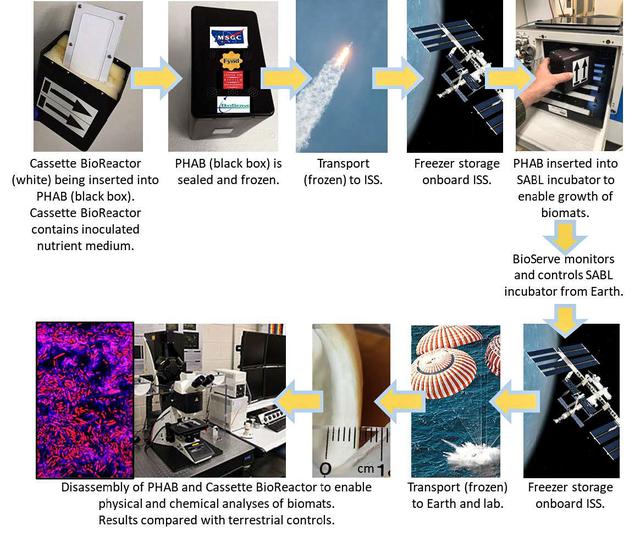
jsc2022e031226 (4/26/2022) --- A mission overview of the Protein Manufacturing investigation shows hardware, operations, and scientific details. The Protein Manufacturing project demonstrates and tests the operation of a novel bioreactor technology to support robust fungal growth for the production of high-protein food in a low-Earth orbit, space environment. Image courtesy of BioServe.
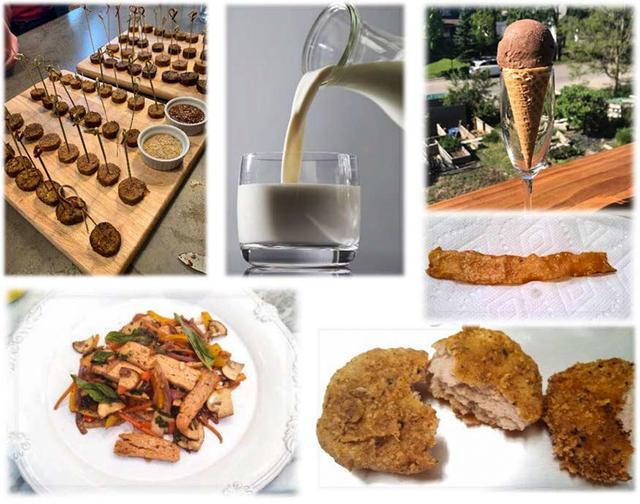
jsc2022e031225 (4/26/2022) --- For the Protein Manufacturing investigations, examples are shown of alternative meat and dairy products prepared from fungal strain MK7 biomats by Nature’s Fynd. Delicious foods developed by world renown chefs, including Sebastian Canonne, founder of the French Pastry School. Image courtesy of BioServe.
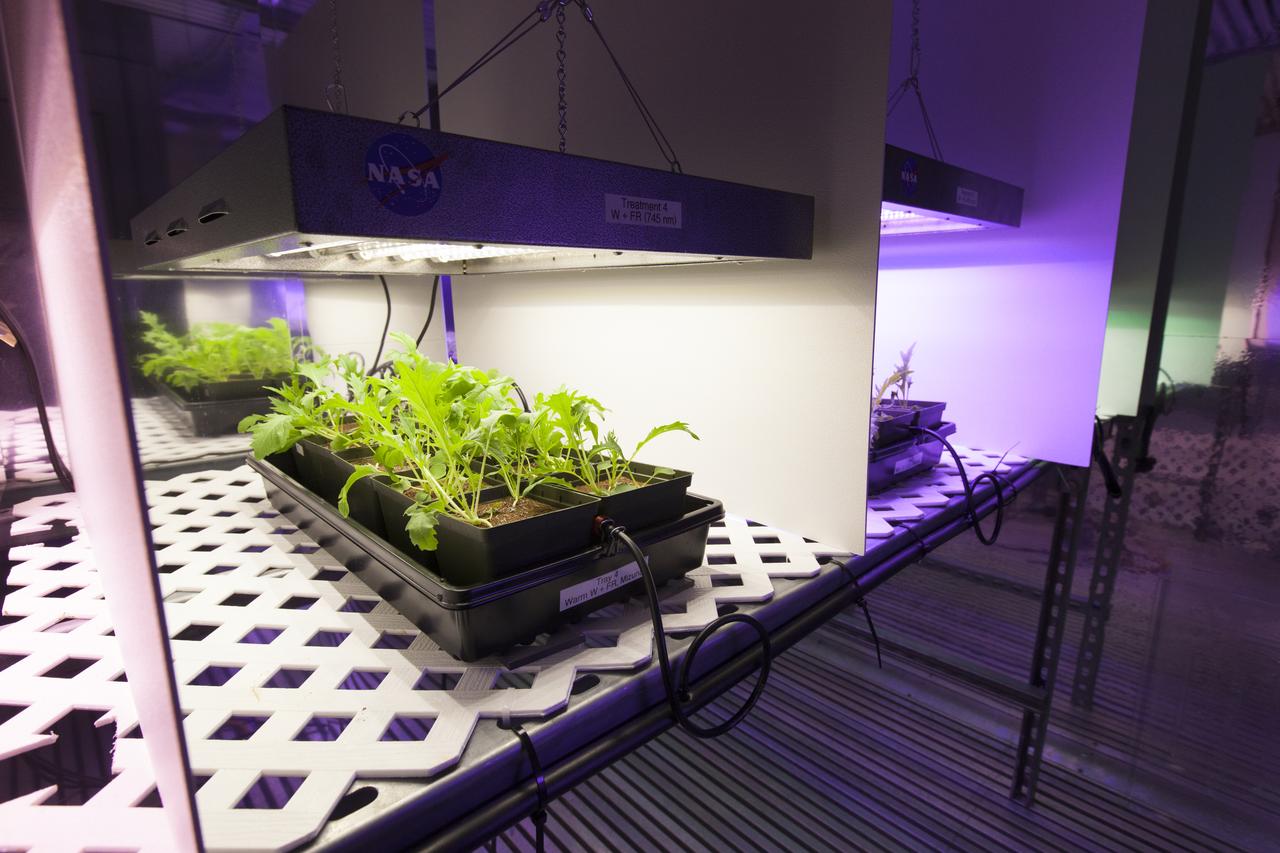
In the Space Life Sciences Laboratory at NASA's Kennedy Space Center in Florida, student interns are joining agency scientists, contributing in the area of plant growth research for food production in space. The agency attracts its future workforce through the NASA Internship, Fellowships and Scholarships, or NIFS, Program.
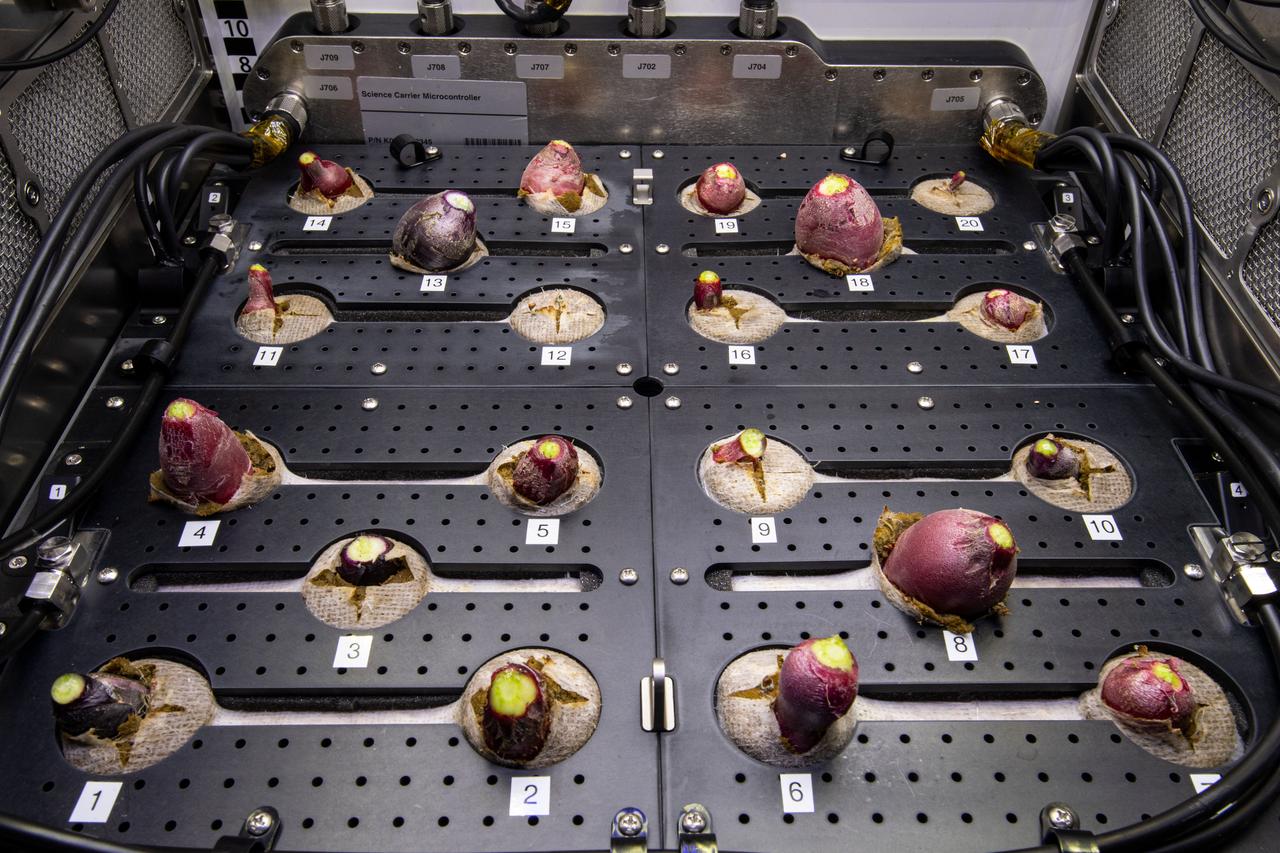
iss064e016711 (Dec. 30, 2020) --- Radish bulbs are pictured inside the International Space Station's Advanced Plant Habitat after the plants were harvested to help botanists learn about managing food production in space and evaluate nutrition and taste in microgravity.

In the Space Life Sciences Laboratory at NASA's Kennedy Space Center in Florida, student interns are joining agency scientists, contributing in the area of plant growth research for food production in space. The agency attracts its future workforce through the NASA Internship, Fellowships and Scholarships, or NIFS, Program.
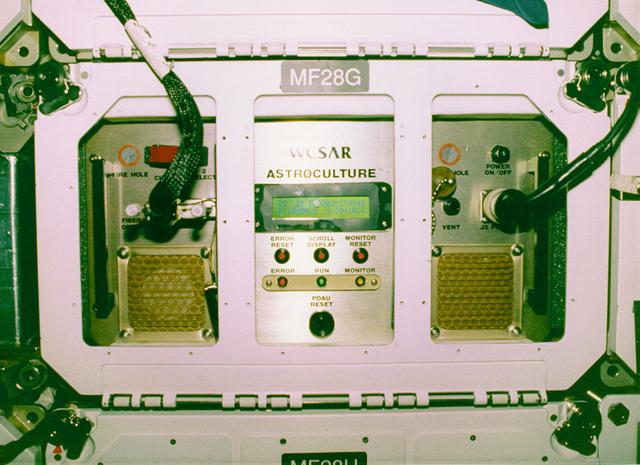
Research with plants in microgravity offers many exciting opportunities to gain new insights and could improve products on Earth ranging from crop production to fragrances and food flavorings. The ASTROCULTURE facility is a lead commercial facility for plant growth and plant research in microgravity and was developed by the Wisconsin Center for Space Automation and Robotics (WSCAR), a NASA Commercial Space Center. On STS-95 it will support research that could help improve crop development leading to plants that are more disease resistant or have a higher yield and provide data on the production of plant essential oils---oils that contain the essence of the plant and provide both fragrance and flavoring. On STS-95, a flowering plant will be grown in ASTROCULTURE and samples taken using a method developed by the industry partner for this investigation. On Earth the samples will be analyzed by gas chromatography/mass spectrometry and the data used to evaluate both the production of fragrant oils in microgravity and in the development of one or more products.
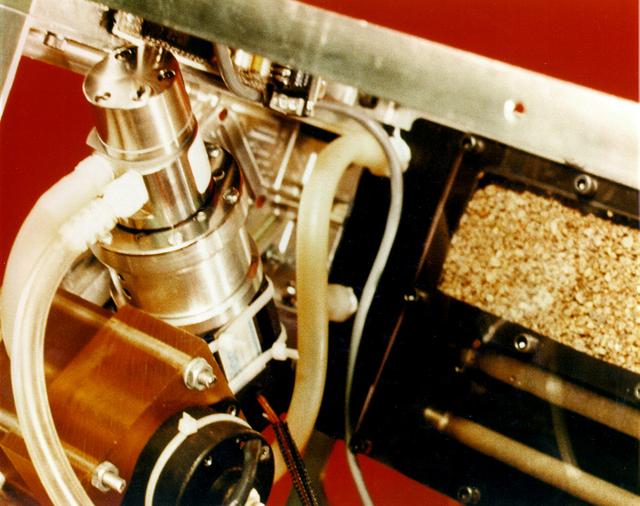
Research with plants in microgravity offers many exciting opportunities to gain new insights and could improve products on Earth ranging from crop production to fragrances and food flavorings. The ASTROCULTURE facility is a lead commercial facility for plant growth and plant research in microgravity and was developed by the Wisconsin Center for Space Automation and Robotics (WSCAR), a NASA Commercial Space Center. On STS-95 it will support research that could help improve crop development leading to plants that are more disease resistant or have a higher yield and provide data on the production of plant essential oils---oils that contain the essence of the plant and provide both fragrance and flavoring. On STS-95, a flowering plant will be grown in ASTROCULTURE and samples taken using a method developed by the industry partner for this investigation. On Earth, the samples will be analyzed by gas chromatography/mass spectrometry and the data used to evaluate both the production of fragrant oils in microgravity and in the development of one or more products. The ASTROCULTURE payload uses these pourous tubes with precise pressure sensing and control for fluid delivery to the plant root tray.
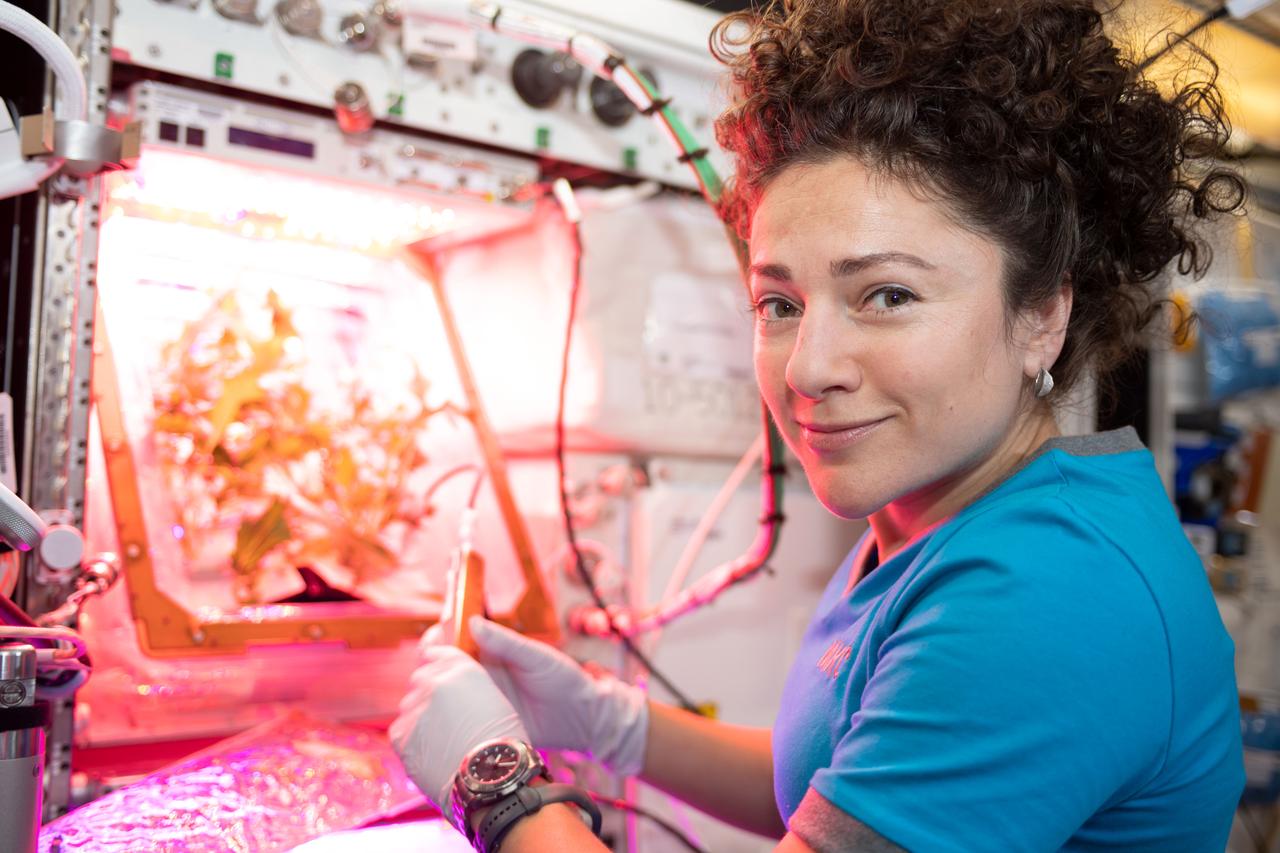
iss061e014149 (Oct. 27, 2019) --- NASA astronaut Jessica Meir waters plant pillows where Mizuna mustard greens are raised as part of the Veg-04B experiment. This investigation is part of a phased research project to address the need for a continuous fresh food production system in space and focuses on the effects of light quality and fertilizer on a leafy crop. Taste is assessed by the crew.
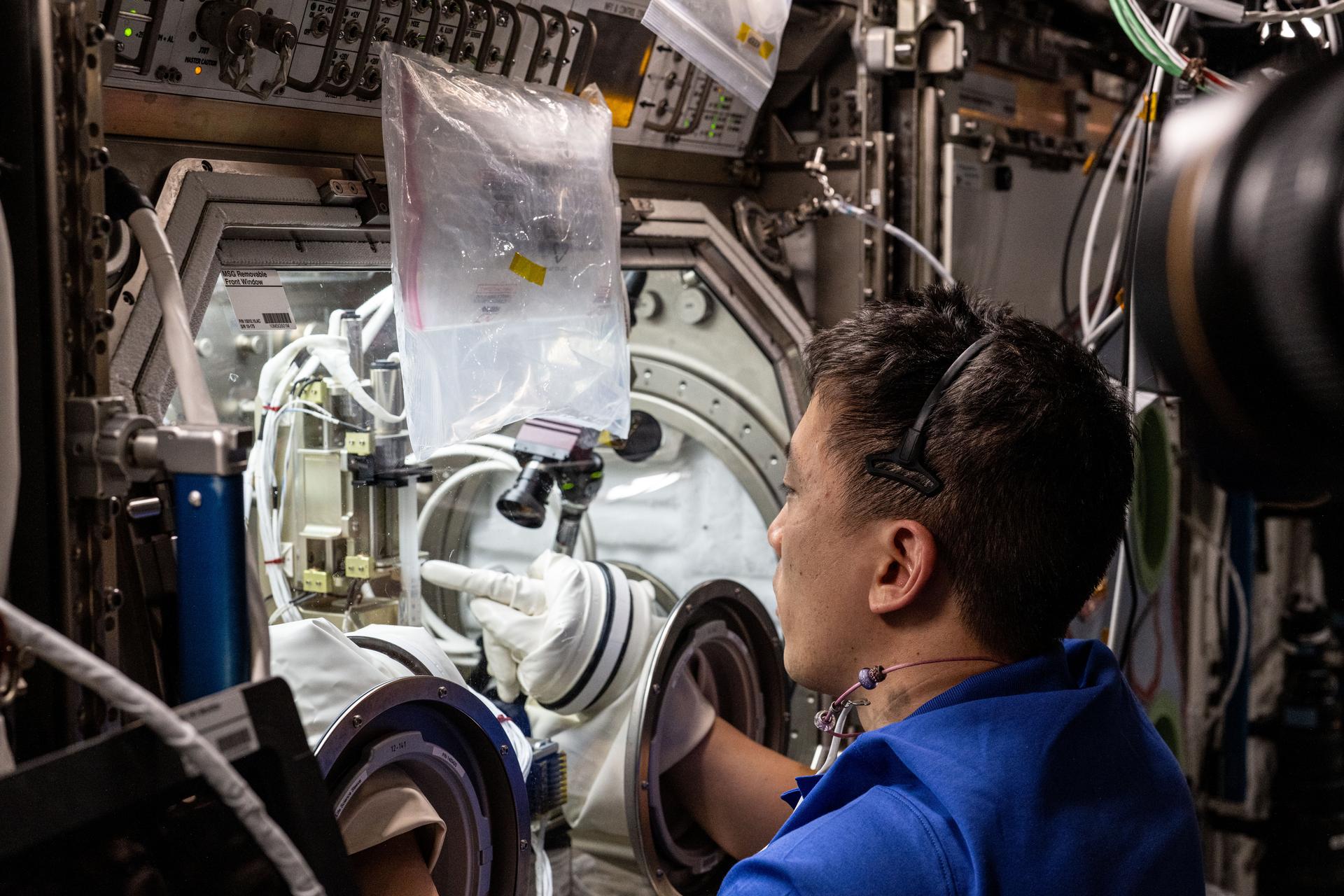
iss073e0177558 (June 12, 2025) -- NASA astronaut Jonny Kim works in the International Space Station’s Microgravity Science Glovebox on Ring Sheared Drop-IBP-2. This investigation studies the behavior of high-concentration protein fluids in microgravity using a special device that holds liquid protein solutions without containers, eliminating interference from interactions with container walls. Results could help advance manufacturing processes and 3D printing in space and for production of medicines, microelectronics, foods, and medical devices on Earth.
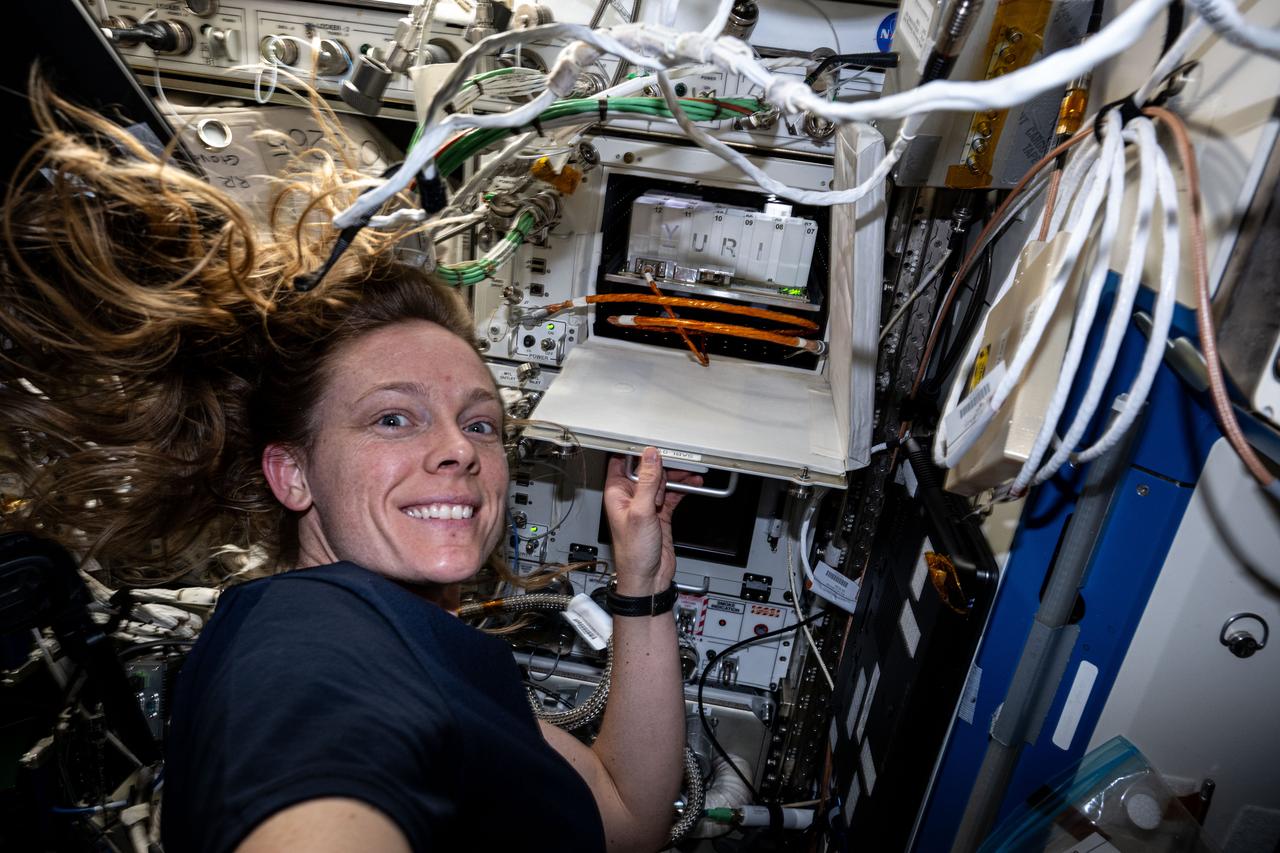
iss073e0002615 (April 28, 2025) --- NASA astronaut and Expedition 73 Flight Engineer Nichole Ayers shows off research hardware to study how microalgae grow in spaceflight conditions such as microgravity and radiation. Results from the biotechnology investigation may provide insights to support life support systems, fuel production, and food on future missions to the Moon, Mars, and beyond.
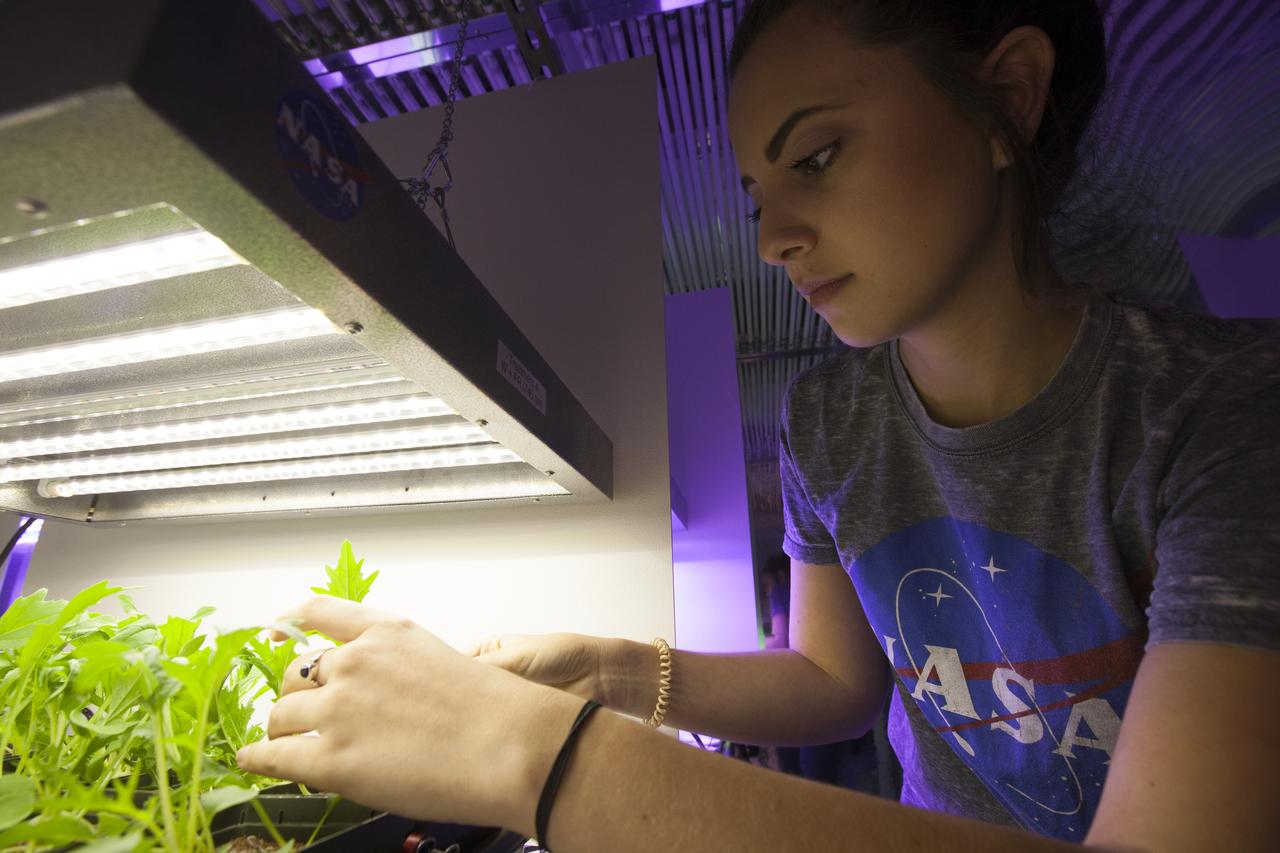
In the Space Life Sciences Laboratory at NASA's Kennedy Space Center in Florida, student interns such as Payton Barnwell are joining agency scientists, contributing in the area of plant growth research for food production in space. Barnwell is a mechanical engineering and nanotechnology major at Florida Polytechnic University. The agency attracts its future workforce through the NASA Internship, Fellowships and Scholarships, or NIFS, Program.
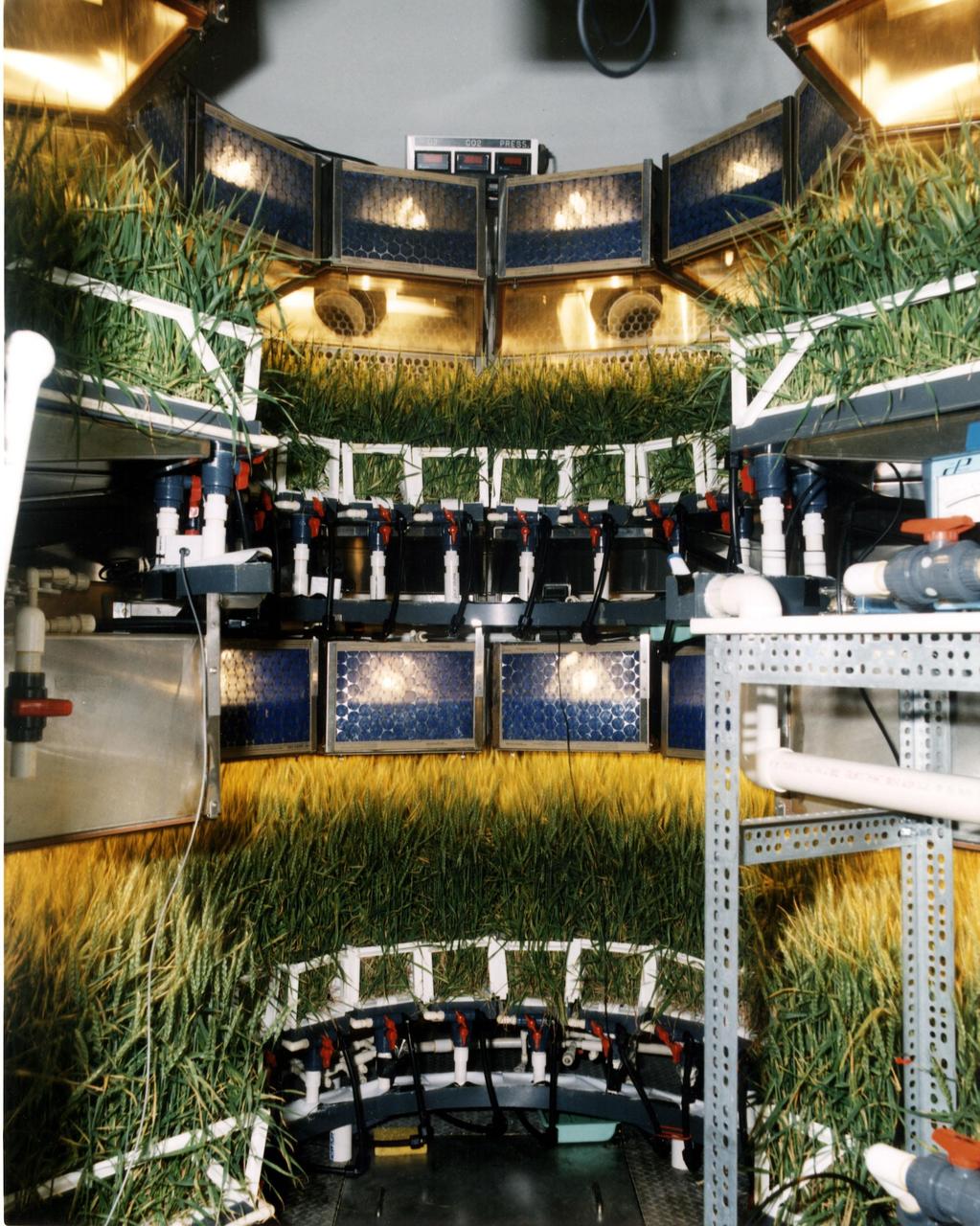
Original photo and caption dated June 22, 1988: "A dwarf wheat variety known as Yecoro Rojo flourishes in KSC's Biomass Production Chamber. Researchers are gathering information on the crop's ability to produce food, water and oxygen, and then remove carbon dioxide. The confined quarters associated with space travel require researchers to focus on smaller plants that yield proportionately large amounts of biomass. This wheat crop takes about 85 days to grow before harvest."
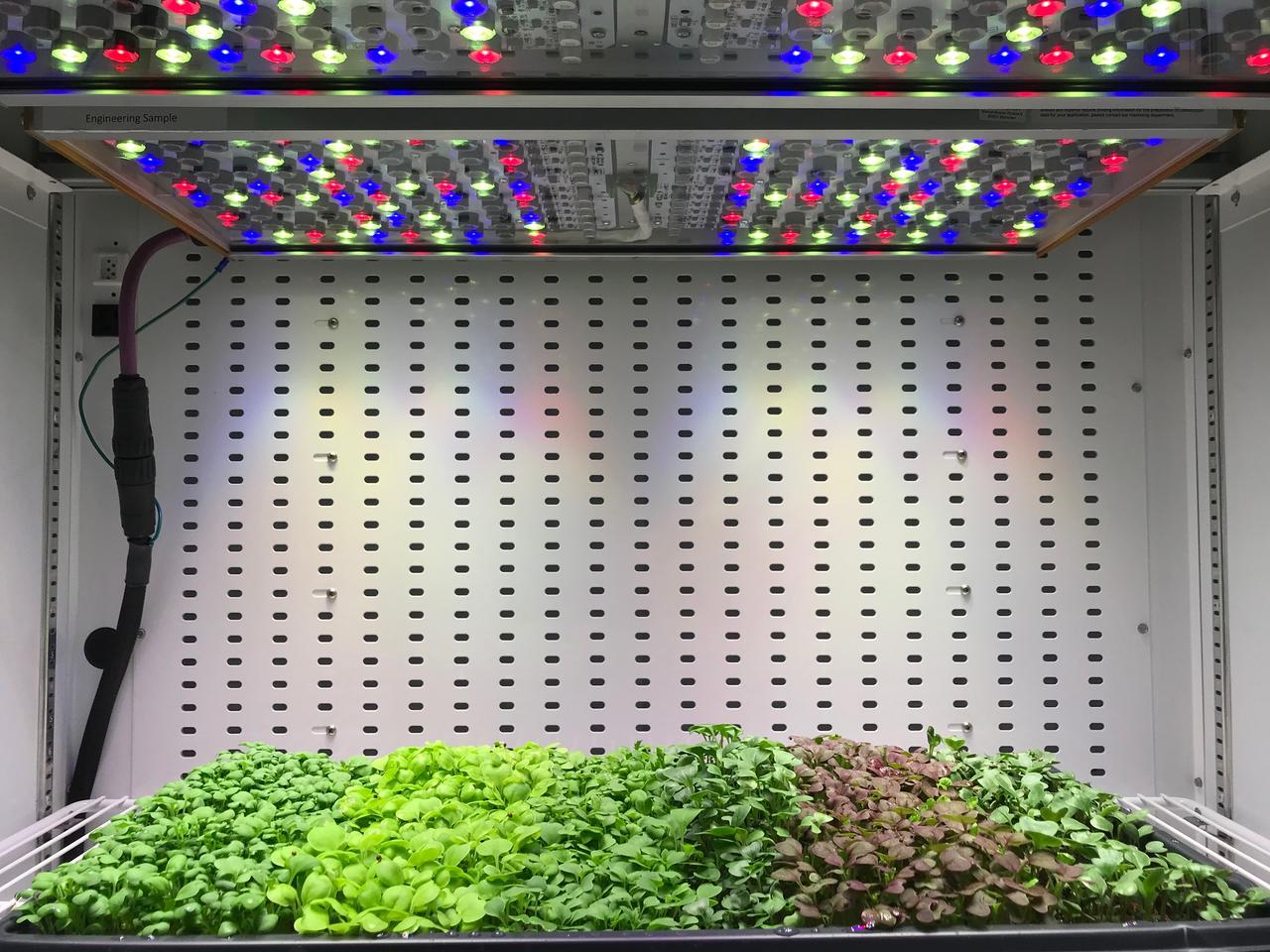
Kennedy Space Center scientists worked with OSRAM to insert a smart horticulture lighting system prototype into a food production system. The Phytofy RL prototype LED provides similar wavelength capability to a plant growth system currently on orbit. Photofy RL provides another avenue for future investigators conducting flight experiments to perform ground tests prior to flight under similar lighting conditions. The Phytofy RLs have been used to successfully grow microgreens of Wasabi, Tokyo Bekana, Mizuna, Broccoli, Garnet Giant, and Cauliflower.
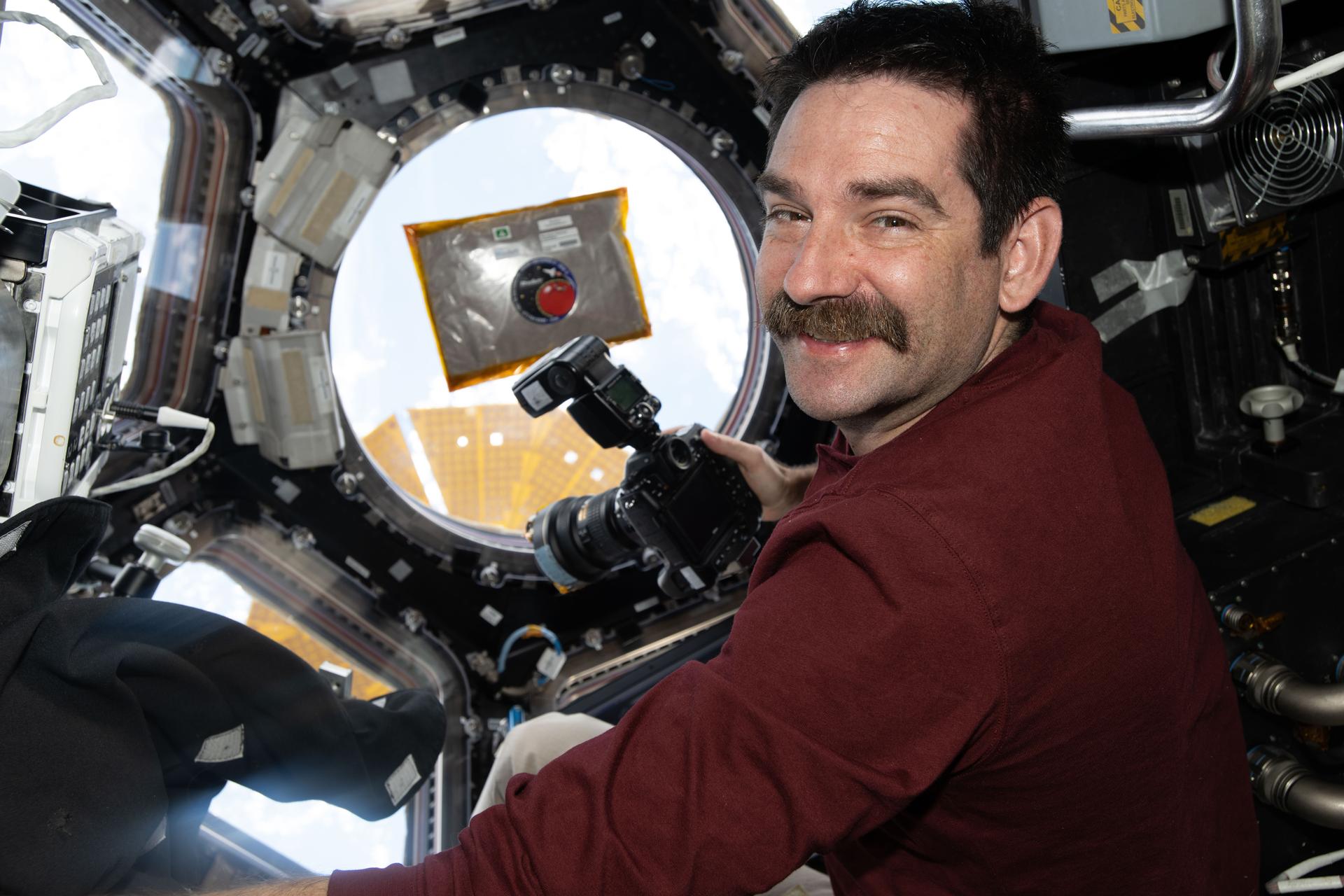
iss074e0325621 (Feb. 25, 2026) --- NASA astronaut and Expedition 74 flight engineer Jack Hathaway smiles for a portrait inside the International Space Station’s cupola while photographing a sample chamber for the Rhodium Biomanufacturing 03 biotechnology experiment. The investigation uses living systems such as microorganisms and cell cultures to produce materials and biomolecules on a commercial scale. Results may support the production of food, pharmaceuticals, and other materials during long‑duration spaceflight. Credit: NASA/Jack Hathaway
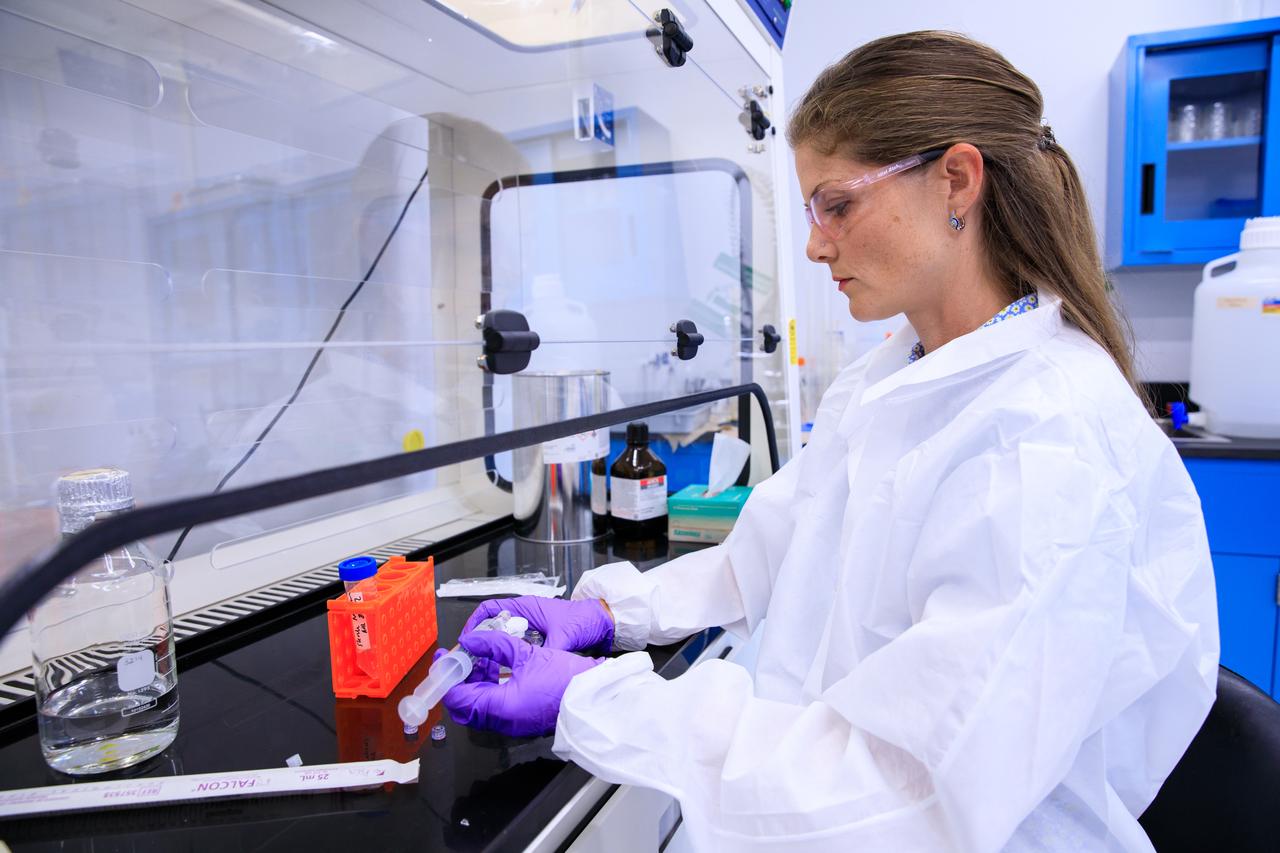
Aubrey O’Rourke, a project scientist at NASA’s Kennedy Space Center, is a member of the Crop Production team at the Florida spaceport. One key project on which she is working involves the building and deploying of an automatic genomic sequencer for spaceflight applications. The capability will allow NASA to conduct fundamental research as well as microbial monitoring of water and foods systems off-planet and at remote locations on Earth.
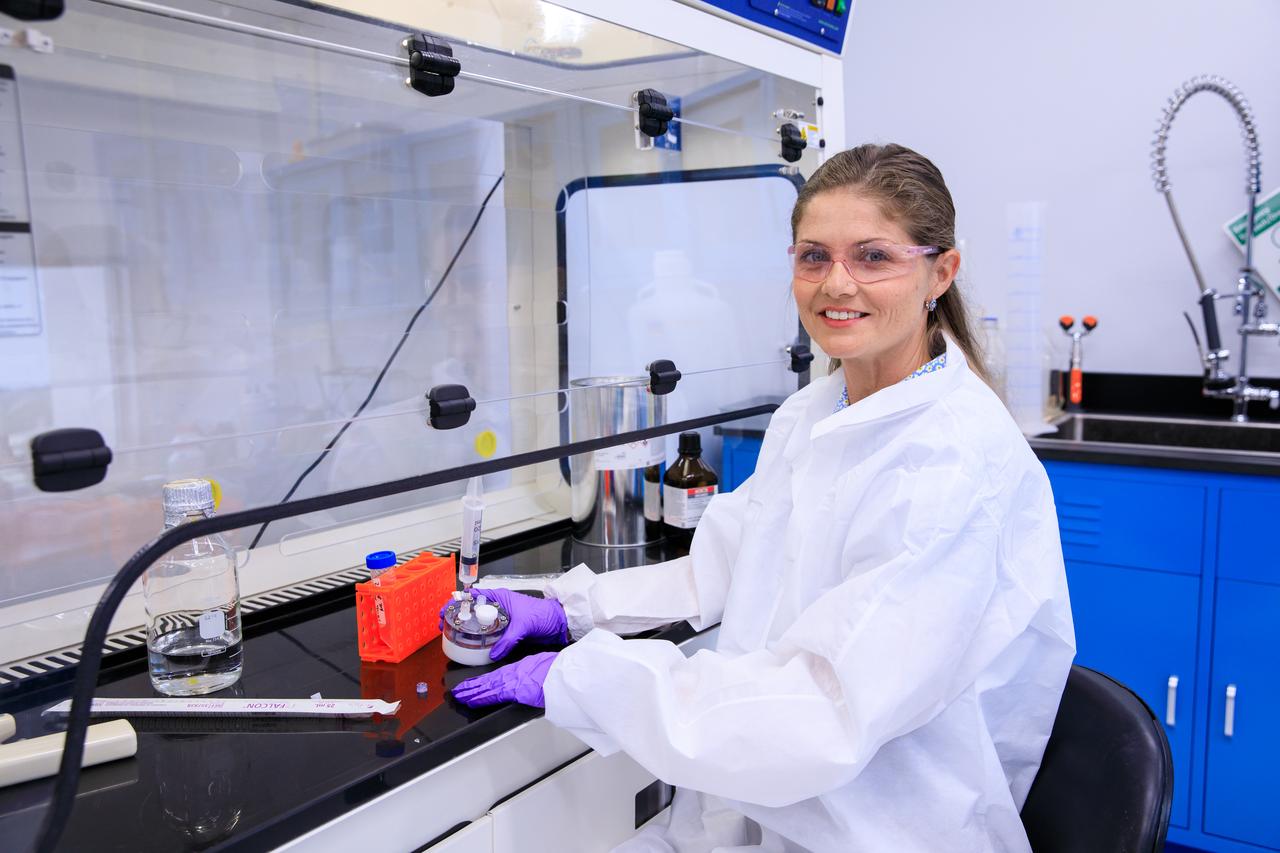
Aubrey O’Rourke, a project scientist at NASA’s Kennedy Space Center, is a member of the Crop Production team at the Florida spaceport. One key project on which she is working involves the building and deploying of an automatic genomic sequencer for spaceflight applications. The capability will allow NASA to conduct fundamental research as well as microbial monitoring of water and foods systems off-planet and at remote locations on Earth.
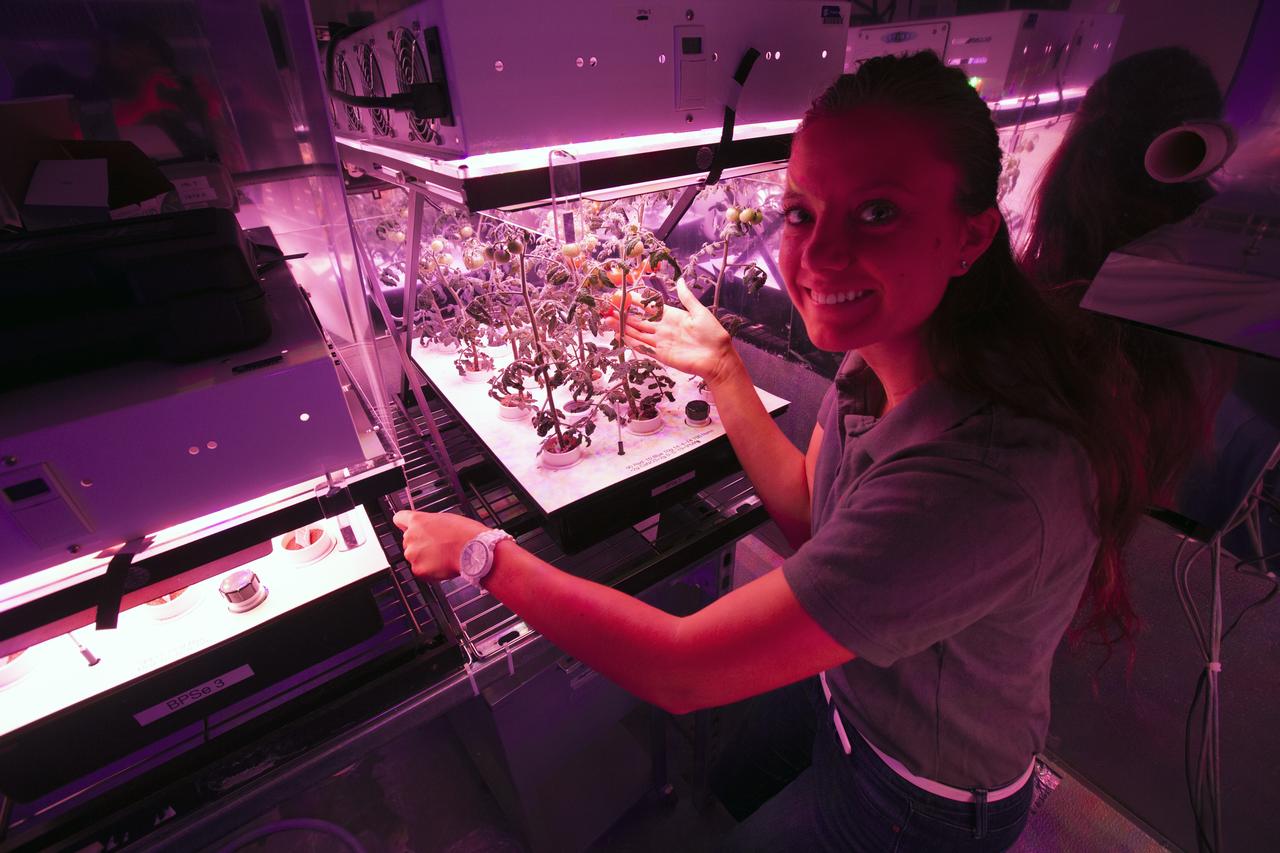
In the Space Life Sciences Laboratory at NASA's Kennedy Space Center in Florida, student interns such as Ayla Grandpre are joining agency scientists, contributing in the area of plant growth research for food production in space. Grandpre is majoring in computer science and chemistry at Rocky Mountain College in Billings, Montana. The agency attracts its future workforce through the NASA Internship, Fellowships and Scholarships, or NIFS, Program.
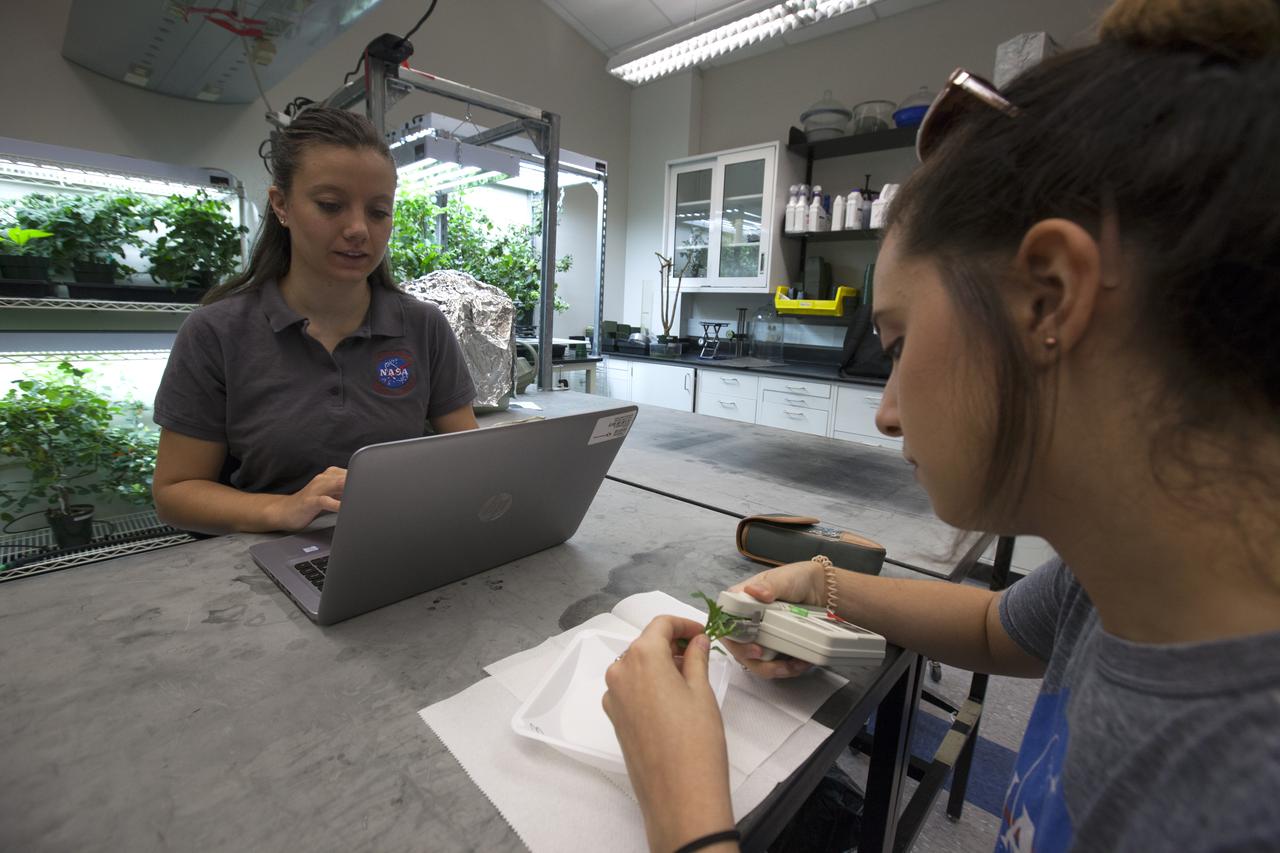
In the Space Life Sciences Laboratory at NASA's Kennedy Space Center in Florida, student interns such as Ayla Grandpre, left, and Payton Barnwell are joining agency scientists, contributing in the area of plant growth research for food production in space. Grandpre is pursuing a degree in computer science and chemistry at Rocky Mountain College in Billings, Montana. Barnwell is a mechanical engineering and nanotechnology major at Florida Polytechnic University. The agency attracts its future workforce through the NASA Internship, Fellowships and Scholarships, or NIFS, Program.
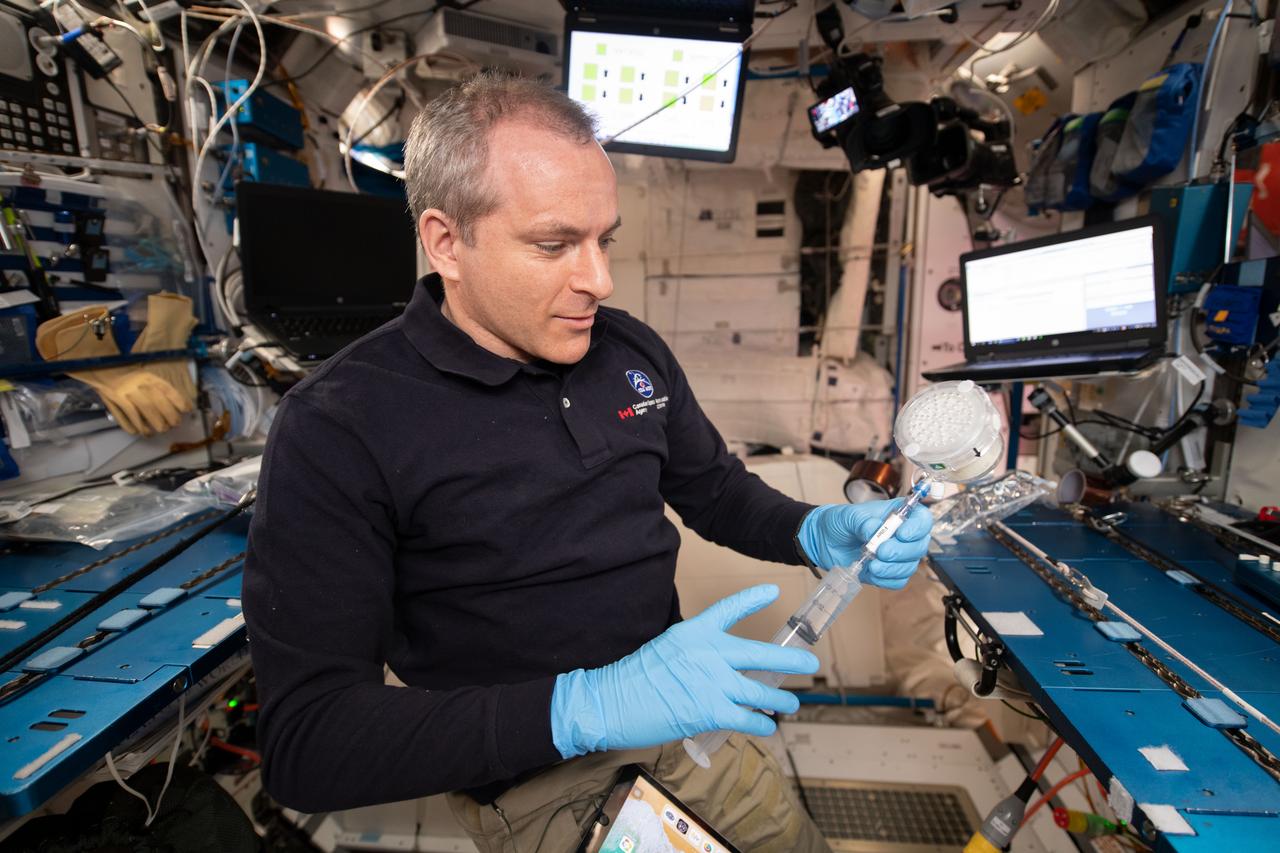
iss059e092719 (6/10/2019) --- Canadian Space Agency astronaut David Saint-Jacques is shown initializing the BioNutirents investigation by hydrating the growth packets onboard the International Space Station (ISS). The BioNutrients investigation demonstrates a technology that enables on-demand production of human nutrients during long-duration space missions. The process uses engineered microbes, like yeast, to generate carotenoids from an edible media to supplement potential vitamin losses from food that is stored for very long periods.
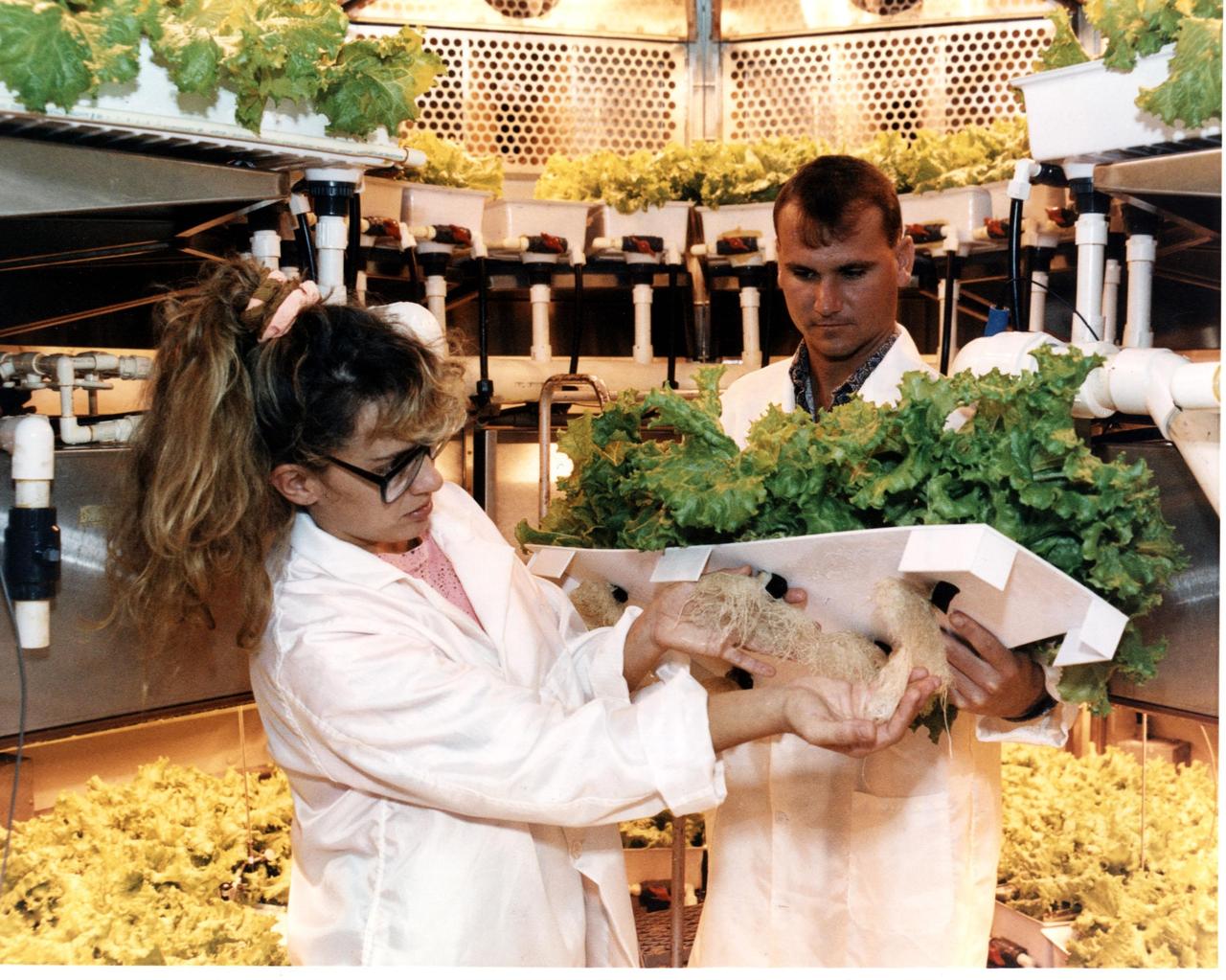
Original photo and caption dated October 8, 1991: <i>"Plant researchers Lisa Ruffe and Neil Yorio prepare to harvest a crop of Waldann's Green Lettuce from KSC's Biomass Production Chamber (BPC). KSC researchers have grown several different crops in the BPC to determine which plants will better produce food, water and oxygen on long-duration space missions."</i
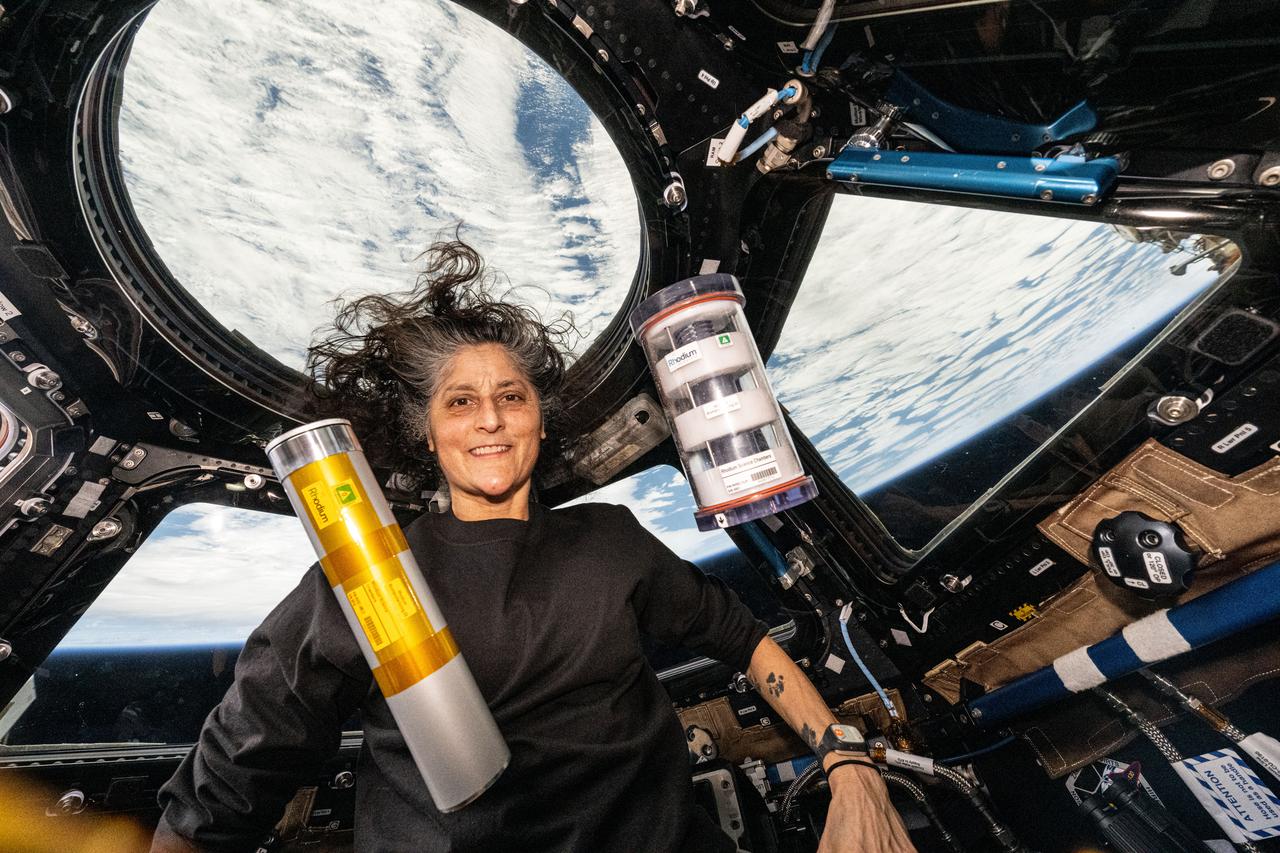
iss072e308289 (Dec. 2, 2024) --- NASA astronaut and Expedition 72 Commander Suni Williams displays science hardware housing bacteria and yeast samples for the Rhodium Biomanufacturing 03 study that may enable the production of food and medicine in space. Williams was in the cupola, the International Space Station's "window to the world," as the orbital outpost soared 258 miles above a cloudy Pacific Ocean off the coast of Costa Rica.
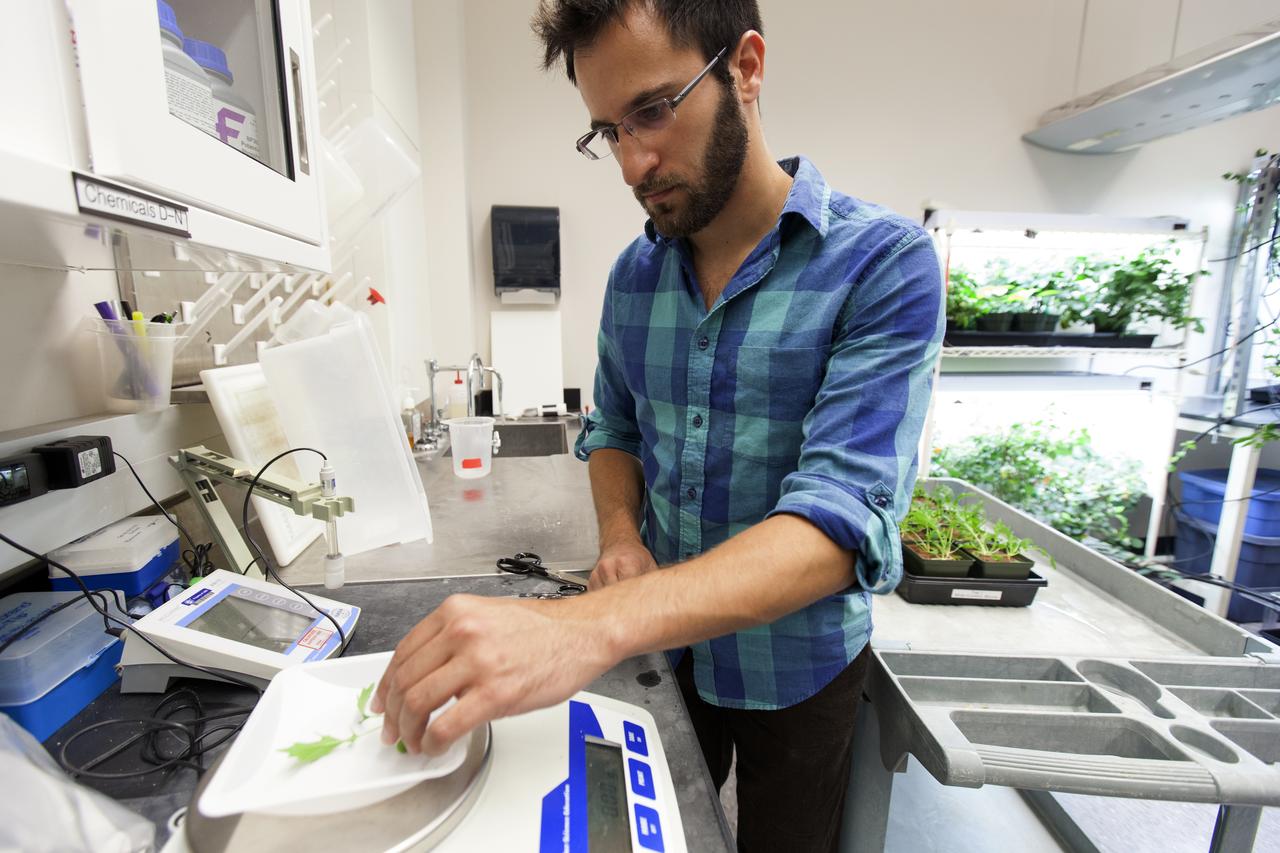
In the Space Life Sciences Laboratory at NASA's Kennedy Space Center in Florida, student interns such as Alex Litvin are joining agency scientists, contributing in the area of plant growth research for food production in space. Litvin is pursuing doctorate in horticulture at Iowa State University. The agency attracts its future workforce through the NASA Internship, Fellowships and Scholarships, or NIFS, Program.
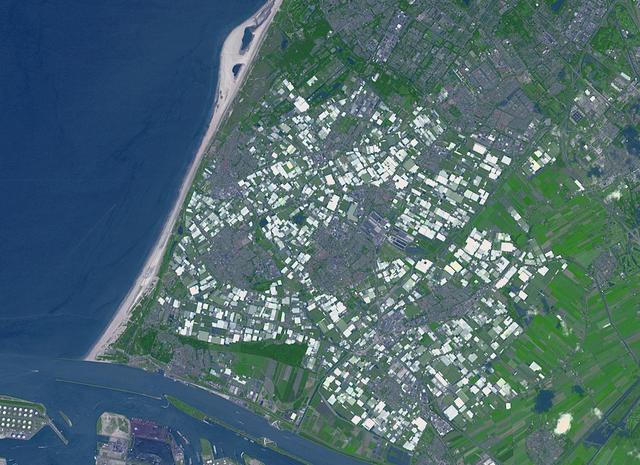
Westland in the Netherlands is the greenhouse capital of the world. It is the number two exporter of food as measured by value, second only to the United States. This is accomplished inside of almost 100 square kilometers of greenhouses. Tomato production, for example is 1 million tons per year, grown on only 18 square kilometers of area, making it number one globally in efficiency. The image was acquired June 12, 2014, covers an area of 13.5 by 18.4 kilometers, and is located at 52 degrees north, 4.3 degrees east. https://photojournal.jpl.nasa.gov/catalog/PIA21986
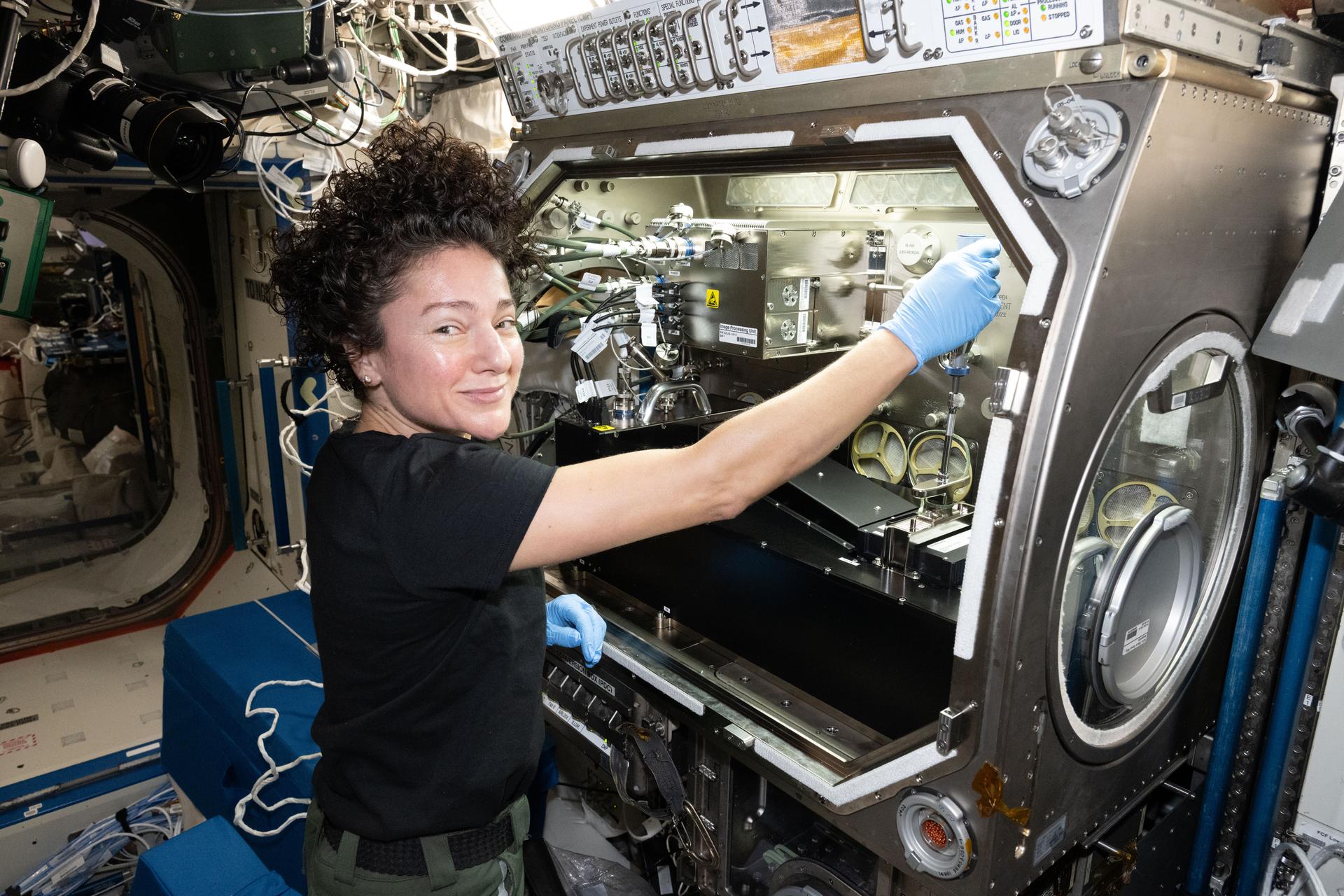
iss074e0541212 (April 29, 2026) --- NASA astronaut and Expedition 74 flight engineer Jessica Meir configures research gear inside the Destiny laboratory module's Microgravity Science Glovebox aboard the International Space Station. Meir was exploring how weightlessness affects tiny particles floating in a gelatin-like substance, known as a colloidal solid. Results may lead to advanced manufacturing techniques leading to new medicines, better food textures, and improved personal care products on Earth and in space. Credit: NASA/Jessica Meir
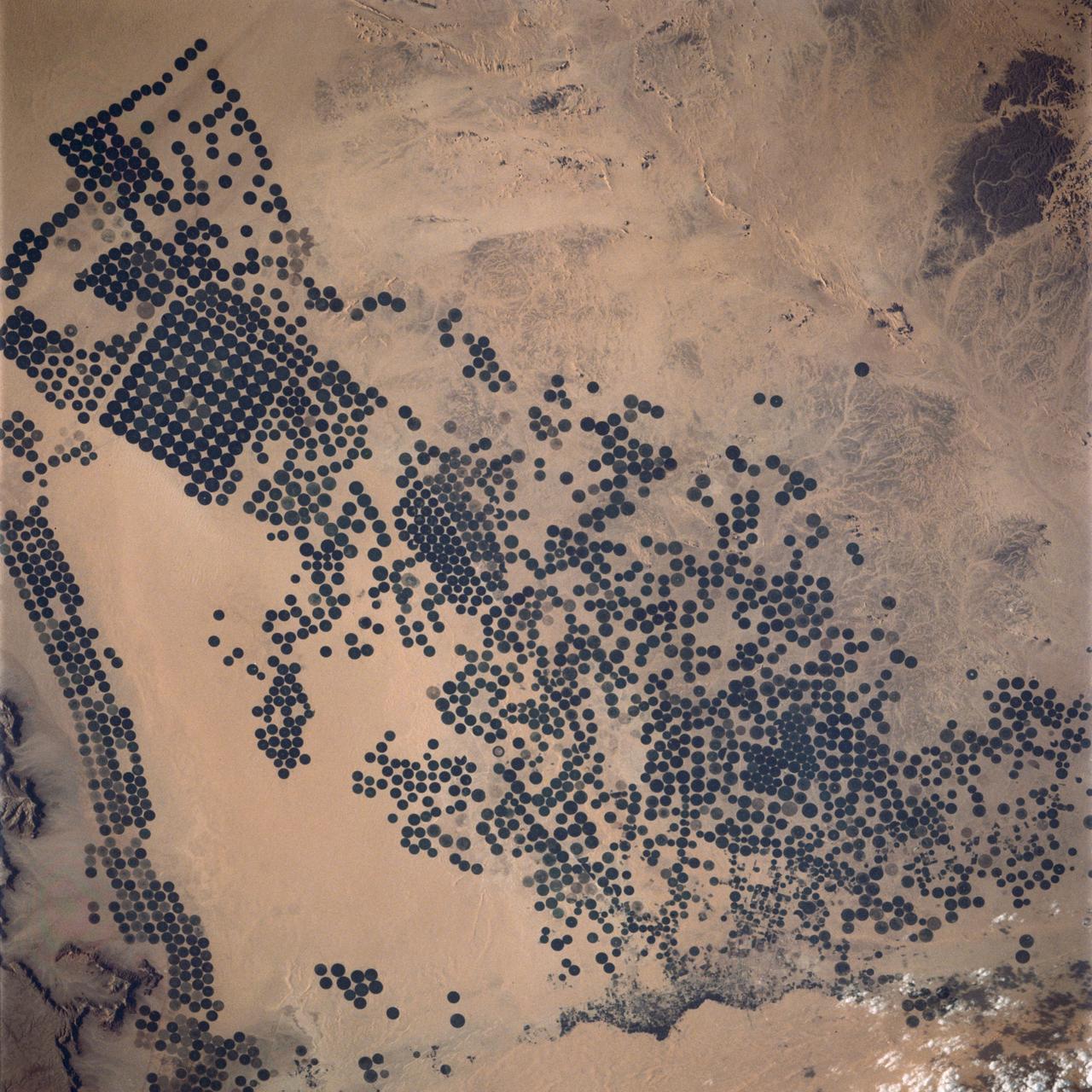
In Saudi Arabia, center-pivot, swing-arm irrigated agriculture complexes such as the one imaged at Jabal Tuwayq (20.5N, 45.0 E) extract deep fossil water reserves to achieve food crop production self sufficiency in this desert environment. The significance of the Saudi expanded irrigated agriculture is that the depletion of this finite water resource is a short term solution to a long term need that will still exist when the water has been extracted.
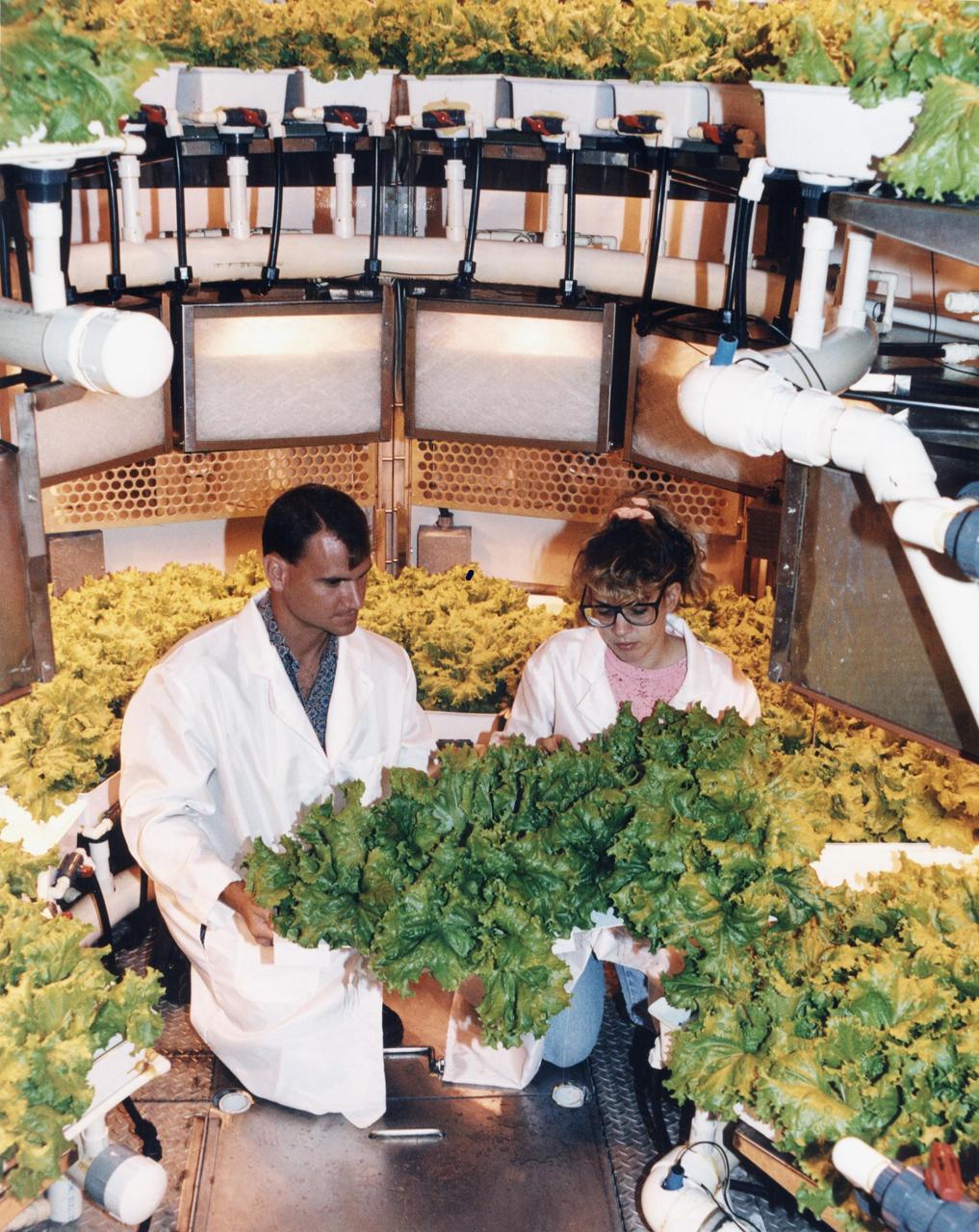
Original photo and caption dated October 8, 1991: "Plant researchers Neil Yorio and Lisa Ruffe prepare to harvest a crop of Waldann's Green Lettuce from KSC's Biomass Production Chamber (BPC). KSC researchers have grown several different crops in the BPC to determine which plants will better produce food, water and oxygen on long-duration space missions."
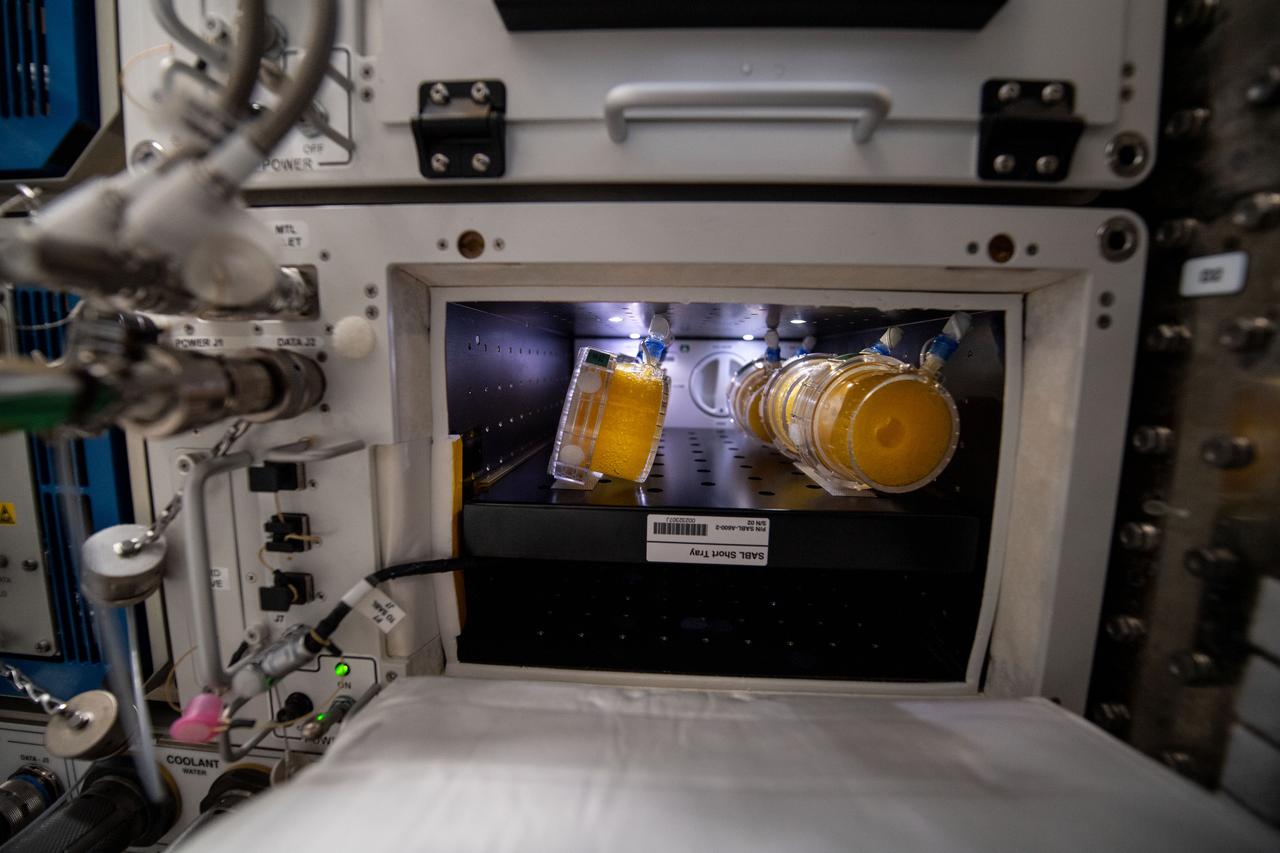
iss059e099184 (6/10/2019) --- Photo documentation of the BioNutirents packets in the Space Automated Bioproduct Laboratory (SABL) incubator onboard the International Space Station (ISS). The BioNutrients investigation demonstrates a technology that enables on-demand production of human nutrients during long-duration space missions. The process uses engineered microbes, like yeast, to generate carotenoids from an edible media to supplement potential vitamin losses from food that is stored for very long periods.
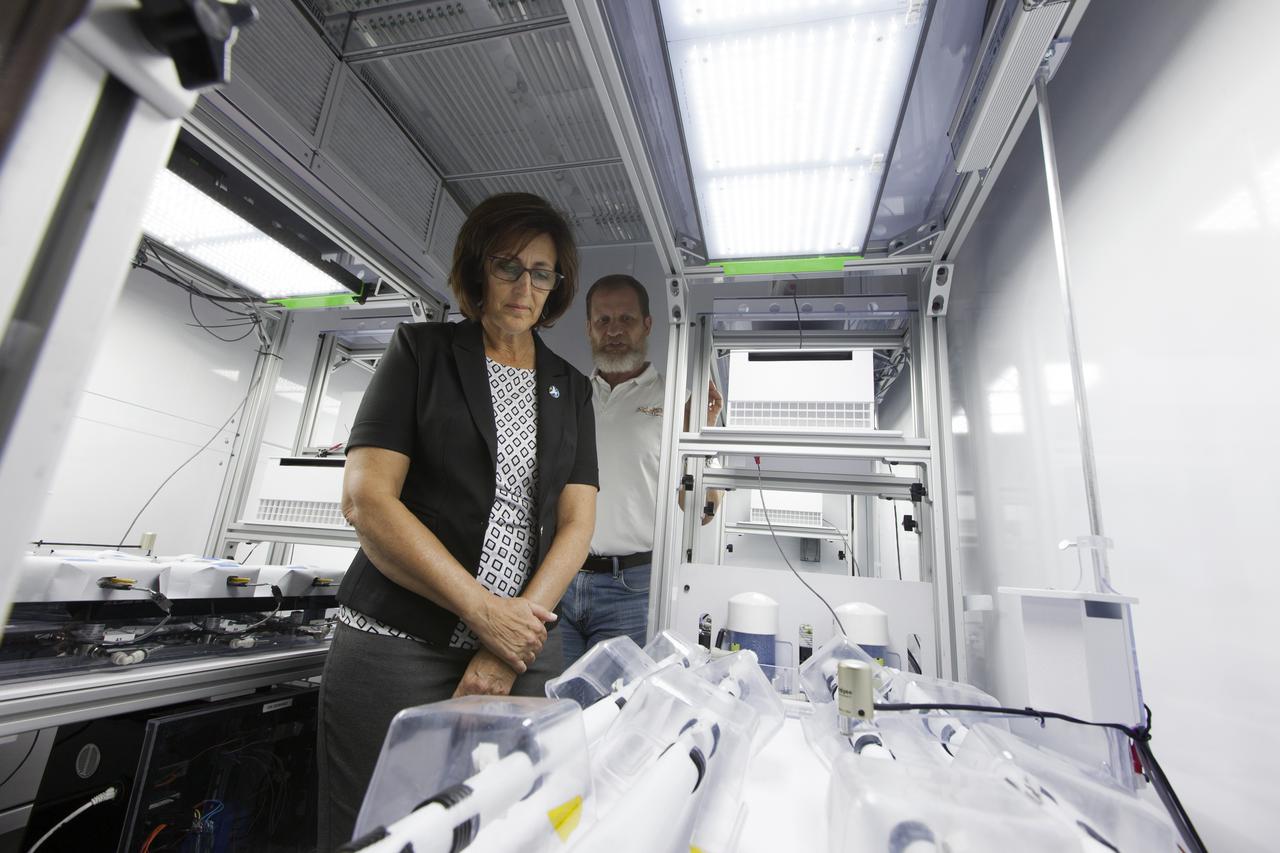
Robyn Gatens, left, deputy director, ISS Division and system capability leader for Environmental Control and Life Support Systems (ECLSS) at NASA Headquarters in Washington, tours laboratories in the Space Station Processing Facility at the agency's Kennedy Space Center in Florida, on June 13, 2018. Standing behind her is Ralph Fritsche, long-duration food production project manager at Kennedy. Gatens is viewing plant growth chambers and seeing firsthand some of the capabilities in the center's Exploration Research and Technology Programs.
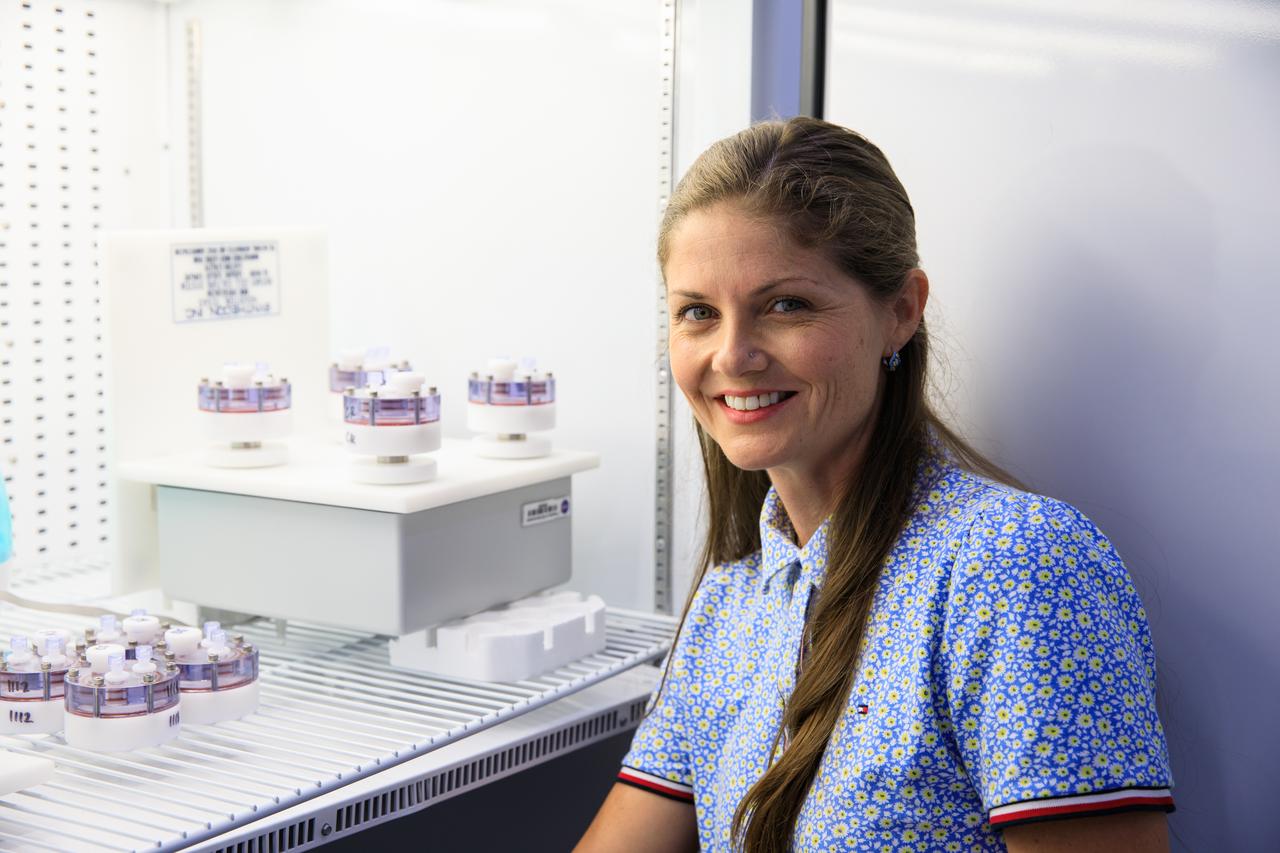
Aubrey O’Rourke, a project scientist at NASA’s Kennedy Space Center, is a member of the Crop Production team at the Florida spaceport. One key project on which she is working involves the building and deploying of an automatic genomic sequencer for spaceflight applications. The capability will allow NASA to conduct fundamental research as well as microbial monitoring of water and foods systems off-planet and at remote locations on Earth.

iss061e131007 (1/7/2020) --- Photo documentation of the BioNutirents packets aboard the International Space Station (ISS). The BioNutrients investigation demonstrates a technology that enables on-demand production of human nutrients during long-duration space missions. The process uses engineered microbes, like yeast, to generate carotenoids from an edible media to supplement potential vitamin losses from food that is stored for very long periods.
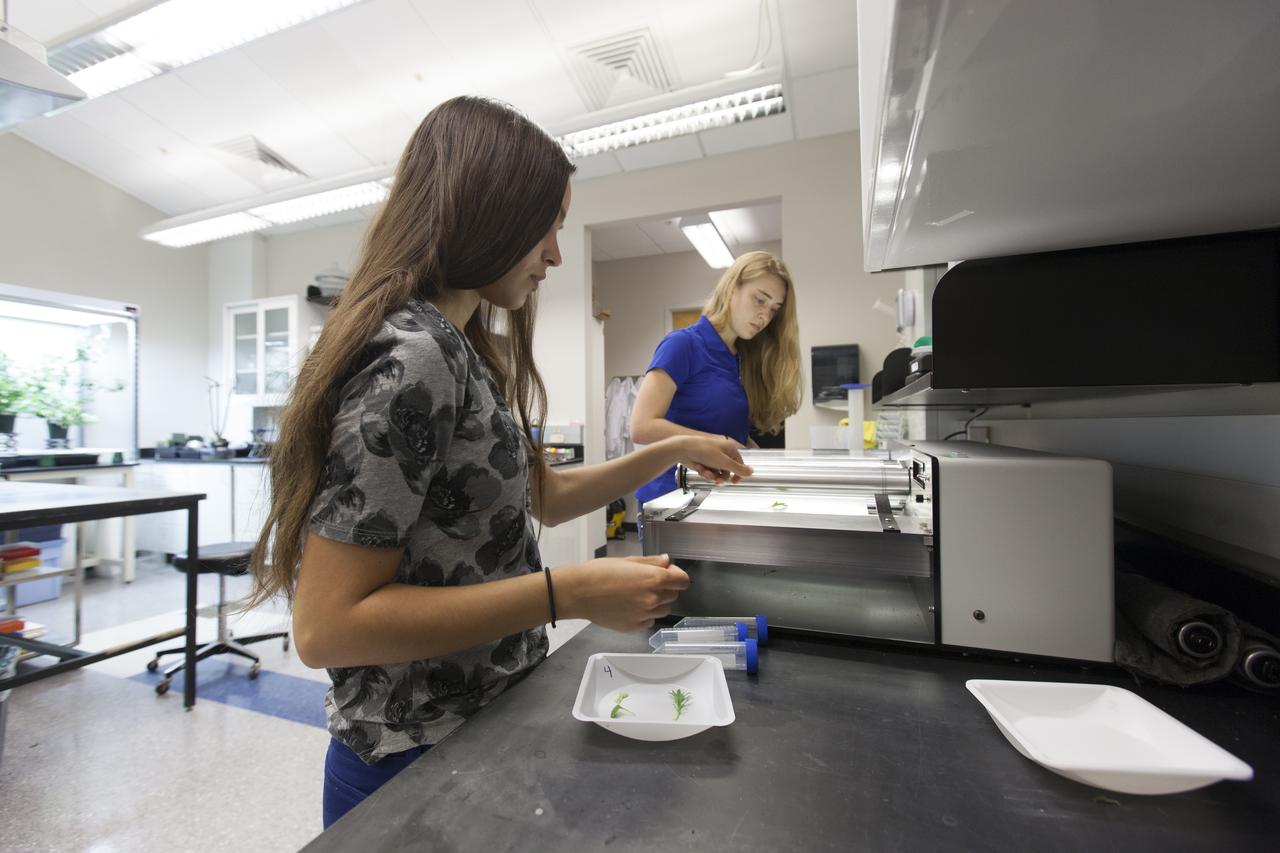
In the Space Life Sciences Laboratory at NASA's Kennedy Space Center in Florida, student interns such as Emma Boehm, left, and Jessica Scotten are joining agency scientists, contributing in the area of plant growth research for food production in space. Boehm is pursuing a degree in ecology and evolution at the University of Minnesota. Scotten is majoring in microbiology at Oregon State University. The agency attracts its future workforce through the NASA Internship, Fellowships and Scholarships, or NIFS, Program.
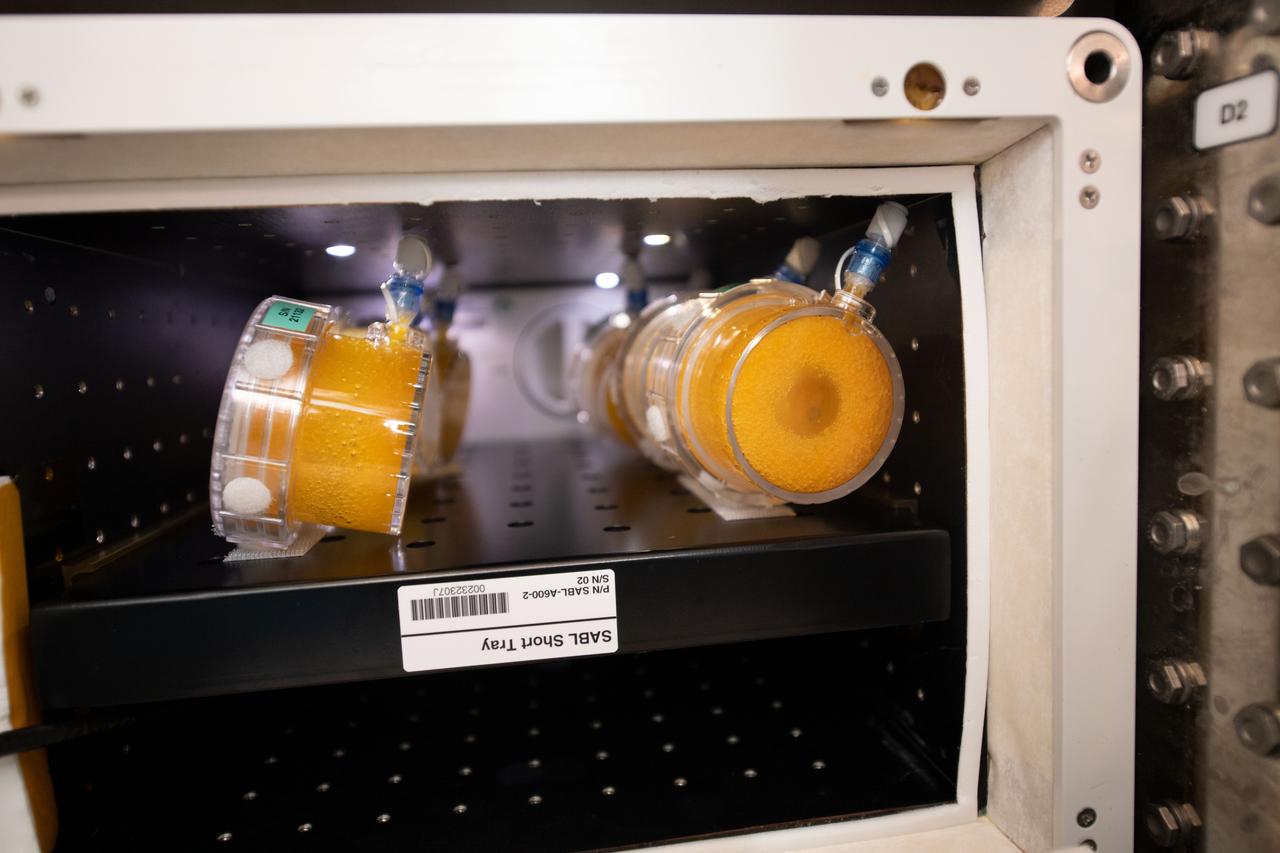
iss059e092729 (6/10/2019) --- Photo documentation of the BioNutirents packets in the Space Automated Bioproduct Laboratory (SABL) incubator onboard the International Space Station (ISS). The BioNutrients investigation demonstrates a technology that enables on-demand production of human nutrients during long-duration space missions. The process uses engineered microbes, like yeast, to generate carotenoids from an edible media to supplement potential vitamin losses from food that is stored for very long periods.
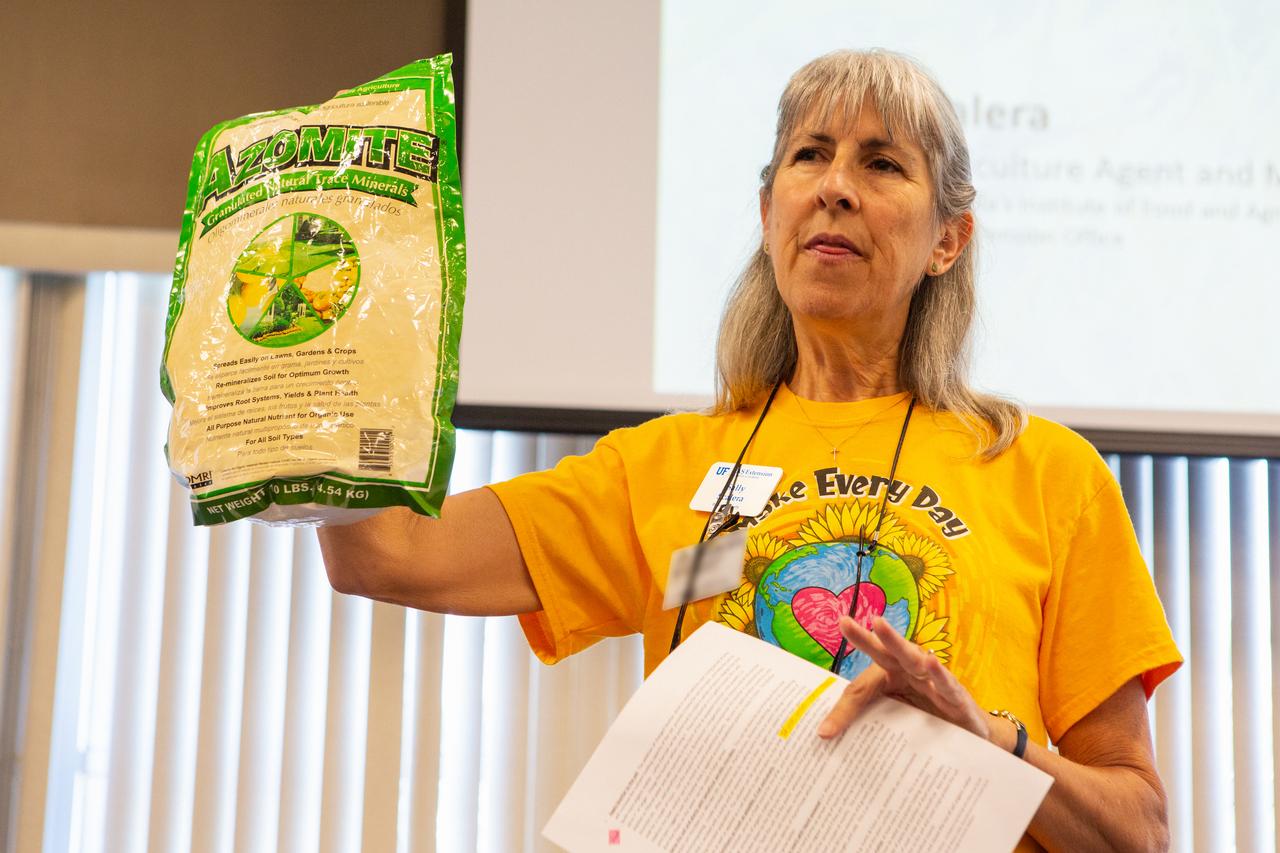
Sally Scalera, urban horticulture agent and master gardener coordinator from the University of Florida’s Institute of Food and Agricultural Sciences Brevard Extension Office, shows Kennedy Space Center employees some sustainable yard products available during her presentation on tips and tricks for a healthy yard and garden on April 24, 2019. Held inside the Florida spaceport’s Space Station Processing Facility Conference Center, Scalera also provided information on Florida-friendly landscaping practices. The lunch and learn was available for employees to attend as part of Kennedy’s Earth Day events.
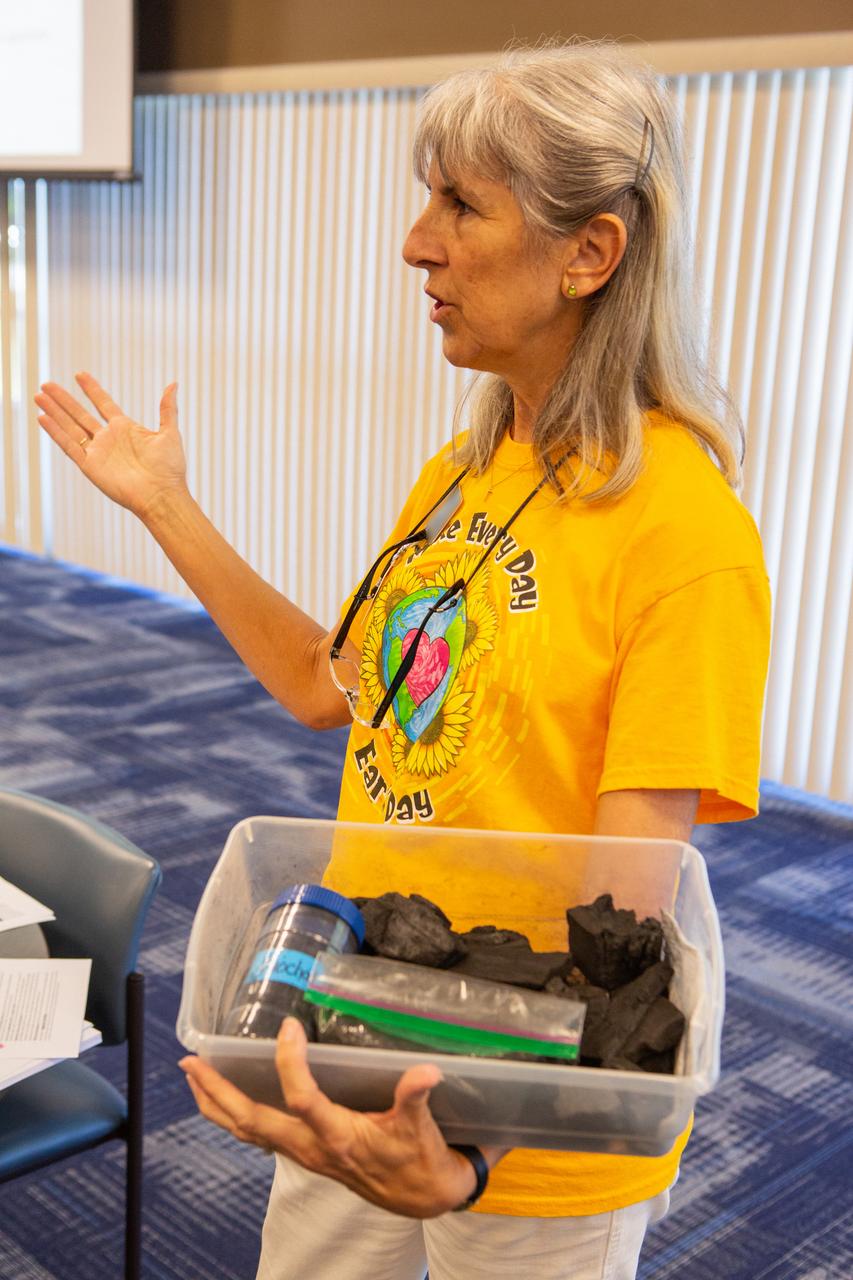
Sally Scalera, urban horticulture agent and master gardener coordinator from the University of Florida’s Institute of Food and Agricultural Sciences Brevard Extension Office, shows Kennedy Space Center employees some sustainable yard products available during her presentation on tips and tricks for a healthy yard and garden on April 24, 2019. Held inside the Florida spaceport’s Space Station Processing Facility Conference Center, Scalera also provided information on Florida-friendly landscaping practices. The lunch and learn was available for employees to attend as part of Kennedy’s Earth Day events.
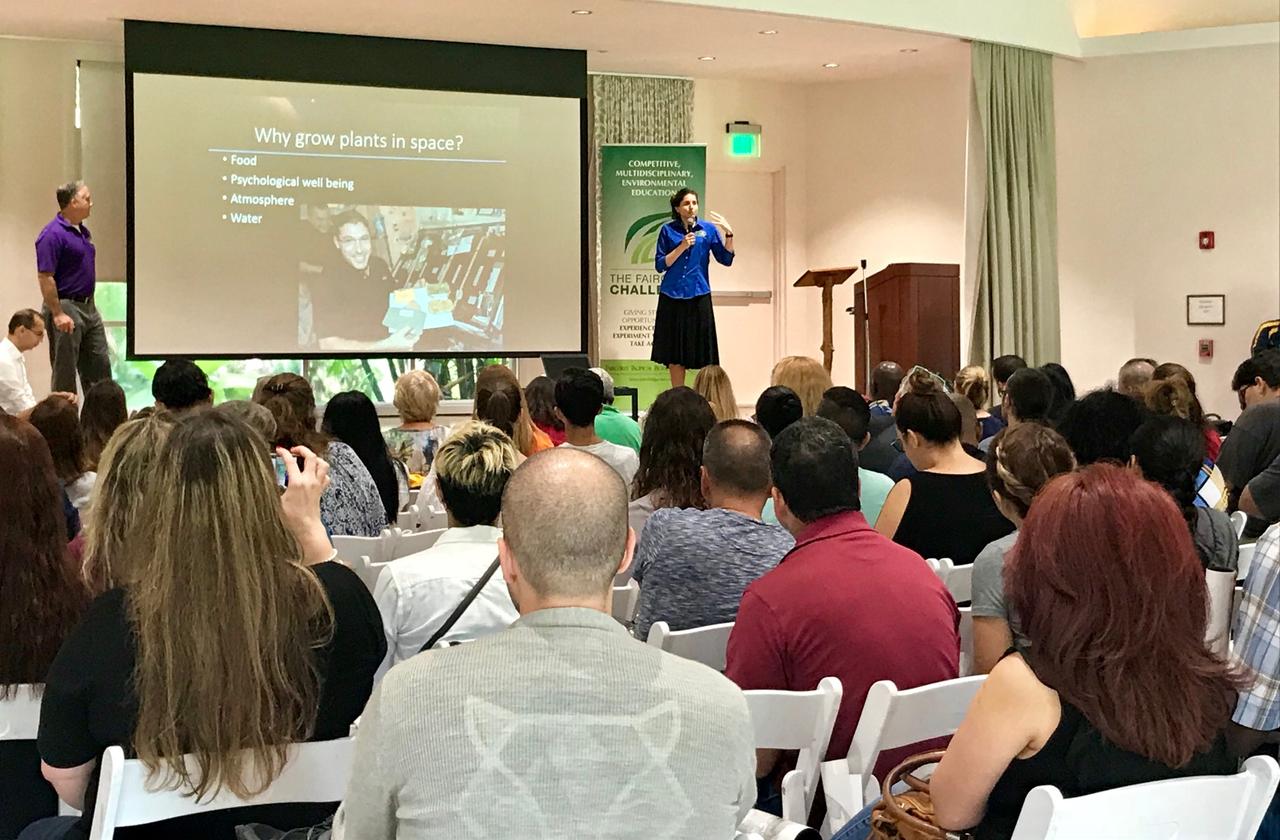
Kennedy scientists Trent Smith, left, and Dr. Gioia Massa speak to middle and high school teachers at Fairchild Tropical Botanic Garden in Miami during the kickoff of the 2017-2018 Fairchild Challenge-Growing Beyond Earth. More than 130 teachers gathered for the opening workshop, where they learned about food production in space and the Veggie hardware currently on the International Space Station. NASA has partnered with Fairchild to create this STEM-based challenge in which students will follow specific research protocols and analyze plant growth factors, flavor and nutrition, in order to help NASA choose the next crops for astronauts to grow aboard the station.
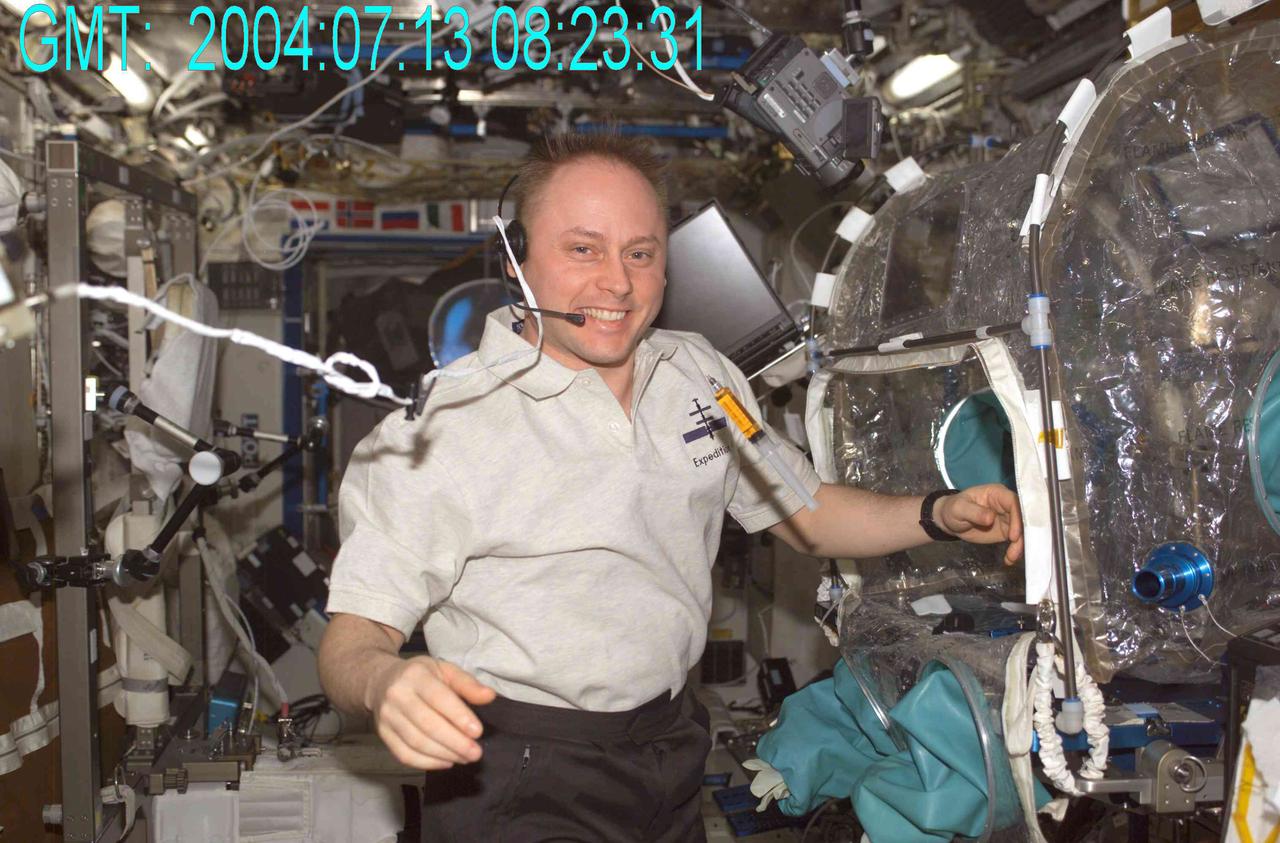
Astronaut Mike Fincke places droplets of honey onto the strings for the Fluid Merging Viscosity Measurement (FMVM) investigation onboard the International Space Station (ISS). The FMVM experiment measures the time it takes for two individual highly viscous fluid droplets to coalesce or merge into one droplet. Different fluids and droplet size combinations were tested in the series of experiments. By using the microgravity environment, researchers can measure the viscosity or "thickness" of fluids without the influence of containers and gravity using this new technique. Understanding viscosity could help scientists understand industrially important materials such as paints, emulsions, polymer melts and even foams used to produce pharmaceutical, food, and cosmetic products.
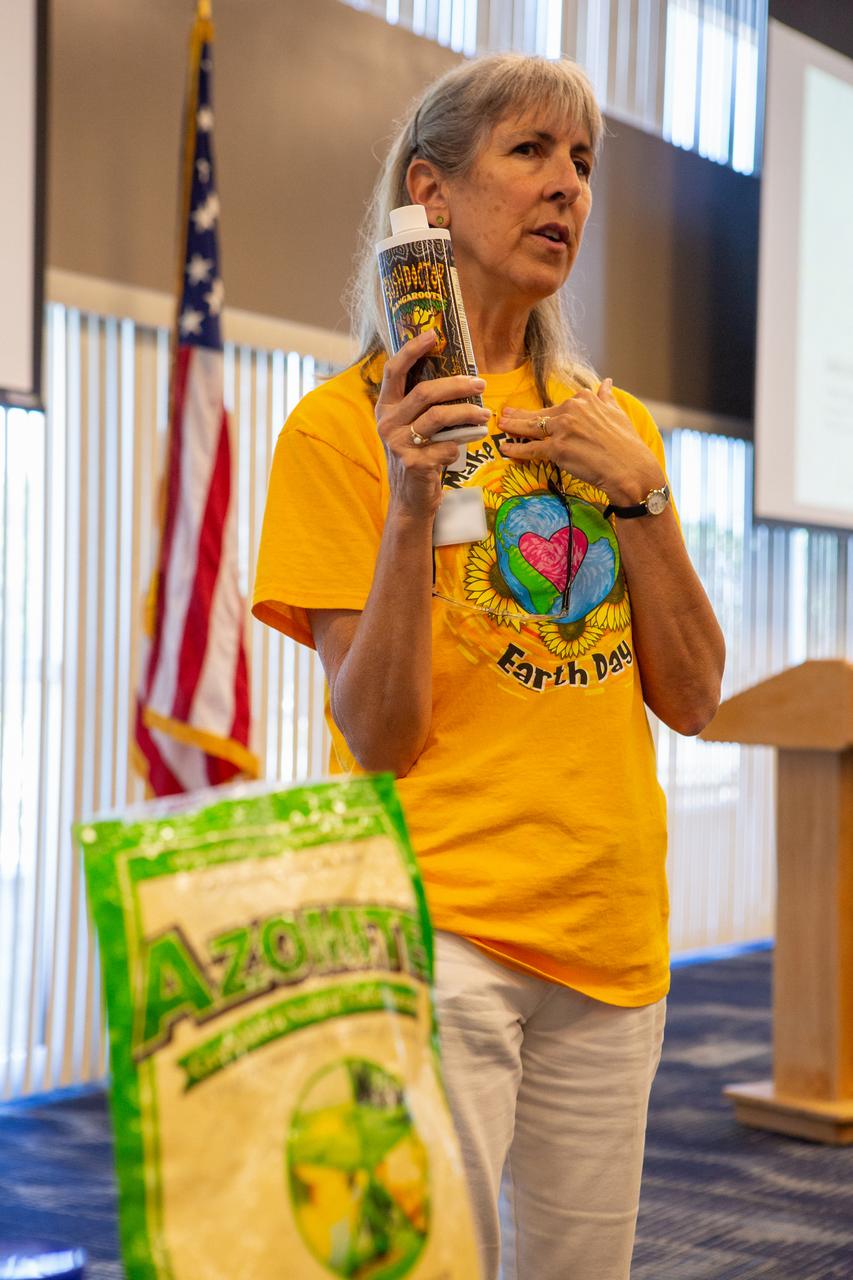
Sally Scalera, urban horticulture agent and master gardener coordinator from the University of Florida’s Institute of Food and Agricultural Sciences Brevard Extension Office, shows Kennedy Space Center employees some sustainable yard products available during her presentation on tips and tricks for a healthy yard and garden on April 24, 2019. Held inside the Florida spaceport’s Space Station Processing Facility Conference Center, Scalera also provided information on Florida-friendly landscaping practices. The lunch and learn was available for employees to attend as part of Kennedy’s Earth Day events.
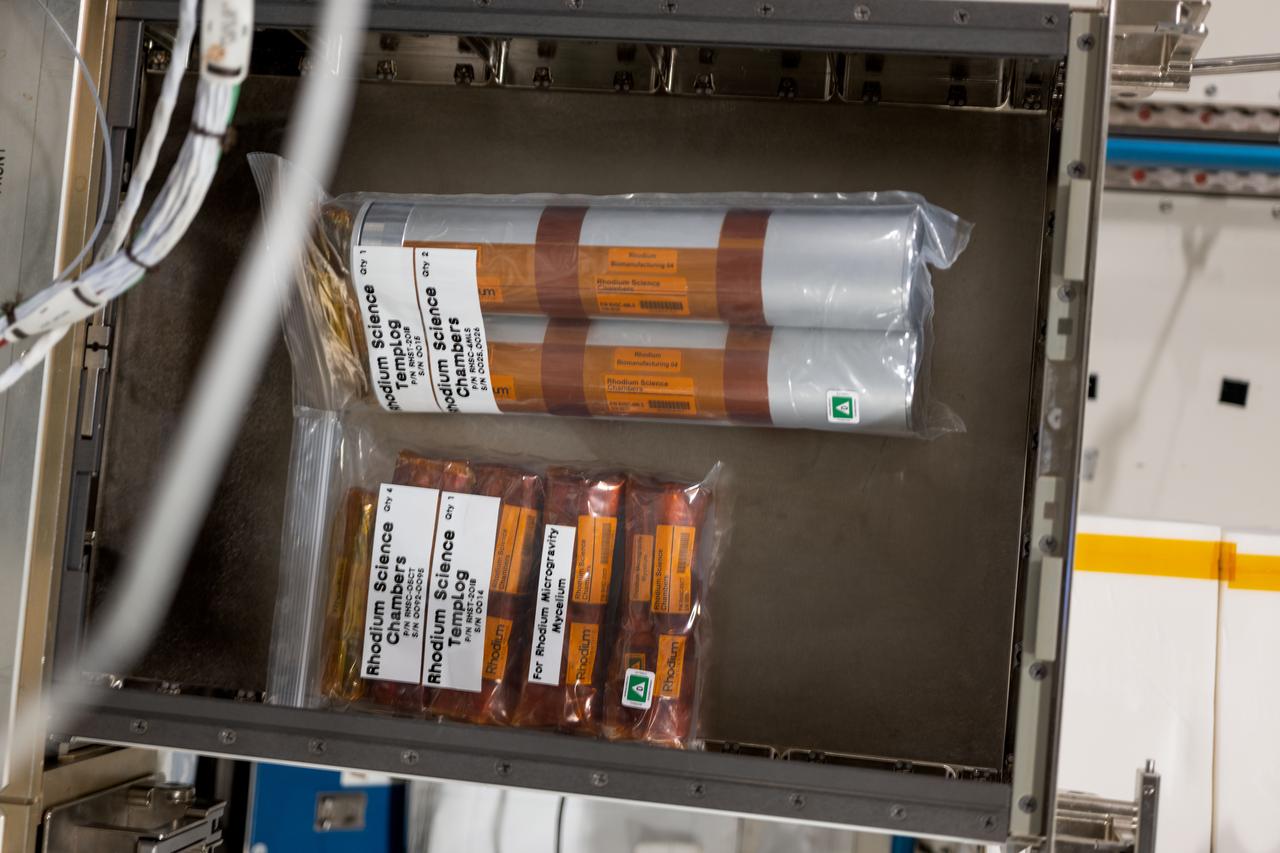
iss071e439623 (Aug. 7, 2024) -- Rhodium science chambers are pictured prior to storage in an ambient locker location aboard the International Space Station. The Swinburne Youth Space Innovation Challenge 2023 Examining Mushroom Growth in Microgravity, or Rhodium Microgravity Mycelium investigation, tests the growth rates of mycelia, the root structures of mushrooms, in space. Microgravity can alter the growth rates of other organisms and understanding how it affects mycelium growth rate and biomass production could provide insight into growth characteristics of fungi. Mushrooms have recognized nutritional value and results could lead to more efficient mushroom growth and new strains of mushrooms as potential food sources for space travel and for research on Earth.
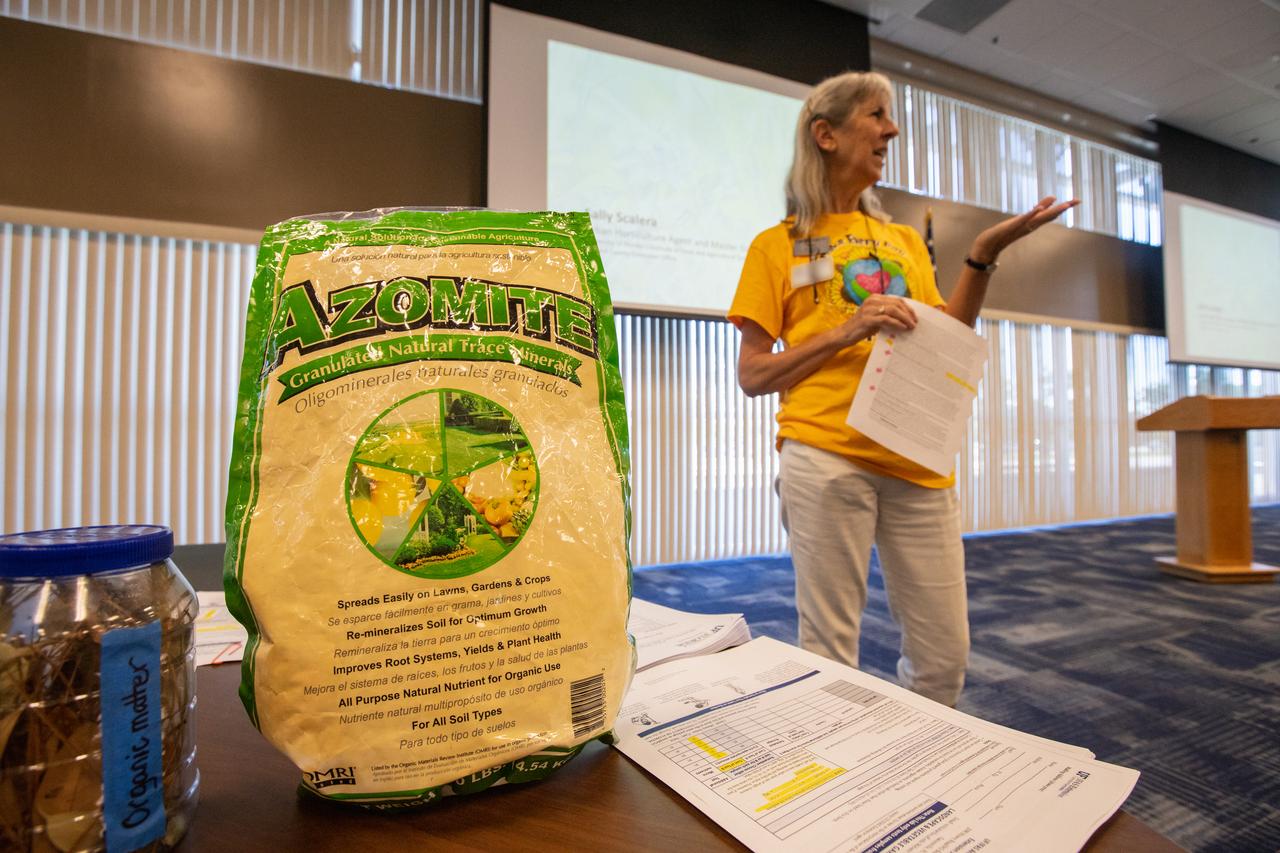
Sally Scalera, urban horticulture agent and master gardener coordinator from the University of Florida’s Institute of Food and Agricultural Sciences Brevard Extension Office, shows Kennedy Space Center employees some sustainable yard products available during her presentation on tips and tricks for a healthy yard and garden on April 24, 2019. Held inside the Florida spaceport’s Space Station Processing Facility Conference Center, Scalera also provided information on Florida-friendly landscaping practices. The lunch and learn was available for employees to attend as part of Kennedy’s Earth Day events.
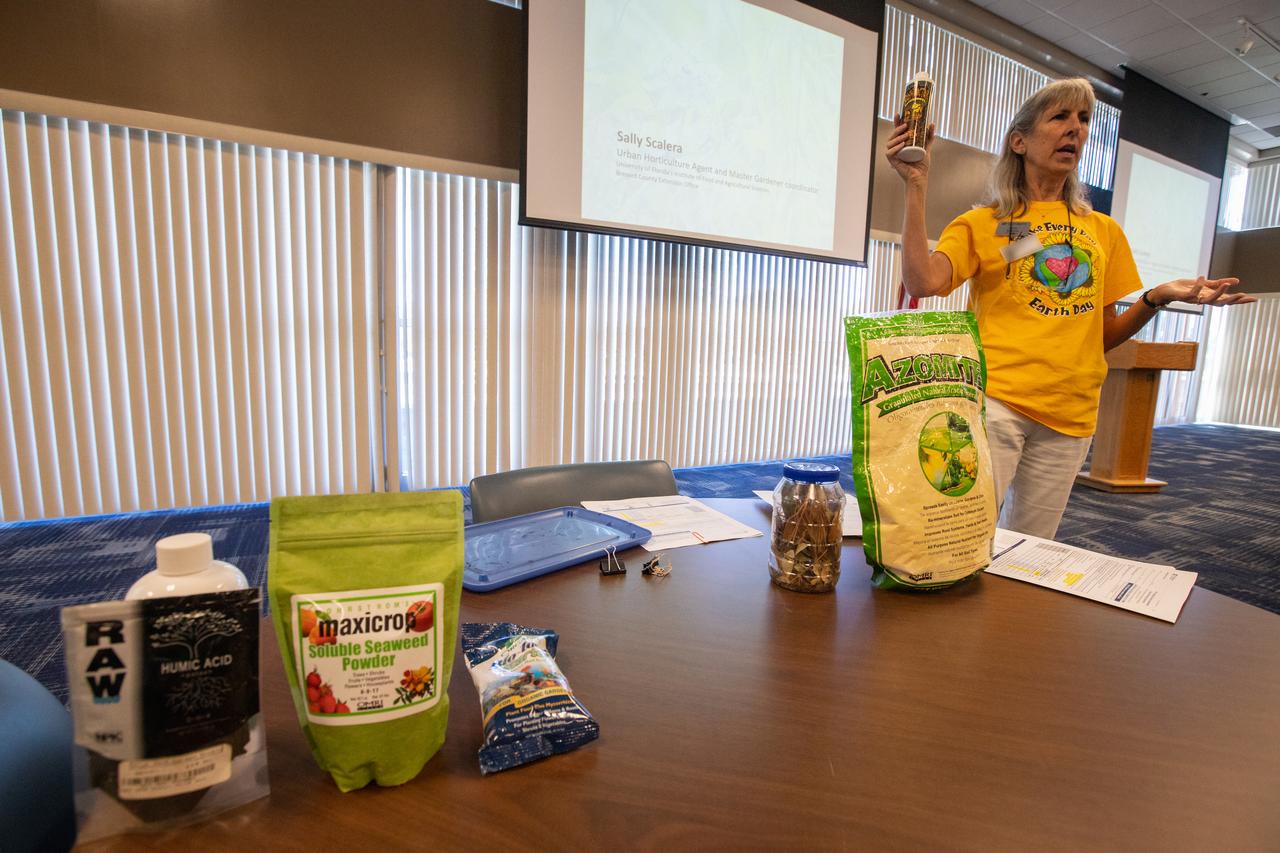
Sally Scalera, urban horticulture agent and master gardener coordinator from the University of Florida’s Institute of Food and Agricultural Sciences Brevard Extension Office, shows Kennedy Space Center employees some sustainable yard products available during her presentation on tips and tricks for a healthy yard and garden on April 24, 2019. Held inside the Florida spaceport’s Space Station Processing Facility Conference Center, Scalera also provided information on Florida-friendly landscaping practices. The lunch and learn was available for employees to attend as part of Kennedy’s Earth Day events.
![jsc2025e047405 (5/28/2025) --- Image of the preparative zone of cultured tobacco cells with visualized microtubules (yellow: microtubules [preparative zone], magenta: nuclei). For the Effects of the Space Environment on Cell Division in Plants (Plant Cell Division) investigation, plant samples are collected that are fixed and frozen for analysis of microstructures, microtubules, proteomes, and transcriptome and imaged using the JAXA Confocal Microscope (COSMIC). The Plant Cell Division investigation provides researchers with a better understanding of how gravity affects the body plan of plants could support production of food crops on future spaceflight missions. Image courtesy of University of Toyama.](https://images-assets.nasa.gov/image/jsc2025e047405/jsc2025e047405~thumb.jpg)
jsc2025e047405 (5/28/2025) --- Image of the preparative zone of cultured tobacco cells with visualized microtubules (yellow: microtubules [preparative zone], magenta: nuclei). For the Effects of the Space Environment on Cell Division in Plants (Plant Cell Division) investigation, plant samples are collected that are fixed and frozen for analysis of microstructures, microtubules, proteomes, and transcriptome and imaged using the JAXA Confocal Microscope (COSMIC). The Plant Cell Division investigation provides researchers with a better understanding of how gravity affects the body plan of plants could support production of food crops on future spaceflight missions. Image courtesy of University of Toyama.
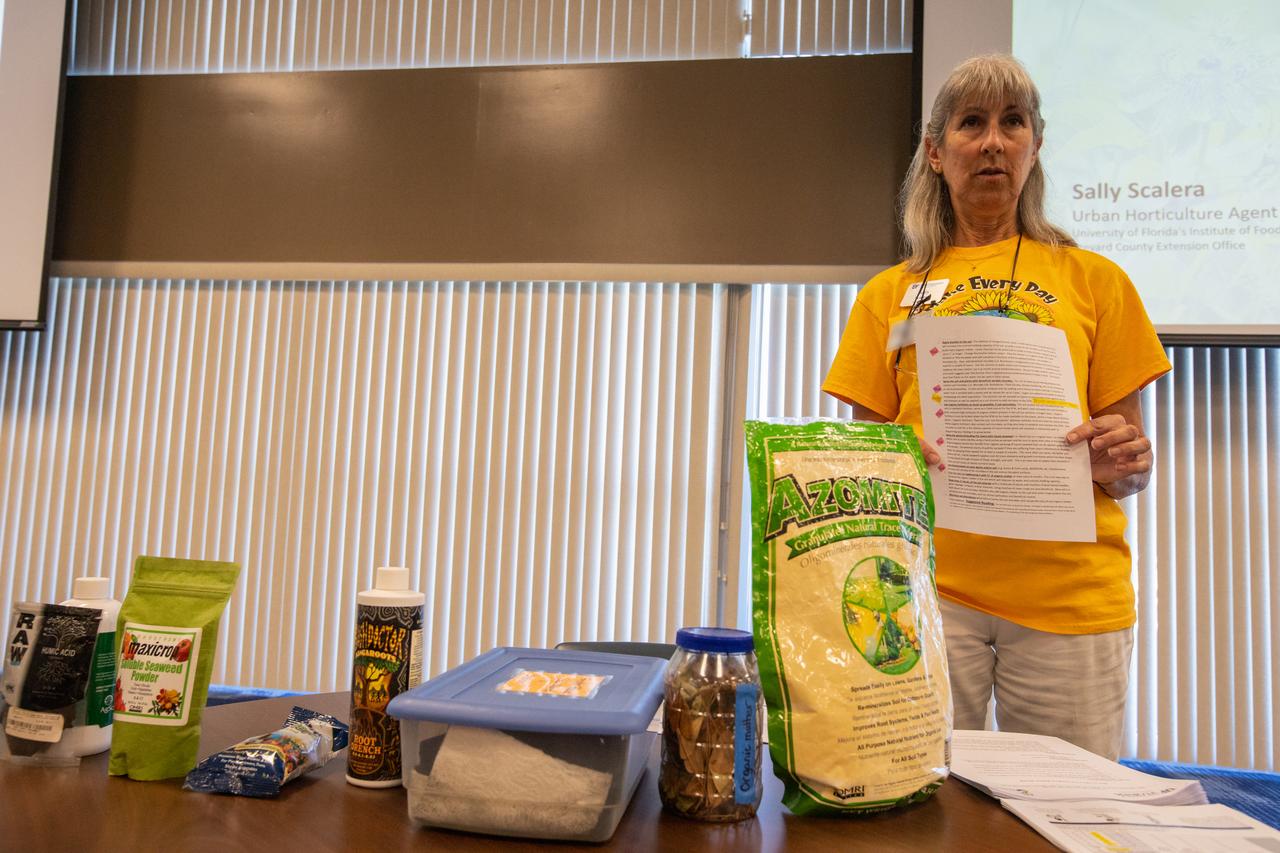
Sally Scalera, urban horticulture agent and master gardener coordinator from the University of Florida’s Institute of Food and Agricultural Sciences Brevard Extension Office, shows Kennedy Space Center employees some sustainable yard products available during her presentation on tips and tricks for a healthy yard and garden on April 24, 2019. Held inside the Florida spaceport’s Space Station Processing Facility Conference Center, Scalera also provided information on Florida-friendly landscaping practices. The lunch and learn was available for employees to attend as part of Kennedy’s Earth Day events.
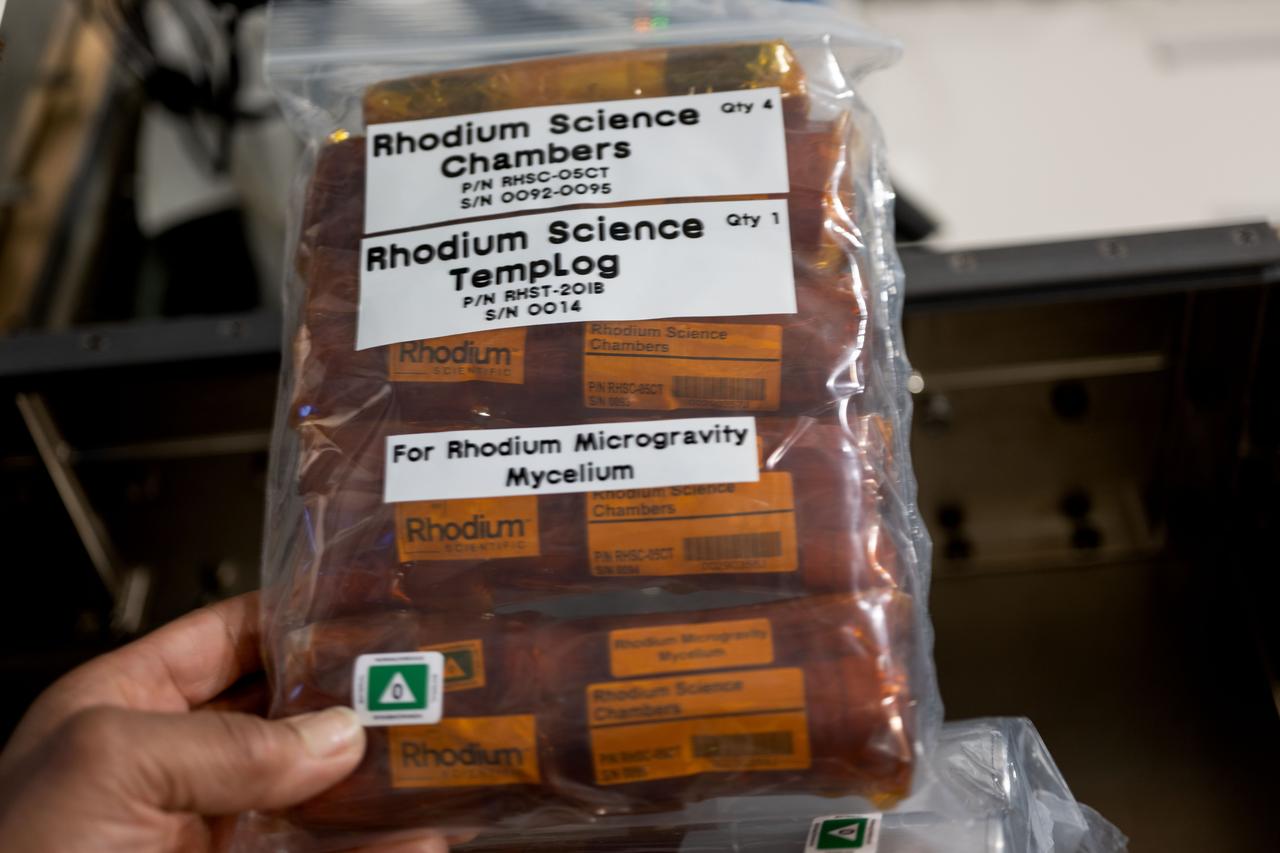
iss071e439621 (Aug. 7, 2024) -- Rhodium science chambers are pictured prior to storage in an ambient locker location aboard the International Space Station. The Swinburne Youth Space Innovation Challenge 2023 Examining Mushroom Growth in Microgravity, or Rhodium Microgravity Mycelium investigation, tests the growth rates of mycelia, the root structures of mushrooms, in space. Microgravity can alter the growth rates of other organisms and understanding how it affects mycelium growth rate and biomass production could provide insight into growth characteristics of fungi. Mushrooms have recognized nutritional value and results could lead to more efficient mushroom growth and new strains of mushrooms as potential food sources for space travel and for research on Earth.
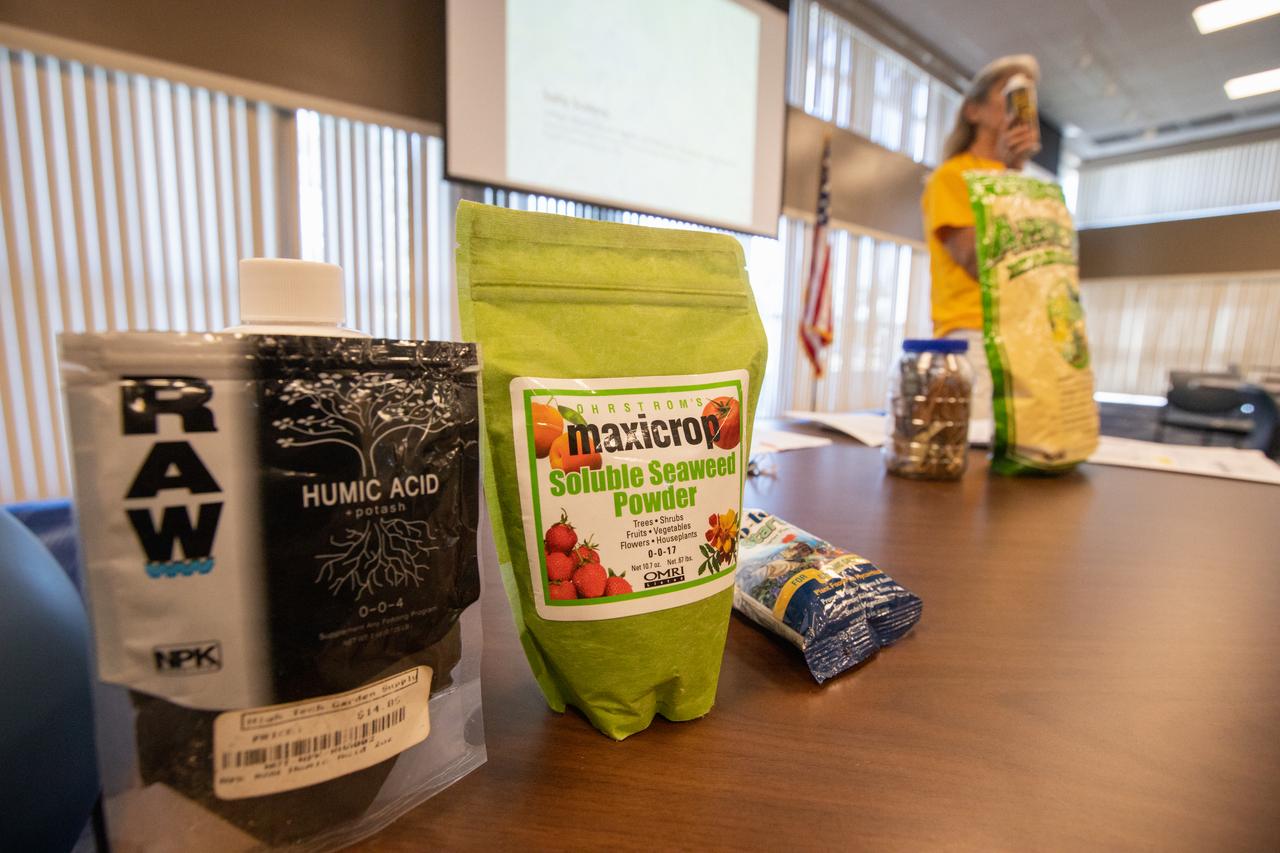
Sustainable yard products are on display while Sally Scalera, urban horticulture agent and master gardener coordinator from the University of Florida’s Institute of Food and Agricultural Sciences Brevard Extension Office, presents some tips and tricks for a healthy yard and garden to Kennedy Space Center employees on April 24, 2019. Held inside the Florida spaceport’s Space Station Processing Facility Conference Center, Scalera also provided information on Florida-friendly landscaping practices. The lunch and learn was available for employees to attend as part of Kennedy’s Earth Day events.
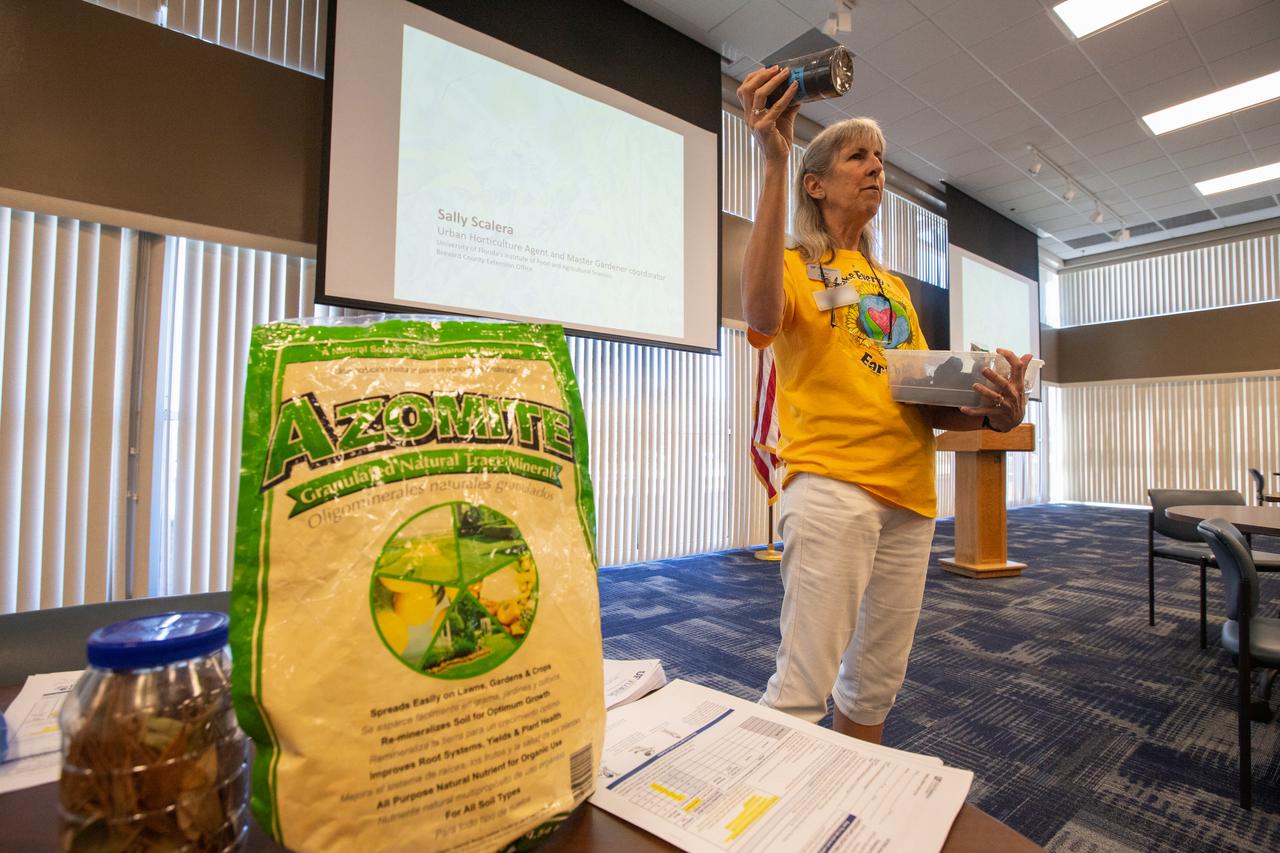
Sally Scalera, urban horticulture agent and master gardener coordinator from the University of Florida’s Institute of Food and Agricultural Sciences Brevard Extension Office, shows Kennedy Space Center employees some sustainable yard products available during her presentation on tips and tricks for a healthy yard and garden on April 24, 2019. Held inside the Florida spaceport’s Space Station Processing Facility Conference Center, Scalera also provided information on Florida-friendly landscaping practices. The lunch and learn was available for employees to attend as part of Kennedy’s Earth Day events.
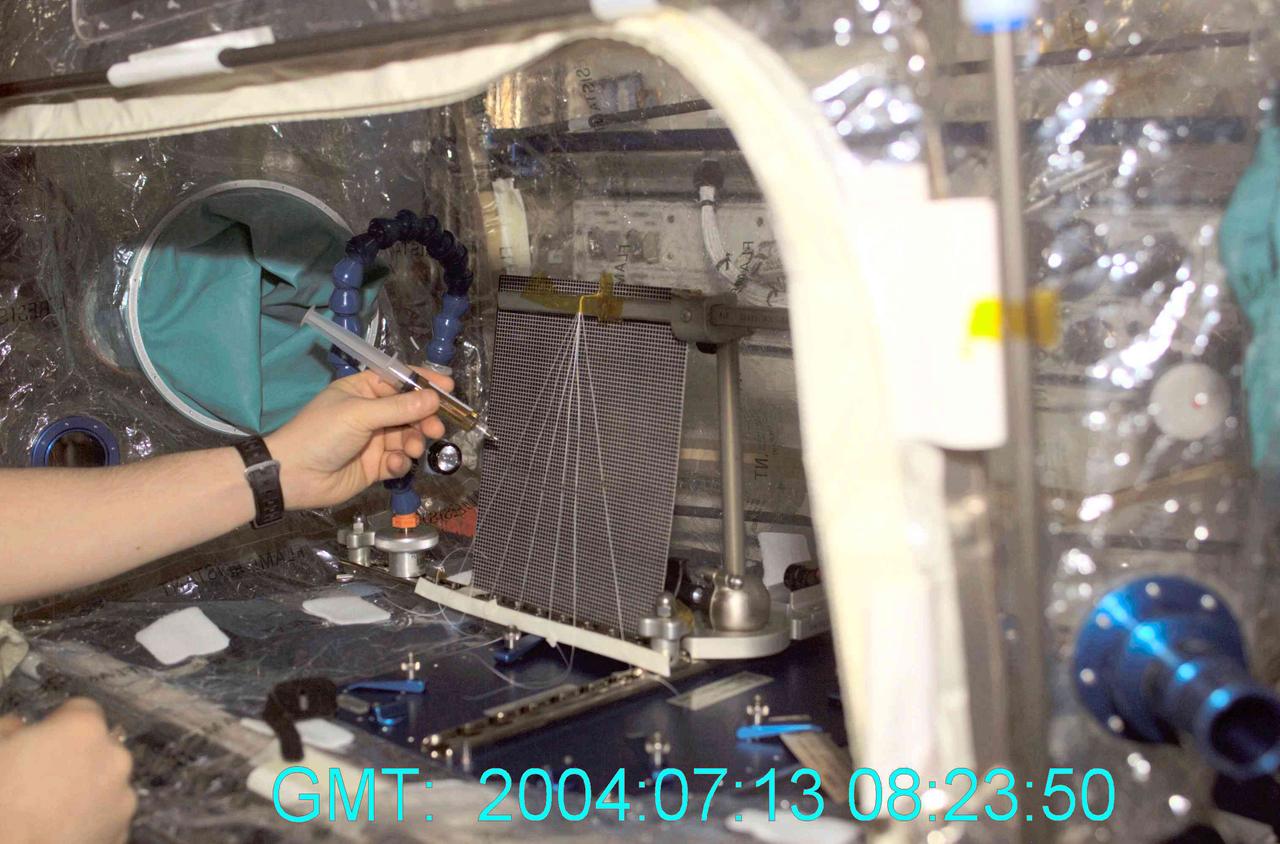
Astronaut Mike Fincke places droplets of honey onto the strings for the Fluid Merging Viscosity Measurement (FMVM) investigation onboard the International Space Station (ISS). The FMVM experiment measures the time it takes for two individual highly viscous fluid droplets to coalesce or merge into one droplet. Different fluids and droplet size combinations were tested in the series of experiments. By using the microgravity environment, researchers can measure the viscosity or "thickness" of fluids without the influence of containers and gravity using this new technique. Understanding viscosity could help scientists understand industrially important materials such as paints, emulsions, polymer melts and even foams used to produce pharmaceutical, food, and cosmetic products.
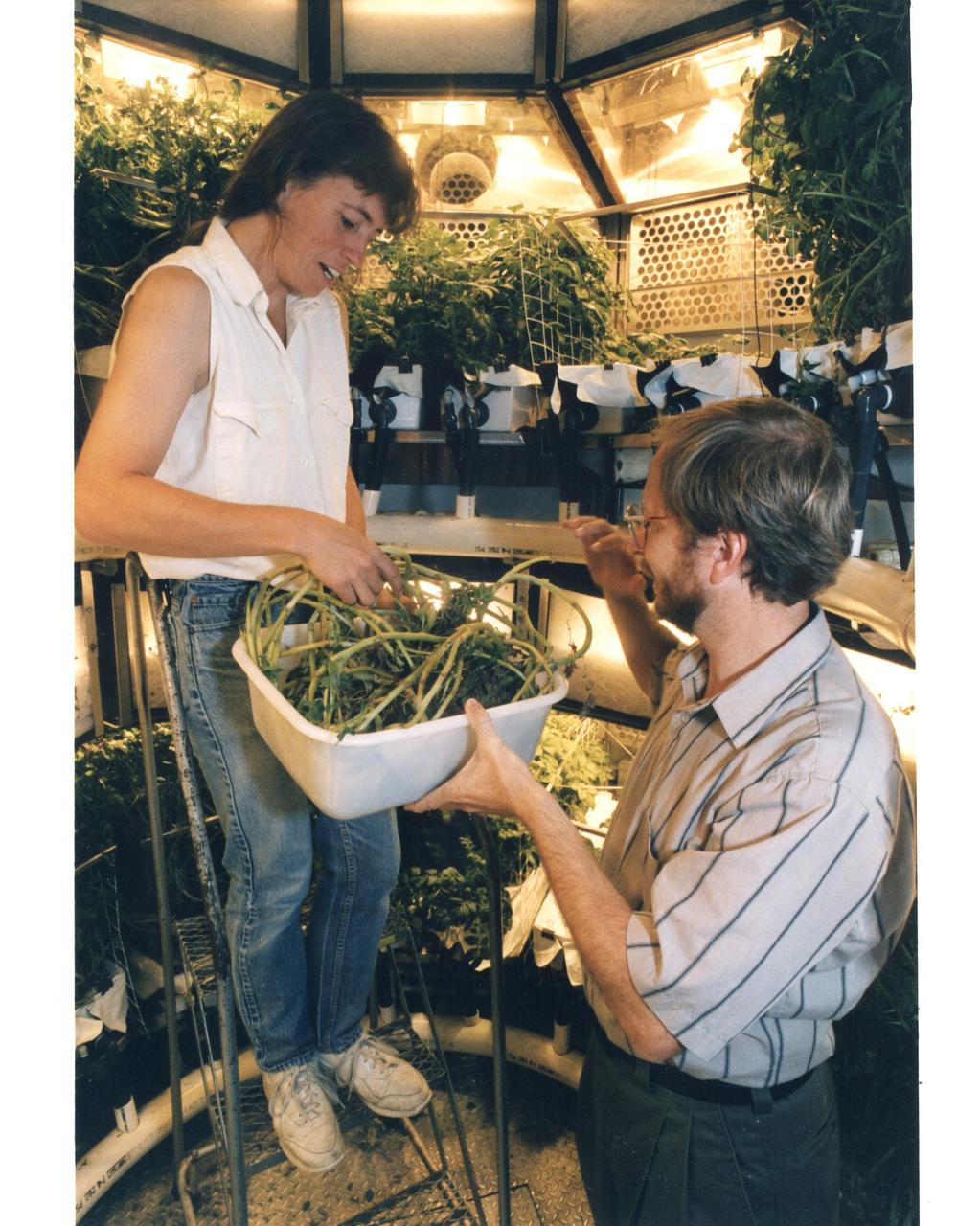
Original photo and caption dated August 14, 1995: <i>"KSC plant physiologist Dr. Gary Stutte (right) and Cheryl Mackowiak harvest potatoes grown in the Biomass Production Chamber of the Controlled Enviornment Life Support System (CELSS in Hangar L at Cape Canaveral Air Station. During a 418-day "human rated" experiment, potato crops grown in the chamber provided the equivalent of a continuous supply of the oxygen for one astronaut, along with 55 percent of that long-duration space flight crew member's caloric food requirements and enough purified water for four astronauts while absorbing their expelled carbon dioxide. The experiment provided data that will help demonstarte the feasibility of the CELSS operating as a bioregenerative life support system for lunar and deep-space missions that can operate independently without the need to carry consumables such as air, water and food, while not requiring the expendable air and water system filters necessary on today's human-piloted spacecraft."</i
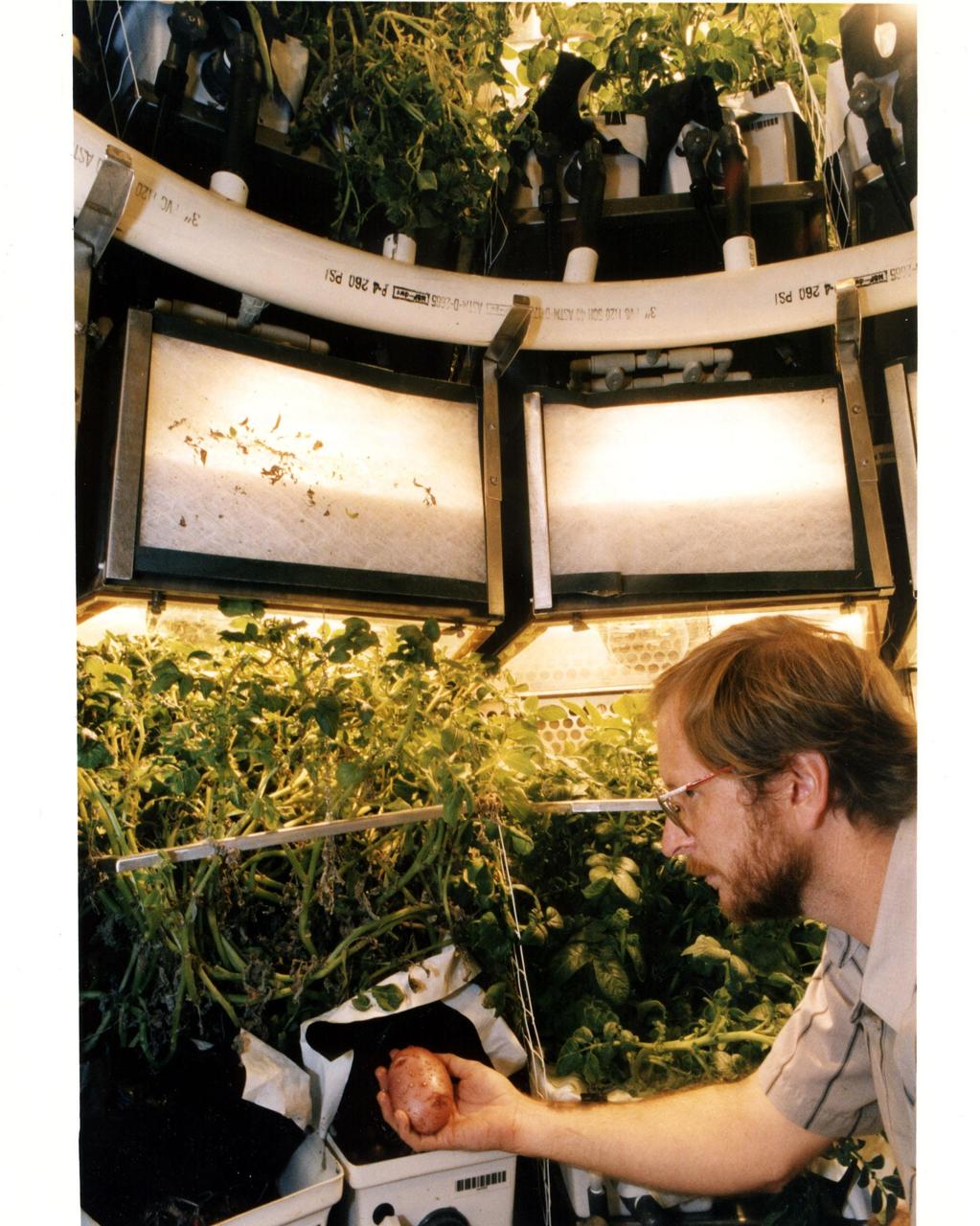
Original photo and caption dated August 14, 1995: <i>"KSC plant physiologist Dr. Gary Stutte harvests a potato grown in the Biomass Production Chamber of the Controlled environment Life Support system (CELSS) in Hangar L at Cape Canaveral Air Station. During a 418-day "human rated" experiment, potato crops grown in the chamber provided the equivalent of a continuous supply of the oxygen for one astronaut, along with 55 percent of that long-duration space flight crew member's caloric food requirements and enough purified water for four astronauts while absorbing their expelled carbon dioxide. The experiment provided data that will help demonstarte the feasibility of the CELSS operating as a bioregenerative life support system for lunar and deep-space missions that can operate independently without the need to carry consumables such as air, water and food, while not requiring the expendable air and water system filters necessary on today's human-piloted spacecraft."</i
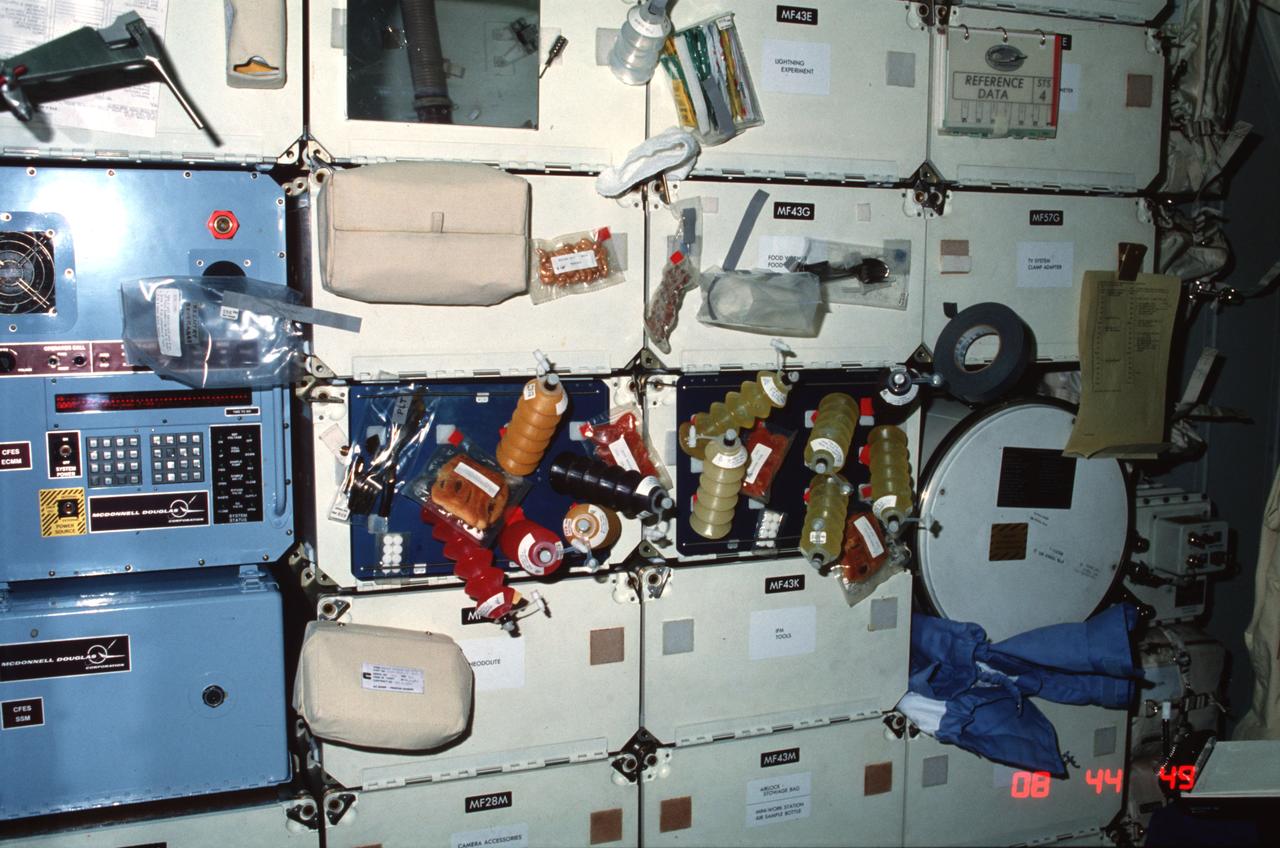
STS004-28-330 (27 June-4 July 1982) --- Thanks to a variety of juices and other food items, this array in the middeck area probably represents the most colorful area onboard the Earth-orbiting space shuttle Columbia. Most of the meal items have been carefully fastened to food trays and locker doors (or both). What has not been attached by conventional methods has been safely ?tucked? under something heavy (note jacket shoved into space occupied by one of Columbia?s experiments). The Monodisperse Latex Reflector (MLR), making its second flight on Columbia, is designed to test the feasibility of making large-size, monodisperse (same size), and polystyrene latex micro-spheres using the products of the STS-3 mission as seed particles. The latex spheres are used in calibration of scientific and industrial equipment and have potential medical and research applications. This frame was exposed with a 35mm camera. Onboard the space vehicle for seven days were astronauts Thomas K. Mattingly II and Henry W. Hartsfield Jr. Photo credit: NASA

These ‘Red Robin’ dwarf tomato plants, photographed Jan. 10, 2020, inside a laboratory in the Space Station Processing Facility at NASA Kennedy Space Center in Florida, are growing from seeds that have been exposed to simulated solar particle radiation. The plants’ edible mass and nutrients will be measured and compared to those of a control crop, grown from non-irradiated seeds. The project was designed to confirm that nutritious, high-quality produce can be reliably grown in deep space, or to provide a baseline to guide development of countermeasures to protect future crop foods from radiation during missions beyond low-Earth orbit. The investigation on space radiation impact on seeds and crop production also will be carried on the Materials International Space Station Experiment (MISSE) platform outside the station, supported NASA’s Space Technology Mission Directorate and the Space Biology Program, and potentially on future beyond-low-Earth platforms.
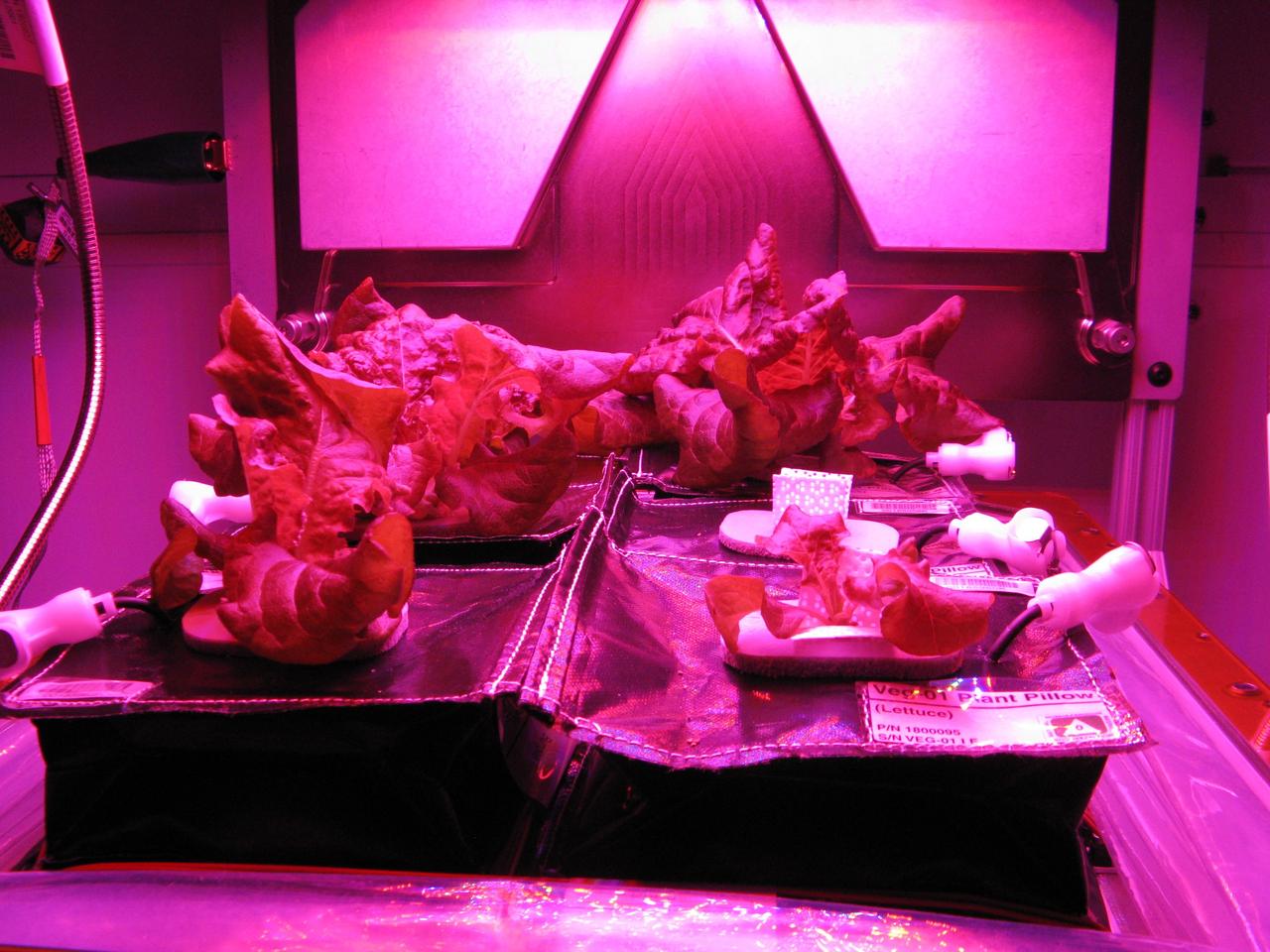
CAPE CANAVERAL, Fla. -- Researchers document the growth of the ground control plants in the Veggie plant growth system inside a control chamber at the Space Station Processing Facility at NASA's Kennedy Space Center in Florida prior to thinning them to one plant each. The growth chamber is being used as a control unit and procedures are being followed identical to those being performed on Veggie and the Veg-01 experiment on the International Space Station. Veggie and Veg-01 were delivered to the space station aboard the SpaceX-3 mission. Veggie is the first fresh food production system delivered to the station. Six plant pillows, each containing outredgeous red romaine lettuce seeds and a root mat were inserted into Veggie. The plant chamber's red, blue and green LED lights were activated. The plant growth was monitored for 28 days. At the end of the cycle, the plants will be carefully harvested, frozen and stored for return to Earth. Photo credit: NASA/Charles Spern
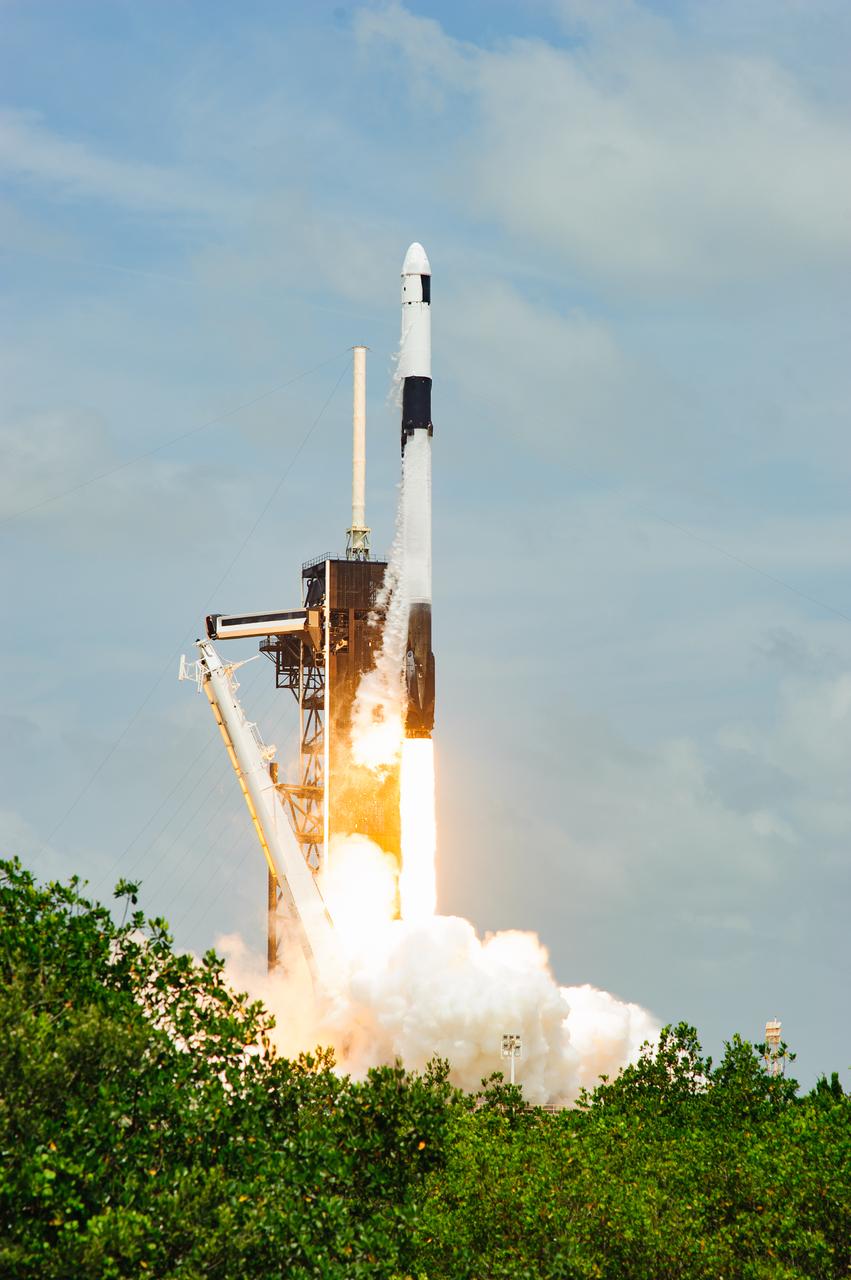
NASA and SpaceX launched the 28th commercial resupply mission of the Cargo Dragon from Launch Complex 39A at the agency's Kennedy Space Center in Florida. Liftoff occurred at 11:47 a.m. EDT, June 5, 2023. SpaceX's Dragon will deliver new science investigations, food, supplies, and equipment to the International Space Station for the crew, including the next pair of IROSAs (International Space Station Roll Out Solar Arrays). These solar panels, which roll out using stored kinetic energy, will expand the energy-production capabilities of the space station. This will be the third set launching in the SpaceX Dragon's trunk, and once installed, will help provide a 20% to 30% increase in power for space station research and operations.
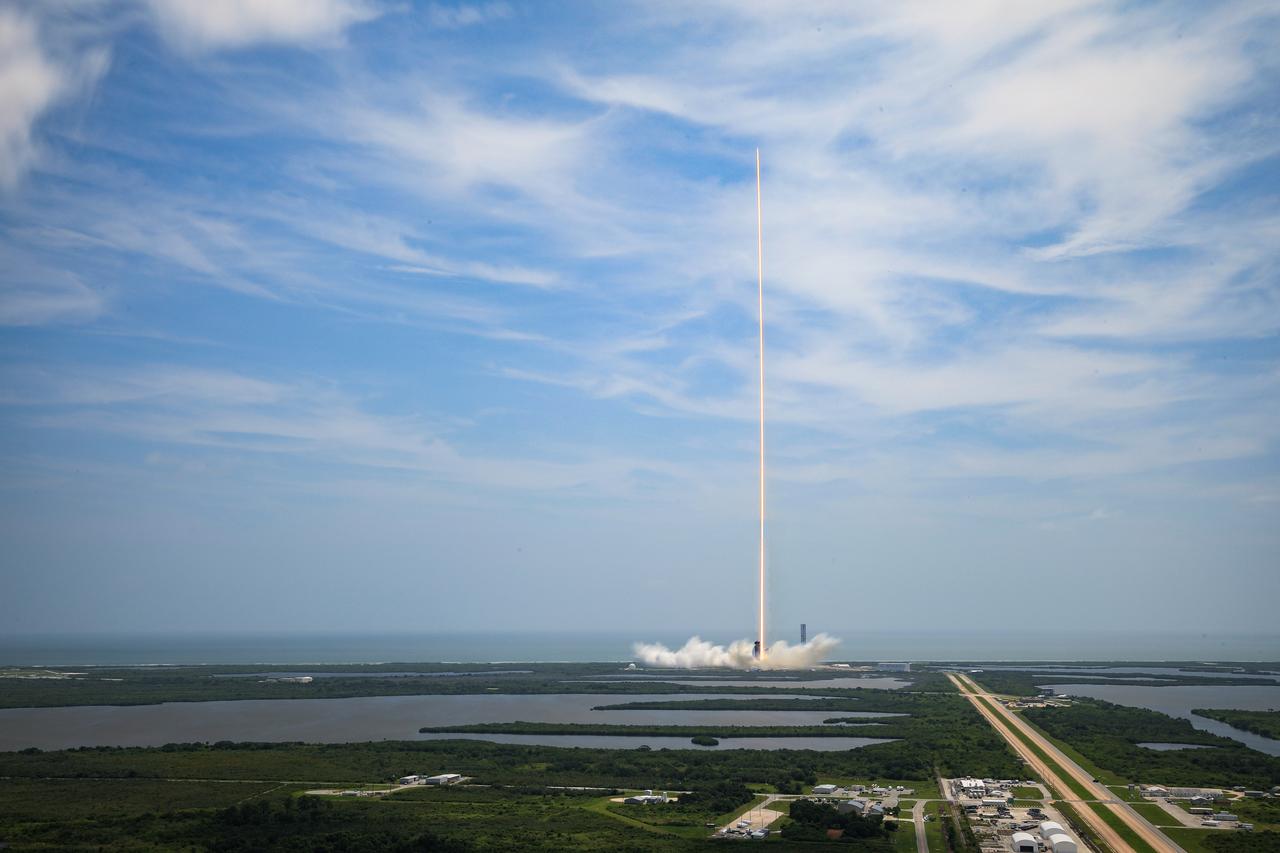
NASA and SpaceX launched the 28th commercial resupply mission of the Cargo Dragon from Launch Complex 39A at the agency's Kennedy Space Center in Florida. Liftoff occurred at 11:47 a.m. EDT, June 5, 2023. SpaceX's Dragon will deliver new science investigations, food, supplies, and equipment to the International Space Station for the crew, including the next pair of IROSAs (International Space Station Roll Out Solar Arrays). These solar panels, which roll out using stored kinetic energy, will expand the energy-production capabilities of the space station. This will be the third set launching in the SpaceX Dragon's trunk, and once installed, will help provide a 20% to 30% increase in power for space station research and operations.
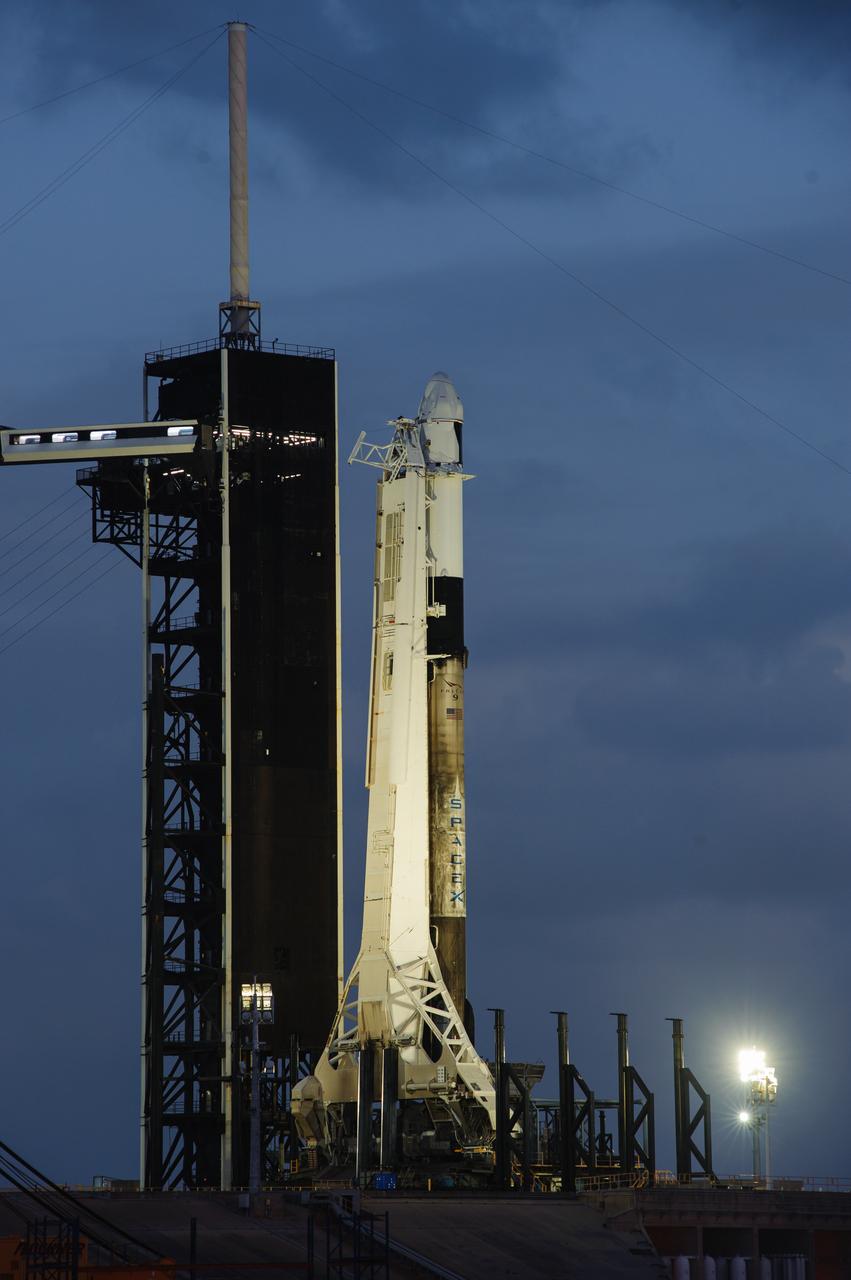
NASA and SpaceX launched the 28th commercial resupply mission of the Cargo Dragon from Launch Complex 39A at the agency's Kennedy Space Center in Florida. Liftoff occurred at 11:47 a.m. EDT, June 5, 2023. SpaceX's Dragon will deliver new science investigations, food, supplies, and equipment to the International Space Station for the crew, including the next pair of IROSAs (International Space Station Roll Out Solar Arrays). These solar panels, which roll out using stored kinetic energy, will expand the energy-production capabilities of the space station. This will be the third set launching in the SpaceX Dragon's trunk, and once installed, will help provide a 20% to 30% increase in power for space station research and operations.
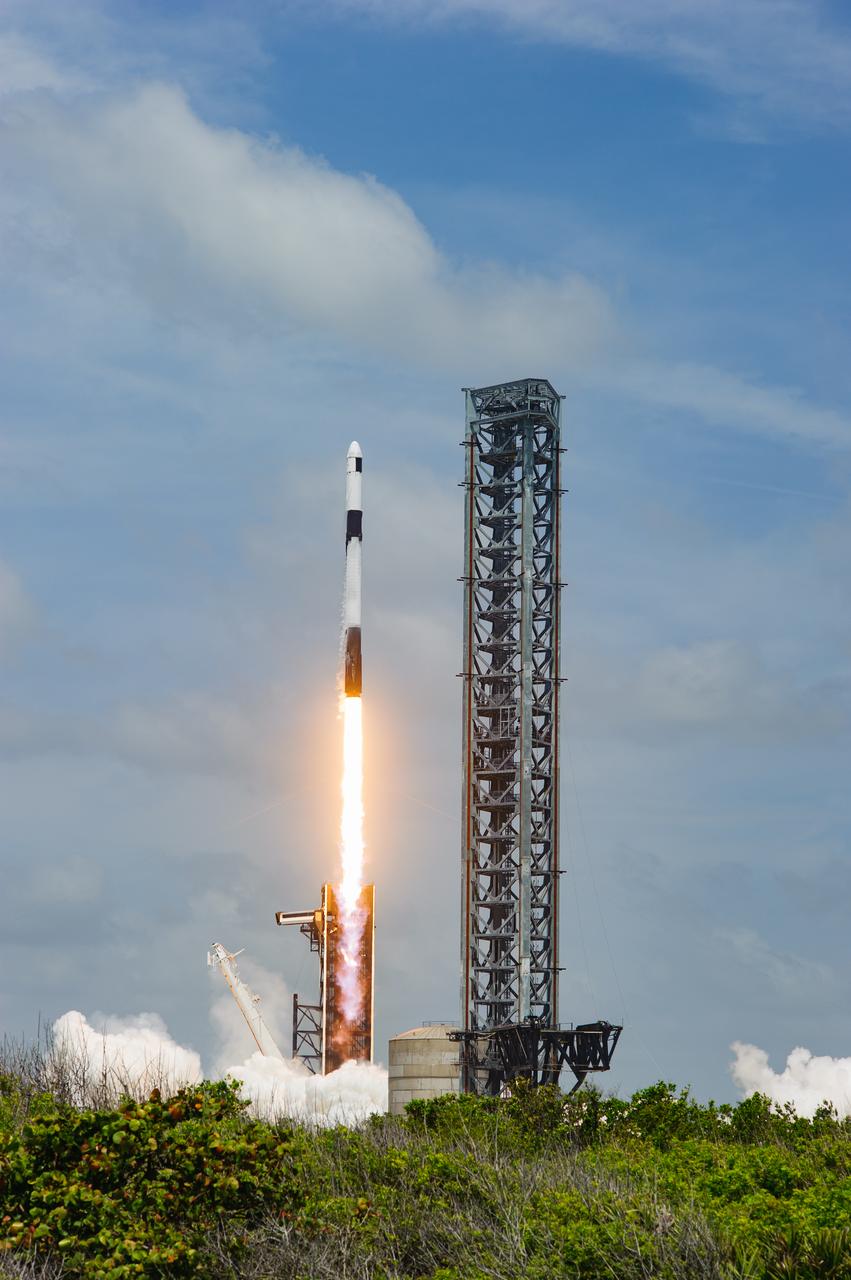
NASA and SpaceX launched the 28th commercial resupply mission of the Cargo Dragon from Launch Complex 39A at the agency's Kennedy Space Center in Florida. Liftoff occurred at 11:47 a.m. EDT, June 5, 2023. SpaceX's Dragon will deliver new science investigations, food, supplies, and equipment to the International Space Station for the crew, including the next pair of IROSAs (International Space Station Roll Out Solar Arrays). These solar panels, which roll out using stored kinetic energy, will expand the energy-production capabilities of the space station. This will be the third set launching in the SpaceX Dragon's trunk, and once installed, will help provide a 20% to 30% increase in power for space station research and operations.

These ‘Red Robin’ dwarf tomato plants, photographed Jan. 10, 2020, inside a laboratory in the Space Station Processing Facility at NASA Kennedy Space Center in Florida, are growing from seeds that have been exposed to simulated solar particle radiation. The plants’ edible mass and nutrients will be measured and compared to those of a control crop, grown from non-irradiated seeds. The project was designed to confirm that nutritious, high-quality produce can be reliably grown in deep space, or to provide a baseline to guide development of countermeasures to protect future crop foods from radiation during missions beyond low-Earth orbit. The investigation on space radiation impact on seeds and crop production also will be carried on the Materials International Space Station Experiment (MISSE) platform outside the station, supported NASA’s Space Technology Mission Directorate and the Space Biology Program, and potentially on future beyond-low-Earth platforms.

These ‘Red Robin’ dwarf tomato plants, photographed Jan. 10, 2020, inside a laboratory in the Space Station Processing Facility at NASA Kennedy Space Center in Florida, are growing from seeds that have been exposed to simulated solar particle radiation. The plants’ edible mass and nutrients will be measured and compared to those of a control crop, grown from non-irradiated seeds. The project was designed to confirm that nutritious, high-quality produce can be reliably grown in deep space, or to provide a baseline to guide development of countermeasures to protect future crop foods from radiation during missions beyond low-Earth orbit. The investigation on space radiation impact on seeds and crop production also will be carried on the Materials International Space Station Experiment (MISSE) platform outside the station, supported NASA’s Space Technology Mission Directorate and the Space Biology Program, and potentially on future beyond-low-Earth platforms.
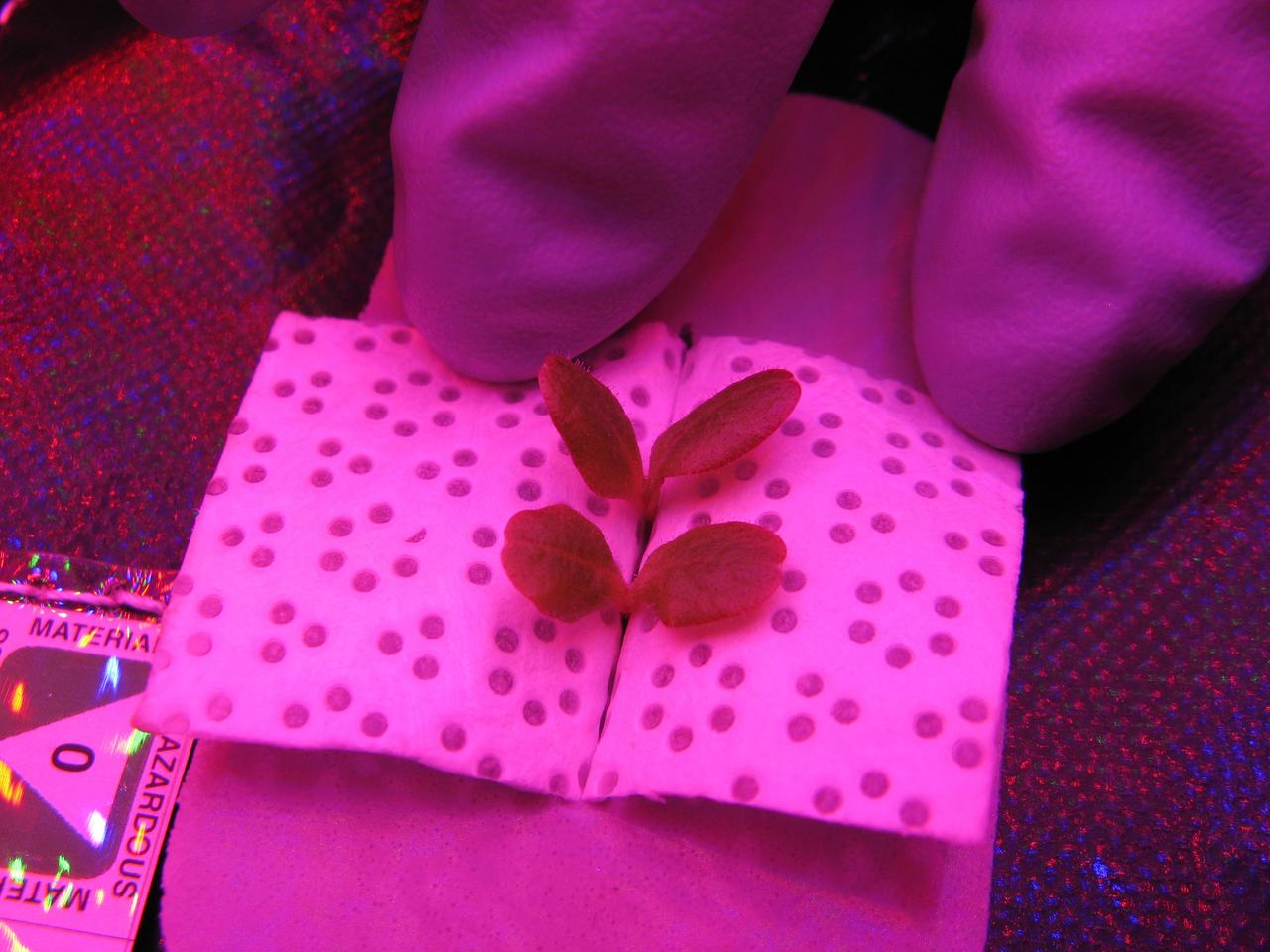
CAPE CANAVERAL, Fla. -- Researchers document the ground control plant pillows in the Veggie plant growth system inside a control chamber at the Space Station Processing Facility at NASA's Kennedy Space Center in Florida prior to thinning them to one plant each. The growth chamber is being used as a control unit and procedures are being followed identical to those being performed on Veggie and the Veg-01 experiment on the International Space Station. Veggie and Veg-01 were delivered to the space station aboard the SpaceX-3 mission. Veggie is the first fresh food production system delivered to the station. Six plant pillows, each containing outredgeous red romaine lettuce seeds and a root mat were inserted into Veggie. The plant chamber's red, blue and green LED lights were activated. The plant growth was monitored for 28 days. At the end of the cycle, the plants will be carefully harvested, frozen and stored for return to Earth. Photo credit: NASA/Charles Spern
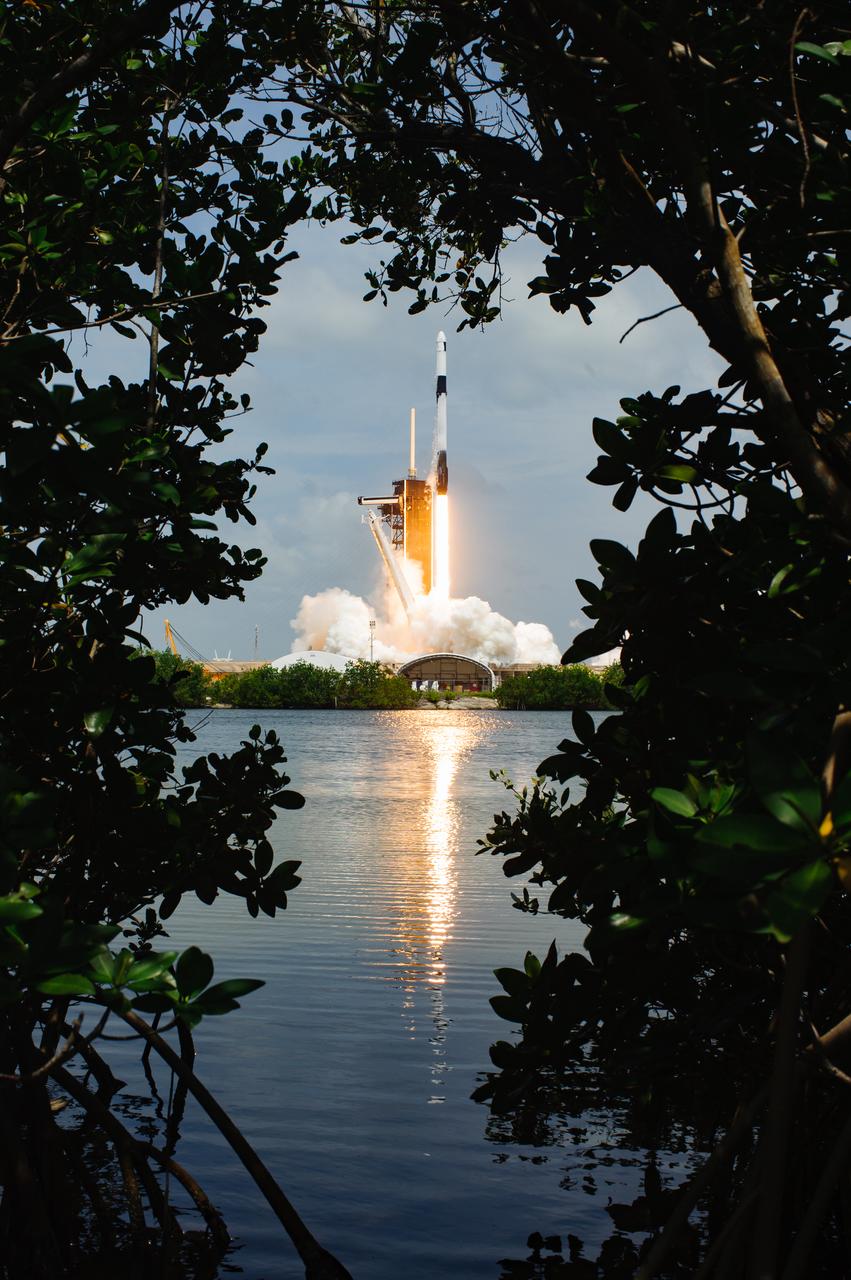
NASA and SpaceX launched the 28th commercial resupply mission of the Cargo Dragon from Launch Complex 39A at the agency's Kennedy Space Center in Florida. Liftoff occurred at 11:47 a.m. EDT, June 5, 2023. SpaceX's Dragon will deliver new science investigations, food, supplies, and equipment to the International Space Station for the crew, including the next pair of IROSAs (International Space Station Roll Out Solar Arrays). These solar panels, which roll out using stored kinetic energy, will expand the energy-production capabilities of the space station. This will be the third set launching in the SpaceX Dragon's trunk, and once installed, will help provide a 20% to 30% increase in power for space station research and operations.
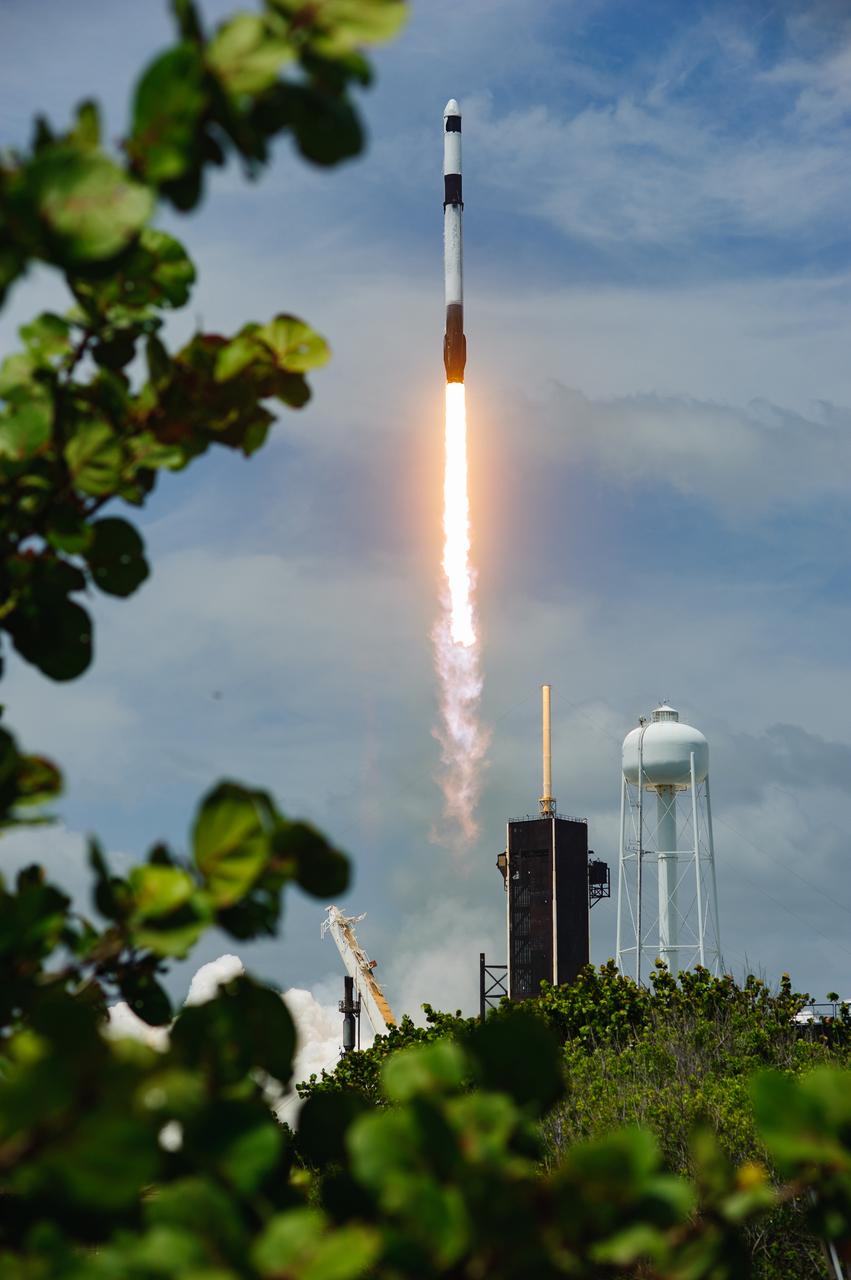
NASA and SpaceX launched the 28th commercial resupply mission of the Cargo Dragon from Launch Complex 39A at the agency's Kennedy Space Center in Florida. Liftoff occurred at 11:47 a.m. EDT, June 5, 2023. SpaceX's Dragon will deliver new science investigations, food, supplies, and equipment to the International Space Station for the crew, including the next pair of IROSAs (International Space Station Roll Out Solar Arrays). These solar panels, which roll out using stored kinetic energy, will expand the energy-production capabilities of the space station. This will be the third set launching in the SpaceX Dragon's trunk, and once installed, will help provide a 20% to 30% increase in power for space station research and operations.
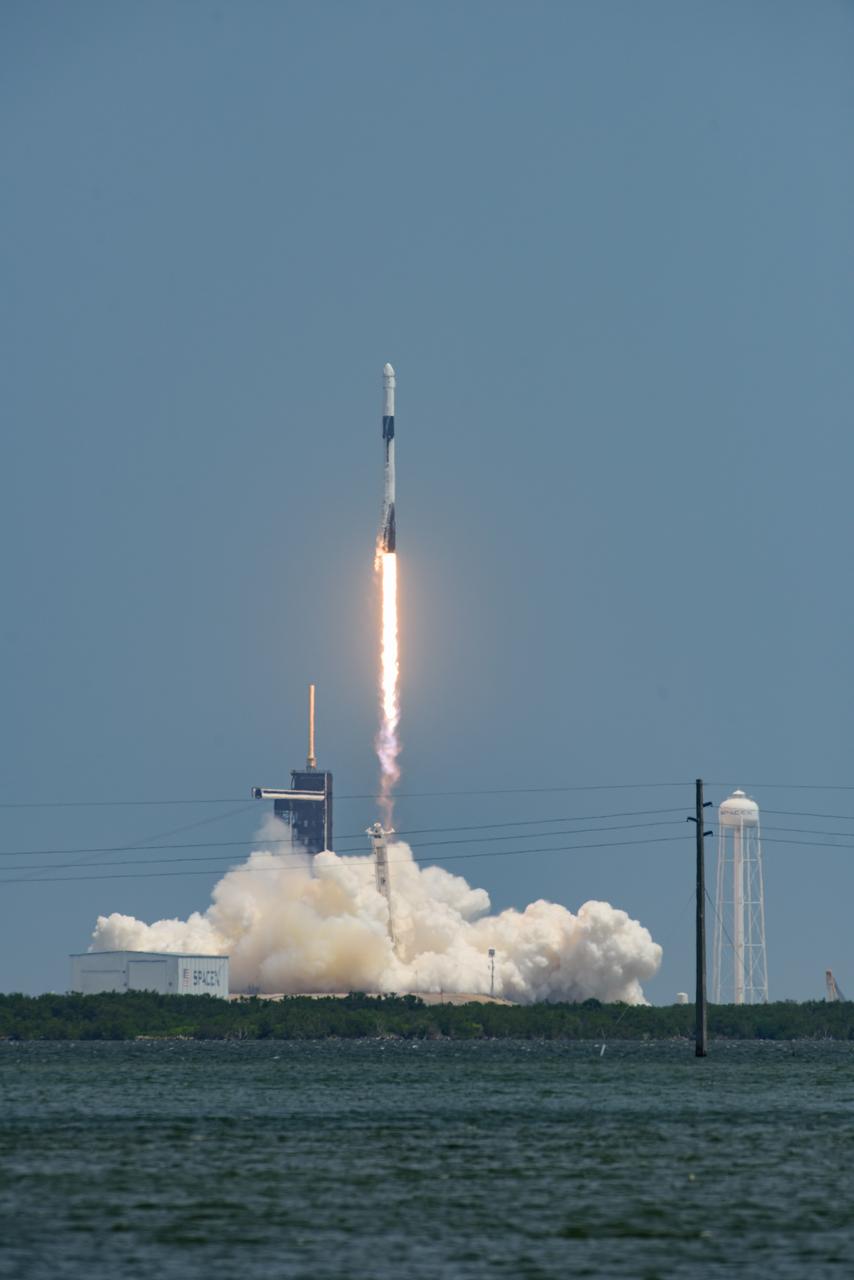
NASA and SpaceX launched the 28th commercial resupply mission of the Cargo Dragon from Launch Complex 39A at the agency's Kennedy Space Center in Florida. Liftoff occurred at 11:47 a.m. EDT, June 5, 2023. SpaceX's Dragon will deliver new science investigations, food, supplies, and equipment to the International Space Station for the crew, including the next pair of IROSAs (International Space Station Roll Out Solar Arrays). These solar panels, which roll out using stored kinetic energy, will expand the energy-production capabilities of the space station. This will be the third set launching in the SpaceX Dragon's trunk, and once installed, will help provide a 20% to 30% increase in power for space station research and operations.
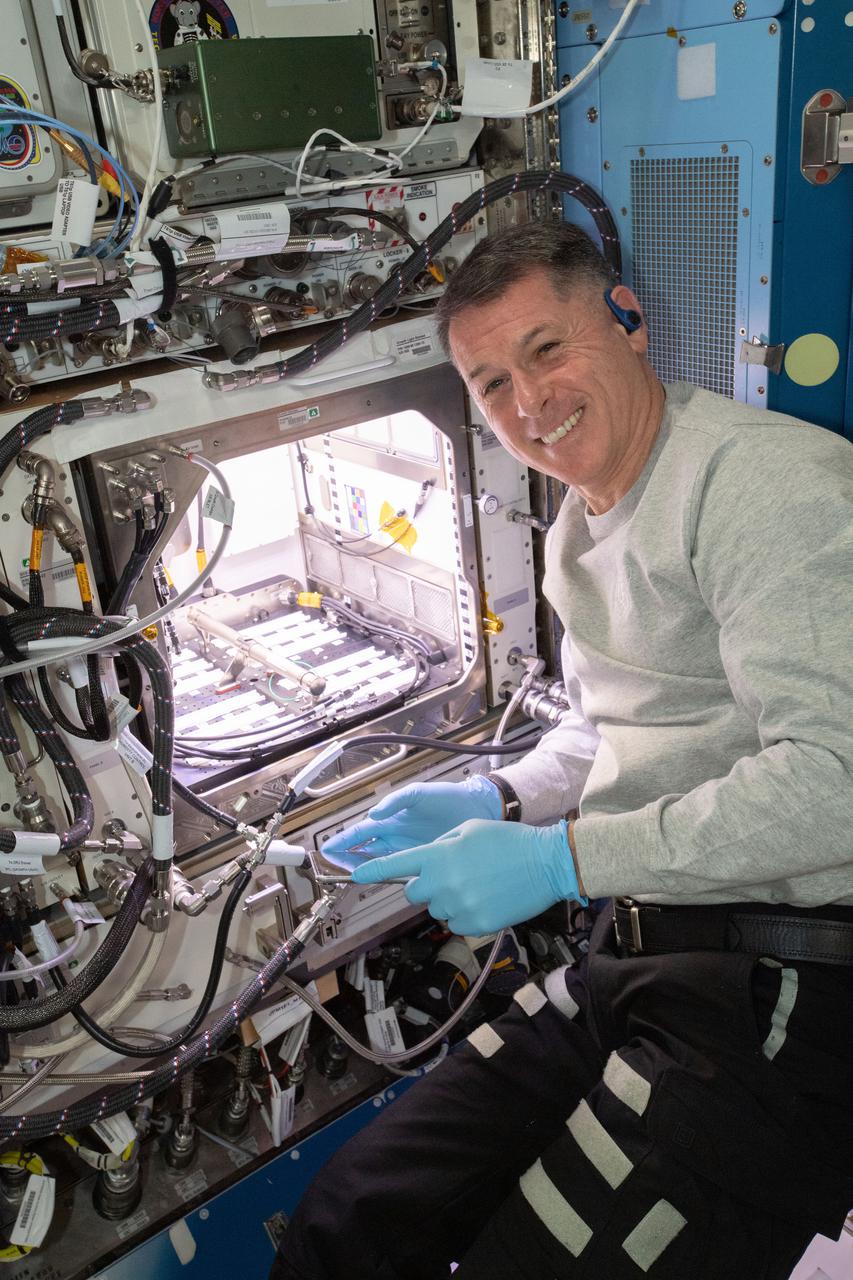
(iss065e163671) July 12, 2021 --- NASA astronaut and Expedition 65 Flight Engineer Shane Kimbrough inserts a device called a science carrier into the Advanced Plant Habitat (APH), which contains 48 Hatch chile pepper seeds NASA started growing on July 12, 2021 as part of the Plant Habitat-04 experiment. Astronauts on station and a team of researchers at Kennedy will work together to monitor the peppers’ growth for about four months before harvesting them. This will be one of the longest and most challenging plant experiments attempted aboard the orbital lab.
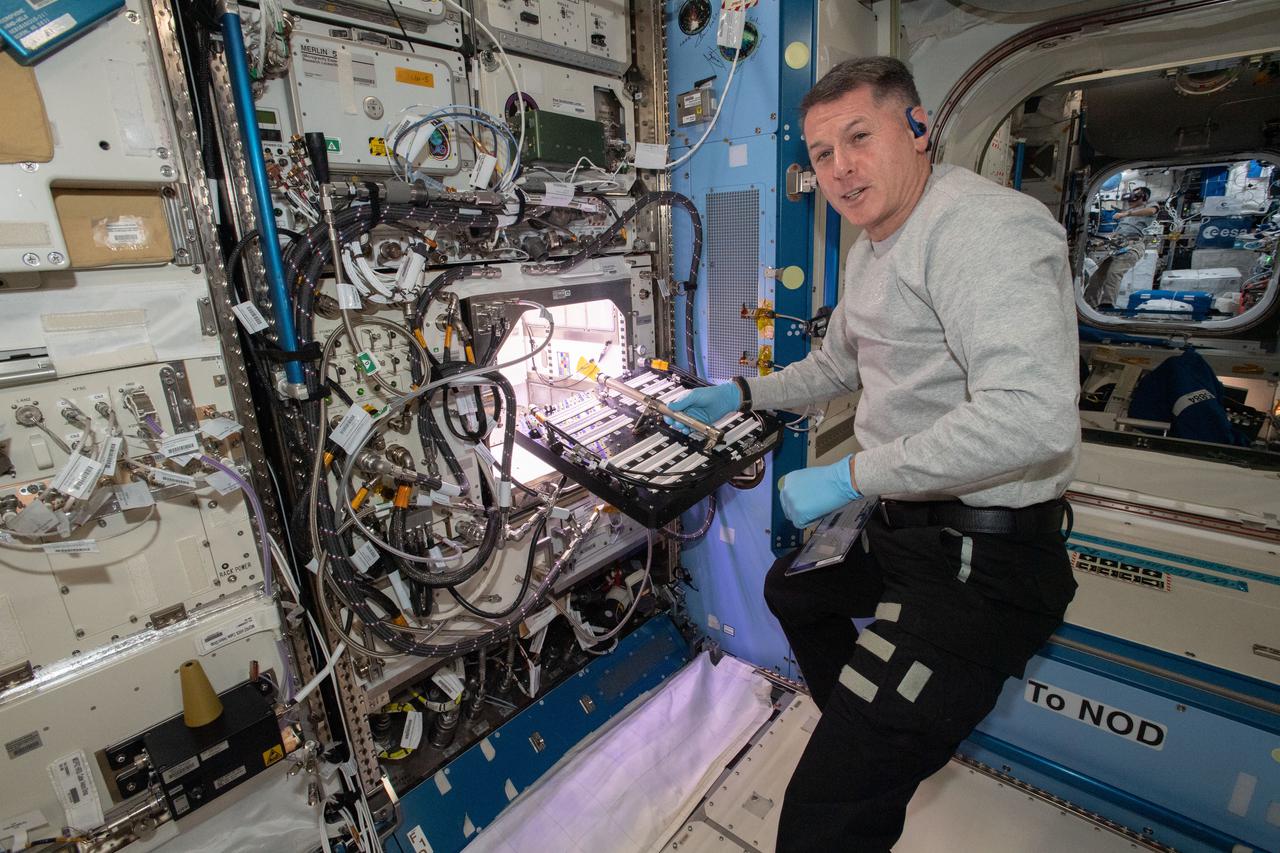
(iss065e163668) July 12, 2021 --- NASA astronaut and Expedition 65 Flight Engineer Shane Kimbrough inserts a device called a science carrier into the Advanced Plant Habitat (APH), which contains 48 Hatch chile pepper seeds NASA started growing on July 12, 2021 as part of the Plant Habitat-04 experiment. Astronauts on station and a team of researchers at Kennedy will work together to monitor the peppers’ growth for about four months before harvesting them. This will be one of the longest and most challenging plant experiments attempted aboard the orbital lab.
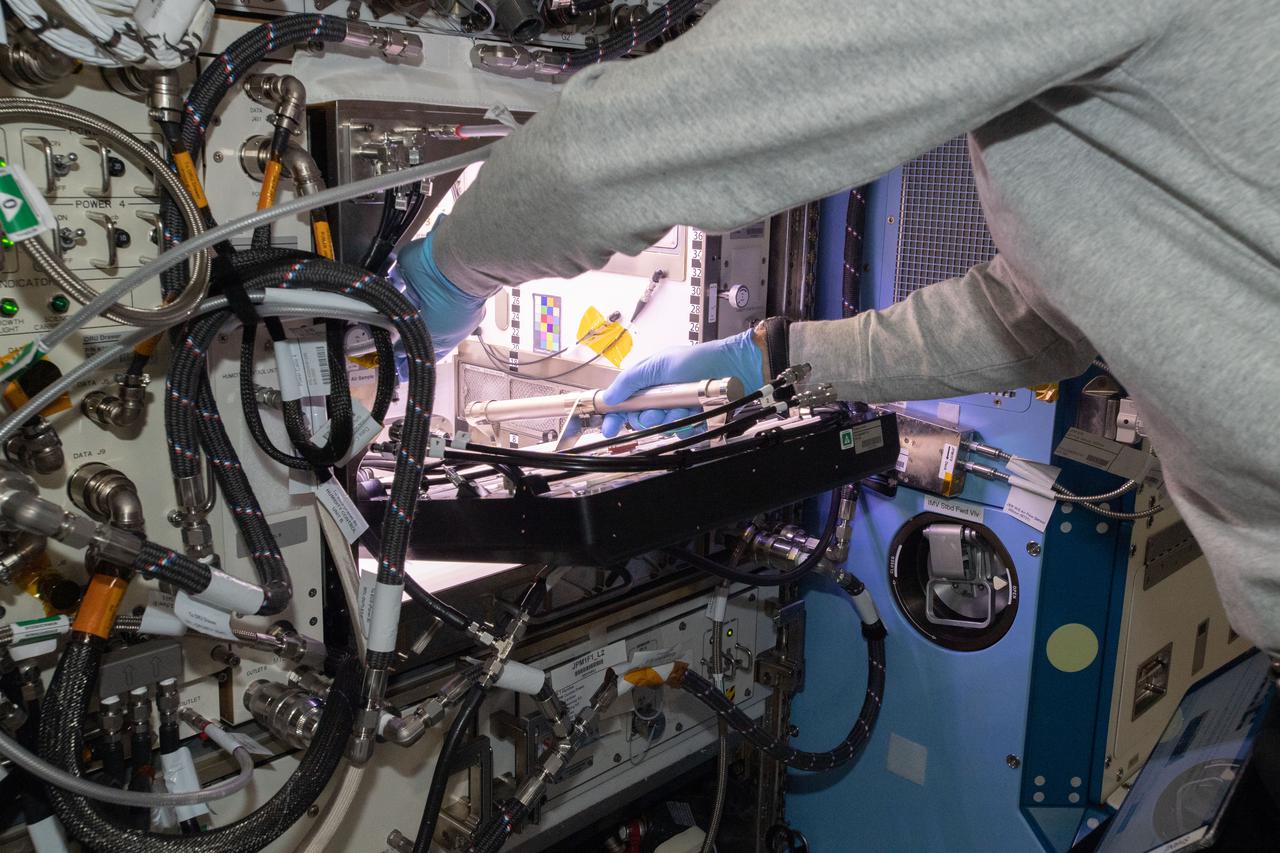
(iss065e163669) July 12, 2021 --- NASA astronaut and Expedition 65 Flight Engineer Shane Kimbrough inserts a device called a science carrier into the Advanced Plant Habitat (APH), which contains 48 Hatch chili pepper seeds NASA started growing on July 12, 2021 as part of the Plant Habitat-04 experiment. Astronauts on station and a team of researchers at Kennedy will work together to monitor the peppers’ growth for about four months before harvesting them. This will be one of the longest and most challenging plant experiments attempted aboard the orbital lab.
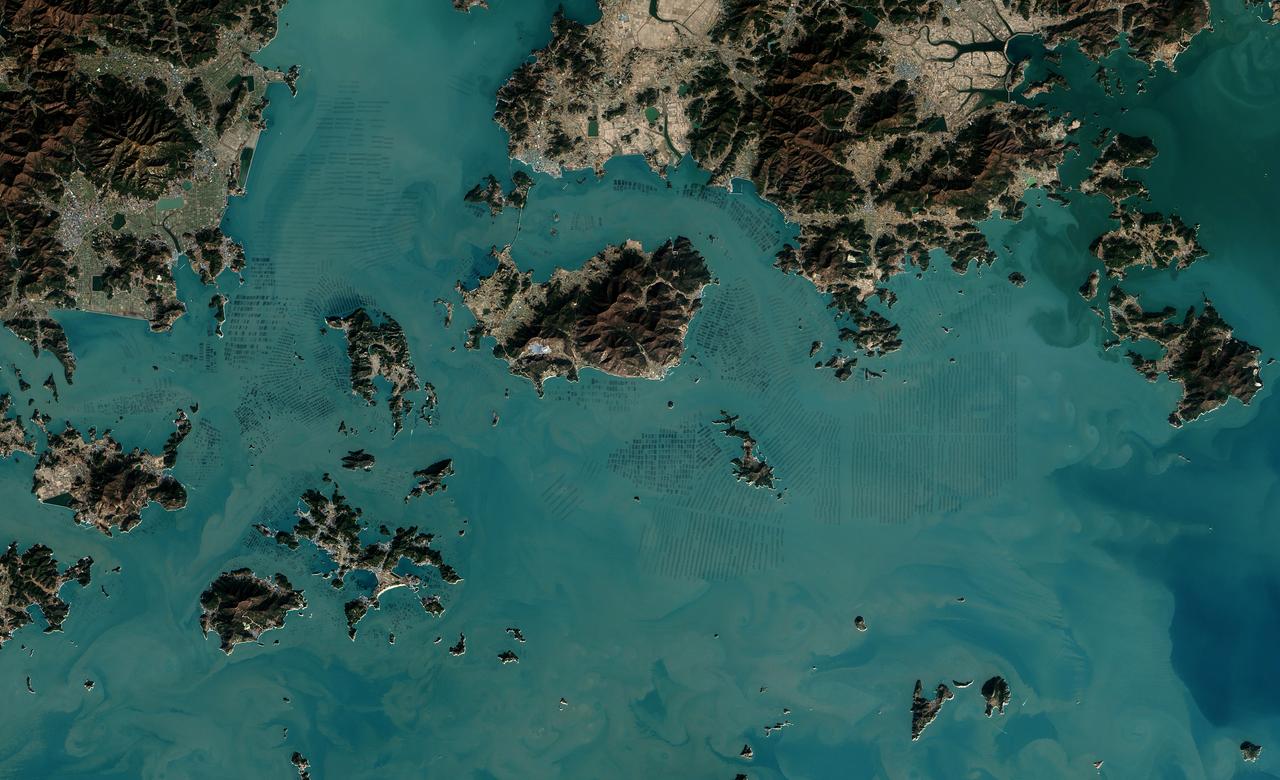
The dark squares that make up the checkerboard pattern in this image are fields of a sort—fields of seaweed. Along the south coast of South Korea, seaweed is often grown on ropes, which are held near the surface with buoys. This technique ensures that the seaweed stays close enough to the surface to get enough light during high tide but doesn’t scrape against the bottom during low tide. The Operational Land Imager (OLI) on Landsat 8 acquired this image of seaweed cultivation in the shallow waters around Sisan Island on January 31, 2014. Home to a thriving aquaculture industry, the south coast of South Korea produces about 90 percent of the country’s seaweed crop. The waters around Sisan are not the only place where aquaculture is common. View the large image to see how ubiquitous seaweed aquaculture is along the coast in Jeollanam-do, the southernmost province on the Korean peninsula. Two main types of seaweed are cultivated in South Korea: Undaria (known as miyeok in Korean, wakame in Japanese) and Pyropia (gim in Korean, nori in Japanese). Both types are used generously in traditional Korean, Japanese, and Chinese food. Since 1970, farmed seaweed production has increased by approximately 8 percent per year. Today, about 90 percent of all the seaweed that humans consume globally is farmed. That may be good for the environment. In comparison to other types of food production, seaweed farming has a light environmental footprint because it does not require fresh water or fertilizer. NASA Earth Observatory image by Jesse Allen, using Landsat data from the U.S. Geological Survey. Caption by Adam Voiland. Credit: <b><a href="http://www.earthobservatory.nasa.gov/" rel="nofollow"> NASA Earth Observatory</a></b> <b><a href="http://www.nasa.gov/audience/formedia/features/MP_Photo_Guidelines.html" rel="nofollow">NASA image use policy.</a></b> <b><a href="http://www.nasa.gov/centers/goddard/home/index.html" rel="nofollow">NASA Goddard Space Flight Center</a></b> enables NASA’s mission through four scientific endeavors: Earth Science, Heliophysics, Solar System Exploration, and Astrophysics. Goddard plays a leading role in NASA’s accomplishments by contributing compelling scientific knowledge to advance the Agency’s mission. <b>Follow us on <a href="http://twitter.com/NASAGoddardPix" rel="nofollow">Twitter</a></b> <b>Like us on <a href="http://www.facebook.com/pages/Greenbelt-MD/NASA-Goddard/395013845897?ref=tsd" rel="nofollow">Facebook</a></b> <b>Find us on <a href="http://instagrid.me/nasagoddard/?vm=grid" rel="nofollow">Instagram</a></b>
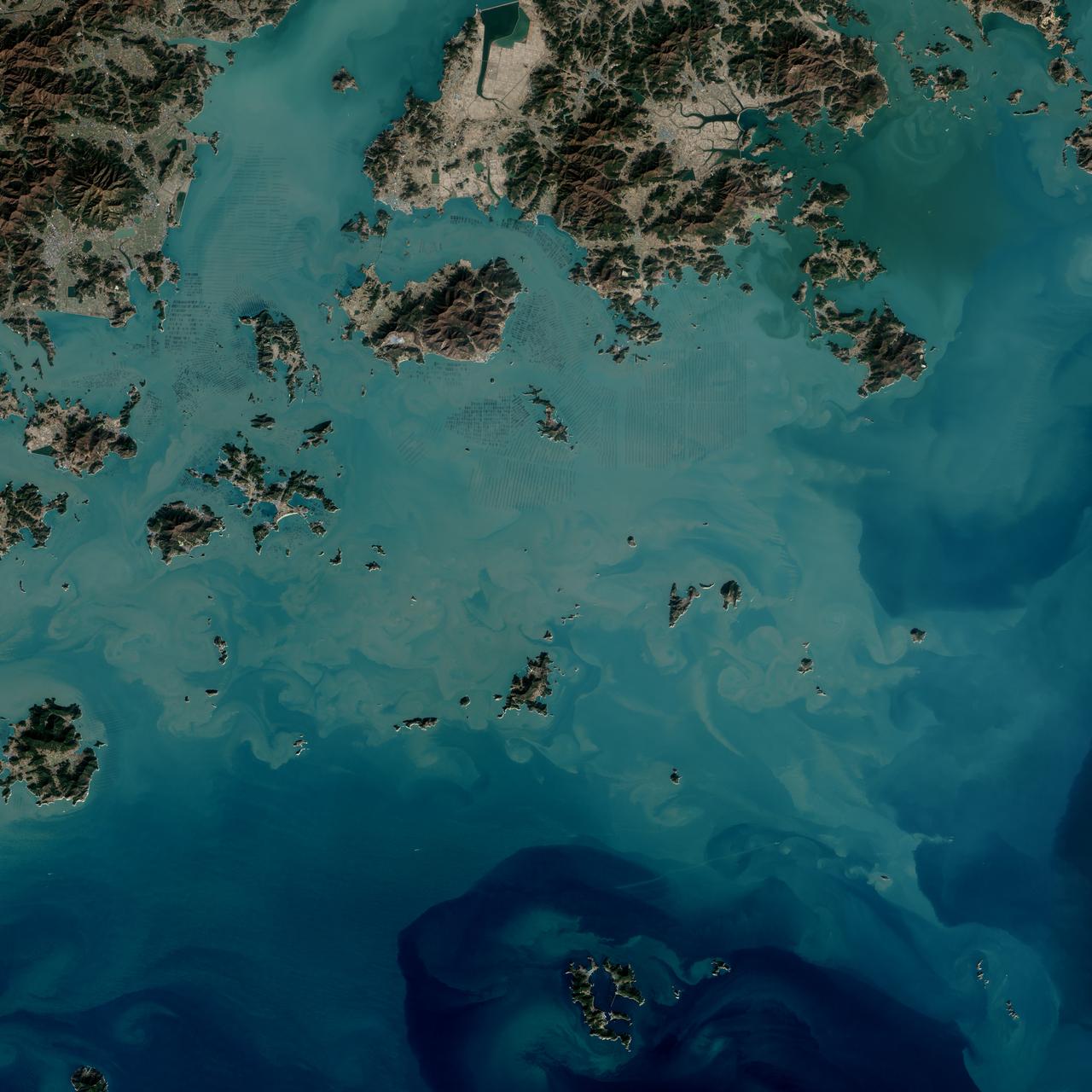
The dark squares that make up the checkerboard pattern in this image are fields of a sort—fields of seaweed. Along the south coast of South Korea, seaweed is often grown on ropes, which are held near the surface with buoys. This technique ensures that the seaweed stays close enough to the surface to get enough light during high tide but doesn’t scrape against the bottom during low tide. The Operational Land Imager (OLI) on Landsat 8 acquired this image of seaweed cultivation in the shallow waters around Sisan Island on January 31, 2014. Home to a thriving aquaculture industry, the south coast of South Korea produces about 90 percent of the country’s seaweed crop. The waters around Sisan are not the only place where aquaculture is common. View the large image to see how ubiquitous seaweed aquaculture is along the coast in Jeollanam-do, the southernmost province on the Korean peninsula. Two main types of seaweed are cultivated in South Korea: Undaria (known as miyeok in Korean, wakame in Japanese) and Pyropia (gim in Korean, nori in Japanese). Both types are used generously in traditional Korean, Japanese, and Chinese food. Since 1970, farmed seaweed production has increased by approximately 8 percent per year. Today, about 90 percent of all the seaweed that humans consume globally is farmed. That may be good for the environment. In comparison to other types of food production, seaweed farming has a light environmental footprint because it does not require fresh water or fertilizer. NASA Earth Observatory image by Jesse Allen, using Landsat data from the U.S. Geological Survey. Caption by Adam Voiland. Credit: <b><a href="http://www.earthobservatory.nasa.gov/" rel="nofollow"> NASA Earth Observatory</a></b> <b><a href="http://www.nasa.gov/audience/formedia/features/MP_Photo_Guidelines.html" rel="nofollow">NASA image use policy.</a></b> <b><a href="http://www.nasa.gov/centers/goddard/home/index.html" rel="nofollow">NASA Goddard Space Flight Center</a></b> enables NASA’s mission through four scientific endeavors: Earth Science, Heliophysics, Solar System Exploration, and Astrophysics. Goddard plays a leading role in NASA’s accomplishments by contributing compelling scientific knowledge to advance the Agency’s mission. <b>Follow us on <a href="http://twitter.com/NASAGoddardPix" rel="nofollow">Twitter</a></b> <b>Like us on <a href="http://www.facebook.com/pages/Greenbelt-MD/NASA-Goddard/395013845897?ref=tsd" rel="nofollow">Facebook</a></b> <b>Find us on <a href="http://instagrid.me/nasagoddard/?vm=grid" rel="nofollow">Instagram</a></b>
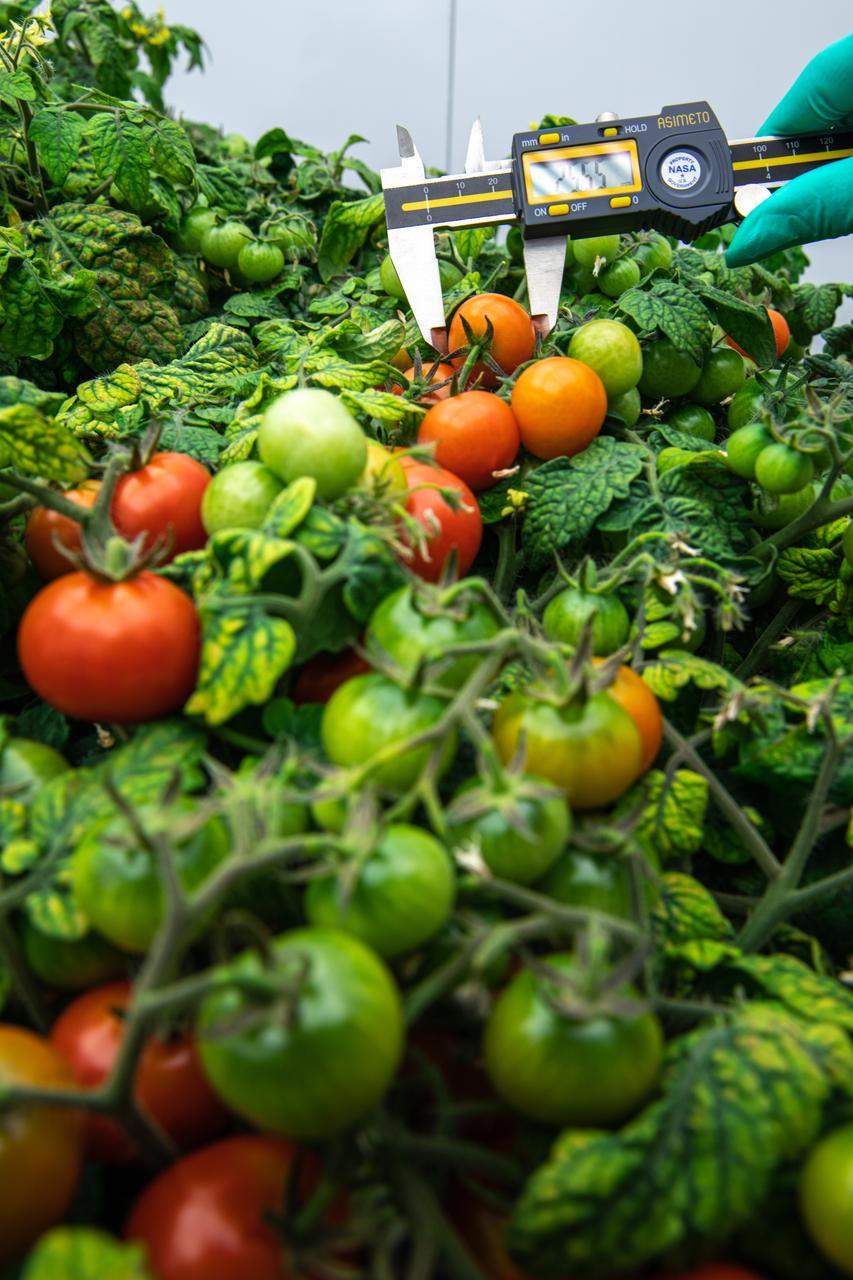
Lashelle Spencer, plant scientist with the Laboratory Support Services and Operations (LASSO) contract at NASA’s Kennedy Space Center in Florida, takes measurements on ‘Red Robin’ dwarf tomato plants, Jan. 10, 2020, inside a laboratory in the spaceport’s Space Station Processing Facility. The tomatoes are growing from seeds that have been exposed to simulated solar particle radiation. The plants’ edible mass and nutrients will be measured and compared to those of a control crop, grown from non-irradiated seeds. The project was designed to confirm that nutritious, high-quality produce can be reliably grown in deep space, or to provide a baseline to guide development of countermeasures to protect future crop foods from radiation during missions beyond low-Earth orbit. The investigation on space radiation impact on seeds and crop production also will be carried on the Materials International Space Station Experiment (MISSE) platform outside the station, supported NASA’s Space Technology Mission Directorate and the Space Biology Program, and potentially on future beyond-low-Earth platforms.
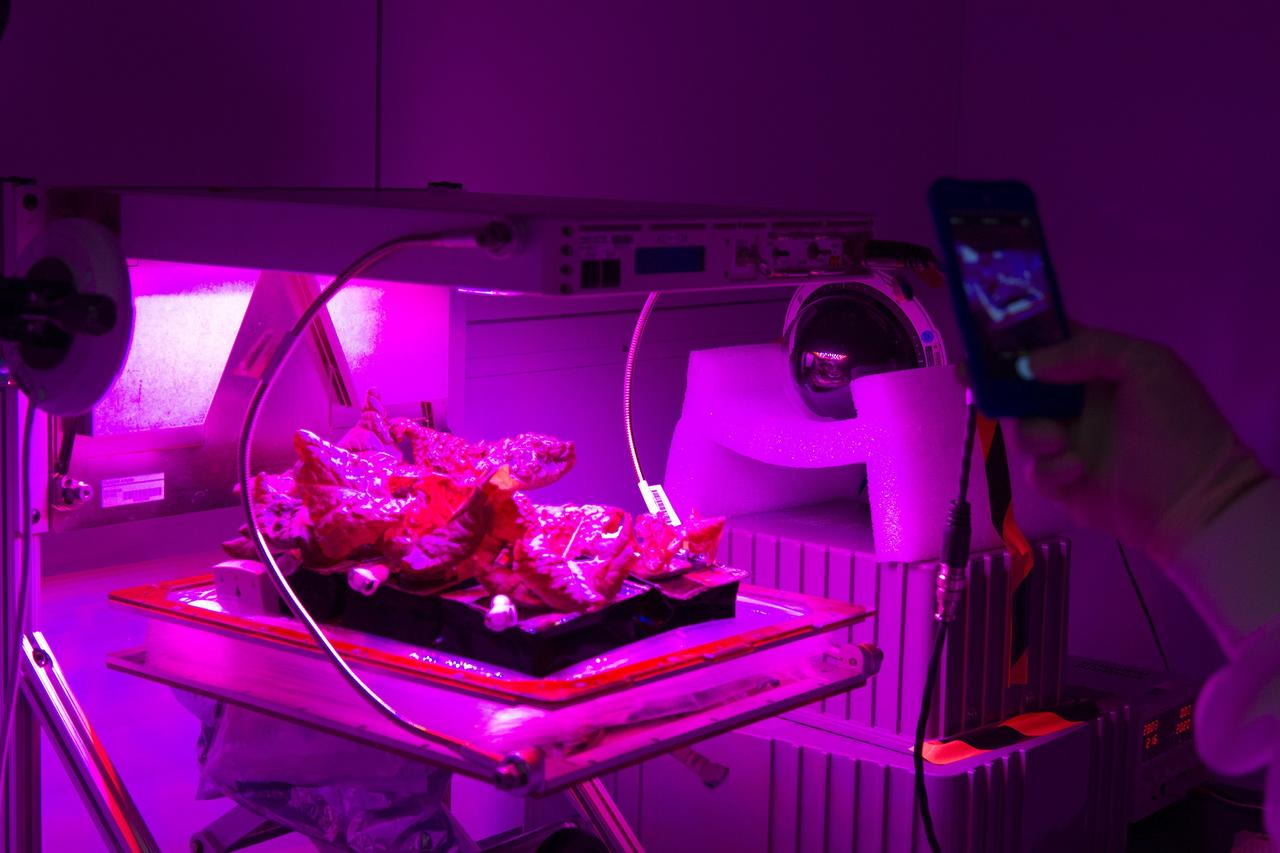
CAPE CANAVERAL, Fla. – Inside the International Space Station Environmental Simulator chamber at the Space Station Processing Facility at NASA's Kennedy Space Center in Florida, the bellows has been removed from around the Veggie plant growth system so that the plant pillows containing the outredgeous red lettuce leaves can be removed. The growth chamber was used as a control unit and procedures were followed identical to those being performed on Veggie and the Veg-01 experiment on the International Space Station. The chamber mimicked the temperature, relative humidity and carbon dioxide concentration of those in the Veggie unit on the space station. Veggie and Veg-01 were delivered to the space station aboard the SpaceX-3 mission. Veggie is the first fresh food production system delivered to the station. Six plant pillows, each containing outredgeous red romaine lettuce seeds and a root mat were inserted into Veggie. The plant chamber's red, blue and green LED lights were activated. The plant growth was monitored for 33 days. On June 10, at the end of the cycle, the plants were carefully harvested, frozen and stored for return to Earth by Expedition 39 flight engineer and NASA astronaut Steve Swanson. Photo credit: NASA/Frankie Martin
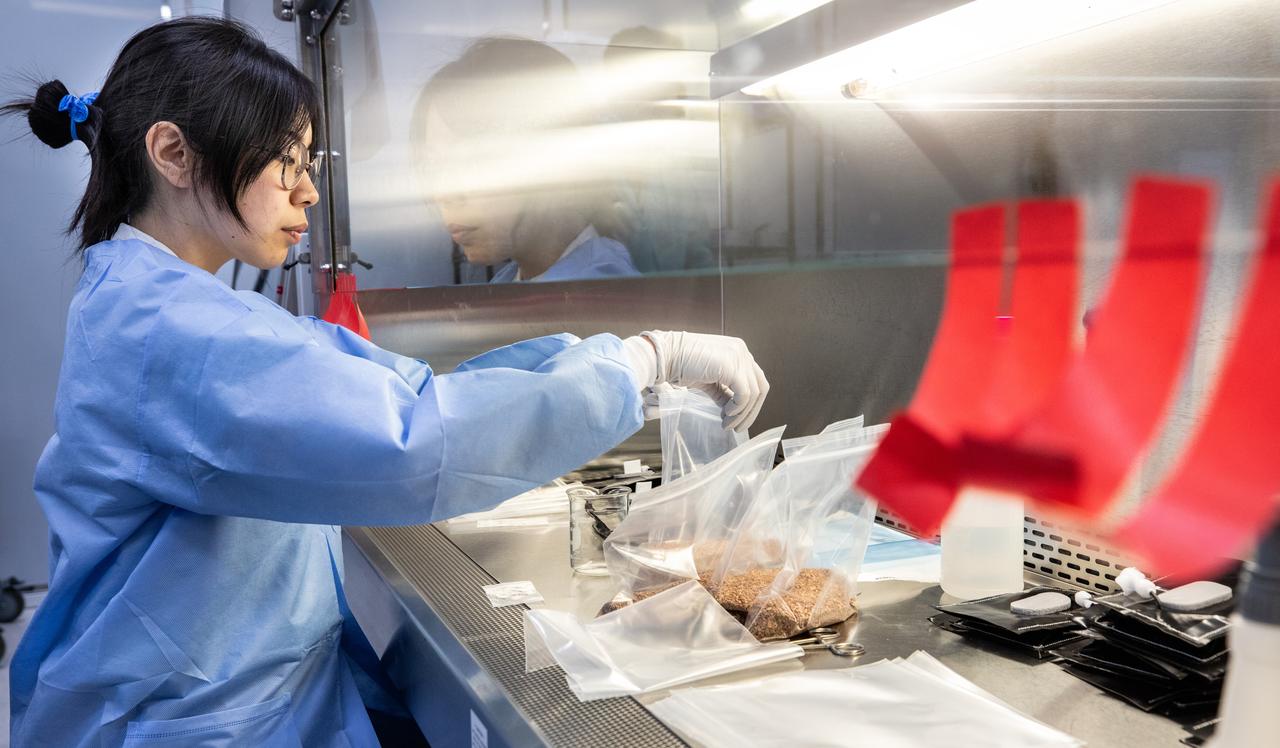
A member of the space crop production team pours substrate and controlled release fertilizer into a Veggie plant pillow on Thursday, May 29, 2025, inside the Space Systems Processing Facility at NASA’s Kennedy Space Center in Florida. The plant pillows, along with Veg-03 MNO seed films, which will carry seeds of Red Russian kale, Wasabi mustard greens, and Dragoon lettuce, are set to fly aboard NASA’s SpaceX Crew-11 mission to the International Space Station to grow in the space environment to study how microgravity impacts crop development compared to ground-grown plants. Seed films enable seed handling and planting of seeds into plant pillows allowing for astronaut choice of crops to grow. Plants can provide whole food nutrition, improve menu variety, and positively impact behavioral health of astronauts on long duration missions to the Moon and Mars and space crop research aboard the orbiting laboratory is enabled by NASA’s Biological and Physical Sciences Division and the International Space Station Program.
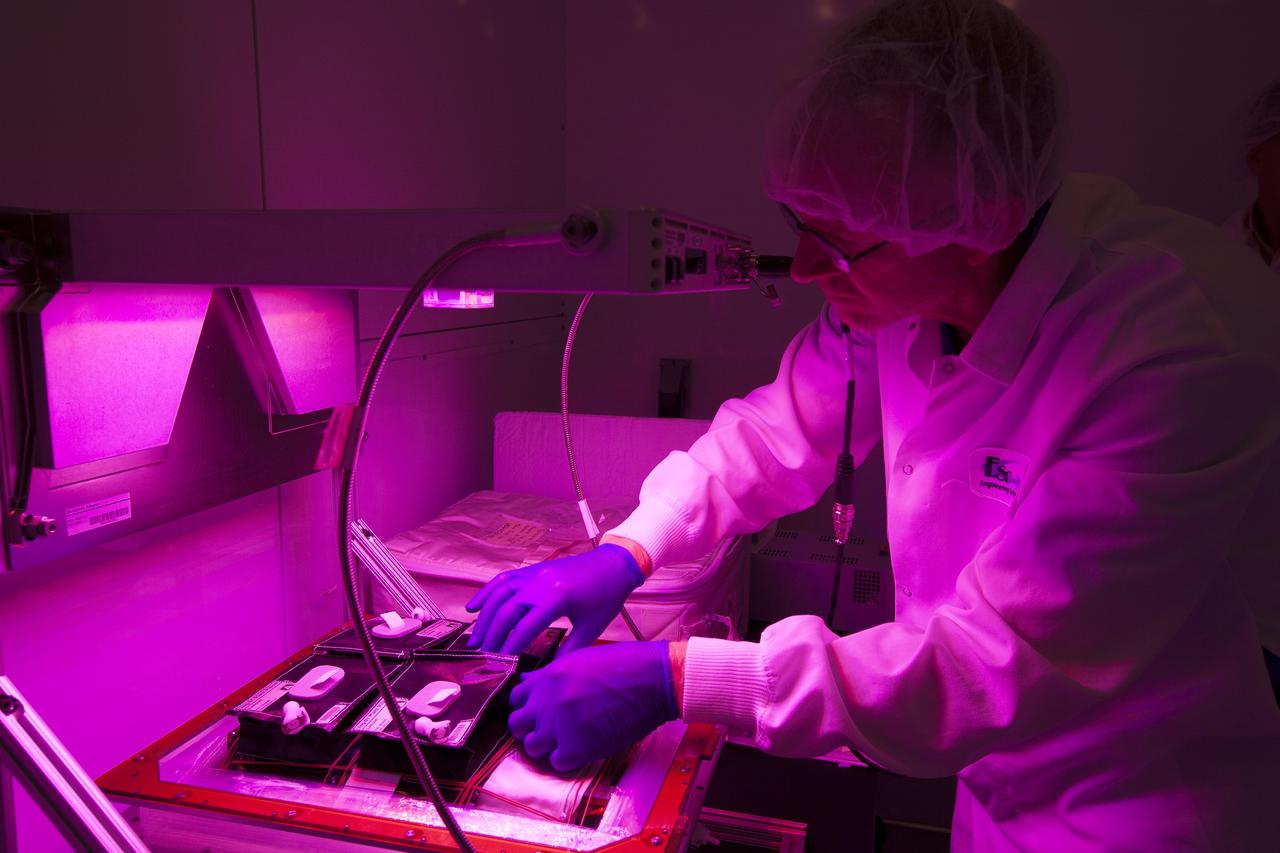
CAPE CANAVERAL, Fla. – Researchers have activated the red, blue and green LED lights on the Veggie plant growth system inside a control chamber at the Space Station Processing Facility at NASA's Kennedy Space Center in Florida. Jim Smodell, a technician with SGT, is securing the plant pillows containing outredgeous red romaine lettuce seeds onto the root mat inside Veggie. The growth chamber will be used as a control unit and procedures will be followed identical to those being performed on Veggie and the Veg-01 experiment on the International Space Station by Expedition 39 flight engineer and NASA astronaut Steve Swanson. Veggie and Veg-01 were delivered to the space station aboard the SpaceX-3 mission. Veggie is the first fresh food production system delivered to the station. Six plant pillows, each containing outredgeous red romaine lettuce seeds and a root mat were inserted into Veggie. The plant chamber's red, blue and green LED lights were activated. The plant growth will be monitored for 28 days. At the end of the cycle, the plants will be carefully harvested, frozen and stored for return to Earth. Photo credit: NASA/Dimitri Gerondidakis
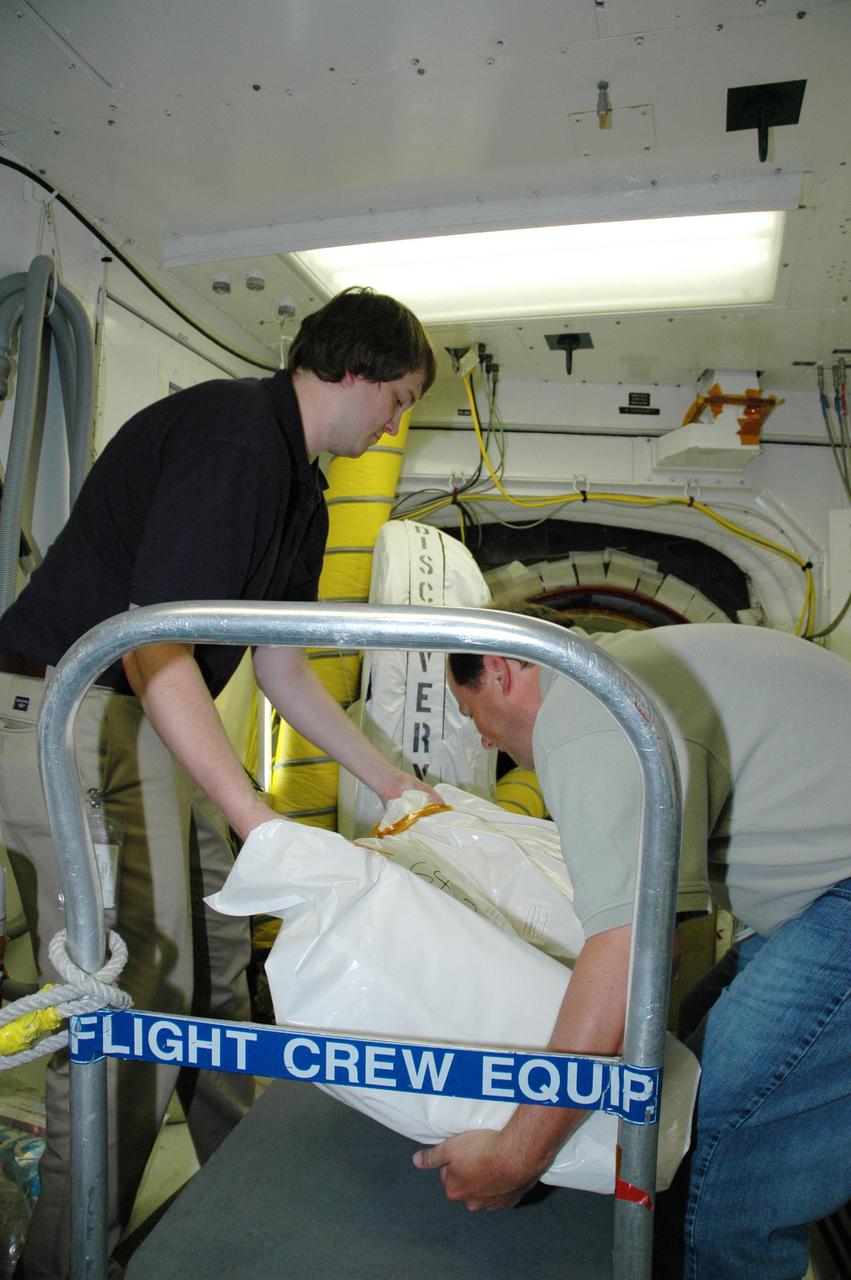
KENNEDY SPACE CENTER, FLA. - At Launch Pad 39B, NASA Flight Crew Systems engineers Ben Van Lear (left) and Brad Poffenberger hand a stowage container to a technician inside Space Shuttle Discovery for installation, a final step in launch preparations. Launch of Discovery on its Return to Flight mission STS-114 is set for July 13, just days away. The container holds consumables that will be unpacked by the crew once on orbit and will be used to return miscellaneous used products back to Earth. During its 12-day mission, Discovery’s seven-person crew will test new hardware and techniques to improve Shuttle safety, as well as deliver supplies to the International Space Station. Discovery’s payloads include the Multi-Purpose Logistics Module Raffaello, the Lightweight Multi-Purpose Experiment Support Structure Carrier (LMC), and the External Stowage Platform-2 (ESP-2). Raffaello will deliver supplies to the International Space Station including food, clothing and research equipment. The LMC will carry a replacement Control Moment Gyroscope and a tile repair sample box. The ESP-2 is outfitted with replacement parts.
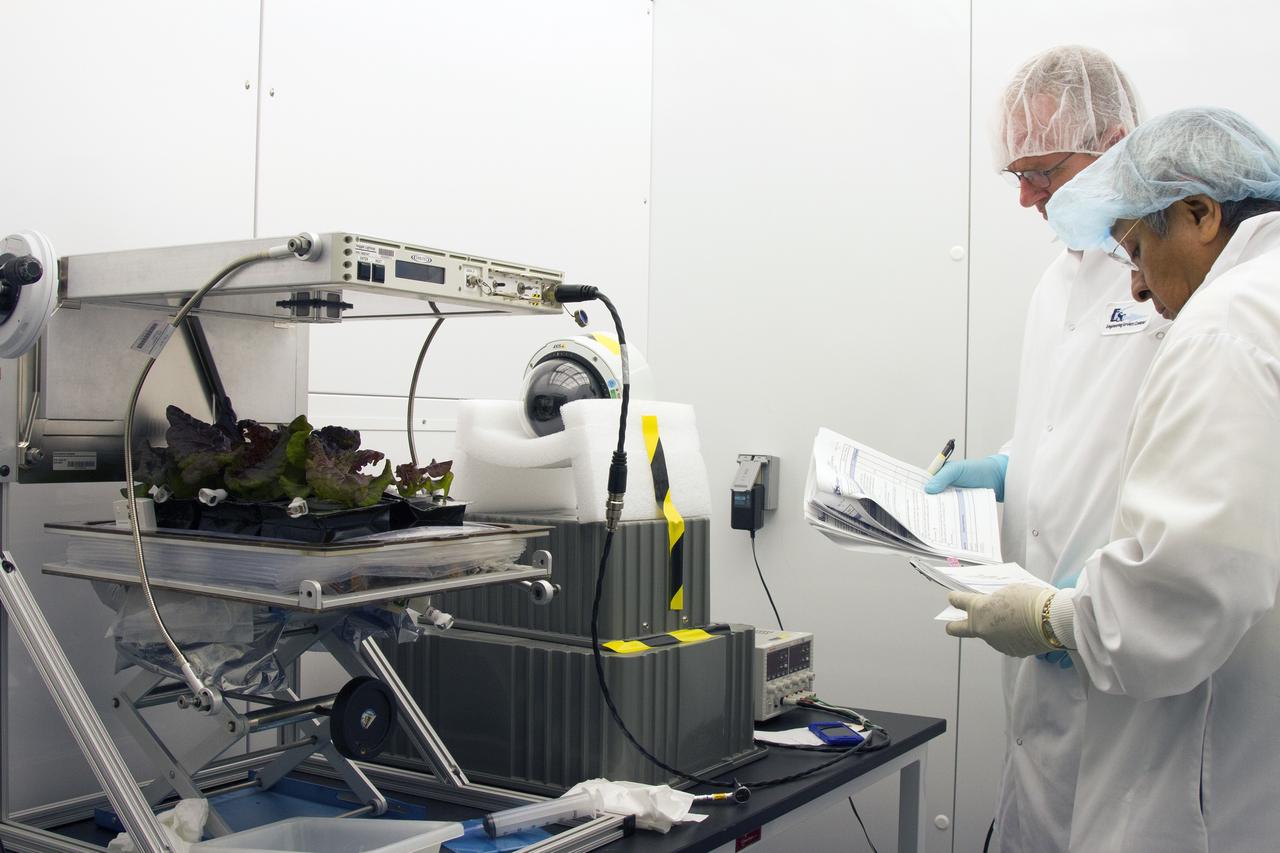
CAPE CANAVERAL, Fla. – From left, Jim Smodell, a technician with SGT, and George Guerra, a quality control engineer with QinetiQ North America, review procedures for removing the plant pillows containing the outredgeous red lettuce leaves from the Veggie plant growth system inside the International Space Station Environmental Simulator chamber at the Space Station Processing Facility at NASA's Kennedy Space Center in Florida. The growth chamber was used as a control unit and procedures were followed identical to those being performed on Veggie and the Veg-01 experiment on the International Space Station. The chamber mimicked the temperature, relative humidity and carbon dioxide concentration of those in the Veggie unit on the space station. Veggie and Veg-01 were delivered to the space station aboard the SpaceX-3 mission. Veggie is the first fresh food production system delivered to the station. Six plant pillows, each containing outredgeous red romaine lettuce seeds and a root mat were inserted into Veggie. The plant chamber's red, blue and green LED lights were activated. The plant growth was monitored for 33 days. On June 10, at the end of the cycle, the plants were carefully harvested, frozen and stored for return to Earth by Expedition 39 flight engineer and NASA astronaut Steve Swanson. Photo credit: NASA/Frankie Martin

CAPE CANAVERAL, Fla. – Researchers have activated the red, blue and green LED lights on the Veggie plant growth system inside a control chamber at the Space Station Processing Facility at NASA's Kennedy Space Center in Florida. In front, is Jim Smodell, a technician with SGT. Behind him is George Guerra, a quality control engineer with QinetiQ North America. The growth chamber will be used as a control unit and procedures will be followed identical to those being performed on Veggie and the Veg-01 experiment on the International Space Station by Expedition 39 flight engineer and NASA astronaut Steve Swanson. Veggie and Veg-01 were delivered to the space station aboard the SpaceX-3 mission. Veggie is the first fresh food production system delivered to the station. Six plant pillows, each containing outredgeous red romaine lettuce seeds and a root mat were inserted into Veggie. The plant chamber's red, blue and green LED lights were activated. The plant growth will be monitored for 28 days. At the end of the cycle, the plants will be carefully harvested, frozen and stored for return to Earth. Photo credit: NASA/Dimitri Gerondidakis
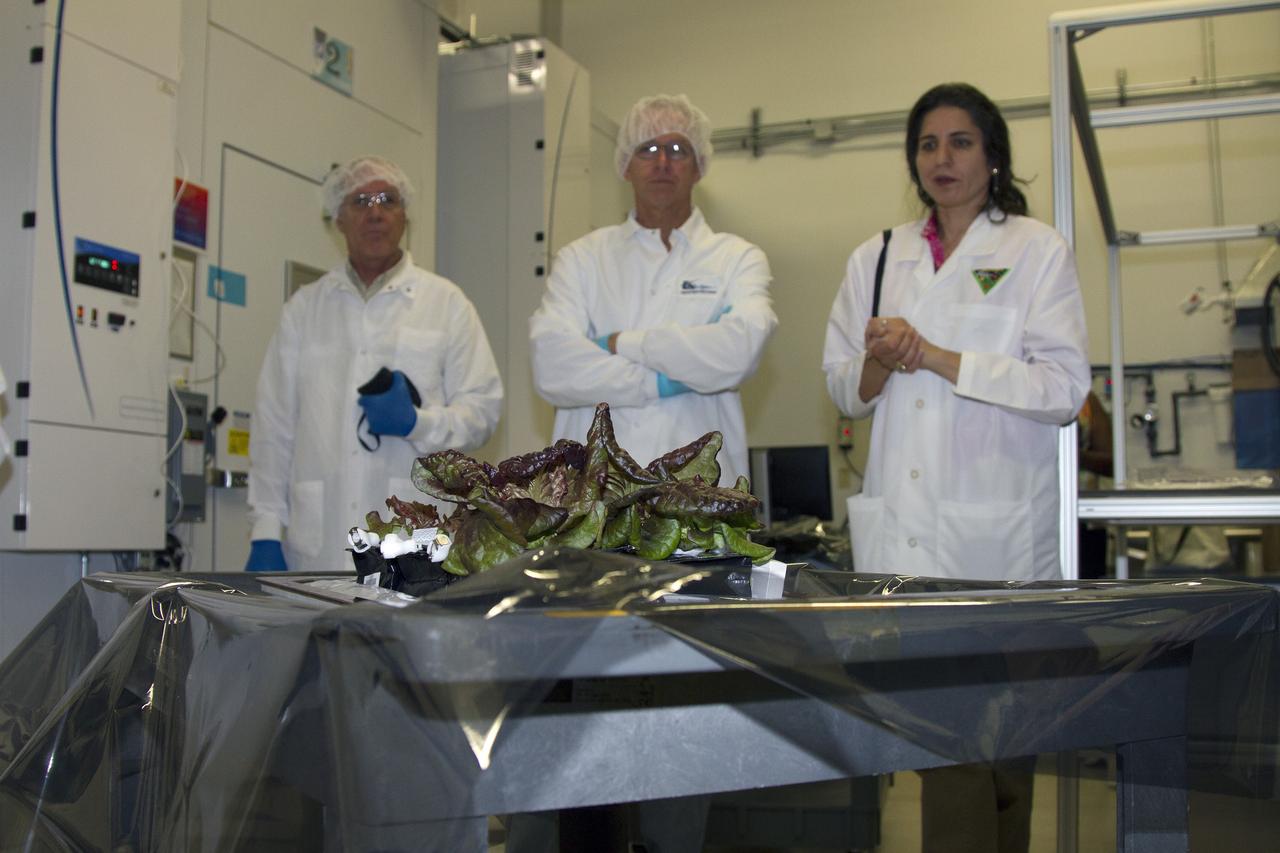
CAPE CANAVERAL, Fla. – The plant pillows containing the outredgeous red lettuce leaves have been removed from the Veggie plant growth system inside a control chamber at the Space Station Processing Facility at NASA's Kennedy Space Center in Florida. From left, are Chuck Spern, lead project engineer with QinetiQ North America on the Engineering Services Contract, Jim Smodell, a technician with SGT, and Gioia Massa, NASA payload scientist for Veggie. The growth chamber was used as a control unit for Veggie and procedures were followed identical to those being performed on Veggie and the Veg-01 experiment on the International Space Station. The chamber mimicked the temperature, relative humidity and carbon dioxide concentration of those in the Veggie unit on the space station. Veggie and Veg-01 were delivered to the space station aboard the SpaceX-3 mission. Veggie is the first fresh food production system delivered to the station. Six plant pillows, each containing outredgeous red romaine lettuce seeds and a root mat were inserted into Veggie. The plant chamber's red, blue and green LED lights were activated. The plant growth was monitored for 33 days. On June 10, at the end of the cycle, the plants were carefully harvested, frozen and stored for return to Earth by Expedition 39 flight engineer and NASA astronaut Steve Swanson. Photo credit: NASA/Frankie Martin
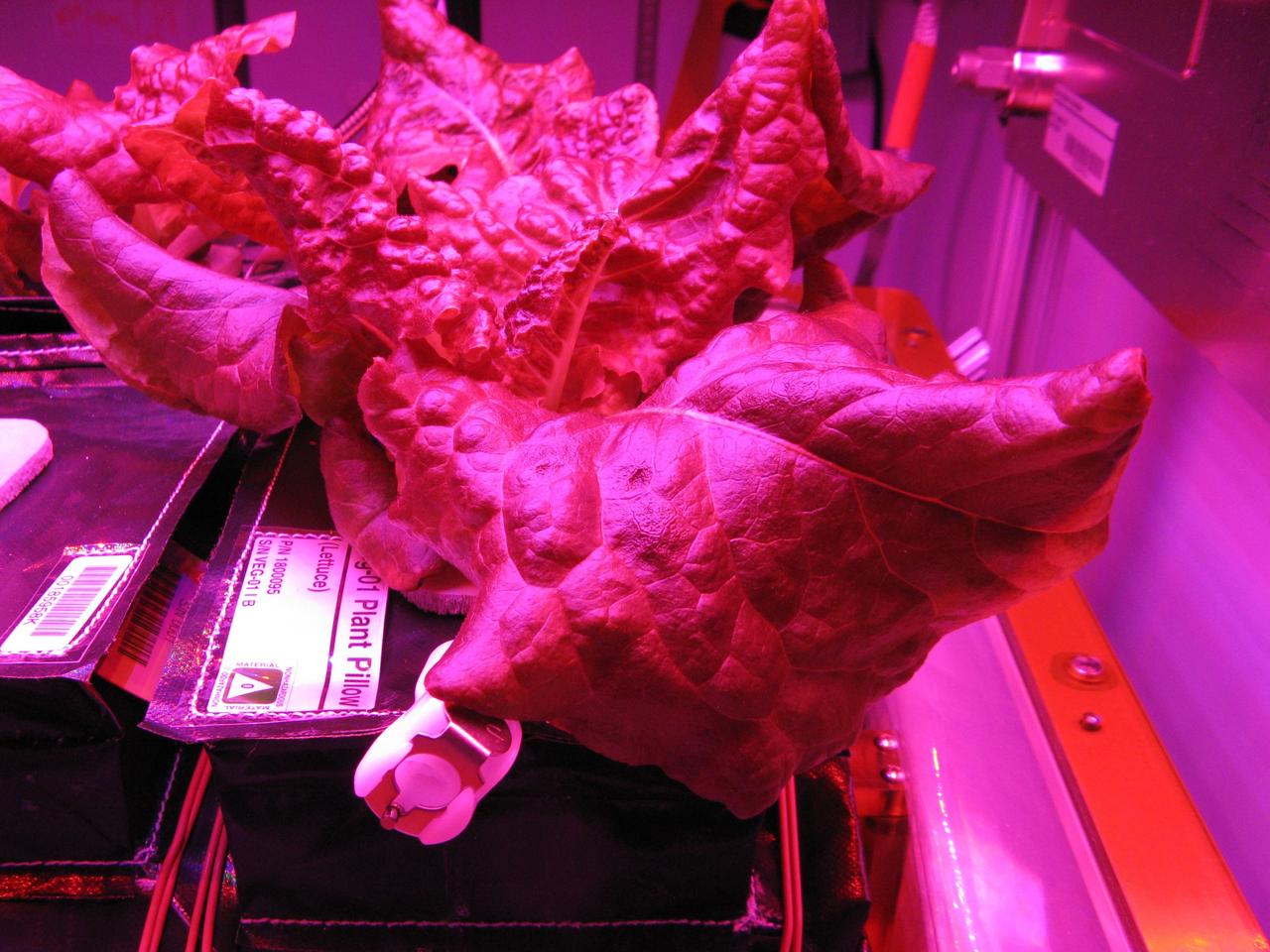
CAPE CANAVERAL, Fla. -- Researchers document the growth of the ground control plants in the Veggie plant growth system inside a control chamber at the Space Station Processing Facility at NASA's Kennedy Space Center in Florida prior to thinning them to one plant each. The growth chamber is being used as a control unit and procedures are being followed identical to those being performed on Veggie and the Veg-01 experiment on the International Space Station. The chamber mimics the temperature, relative humidity and carbon dioxide concentration of those in the Veggie unit on the space station. Veggie and Veg-01 were delivered to the space station aboard the SpaceX-3 mission. Veggie is the first fresh food production system delivered to the station. Six plant pillows, each containing outredgeous red romaine lettuce seeds and a root mat were inserted into Veggie. The plant chamber's red, blue and green LED lights were activated. The plant growth was monitored for 28 days. At the end of the cycle, the plants will be carefully harvested, frozen and stored for return to Earth. Photo credit: NASA/Charles Spern

A member of the space crop production team pours substrate and controlled release fertilizer into a Veggie plant pillow on Thursday, May 29, 2025, inside the Space Systems Processing Facility at NASA’s Kennedy Space Center in Florida. The plant pillows, along with Veg-03 MNO seed films, which will carry seeds of Red Russian kale, Wasabi mustard greens, and Dragoon lettuce, are set to fly aboard NASA’s SpaceX Crew-11 mission to the International Space Station to grow in the space environment to study how microgravity impacts crop development compared to ground-grown plants. Seed films enable seed handling and planting of seeds into plant pillows allowing for astronaut choice of crops to grow. Plants can provide whole food nutrition, improve menu variety, and positively impact behavioral health of astronauts on long duration missions to the Moon and Mars and space crop research aboard the orbiting laboratory is enabled by NASA’s Biological and Physical Sciences Division and the International Space Station Program.
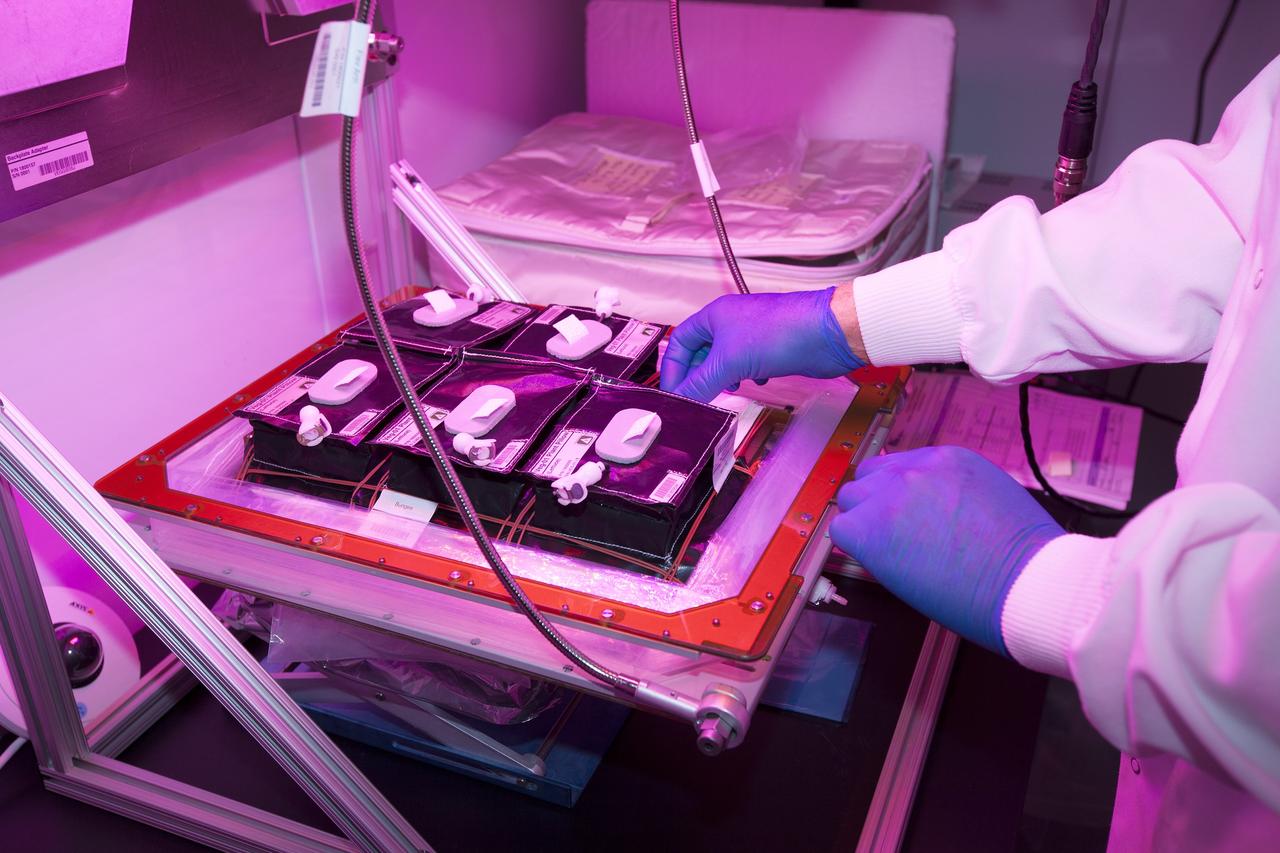
CAPE CANAVERAL, Fla. – Researchers have activated the red, blue and green LED lights on the Veggie plant growth system inside a control chamber at the Space Station Processing Facility at NASA's Kennedy Space Center in Florida. Jim Smodell, a technician with SGT, is securing the plant pillows containing outredgeous red romaine lettuce seeds onto the root mat inside Veggie. The growth chamber will be used as a control unit and procedures will be followed identical to those being performed on Veggie and the Veg-01 experiment on the International Space Station by Expedition 39 flight engineer and NASA astronaut Steve Swanson. Veggie and Veg-01 were delivered to the space station aboard the SpaceX-3 mission. Veggie is the first fresh food production system delivered to the station. Six plant pillows, each containing outredgeous red romaine lettuce seeds and a root mat were inserted into Veggie. The plant chamber's red, blue and green LED lights were activated. The plant growth will be monitored for 28 days. At the end of the cycle, the plants will be carefully harvested, frozen and stored for return to Earth. Photo credit: NASA/Dimitri Gerondidakis
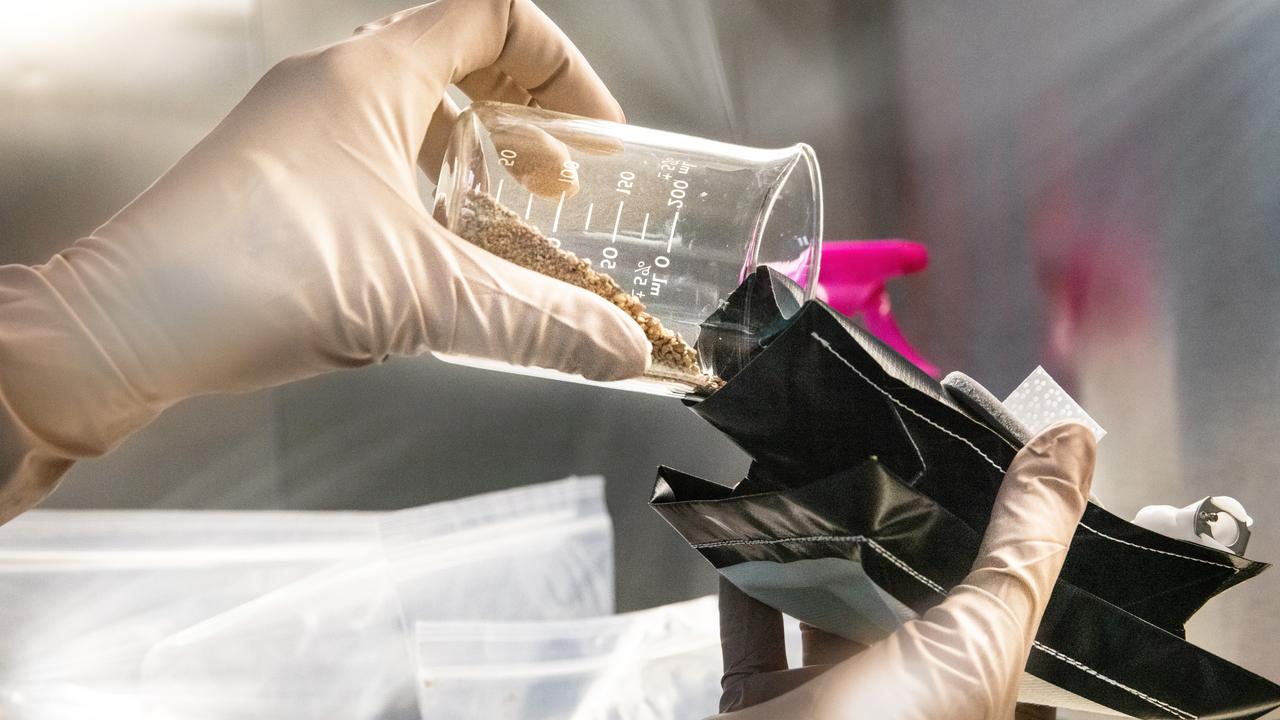
A member of the space crop production team pours substrate and controlled release fertilizer into a Veggie plant pillow on Thursday, May 29, 2025, inside the Space Systems Processing Facility at NASA’s Kennedy Space Center in Florida. The plant pillows, along with Veg-03 MNO seed films, which will carry seeds of Red Russian kale, Wasabi mustard greens, and Dragoon lettuce, are set to fly aboard NASA’s SpaceX Crew-11 mission to the International Space Station to grow in the space environment to study how microgravity impacts crop development compared to ground-grown plants. Seed films enable seed handling and planting of seeds into plant pillows allowing for astronaut choice of crops to grow. Plants can provide whole food nutrition, improve menu variety, and positively impact behavioral health of astronauts on long duration missions to the Moon and Mars and space crop research aboard the orbiting laboratory is enabled by NASA’s Biological and Physical Sciences Division and the International Space Station Program.
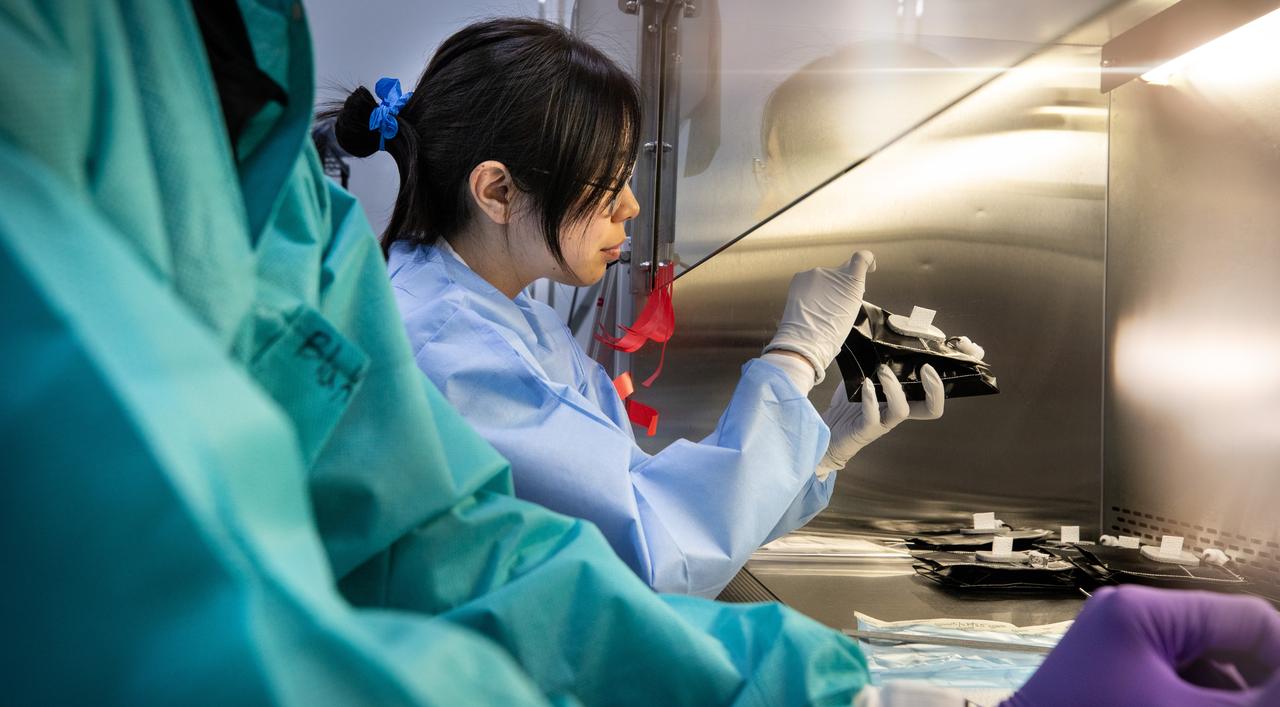
A member of the space crop production team pours substrate and controlled release fertilizer into a Veggie plant pillow on Thursday, May 29, 2025, inside the Space Systems Processing Facility at NASA’s Kennedy Space Center in Florida. The plant pillows, along with Veg-03 MNO seed films, which will carry seeds of Red Russian kale, Wasabi mustard greens, and Dragoon lettuce, are set to fly aboard NASA’s SpaceX Crew-11 mission to the International Space Station to grow in the space environment to study how microgravity impacts crop development compared to ground-grown plants. Seed films enable seed handling and planting of seeds into plant pillows allowing for astronaut choice of crops to grow. Plants can provide whole food nutrition, improve menu variety, and positively impact behavioral health of astronauts on long duration missions to the Moon and Mars and space crop research aboard the orbiting laboratory is enabled by NASA’s Biological and Physical Sciences Division and the International Space Station Program.

Lashelle Spencer, plant scientist with the Laboratory Support Services and Operations (LASSO) contract at NASA’s Kennedy Space Center in Florida, takes measurements on ‘Red Robin’ dwarf tomato plants, Jan. 10, 2020, inside a laboratory in the spaceport’s Space Station Processing Facility. The tomatoes are growing from seeds that have been exposed to simulated solar particle radiation. The plants’ edible mass and nutrients will be measured and compared to those of a control crop, grown from non-irradiated seeds. The project was designed to confirm that nutritious, high-quality produce can be reliably grown in deep space, or to provide a baseline to guide development of countermeasures to protect future crop foods from radiation during missions beyond low-Earth orbit. The investigation on space radiation impact on seeds and crop production also will be carried on the Materials International Space Station Experiment (MISSE) platform outside the station, supported NASA’s Space Technology Mission Directorate and the Space Biology Program, and potentially on future beyond-low-Earth platforms.
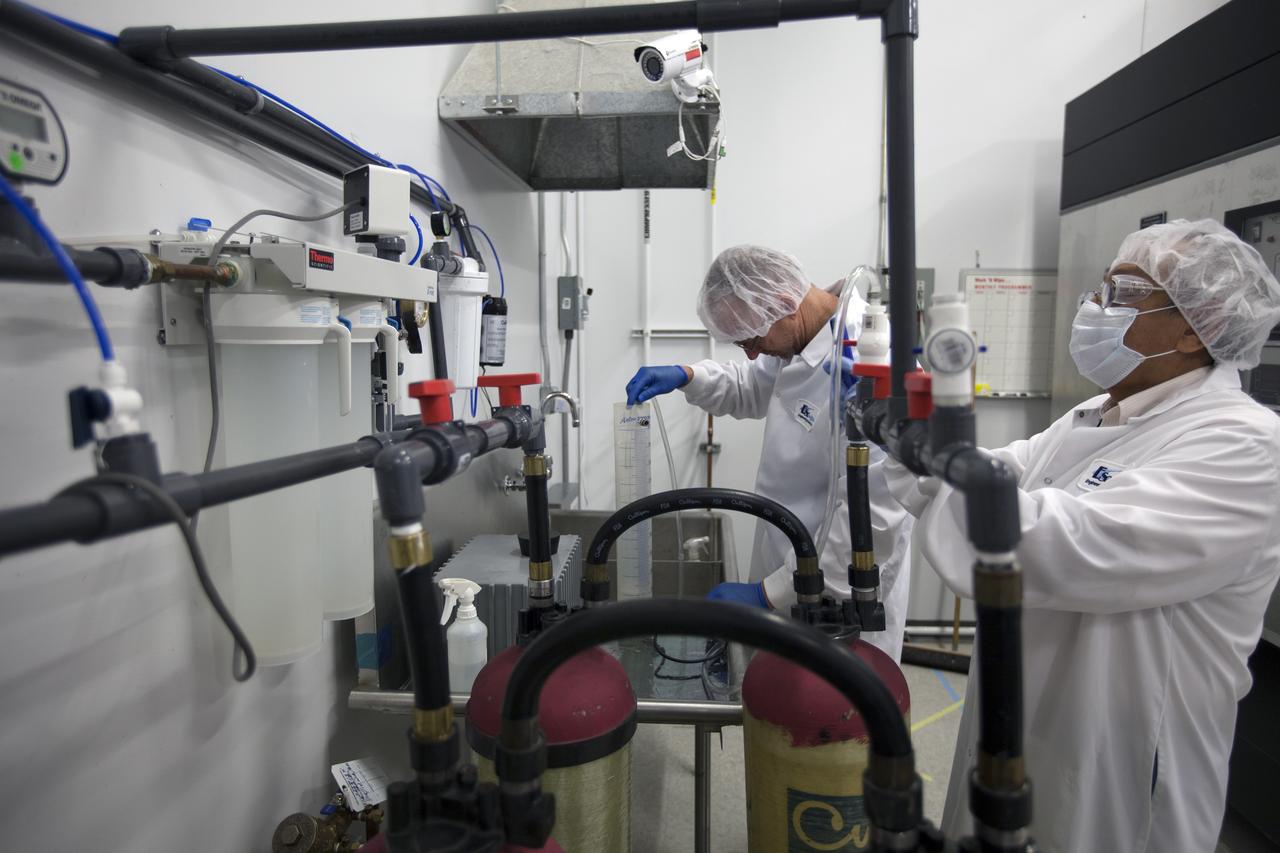
CAPE CANAVERAL, Fla. – Researchers acquire the ionized water for the Veggie plant growth system inside a control chamber at the Space Station Processing Facility at NASA's Kennedy Space Center in Florida. From left, are Jim Smodell, a technician with SGT, and George Guerra, a quality control engineer with QinetiQ North America. The growth chamber will be used as a control unit and procedures will be followed identical to those being performed on Veggie and the Veg-01 experiment on the International Space Station by Expedition 39 flight engineer and NASA astronaut Steve Swanson. Veggie and Veg-01 were delivered to the space station aboard the SpaceX-3 mission. Veggie is the first fresh food production system delivered to the station. Six plant pillows, each containing outredgeous red romaine lettuce seeds and a root mat were inserted into Veggie. The plant chamber's red, blue and green LED lights were activated. The plant growth will be monitored for 28 days. At the end of the cycle, the plants will be carefully harvested, frozen and stored for return to Earth. Photo credit: NASA/Dimitri Gerondidakis
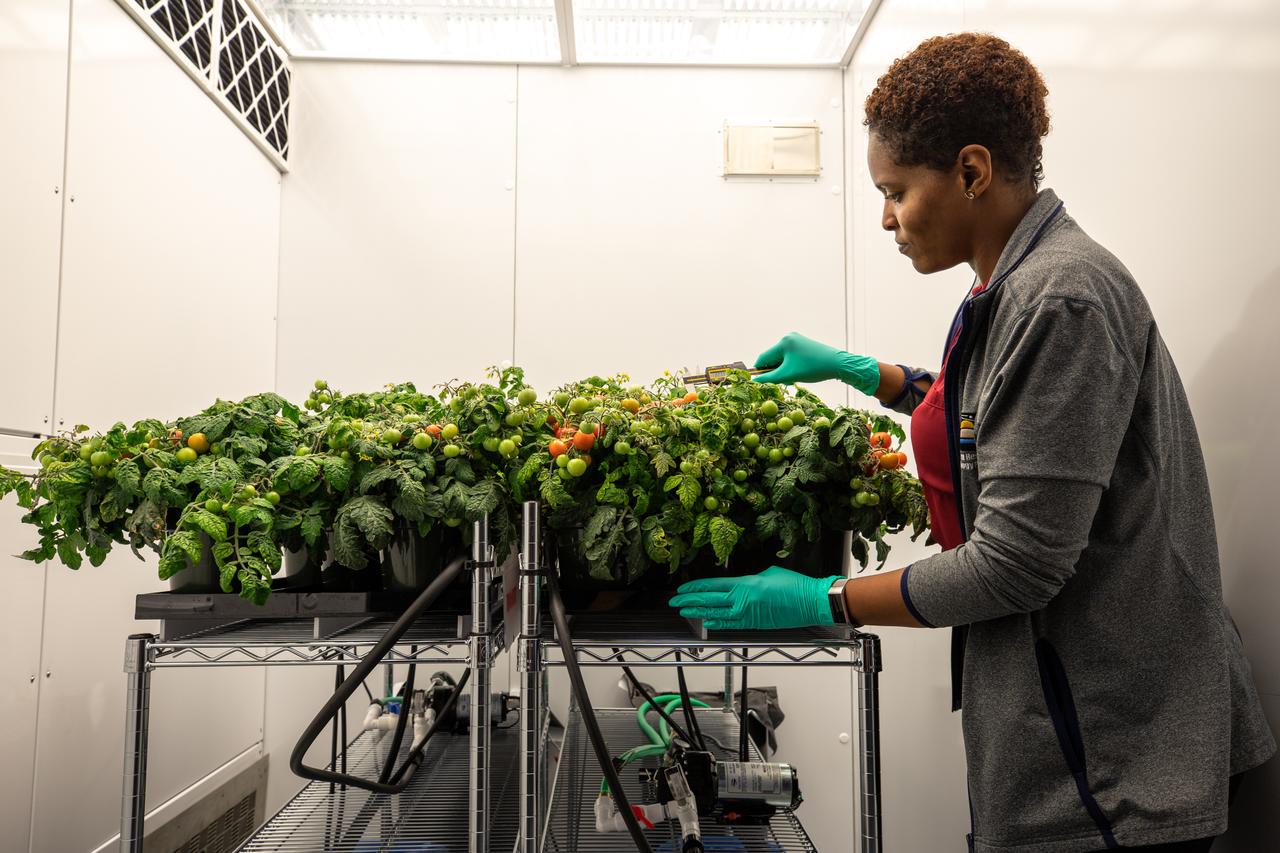
Lashelle Spencer, plant scientist with the Laboratory Support Services and Operations (LASSO) contract at NASA’s Kennedy Space Center in Florida, takes measurements on ‘Red Robin’ dwarf tomato plants, Jan. 10, 2020, inside a laboratory in the spaceport’s Space Station Processing Facility. The tomatoes are growing from seeds that have been exposed to simulated solar particle radiation. The plants’ edible mass and nutrients will be measured and compared to those of a control crop, grown from non-irradiated seeds. The project was designed to confirm that nutritious, high-quality produce can be reliably grown in deep space, or to provide a baseline to guide development of countermeasures to protect future crop foods from radiation during missions beyond low-Earth orbit. The investigation on space radiation impact on seeds and crop production also will be carried on the Materials International Space Station Experiment (MISSE) platform outside the station, supported NASA’s Space Technology Mission Directorate and the Space Biology Program, and potentially on future beyond-low-Earth platforms.
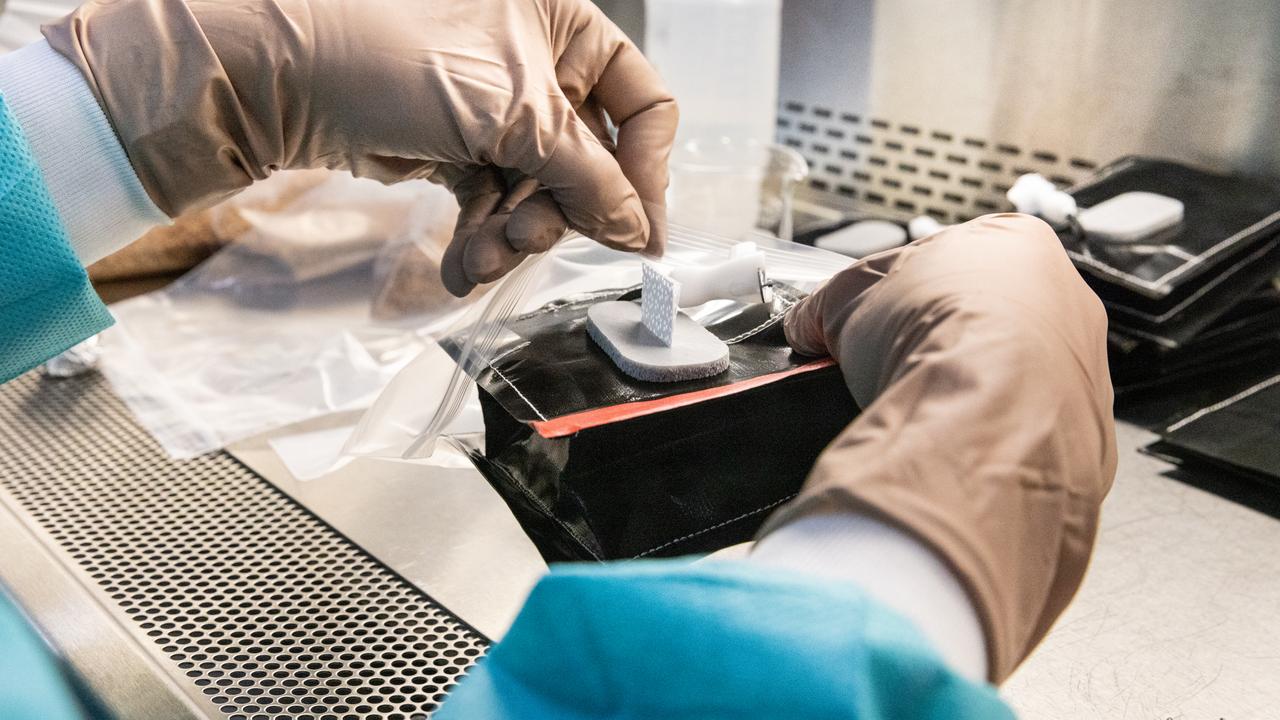
A member of the space crop production team pours substrate and controlled release fertilizer into a Veggie plant pillow on Thursday, May 29, 2025, inside the Space Systems Processing Facility at NASA’s Kennedy Space Center in Florida. The plant pillows, along with Veg-03 MNO seed films, which will carry seeds of Red Russian kale, Wasabi mustard greens, and Dragoon lettuce, are set to fly aboard NASA’s SpaceX Crew-11 mission to the International Space Station to grow in the space environment to study how microgravity impacts crop development compared to ground-grown plants. Seed films enable seed handling and planting of seeds into plant pillows allowing for astronaut choice of crops to grow. Plants can provide whole food nutrition, improve menu variety, and positively impact behavioral health of astronauts on long duration missions to the Moon and Mars and space crop research aboard the orbiting laboratory is enabled by NASA’s Biological and Physical Sciences Division and the International Space Station Program.
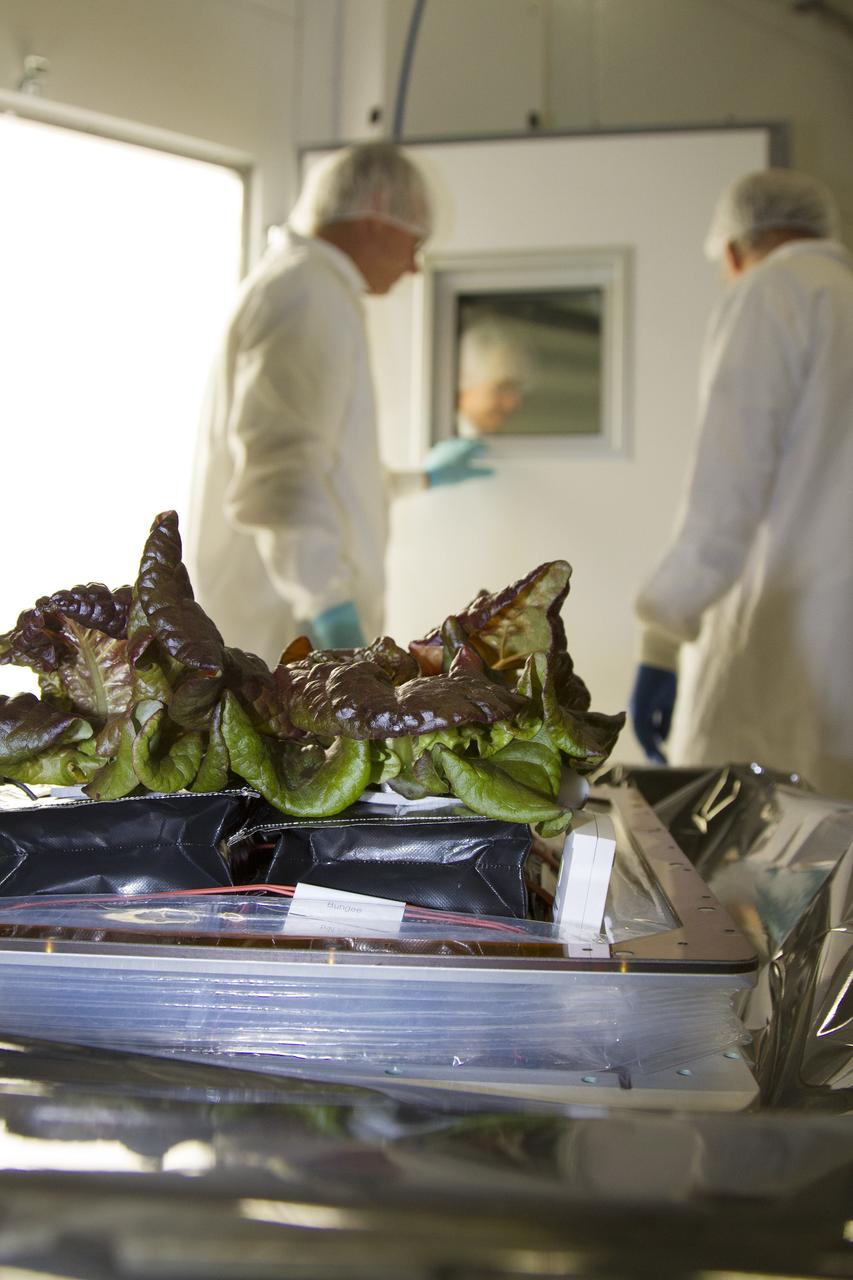
CAPE CANAVERAL, Fla. – Jim Smodell, left, a technician with SGT, and Chuck Spern, lead project engineer with QinetiQ North America on the Engineering Services Contract, move the plant pillows containing the outredgeous red lettuce leaves outside of the International Space Station Environmental Simulator chamber at the Space Station Processing Facility at NASA's Kennedy Space Center in Florida. The growth chamber was used as a control unit for Veggie and procedures were followed identical to those being performed on Veggie and the Veg-01 experiment on the International Space Station. The chamber mimicked the temperature, relative humidity and carbon dioxide concentration of those in the Veggie unit on the space station. Veggie and Veg-01 were delivered to the space station aboard the SpaceX-3 mission. Veggie is the first fresh food production system delivered to the station. Six plant pillows, each containing outredgeous red romaine lettuce seeds and a root mat were inserted into Veggie. The plant chamber's red, blue and green LED lights were activated. The plant growth was monitored for 33 days. On June 10, at the end of the cycle, the plants were carefully harvested, frozen and stored for return to Earth by Expedition 39 flight engineer and NASA astronaut Steve Swanson. Photo credit: NASA/Frankie Martin
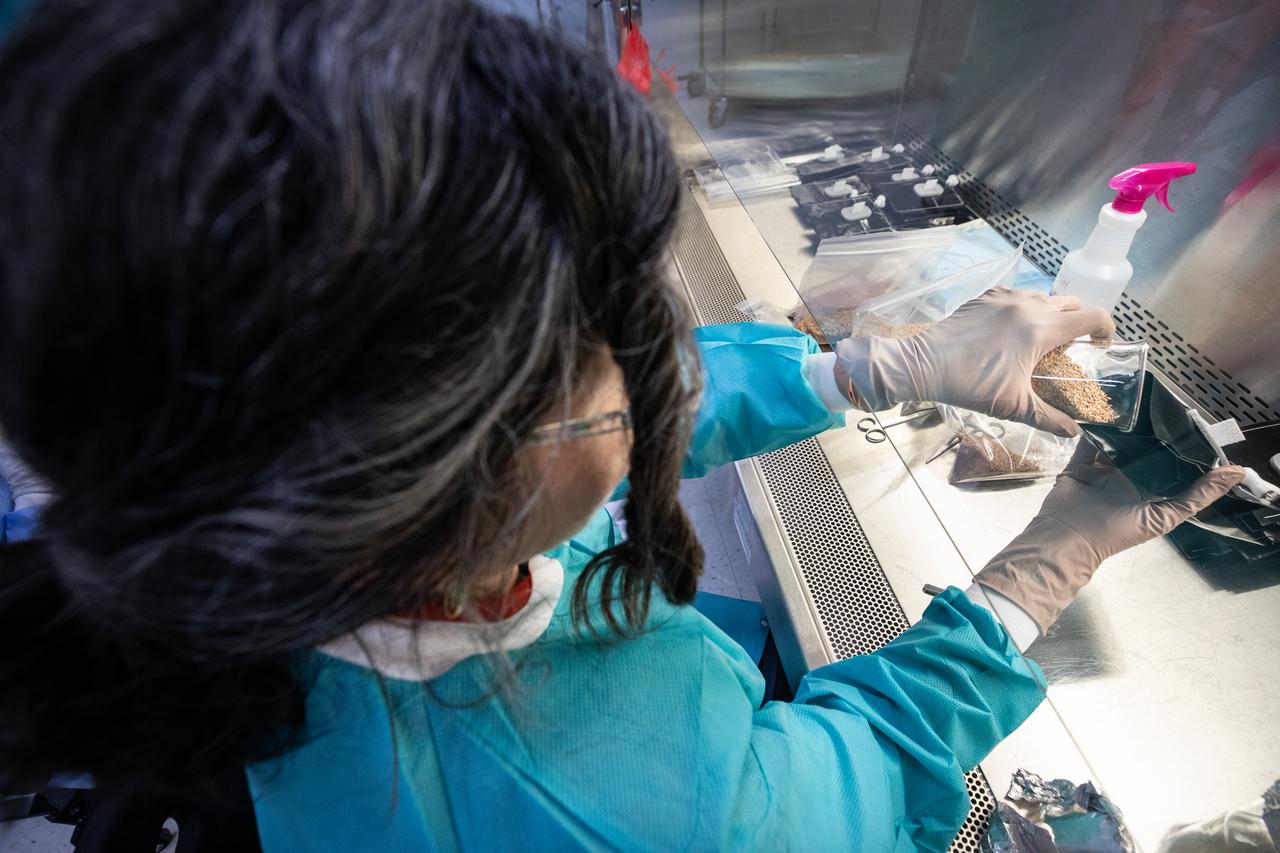
A member of the space crop production team pours substrate and controlled release fertilizer into a Veggie plant pillow on Thursday, May 29, 2025, inside the Space Systems Processing Facility at NASA’s Kennedy Space Center in Florida. The plant pillows, along with Veg-03 MNO seed films, which will carry seeds of Red Russian kale, Wasabi mustard greens, and Dragoon lettuce, are set to fly aboard NASA’s SpaceX Crew-11 mission to the International Space Station to grow in the space environment to study how microgravity impacts crop development compared to ground-grown plants. Seed films enable seed handling and planting of seeds into plant pillows allowing for astronaut choice of crops to grow. Plants can provide whole food nutrition, improve menu variety, and positively impact behavioral health of astronauts on long duration missions to the Moon and Mars and space crop research aboard the orbiting laboratory is enabled by NASA’s Biological and Physical Sciences Division and the International Space Station Program.