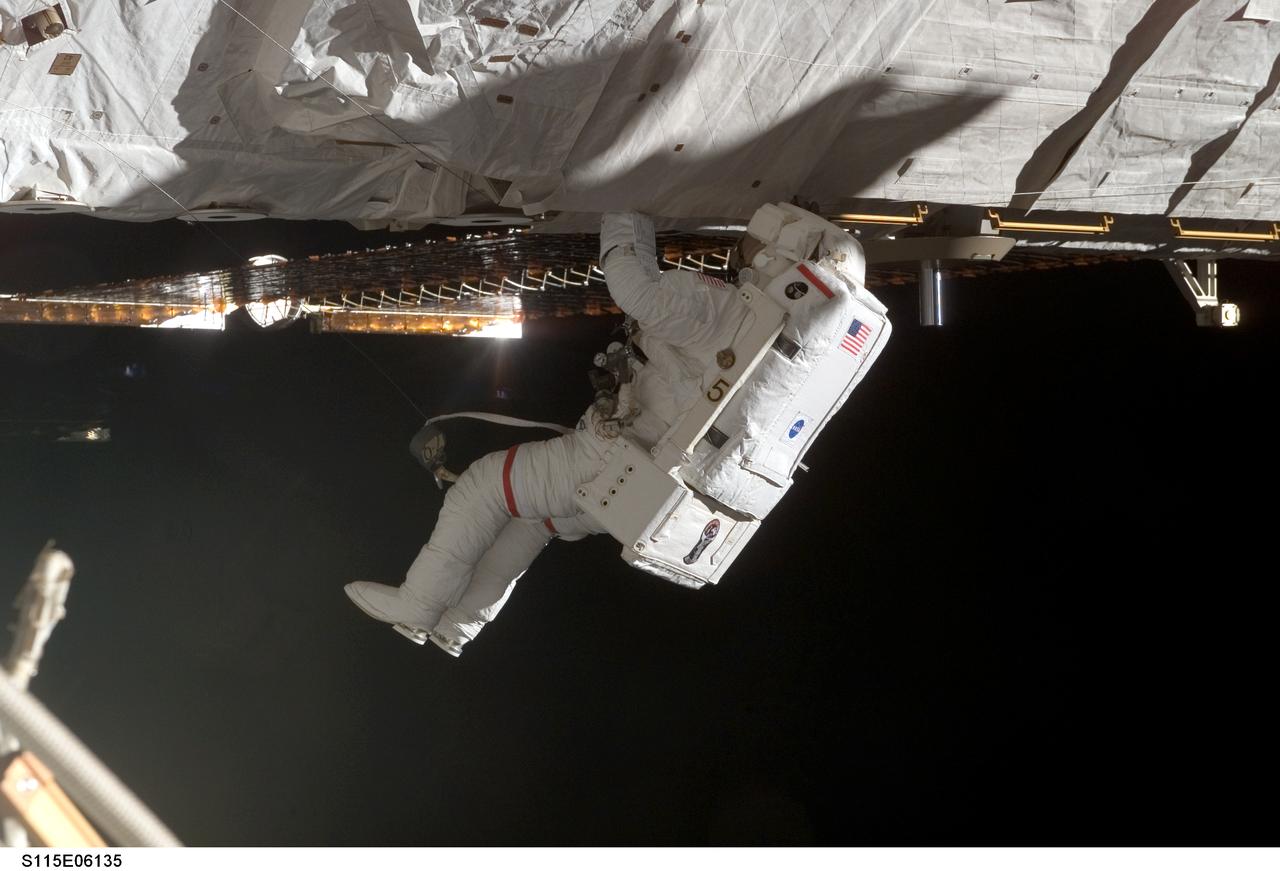
S115-E-06135 (15 Sept. 2006) --- Astronaut Joseph R. Tanner, STS-115 mission specialist and a veteran NASA spacewalker, is pictured during work on the P3/P4 truss on the third and final EVA, supported by the Atlantis and International Space Station crews this week.
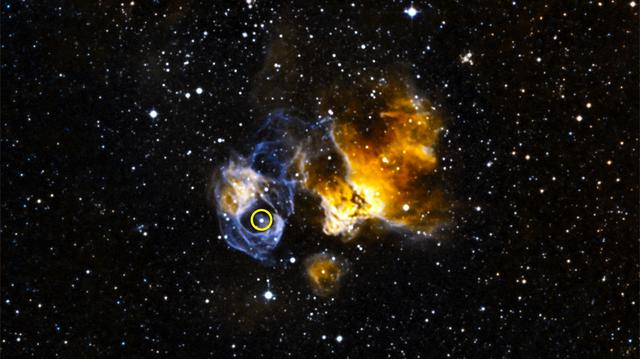
This composite image contains data from Chandra (purple) that provides evidence for the survival of a companion star from the blast of a supernova explosion. Chandra's X-rays reveal a point-like source in the supernova remnant at the location of a massive star. The data suggest that mass is being pulled away from the massive star towards a neutron star or a black hole companion. If confirmed, this would be only the third binary system containing both a massive star and a neutron star or black hole ever found in the aftermath of a supernova. This supernova remnant is found embedded in clouds of ionized hydrogen, which are shown in optical light (yellow and cyan) from the MCELS survey, along with additional optical data from the DSS (white).
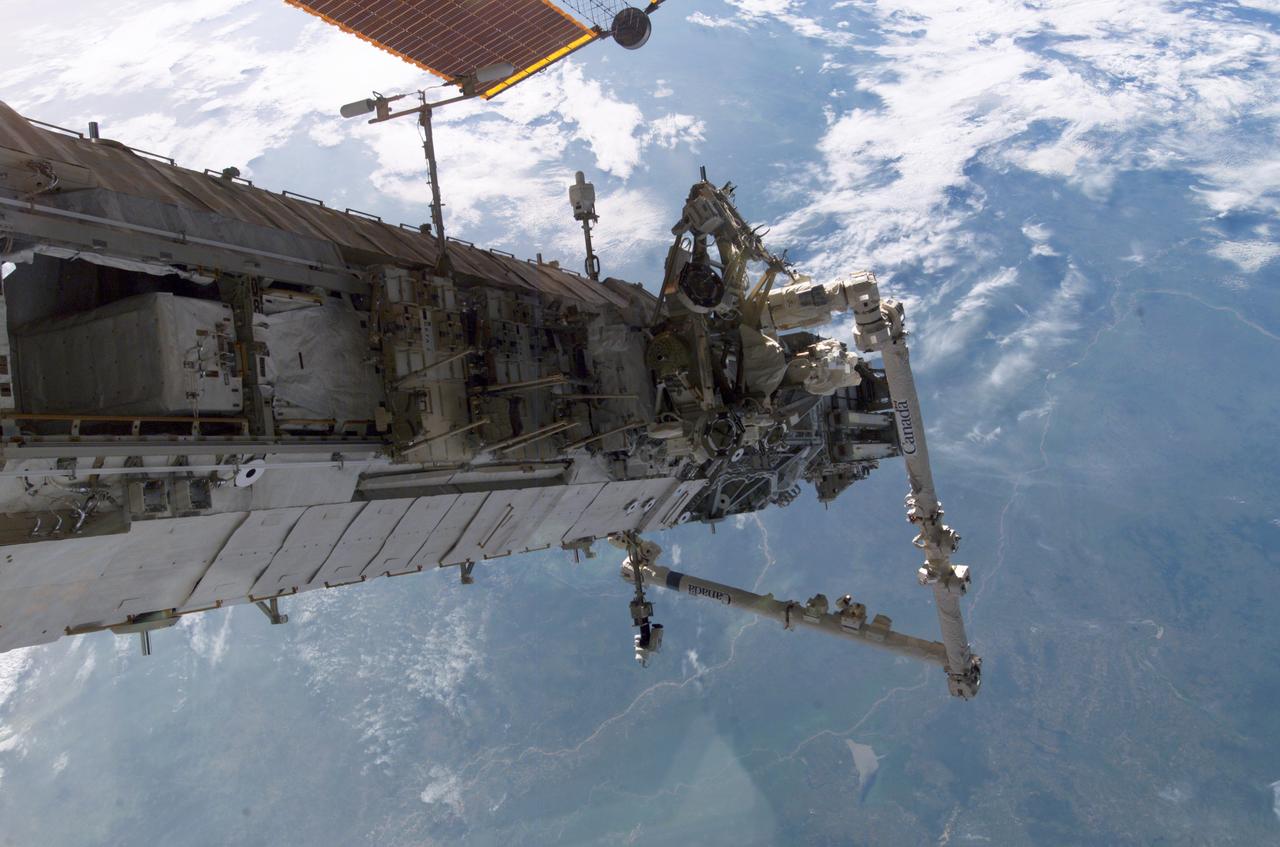
ISS013-E-80783 (12 Sept. 2006) --- Backdropped by a blue and white Earth, the new P3/P4 truss and the Canadarm2 on the International Space Station are featured in this image taken by an Expedition 13 crewmember while Space Shuttle Atlantis (STS-115) was docked with the orbital outpost.
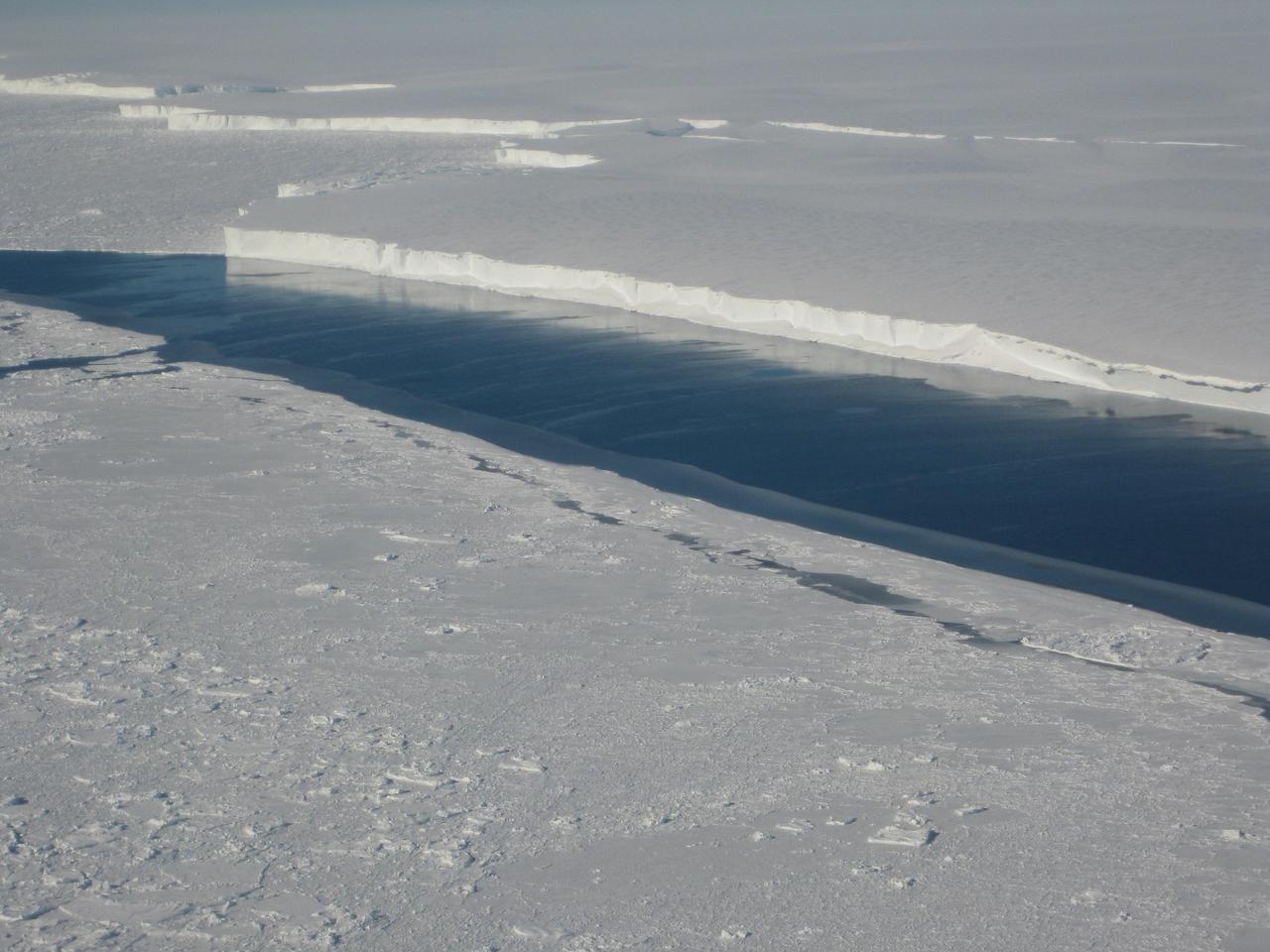
This photo, taken onboard the Chilean Navy P3 aircraft, shows the ice front of Venable Ice Shelf, West Antarctica, in October 2008. It is an example of a small-size ice shelf that is a large melt water producer.
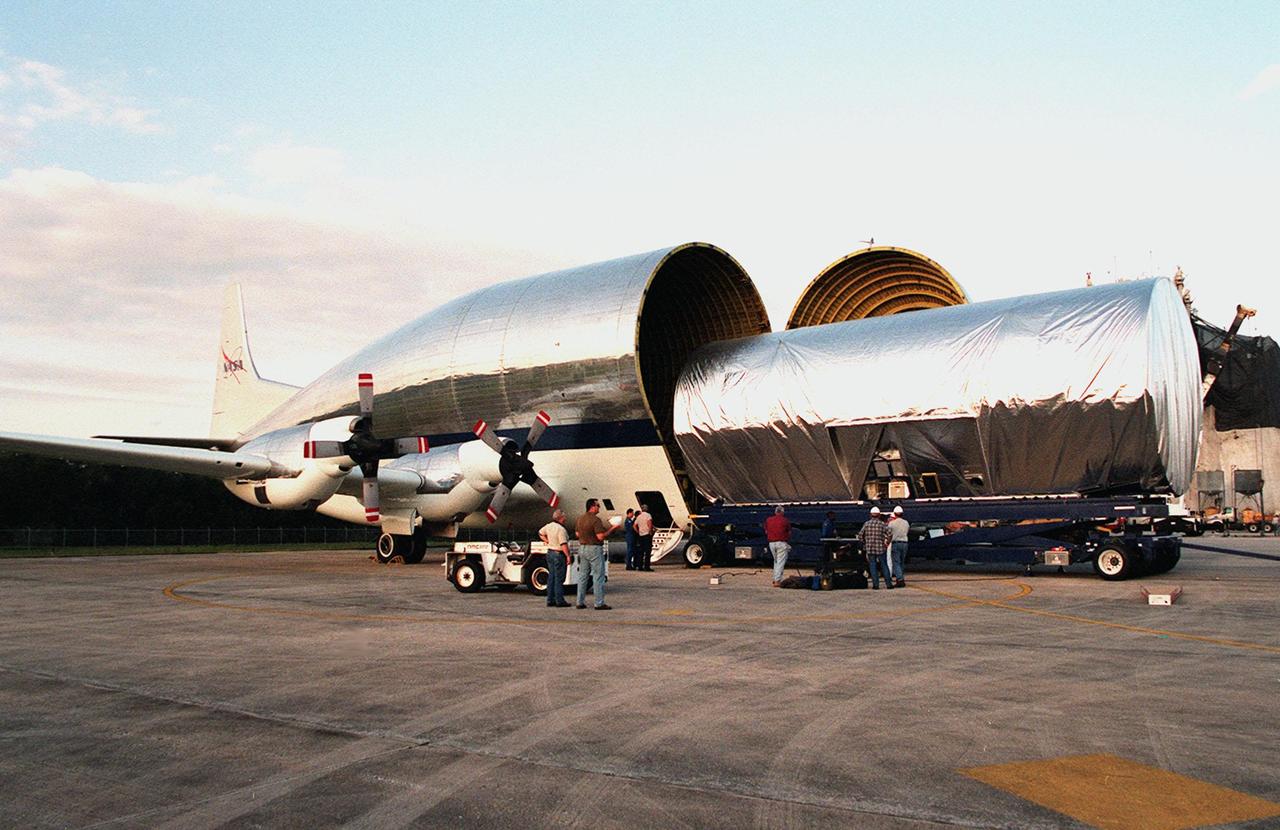
KENNEDY SPACE CENTER, FLA. -- Rolling out of NASA's Super Guppy aircraft aboard a payload transporter is a port-side P3 truss, a component for the International Space Station (ISS). The truss is scheduled to be added to the ISS on mission STS-115 in 2002 aboard Space Shuttle Atlantis. The second port truss segment, P3 will be attached to the first port truss segment (P1). The P3 truss will be taken to the Operations and Checkout Building.
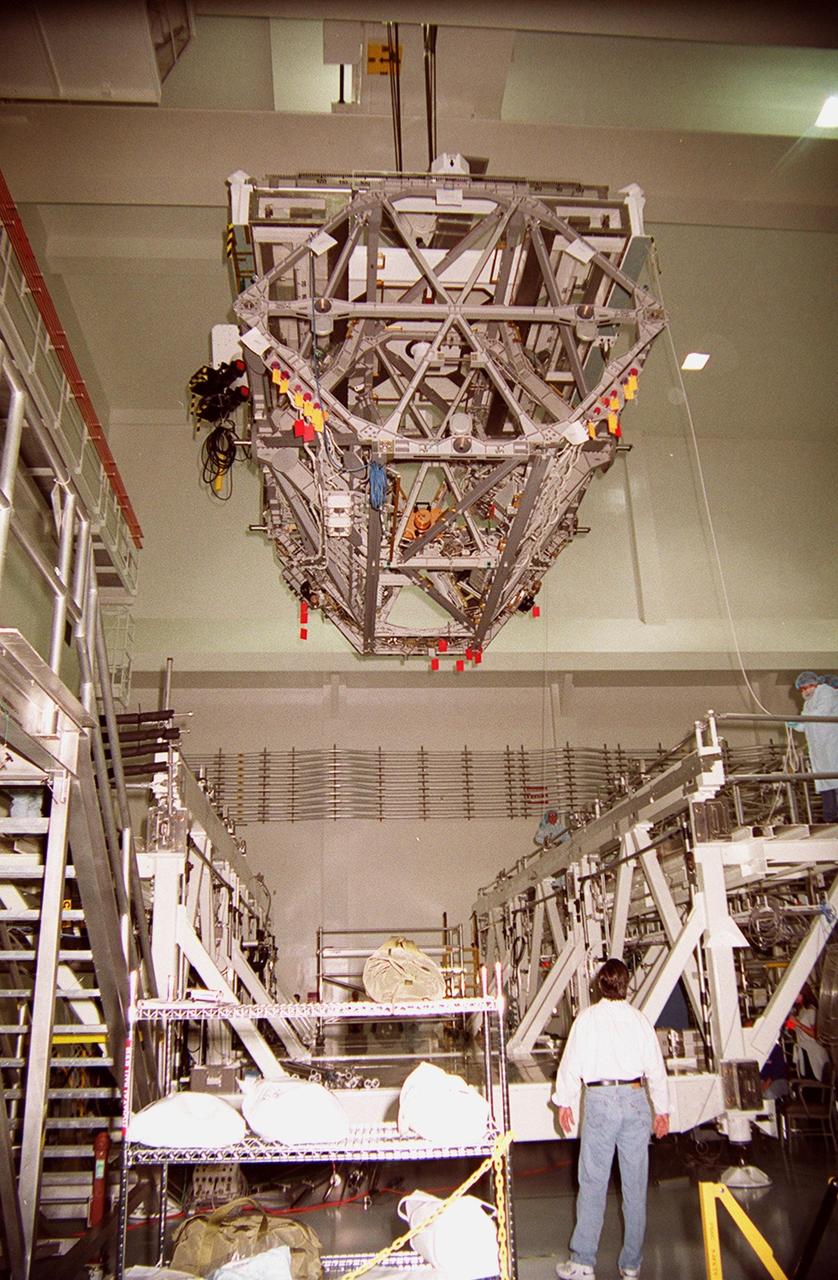
KENNEDY SPACE CENTER, FLA. -- In the Space Station Processing Facility, an overhead crane carrying the P3 Integrated Truss Structure moves into place over a workstand where it will deposit the truss. The port-side P3 truss is scheduled to be added to the International Space Station on mission STS-115 in 2002 aboard Space Shuttle Atlantis. The P3 will be attached to the first port truss segment, P1, being installed in an earlier mission
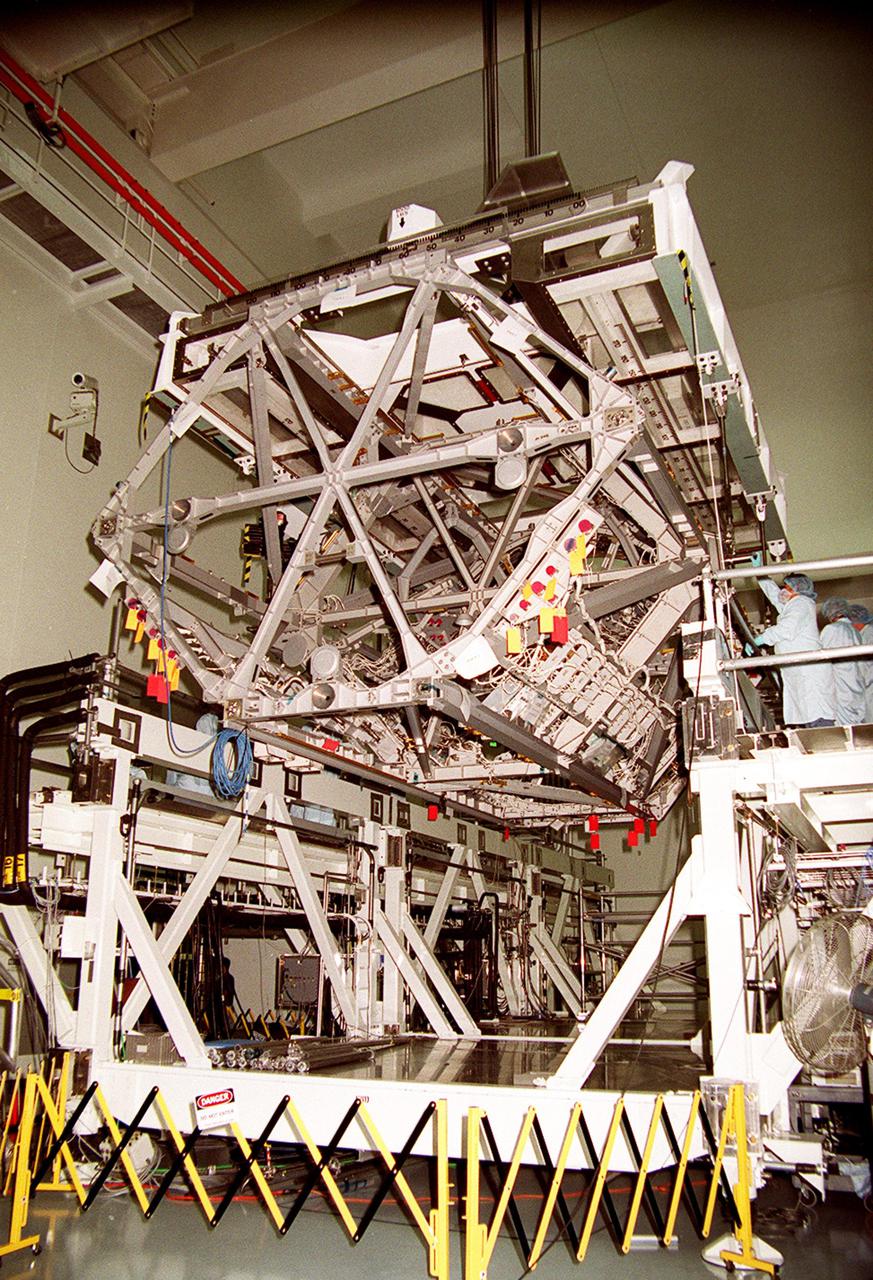
KENNEDY SPACE CENTER, FLA. -- The P3 Integrated Truss Structure is lowered onto a workstand in the Space Station Processing Facility. The port-side P3 truss is scheduled to be added to the International Space Station on mission STS-115 in 2002 aboard Space Shuttle Atlantis. The P3 will be attached to the first port truss segment, P1, being installed in an earlier mission
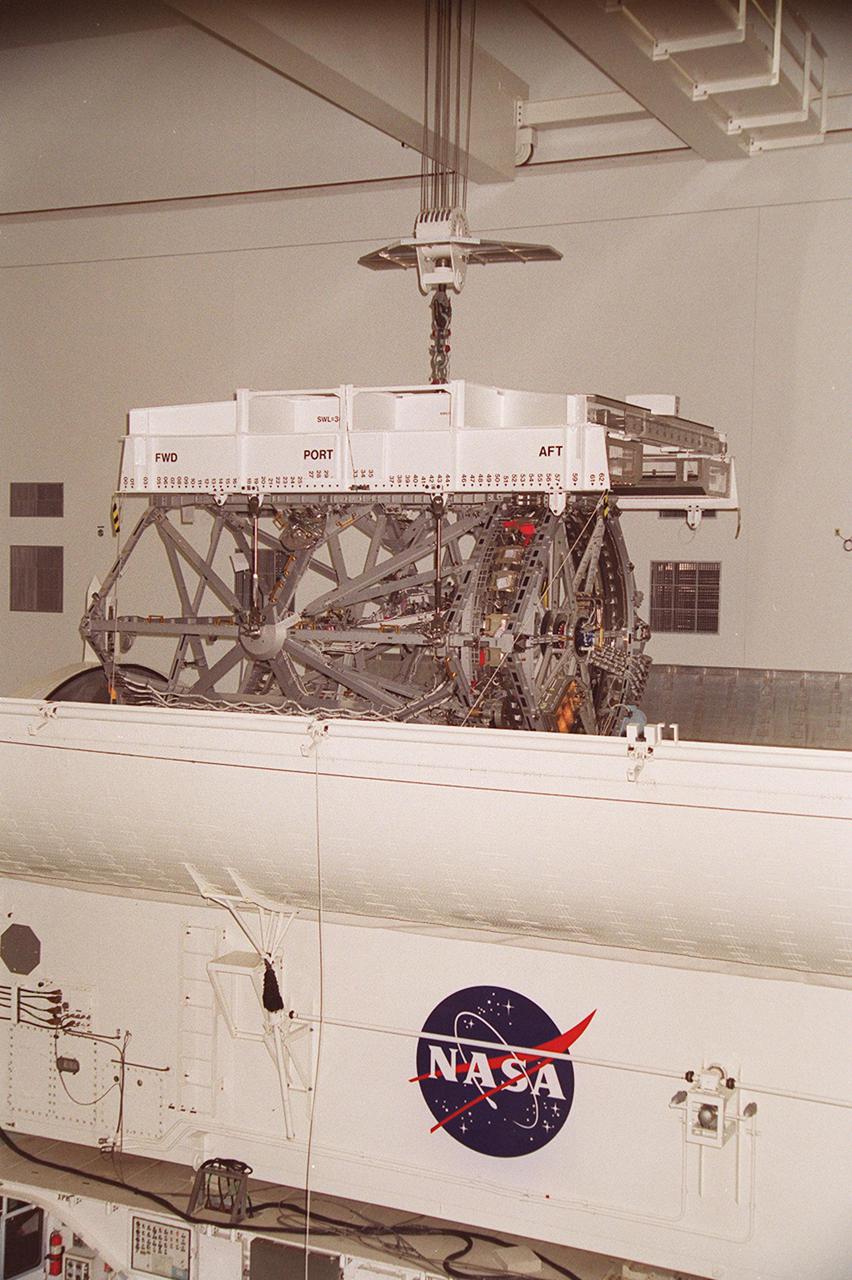
KENNEDY SPACE CENTER, FLA. -- In the Space Station Processing Facility, an overhead crane lifts the P3 Integrated Truss Structure out of the payload canister that transferred it from the Operations and Checkout Building. The port-side P3 truss is scheduled to be added to the International Space Station on mission STS-115 in 2002 aboard Space Shuttle Atlantis. The P3 will be attached to the first port truss segment, P1, being installed in an earlier mission.
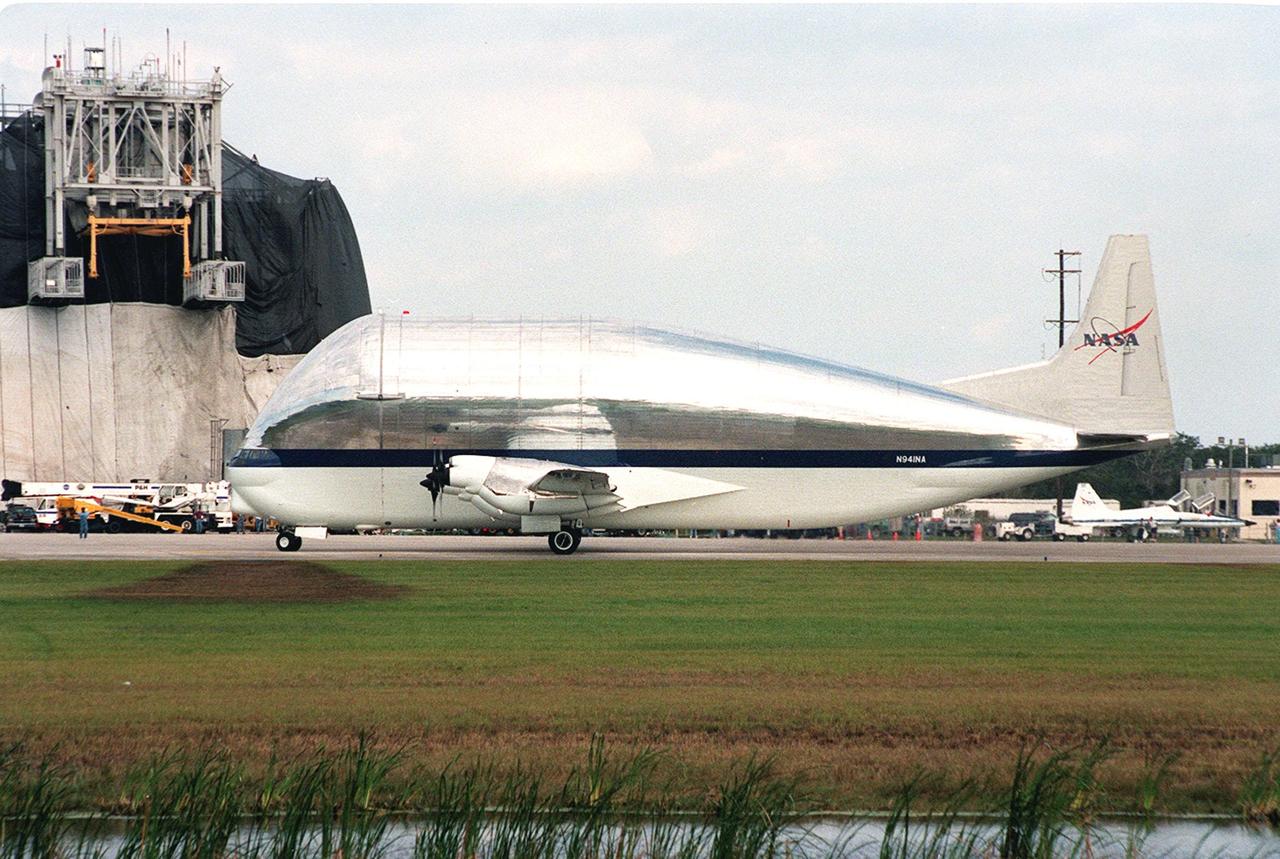
KENNEDY SPACE CENTER, FLA. -- NASA's Super Guppy aircraft arrives at Kennedy Space Center's Shuttle Landing Facility. The plane carries a component for the International Space Station (ISS), the port-side P3 truss. The truss is scheduled to be added to the ISS on mission STS-115 in 2002 aboard Space Shuttle Atlantis. The second port truss segment, P3 will be attached to the first port truss segment (P1). The P3 truss will be taken to the Operations and Checkout Building
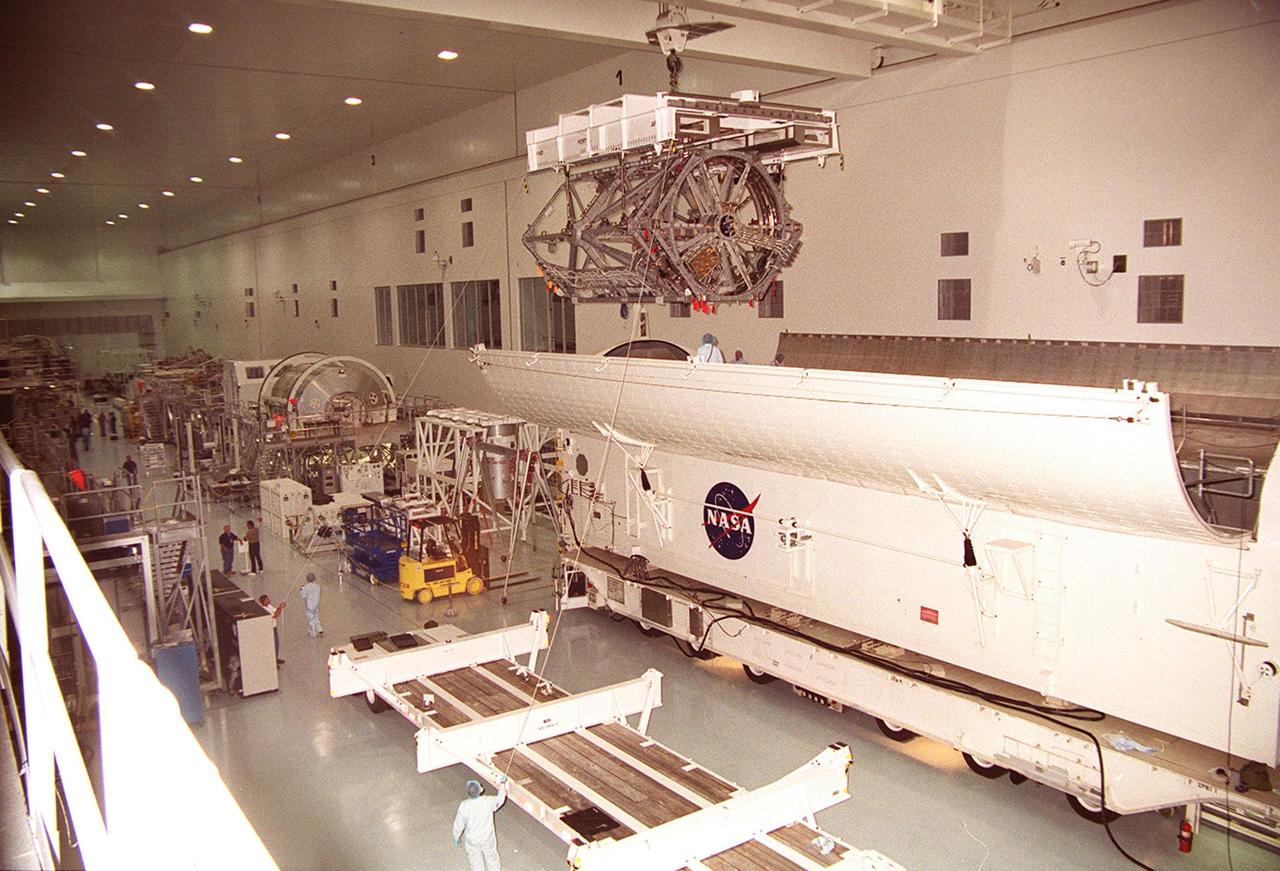
KENNEDY SPACE CENTER, FLA. -- In the Space Station Processing Facility, an overhead crane lifts the P3 Integrated Truss Structure clear of the payload canister that transferred it from the Operations and Checkout Building. The port-side P3 truss is scheduled to be added to the International Space Station on mission STS-115 in 2002 aboard Space Shuttle Atlantis. . The P3 will be attached to the first port truss segment, P1, being installed in an earlier mission
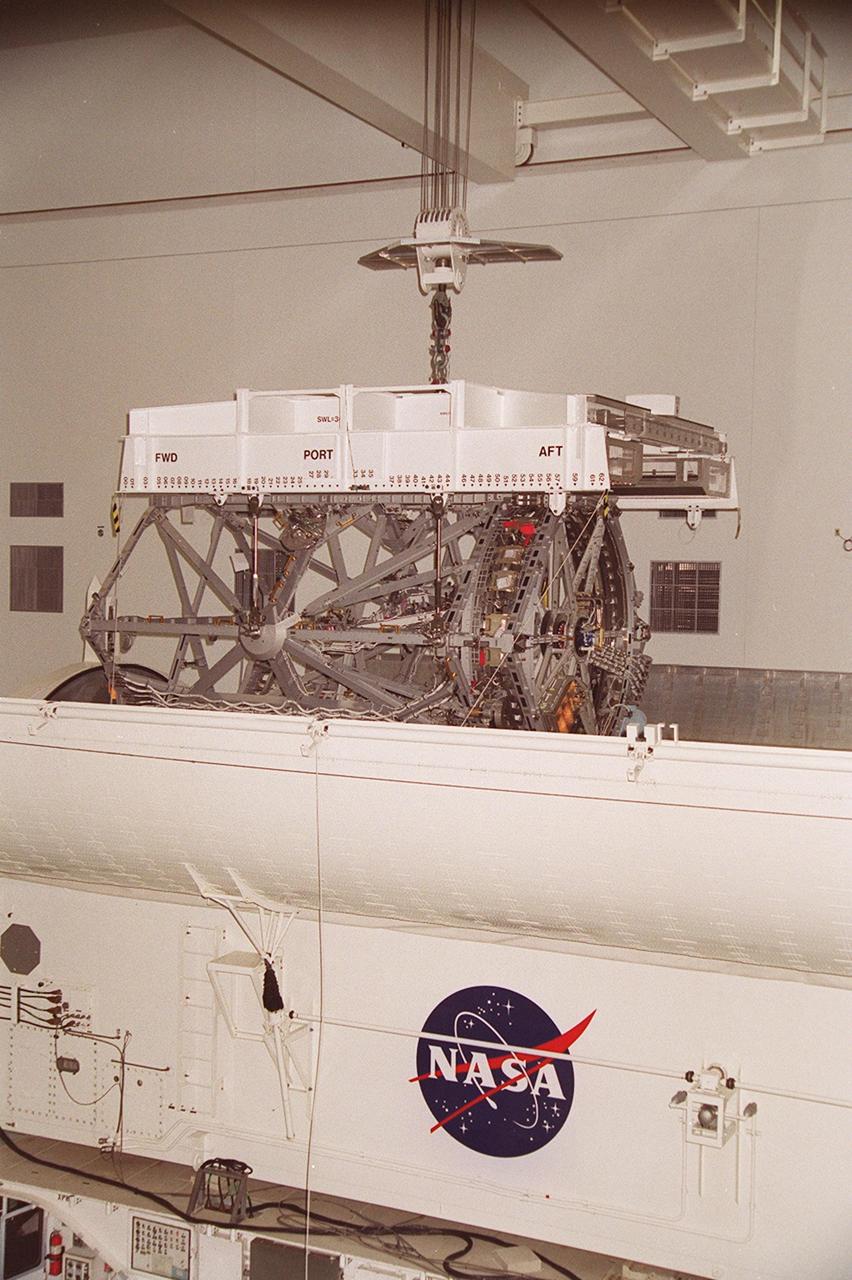
KENNEDY SPACE CENTER, FLA. -- In the Space Station Processing Facility, an overhead crane lifts the P3 Integrated Truss Structure out of the payload canister that transferred it from the Operations and Checkout Building. The port-side P3 truss is scheduled to be added to the International Space Station on mission STS-115 in 2002 aboard Space Shuttle Atlantis. The P3 will be attached to the first port truss segment, P1, being installed in an earlier mission.
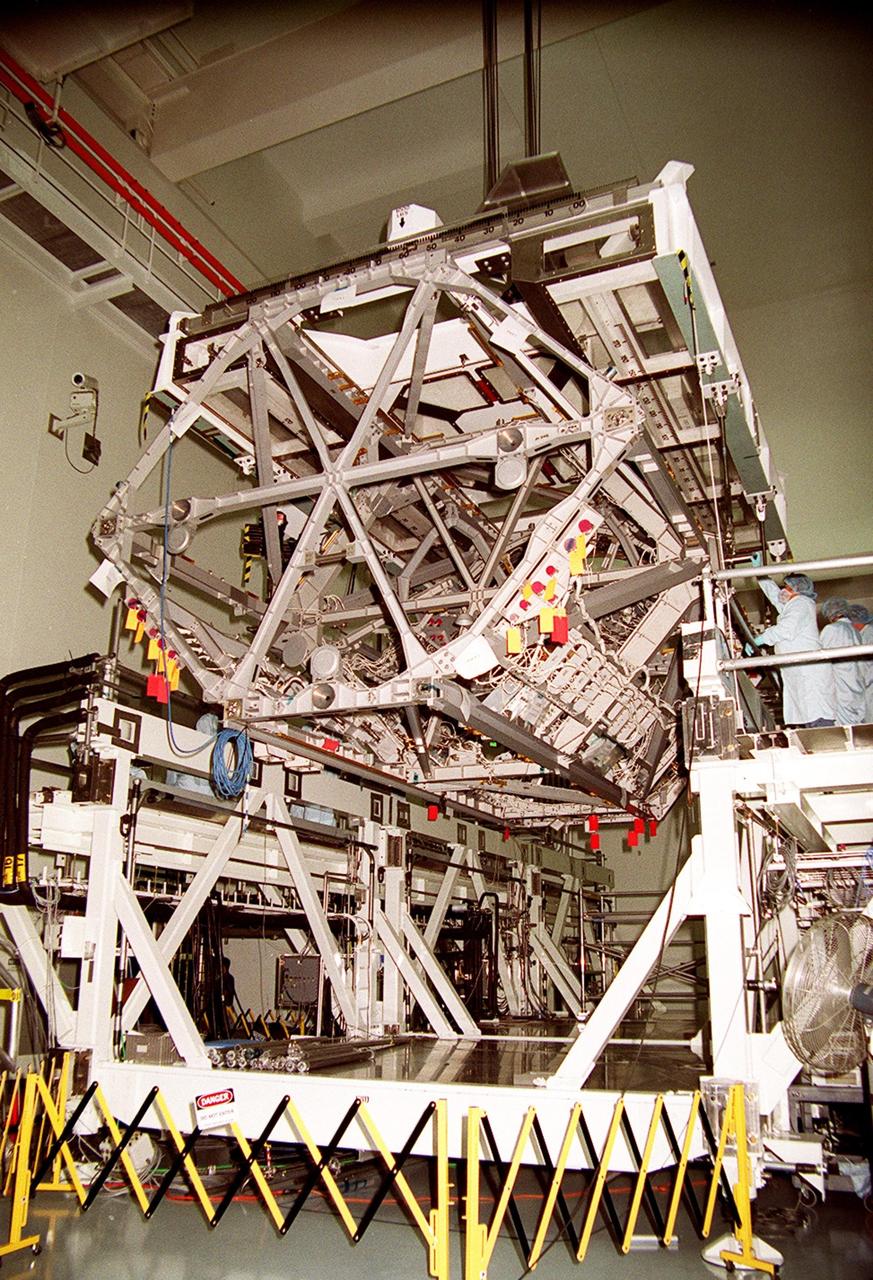
KENNEDY SPACE CENTER, FLA. -- The P3 Integrated Truss Structure is lowered onto a workstand in the Space Station Processing Facility. The port-side P3 truss is scheduled to be added to the International Space Station on mission STS-115 in 2002 aboard Space Shuttle Atlantis. The P3 will be attached to the first port truss segment, P1, being installed in an earlier mission
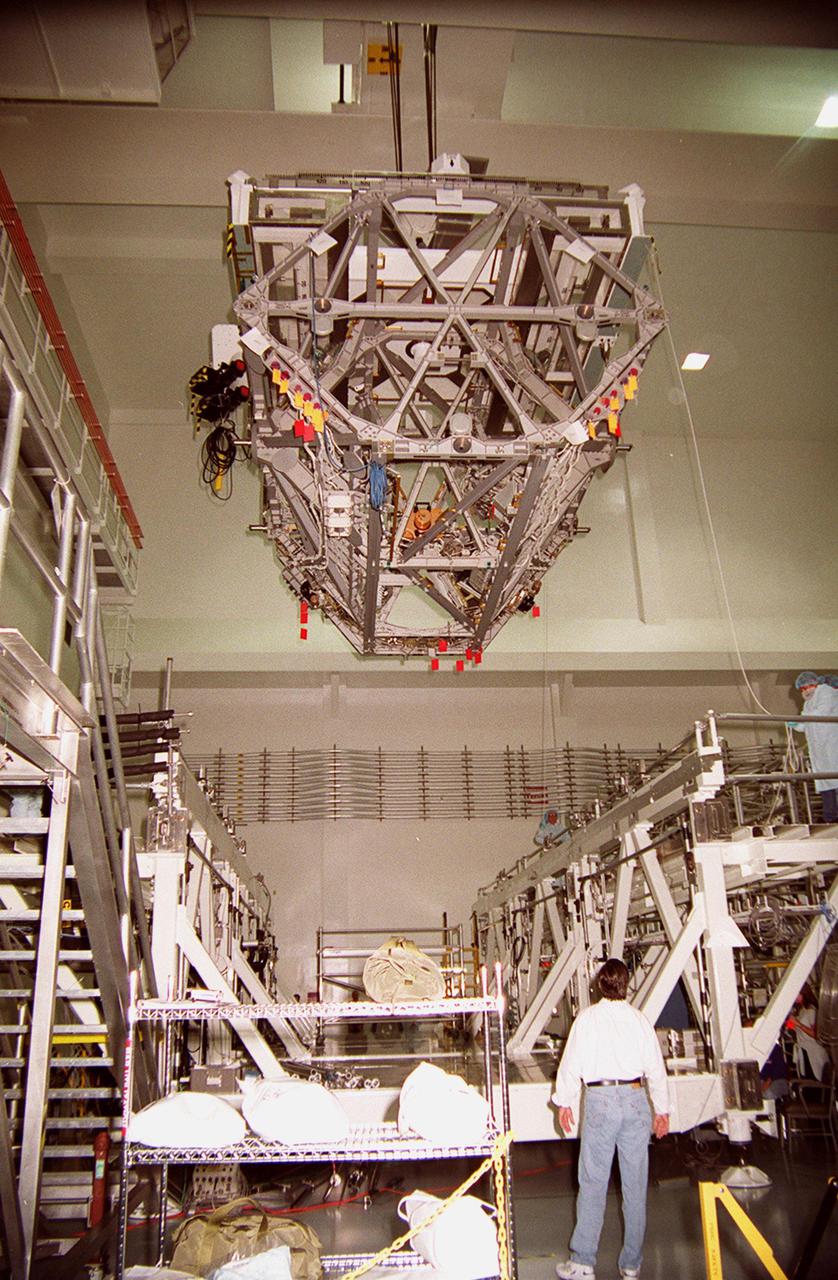
KENNEDY SPACE CENTER, FLA. -- In the Space Station Processing Facility, an overhead crane carrying the P3 Integrated Truss Structure moves into place over a workstand where it will deposit the truss. The port-side P3 truss is scheduled to be added to the International Space Station on mission STS-115 in 2002 aboard Space Shuttle Atlantis. The P3 will be attached to the first port truss segment, P1, being installed in an earlier mission
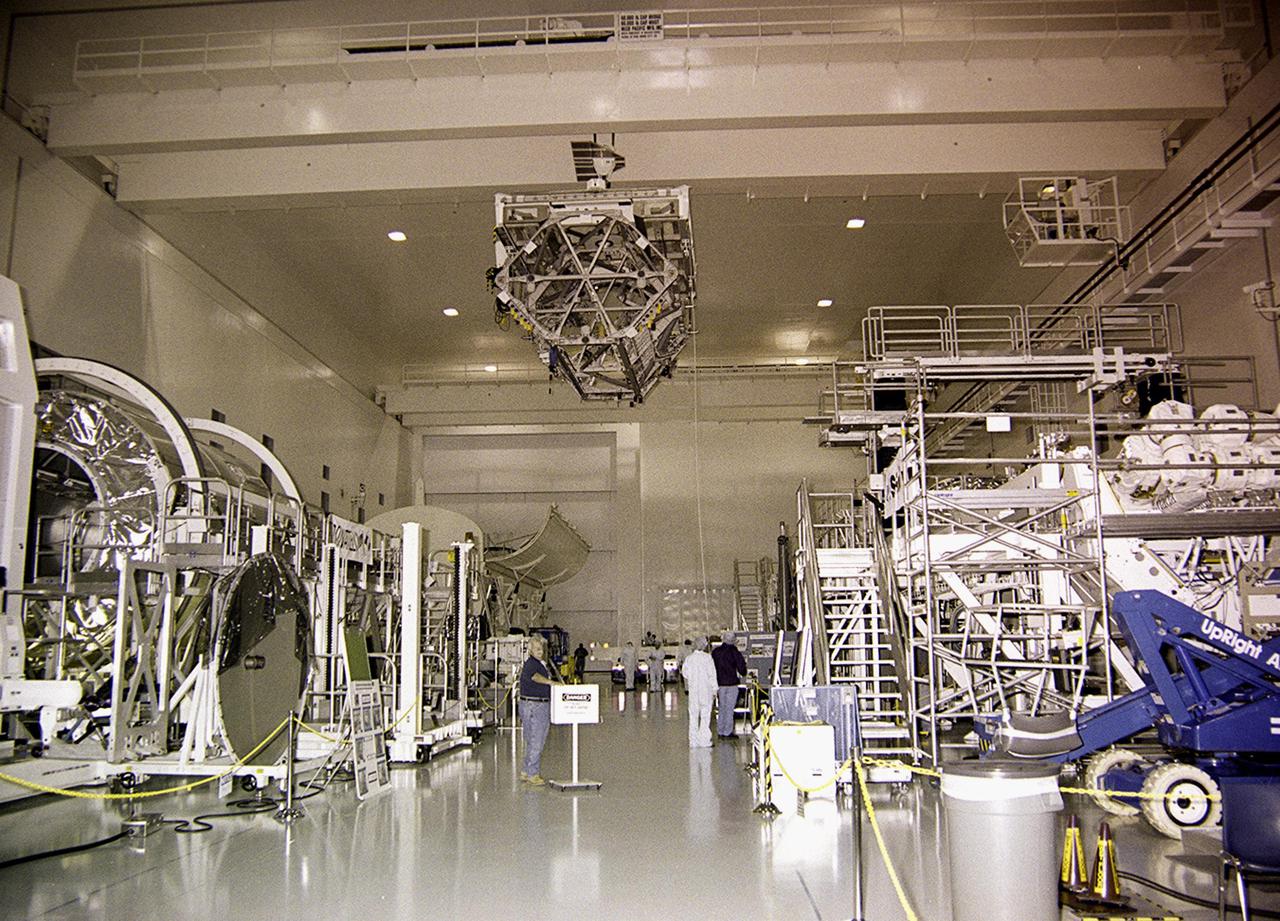
KENNEDY SPACE CENTER, FLA. -- Suspended from an overhead crane in the Space Station Processing Facility, the P3 Integrated Truss Structure glides along the ceiling to a workstand. The port-side P3 truss is scheduled to be added to the International Space Station on mission STS-115 in 2002 aboard Space Shuttle Atlantis. . The P3 will be attached to the first port truss segment, P1, being installed in an earlier mission.
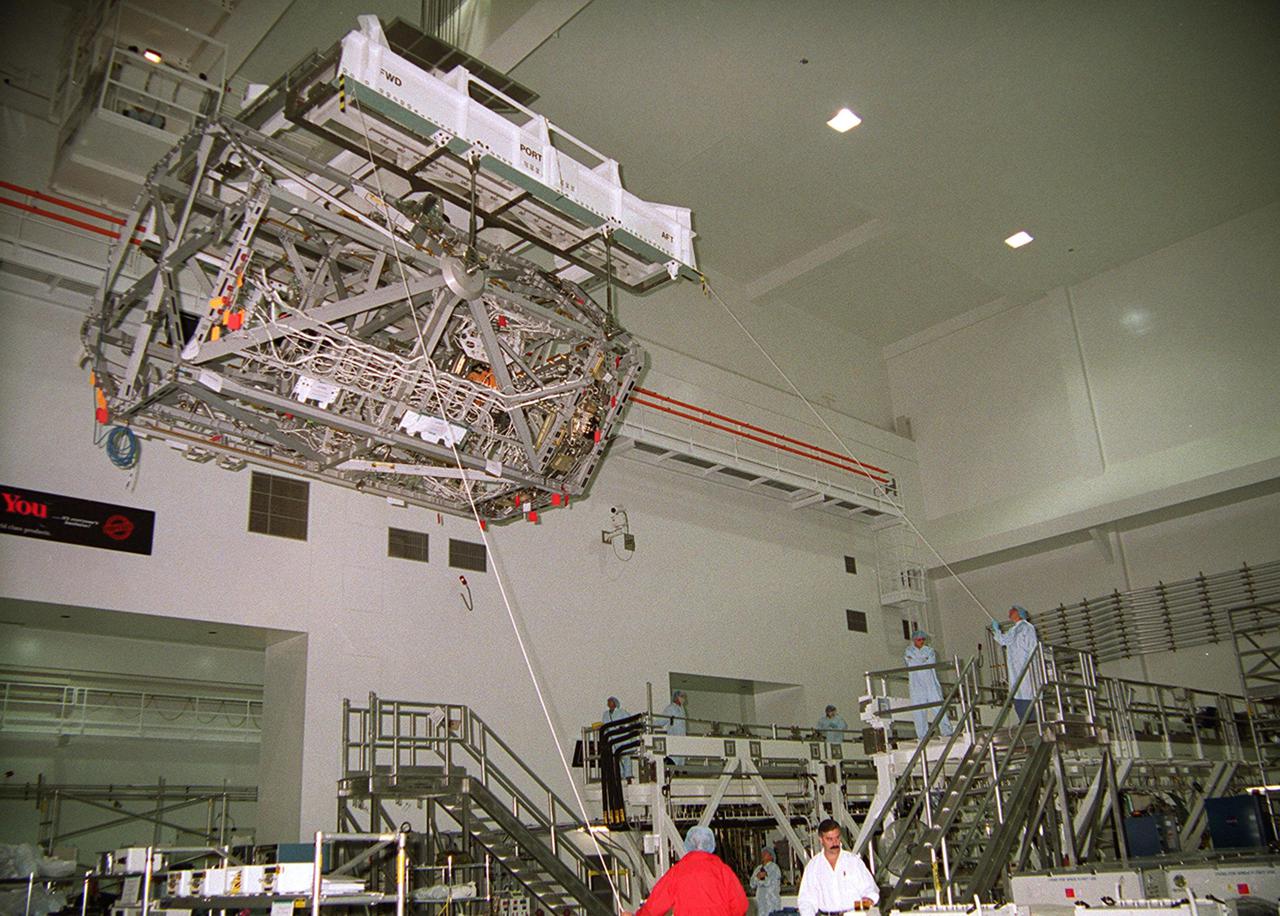
KENNEDY SPACE CENTER, FLA. -- Suspended from an overhead crane in the Space Station Processing Facility, the P3 Integrated Truss Structure glides along the ceiling to a workstand, at right. The port-side P3 truss is scheduled to be added to the International Space Station on mission STS-115 in 2002 aboard Space Shuttle Atlantis. . The P3 will be attached to the first port truss segment, P1, being installed in an earlier mission
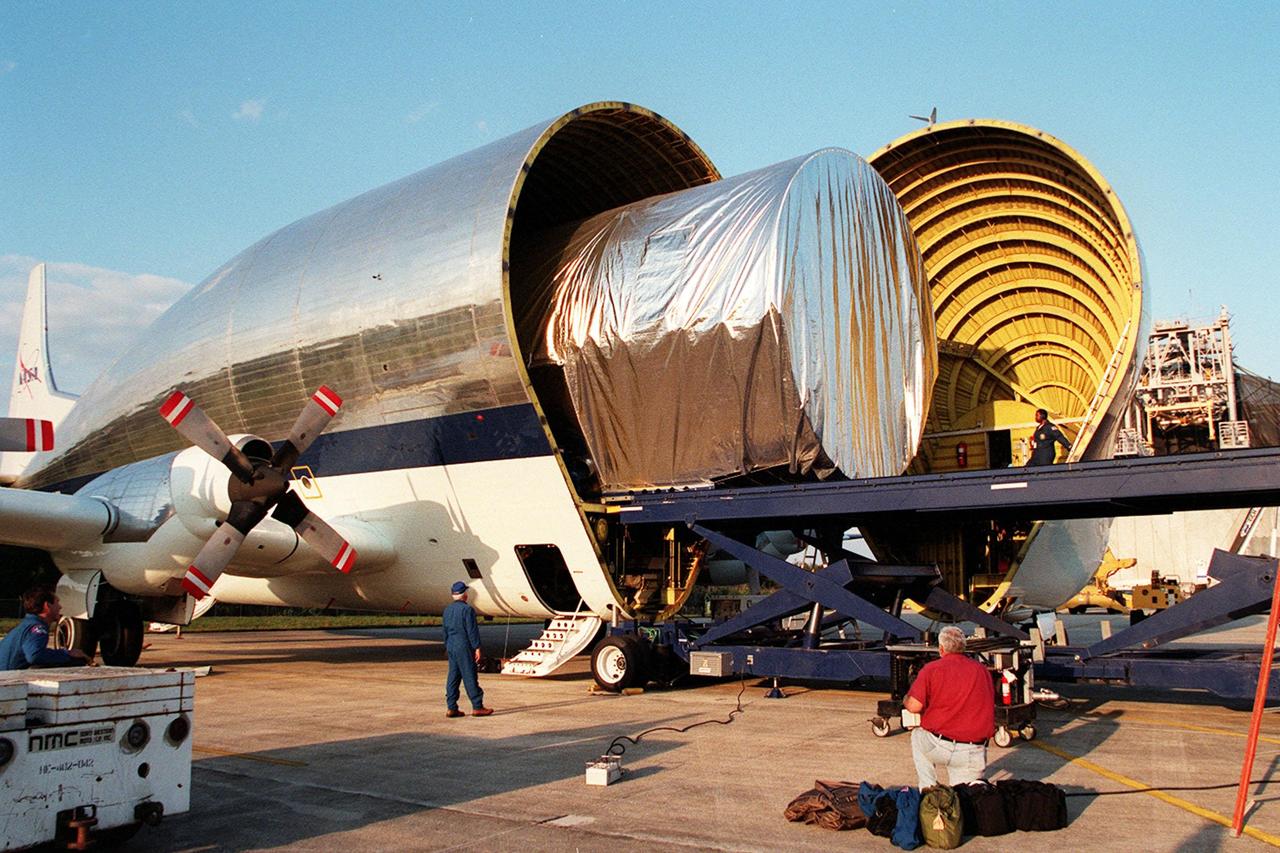
KENNEDY SPACE CENTER, FLA. -- At Kennedy Space Center's Shuttle Landing Facility, the cargo of NASA's Super Guppy aircraft begins rolling out onto a payload transporter. The cargo is a P3 port-side truss, a segment of the International Space Station (ISS). The truss is scheduled to be added to the ISS on mission STS-115 in 2002 aboard Space Shuttle Atlantis. The second port truss segment, P3 will be attached to the first port truss segment (P1). The P3 truss will be taken to the Operations and Checkout Building.
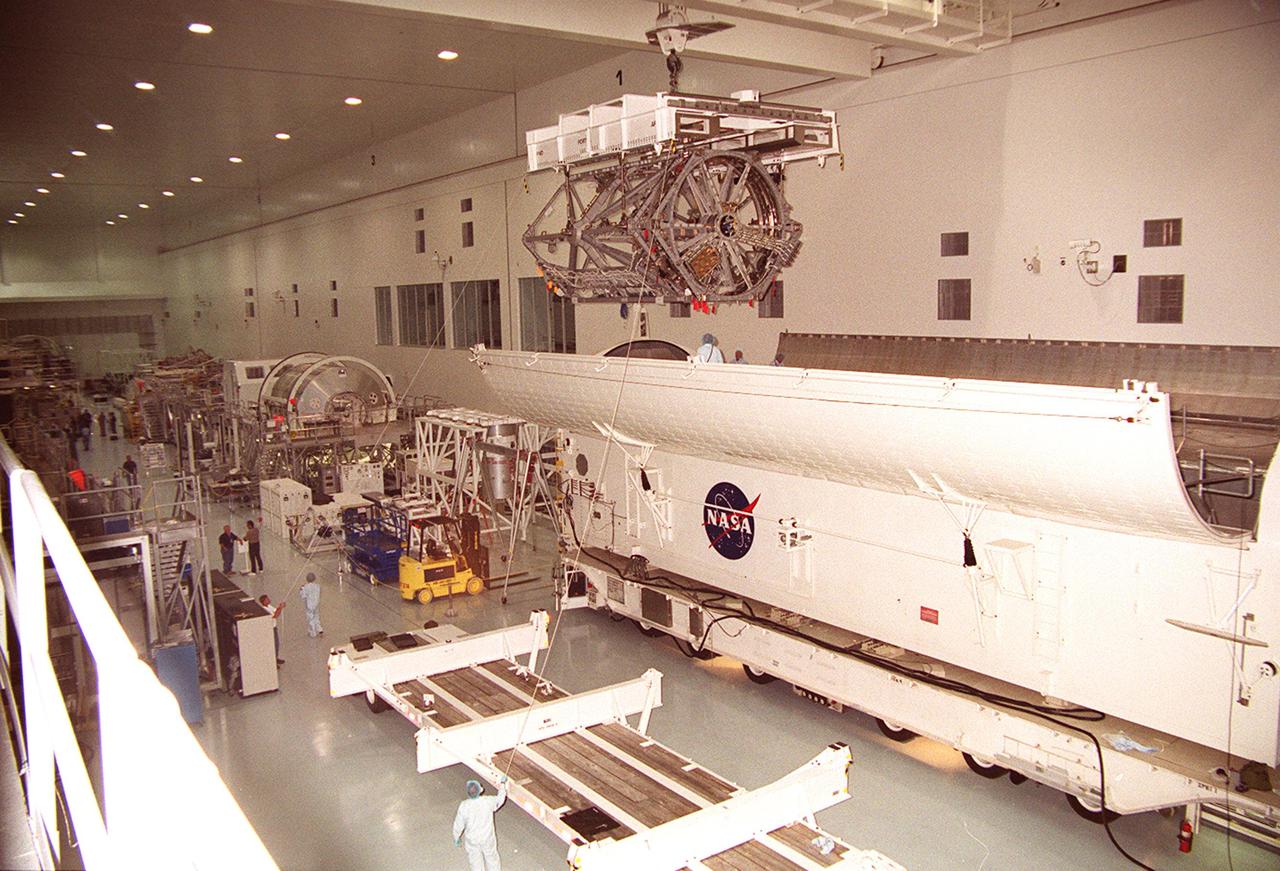
KENNEDY SPACE CENTER, FLA. -- In the Space Station Processing Facility, an overhead crane lifts the P3 Integrated Truss Structure clear of the payload canister that transferred it from the Operations and Checkout Building. The port-side P3 truss is scheduled to be added to the International Space Station on mission STS-115 in 2002 aboard Space Shuttle Atlantis. . The P3 will be attached to the first port truss segment, P1, being installed in an earlier mission
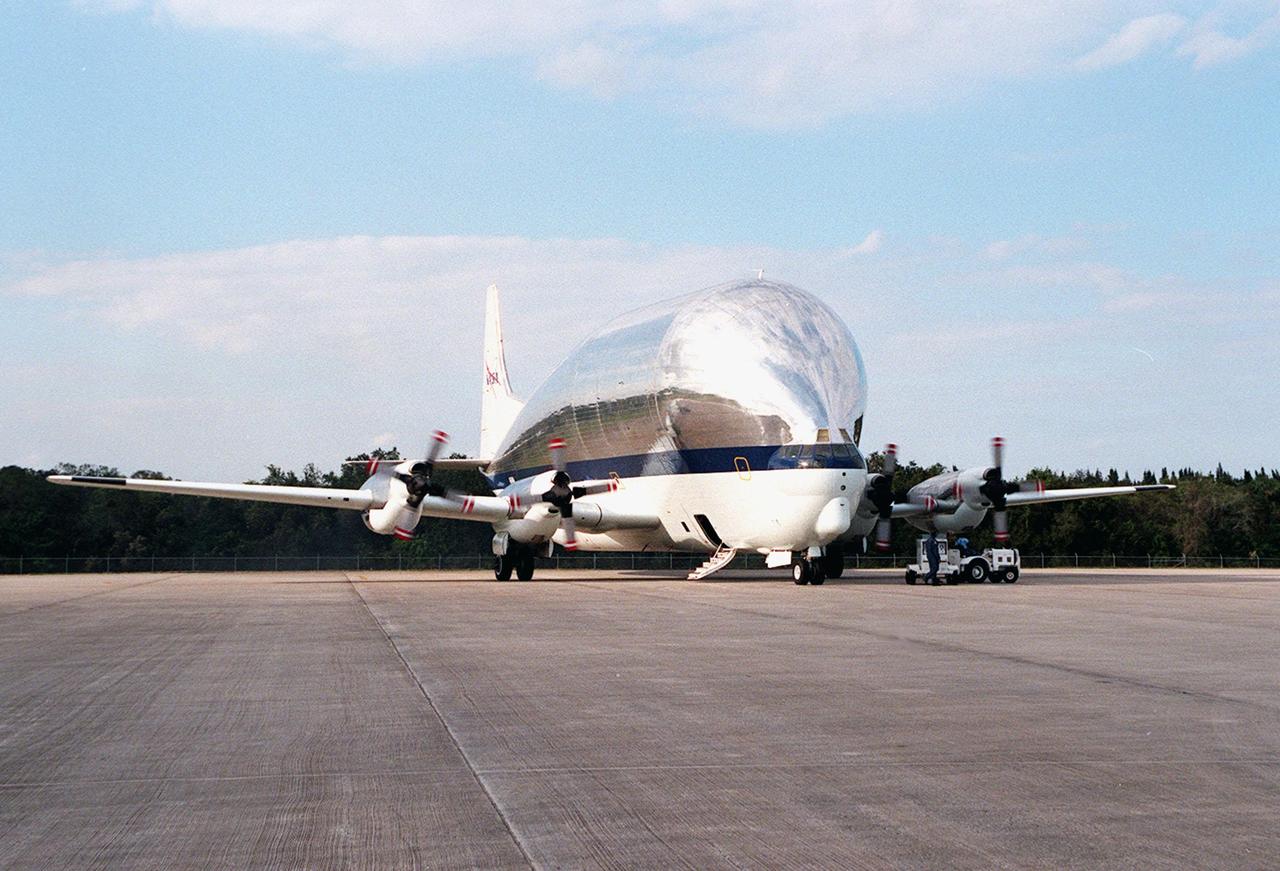
KENNEDY SPACE CENTER, FLA. -- NASA's Super Guppy aircraft arrives at Kennedy Space Center's Shuttle Landing Facility. The plane carries a component for the International Space Station (ISS), the port-side P3 truss. The truss is scheduled to be added to the ISS on mission STS-115 in 2002 aboard Space Shuttle Atlantis. The second port truss segment, P3 will be attached to the first port truss segment (P1). The P3 truss will be taken to the Operations and Checkout Building.
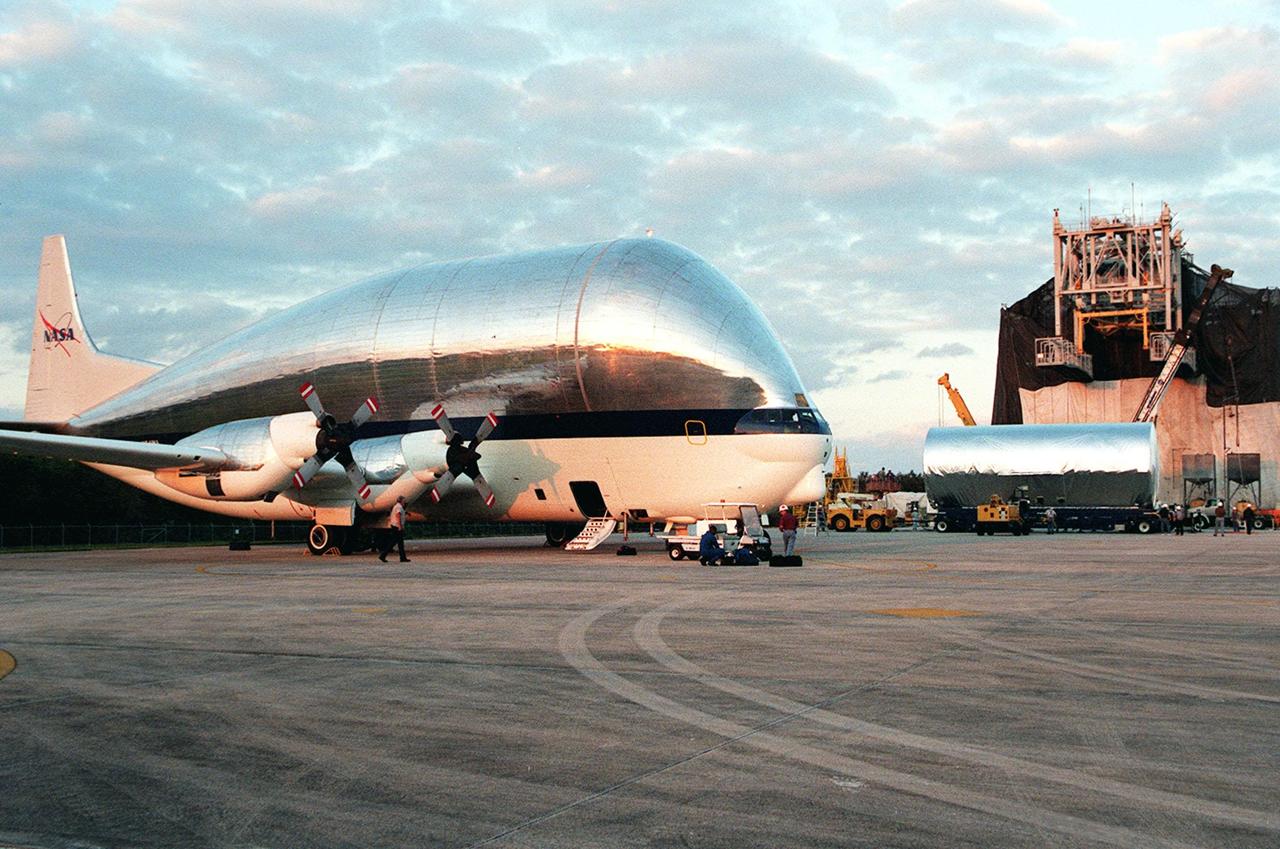
With its cargo off-loaded (background), the nose cone of the Super Guppy aircraft is closed. The cargo is a P3 port-side truss, a segment of the International Space Station (ISS). The truss is scheduled to be added to the ISS on mission STS-115 in 2002 aboard Space Shuttle Atlantis. The second port truss segment, P3 will be attached to the first port truss segment (P1). The P3 truss will be taken to the Operations and Checkout Building.
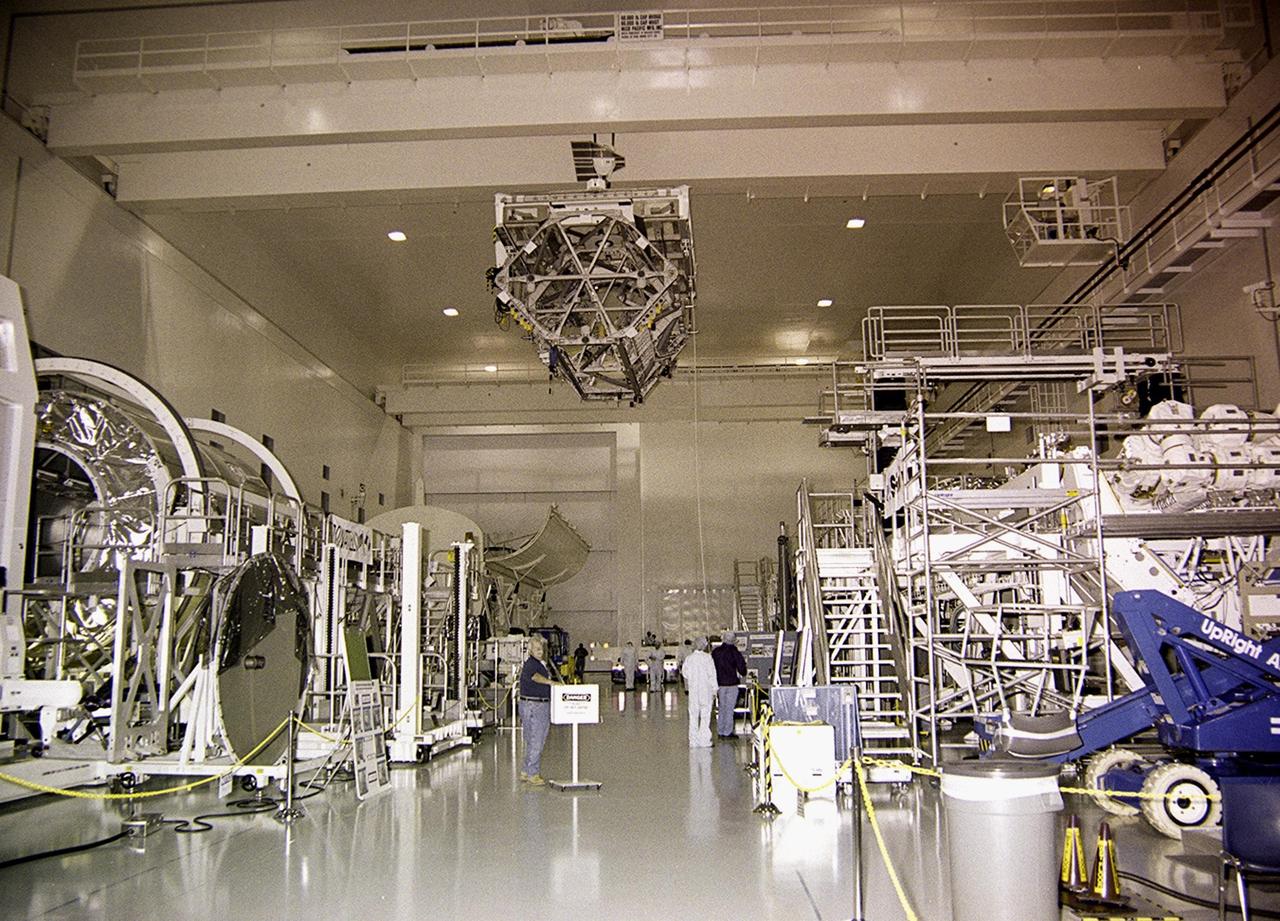
KENNEDY SPACE CENTER, FLA. -- Suspended from an overhead crane in the Space Station Processing Facility, the P3 Integrated Truss Structure glides along the ceiling to a workstand. The port-side P3 truss is scheduled to be added to the International Space Station on mission STS-115 in 2002 aboard Space Shuttle Atlantis. . The P3 will be attached to the first port truss segment, P1, being installed in an earlier mission.
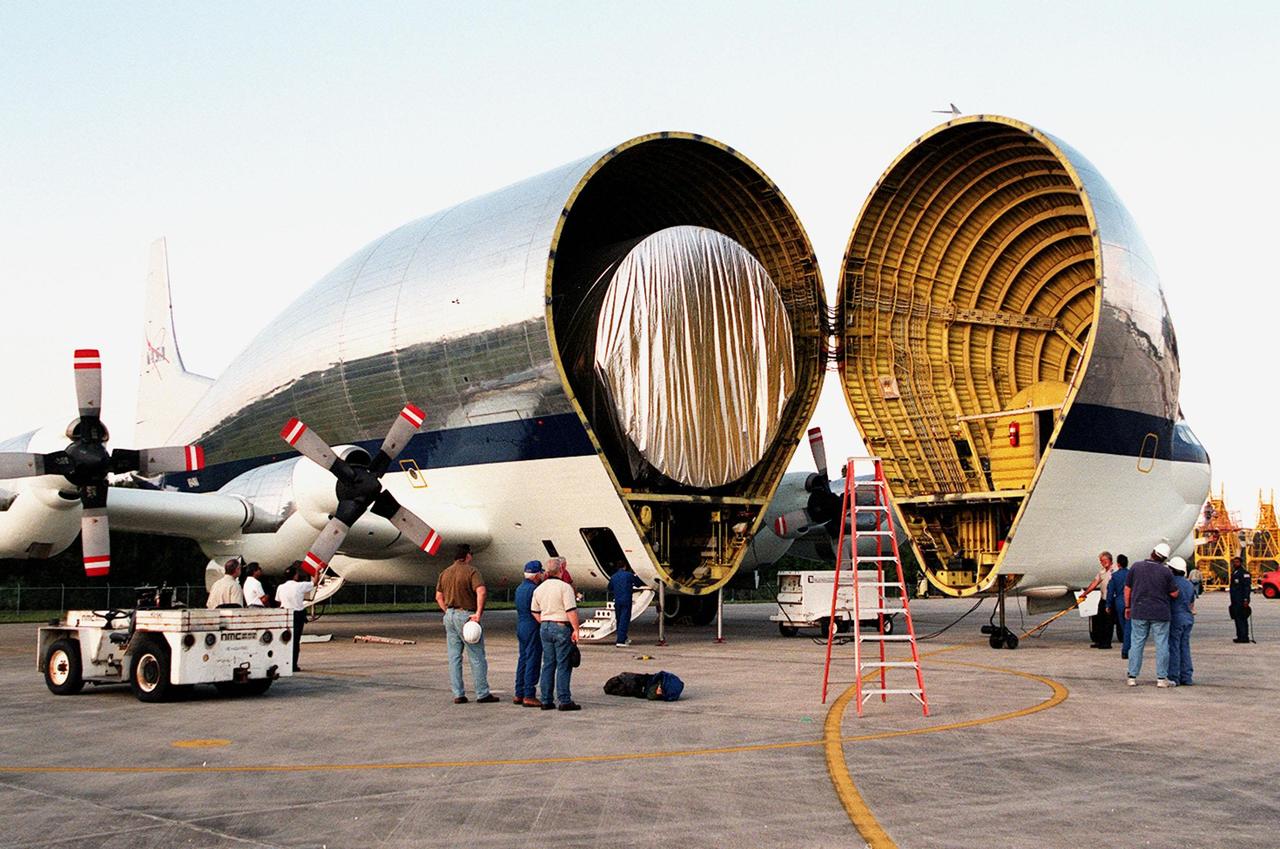
KENNEDY SPACE CENTER, FLA. -- At Kennedy Space Center's Shuttle Landing Facility, workers watch as the nose of NASA's Super Guppy aircraft opens to reveal its cargo, a component for the International Space Station (ISS), the port-side P3 truss. The truss is scheduled to be added to the ISS on mission STS-115 in 2002 aboard Space Shuttle Atlantis. The second port truss segment, P3 will be attached to the first port truss segment (P1). The P3 truss will be taken to the Operations and Checkout Building.
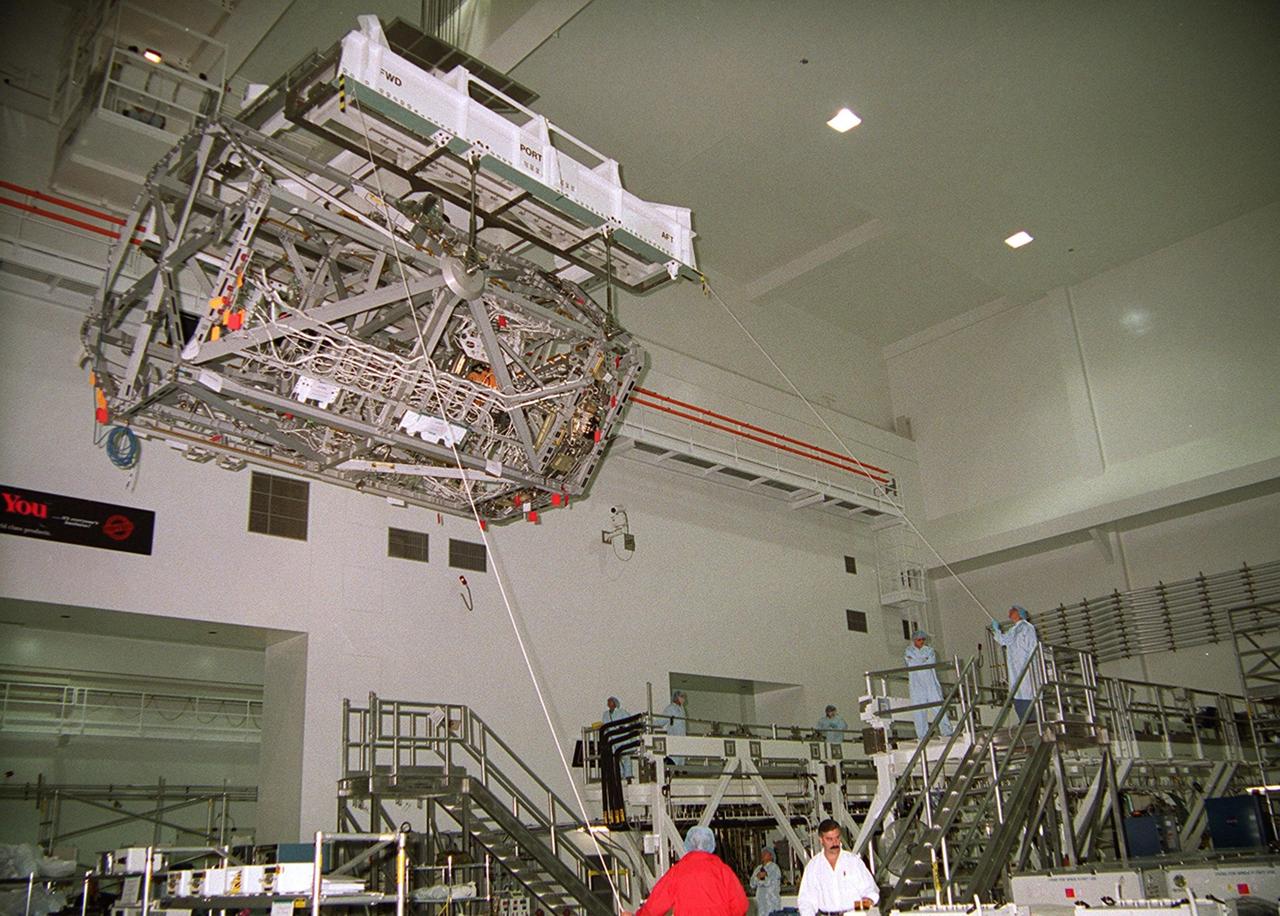
KENNEDY SPACE CENTER, FLA. -- Suspended from an overhead crane in the Space Station Processing Facility, the P3 Integrated Truss Structure glides along the ceiling to a workstand, at right. The port-side P3 truss is scheduled to be added to the International Space Station on mission STS-115 in 2002 aboard Space Shuttle Atlantis. . The P3 will be attached to the first port truss segment, P1, being installed in an earlier mission
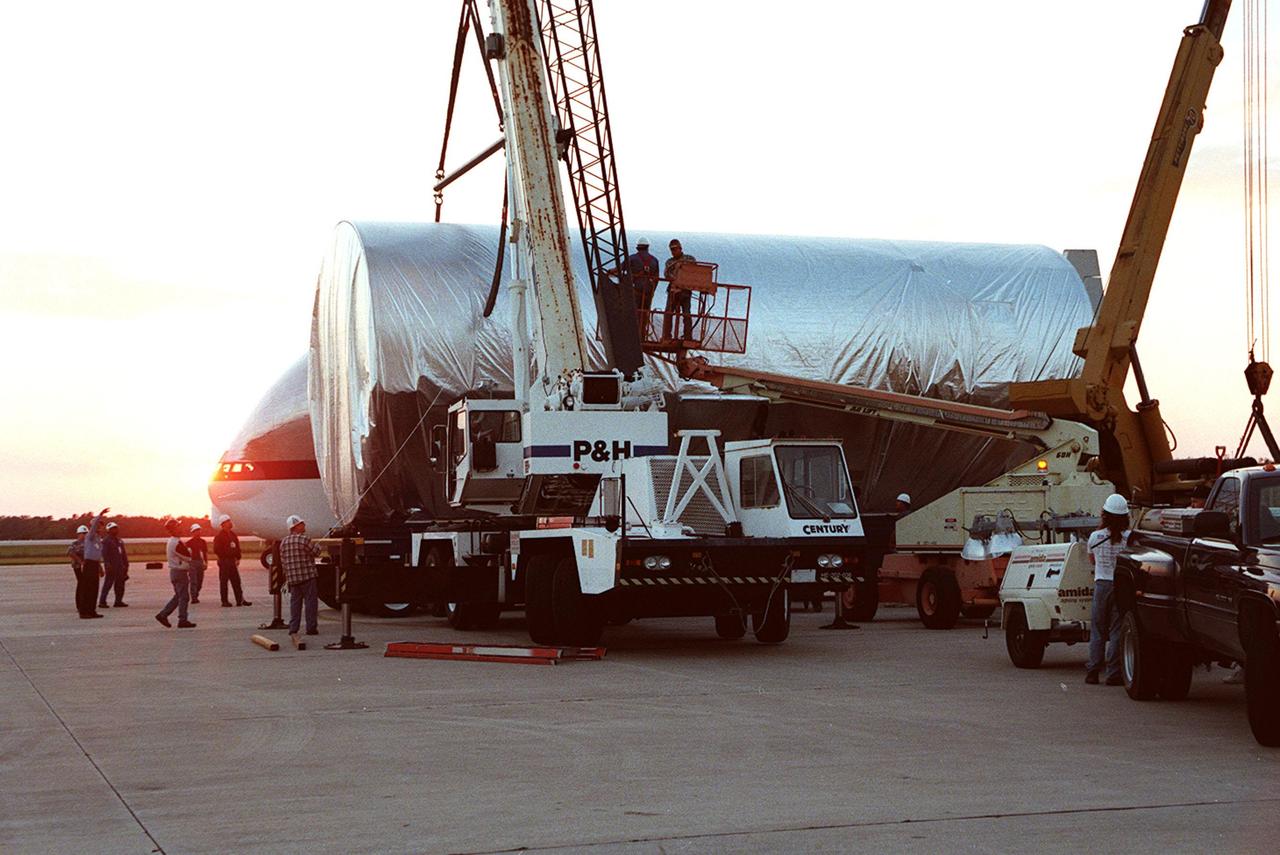
KENNEDY SPACE CENTER, FLA. -- Workers secure the P3 truss on the transporter for the trip to the Operations and Checkout Building. The second port-side truss is a segment of the International Space Station (ISS), scheduled to be added to the ISS on mission STS-115 in 2002 aboard Space Shuttle Atlantis. P3 will be attached to the first port truss segment (P1).
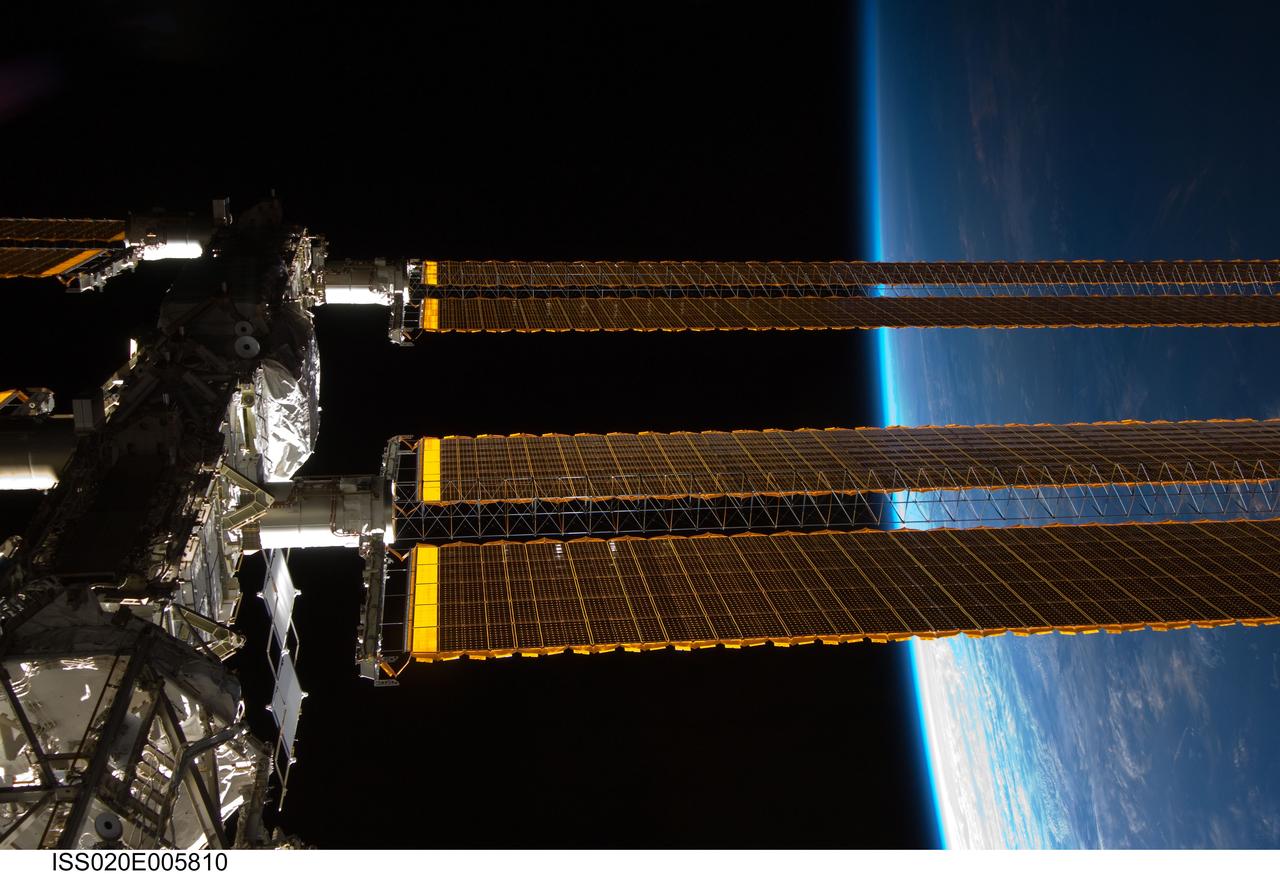
ISS020-E-005810 (31 May 2009) --- Backdropped by Earth's horizon and the blackness of space, a portion of the International Space Station is featured in this image photographed by an Expedition 20 crew member aboard the station.
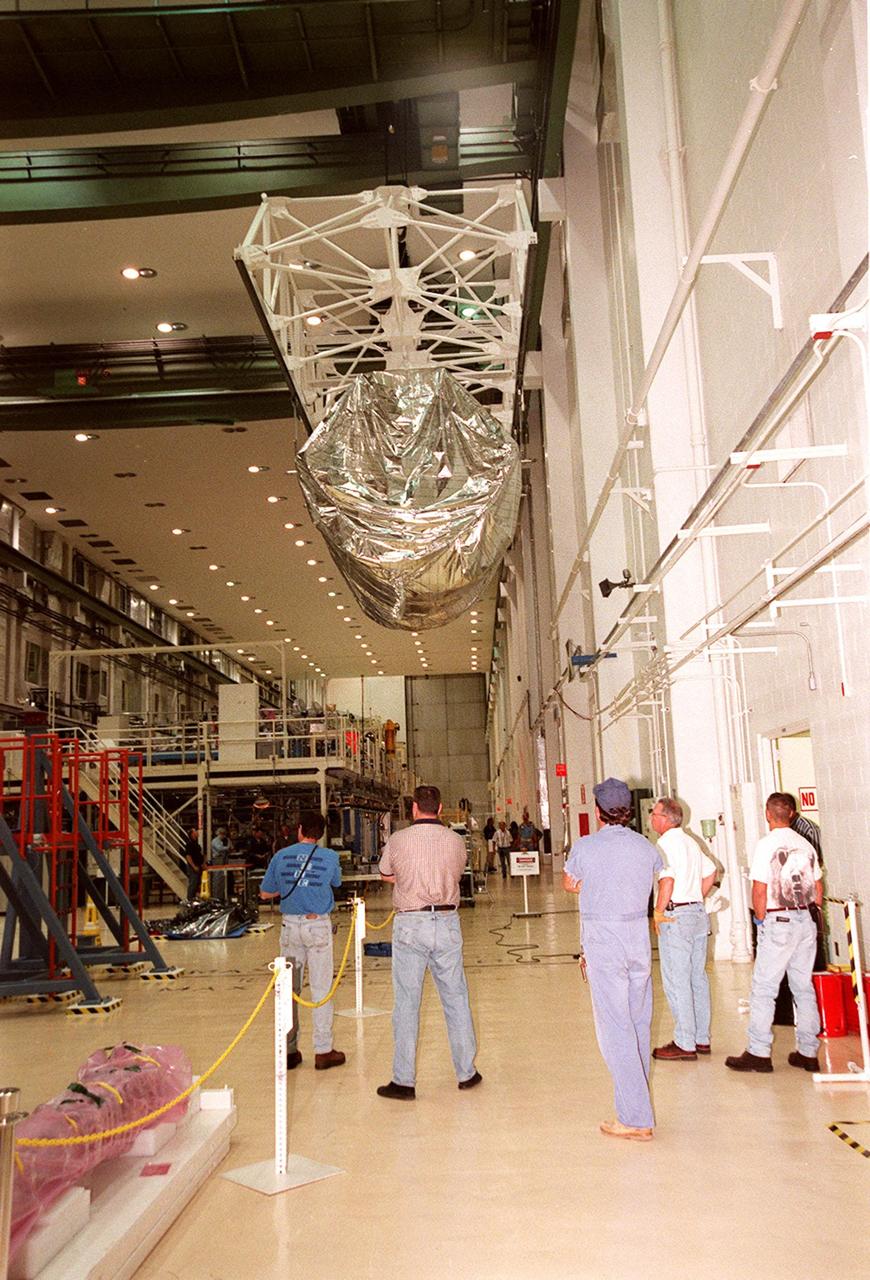
KENNEDY SPACE CENTER, FLA. -- Inside the Operations and Checkout Building, overhead cranes move a segment of the International Space Station (ISS), the port-side P3 truss, toward a workstand. The truss is scheduled to be added to the ISS on mission STS-115 in 2002 aboard Space Shuttle Atlantis. The second port truss segment, P3 will be attached to the first port truss segment (P1).
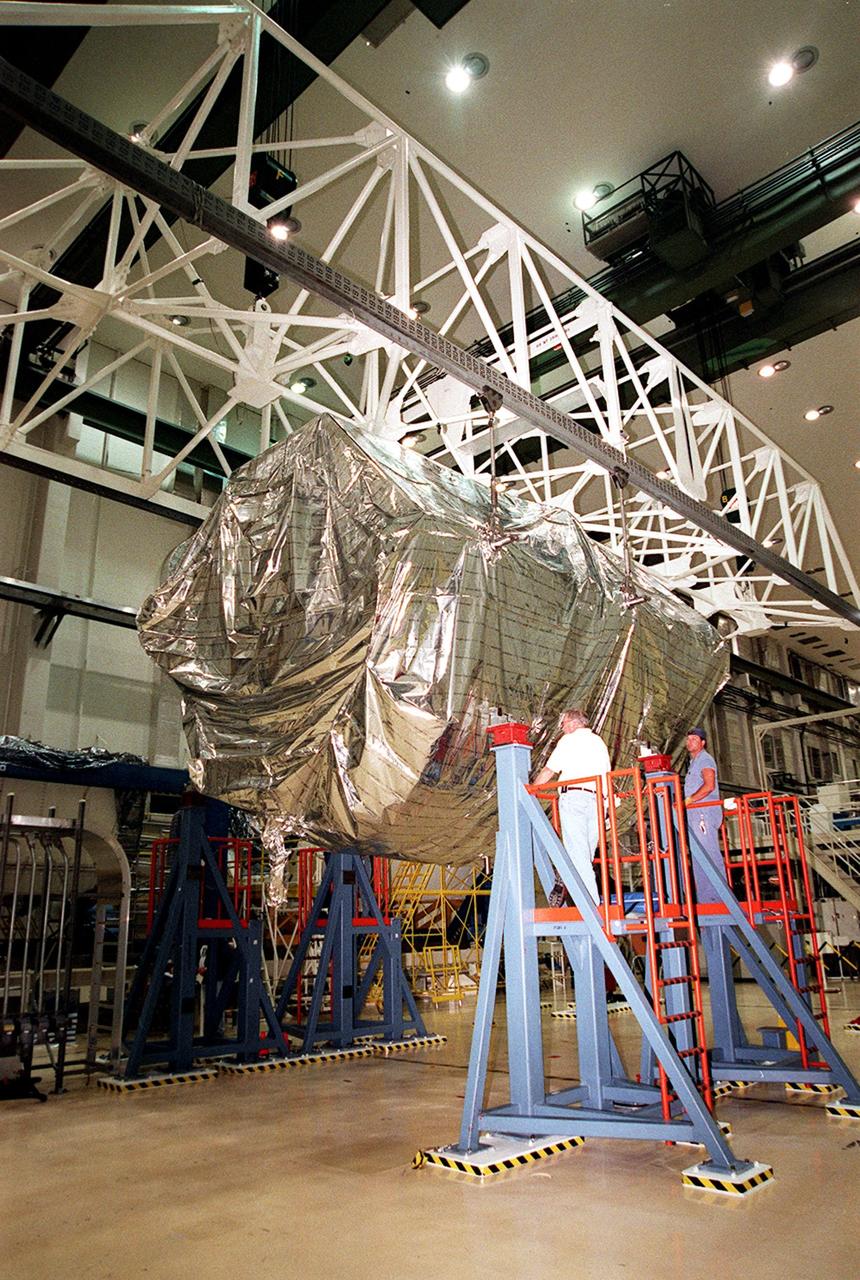
KENNEDY SPACE CENTER, FLA. -- Workers in the Operations and Checkout Building oversee the movement of a segment of the International Space Station (ISS), the port-side P3 truss, onto a workstand. The truss is scheduled to be added to the ISS on mission STS-115 in 2002 aboard Space Shuttle Atlantis. The second port truss segment, P3 will be attached to the first port truss segment (P1).
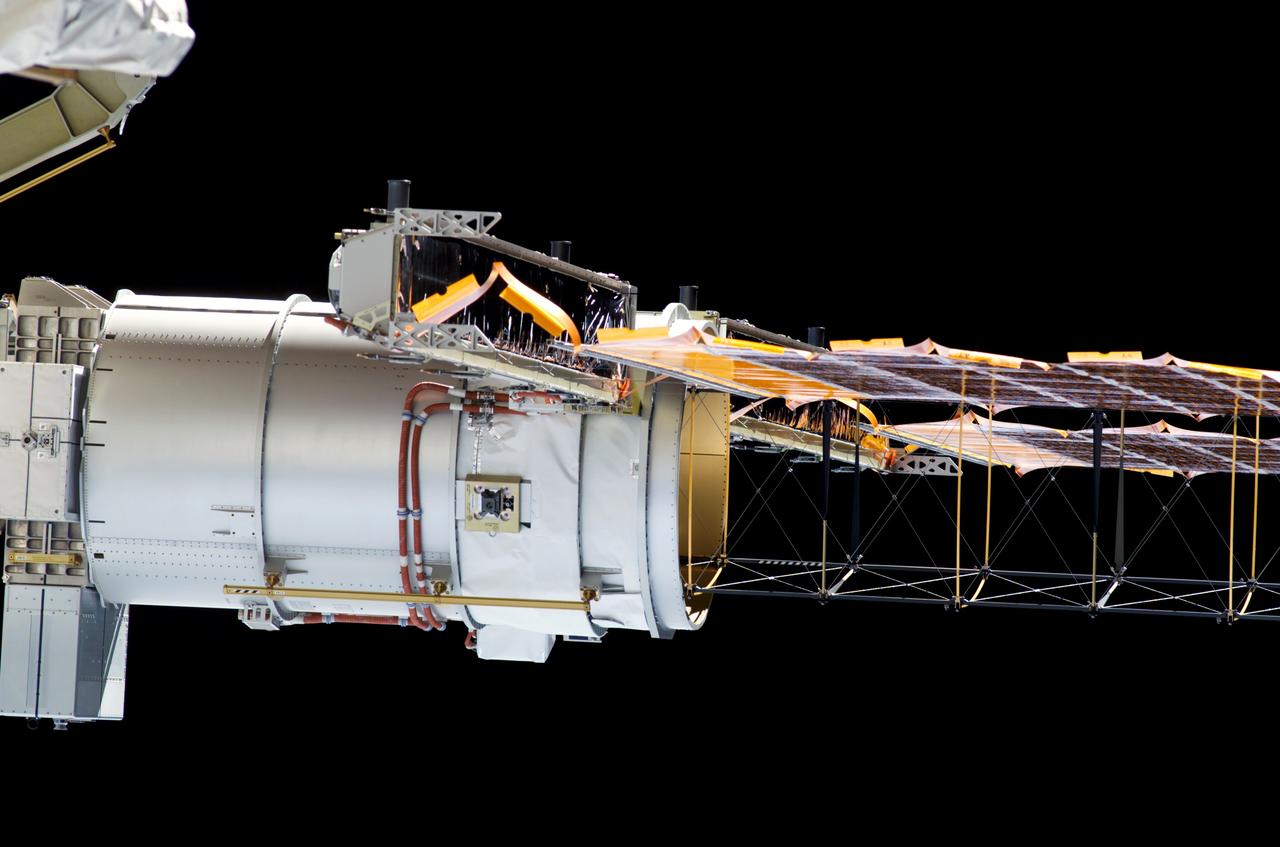
S115-E-06186 (14 Sept. 2006) --- Space Shuttle Atlantis astronauts spread a second set of wings for the International Space Station today. The new solar arrays were fully extended at 7:44 a.m. (CDT). The new arrays span a total of 240 feet and have a width of 38 feet. They are attached to the station's newest component, the P3/P4 integrated truss segment. The installation of the P3/P4, which occurred Sept. 12 and the deployment of the arrays set the stage for future expansion of the station.
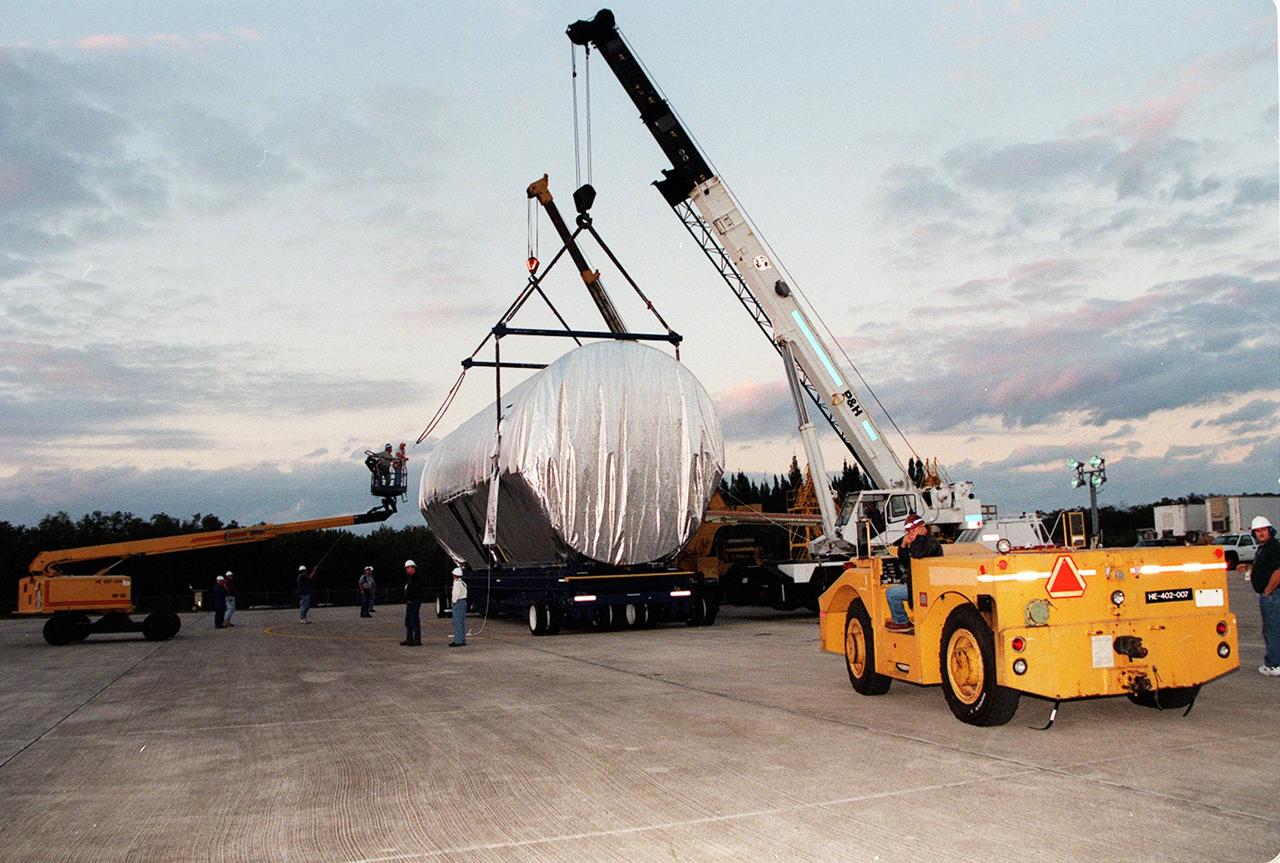
KENNEDY SPACE CENTER, FLA. -- In the waning afternoon light, cranes secure the P3 truss on the transporter while a tractor and driver wait to move it to the Operations and Checkout Building. The second port-side truss is a segment of the International Space Station (ISS), scheduled to be added to the ISS on mission STS-115 in 2002 aboard Space Shuttle Atlantis. P3 will be attached to the first port truss segment (P1).
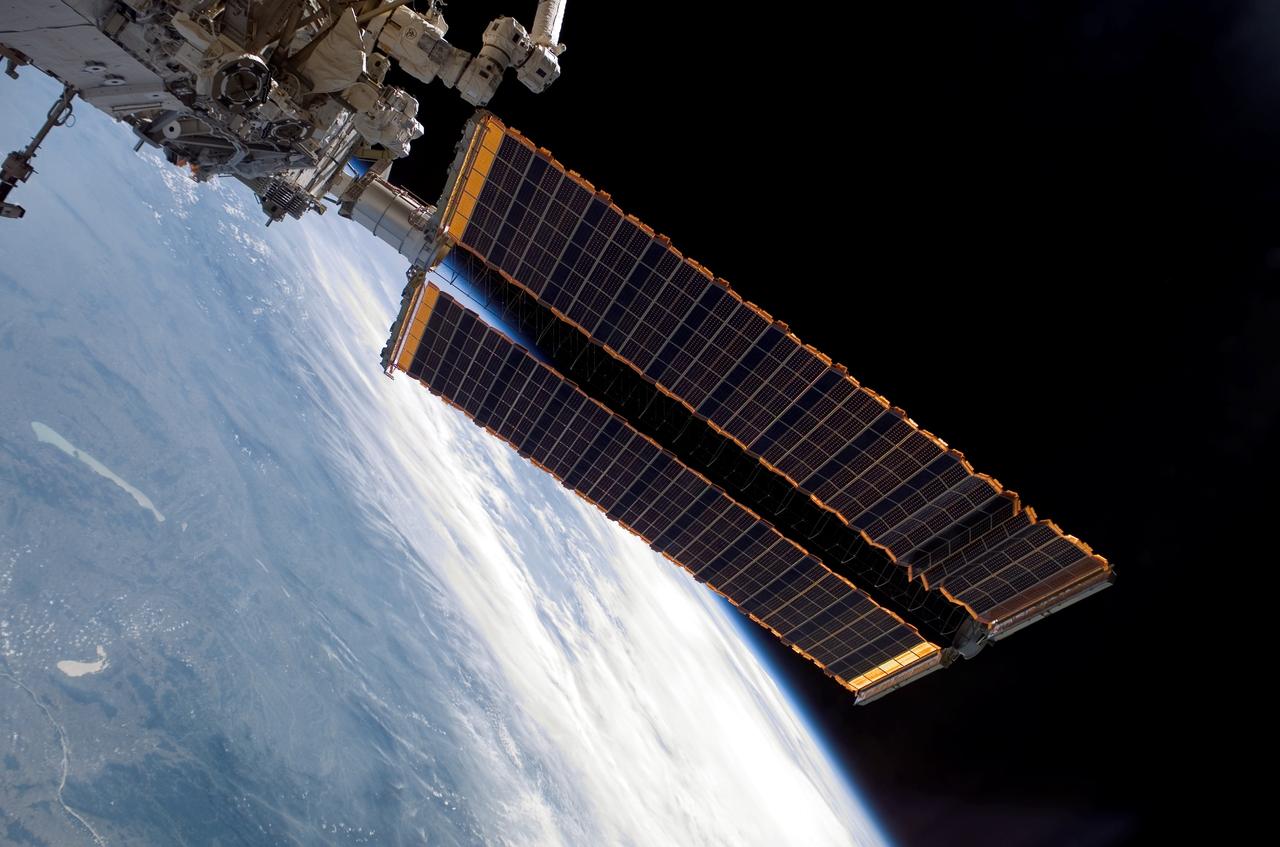
S115-E-05996 (14 Sept. 2006) --- Space Shuttle Atlantis astronauts spread a second set of wings for the International Space Station today. The new solar arrays were fully extended at 7:44 a.m. (CDT). The new arrays span a total of 240 feet and have a width of 38 feet. They are attached to the station's newest component, the P3/P4 integrated truss segment. The installation of the P3/P4, which occurred Tuesday and the deployment of the arrays set the stage for future expansion of the station.
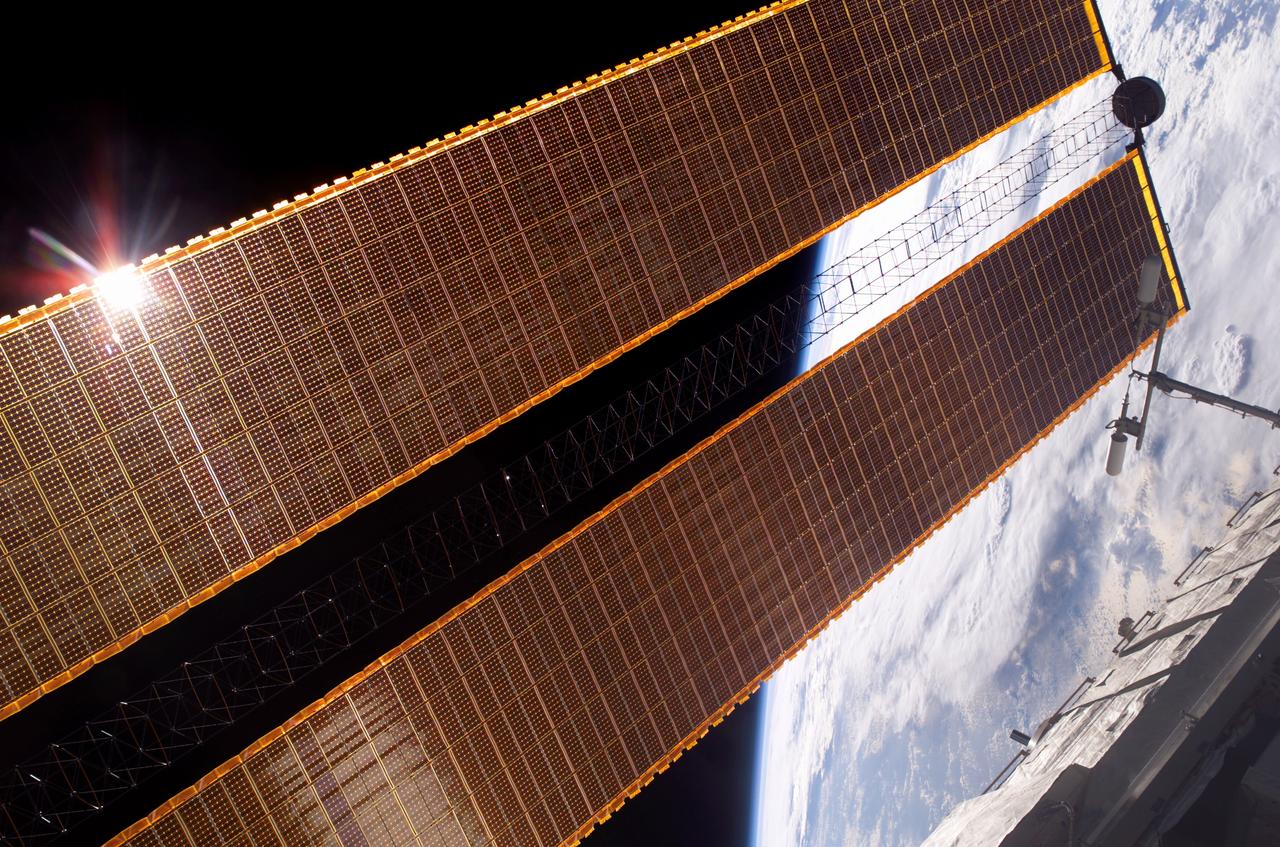
S115-E-06052 (14 Sept. 2006) --- Space Shuttle Atlantis astronauts spread a second set of wings for the International Space Station today. The new solar arrays were fully extended at 7:44 a.m. (CDT). The new arrays span a total of 240 feet and have a width of 38 feet. They are attached to the station's newest component, the P3/P4 integrated truss segment. The installation of the P3/P4, which occurred Tuesday, and the deployment of the arrays set the stage for future expansion of the station.
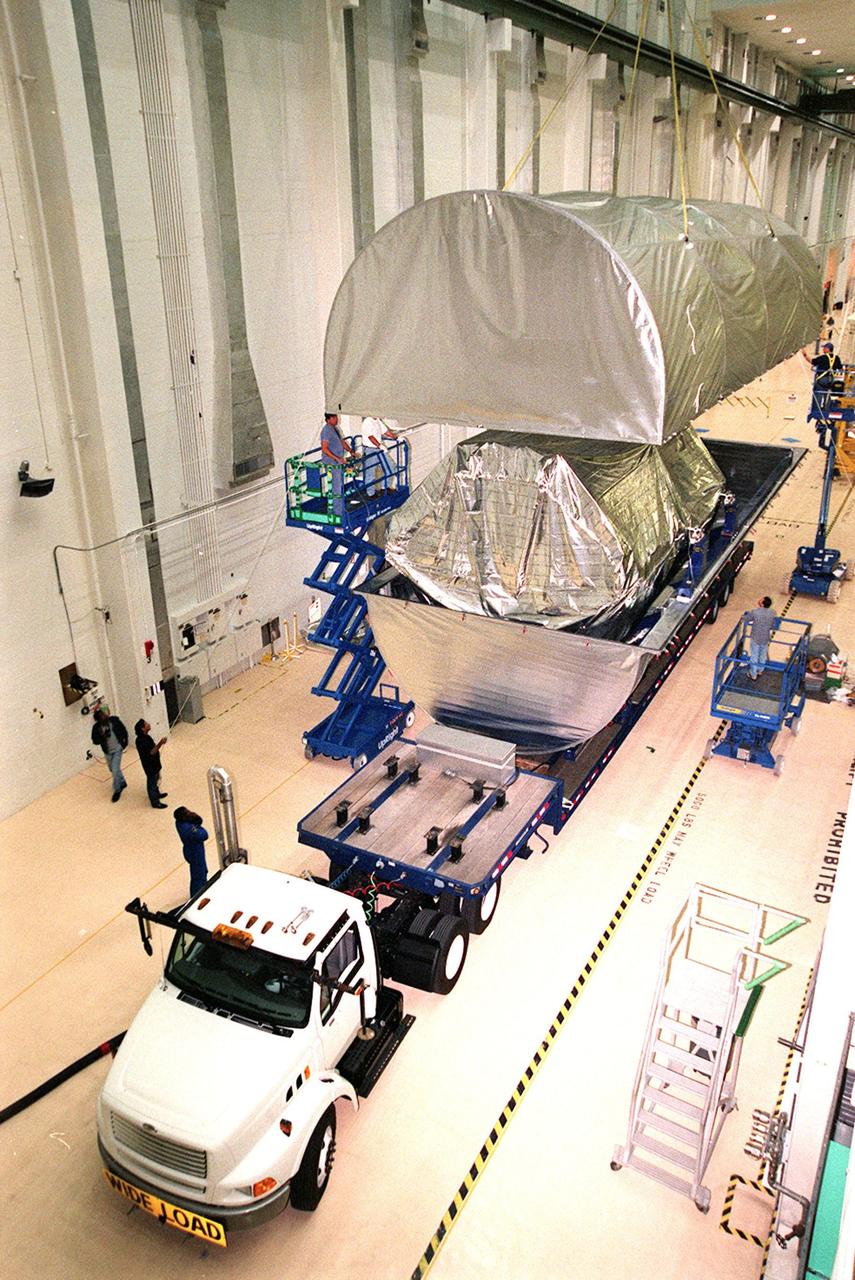
KENNEDY SPACE CENTER, FLA. -- Inside the Operations and Checkout Building, cranes lift the top of the shipping container containing the port-side P3 truss, a segment of the International Space Station (ISS). The truss is scheduled to be added to the ISS on mission STS-115 in 2002 aboard Space Shuttle Atlantis. The second port truss segment, P3 will be attached to the first port truss segment (P1).
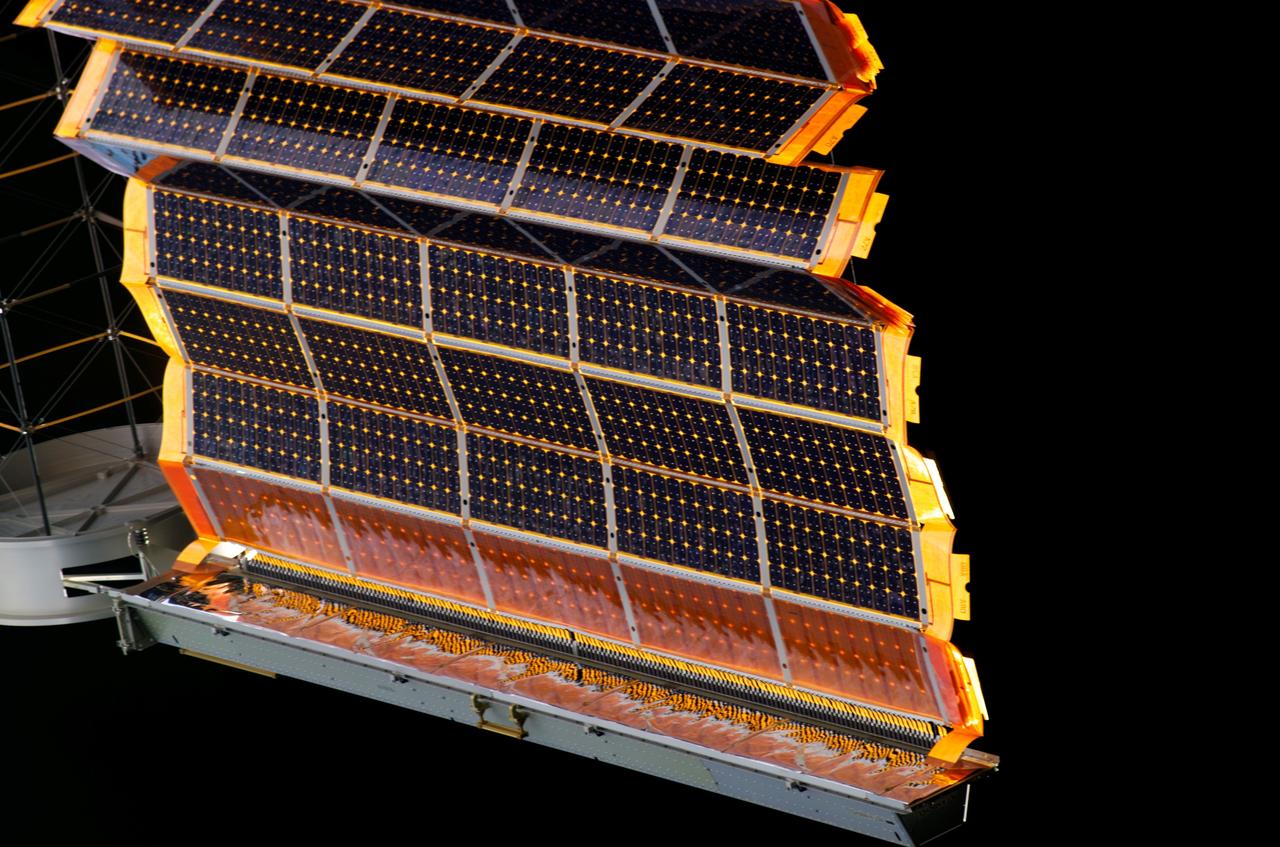
S115-E-06184 (14 Sept. 2006) --- Space Shuttle Atlantis astronauts spread a second set of wings for the International Space Station today. The new solar arrays were fully extended at 7:44 a.m. (CDT). The new arrays span a total of 240 feet and have a width of 38 feet. They are attached to the station's newest component, the P3/P4 integrated truss segment. The installation of the P3/P4, which occurred Sept. 12 and the deployment of the arrays set the stage for future expansion of the station.

KENNEDY SPACE CENTER, FLA. -- Inside the Operations and Checkout Building, overhead cranes lift another segment of the International Space Station (ISS), the port-side P3 truss, from its shipping container. The truss is scheduled to be added to the ISS on mission STS-115 in 2002 aboard Space Shuttle Atlantis. The second port truss segment, P3 will be attached to the first port truss segment (P1).
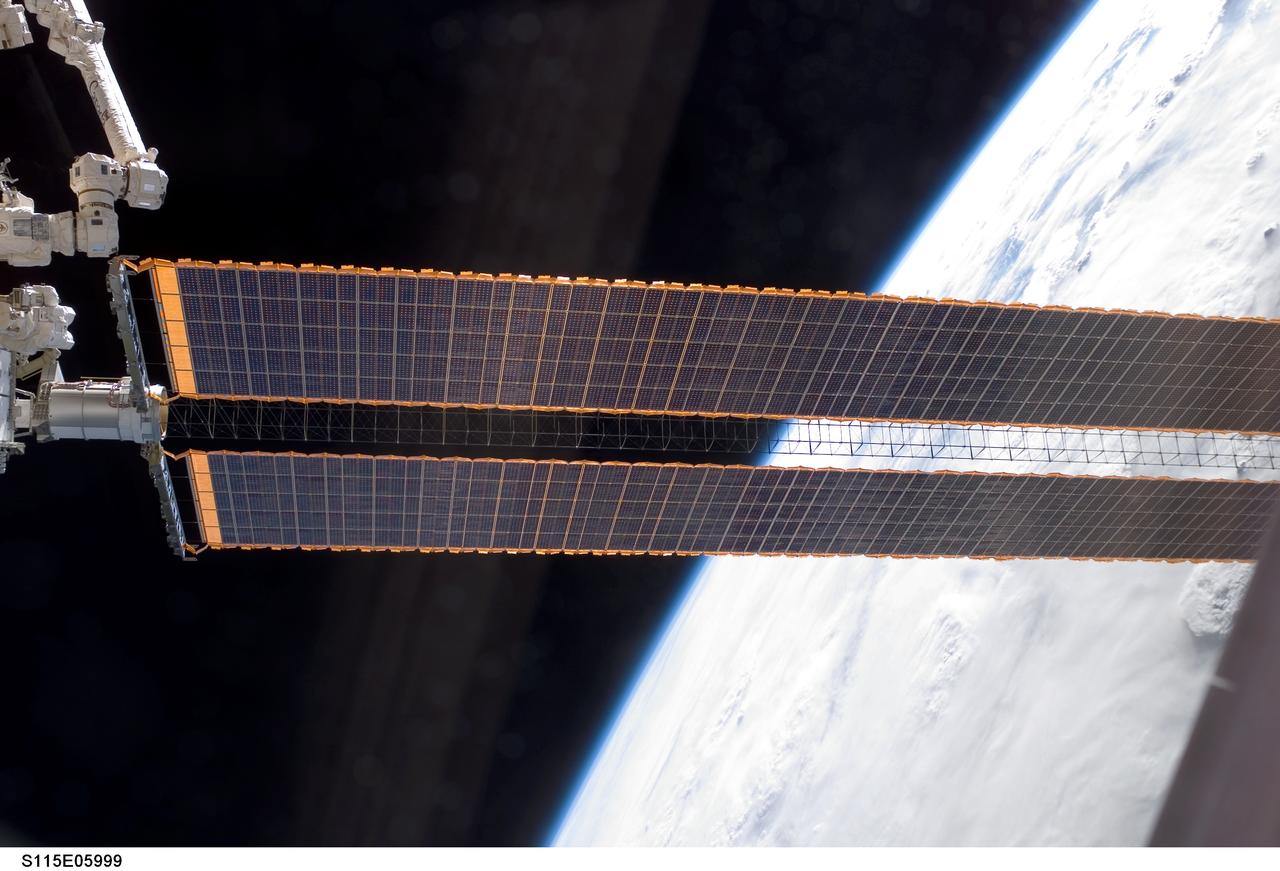
S115-E-05999 (14 Sept. 2006) --- Space Shuttle Atlantis astronauts spread a second set of wings for the International Space Station today. The new solar arrays were fully extended at 7:44 a.m CDT. The new arrays span a total of 240 feet and have a width of 38 feet. They are attached to the station's newest component, the P3/P4 integrated truss segment. The installation of the P3/P4, which occurred Tuesday, and the deployment of the arrays set the stage for future expansion of the station.

NASA's P-3B airborne laboratory on the ramp at Thule Air Base in Greenland early on the morning of Mar. 21, 2013. Credit: NASA/Goddard/Christy Hansen NASA's Operation IceBridge is an airborne science mission to study Earth's polar ice. For more information about IceBridge, visit: <a href="http://www.nasa.gov/icebridge" rel="nofollow">www.nasa.gov/icebridge</a> <b><a href="http://www.nasa.gov/audience/formedia/features/MP_Photo_Guidelines.html" rel="nofollow">NASA image use policy.</a></b> <b><a href="http://www.nasa.gov/centers/goddard/home/index.html" rel="nofollow">NASA Goddard Space Flight Center</a></b> enables NASA’s mission through four scientific endeavors: Earth Science, Heliophysics, Solar System Exploration, and Astrophysics. Goddard plays a leading role in NASA’s accomplishments by contributing compelling scientific knowledge to advance the Agency’s mission. <b>Follow us on <a href="http://twitter.com/NASA_GoddardPix" rel="nofollow">Twitter</a></b> <b>Like us on <a href="http://www.facebook.com/pages/Greenbelt-MD/NASA-Goddard/395013845897?ref=tsd" rel="nofollow">Facebook</a></b> <b>Find us on <a href="http://instagram.com/nasagoddard?vm=grid" rel="nofollow">Instagram</a></b>
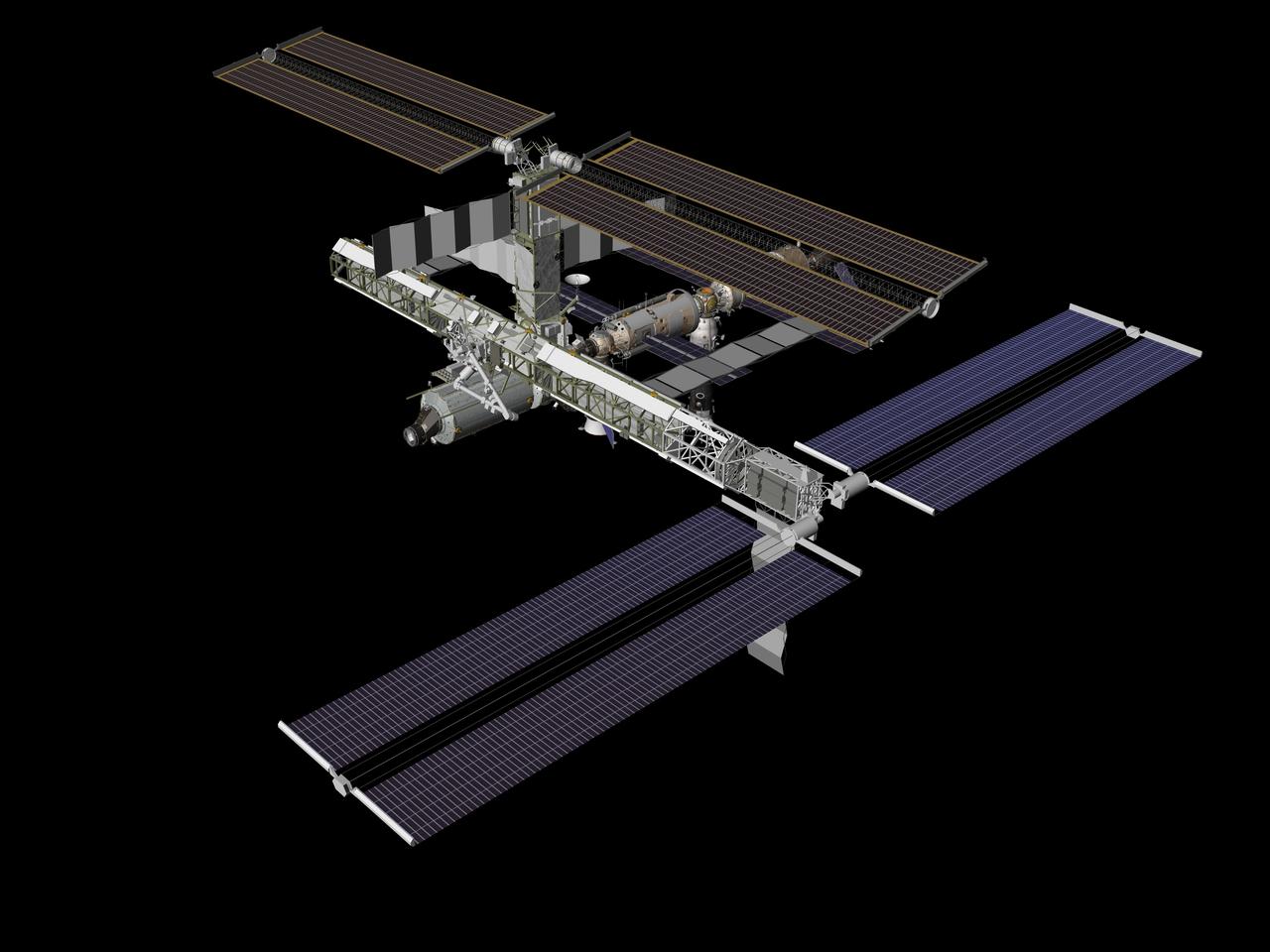
JSC2006-E-38949 (August 2006) --- Computer generated graphic of the International Space Station configuration after STS-115/12A with the addition of the P3/P4 integrated truss segments.
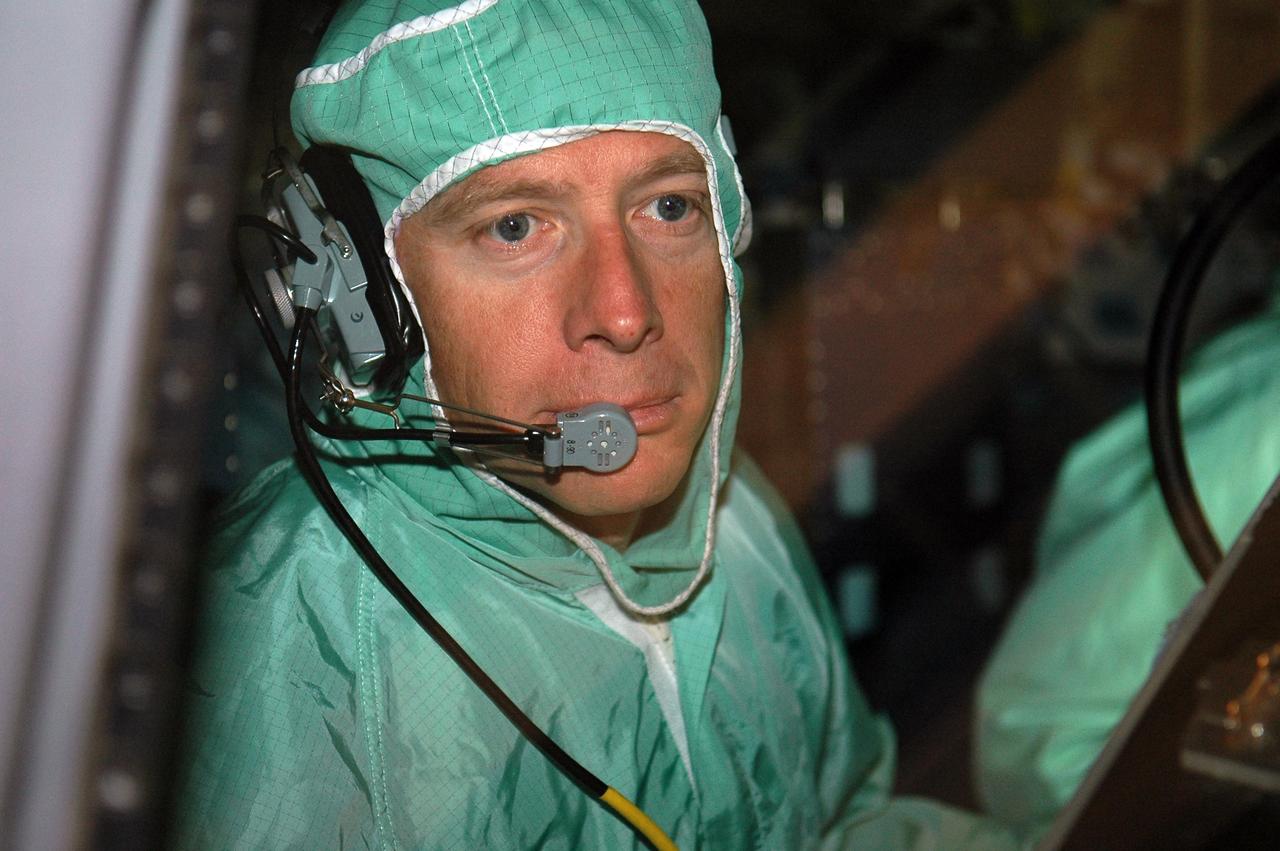
KENNEDY SPACE CENTER, FLA. - In the Orbiter Processing Facility, STS-115 Pilot Christopher Ferguson inspects the window of the cockpit in the orbiter Atlantis. The crew is at KSC for Crew Equipment Interface Test activities, which involve equipment familiarization and inspection, a routine part of astronaut training and launch preparations. The STS-115 mission will deliver the second port truss segment, the P3/P4 truss, to the International Space Station. The crew will attach the P3 to the first port truss segment, the P1 truss, as well as deploy solar array set 2A and 4A. Launch on Space Shuttle Atlantis is scheduled for late August. Photo credit: NASA/Kim Shiflett
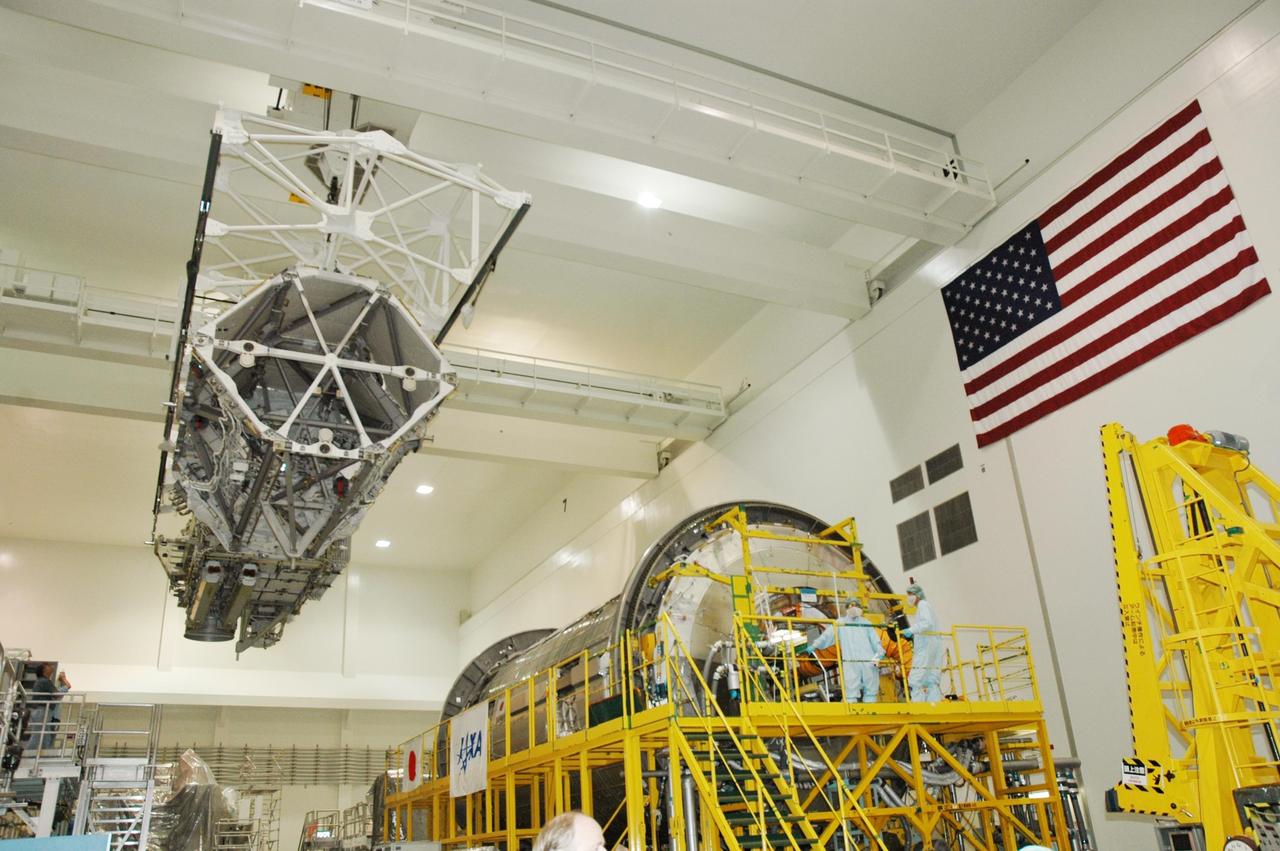
KENNEDY SPACE CENTER, FLA. - In the Space Station Processing Facility, an overhead crane moves the Port 3/4 truss segment across the floor to the waiting payload canister for installation in the orbiter Atlantis. The truss is slated for launch on mission STS-115 no earlier than Aug. 28. The truss is the next major addition to the 11-segment integrated truss structure that will eventually span more than 300 feet on the station. The P3/P4 truss, with its two large solar arrays, will provide one-fourth of the total power-generation capability of the completed station. The P3/P4 truss is expected to be loaded into Atlantis's cargo bay around the beginning of August. Photo credit: NASA/Troy Cryder
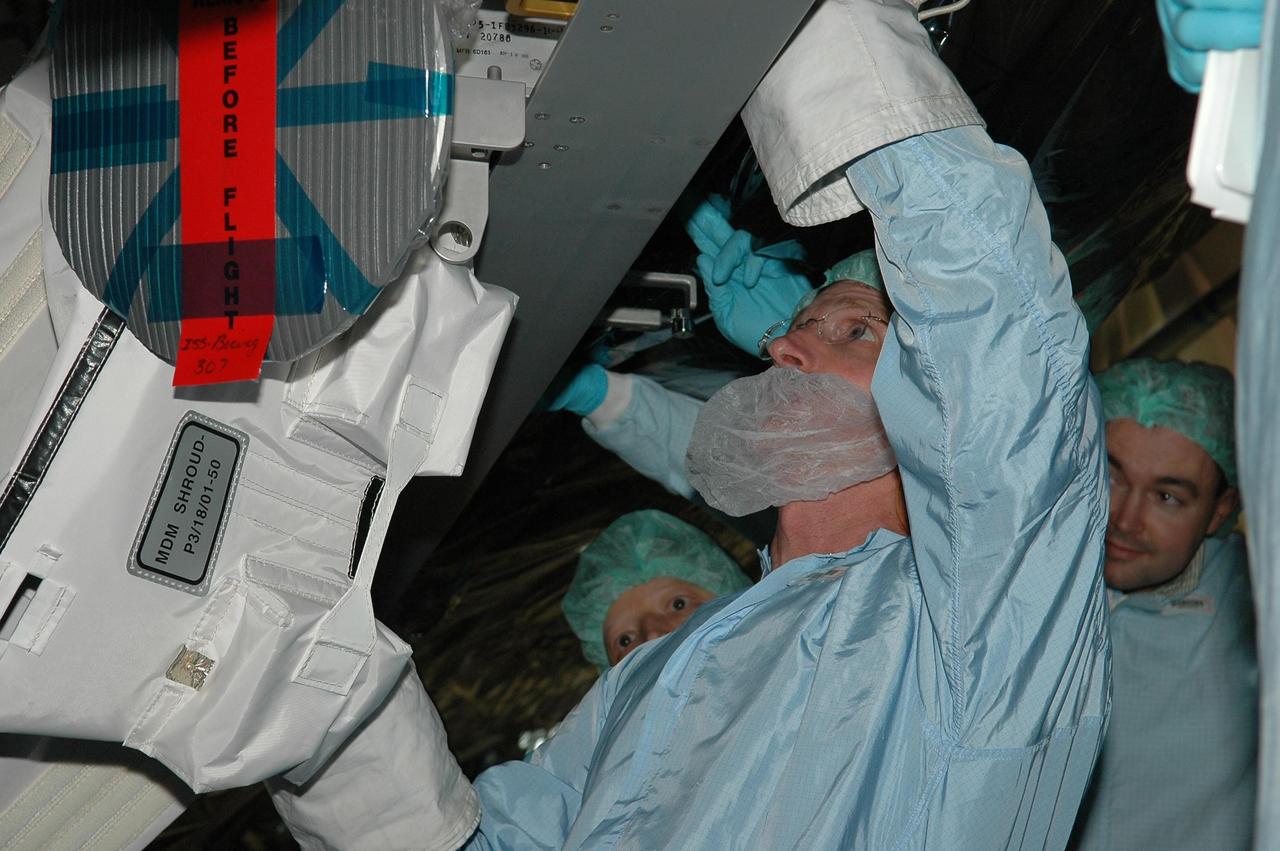
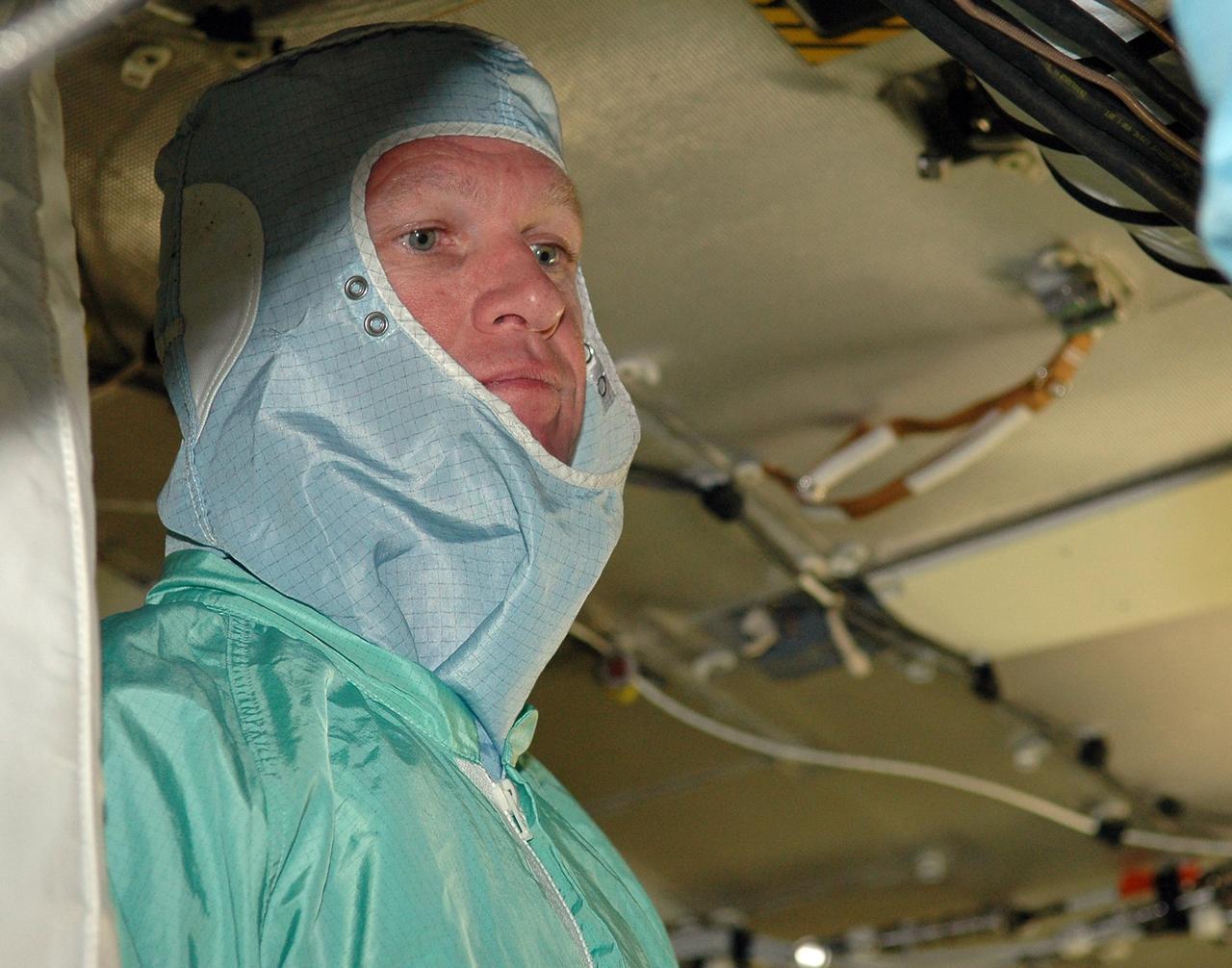
KENNEDY SPACE CENTER, FLA. - In the Space Station Processing Facility at NASA's Kennedy Space Center, STS-115 Mission Specialist Joe Tanner is removing the P3 truss multiplexer-demultiplexer launch to activation multilayer installation blanket. He and other crew members are at the center for Crew Equipment Interface Test activities. Equipment familiarization is a routine part of astronaut training and launch preparations. The mission will deliver the second port truss segment, the P3/P4 Truss, to attach to the first port truss segment, the P1 Truss, as well as deploy solar array set 2A and 4A. Launch on Space Shuttle Atlantis is scheduled for late August. Photo credit: NASA/Kim Shiflett
KENNEDY SPACE CENTER, FLA. - In the Orbiter Processing Facility, STS-115 Commander Brent Jett completes inspection of the orbiter Atlantis. The crew is at KSC for Crew Equipment Interface Test activities, which involve equipment familiarization and inspection, a routine part of astronaut training and launch preparations. The STS-115 mission will deliver the second port truss segment, the P3/P4 truss, to the International Space Station. The crew will attach the P3 to the first port truss segment, the P1 truss, as well as deploy solar array set 2A and 4A. Launch on Space Shuttle Atlantis is scheduled for late August. Photo credit: NASA/Kim Shiflett
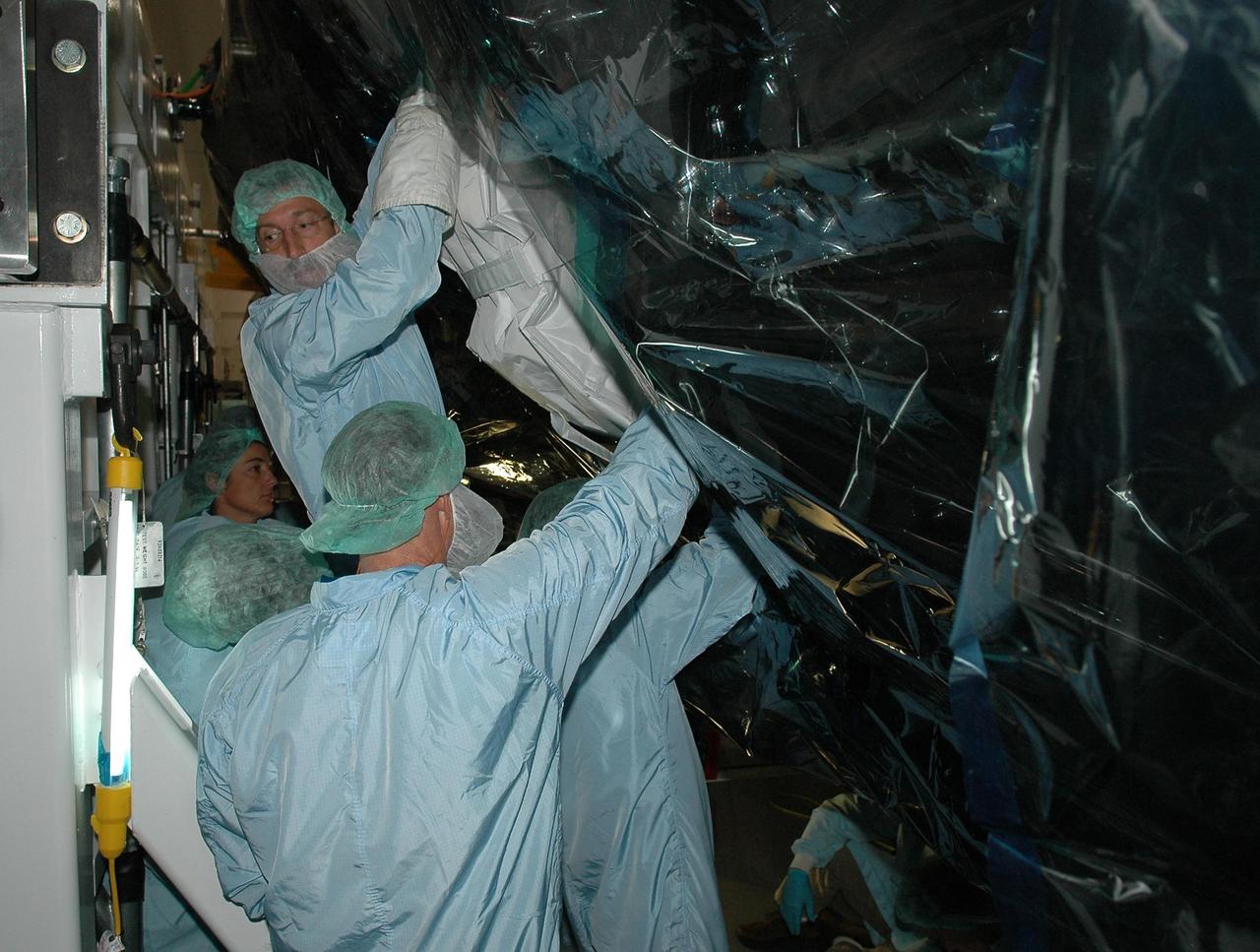
KENNEDY SPACE CENTER, FLA. - In the Space Station Processing Facility at NASA's Kennedy Space Center, STS-115 Mission Specialist Joe Tanner is removing the P3 truss multiplexer-demultiplexer launch to activation multilayer installation blanket. He and other crew members are at the center for Crew Equipment Interface Test activities. Equipment familiarization is a routine part of astronaut training and launch preparations. The mission will deliver the second port truss segment, the P3/P4 Truss, to attach to the first port truss segment, the P1 Truss, as well as deploy solar array set 2A and 4A. Launch on Space Shuttle Atlantis is scheduled for late August. Photo credit: NASA/Kim Shiflett
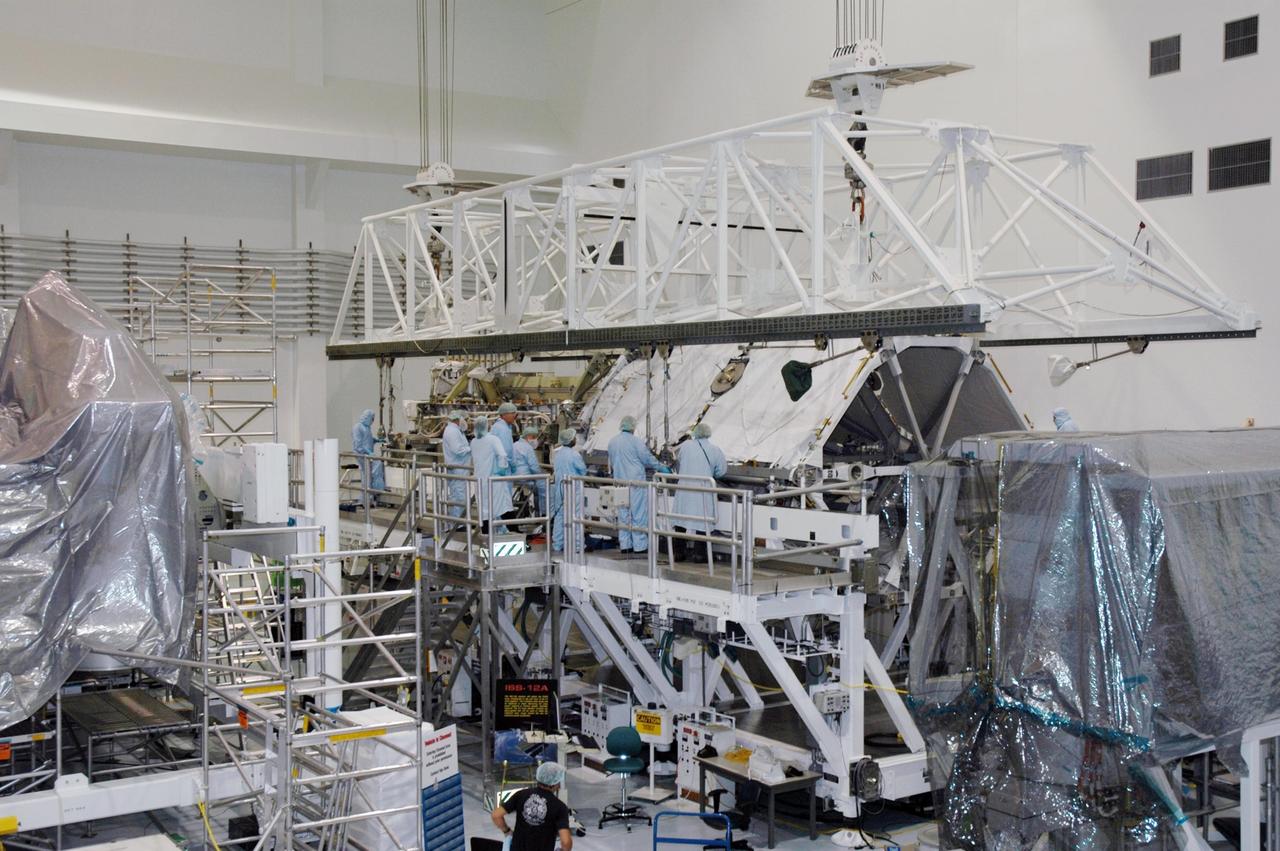
KENNEDY SPACE CENTER, FLA. - In the Space Station Processing Facility, an overhead crane is ready to lift the Port 3/4 truss segment and move it to a payload canister for installation in the orbiter Atlantis. The truss is slated for launch on mission STS-115 no earlier than Aug. 28. The truss is the next major addition to the 11-segment integrated truss structure that will eventually span more than 300 feet on the station. The P3/P4 truss, with its two large solar arrays, will provide one-fourth of the total power-generation capability of the completed station. The P3/P4 truss is expected to be loaded into Atlantis's cargo bay around the beginning of August. Photo credit: NASA/Troy Cryder
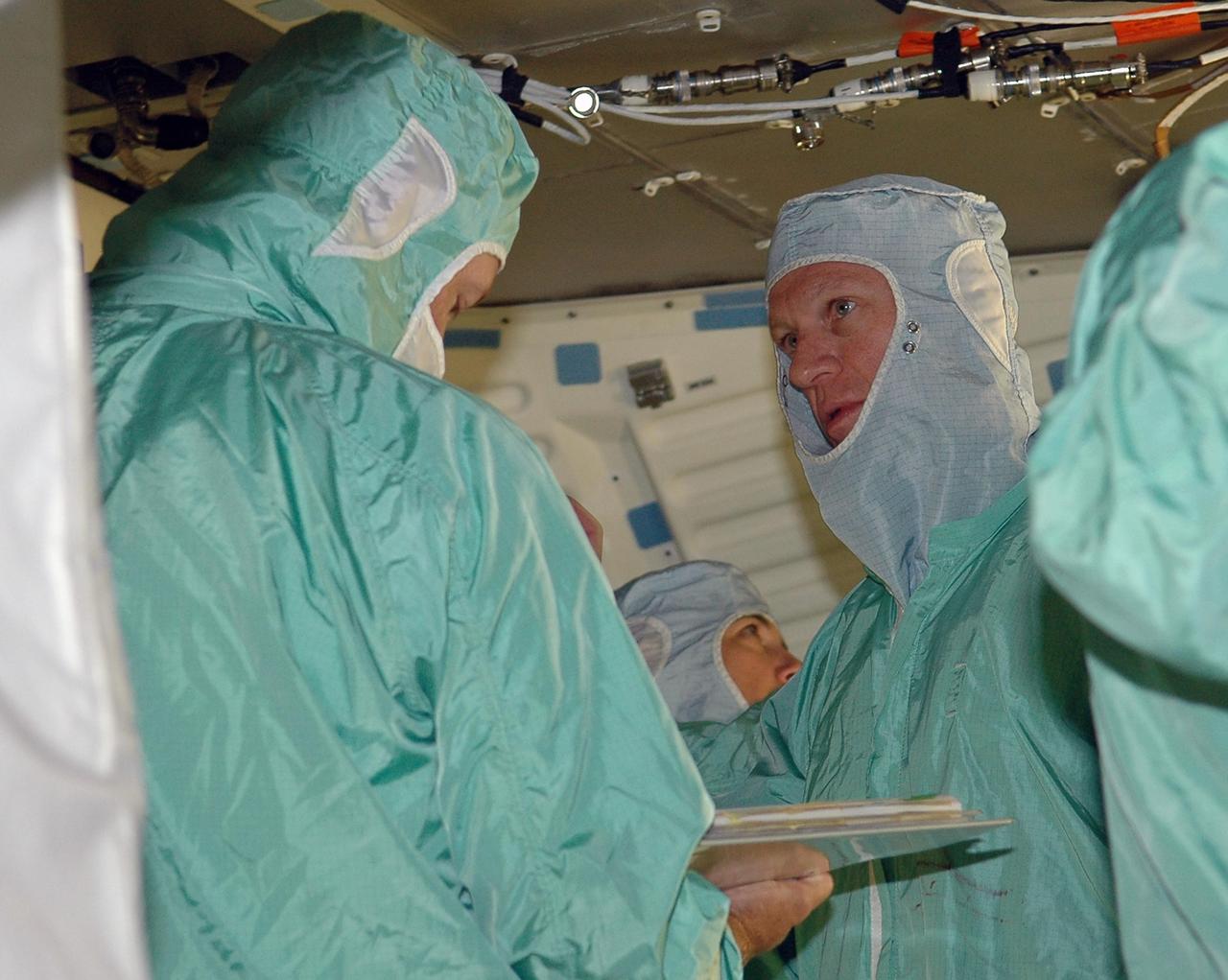
KENNEDY SPACE CENTER, FLA. - In the Orbiter Processing Facility, STS-115 Commander Brent Jett continues inspection of the orbiter Atlantis with other crew members. The crew is at KSC for Crew Equipment Interface Test activities, which involve equipment familiarization and inspection, a routine part of astronaut training and launch preparations. The STS-115 mission will deliver the second port truss segment, the P3/P4 truss, to the International Space Station. The crew will attach the P3 to the first port truss segment, the P1 truss, as well as deploy solar array set 2A and 4A. Launch on Space Shuttle Atlantis is scheduled for late August. Photo credit: NASA/Kim Shiflett

KENNEDY SPACE CENTER, FLA. - In the Orbiter Processing Facility, STS-115 Pilot Christopher Ferguson inspects the window of the cockpit in the orbiter Atlantis. The crew is at KSC for Crew Equipment Interface Test activities, which involve equipment familiarization and inspection, a routine part of astronaut training and launch preparations. The STS-115 mission will deliver the second port truss segment, the P3/P4 truss, to the International Space Station. The crew will attach the P3 to the first port truss segment, the P1 truss, as well as deploy solar array set 2A and 4A. Launch on Space Shuttle Atlantis is scheduled for late August. Photo credit: NASA/Kim Shiflett
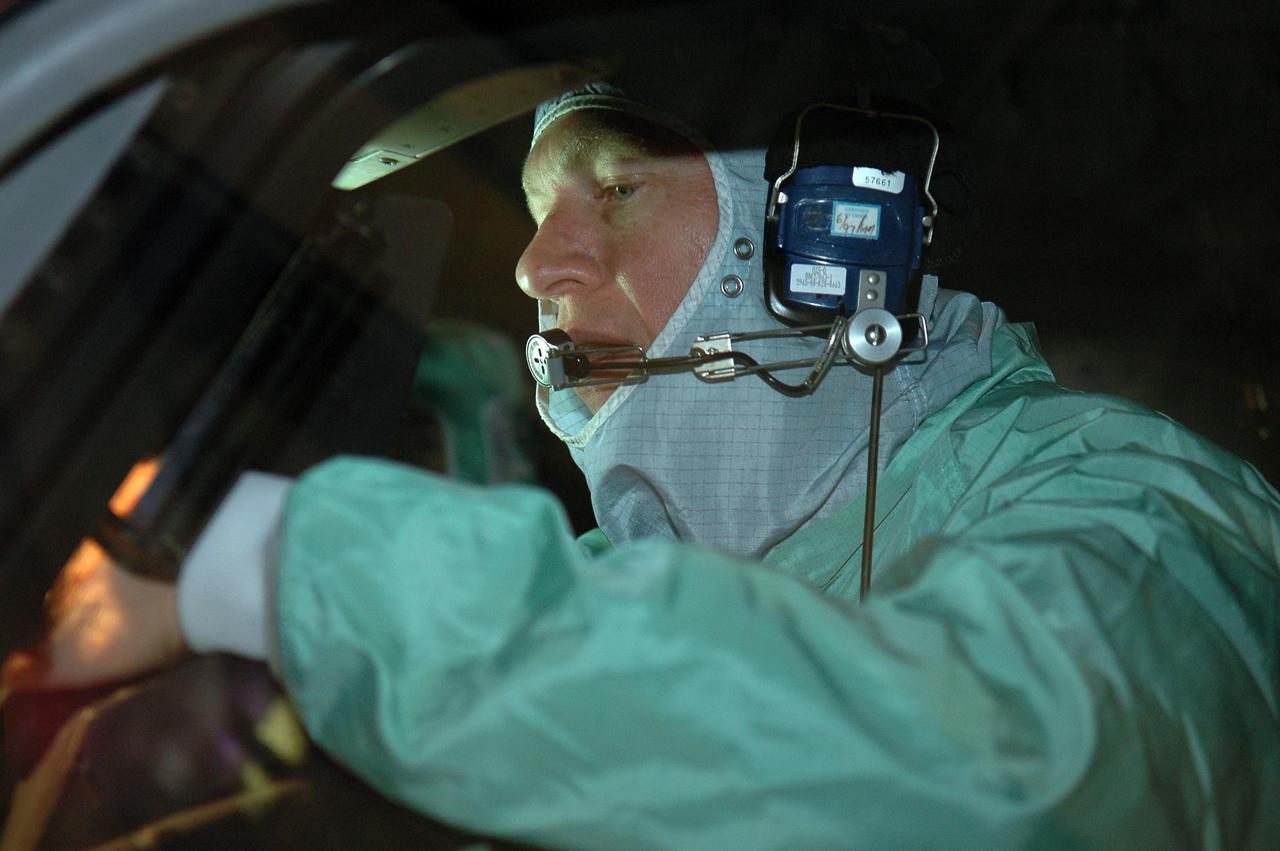
KENNEDY SPACE CENTER, FLA. - In the Orbiter Processing Facility, STS-115 Commander Brent Jett inspects the window of the cockpit in the orbiter Atlantis. The crew is at KSC for Crew Equipment Interface Test activities, which involve equipment familiarization and inspection, a routine part of astronaut training and launch preparations. The STS-115 mission will deliver the second port truss segment, the P3/P4 truss, to the International Space Station. The crew will attach the P3 to the first port truss segment, the P1 truss, as well as deploy solar array set 2A and 4A. Launch on Space Shuttle Atlantis is scheduled for late August. Photo credit: NASA/Kim Shiflett
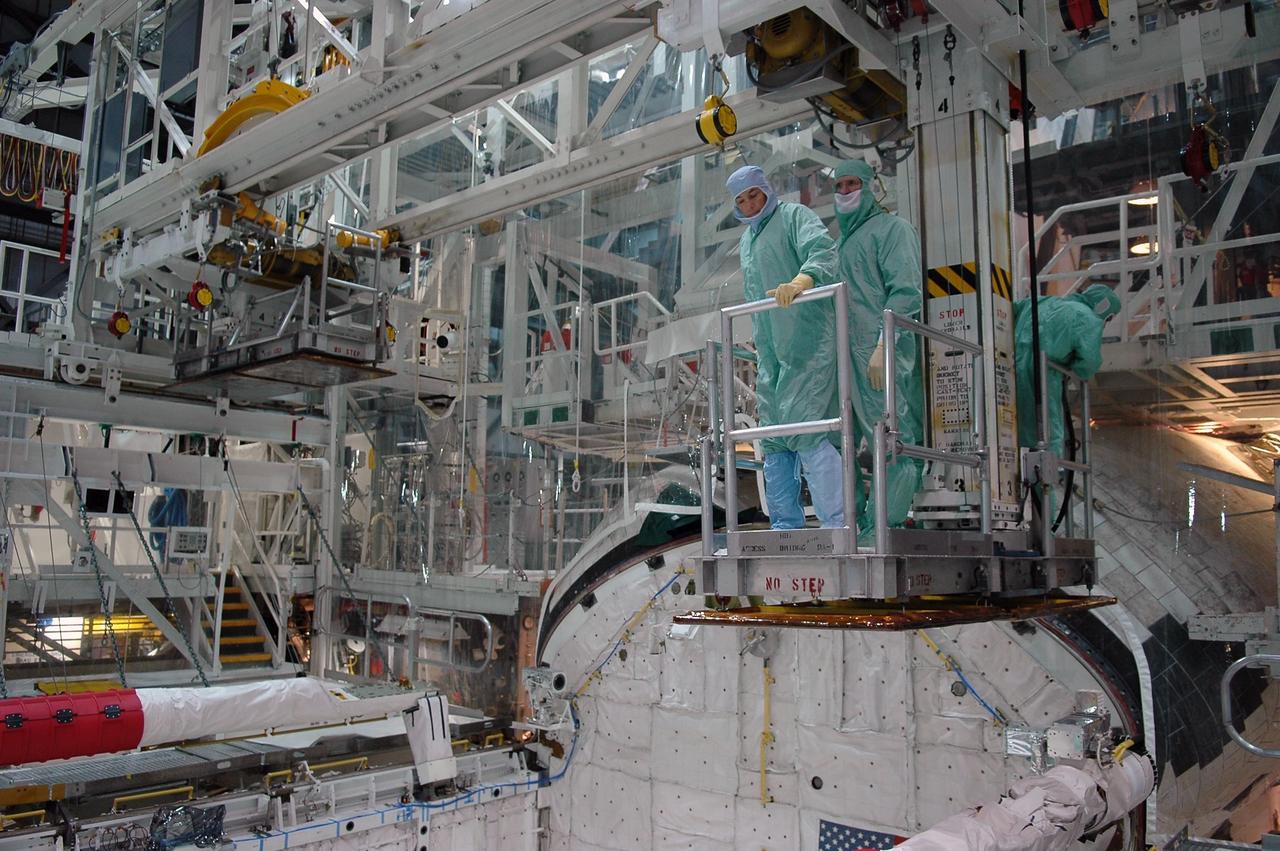
KENNEDY SPACE CENTER, FLA. - In the Orbiter Processing Facility at NASA's Kennedy Space Center, STS-115 crew members inspect equipment in Atlantis's payload bay. The crew is at KSC for Crew Equipment Interface Test activities, which involves equipment familiarization, a routine part of astronaut training and launch preparations. The STS-115 mission will deliver the second port truss segment, the P3/P4 truss, to the International Space Station. The crew will attach the P3 to the first port truss segment, the P1 truss, as well as deploy solar array set 2A and 4A. Launch on Space Shuttle Atlantis is scheduled for late August. Photo credit: NASA/Kim Shiflett

KENNEDY SPACE CENTER, FLA. - In the Orbiter Processing Facility, STS-115 Pilot Christopher Ferguson and Commander Brent Jett review procedures in the cockpit of the orbiter Atlantis. The crew is at KSC for Crew Equipment Interface Test activities, which involve equipment familiarization and inspection, a routine part of astronaut training and launch preparations. The STS-115 mission will deliver the second port truss segment, the P3/P4 truss, to the International Space Station. The crew will attach the P3 to the first port truss segment, the P1 truss, as well as deploy solar array set 2A and 4A. Launch on Space Shuttle Atlantis is scheduled for late August. Photo credit: NASA/Kim Shiflett
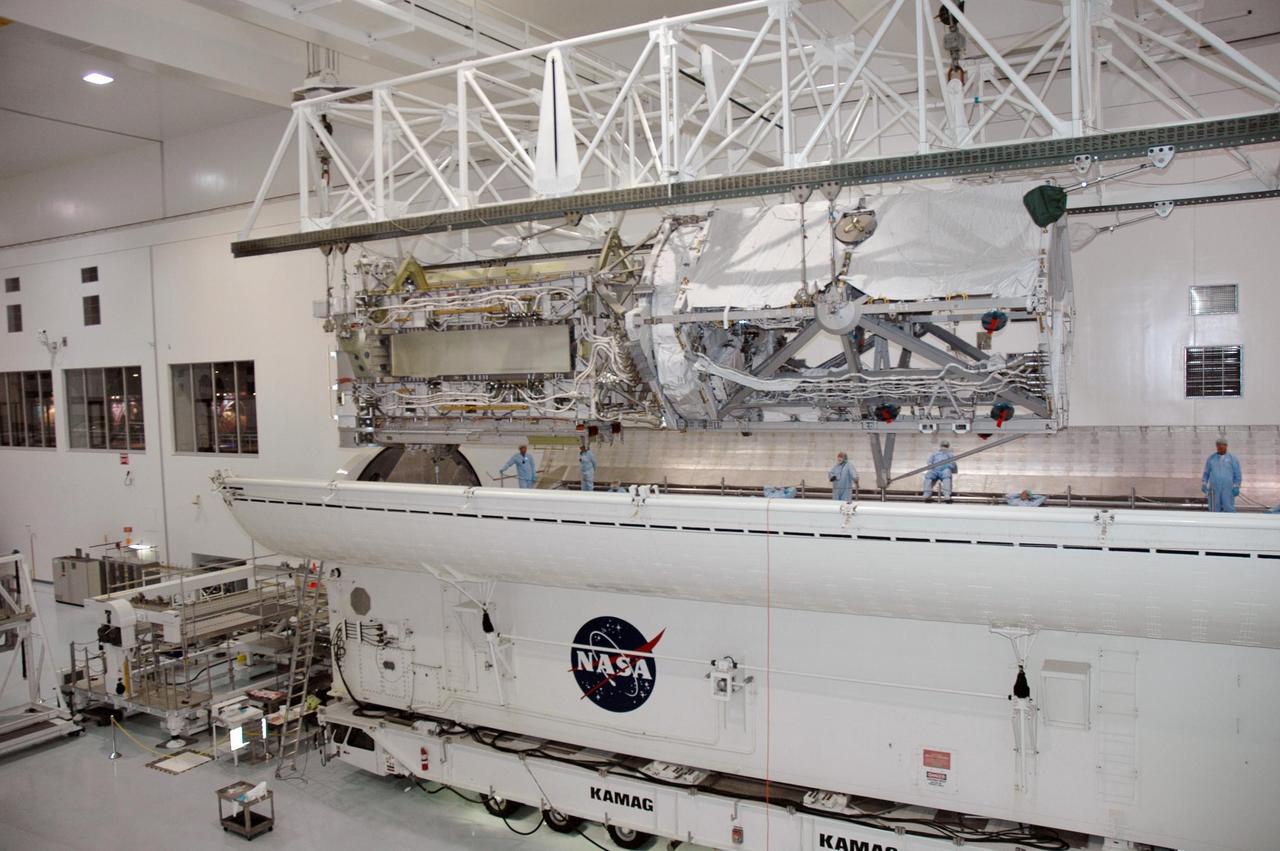
KENNEDY SPACE CENTER, FLA. - In the Space Station Processing Facility, an overhead crane lowers the Port 3/4 truss segment into the waiting payload canister for installation in the orbiter Atlantis. The truss is slated for launch on mission STS-115 no earlier than Aug. 28. The truss is the next major addition to the 11-segment integrated truss structure that will eventually span more than 300 feet on the station. The P3/P4 truss, with its two large solar arrays, will provide one-fourth of the total power-generation capability of the completed station. The P3/P4 truss is expected to be loaded into Atlantis's cargo bay around the beginning of August. Photo credit: NASA/Troy Cryder

KENNEDY SPACE CENTER, FLA. - In the Space Station Processing Facility, an overhead crane lowers the Port 3/4 truss segment into the waiting payload canister for installation in the orbiter Atlantis. The truss is slated for launch on mission STS-115 no earlier than Aug. 28. The truss is the next major addition to the 11-segment integrated truss structure that will eventually span more than 300 feet on the station. The P3/P4 truss, with its two large solar arrays, will provide one-fourth of the total power-generation capability of the completed station. The P3/P4 truss is expected to be loaded into Atlantis's cargo bay around the beginning of August. Photo credit: NASA/Troy Cryder
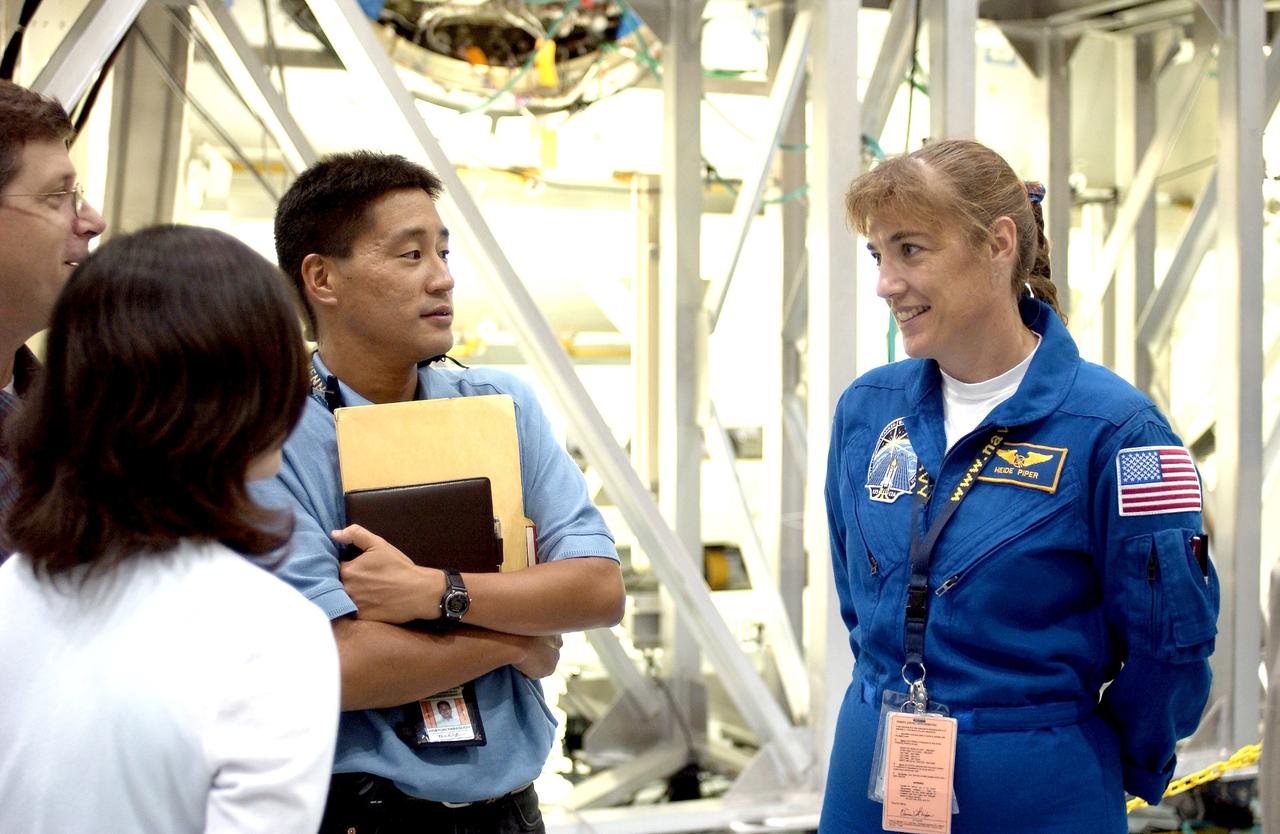
KENNEDY SPACE CENTER, FLA. - STS-115 Mission Specialist Heidemarie Stefanyshyn-Piper talks to workers in the Space Station Processing Facility. She and other crew members are at KSC for hardware familiarization. The mission will deliver the second port truss segment, the P3/P4 Truss, to attach to the first port truss segment, the P1 Truss, as well as deploy solar array sets 2A and 4A.. The crew is scheduled to activate and check out the Solar Alpha Rotary Joint (SARJ) and deploy the P4 Truss radiator.
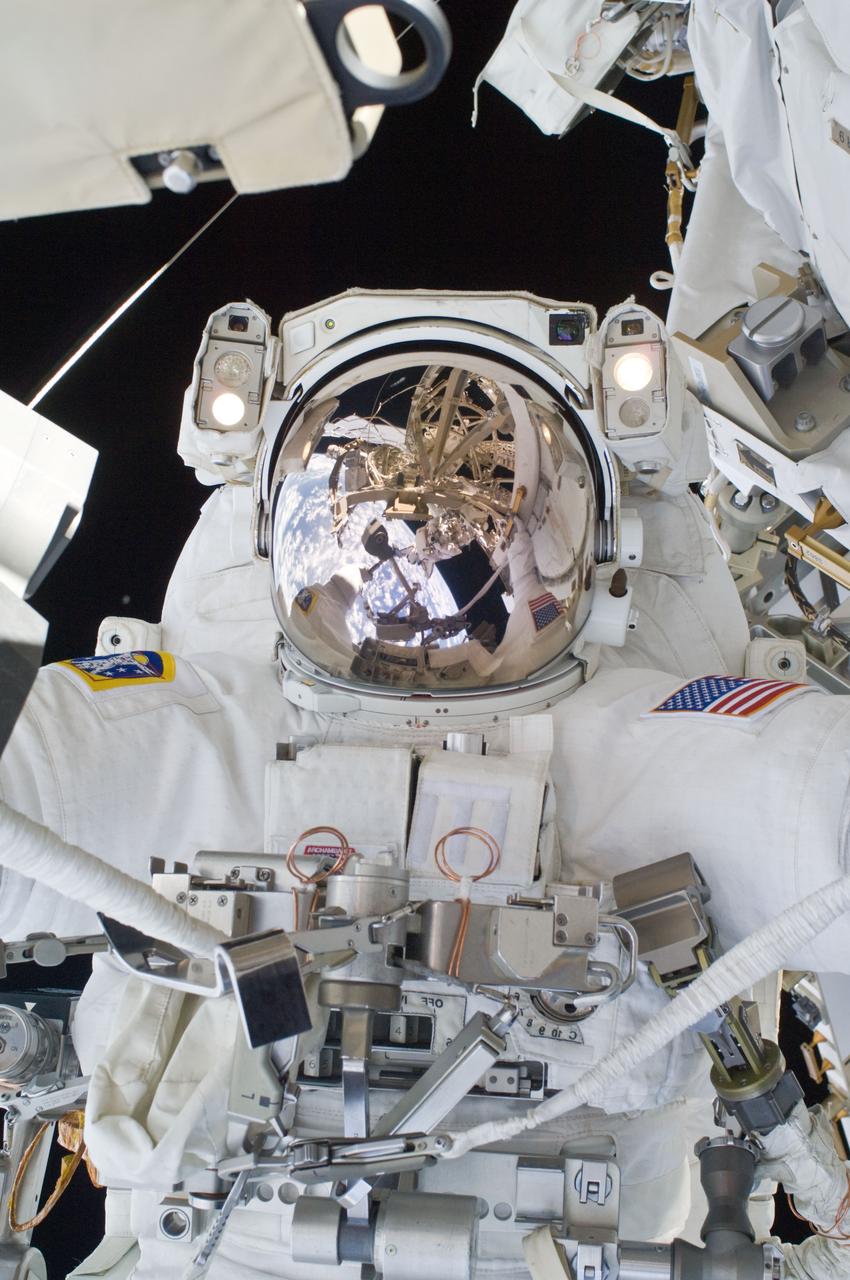
ISS018-E-042523 (23 March 2009) --- Astronaut Richard Arnold, STS-119 mission specialist, participates in the mission's third scheduled session of extravehicular activity (EVA) as construction and maintenance continue on the International Space Station. During the six-hour, 27-minute spacewalk, Arnold and Joseph Acaba (out of frame), mission specialist, helped robotic arm operators relocate the Crew Equipment Translation Aid (CETA) cart from the Port 1 to Starboard 1 truss segment, installed a new coupler on the CETA cart, lubricated snares on the "B" end of the space station's robotic arm and performed a few "get ahead" tasks.
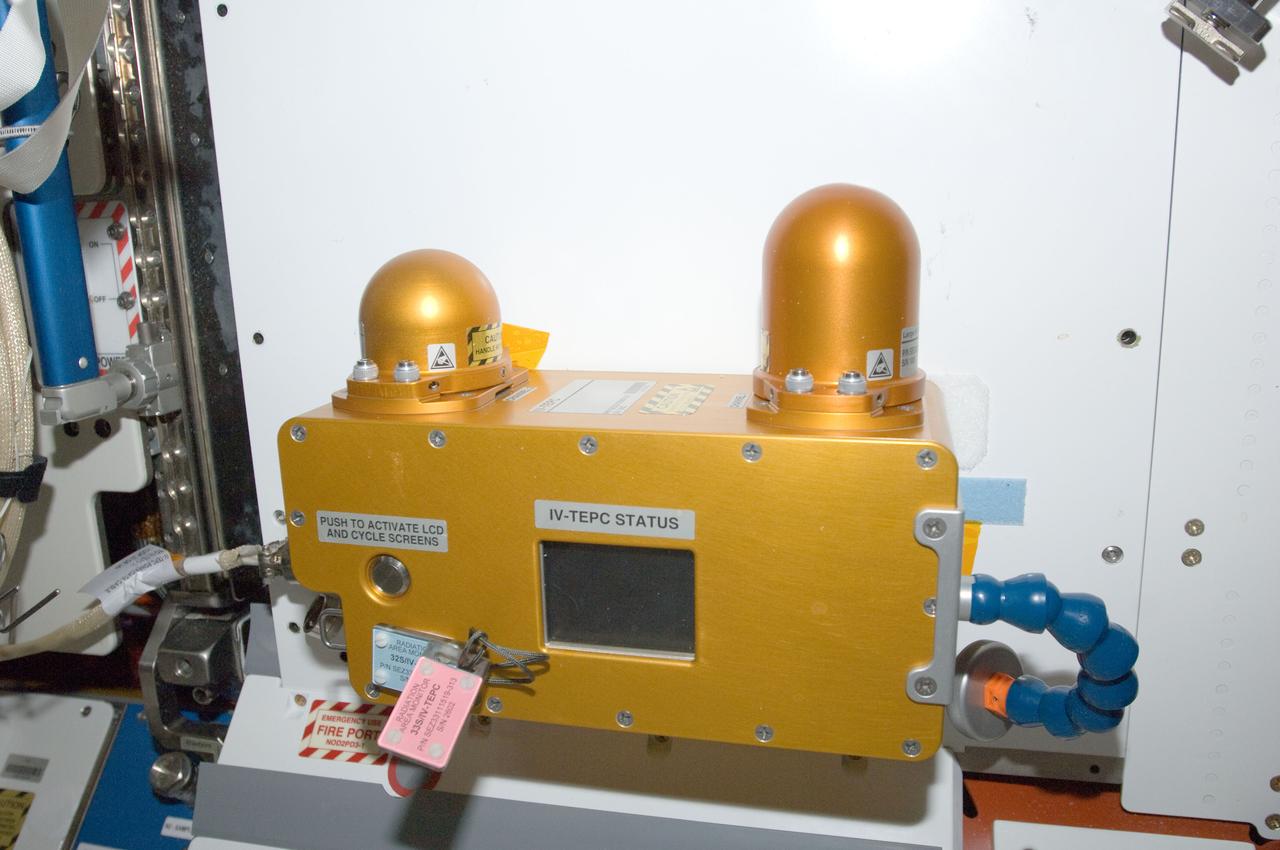
View of radiation monitor,Intra-Vehicular Tissue Equivalent Proportional Counter (IV-TEPC),relocated to NOD2 P3,Part Number (P/N): SEG33120960-301,Serial Number (S/N): 1002,in the Node 2. Photo was taken during Expedition 34.
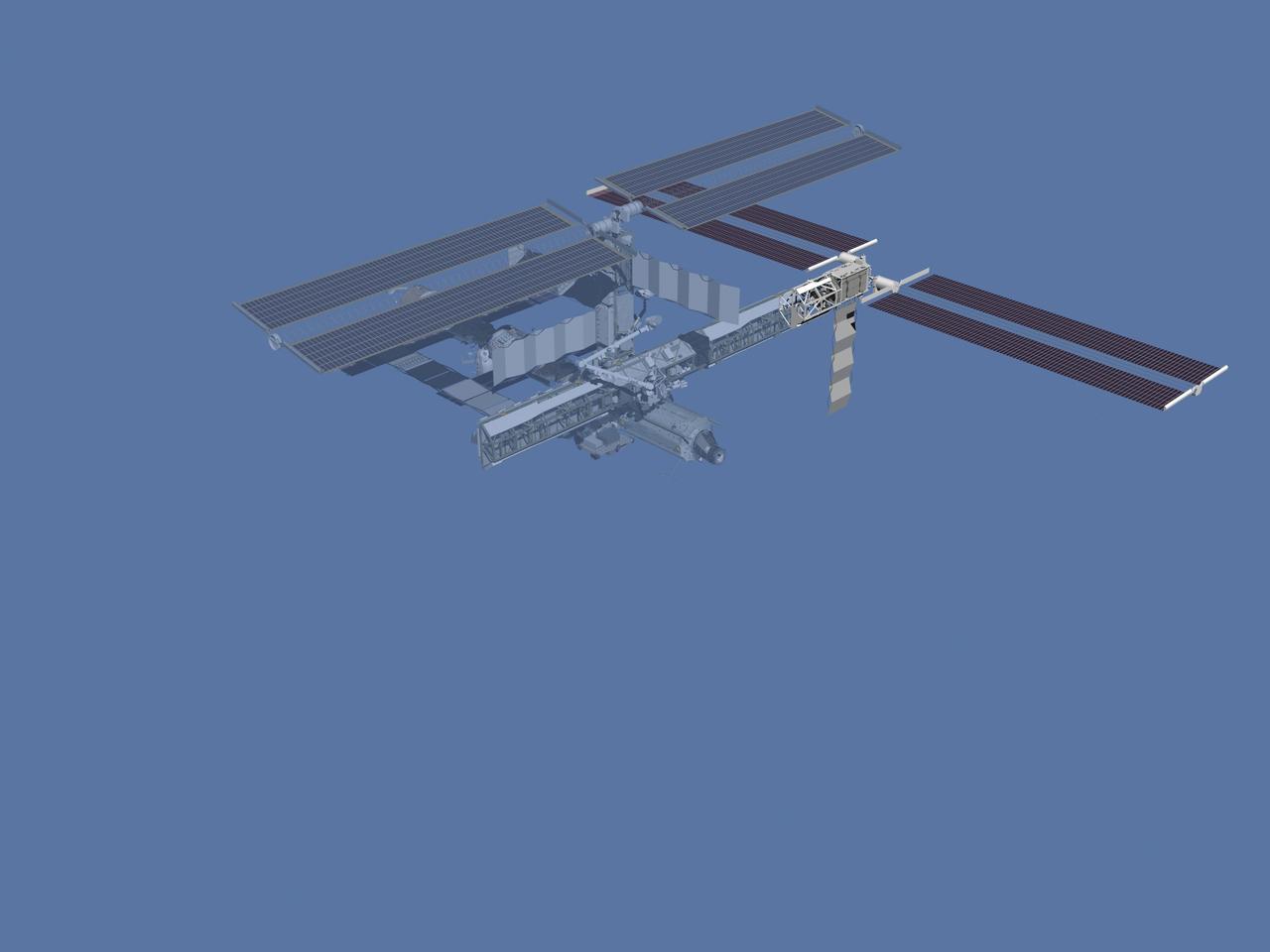
JSC2006-E-43498 (September 2006) --- Computer-generated artist's rendering of the International Space Station after flight STS-115/12A. Space Shuttle Atlantis crew delivers and installs the second port truss segment P3/P4. The second set of solar arrays is deployed.
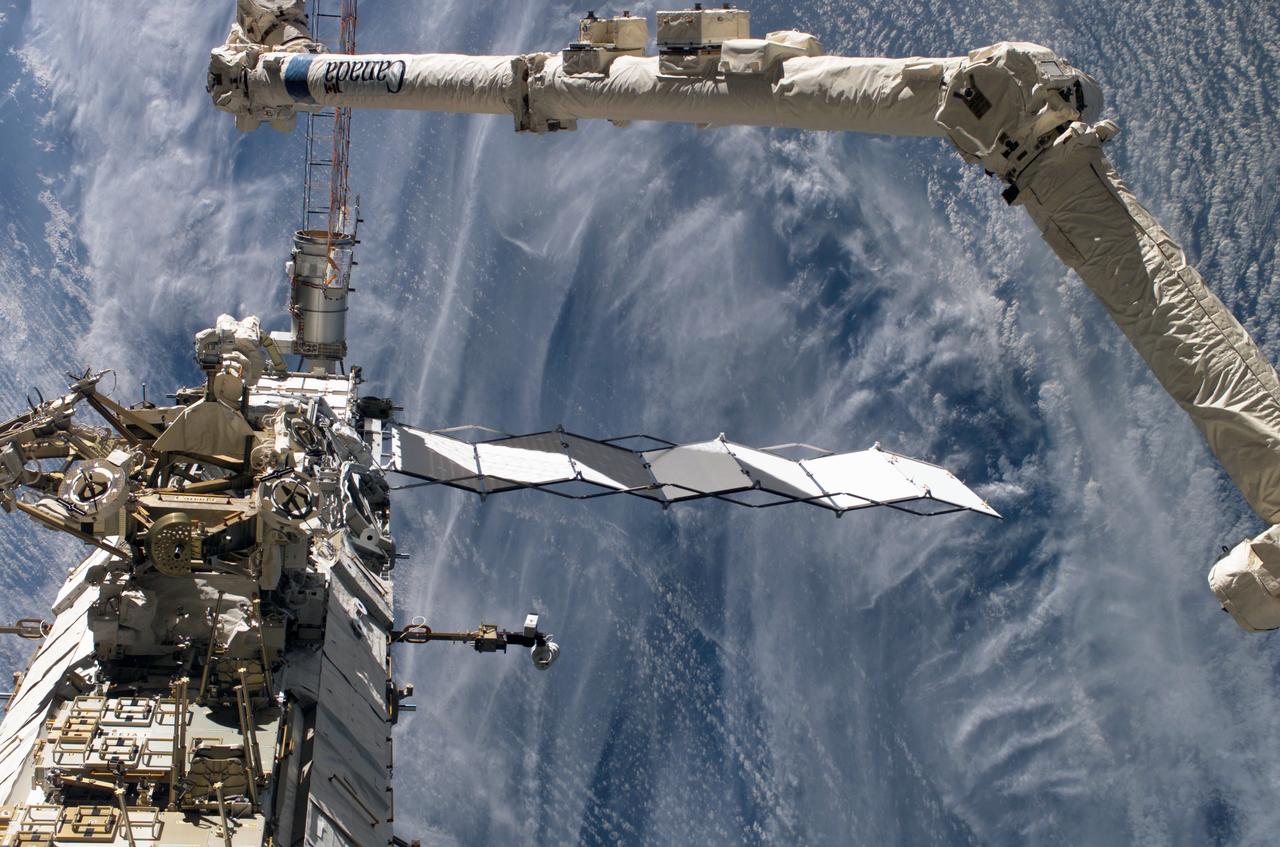
S115-E-06143 (15 Sept. 2006) --- Backdropped by a blue and white Earth, the newly installed P3/P4 truss and the Canadarm2 of the International Space Station are featured in this image photographed by a STS-115 crewmember while the Space Shuttle Atlantis was docked with the International Space Station.
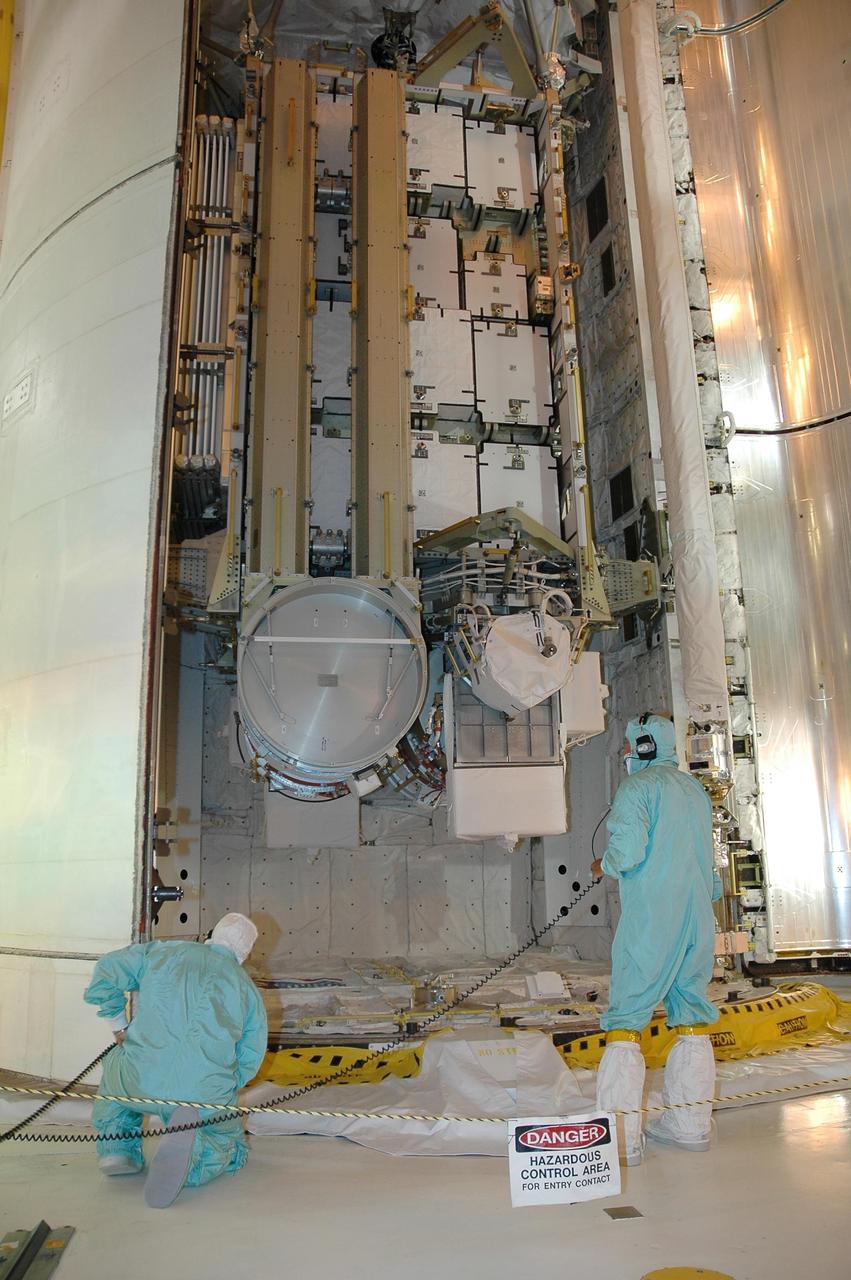
KENNEDY SPACE CENTER, FLA. - Workers on Launch Pad 39B watch closely as Space Shuttle Atlantis' payload bay doors begin to close. Inside the payload bay is the orbiter's cargo, the 17-and-a-half-ton P3/P4 truss segment for the International Space Station. Mission STS-115 is scheduled to lift off about 4:30 p.m. Aug. 27. The crew will deliver and install the P3/P4 segment to the port side of the integrated truss system on the International Space Station. The truss includes a new set of photovoltaic solar arrays. When unfurled to their full length of 240 feet, the arrays will provide additional power for the station in preparation for the delivery of international science modules over the next two years. The mission is expected to last 11 days and includes three scheduled spacewalks. Photo credit: NASA/Kim Shiflett
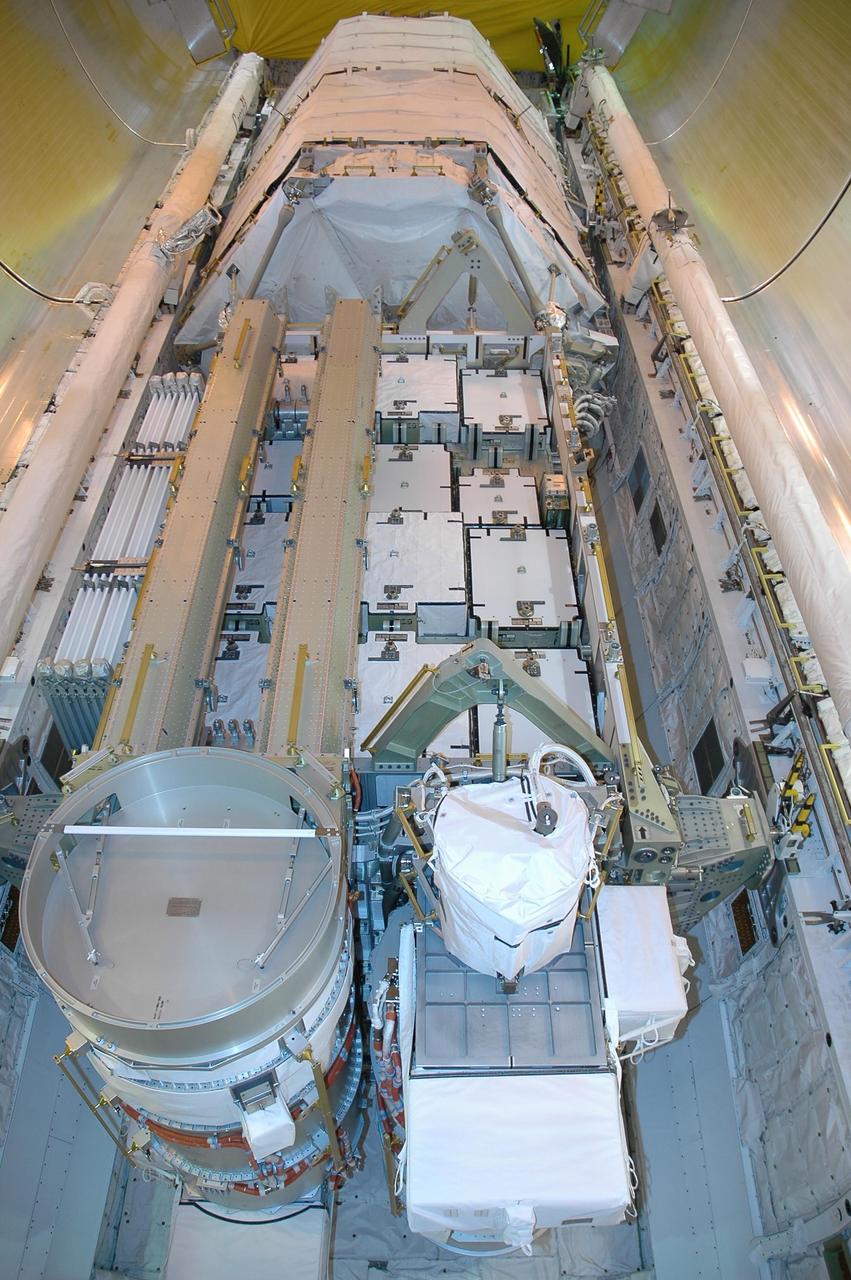
KENNEDY SPACE CENTER, FLA. - On Launch Pad 39B, the cargo in Space Shuttle Atlantis' payload bay is seen before the closing of the bay doors. The cargo is the 17-and-a-half-ton P3/P4 truss segment for the International Space Station. Scheduled to launch Aug. 27, Atlantis will fly on mission STS-115 with a crew of six to deliver and install the P3/P4 segment to the port side of the integrated truss system on the orbital outpost. The truss includes a new set of photovoltaic solar arrays. When unfurled to their full length of 240 feet, the arrays will provide additional power for the station in preparation for the delivery of international science modules over the next two years. STS-115 is expected to last 11 days and includes three scheduled spacewalks. Photo credit: NASA/Jack Pfaller

KENNEDY SPACE CENTER, FLA. - In the Orbiter Processing Facility at NASA's Kennedy Space Center, STS-115 crew members inspect equipment in Atlantis's payload bay. Mission Specialists Heidemarie Stefanyshyn-Piper (center) and Joseph Tanner look at the orbiter docking mechanism. The crew is at KSC for Crew Equipment Interface Test activities, which involves equipment familiarization, a routine part of astronaut training and launch preparations. The STS-115 mission will deliver the second port truss segment, the P3/P4 truss, to the International Space Station. The crew will attach the P3 to the first port truss segment, the P1 truss, as well as deploy solar array set 2A and 4A. Launch on Space Shuttle Atlantis is scheduled for late August. Photo credit: NASA/Kim Shiflett
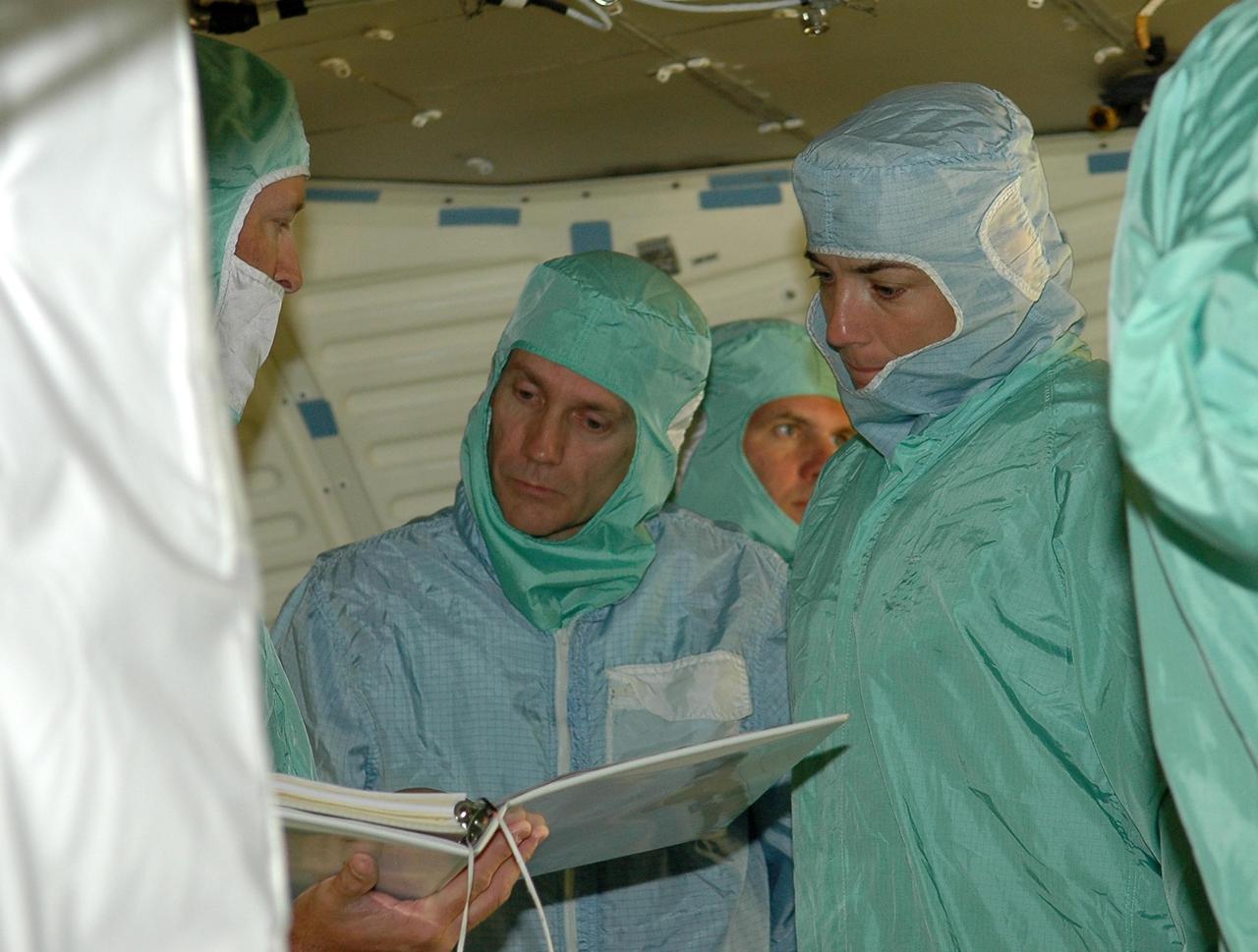
KENNEDY SPACE CENTER, FLA. - In the Orbiter Processing Facility, STS-115 Mission Speciailsts Steven MacLean and Heidemarie Stefanyshyn-Piper (center) review procedures for launch while inspecting the orbiter Atlantis. The crew is at KSC for Crew Equipment Interface Test activities, which involve equipment familiarization and inspection, a routine part of astronaut training and launch preparations. The STS-115 mission will deliver the second port truss segment, the P3/P4 truss, to the International Space Station. The crew will attach the P3 to the first port truss segment, the P1 truss, as well as deploy solar array set 2A and 4A. Launch on Space Shuttle Atlantis is scheduled for late August. Photo credit: NASA/Kim Shiflett
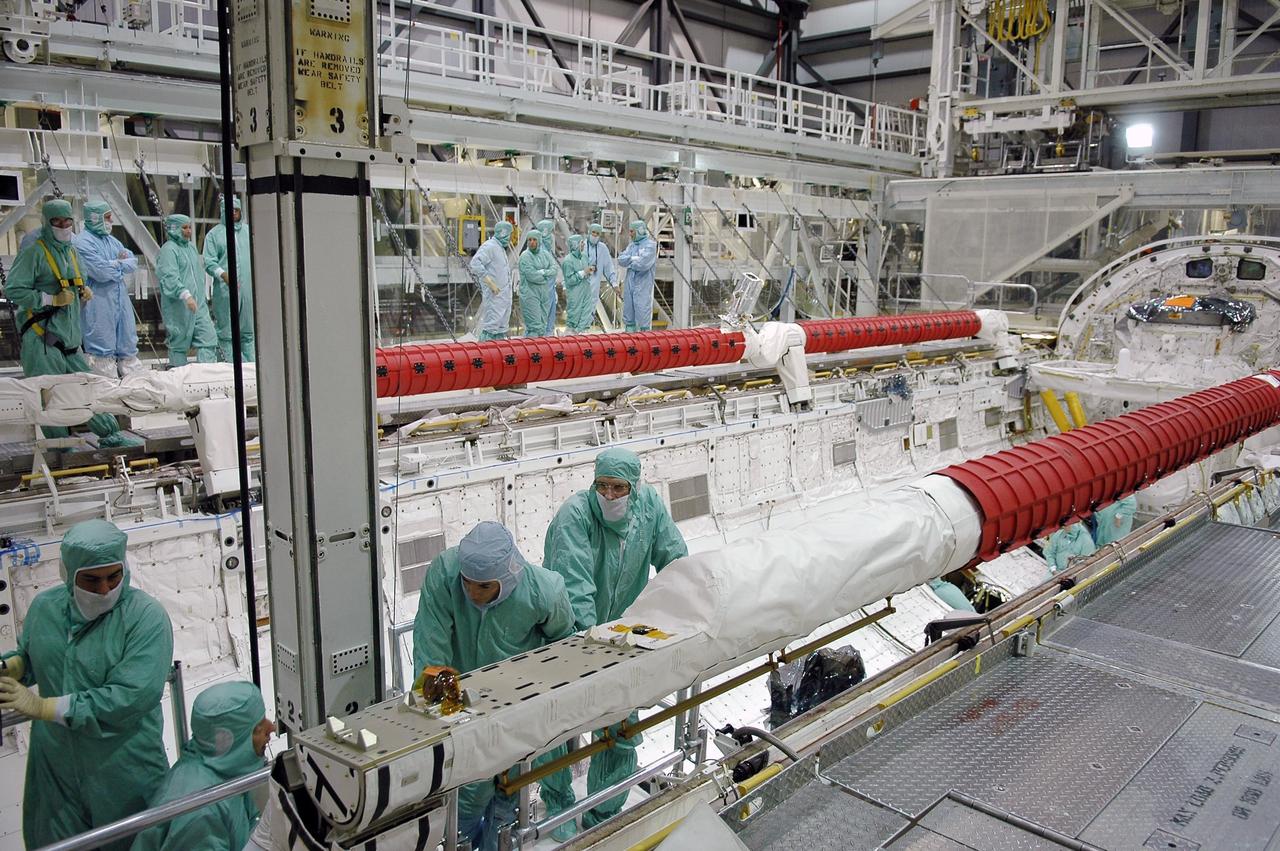
KENNEDY SPACE CENTER, FLA. - In the Orbiter Processing Facility at NASA's Kennedy Space Center, STS-115 crew members inspect equipment in Atlantis's payload bay. At right are Mission Specialists Heidemarie Stefanyshyn-Piper and Joseph Tanner looking at the orbiter boom sensor system. The crew is at KSC for Crew Equipment Interface Test activities, which involves equipment familiarization, a routine part of astronaut training and launch preparations. The STS-115 mission will deliver the second port truss segment, the P3/P4 truss, to the International Space Station. The crew will attach the P3 to the first port truss segment, the P1 truss, as well as deploy solar array set 2A and 4A. Launch on Space Shuttle Atlantis is scheduled for late August. Photo credit: NASA/Kim Shiflett
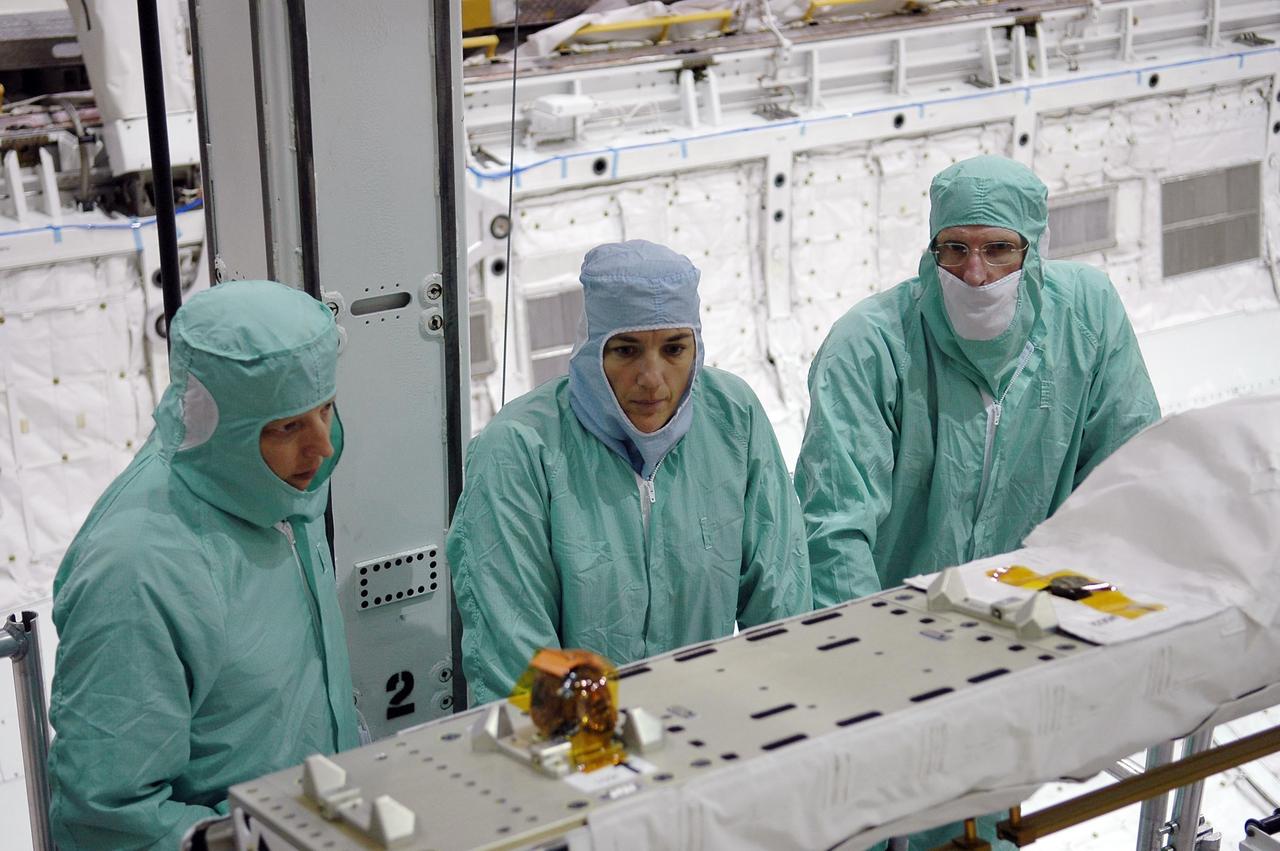
KENNEDY SPACE CENTER, FLA. - In the Orbiter Processing Facility at NASA's Kennedy Space Center, STS-115 crew members inspect equipment in Atlantis's payload bay. Looking at the airlock are Mission Specialists Steven MacLean (left) and Daniel Burbank (foreground). The crew is at KSC for Crew Equipment Interface Test activities, which involves equipment familiarization, a routine part of astronaut training and launch preparations. The STS-115 mission will deliver the second port truss segment, the P3/P4 truss, to the International Space Station. The crew will attach the P3 to the first port truss segment, the P1 truss, as well as deploy solar array set 2A and 4A. Launch on Space Shuttle Atlantis is scheduled for late August. Photo credit: NASA/Kim Shiflett
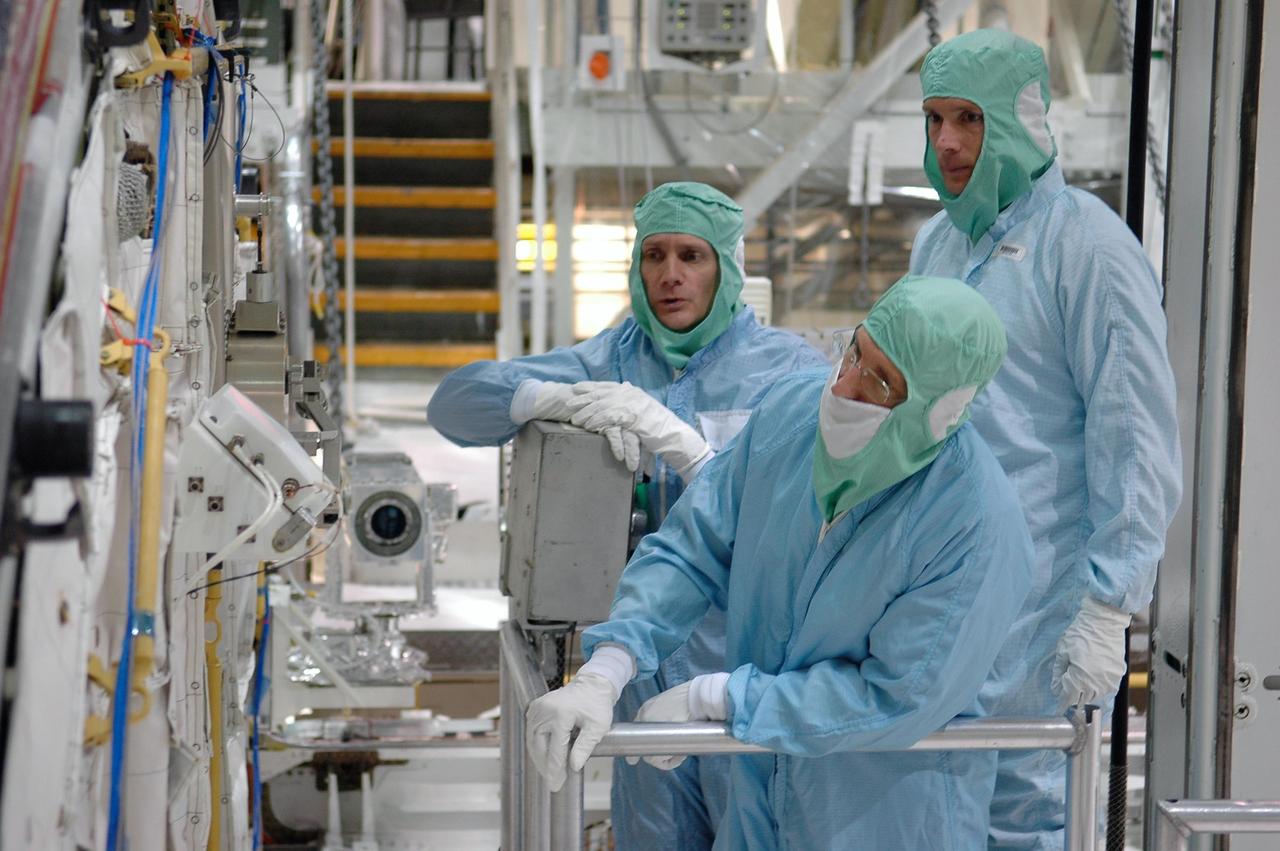
KENNEDY SPACE CENTER, FLA. - In the Orbiter Processing Facility at NASA's Kennedy Space Center, STS-115 crew members inspect equipment in Atlantis's payload bay. Mission Specialists Heidemarie Stefanyshyn-Piper (center) and Joseph Tanner (right) look at the orbiter boom sensor system. The crew is at KSC for Crew Equipment Interface Test activities, which involves equipment familiarization, a routine part of astronaut training and launch preparations. The STS-115 mission will deliver the second port truss segment, the P3/P4 truss, to the International Space Station. The crew will attach the P3 to the first port truss segment, the P1 truss, as well as deploy solar array set 2A and 4A. Launch on Space Shuttle Atlantis is scheduled for late August. Photo credit: NASA/Kim Shiflett
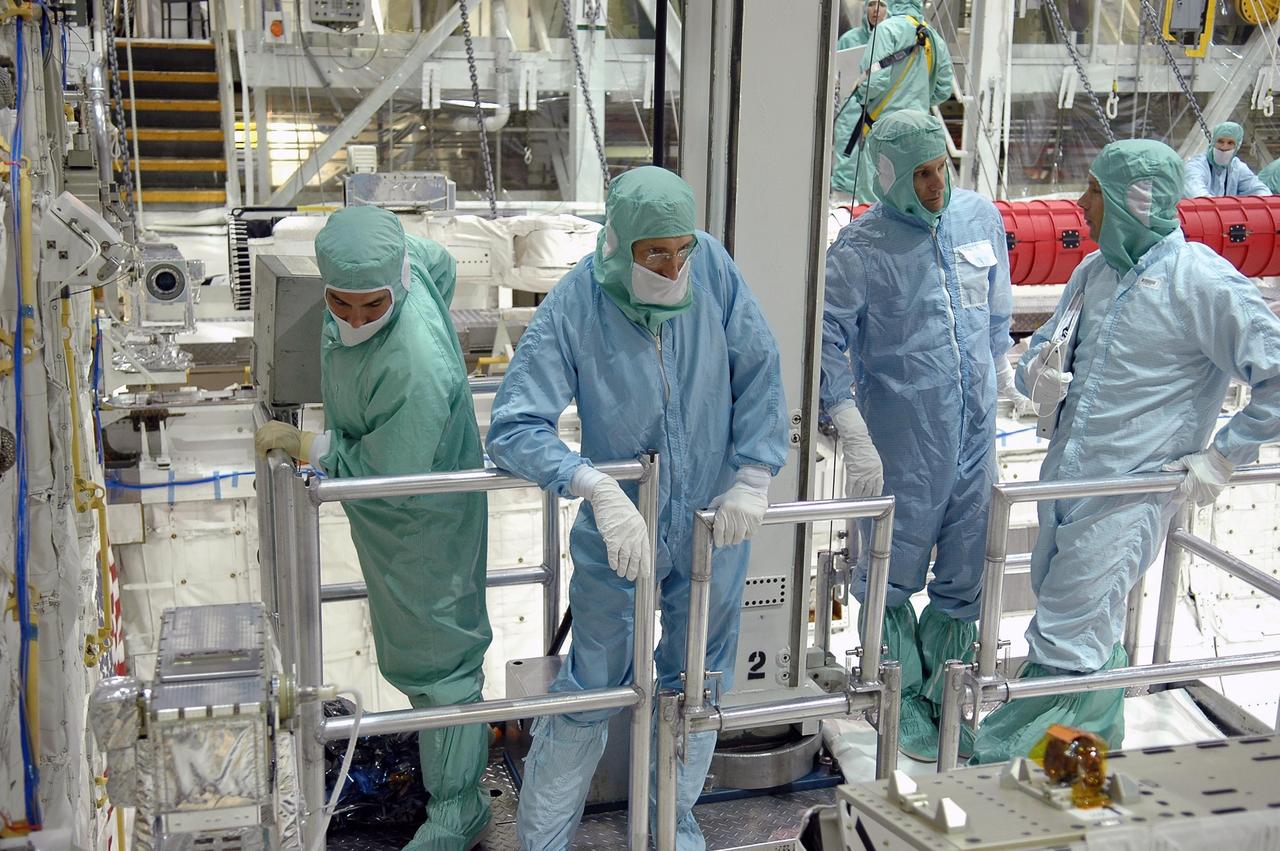
KENNEDY SPACE CENTER, FLA. - In the Orbiter Processing Facility at NASA's Kennedy Space Center, STS-115 crew members inspect equipment in Atlantis's payload bay. Mission Specialist Daniel Burbank (second from left) looks into the bay. Next to him on the right is Mission Specialist Steven MacLean, talking to a technician. The crew is at KSC for Crew Equipment Interface Test activities, which involves equipment familiarization, a routine part of astronaut training and launch preparations. The STS-115 mission will deliver the second port truss segment, the P3/P4 truss, to the International Space Station. The crew will attach the P3 to the first port truss segment, the P1 truss, as well as deploy solar array set 2A and 4A. Launch on Space Shuttle Atlantis is scheduled for late August. Photo credit: NASA/Kim Shiflett
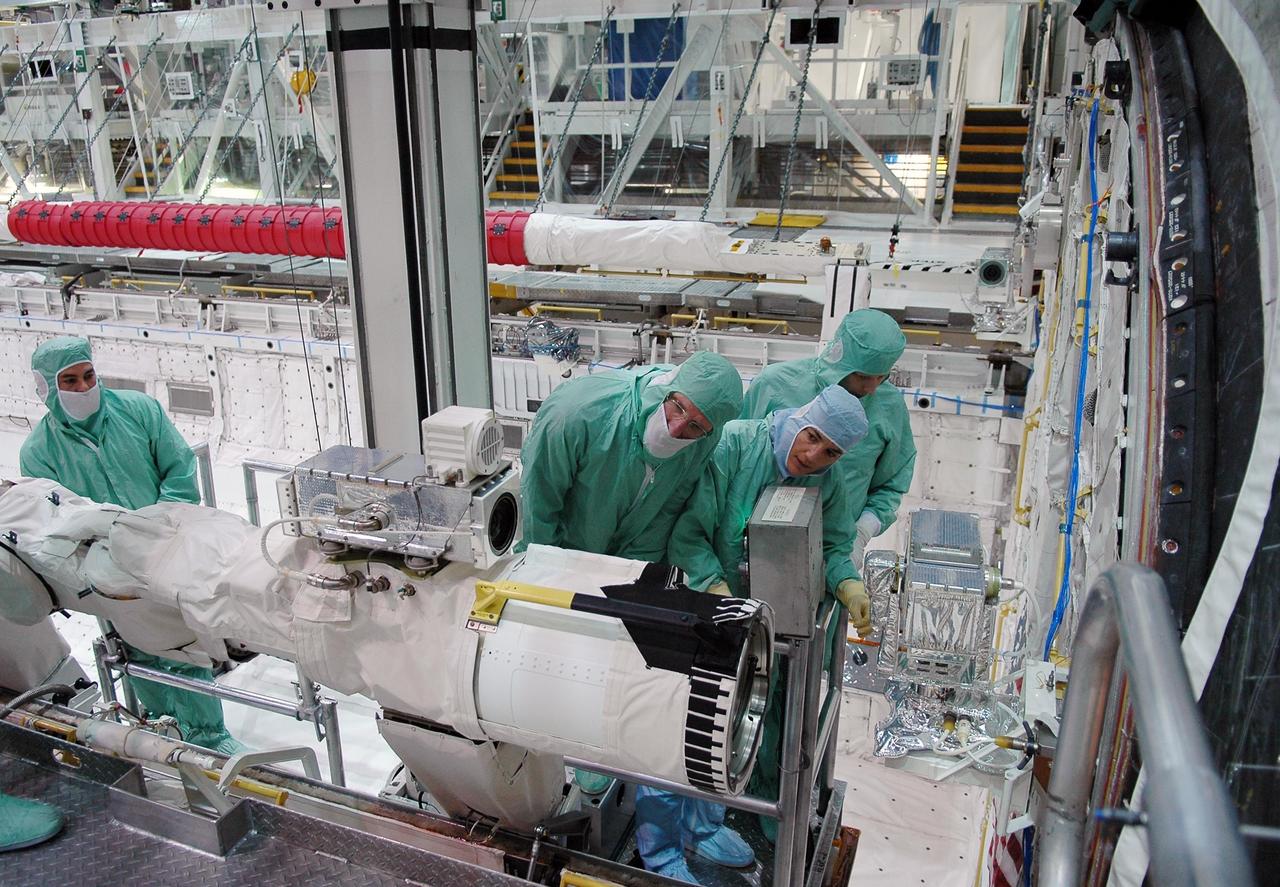
KENNEDY SPACE CENTER, FLA. - In the Orbiter Processing Facility at NASA's Kennedy Space Center, STS-115 crew members inspect equipment in Atlantis's payload bay. Looking at the orbiter boom sensor system are, from left, Mission Specialists Joseph Tanner and Heidemarie Stefanyshyn-Piper. The crew is at KSC for Crew Equipment Interface Test activities, which involves equipment familiarization, a routine part of astronaut training and launch preparations. The STS-115 mission will deliver the second port truss segment, the P3/P4 truss, to the International Space Station. The crew will attach the P3 to the first port truss segment, the P1 truss, as well as deploy solar array set 2A and 4A. Launch on Space Shuttle Atlantis is scheduled for late August. Photo credit: NASA/Kim Shiflett

KENNEDY SPACE CENTER, FLA. - On Launch Pad 39B, the payload bay doors on Space Shuttle Atlantis have closed around the orbiter's cargo, the 17-and-a-half-ton P3/P4 truss segment for the International Space Station. Scheduled to launch Aug. 27, Atlantis will fly on mission STS-115 with a crew of six to deliver and install the P3/P4 segment to the port side of the integrated truss system on the orbital outpost. The truss includes a new set of photovoltaic solar arrays. When unfurled to their full length of 240 feet, the arrays will provide additional power for the station in preparation for the delivery of international science modules over the next two years. STS-115 is expected to last 11 days and includes three scheduled spacewalks. Photo credit: NASA/Jack Pfaller
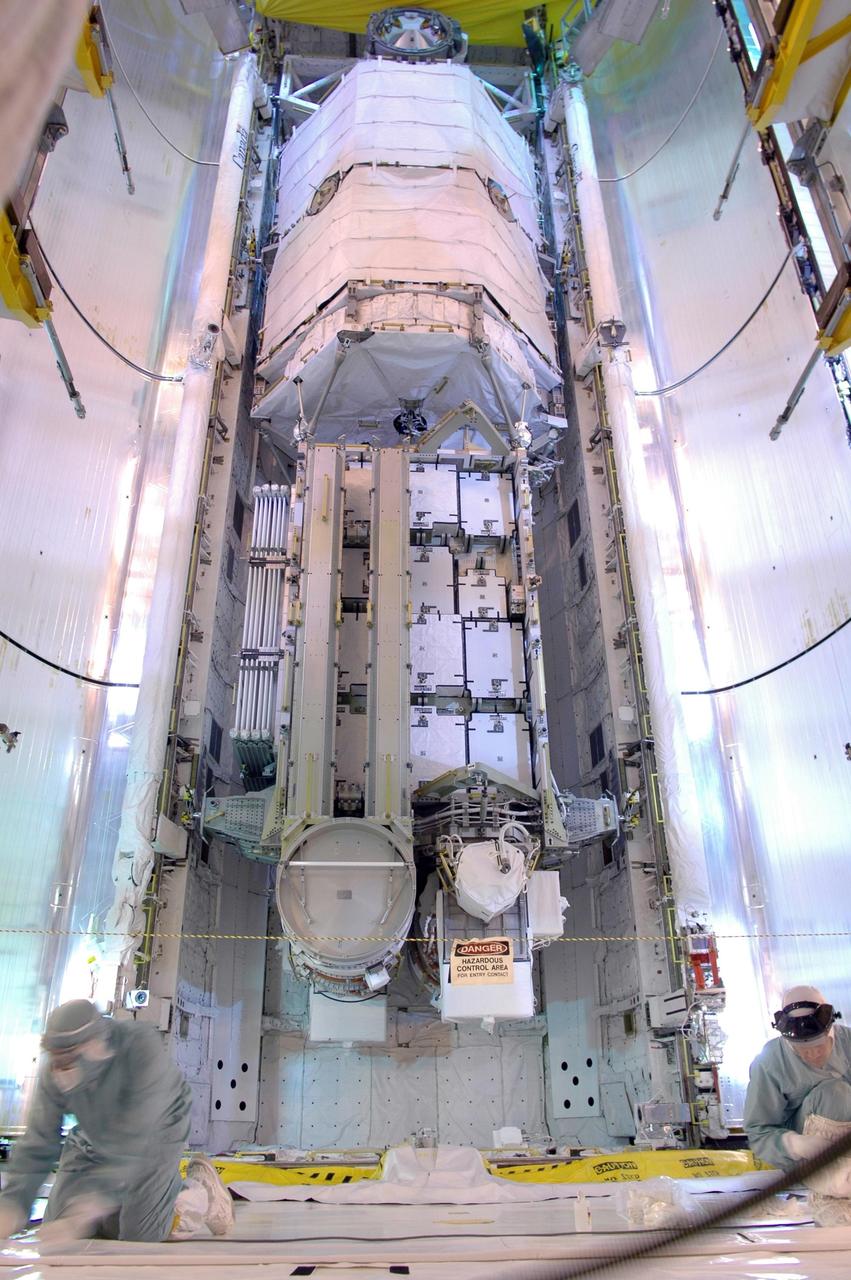
KENNEDY SPACE CENTER, FLA. - On Launch Pad 39B, Space Shuttle Atlantis' payload bay doors are being closed for launch. Inside is seen the orbiter's cargo, the 17-and-a-half-ton P3/P4 truss segment for the International Space Station. Mission STS-115 is scheduled to lift off about 4:30 p.m. Aug. 27. The crew will deliver and install the P3/P4 segment to the port side of the integrated truss system on the International Space Station. The truss includes a new set of photovoltaic solar arrays. When unfurled to their full length of 240 feet, the arrays will provide additional power for the station in preparation for the delivery of international science modules over the next two years. The mission is expected to last 11 days and includes three scheduled spacewalks. Photo credit: NASA/Kim Shiflett
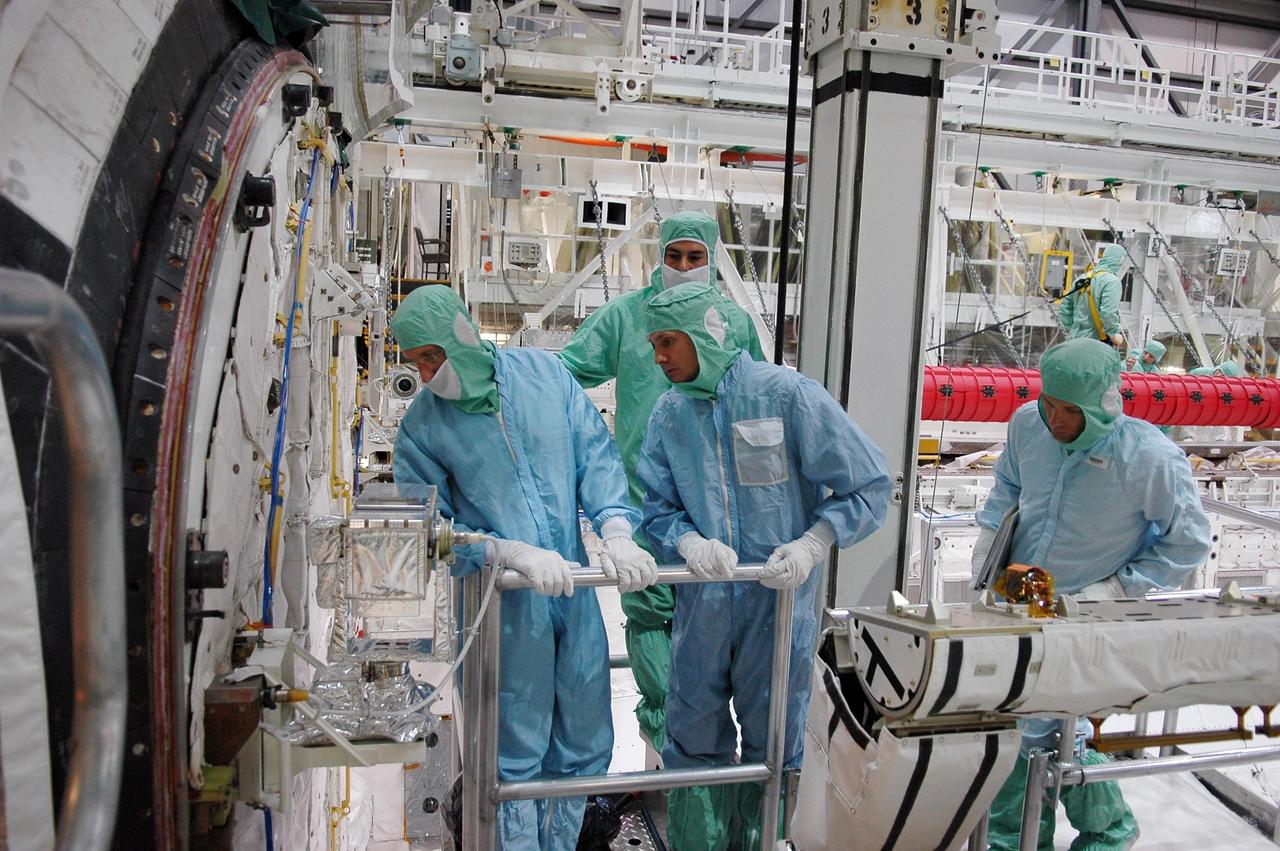
KENNEDY SPACE CENTER, FLA. - In the Orbiter Processing Facility at NASA's Kennedy Space Center, STS-115 crew members inspect equipment in Atlantis's payload bay. Looking at the airlock are Mission Specialist Daniel Burbank (left) and Steven MacLean. The crew is at KSC for Crew Equipment Interface Test activities, which involves equipment familiarization, a routine part of astronaut training and launch preparations. The STS-115 mission will deliver the second port truss segment, the P3/P4 truss, to the International Space Station. The crew will attach the P3 to the first port truss segment, the P1 truss, as well as deploy solar array set 2A and 4A. Launch on Space Shuttle Atlantis is scheduled for late August. Photo credit: NASA/Kim Shiflett
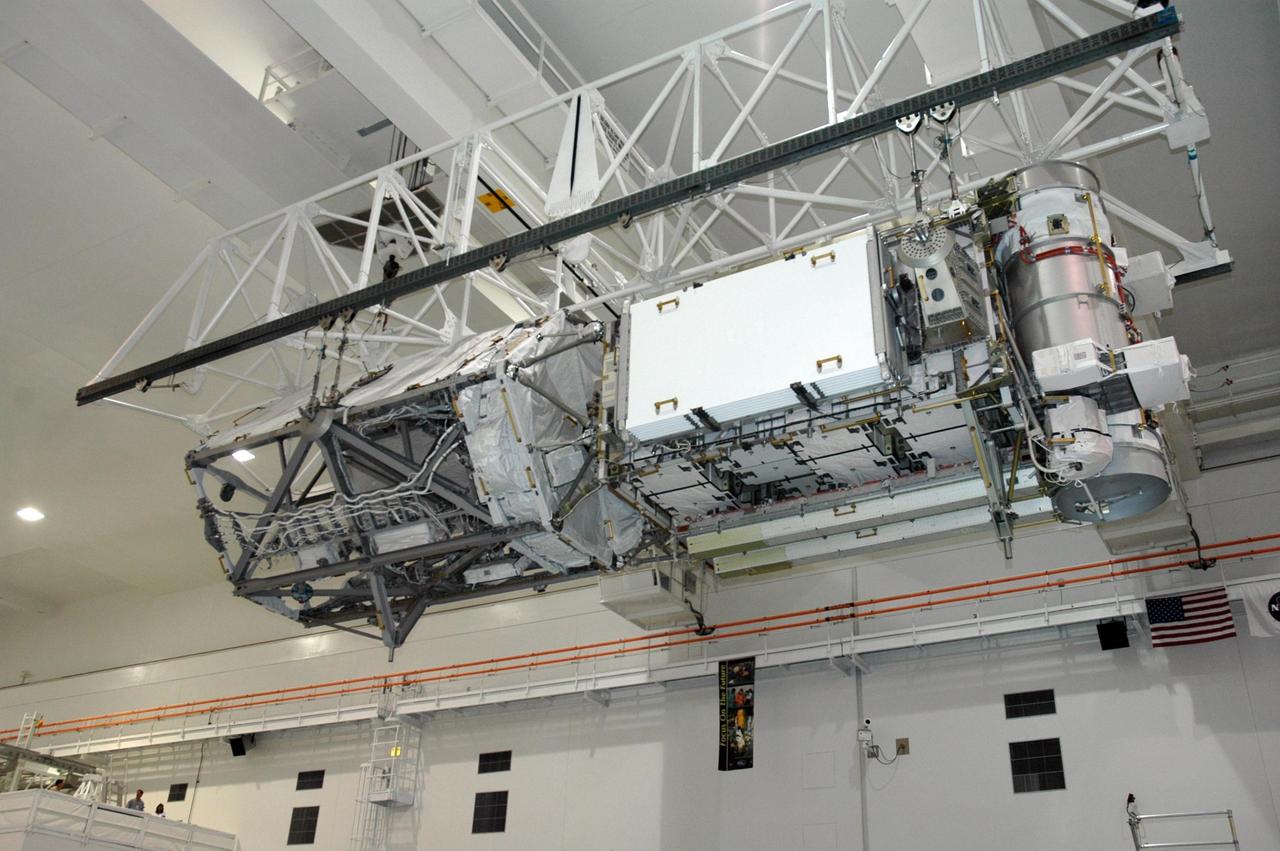
KENNEDY SPACE CENTER, FLA. - In the Space Station Processing Facility, an overhead crane lowers the Port 3/4 truss segment toward the waiting payload canister for installation in the orbiter Atlantis. On the right end are the mast canisters for the solar arrays. The truss is slated for launch on mission STS-115 no earlier than Aug. 28. The truss is the next major addition to the 11-segment integrated truss structure that will eventually span more than 300 feet on the station. The P3/P4 truss, with its two large solar arrays, will provide one-fourth of the total power-generation capability of the completed station. The P3/P4 truss is expected to be loaded into Atlantis's cargo bay around the beginning of August. Photo credit: NASA/Troy Cryder
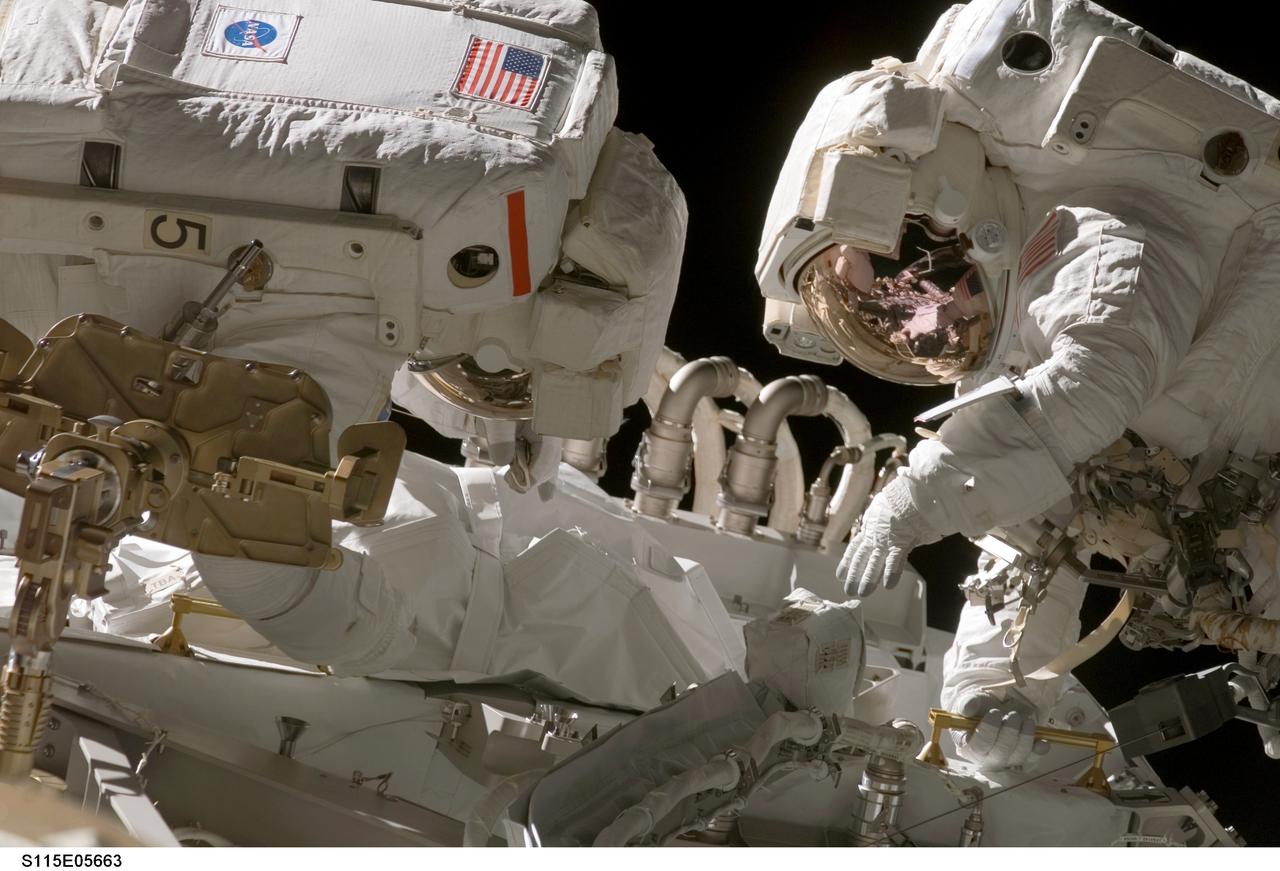
S115-E-05663 (12 Sept. 2006) --- Astronauts Joseph R. Tanner (left) and Heidemarie M. Stefanyshyn-Piper, both STS-115 mission specialists, work in tandem during the mission's first session of extravehicular activity (EVA) while the Space Shuttle Atlantis was docked with the International Space Station. During today's spacewalk, Tanner and Stefanyshyn-Piper worked to connect power cables on the P3/P4 truss, release restraints for the Solar Array Blanket Boxes that hold the solar arrays and the Beta Gimbal Assemblies that serve as the structural link between the truss' integrated electronics and the Solar Array Wings. Stefanyshyn-Piper and Tanner also installed the Solar Alpha Rotary Joint and completed the connection of electrical cables between the new P3 truss and the P1 truss.
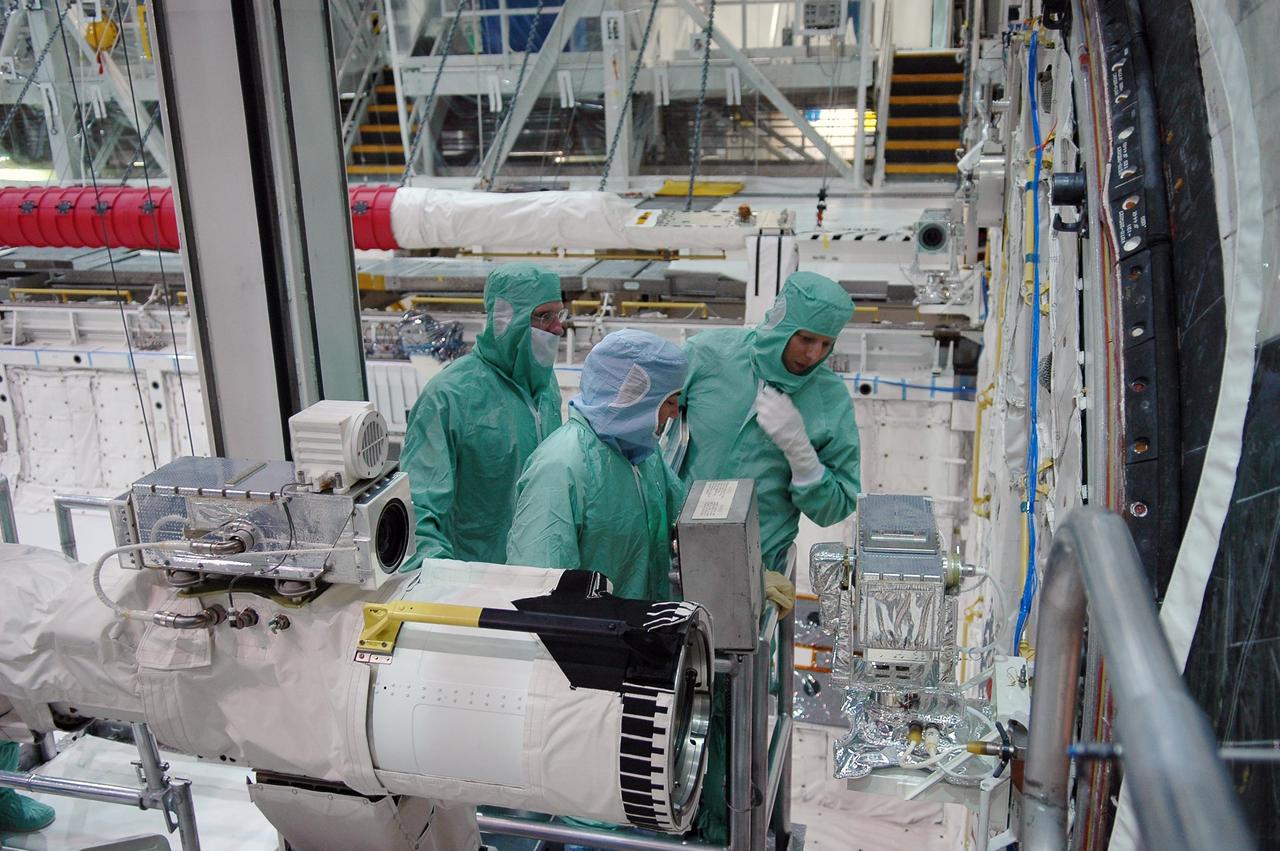
KENNEDY SPACE CENTER, FLA. - In the Orbiter Processing Facility at NASA's Kennedy Space Center, STS-115 crew members inspect equipment in Atlantis's payload bay. From left are Mission Specialists Joseph Tanner and Heidemarie Stefanyshyn-Piper. The crew is at KSC for Crew Equipment Interface Test activities, which involves equipment familiarization, a routine part of astronaut training and launch preparations. The STS-115 mission will deliver the second port truss segment, the P3/P4 truss, to the International Space Station. The crew will attach the P3 to the first port truss segment, the P1 truss, as well as deploy solar array set 2A and 4A. Launch on Space Shuttle Atlantis is scheduled for late August. Photo credit: NASA/Kim Shiflett
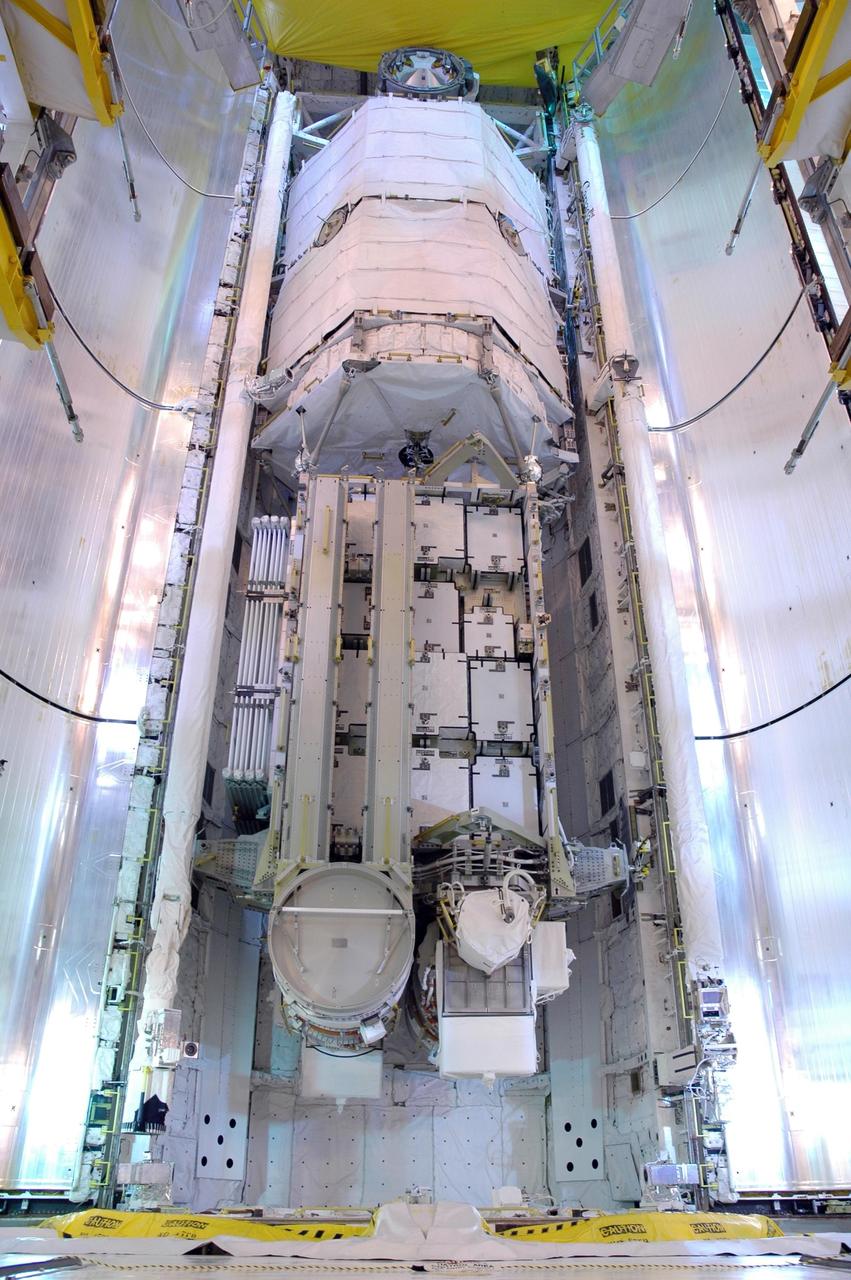
KENNEDY SPACE CENTER, FLA. - On Launch Pad 39B, Space Shuttle Atlantis' payload bay doors are being closed for launch. Inside is seen the orbiter's cargo, the 17-and-a-half-ton P3/P4 truss segment for the International Space Station. Scheduled to launch Aug. 27, Atlantis will fly on mission STS-115 with a crew of six to deliver and install the P3/P4 segment to the port side of the integrated truss system on the orbital outpost. The truss includes a new set of photovoltaic solar arrays. When unfurled to their full length of 240 feet, the arrays will provide additional power for the station in preparation for the delivery of international science modules over the next two years. STS-115 is expected to last 11 days and includes three scheduled spacewalks. Photo credit: NASA/Jim Grossmann
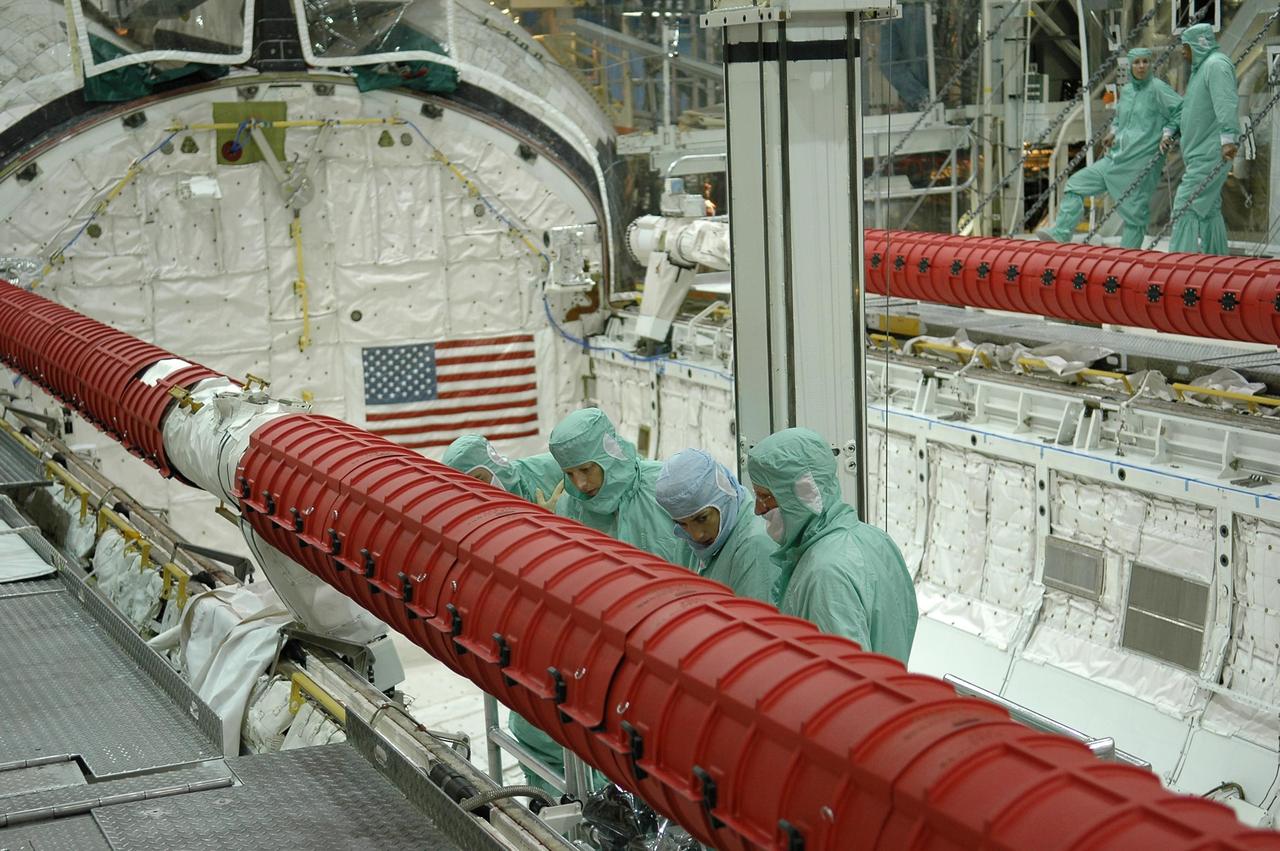
KENNEDY SPACE CENTER, FLA. - In the Orbiter Processing Facility at NASA's Kennedy Space Center, STS-115 crew members inspect equipment in Atlantis's payload bay. Mission Specialists Heidemarie Stefanyshyn-Piper (second from right) and Joseph Tanner (right) look at the orbiter boom sensor system. The crew is at KSC for Crew Equipment Interface Test activities, which involves equipment familiarization, a routine part of astronaut training and launch preparations. The STS-115 mission will deliver the second port truss segment, the P3/P4 truss, to the International Space Station. The crew will attach the P3 to the first port truss segment, the P1 truss, as well as deploy solar array set 2A and 4A. Launch on Space Shuttle Atlantis is scheduled for late August. Photo credit: NASA/Kim Shiflett
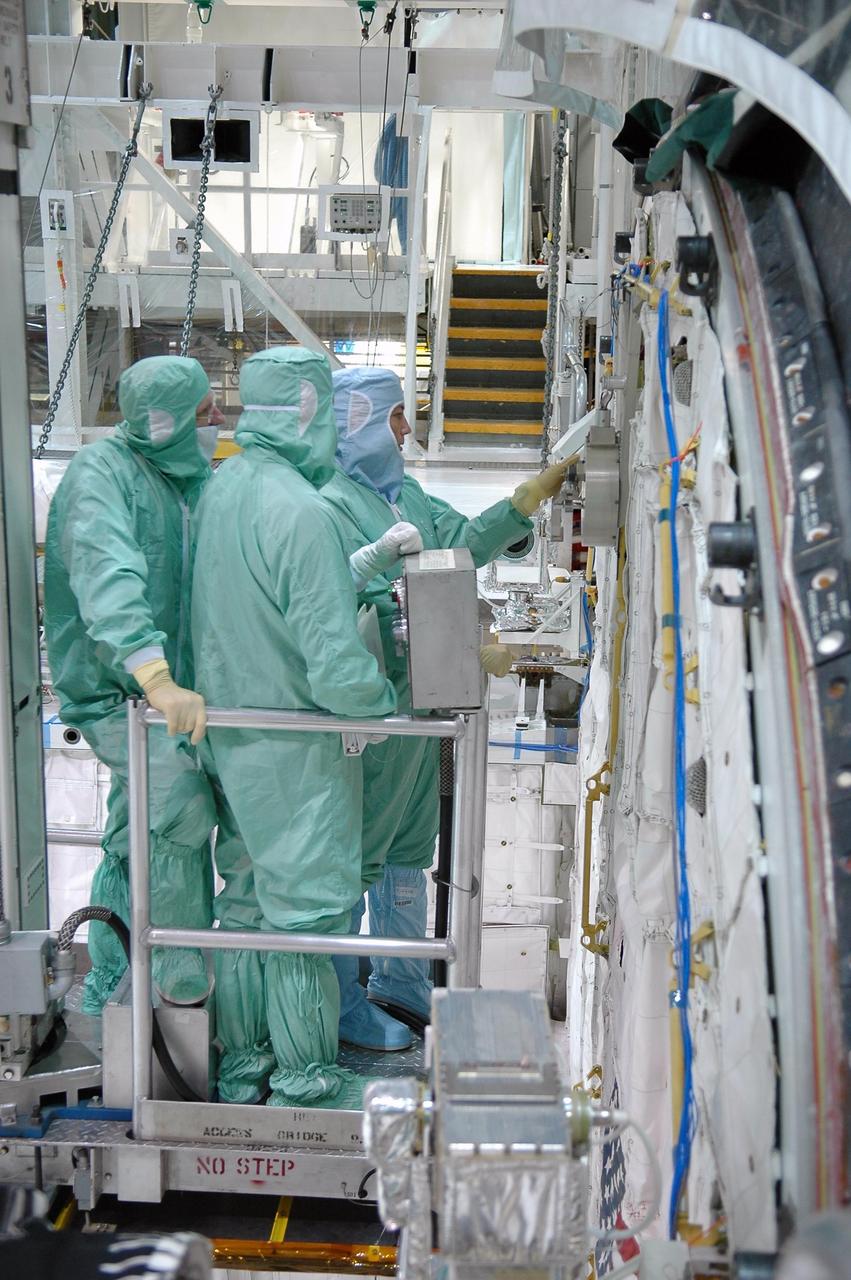
KENNEDY SPACE CENTER, FLA. - In the Orbiter Processing Facility at NASA's Kennedy Space Center, STS-115 crew members inspect equipment in Atlantis's payload bay. Mission Specialists (at left) Joseph Tanner and (at right) Heidemarie Stefanyshyn-Piper look at the airlock. The crew is at KSC for Crew Equipment Interface Test activities, which involves equipment familiarization, a routine part of astronaut training and launch preparations. The STS-115 mission will deliver the second port truss segment, the P3/P4 truss, to the International Space Station. The crew will attach the P3 to the first port truss segment, the P1 truss, as well as deploy solar array set 2A and 4A. Launch on Space Shuttle Atlantis is scheduled for late August. Photo credit: NASA/Kim Shiflett
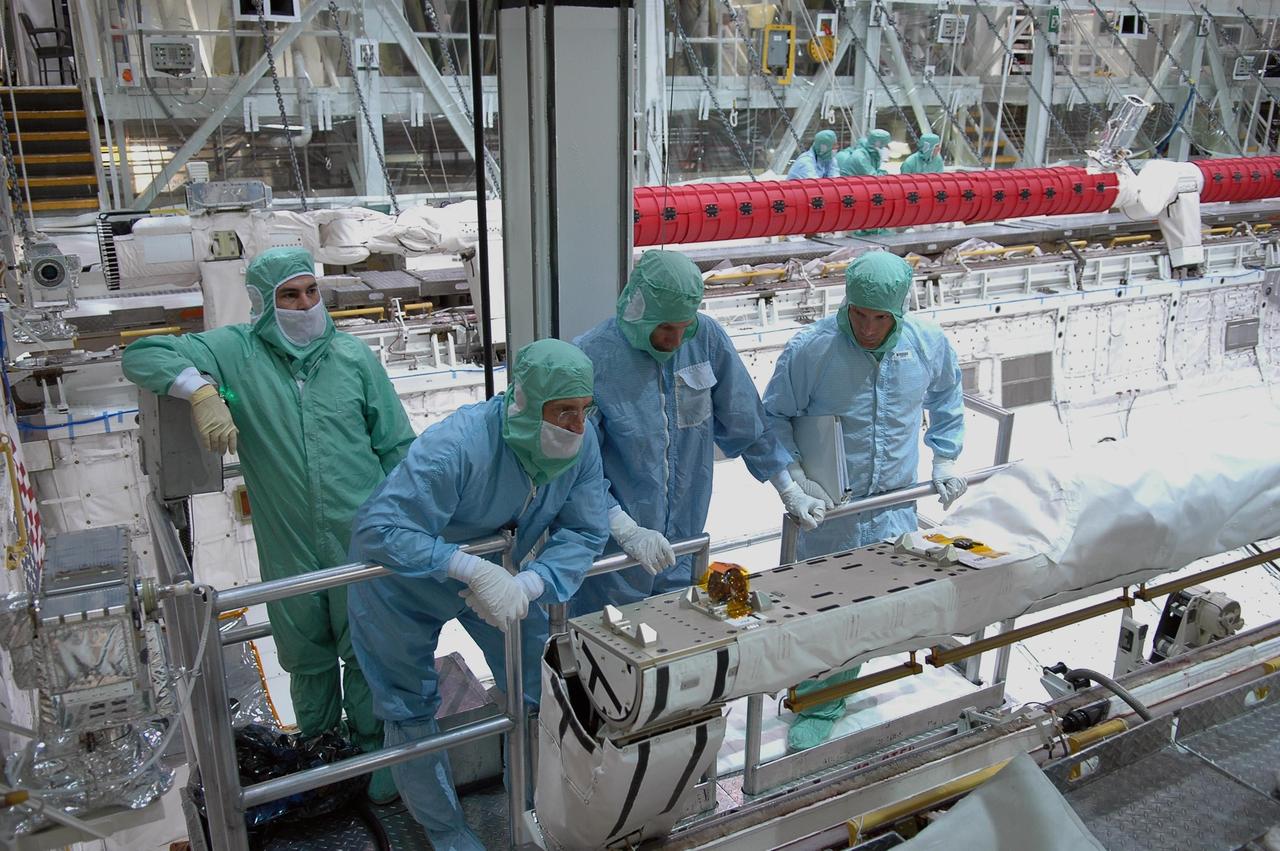
KENNEDY SPACE CENTER, FLA. - In the Orbiter Processing Facility at NASA's Kennedy Space Center, STS-115 crew members inspect equipment in Atlantis's payload bay. Mission Specialists (starting second from left) Daniel Burbank and Steven MacLean look at the orbiter boom sensor system. The crew is at KSC for Crew Equipment Interface Test activities, which involves equipment familiarization, a routine part of astronaut training and launch preparations. The STS-115 mission will deliver the second port truss segment, the P3/P4 truss, to the International Space Station. The crew will attach the P3 to the first port truss segment, the P1 truss, as well as deploy solar array set 2A and 4A. Launch on Space Shuttle Atlantis is scheduled for late August. Photo credit: NASA/Kim Shiflett
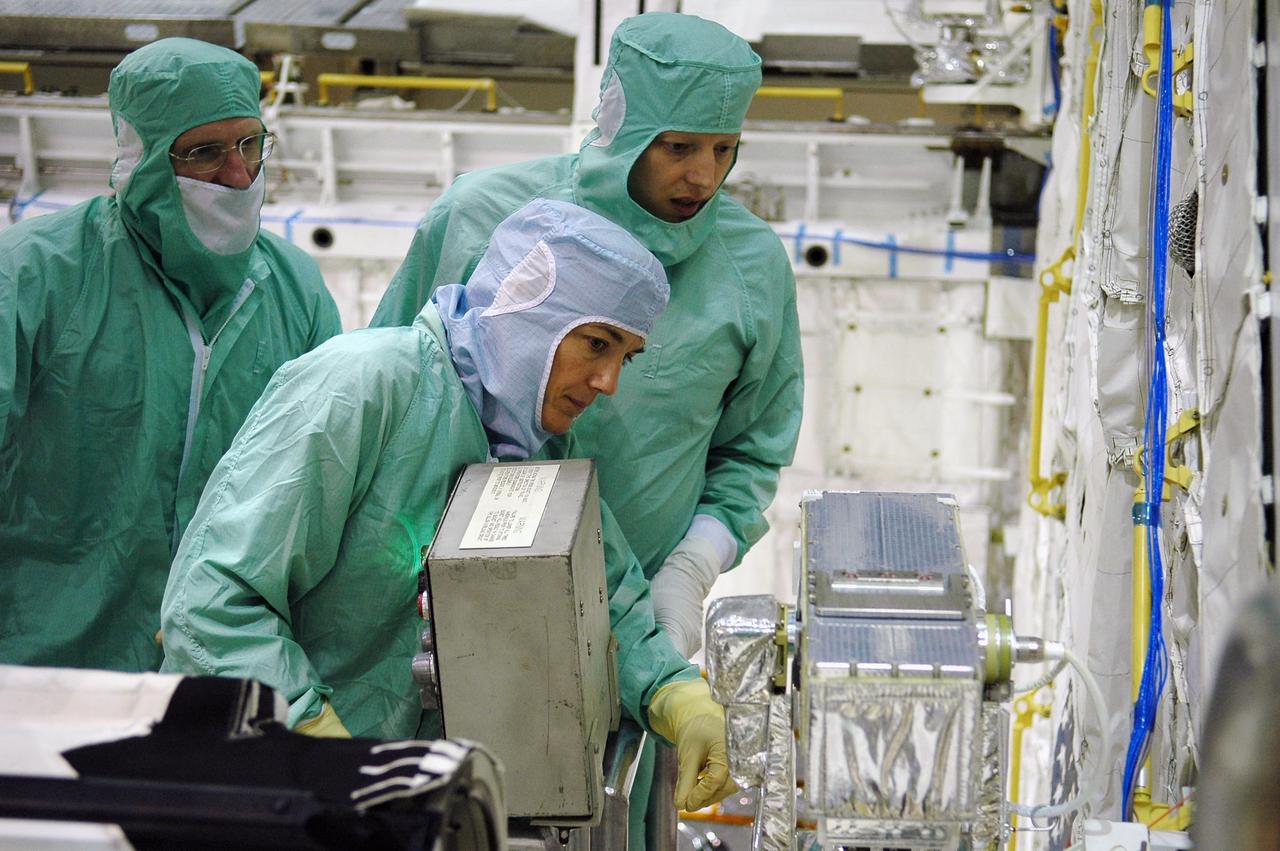
KENNEDY SPACE CENTER, FLA. - In the Orbiter Processing Facility at NASA's Kennedy Space Center, STS-115 crew members inspect equipment in Atlantis's payload bay. From left are Mission Specialists Joseph Tanner and Heidemarie Stefanyshyn-Piper. The crew is at KSC for Crew Equipment Interface Test activities, which involves equipment familiarization, a routine part of astronaut training and launch preparations. The STS-115 mission will deliver the second port truss segment, the P3/P4 truss, to the International Space Station. The crew will attach the P3 to the first port truss segment, the P1 truss, as well as deploy solar array set 2A and 4A. Launch on Space Shuttle Atlantis is scheduled for late August. Photo credit: NASA/Kim Shiflett
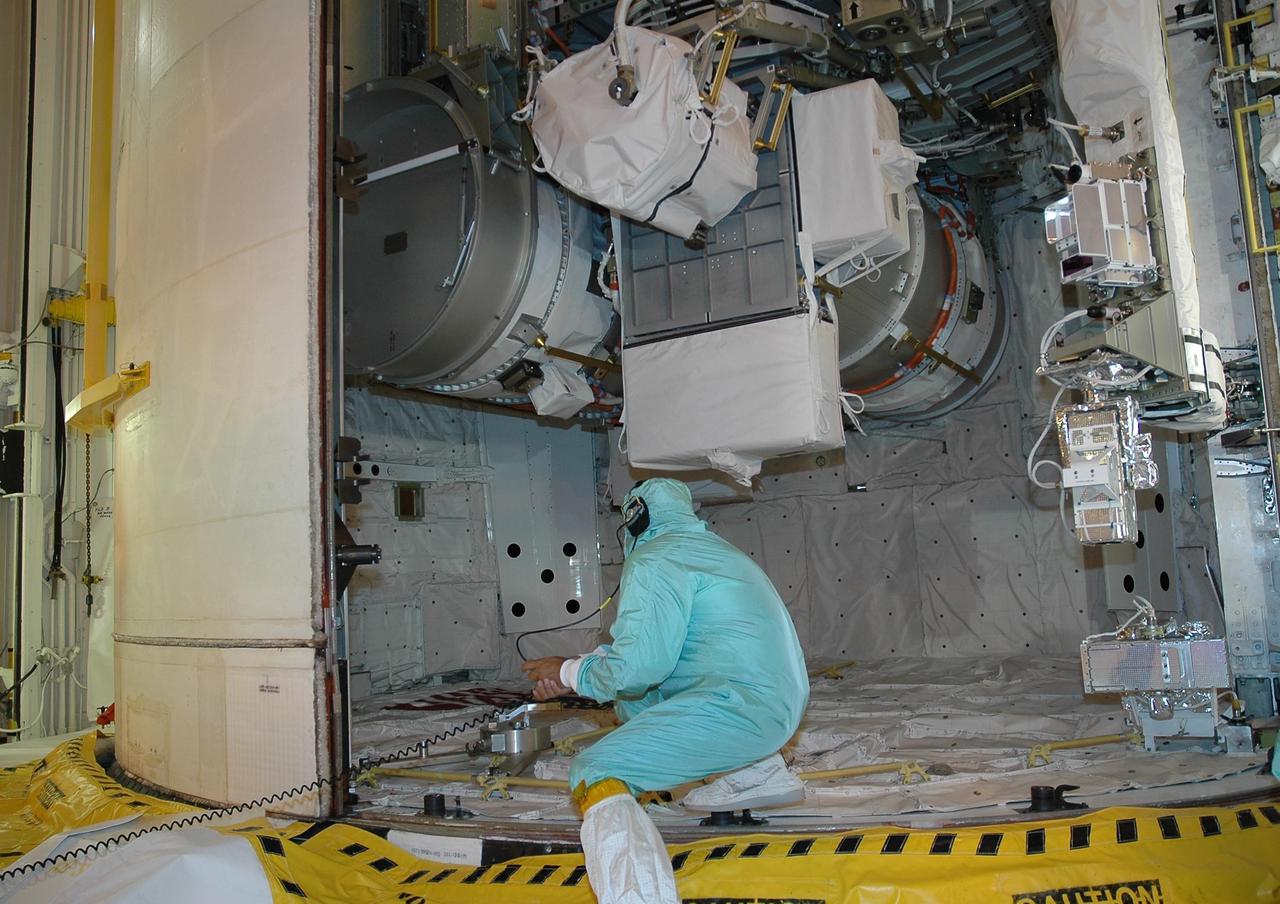
KENNEDY SPACE CENTER, FLA. - On Launch Pad 39B, a worker checks the port payload bay door as it closes around the cargo in Space Shuttle Atlantis' payload bay. The cargo is the 17-and-a-half-ton P3/P4 truss segment for the International Space Station. Scheduled to launch Aug. 27, Atlantis will fly on mission STS-115 with a crew of six to deliver and install the P3/P4 segment to the port side of the integrated truss system on the orbital outpost. The truss includes a new set of photovoltaic solar arrays. When unfurled to their full length of 240 feet, the arrays will provide additional power for the station in preparation for the delivery of international science modules over the next two years. STS-115 is expected to last 11 days and includes three scheduled spacewalks. Photo credit: NASA/Jack Pfaller

KENNEDY SPACE CENTER, FLA. - Workers on Launch Pad 39B examine the bottom of the starboard payload bay door as it closes around the cargo in Space Shuttle Atlantis' payload bay. The cargo is the 17-and-a-half-ton P3/P4 truss segment for the International Space Station.Mission STS-115 is scheduled to lift off about 4:30 p.m. Aug. 27. The crew will deliver and install the P3/P4 segment to the port side of the integrated truss system on the International Space Station. The truss includes a new set of photovoltaic solar arrays. When unfurled to their full length of 240 feet, the arrays will provide additional power for the station in preparation for the delivery of international science modules over the next two years. The mission is expected to last 11 days and includes three scheduled spacewalks. Photo credit: NASA/Kim Shiflett
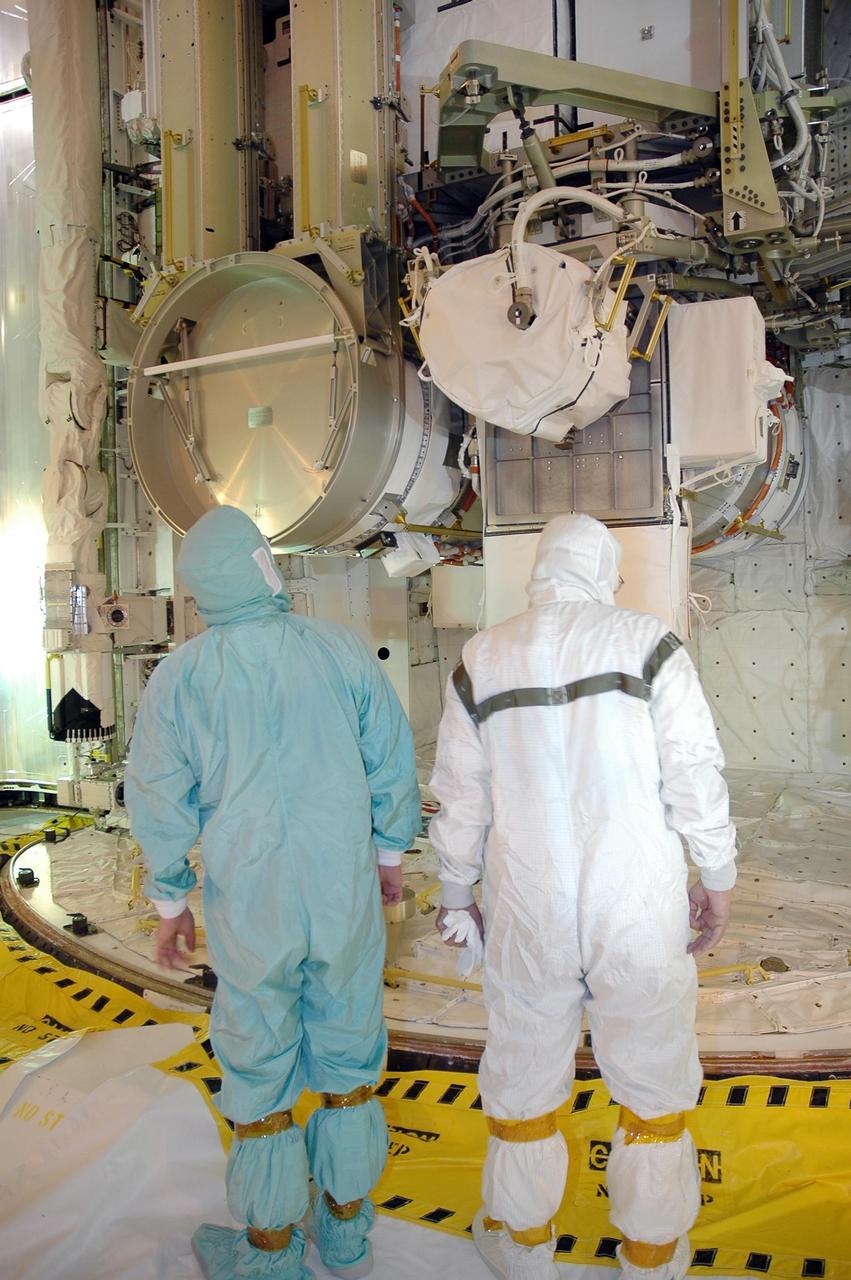
KENNEDY SPACE CENTER, FLA. - Workers on Launch Pad 39B watch closely as Space Shuttle Atlantis' payload bay doors begin to close. Inside the payload bay is the orbiter's cargo, the 17-and-a-half-ton P3/P4 truss segment for the International Space Station. Scheduled to launch Aug. 27, Atlantis will fly on mission STS-115 with a crew of six to deliver and install the P3/P4 segment to the port side of the integrated truss system on the orbital outpost. The truss includes a new set of photovoltaic solar arrays. When unfurled to their full length of 240 feet, the arrays will provide additional power for the station in preparation for the delivery of international science modules over the next two years. STS-115 is expected to last 11 days and includes three scheduled spacewalks. Photo credit: NASA/Jack Pfaller
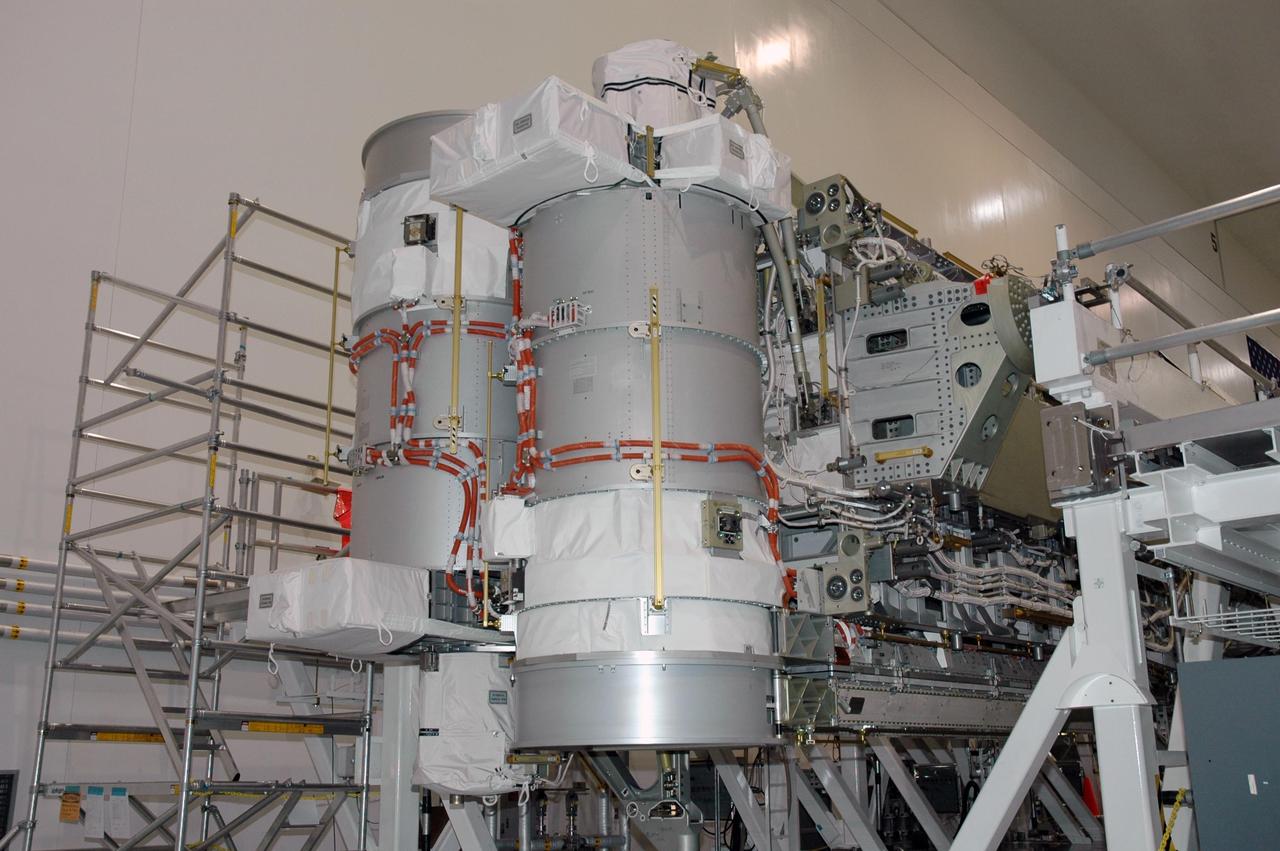
KENNEDY SPACE CENTER, FLA. - The next element to be added to the International Space Station, the Port 3/4 truss segment is being moved to a payload canister for installation in the orbiter Atlantis. The cylinders shown are the mast canisters for the solar arrays. The truss is slated for launch on mission STS-115 no earlier than Aug. 28. The truss is the next major addition to the 11-segment integrated truss structure that will eventually span more than 300 feet on the station. The P3/P4 truss, with its two large solar arrays, will provide one-fourth of the total power-generation capability of the completed station. The P3/P4 truss is expected to be loaded into Atlantis's cargo bay around the beginning of August. Photo credit: NASA/Troy Cryder
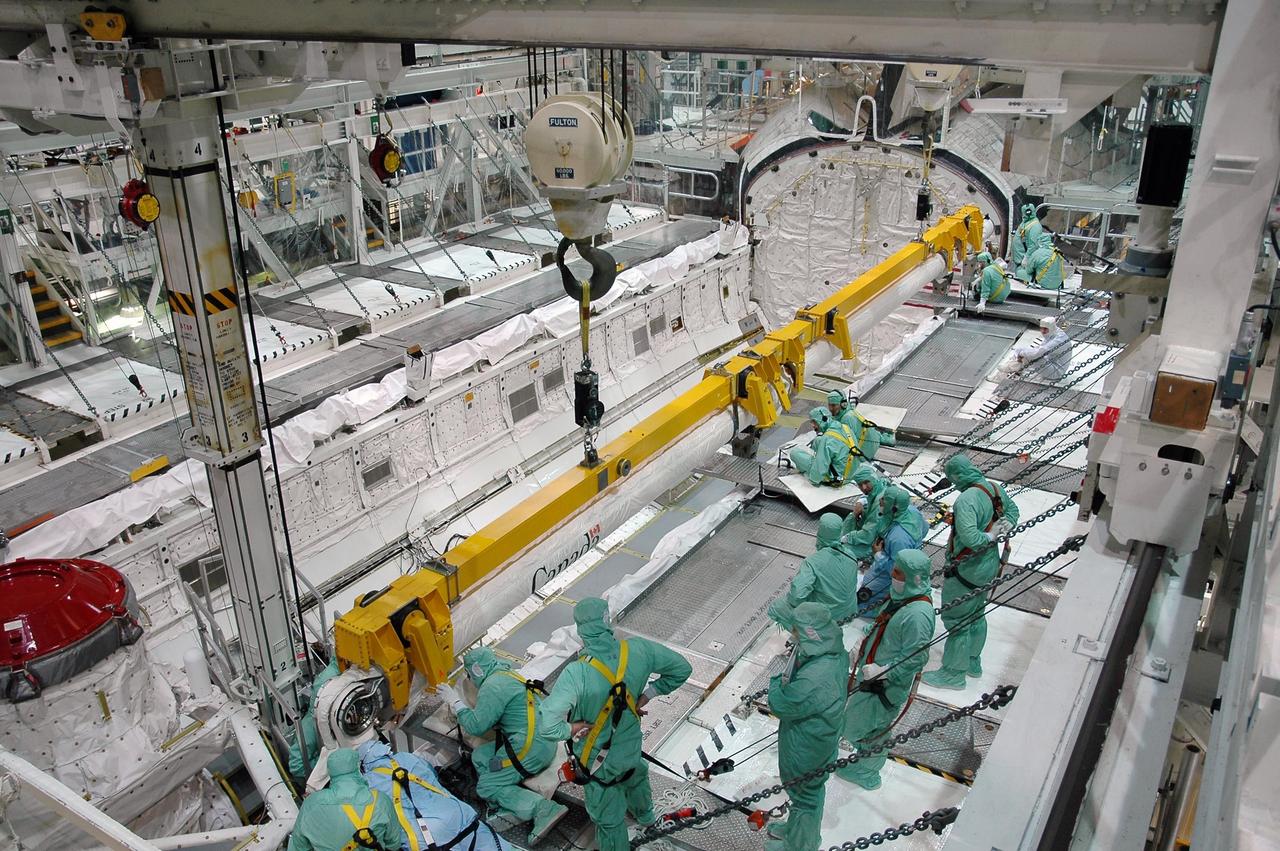
KENNEDY SPACE CENTER, FLA. - In the Orbiter Processing Facility bay 1 at NASA Kennedy Space Center, engineers finish attaching the remote manipulator system, or boom, in Atlantis’ payload bay. Atlantis is the designated orbiter for mission STS-115, the 19th assembly flight to the International Space Station. The payload includes the P3/P4 solar arrays. The launch planning window has not been determined yet for STS-115.
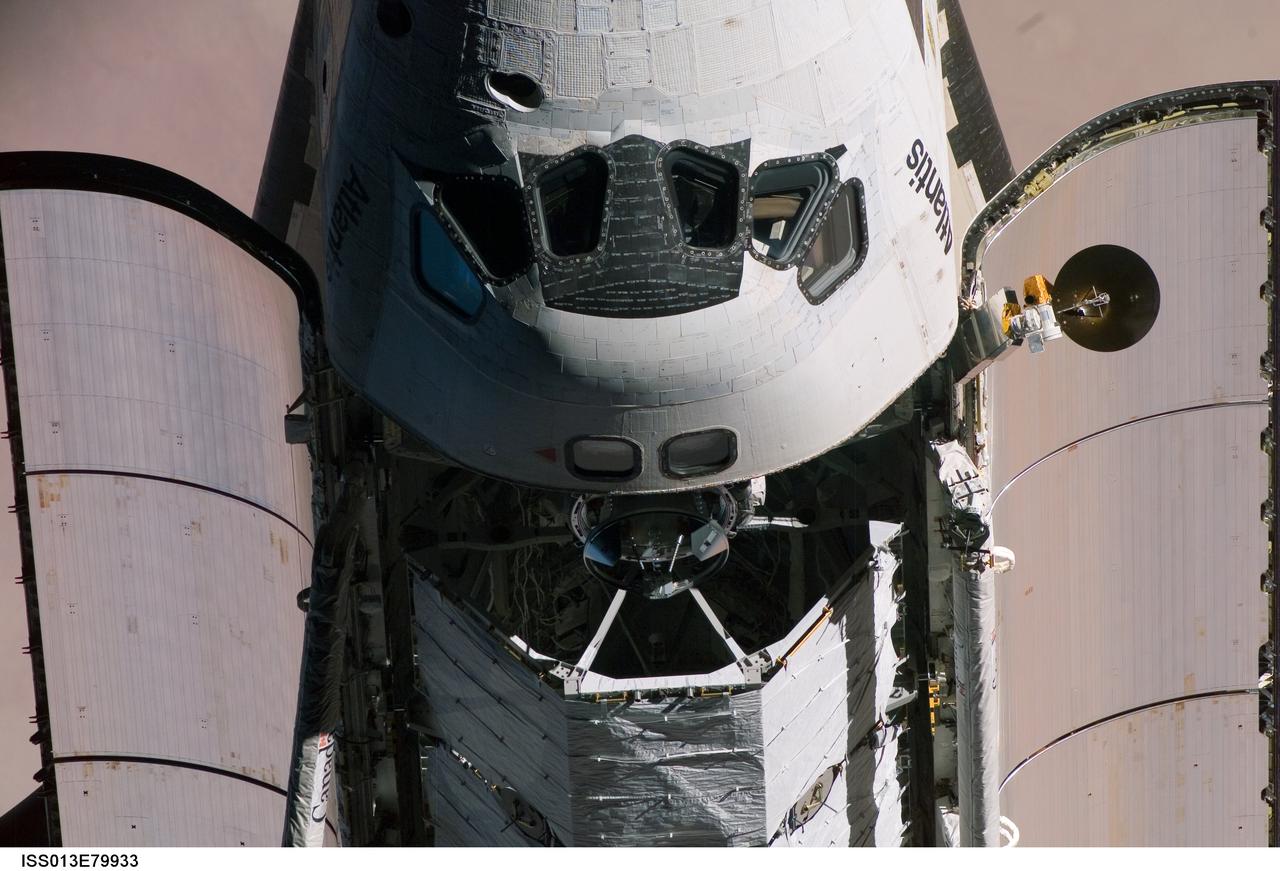
ISS013-E-79933 (11 Sept. 2006) --- This view of part of the crew cabin and the forward portion of the cargo bay of the Space Shuttle Atlantis was provided by an Expedition 13 crew member during a backflip maneuver performed by the approaching visitors to the International Space Station. Part of the P3/P4 Integrated Truss Structure can be seen in the stowed position.
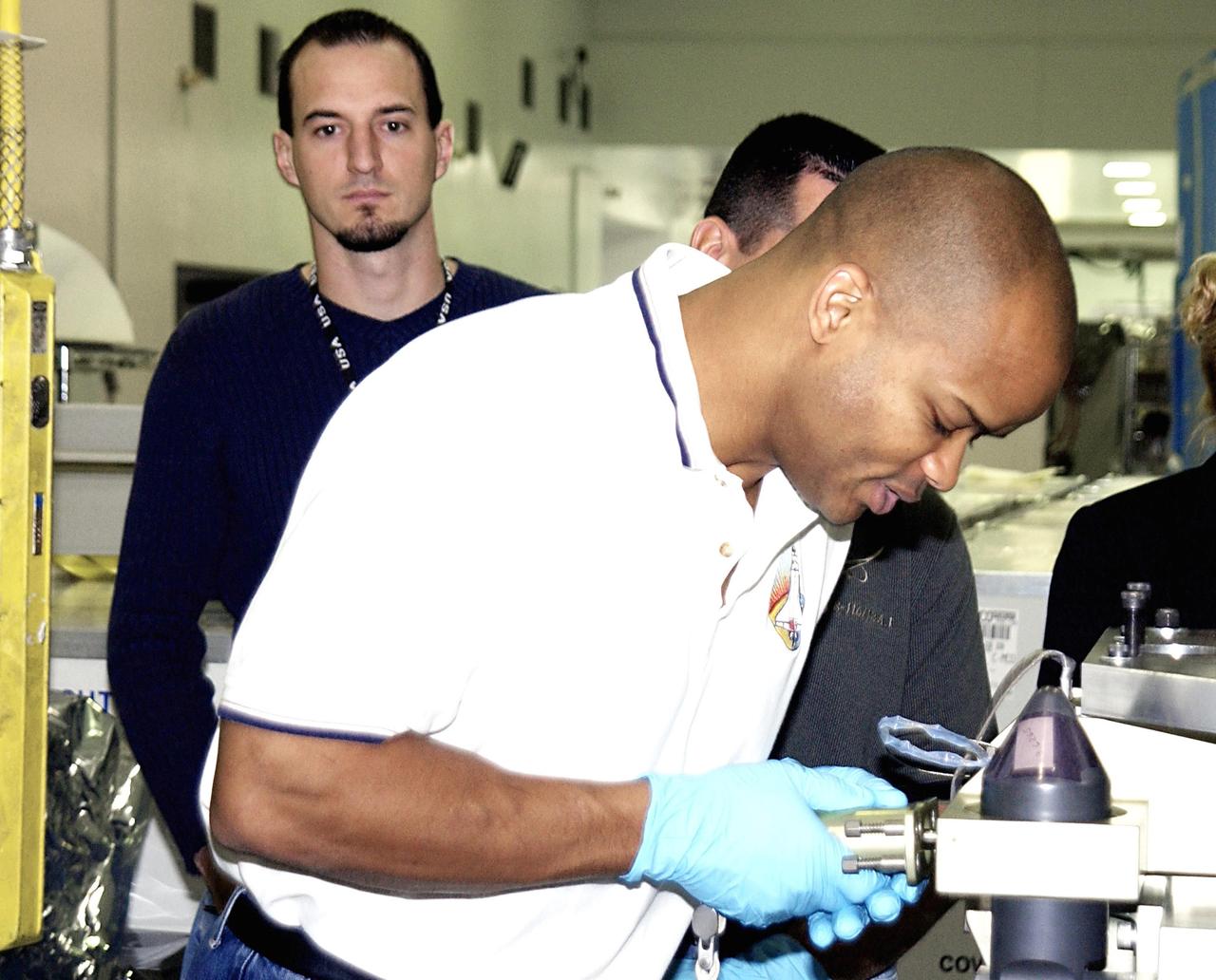
KENNEDY SPACE CENTER, FLA. - In the Space Station Processing Facility, STS-116 Mission Specialist Robert Curbeam works on equipment for the mission during a Crew Equipment Interface Test activity. Mission STS-116 is the 19th assembly flight to the International Space Station, delivering the third port truss segment, the P5 Truss, that will be attached to the second port truss segment, the P3/P4 Truss. The mission will also deliver the eighth expedition crew to the ISS and return Expedition 7. STS-116 is scheduled for launch July 24, 2003.
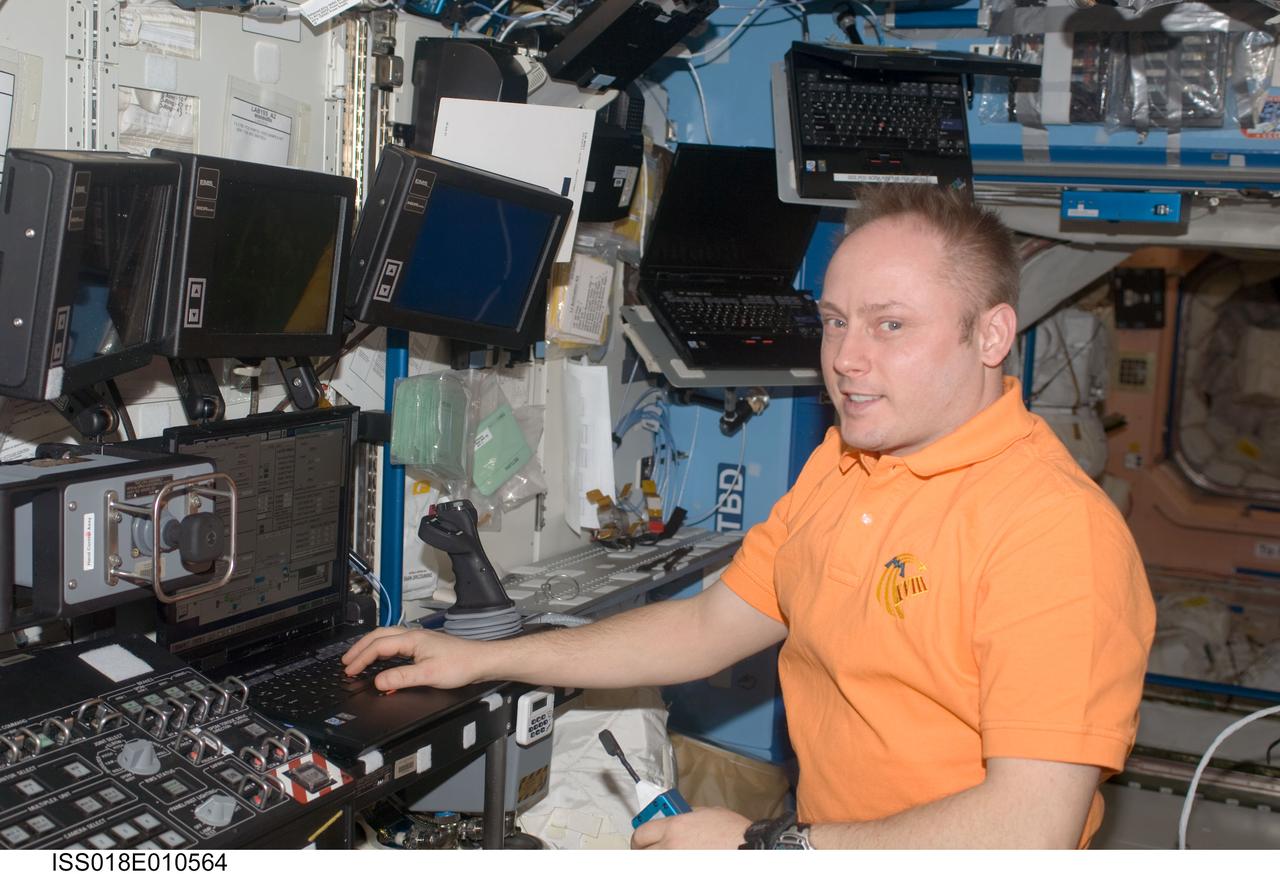
ISS018-E-010564 (5 Dec. 2008) --- Astronaut Michael Fincke, Expedition 18 commander, uses a computer at the robotics work station in the Destiny laboratory of the International Space Station. Using the station's robotic arm, Fincke and astronaut Sandra Magnus (out of frame), flight engineer, relocated the ESP-3 from the Mobile Base System back to the Cargo Carrier Attachment System on the P3 truss. The ESP-3 spare parts platform was temporarily parked on the MBS to clear the path for the spacewalks during STS-126.
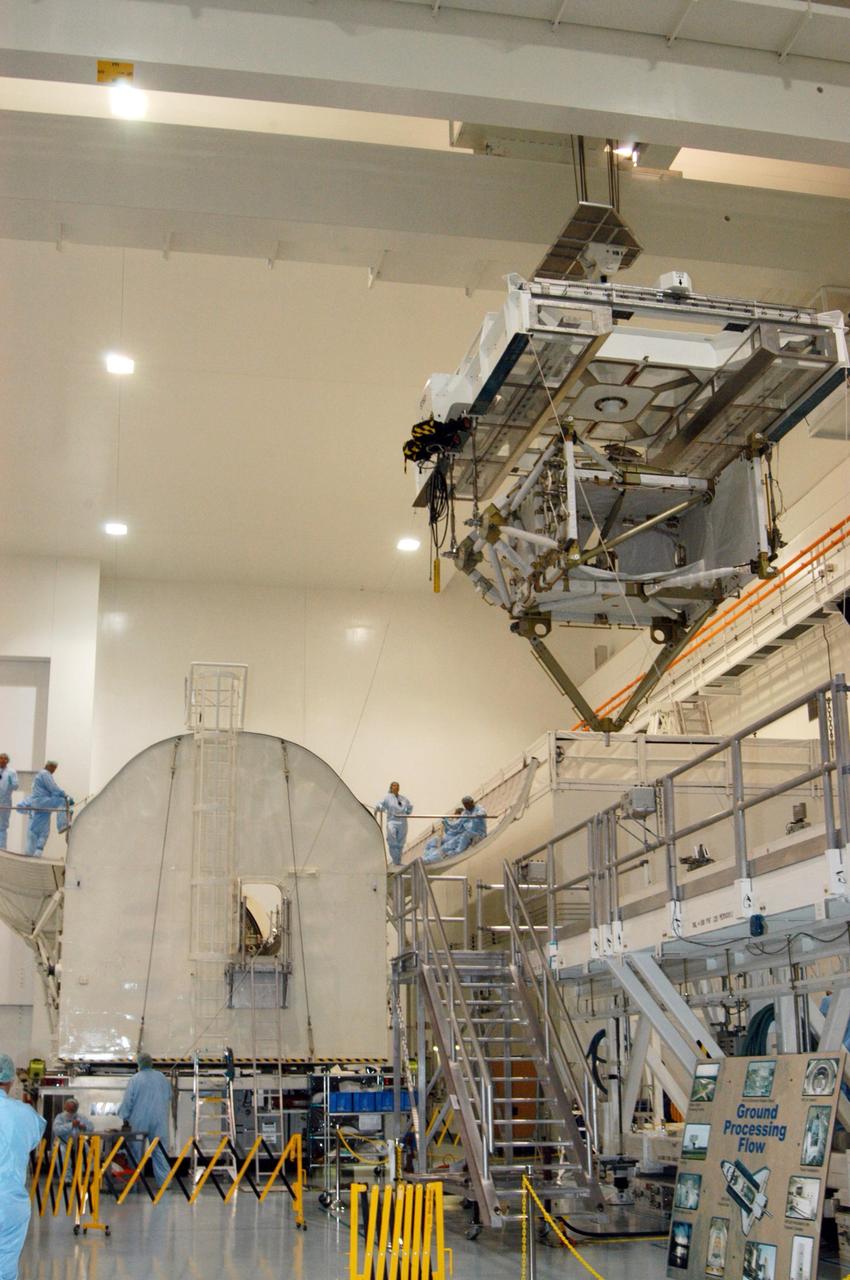
KENNEDY SPACE CENTER, FLA. -- In the Space Station Processing Facility, the P5 truss for mission STS-116 moves closer to the payload canister (left). The canister will transport the truss to Launch Pad 39B where it will wait for installation in Space Shuttle Discovery’s payload bay. The third port truss segment, the P5 will be attached to the P3/P4 truss on the International Space Station during the 11-day mission. The window for launch of mission STS-116 opens Dec. 7. Photo credit: NASA/George Shelton
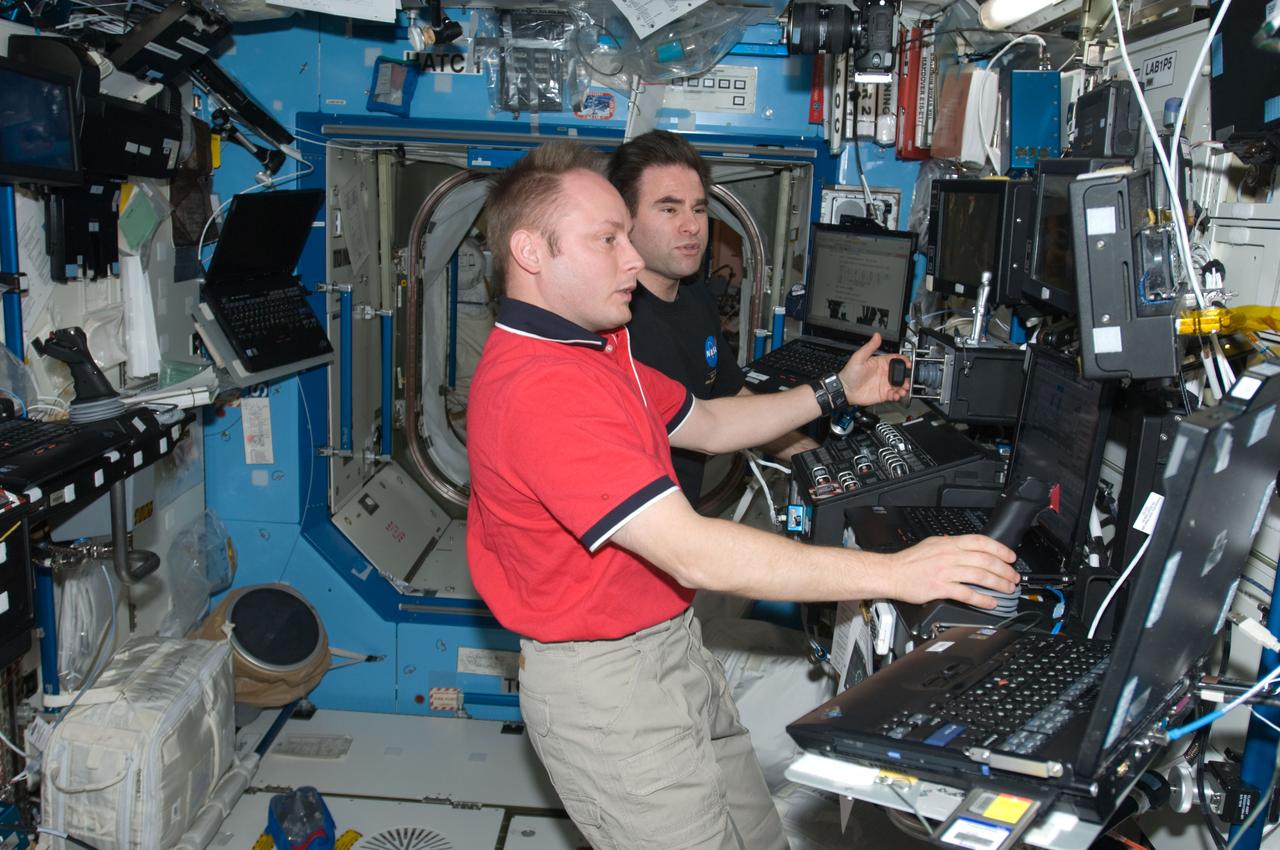
ISS018-E-007817 (5 Nov. 2008) --- Astronauts Michael Fincke (foreground) and Greg Chamitoff, Expedition 18 commander and flight engineer, respectively, work the controls of the Canadarm2 robotic work station in the Destiny laboratory of the International Space Station. Fincke and Chamitoff grappled the External Stowage Platform-3 on the P3 truss and relocated it to a capture attachment mechanism on the Mobile Base System.
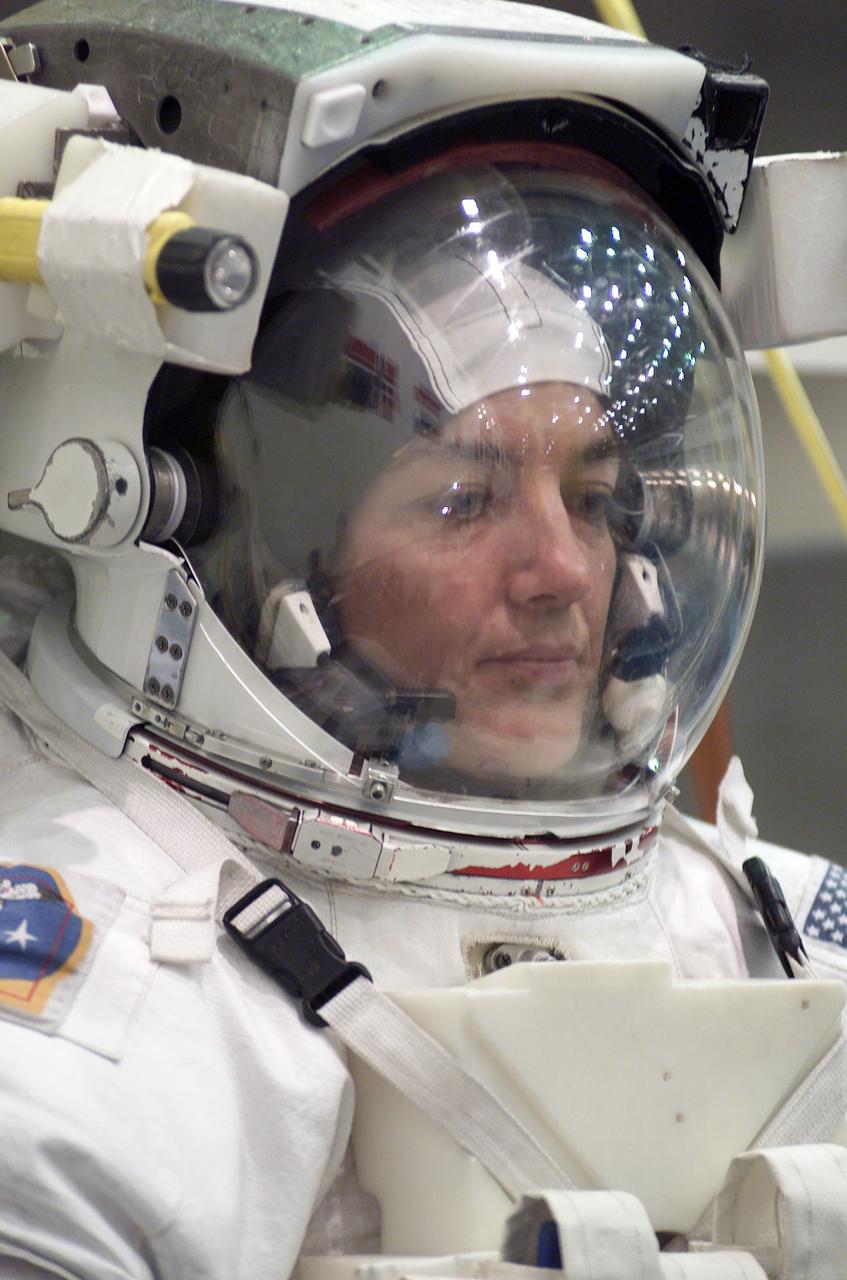
Attired in a training version of the Extravehicular Mobility Unit (EMU) space suit, STS-115 astronaut and mission specialist, Heidemarie M. Stefanyshyn-Piper, is about to begin a training session in the Neutral Buoyancy Laboratory (NBL) near Johnson Space Center in preparation for the STS-115 mission. Launched on September 9, 2006, the STS-115 mission continued assembly of the International Space Station (ISS) with the installation of the truss segments P3 and P4.
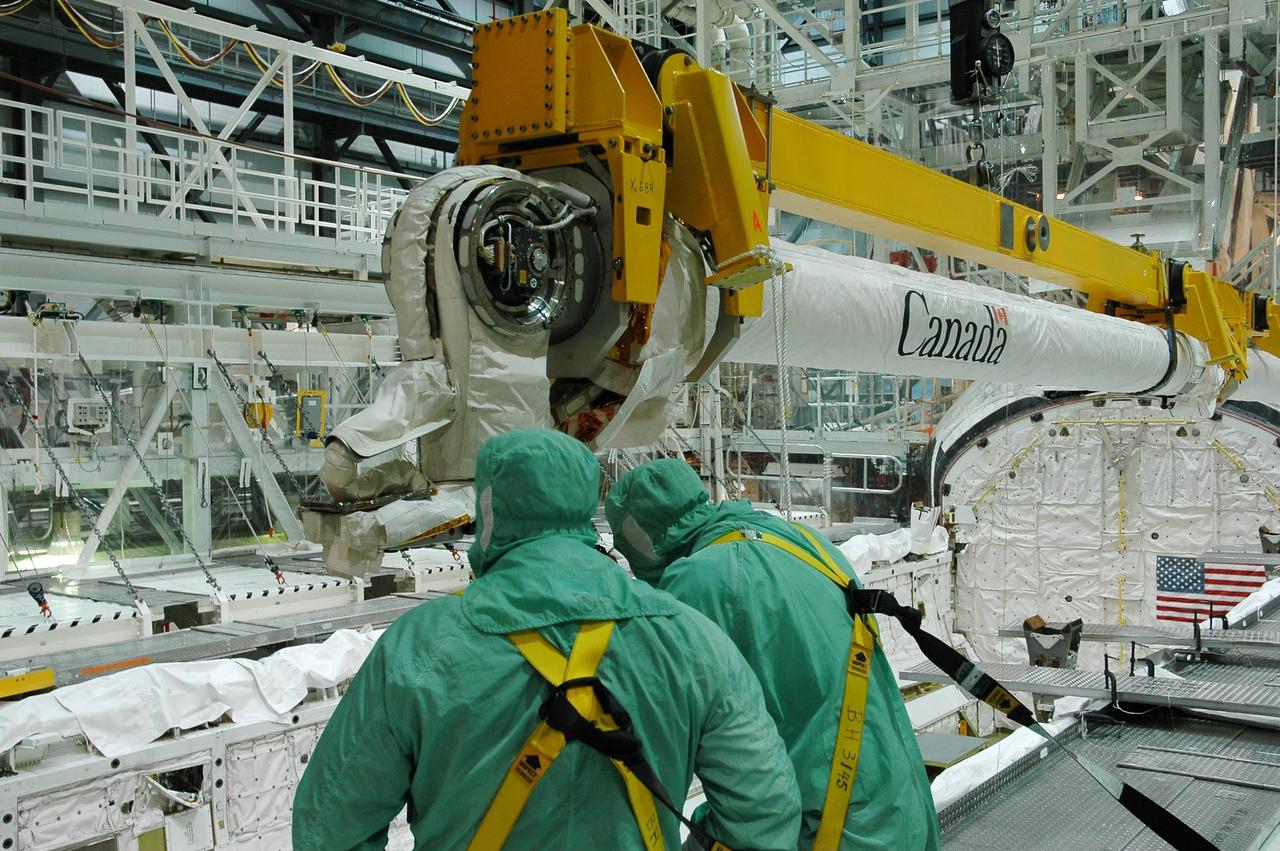
KENNEDY SPACE CENTER, FLA. - In the Orbiter Processing Facility bay 1 at NASA Kennedy Space Center, the remote manipulator system, or boom, is lowered into Atlantis’ payload bay for installation. Atlantis is the designated orbiter for mission STS-115, the 19th assembly flight to the International Space Station. The payload includes the P3/P4 solar arrays. The launch planning window has not been determined yet for STS-115.
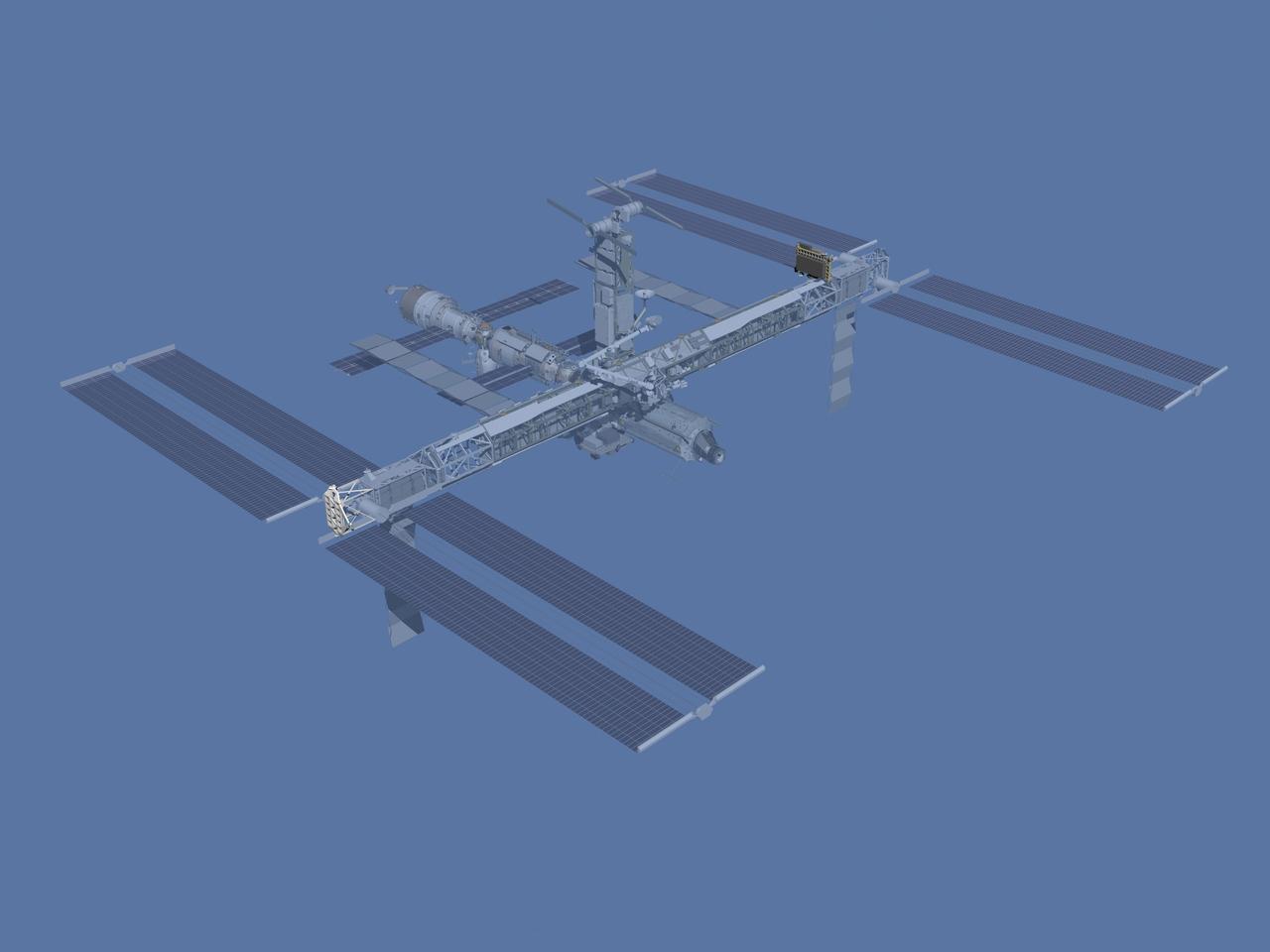
JSC2006-E-43502 (October 2006) --- Computer-generated artist's rendering of the International Space Station after flight STS-118/13A.1. Third starboard truss segment (S5) is delivered and installed. External Stowage Platform 3 (ESP3) is installed on top of the P3 truss segment. Pressurized Mating Adapter-3 (PMA-3) moves to Unity node nadir port.
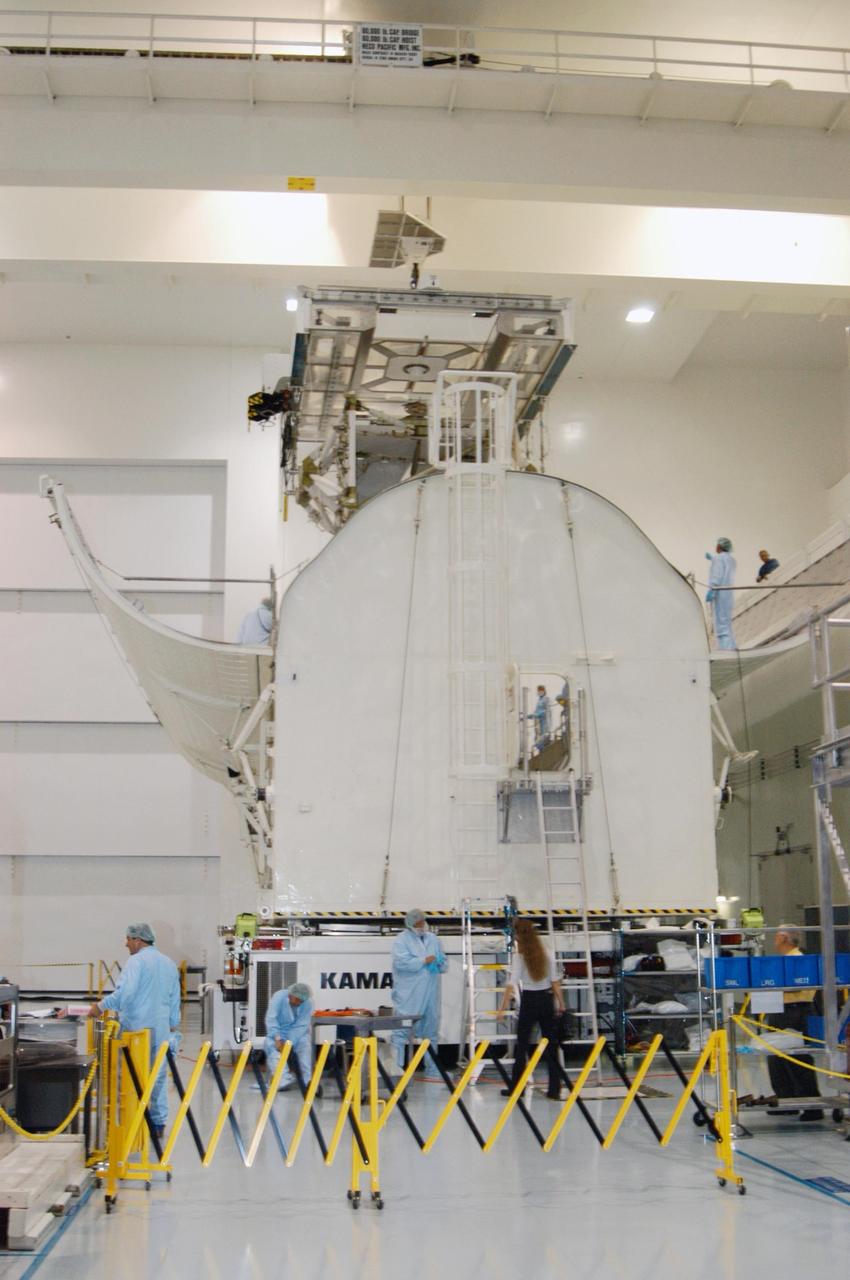
KENNEDY SPACE CENTER, FLA. -- In the Space Station Processing Facility, the P5 truss for mission STS-116 is lowered into the payload canister. The canister will transport the truss to Launch Pad 39B where it will wait for installation in Space Shuttle Discovery’s payload bay. The third port truss segment, the P5 will be attached to the P3/P4 truss on the International Space Station during the 11-day mission. The window for launch of mission STS-116 opens Dec. 7. Photo credit: NASA/George Shelton
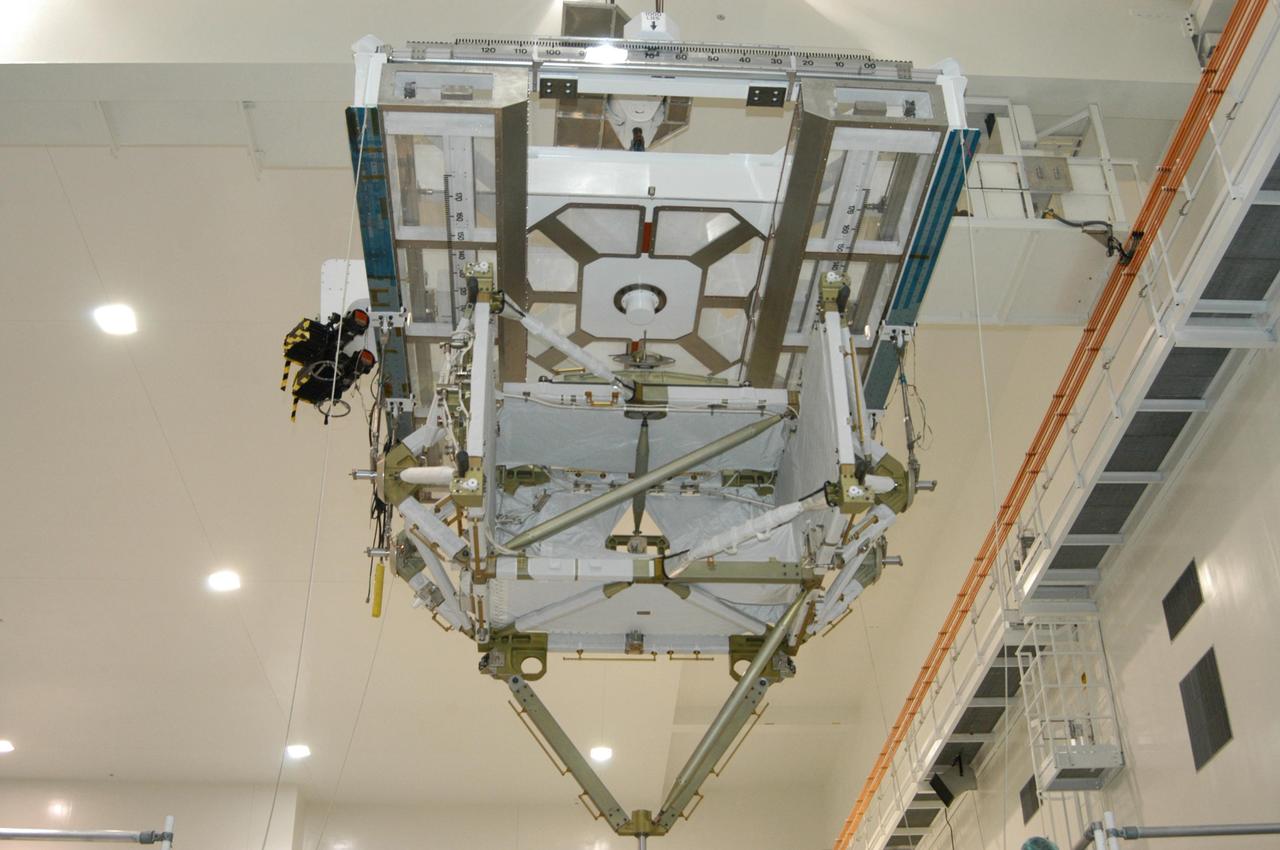
KENNEDY SPACE CENTER, FLA. -- In the Space Station Processing Facility, an overhead crane moves the P5 truss for mission STS-116 to the payload canister. The truss will be transported to Launch Pad 39B where it will wait for installation in Space Shuttle Discovery’s payload bay. The third port truss segment, the P5 will be attached to the P3/P4 truss on the International Space Station during the 11-day mission. The window for launch of mission STS-116 opens Dec. 7. Photo credit: NASA/George Shelton
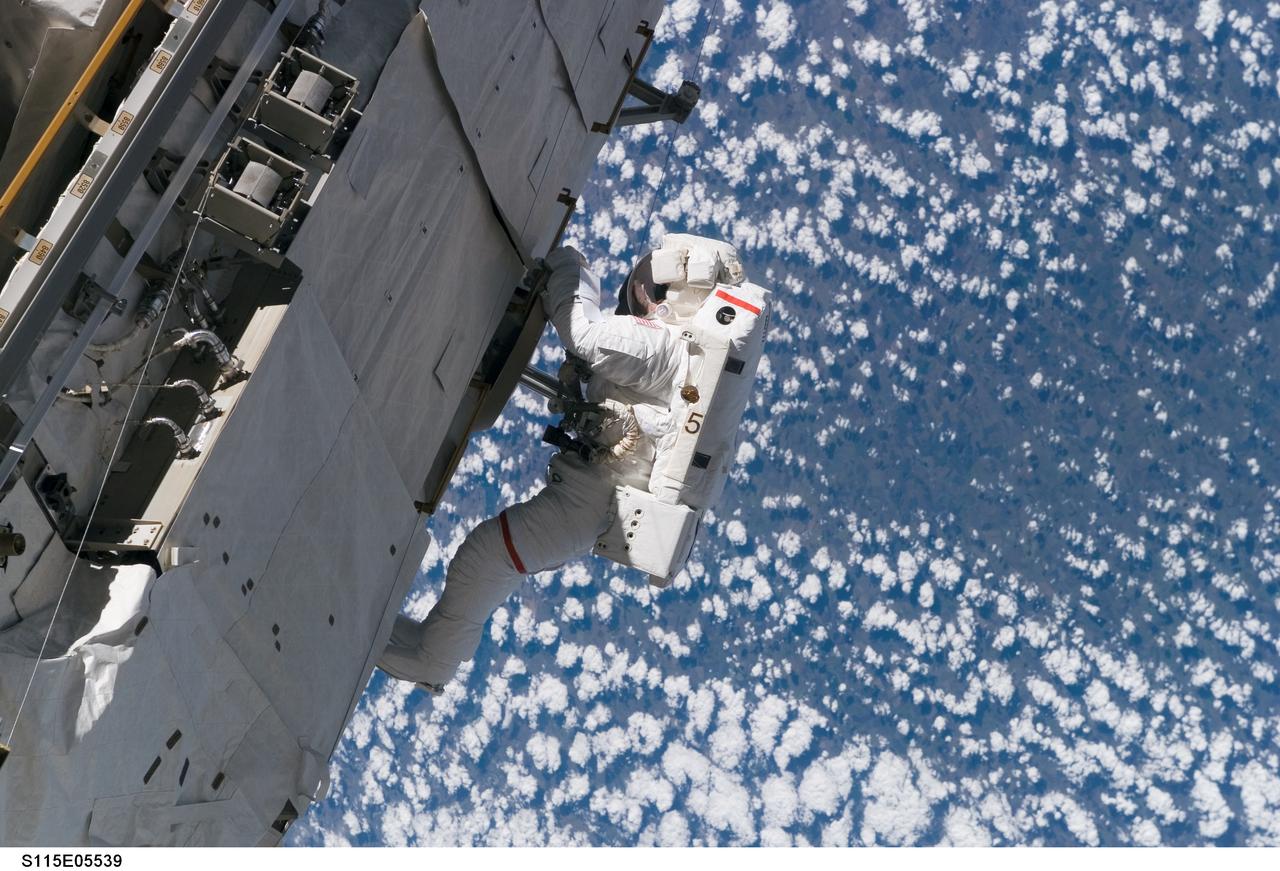
S115-E-05539 (12 Sept. 2006) --- It was "installation day" on the International Space Station on Sept. 12, 2006. The Atlantis and Expedition 13 crews worked on attaching the P3/P4 truss during the first of three scheduled spacewalks by STS-115 shuttle crew members. Astronaut Joseph R. Tanner, mission specialist, pictured as he translated along the station hardware, was joined by astronaut Heidemarie M. Stefanyshyn-Piper, mission specialist.

KENNEDY SPACE CENTER, FLA. - STS-115 Mission Specialist Steven MacLean looks over part of the mission payload in the Space Station Processing Facility during Crew Equipment Interface Test activities. MacLean is with the Canadian Space Agency. The mission will deliver the second port truss segment, the P3/P4 Truss, to attach to the first port truss segment, the P1 Truss, as well as deploy solar array set 2A and 4A. Launch on Space Shuttle Endeavour is scheduled for May 23, 2003.

KENNEDY SPACE CENTER, FLA. - STS-115 Mission Specialist Joseph Tanner (center) works a piece of equipment during Crew Equipment Interface Test activities in the Space Station Processing Facility. On the right is Mission Specialist Heidemarie Stefanyshyn-Piper. The mission will deliver the second port truss segment, the P3/P4 Truss, to attach to the first port truss segment, the P1 Truss, as well as deploy solar array set 2A and 4A. Launch on Space Shuttle Endeavour is scheduled for May 23, 2003.
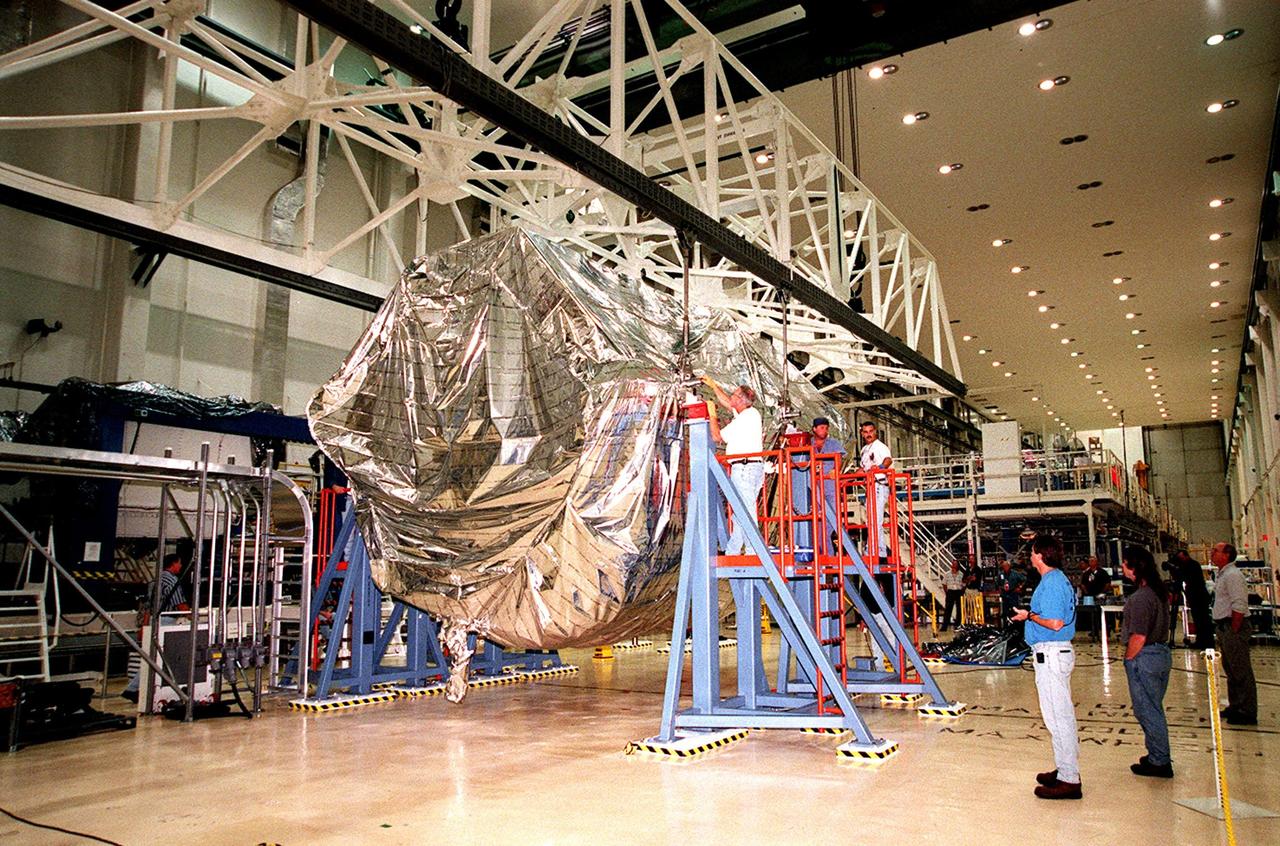
KENNEDY SPACE CENTER, FLA. -- Workers adjust connection of the port-side P3 truss on its workstand in the Operations and Checkout Building. The truss is a segment of the International Space Station (ISS), the second port truss segment, that will be attached to the first port truss segment (P1). The truss is scheduled to be added to the ISS on mission STS-115 in 2002 aboard Space Shuttle Atlantis.
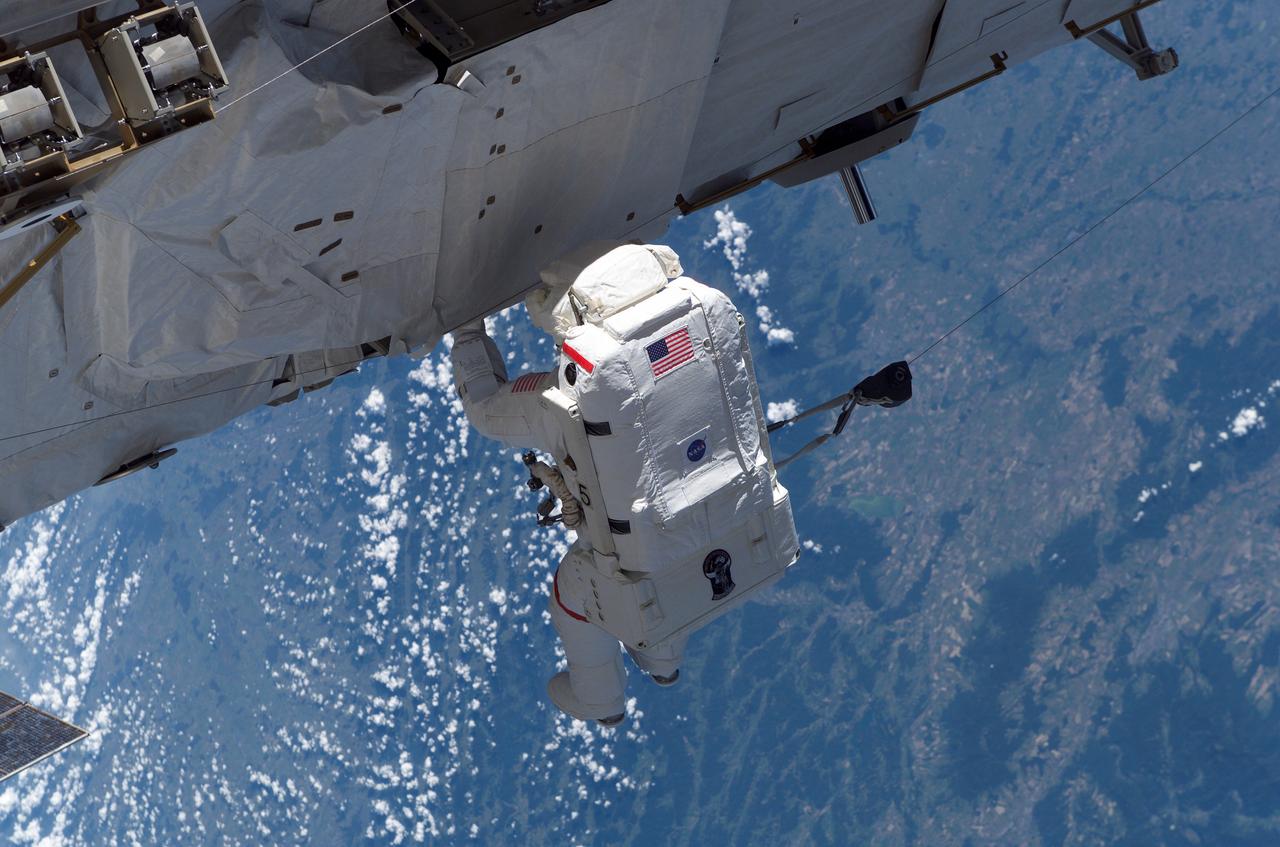
S115-E-05532 (12 Sept. 2006) --- It was "installation day" on the International Space Station on Sept. 12, 2006. The Atlantis and Expedition 13 crews worked on attaching the P3/P4 truss during the first of three scheduled spacewalks by STS-115 shuttle crewmembers. Astronaut Joseph R. Tanner, mission specialist, pictured as he translated along the station hardware, was joined by astronaut Heidemarie M. Stefanyshyn-Piper, mission specialist.
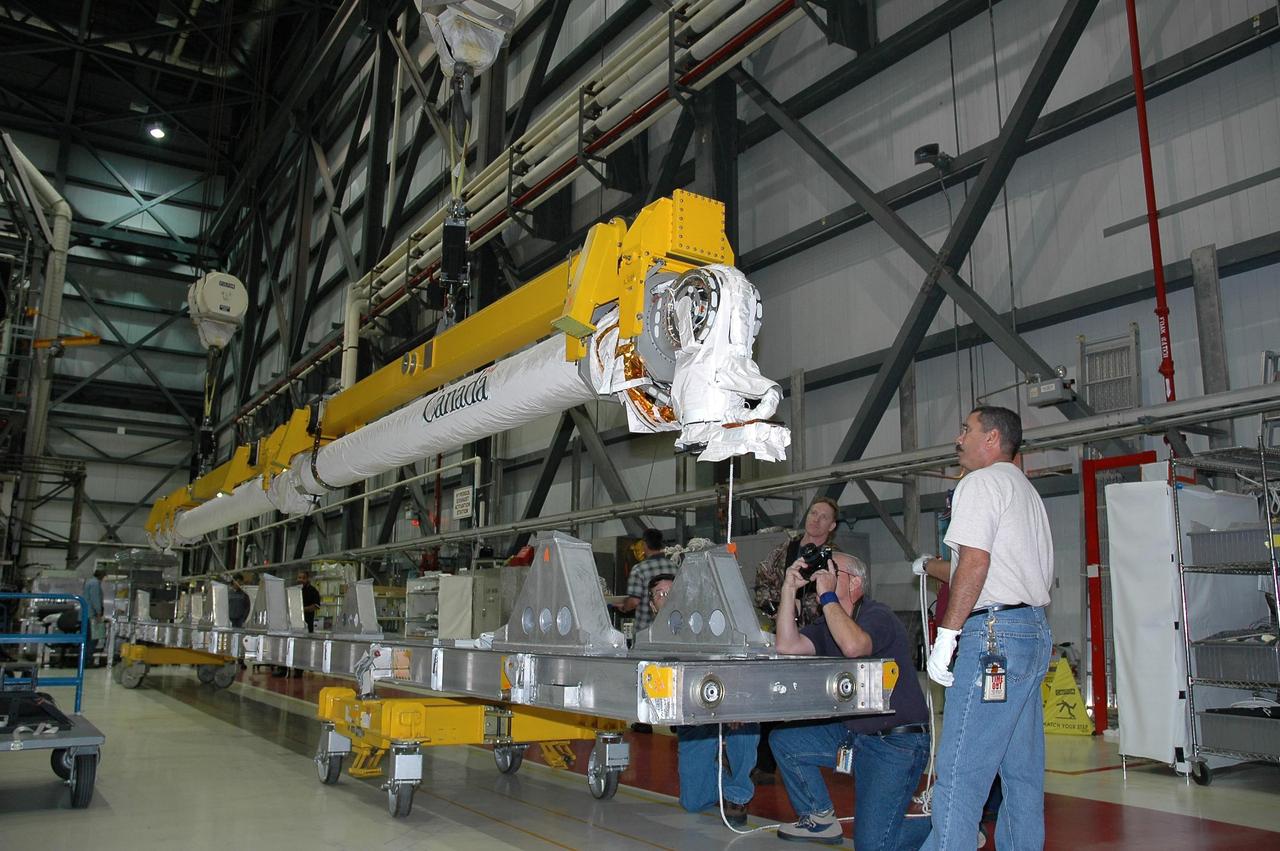
KENNEDY SPACE CENTER, FLA. - In the Orbiter Processing Facility bay 1 at NASA Kennedy Space Center, the remote manipulator system, or boom, is lifted off a stand via overhead cranes. The boom will be installed in Atlantis’ payload bay. Atlantis is the designated orbiter for mission STS-115, the 19th assembly flight to the International Space Station. The payload includes the P3/P4 solar arrays. The launch planning window has not been determined yet for STS-115.
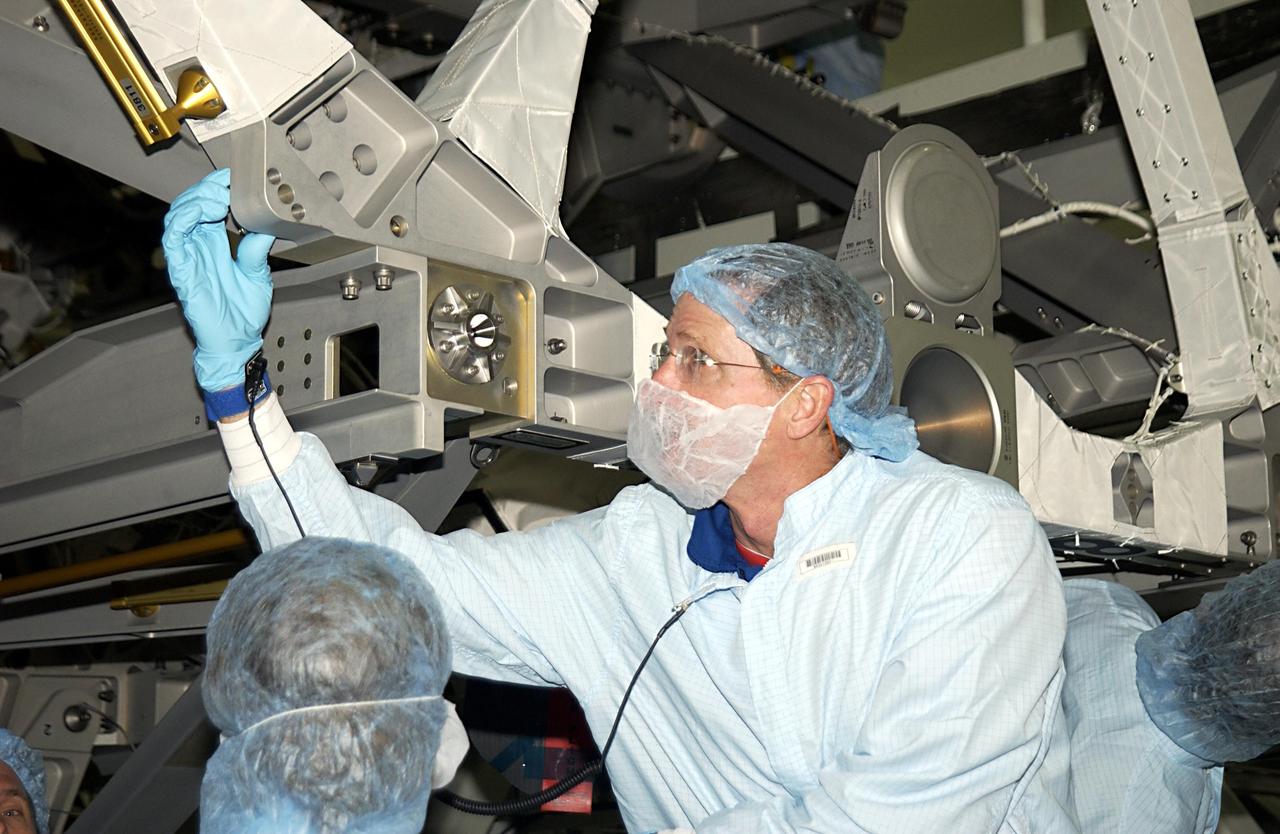
KENNEDY SPACE CENTER, FLA. - Members of the STS-115 crew take part in Crew Equipment Interface Test activities in the Space Station Processing Facility. Checking out part of the payload is Mission Specialist Joseph Tanner. The mission will deliver the second port truss segment, the P3/P4 Truss, to attach to the first port truss segment, the P1 Truss, as well as deploy solar array set 2A and 4A. Launch on Space Shuttle Endeavour is scheduled for May 23, 2003.
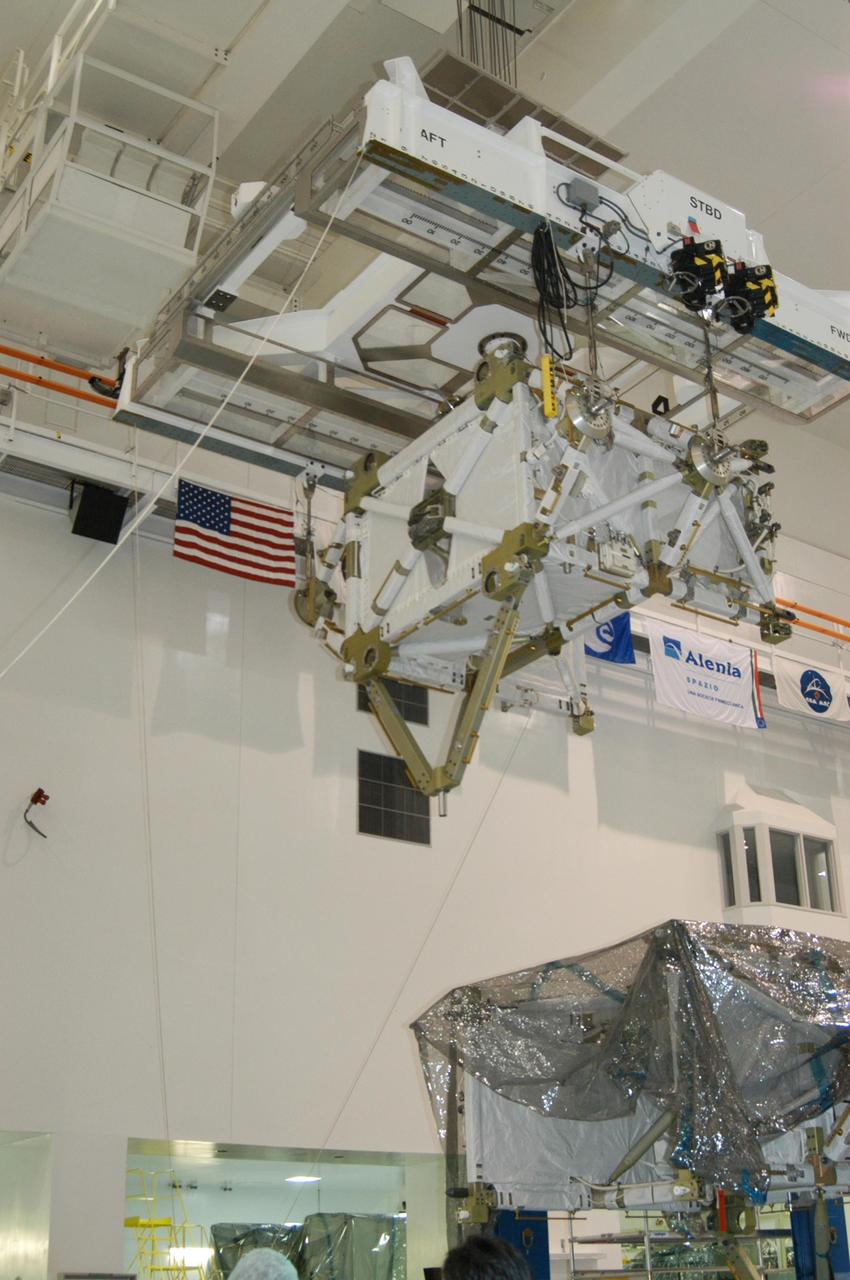
KENNEDY SPACE CENTER, FLA. -- In the Space Station Processing Facility, an overhead crane moves the P5 truss for mission STS-116 to the payload canister. The truss will be transported to Launch Pad 39B where it will wait for installation in Space Shuttle Discovery’s payload bay. The third port truss segment, the P5 will be attached to the P3/P4 truss on the International Space Station during the 11-day mission. The window for launch of mission STS-116 opens Dec. 7. Photo credit: NASA/George Shelton
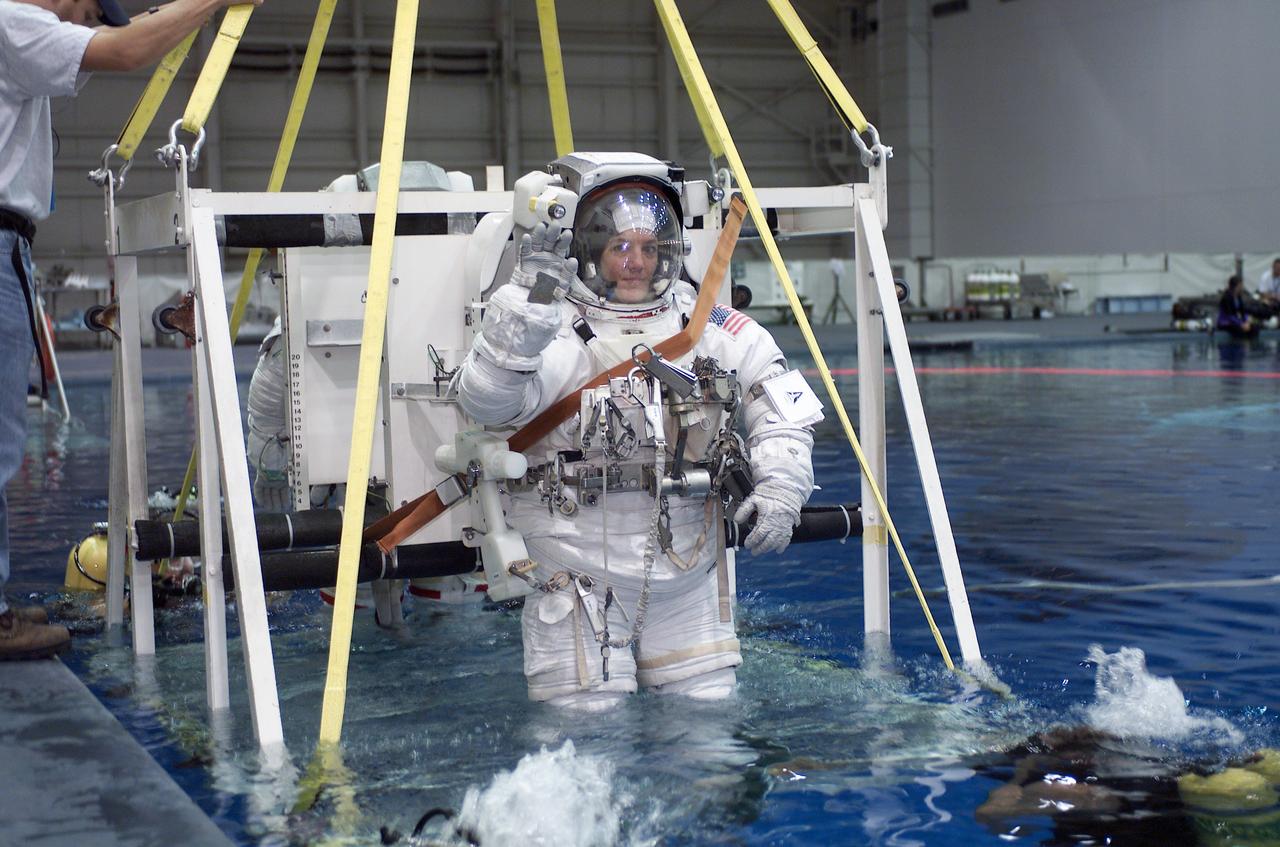
Attired in a training version of the Extravehicular Mobility Unit (EMU) space suit, STS-115 astronaut and mission specialist, Heidemarie M. Stefanyshyn-Piper, is submerged into the waters of the Neutral Buoyancy Laboratory (NBL) near Johnson Space Center for training in preparation for the STS-115 mission. Launched on September 9, 2006, the STS-115 mission continued assembly of the International Space Station (ISS) with the installation of the truss segments P3 and P4.
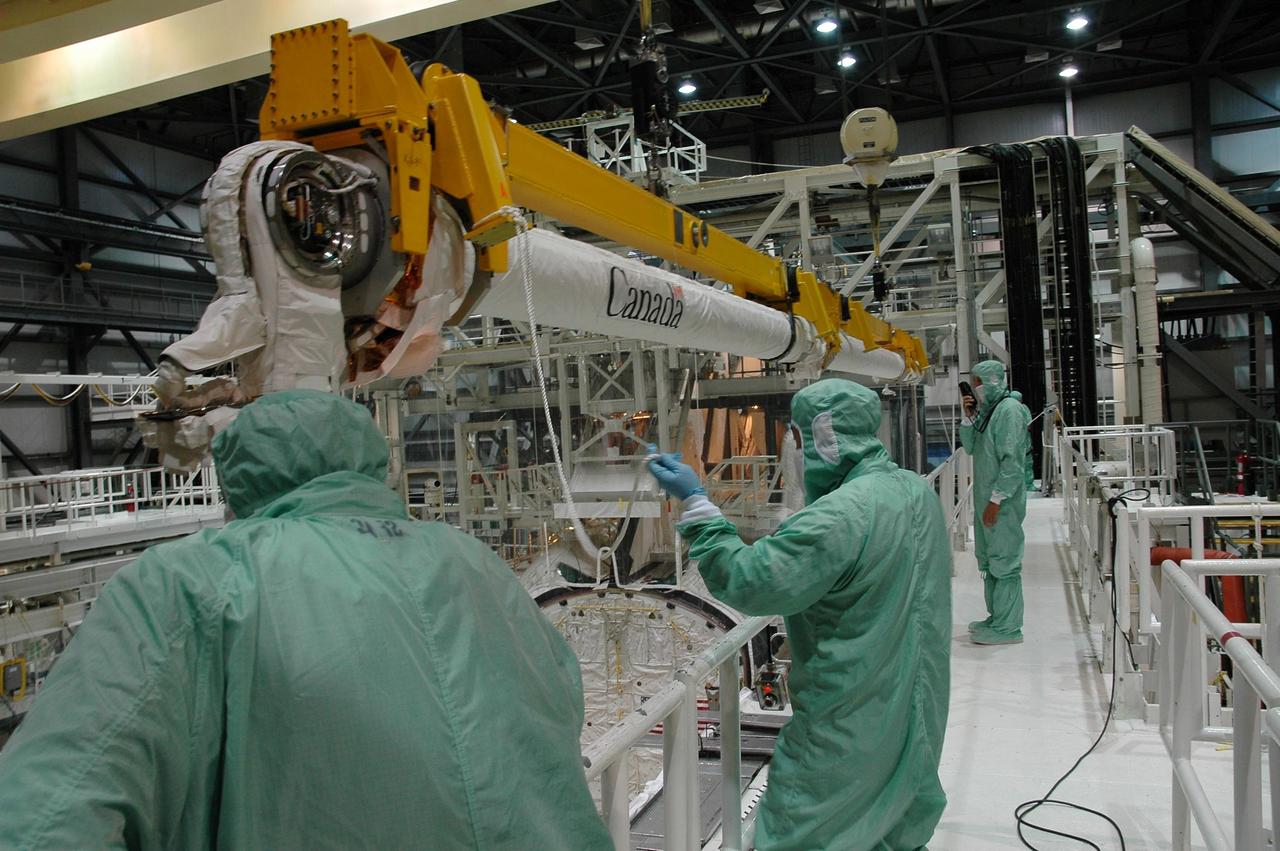
KENNEDY SPACE CENTER, FLA. - In the Orbiter Processing Facility bay 1 at NASA Kennedy Space Center, engineers stand by as the remote manipulator system, or boom, is lowered toward Atlantis’ payload bay for installation. Atlantis is the designated orbiter for mission STS-115, the 19th assembly flight to the International Space Station. The payload includes the P3/P4 solar arrays. The launch planning window has not been determined yet for STS-115.
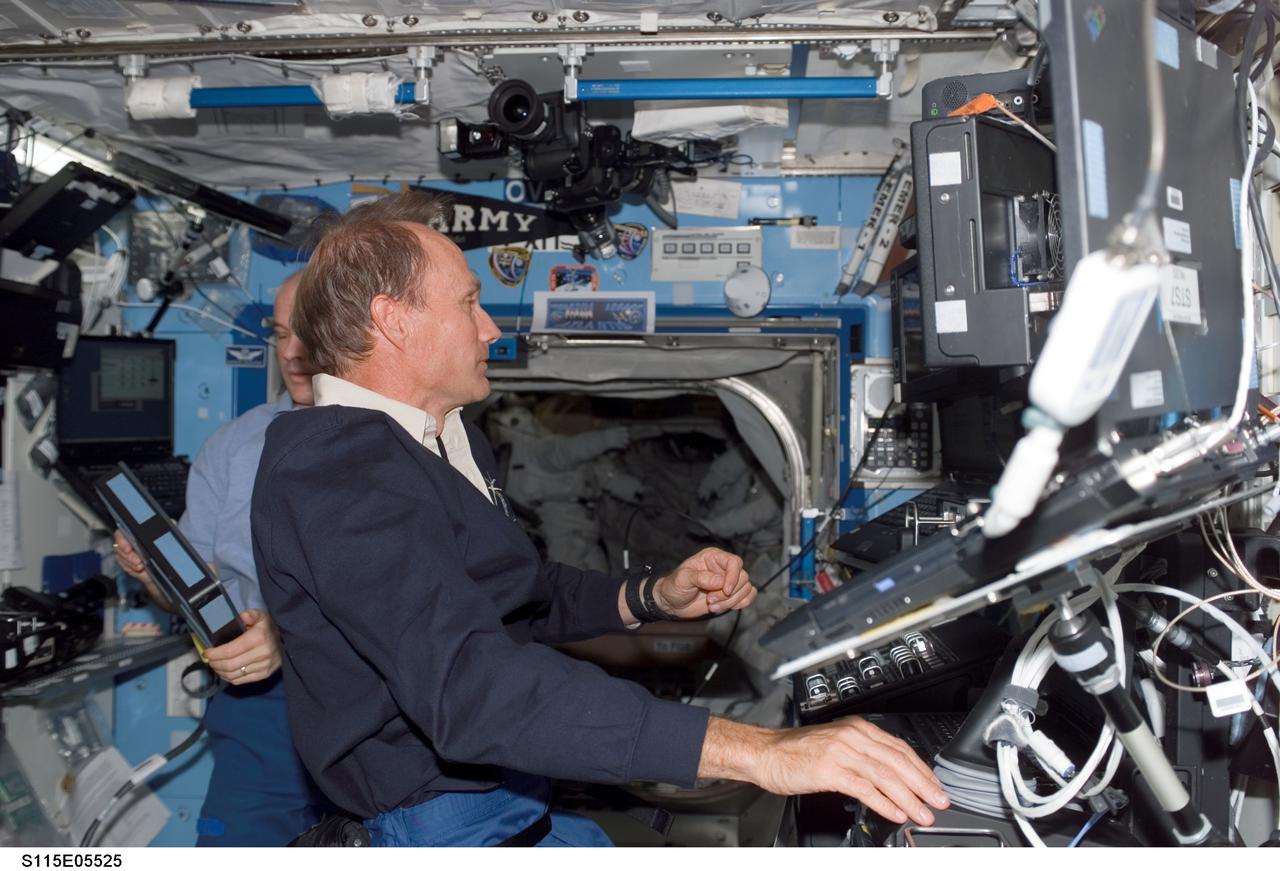
View of Astronauts Steve MacLean, Canadian Space Agency (CSA), Mission Specialist (MS), and Jeffrey N. Williams, Expedition 13 Flight Engineer (FE) and NASA Space Station Science Officer working at the Space Stations Robotic Arm to slowly move the 17 and a half ton P3/P4 truss to the port side of the Integrated Truss System. They will align it using a television camera and then mate it to the P1. Photo was taken in the U.S. Laboratory/Destiny during Expedition 13 / STS-115 joint operations.